Best Cleaver Knives for Heavy-Duty Chopping

Why a Dedicated Cleaver Matters
Anyone who has tried to break down a whole chicken with a slim gyuto or push a paring knife through a rack of ribs knows the frustration immediately. Thin, delicate blades are built for finesse, not force, and asking them to do a cleaver’s job usually ends with a chipped edge, a bent tip, or a badly mangled cut of meat. A dedicated cleaver knife solves this problem by putting weight, geometry, and steel thickness exactly where you need it: directly behind the edge, distributed across a wide, rectangular blade that can absorb repeated impact without flexing or folding.
Cleavers occupy a strange middle ground in most home kitchens. They look intimidating, they get associated almost exclusively with butcher shops, and a lot of cooks simply never consider owning one. But once you’ve used a proper heavy-duty cleaver to break down a chicken carcass in four clean strokes, or split a butternut squash without wrestling it off the cutting board, it becomes obvious how much time and effort a good cleaver saves. This is not a niche tool reserved for professional butchers; it is one of the most versatile blades you can add to a kitchen, capable of chopping through joints and small bones, crushing garlic, scooping diced vegetables off the board, and even standing in as an improvised rolling pin in a pinch.
There is also an important distinction between a true meat cleaver and the thinner “vegetable cleavers” (sometimes called Chinese chef’s knives or caidao) that share the same rectangular silhouette but are built for a completely different job. Heavy-duty meat cleavers are thick, blunt-edged, and heavy near the spine so they can chop through cartilage and small bones. Vegetable cleavers are thinner, lighter, and sharpened more acutely for fast, precise vegetable prep. Confusing the two is one of the most common and costly mistakes buyers make, and we’ll flag which category each knife on this list belongs to as we go.
If you already own a full lineup of Western or Japanese knives, you might be wondering how a cleaver fits into that collection. It pairs particularly well with knives built for controlled push cuts, and if you’re still building out your kitchen roster it’s worth reading our breakdown of chef’s knife versus santoku cutting styles to understand where a cleaver’s chopping motion differs from either. For readers coming from a more general “which knives do I actually need” mindset, our guide to three blades that can replace a full knife block is a useful companion read, since a cleaver is often the fourth tool that rounds out that minimalist setup.
In this guide we tested and researched twelve of the most popular cleaver knives on the market today, ranging from budget-friendly stamped blades under thirty dollars to hand-forged premium options that cost several times that. We’ll walk through the construction, steel, handle ergonomics, and best use case for each one, then wrap up with a full comparison table, a maintenance section, and answers to the most common questions buyers have before pulling the trigger on a purchase.
How to Choose the Right Cleaver for Your Kitchen
Not every cleaver is built the same way, and picking the wrong one for your intended use is the single biggest source of buyer’s remorse in this category. Before diving into individual reviews, it helps to understand the handful of variables that actually separate a great cleaver from a mediocre one.
Blade Thickness and Weight
Thickness is the defining trait of a meat cleaver. A true heavy-duty chopper typically measures somewhere between 3mm and 5mm at the spine, giving it enough mass to power through cartilage, poultry joints, and small bones without the edge rolling or chipping. Vegetable-focused cleavers, by contrast, are usually thinner, often closer to 2mm, trading chopping power for speed and precision on produce. If your primary goal is breaking down whole chickens, splitting lobster shells, or portioning ribs, prioritize a thicker, heavier blade. If you mainly want a wide blade for fast vegetable prep and scooping ingredients off the board, a lighter vegetable cleaver will feel far more comfortable over a long prep session.
Steel Type and Edge Retention
Cleaver steels generally fall into two camps: high-carbon stainless steels that balance rust resistance with reasonable edge retention, and higher-carbon or specialty alloys that hold an edge longer but demand more maintenance. Budget cleavers often use steels in the 3Cr13 to 5Cr15MoV family, which sharpen easily but dull faster under heavy bone contact. Mid-range and premium options move into German-style steels like X50CrMoV15 or Japanese-influenced high-carbon blends that hold an edge considerably longer. If you’re unfamiliar with how these steel families stack up, our comparisons of D2 versus 8Cr13MoV and VG-10 versus AUS-10 break down the tradeoffs between edge retention, toughness, and ease of sharpening in accessible terms, and the same principles apply directly to kitchen cleaver steels.
Handle Material and Balance
Because cleavers are heavier than most kitchen knives, handle comfort matters enormously. Full-tang construction with secure pinned or bolted scales tends to offer the best balance and the least fatigue during extended use, while cheaper stamped cleavers with a partial tang can feel front-heavy and awkward. Composite handles like Fibrox or POM resist moisture and are dishwasher-friendlier, while wood handles look beautiful but require more diligent drying and occasional oiling.
Bevel Geometry
Meat cleavers typically use a wider bevel angle, often 20 to 25 degrees per side, to protect the edge from chipping when it meets bone. Vegetable cleavers are ground much thinner, closer to 12 to 15 degrees per side, for cleaner slices through produce. If you’re curious how bevel count affects performance more broadly, our explainer on single bevel versus double bevel knives covers the fundamentals, though nearly every cleaver on this list uses a double bevel for durability and ease of home sharpening.
Size
Cleaver blade length generally runs from 6 to 9 inches. Smaller 6-inch blades are more maneuverable and better suited to smaller hands or lighter-duty tasks, while 7 to 9-inch blades give you more surface area for scooping and more momentum for tougher chopping jobs. Consider your storage space too, since a full-size cleaver takes up considerably more room in a drawer or block than a standard chef’s knife.
1. PAUDIN Cleaver Knife 7 Inch

PAUDIN has built a reputation for offering genuinely usable kitchen knives at prices that undercut most of the competition, and their 7-inch cleaver is a good example of that value proposition in action. The blade is forged from high-carbon German steel and runs through a full-tang construction, which immediately puts it a step above the stamped, partial-tang cleavers that dominate the budget end of the market. That extra mass in the tang shifts the balance point closer to the bolster, so the knife doesn’t feel front-heavy even during longer chopping sessions.
The 7-inch blade sits in a comfortable middle ground: wide enough to double as a bench scraper for transferring diced vegetables into a pan, but not so oversized that it becomes unwieldy for home cooks used to a standard chef’s knife. The edge comes reasonably sharp out of the box and holds up well to everyday vegetable prep, garlic crushing, and light poultry work, though like most cleavers in this price range it’s best kept away from thick beef or pork bones.
The ergonomic pakkawood-style handle is triple-riveted, which is a small but meaningful detail at this price point since it signals the manufacturer invested in a handle that won’t loosen over time. Anyone comparing budget-friendly steels across brands might also find our breakdown of whether Paudin knives are actually good useful context before buying, since it digs into how the brand’s steel and construction choices hold up against pricier competitors.
Pros
- Excellent value for a full-tang, forged cleaver
- Comfortable, well-balanced handle
- Versatile for both vegetables and light poultry
Cons
- Not rated for thick bones or heavy cartilage
- Requires more frequent honing than premium steels
PAUDIN Cleaver Knife 7 Inch — a budget-friendly, full-tang everyday cleaver.
Check Price on Amazon2. Dalstrong Gladiator Series 9″ “The Obliterator”

If sheer chopping authority is what you’re after, Dalstrong’s aptly-named “Obliterator” is built specifically for that job. This is a full-size, 9-inch heavy-duty cleaver forged from high-carbon German steel and hardened to a level that supports genuine bone-chopping work, not just the light poultry duty that smaller cleavers are limited to. The blade geometry is noticeably thicker near the spine than most of the other cleavers on this list, giving it the mass to drive through rib sections, chicken joints, and thick cartilage with a single confident stroke.
Dalstrong’s Gladiator Series is known for its aggressive, almost tactical aesthetic, and the Obliterator doesn’t shy away from that identity. The G10 handle material is the same tough, moisture-resistant composite used in many outdoor and tactical knives, chosen here specifically because a cleaver’s handle takes a beating from repeated impact forces that a chef’s knife never experiences. The handle is contoured with a pronounced finger guard, which matters more than it might seem, since heavy chopping motions can cause your grip hand to slide forward toward the blade if the guard geometry is flat.
This is not a knife for delicate vegetable brunoise work; its whole design philosophy leans into raw power. For readers who want to understand how a heavy meat cleaver differs functionally from a lighter vegetable-oriented blade of similar shape, our comparison of meat versus vegetable cleaver thickness lays out exactly why a knife like the Obliterator behaves so differently from thinner Chinese-style choppers.
Pros
- True bone-chopping capability
- Aggressive, secure ergonomic handle
- Full tang with excellent balance for its size
Cons
- Large and heavy for smaller hands
- Overkill for light vegetable prep
Dalstrong Gladiator Series 9″ Obliterator — a serious bone-chopping heavy-duty cleaver.
Check Price on Amazon3. Dexter-Russell Traditional 8″ Heavy-Duty Cleaver (S5288)

Dexter-Russell has been supplying commercial kitchens and butcher shops with no-nonsense working knives for well over a century, and the S5288 traditional cleaver reflects exactly that heritage. This is a purely functional tool, stamped rather than forged, but stamped from thick high-carbon steel and tempered specifically for repeated impact rather than fine edge retention. It’s the kind of cleaver you’ll find hanging in real butcher shops, not because it’s flashy, but because it simply gets the job done shift after shift.
The 8-inch blade has a wide, flat profile that’s excellent for both bone chopping and for use as a scoop to transfer prepped ingredients. The polypropylene handle is textured for grip even when wet or greasy, which matters enormously in a cleaver’s typical use case of processing raw meat. It’s also NSF-certified and dishwasher safe, a detail that home cooks sometimes overlook but that speaks to how easy this knife is to keep sanitary during heavy use.
Because Dexter-Russell builds so many of its knives around this same no-frills, high-carbon steel philosophy, it’s worth reading our dedicated Dexter-Russell knives review if you’re considering building out a broader set from the brand, since the same handle material and heat treatment shows up across several of their most popular lines.
Pros
- Proven commercial-grade durability
- Textured, slip-resistant handle
- Excellent value for genuine heavy-duty use
Cons
- Basic, utilitarian appearance
- Stamped rather than forged construction
Dexter-Russell Traditional 8″ Heavy-Duty Cleaver — a commercial-grade workhorse.
Check Price on Amazon4. WÜSTHOF Classic 6″ Cleaver

WÜSTHOF’s Classic line needs little introduction among anyone who has spent time researching German cutlery, and the 6-inch cleaver applies the same precision forging process the brand is known for to a smaller, more maneuverable chopping blade. Made from a single piece of high-carbon stainless steel, the blade is precision-forged and features WÜSTHOF’s signature full bolster, which not only protects fingers but also adds balancing weight right where a cleaver benefits from it most.
At 6 inches, this cleaver sits on the smaller end of the spectrum, making it noticeably easier to control than the 8 and 9-inch options on this list. It’s an excellent choice for cooks who want cleaver functionality, like crushing garlic, portioning smaller cuts, and scooping vegetables, without committing to a full-size, heavy-duty bone chopper. WÜSTHOF’s Precision Edge Technology gives the blade a laser-controlled edge that’s noticeably sharper out of the box than most stamped competitors.
If you’re weighing WÜSTHOF against other premium German brands, our detailed comparison of Zwilling versus WÜSTHOF is a useful read, and readers specifically curious how this cleaver’s full-size chef’s knife sibling performs can check our WÜSTHOF Classic 8-inch chef’s knife review for a sense of how consistent the brand’s Classic line feels across different blade shapes.
Pros
- Precision forged, razor-sharp factory edge
- Full bolster adds balance and finger protection
- Easier to control than larger cleavers
Cons
- Premium price point
- Not sized for heavy bone-chopping tasks
WÜSTHOF Classic 6″ Cleaver — precision German forging in a compact package.
Check Price on Amazon5. Victorinox Fibrox Pro 7″ Kitchen Cleaver
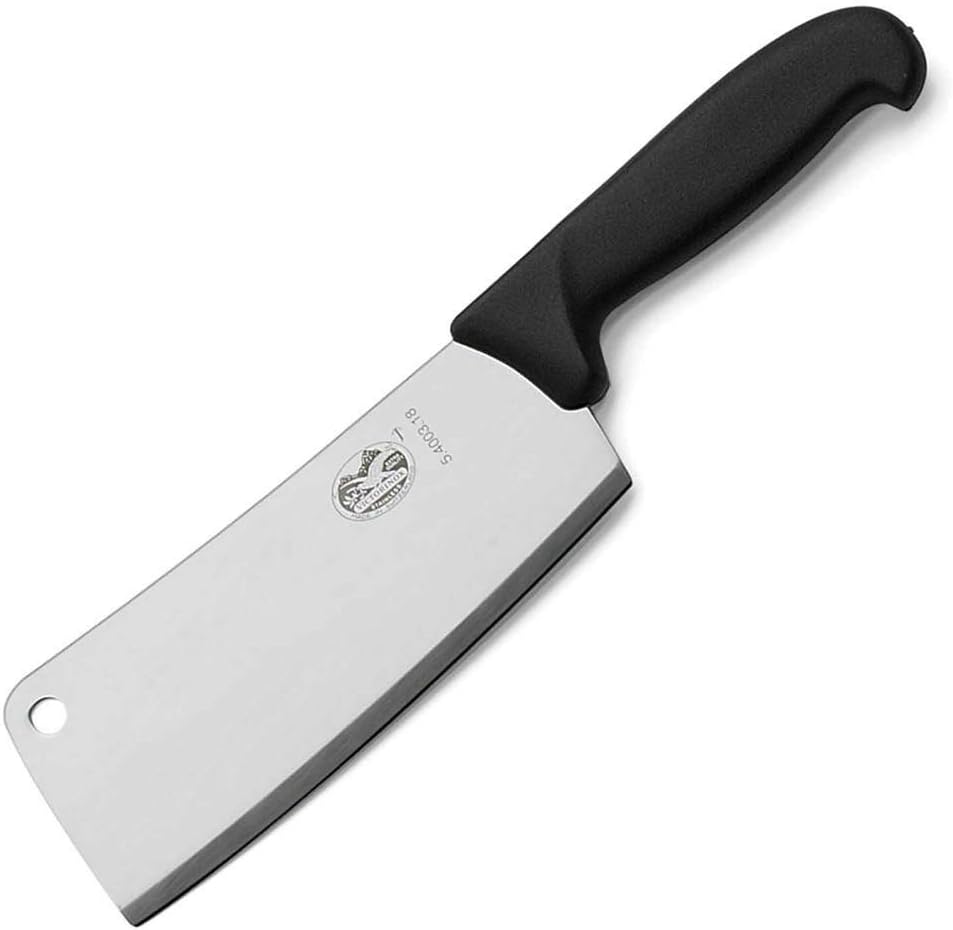
Victorinox’s Fibrox Pro line is a perennial recommendation across nearly every knife category because it delivers professional-grade steel and ergonomics without a professional-grade price tag, and the 7-inch meat cleaver continues that tradition. The blade uses Victorinox’s proprietary high-carbon stainless steel, which strikes a genuinely good balance between edge retention and ease of resharpening, an important trait for a knife that will regularly come into contact with bone and cartilage.
The Fibrox handle is the real star of this knife. It’s textured, non-slip even when covered in raw meat juices, and shaped with a slight taper that fits securely in the palm during forceful chopping strokes. Because the handle absorbs so much of the shock from repeated impact, hand fatigue is noticeably lower during extended butchering sessions compared to rigid wood or metal-handled alternatives. It’s also fully dishwasher safe, a genuine convenience for a knife that tends to get heavily soiled during use.
Victorinox knives show up throughout our other buying guides for good reason, including our Victorinox chef’s knife review and our head-to-head WÜSTHOF versus Victorinox comparison for heavy chopping, both of which reinforce how consistently strong the Fibrox Pro line performs against pricier competitors.
Pros
- Outstanding value relative to steel quality
- Non-slip Fibrox handle reduces fatigue
- Easy to resharpen at home
Cons
- Handle aesthetics are purely functional
- Not the heaviest option for large bones
Victorinox Fibrox Pro 7″ Kitchen Cleaver — professional steel, comfort-first handle.
Check Price on Amazon6. HENCKELS Statement Razor-Sharp 6-inch Meat Cleaver

HENCKELS’ Statement line is designed as an accessible entry point into the brand’s broader catalog, offering solid stainless steel construction and a genuinely comfortable handle at a price closer to budget cleavers than to the brand’s premium forged lines. The 6-inch blade is compact enough for easy storage and control, while still offering enough surface area to handle garlic crushing, poultry portioning, and general chopping duty.
The handle uses a modern, ergonomically contoured design made from a durable synthetic material, which resists moisture absorption far better than traditional wood and holds up well to dishwasher cycles despite HENCKELS generally recommending hand washing for longevity. The stainless steel blade resists staining and pitting even with frequent exposure to acidic ingredients like tomatoes or citrus, a detail that matters if your cleaver does double duty in vegetable prep as well as meat work.
Because HENCKELS and its parent brand Zwilling share overlapping design philosophies, readers comparing options within the same manufacturer family might find our Zwilling versus HENCKELS comparison helpful for understanding where the Statement line sits relative to the brand’s higher-end offerings, and our review of the HENCKELS Statement chef’s knife set gives a sense of how the rest of the line performs if you’re considering building out a matching set.
Pros
- Affordable entry into a trusted German brand
- Comfortable, modern ergonomic handle
- Stain and corrosion resistant steel
Cons
- Not designed for heavy bone chopping
- Hand washing recommended for longevity
HENCKELS Statement 6-inch Meat Cleaver — an accessible entry point into German steel.
Check Price on Amazon7. SHI BA ZI ZUO 8-inch Professional Cleaver

SHI BA ZI ZUO is a well-established Chinese cutlery brand with a long manufacturing history, and their 8-inch professional cleaver represents an authentic take on the traditional Chinese caidao shape rather than a Western reinterpretation of it. This distinction matters: the blade geometry, weight distribution, and edge angle are tuned specifically for the fast, rhythmic chopping and scooping motions that define Chinese knife technique, rather than the more static, deliberate strokes typical of Western meat cleavers.
The high-carbon stainless steel blade is thinner near the edge than the dedicated bone-choppers on this list, making it far better suited to vegetables, boneless proteins, and general prep than heavy bone work. Its wide profile still makes it superb for scooping and transferring ingredients, which is one of the traditional caidao’s defining strengths. The wood-accented handle offers a classic aesthetic while remaining functional and grippy in daily use.
For cooks trying to understand exactly how this style of vegetable-forward cleaver differs from a Western nakiri or santoku, our comparison of santoku versus nakiri for vegetable prep offers useful context, since the caidao occupies a similar functional niche despite its very different silhouette.
Pros
- Authentic caidao geometry for fast vegetable prep
- Excellent scooping and transferring capability
- Attractive traditional handle design
Cons
- Not built for heavy bone chopping
- Thinner edge requires more careful use
SHI BA ZI ZUO 8-inch Professional Cleaver — authentic Chinese vegetable-cleaver design.
Check Price on Amazon8. HEZHEN 7″ Cleaver Knife

HEZHEN has built a strong following among enthusiasts who want visually striking, high-performance kitchen knives, and the 7-inch cleaver is one of the brand’s most eye-catching offerings. Many versions of this knife feature a Damascus-patterned steel construction, layering a harder core steel between softer outer layers to combine edge retention with toughness, along with the rippled visual pattern that Damascus steel is known for. If you’re unfamiliar with how this manufacturing process actually works and why it affects performance, our explainer on what Damascus steel is and how it’s made covers the fundamentals in plain language.
Beyond the aesthetics, the HEZHEN cleaver is a genuinely capable performer. The blade holds a fine edge well thanks to its layered core steel, and the ergonomic handle, typically crafted from stabilized wood, is shaped to sit comfortably in the palm during extended chopping sessions. It leans more toward the vegetable-cleaver end of the spectrum in terms of edge thinness, making it an excellent choice for cooks who want a showpiece knife that still earns its keep on prep duty rather than sitting in a display case.
If you’re building a broader appreciation for how forged, layered steel construction compares to simpler stamped blades, our guide on forged versus stamped knives offers a helpful framework for understanding why knives like this command a higher price than mass-produced alternatives.
Pros
- Striking Damascus-style visual pattern
- Excellent edge retention from layered steel
- Comfortable stabilized wood handle
Cons
- Higher price for the visual craftsmanship
- Best suited to vegetables over heavy bone work
HEZHEN 7″ Cleaver Knife — striking layered steel with genuine everyday performance.
Check Price on Amazon9. KYOKU Vegetable Cleaver Knife

KYOKU built its brand identity around Japanese-inspired blade design paired with more accessible pricing than boutique Japanese cutlery brands, and the vegetable cleaver in their lineup reflects that same philosophy. As the name signals, this is firmly a vegetable-focused chopper rather than a bone-cleaving tool, ground from high-carbon stainless steel to a thinner, more acute edge that excels at clean, precise cuts through produce.
The blade’s wide profile still delivers the classic cleaver advantage of scooping ingredients directly off the cutting board, and its lighter weight compared to true meat cleavers makes it noticeably less fatiguing during long vegetable-prep sessions like dicing large batches of onions or slicing through winter squash. The Pakkawood handle is a common feature across KYOKU’s lineup, prized for combining an attractive grain pattern with strong moisture resistance.
KYOKU’s approach to accessible Japanese-style cutlery pairs well with our broader coverage of vegetable-focused blade shapes, including our guide to the best nakiri knives for vegetable prep and our comparison of nakiri versus santoku for vegetable cutting, both of which help clarify where a vegetable cleaver like this one fits relative to more common Japanese vegetable knife shapes.
Pros
- Precise, thin edge for clean vegetable cuts
- Lighter weight reduces prep-session fatigue
- Attractive Pakkawood handle
Cons
- Not suitable for bone or heavy cartilage
- Thinner edge is more chip-prone if misused
KYOKU Vegetable Cleaver Knife — precise, Japanese-inspired vegetable chopping.
Check Price on Amazon10. Mueller 7-Inch Meat Cleaver Butcher Knife

Mueller has expanded well beyond its original kitchen appliance roots into cutlery, and its 7-inch meat cleaver targets home cooks who want genuine butcher-style chopping capability without paying professional-grade prices. The blade is stamped from high-carbon German steel and hardened for durability against the kind of repeated impact that meat cleavers regularly absorb, whether that’s breaking down a whole chicken or splitting through rib bones.
One of the more thoughtful design choices on this cleaver is its bolster-free, full-length blade profile, which maximizes usable cutting surface and makes the knife easier to sharpen evenly along its entire edge, since there’s no bolster interrupting the grind near the heel. The ergonomic handle uses a soft-touch composite material that stays secure in the hand even with wet or greasy grips, an important safety feature given how much force goes into typical cleaver strokes.
Buyers weighing this knife against other butcher-style cleavers on a tight budget might also want to check our guide to the best chef’s knives under $75 for heavy daily use, which covers the broader landscape of value-oriented knives built to handle serious kitchen workloads without premium pricing.
Pros
- Strong bone-chopping capability for the price
- Full-length blade simplifies sharpening
- Secure soft-touch handle grip
Cons
- Stamped construction feels lighter than forged rivals
- Edge retention trails premium steels
Mueller 7-Inch Meat Cleaver Butcher Knife — solid butcher-style chopping on a budget.
Check Price on Amazon11. HOSHANHO Cleaver Knife 7 Inch

HOSHANHO has quietly built a loyal following among online knife shoppers thanks to consistently strong reviews on its forged, high-carbon steel cutlery, and its 7-inch cleaver continues that pattern. The blade is hand-forged rather than stamped, and undergoes a multi-step heat treatment process intended to push hardness into a range that supports both a durable, chip-resistant edge and reasonably long edge retention between sharpenings.
This cleaver leans toward the all-purpose end of the spectrum, capable of handling boneless meat portioning, dense vegetables like squash and cabbage, and everyday mincing and dicing tasks without feeling underpowered or overly specialized. The full-tang construction and triple-riveted ergonomic handle contribute to a well-balanced feel that many reviewers compare favorably to knives costing significantly more.
Readers interested in how forged construction generally compares to mass-produced stamped alternatives, and why that difference actually matters for day-to-day performance rather than just marketing language, will find our guide on the difference between forging and stamping in knife making a useful companion piece before comparing HOSHANHO against other options on this list.
Pros
- Hand-forged construction at a competitive price
- Well-balanced, comfortable handle
- Versatile for both vegetables and boneless meat
Cons
- Not intended for heavy bone chopping
- Newer brand with a shorter track record
HOSHANHO Cleaver Knife 7 Inch — hand-forged, all-purpose everyday cleaver.
Check Price on Amazon12. imarku Cleaver Knife 7 Inch

imarku has become one of the more recognizable names in the affordable kitchen knife space, largely because its knives consistently punch above their price in terms of steel quality and finish. The 7-inch cleaver follows the same formula as the rest of the brand’s catalog: high-carbon German stainless steel, a full-tang build, and an ergonomic Pakkawood handle designed to stay comfortable through extended prep sessions.
This cleaver is well-suited to the everyday tasks most home cooks actually need a cleaver for, including dicing large vegetables, mincing herbs and garlic in bulk, portioning boneless meat and poultry, and scooping prepped ingredients off the cutting board. It arrives with a reasonably sharp factory edge and holds that edge well through normal use, though like most stainless steels in this category it benefits from periodic honing to maintain peak sharpness.
Because imarku’s lineup spans multiple knife shapes with the same overall construction philosophy, it’s worth comparing this cleaver against the brand’s broader offerings if you’re building a full set. For readers who want to understand how a wide-blade cleaver like this one stacks up functionally against a classic chef’s knife for everyday tasks, our comparison of chef’s knife versus santoku cutting styles offers a useful mental model, even though the cleaver’s flat-push chopping motion sits closer to the santoku camp than the rocking motion of a traditional chef’s knife.
Pros
- Strong value for full-tang, forged construction
- Comfortable Pakkawood handle
- Great all-around everyday performer
Cons
- Not built for heavy bone chopping
- Requires regular honing to stay razor-sharp
imarku Cleaver Knife 7 Inch — a well-rounded, everyday value cleaver.
Check Price on AmazonCleaver Technique: Getting the Most Out of Any Blade
Owning a great cleaver is only half the equation. The other half is using it correctly, and a surprising number of home cooks unintentionally shorten the life of an otherwise excellent blade simply because they’re applying the wrong technique. Cleavers reward a very specific style of cutting motion, and understanding it will make any knife on this list perform noticeably better.
The Controlled Drop Cut
Unlike the rocking motion many cooks use with a curved chef’s knife, cleavers are almost always used with a controlled, straight-down drop cut. The blade rises a short distance above the food and falls in a mostly vertical line, letting gravity and the blade’s own mass do much of the work. Trying to rock a cleaver the way you would a chef’s knife wastes the tool’s natural advantage and increases the risk of an uneven cut, since the flat cutting edge isn’t curved for a rolling motion.
Letting the Weight Work For You
New cleaver owners often make the mistake of forcing the blade down with arm strength alone, which leads to fatigue and inconsistent cuts. A better approach is to let the cleaver’s natural weight build momentum through a short, controlled drop, applying only enough additional force at the very end of the stroke to finish the cut cleanly. This is especially true with heavier bone-choppers like the Dalstrong Obliterator, where the blade’s own mass is doing most of the real work.
Bone Chopping Specifically
When chopping through bone or thick cartilage with a rated heavy-duty cleaver, always aim for a joint or a naturally thinner section of bone rather than the thickest part of a shaft bone. Striking directly through the densest section of a large bone is one of the fastest ways to chip even a well-made blade. If you regularly process whole birds or larger cuts, it’s worth reading up on the best knives for field dressing for a broader sense of how blade selection changes as the cutting task gets tougher.
Using the Blade as a Scoop
One of the most underrated cleaver skills is using the flat of the blade to transfer chopped ingredients from the cutting board into a pan or bowl. Angle the blade slightly, use your free hand to guide ingredients onto the flat, and lift in one smooth motion. This alone can save several minutes during a busy prep session and is part of why professional kitchens keep a cleaver within easy reach even when a chef’s knife handles most of the actual cutting.
Common Mistakes to Avoid
Twisting the blade to pry apart stuck food, using a cleaver on frozen meat, or striking bone at an angle rather than straight down are the three most common ways cleaver edges get damaged. Straight, controlled strokes are always safer for both the blade and your fingers than twisting or angled motions.
A Brief History of the Cleaver
The cleaver’s basic form, a wide, heavy, rectangular blade, has appeared independently across multiple culinary traditions for centuries, which speaks to how naturally the shape solves a universal kitchen problem. In Chinese culinary tradition, the caidao has served as an all-purpose kitchen tool for generations, handling everything from fine vegetable slicing to bone chopping depending on its specific grind and thickness, often within a single household using just one blade. Western butcher cleavers evolved along a somewhat different path, becoming heavier and more specialized specifically for breaking down large cuts of meat in commercial settings, a role that’s reflected clearly in knives like the Dexter-Russell S5288 on this list, whose design has barely changed in decades because the basic engineering already solved the problem effectively.
Understanding this dual heritage helps explain why cleavers on the market today vary so dramatically in thickness and intended use, even though they share a broadly similar silhouette. A knife descended from the all-purpose Chinese caidao tradition, like the SHI BA ZI ZUO or KYOKU on this list, will always behave differently from a knife descended from the heavy Western butcher-cleaver tradition, like the Dalstrong Obliterator, even though both are technically “cleavers” in casual conversation.
Building Out Your Knife Collection Around a Cleaver
A cleaver rarely works best in isolation. Most cooks get the most value from theirs when it’s paired thoughtfully with a smaller, more maneuverable knife for detail work. A classic Western chef’s knife or a Japanese-style gyuto handles fine dicing, slicing, and mincing tasks a cleaver isn’t suited for, while the cleaver takes over for bulk chopping, bone work, and ingredient transfer. If you’re still rounding out that core lineup, our guide to the best Japanese gyuto knives for home chefs is a strong companion piece, as is our broader breakdown of ten knife types and how their edge geometry fits different tasks, which places the cleaver in context alongside boning knives, paring knives, and everything in between.
For cooks who process a lot of poultry or fish alongside heavier cuts, a dedicated boning or fillet knife is another natural pairing. Our guide to the best boning knives for butchers and home cooks covers exactly this kind of complementary setup, where the cleaver handles the initial breakdown and a thinner, more flexible blade finishes the detail work around joints and bones.
Finally, don’t overlook sharpening equipment as part of the same purchasing decision. A cleaver’s thick edge geometry, especially on true bone-choppers, can be genuinely difficult to maintain on tools designed for thinner blades. Our guide to the best knife sharpeners walks through which options handle thicker cleaver bevels well, so you’re not stuck with a dull blade a few months after your purchase.
Understanding Cleaver Steel: What Actually Matters
The steel in your cleaver determines not just how long the edge lasts, but also how the knife handles impact, how easily it sharpens back up, and whether it’s likely to rust in a humid kitchen. For cleavers specifically, the steel formula matters more than it does for most other kitchen knives because the blade has to balance two opposing demands: hardness for edge retention, and toughness to absorb repeated shock without cracking or chipping.
Carbon Content and Hardness
Steel hardness is measured on the Rockwell C scale, usually abbreviated as HRC. Most kitchen cleavers fall somewhere between 54 and 62 HRC. On the lower end of that range, around 54 to 56 HRC, the steel is softer and tougher, rolling or deforming slightly on impact rather than chipping, which makes it far more forgiving for bone-chopping work. On the higher end, above 58 HRC, the steel holds an edge significantly longer but becomes more brittle, making it better suited to vegetable cleavers that won’t regularly strike hard surfaces. The Dexter-Russell S5288 deliberately targets the lower end of this range because commercial butchers prioritize resilience over a razor-fine edge, while the HEZHEN or KYOKU vegetable cleavers push higher into the 58-60 HRC range because vegetable contact doesn’t threaten a harder, thinner edge the same way bone does.
Chromium and Stain Resistance
Stainless steel contains at least 10.5% chromium, which forms a protective oxide layer on the blade surface that resists rust. Budget cleavers often use lower-chromium blends, usually labeled 3Cr13 or 4Cr13 in product specs, that offer decent stain resistance but lower overall hardness. Mid-range options shift to 5Cr15MoV, adding molybdenum and vanadium for improved wear resistance and edge stability. Premium cleavers commonly use X50CrMoV15, the classic German stainless formula behind most WÜSTHOF and Zwilling knives, which balances all three properties—hardness, stain resistance, and sharpenability—about as well as any kitchen steel on the market.
High-Carbon vs Stainless: The Real Tradeoff
The knife world loves to frame carbon versus stainless as a dramatic either-or choice, but in practice the line has blurred considerably. Modern high-carbon stainless steels incorporate enough carbon to take and hold an aggressive edge while keeping enough chromium to resist rust in normal kitchen conditions. The main practical difference for a cleaver owner is maintenance: a true high-carbon non-stainless blade will develop a patina over time and requires immediate drying after every use to prevent rust spots, while high-carbon stainless gives you most of the performance with far less babysitting. For a tool that spends a lot of its time in contact with wet meat and acidic produce, stainless makes life noticeably easier.
Layered and Damascus Steels
The layered steel construction often labeled Damascus or pattern-welded combines a hard, high-carbon core steel with softer outer cladding layers. The core provides the cutting performance and edge retention, while the softer outer layers add shock absorption and resistance to cracking. For a cleaver that will see moderate impact work, this layered approach offers a meaningful functional advantage beyond just the visual appeal, which is why it shows up on capable mid-range options like the HEZHEN rather than being limited to display-only showpieces.
Cleaver Safety: Because Force Multiplies Risk
Cleavers bring more force to the cutting board than any other kitchen knife, and that force amplifies the consequences of even small mistakes. Most cleaver injuries happen not during the actual chopping motion but during the setup: a finger left in the path of the blade because of poor hand placement, or a cutting board that slides mid-stroke because it wasn’t stabilized. A few simple safety habits make a genuine difference.
The Claw Grip for Your Guide Hand
The non-dominant hand should always use a claw grip when holding food for a cleaver stroke: fingertips curled under so the knuckles, not the fingertips, face the blade. This positions the blade against a flat, bony surface that naturally deflects the knife if it drifts slightly, rather than against exposed fingertips. The claw grip feels unnatural at first to anyone who hasn’t used it before, but after a few sessions it becomes automatic and it’s the single most important safety technique for cleaver work.
Board Stability
A cutting board that shifts under a forceful cleaver stroke can redirect the blade toward your guide hand or off the board entirely. A damp paper towel or a dedicated non-slip mat placed under the board solves this problem almost entirely. On a countertop that’s already wet or greasy from meat processing, stabilizing the board is even more important, since the combination of a sliding board and a heavy cleaver stroke creates exactly the kind of chaotic situation where injuries happen.
Never Chop Frozen Food
Frozen meat or vegetables are far harder than their fresh counterparts, hard enough that they behave more like a solid block of ice or a piece of wood than like food. Striking frozen material with a cleaver, even a heavy-duty bone chopper, applies forces well beyond what the blade was designed to absorb. The result is often a chipped edge, a cracked blade, or a ricochet that sends the cleaver in an unexpected direction. Always thaw food completely before cleaver work.
The No-Twist Rule
Prying or twisting with a cleaver blade to separate stuck pieces of food is one of the fastest ways to snap a blade. Cleavers are built for vertical chopping force, not lateral torque, and even a high-quality forged blade can fail catastrophically if twisted hard enough against a solid surface. If food sticks mid-cut, lift the cleaver, reposition, and chop again rather than levering the blade sideways.
How to Store Your Cleaver Properly
Cleavers are heavier and wider than most kitchen knives, which means many standard storage solutions don’t fit them well. A knife block slot sized for a chef’s knife won’t accommodate a full-size 8 or 9-inch cleaver, and tossing a heavy cleaver loose into a drawer with other utensils is both a safety hazard and a fast way to dull or chip the edge every time the drawer opens and closes. Magnetic strips, dedicated cleaver blocks, and blade guards are the three most practical solutions.
Magnetic Wall Strips
A strong magnetic strip mounted on a wall or under a cabinet keeps the cleaver visible, accessible, and safely separated from other blades. Because cleavers are heavier than other knives, make sure the strip is rated for the weight and that the magnet grips firmly across the full width of the blade. A cleaver that slides or falls off a magnetic strip is dangerous, so test the hold before trusting it permanently.
Blade Guards and Drawer Inserts
If drawer storage is your only option, a rigid blade guard that covers the entire edge is non-negotiable. Soft edge guards can compress under the cleaver’s weight over time, exposing the edge and creating a hazard the next time someone reaches into the drawer. A dedicated in-drawer knife organizer with a wide slot sized for a cleaver is even better, since it keeps the knife stationary rather than letting it slide around.
Countertop Stands and Blocks
Some manufacturers sell standalone cleaver blocks or universal knife blocks with oversized slots. These work well if you have the counter space, but measure before buying, since many “universal” blocks still max out at 8-inch blades. A custom magnetic stand is another option for cooks who want the cleaver accessible during prep without committing to a wall-mounted strip.
Professional Butcher vs Home Cook: How Cleaver Needs Differ
The cleaver that makes sense for a professional butcher processing dozens of primal cuts per shift is rarely the best choice for a home cook breaking down one chicken per week, and understanding those differences prevents expensive mismatches. Professional butcher cleavers like the Dexter-Russell S5288 prioritize durability, ease of sanitation, and low cost over aesthetics and edge refinement. They’re designed to be sharpened quickly on a grinding wheel or belt sander between shifts rather than meticulously maintained on a whetstone at home, and they’re often replaced entirely once the blade wears down past a usable thickness.
Home cook cleavers, by contrast, benefit from better balance, more comfortable handle materials, and edge geometries that work across a wider range of tasks since most home kitchens can’t justify a single-purpose bone chopper. The PAUDIN, HOSHANHO, and imarku on this list all target this home-cook sweet spot: capable enough for occasional bone work but not so specialized that they can’t handle vegetable prep and general chopping when called on. Home cooks also tend to care more about appearance and handle comfort than commercial buyers, since the knife lives in a visible kitchen rather than a back-of-house prep area.
If you only process whole chickens or portion ribs a handful of times per year, a heavy-duty butcher’s cleaver like the Dalstrong Obliterator or Dexter-Russell S5288 is likely overkill, and you’re better served by a lighter all-purpose option that handles those occasional tough jobs adequately while being far more comfortable for the daily vegetable and boneless-meat work that fills most of your actual prep time.
Seasonal Tasks Where a Cleaver Earns Its Keep
Certain times of year push a cleaver from occasional convenience to near-daily necessity, and recognizing those seasons helps justify the purchase if you’re on the fence about whether you’ll use one enough to make it worthwhile.
Holiday Roast Season (November-December)
Turkey carving, prime rib portioning, and ham slicing all benefit enormously from a cleaver’s reach and authority. Breaking down a full turkey carcass post-roast to make stock is cleaner and safer with a cleaver than with a chef’s knife, since the cleaver doesn’t require as much precision to navigate around slippery cooked joints. A cleaver is also the ideal tool for splitting the turkey carcass into pieces small enough to fit a stockpot, a task that’s genuinely frustrating with a shorter, thinner blade.
Garden Harvest Season (July-September)
If you garden or shop at farmers’ markets during peak summer produce season, the sheer volume of vegetable processing makes a cleaver’s scoop-and-transfer ability far more valuable than during the rest of the year. Bulk chopping zucchini for ratatouille, processing pounds of tomatoes for sauce, or dicing winter squash for roasting all go faster with a wide-blade cleaver, and the scoop function saves dozens of individual trips between the cutting board and the pot.
Grilling and BBQ Season (May-September)
Portioning racks of ribs, splitting chicken halves for the grill, and chopping large quantities of aromatics for marinades and rubs are all cleaver-native tasks that come up constantly during outdoor cooking season. A dedicated meat cleaver becomes a go-to tool during these months even if it sits in the block the rest of the year.
Batch Cooking and Meal Prep
Any time you’re processing food in bulk—prepping a week’s worth of vegetables for meal containers, breaking down multiple chickens at once, or making a large-batch stock that requires splitting bones—the cleaver’s efficiency edge over a standard chef’s knife becomes dramatic. The time saved on scooping and transferring ingredients alone can easily cut 20 minutes off a large batch-cooking session.
Common Cleaver Myths Debunked
Cleavers attract more myths and misconceptions than almost any other kitchen knife category, likely because their size and weight make them seem fundamentally different from other blades rather than just occupying one end of a spectrum. Addressing the most persistent myths helps set realistic expectations before a purchase.
Myth: All Cleavers Can Chop Through Bone
This is the most common and most damaging misconception in the category. As covered throughout this guide, only heavy-duty meat cleavers with sufficient spine thickness and appropriate bevel angles are built for bone contact. Using a thin vegetable cleaver like the KYOKU or SHI BA ZI ZUO on bone will almost certainly chip the edge and may crack the blade entirely.
Myth: A Cleaver Needs to Be Razor-Sharp
For a bone chopper, this is actually counterproductive. An edge that’s too fine will roll or chip on the first bone strike, because there isn’t enough steel behind the apex to support the impact force. A properly sharpened meat cleaver should feel less aggressively sharp than a chef’s knife, but should bite into the work with authority thanks to its weight rather than relying on a delicate, refined edge.
Myth: Heavier Is Always Better
There’s a point of diminishing returns with cleaver weight. A blade that’s too heavy for the user causes fatigue, reduces control, and increases the risk of an inaccurate stroke that misses the intended cut line. A well-balanced cleaver that the cook can control comfortably is far safer and more effective than a heavier knife that wobbles or over-travels on every stroke.
Myth: Cleavers Are Only for Professionals
While commercial kitchens and butcher shops use cleavers heavily, the modern market offers plenty of options scaled specifically for home cooks, including every vegetable cleaver on this list and mid-weight meat cleavers like the Victorinox and PAUDIN. A home cook who processes whole poultry, portions ribs, or simply wants the fastest possible vegetable prep will get just as much value from a cleaver as a professional, provided the blade is sized and weighted appropriately for home use.
Myth: One Cleaver Does Everything
No single cleaver excels at both heavy bone chopping and delicate vegetable slicing. The geometry that makes a cleaver tough enough for bone makes it less precise for fine vegetable work, and the thin edge that makes a vegetable cleaver so efficient makes it vulnerable to bone damage. Most cleaver users eventually end up with at least two: a heavy chopper for meat and a lighter model for produce.
Cleaver vs Machete vs Axe vs Santoku: Understanding the Differences
The wide, flat blade profile isn’t unique to kitchen cleavers, and it’s worth clarifying how a cleaver differs from other large-bladed cutting tools that sometimes get mentioned in the same conversation. Each of these tools is optimized for a fundamentally different task, and using the wrong one for kitchen work creates both safety and performance problems.
Cleaver vs Machete
Machetes are long, thin, and flexible, built for slashing through vegetation with sweeping arm motions. They lack the mass and rigidity needed for controlled kitchen chopping and are far too long for safe use on a cutting board. A machete brought into the kitchen is an accident waiting to happen.
Cleaver vs Axe
Axes split wood by wedging material apart, using a thick, convex grind that’s nothing like a cleaver’s flat bevel. An axe head weighs far more than even the heaviest cleaver and is designed for two-handed swinging, not the controlled one-handed drop cut that kitchen work requires. While a small hatchet can technically split bones, it does so by smashing and wedging rather than cutting cleanly, and it’s completely unsuited to any food prep beyond the most primitive field processing.
Cleaver vs Santoku
Santoku knives share a similar flat-edged, push-cut profile with vegetable cleavers but are narrower, lighter, and built for finesse rather than force. A santoku excels at precise slicing and dicing of vegetables and boneless proteins, while a vegetable cleaver brings more mass, a taller blade for scooping, and a wider flat surface that makes repetitive chopping faster. The santoku is the more versatile daily driver for most cooks, while the vegetable cleaver is the specialist for high-volume vegetable work.
Grip Styles, Safety, and Hand Positioning for Cleaver Work
How you hold a cleaver directly affects both control and fatigue during use, and the right grip changes depending on the task. Three main grip styles cover most cleaver work, and switching between them fluidly is a skill that develops with practice.
The Full Grip
All four fingers wrap fully around the handle, with the thumb resting on the side of the blade or the spine for stability. This is the standard grip for heavy chopping, as it gives you the most control over the blade’s angle and the most secure hold against the handle. The thumb on the spine adds downward pressure and stabilizes the knife through impact.
The Pinch Grip
Common with vegetable cleavers and lighter blades, the pinch grip positions the thumb and index finger on the blade itself just ahead of the handle, with the remaining three fingers wrapping the handle. This gives more precise control over the cutting edge for detailed vegetable work but sacrifices some of the secure hold that heavy bone chopping demands.
The Hammer Grip
The handle is held like a hammer, with all fingers wrapped around and the thumb tucked rather than resting on the spine. This grip favors raw downward power over precision and is generally used only for the heaviest bone-chopping strokes, since it trades control for maximum force delivery.
Grip Safety Considerations
Regardless of which grip you use, the non-dominant hand’s claw grip and the cutting board’s stability are the two safety factors that matter most. A secure grip on the cleaver itself matters less than controlling where the blade goes on the downstroke, and that’s almost entirely a function of the guide hand’s position and the board’s stability.
Cleaver Buying Guide by Budget
Cleaver prices span a wide range, and knowing what you actually get at each price point helps avoid both overspending and underbuying for your actual needs. Here’s what to expect at each tier.
Under $30: Entry-Level Stamped Cleavers
At this price, you’re getting a stamped blade from basic stainless steel, usually with a simple synthetic handle and partial tang construction. These cleavers work fine for light vegetable chopping and occasional poultry work, but they lack the mass and edge durability for regular bone contact. The Mueller on this list sits at the upper edge of this category and delivers more capability than most budget stamped blades.
$30-$60: Value Forged and Premium Stamped
This is the sweet spot for most home cooks. Here you’ll find full-tang forged blades like the PAUDIN, HOSHANHO, and imarku, along with the best stamped commercial-grade options like the Victorinox Fibrox Pro. Cleavers in this range use better steel, hold an edge longer, and offer noticeably better balance and handle comfort than sub-$30 options. For any home cook who plans to use a cleaver regularly, this is where the value lives.
$60-$120: Premium Forged and Specialty Steels
In this tier you’re paying for better heat treatment, more refined blade geometry, and often layered or specialty steels that offer distinct performance advantages. The HEZHEN with its Damascus-patterned construction, the KYOKU with its Japanese-inspired grind, and the SHI BA ZI ZUO with its authentic caidao pedigree all justify their higher prices with measurable performance improvements over value-tier alternatives.
$120 and Up: Heirloom and Professional Grade
The WÜSTHOF Classic, Dalstrong Obliterator, and Dexter-Russell S5288 sit in this tier for different reasons. WÜSTHOF offers precision German forging and a lifetime warranty; Dalstrong delivers extreme bone-chopping capability that cheaper cleavers simply can’t match; and Dexter-Russell provides commercial-grade durability tested in real butcher shops over decades of daily use. These are long-term investments rather than casual purchases.
Best Cleaver for Specific Kitchen Tasks
Different cooking styles demand different cleaver characteristics. Here’s a task-by-task breakdown of which cleavers on this list perform best for specific jobs.
Breaking Down Whole Chickens
For this task you want a mid-weight cleaver with enough thickness to handle joints but not so heavy that it crushes the surrounding meat. The Victorinox Fibrox Pro 7″ and PAUDIN 7″ both hit this balance well, with the Victorinox offering slightly better grip security during greasy poultry work.
Splitting Ribs and Pork Bones
This requires a true heavy-duty chopper. The Dalstrong Obliterator leads this category, with the Dexter-Russell S5288 close behind for those who prioritize commercial durability over aesthetics.
High-Volume Vegetable Prep
The SHI BA ZI ZUO 8″ is purpose-built for this exact task, with the KYOKU offering a more Japanese-influenced alternative. Both provide the thin, precise edge and wide scooping surface that make repetitive vegetable chopping dramatically faster than a chef’s knife.
Crushing Garlic and Ginger
Any cleaver with a wide, flat blade does this well, but the 6-inch models like the WÜSTHOF Classic and HENCKELS Statement offer the easiest control for the precise placement that crushing requires.
Transferring Prepped Ingredients
Larger blades with more surface area scoop more efficiently. The SHI BA ZI ZUO 8″ and Dalstrong 9″ both excel here, though the Dalstrong’s weight makes it more tiring during long scoop-and-transfer sessions.
Left-Handed Cleaver Use: What to Know
Most cleavers, like most Western kitchen knives, feature a symmetrical double-bevel grind that cuts equally well regardless of which hand holds the knife. Left-handed cooks rarely encounter the specific ergonomic issues with cleavers that they do with some asymmetrical Japanese single-bevel knives. However, a few handle and bolster considerations are worth noting. Some heavily contoured handles, particularly on premium forged models, are sculpted with a slight right-hand bias that can feel less natural in the left hand, though this varies by manufacturer and model. Bolsters with finger guards that flare more on one side than the other can also create a minor comfort difference. Testing the specific handle in person before buying is always ideal for left-handed cooks, but in practice the difference is rarely significant enough to rule out any cleaver on this list.
Regional Cleaver Styles Around the World
Culinary traditions across the globe have developed their own cleaver variants, each adapted to the specific ingredients and techniques of their cuisine. Understanding these regional styles adds useful context to the buying decision.
Chinese Caidao
The all-purpose Chinese kitchen cleaver, or caidao, comes in three main thicknesses: the thin slicing cleaver for vegetables and boneless meat, the mid-weight all-purpose cleaver, and the thicker bone chopper. Most home Chinese kitchens own at least two of the three, and the SHI BA ZI ZUO on this list represents the thin to mid-weight end of this tradition.
Western Butcher Cleaver
Heavier, thicker, and more specialized than its Chinese counterparts, the Western butcher cleaver is built almost exclusively for breaking down large cuts of meat and bone. The Dexter-Russell S5288 and Dalstrong Obliterator are textbook examples, prioritizing raw chopping authority over the versatility that defines the Chinese caidao tradition.
Japanese Deba and Yo-Deba
While not technically a cleaver in the Western sense, the Japanese deba bōchō serves a similar role for fish butchery, with a thick, heavy blade designed to cut through fish heads and bones cleanly. The yo-deba is a Western-style hybrid that adapts the deba’s heavy blade to a double-bevel format more comfortable for non-Japanese cooks. These knives are more specialized than the general-purpose cleavers on this list but worth knowing about if fish processing is a major part of your kitchen workload.
Cleaver Gift Guide: Choosing the Right Knife for Someone Else
Cleavers make memorable gifts, but they’re also easy to get wrong if you don’t match the knife to the recipient’s actual cooking habits. A few guidelines help narrow the field.
For the home cook who already has a solid knife set but lacks a heavy-duty chopper, the Victorinox Fibrox Pro or PAUDIN offers an accessible entry point that won’t overwhelm someone who’s never used a cleaver before. For the enthusiastic home butcher who processes whole animals or regularly breaks down primal cuts, the Dalstrong Obliterator or Dexter-Russell S5288 provides the genuine bone-chopping authority that makes those tasks safer and more efficient. For the cook who primarily wants a cleaver for vegetable work, the KYOKU or HEZHEN delivers a more enjoyable daily experience than a heavy bone chopper that would spend most of its time feeling oversized and awkward. And for the collector or enthusiast who appreciates craftsmanship as much as function, the HEZHEN’s Damascus-patterned blade or the WÜSTHOF Classic’s precision forging makes a more meaningful impression than a purely utilitarian option.
Pairing the cleaver with a quality honing rod or a gift card for a professional sharpening service rounds out the gift and shows you’ve thought beyond the knife itself.
Glossary of Cleaver Terms
Like any specialized tool category, cleavers come with their own vocabulary. Here’s a quick reference for the terms that show up most often in product descriptions and reviews.
Bolster: The thickened junction between the blade and handle, which adds weight, improves balance, and protects fingers from sliding forward onto the cutting edge during use.
Caidao: The Chinese term for a kitchen cleaver, encompassing both thin vegetable slicers and thicker bone choppers. Often translated simply as “Chinese chef’s knife.”
Damascus Steel: A layered steel construction that combines a hard core steel with softer outer layers, producing a distinctive rippled surface pattern and improved toughness compared to mono-steel blades.
Full Tang: A blade construction where the steel extends through the entire length of the handle, typically with handle scales pinned or riveted on both sides. Full tang improves balance and durability.
HRC (Rockwell Hardness): The standard scale for measuring steel hardness in knives. Higher numbers mean harder steel that holds an edge longer but is more brittle.
Nakiri: A Japanese vegetable knife with a straight edge and squared-off tip, functionally similar to a thin vegetable cleaver but narrower in profile.
Pakkawood: A composite handle material made from layers of wood veneer impregnated with resin, combining the look of wood with enhanced moisture resistance and durability.
Partial Tang: A blade construction where the tang extends only partway into the handle, common on stamped, budget-oriented knives. Less durable and often less well-balanced than full tang.
Spine: The top, unsharpened edge of the blade. On cleavers, the spine thickness largely determines the knife’s weight and chopping authority.
Stamped Blade: A blade cut from a flat sheet of steel rather than shaped through forging. Stamped blades are generally lighter and less expensive, but quality varies widely by manufacturer.
Cleaver Comparison Table
To help you scan the field at a glance, here’s how all twelve cleavers stack up across the traits that matter most: blade size, primary use case, construction method, and overall best fit.
| Cleaver | Blade Size | Best For | Construction | Ideal Buyer |
|---|---|---|---|---|
| PAUDIN | 7″ | Vegetables, light poultry | Forged, full tang | Budget-conscious everyday cook |
| Dalstrong Obliterator | 9″ | Heavy bone chopping | Forged, full tang | Serious home butchers |
| Dexter-Russell S5288 | 8″ | Commercial-style bone work | Stamped, high-carbon | Heavy-duty, no-frills use |
| WÜSTHOF Classic | 6″ | Precision light chopping | Precision forged | Buyers wanting premium German steel |
| Victorinox Fibrox Pro | 7″ | All-around chopping | Stamped, high-carbon | Value-focused, comfort-first buyers |
| HENCKELS Statement | 6″ | Light everyday tasks | Stainless, ergonomic | Entry-level German steel fans |
| SHI BA ZI ZUO | 8″ | Fast vegetable prep | High-carbon stainless | Chinese-style cooking enthusiasts |
| HEZHEN | 7″ | Vegetables, showpiece use | Layered/Damascus-style | Enthusiasts wanting craftsmanship |
| KYOKU | 7″ | Precision vegetable prep | Forged, thinner edge | Japanese-style vegetable cutting fans |
| Mueller | 7″ | Butcher-style chopping | Stamped, German steel | Budget bone-chopping needs |
| HOSHANHO | 7″ | All-purpose everyday use | Hand-forged, full tang | Balanced all-rounder seekers |
| imarku | 7″ | Everyday vegetables and meat | Forged, full tang | General-purpose home cooks |
Cleaver Care and Maintenance
A cleaver’s job description puts more strain on its edge and construction than almost any other kitchen knife, which makes proper maintenance especially important. Regardless of which model you choose, a few habits will dramatically extend both the sharpness and the lifespan of the blade.
Hand Wash and Dry Immediately
Even on cleavers marketed as dishwasher safe, hand washing and immediate drying is strongly recommended. Dishwasher cycles expose blades to prolonged moisture, harsh detergents, and contact with other utensils that can dull or chip the edge. This is especially important for carbon-heavy steels prone to spotting or corrosion, and our guide on how to prevent rust on knives covers the specific habits that make the biggest difference.
Hone Before Every Heavy Use
Because cleavers regularly contact bone and cartilage, their edges roll out of alignment faster than a standard chef’s knife. A few passes on a honing rod before each heavy-duty session realigns the edge and meaningfully improves chopping performance. If you’re unsure how honing differs from actual sharpening, our comparison of honing steel versus whetstone clears up the distinction.
Sharpen with the Right Tool
Thick cleaver blades can be more challenging to sharpen on standard pull-through sharpeners designed for thinner blades. A quality whetstone gives you full control over the bevel angle and works well across both thin vegetable cleavers and thick bone-choppers alike. Our guide comparing whetstones versus electric sharpeners walks through which option makes sense depending on your cleaver’s steel and your own sharpening confidence.
Store Safely
Given their weight and wide profile, cleavers deserve secure, dedicated storage rather than being tossed loose into a drawer with other utensils. A magnetic strip or a dedicated knife block slot both work well; our guide on small kitchen knife storage and magnetic strip layouts offers practical setups even for compact kitchens.
Frequently Asked Questions
What’s the difference between a meat cleaver and a vegetable cleaver?
A meat cleaver is thick, heavy near the spine, and ground with a wider bevel angle so it can chop through bone and cartilage without chipping. A vegetable cleaver is thinner, lighter, and ground more acutely for clean, precise cuts through produce, but it isn’t built to withstand bone contact.
Can I use a cleaver to chop through bone?
Only if it’s specifically designed as a heavy-duty meat cleaver with sufficient blade thickness, like the Dalstrong Obliterator or Dexter-Russell S5288. Thinner vegetable-oriented cleavers should never be used on bone, since the edge can chip or the blade can crack.
Is a cleaver better than a chef’s knife for chopping vegetables?
It depends on the task. A cleaver’s wide, flat blade excels at fast, repetitive chopping and doubles as a scoop for transferring ingredients, while a chef’s knife offers more precision and control for detailed cuts. Many cooks find the two knives complement each other rather than compete.
What steel is best for a heavy-duty cleaver?
High-carbon stainless steels in the German tradition, such as X50CrMoV15, offer a strong balance of toughness and edge retention for bone-chopping cleavers. For vegetable cleavers, thinner high-carbon stainless blades prioritize edge sharpness over raw toughness.
How often should I sharpen my cleaver?
Heavy-duty meat cleavers used regularly on bone benefit from sharpening every few weeks, plus honing before each use. Vegetable cleavers used mainly on produce can often go a month or more between sharpenings with regular honing in between.
Are stamped cleavers worse than forged cleavers?
Not necessarily. Stamped cleavers are typically lighter and less expensive, but quality stamped blades from reputable manufacturers can still perform very well for everyday tasks. Forged cleavers tend to offer better balance and, in premium lines, superior heat treatment and edge retention.
Can a cleaver replace my chef’s knife entirely?
For most home cooks, no. A cleaver is an excellent complement to a chef’s knife rather than a full replacement, since its wide, heavy blade isn’t as maneuverable for detailed cuts like julienning or fine mincing.
What size cleaver should I buy?
Six-inch cleavers are easier to control and better for smaller hands or lighter tasks, while 7 to 9-inch cleavers offer more chopping power and scooping surface for heavier-duty work. Choose based on your typical kitchen tasks and comfort with larger blades.
Is it safe to put a cleaver in the dishwasher?
Some cleavers are labeled dishwasher safe, but hand washing and immediate drying is still recommended to protect the edge and prevent long-term corrosion, especially on higher-carbon steels.
Why does my cleaver feel front-heavy?
Cleavers intentionally carry more weight toward the blade to generate chopping momentum. If the imbalance feels excessive, look for models with full-tang construction and a substantial bolster, which help shift the balance point back toward the handle.
Do I need a special cutting board for a cleaver?
A thick wood or heavy-duty plastic cutting board is strongly recommended, since thin boards can crack or slide under the repeated impact of cleaver strokes. Avoid glass or stone boards entirely, as they’ll rapidly dull any blade.
What’s the best cleaver for a beginner?
A mid-weight, 7-inch, full-tang cleaver like the PAUDIN, imarku, or HOSHANHO strikes a good balance between capability and control, making it a forgiving starting point before moving up to a heavier, dedicated bone-chopper.
Final Verdict
There’s no single “best” cleaver for every kitchen, but there is a right cleaver for your specific needs. If you want raw bone-chopping power, the Dalstrong Obliterator and Dexter-Russell S5288 lead the pack. If you’re after a versatile everyday performer that handles vegetables and light meat work equally well, the PAUDIN, imarku, and HOSHANHO all deliver excellent value. And if precise vegetable prep is your main goal, the KYOKU and SHI BA ZI ZUO bring genuine Chinese-cleaver pedigree to the cutting board.
Whichever option fits your cooking style, investing in a dedicated cleaver is one of the simplest upgrades you can make to speed up prep work and take pressure off your everyday chef’s knife.
Browse Top Cleaver Picks on Amazon