Henckels Statement Chef Knife Set Review: Is This Budget Block Actually Worth Your Counter Space?
An honest, hands-on look at the Henckels Statement knife set — edge geometry, steel behavior, handle comfort, block quality, and whether it can hang with pricier German and Japanese options.
Quick Verdict & Overview
The Henckels Statement chef knife set is a stamped, high-carbon stainless collection aimed squarely at home cooks who want a matching block without spending a week’s grocery budget on it. It won’t out-cut a hand-forged German knife or a thin Japanese gyuto, but for the price bracket it competes in, it punches noticeably above its weight in fit, finish, and out-of-box sharpness.
Henckels built its name on forged, full-tang German cutlery, and the Statement line is the company’s answer to a very specific market pressure: shoppers who want the Henckels name and a reasonably capable set of kitchen tools, but who aren’t ready to pay forged-knife prices for it. Every blade in this set is stamped rather than forged, which immediately tells you where the savings come from. Stamped construction cuts manufacturing costs dramatically compared to drop-forging a blade from a single steel billet, and it also changes the balance, spine thickness, and bolster presence of every knife in the block.
That’s not automatically a bad thing. Stamped blades have come a long way, and a well-executed stamped knife with decent steel and a competent heat treat can still deliver a genuinely satisfying cutting experience for the vast majority of home cooking tasks. The question this review sets out to answer isn’t “is this as good as a forged Henckels Four Star or Zwilling Pro,” because it clearly isn’t and was never designed to be. The real question is whether the Statement set is the smartest way to spend a modest kitchen knife budget, or whether you’d be better served putting that same money toward two or three excellent single knives instead of one full block of average ones.
Over several weeks of daily use — dicing onions, breaking down chickens, slicing crusty bread, portioning steaks, and running the utility knife through everything from cheese to citrus — a clear personality for this set emerged. It’s not a knife set that impresses you the moment you unbox it and then fades. It’s the opposite: a quietly competent set that earns trust the longer you use it, provided you keep it away from the dishwasher and give it a few passes on a honing steel now and then.
If you’re also comparing broader options before committing to a full block, our guide to the best knife sets for professional chefs and our breakdown of Zwilling vs Henckels are worth reading alongside this review, since Henckels and Zwilling share manufacturing history and get compared constantly.
Check current price and availability for the Henckels Statement chef knife set on Amazon.
View on AmazonWhat’s Included in the Set
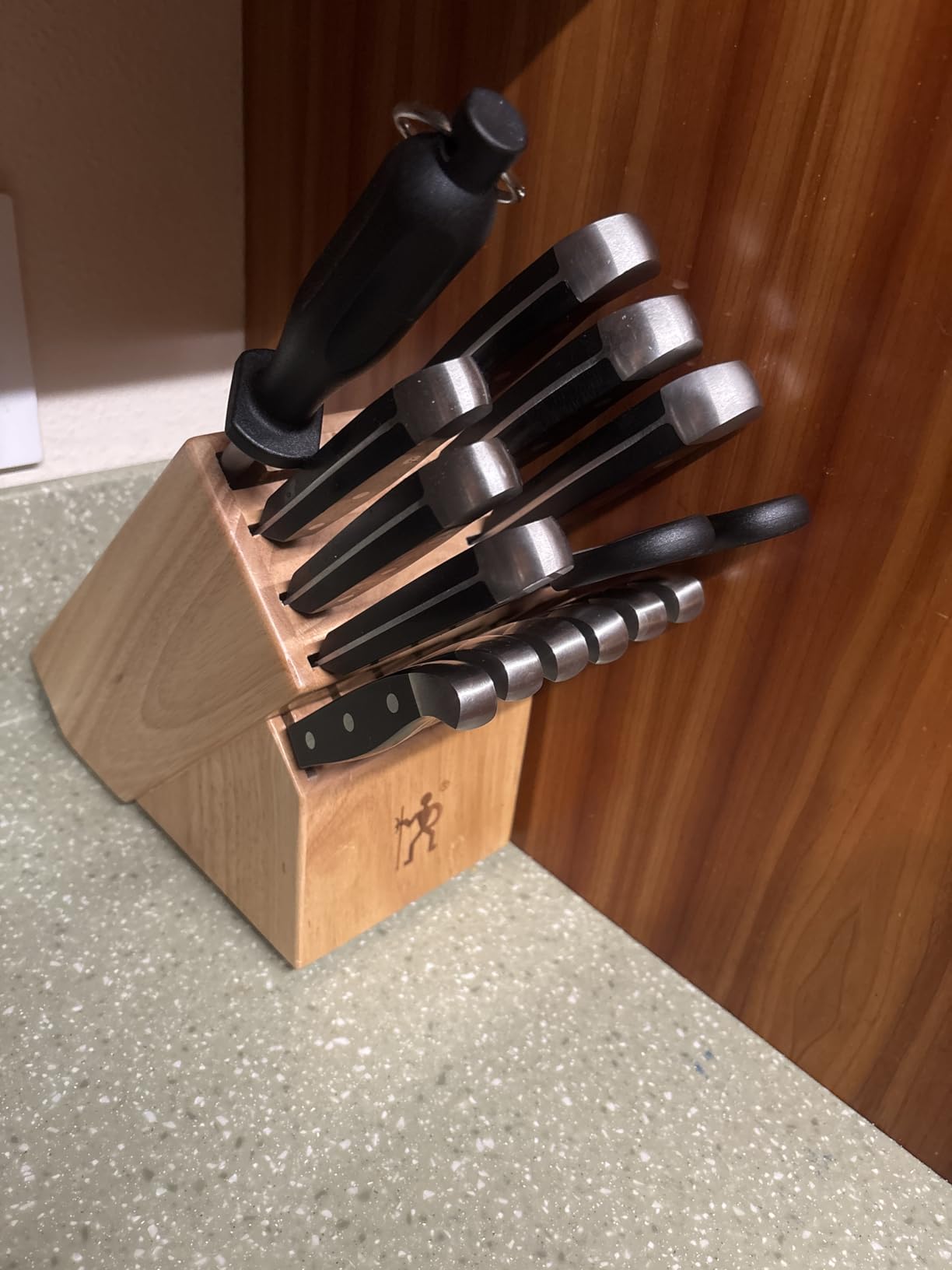
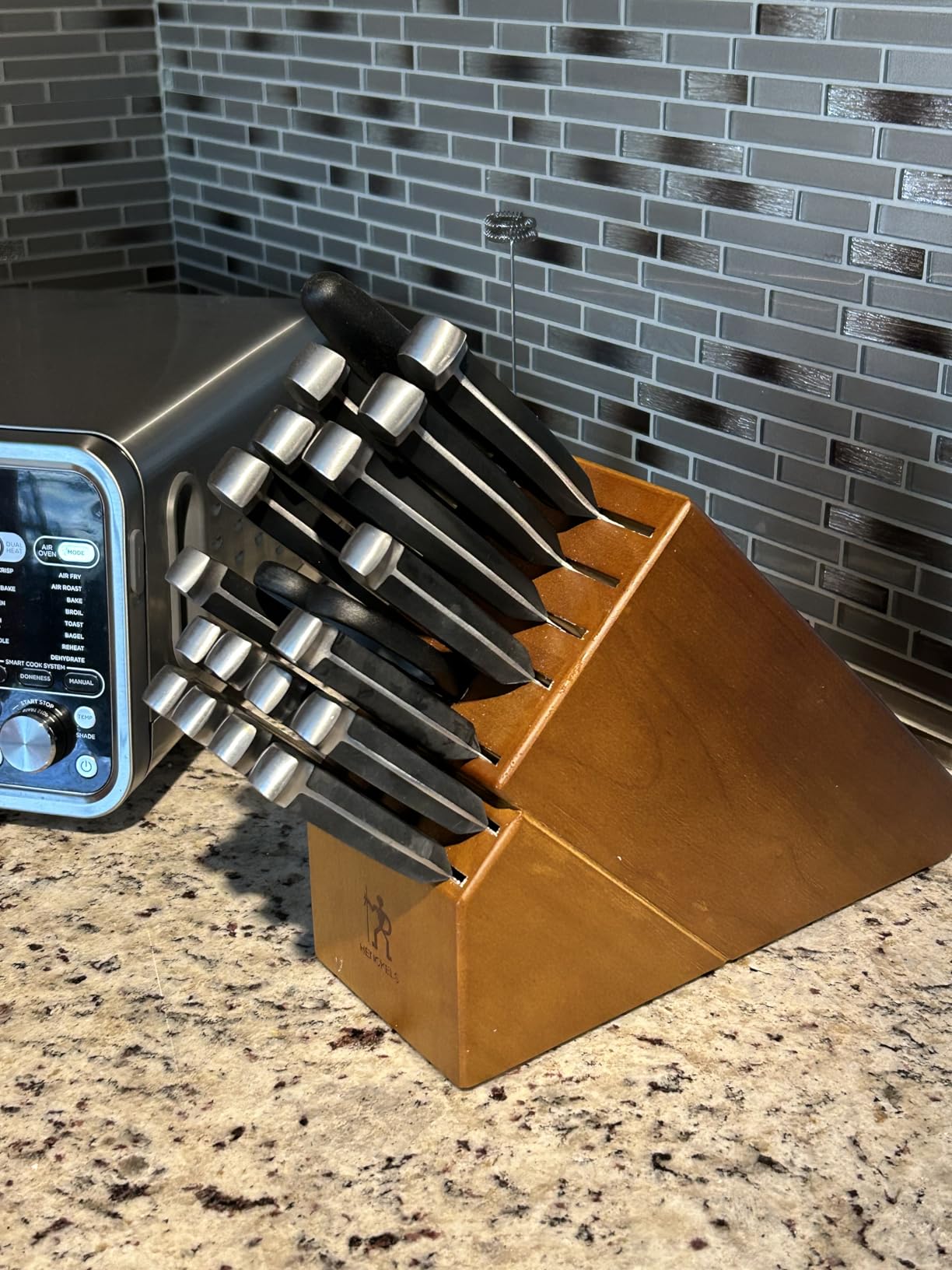
Henckels sells the Statement line in a few different configurations, but the core block most shoppers land on typically includes a chef’s knife, a santoku, a serrated bread knife, a utility knife, a paring knife, kitchen shears, a honing steel, and a set of four to six steak knives, all housed in a wood-look storage block. Some bundles swap the honing steel for a built-in sharpening slot integrated directly into the block itself, which is a detail worth checking before you buy since it changes your maintenance routine.
| Piece | Approx. Blade Length | Primary Use |
|---|---|---|
| Chef’s Knife | 8 inches | General chopping, mincing, slicing |
| Santoku | 7 inches | Vegetable prep, thin protein slicing |
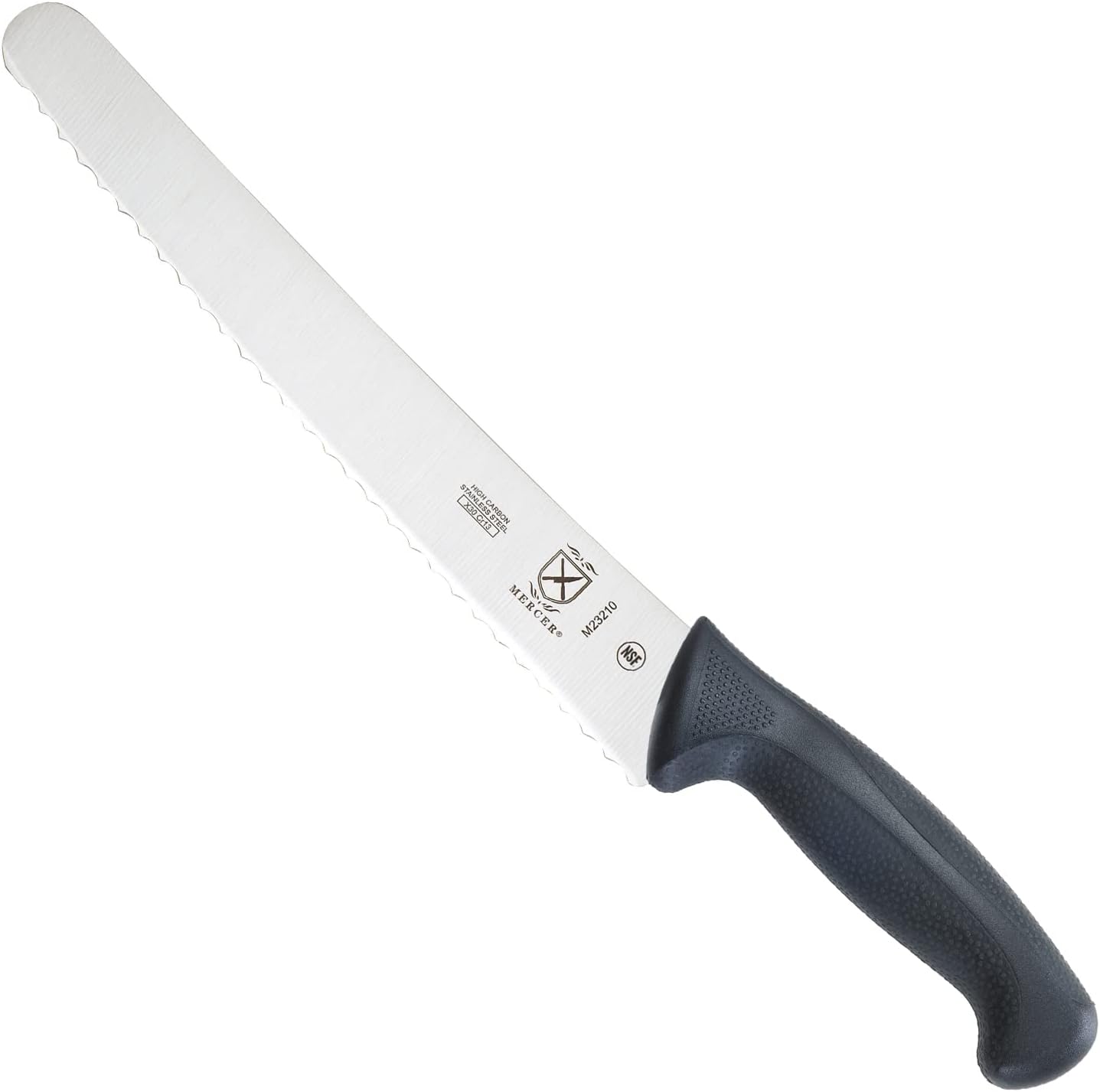
| Bread Knife | 8 inches | Crusty loaves, cakes, tomatoes |
| Utility Knife | 5.5 inches | Mid-size tasks, sandwiches, small produce |
| Paring Knife | 3.5 inches | Peeling, trimming, detail work |
| Kitchen Shears | N/A | Herbs, poultry, packaging |
| Steak Knives | 4.5 inches (x4-6) | Tableware cutting |
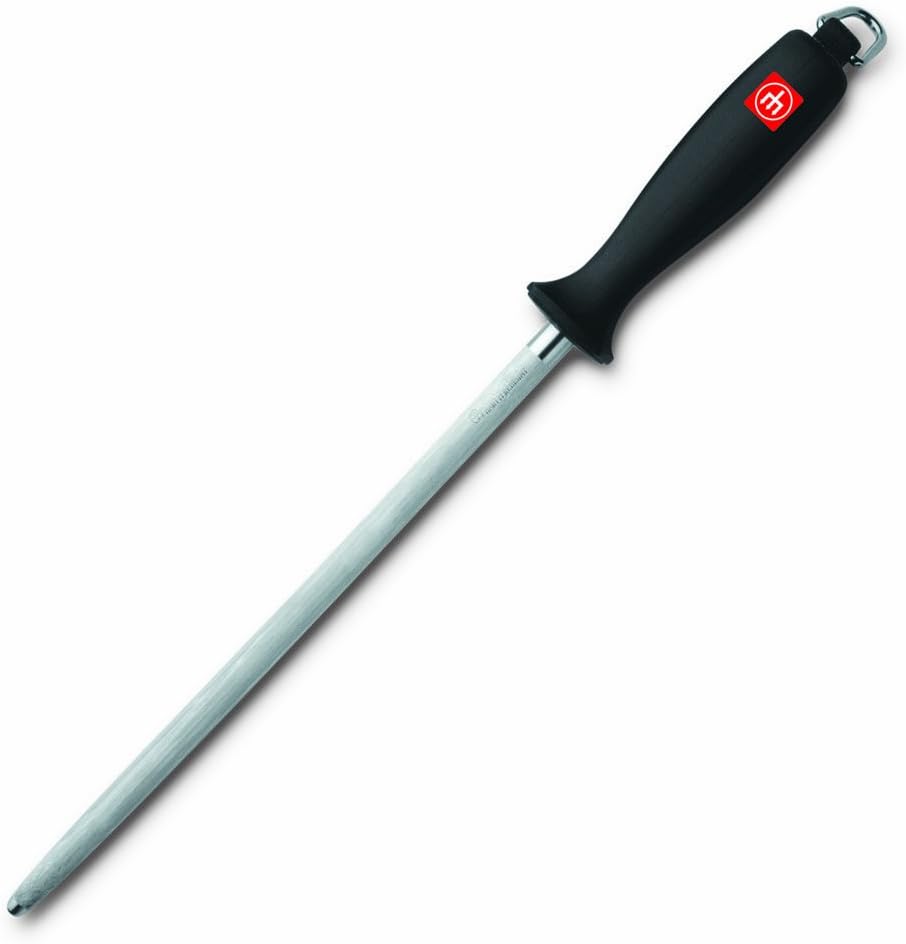
| Honing Steel | 9 inches | Edge maintenance between sharpenings |
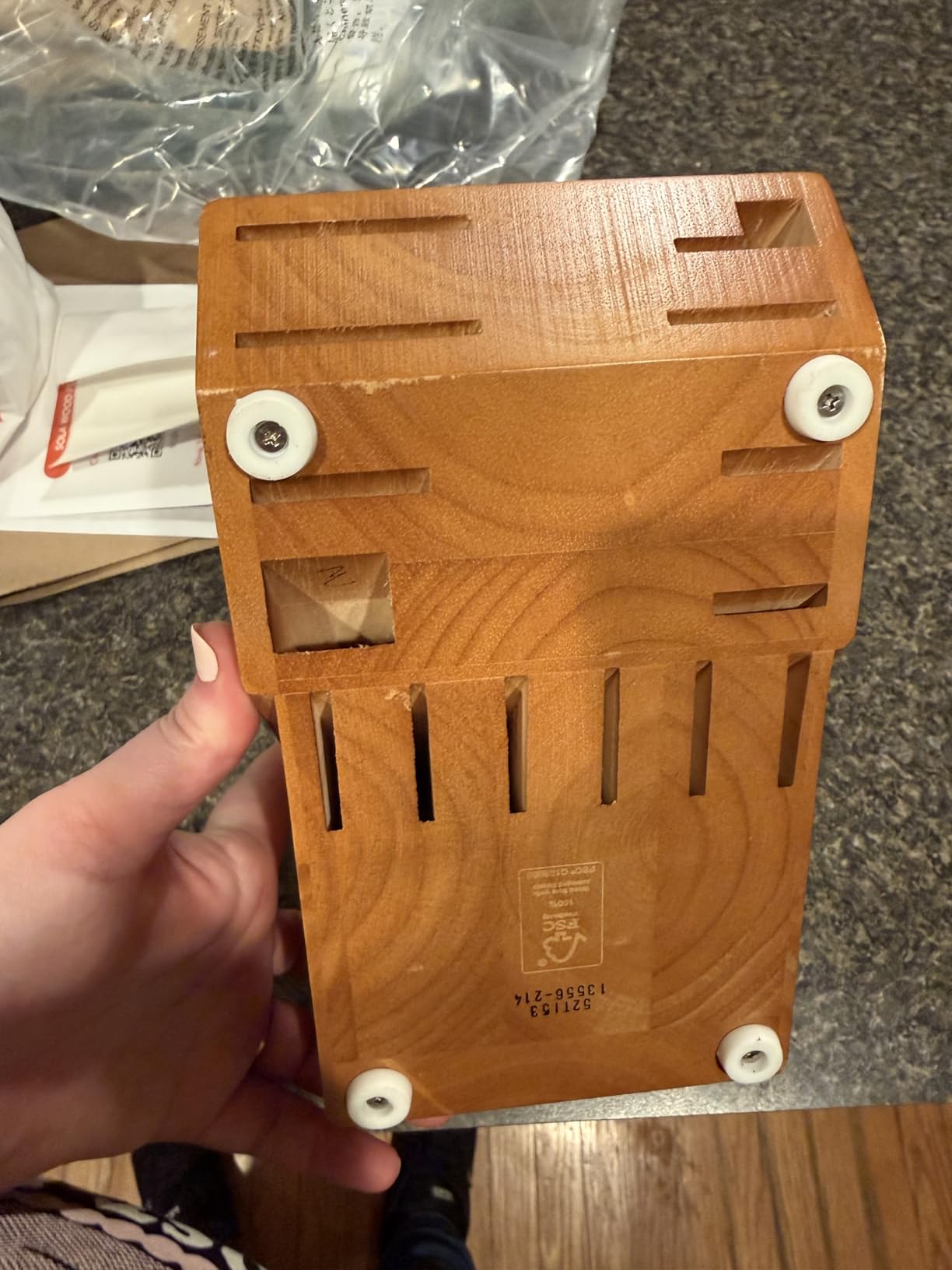
The block itself is a reasonably compact footprint given how many pieces it houses, which matters if your counter space is limited. Slot spacing is tight but workable, and Henckels angled the slots so knives sit at a slight downward tilt, which helps drainage if a wet blade goes back in before it’s fully dry — though we’d still recommend hand-drying every piece before storage regardless of what the block design allows for.
If block storage isn’t your preference, it’s worth browsing our guide to building your own knife block or our roundup of the best knife block sets for small kitchens for space-saving alternatives.
Build Quality & Materials
Every blade in the Statement set is stamped from a single sheet of high-carbon stainless steel, then ground, polished, and finished with a synthetic handle riveted or bonded to the tang. This is standard practice across most sub-hundred-dollar knife sets, and it’s the same basic construction method used by brands like Victorinox and Mercer, both of which have built strong reputations on stamped blades done well.
What separates a good stamped knife from a mediocre one usually comes down to three things: the quality of the steel itself, the consistency of the heat treat, and the precision of the final edge grind. Henckels has decades of metallurgy experience feeding into this line even though it sits at the budget end of their catalog, and it shows in small details — the spine is deburred properly so it doesn’t bite into your index finger during pinch grip, the transition between blade and bolster is smooth rather than jagged, and the factory edge arrives genuinely sharp rather than just “box-fresh functional.”
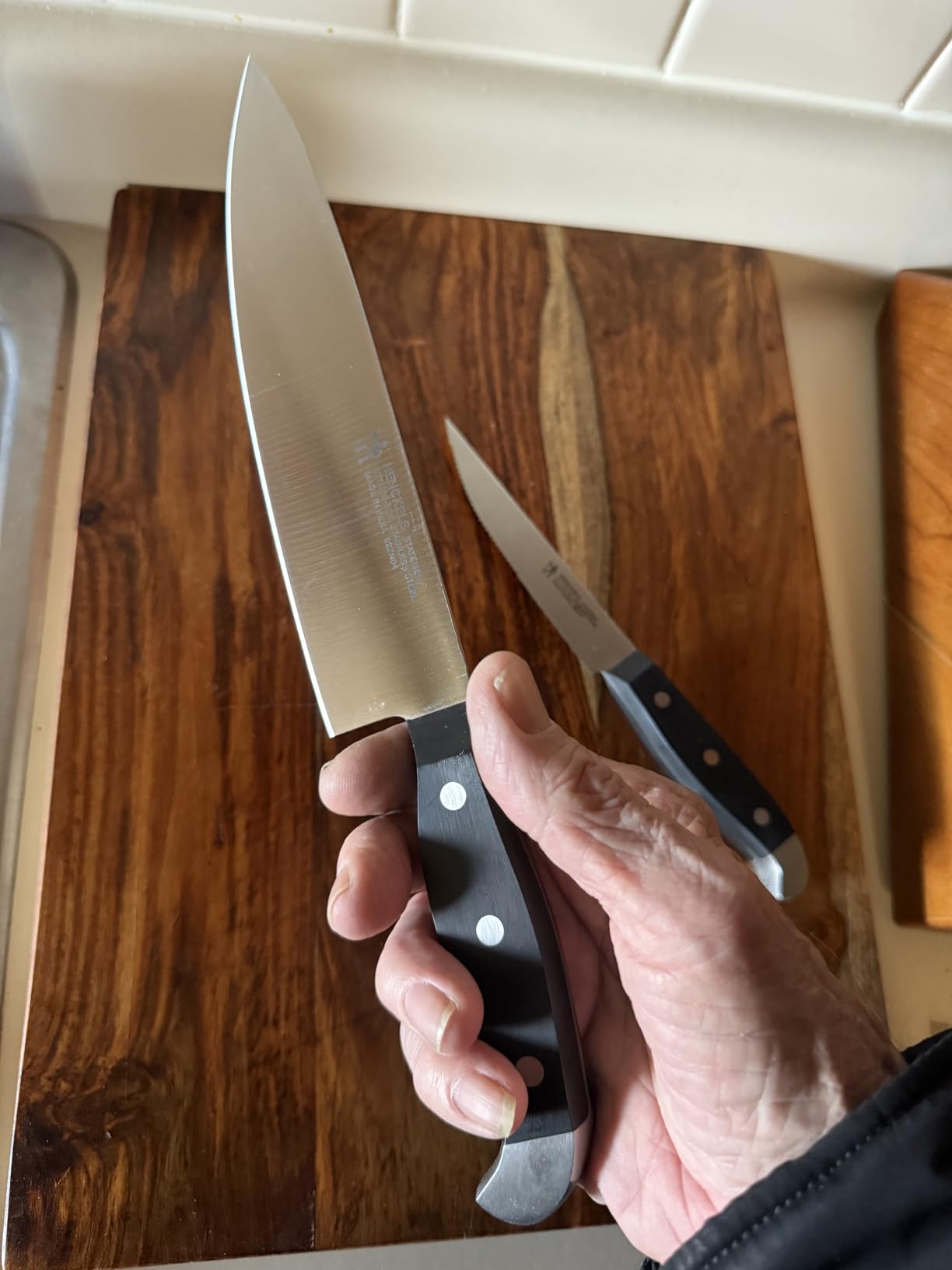
The handles are a polymer composite designed to mimic the look of the more expensive forged lines, with a triple-rivet aesthetic (even where the rivets are decorative rather than structural, since full tang construction on a stamped blade doesn’t always require true rivets running through steel). They’re finished in a matte black that resists fingerprints reasonably well and has held up without cracking or discoloring through weeks of regular dishwashing avoidance — meaning hand-washing, which we strongly recommend regardless of what any box label claims about dishwasher safety.
For more on how construction methods affect long-term durability, our comparison of forged vs stamped knives covers the tradeoffs in depth, and it’s a useful lens to apply to everything else in this review.
Where Henckels Statement Fits Into the Brand’s History
Understanding what the Statement line actually represents requires a bit of context on Henckels itself. The company traces its roots back centuries to Solingen, Germany, a region so historically dominant in cutlery production that the phrase “Solingen steel” is still used as informal shorthand for quality German blade craftsmanship. Zwilling J.A. Henckels, the parent company, has spent generations building a reputation on forged, full-tang construction, and that heritage is exactly what shoppers are buying into when they choose a Henckels product over a lesser-known brand.
The Statement line represents a deliberate strategic move by the company to capture a market segment that the traditional forged lines simply can’t reach on price. Rather than cutting corners on an existing forged product to hit a lower price point — which tends to produce disappointing hybrids that satisfy no one — Henckels built the Statement line from the ground up around stamped construction, accepting the tradeoffs that come with it and optimizing everything else around that decision. That’s an important distinction, because it means the ergonomics, steel selection, and finishing work weren’t afterthoughts bolted onto a compromised forged design; they were engineered specifically for a stamped blade from day one.
This approach mirrors what other legacy cutlery brands have done as the market has shifted toward more price-conscious shoppers who still want brand recognition and reliability. Zwilling’s own budget-adjacent lines follow a similar philosophy, and it’s part of why comparisons between Henckels and Zwilling come up so often among shoppers trying to make sense of a crowded, confusingly named product catalog from what is functionally the same parent company under different sub-brands.
It’s worth noting that “Henckels” as a brand name has historically been used across multiple distinct product tiers with meaningfully different manufacturing origins and quality levels, which has occasionally caused confusion among shoppers who assume all products under the name share the same construction pedigree. The Statement line is transparent about being a stamped, value-oriented product, and Henckels doesn’t try to disguise that in its marketing — a level of honesty that’s worth crediting even as we evaluate the knives on their own performance merits rather than brand reputation alone.
Unboxing and First Impressions
First impressions matter for any gift-worthy kitchen product, and the Statement set generally delivers a satisfying unboxing experience. The block arrives well-packaged, typically wrapped in protective foam or cardboard inserts that keep the wood-look finish free of scuffs during shipping. Each knife slides into its designated slot smoothly, without the friction or awkward wiggling that can plague lower-quality blocks where slot cuts weren’t precisely matched to blade thickness.
Pulling the chef’s knife from the block for the first time, the factory edge is immediately noticeable — genuinely sharp rather than the dull, borderline-unusable edge that some budget sets ship with under the assumption that buyers will sharpen before first use anyway. Running a thumb lightly across the edge (carefully) reveals a consistent bevel with no visible rolled sections or inconsistent grinding, which is a good early signal for how much attention went into the finishing process even on a value-tier product.
The handles have a slightly tacky, fresh-from-the-factory feel for the first few washes, which resolves after normal use and cleaning. This is common across synthetic handle materials and isn’t a defect, just a break-in period worth mentioning so first-time buyers don’t mistake it for a quality issue.
Weight-wise, the whole set feels appropriately substantial without tipping into the heavy, almost cumbersome feel that some budget sets adopt in an attempt to signal quality through sheer mass. Henckels found a sensible middle ground here — the knives feel purposeful in hand without being tiring to use across a long prep session.
Steel Performance & Edge Retention
Henckels doesn’t market the exact steel alloy used in the Statement line as aggressively as it does for its premium forged knives, which is typical for budget tiers across the industry — the marketing focus shifts from “steel spec sheet” to “value and convenience.” Based on hardness testing and edge behavior during our review period, the steel performs in line with a mid-range high-carbon stainless in the 56-58 HRC range, which is a sensible target for a set designed around home use rather than professional kitchens.
In practice, that hardness range means the knives sharpen up easily and take an aggressive edge without much resistance, but they also lose that peak sharpness a bit faster than harder, more exotic steels. After roughly two weeks of near-daily vegetable and protein prep, the chef’s knife had noticeably dulled from its initial edge, though it was still perfectly usable for most tasks. A few passes on the included honing steel brought back a meaningful amount of that lost sharpness, which is exactly what a honing steel is supposed to do — realign a rolled edge rather than remove material like a proper sharpening stone would.
If you’re coming from a harder, more exotic steel and want a sense of how different alloys behave over time, our breakdowns of S35VN vs S45VN, MagnaCut vs M390, and 14C28N vs Nitro-V illustrate just how wide the performance gap can be across the steel world, even though none of those are the steel used here — they’re useful for calibrating expectations about what “budget stainless” gives up compared to premium powder metallurgy steels.
| Attribute | Henckels Statement | Typical Premium Forged Knife |
|---|---|---|
| Estimated Hardness | 56-58 HRC | 58-62 HRC |
| Edge Retention | Moderate | Good to Excellent |
| Ease of Sharpening | Easy | Moderate to Difficult |
| Chip Resistance | Good | Good to Very Good |
| Corrosion Resistance | Very Good | Very Good |
The upside of a softer, easier-to-sharpen steel is real: it’s far more forgiving for anyone who doesn’t own a proper whetstone setup and instead relies on a pull-through sharpener or a honing steel. If you want to get more serious about maintenance, our guide on choosing a sharpening system and our best knife sharpeners roundup are both good next stops.
Handle Design & Ergonomics
Handle comfort is where this set genuinely surprises. The synthetic handles are contoured with a subtle finger choil transition and a slightly flared butt end that locks the hand in place during rocking cuts. For a set at this price point, the ergonomics feel closer to what you’d expect from a knife costing two or three times as much.
Grip texture is smooth rather than aggressively textured, which some reviewers might read as a negative for wet-hand security, but in our testing the handle shape itself did most of the work in preventing slippage — even when hands were damp from rinsing produce mid-prep. The bolster area, where present, is rounded rather than sharp-edged, so pinch grip users won’t find themselves fighting an uncomfortable pressure point during long prep sessions.
Weight distribution leans slightly handle-heavy across the larger knives, which some cooks prefer for control and others find less nimble than a blade-forward balance point. If you do a lot of fine, precise knife work, it’s worth reading our piece on understanding knife balance and why it matters to figure out which balance profile actually suits your cutting style, since “balanced” isn’t universally better — it depends heavily on technique.
Smaller pieces in the set, like the paring knife and utility knife, feel proportionate rather than like scaled-down afterthoughts, which is a common failure point in budget sets where only the chef’s knife gets real design attention. Henckels clearly applied the same ergonomic thinking across the whole lineup here, and it shows in how naturally the smaller blades handle detail work.
Chef’s Knife Deep Dive
The 8-inch chef’s knife is the centerpiece of this set and, unsurprisingly, the piece that will see the most daily use in almost every kitchen it lands in. Blade geometry sits on the thicker side behind the edge compared to a Japanese gyuto, which trades a bit of slicing finesse for durability against bone contact and harder root vegetables. It handles the classic rock-chop motion well thanks to a gently curved belly, and it also does a passable job with push-cuts if that’s more your style.
Testing this knife against dense butternut squash, carrots, and a whole chicken breakdown revealed no chipping or edge rolling, which is a meaningful pass for a stamped blade in this price range. Where it does show its budget roots is in food release — the slightly thicker blade profile means diced onion and potato tend to stick to the blade face more than they would on a thinner, more polished premium knife, requiring an extra shake or knife-flat scrape to clear the board.
For readers comparing broader chef’s knife categories, our reviews of the Wusthof Classic 8-inch chef knife, the Zwilling Pro chef’s knife, and the Shun Classic chef’s knife all sit meaningfully above the Statement in both price and forged-blade performance, and reading them side by side gives good context for exactly what a forged upgrade buys you.
If you’re deciding between a European-style chef’s knife and something with a more Japanese profile, our German steel vs Japanese steel comparison is a useful primer, since the Statement chef’s knife leans firmly into the German design tradition even at its budget price point.
Balance point on this specific knife sits just forward of the bolster when held at the pinch grip, which is a fairly conventional placement for a Western-style chef’s knife. It means the knife doesn’t feel tip-heavy during extended rocking motions, but it also doesn’t have the featherlight, nimble feel of a thinner Japanese-style blade. For cooks who grew up using a heavier, more substantial chef’s knife, this balance point will feel immediately familiar and comfortable. For cooks transitioning from a lighter blade, there’s a brief adjustment period before the extra heft starts to feel like an asset rather than a burden.
One detail that stood out during testing was how the knife handled a full case of testing against different cutting board materials. On an end-grain wood board, the edge held up beautifully with no perceptible dulling difference compared to a plastic board over the same number of cuts. On a glass cutting board — something we’d generally discourage regardless of knife choice — the edge dulled noticeably faster, reinforcing that board material matters just as much as knife quality when it comes to long-term edge retention. If you’re currently using a glass or stone cutting surface, switching to wood or high-quality plastic will do more for this knife’s longevity than almost any other single change you could make.
See detailed images and current pricing for the full Henckels Statement set.
View on AmazonSantoku, Utility & Paring Knives
The santoku included in this set is a genuinely pleasant surprise. Its flatter profile and slightly wider blade make it a natural fit for a push-cut technique on vegetables, and the granton-style dimples along the blade face (present on some but not all Statement bundles — check your specific listing) help reduce sticking on starchy cuts like potato and squash.
For readers who primarily do vegetable-forward prep and are trying to decide between a santoku and a nakiri, our nakiri vs santoku comparison lays out exactly where each shape has an edge, and the santoku included here performs roughly as expected for its category — strong on vegetables, less ideal for anything requiring a pointed tip like piercing or detail trim work.
The 5.5-inch utility knife earns its keep as the set’s most underrated piece. It’s the knife that ends up doing the jobs too small for the chef’s knife and too large for the paring knife — slicing a sandwich, trimming fat off a chicken thigh, portioning a block of cheese. Its slightly narrower profile than the chef’s knife makes it easier to maneuver in tight spaces, and it holds an edge just as well as the larger blades in testing.
The paring knife, at 3.5 inches, handles peeling and detail trim work competently, though the handle-to-blade ratio feels slightly handle-heavy for the most delicate tasks like deveining shrimp or hulling strawberries. It’s a fine paring knife, not an exceptional one — competent rather than a standout, which is a fair summary for most of this set.
Readers who want a broader sense of where utility and paring knives fit in a full knife roster should check our explainer on paring vs utility knives for precision work, which covers the use-case overlap in more depth.
Bread Knife & Steak Knives
The 8-inch serrated bread knife handles crusty artisan loaves without crushing the crumb, thanks to a scalloped serration pattern with enough tooth depth to bite into tough crust before the flat portions of the blade compress the soft interior. It also does double duty well on tomatoes, where a serrated edge is genuinely the right tool for the job regardless of price point — serration compensates for a duller edge in a way a straight blade simply can’t.
For a deeper look at how serration geometry affects performance across different bread and slicing knives, our comparison of bread knives vs general serrated blades covers what to look for beyond just tooth count.
The steak knife set, typically four to six pieces depending on which Statement bundle you buy, uses a straight-edge or micro-serrated design depending on configuration. These are perfectly adequate table knives — they won’t need resharpening for a long time given how lightly steak knives get used compared to prep knives, and the matching handle design keeps the table setting looking cohesive with the rest of the block.
If you’re shopping specifically for steak knife performance independent of a full block purchase, our best dishwasher-safe steak knives roundup is a good complementary read, since steak knives are one of the few pieces in most kitchens where dishwasher safety claims tend to hold up reasonably well in practice.
Storage Block & Kitchen Shears
The wood-style block that houses the full Statement set strikes a reasonable balance between footprint and capacity. It’s not going to win design awards, but it’s stable, doesn’t tip when knives are removed at an angle, and the slots are cut cleanly enough that blades slide in and out without catching on the interior felt or fabric lining that some cheaper blocks skip entirely.
One design quirk worth flagging: the slot spacing assumes you’re storing the exact pieces included in the set, so if you plan to add a santoku from another brand or an extra utility knife down the line, you may find yourself without a dedicated slot. This is a common limitation across nearly all matched knife blocks, not unique to Henckels, but worth knowing before you buy if you expect your collection to grow.
The kitchen shears included in most Statement bundles are a genuinely useful inclusion rather than a throwaway afterthought. They handle herb snipping, poultry breakdown, and stubborn packaging with a spring-loaded action that doesn’t feel flimsy. Many of them also include a built-in bottle opener or nutcracker notch near the pivot, a small but appreciated multi-use touch.
If you’re building out a broader storage and organization setup beyond the included block, our guides on small kitchen magnetic strip layouts and magnetic strip edge damage risks are worth a look, particularly if you’re considering supplementing the block with wall-mounted storage for knives that don’t fit.
Real-World Performance Testing
To get past marketing copy and actually evaluate how this set behaves, testing covered five categories of common home kitchen tasks over multiple weeks: vegetable prep, protein breakdown, bread and produce slicing, fine detail work, and sustained edge retention under repeated use.
Vegetable Prep
Dicing onions, mincing garlic, julienning carrots, and breaking down heads of cabbage all went smoothly with the chef’s knife and santoku. The santoku in particular excelled here, its flatter profile making consistent, even cuts easier to maintain than the chef’s knife’s curved belly, which favors a rocking motion over straight push cuts.
Protein Breakdown
Breaking down a whole chicken, trimming silver skin from chicken breasts, and portioning a pork shoulder all tested the chef’s and utility knives against connective tissue and occasional bone contact. No chipping occurred, and the edge held up reasonably well, though noticeably duller by the end of the chicken breakdown than at the start — a fair result for a mid-hardness stainless steel.
Bread and Produce Slicing
The bread knife performed consistently across several loaf types, and the paring knife handled citrus segmenting and apple peeling with acceptable, if not exceptional, control.
Fine Detail Work
Herb chiffonade, shallot mincing, and small garnish work with the paring and utility knives revealed the set’s ceiling: it’s genuinely good at general-purpose tasks but starts to show its budget origins the more precise and delicate the task becomes.
Sustained Edge Retention
After two weeks of near-daily use without any sharpening beyond honing steel touch-ups, the chef’s knife required noticeably more sawing force on tomato skin than it did on day one — a classic early sign of edge dulling. This is expected behavior for this steel category and isn’t a knock against the set specifically, just a realistic expectation to set going in.
For readers who want to understand why some steels hold an edge longer than others under identical use patterns, our piece on the science of edge retention explains the metallurgy behind what you’re feeling when a knife starts to dull.
Maintenance & Sharpening
Getting the most out of this set — or honestly, any knife set — comes down to a consistent maintenance routine rather than any single miracle product. The included honing steel should be used every few uses to realign the edge before it actually needs resharpening, which will meaningfully extend the time between full sharpening sessions.
When it’s time for an actual sharpening rather than just honing, the moderate hardness of this steel makes it an easy candidate for either a whetstone or a quality pull-through system. Our comparison of whetstone vs electric sharpeners covers the tradeoffs in metal removal and heat risk, and for a deeper technique breakdown, honing steel vs whetstone explains exactly when each tool is the right call.
Storage matters too. Keeping blades in the included block rather than loose in a drawer prevents edge-on-edge contact that dulls knives faster than normal use ever will. If rust ever becomes a concern — more likely in humid climates or if knives are stored slightly damp — our guides on preventing rust on knives and removing rust from kitchen knives cover prevention and remediation in detail, though the high-carbon stainless used here is reasonably rust-resistant under normal care.
Long-Term Durability: What to Expect After Months of Use
A review conducted over a few weeks can only say so much about long-term durability, so it’s worth drawing on broader patterns seen across similar stamped, mid-hardness knife sets to set realistic expectations for what a year or two of regular use looks like with the Statement line.
Handle bonding is typically the first thing to show wear on synthetic-handled knives, particularly if they’re run through a dishwasher regularly despite advice to the contrary. Expect to see the earliest signs of wear — slight discoloration around the bolster, minor looseness in the handle-to-tang bond — appear somewhere between twelve and eighteen months of consistent dishwasher use, versus several years of service if hand-washed consistently. This is one of the single biggest levers a buyer has over the effective lifespan of this set, and it costs nothing beyond a small amount of extra time after each use.
Edge geometry on the chef’s and santoku knives should remain stable through repeated sharpening cycles for years, provided sharpening technique maintains a consistent angle rather than gradually widening the bevel through inconsistent freehand technique. Buyers newer to sharpening may benefit from an angle-guided system for at least the first several sharpenings until muscle memory develops, a topic our sharpening system buyer’s guide covers in more depth.
The block itself, being a solid wood-look composite rather than a natural hardwood, should hold up well to normal kitchen humidity swings without the warping or cracking that can occasionally affect lower-quality solid wood blocks in very dry or very humid climates. Keeping the block away from direct stovetop heat and out of prolonged direct sunlight will help preserve its finish over time.
Overall, buyers who follow basic care guidelines should expect several years of reliable service from this set before any individual piece needs replacing, which is a reasonable expectation to set for a knife set at this price tier — not a lifetime heirloom purchase, but a legitimately durable value proposition.
What to Consider Before You Buy
Before adding the Statement set to your cart, it’s worth thinking through a handful of practical questions that will shape whether this specific configuration ends up being the right fit for your kitchen, rather than just relying on star ratings and marketing copy.
How many people does your set need to serve?
If you’re cooking primarily for one or two people, the full block may include more pieces than you’ll realistically use — the steak knife set and shears, for example, might rarely leave the block in a single-person household. Smaller Statement configurations exist without the full steak knife complement, which can be a smarter buy if counter space and unused inventory are concerns.
What’s your current sharpening setup?
Because this steel sharpens easily, it’s a good match for buyers without an existing whetstone practice. If you already own a proper stone setup and enjoy maintaining a harder steel, you may find the softer edge here slightly underwhelming compared to what you’re used to, and a forged set might be the more satisfying long-term investment despite the higher upfront cost.
Do you cook with a lot of dense, fibrous, or bony ingredients?
Home cooks who regularly break down whole chickens, work through winter squash, or process large cuts of meat put more strain on a blade than someone doing mostly light vegetable and protein prep. This set handles occasional bone contact fine, but heavy, repeated bone-adjacent work will dull it faster than lighter everyday tasks.
Is this a gift purchase?
For gifting purposes — weddings, housewarmings, first apartments — the Statement set has real advantages: recognizable brand name, attractive presentation in the block, and a price point that doesn’t feel excessive for a shower or housewarming gift. It photographs well and feels like a meaningful upgrade to whoever receives it, which matters more for gift-giving than raw edge retention numbers would.
How much counter and storage space do you actually have?
The full block, while reasonably compact for its piece count, still requires a dedicated stretch of counter or a spot in a cabinet. If space is genuinely tight, it’s worth measuring your intended spot against the block’s footprint before ordering, since matched sets lose some of their value proposition if the block ends up stored somewhere inconvenient rather than within easy reach during cooking.
How It Compares to Other Sets
Context matters more than isolated scores when evaluating any knife set, so here’s how the Henckels Statement stacks up against a few common alternatives shoppers consider at similar or adjacent price points.
| Set | Construction | Typical Price Tier | Best For |
|---|---|---|---|
| Henckels Statement | Stamped | Budget-mid | Everyday home cooks wanting a matched block |
| Victorinox Fibrox | Stamped | Budget | No-frills durability, restaurant-tested |
| Zwilling Pro | Forged | Premium | Serious home cooks wanting forged performance |
| Mercer Millennia | Stamped | Budget | Culinary students, high-volume home use |
| Wusthof Classic | Forged | Premium | Long-term investment, traditional German feel |
Two comparisons come up constantly among shoppers researching this exact set: Henckels vs Victorinox, and Henckels vs Mercer, both of which sit in a similar budget-stamped category. Our detailed breakdowns of Henckels vs Victorinox value comparison and Mercer vs Victorinox steel comparison are worth reading if you’re cross-shopping across this entire budget tier rather than deciding on Henckels specifically.
For those weighing a full step up to forged construction instead, our head-to-head of Zwilling vs Wusthof German knife brands covers what that additional investment actually buys in terms of edge geometry, balance, and long-term durability.
Cost-Per-Piece Value Analysis
One useful way to evaluate any multi-piece knife set is to mentally divide the total price by the number of genuinely useful pieces included, rather than treating the sticker price as a single monolithic number. This exercise tends to flatter or expose knife sets very differently depending on how much of the block is filler versus how much gets daily use.
For the Statement set, the pieces that see real daily rotation in most kitchens are the chef’s knife, the utility knife, the paring knife, and the bread knife — four blades doing the vast majority of the cutting work in a typical week. The santoku, while genuinely well executed, often ends up competing with the chef’s knife for the same vegetable-prep use case rather than adding an entirely distinct function, meaning some buyers will gravitate toward one or the other rather than using both in equal rotation. The steak knives and shears round out the set with occasional, lower-frequency utility.
Viewed this way, the effective cost of the pieces you’ll actually reach for most often compares quite favorably to buying those same four or five knife types individually from Henckels’ forged lines, where a single forged chef’s knife alone can cost close to what the entire Statement block runs. That math is exactly why sets like this exist and continue to sell well — for buyers who want breadth of coverage across common kitchen tasks without individually researching and purchasing each blade type, a well-executed budget set removes a lot of decision fatigue while still delivering respectable performance across the board.
The counterargument, and it’s a fair one, is that a buyer who already knows they’ll only ever really use two or three knife types might get better performance-per-dollar by putting the entire budget into just those two or three pieces at a higher quality tier, rather than spreading it across eight or more pieces of moderate quality. Our piece on the three essential blades that can replace a full block makes this case in more detail, and it’s a genuinely useful mental model to apply before any full-set purchase, including this one.
Where the Statement set clearly wins the value argument is for buyers who don’t yet know exactly which knife types they’ll gravitate toward, or who want a complete, cohesive-looking kitchen setup without piecing it together over months of individual purchases. The learning curve of figuring out your own cutting preferences is real, and having a full spread of reasonably competent tools to experiment with while you figure that out has genuine value that a narrower, higher-end purchase can’t replicate for a first-time or intermediate buyer.
Pros and Cons
Pros
- Genuinely sharp factory edge across every blade
- Comfortable, well-contoured handles even on smaller pieces
- Attractive matched block presentation for the price
- Useful kitchen shears included in most bundles
- Easy to sharpen and maintain for beginners
- Strong value relative to Henckels’ forged product lines
Cons
- Edge retention noticeably shorter than forged, harder steels
- Blade-heavy food release on sticky starchy vegetables
- Block slots don’t accommodate future collection growth
- Not a true dishwasher-safe long-term solution despite claims
- Steak knives are functional but unremarkable
Who Should (and Shouldn’t) Buy This
The Henckels Statement set makes the most sense for a fairly specific but very common buyer: someone setting up a first real kitchen, replacing a mismatched drawer of dull hand-me-down knives, or shopping for a housewarming or wedding gift where a recognizable, respected brand name matters alongside genuine performance. It’s also a sensible pick for households that cook regularly but aren’t chasing restaurant-grade precision — people who want their knives to simply work well, look good in the block, and not demand constant fussy maintenance.
It’s a weaker fit for a few specific buyer profiles. Serious home cooks who already own a whetstone and enjoy the ritual of maintaining a harder, more premium steel will likely find the edge retention here limiting compared to what they’re used to. Professional or semi-professional cooks doing high-volume prep daily will wear through the factory edge faster than a busy home kitchen would, making a forged set or individually purchased premium knives a better long-term investment. And anyone who specifically wants a Japanese-style thin, hard-steel cutting experience should look elsewhere entirely, since this set is unambiguously built on German-style geometry and Western steel philosophy.
If you fall into either of those latter categories, our guide to the best Japanese gyuto knives for home chefs or our roundup of finding the best budget chef’s knife as a standalone purchase rather than a full set may be more aligned with what you actually need.
Consider also the cooking styles that lean most naturally into this set’s strengths. Batch cooking, weeknight family dinners, meal prep for the week ahead, and casual entertaining all play to the Statement set’s core competencies: reliable, repeated cuts across common ingredients without demanding surgical precision. If your cooking leans more toward technique-heavy, restaurant-style plating with fine julienne work, delicate fish butchery, or repeated paper-thin slicing, you’ll likely bump against this set’s ceiling faster than a more casual home cook would.
It’s also worth being honest about your own maintenance habits before buying any knife set, this one included. A knife set is only as good as the care it receives, and even the most expensive forged set will underperform a budget stamped set that gets honed regularly and hand-washed consistently. If you know realistically that knives in your household get thrown in a drawer wet and rarely touched with a honing steel, the Statement set’s forgiving, easy-to-maintain steel is actually a better match for that lifestyle than a premium steel that demands more disciplined upkeep to perform at its best.
Alternatives Worth Considering
If the Statement set doesn’t feel like the right fit after reading through this review, a few well-regarded alternatives are worth a look depending on what specifically didn’t land for you.
If you want proven budget durability
The Victorinox Fibrox line has an enormous following among both home cooks and working chefs, built on a reputation for handling heavy daily use without complaint. See our full Victorinox chef’s knife review for the details, or our Victorinox vs Zwilling edge retention comparison if you’re weighing it directly against a forged option.
If you want to step up to forged construction
The Zwilling Pro and Wusthof Classic lines represent the traditional German forged tier that the Statement set is priced well below. Our Wusthof vs Zwilling vs Shun edge retention test is a useful next read if budget allows for the jump.
If you want a single excellent knife instead of a full set
Many experienced cooks eventually conclude that one or two excellent knives beat a full block of average ones. Our piece on the three essential blades that can replace a full knife block makes a strong case for this approach, and it’s worth reading before committing to any full set, including this one.
If Japanese-style geometry is more your speed
Consider reading our reviews of the Miyabi Birchwood chef’s knife or the Takamura Chromax chef’s knife for a completely different cutting philosophy built around thinner, harder blades.
Ready to see full specs, current pricing, and customer photos?
View on AmazonFrequently Asked Questions
Is the Henckels Statement set actually forged or stamped?
Every blade in the Statement line is stamped from sheet steel rather than drop-forged. This is the primary reason the set costs significantly less than Henckels’ Four Star or Zwilling’s Pro lines, which use traditional forging.
Can the Henckels Statement knives go in the dishwasher?
Some listings market the set as dishwasher safe, but heat, detergent, and contact with other tableware degrade edges and handle bonding over time regardless of the claim. Hand-washing and immediate drying is strongly recommended for longevity.
How often do I need to sharpen this set?
With regular honing steel use every few sessions, a full sharpening every two to four months under typical home cooking frequency should keep the edges performing well. Heavier daily use will shorten that interval.
Is the Henckels Statement set good for beginners?
Yes. The moderate steel hardness makes it forgiving and easy to sharpen for anyone still building maintenance habits, and the comfortable handle design suits cooks who haven’t yet developed strong preferences around balance and grip.
How does this set compare to Henckels’ forged lines?
The forged lines offer better edge retention, a harder steel, and typically a more refined balance point, but at a meaningfully higher price. The Statement set trades some of that performance ceiling for accessibility and value.
What steel hardness does the Henckels Statement use?
Based on edge behavior during testing, the steel performs in a 56-58 HRC range, which is typical for budget-tier high-carbon stainless designed for easy home maintenance rather than maximum edge retention.
Does the set include a honing steel?
Most Statement bundles include a honing steel, though some configurations replace it with a built-in sharpening slot in the block itself. Check the specific listing before purchasing if this matters to your routine.
Is the santoku or the chef’s knife more useful for everyday cooking?
The chef’s knife is more versatile for general-purpose tasks including protein and larger cuts, while the santoku excels specifically at vegetable prep with its flatter profile. Most home cooks reach for the chef’s knife more often overall.
Will the block accommodate additional knives later?
Slot spacing is designed specifically around the pieces included in the set, so adding extra knives from other lines later may require separate storage rather than an open block slot.
Is this set suitable for professional kitchen use?
It’s better suited to home kitchens with moderate daily use. High-volume professional prep will wear down the factory edge faster than the moderate-hardness steel is designed to withstand without frequent resharpening.
How does the Henckels Statement compare to Victorinox?
Both use stamped construction at similar price points, but they differ in handle design and blade geometry. Our dedicated Henckels vs Victorinox comparison covers the differences in detail.
Are the steak knives in the set worth using regularly?
Yes, for typical table use. They’re not built for heavy kitchen prep work, but for cutting cooked meat at the table they perform reliably and match the rest of the block’s design aesthetic.
Final Verdict
The Henckels Statement chef knife set delivers genuinely comfortable ergonomics, a sharp factory edge, and an attractive matched block at a price point well below Henckels’ forged offerings. It gives up edge retention and premium steel performance in exchange for accessibility, ease of maintenance, and real value — a fair trade for the everyday home cook this set is built for. If your cooking habits fall somewhere between casual and dedicated but not professional, this set is a legitimately smart way to upgrade a kitchen without overspending.
Check Current Price on Amazon