Wüsthof vs. Zwilling vs. Shun: The Ultimate Knife Showdown
You’ve reached the final boss of kitchen knife decisions. This is the holy trinity, the pinnacle of premium cutlery available to the passionate home cook. In one corner, the German titans: Wüsthof, the unshakeable benchmark of durability, and Zwilling, the innovative engineer. In the other corner, the Japanese master: Shun, the icon of artistic precision and razor sharpness. Choosing between them is about more than just buying a knife; it’s about choosing your culinary identity. After more than a decade of using all three of these legendary brands in my own kitchen, this is my definitive, hands-on guide to help you find your perfect lifelong culinary partner.
Affiliate Disclosure & E-E-A-T Commitment: This guide is the result of years of passionate cooking and thousands of hours of testing. To support this work, this post contains affiliate links. If you purchase through them, I may earn a commission at no extra cost to you. My promise is unwavering honesty and expert advice you can genuinely trust.
The Quick Verdict (TL;DR)
If you’re short on time, here’s everything you need to know:
- Choose Wüsthof for ultimate durability and a classic “workhorse” feel. It’s a powerful, forgiving, and perfectly balanced German knife that will last for generations. It’s The Benchmark.
- Choose Zwilling for superior ergonomics and a more modern German design. It offers the same durability as Wüsthof but with innovative features like the curved bolster that many, including myself, find more comfortable. It’s The Innovator.
- Choose Shun for unparalleled sharpness and artistic beauty. It’s a lightweight, precise Japanese scalpel that excels at slicing. It requires a more delicate touch but rewards with incredible performance. It’s The Artist.
Comparison Table: The Holy Trinity at a Glance
| Feature | Wüsthof Classic | Zwilling Pro | Shun Classic |
|---|---|---|---|
| Philosophy | German Durability | German Ergonomics | Japanese Precision |
| Steel | X50CrMoV15 (~58 HRC) | Ice-Hardened X50CrMoV15 (~57 HRC) | VG-MAX Core (~61 HRC) |
| Blade Profile | Curved (Rock-chopping) | Moderate Curve (Hybrid) | Flat (Slicing) |
| Feel | Heavy, Powerful, Balanced | Heavy, Ergonomic, Controlled | Lightweight, Nimble, Agile |
| Best For | Heavy-duty, all-purpose work | Long prep sessions, comfort | Precise slicing, delicate tasks |
| Maintenance | Easy to maintain, tough | Easy to maintain, tough | Requires care, can be brittle |
| Edge Angle | 14° per side | 15° per side | 16° per side (asymmetric) |
| Handle Material | POM (Polyoxymethylene) | POM (Polyoxymethylene) | Pakkawood (composite wood) |
| Weight (8-inch) | ~9.5 oz / 269g | ~9.0 oz / 255g | ~6.9 oz / 195g |
| Country of Origin | Solingen, Germany | Solingen, Germany | Seki City, Japan |
| Dishwasher Safe? | No (hand-wash only) | No (hand-wash only) | No (hand-wash only) |
| Price Range | $$$ | $$$ | $$$–$$$$ |
The Contenders: A Deep Dive into the Soul of Each Brand
Before we compare them feature by feature, let’s get to know the personality of each of these legendary brands.
1. Wüsthof: The Unshakeable Workhorse 🇩🇪
Forged in Solingen, Germany, for over 200 years, Wüsthof is the very definition of a German knife. They are relentlessly focused on consistency, durability, and a traditional feel. A Wüsthof is a tool of power and confidence. It feels substantial in your hand, a perfectly balanced instrument that can plow through a pile of carrots just as easily as it can mince a clove of garlic. It’s the knife that has been the benchmark for professional Western kitchens for generations.

Flagship: Wüsthof Classic 8-Inch Chef’s Knife
The icon. This knife is the standard by which all other Western chef’s knives are judged. It features a full tang, a full bolster, and a triple-riveted handle made of nearly indestructible polymer. Its Precision Edge Technology (PEtec) creates a remarkably sharp and long-lasting 14° edge. In hand, it feels like an unstoppable force, a true kitchen Clydesdale.
✅ Pros
- Legendary durability — virtually indestructible with proper care
- PEtec laser-tested edge is 20% sharper than earlier models
- Full bolster provides excellent finger protection
- Triple-riveted polymer handle is moisture and bacteria resistant
- Superb balance point — perfectly neutral at the bolster
- Wide blade perfect for scooping and transferring food
❌ Cons
- Full bolster makes sharpening the heel tricky
- Heavier than Japanese alternatives — can cause fatigue
- Traditional handle offers no hand-placement guidance
- Premium price point
2. Zwilling J.A. Henckels: The Innovative Engineer 🇩🇪
Also hailing from Solingen, Zwilling is even older than Wüsthof and brings a different flavor to German engineering. While still focused on durability, Zwilling has a reputation for innovation, particularly in ergonomics and steel treatment. Their signature FRIODUR ice-hardening process creates a blade that is both incredibly durable and stain-resistant. They build on the German foundation with modern, user-focused design touches.
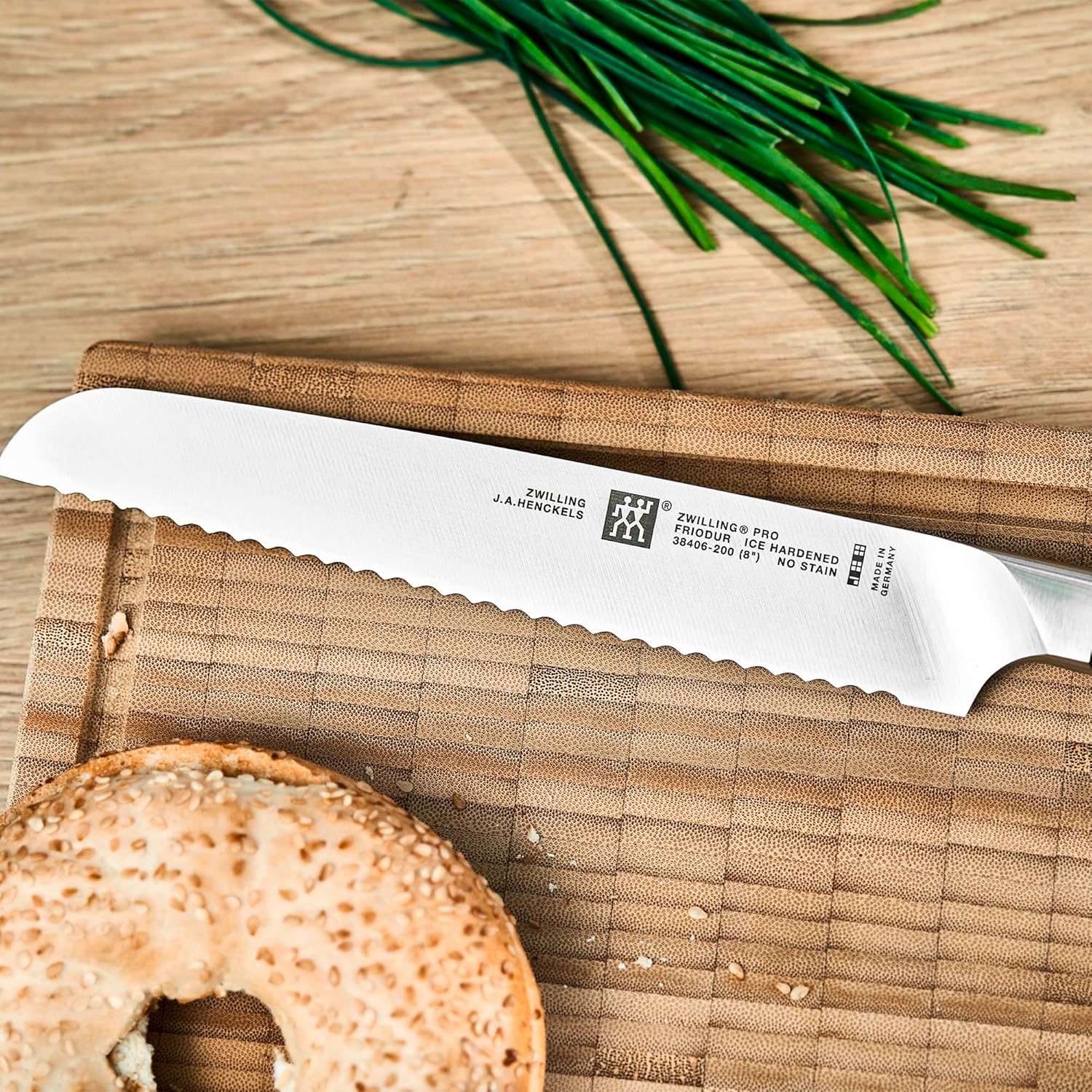
Flagship: Zwilling Pro 8-inch Chef’s Knife
The Zwilling Pro is my personal favorite German knife. It takes the solid foundation of the Wüsthof Classic and adds a game-changing curved bolster. This small design tweak guides your hand into a perfect professional pinch grip, making the knife feel more comfortable and controlled during long sessions. It has the same power as the Wüsthof, but with a more refined, modern feel.
✅ Pros
- Curved bolster naturally encourages a safer, more efficient pinch grip
- FRIODUR ice-hardening makes the steel extremely durable and stain-resistant
- Slightly lighter than the Wüsthof Classic — less fatigue over long sessions
- Full length of the blade edge is accessible for easier sharpening
- Forged from a single piece of steel for maximum integrity
❌ Cons
- The curved bolster takes a brief adjustment period for some cooks
- Slightly softer than Wüsthof’s steel — marginally shorter edge retention
- Premium price point
3. Shun Cutlery: The Artistic Scalpel 🇯🇵
Born from Japan’s historic sword-making capital of Seki City, Shun represents the pinnacle of Japanese knife philosophy for the Western market. They are instruments of breathtaking beauty and surgical precision. A Shun is not a brute-force tool; it’s a lightweight, razor-sharp scalpel designed for slicing and delicate work. Using one is an experience in effortless, graceful cutting.

Flagship: Shun Classic 8-Inch Chef’s Knife
The Shun Classic is a work of art. Its signature feature is the beautiful Damascus cladding, but the real magic is the hard VG-MAX cutting core. This “super steel” allows for a screamingly sharp 16° edge that holds its sharpness for an incredibly long time. The light weight and D-shaped Pakkawood handle make it feel agile and precise in the hand. It glides through food with almost zero resistance.
✅ Pros
- VG-MAX super steel holds an edge exceptionally long — less frequent sharpening needed
- Damascus cladding provides stunning aesthetics and reduces food sticking
- Significantly lighter — ideal for those with wrist or hand fatigue
- D-shaped handle fits securely in right-handed grip (left-handed versions available)
- Shun offers a free lifetime sharpening service by mail
❌ Cons
- Much more brittle — susceptible to micro-chipping on bones or frozen food
- Requires a Japanese-angle whetstone or specialized sharpener — no standard honing rod
- D-handle is right-hand biased (must order specific left-hand models)
- Highest price point of the three
Head-to-Head Technical Breakdown
Let’s get into the weeds. These are the critical differences that determine how these knives actually perform.
The Steel Wars: Durability vs. Edge Retention
The core difference lies here. The German brands, Wüsthof and Zwilling, both use a high-quality stainless steel called X50CrMoV15, hardened to about 57-58 HRC. This is a relatively tough steel — it can take a beating, resist chipping, and is easy to sharpen. It’s the perfect formula for a durable workhorse.
Shun, on the other hand, uses a very hard Japanese “super steel” called VG-MAX as its cutting core, hardened to a blistering 60-61 HRC. This extreme hardness allows it to hold a much finer, sharper edge for a much longer time. The trade-off? That hardness makes it more brittle. If you twist the blade or hit a hard bone, it’s more likely to get a micro-chip, whereas the German blades would likely just roll their edge, which can be fixed with honing.
📖 What is HRC (Rockwell Hardness)?
HRC stands for Hardness Rockwell C-scale — the standard measurement of how hard steel is. A higher number means harder steel. Harder steel holds a sharper edge longer but is more brittle and prone to chipping. Softer steel is tougher, more chip-resistant, and easier to resharpen, but loses its edge faster. German knives typically sit at 56–58 HRC. Japanese knives like Shun often range from 60–66 HRC. Neither is “better” — they serve different cooking philosophies. Understanding HRC is the foundation of understanding why a Shun and a Wüsthof feel so dramatically different to use.
Geometry & Cutting Style: The Rock vs. The Slice
The shape of the blade dictates its use. The Wüsthof Classic has a broad, sweeping curve or “belly.” This is designed for the classic rock-chop motion — letting the tip stay in contact with the board while the heel rocks up and down through the food. It’s efficient for mincing herbs, garlic, and rapidly dicing onions. The Zwilling Pro has a slightly flatter profile, making it a bit more of a hybrid that’s good at both rocking and slicing. The Shun Classic has the flattest profile of the three, designed for clean, single-stroke push-cuts and pull-cuts. It can feel awkward and inefficient to try and rock-chop with a Shun — that’s not what it was designed for.
This is one of the most underappreciated differences in the entire comparison. If you have spent years training your muscle memory to rock-chop, you will find the Shun’s flat profile initially frustrating. Conversely, if you are trained in the Japanese push-cut tradition, the belly of the Wüsthof may feel clumsy. This is not a flaw in either knife — it’s a fundamental philosophical difference between two great culinary traditions.
Ergonomics: How They Feel in Your Hand
This is highly subjective, but there are clear design differences.
- Wüsthof Classic: A classic, straight, triple-riveted handle. It’s simple, secure, and has been trusted for decades. It feels powerful and no-nonsense.
- Zwilling Pro: Features a sculpted handle and a revolutionary curved bolster. In my experience, this is the most comfortable of the three for long periods, as it naturally promotes the correct professional grip.
- Shun Classic: The D-shaped handle is designed to nestle into the curve of your fingers (for right-handers). It provides a very secure, controlled grip for precise movements. It feels agile and elegant.
Handle Materials: A Deeper Look at What You’re Actually Holding
When most people evaluate a chef’s knife, they focus on the blade. But experienced cooks know that the handle is just as critical — it’s the only part of the knife you actually touch. The handle determines comfort, hygiene, grip security, and longevity. All three of these brands approach handle materials with intention, and the differences matter far more than most reviews acknowledge.
Wüsthof Classic: POM (Polyoxymethylene) Handle
The Wüsthof Classic uses a handle made from POM, a high-tech synthetic polymer also known by the brand name Delrin. This is not cheap plastic — POM is a high-strength, semi-crystalline thermoplastic that is used in precision mechanical parts. In a kitchen knife handle, its properties are outstanding: it is virtually impervious to moisture, resistant to fading, non-porous (meaning bacteria cannot colonize it), and extremely durable against impacts. The dark color also hides stains beautifully.
The triple-riveted design — three stainless steel rivets pinning the handle scales to the full tang — is a time-honored construction method that creates a rock-solid, permanent bond. With a Wüsthof Classic handle, there is zero flex, zero wobble, and zero worry. The handle is shaped simply: a slight taper from bolster to heel with a gentle swell in the middle to seat the hand. It is not contoured or shaped to guide your grip, which is both a strength (fits any hand size or grip style) and a weakness (provides no guidance to beginners on correct technique).
Zwilling Pro: POM Handle with an Ergonomic Sculpt
Zwilling also uses POM for the Pro series, but the magic is in the shape. The Zwilling Pro handle is subtly sculpted with a gentle contour that encourages the hand to naturally find the correct pinch grip position. This is paired with the landmark curved bolster — a bolster that arcs away from the handle, inviting your index finger to curve around it and grip the blade itself rather than resting on the handle. This is the professional pinch grip, and it dramatically improves control, reduces hand fatigue, and increases safety.
The difference between the Wüsthof and Zwilling handle feels subtle on first use. But cook a large holiday meal — six hours on your feet, dicing, slicing, and mincing — and the Zwilling Pro’s ergonomic advantage becomes undeniable. It is the single reason why I personally reach for the Zwilling Pro slightly more often than the Wüsthof Classic for marathon cooking sessions.
Shun Classic: Pakkawood D-Handle
The Shun Classic’s Pakkawood handle is a completely different material and a completely different philosophy. Pakkawood is a composite material made by infusing natural wood with a resin stabilizer under extreme pressure. The result is a material that has the beautiful, warm appearance of real wood combined with the durability and water resistance of synthetic materials. The Shun handle has a gorgeous ebony appearance with a subtle grain visible under the surface — it genuinely looks like a piece of fine furniture.
The D-shape is perhaps the most distinctive feature. The cross-section of the handle is not oval or circular — it’s shaped like the letter “D,” with a flat side and a curved side. For right-handed users, this flat side sits against the palm and naturally orients the blade to the correct cutting angle. It is a design brilliantly tuned for precision work. The Shun D-handle provides a level of grip security and positional awareness that the symmetrical German handles simply cannot match for delicate, precise cutting tasks.
However, the D-handle also has one notable limitation: it is inherently handed. A right-handed Shun Classic feels awkward in the left hand and can cause blade misorientation. Shun does produce left-handed versions of many of their knives, but you must specifically seek them out.
🤚 A Note on Handle Fit
No written review — including this one — can substitute for holding a knife in your own hand. Grip size, shape, and hand anatomy vary enormously from person to person. If you have very large hands, the Shun’s compact D-handle may feel cramped. If you have smaller hands, the robust Wüsthof handle may feel like gripping a baseball bat. Whenever possible, visit a kitchen supply store that has floor models and hold each knife before purchasing. Williams-Sonoma and Sur La Table are both excellent places to do exactly this.
Full Tang Construction and Balance Point: Why It Matters
What Is a Full Tang?
A tang is the portion of the blade steel that extends into the handle. A full tang means the steel runs the full length and width of the handle, with the handle scales attached on either side. A partial tang or rat-tail tang is a thinner strip of steel that extends partway into the handle, typically bonded in place rather than riveted.
All three knives in this comparison — the Wüsthof Classic, Zwilling Pro, and Shun Classic — feature full tang construction. This is a strong positive: full tang construction maximizes the structural integrity of the knife, prevents handle wobble over time, and ensures that the balance and weight distribution of the knife is stable and consistent across the life of the blade. It is the construction method that separates a premium knife from a budget knife, and all three brands deliver it without compromise.
The practical implication of full tang construction is that these knives will not break at the junction of blade and handle — the most common failure point of cheaper knives. When a Wüsthof Classic feels solid and “one piece” in your hand, it’s because structurally, it essentially is.
Balance Point: Where Does Each Knife Sit?
Balance point is the physical location along the knife’s length where it would balance perfectly on a single finger. This is one of the most telling indicators of a knife’s intended use. A balance point closer to the handle creates a more blade-forward feel — the tip has inertia, great for powerful chopping motions. A balance point at or near the bolster creates a neutral feel that is the preference of most professional cooks. A balance point back toward the handle creates a handle-heavy feel that can be tiring for precision work.
- Wüsthof Classic: Balances almost exactly at the bolster. This creates an exceptionally neutral, well-controlled feel. The blade doesn’t feel heavy or unwieldy, even though the knife weighs nearly 10 ounces. This balanced distribution is one of the reasons the Wüsthof is so universally praised by professional chefs.
- Zwilling Pro: Balances slightly blade-forward of the bolster, giving it a slightly more “active” feel. This is a deliberate engineering choice that works in concert with the curved bolster — since your grip is positioned further forward than on the Wüsthof, the blade-forward balance still feels neutral in actual use.
- Shun Classic: Balances slightly toward the handle end, which feels counterintuitive given the blade’s visual drama. In practice, this makes the Shun feel incredibly light and maneuverable — there is very little momentum in the blade, which is exactly right for precision slicing tasks where you want full conscious control of every stroke.
Real-World Cutting Tests: How Each Knife Handles Specific Foods
Abstract descriptions of blade geometry and steel hardness only tell part of the story. What really matters is how each knife performs on the actual food you cook every day. After years of using all three knives, here is a frank assessment of each knife’s performance on the foods that appear most often in home kitchens.
🧅 Onions & Alliums
Wüsthof Classic: Excellent. The curved belly enables rapid, efficient rocking that powers through onions with ease. The wide blade easily scoops the diced pieces.
Zwilling Pro: Excellent. Slightly flatter profile still rocks well. The ergonomic grip reduces eye-watering by keeping your hand stable.
Shun Classic: Very Good. Requires push-cut technique rather than rocking. The razor edge creates clean, less cell-rupturing cuts — actually reduces sharpness of onion fumes.
Winner: Wüsthof / Zwilling🍅 Tomatoes
Wüsthof Classic: Good. The weight helps push through the skin, but can crush a very ripe tomato if pressure isn’t controlled.
Zwilling Pro: Good. Similar to Wüsthof but the ergonomics allow for better pressure control.
Shun Classic: Extraordinary. The razor-thin edge glides through tomato skin without any downward pressure at all. Almost zero crushing. This is where the Shun’s sharpness is jaw-dropping.
Winner: Shun — decisively🥕 Dense Root Vegetables
Wüsthof Classic: Outstanding. The weight and power of the knife makes hard carrots, parsnips, and butternut squash feel easy. No hesitation in the stroke.
Zwilling Pro: Outstanding. Matched power with slightly less fatigue over extended prep.
Shun Classic: Good but requires care. The thin blade geometry excels at the cut itself, but forcing the blade through a large squash risks chipping the brittle edge on the hard exterior. Extra caution is warranted.
Winner: Wüsthof / Zwilling🌿 Fresh Herbs (Chiffonade & Mincing)
Wüsthof Classic: Excellent for rocking-mincing large quantities quickly.
Zwilling Pro: Excellent. The ergonomic grip reduces hand fatigue during extended mincing.
Shun Classic: Superb for chiffonade — the thin, razor-sharp blade shears basil and mint with zero bruising. Mincing with a rocking motion is less natural but still effective.
Winner: Shun (chiffonade) / German (mincing)🐟 Fish & Boneless Proteins
Wüsthof Classic: Very good. Weight provides good control for portioning fish steaks, but may be more pressure than needed for delicate fillets.
Zwilling Pro: Very good. Similar to Wüsthof with better ergonomic control.
Shun Classic: Exceptional. The thin geometry and razor edge produce clean, nearly-compression-free cuts through fish and chicken breast. The difference in quality of cut is visible and tasteable in dishes like sashimi or carpaccio.
Winner: Shun🍖 Meat with Bones
Wüsthof Classic: Good for cutting near bones with care. Never strike bone directly — use a dedicated cleaver for bone splitting.
Zwilling Pro: Good with same caveat. Arguably better edge resilience than Shun in this scenario.
Shun Classic: Avoid contact with bones. The hard, brittle VG-MAX steel is highly vulnerable to chipping on contact with bone. This is the Shun’s most significant practical limitation for home cooks who don’t break down meat carefully.
Winner: German knives, clearlyKnife Sharpening and Maintenance: The Critical Skill Nobody Talks About
Buying a premium knife is only half the equation. A $200 knife that is never sharpened will eventually perform worse than a $30 knife that is properly maintained. Understanding how to maintain each of these three knives is essential knowledge before you purchase. The maintenance requirements of all three are genuinely different, and this is one of the most important factors in your decision.
Honing vs. Sharpening: Understanding the Difference
Before we dive into each brand’s requirements, let’s establish vocabulary. These terms are frequently confused by home cooks.
Honing does not remove steel. When a knife edge is used, the thin apex of the edge (the “wire edge” or “burr”) bends and deforms microscopically, causing the blade to feel dull. A honing rod — the long steel rod that looks like a magic wand — straightens this folded edge back into perfect alignment without grinding away any metal. This is a maintenance task that should be performed before or after every use.
Sharpening removes steel to create a brand-new edge. When a knife is truly dull — when honing no longer restores its cutting ability — sharpening is required. This is done with whetstones, electric sharpeners, or pull-through sharpeners. Sharpening should be performed a few times per year for a regularly used knife, not daily.
Maintaining the Wüsthof Classic
The Wüsthof Classic is the most forgiving and lowest-maintenance knife of the three. Its softer German steel is highly receptive to a standard smooth or lightly-ridged honing rod. Hone the blade at the same 14° angle as its edge for best results, though Wüsthof’s slightly flexible edge will still benefit from honing even at slightly off angles. The POM handle requires zero special treatment — simply wash with warm water and mild soap and dry immediately.
For sharpening, the Wüsthof Classic is compatible with a wide range of tools: whetstones (a 1000/3000 grit combo works perfectly), quality pull-through sharpeners set to 14°, or professional sharpening services. The full bolster does create one challenge: the very heel of the blade near the bolster is difficult to reach on most whetstones and pull-through devices. Wüsthof offers a special “Precision Edge” sharpener designed to address this, or you can have the blade professionally tapered at the bolster over time. This is a genuine maintenance consideration that Wüsthof’s own design creates.
Maintaining the Zwilling Pro
The Zwilling Pro is similarly easy to maintain as the Wüsthof. Its FRIODUR ice-hardened steel responds excellently to a standard honing rod, and the SIGMAFORGE forging process creates a steel structure that holds its edge reliably. The key difference from the Wüsthof is the curved bolster — because the curved bolster recedes away from the blade edge, the full length of the edge is accessible from heel to tip. This means you can sharpen the Zwilling Pro on a flat whetstone without any awkward maneuvering around a bolster. This is a significant practical advantage that is rarely highlighted in comparisons.
Sharpening a Zwilling Pro at its 15° factory edge on a whetstone is straightforward and satisfying. It takes a sharpening edge very well and returns to shaving-sharp quickly. Many experienced cooks find the Zwilling Pro easier to maintain in peak condition than the Wüsthof for this precise reason.
Maintaining the Shun Classic — The Most Important Section for Shun Buyers
Maintaining the Shun Classic is a fundamentally different — and more demanding — undertaking than maintaining either German knife. There are several things you absolutely must know before purchasing a Shun.
⚠️ Critical Warning: Do NOT Use a Standard Honing Rod on a Shun
This is the most common and most damaging mistake Shun owners make. The hard, brittle VG-MAX steel of the Shun cannot be realigned with a standard steel honing rod — the rod’s hardness relative to the Shun’s edge geometry will actually micro-chip and damage the very edge you are trying to maintain. If you wish to hone a Shun, you must use either a ceramic honing rod (which is gentle enough) or simply not hone it at all between sharpening sessions. Many Shun owners skip honing entirely, relying instead on slightly more frequent whetstone sessions to maintain the edge. This is the correct approach.
For sharpening the Shun Classic, you must use a whetstone. The asymmetric VG-MAX edge requires sharpening at the correct Japanese angle — typically 16° on one side and slightly different on the other depending on the specific model. Pull-through sharpeners, even those marketed for Japanese knives, are generally inadequate for maintaining the true geometry of a Shun blade and should be avoided. Recommended whetstones are Japanese water stones in the 1000–6000 grit range. A 1000 grit stone for edge setting and a 3000–6000 grit stone for polishing and refining the edge is an excellent two-stone setup.
Here’s the silver lining that often goes unmentioned: because Shun’s VG-MAX steel is so hard and holds its edge so long, you will need to sharpen it significantly less frequently than you would a German knife. A Shun used several times a week in a home kitchen might genuinely need whetstone sharpening only two or three times per year. Additionally, Shun offers a remarkable free lifetime sharpening service — you can mail your knife directly to Shun and they will sharpen and service it at no charge. This program is an extraordinary value that dramatically changes the total cost of ownership calculation.
| Maintenance Task | Wüsthof Classic | Zwilling Pro | Shun Classic |
|---|---|---|---|
| Honing Rod | Standard steel rod — Yes ✅ | Standard steel rod — Yes ✅ | Ceramic rod only — ⚠️ (or skip) |
| Honing Frequency | Before or after every use | Before or after every use | Every few sessions or skip |
| Sharpening Tool | Whetstone, pull-through, or professional | Whetstone or pull-through (easier than Wüsthof) | Whetstone only — Japanese water stones |
| Sharpening Frequency | 3–5 times per year (home use) | 3–5 times per year (home use) | 1–3 times per year (home use) |
| Free Sharpening Service | No (Wüsthof offers in-store sharpening at some retailers) | No | Yes — free lifetime mail-in sharpening ✅ |
| Handle Care | None special — POM is maintenance-free | None special — POM is maintenance-free | Occasional mineral oil treatment recommended for Pakkawood |
| Dishwasher Safe? | No — heat and detergent damage all premium knife handles and edges | No | Absolutely not — will damage Damascus cladding and Pakkawood handle |
Proper Knife Storage: Protecting Your Investment
The way you store your knives has an enormous impact on how long they retain their edges. A knife rattling around in a drawer against other utensils suffers microscopic edge damage every time it moves. For knives at this price point, proper storage is not optional — it’s part of the investment.
Knife Block
A knife block is the classic and most popular storage solution. Both Wüsthof and Zwilling sell purpose-built knife blocks for their own lines, which is the ideal solution since the slot angles and widths are calibrated for their specific blades. Shun also produces elegant blocks. When inserting a knife into a block, always insert it edge-up (spine down) to protect the edge from dragging across the wood at the slot entrance. The primary downside of knife blocks is that they take up significant counter space and can harbor bacteria and food particles in the slots if not cleaned regularly — an often-overlooked hygiene issue.
Magnetic Knife Strip
A wall-mounted magnetic knife strip is the preferred storage method of most serious home cooks and professional kitchens alike. It keeps knives accessible, allows the edges to breathe (no contact with other surfaces), and makes the collection visible and admirable — especially for the gorgeous Damascus-clad Shun. When mounting knives on a magnetic strip, always place the blade spine first against the magnet, then rotate down gently. Never slap the cutting edge against the magnet, as the impact can roll or chip the edge. A quality rare-earth magnet strip is strong enough to securely hold even the heaviest Wüsthof.
Knife Guards and Edge Guards
If you must store your knives in a drawer, individual knife guards — plastic sheaths that slide over the blade — are essential. These protect both your knives and your fingers when reaching into the drawer. All three brands sell branded guards, or you can purchase universal guards sized to fit. This is the minimum acceptable storage method for premium knives. Storing a bare Shun Classic in a kitchen drawer is equivalent to throwing money away — the exposed Damascus edge will be ruined within weeks.
Knife Roll
For cooks who travel with their knives — to cooking classes, friends’ homes, or catered events — a quality knife roll provides excellent protection and portability. Leather rolls are elegant and long-lasting; canvas rolls are practical and less expensive. The individual blade sleeves in a roll protect each edge from contact with other knives, which is the most damaging scenario in travel. A knife roll is also an excellent gift accessory to pair with any of these knives.
Beyond the Chef’s Knife: Exploring the Full Wüsthof, Zwilling & Shun Lineups
Most comparisons focus exclusively on the 8-inch chef’s knife, but all three brands offer comprehensive knife lines. If you plan to build a matching set — which is both aesthetically and practically appealing — it’s worth understanding what each brand offers across its full lineup and how those secondary knives perform.
Paring Knives
The 3.5-inch paring knife is the workhorse of detailed, in-hand work — peeling, coring, trimming, and intricate vegetable work. The Wüsthof Classic paring knife is extraordinarily reliable, maintaining the same construction quality as the chef’s knife in miniature. The Zwilling Pro paring knife is similarly excellent, with the same curved bolster in a scaled-down form. The Shun Classic paring knife is where the Japanese blade really shows off — the razor-sharp edge makes peeling a mango or coring a strawberry feel almost meditative. For pure in-hand peeling work, the Shun paring knife may be the most impressive of the three.
Bread Knives
A serrated bread knife is the one knife in your kitchen where the brand philosophy differences matter least — the serrations do the work regardless. That said, the Wüsthof Classic 9-inch bread knife has an exceptionally aggressive offset serration that makes it devastatingly effective on crusty sourdough and delicate brioche alike. The Zwilling Pro bread knife features a slightly different serration pattern that many cooks prefer for soft sandwich breads. The Shun bread knife has a beautiful wave-pattern serration that is excellent — though at its higher price, the performance premium over the German options is narrower for bread knives than for chef’s knives.
Santoku Knives
The Santoku — literally “three virtues” in Japanese, referring to meat, fish, and vegetables — is a popular alternative to the chef’s knife, particularly among cooks who prefer the push-cut technique. This is where the Shun truly finds its home. The Shun Classic Santoku is, in the opinion of many professional cooks, the best Santoku available for home use. Its flat profile, hollowed granton edge (which reduces food sticking to the blade), and razor sharpness create an otherworldly cutting experience on vegetables and fish. Both Wüsthof and Zwilling also produce Santoku knives, and they are excellent — particularly for cooks who want the Santoku format but the familiar German feel — but if Santoku is your primary knife, the Shun may make more sense than the chef’s knife as your gateway purchase.
Nakiri Knives
The Nakiri is a Japanese-style vegetable cleaver with a rectangular blade and completely flat profile — designed exclusively for push-cutting vegetables. It is one of Shun’s strongest product categories. If you cook a plant-forward diet with significant volume of vegetable prep, the Shun Classic Nakiri is a revelation. Wüsthof and Zwilling both offer Nakiri-style knives, but this is a category where the Japanese tradition and Shun’s execution genuinely excel.
Boning & Fillet Knives
Boning knives — used to separate meat from bone — and fillet knives for fish are categories where the German philosophy dominates. The Wüsthof Classic boning knife and Zwilling Pro boning knife are both built to take the lateral stress and scraping that boning work demands without chipping. The Shun does produce boning and fillet knives, but the brittle VG-MAX steel requires extra caution around bones, and many experienced butchers prefer the more forgiving German steel for this task. For home cooks who regularly break down whole chickens or portion fish fillets, a German boning knife alongside a Shun chef’s knife is actually an excellent combination setup.
The Cook Persona Guide: Which Knife Matches Your Identity?
Rather than repeating generic advice, let’s map these knives to specific cook profiles. The goal is to help you see yourself in one of these descriptions and make a confident decision.
The Everyday Home Cook
You cook dinner most nights, maybe something elaborate on weekends. You prioritize convenience and reliability. You use a rock-chop motion because that’s what YouTube taught you. You want a knife that just works every single time, without fuss. You are not interested in becoming a knife-maintenance hobbyist.
Recommendation: Wüsthof Classic. It is the most durable, most forgiving, easiest to maintain, and most “set it and forget it” premium knife you can buy. Hone it regularly, have it professionally sharpened once a year, and it will serve you faithfully for the rest of your life. It is the appliance of the knife world: reliable, powerful, and invisible in the best possible way.
The Serious Home Cook Who Loves Long Sessions
You spend hours in the kitchen. You meal prep for the week on Sundays. You’ve hosted dinner parties where you prep for four hours before the first guest arrives. Your hand and wrist get genuinely fatigued during long sessions. You care about ergonomics and comfort as much as performance.
Recommendation: Zwilling Pro. The curved bolster’s encouragement of the pinch grip, combined with the slightly lighter weight and sculpted handle, makes the Zwilling Pro the most comfortable knife to use for extended periods. It doesn’t sacrifice any of the German durability in the process. You will feel the difference at hour three of prep.
The Precision-Focused Plant-Based or Pescatarian Cook
Your cooking is dominated by vegetables, grains, and fish. You care deeply about the quality and presentation of your cuts — you know that a cleaner cut on a tomato doesn’t just look better, it tastes better because fewer cells are ruptured. You appreciate beautiful tools and are willing to invest in proper technique and maintenance.
Recommendation: Shun Classic. Your cooking style perfectly plays to the Shun’s strengths and avoids its weaknesses. You rarely encounter bones. You care about cut quality. You will have the discipline to maintain it properly. The Shun will elevate your cooking in ways the German knives simply cannot match for your specific use case.
The Aspiring Technique-Focused Cook
You are actively working to improve your skills. You watch cooking technique videos. You want a knife that teaches you to use it correctly rather than accommodating your current imperfect technique. You are willing to put in the time to learn proper knife skills.
Recommendation: Zwilling Pro. The curved bolster is a gentle but persistent teacher. Every time you pick up the Zwilling Pro, it guides your hand into the correct pinch grip. This passive coaching effect is remarkably powerful for developing technique. After six months with the Zwilling Pro, you will have a fundamentally better knife grip than you arrived with.
The Gift Buyer
You are shopping for someone else — a passionate home cook, a wedding couple setting up their first kitchen, a culinary school graduate. You want something that makes a statement, looks extraordinary, and communicates that you did not pick it up at a gas station on the way to the party.
Recommendation: Shun Classic. No other knife in this comparison arrives in the box looking like a luxury gift. The Damascus cladding, the Pakkawood handle, and the branded Shun packaging create a gift moment that is genuinely memorable. However, read the recipient first — if they are a rough-and-tumble cook who would use it to chop through chicken bones, a Wüsthof may actually serve them better. See our dedicated gift guide section below for more nuanced gift recommendations.
🎁 The Complete Premium Kitchen Knife Gift Guide
Purchasing a premium knife as a gift requires understanding the recipient’s cooking style. Here are our curated gift recommendations across different scenarios.
The Shun Classic 8-inch Chef’s Knife packaged in its presentation box is one of the most impressive kitchen gifts available at any price point. The visual drama of the Damascus blade makes an immediate and lasting impression. Pair it with a quality knife guard or Shun-branded knife block for a complete gift set.
The Wüsthof Classic is the knife most commonly recommended in Western culinary schools, and a culinary graduate who receives one knows exactly what they are holding. Consider the Wüsthof Classic Ikon if budget allows — it adds a contoured handle for improved ergonomics while keeping the same legendary blade quality. This is a “I’m proud of your achievement” gift that respects their professional path.
The Zwilling Pro is an excellent choice here. The ergonomic curved bolster is especially beneficial for older cooks who may have some arthritis or reduced grip strength, as the correct pinch grip actually reduces the force required for cutting. The lighter relative weight compared to the Wüsthof is another advantage for hands that tire more easily.
If the recipient already owns a quality German chef’s knife, consider a Shun Classic Santoku or Shun Classic 6-inch chef’s knife as a complement to their existing collection. Adding a Japanese knife to a German knife collection is a culinary revelation — the two philosophies complement each other beautifully, and a Shun Santoku becomes “the vegetable knife” that makes even a Wüsthof owner gasp with delight.
If the full 8-inch chef’s knife is beyond your budget, consider a paring knife from any of these three brands. A Wüsthof Classic 3.5-inch paring knife, a Zwilling Pro paring knife, or a Shun Classic paring knife all represent the brand’s quality in a smaller, more affordable package. This is a thoughtful gift that a serious cook will use every single day.
Where to Buy Wüsthof, Zwilling, and Shun: Authorized Retailers vs. Third-Party Sellers
At the price points of these knives, buying from the right source matters. Counterfeits and grey-market knives exist, and purchasing from an unauthorized reseller may void the manufacturer’s warranty. Here is a guide to buying confidently.
Authorized Retail Channels
All three brands sell through authorized channels including Williams-Sonoma, Sur La Table, Crate & Barrel, and their own direct websites (wusthof.com, zwilling.com, and shun.com or kaiusaltd.com for Shun’s US operations). Purchasing from these retailers guarantees the authenticity of the product and full warranty coverage.
Amazon
Amazon is an authorized retailer for all three brands when purchasing from “Ships from and Sold by Amazon” listings. However, the third-party marketplace on Amazon has seen counterfeit knives — particularly counterfeit Shun products. Always verify that the specific listing is sold directly by Amazon or an authorized dealer, not a third-party reseller with no track record. The product links throughout this guide point to verified, authorized listings.
Price Matching and Sales
Premium knife brands occasionally discount through authorized retailers, particularly during major shopping events like Black Friday, Cyber Monday, and cooking-related holidays. Williams-Sonoma and Sur La Table both offer loyalty programs that can provide additional savings. Signing up for email newsletters from these retailers and the brands themselves is the most reliable way to be notified of sales on knives at this quality tier. Be cautious of year-round “discounted” listings that seem dramatically below the typical street price — these are often indicators of counterfeit or grey-market products.
The Manufacturer Warranty
All three brands back their products with strong warranties. Wüsthof offers a limited lifetime warranty against defects in materials and workmanship. Zwilling similarly offers a lifetime warranty. Shun — through parent company Kai — offers a limited lifetime warranty plus the aforementioned free lifetime sharpening service. None of these warranties cover edge damage from misuse (cutting frozen food, using the knife on glass or stone cutting boards, or chopping through bones). Registering your knife with the manufacturer after purchase ensures warranty coverage is associated with your specific unit.
The Right Cutting Board: An Often-Overlooked Factor
The cutting surface you use with your knife has a dramatic and direct impact on how long the edge lasts. This topic is almost never discussed in knife comparisons, yet it is one of the most important variables in knife edge longevity — especially for a hard, brittle knife like the Shun Classic.
Wood Cutting Boards: The Gold Standard
End-grain or edge-grain hardwood cutting boards are the best surface for premium knives. Wood has a slight give that is gentle on knife edges — the fibers of the wood actually part slightly as the blade passes through, then close back. This creates minimal edge damage compared to harder surfaces. The Shun Classic’s hard, brittle edge benefits enormously from a quality wood board. If you own or plan to own a Shun, a quality end-grain maple or walnut board is essentially required equipment. Japanese knife culture treats the pairing of a great Japanese knife with a quality wood board as inseparable.
The German knives — Wüsthof Classic and Zwilling Pro — also benefit from wood boards, though their softer, tougher steel is less sensitive to cutting surface than the Shun. They will perform acceptably on plastic boards as well, though wood remains superior.
Plastic Cutting Boards: Acceptable for German Knives, Problematic for Shun
High-density polyethylene (HDPE) plastic boards are commonly used in professional kitchens for food safety reasons (they are dishwasher-safe and easy to sanitize). For German knives, plastic boards are a reasonable everyday surface. For a Shun Classic, plastic boards are significantly harder on the edge than wood and will accelerate the need for resharpening. The hard plastic surface transmits more impact energy to the brittle VG-MAX edge than wood does.
Glass, Ceramic, Stone, and Marble: Never, for Any Premium Knife
Glass cutting boards are perhaps the single worst thing you can do to any premium kitchen knife. Marble and stone surfaces are equally destructive. These surfaces are harder than the knife steel itself and will destroy even a Wüsthof edge in a single cutting session. They are not cutting boards — they are knife destroyers. If someone in your home has a glass cutting board, relocating it far from your knives is an act of mercy toward your investment.
Category-by-Category Scoring: The Definitive Breakdown
After years of use, here is how I score each knife across the dimensions that matter most to a serious home cook. Each category is scored out of 10.
Wüsthof Classic
Zwilling Pro
Shun Classic
The Deeper Philosophy: German vs. Japanese Knife-Making Traditions
Understanding why these knives exist in their particular forms requires a brief journey into the cultural and historical traditions that created them. This is not academic — it directly explains every design decision you encounter when using these blades.
The German Tradition: The Knife as a Tool
Solingen, Germany — the home of both Wüsthof and Zwilling — has been one of the world’s foremost blade-manufacturing cities for over 700 years. The German approach to knife-making was shaped by European culinary tradition: meat-heavy diets requiring powerful, durable tools, professional kitchen environments demanding reliability above all, and a cultural value placed on durability and honest craftsmanship over beauty. A German knife is built to be used hard, maintained without ceremony, and passed down through generations. The ideal German knife is one that a professional sous chef can sharpen on a honing rod between courses and never have to think about again.
This philosophy manifests in every aspect of the Wüsthof and Zwilling design: the harder-to-chip but easier-to-sharpen German steel, the robust full-tang construction, the impervious polymer handles, the curved blade belly that enables the efficient rock-chop. These are not compromises — they are deliberate engineering choices made in service of a philosophy of strength and reliability.
The Japanese Tradition: The Knife as an Art Form
Japan’s knife-making tradition traces directly to sword-making culture — particularly the katana. The same principles that created the world’s most celebrated swords were adapted into culinary tools: extreme sharpness, exceptional edge retention, and a deep reverence for the craft of the blade itself. Japanese culinary culture also influenced knife design: a cuisine historically centered on precision cuts of vegetables and raw fish (sashimi, sushi) required tools capable of achieving true cutting perfection rather than mere functional adequacy.
The result is a knife philosophy in which the edge is sacred and everything else — the handle, the construction, the weight — is subordinated to the mission of achieving and maintaining the sharpest possible cutting edge. The Shun Classic’s hard VG-MAX steel, its asymmetric edge geometry, its thin blade profile — all of these are expressions of a philosophy that says: the quality of the cut is more important than the convenience of maintenance.
Understanding this philosophical divide is perhaps the most useful insight in this entire guide. Both traditions are internally coherent and historically legitimate. Neither is wrong. They simply represent different answers to the question: what is the most important property of a knife?
The Context: What About Value?
Before you spend $150-$200 on one of these masterpieces, it’s critical to know what your other options are. The world of cutlery is vast, and value can be found at all price points. For many, the “good enough” performance of a high-value knife is the smartest choice. The undisputed king of value is Victorinox, a brand whose performance often nips at the heels of these premium giants for a fraction of the cost. We’ve done extensive comparisons, like our Wüsthof vs. Victorinox and Victorinox vs. Zwilling deep dives, that explore this very question.
Even within the German-design world, there are excellent budget options. Henckels, the value-brand from Zwilling, offers a great entry point, as explored in our Henckels vs. Victorinox matchup. If your budget is your primary concern, our guide to the best affordable chef knives is an essential read before you commit to a premium brand. These three titans are fantastic, but they are just the top of a very large and diverse pyramid of the best chef knife brands.
Building the Perfect Knife Set: Do You Need More Than One Brand?
One of the most practical questions that rarely gets answered in brand comparisons: do you need to commit to a single brand, or is mixing brands acceptable — even beneficial? The answer, perhaps surprisingly, is that mixing brands is not only acceptable but can produce a better kitchen than committing to a single brand.
The concept of a “knife set in a block” that matches aesthetically is a kitchen retail concept, not a culinary one. No professional kitchen in the world has a perfectly matching block of identical-brand knives. Professional kitchens use the best tool for each specific task, regardless of brand. Your home kitchen can adopt the same philosophy.
The most commonly recommended “mixed brand” setup among serious home cooks is a three-knife collection built across the German-Japanese divide: a Wüsthof Classic or Zwilling Pro 8-inch chef’s knife for heavy-duty daily work, a Shun Classic Santoku or nakiri for vegetable prep and delicate cuts, and a reliable paring knife from either tradition. This setup captures the durability and power of German engineering where you need it, and the precision and sharpness of Japanese craftsmanship where those qualities matter most.
If you are committed to building a single-brand set for aesthetic or philosophical reasons, all three brands offer comprehensive lineups that can outfit a kitchen completely. Wüsthof’s Classic line alone spans over 40 different knife and tool configurations. Zwilling and Shun offer similarly comprehensive ranges. Matching sets do have a practical advantage in that you only need to master one set of maintenance requirements rather than two.
Frequently Asked Questions
Is there a single “best” brand out of the three?
Absolutely not. There is only the best brand for you. Wüsthof is best for durability. Zwilling is best for comfort. Shun is best for sharpness. It is a true three-way tie, entirely dependent on your personal preference and cooking style.
I’m a beginner cook. Which one should I buy?
Honestly, probably none of them — yet. We recommend beginners start with a high-value, lower-cost knife like the Victorinox Fibrox Pro. It allows you to develop your knife skills and learn sharpening without the fear of damaging a $200 investment. Once you know what you like — what grip feels natural, what cutting motion you prefer — you can confidently graduate to one of these premium brands and make the right choice with experience behind you.
Which knife is the most durable?
The Wüsthof Classic and Zwilling Pro are tied for durability. Their softer, tougher German steel and robust forged construction make them far more resistant to chipping than the harder, more brittle Shun. If you are rough on your tools, have children helping in the kitchen, or cook in conditions where careful blade control isn’t always possible, choose a German knife without hesitation.
What’s the difference between Zwilling and Henckels?
Zwilling J.A. Henckels is the parent company. ZWILLING (with the two figures logo) is their premium, German-made brand. HENCKELS (with the single figure) is their affordable, internationally-made value brand. We cover this in detail in our Zwilling vs. Henckels guide. The quality difference is real and significant — don’t assume they are interchangeable.
Can I put any of these knives in the dishwasher?
No — and this cannot be stressed strongly enough. Dishwashers damage premium knives in three ways: the high heat weakens the bond between handle and blade, the harsh detergents corrode and dull the edge, and the physical movement of the knife during the wash cycle chips and damages the edge by contact with other utensils. All three brands specify hand-washing only. Wash in warm water with mild dish soap immediately after use and dry completely before storing. This single habit extends the life of your investment dramatically.
Is the Shun Classic good for left-handed cooks?
The standard Shun Classic with its D-shaped handle is designed for right-handed use. However, Shun produces left-handed versions of many of their knives — the handle is mirror-reversed. When purchasing a Shun for a left-handed cook, always specifically search for the left-hand version. Both German knives — Wüsthof Classic and Zwilling Pro — use symmetrical handles and are perfectly comfortable for both right and left-handed cooks, which is a genuine advantage in a shared kitchen.
How do I tell if a Shun or Wüsthof is counterfeit?
Counterfeits of popular premium knife brands do exist, particularly on third-party marketplaces. Signs of a counterfeit include: unusually low price (more than 40-50% below typical retail), packaging that looks slightly off in font or finish, blade steel that feels light or hollow, and logos or engravings that are shallow or imprecise. The safest defense is purchasing from authorized retailers only — the brand websites, Williams-Sonoma, Sur La Table, or Amazon’s own direct listings (not third-party sellers on Amazon’s marketplace). When in doubt, contact the brand directly to verify authorized seller status.
Which knife holds its edge the longest?
The Shun Classic, by a significant margin. The VG-MAX steel hardened to 60-61 HRC holds a fine edge considerably longer than the German steel at 57-58 HRC. In practical terms, a Shun in regular home use might need whetstone sharpening two to three times per year, while a Wüsthof or Zwilling used with equal frequency might need sharpening four to six times per year. However, the Wüsthof and Zwilling are much easier to bring back to sharp — a few strokes on a honing rod restore their edge instantly, while the Shun requires a full whetstone session when it finally needs attention.
What is Damascus steel and is it better?
The beautiful wavy, almost water-like pattern on the Shun Classic blade is Damascus cladding — multiple layers of steel (typically 32-68 layers in the Shun Classic) folded and welded around the hard VG-MAX cutting core. The Damascus layers are not the cutting steel — they are a protective and aesthetic outer layer. The pattern is real and formed through the actual forge-welding process, not printed or etched. Damascus cladding does provide one functional benefit: the micro-texture of the pattern creates microscopic air pockets between the blade and food, reducing the adhesion that causes food to stick to a smooth blade. In practical terms, this means slightly less food sticking during slicing tasks. Whether that functional benefit justifies the premium over a plain-clad Japanese knife is debatable — but the aesthetic value is undeniable.
Should I buy a knife set or individual knives?
For premium brands at this price point, we generally recommend building your collection knife by knife rather than purchasing a pre-packaged set. Set pricing may appear to offer savings, but sets often include knives you will never use (a slicing knife and bread knife may sit unused if you only reach for your chef’s knife and paring knife) and typically do not include the specific knives that would most benefit your cooking style. Instead, identify the two or three knives you use most frequently, invest in the highest quality versions of those, and add to the collection purposefully over time as budget allows.
Final Verdict: Choose Your Culinary Identity
After years of living with these knives, I’ve come to see them as distinct culinary personalities. Choosing one is about finding the one that matches your own.
You Should Buy Wüsthof If…
- You see your knife as a powerful, all-purpose workhorse.
- You value durability and a “buy it for life” tradition above all else.
- You primarily use a rocking-chop motion.
- Your cooking style is robust and hearty, with regular contact with dense vegetables and proteins.
- You want the lowest-maintenance premium knife available.
- You cook with children or in chaotic conditions where careful blade handling is not always guaranteed.
You Should Buy Zwilling If…
- You value comfort and modern ergonomics during long cooking sessions.
- You want the durability of a German knife with a more refined, innovative feel.
- You appreciate thoughtful design details like a curved bolster that teaches better technique.
- You want the perfect hybrid of power and control.
- You are actively working to improve your pinch grip and knife technique.
- You experience hand or wrist fatigue during extended cooking sessions.
You Should Buy Shun If…
- You see your knife as a precision instrument, a culinary scalpel.
- You value razor sharpness and artistic beauty equally.
- You primarily slice vegetables, fish, and boneless meats.
- You have a careful, delicate touch and appreciate lightweight agility.
- You cook a plant-forward or pescatarian diet where cut quality matters most.
- You are willing to invest time in learning proper Japanese knife maintenance techniques.
- You want the most impressive gift a knife can make.
The truth is, you cannot make a bad choice here. Wüsthof, Zwilling, and Shun are the best of the best for a reason. They are all magnificent tools that will elevate your cooking and bring you joy for decades. The choice isn’t about which is better — it’s about discovering which one feels like it was made just for you. The knife that makes you want to cook more is always the right knife.