Henckels vs. Victorinox: Battle of the Budget Kings
Welcome to the ultimate showdown for the savvy home cook. In the world of kitchen knives, you can spend a fortune on premium steel. But what if you just want a great knife that works, without the four-figure price tag? That’s where two legends enter the ring: Henckels International and Victorinox. Henckels brings German design heritage and fantastic value in complete sets. Victorinox brings Swiss precision and the unwavering trust of professional kitchens. I’ve recommended these two brands to friends and family more than any others. This is the definitive, hands-on guide to help you decide which of these affordable champions deserves a spot on your magnetic strip.
Affiliate Disclosure & My Promise: This review is based on years of personal cooking experience. To keep this site running, I use affiliate links. If you purchase through them, I may earn a commission at no extra cost to you. My promise is to provide brutally honest, practical advice to help you get the absolute best value for your hard-earned money.
The Short Answer (TL;DR)
Here’s the quick takeaway if you’re standing in the store right now:
- Choose Henckels if you want a traditional look and feel, or if you need a complete kitchen knife set. Their forged “Classic” line offers the weight and balance of a German knife at a low price, and their “Statement” block sets are an unbeatable value for outfitting a new kitchen.
- Choose Victorinox if you want the single best-performing knife for the money. Its Fibrox Pro line is lighter, sharper out of the box, and features a superior non-slip grip. It’s the choice for pure, uncompromising utility.
- If you’re somewhere in the middle, the Henckels Forged Premio bridges the gap with a forged blade, full bolster, and a price still well under most premium European competitors.
Understanding the Brands: German Design vs. Swiss Utility
These brands may compete on price, but their philosophies are worlds apart. Before you choose between them, you need to understand what each company actually is, because the marketing on the box hides more than it reveals. Both brands trade on heritage, but the heritage tells you very little about where your specific knife was made or which line you’re actually holding in your hand. Get this part right and the rest of the decision is easy.
Henckels International: Accessible German Heritage
It’s crucial to understand that Henckels International is the value-focused arm of the premium German company, Zwilling J.A. Henckels. As we detail in our Zwilling vs. Henckels knives guide, Zwilling is the top-tier, German-made line. Henckels’ goal is to take that German design DNA — the classic shapes, the three-rivet handles, the satisfying feel — and make it accessible to everyone through global manufacturing in places like Spain, India, and China. They bring a touch of that premium aesthetic to the budget category.
The brand identity is genuinely confusing on store shelves. The “single-man” Henckels logo (one stick figure) is the international value line. The “twin-man” Zwilling logo is the German-made flagship line. Both come from the same parent company headquartered in Solingen, Germany, but the steel composition, heat treatment, hand-finishing, and pricing are entirely different. When you buy a Henckels Classic, you are buying a budget-friendly product that uses Zwilling’s design language, manufactured to a tighter cost target in Spain. When you buy a Zwilling Pro, you’re paying for German labor, German steel, and Zwilling’s proprietary FRIODUR ice-hardening process. Neither is “fake.” They are simply different products at different price tiers, and the marketing intentionally lets the halo of the Zwilling name spill onto the Henckels label.
Victorinox: The Purity of Function
Victorinox, the maker of the Swiss Army Knife, has a single-minded focus: pure function. They are not concerned with aesthetics, tradition, or kitchen decor. Every aspect of their knives, from the simple stamped blade to the proprietary Fibrox handle, is optimized for cutting performance, safety, and efficiency. They are the definition of a tool designed by engineers, not artists, and that’s why they’ve become a standard in demanding professional kitchens worldwide.
Victorinox is also the rare Swiss-owned brand still primarily manufactured in Switzerland. Their kitchen line is produced in Ibach-Schwyz, the same factory complex that has been turning out Swiss Army Knives since 1884. That’s an important point of distinction: many “Swiss” or “European” knife brands now outsource the bulk of their kitchen production to Asia and reserve a halo line for the home factory. Victorinox does the opposite — the workhorse Fibrox Pro you can buy for the price of a takeout dinner is the same knife the brand uses to anchor its identity. There is no separate “premium” Victorinox kitchen line that quietly absorbs all the manufacturing care while the budget tier gets cost-engineered. What you see is genuinely what you get.
Comparison Table: Henckels vs. Victorinox at a Glance
| Feature | Henckels (Classic/Statement) | Victorinox (Fibrox Pro) |
|---|---|---|
| Philosophy | German Design, Accessible Value | Swiss Utility, Pure Function |
| Primary Origin | Global (Spain, China, India) | Switzerland |
| Typical Construction | Stamped or Forged (line dependent) | Stamped |
| Steel | Special formula stainless (X50CrMoV15-class) | Proprietary X55CrMo14 stainless |
| Hardness (HRC) | ~55–57 HRC | ~55–56 HRC |
| Edge Angle | ~14–15° per side | ~15° per side |
| Handle Design | Traditional, ergonomic polymer | Modern, high-grip Fibrox (TPE) |
| Best Known For | Complete, high-value block sets | Individual, high-performance chef’s knives |
| Aesthetic | Classic, traditional kitchen look | Utilitarian, professional look |
| Feel in Hand | Heavier, more substantial (forged line) | Lightweight, nimble, grippy |
| Warranty | Limited lifetime against defects | Limited lifetime against defects |
| NSF Certified | Select lines | Yes (Fibrox Pro) |
The Steel Story: What X50CrMoV15 and X55CrMo14 Actually Tell You
Here’s where most budget-knife reviews wave their hands. Both brands use cromium-molybdenum-vanadium stainless steels in the same general family, but the small differences in chemistry change how the knives behave on a cutting board. You don’t need to memorize the periodic table, but a thirty-second primer will save you from buying the wrong tool for your kitchen.
Henckels Classic uses a steel in the X50CrMoV15 family, the same broad alloy class as Wüsthof Classic, Zwilling Pro, and most German workhorse knives. The “50” means 0.50% carbon, which is moderate — high enough to take a real edge, low enough to stay tough and forgiving. The “Cr” is chromium (about 15%), which is what makes it stainless. The “Mo” and “V” are molybdenum and vanadium, small additions that improve wear resistance and let the steel respond well to heat treatment. Hardness lands in the mid-50s on the Rockwell scale (HRC 55–57). It is, frankly, a perfect home-cook steel: easy to sharpen, forgiving of board contact and bone strikes, and very rust-resistant in a humid kitchen.
Victorinox Fibrox Pro uses X55CrMo14, a slightly higher-carbon, slightly lower-chromium variant. The extra 0.05% carbon is essentially noise in real-world cutting performance, but the steel is heat-treated to a similar HRC 55–56 range. What matters is the geometry on top of that steel: Victorinox grinds their stamped blades thinner than most competitors and hand-finishes the edge to roughly 15° per side, which is a touch finer than a typical German factory edge. That single decision is why Fibrox Pro knives feel “sharper” than their nominally identical-spec rivals. The metallurgy is conservative; the grinding is aggressive.
What this means for you: both knives will need a honing rod after every few cooking sessions and a real sharpening (whetstone or pull-through) every few months. Neither is going to hold an edge through a year of nightly cooking like a Japanese knife in SG2 or HAP40 will. But neither is supposed to. They are tough, consumable, friendly steels designed for cooks who’d rather sharpen than baby a blade. If you want a deeper read on whether to use a rod or a stone, our guide on honing steel vs. whetstone walks through the difference between realigning an edge and regrinding one.
If you can’t tell whether a knife is “dull” or just “not aligned,” it’s almost always alignment. A honing rod fixes that in 20 seconds. Stones come out maybe twice a year for soft German or Swiss steel.
Stamped vs. Forged: Why It Matters at This Price Point
One of the loudest myths in the budget knife world is that “forged is always better.” It isn’t. Forged is different, and at the Henckels-vs-Victorinox price tier, the difference is mostly about feel and balance, not cutting ability. Our deep dive on stamped vs forged construction covers the manufacturing side. Here’s what the choice actually costs you in the kitchen.
A forged knife like the Henckels Classic is shaped from a single bar of steel using heat and force. The metal is squeezed into a chef’s knife profile, given a thick spine, and finished with an integral bolster — that little chunk of metal between the blade and the handle. The result is a heavier, more rigid knife with a satisfying balance point right at your pinch grip. The bolster acts as a finger guard and adds heft. The downside is that the bolster gets in the way of edge sharpening over time (the heel of the blade can’t be ground evenly because the bolster blocks it), and the extra weight is fatiguing during marathon prep sessions.
A stamped knife like the Victorinox Fibrox Pro is cut from a flat sheet of steel like a cookie cutter. The blank is then ground, hardened, and assembled with a separate handle. There is no bolster (or a very small one), no integral heft, and the knife is dramatically lighter. Many pro cooks specifically prefer stamped blades because the lower weight reduces wrist fatigue across an eight-hour shift and the full edge is sharpenable from heel to tip with no obstruction. The trade-off is that a stamped blade can feel “flimsy” to a home cook used to the heft of a German knife. It isn’t actually flimsy — Fibrox Pros are built to commercial-kitchen abuse standards — but the perception is real.
For most home cooks, neither construction style is strictly better. If you cook in short bursts (30–45 minutes a few times a week), the forged Henckels feels more luxurious. If you do long sessions, big batches, or canning marathons, the lighter Victorinox saves your forearm. This is one of those choices where the right answer depends entirely on your wrist, your prep style, and what feels good when you pick the knife up.
The Flagship Showdown: In-Depth Reviews
To really understand the difference, we need to compare their most popular offerings head-to-head. This pits Henckels’ best value propositions against the undisputed champion from Victorinox.
The Forged Value King: Henckels Classic 8-inch Chef’s Knife

Henckels Classic 8-inch Chef’s Knife
This knife is Henckels’ secret weapon. In a world of flimsy, stamped budget knives, the Classic is forged from a single piece of German steel in Spain. This gives it the weight, balance, and satisfying heft that you’d expect from a knife costing twice as much. The full bolster and traditional three-rivet handle feel comfortable and familiar. While its edge retention isn’t on par with premium brands, it offers a taste of the high-end German knife experience for an entry-level price.
Pros
- Forged construction provides excellent balance
- Durable full-tang design
- Incredible value for a forged knife
- Classic, comfortable handle
Cons
- Requires frequent honing
- Not as sharp out-of-the-box as Victorinox
Spend a week with the Classic 8″ and you’ll start to notice why it punches above its price class. The blade has a comfortable rocking belly that suits the German chef’s-knife technique — the heel never quite leaves the cutting board, and you can pivot through a pile of onions without lifting. It’s the same motion any cook trained on a Wüsthof or Zwilling will recognize. Where the cheaper stamped lines feel like a tool, the forged Classic feels like a knife. That distinction is mostly about balance: the integral bolster shifts the center of gravity rearward toward your pinch grip, which is exactly where it belongs for confident control during heavy work.
Honest weakness? The factory edge is not great. Out of the box, my Classic was sharp enough to cut tomatoes, but it wasn’t keen — there was a slight burr on the right side and the geometry behind the edge was a touch thicker than I’d like. Five minutes on a 1000-grit whetstone fixed it permanently, but if you don’t sharpen and don’t plan to learn, the Victorinox will out-cut the Henckels straight from the box for the first three or four months of ownership. After that, with regular honing, they perform similarly.
The Ultimate Starter Set: Henckels Statement 15-Piece Block Set

Henckels Statement 15-Piece Set
This is where Henckels truly dominates. If you are outfitting a kitchen from scratch, there is no better value on the market. The Statement knives are lightweight, stamped blades that are sharp and easy to handle. The real magic is the sheer amount of utility you get: a chef’s knife, paring knife, serrated utility, bread knife, a santoku, a full set of steak knives, and a self-sharpening block. While a single knife won’t compete with the Fibrox Pro, the complete, cohesive set is one of the best affordable chef knives packages you can buy.
Pros
- Unbeatable value for a full set
- Covers every need for a new kitchen
- Self-sharpening block is great for beginners
- Includes steak knives
Cons
- Stamped blades lack weight and balance
- Individual quality is good, not great
A word on the self-sharpening block: it isn’t magic, but it isn’t snake oil either. Inside each blade slot are two small ceramic rods angled at roughly 15° per side. Every time you draw a knife in or out of the block, the edge passes through the rods and gets a light realignment — essentially a passive honing pass. It will not sharpen a truly dull knife (you can’t add steel back to an edge that’s been ground away), but it will keep a freshly-sharpened edge aligned for a remarkably long time. For a household where nobody wants to learn a honing rod, that’s a genuine quality-of-life feature. Don’t expect it to replace a real sharpening once or twice a year, though.
One thing the Statement set does not include is a true narrow boning knife or fish fillet knife. If you regularly break down whole chickens or fillet whole fish, you’ll want to add one of those open-stock. Otherwise, the 15-piece lineup hits every use case a typical home kitchen will throw at it: chef’s, santoku, paring, utility, bread, and a full row of serrated steak knives.
The Pro’s Choice: Victorinox Fibrox Pro 8-inch Chef’s Knife

Victorinox Fibrox Pro 8-Inch Chef’s Knife
The legend itself. The Victorinox Fibrox Pro focuses all of its budget on two things: a razor-sharp blade and a world-class handle. The Swiss-made stamped blade is laser-tested for sharpness and consistently outperforms knives at twice the price. The Fibrox handle is its killer feature, offering a secure, comfortable, non-slip grip that has made it a favorite in demanding, fast-paced professional kitchens. It is lightweight, nimble, and ruthlessly efficient. If you want the best possible cutting tool for your money, this is it. For an even more detailed analysis, see my full Victorinox chef knife reviews.
Pros
- World-class sharpness and performance
- Legendary non-slip Fibrox grip
- Lightweight and reduces fatigue
- The choice of professionals worldwide
Cons
- Plain, utilitarian appearance
- Lacks the satisfying heft of a forged knife
The Fibrox handle is doing more work than people give it credit for. The material is a thermoplastic elastomer (TPE) — a slightly grippy polymer with a faint matte texture and gentle finger contours. What it doesn’t have is the fashionable seamless aesthetic of a high-end European handle. What it does have is a death grip when wet. Olive oil, raw chicken, fish slime, soapy dishwater — the Fibrox grip simply does not slip. That’s why teaching kitchens insist on these knives for first-year culinary students. A knife that doesn’t slip when you’re tired and your hands are wet is, frankly, the safest tool you can put in a beginner’s hand.
The Fibrox is also NSF certified, which matters if you cook for a living or run a small food business. NSF (National Sanitation Foundation) certification means the knife meets standards for commercial-kitchen sanitation: smooth surfaces, no crevices to harbor bacteria, materials that hold up to industrial dishwashers and bleach sanitizers. Most home cooks will never need this paperwork, but it’s a tell about how seriously the knife is engineered. You don’t get NSF certification by accident — the construction has to be designed for it from the start.
The Forgotten Henckels Lines (And Why They Matter)
Most reviews stop at “Classic” and “Statement” because those are the bestsellers. But Henckels makes several other lines that quietly outperform their price tags, and at least one of them deserves a serious look if you’re cross-shopping the Fibrox Pro.
Henckels Forged Premio
The Premio sits one step above the Classic. It’s still forged, still made in Spain, and still uses the same X50CrMoV15-class steel — but the geometry behind the edge is thinner, the bolster is taller, and the handle has a more refined finish. If you put a Premio next to a Wüsthof Classic Ikon and a Zwilling Pro, the differences come down to fit-and-finish rather than performance. For someone who wants the look and feel of a $150 German knife at half that price, the Premio is the smart move. It’s what I tend to recommend to friends who are upgrading from a 20-year-old hand-me-down chef’s knife and don’t want to think about it again for a decade.
Henckels Solution & Forged Accent
“Solution” is Henckels’ true entry-level stamped line — even cheaper than Statement, often sold in 12-piece sets at warehouse stores. The blades are competent but thin and the handles feel basic. Solution is fine for a college apartment or a guest kitchen but not where you’d want a long-term primary set. “Forged Accent” is the dressed-up version of the Classic with colored handle inserts and matching block options; the blade is identical to the Classic. If your kitchen has a color theme, Forged Accent is what you want. If you don’t care, save the money and buy Classic.
Henckels Modernist
A relatively new line with rivetless polymer handles, similar in profile to a Wüsthof Classic Ikon. The selling point is the seamless handle — no rivets to trap food residue, no exposed tang. Made in China rather than Spain, which keeps the price low. It’s a legitimately good knife, but the Modernist’s identity is “Wüsthof-Ikon-look-alike-for-half-the-price” rather than offering anything Henckels Classic doesn’t already do better.
The Forgotten Victorinox Lines
Victorinox itself has a small but interesting product range beyond the Fibrox Pro most reviewers fixate on. Knowing the differences will save you from buying the wrong handle for your hands.
Victorinox Rosewood
Same Swiss-made blade as the Fibrox Pro, but with a traditional rosewood handle and a slightly fancier finish. It looks dramatically better on a magnetic strip than the utilitarian black Fibrox. The catch: the rosewood handle isn’t dishwasher-safe and isn’t NSF certified for commercial use, because wood traps moisture and bacteria. For a home cook who hand-washes and wants the look, Rosewood is a quiet upgrade for not much more money. For a culinary student or pro, stick with Fibrox.
Victorinox Swiss Modern
A premium-er Victorinox line with a slightly thicker spine, a more refined handle, and more design intent. Pricier than the Fibrox Pro but still well below most German competitors. The Swiss Modern is what Victorinox would build if they ever decided to compete on aesthetics. They mostly don’t, which is why this line stays niche. If you’re choosing a knife for a kitchen where aesthetics matter and you don’t want to leave the Victorinox quality envelope, Swiss Modern is the play.
Victorinox Grand Maître
The closest thing Victorinox has to a “premium” line — a forged blade with a contoured ABS or wood handle, dressed-up packaging, and a price tag that approaches the bottom rung of Wüsthof. Grand Maître exists mostly to prove Victorinox can build a forged knife if asked. It’s good, but at this price, you’re cross-shopping with Wüsthof Gourmet, Zwilling Pro, and the Henckels Forged Premio. The math gets harder. For most buyers, Fibrox Pro remains the smartest place to spend Victorinox money.
What About Mercer Culinary?
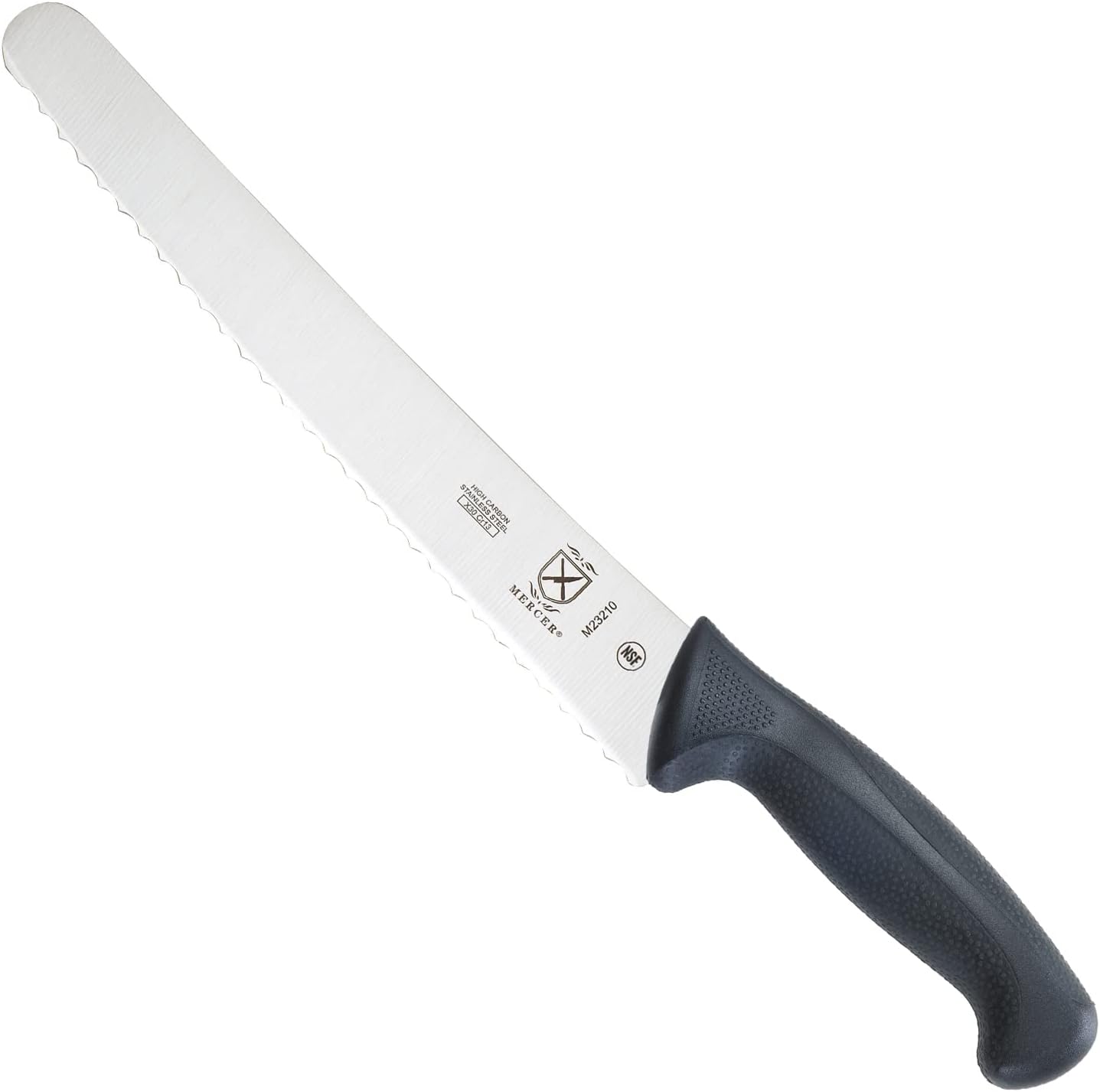
Any honest “battle of the budget kings” article has to acknowledge a third contender: Mercer Culinary’s Millennia line. Mercer is the dominant chef-knife brand in American culinary schools, and its Millennia 8″ chef’s knife competes directly with the Fibrox Pro on price, NSF certification, and culinary-school adoption. We have a full breakdown in our Mercer vs Victorinox comparison, but here’s the short version: the Mercer is a touch heavier, has a bigger and slightly less grippy handle, and uses a Japanese-sourced steel formula that some cooks find easier to maintain. The Victorinox grip is still better. The Mercer balance is more substantial. They’re so close on performance that most pros pick based on what their school issued them and never reconsider.
If you’ve been recommended a Mercer by a culinary school or a chef friend, don’t second-guess it — it’s a great knife. If you’re choosing in a vacuum between the three, the order I’d put them in for a typical home kitchen is: Victorinox Fibrox Pro for pure performance and grip, Henckels Classic for balance and traditional feel, Mercer Millennia for the middle ground.
Use-Case Buying Guide: Pick by What You Actually Cook
Spec sheets are useful, but most readers don’t have a clear question. They have a clear use case — “I want a knife I can actually use to break down a chicken” or “I want one I can hand to my teenager without worrying.” Here’s how the two brands play out across the kitchens I see most often.
For New Cooks & Culinary Students
Victorinox Fibrox Pro, every time. The grip alone makes it the safer first knife. The factory edge is ready to use straight from the box, so a new cook isn’t punished for not knowing how to sharpen yet. It’s NSF certified, which most US culinary schools require. And it’s affordable enough that you won’t cry if it gets nicked, dropped, or accidentally run through a dishwasher cycle in the early years. This is what I’d put in a college care package.
For First-Apartment Setups & Wedding Gifts
Henckels Statement 15-piece block set. The Fibrox Pro is a better single knife, but a single knife doesn’t equip a kitchen. The Statement set covers chef’s, paring, utility, bread, and a full row of steak knives in one box, with a self-sharpening block on top. For a brand-new kitchen — newlyweds, college grads moving into a real apartment, anyone replacing a hand-me-down knife drawer — the Statement is the highest-value way to instantly have everything you need.
For Weekend Cooks Who Want One “Real” Knife
Henckels Classic 8″ or Henckels Forged Premio. If you only cook seriously on weekends and want one nice forged knife that feels like the kitchen knives you remember from your grandparents’ house, the Classic delivers that experience for entry-level money. The Premio steps it up a notch with thinner geometry and a more refined handle for not much more cash. Either one looks better on a magnetic strip than a black Fibrox.
For Big-Batch Cooking, Canning, & Meal Prep
Victorinox Fibrox Pro 10″. When you’re prepping ten pounds of tomatoes for sauce or breaking down twenty pounds of chicken for the freezer, weight is the enemy. The lighter Fibrox in the longer 10-inch length covers more cutting board per stroke and keeps your forearm fresher. The grip stays secure even with greasy chicken-fat hands. This is the workhorse setup.
For Cooks With Smaller Hands, Arthritis, or Wrist Pain
Victorinox Fibrox Pro 7″ Santoku or the 8″ chef’s. The lighter weight is a gift for arthritic hands, and the slightly textured Fibrox grip needs less squeeze pressure than a smooth polymer handle. A heavier forged Henckels can become genuinely painful during a long prep session for someone with hand mobility issues. Smaller hands also tend to find the Fibrox handle’s modest profile more comfortable than the chunkier three-rivet Henckels Classic grip.
For Left-Handed Cooks
Both knives are functionally ambidextrous. Western chef’s knives are ground with a 50/50 (symmetric) edge, unlike single-bevel Japanese knives, which means the edge cuts straight regardless of which hand drives it. The Fibrox handle is a touch more left-friendly because it has no asymmetric thumb scoop. The Henckels Classic three-rivet handle is also symmetrical. If you’re a lefty, either works — buy on price and feel.
For Bone-In Chicken & Light Butchery
Henckels Classic, hands down. The forged blade has the spine thickness and weight to handle chicken backbones, ribs, and joint cartilage. The thinner Fibrox blade is technically capable but feels alarmingly flexy when you’re rocking through a chicken’s pelvis. Use the right tool. (And consider adding a dedicated boning knife from either brand if butchery is a regular thing — both make an inexpensive 5-6″ boning blade in the same lines.)
For Bread & Tomatoes
Either brand’s serrated bread knife is competent and inexpensive, but the Victorinox 10.25″ serrated bread knife is one of the most-recommended individual knives in all of professional cooking. It also doubles as a tomato knife for when you don’t feel like keeping the chef’s knife at maximum sharpness. If you’re shopping Henckels for a set, the included bread knife is fine. If you’re shopping open-stock, the Victorinox serrated is a no-brainer add-on.
Care, Sharpening & Long-Term Ownership
One reason these brands have stayed popular for decades isn’t just initial value — it’s that both are forgiving over the long haul. Soft-ish German/Swiss steel, simple geometry, and replaceable handles (in the case of the Fibrox Pro) mean a careful cook can keep one of these knives in service for ten to twenty years. Here’s the maintenance reality.
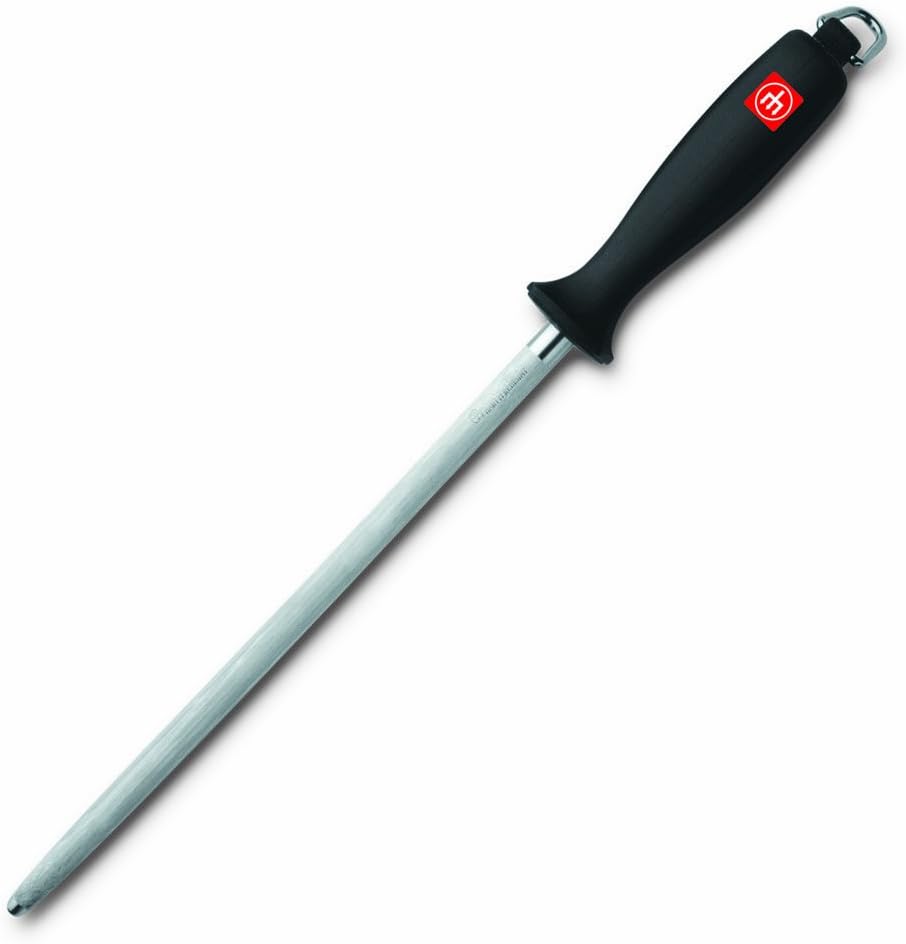
Honing Rod: Every Few Cooking Sessions
Both knives respond well to a steel honing rod. Five to ten light passes per side, alternating, restores the edge alignment between sharpenings. A ceramic rod is a slightly gentler option that some cooks prefer for soft European steel because it’s less aggressive than a steel rod. Either works. If you’re new to honing, watch a thirty-second video — it looks intimidating and it’s actually trivial.
Whetstone or Sharpener: Every 3–6 Months
For real edge work, a 1000/6000-grit combination whetstone is the gold standard for soft European steel and it’s a one-time purchase that lasts a lifetime. If stones intimidate you, a quality pull-through sharpener (Chef’s Choice and similar) does an acceptable job — not as good as a stone, but vastly better than nothing. Avoid the cheapest pull-through sharpeners; they grind too aggressively and shorten knife life. Both Henckels and Victorinox sell branded pull-through sharpeners that match their factory edge angles, which is the foolproof option.
Dishwasher Safety: The Real Answer
Manufacturer policies say “dishwasher safe” for both lines (the Fibrox handle is genuinely engineered for it; Henckels Statement is also rated for dishwasher use). The honest answer from anyone who’s owned these knives long-term: don’t do it. Dishwasher detergent is abrasive, the heat dries out polymer handles over decades, and the rack jostling rounds off your edge. Hand-wash, hand-dry, store on a magnetic strip or in a block. Your knife will thank you with another decade of service. The dishwasher might add a year of convenience and cost you five years of edge.
Storage
Don’t store any chef’s knife loose in a drawer. The edges bang against other utensils and dull within weeks. Both brands’ included blocks are fine, magnetic wall strips are excellent, and in-drawer dock organizers are the unsung hero of small kitchens. Whatever you do, the knife should never come into contact with hard metal surfaces between uses.
Rust & Corrosion
Both X50CrMoV15 and X55CrMo14 are highly stainless thanks to ~14–15% chromium content. Spotting rust on either of these knives means something is genuinely wrong — usually leaving the knife wet in a sink for hours, or storing it after cutting acidic citrus and not rinsing. A quick wipe with a soft cloth after each use is all the care needed. If light surface rust does appear, a paste of baking soda and water on a soft cloth removes it without damaging the finish.
Warranty, Resale, and the Long View
Both brands offer a limited lifetime warranty against manufacturing defects. In practice, this covers handle separation, blade cracking, and bolster issues — not “I dropped it on the floor and the tip broke.” Victorinox’s warranty service through their North American distributor is famously responsive; Henckels’ is slower but functional. Neither company will sharpen your knife for you under warranty (that’s wear, not a defect), but Victorinox does offer a paid sharpening-by-mail service that’s worth knowing about.
On resale and longevity: a well-cared-for Fibrox Pro from twenty years ago still goes for nearly its retail price on the used market because the design hasn’t changed and the Fibrox handle ages slowly. A twenty-year-old Henckels Classic with the original packaging holds value too, especially in collectible block-set configurations. Neither is an investment-grade knife the way some Japanese brands are, but neither depreciates the way mass-market gimmick knives do. If your grandkids inherit either of these, they’ll inherit something usable, not a paperweight.
The Broader Context: Climbing the Cutlery Ladder
Henckels and Victorinox are the titans of value, but they are the entry point into a much larger world of cutlery. Understanding what you get when you spend more is key to appreciating their value.
When you step up from Victorinox, you often land on the premium German brands. The comparison in our Wüsthof vs. Victorinox article clearly shows the difference in feel and balance you get from a forged, heirloom-quality knife. The same is true for Zwilling, Henckels’ parent company; as detailed in our Victorinox vs. Zwilling guide, the extra cost buys you a more refined instrument with better edge retention. To see how all these brands stack up, from budget to luxury, our definitive guide to the best chef knife brands is the perfect resource. The premium end of that spectrum is the legendary Shun vs Wüsthof debate, which highlights the pinnacle of Japanese and German knife philosophies.
What you really gain by spending more isn’t sharper knives at the moment of purchase — both Victorinox and Henckels arrive plenty sharp. What you gain is edge retention, geometry refinement, and finishing. A Wüsthof Classic Ikon holds its edge through perhaps three or four times as much cutting before it needs honing. A premium Japanese knife in something like SG2 powder steel can go six months to a year between sharpenings under home-cook use. The trade-off is fragility (harder steels chip more easily on bones and frozen food) and learning curve (Japanese profiles cut differently). For most home cooks, the value-tier knives in this article are objectively the smarter buy. The premium tier is for cooks who’ve decided knife maintenance is a hobby they enjoy.
Frequently Asked Questions
Is Henckels a good knife brand?
Yes, Henckels is an excellent value brand. They offer good quality materials and design for a very affordable price. Their forged lines, like the Henckels Classic, are particularly good deals, and their block sets are arguably the best value on the market for outfitting a new kitchen.
Which knife is more durable?
Both brands are known for durability. However, the forged Henckels Classic, being made from a single solid piece of steel with a full tang, has a structural advantage and feels more robust than the stamped Victorinox blade. For everyday use, both are more than tough enough.
Which knife stays sharp longer?
In my experience, their edge retention is very similar, with a slight advantage to Victorinox’s factory edge. Both use relatively soft steel that will require frequent honing (using a honing steel) to keep the edge aligned. Both are also very easy to fully re-sharpen.
Where are Henckels knives made?
Henckels International knives are manufactured globally. The forged Classic series is primarily made in Spain. Many of the stamped lines and block sets, like the Statement series, are made in China or India to keep costs down, all under the quality control of the German parent company, Zwilling.
What’s the difference between Henckels and Zwilling?
Same parent company, different product tiers. “Henckels International” (one-man logo) is the global value line, made in factories across Spain, China, and India. “Zwilling J.A. Henckels” (two-man logo) is the premium German-made line, produced in Solingen, Germany. Zwilling typically uses harder steel, more rigorous heat treatment (FRIODUR ice-hardening), and more hand-finishing. Expect to pay roughly 2–4× for a comparable Zwilling versus a Henckels.
Is Victorinox really made in Switzerland?
Yes. The Fibrox Pro and most Victorinox kitchen knives are produced in Ibach-Schwyz, Switzerland — the same factory that builds Swiss Army Knives. This is one of the few European kitchen-knife brands at this price point that has not outsourced production to Asia.
What steel does Victorinox use?
Victorinox uses X55CrMo14 — a chromium-molybdenum stainless steel with about 0.55% carbon and 14% chromium. It’s heat-treated to roughly 55–56 HRC. The steel is conservative by design: tough, easy to sharpen, very rust-resistant, and forgiving of cutting-board contact. It will not hold an edge as long as harder Japanese steels but it’s significantly easier to maintain.
What steel does Henckels use?
Henckels uses steels in the X50CrMoV15 family — the same broad alloy class used by Wüsthof, Zwilling, and most German workhorse knives. Approximately 0.5% carbon, 15% chromium, plus small additions of molybdenum and vanadium. Hardness lands in the 55–57 HRC range depending on the line.
Are Henckels and Victorinox dishwasher safe?
Manufacturer guidance allows dishwasher use for the Fibrox Pro and most Henckels stamped lines. In practice, hand-washing extends knife life dramatically. Dishwasher detergent is abrasive, the rack jostles edges, and prolonged moisture isn’t kind to wooden accents on lines like Victorinox Rosewood. Hand-wash and hand-dry whenever you can.
Is the Fibrox handle safe for professional kitchens?
Yes. The Fibrox Pro is NSF (National Sanitation Foundation) certified, which means it meets US commercial-kitchen sanitation standards. The smooth, seamless TPE handle has no crevices to harbor bacteria, and it stands up to industrial dishwashers and bleach sanitizers. This certification is part of why Fibrox Pro dominates American culinary schools and hotel kitchens.
What angle should I sharpen these knives at?
Both brands grind their factory edges to roughly 15° per side (30° inclusive). When you sharpen on a whetstone or with a guided sharpener, match that angle. Going steeper (e.g., 20° per side) will create a more durable edge for chopping bone-in but cuts less keenly. Going shallower (10–12° per side) is keener but chips more easily. 15° per side is the safe default for Western kitchen use.
Henckels Classic or Fibrox Pro for a first “real” knife?
Fibrox Pro for someone who values pure cutting performance, lightness, and grip — especially if they haven’t yet learned to sharpen. Henckels Classic for someone who values traditional balance, weight, and that forged-knife feel. Both are excellent choices; neither is wrong. If you’re undecided after reading both reviews, buy the Fibrox Pro — it’s slightly cheaper, performs better out of the box, and requires zero learning curve.
How long should one of these knives last?
With basic care — honing rod use, occasional sharpening, hand-washing, edge-protected storage — both knives easily last fifteen to twenty years of regular home-cook use. Victorinox tends to outlast Henckels at the very long term because the simple Fibrox construction has fewer failure points than a riveted handle. But both will outlive most kitchen appliances you own.
Final Verdict: A Choice Between Tradition and Utility
This isn’t a competition with a single winner. It’s about matching the right brand to the right person.
You Should Buy Henckels If:
- You are outfitting a new kitchen. Their block sets offer a complete, cohesive, and incredibly affordable solution.
- You prefer the weight and feel of a traditional German knife. The forged Henckels Classic gives you that satisfying balance and heft.
- Aesthetics matter to you. The classic three-rivet handle and polished bolster have a more traditional kitchen look than the utilitarian Victorinox.
- You’re giving a gift. A big, impressive knife block often makes a better gift than a single knife in a plastic package.
- You break down bone-in proteins regularly. The forged blade has the spine and weight to handle chicken backbones and joint work that a thinner stamped blade flexes through.
You Should Buy Victorinox If:
- You want the single best cutting tool for under $50. For pure performance, the Fibrox Pro is unmatched.
- Safety and grip are your top priorities. The Fibrox handle is simply the most secure grip you can get, especially in wet or messy conditions.
- You are a culinary student or work in a professional kitchen. The NSF certification and durability are essential.
- You prefer a lightweight, nimble knife that reduces fatigue. Long prep sessions, big-batch cooking, and arthritic hands all favor the lighter Swiss blade.
- You don’t want to learn knife maintenance yet. The factory edge is excellent and Victorinox’s affordable branded sharpener does the rest.
Here is my final, actionable advice: If your goal is to buy one single, great chef’s knife that will serve you for years, buy the Victorinox Fibrox Pro. If your goal is to buy a complete, matching set of knives to fully equip your kitchen on a budget, buy a Henckels Statement block set. If your goal is something in the middle — one really nice forged knife that doesn’t punish your wallet — go straight to the Henckels Forged Premio. By matching your purchase to your primary need, you are guaranteed to get the best value in the world of cutlery.