Zwilling vs Wusthof: Which German Chef’s Knife Brand Actually Deserves Your Money?
A no-fluff, blade-by-blade comparison of steel, geometry, ergonomics, and long-term value from two of Solingen’s most respected knife makers.
Introduction: Two Titans of Solingen
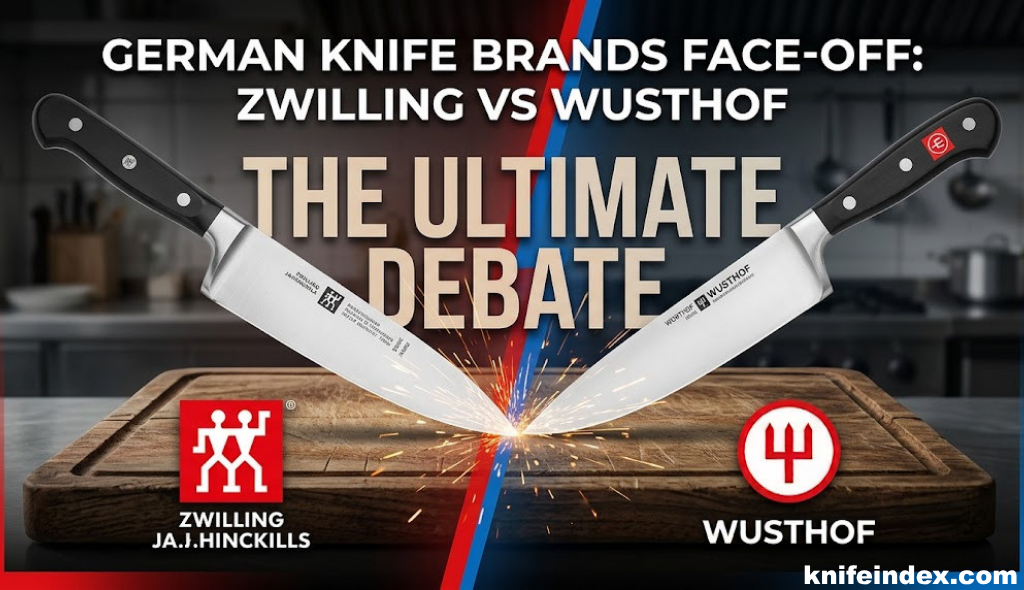
If you’ve spent any time shopping for a proper kitchen knife, you’ve almost certainly run into these two names. Zwilling and Wusthof are both headquartered in Solingen, Germany — a city so associated with bladesmithing it’s nicknamed the “City of Blades.” Both brands have been forging knives for well over two centuries, and both are frequently recommended in the same breath by professional chefs and home cooks alike.
That similarity is exactly what makes the decision so frustrating. On paper, a Zwilling chef’s knife and a Wusthof chef’s knife look nearly identical: full tang, triple-riveted handle, drop-forged German steel, similar price bracket. But once you’ve held both, cut with both, and lived with both for a few months, real differences emerge in balance, edge geometry, steel hardness, and overall feel in the hand.
This guide breaks down every meaningful difference between the two brands so you can buy with confidence instead of flipping a coin. We’ll also touch on how these German workhorses stack up against the Japanese steel philosophy for readers who are still deciding between styles entirely.
Want to see current pricing and available sets for both brands before you keep reading?
Check Prices on AmazonBrand History & Heritage
Wusthof: Founded 1814
Wusthof is a family-owned company, now in its seventh generation of Wüsthof family leadership. Founded in Solingen in 1814, the brand built its reputation on the Trident logo, one of the oldest registered trademarks still in continuous use. Wusthof has always leaned into a traditionalist identity — precision-forged, heavy-bolstered knives that feel substantial and reassuringly old-world in the hand.
Zwilling: Founded 1731
Zwilling J.A. Henckels is actually the older of the two companies, tracing its roots to 1731, making it one of the oldest trademarks in the world still in use today. Zwilling has grown into a much larger, more diversified company over the decades, now owning brands like Miyabi, Staub, and Ballarini. That scale has let Zwilling invest heavily in R&D, and it shows in features like their ICE-HARDENED FRIODUR blade treatment.
Both brands manufacture in Solingen for their flagship “Made in Germany” lines, though both also produce budget-friendly ranges overseas. If country of manufacture matters to your purchase decision, always check the specific line rather than assuming based on brand name alone.
Steel & Metallurgy: What’s Actually in the Blade
Both companies use proprietary variations of German stainless steel, generally in the X50CrMoV15 family — roughly 0.5% carbon, 15% chromium, plus molybdenum and vanadium for toughness and corrosion resistance. This steel type is famous for being tough and easy to maintain, though it doesn’t hold an edge quite as long as harder Japanese steels like those used in Miyabi’s higher-end lines.
| Attribute | Zwilling (Pro/Professional S) | Wusthof (Classic/Classic Ikon) |
|---|---|---|
| Steel Type | Special formula stainless (proprietary) | X50CrMoV15 |
| Approx. Rockwell Hardness | 57 HRC | 58 HRC |
| Hardening Process | FRIODUR ice-hardening | Precision Edge Technology (PEtec) |
| Corrosion Resistance | Excellent | Excellent |
| Edge Angle | ~15° per side (Pro line) | ~14° per side (PEtec lines) |
The takeaway: neither brand is chasing exotic super-steels here. Both prioritize toughness, easy resharpening, and rust resistance over raw edge-holding time — a sensible tradeoff for daily kitchen use rather than showroom collecting. If edge retention numbers matter more to you than brand heritage, it’s worth reading how similar tradeoffs play out in modern powder steels like S35VN vs S45VN used in premium pocket knives, just to understand where German kitchen steel sits on the broader spectrum.
Blade Construction & Geometry
This is where the brands genuinely diverge, and it matters more than the steel spec sheet suggests.
Wusthof’s Bolster Philosophy
Classic Wusthof knives feature a full bolster — that thick collar of steel between blade and handle — which adds weight toward the front-center of the knife and creates a rigid, substantial feel. It also traditionally acts as a finger guard. The tradeoff is that a full bolster can make full-blade sharpening trickier, since it prevents the heel of the blade from reaching the whetstone at the same angle as the rest of the edge.
Zwilling’s Half-Bolster Approach
Many Zwilling lines, including the popular Pro series, use a half-bolster or tapered bolster design specifically to solve this problem, allowing the entire edge — including the heel — to make full contact with a sharpening stone. This is a small detail that professional cooks notice quickly once they start freehand sharpening.
Wusthof Construction Pros
- Reassuringly heavy, front-weighted balance
- Full bolster offers hand protection
- Extremely rigid spine, resists flex
Zwilling Construction Pros
- Easier full-edge sharpening
- Slightly lighter, more nimble in hand
- Thinner heel geometry aids fine slicing
For readers who obsess over blade geometry the way pocket-knife enthusiasts do, this same “thin behind the edge” debate shows up across the whole hobby — see our breakdown of thin vs. thick behind the edge for the underlying physics.
See today’s best-selling Zwilling and Wusthof knife sets and single blades.
Shop Wusthof SetsHardness, Sharpness & Edge Retention
Straight out of the box, most reviewers and professional testers find Wusthof’s factory edge arrives noticeably sharper thanks to its slightly steeper Rockwell hardness and the precision PEtec edge-forming process. Zwilling’s factory edge is still sharp and functional, but many users report needing a quick strop or light honing session within the first few uses to bring it to its best.
Over the medium term — say, three to six months of regular home use — the gap narrows considerably. Both steels sit in a similar hardness bracket, so edge retention under normal cutting board use (vegetables, proteins, herbs) is close to a wash. Where you’ll notice a difference is in how each blade responds to abuse: cutting through bone, frozen food, or using the knife as a makeshift screwdriver (please don’t). Wusthof’s slightly harder steel tends to chip a hair more easily under lateral stress, while Zwilling’s marginally softer profile rolls rather than chips, which is arguably easier to fix with a honing steel.
If you’re the type of cook who wants to understand exactly why hardness numbers matter this much, our deep dive on Rockwell hardness in kitchen knives explains the tradeoffs between hardness, toughness, and edge stability in plain English.
Handles & Ergonomics
Both brands use synthetic polymer handles (often marketed as a proprietary blend) riveted in a classic triple-rivet pattern on their flagship lines. Both are dishwasher-resistant in theory, though neither brand actually recommends the dishwasher — heat and detergent will dull the edge and can degrade the handle bond over years of use.
In-Hand Feel
Wusthof’s Classic handle has a slightly more rounded, bulbous profile that fills a larger palm nicely and suits a hammer-grip or blade-forward pinch grip equally well. Zwilling’s Pro handle is a touch more contoured with a subtle finger notch near the bolster, which some cooks love for control and others find restrictive if their grip style shifts mid-task.
Neither handle shape is objectively “better” — this genuinely comes down to hand size and grip preference, similar to how handle material choice affects comfort across the wider knife world. If at all possible, hold both in a physical store before committing, especially if you have unusually small or large hands.
Product Lineups Compared
Both brands offer a confusing number of tiers. Here’s a simplified breakdown of the most relevant lines for home cooks.
| Tier | Zwilling Line | Wusthof Line | Best For |
|---|---|---|---|
| Entry / Value | Zwilling Four Star / Gourmet | Wusthof Gourmet | Budget-conscious first upgrade from big-box knives |
| Mid / Flagship | Zwilling Pro | Wusthof Classic | Most home cooks and serious hobbyists |
| Premium | Zwilling Professional S | Wusthof Classic Ikon | Ergonomics-focused upgrades, gifting |
| Ultra-Premium / Japanese Fusion | Miyabi (Zwilling-owned) | Wusthof Epicure / Nagoya sub-lines | Cooks who want harder steel and thinner geometry |
Notably, Zwilling’s ownership of Miyabi means if you love the Zwilling ecosystem but want a harder, thinner Japanese-style blade, you don’t have to leave the family — see our dedicated Miyabi Birchwood review for that crossover option. Wusthof doesn’t have a directly comparable in-house Japanese sub-brand, though its Nagoya-inspired lines borrow some geometry cues.

Compare the Zwilling Pro 8-inch chef’s knife against its closest Wusthof rival.
View Zwilling Pro LineReal Kitchen Performance
Chopping Vegetables
Both knives glide through onions, carrots, and herbs with minimal effort straight out of the box. Wusthof’s added heel weight gives a slightly satisfying “thunk” through dense root vegetables, while Zwilling’s lighter swing favors cooks who chop for long stretches and want less wrist fatigue.
Breaking Down Proteins
Neither of these is a dedicated boning or fillet knife, but for trimming chicken breasts or portioning a roast, both perform admirably. If your protein prep gets more serious, it’s worth pairing either brand’s chef’s knife with a dedicated boning knife rather than forcing a chef’s knife to do that job.
Precision Slicing
Wusthof’s slightly harder edge holds a fine slicing bevel a touch longer, giving it a small edge (pun intended) for delicate work like slicing raw fish thinly for home sushi nights — though if that’s your primary use case, a purpose-built yanagiba or sujihiki will outperform either German knife.
Rock-Chopping vs. Push-Cutting
Both brands’ chef’s knives have a similar curved belly suited to the classic rock-chop technique. If you’re a push-cutter rather than a rock-chopper, you may actually prefer the flatter profile of a santoku-style blade, which both brands also offer in their respective lineups.
Maintenance & Sharpening
Both brands recommend honing before each use with a ceramic or steel honing rod, and both are compatible with standard whetstones, pull-through sharpeners, and electric sharpening systems — though whetstones will always give the cleanest, longest-lasting edge. For a full walkthrough of the tradeoffs, see our guide on whetstone vs. electric sharpeners.
As mentioned earlier, Wusthof’s full bolster on Classic-line knives can make heel sharpening slightly more awkward on a flat stone; Zwilling’s tapered bolster avoids this issue on most of its Pro-line knives. If you sharpen your own knives regularly, this single detail may be the deciding factor.
For day-to-day upkeep between full sharpenings, a simple honing steel routine goes a long way — our comparison of honing steel vs. whetstone use cases explains when each tool is appropriate.
Durability & Warranty
Both companies back their flagship forged lines with a limited lifetime warranty against manufacturing defects, though neither warranty covers normal wear, chipping from misuse, or rust from improper care. Both brands’ full-tang, triple-riveted construction is built to last decades with reasonable care — hand washing, drying immediately, and proper block or magnetic strip storage rather than tossing them loose in a drawer.
Rust is rarely an issue with either brand’s stainless formulations, but if you ever do spot early surface rust, our guide on removing rust from a knife covers safe removal methods that won’t damage the finish.
Pricing & Value
At the flagship tier (Zwilling Pro vs. Wusthof Classic), pricing is nearly identical dollar-for-dollar on an 8-inch chef’s knife. Entry-level lines from both brands undercut the flagship tiers by a meaningful margin without sacrificing the core forged-steel construction, making them smart starter picks if you’re not ready to commit to the premium tier yet.
| Tier | Typical Price Range (8″ Chef’s Knife) | Value Notes |
|---|---|---|
| Entry-level | $ | Great intro to German forged steel |
| Flagship (Pro / Classic) | $$ | Best long-term value for most cooks |
| Premium (Professional S / Ikon) | $$$ | Ergonomic refinements, diminishing returns for most home use |
If your budget is capped and you’re weighing this purchase against other quality options entirely, it’s worth reading our roundup of the best budget chef’s knives before committing to either premium German brand.
Ready to pick your knife? Compare current bundle deals for both brands side by side.
See Current DealsWho Should Buy Which Brand
Choose Wusthof if you…
- Prefer a heavier, front-weighted knife
- Like the reassurance of a full bolster hand guard
- Mostly send knives out for professional sharpening
- Want the sharpest possible factory edge out of the box
Choose Zwilling if you…
- Sharpen your own knives on a whetstone regularly
- Prefer a lighter, more maneuverable blade
- Want the flexibility to step up into Miyabi later
- Chop for long stretches and want less hand fatigue
If neither ergonomic profile sounds compelling and you’re open to exploring other trusted German-adjacent options, our broader roundup of best German kitchen knives covers a wider field, including brands like Messermeister and Böker.
Alternatives Worth Considering
Not everyone needs to choose between exactly these two. A few honorable mentions worth cross-shopping:
- Victorinox Fibrox — dramatically cheaper, lighter, and beloved by working chefs; see our Victorinox chef knife review and the direct Victorinox vs. Zwilling comparison.
- Shun — Japanese-style harder steel with a thinner profile; see Shun vs. Wusthof for that matchup.
- Global — one-piece stainless construction with a completely different balance point; compare in Global vs. Wusthof.
- Dalstrong — aggressive marketing but genuinely competitive steel; see Dalstrong vs. Wusthof.
- Miyabi — Zwilling’s own premium sub-brand with harder SG2 or VG-MAX steel; see Miyabi vs. Wusthof.
For readers who haven’t yet settled on the German philosophy at all, our foundational comparison of German vs. Japanese steel is a useful starting point before you spend money on either Zwilling or Wusthof.
Paring & Utility Knives Compared
A chef’s knife gets all the attention in these debates, but the paring knife is where a lot of home cooks actually spend more hands-on time — peeling apples, deveining shrimp, hulling strawberries, trimming fat off a chicken thigh. Both Zwilling and Wusthof treat their paring knives as scaled-down versions of their flagship chef’s knife philosophy, and the same personality differences carry over at this smaller size.
Wusthof’s Classic paring knife keeps a small but present bolster, which on a 3 to 4-inch blade actually matters less than it does on a chef’s knife, since you’re rarely driving the heel into a cutting board at that scale. What you do notice is the handle — it’s proportioned generously enough that even larger hands don’t feel cramped, which is a common complaint with cheaper paring knives that seem designed for doll-sized fingers. The blade itself holds a fine edge well for the delicate, low-pressure cuts a paring knife is meant for, and the slightly firmer steel resists the kind of edge rolling you’d get from twisting the tip while removing a strawberry hull.
Zwilling’s Pro paring knife drops the bolster almost entirely, favoring a slimmer profile that some cooks find easier to maneuver in tight, precise work like deveining or trimming silverskin off a tenderloin. The tradeoff is a slightly lighter, less substantial feel that a small number of users describe as “flimsier,” even though the steel and construction quality is identical to the larger Pro-line knives. If your hands are on the smaller side, or you do a lot of fine detail work — think garnish carving or intricate fruit prep — the Zwilling shape tends to win people over.
Neither brand’s paring knife should be confused with a true utility knife, which sits in between a paring knife and a chef’s knife in both length and purpose. If you’re building out a full knife roll and trying to figure out exactly where a utility knife fits versus a paring knife, our detailed breakdown of paring vs. utility knives is worth a read before you buy either brand’s smaller blades. And if you’re still unclear on what a paring knife is actually for in the first place, our basics guide on what a paring knife is used for covers the fundamentals.
Which Paring Knife Should You Buy?
If you already own a Wusthof Classic chef’s knife, buying the matching paring knife keeps your knife roll visually and ergonomically consistent, and the firmer edge holds up well to the twisting motions common in produce prep. If you already lean Zwilling for your primary chef’s knife, the Pro paring knife’s lighter feel will match the rest of your set nicely without introducing an unfamiliar grip pattern.
Santoku & Nakiri Compared
Both Zwilling and Wusthof offer santoku-style knives as an alternative to the traditional Western chef’s knife, and both also dabble in nakiri-style vegetable cleavers, though with noticeably different levels of commitment to the format.
A santoku’s flatter belly and shorter length make it a natural fit for push-cutting rather than the rock-chop motion a curved chef’s knife encourages. Wusthof’s santoku keeps the same full-bolster, heavier-handed philosophy as its chef’s knives, which some cooks find at odds with the santoku’s traditionally lighter, more nimble intended use. Zwilling’s santoku, by contrast, tends to feel closer to what you’d expect from the format — light, quick, and well-suited to rapid vegetable prep — likely because Zwilling’s broader ownership of Miyabi has influenced how its in-house design team thinks about Japanese-style blade shapes even on its German-made lines.
Neither brand’s santoku includes the traditional kullenschliff (granton) hollow-ground dimples as standard on every size, though several santoku models from both brands do offer this feature specifically to reduce food sticking to the blade face during rapid slicing.
If you’re trying to decide whether a santoku or a full chef’s knife suits your actual cooking style better, it’s worth reading our comparison of chef’s knife vs. santoku before spending money on either brand’s version. For vegetable-heavy cooks specifically, our nakiri vs. santoku breakdown digs into why a flat-edged nakiri might outperform both a santoku and a chef’s knife for pure vegetable volume work, and our wider best nakiri knives guide covers options beyond just these two German brands.
Nakiri: Not a German Specialty
To be blunt, neither Zwilling nor Wusthof is where you should shop first if a true nakiri is your goal. Both brands offer nakiri-shaped blades, but the format was born in Japan for a reason — a thinner, harder steel edge holds the flat, precise vegetable cuts a nakiri is designed for far better than the tougher, slightly thicker German steel formulations either brand uses. If you love the Zwilling ecosystem, stepping up to a Miyabi nakiri will genuinely outperform Zwilling’s own in-house nakiri offering.
Bread & Serrated Knives Compared
Bread knives rarely get the spotlight in a Zwilling vs. Wusthof debate, but if you bake at home or regularly buy crusty artisan loaves, the difference between these two brands’ serrated offerings is genuinely noticeable.
Wusthof’s Classic bread knife uses a wide-set, deep serration pattern that bites aggressively into a hard crust without crushing the soft crumb underneath — a common failure point for cheaper serrated knives that flatten a loaf instead of slicing it cleanly. The tradeoff is that this deep serration pattern is genuinely difficult to resharpen at home; most owners simply replace the knife every several years rather than attempting a full resharpen, since serrated edges require specialized sharpening tools most home cooks don’t own.
Zwilling’s Pro bread knife uses a slightly shallower, more tightly-spaced serration pattern, which some bakers find gives a cleaner, less ragged cut on softer sandwich breads and brioche, though it can struggle slightly more with a very hard, chewy sourdough crust compared to Wusthof’s deeper teeth.
If you’re building a broader case for what makes a good serrated knife in the first place, our dedicated explainer on what a bread knife is used for covers serration patterns in more depth, and our head-to-head on bread knife size considerations explains why blade length matters more than most buyers assume when slicing a full round loaf versus a long baguette.
Steak Knives: The Overlooked Companion Purchase
Both brands also sell matching steak knife sets designed to complement their flagship chef’s knife lines, typically with a similar handle shape for visual and ergonomic consistency at the dinner table. If dishwasher convenience matters to you for this particular category — since steak knives get handled far more casually than a chef’s knife — our roundup of best dishwasher-safe steak knives is worth checking before assuming either German brand’s steak knives are dishwasher-friendly by default.
Knife Sets, Blocks & Bundles
Buying a full knife block set from either brand is almost always cheaper per-knife than buying each piece individually, but it comes with a common tradeoff: sets typically bundle in one or two knives you’ll rarely use (a birds-beak knife, a second paring knife, honing steel and kitchen shears you may already own) to pad out the perceived value.
Wusthof’s classic block sets tend to lean toward a traditional 7 to 10-piece configuration, with the block itself made from solid wood and designed to sit on a counter as a semi-permanent fixture. Zwilling’s block sets often include a slightly wider range of specialty blades depending on the specific bundle, reflecting the company’s larger overall product catalog.
Before buying a full set from either brand, it’s worth honestly assessing which blades you’d actually reach for daily. Our guide on three blades that can replace a full block makes the case that most home cooks only need a chef’s knife, a paring knife, and a serrated bread knife to cover 90% of kitchen tasks — everything else in a boxed set is often just clutter with a knife handle.
If storage space is a genuine constraint rather than just a preference, both brands’ individual knives pair well with space-saving solutions covered in our small kitchen magnetic strip layouts guide, which is often a smarter buy than a bulky wooden block if counter space is tight. For readers assembling a full professional-grade rotation rather than a starter set, our list of the 10 essential kitchen knives for a professional rotation is a useful shopping checklist regardless of which brand you ultimately choose.
Block Set vs. Open Stock: Which Is the Smarter Buy?
Open-stock buying — purchasing each knife individually rather than as a set — costs more upfront per knife but lets you mix and match exactly the blades you need, potentially even blending brands (a Wusthof chef’s knife alongside a Zwilling bread knife, for example). If you’re the type of cook who already knows your preferred blade shapes, open stock is almost always the better long-term value. If you’re building a kitchen from scratch and aren’t sure what you’ll actually use, a modestly sized set from either brand is a reasonable, lower-research starting point.
Country of Origin: Solingen vs. Overseas Lines
“Made in Germany” carries real weight in the knife world, and both Zwilling and Wusthof lean on that heritage in their marketing — legitimately, for their flagship lines. But it’s worth understanding exactly which product lines are actually forged in Solingen and which are produced elsewhere under the same brand name, since this detail gets glossed over in a lot of casual buying guides.
Wusthof’s Classic, Classic Ikon, and Epicure lines are manufactured in Solingen, Germany, using the company’s own forging facilities. Some of Wusthof’s more budget-oriented lines and licensed products, however, are produced in other facilities, and the company is generally transparent about this distinction if you check the specific product packaging or listing rather than assuming based on brand name alone.
Zwilling follows a similar pattern: its Pro, Professional S, and Four Star lines trace back to Solingen manufacturing, while some of its more accessible sub-lines and licensed collaborations are produced overseas to hit a lower price point. Because Zwilling owns a much larger portfolio of brands than Wusthof — including Miyabi (Japan-made), Staub, Ballarini, and various licensed collections — it’s especially important to check the specific line rather than assuming everything under the Zwilling corporate umbrella is Solingen-forged.
Neither company is being deceptive here — country-of-origin claims for cookware are generally regulated, and both brands clearly label their Solingen-made flagship products as such. The confusion tends to come from shoppers assuming the entire brand catalog shares one manufacturing story, when in reality large knife companies increasingly run tiered manufacturing strategies to serve different price points.
Does It Actually Matter for Performance?
Honestly, for most home cooks, country of origin matters more as a heritage and marketing signal than as a hard performance guarantee. Overseas-produced lines from both brands still generally meet the same steel specification and quality control standards the parent company sets, even if the romantic “hand-forged in a centuries-old German workshop” story doesn’t apply to every single SKU. If country of manufacture is a genuine priority for you — whether for quality assurance or simply personal preference — always check the specific product page rather than relying on brand reputation alone.
Blade Size Chart: 6″ vs 8″ vs 10″
Both brands offer their flagship chef’s knife in multiple lengths, and the right size genuinely depends on your hand size, cutting board space, and the volume of food you typically prep in one sitting.
| Blade Length | Best For | Wusthof Availability | Zwilling Availability |
|---|---|---|---|
| 6 inch | Smaller hands, tight cutting boards, precise work | Classic, Classic Ikon | Pro, Four Star |
| 7 inch | A middle-ground compromise size | Classic (select SKUs) | Pro |
| 8 inch | The default recommendation for most home cooks | Classic, Classic Ikon, Epicure | Pro, Professional S, Four Star |
| 9 inch | Larger hands, high-volume prep | Classic (select SKUs) | Pro (select SKUs) |
| 10 inch | Restaurant-volume prep, larger produce like squash | Classic, Classic Ikon | Pro, Professional S |
The 8-inch length remains the industry-standard recommendation from both brands, and for good reason — it’s long enough to handle a butternut squash or a whole cabbage in a couple of passes, while still being controllable for someone without professional-level knife skills. If you regularly break down larger, denser vegetables, our comparison of gyuto vs. chef’s knife for heavy squash explores whether a longer Japanese-style blade might actually suit that specific task better than either brand’s German 8 or 10-inch offering.
Smaller cooks or those with limited hand strength sometimes gravitate toward the 6-inch size from either brand, trading some cutting capacity for significantly reduced wrist fatigue during long prep sessions — a real consideration if you’re cooking for a large family multiple times a week rather than the occasional weekend meal.
Left-Handed Cooks & Grip Considerations
Neither Zwilling’s nor Wusthof’s flagship Western-style knives are handed in the traditional sense — meaning the blade grind is symmetrical and works equally well in either hand, unlike some single-bevel Japanese blades that are ground specifically for right or left-handed use. This is genuinely good news for left-handed cooks who don’t want to hunt down a specialty left-handed SKU or pay a premium for one.
Where handedness can still matter with either brand is in the bolster and finger-notch design on certain handle shapes. Wusthof’s Classic Ikon handle, with its more sculpted grip zone, was designed with a right-hand-dominant grip pattern in mind, and a small number of left-handed users report it feels slightly less natural than the more neutral standard Classic handle. Zwilling’s handles are generally considered more grip-neutral across its main lines, though individual hand shape and grip style will always matter more than brand-level generalizations.
If you’re comparing single-bevel options at all — which do require handedness-specific purchasing — our guide on single-bevel vs. double-bevel blades explains why that distinction matters so much more for traditional Japanese knives than it does for either Zwilling or Wusthof’s Western-style double-bevel lineup.
Dishwasher Damage & Cleaning Deep Dive
We touched on this earlier, but it’s worth going deeper, because “is it dishwasher safe” is one of the most searched questions about both brands, and the honest answer is more nuanced than a simple yes or no.
Both Zwilling and Wusthof use synthetic handle materials on their flagship lines that are technically water- and heat-resistant enough to survive an occasional dishwasher cycle without falling apart. However, three separate mechanisms of damage occur even when the handle itself survives structurally intact:
- Edge dulling from contact — dishwasher racks force the blade to knock against other utensils, plates, and the rack itself during the wash and dry cycles, physically dulling the fine edge geometry over repeated cycles.
- Detergent corrosion — modern dishwasher detergents are highly alkaline and, combined with prolonged heat and moisture exposure, can slowly degrade even good stainless steel’s protective oxide layer over hundreds of cycles, leading to pitting or discoloration.
- Handle bond stress — the repeated heat-up and cool-down cycles of a dishwasher can, over years, stress the resin bond between a riveted handle and the tang, occasionally leading to a slightly loose feel long before the knife would otherwise need replacing.
Both companies explicitly recommend hand washing and immediate drying for exactly these reasons, even on knives marketed as dishwasher-resistant. If you’ve already run either brand’s knives through a dishwasher a few times and are seeing early rust spots, our step-by-step guide on removing rust from kitchen knives covers safe, non-damaging removal methods. For a longer-term storage routine that keeps either brand’s knives rust-free between uses, see our guide on how to prevent rust on knives.
Gifting Guide: Which Brand Wins as a Gift
Both Zwilling and Wusthof make genuinely excellent gifts for a home cook, wedding registry, or housewarming, largely because both carry enough brand recognition that the recipient will understand they’re receiving something premium without needing to research it themselves.
Wusthof tends to have a slight edge as a gift specifically because of its Trident logo and the “old-world heirloom” story that comes with a 1814 founding date — it reads as a classic, safe choice for a more traditional recipient, a parent, or an in-law who values heritage branding. The heavier, more substantial in-hand feel also photographs and unboxes well, which matters more than we’d like to admit for a gift-giving occasion.
Zwilling makes more sense as a gift for a recipient who already has some knife knowledge or a stated preference for lighter, more maneuverable blades — a home cook who’s mentioned wanting to get into sharpening their own knives, for instance, since Zwilling’s tapered bolster design directly serves that hobby. It’s also the safer choice if you know the recipient already owns other Zwilling-family products like Staub cookware, since matching a cohesive brand ecosystem in a kitchen gift tends to land well.
Either brand’s single boxed chef’s knife makes a cleaner, more focused gift than a full block set, which can feel impersonal or redundant if the recipient already owns some knives. If you want a gift that’s still practical but slightly more unique, pairing either brand’s chef’s knife with a well-reviewed chef’s knife roll or bag elevates a simple knife gift into something that reads as more thoughtfully curated.
What Professional Chefs Actually Say
Ask around any professional kitchen and you’ll get a genuinely mixed answer between these two brands — which itself tells you something useful. Neither is considered a compromise choice among working chefs; both show up regularly in culinary school knife kits and professional knife rolls.
Chefs who came up through more classically French-influenced kitchens often gravitate toward Wusthof, citing the heavier balance as an advantage for the repetitive, high-volume mise en place work that defines a typical prep shift — the added weight does some of the cutting work for you over an eight-hour shift, reducing wrist fatigue in a different way than a lighter blade would.
Chefs who sharpen their own knives obsessively, or who trained in kitchens with a stronger Japanese-technique influence, more often lean Zwilling, appreciating the easier full-edge stone access and the lighter swing for rapid, high-precision cuts. It’s genuinely common to see chefs owning knives from both brands simultaneously, using each for the tasks it happens to suit best rather than treating the choice as an exclusive brand loyalty.
What almost no professional disagrees on is that either brand, properly maintained, will outperform the vast majority of consumer-grade knife sets sold at big-box retailers — the real performance gap in this conversation isn’t Zwilling versus Wusthof, it’s either of these brands versus an unmaintained, never-honed knife of any origin.
Resale Value & Long-Term Ownership
Neither brand is typically purchased with resale value in mind — these are tools meant to be used for decades, not flipped for profit — but it’s still worth understanding how each brand holds up on the secondhand market, since it reflects broader build-quality perception.
Wusthof knives, particularly older Classic-line pieces from past decades, tend to hold reasonable secondhand value precisely because the design has remained largely unchanged for generations — a used Wusthof Classic chef’s knife from years ago is still functionally identical to a new one, which reassures secondhand buyers that they’re not getting an outdated product. Well-maintained vintage Wusthof pieces occasionally attract interest from collectors specifically because of this design consistency.
Zwilling’s broader product evolution over the decades — driven by its larger corporate scale and more frequent line refreshes — means older secondhand Zwilling knives sometimes differ meaningfully in construction or steel formulation from current production, which can slightly complicate secondhand valuation for buyers trying to confirm exactly what they’re purchasing.
In practical terms, both brands’ knives are worth keeping and maintaining rather than replacing at the first sign of wear. A full professional resharpening, new handle rivets if needed, or even just a proper deep-clean and re-honing can restore either brand’s knife to near-original performance far more cost-effectively than buying a replacement, provided the blade hasn’t suffered structural damage like a snapped tip or heavily pitted, rusted steel that a simple rust removal process can’t fully reverse.
Frequently Asked Questions
Is Zwilling or Wusthof better for a beginner home cook?
Either is a strong choice, but Wusthof’s sharper factory edge and reassuring heft make it slightly more forgiving for someone who isn’t planning to sharpen their own knives regularly. Zwilling rewards cooks who plan to maintain their own edge over time.
Are Zwilling and Wusthof knives dishwasher safe?
Both brands technically use dishwasher-resistant materials on their flagship lines, but neither company recommends it. Heat, detergent, and knocking against other utensils will dull the edge and can loosen the handle rivets over years of repeated washing.
Which brand holds an edge longer?
The two are very close, since both use steel in a similar hardness range. Wusthof’s slightly harder edge may hold a fine edge marginally longer under light use, while Zwilling’s marginally softer edge is easier to bring back with a honing steel between full sharpenings.
Can I sharpen these knives myself, or do I need a professional?
Both are fully compatible with home whetstone sharpening. Zwilling’s tapered bolster design on many Pro-line knives makes reaching the heel of the blade slightly easier for freehand sharpeners compared to Wusthof’s full-bolster Classic line.
Do Zwilling and Wusthof make their knives in Germany?
Their flagship forged lines are made in Solingen, Germany. However, both companies also produce lower-tier or licensed product lines overseas, so it’s worth checking the specific product listing rather than assuming based on brand alone.
Which brand is heavier?
Wusthof’s Classic line generally feels heavier and more front-weighted due to its full bolster. Zwilling’s Pro line trims some of that bolster weight for a lighter, more nimble feel in hand.
Is Miyabi better than both Zwilling and Wusthof?
Miyabi, owned by Zwilling, uses harder Japanese-style steel and thinner geometry, which can outperform both brands in raw sharpness and edge retention — at the cost of being more brittle and less forgiving of hard use like bone-cutting.
What’s the difference between Wusthof Classic and Classic Ikon?
Classic Ikon uses a redesigned, more ergonomic handle shape and a slightly different bolster, while keeping essentially the same steel and hardening process as the standard Classic line. It’s a comfort upgrade rather than a performance upgrade.
Do these knives come with a warranty?
Yes, both brands offer a limited lifetime warranty on their flagship forged knives against manufacturing defects, though normal wear, chipping, and rust from improper care are not covered.
Which knife is better for cutting through bone or frozen food?
Neither is designed for that task, and doing so regularly can damage either blade’s edge. If you frequently break down bone-in proteins, pair your chef’s knife with a dedicated cleaver or boning knife instead.
Can beginners tell the difference between the two brands in daily use?
Honestly, in casual home cooking, most people notice balance and handle comfort far more than steel performance differences. It’s worth handling both in person if you can, since personal grip preference matters more than the spec sheet for most buyers.
Conclusion: The Real Verdict
There’s no universally “correct” answer between Zwilling and Wusthof — both brands make genuinely excellent, decades-durable German forged knives, and either one will outperform a big-box store knife set for the rest of your cooking life. If you want the sharper out-of-box edge, more heft, and a traditional full-bolster feel, lean Wusthof. If you plan to sharpen your own knives, prefer a lighter blade, and like the option to step up into Miyabi later, lean Zwilling.
Whichever you choose, invest in proper care: hand-wash only, dry immediately, hone before each use, and store on a block or magnetic strip rather than loose in a drawer. Do that, and either knife will likely outlast you in the kitchen.
Ready to make your choice? Compare live pricing, current bundle deals, and available blade sizes for both brands before you buy.
Compare Zwilling & Wusthof on Amazon