Gyuto vs. Chef Knife: Which Primary Blade Should Command Your Cutting Board?
In the culinary universe, whether you are a Michelin-starred executive chef or an enthusiastic home cook preparing a humble weeknight dinner, the “Chef’s Knife” is the undisputed, absolute king of the kitchen. It acts as a direct extension of the cook’s hand and is functionally responsible for roughly 90% of all standard prep work. But if you have been actively browsing knifeindex.com looking to upgrade your primary blade, you have likely noticed a massive division in the ranks.
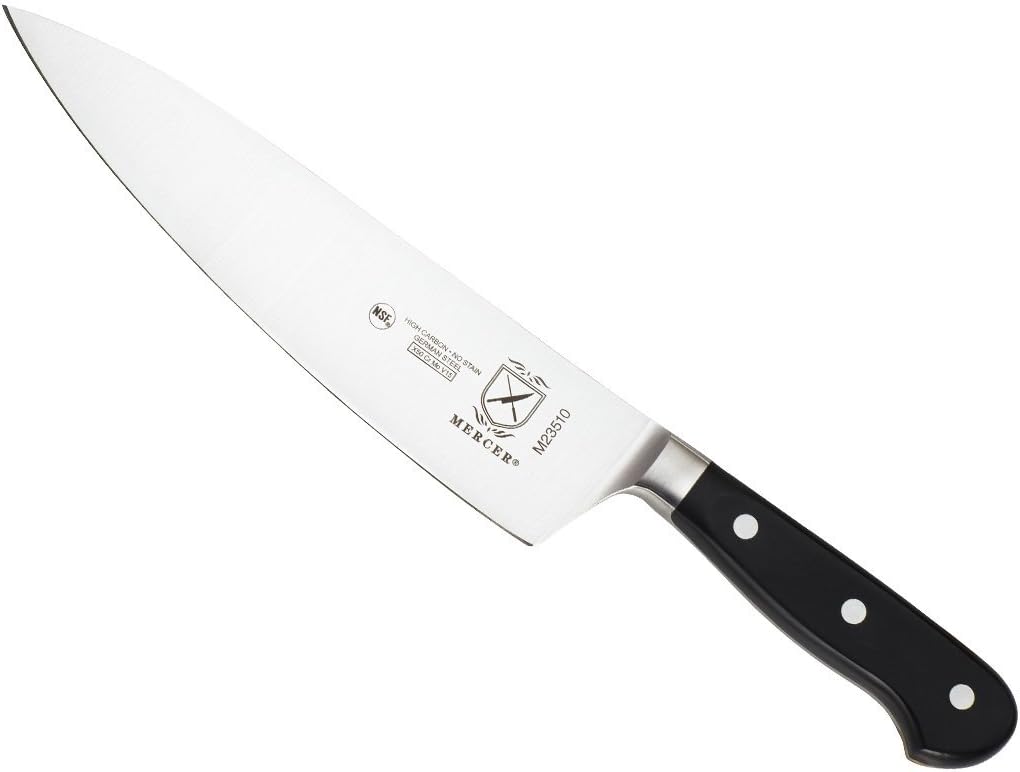
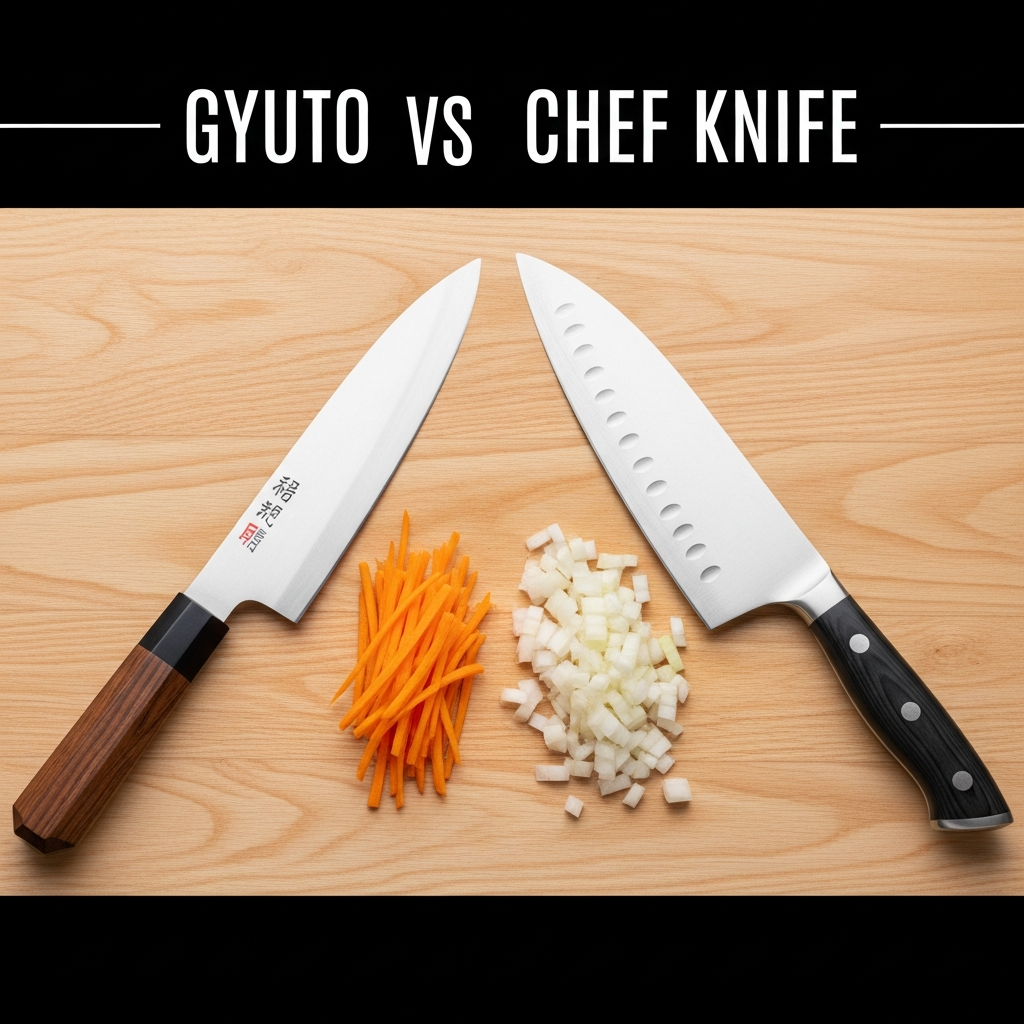
On one side of the cutting board lies the Western Chef Knife (traditionally German or French): robust, heavily curved, substantial in weight, and built like an indestructible tank. On the exact opposite side lies the Japanese Gyuto: exceptionally nimble, razor-thin, elegantly balanced, and sharpened to a scalpel-like edge. Are they simply different names for the same tool? Not quite.
The deeply debated Gyuto vs. Chef Knife rivalry is about vastly more than just geographical origins; it fundamentally comes down to distinct cooking styles, personal maintenance habits, ergonomic preferences, and your inherent physical cutting technique. Whether you are a die-hard fan of rugged German steel that can withstand brutal abuse, or you crave the effortless, feather-light precision of premium Japanese blades, this meticulously detailed, comprehensive guide will help you definitively decide which sword belongs in your kitchen stone.
Understanding Professional Kitchen Knife Terminology: A Primer for the Discerning Chef
Before diving deep into the specific comparison between the Japanese Gyuto and the Western chef’s knife, it is absolutely essential to establish a foundational understanding of professional kitchen knife terminology. The world of high-end cutlery is saturated with specialized vocabulary that can overwhelm even experienced home cooks. Terms like Rockwell hardness scale ratings, blade geometry, distal taper, edge retention, chromium carbide formation, martensitic steel structures, and double-bevel versus single-bevel edges are frequently thrown around in knife forums and product descriptions without proper context. This section serves as your comprehensive glossary and educational primer, ensuring you can make an informed purchasing decision based on objective technical specifications rather than marketing hyperbole.
The Rockwell Hardness Scale (HRC) Explained in Detail
The Rockwell Hardness Scale, specifically the C scale (HRC) used for measuring knife steel, is arguably the single most important technical specification to understand when comparing any chef knife or Gyuto. Developed by Stanley Rockwell in 1919, this indentation hardness test measures the permanent depth of penetration when a diamond cone indenter is applied to the steel surface under a major load of 150 kilograms. The resulting number on the HRC scale directly correlates to the steel’s ability to resist permanent deformation, which in culinary terms translates to edge retention, sharpness potential, and brittleness.
For professional kitchen knives and home cook cutlery, the HRC spectrum typically ranges from 52 to 67. Soft stainless steel knives used in budget culinary school starter kits often measure around 52-54 HRC, while premium Japanese Gyuto knives forged from exotic powdered metallurgy steels can reach an astonishing 66-67 HRC. The relationship between hardness and performance is not linear, and understanding the trade-offs at every increment is crucial for matching the knife to your specific cooking style, cutting board material, and maintenance commitment.
At the lower end of the spectrum (54-56 HRC), you find knives that are extremely tough, ductile, and forgiving. These blades will deform and roll rather than chip when subjected to lateral stress, making them ideal for heavy-duty tasks like breaking down whole poultry, cutting through small bones, or processing semi-frozen ingredients. The trade-off is that they cannot hold an extremely acute edge angle and require frequent honing and sharpening to maintain acceptable cutting performance. Many commercial kitchen supply knives and entry-level German chef knives fall into this category.
In the middle range (57-59 HRC), you encounter the sweet spot for most Western professional chef knives. Brands like Wüsthof, Zwilling J.A. Henckels, and Messermeister target this hardness range for their flagship lines because it offers an excellent balance between edge retention and ease of maintenance. The steel is hard enough to hold a reasonably sharp edge through extended prep sessions, yet soft enough that a busy line cook can quickly realign the edge with a few strokes on a honing steel without interrupting the rhythm of service. This is the hardness range that built the reputation of German engineering in professional kitchens worldwide.
The high range (60-62 HRC) marks the entry point for serious Japanese Gyuto performance. At this hardness level, the steel matrix has undergone sufficient martensitic transformation during heat treatment to form a dense network of hard chromium and vanadium carbides suspended in a hardened steel matrix. The resulting blade can be ground to remarkably acute edge angles—often 12-15 degrees per side—and will maintain that razor edge through pounds of vegetable prep without requiring touch-ups. However, this hardness introduces genuine brittleness concerns that demand respect. A lateral twist in a dense butternut squash or an accidental collision with a chicken bone can result in micro-chipping or catastrophic edge failure.
At the extreme high end (63-67 HRC), you enter the realm of specialized powdered metallurgy super-steels like SG2, R2, ZDP-189, and HAP40. These exotic alloys push the boundaries of what is physically possible in knife steel, achieving hardness levels that rival some tool steels while maintaining enough toughness to function as kitchen cutlery. Knives at this hardness level are essentially scalpels for food preparation—they offer unparalleled slicing aggression and edge retention measured in months rather than days, but they absolutely require flawless technique, specialized sharpening equipment, and an almost ceremonial level of care. Dropping such a knife onto a tile floor will almost certainly result in a shattered blade.
Blade Geometry: The Invisible Determinant of Cutting Performance
While steel type and hardness receive the majority of attention in knife marketing materials, blade geometry—the three-dimensional shape of the blade’s cross-section—is arguably more impactful on real-world cutting performance. A poorly ground blade made from the finest SG2 powdered steel will cut worse than a perfectly ground blade made from basic AUS-8 stainless. Understanding the elements of blade geometry empowers you to look beyond brand names and steel specifications to evaluate how a knife will actually perform on your cutting board.
Spine thickness refers to the measurement of the unsharpened top edge of the blade, typically measured at the heel, midpoint, and one inch from the tip. Western chef knives traditionally feature substantial spine thickness (2.5-3.5mm at the heel) to provide the heft and rigidity required for powering through dense root vegetables and tough connective tissue. The thick spine creates a wedge effect that forcefully separates food as the blade passes through, which can be advantageous for splitting hard squash but disadvantageous when attempting paper-thin slices of soft tomato. Japanese Gyuto blades typically feature dramatically thinner spines (1.5-2.5mm at the heel) that taper aggressively toward the tip, minimizing drag and allowing the blade to ghost through ingredients with almost no perceived resistance.
Distal taper describes the gradual thinning of the blade from the heel toward the tip. A well-executed distal taper is a hallmark of premium knife craftsmanship, indicating that the bladesmith or grinding technician invested significant time in creating a blade that transitions seamlessly from the robust heel section (where strength is needed for heavy chopping) to the delicate tip (where precision is needed for detailed work). Mass-produced knives often lack meaningful distal taper, resulting in blades that feel clumsy and imprecise at the tip. Hand-forged Japanese Gyutos and high-end Western customs frequently exhibit dramatic distal taper that transforms the cutting experience from heel to tip.
The grind refers to the specific cross-sectional shape of the blade from spine to edge. The most common grinds found in kitchen knives include full flat grinds, convex grinds, hollow grinds, and compound grinds that combine multiple geometries. A full flat grind creates a straight V-shape from spine to edge, offering excellent slicing performance but potentially creating friction and sticking when cutting through tall, dense ingredients. Convex grinds curve outward from the spine toward the edge, creating a shape that smoothly pushes food away from the blade face, dramatically reducing the sticking that plagues flat-ground knives when dicing potatoes or onions. Many premium Gyutos feature hand-ground convex geometries that produce almost magical food release properties. Hollow grinds, created by grinding the blade face with a large-diameter wheel, produce a concave surface that reduces sticking but can create structural weakness if ground too thin.
Edge Angle and Bevel Configuration
The angle at which the cutting edge is ground is the final arbiter of cutting performance and durability. Kitchen knife edge angles are typically measured in degrees per side, with the total inclusive angle being double that measurement. A Western chef knife ground at 20 degrees per side has a total inclusive edge angle of 40 degrees—robust enough to withstand contact with bones and cutting boards, but geometrically limited in its ability to initiate cuts smoothly. A Japanese Gyuto ground at 12 degrees per side has a total inclusive angle of only 24 degrees, creating a dramatically more acute wedge that initiates cuts with almost no resistance.
The relationship between edge angle and steel hardness is deterministic. Softer steel (54-58 HRC) cannot support an edge angle below approximately 15 degrees per side without the edge immediately rolling or deforming upon contact with the cutting board. Harder steel (60+ HRC) possesses the structural integrity to maintain edge angles as low as 8-10 degrees per side, though such extreme acuteness introduces fragility concerns that most manufacturers mitigate by staying in the 12-15 degree range. Understanding this relationship explains why you cannot simply sharpen a soft German chef knife to a Japanese angle and expect it to perform—the steel matrix itself lacks the hardness to support such acute geometry.
Most Western chef knives and Japanese Gyutos feature double-bevel edges, meaning the edge is ground symmetrically from both sides of the blade. This is distinct from traditional single-bevel Japanese knives like Yanagiba and Usuba, which are ground only from one side to create an extremely acute edge for specialized slicing tasks. Double-bevel edges are ambidextrous and forgiving of technique variations, making them ideal for general-purpose kitchen knives. Some premium Gyutos feature asymmetric double-bevel edges (60/40 or 70/30 splits) that combine some of the cutting advantages of single-bevel geometry with the versatility and ease-of-use of double-bevel designs.
Handle Ergonomics and Grip Styles for Professional Chefs
The handle of a kitchen knife is the critical interface between the tool and the human hand, and its design profoundly influences comfort, control, and safety during extended prep sessions. Professional chefs who spend six to twelve hours daily with a knife in hand develop strong preferences for specific handle shapes, materials, and balance characteristics. Understanding the ergonomic science behind handle design will help you select a knife that minimizes fatigue and reduces the risk of repetitive strain injuries.
The pinch grip is the universally recommended grip for professional knife work, regardless of whether you wield a Western chef knife or a Japanese Gyuto. In this grip, the thumb and index finger pinch the blade itself just forward of the handle, while the remaining three fingers wrap around the handle. This grip position maximizes control by bringing the hand as close as possible to the cutting edge, effectively shortening the lever arm and increasing precision. The pinch grip also naturally encourages proper wrist alignment, reducing the risk of carpal tunnel syndrome and tendonitis that can plague cooks who use improper full-handle grips.
Western knife handles are designed with a pronounced contour that fills the palm when gripped conventionally, but they also accommodate the pinch grip through a curved transition zone (the choil) where the blade meets the handle. The presence or absence of a full bolster dramatically affects pinch grip comfort. Traditional forged Western knives feature a thick metal bolster that extends from the spine to the heel, creating a smooth transition but also adding weight and preventing the user from sharpening the heel portion of the blade. Many modern Western manufacturers now offer half-bolster or bolsterless designs that combine the ergonomic advantages of a contoured handle with the sharpening accessibility of Japanese designs.
Japanese Wa-handles represent a fundamentally different ergonomic philosophy. Rather than contouring the handle to fill the hand, Wa-handles present simple geometric shapes—most commonly octagonal, D-shaped, or oval—that allow the hand to find its own optimal position. The hidden tang construction dramatically reduces handle weight, shifting the balance point forward into the blade and naturally encouraging the pinch grip. Many professional chefs and serious enthusiasts report that Wa-handles reduce hand fatigue during marathon prep sessions because the hand can subtly adjust its position rather than being locked into a single contoured shape. The trade-off is that Wa-handles provide less mechanical advantage for power-intensive tasks like splitting squash, where the substantial handle of a Western knife can be clenched in a fist for maximum force transfer.
Understanding Knife Steel Families: Carbon, Stainless, and Powdered Metallurgy
The steel used to forge a kitchen knife blade is more than just a material—it is a complex metallurgical system whose composition, heat treatment, and processing history determine every aspect of the knife’s performance and maintenance requirements. While the German vs. Japanese steel dichotomy is useful as a broad generalization, the reality is considerably more nuanced, with dozens of specific steel formulations occupying different positions on the toughness-hardness-corrosion resistance spectrum.
Simple carbon steels like White Paper Steel (Shirogami) and Blue Paper Steel (Aogami) represent the traditional pinnacle of Japanese bladesmithing. These steels contain minimal chromium (typically less than 0.5%), making them highly reactive and prone to forming a patina or rusting if not meticulously dried after each use. The absence of chromium carbides allows these steels to be sharpened to an almost unimaginable degree of sharpness—the fine grain structure produced by traditional forge-welding and heat treatment creates an edge that can literally split individual paper fibers. White Steel #1 and #2 are favored for their purity and ease of sharpening, while Blue Steel #1, #2, and Super Blue incorporate tungsten and vanadium for improved wear resistance at the cost of slightly more challenging sharpening.
Stainless steels for kitchen knives always involve a trade-off between corrosion resistance and edge performance. The chromium that provides stain resistance (minimum 13% chromium by mass to be classified as stainless) forms large chromium carbide particles that interfere with the formation of a perfectly refined edge. The classic German knife steel X50CrMoV15 (used by Wüsthof, Zwilling, and many others) represents a carefully optimized compromise: enough chromium for practical stain resistance, enough carbon for acceptable hardness, and a processing protocol that produces a fine enough grain structure for decent edge quality. More advanced stainless formulations like AEB-L, 14C28N, and Nitro-V achieve finer grain structures through precise heat treatment protocols, offering edge quality approaching carbon steel while maintaining excellent corrosion resistance.
Powdered metallurgy steels represent the cutting edge of modern knife steel technology. In the powdered metallurgy process, molten steel is atomized into microscopic droplets that rapidly solidify into uniform powder particles. These particles are then consolidated under extreme heat and pressure in a process called Hot Isostatic Pressing (HIP). The result is a steel with an extraordinarily uniform distribution of extremely fine carbides—far finer than possible through conventional ingot metallurgy. Steels like SG2 (also known as R2), ZDP-189, and HAP40 achieve combinations of hardness, wear resistance, and toughness that were impossible just a few decades ago. The fine carbide structure of powdered metallurgy steels allows them to be sharpened to incredibly acute angles while maintaining edge stability, making them ideal for high-performance Gyuto blades.
The Critical Role of Cutting Boards in Knife Performance and Longevity
No discussion of professional kitchen knives would be complete without an equally detailed examination of the surface upon which those knives are used. The cutting board is not merely a passive platform—it is an active participant in the cutting system that directly affects edge retention, food safety, and the overall cooking experience. Investing in a premium chef knife or Gyuto while using an inappropriate cutting board is analogous to purchasing a high-performance sports car and fitting it with bargain-basement tires. The system is only as strong as its weakest component.
End-Grain Wood: The Gold Standard for Professional Kitchens
End-grain wood cutting boards are constructed by arranging wood blocks with their grain oriented vertically, creating a surface where the knife edge descends between wood fibers rather than across them. This orientation provides several critical advantages that have made end-grain boards the preferred choice of professional chefs, butcher shops, and high-end sushi bars worldwide. When a knife edge contacts an end-grain surface, the wood fibers naturally separate to accommodate the blade, then close back together when the blade is withdrawn. This self-healing property dramatically reduces visible cut marks and extends the board’s service life by decades when properly maintained.
The most prized woods for end-grain cutting boards include hard maple, black walnut, cherry, and Japanese hinoki cypress. Hard maple has long been the standard for North American butcher blocks due to its tight grain structure, moderate hardness (1450 lbf on the Janka scale), and excellent resistance to bacterial penetration. Black walnut offers similar performance with a darker, more dramatic aesthetic, though its slightly softer nature (1010 lbf Janka) may show cut marks sooner. Cherry wood provides a warm reddish hue that deepens with age and oil exposure, and its medium hardness (950 lbf Janka) is gentle on knife edges while still resisting deep scoring. Japanese hinoki cypress is softer still, favored in traditional sushi preparation because its slight give allows the knife edge to settle perfectly without crushing delicate fish flesh.
The maintenance of an end-grain wood cutting board requires commitment but rewards that commitment with decades of service. Regular application of food-grade mineral oil prevents the wood from drying out, which would otherwise cause the glued joints to separate and the surface to develop cracks that harbor bacteria. A monthly application of a mineral oil and beeswax mixture creates a protective barrier that repels moisture and food particles. Boards should never be submerged in water or cleaned in a dishwasher, as prolonged water exposure causes the wood fibers to swell, weakening glue joints and potentially warping the board. Instead, the surface should be wiped clean with a damp cloth and mild soap, then dried immediately with a towel.
Edge-Grain and Face-Grain Wood: Affordable Alternatives with Trade-Offs
Edge-grain wood cutting boards orient the wood fibers horizontally rather than vertically, creating a surface where the knife edge cuts across the grain rather than between fibers. This construction is significantly less expensive to manufacture because it can utilize longer, narrower strips of wood rather than the short blocks required for end-grain construction. Edge-grain boards are lighter, thinner, and more affordable than end-grain equivalents, making them popular choices for home kitchens and budget-conscious culinary students.
The primary disadvantage of edge-grain boards is their greater tendency to show knife marks and develop grooves over time. Because the blade is cutting across wood fibers rather than between them, each cut severs fibers that cannot self-heal. Over months and years of heavy use, an edge-grain board will accumulate visible wear patterns that can trap food particles and bacteria if not thoroughly cleaned. However, for home cooks who use their knives for an hour or two daily, the difference between end-grain and edge-grain longevity may be measured in decades rather than years—making edge-grain an entirely reasonable choice for non-professional applications.
Face-grain boards, constructed with the widest face of the board oriented upward, represent the most economical option but also the least durable. The long grain fibers on the surface are extremely susceptible to knife marks, and the board will show significant wear relatively quickly. Face-grain boards are best suited for light-duty tasks or as decorative serving platters rather than primary prep surfaces.
Japanese Synthetic Rubber Boards: The Professional Sushi Chef’s Secret
In the rarified world of high-end Japanese cuisine, traditional wood has been largely supplanted by specialized synthetic rubber cutting boards manufactured by companies like Hasegawa and Asahi. These boards are not the soft, flexible plastic mats found in discount stores—they are dense, rigid slabs of specially formulated polyvinyl acetate and polyethylene composite that mimic the cutting feel of wood while offering superior sanitation properties and absolute consistency.
The key advantage of Japanese synthetic rubber boards lies in their unique combination of hardness and compliance. The surface is firm enough to provide a stable cutting platform, yet slightly softer than the knife edge, ensuring that the board absorbs impact rather than the blade. This property is particularly valuable for maintaining the delicate edges of high-hardness Gyutos, which can micro-chip when contacting surfaces that are harder than the steel matrix. The closed-cell structure of the synthetic rubber prevents liquid absorption, making these boards naturally antimicrobial and immune to the warping and cracking that plague wooden boards in humid commercial kitchen environments.
Professional sushi chefs favor these boards because they can be thoroughly sanitized with bleach solutions between different types of fish without risking cross-contamination or flavor transfer. The boards are also dimensionally stable through temperature fluctuations, meaning they will not warp when moved between refrigerated prep areas and hot kitchen lines. The primary disadvantages are aesthetic (they lack the natural beauty of wood), initial cost (premium Hasegawa boards can exceed $200), and weight (the dense synthetic material is surprisingly heavy).
Materials to Absolutely Avoid: Glass, Marble, Bamboo, and Hard Plastic
Certain cutting board materials are fundamentally incompatible with quality kitchen knives and should be categorically avoided regardless of their aesthetic appeal or convenience. Glass cutting boards, while undeniably hygienic and easy to clean, are harder than any knife steel and will rapidly dull, roll, or chip the edge with every single cut. Using a finely sharpened Gyuto on a glass cutting board is essentially a deliberate act of edge destruction—the audible scraping sound is the sound of your edge being systematically demolished.
Marble, granite, and other stone surfaces present the same hardness incompatibility as glass, compounded by their uneven, pitted surfaces that create unpredictable contact points. The thermal mass of stone boards also makes them unpleasant to work on in cold kitchens, and their weight makes them impractical for frequent movement. While a marble slab serves admirably as a pastry rolling surface (where its cool temperature keeps butter solid), it has no place as a general-purpose cutting surface.
Bamboo cutting boards have gained popularity due to their sustainability credentials and low cost, but they present hidden dangers to knife edges. Bamboo is technically a grass rather than a wood, and its structure consists of hard silica particles embedded in a fibrous matrix. These silica particles are abrasive to knife edges, causing accelerated dulling compared to traditional hardwoods. Additionally, bamboo boards are typically constructed by laminating thin strips with adhesives that may contain formaldehyde or other chemicals of concern. While bamboo boards are acceptable for occasional use, they should not be the primary cutting surface for premium knives.
Hard polypropylene and polyethylene plastic boards, ubiquitous in commercial kitchens due to their low cost and dishwasher compatibility, present a complex trade-off. Their softness relative to steel means they are gentle on edges, but that same softness causes them to develop deep grooves that harbor bacteria even after commercial dishwashing. Studies have shown that heavily scored plastic boards can retain more bacterial contamination than properly maintained wooden boards, which possess natural antimicrobial properties. For home use, high-quality plastic boards that are replaced when they develop significant scoring represent a reasonable compromise, but they should never be considered the optimal surface for premium Japanese knives.
Global Cutting Techniques: Understanding Cultural Approaches to Knife Work
The knife you choose inevitably shapes and is shaped by the cutting techniques you employ. The Western and Japanese culinary traditions have developed fundamentally different approaches to ingredient preparation, and these differences are directly reflected in the design of their respective primary knives. Understanding these cultural cutting philosophies illuminates why a Western chef knife and a Japanese Gyuto behave so differently on the cutting board, and helps you identify which tradition better aligns with your personal cooking style.
French Mise en Place and the Rock Chop Tradition
The French culinary tradition, which heavily influenced the development of the modern Western chef knife, is built upon the concept of mise en place—literally “putting in place.” This philosophy demands that all ingredients be fully prepared, measured, and organized before cooking begins. The Western chef knife, with its pronounced belly curve, evolved to efficiently execute this volume-oriented prep work through the characteristic rocking chop motion.
In the French rock chop technique, the tip of the chef knife remains in constant contact with the cutting board, acting as a pivot point. The cook’s dominant hand grips the handle while the non-dominant hand guides the ingredient toward the blade. The knife rocks up and down in a rhythmic, circular motion, with the curved belly rolling smoothly across the cutting board. When executed by a skilled practitioner, this technique produces a hypnotic, machine-like cadence that can reduce a pile of parsley to a fine mince in seconds.
The rock chop is particularly effective for mincing herbs, garlic, shallots, and nuts—ingredients that benefit from the progressive crushing-and-slicing action created by the descending blade. The constant contact between the blade belly and the board provides tactile feedback that helps the cook maintain consistent rhythm and piece size. However, the rock chop can bruise delicate herbs like basil and cilantro, and it is suboptimal for creating the perfectly uniform, precise cuts demanded by high-end presentation.
French knife technique also emphasizes the guiding hand—the non-dominant hand that holds and advances the ingredient being cut. The classic “claw grip” positions the fingertips curled under the knuckles, creating a flat surface against which the side of the blade can slide safely. This technique protects the fingertips from the descending blade while providing consistent reference for slice thickness. Professional chefs develop calluses on their guiding-hand knuckles from years of blade contact, a badge of honor in commercial kitchens.
Japanese Katsuramuki and the Push Cut Tradition
Japanese knife technique evolved from fundamentally different culinary requirements than its Western counterpart. Traditional Japanese cuisine emphasizes the intrinsic qualities of ingredients—their natural flavors, textures, and appearances—rather than their transformation through cooking. This ingredient-centric philosophy demands cutting techniques that preserve cellular integrity, prevent oxidation, and create visually perfect presentations. The Gyuto and its specialized Japanese relatives were designed to execute these precise techniques.
The Japanese push cut, the primary technique used with Gyuto knives, involves lifting the blade completely off the cutting board, advancing it forward into the ingredient, and simultaneously pushing downward. This motion creates a clean, shearing cut that severs ingredient fibers without crushing or bruising surrounding tissue. When slicing an onion with proper push-cut technique, far fewer cell walls are ruptured compared to rock chopping, releasing fewer of the volatile sulfur compounds that cause eye irritation. The same principle applies to herbs, fish, and delicate vegetables—the push cut preserves texture and appearance in ways that rock chopping cannot match.
The most refined expression of Japanese cutting technique is katsuramuki—the art of rotating a vegetable against a stationary blade to create a continuous, paper-thin sheet. This technique, typically applied to daikon radish and cucumbers, requires an exceptionally sharp blade with a perfectly consistent edge angle. The resulting translucent sheets are then cut into fine julienne (ken) for use as garnish or bedding for sashimi presentations. Katsuramuki demands years of dedicated practice to master, and it epitomizes the Japanese culinary philosophy of elevating ingredient preparation to an art form.
Japanese cutting also emphasizes hiki-giri (draw cutting)—pulling the blade backward through the ingredient rather than pushing forward. This technique utilizes the full length of the blade and produces exceptionally clean cuts in proteins. When slicing raw fish for sashimi, a single, fluid draw cut with a properly sharpened Yanagiba produces a mirror-smooth surface that glistens on the plate. While the Gyuto is not a dedicated sashimi knife, its geometry supports draw-cutting technique far better than the belly-heavy Western chef knife.
Chinese Cleaver Technique: A Third Path
No discussion of global knife techniques would be complete without acknowledging the Chinese cleaver tradition, which represents a third, equally valid approach to kitchen cutting. The Chinese chef’s knife (often called a Chinese cleaver, though it is not primarily a bone-cleaving tool) is a large, rectangular blade that serves as the all-purpose knife in Chinese kitchens. Its tall blade face provides knuckle clearance and a built-in scoop for transferring ingredients from board to wok, while its flat profile supports a straight up-and-down chopping motion rather than rocking.
The Chinese chopping technique emphasizes vertical motion with minimal lateral blade travel. The cook’s guiding hand rests flat on top of the ingredient being cut, with the fingertips safely curled away from the descending blade. The tall blade face provides a visual reference and physical guide for the guiding hand, making this technique surprisingly safe despite the intimidating size of the blade. This technique produces rapid, uniform cuts ideal for stir-fry preparation, where consistent piece size ensures even cooking in the intense heat of a wok.
Understanding the Chinese cleaver tradition contextualizes the Gyuto vs. Chef Knife debate by demonstrating that neither Western nor Japanese approaches are objectively superior—they are simply optimized for different culinary contexts. A Chinese chef could no more execute their cuisine’s cutting techniques with a Gyuto than a Japanese sushi chef could prepare sashimi with a Chinese cleaver. The tool and the technique co-evolved, each shaping the other over centuries of culinary practice.
The Science and Art of Kitchen Knife Sharpening: A Comprehensive Guide
The ability to maintain a razor-sharp edge on your kitchen knives is arguably more important than the initial quality of the knives themselves. A $500 hand-forged Gyuto that is never sharpened will eventually perform worse than a $30 stamped chef knife that receives regular, skilled maintenance. Understanding the metallurgical science behind sharpening, the different sharpening systems available, and the specific techniques required for different steel types will empower you to extract maximum performance from whatever knife you choose.
The Physics of the Cutting Edge: What Sharpness Actually Means
At the microscopic level, a knife edge is not a perfect geometric line but rather a jagged, tooth-like structure composed of carbides embedded in the steel matrix. The perceived sharpness of a knife is determined by the width of the apex—the very tip of the edge where the two bevel faces converge. A truly sharp kitchen knife has an apex width measured in fractions of a micron, far smaller than the diameter of a human hair. When this apex contacts food, the pressure at the point of contact is enormous (pressure equals force divided by area, and the area is vanishingly small), allowing the edge to initiate a cut with minimal downward force.
As a knife is used, two primary mechanisms degrade the cutting edge: abrasive wear and plastic deformation. Abrasive wear occurs when the edge contacts materials harder than the steel matrix—silica particles in vegetables, minerals in cutting board surfaces, and even the chromium carbides that provide wear resistance can themselves cause micro-abrasion as they are torn from the matrix. Plastic deformation occurs when the thin edge apex is bent or rolled to one side, typically from contact with the cutting board or from lateral stress during cutting. Both mechanisms increase the apex width, requiring progressively more force to initiate cuts and producing the frustrating sensation of a “dull” knife.
Sharpening addresses both degradation mechanisms by removing steel from the bevel faces to create a new, narrower apex. The abrasive particles in sharpening stones or other sharpening media cut microscopic grooves into the steel, progressively refining the surface until a new apex is formed where the bevel faces meet. The size of the abrasive particles determines the character of the resulting edge—coarse abrasives create a “toothy” edge with pronounced micro-serrations ideal for slicing soft-skinned produce like tomatoes, while fine abrasives create a polished, smooth edge ideal for push-cutting proteins and delicate vegetables.
Water Whetstones: The Traditional Path to Ultimate Sharpness
Japanese water whetstones represent the gold standard for kitchen knife sharpening, offering unparalleled control over edge geometry and surface finish. Unlike oil stones or diamond plates, water stones are designed to be used with water as the lubricant, which carries away the swarf (metal particles and worn abrasive) to expose fresh cutting particles. The binder that holds the abrasive particles together in a water stone is formulated to wear away at a controlled rate, continuously exposing sharp new particles—a process called “friability” that makes water stones cut faster than non-friable alternatives.
A complete water stone sharpening progression typically involves three to five stones of increasing grit. A coarse stone (220-400 grit) establishes the basic edge geometry and repairs chips or damage. A medium stone (800-1200 grit) refines the scratch pattern and creates the primary cutting edge. A fine stone (3000-6000 grit) polishes the bevel faces and refines the apex to a keen edge suitable for most kitchen tasks. Finishing stones (8000-12000+ grit) create a mirror polish and a surgically refined edge, though many chefs find edges finished above 6000 grit lack the “bite” desired for vegetable and protein cutting.
The technique required for effective water stone sharpening is deceptively simple but challenging to master. Maintaining a consistent angle throughout each sharpening stroke is the fundamental skill that separates sharp edges from frustration. Most beginners unknowingly round the edge by varying the angle during each stroke, creating a convex bevel that feels sharp initially but lacks the precise geometry of a properly flat-ground edge. Angle guides and practice on inexpensive knives are recommended for developing the muscle memory required for freehand sharpening.
The specific sharpening angle chosen dramatically affects knife performance. Western chef knives are typically sharpened at 18-22 degrees per side, creating a durable edge that withstands the rocking motion and incidental bone contact of Western cooking. Japanese Gyutos are sharpened at 10-15 degrees per side, creating a dramatically keener edge that initiates cuts with less force but requires more careful technique and more frequent maintenance. Some enthusiasts sharpen their Gyutos at different angles on each side (asymmetric sharpening) to combine the cutting performance of an acute angle with the durability of a more obtuse angle.
Honing vs. Sharpening: Understanding the Crucial Distinction
The most common maintenance mistake made by home cooks and even some professional chefs is confusing honing with sharpening. These are fundamentally different processes that serve complementary but distinct purposes. Understanding when to hone and when to sharpen will dramatically extend the service life of your knives and ensure consistent cutting performance.
A honing steel (also called a sharpening steel, though this name is misleading) does not sharpen in the abrasive sense—it does not remove metal from the edge. Instead, honing realigns the microscopic edge that has been bent or rolled through normal use. The hard steel or ceramic rod pushes the bent apex back toward center, restoring the narrow apex width without removing material. This is why honing provides an immediate improvement in cutting performance without the time investment of full sharpening.
Western chef knives, with their softer steel (56-58 HRC), require frequent honing—often multiple times during a single extended prep session. The softer steel matrix is more susceptible to edge rolling, and a few strokes on a honing steel quickly restores cutting performance. This frequent honing is a feature, not a bug, of the Western knife design philosophy. The knife can be maintained at acceptable sharpness indefinitely with only periodic actual sharpening.
Japanese Gyutos with hard steel (60+ HRC) require a fundamentally different maintenance approach. The hard steel matrix resists edge rolling—the apex is more likely to micro-chip than to roll—so traditional honing with a grooved steel rod is both ineffective and potentially damaging. The grooves on a standard honing steel can catch and tear the delicate edge of a hard Japanese blade, causing more damage than they remedy. Instead, hard Japanese knives should be maintained with a smooth ceramic honing rod or a leather strop loaded with fine abrasive compound. These tools gently realign the edge without the aggressive action of grooved steel rods.
The interval between sharpenings depends entirely on usage volume, cutting technique, cutting board material, and steel hardness. A home cook using a Western chef knife for thirty minutes daily might need actual sharpening every three to six months, with weekly honing in between. A professional chef using the same knife for eight hours daily might need sharpening every two to four weeks. A home cook using a premium Gyuto with SG2 steel might go six to twelve months between sharpenings, with only occasional stropping required to maintain the edge.
Electric Sharpeners and Guided Systems: Modern Convenience vs. Traditional Control
The knife sharpening market has expanded dramatically to accommodate cooks who lack the time or inclination to develop freehand whetstone skills. Electric sharpeners and guided angle systems offer repeatable results with minimal technique development, making consistent sharpening accessible to a broader audience. However, these systems involve significant trade-offs that should be understood before purchase.
Electric knife sharpeners use motor-driven abrasive wheels or belts to grind the edge at a preset angle. The best electric sharpeners offer multiple stages with progressively finer abrasives and flexible angle guides that accommodate both Western and Japanese edge angles. However, even premium electric sharpeners remove more material per sharpening session than manual methods, potentially shortening blade life. They also struggle with the thin, flexible blades of some Gyutos and cannot accommodate traditional single-bevel Japanese knives. For Western chef knives used in high-volume home cooking, an electric sharpener can be a practical time-saving investment. For expensive Gyutos, the risk of over-grinding and the inability to customize edge geometry make them a questionable choice.
Guided angle sharpening systems like the Edge Pro, Wicked Edge, and Tormek bridge the gap between freehand whetstone sharpening and electric convenience. These systems physically constrain the sharpening angle through an articulated arm or clamp mechanism, eliminating the angle-consistency variable that frustrates freehand beginners. High-end guided systems can produce edges that rival or exceed the sharpness achievable by skilled freehand sharpeners, with perfect angle consistency from heel to tip. The trade-off is setup time, cost (premium systems can exceed $500), and reduced connection to the craft of sharpening. For knife enthusiasts who value absolute sharpness and perfect bevel geometry, guided systems represent an excellent compromise between tradition and technology.
Leather Strops and Edge Maintenance Between Sharpenings
The leather strop is perhaps the most underrated tool in the knife maintenance arsenal. A strop is simply a strip of leather (or balsa wood, denim, or specialized synthetic material) that is loaded with a fine abrasive compound—typically chromium oxide, diamond paste, or aluminum oxide in sub-micron particle sizes. Drawing the knife edge across the loaded strop at the appropriate angle performs a micro-abrasive action that refines the apex without the material removal of a sharpening stone.
Stropping serves multiple purposes in the maintenance routine. Immediately after sharpening, stropping removes the microscopic burr (the thin wire edge that forms during sharpening) and polishes the apex to its final keenness. Between sharpenings, regular stropping maintains the edge by addressing the very earliest stages of apex degradation before they progress to the point requiring stone sharpening. Many professional chefs and knife enthusiasts strop their knives at the end of each cooking session, a 30-second ritual that dramatically extends the interval between full sharpenings.
For high-hardness Gyutos, stropping often replaces honing entirely. The hard steel responds well to the gentle abrasive action of loaded leather, and the risk of edge chipping from a grooved honing steel is eliminated. A well-maintained Gyuto that is regularly stropped may only require whetstone sharpening once or twice per year in a home kitchen environment, with the edge remaining functionally sharp through daily use.
Deep Dive: The Titans of Western and Japanese Knife Manufacturing
The global kitchen knife market is dominated by a handful of manufacturers whose names have become synonymous with quality, heritage, and performance. Understanding the distinct philosophies, manufacturing methods, and product line structures of these major brands will help you navigate the overwhelming array of options and select the specific knife that best matches your needs and preferences.
Wüsthof: Seven Generations of Solingen Excellence
Founded in 1814 in Solingen, Germany—the historic “City of Blades”—Wüsthof represents the platonic ideal of German knife manufacturing. Still family-owned after seven generations, Wüsthof has maintained an unwavering commitment to precision forging and traditional craftsmanship while selectively incorporating modern manufacturing technologies where they demonstrably improve quality. Every Wüsthof knife is forged from a single piece of X50CrMoV15 steel using a proprietary Precision Edge Technology (PEtec) that computer-optimizes the edge angle to within 0.1 degrees of the target specification.
The Wüsthof Classic line, with its signature black synthetic handle and full bolster, has been the best-selling premium German knife series for decades. The triple-riveted handle is designed for a lifetime of commercial use, and the synthetic material withstands the high-temperature sanitizing cycles of commercial dishwashers (though hand washing is still strongly recommended). The Classic Ikon line refines the Classic design with a more ergonomic handle shape and a half-bolster that allows full-edge sharpening. The Ikon’s contoured African Blackwood handle represents a premium aesthetic upgrade, though the synthetic Classic remains more practical for commercial environments.
Wüsthof’s manufacturing process begins with a single blank of steel that is heated to 1075°C and drop-forged under 120 tons of pressure. This forging process aligns the steel’s grain structure, eliminating internal voids and creating the uniform density required for consistent heat treatment. After forging, the blades undergo a precisely controlled heat treatment cycle including austenitizing, quenching, and tempering stages that achieve the target 58 HRC hardness while maintaining the toughness that defines the German knife character. Each blade is then ground, polished, and sharpened by a combination of computer-controlled robots and skilled human technicians who perform the final edge inspection by hand.
For cooks considering a Wüsthof as their primary knife, the 8-inch Classic Ikon Chef’s Knife represents the optimal entry point. Its 8-inch blade length provides sufficient real estate for tackling large ingredients while remaining maneuverable enough for detailed work. The half-bolster design allows sharpening along the entire edge, addressing the primary criticism of the full-bolster Classic. At approximately 8.5 ounces, it provides the authoritative heft expected from a German knife without causing fatigue during extended prep sessions.
Zwilling J.A. Henckels: Dual-Brand Strategy and Global Reach
Zwilling J.A. Henckels, also headquartered in Solingen and founded in 1731, employs a dual-brand strategy that can confuse consumers unfamiliar with the distinction. The “Zwilling” (German for “twin,” represented by the iconic twin-figure logo) brand is reserved for knives manufactured in Germany to the highest quality standards. The “J.A. Henckels International” brand is applied to knives manufactured in Spain, China, and other locations to lower price points, using different steel formulations and simplified manufacturing processes. When comparing Zwilling and Wüsthof, it is essential to ensure you are comparing the German-made Zwilling products against their similarly German-made competitors.
The Zwilling Pro line represents the brand’s most significant recent innovation, featuring a redesigned blade shape with a broader belly curve and a unique curved bolster that supports the pinch grip. The Pro’s handle is manufactured from a specially formulated synthetic material that provides secure grip even when wet, and the blade steel (Zwilling’s proprietary special formula stainless) is hardened to 57 HRC. The Zwilling Four Star line, with its distinctive molded handle and full tang construction, has been a commercial kitchen staple for decades and offers perhaps the best value proposition in the premium German knife category.
Zwilling’s manufacturing philosophy shares the fundamental German emphasis on durability and ease of maintenance, but with subtle differences from Wüsthof that become apparent in extended use. Zwilling knives typically feature slightly thinner blade stock than equivalent Wüsthof models, resulting in marginally better slicing performance at the cost of slightly less authoritative heft. The edge angle on Zwilling knives is typically 15 degrees per side out of the box—slightly more acute than Wüsthof’s 14 degrees—though both can be customized during sharpening to the user’s preference.
Shun: Bringing Japanese Aesthetics to Western Kitchens
Shun Cutlery, a division of the Kai Corporation based in Seki City, Japan, has been the primary driver of Japanese knife adoption in Western home kitchens. Unlike traditional Japanese knife makers who primarily serve the domestic Japanese market, Shun explicitly designs its products for Western cooks, incorporating familiar handle shapes and blade profiles while maintaining Japanese steel and sharpening standards. This hybrid approach has made Shun the most recognized Japanese knife brand in North America, though it has also generated criticism from traditionalists who view the designs as insufficiently authentic.
Shun’s Classic line features a Damascus-clad VG-MAX steel core (Shun’s proprietary evolution of VG-10 with additional chromium, tungsten, and vanadium) hardened to 61 HRC. The 34-layer Damascus cladding (16 layers of alternating nickel and stainless steel on each side) provides aesthetic drama while offering some protection against chipping and improved food release. The D-shaped PakkaWood handle is specifically designed for right-handed users (left-handed versions are available) and provides the comfortable, secure grip that Western cooks expect.
The Shun Premier line elevates the Classic design with a hand-hammered tsuchime finish that creates air pockets between the blade and food, dramatically reducing sticking when slicing starchy vegetables. The Premier’s walnut handle and embossed end cap create a more premium aesthetic, while the blade geometry remains essentially identical to the Classic line. For cooks willing to invest in aesthetics alongside performance, the Premier line represents Shun at its most visually impressive.
Shun’s manufacturing process combines traditional Japanese forging techniques with modern quality control systems. The VG-MAX core is forge-welded between layers of softer cladding steel, then the composite billet is hammered to shape through multiple heating and forging cycles. This process creates the characteristic Damascus pattern while ensuring a strong metallurgical bond between core and cladding. After forging, each blade undergoes cryogenic treatment (cooling to -196°C in liquid nitrogen) to complete the martensitic transformation and maximize hardness before final grinding and sharpening.
Tojiro: The Gateway to Serious Japanese Performance
Tojiro, based in Tsubame-Sanjo, Japan, occupies a unique position in the Japanese knife market as the primary gateway for cooks transitioning from Western knives to Japanese performance. The Tojiro DP (Decarburization Prevention) line uses a VG-10 stainless steel core clad in softer stainless steel, hardened to 60 HRC, at a price point that dramatically undercuts comparable Japanese knives. For cooks curious about Japanese knife performance but hesitant to invest in premium brands, Tojiro DP represents the lowest-risk entry point.
The Tojiro DP Gyuto has earned a reputation as the best value in Japanese knives, offering genuine VG-10 steel performance for approximately one-third the price of equivalent Shun or Miyabi models. The cost savings come primarily from simplified manufacturing and finishing—the fit and finish on a Tojiro DP is noticeably rougher than premium competitors, with sharper spine and choil edges that some users find uncomfortable. However, these cosmetic issues are easily addressed with sandpaper, and the core performance—the steel, heat treatment, and geometry—is genuinely excellent.
Tojiro’s manufacturing philosophy prioritizes function over form, a approach that resonates with professional cooks who view knives as tools rather than art objects. The stamped (rather than forged) construction reduces cost without compromising the properties that determine cutting performance, and the simple Western-style handle provides familiarity for users not yet ready to embrace traditional Wa-handle designs. For cooks who want to experience the laser-like cutting performance of Japanese steel without the premium price tag, Tojiro DP is the virtually undisputed recommendation.
Miyabi: When German Manufacturing Meets Japanese Tradition
Miyabi represents a fascinating hybrid: a Japanese knife brand manufactured in Seki City but owned by the Zwilling Group, combining Japanese blade geometry and steel selection with German manufacturing precision and quality control. This fusion produces knives that occupy a unique middle ground in the Gyuto vs. Chef Knife spectrum, offering Japanese-level sharpness with subtle concessions to Western cutting techniques.
The Miyabi Kaizen line (meaning “continuous improvement”) features a VG-10 core clad in 64 layers of Damascus steel, hardened to 60 HRC and ground to a symmetric 9.5-12 degree edge angle. The blade profile incorporates a slightly more pronounced belly than traditional Gyutos, making the Kaizen more forgiving for cooks accustomed to Western rocking motions. The D-shaped handle accommodates the pinch grip while providing the contoured comfort that Western cooks expect.
Miyabi’s premium lines push further into exotic steel territory. The Miyabi Black line uses a ZDP-189 powdered metallurgy steel core hardened to an astonishing 66 HRC, clad in 132 layers of Damascus steel. The Miyabi Birchwood line pairs SG2 powdered steel with a handle crafted from Karelian (Masur) birch, a strikingly figured wood traditionally used in Finnish knife handles. These premium lines compete directly with the highest-end offerings from traditional Japanese makers while maintaining the distinctive Miyabi fusion character.
Comprehensive Knife Care Protocols: Maximizing the Lifespan of Your Investment
A quality kitchen knife, whether a German workhorse or a Japanese laser, represents a significant financial investment that should provide decades of service when properly maintained. The care protocols for each type differ in important ways that reflect their distinct metallurgical properties. Understanding and implementing these protocols will protect your investment and ensure that your knife performs at its peak throughout its service life.
Daily Cleaning and Immediate Post-Use Care
The most fundamental rule of knife care is also the most frequently violated: quality kitchen knives should never, under any circumstances, be placed in a dishwasher. The combination of prolonged high heat, aggressive detergents, and violent water jets creates a perfect storm of conditions that rapidly degrade knife performance and appearance. The heat can partially anneal the carefully tempered steel, permanently reducing hardness and edge retention. The alkaline detergents chemically attack the steel surface, causing discoloration and potentially initiating pitting corrosion. The water jets slam the blade against ceramic plates and metal utensils, causing chips in the edge and scratches in the blade face. What emerges from the dishwasher is a knife that has aged years in the span of a single wash cycle.
Proper daily cleaning is simple and requires minimal time investment. Immediately after use, the knife should be hand-washed with warm water and mild dish soap, using a soft sponge or cloth. The blade should be wiped from spine to edge (never edge to spine, which risks cutting the sponge and your hand) to remove food residue. After washing, the blade must be thoroughly dried with a clean towel immediately—never left to air dry, which allows water spots to form and initiates corrosion on carbon steel blades. The handle, whether synthetic, wood, or PakkaWood, should also be dried to prevent moisture absorption that can cause swelling, cracking, or bacterial growth.
For carbon steel Gyutos that develop a patina (a natural oxide layer that forms on reactive steel), cleaning takes on an additional dimension. The patina itself is not harmful—indeed, many enthusiasts prize the unique coloration that develops with use—but aggressive scrubbing can remove it unevenly, creating an unattractive mottled appearance. Carbon steel knives should be rinsed with plain water (no soap) when possible, as soap can strip the thin patina layer. If soap is necessary, a pH-neutral formulation is preferable to alkaline detergents. After drying, a very thin application of food-grade mineral oil or camellia oil provides additional protection against humidity-induced rust.
Storage Solutions: Protecting Edges and Preventing Accidents
How you store your knives between uses profoundly affects both edge retention and kitchen safety. Loose storage in a utensil drawer, even with blade guards, inevitably results in edge-to-edge contact that causes micro-chipping and dulling. Each time the drawer is opened or closed, the knives shift and collide, progressively degrading their edges through accumulated micro-damage. Furthermore, reaching into a drawer containing loose sharp knives is a recipe for accidental cuts—a moment of inattention can result in a serious laceration.
Wall-mounted magnetic knife strips offer an excellent storage solution that protects edges, provides easy access, and creates an attractive kitchen display. The strip should be mounted at a comfortable height away from heat sources and areas where it might be accidentally bumped. Knives should be placed on the strip spine-first and removed by rotating the edge away from the strip before lifting—never by pulling the edge across the magnetic surface. High-quality magnetic strips use rare-earth magnets encased in wood or stainless steel, providing secure hold without the risk of scratching that accompanies exposed magnet designs.
In-drawer knife organizers provide similar edge protection with a cleaner aesthetic for those who prefer countertops free of visual clutter. The best organizers use cork, felt, or soft wood dividers that hold each knife in a dedicated slot, preventing any contact between adjacent blades. The organizer should be sized to accommodate the specific knives in your collection, with slots deep enough to prevent knives from shifting when the drawer is opened or closed. For households with children, in-drawer storage with a child-proof latch adds an important safety layer beyond what magnetic strips provide.
For Gyutos, the traditional Japanese storage solution is the saya—a wooden sheath carved to precisely fit the individual blade. A well-made saya protects the edge from contact damage, prevents accidental cuts when reaching for the knife, and allows the knife to be safely transported in a knife roll or bag. Sayas are typically crafted from magnolia wood, which is lightweight and does not impart odor or flavor. The knife should be inserted and removed from the saya carefully, as the hard wood interior can dull the edge if the blade drags against it. Some cooks apply a thin layer of Renaissance wax to the interior of a saya to reduce friction.
Professional Sharpening Services: When to Delegate
While developing sharpening skills is rewarding and economical, there are situations where professional sharpening services are the prudent choice. Knives with significant edge damage—visible chips, a broken tip, or a completely rounded edge—require the removal of substantial material that is best performed by experienced professionals with powered equipment. Attempting to repair major damage on manual whetstones is possible but will consume hours of labor and potentially compromise the blade geometry if attempted by a novice.
When selecting a professional sharpening service, several warning signs indicate potential problems. Services that use high-speed dry grinders without coolant risk overheating the blade, which can permanently ruin the heat treatment and reduce edge retention. A skilled sharpener will use either water-cooled grinding wheels or low-speed belt grinders that prevent heat buildup. Services that cannot specify the angles they sharpen to, or that apply a “one angle fits all” policy regardless of knife type, should be avoided. A professional sharpener should ask about your knife’s steel type, your typical usage, and your cutting style before determining the appropriate sharpening angle.
Many premium knife retailers and Japanese knife specialty shops offer sharpening services performed by trained technicians familiar with the specific requirements of different knife types. These services typically cost $15-30 per knife for standard sharpening, with additional charges for significant repair work. For owners of expensive Gyutos, developing a relationship with a trusted sharpening service provides peace of mind and ensures consistent edge quality without the investment in equipment and skill development required for DIY sharpening.
Building Your Knife Collection: A Strategic Approach to Kitchen Cutlery
While this guide focuses on the primary chef’s knife or Gyuto, no single knife can optimally perform every kitchen task. Building a thoughtfully curated collection of complementary knives allows you to tackle any ingredient or technique with the optimal tool. Understanding which knives to acquire and in what order will prevent the common mistake of purchasing a large, mediocre set when a few excellent knives would serve you better.
The Essential Three-Knife Core Collection
The foundation of any functional kitchen knife collection consists of three knives that together handle approximately 95% of all cutting tasks: the chef’s knife or Gyuto (8-inch for most home cooks), a paring knife (3-4 inches), and a bread knife (8-10 inches serrated). This trio covers large-volume vegetable and protein prep (chef’s knife), detailed in-hand work like peeling and trimming (paring knife), and slicing crusty breads and delicate pastries without crushing (bread knife).
The paring knife is the unsung hero of the kitchen, handling the small, detailed tasks that the chef’s knife is too large to perform efficiently. Peeling apples, hulling strawberries, deveining shrimp, segmenting citrus, and trimming silver skin from meat all fall within the paring knife’s domain. For a detailed exploration of paring knife selection and technique, see What is a Paring Knife Used For?
The bread knife’s serrated edge slices through hard crusts without compressing the soft interior, a task at which even the sharpest straight-edge knife struggles. Beyond bread, a serrated knife excels at slicing ripe tomatoes with delicate skins, leveling cake layers, and cutting sandwiches without displacing fillings. For guidance on selecting a quality bread knife, consult our Best Bread Knife Guide.
Expanding to a Five-Knife Professional Collection
Once the core three are established, two additional knives expand your capabilities into specialized tasks: a boning or fillet knife and a heavy-duty cleaver or vegetable cleaver. The boning knife’s thin, flexible blade navigates around bones and joints, making it essential for breaking down whole poultry, trimming large cuts of meat, and filleting fish. The distinction between boning and fillet knives is explored in detail at Boning Knife vs. Fillet Knife.
A heavy cleaver serves as the specialist for tasks that would damage your primary chef’s knife or Gyuto. Splitting chicken carcasses, cutting through pork ribs, and processing hard winter squash all demand the cleaver’s thick spine and substantial weight. The cleaver’s flat blade face also excels at crushing garlic and ginger, and its broad surface functions as an impromptu scoop for transferring chopped ingredients from board to pan. For a comparison of cleaver types, see Cleaver vs. Butcher Knife.
The Complete Professional Arsenal
For serious home cooks and culinary professionals, additional specialized knives address specific niches: a slicing knife (sujihiki) for cleanly portioning cooked roasts and smoked salmon, a vegetable cleaver (nakiri) for dedicated vegetable prep, and a petty or utility knife (5-6 inches) for tasks too large for a paring knife but too small for a chef’s knife. Each addition should be driven by genuine need rather than collector’s impulse—a knife that sits unused in the block represents capital that could have been invested in upgrading a knife you use daily.
The journey from a single chef’s knife to a complete collection should be gradual and intentional. Each new knife should fill a demonstrated gap in your capabilities, and you should resist the temptation to purchase knives you do not genuinely need simply because they are beautiful or on sale. The most functional knife collections are often the smallest—a handful of exceptional tools, each used frequently and maintained meticulously, will always outperform a drawer full of neglected mediocrity.
External Culinary Insight
The renowned knife experts at Koi Knives describe the Gyuto as “The Beef Sword,” correctly noting that while it functions similarly to a heavy Western chef knife, its noticeably lighter weight, acute edge angle, and much thinner spine make it an absolute favorite for fatigue-free precision work in high-end kitchens. Read their professional take here: Gyuto vs Chef Knife: Which One is Right for You?
1. Historical Origins: How Did We Get Here?
To truly understand how to use these knives, you must understand why they were created in the first place. The history of culinary tools is entirely dictated by the historical diets of the people who forged them.
The Western Chef Knife (The European Workhorse)
The classic Western Chef Knife—originating primarily from the culinary capitols of Solingen, Germany, and Thiers, France—was explicitly designed to handle the heavy, dense, and demanding traditional European diet. This diet consisted of thick-crusted artisan breads, dense root vegetables (like turnips and massive potatoes), and large, bone-in cuts of meat. The tool required to process this food needed to possess significant weight, a thick spine to drive through resistance, and tough, durable steel that wouldn’t shatter if it struck a bone or a wooden cutting board aggressively.
Deep Dive into its myriad uses: What is a Chef Knife used for?
The Gyuto (The Japanese Evolution)
The Gyuto (牛刀), which literally translates to “Cow Sword” or “Beef Knife,” is actually a relatively modern invention in the grand timeline of Japanese bladesmithing. During the Meiji Restoration in the late 19th century, Japan opened its borders to Western influence, which drastically introduced beef and other large livestock into the traditional Japanese diet of fish and vegetables. Traditional Japanese knives like the Nakiri (vegetable cleaver) and Yanagiba (fish slicer) were poorly suited for breaking down large cuts of beef.
Japanese blacksmiths looked at the Western chef’s knife and adapted it to their own metallurgical traditions. They adopted the general shape but made it significantly thinner, lighter, and forged it from extremely hard, high-carbon steel. Today, the Gyuto is the true Japanese all-purpose knife, acting as the perfect, versatile bridge between a heavy Western Chef Knife and a flat-edged Santoku.
2. Blade Anatomy & Geometry: The Tank vs. The Laser
While they may share a superficially similar triangular profile, placing a Western Chef Knife next to a Gyuto reveals massive anatomical differences.
- The Belly Curve: Western chef knives (especially German profiles like Wüsthof) feature a highly prominent “belly”—a sweeping, deep curve that runs from the middle of the blade up to the tip. A Gyuto is much flatter along the cutting edge, with only a very gradual, slight curve near the tip.
- The Spine Thickness: A Western knife possesses a thick, sturdy spine (the unsharpened top edge) that tapers down to the tip. This adds weight and rigidity. A Gyuto is incredibly thin at the spine, which reduces overall drag and friction as it passes through tall, dense ingredients like onions or potatoes.
- The Bolster: Traditional Western forged knives feature a “full bolster”—a thick, heavy collar of steel where the blade meets the handle. This adds balance and protects the fingers, but it makes sharpening the heel of the blade impossible over time. Most Gyutos lack a bolster entirely, or use a much smaller “half-bolster,” allowing the user to sharpen the entire length of the cutting edge.
- The Tip: The Western knife tip is pointed but robust, designed to take abuse. The Gyuto tip is needle-like, perfect for delicate scoring of proteins or extremely fine, detailed vegetable brunoise.
3. Head-to-Head: The Specs Breakdown
| Feature / Spec | Western Chef Knife | Japanese Gyuto |
|---|---|---|
| Blade Profile | Prominent Curved Belly (Ideal for Rocking) | Flatter Profile (Ideal for Push Cutting) |
| Steel Hardness (HRC) | 56-58 HRC (Softer, Tougher, more ductile) | 60-64+ HRC (Extremely Hard, but Brittle) |
| Edge Angle (Bevel) | 20 degrees per side (inclusive 40°) | 10-15 degrees per side (inclusive 20-30°) |
| Overall Weight | Heavy / Substantial / Authoritative | Light / Nimble / Agile |
| Bolster Style | Full Bolster (Finger Guard, adds weight) | No Bolster / Half Bolster (Easy to sharpen) |
| Best Brands | Wüsthof, Zwilling, Mercer, Messermeister | Shun, Miyabi, Tojiro, Yoshihiro, Global |
Extended Technical Specifications: Beyond the Basics
| Advanced Specification | Western Chef Knife | Japanese Gyuto |
|---|---|---|
| Typical Steel Types | X50CrMoV15, 4116, 1.4116 | VG-10, SG2/R2, Aogami Super, Shirogami #2, ZDP-189 |
| Carbide Structure | Large chromium carbides (10-20 microns) | Fine vanadium/tungsten carbides (1-5 microns) |
| Grain Structure | Medium-fine (ASTM 7-9) | Ultra-fine (ASTM 10-12+) |
| Corrosion Resistance | Excellent (14-15% chromium) | Variable: Excellent (VG-10, SG2) to Poor (Shirogami carbon) |
| Toughness (Resistance to Chipping) | Very High | Low to Moderate (steel-dependent) |
| Edge Retention Duration | 1-4 weeks of professional use | 2-6 months of professional use |
| Sharpening Difficulty | Easy (forgiving of angle variation) | Moderate to Difficult (demands precise angle control) |
| Typical Price Range (8-inch) | $50-$200 | $80-$500+ |
| Weight Range (8-inch/210mm) | 220-300 grams | 140-220 grams |
| Typical Blade Length Options | 6, 8, 10, 12 inches | 180mm, 210mm, 240mm, 270mm |
4. Metallurgy: The Core Difference in Steel
The single most important functional differentiator between these two styles of knives is the molecular chemistry of the metal used to forge them. (For a deep, nerdy dive into this, see our Stainless vs Carbon Steel guide).
Western Steel (The German Approach)
Knives from legendary brands like Wüsthof and Victorinox predominantly use a proprietary formula of softer stainless steel, most commonly X50CrMoV15. This steel is meticulously heat-treated to a Rockwell Hardness (HRC) of roughly 56 to 58.
Pros: Extremely tough, ductile, and durable. If you accidentally strike a chicken bone or hit the cutting board too hard, the edge of the steel will simply “roll” or bend to the side. It will not chip. It is virtually rust-proof and very easy to hone back into alignment.
Cons: Because the steel is softer, it cannot be sharpened to an extreme angle, and it requires highly frequent honing on a steel rod to maintain its working sharpness.
Japanese Steel (The Gyuto Approach)
Gyutos from premium makers like Shun or Miyabi utilize highly advanced powdered stainless steels (like SG2, R2, or VG-10) or traditional reactive carbon steels (like Shirogami/White Steel or Aogami/Blue Steel). These are heat-treated to an extreme hardness of 60 to 64+ HRC.
Pros: Takes a wicked, terrifyingly sharp edge (often 12 degrees per side) and holds that surgical sharpness up to 10 times longer than German steel.
Cons: High hardness equals high brittleness. If you aggressively twist a Gyuto blade while it is embedded in a dense squash, or if you hack at a bone, the edge will physically chip or shatter. They also require much more careful, deliberate maintenance.
Also, heavily consider the manufacturing construction methods when shopping: Stamped vs Forged Knives.
Deep Dive: Comparing Specific Steel Formulations Across Both Traditions
Understanding the specific steel used in your knife provides deeper insight into its performance characteristics than broad generalizations about “German” or “Japanese” steel. Here we examine the most common steel formulations found in production kitchen knives, their chemical compositions, and the real-world performance implications of those compositions.
X50CrMoV15 (German Standard): This steel, used by Wüsthof, Zwilling, and many other Solingen manufacturers, contains approximately 0.50% carbon, 14.5% chromium, 0.65% molybdenum, and 0.15% vanadium. The relatively low carbon content (for a knife steel) limits maximum achievable hardness to approximately 58 HRC, but the high chromium content ensures excellent stain resistance. The molybdenum addition improves toughness at the achieved hardness, while the vanadium helps refine grain size during heat treatment. This steel represents a carefully balanced formula that prioritizes toughness and corrosion resistance over absolute hardness and edge retention.
VG-10 (Japanese Mid-Range Standard): VG-10, developed by Takefu Special Steel, contains approximately 1.0% carbon, 15.0% chromium, 1.0% molybdenum, 0.2% vanadium, and 1.5% cobalt. The higher carbon content compared to X50CrMoV15 enables significantly higher hardness (60-61 HRC typical), while the cobalt addition promotes more uniform carbide distribution during heat treatment. The vanadium content, while modest, forms hard vanadium carbides that improve wear resistance. VG-10 represents a middle ground in Japanese steel—harder and better edge-retaining than German steel, but not as extreme as powdered metallurgy alternatives.
SG2/R2 (Premium Powdered Metallurgy): SG2 (marketed as R2 by some manufacturers) is a powdered metallurgy stainless steel containing approximately 1.25-1.45% carbon, 14-16% chromium, 2.3-3.3% molybdenum, 1.8-2.2% vanadium, and 0.4% tungsten. The powdered metallurgy process distributes these alloying elements in extremely fine, uniform carbides that would be impossible through conventional ingot metallurgy. The result is a steel that combines hardness up to 64 HRC with surprisingly good toughness, and edge retention that dramatically exceeds both German steels and conventional Japanese alternatives. SG2 has become the premium stainless standard for high-end Gyuto production.
5. Ergonomics: Wa-Handle vs. Yo-Handle
How you hold the knife dictates your endurance during a long prep session.
Western Handles (Yo-Handle): Western knives usually feature contoured, ergonomic handles made of dense polymers (like POM) or stabilized wood. They are secured to a heavy, full tang with visible metal rivets. They are designed for a very firm, full-fisted grip and shift the overall balance point of the knife toward the handle, making the blade feel maneuverable but heavy. (See the handle breakdown in Henckels vs Victorinox).
Japanese Handles (Wa-Handle): Traditional Gyutos feature authentic “Wa-handles.” These are typically un-contoured, straight handles carved from lightweight woods (like Magnolia or Ho wood) in an octagonal, D-shape, or oval profile. They utilize a hidden tang. This drastically reduces the weight of the handle, shifting the balance point of the knife far forward into the blade itself. This forward balance naturally encourages the chef to use a professional “pinch grip” (pinching the base of the steel blade with the thumb and index finger) for ultimate, fatigue-free control. Note: Modernized, mass-market Gyutos (like Dalstrong or Shun Classic) often hybridize the design by using Western-style riveted handles on Japanese steel blades.
Handle Shape Deep Dive: Octagonal, D-Shape, Oval, and Round Wa-Handles
The traditional Japanese Wa-handle comes in several distinct shapes, each offering subtly different ergonomic experiences. The octagonal (hakkaku) handle is the most popular among professional chefs and serious enthusiasts. Its eight flat facets provide secure indexing—the hand always knows exactly where the edge is oriented without visual confirmation—while the flat sides prevent the knife from rolling in the hand during precise cuts. The octagonal handle is symmetrical, making it ambidextrous and equally comfortable in both pinch grip and full grip positions.
The D-shaped handle features a cross-section that resembles the letter D, with a flat side and a curved side. This shape is designed to fit the natural curl of the fingers when the knife is held in a particular hand—the flat side sits against the palm while the curved side fills the fingers. D-shaped handles are hand-specific (right-handed or left-handed) and provide excellent rotational control, but they can be uncomfortable for users who switch hands or employ the opposite-handed grip. Many Shun knives use a right-handed D-shape as their default handle configuration.
The oval handle offers a compromise between the octagonal’s secure indexing and the D-shape’s palm-filling comfort. Oval handles lack the flat facets that provide edge orientation feedback, but their smooth, continuous curve is comfortable in a variety of grip positions. Oval handles are ambidextrous and forgiving of grip variations, making them a safe choice for cooks who have not yet developed strong handle preferences.
The round handle, while common on mass-produced Japanese-style knives, is generally considered the least ergonomic Wa-handle shape. Without any flat facets or palm-filling curves, a round handle provides no inherent orientation feedback and can rotate in the hand during cutting. Round handles are typically found on budget knives where simplified manufacturing reduces costs.
6. Cutting Mechanics: Rock Chopping vs. Push Cutting
Your natural wrist mechanics should ultimately decide which knife you buy.
The Western “Rock Chop”: Because of the sweeping, curved belly on a classic Zwilling or Wüsthof, you are meant to keep the tip of the knife firmly anchored on the cutting board. You then rock the handle up and down in a rhythmic, circular motion. This technique is incredibly fast and highly efficient for mincing large piles of herbs, garlic, or nuts.
The Japanese “Push Cut”: Because a Gyuto (and its shorter, stouter cousin, the Santoku) features a much flatter edge profile, attempting to “rock chop” will cause the belly to awkwardly slam into the board, jarring your wrist and potentially chipping the hard steel. Instead, you must use a “push cut.” You lift the blade entirely off the board, move it forward, and push down simultaneously in a slicing motion. This creates perfectly clean, sheer cuts on vegetables without bruising their cellular walls (which prevents onions from making you cry as much).
If you absolutely love the rhythmic “rock chop” but desperately want Japanese-level sharpness, you should look at hybrid brands like Miyabi or Mac Knives, which deliberately forge a slightly more pronounced belly into their specific Gyuto profiles to accommodate Western cutting habits.
Cutting Technique Applications: Specific Foods and Optimal Methods
The choice between rock chopping and push cutting extends beyond personal preference—certain foods genuinely benefit from one technique over the other, regardless of the knife being used. Understanding these food-specific optimal techniques will improve your results even if you are using the “wrong” knife style for the method.
Fresh Herbs (Parsley, Cilantro, Chives): Rock chopping is the traditional and arguably superior method for finely mincing large quantities of leafy herbs. The progressive crushing-and-slicing action of the rocking belly breaks down herb leaves rapidly without requiring the repetitive lifting motion of push cutting. However, the rock chop does cause some bruising, which releases aromatic oils and can darken the herbs if they are not used immediately. For herbs destined for garnish where appearance matters, the push cut’s cleaner severing action produces less bruising and better visual results.
Onions and Shallots: Push cutting demonstrates clear superiority for dicing onions, particularly when executing the classic horizontal-and-vertical cross-cut technique. The flatter profile of a Gyuto allows the horizontal cuts to be made with a single, smooth slicing motion rather than the sawing action required by a heavily curved Western blade. The cleaner cellular cuts release fewer volatile sulfur compounds, genuinely reducing eye irritation. For French onion soup or other applications requiring uniformly diced onions, a push-cutting Gyuto produces noticeably superior results.
Garlic: Rock chopping is the standard method for mincing garlic, and the Western chef knife’s weight provides genuine advantage when crushing cloves before mincing. The broad blade face of a chef knife can be pressed down on a garlic clove with the heel of the hand, crushing it instantly for easy peeling. A lightweight Gyuto lacks the mass for this crushing technique, requiring the cook to peel garlic manually before mincing.
Raw Proteins (Beef, Pork, Chicken, Fish): Push cutting and draw cutting (the Japanese hiki-giri technique) produce cleaner slices in raw protein than rock chopping. The belly of a Western knife, when rocked, can tear protein fibers rather than severing them cleanly, creating a ragged surface that cooks unevenly. A Gyuto’s flatter profile and sharper edge create mirror-smooth cuts that cook more evenly and present more attractively on the plate.
7. Top Product Recommendations
We have rigorously tested and curated the absolute best examples of each style from our essential knives guide to help you start your collection.
 Wüsthof Classic Ikon 8″ Chef’s Knife
The undisputed German gold standard. Forged from a single piece of high-carbon stainless steel with a flawlessly comfortable, contoured double-bolster handle. It feels indestructible, perfectly balanced, and highly authoritative in the hand.
Pros
- Incredibly robust & highly durable
- Perfect belly for rapid rock chopping
- Very easy to maintain on a honing steel
- Lifetime warranty with legendary support
- Excellent weight distribution for heavy prep
Cons
- Objectively heavy, causing potential fatigue
- Requires highly frequent edge honing
- Premium price point ($170+ typically)
- Half-bolster still slightly limits sharpening
 Tojiro DP Gyuto 8.2″ (VG10)
Widely considered the best value Gyuto on the global market. It features a premium VG10 super-steel core clad in softer stainless steel. It offers true, laser-like Japanese performance for a mere fraction of the price of luxury brands.
Pros
- Razor sharp factory edge (9-12° angle)
- Exceptionally lightweight and nimble
- Holds its edge exponentially longer
- Unbeatable value in the Japanese category
- Genuine VG10 steel at entry-level pricing
Cons
- Brittle edge cannot handle bones or frozen food
- The Western-style handle is somewhat boxy
- Fit and finish rougher than premium brands
- Spine and choil may need sanding for comfort
Best Budget-Friendly Western Chef Knife Options
For cooks who want the durability and rocking capability of a Western chef knife without the premium price tag of a Wüsthof or Zwilling, several manufacturers offer exceptional value. The Victorinox Fibrox Pro 8-Inch Chef’s Knife has earned near-legendary status among culinary students and budget-conscious professionals. Its stamped construction and Fibrox handle lack the aesthetic refinement of forged German knives, but its X50CrMoV15-equivalent steel and excellent factory grind deliver cutting performance that far exceeds its modest price. Read our comprehensive Victorinox Chef Knife Review for detailed analysis.
The Mercer Culinary Genesis 8-Inch Chef’s Knife offers forged construction at a price point that competes with stamped knives. Mercer’s German-spec steel, forged in Taiwan to the company’s exacting specifications, delivers hardness and edge retention comparable to entry-level Solingen knives. The Santoprene handle provides secure grip even when wet, making it a popular choice in culinary schools. Our Mercer vs Victorinox comparison examines the trade-offs between these two budget champions.
Premium Japanese Gyuto Alternatives Worth Considering
Beyond the Tojiro DP, several Gyuto options offer different value propositions for cooks seeking Japanese performance. The MAC Professional Series 8-Inch Chef’s Knife (model MTH-80) has been a favorite of professional chefs for decades, featuring a unique hybrid design with a Western-style handle and a thin, Japanese-inspired blade. MAC’s proprietary steel and sub-zero tempering process produce an edge that combines sharpness with surprising durability. See our detailed MAC vs Wüsthof comparison for context on where MAC fits in the knife landscape.
For cooks wanting traditional Wa-handle aesthetics without extreme maintenance requirements, the Misono UX10 Gyuto offers Swedish stainless steel performance in a classic Japanese package. The UX10’s asymmetrical grind (70/30 right-hand bias standard) provides some of the cutting advantages of single-bevel geometry while maintaining the versatility of a double-bevel knife. Its Swedish stainless steel is hardened to approximately 59-60 HRC—harder than German steel but not as brittle as VG-10 or SG2—creating a forgiving entry point into Japanese knife ownership.
8. Maintenance: The True Price of Performance
Owning a high-end Gyuto requires a significantly higher level of respect, discipline, and maintenance than a standard Western Chef’s knife.
- Sharpening Protocols: Western knives can usually be adequately sharpened using standard, coarse pull-through tools. High-hardness Gyutos absolutely require water whetstones (typically a 1000/3000 grit setup) or highly specific electric sharpeners with adjustable guides designed to accommodate fragile 15-degree angles. (Read our deep dive: Whetstone vs Electric).
- The Rules of Honing: You should use a smooth ceramic honing rod (or a leather strop) to realign a Gyuto’s edge. Using a heavily grooved steel rod on hard VG10 or SG2 steel will almost certainly chip the microscopic edge. (Read the crucial differences in Stone vs Steel).
- Rust and Patina Prevention: If you purchase a Gyuto forged from reactive high-carbon steel (like Shirogami), it must be washed and bone-dried instantly after cutting acidic foods. If you slip up, you must learn how to remove rust safely using baking soda or rust erasers.
- Safe Storage: Do not ever throw a Gyuto loosely into a crowded utensil drawer! The delicate edge will be instantly destroyed by clinking against spoons and spatulas. Utilize an in-drawer drawer organizer, a wooden saya (sheath), or a wall-mounted magnetic strip.
- The Cutting Board: A Japanese knife demands a forgiving surface. Never cut on glass, marble, or hard bamboo. You must use end-grain wood (like Walnut or Hinoki) or specialized Japanese synthetic rubber boards (like Hasegawa or Asahi) to protect the brittle edge.
9. Brand Battles: Who Dominates Which Category?
If you are still on the fence about which specific manufacturer to trust with your investment, here is how the top brands compare directly across the culinary spectrum:
- The Legendary Classics: Wüsthof vs Zwilling vs Shun (The ultimate showdown of German durability vs Japanese aesthetics).
- The Flashy Moderns: Dalstrong vs Wüsthof or Dalstrong vs Zwilling (Aggressive modern marketing vs centuries of heritage).
- The Budget & Culinary School Heroes: Mercer vs Victorinox (The absolute best value for culinary students and home cooks on a budget).
- The Perfect Hybrids: Global vs Wüsthof (Global offers an all-steel, lightweight Japanese blade with a slightly Westernized profile).
- The Japanese Elite: Miyabi vs Shun and Tojiro vs Shun (Comparing the absolute best production-level Damascus and super-steels out of Seki City).
Global Knife Manufacturing Centers: Solingen, Seki City, Thiers, and Beyond
The character of a kitchen knife is profoundly influenced by the geographic and cultural context of its manufacture. Understanding the major knife-making regions and their distinct traditions provides context for the differences between brands and helps explain why certain knives feel the way they do.
Solingen, Germany has been synonymous with cutlery excellence since the Middle Ages, earning the nickname “City of Blades” through centuries of concentrated bladesmithing expertise. The Wupper River provided water power for grinding mills, while nearby deposits of high-quality iron ore supplied raw material. Today, Solingen is a protected designation of origin—knives bearing the “Made in Solingen” mark must have been forged and finished within the city limits according to strict quality standards. The Solingen tradition emphasizes durability, ease of maintenance, and balanced performance across a wide range of kitchen tasks. Knives from Solingen are designed to be workhorses, prioritizing reliability and longevity over absolute cutting performance.
Seki City, Japan occupies a position in Japanese cutlery culture analogous to Solingen’s in Germany. Located in Gifu Prefecture, Seki has been a sword-making center since the Kamakura period (1185-1333), when the region’s high-quality clay deposits proved ideal for the traditional sword-making process. After the Haitorei Edict of 1876 banned the carrying of swords, Seki’s bladesmiths transitioned their expertise to kitchen knives, scissors, and razors. The Seki tradition emphasizes sharpness, precision, and the pursuit of increasingly refined edge geometry. Modern Seki manufacturers like Shun, Miyabi, and countless smaller workshops combine traditional forging knowledge with advanced metallurgy to produce knives that push the boundaries of cutting performance.
Thiers, France is Europe’s other major knife-making center, with a tradition dating to the 14th century. The Durolle River provided water power for grinding, and the region’s proximity to the Saint-Étienne coal mines supplied fuel for forges. Thiers knives, exemplified by brands like Sabatier, occupy a middle ground between German and Japanese philosophies—typically thinner and lighter than Solingen knives but tougher and more forgiving than Seki knives. The classic French chef knife profile, with its gentle curve and pointed tip, influenced both German and Japanese designs and remains popular among traditionalist cooks.
Tsubame-Sanjo, Japan represents a distinct tradition from Seki City, focused on stamped and clad knives rather than forged. This region, located in Niigata Prefecture, developed expertise in metalworking through its history of manufacturing nails, hardware, and agricultural tools. Tojiro, based in Tsubame-Sanjo, exemplifies the region’s philosophy: prioritize function and value, utilizing efficient manufacturing processes to deliver professional-grade performance at accessible prices. Tsubame-Sanjo knives often lack the decorative Damascus cladding and hand-hammered finishes of Seki City knives, but they frequently match or exceed their cutting performance at substantially lower cost.
10. Beyond the Primary Knife: Building Your Kit
It is vital to remember that neither a Gyuto nor a Chef’s Knife is designed to do everything perfectly. They are generalists. To build a highly functional kitchen arsenal, you need specialists.
Need to peel an apple or hull strawberries? Get a Paring Knife.
Need to hack through thick beef femurs or pork spines? Get a heavy-duty Meat Cleaver.
Need to slice crusty artisan sourdough without crushing the delicate crumb inside? Get a Bread Knife.
Are you meticulously breaking down whole poultry or filleting fish? Get a flexible Boning/Fillet Knife.
Exploring the Japanese Knife Ecosystem: Specialized Blades for Specific Tasks
For cooks who fall in love with the Gyuto and want to explore the broader world of Japanese cutlery, a fascinating ecosystem of specialized blades awaits. Each traditional Japanese knife type was developed for a specific culinary task, and using the correct knife for each job elevates both the process and the result.
Santoku (三徳): Often described as the Japanese equivalent of a chef’s knife, the Santoku (“three virtues” or “three uses”) is designed for vegetables, fish, and meat. Its shorter blade (typically 165-180mm) and blunt “sheep’s foot” tip differentiate it from the Gyuto, which is longer and features a pointed tip. The Santoku’s flatter profile and taller blade face make it an exceptional vegetable knife, and its compact size suits smaller kitchens and cooks with smaller hands. For a comprehensive comparison, see Chef Knife vs Santoku.
Nakiri (菜切り): The Nakiri is a dedicated vegetable knife with a tall, rectangular blade and a perfectly flat edge. Unlike the Gyuto or Santoku, which are generalists, the Nakiri is a pure specialist designed exclusively for vegetable preparation. Its tall blade face provides knuckle clearance and acts as a scoop for transferring chopped vegetables, while its flat edge makes full contact with the cutting board for clean, complete cuts. The Nakiri lacks a pointed tip, making it poor for detailed work or meat processing, but for cooks who prepare large volumes of vegetables, it is arguably the most efficient tool available.
Sujihiki (筋引き): The Sujihiki is a long, narrow slicing knife designed for portioning cooked meats and raw fish. Its name translates to “tendon cutter,” referencing its original purpose of separating meat from connective tissue. The Sujihiki’s length (typically 240-300mm) allows single-stroke slicing that produces clean, attractive portions, while its narrow blade reduces drag through large roasts. It is the Japanese equivalent of a Western slicing or carving knife, but with the characteristic thinness and sharpness of Japanese geometry.
Expert Frequently Asked Questions (FAQ)
You must be incredibly careful. Gyutos are extremely thin and forged from highly hardened steel. If you embed the blade deeply inside a dense squash and accidentally twist or torque the handle to pry the vegetable apart, the immense lateral stress can easily snap the blade in half or cause massive edge chipping. A thicker, softer Western Chef’s Knife or a dedicated heavy Cleaver is vastly safer for processing dense winter gourds and root vegetables.
No, they are distinct shapes serving different primary functions. A Santoku is noticeably shorter (usually 5 to 7 inches) and features a flat edge with a blunt “sheep’s foot” tip, making it an excellent dedicated vegetable chopper for small spaces. A Gyuto is significantly longer (typically 8 to 10 inches) and features a sharp, pointed tip essential for detailed scoring and delicate meat processing. The Gyuto is universally more versatile for slicing large proteins. Detailed Comparison: Chef Knife vs Santoku.
Absolutely NO. You must never put a quality knife in the dishwasher. The extreme, prolonged heat can effectively ruin the careful temper of the steel, the caustic detergent chemicals will degrade and crack the wooden or polymer handles, and the violent water jets will forcefully bash the delicate blade edge against ceramic plates and metal silverware, severely dulling it. Hand wash with warm soapy water and towel dry immediately. Even cheaper dishwasher safe steak knives degrade noticeably over time; do not risk your primary, expensive prep blade.
A high-quality Western Chef Knife (like the highly acclaimed Victorinox Fibrox or a standard Wüsthof Classic) is almost always recommended for beginners. The softer German steel is highly forgiving of sloppy knife technique, highly durable against accidental bone strikes, and incredibly low-maintenance regarding rust. Once you have fully mastered basic knife skills, rocking motions, and proper maintenance routines, you can confidently upgrade to a delicate, high-performance Gyuto for unparalleled precision.
For Western chef knives, 8 inches (200mm) is the universally recommended length for home cooks, providing sufficient blade real estate for handling large ingredients while remaining maneuverable in typical home kitchen spaces. Professional chefs in commercial kitchens often prefer 10-inch blades for higher-volume work. For Japanese Gyutos, 210mm (approximately 8.2 inches) is the standard recommendation, though 240mm is popular among experienced users who appreciate the additional length for slicing large proteins. Shorter 180mm Gyutos are available for cooks with smaller hands or compact kitchen spaces, but they sacrifice some of the slicing efficiency that makes the Gyuto design effective. When in doubt, choose 8 inches/210mm—this length has been the professional standard for decades for excellent reasons.
The definitive test is the paper test: hold a sheet of standard printer paper by one corner and attempt to slice through it with a smooth draw cut. A sharp knife will bite into the paper immediately and produce a clean cut with minimal tearing. If the knife skids across the surface without biting, or if it tears the paper rather than slicing cleanly, it needs sharpening rather than honing. Another practical test: try slicing a ripe tomato with no downward pressure beyond the weight of the blade. A knife that needs only honing will still cut the tomato, though perhaps with slight hesitation. A knife that needs sharpening will slide across the skin without penetrating. If honing restores acceptable tomato-slicing performance, sharpening is not yet needed. If honing does not restore it, it is time for the stones.
A Japanese Gyuto can perform the vast majority of tasks expected of a Western chef knife, but there are specific limitations you must respect to avoid damaging the blade. The Gyuto should never be used to cut through bones, frozen foods, or extremely hard ingredients like coconut shells. The thin, hard edge cannot withstand the impact forces that a softer Western blade can absorb. The Gyuto should also not be used to scoop chopped ingredients from the cutting board by scraping the edge across the surface—this motion can micro-chip the edge. Instead, use the spine of the blade or a bench scraper for ingredient transfer. Finally, the Gyuto should not be used with the lateral twisting motion that some cooks employ when the blade becomes embedded in dense ingredients. If the blade binds, withdraw it straight up rather than twisting. With these precautions observed, a Gyuto handles 90%+ of the same tasks as a Western chef knife while delivering superior cutting performance on soft and medium-density ingredients.
In the context of modern kitchen knives, “Damascus steel” refers to the decorative pattern created by forge-welding alternating layers of different steel alloys, then etching the finished blade with acid to reveal the layered structure. True historical Damascus steel (wootz) was a crucible steel with inherent carbide banding, but modern knife Damascus is almost entirely aesthetic. The cladding layers on most Damascus kitchen knives serve a functional purpose—the softer outer layers protect the hard core steel from lateral stress and provide some resistance to chipping—but the number of layers (often 33, 67, or more) is driven by aesthetic considerations rather than performance optimization. A Damascus-clad VG-10 Gyuto will cut identically to a non-Damascus VG-10 Gyuto with the same geometry. The decision to purchase Damascus is purely aesthetic and should not be justified on performance grounds. That said, the beauty of a well-executed Damascus pattern is undeniable, and the joy of owning a visually stunning tool should not be dismissed—just understand that you are paying for art, not additional cutting performance.
Decision Matrix: Matching Your Cooking Style to the Right Knife
The following decision matrix synthesizes everything we have covered into a practical tool for determining which knife style best matches your specific circumstances. Consider each factor honestly, and the knife that accumulates the most “points” for your situation is likely your optimal choice.
| Decision Factor | Western Chef Knife Scores Higher If… | Japanese Gyuto Scores Higher If… |
|---|---|---|
| Primary Cutting Motion | You naturally rock chop and love the rhythm | You prefer push cutting or draw slicing |
| Ingredient Types | You process dense vegetables, whole poultry, and crusty breads regularly | You work primarily with boneless proteins, soft vegetables, and herbs |
| Maintenance Commitment | You want to hone frequently and sharpen occasionally | You are willing to strop regularly and sharpen on whetstones |
| Technique Precision | You are still developing knife skills and make occasional mistakes | You have refined technique and respect blade fragility |
| Fatigue Sensitivity | You prefer heavier tools with authoritative feel | You value lightweight tools for extended prep sessions |
| Budget Range | $50-150 for excellent quality | $80-300+ for comparable quality tier |
| Aesthetic Preference | You appreciate traditional, substantial European design | You are drawn to minimalist Japanese elegance |
| Collection Plans | This may be your only high-quality knife | You plan to build a collection of specialized Japanese knives |
Conclusion: The Final Verdict
The ultimate Gyuto vs. Chef Knife decision isn’t actually a debate about which knife is objectively “better” in a vacuum. It is entirely about how you personally interact with your food, your preferred cutting mechanics, and your willingness to maintain your tools.
Choose the Western Chef Knife If: You want a rugged, indestructible tank. You perform heavy prep work involving thick vegetables and whole poultry, you are admittedly rough on your kitchen tools, or you deeply love the rapid, fluid rocking motion of mincing garlic. It is the highly reliable, heavy-duty partner that will never, ever let you down. The Western chef knife forgives mistakes, tolerates neglect, and still shows up ready to work—it is the loyal pickup truck of the kitchen world.
Choose the Japanese Gyuto If: You want a surgical laser. You meticulously slice massive volumes of soft vegetables and boneless meats, you treat your culinary tools with deep respect and care, and you want to experience the sheer, unadulterated joy of effortless, paper-thin push-cutting without wrist fatigue. The Gyuto rewards careful technique with transcendent performance, transforming mundane prep work into a sensory pleasure. It is the precision sports car of the kitchen—demanding but exhilarating.
The Hybrid Path: If you find yourself genuinely torn between these two philosophies, know that the knife market increasingly offers compelling compromises. Brands like MAC, Global, and Miyabi have built their reputations on bridging the German-Japanese divide, offering blades with Japanese-inspired thinness and hardness paired with Western-style ergonomics and slightly more forgiving profiles. A MAC MTH-80 or Miyabi Kaizen may provide exactly the balance you seek—not perfectly optimized for either tradition, but brilliantly functional across both.
The True Answer: In the end, the best knife is the one that feels like an extension of your hand, that makes you want to cook more often, and that you are willing to maintain properly. Both the Western chef knife and the Japanese Gyuto are extraordinary tools with centuries of refinement behind them. Whichever you choose, commit to learning its care, respecting its limitations, and exploring its capabilities. The knife that gets used daily, maintained properly, and treated with respect will always outperform the “better” knife that sits neglected in a drawer.
Whichever style you ultimately choose, be sure to protect your investment. Invest in a heavy-duty padded knife bag for travel, or a quality wooden block for safe home display. Your relationship with your primary kitchen knife may span decades—choose wisely, care deeply, and cook joyfully. Happy, safe cooking!