Dalstrong vs. Wusthof: The Ultimate Showdown (New School vs. Old School)
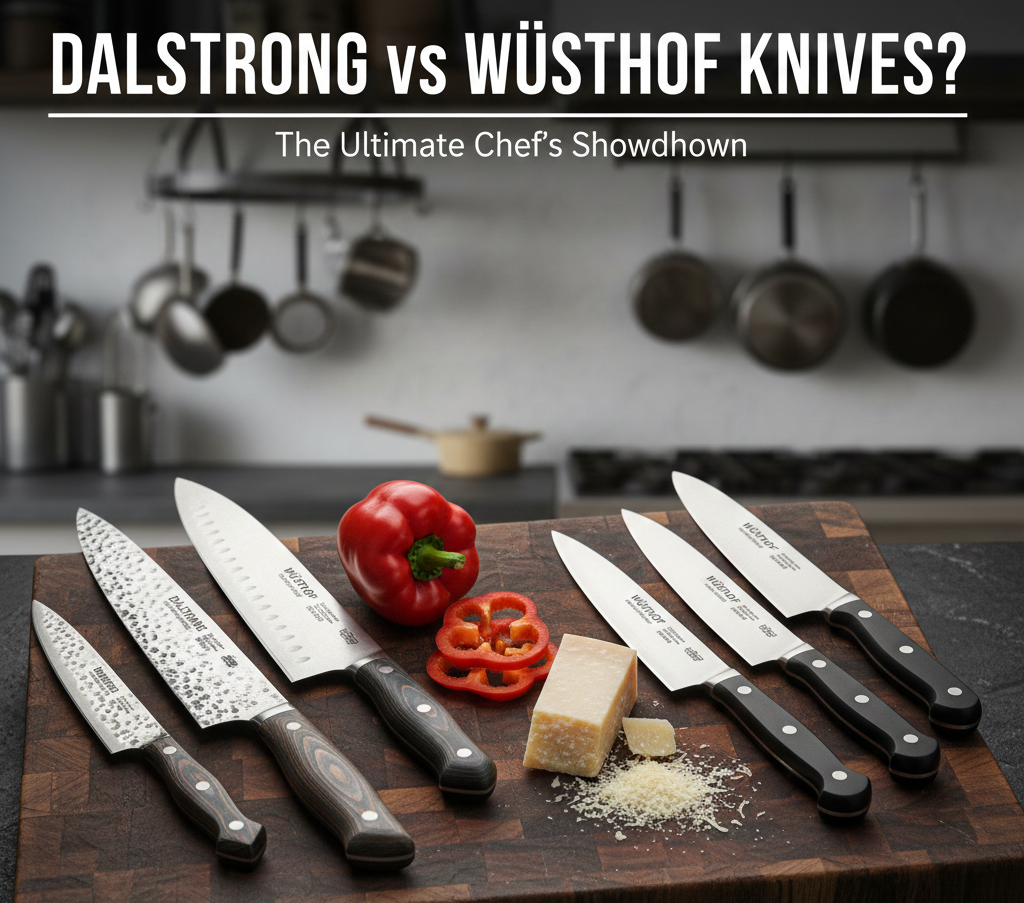
If you are standing in the kitchen aisle or browsing knifeindex.com, paralyzed by choice, you have likely narrowed it down to two very different contenders. On one side, you have Wüsthof, the patriarch of German steel, forging blades in Solingen for over 200 years. On the other, you have Dalstrong, the brash, modern disruptor that burst onto the scene with “Avengers-style” marketing and global manufacturing.
The Dalstrong vs. Wusthof debate is more than just steel; it is a clash of philosophies. Do you want the proven, rugged reliability of a European icon? Or do you want the high-performance features and visual flair of the new challenger?
In this comprehensive guide, we will dissect the metallurgy, the design, and the performance. We will see how they stack up against other giants (like Shun vs Wusthof or Zwilling vs Henkel), and help you decide which brand deserves a spot in your knife block.
This is a long guide, and intentionally so — we cover everything from the exact steel formulas each brand uses down to which one a professional line cook is more likely to reach for during a Friday dinner rush. If you only care about one specific angle of the debate, use the table of contents below to jump straight there. If you want the full picture, read it top to bottom; by the end you will know precisely which knife belongs on your counter.
Table of Contents
- The Contenders: Heritage vs. Disruption
- Head-to-Head: The Specs Breakdown
- Detailed Comparison: Performance and Feel
- The Chef’s Knife Battle
- Beyond the Basics: Specialty Knives
- Maintenance and Durability
- Storage and Presentation
- Who Are These Brands For?
- Comparisons to Other Brands
- The Science of Steel Explained
- Full Product Line Comparison
- Buying Guide by Knife Type
- Warranty and Customer Service
- Weight, Balance, and Tang Construction
- What Home Cooks and Chefs Actually Say
- Price Breakdown by Knife Type
- Manufacturing and Sustainability
- Gift Guide
- Mistakes New Knife Owners Make
- Resale and Long-Term Value
- Glossary of Knife Terms
- Frequently Asked Questions
- Final Verdict
1. The Contenders: Heritage vs. Disruption
Wüsthof: The Standard Bearer
Founded in 1814 in Solingen, Germany (the “City of Blades”), Wüsthof is family-owned and steeped in tradition. Their knives are synonymous with the best German kitchen knives. They prioritize durability, balance, and a classic aesthetic. When you buy Wüsthof, you are buying history.
Dalstrong: The Global Challenger
Founded in 2014, Dalstrong is a digital-native brand. They design in North America and manufacture in Yangjiang, China (a city with its own 1400-year knife history). They use materials from all over the world—German steel, Japanese steel, American G10 handles—to create high-spec knives at competitive prices. They are loud, visual, and aggressive.
Competitor’s View
Dalstrong isn’t shy about the comparison. They actively position themselves as the modern evolution of the classic German knife. Read their direct take here: Wusthof vs. Dalstrong: A Detailed Comparison.
It helps to understand the two companies as products of very different eras of the knife industry. Wüsthof grew up in a world where a chef’s knife was purchased once, from a local hardware or department store, and expected to be handed down. Its entire operating model — vertically integrated forging, in-house heat treatment, generations of the same family overseeing quality — was built around that expectation. Dalstrong, by contrast, was born in the direct-to-consumer, Instagram-and-Amazon era, where a knife has to catch someone’s eye scrolling a feed before it ever gets a chance to prove itself in a kitchen. That difference in origin shapes almost everything else in this comparison: pricing strategy, packaging, marketing tone, and even how aggressively each brand chases new steel types and finishes.
Neither approach is inherently better; they are simply optimized for different buyers. A restaurant that has used Wüsthof Classic knives for fifteen years has no reason to switch, because the knives still work and replacement blades are easy to source. A home cook building their first serious knife collection on a budget, however, may find Dalstrong’s aggressive spec-for-dollar pricing more appealing, especially if they also want their knives to look striking on a magnetic wall strip.
2. Head-to-Head: The Specs Breakdown
To keep this fair, we are comparing the flagship lines: the **Wüsthof Classic** (the industry workhorse) vs. the **Dalstrong Gladiator Series** (their direct German-steel competitor).
| Feature | Wüsthof Classic | Dalstrong Gladiator |
|---|---|---|
| Steel Type | X50CrMoV15 (German High Carbon) | X50CrMoV15 (German High Carbon) |
| Hardness (HRC) | 58 | 56+ |
| Edge Angle | 14° per side (PEtec Technology) | 16-18° per side |
| Construction | Precision Forged | Precision Forged |
| Handle | POM (Synthetic, Triple Rivet) | G10 (Military Grade, Triple Rivet) |
| Origin | Made in Germany | Made in China (German Steel) |
| Price | Premium ($$$) | Mid-Range ($$) |
3. Detailed Comparison: Performance and Feel
Blade Steel and Heat Treatment
Surprisingly, both brands often use the exact same steel code: X50CrMoV15. This is the standard for Western knives—tough, stain-resistant, and easy to sharpen. (Learn more about construction in our stamped vs forged guide).
However, Wüsthof has mastered the heat treatment. Their “PEtec” (Precision Edge Technology) ensures every blade is laser-measured and sharpened to a steeper 14-degree angle. They hold an edge incredibly well for German steel.
Dalstrong offers variety. While the Gladiator series uses German steel, their **Shogun Series** uses Japanese AUS-10V super steel (62 HRC), putting them in competition with brands like Shun. (See our Dalstrong vs Shun comparison for that specific battle).
Handle Ergonomics
Wüsthof Classic handles are iconic but polarizing. They have a distinct “belly” and a full bolster (the thick metal between handle and blade). The full bolster protects fingers but makes sharpening the heel difficult. The Wüsthof Ikon line removes this bolster for a modern feel.
Dalstrong handles are generally larger and contoured for a “pinch grip.” They use G10 Garolite, a military-grade fiberglass composite that is virtually indestructible and impervious to heat and moisture. They often include a stainless steel end cap for balance, giving the knife a hefty, substantial feel.
4. The Chef’s Knife Battle
The 8-inch Chef’s knife is the most important tool you will own. (Read what is a chef knife used for to understand why).
 Wüsthof Classic Ikon 8″ Chef’s Knife
The evolution of a legend. The “Ikon” handle is more ergonomic than the standard Classic, and the half-bolster allows for full-blade sharpening. A favorite in Wusthof vs Victorinox debates.
Check Price on Amazon Dalstrong Gladiator Series 8″
The value king. Forged from high-carbon German steel, hand-sharpened to 16-18 degrees. It comes with a premium sheath and packaging that puts other brands to shame.
Check Price on AmazonBeyond the flagship 8-inch, both brands sell the chef’s knife in other lengths worth knowing about. Wüsthof’s 6-inch Classic is popular with cooks who have smaller hands or work primarily with vegetables rather than large cuts of protein, while their 10-inch version is aimed at people who regularly break down whole chickens or large squash. Dalstrong mirrors this with 7-inch and 9.5-inch options in several of its lines, and its Shogun series even extends to a 10.5-inch “big brother” chef’s knife for cooks who want extra reach without moving up to a full slicer.
5. Beyond the Basics: Specialty Knives
Both brands offer massive catalogs. Here is where the differences shine.
Vegetable Knives (Santoku & Nakiri)
Wüsthof offers traditional Santokus with hollow edges (Granton) to prevent sticking. They function like Western knives—tough and rock-choppable.
Dalstrong leans into the Japanese aesthetic here. Their Nakiri knives in the Shogun or Phantom series look like samurai weapons, often featuring Damascus patterns and hammered finishes usually seen in best Japanese kitchen knives lists.
Bread and Paring
For serrated knives, Wüsthof’s “Double Serrated” technology stays sharp longer but is hard to sharpen. Dalstrong offers massive serrated slicers (up to 12 inches) that can tackle briskets and watermelons easily.
For precision work, check out our guide on what is a paring knife used for. Dalstrong creates unique shapes like “Bird’s Beak” paring knives in budget lines, which are great for garnishing.
Boning, Fillet, and Utility Knives
This is a category where the keyword searches are high but most comparison articles say almost nothing, so it is worth going deeper. A boning knife needs a thin, flexible-to-semi-stiff blade that can navigate around joints and connective tissue without snapping. Wüsthof’s boning knife uses their standard high-carbon steel with a stiffer flex, which butchers and serious home cooks who process whole animals tend to prefer because it gives more control near bone. Dalstrong’s boning knives, particularly in the Gladiator series, run slightly more flexible, which some fish and poultry processors like because it hugs the contour of the meat more closely.
Utility knives — the “in-between” blade that is too big to be a paring knife and too small to be a chef’s knife — are underrated tools in both lineups. Wüsthof’s utility knife is essentially a scaled-down Classic chef’s knife and inherits the same balance and bolster. Dalstrong’s utility knives in the Phantom and Gladiator series are noticeably lighter than their chef’s knives, making them a favorite for quick tasks like slicing citrus, trimming sandwich fillings, or halving small tomatoes.
Cleavers and Heavy-Duty Choppers
If your search history includes “Dalstrong cleaver vs Wusthof cleaver,” here is the short version: Wüsthof does not make a true heavy Chinese-style vegetable cleaver in most of its core lines, focusing instead on a smaller Western meat cleaver meant for chopping through bone. Dalstrong, on the other hand, produces a full-sized Chinese cleaver in its Gladiator and Shogun lines that is popular for breaking down whole chickens, crushing garlic, and doing high-volume vegetable prep. If cleaver work is a priority for you, Dalstrong currently has the broader selection.
Honing Steels, Shears, and Knife Blocks
Both brands sell honing steels designed to match the hardness of their blades — using a mismatched steel can actually dull a good edge rather than sharpen it. Wüsthof’s honing steels are typically fine-grit and gentle, matching the softer 58 HRC steel. Dalstrong’s honing rods are often diamond-coated, giving them extra bite that suits both their German-steel and harder Japanese-steel lines. Kitchen shears are a smaller battleground: Wüsthof’s shears are simple and come-apart for cleaning, while Dalstrong’s shears tend to include extra features like a bottle opener, nutcracker notch, and herb stripper built into the handle.
6. Maintenance and Durability
Both brands produce durable tools, but they require care.
- Rust: Even though they use “stainless” steel, they can rust if left wet. Learn how to remove rust from kitchen knives just in case.
- Sharpening: Wüsthof steel is softer (58 HRC), making it very easy to hone. Dalstrong’s German lines are similar. However, Dalstrong’s Japanese lines (Shogun) are hard (62 HRC) and require whetstones or specialized electric sharpeners.
- Dishwasher: Neither is dishwasher safe! See our guide on dishwasher safe knives to understand why the heat destroys handles.
A maintenance routine worth adopting regardless of which brand you buy: hand wash and dry immediately after every use, hone before or after each session with the correct-hardness steel, and run the blade across a whetstone or send it to a professional sharpener every three to six months depending on how often you cook. Wüsthof’s softer steel means it will need full resharpening more often but each session is quick and forgiving of beginner technique. Dalstrong’s harder Japanese-steel lines hold an edge for longer stretches between sharpenings, but when they do need attention, the process takes more skill and patience because the steel is less forgiving of an incorrect angle.
7. Storage and Presentation
Wüsthof usually sells knives in simple boxes or large wooden blocks. Dalstrong treats unboxing like an event. Every knife comes with a high-quality sheath (PerfectFit), a cleaning cloth, and a collector’s pin.
Regardless of brand, protect your investment.
- Use a drawer organizer if you are short on counter space.
- Magnetic strips are excellent for showing off Dalstrong’s flashy designs (see how to store knives without a block).
- If you travel, Dalstrong makes some of the best knife bags in the industry.
8. Who Are These Brands For?
The Wüsthof Buyer
You value heritage. You want a knife that your grandchildren could inherit. You prefer a classic, understated look and a blade that can handle heavy-duty tasks like splitting squash or disjointing chicken without chipping. You are looking for the best chef knife brands with a proven track record.
The Dalstrong Buyer
You want value and excitement. You love the look of Damascus steel but don’t want to pay $300 for a single knife. You want a collection that looks impressive on a magnetic strip. You might be looking for the best affordable chef knives that still offer premium features like G10 handles and tapered bolsters.
9. Comparisons to Other Brands
If neither of these fits, consider the competition:
- Vs. Zwilling: Zwilling is Wusthof’s main German rival. They are very similar, though Zwilling offers more handle varieties. (See Zwilling vs Henkel).
- Vs. Victorinox: If Wusthof is too expensive, Victorinox is the performance king of stamped knives. (See Henckels vs Victorinox).
- Vs. Shun: If you want true Japanese heritage, Shun is the mass-market standard. (See Wusthof vs Zwilling vs Shun).
- Vs. Global: Global knives take a completely different approach with a one-piece stainless construction and a hollow handle filled with sand for balance. They are lighter and thinner than either Wüsthof or Dalstrong, which some cooks love and others find flimsy for heavy tasks.
- Vs. Miyabi: Owned by the same parent company as Zwilling, Miyabi sits above both Wüsthof and Dalstrong in price, using powdered Japanese steel (SG2/VG10 core) with beautiful Damascus cladding. It’s the knife to consider if you have already outgrown Dalstrong’s Shogun line and want true premium Japanese performance.
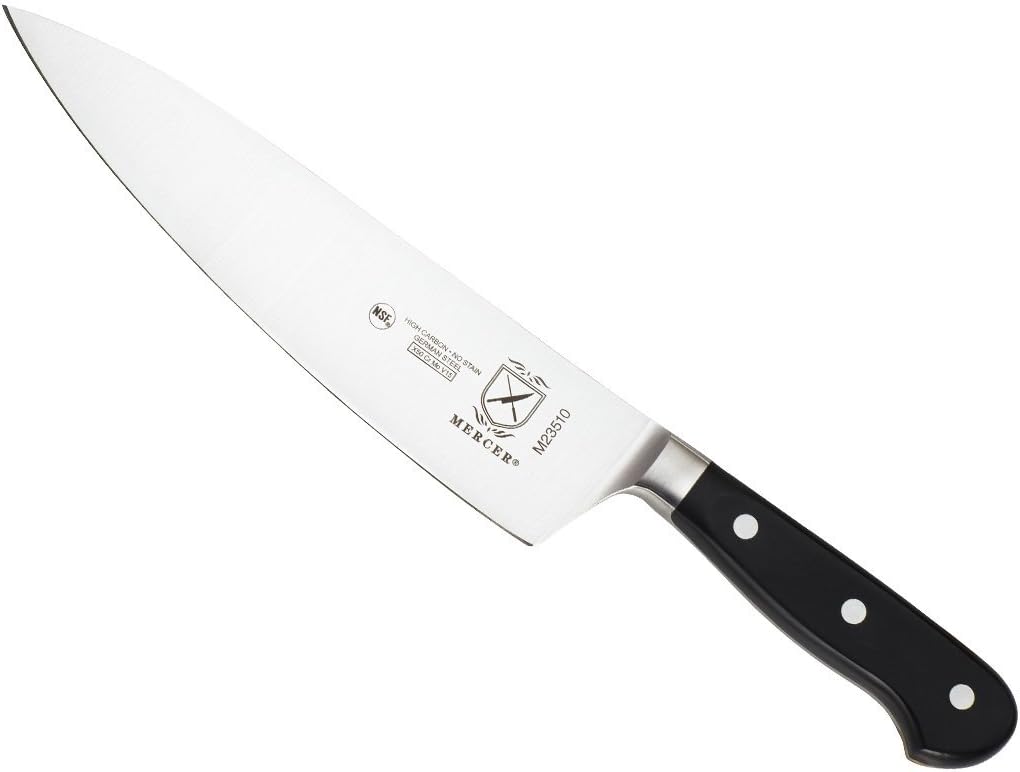
- Vs. Mercer Culinary: Mercer is the budget workhorse used in culinary schools. It’s not a real rival to either brand in terms of prestige, but it’s a useful reference point for what a “no-frills” knife costs compared to Dalstrong’s mid-range pricing.
10. The Science of Steel: HRC, Carbon Content, and Edge Retention Explained
Most comparison articles throw around terms like “HRC” and “high-carbon steel” without ever explaining what they mean, so let’s fix that. HRC stands for Hardness Rockwell C, a standardized scale that measures how much a material resists being permanently dented by a hardened steel ball under a fixed load. In knives, a higher HRC number generally means the edge stays sharp longer before it needs sharpening, but it also usually means the blade is more brittle and can chip if it strikes something hard, like a bone or a frozen block of food.
Wüsthof’s Classic line sits at roughly 58 HRC. This is a deliberately conservative number. German cutlery makers have historically prioritized toughness over raw edge retention, because their knives were designed to be used hard, dropped occasionally, and still come out the other side without chipping. Dalstrong’s Gladiator series, built from the same German steel formula, is rated slightly lower at 56+ HRC, which puts it in a similar toughness category, while their Shogun series jumps up to 62 HRC using AUS-10V, a Japanese super-steel that trades some toughness for significantly better edge retention.
Carbon content is the other half of the story. X50CrMoV15, the steel both brands use in their German lines, gets its name from its composition: roughly 0.5% carbon, plus chromium, molybdenum, and vanadium. The chromium is what makes the steel “stainless” by forming a protective oxide layer, the molybdenum adds toughness, and the vanadium refines the grain structure for a finer, more stable edge. AUS-10V, used in Dalstrong’s Shogun line, swaps in a higher carbon percentage and a different alloy mix, resulting in a harder but more brittle blade that holds its edge notably longer between sharpenings.
What does this mean practically? If you cook aggressively — chopping through squash, disjointing chicken, occasionally hitting the cutting board hard — the tougher, lower-HRC steel in Wüsthof Classic or Dalstrong Gladiator is more forgiving. If you do precise, controlled cutting and want to sharpen less often, the harder AUS-10V steel in Dalstrong’s Shogun line will reward you, provided you’re careful not to twist the blade or use it on bone.
11. Full Product Line Comparison
Neither brand sells just one knife line, and the “Classic vs Gladiator” comparison above only tells part of the story. Here’s how the broader catalogs stack up.
| Wüsthof Line | Steel / HRC | Dalstrong Equivalent | Steel / HRC |
|---|---|---|---|
| Classic | X50CrMoV15 / 58 | Gladiator Series | German steel / 56+ |
| Classic Ikon | X50CrMoV15 / 58 | Vagabond Series | German steel / 56+ |
| Epicure | X50CrMoV15 / 58 (walnut handle) | Shadow Black Series | German steel, titanium-coated / 56+ |
| Gourmet | X50CrMoV15 / 58 (stamped) | Phantom Series | German steel / 55+ |
| N/A (no direct match) | — | Shogun Series | AUS-10V / 62 |
A few things stand out from this table. First, Wüsthof does not currently sell a super-steel Japanese line to rival Dalstrong’s Shogun; if you specifically want a 61-63 HRC knife from Wüsthof’s own catalog, you would need to look outside the Classic family entirely, which is one reason enthusiasts often pair a Wüsthof for daily heavy work with a separate Japanese single-bevel knife for delicate tasks. Second, Dalstrong’s naming convention groups knives by finish and handle material rather than by steel hardness the way Wüsthof does, so it’s worth checking the individual product listing for HRC rather than assuming all Dalstrong knives perform the same.
12. Buying Guide by Knife Type
If you’re building a full set rather than replacing a single blade, here’s a practical order of priority and what to look for at each stage.
Step 1: The Chef’s Knife
This is the knife you will use for 80% of your prep work. Buy the best one you can afford first, from either brand’s flagship line, before spending money anywhere else.
Step 2: The Paring Knife
Used for peeling, trimming, and small precision cuts. Both brands’ entry-level paring knives are excellent value and rarely need to be the premium version — save your money for the chef’s knife and bread knife instead.
Step 3: The Bread Knife
A serrated slicer for crusty loaves, tomatoes, and delicate cakes. Wüsthof’s double-serration and Dalstrong’s longer 10-12 inch offerings both solve this well; choose based on the size of what you typically slice.
Step 4: The Utility or Santoku
Fills the gap between the paring knife and the chef’s knife. A Santoku is a good pick if you cook a lot of vegetables and want a flatter cutting motion; a utility knife is better for quick, varied small tasks.
Step 5: Specialty Additions
Boning knives, cleavers, and fillet knives should be the last purchases, added only once you know your specific cooking style requires them. There’s no reason to buy a cleaver if you never break down whole chickens.
13. Warranty and Customer Service Face-Off
This is a genuine keyword gap most comparison articles skip entirely, even though it’s one of the most-searched questions before a purchase. Wüsthof backs its knives with a limited lifetime warranty against manufacturing defects, and because the company has been in continuous operation since 1814, replacement parts and warranty service are straightforward to access through their official channels or authorized retailers. The tradeoff is that Wüsthof’s warranty, like most heritage brands, does not cover misuse, normal wear, or damage from improper sharpening.
Dalstrong also offers a lifetime warranty against manufacturing defects, and because the brand operates primarily through direct-to-consumer channels, many buyers report a faster and more flexible resolution process — including easier replacements for knives purchased through Amazon, since the company is used to handling e-commerce customer service at scale. As with Wüsthof, cosmetic wear, chipping from misuse, and rust from improper care are not covered.
In practice, both companies have a reputation for standing behind their products. The difference tends to be speed and communication style rather than the substance of the warranty itself: Wüsthof feels more like dealing with a traditional manufacturer, while Dalstrong feels more like dealing with a modern e-commerce brand.
14. Weight, Balance, and Tang Construction
Weight and balance point are two of the most personal aspects of choosing a knife, and they rarely get discussed in detail. Wüsthof Classic knives are full-tang, meaning the steel of the blade extends the entire length of the handle, which is sandwiched by two scales and secured with three rivets. This construction, combined with the traditional bolster, places the balance point close to the bolster itself — right where your index finger and thumb naturally grip in a pinch grip. Cooks who like a “knife that disappears in the hand” tend to prefer this balance.
Dalstrong’s Gladiator and Shogun series are also full-tang with a triple-rivet handle, but the G10 handle material is slightly lighter than Wüsthof’s POM, while the added stainless steel end cap on many models shifts a bit of weight toward the back of the handle. The net effect is a knife that feels more blade-heavy in the front third but well-anchored at the back, which some cooks describe as feeling more “substantial” or “confidence-inspiring” during heavy chopping, even though the actual difference in total weight between comparable models is often less than half an ounce.
15. What Home Cooks and Professional Chefs Actually Say
Across cooking forums, subreddits, and professional kitchen communities, a fairly consistent pattern emerges. Professional chefs and culinary school graduates who grew up using German knives tend to stick with Wüsthof or a similar heritage brand, largely out of familiarity and trust built over years of daily, high-volume use. They cite the predictable geometry, the ease of maintaining the edge under time pressure, and the fact that replacement parts and sharpening services are widely available through commercial kitchen suppliers.
Home cooks and knife enthusiasts who got into cooking more recently — often influenced by food content online — are more likely to mention Dalstrong, usually citing the value proposition (premium-feeling features at a lower price point), the visual appeal of the Damascus and titanium-coated finishes, and the overall unboxing experience. A recurring theme in more critical feedback is that Dalstrong’s marketing can oversell the exotic-steel narrative, and that buyers should pay close attention to which specific series and steel type they’re purchasing rather than assuming every Dalstrong knife performs like the flagship Shogun.
Neither brand draws serious complaints about outright failure or poor build quality at scale — most negative feedback centers on individual expectations (a knife feeling too heavy, an edge angle being unfamiliar) rather than defects.
16. Price Breakdown by Knife Type
Approximate street pricing (excluding sales and bundle discounts) helps put the “premium vs mid-range” framing into concrete terms.
| Knife Type | Wüsthof Classic | Dalstrong Gladiator |
|---|---|---|
| 3.5″ Paring Knife | $50–$70 | $30–$45 |
| 8″ Chef’s Knife | $150–$180 | $70–$100 |
| 9″ Bread Knife | $130–$160 | $60–$90 |
| 6″ Boning Knife | $110–$140 | $50–$75 |
| 7-Piece Block Set | $700–$900 | $250–$350 |
The gap widens further once you factor in Dalstrong’s frequent site-wide sales, which can bring already-affordable knives down another 20-30%. Wüsthof’s pricing is more stable year-round, with discounts more commonly appearing around major shopping holidays through authorized retailers rather than the brand’s own site.
17. Manufacturing and Sustainability
For buyers who care about where and how their tools are made, this is a meaningful point of differentiation. Wüsthof’s entire production process, from forging to final sharpening, happens in a single facility in Solingen, Germany, under a regulatory and labor environment with strict European manufacturing standards. This vertical integration gives the company tight quality control and a smaller, more traceable supply chain.
Dalstrong’s model is more distributed: steel is sourced from Germany or Japan, handle materials like G10 often come from the United States, and final forging and assembly happen in Yangjiang, China, a city with its own centuries-old cutlery tradition and a large modern manufacturing base. This global sourcing approach is how Dalstrong keeps costs down while still using premium raw materials, but it also means the company depends on third-party quality control across multiple countries rather than one integrated facility.
Neither brand has published extensive third-party sustainability certifications, so buyers who prioritize environmental transparency may want to reach out to each company directly for current data on their supply chain practices.
18. Gift Guide: Which Brand Makes a Better Present
Knives are one of the more popular gift categories in the kitchen space, and the right choice depends heavily on the recipient. For a wedding registry, a retirement gift, or any occasion where you want something that signals lasting quality, a single Wüsthof Classic or Classic Ikon chef’s knife is a safe, well-recognized choice that the recipient is unlikely to have already discovered on their own.
For a birthday gift to a younger home cook, a food-content enthusiast, or someone who would appreciate a dramatic unboxing moment, a Dalstrong Shadow Black or Shogun series knife tends to land better — the presentation, sheath, and included pin make it feel like a complete gift experience rather than just a tool. Dalstrong’s boxed sets are also a strong option for a “starter kit” gift, since a single box typically includes a chef’s knife, a smaller utility or paring knife, and storage, at a price point well below an equivalent Wüsthof set.
19. Common Mistakes New Knife Owners Make
- Skipping the honing step. A knife that “feels dull” after two weeks often just needs honing, not sharpening. Both brands recommend honing before or after most sessions.
- Using the wrong cutting surface. Glass, marble, and stone boards will dull any blade quickly regardless of brand. Stick to wood or high-quality plastic.
- Washing immediately in hot, soapy water and leaving it to air dry. Both brands’ handles and blades do best hand-washed and dried immediately, not left in a wet sink or dish rack.
- Buying the wrong hardness for their cutting style. Someone who chops aggressively through bone and frozen food will be happier with a tougher, lower-HRC blade (Wüsthof Classic or Dalstrong Gladiator) than a brittle high-HRC Japanese steel edge.
- Ignoring the warranty registration. Both companies make warranty claims easier when the purchase is registered or the receipt is kept, especially for Amazon purchases.
20. Resale and Long-Term Value
Wüsthof knives, thanks to their 200-year brand history and slower design turnover, tend to hold resale value reasonably well on the secondhand market, particularly older Solingen-made pieces from discontinued lines that collectors seek out. A well-maintained Wüsthof Classic can often be resold for 40-50% of its original price years later.
Dalstrong, being a newer company with frequent new product releases, does not yet have the same track record in the secondhand market. Because the brand refreshes its lineup and finishes relatively often, older Dalstrong knives can be harder to identify or match to current pricing, which tends to depress resale value compared to Wüsthof. That said, for most buyers, resale value is a secondary consideration compared to day-to-day performance and price at purchase.
21. Glossary of Knife Terms
The blade’s steel extends the entire length of the handle, providing better balance and durability than a partial tang.
The thick junction between blade and handle. A full bolster protects fingers but can make sharpening the heel of the blade difficult.
A scale measuring a blade’s resistance to denting. Higher HRC generally means better edge retention but more brittleness.
Scalloped indentations along the blade that create air pockets, reducing food sticking to the knife during slicing.
A layered steel pattern created by folding multiple metal types together, prized for its visual appearance and, in some cases, added flexibility.
A fiberglass composite handle material that is extremely durable, waterproof, and resistant to temperature changes.
Honing realigns a rolled edge using a steel rod and does not remove metal; sharpening removes metal to create a new edge, typically via whetstone.
Frequently Asked Questions (FAQ)
You are paying for German labor costs, rigorous quality control (PEtec technology), and brand legacy. Wüsthof knives are manufactured 100% in Solingen, Germany, which ensures consistent quality but raises the price.
Yes. Dalstrong manufactures in Yangjiang, China. However, they import materials (steel from Germany and Japan, G10 from the US) and enforce strict quality control. This “global supply chain” model allows them to offer premium features at lower prices.
Generally, Wüsthof has a slight edge (pun intended) due to their laser-guided sharpening process. However, Dalstrong’s Shogun series (Japanese steel) is ground to a very acute 8-12 degrees, making it sharper than the standard Wusthof Classic, though more brittle. Check our sharpener guide to keep them that way.
Their German steel lines (Gladiator) are very rust-resistant. Their high-carbon Japanese lines (Shogun, Phantom) are more susceptible to rust if left wet. Always dry them immediately.
Independent of the marketing, the underlying steel and construction are genuinely comparable to established mid-tier brands. The “hype” criticism usually refers to how the brand is presented online rather than the actual metallurgy, which holds up in independent testing.
No. Heat and detergent will degrade the handle material and can dull or damage the edge on both brands. Always hand wash and dry immediately.
Dalstrong’s Gladiator series is often recommended for beginners because it offers premium features at a lower price, reducing the financial risk while a new cook figures out their preferences. Wüsthof Classic is a better choice if the beginner is confident they want a long-term, one-time investment.
Yes, though it’s less common in older, established kitchens where German brands remain the default. Younger chefs and those active in food content creation have driven a lot of Dalstrong’s adoption in professional settings.
Gladiator uses German X50CrMoV15 steel at a tougher, lower hardness, similar in philosophy to Wüsthof. Shogun uses Japanese AUS-10V steel at a higher 62 HRC for sharper, longer-lasting edges that require more careful maintenance.
With proper care — hand washing, regular honing, and periodic sharpening — both brands are built to last decades. Wüsthof’s 200-year track record gives it a longer proven history, but Dalstrong’s materials and construction are rated for similarly long-term daily use.
Conclusion: The Final Verdict
The Dalstrong vs. Wusthof battle ends in a draw, because they serve different masters.
Choose Wüsthof if: You are a traditionalist. You want a tool that is guaranteed to last 50 years, has perfect balance, and represents the pinnacle of Western cutlery history.
Choose Dalstrong if: You are a modernist. You want high specs (like G10 handles and exotic steels) for a lower price, and you appreciate bold, aggressive design that stands out in the kitchen.
And if you’re still torn, consider buying based on how you’ll actually build your collection rather than which single knife “wins.” Many serious home cooks end up owning both: a Wüsthof Classic or Classic Ikon chef’s knife for daily heavy-duty prep, paired with a Dalstrong Shogun Santoku or Nakiri for precision vegetable work. That combination captures the toughness of German heritage steel and the edge retention of premium Japanese steel in a single knife roll, without forcing a single-brand compromise.
Whichever you choose, ensure you have the right accessories. A good whetstone and a safe storage block will ensure your new investment performs perfectly for years to come.