Effortless Edge: The 5 Best Electric Knife Sharpeners for Your Kitchen
Let’s be honest: while mastering a whetstone is a noble skill, most of us just want our knives to be sharp, and we want it to be easy. A dull knife turns cooking from a joy into a chore, but the thought of complex sharpening techniques can be intimidating. This is where the modern electric knife sharpener shines. It’s a marvel of kitchen technology that takes the guesswork out of achieving a factory-sharp, razor edge in minutes, giving you foolproof results every single time.
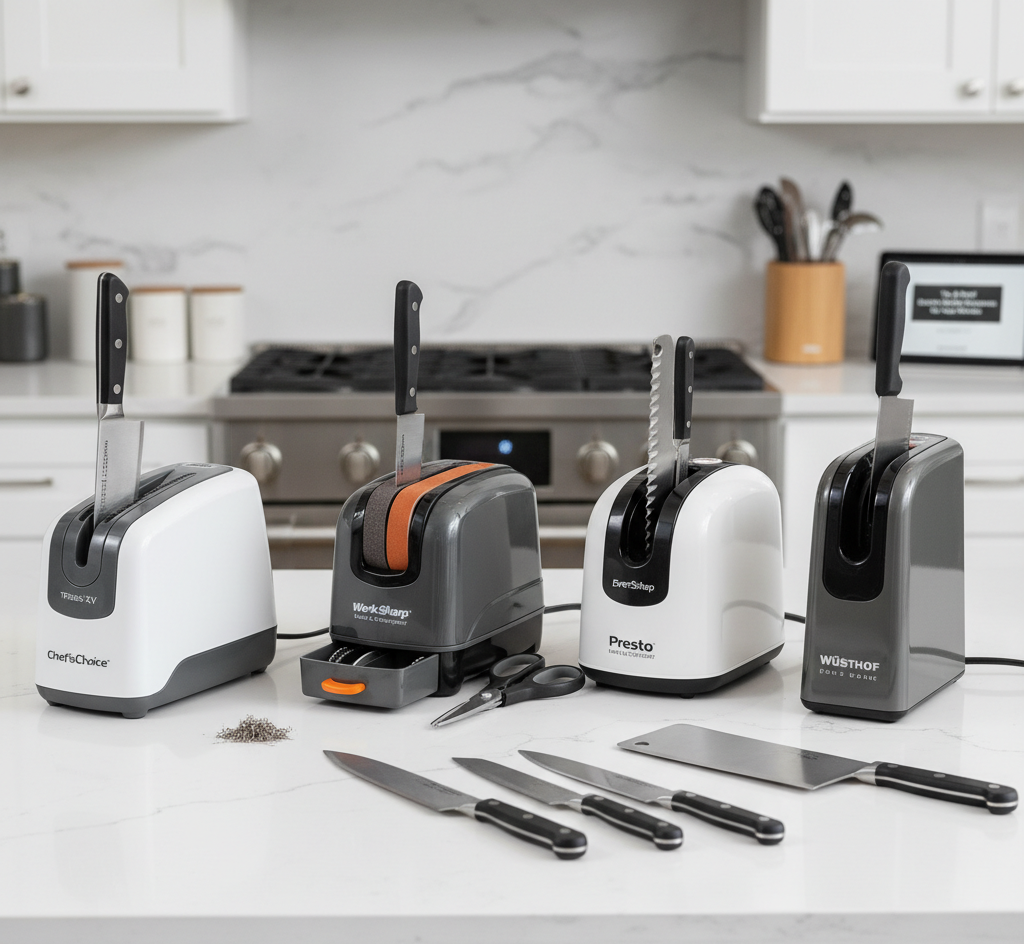
My Fear of Sharpening: How a Machine Saved My Knives (and My Thumbs)
For years, I was terrified of sharpening my own knives. I had a beautiful Wüsthof chef’s knife that I loved, but as it slowly grew duller, I treated it with a kind of neglectful reverence. I’d try to use the honing steel, but I knew I wasn’t really sharpening it. I was too afraid of using a whetstone and messing up the angle, permanently ruining my expensive tool. So, I did what many people do: I just lived with a dull knife, pressing harder, and constantly slipping on onions.
My brother-in-law, an engineer who loves kitchen gadgets, brought over his Chef’sChoice Trizor XV one Thanksgiving. He saw me struggling to carve the turkey and just shook his head. He took my sad, dull knife, ran it through the three stages of his machine, and handed it back to me. The difference was staggering. It felt like a brand-new knife, maybe even sharper. It glided through the turkey with zero effort. There was no skill involved, no complex angles to hold—just a perfect, consistent, terrifyingly sharp edge in about 60 seconds. That day, I was converted. I realized a good electric sharpener isn’t a shortcut; it’s just a smarter tool.
Engineering the Edge: Our Criteria for Top Electric Sharpeners
Not all electric sharpeners are created equal. Older, cheaper models earned a bad reputation for eating away blades. We focused on modern, multi-stage sharpeners that use advanced technology to create a precise and durable edge without causing unnecessary wear and tear on your valuable knives.
Our Core Testing Philosophy: A top-tier electric sharpener must be foolproof, consistent, and safe for a wide range of knives. It should inspire confidence and deliver a factory-quality edge or better, with minimal effort from the user.
- Abrasive Quality & Stages: The heart of any sharpener is its abrasive. We exclusively selected models that use 100% diamond abrasives for sharpening and ceramic or flexible strops for honing/polishing. Multi-stage systems (2 or 3 stages) were heavily favored, as they allow for both coarse sharpening and fine polishing.
- Angle Precision & Versatility: Does the sharpener create the correct angle for your knife? We looked for models with precise, spring-loaded guides that guarantee a consistent angle. We selected sharpeners designed for the two main standards: 20-degree edges (for Western/German knives) and 15-degree edges (for Asian/Japanese knives).
- Ease of Use & Safety: The primary benefit of an electric sharpener is simplicity. We tested for a clear, intuitive process that a beginner could master in minutes. Safety features like a sturdy base, secure housing, and clear instructions were essential.
- Knife Compatibility: Can it sharpen your whole collection? We tested each model on various knife types, including chef’s knives, paring knives, and even serrated knives (for models with that feature).
- Durability & Brand Reputation: An electric sharpener is an investment. We chose models from reputable, established brands known for their quality engineering and customer support, ensuring your tool will last for years of service.
Electric vs. Manual, Pull-Through, and Whetstone: Which Sharpening Method Actually Wins?
Before you commit to an electric knife sharpener, it’s worth understanding exactly what you’re choosing over. Every sharpening method removes metal from a blade to expose fresh, sharp steel underneath — the differences lie in speed, control, consistency, and how much skill the process demands. We get asked constantly whether an electric sharpener is “cheating,” or whether it can really compete with a traditional whetstone. The honest answer is that it depends entirely on what you value: outcome or process.
Whetstones (Sharpening Stones)
A whetstone is the gold standard among professional sharpeners, bladesmiths, and serious enthusiasts, and for good reason. Because you control the angle, pressure, and stroke by hand, a skilled user can produce an edge that’s more refined than almost anything a machine can create, especially on premium Japanese steel. Whetstones come in a huge range of grits, from coarse stones around 220-400 grit for repairing damaged edges, to fine finishing stones at 3000, 6000, or even 8000+ grit for a mirror polish.
The catch is the learning curve. Maintaining a consistent angle across the full length of a blade, stroke after stroke, takes real practice. Beginners frequently round over the edge, apply uneven pressure, or simply give up halfway through because the process is slow — a full sharpening session on a neglected knife can take fifteen to thirty minutes per side. If you enjoy the ritual and have the patience to learn, a whetstone will always deliver the best possible edge. If you just want your knife sharp before dinner, it’s a frustrating detour.
Pull-Through (Manual) Sharpeners
These are the simple V-slot or crossed-rod devices you clamp to a countertop or hold in one hand, dragging the blade through a fixed slot a few times. They’re inexpensive, require zero technique, and can be used in seconds. Unfortunately, pull-through sharpeners are also the least precise option on this list. Because the angle is fixed and the abrasive is usually carbide or coarse ceramic rather than diamond, these tools tend to remove a disproportionate amount of metal for the sharpness they deliver, and they can leave a rough, inconsistent edge that dulls again quickly. They’re a reasonable emergency fix for a butter-knife-dull blade, but we don’t recommend them as a primary sharpening method for any knife you care about.
Electric Knife Sharpeners
Electric sharpeners sit in the sweet spot between these two extremes. Modern multi-stage machines use the same diamond abrasives and often the same target angles that a skilled whetstone user would choose, but they hold that angle for you with a spring-loaded guide slot. The motor moves the abrasive rather than asking you to move the blade with perfect consistency, which removes the single hardest variable in manual sharpening: keeping the angle identical on every single pass.
The result is an edge that, in blind cutting tests, is frequently indistinguishable from a hand-sharpened one — and in the hands of a beginner, it’s usually sharper and more consistent than what they’d achieve on a stone. The tradeoff is a small loss of ultimate control: you can’t customize the exact bevel shape or polish level the way an expert can on a stone, and cheaper electric models can be more aggressive with metal removal than they need to be. For the vast majority of home cooks, that tradeoff is well worth it.
Our take: If sharpening is a hobby you enjoy, invest in a good whetstone set and learn the technique — it’s genuinely rewarding. If sharpening is a chore standing between you and dinner, a quality multi-stage electric sharpener like the ones on this list will get you 95% of the way to a professional edge in a fraction of the time, with none of the risk of an uneven bevel.
How to Use an Electric Knife Sharpener: A Step-by-Step Walkthrough
One of the biggest advantages of an electric sharpener is how little there is to learn, but a few small habits make the difference between a great edge and a mediocre one. Here’s the process we follow with every multi-stage model we test.
- Clean and dry the blade first. Food residue, grease, or moisture on the blade can gum up the abrasive wheels and cause uneven contact. Wipe the knife down with a dry cloth before you begin.
- Identify your knife’s current angle (if you know it). Most Western knives are ground around 20 degrees per side, while most Japanese knives sit closer to 15 degrees. If you’re unsure, check the manufacturer’s spec sheet, or simply start with whichever slot in your sharpener matches the type of knife you own.
- Start at Stage 1 (coarse) only if the knife is genuinely dull. If your knife just needs a touch-up, skip straight to the honing or polishing stage. Running a knife that’s already sharp through the coarse stage removes metal you don’t need to lose, shortening the life of your blade.
- Position the heel of the blade in the slot near the handle guard. Apply light, even downward pressure — the machine’s guide does the angle work, not your hand strength.
- Pull the blade through in one smooth, unhurried motion, moving from the heel to the tip so the entire edge, including the curved belly near the point, passes through the abrasive. Rushing this step is the single most common reason for an uneven edge.
- Repeat each stage the recommended number of times (typically 3 to 5 pulls per stage for a moderately dull knife, more for a very dull one), alternating which side of the blade you draw through if your model has separate left and right slots.
- Move to the next stage only once the previous one feels complete. A quick way to check progress between stages is the fingernail test described below.
- Finish with the honing or polishing stage every time, even if you feel the blade is already sharp enough after the coarse and medium stages. This final pass removes the microscopic burr left behind by the grinding stages and is what gives the edge its final, hair-popping sharpness.
- Wipe the blade clean of metal filings (swarf) before use or storage. A few passes through a paper towel will pick up any stray abrasive particles.
Pro tip: Let the machine do the work. The most common beginner mistake is pressing down hard to “help” the sharpener, which actually creates uneven pressure and inconsistent contact with the abrasive. A light, steady touch paired with a slow, complete pull from heel to tip will outperform a heavy hand every time.
Instant Results: The Best Electric Knife Sharpeners Right Now
In a rush? Here are our top five picks that deliver incredible sharpness with the push of a button.
| Sharpener | Image | Best For | Edge Angle | Check on Amazon |
|---|---|---|---|---|
| Chef’sChoice Trizor XV | 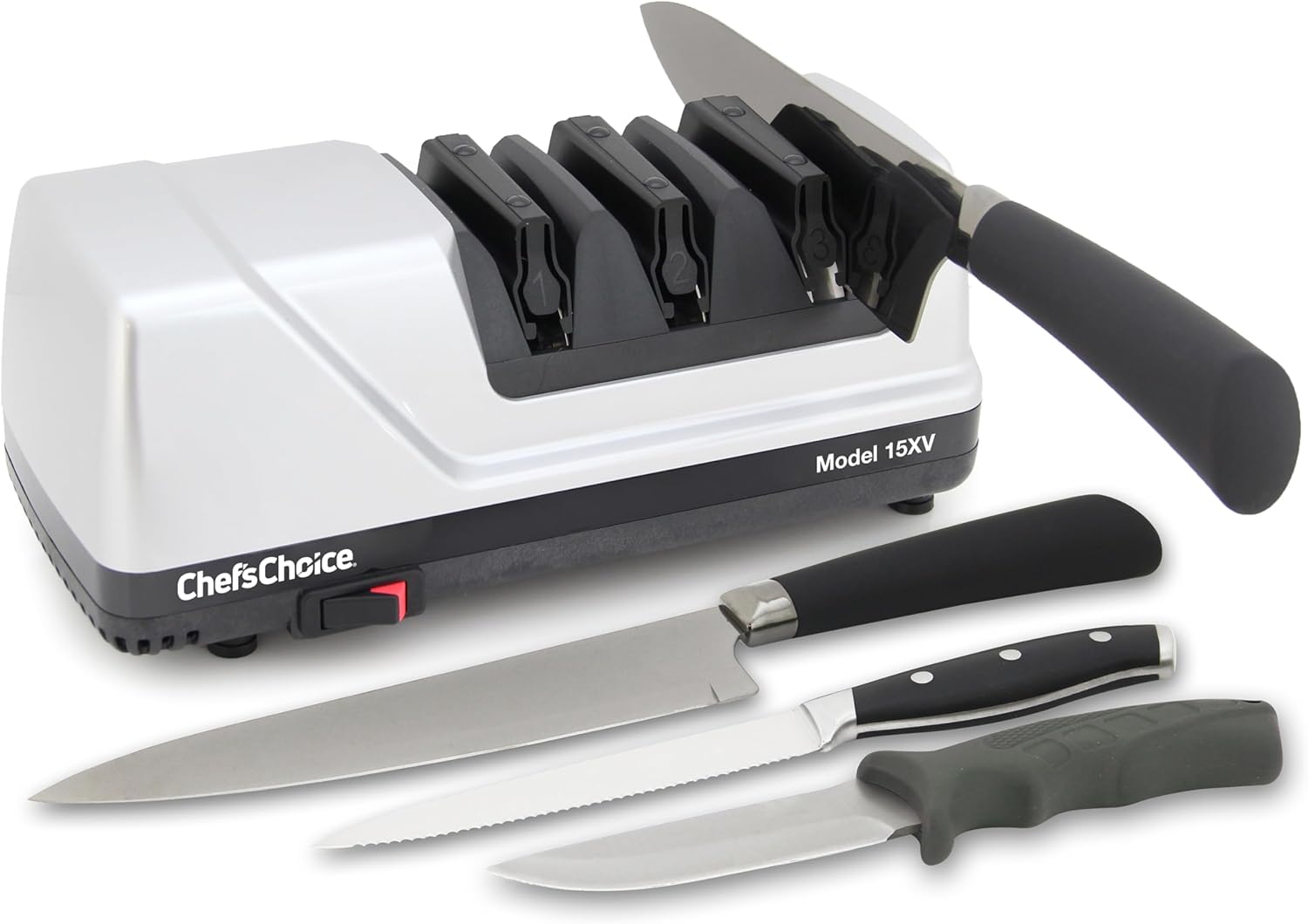 |
Overall Performance | 15-Degree | View Price |
| Work Sharp Culinary E5 |  |
Best for Mixed Knife Sets | 17-Degree | View Price |
| Presto EverSharp 08800 |  |
Best Budget Option | 20-Degree (approx) | View Price |
| Work Sharp Ken Onion Edition |  |
Best for Enthusiasts & Tools | Adjustable (15-30°) | View Price |
| Chef’sChoice 220 Hybrid |  |
Best Compact/Hybrid | 20-Degree | View Price |
The Full Analysis: In-Depth Reviews of the Best Electric Sharpeners
We took a collection of dull, neglected kitchen knives and gave them a new life. Here’s a detailed look at how each of our top picks performed under pressure.
1. Chef’sChoice Trizor XV EdgeSelect (Best Overall Performance)
This is the undisputed king of home electric sharpeners for a reason. Its patented Trizor XV technology is designed to do one thing brilliantly: take any knife and convert its edge to a razor-sharp, 15-degree angle. This is the angle used on high-performance Japanese knives, and applying it to a sturdy German blade creates a “hybrid” edge that is both surgically sharp and durable. The 3-stage process is foolproof: Stage 1 with diamond abrasives re-profiles the edge, Stage 2 refines it with finer diamonds, and Stage 3 polishes it with flexible stropping disks.
The result is a shockingly sharp edge that will transform how your knives feel. It’s a significant investment, but it’s the perfect tool for maintaining a collection of premium knives, whether you’re a fan of German steel as seen in our Wüsthof vs. Zwilling vs. Shun guide, or Japanese blades. It even has a setting for serrated knives.
Who is this best for?
The serious home cook or culinary enthusiast who owns high-quality knives and wants the absolute best in sharpening performance and convenience.
- Creates an incredibly sharp and durable 15-degree edge
- Foolproof 3-stage system with precise angle guides
- Works on Western, Asian, and serrated knives
- Extremely fast and effective
- Made in the USA with a 3-year warranty
Pros
- High price point
- Permanently converts blades to a 15-degree angle
Cons
2. Work Sharp Culinary E5 (Best for Mixed Knife Sets)
The Work Sharp E5 offers a unique approach. Instead of static grinding wheels, it uses flexible abrasive belts—the same method used in knife factories. This creates a strong “convex” edge that is less prone to chipping. Its standout feature is automation: a microprocessor controls the sharpening speed and timing, telling you when to switch slots. It sharpens to a versatile 17-degree angle, which is a perfect compromise—sharper than a 20-degree German knife but more durable than a 15-degree Japanese blade.
This makes it ideal for someone with a mixed collection of knives, perhaps a Zwilling chef knife and a Victorinox paring knife, a matchup we explore in our Victorinox vs. Zwilling article. It also features a ceramic honing wheel and can be upgraded with different grit belts. It’s an intelligent, modern sharpening system.
Who is this best for?
The home cook with a variety of knife brands who wants a versatile, automated system that is very gentle on blades.
- Automated system is incredibly easy to use
- Flexible belts are gentle and create a strong convex edge
- Versatile 17-degree angle is great for most knives
- Built-in ceramic honing wheel for maintenance
Pros
- Slightly slower than the Trizor XV
- Belts are a consumable that will need replacement eventually
Cons
3. Presto 08800 EverSharp (Best Budget Option)
If you’re looking to dip your toes into electric sharpening without a major financial commitment, the Presto EverSharp is the undisputed budget king. For under $40, this simple machine delivers surprisingly good results. It uses a 2-stage system with sapphire grinding wheels to quickly put a working edge on very dull knives. The angle guides are straightforward and easy to follow, making it accessible for absolute beginners.
This is not a precision instrument for high-end Japanese steel. It’s a workhorse designed to bring your everyday kitchen knives back to life quickly and cheaply. It’s the perfect tool for maintaining the best budget chef knife or reviving an older set of knives you thought were beyond saving. For the price, its performance is remarkable.
Who is this best for?
The budget-conscious home cook, college student, or anyone who wants a fast, no-frills way to sharpen their standard kitchen knives.
- Extremely affordable price point
- Very simple and fast 2-stage operation
- Quickly restores a sharp edge to very dull knives
- Compact and easy to store
Pros
- Not suitable for expensive or high-end knives
- Removes more metal than premium models
- Fixed angle is not ideal for Japanese knives
Cons
4. Work Sharp Ken Onion Edition (Best for Enthusiasts & Tools)
This is less a kitchen gadget and more a professional-grade sharpening tool. Designed in partnership with legendary knifemaker Ken Onion, this Work Sharp model offers unparalleled power and versatility. It uses flexible abrasive belts (from extra-coarse to extra-fine) and features a fully adjustable angle guide, allowing you to sharpen any blade from 15 to 30 degrees. This means you can perfectly match the factory edge on your Shun, your Wüsthof, and even your pocket knife and axe.
There’s a slight learning curve, but the results are phenomenal, creating a razor-sharp convex edge. For the serious DIY enthusiast who wants one machine to sharpen every blade they own, this is the ultimate tool. It’s for the person who not only owns a chef’s knife bag for travel but also has a workshop full of tools that need a perfect edge.
Who is this best for?
The knife aficionado, woodworker, or home DIY enthusiast who wants total control and the ability to sharpen kitchen knives, pocket knives, scissors, and tools to a perfect edge.
- Fully adjustable angle guide (15-30 degrees)
- Uses professional-grade flexible abrasive belts
- Incredibly versatile—sharpens almost any blade
- Powerful variable-speed motor
- Creates a superb, long-lasting convex edge
Pros
- Has a learning curve to master
- Can remove metal very quickly if used improperly
- More expensive than standard kitchen models
Cons
5. Chef’sChoice 220 Hybrid (Best Compact/Hybrid)
The Chef’sChoice 220 Hybrid offers the best of both worlds in a compact package. It combines one electric sharpening stage with one manual honing stage. Stage 1 uses diamond abrasives for electric sharpening, quickly applying a 20-degree edge. Stage 2 uses ceramic wheels for manual honing and polishing, giving you more control for the finishing touches. This hybrid design is perfect for smaller kitchens where storage is at a premium.
It provides the speed of electric sharpening when you need to fix a truly dull knife, but allows for the finesse of manual honing for regular maintenance. It’s an excellent, space-saving solution for keeping your standard 20-degree Western knives in top condition, such as those from Henckels or Victorinox, whose differences we explore in our Henckels vs. Victorinox comparison.
Who is this best for?
The home cook with limited storage space who wants the power of an electric sharpener combined with the control of a manual honing tool.
- Combines electric sharpening and manual honing
- Compact design is great for small kitchens
- Uses 100% diamond abrasives
- Easy and intuitive to use
Pros
- Only for 20-degree knives
- Not as fast or powerful as larger, fully electric models
Cons
Common Mistakes That Ruin Knives in an Electric Sharpener
Electric sharpeners earned their old reputation for “eating” blades largely because of user error, not bad engineering. Even with a modern, high-quality machine, a handful of avoidable mistakes can shorten your knife’s life or leave you with a worse edge than you started with.
- Using the coarse stage every time. The first, most aggressive stage exists to fix a genuinely dull or damaged edge. If you run a knife that’s only slightly dull through the coarse stage anyway, you’re removing metal you don’t need to lose. Reserve Stage 1 for knives that fail the paper test outright, and use lighter honing stages for routine maintenance.
- Pressing down hard. It feels intuitive to add pressure to “help” a stubborn edge sharpen faster, but doing so unbalances the contact between the blade and the abrasive, often creating a lopsided or uneven bevel. Let the spring-loaded guides and the abrasive do the work; your hand should just guide the blade smoothly.
- Sharpening a knife that’s already sharp. Sharpening isn’t like washing dishes — more isn’t better. Repeatedly running a sharp knife through the coarse or medium stages “just to be safe” wears down the blade faster than necessary and can eventually thin the metal enough to weaken the edge.
- Mismatching the angle to the knife. Running a 15-degree Japanese knife through a 20-degree-only sharpener (or vice versa) creates a secondary bevel that fights the knife’s original geometry, often leaving a rougher, less durable edge than either angle alone would produce.
- Ignoring the honing/polishing stage. Skipping the final stage leaves a microscopic wire-thin burr along the edge. This burr can feel sharp to the touch initially but folds over almost immediately during use, making the blade feel dull again within a single cutting session.
- Sharpening serrated or Damascus-clad knives in the wrong slot. Standard slots will grind down and permanently destroy the scalloped teeth of a serrated blade. Only use a slot explicitly designed for serrations, and check your sharpener’s documentation before attempting it on specialty blades.
- Letting metal filings build up inside the machine. Swarf (the fine metal dust created during sharpening) that isn’t cleaned out can contaminate future sharpening passes, causing inconsistent results and, over time, premature wear on the abrasive wheels or belts themselves.
Sharpening Beyond the Chef’s Knife: Paring Knives, Serrated Blades, Scissors, and Pocket Knives
Most people buy an electric sharpener with their chef’s knife in mind, but a well-designed multi-stage machine can maintain nearly every blade in the house. Here’s how to approach the knife types you probably haven’t thought about.
Paring and utility knives
Short blades sharpen just as easily as a chef’s knife on most machines, but because the blade is shorter, it’s easy to rush the pull and miss the tip entirely. Slow down and make sure the very point of the blade tracks through the abrasive on every pass, since the tip is used constantly for detail work like trimming and peeling.
Serrated and bread knives
Serrated blades are sharpened differently from straight edges: only the flat bevel on the inside of each scallop needs attention, not the entire tooth. Sharpeners with a dedicated serrated stage (usually a narrow rotating stone or slotted guide) polish just the tip of each serration without altering the shape of the teeth. If your machine doesn’t have this feature, leave serrated blades to a specialty tool or a sharpening service rather than forcing them through a standard slot.
Kitchen shears and scissors
Many electric sharpeners include a dedicated scissors slot, usually positioned separately from the knife slots because shears are ground at a steeper, more obtuse angle. If your model has this feature, open the blades fully and draw each side through slowly, just as you would a knife. Machines without a scissors slot shouldn’t be used for shears — the mismatched angle will do more harm than good.
Pocket knives, hunting knives, and outdoor tools
Fully adjustable machines with a wide angle range (typically 15 to 30 degrees) can handle everything from a slim EDC folder to a thick-spined hunting or camp knife. Because these blades vary enormously in steel hardness and edge geometry, it’s worth checking the manufacturer’s recommended angle before you start, and using a lighter touch on thinner, more brittle blade steels that chip more easily than typical kitchen stainless.
Garden pruners and hedge shears
Heavier-duty adjustable sharpeners can also handle single-bevel garden tools like pruning shears, though the coarser belts are usually needed given how much these tools dull with sap, dirt, and repeated impact against woody stems. If you maintain a garden alongside your kitchen, look for a model with a coarse belt option specifically rated for outdoor tools.
Caring for Your Electric Sharpener: Cleaning, Storage, and Replacing Abrasives
An electric sharpener is a long-term kitchen investment, and like any tool with moving abrasive parts, it performs best — and lasts longest — with a little routine care.
Cleaning after every use
Metal filings (swarf) accumulate in the sharpening slots after every session. Most manufacturers recommend using the small brush that comes with the unit, or a dry cloth, to clear out the slots after each use. Never use water or liquid cleaners directly inside the housing, since moisture can corrode the abrasive wheels and damage the internal motor and electronics.
Storage
Keep your sharpener in a dry drawer or on the counter away from a stovetop or sink, where heat and humidity can accelerate wear on the abrasive discs and any rubber grips or feet. If your model comes with a dust cover, use it between sessions to keep debris out of the slots.
Replacing belts, discs, or grinding wheels
Belt-driven sharpeners (like flexible-abrasive models) will eventually need replacement belts as the grit wears down — a good rule of thumb is to inspect belts after every 20 to 30 sharpening sessions and replace any that look glazed, smooth, or visibly worn. Disc-based sharpeners with fixed diamond wheels last considerably longer since the diamond abrasive doesn’t wear down the way a belt’s coating does, but the wheels can still load up with metal over time and should be cleaned regularly to maintain their cutting ability.
Motor care
Avoid running the sharpener continuously for extended periods; motors are designed for the short, intermittent bursts typical of sharpening a handful of knives, not continuous industrial use. If you’re maintaining a large collection of knives in one sitting, give the machine brief rest periods between blades, especially on lower-cost models with smaller motors.
Corded vs. Cordless, Wattage, and Noise: What the Spec Sheet Actually Means
Product listings are full of numbers that don’t mean much without context. Here’s how to translate the specs you’ll see into something that actually affects your sharpening experience.
Corded power
Virtually every countertop electric knife sharpener on the market is corded rather than battery-powered, since sharpening motors draw more current than a battery could sustain for long. A short, thick cord is generally preferable to a long, thin one, both for stability on the counter and for durability over years of use.
Motor wattage
Wattage indicates how much power the motor can deliver, which affects how quickly and consistently the abrasive spins under load. Most home kitchen sharpeners run in the range of roughly 40 to 100 watts. Higher-wattage motors, especially on adjustable belt sharpeners designed for both kitchen knives and outdoor tools, maintain consistent belt speed even on thick or hard steel, while lower-wattage motors are perfectly adequate for typical kitchen cutlery but may bog down slightly on thicker blades.
Noise level
Sharpening produces a mechanical whirring sound similar to a small power tool, generally louder than a coffee grinder but well short of a vacuum cleaner. Diamond disc models tend to run quieter than belt-driven systems, since belts create more airflow noise as they move at speed. If early morning or late-night sharpening near a sleeping household is a concern, a disc-based model is usually the quieter choice.
Suction feet and stability
Because you’re applying lateral pressure while pulling a blade through the slot, a stable base matters more than it might seem. Rubberized feet or suction cups on the bottom of the housing keep the unit from sliding on the counter mid-stroke, which both protects your countertop finish and keeps the blade tracking through the guide at a consistent angle.
Buying Guide: How to Choose the Right Electric Sharpener for Your Kitchen
With the technical background out of the way, here’s a practical framework for matching a sharpener to your actual knife collection and habits.
If you own mostly Western/German knives (Wüsthof, Zwilling, Henckels, Victorinox)
Look for a sharpener with a 20-degree slot as a primary option. A dedicated 20-degree model, or a compact hybrid design, will maintain the factory geometry these knives were designed with rather than converting them to a steeper Japanese-style angle.
If you own mostly Japanese knives (Shun, Global, Miyabi)
Prioritize a sharpener explicitly built for a 15-degree edge. Running these knives through a generic 20-degree machine will round over the fine edge geometry that makes Japanese steel excel at thin, precise slicing.
If your collection is mixed
A mid-angle model (commonly 17 or 19 degrees) or a fully adjustable machine gives you a single edge geometry that performs reasonably well across both knife families without being ideal for either extreme — a sensible compromise if you don’t want multiple sharpeners.
If you’re on a tight budget
A simple 2-stage sharpener with sapphire or ceramic wheels will restore a working edge to everyday kitchen knives quickly and cheaply. Just don’t expect the refinement of a 3-stage diamond system, and avoid using a budget sharpener on expensive specialty steel.
If you sharpen more than just kitchen knives
A fully adjustable, belt-driven sharpener with a wide angle range gives you the flexibility to maintain kitchen knives, pocket knives, hunting knives, and even some outdoor tools with one machine, at the cost of a steeper learning curve than a fixed-angle model.
If counter space is tight
A compact hybrid unit that combines one electric stage with one manual honing stage takes up a fraction of the footprint of a full 3-stage machine while still covering the two most common sharpening needs.
Cost, Value, and Warranty: Is an Electric Sharpener Worth It?
Electric knife sharpeners span a wide price range, and understanding what that money buys you helps set realistic expectations.
Budget tier (under $50): Simple 2-stage machines with sapphire or ceramic abrasives. These deliver a genuinely usable edge quickly and cheaply, though they remove more metal per session than premium models and aren’t designed for delicate, high-end blades.
Mid tier ($50-$120): Multi-stage diamond systems, often with a honing or polishing stage included. This is where most dedicated kitchen sharpeners land, offering a meaningful jump in edge quality and blade longevity over budget models.
Premium tier ($120+): Precision multi-stage systems with fine-tuned angle guides, automated or belt-driven mechanisms, and support for a wider range of blade types including serrated edges. These represent the best home sharpening results available without hiring a professional service.
When comparing warranties, look beyond the headline length of coverage to what’s actually included. A longer warranty period backed by a well-established manufacturer with responsive customer service is worth more than a slightly longer warranty from a brand with no service infrastructure. Manufacturers who build their sharpeners domestically tend to offer more comprehensive parts-and-labor coverage, while budget imported models more often limit warranty coverage to manufacturing defects only, excluding wear items like belts or grinding wheels.
In terms of raw value, most home cooks recoup the cost of a mid-tier or premium electric sharpener within a couple of years simply by avoiding professional sharpening services, which typically charge a per-knife fee every time you drop off a set. For a household with more than three or four frequently used knives, owning a sharpener is almost always the more economical choice over time.
Troubleshooting Common Electric Sharpener Problems
The knife feels sharp right after sharpening but dulls again within days
This usually points to a skipped or rushed honing/polishing stage, leaving a wire burr along the edge that folds over quickly during use. Run the knife through the final stage again with a slow, complete pull, and make sure you’re not skipping straight from the coarse stage to using the knife.
The edge feels uneven, sharp in some spots and dull in others
Inconsistent pressure or an interrupted pull is almost always the cause. Make sure you draw the blade through in one smooth motion from heel to tip, without pausing partway, and avoid pressing down harder in the middle of the stroke than at the start.
The sharpener seems to be removing too much metal
You may be over-using the coarse stage on a knife that doesn’t need it. Reserve the aggressive first stage for genuinely dull knives, and use lighter honing stages for routine maintenance between full sharpenings.
The motor sounds like it’s straining or bogging down
This can happen with very thick or hard blade steel on a lower-wattage model, or if metal filings have built up inside the housing and are creating extra friction. Clean the slots thoroughly and give the motor brief rest periods between knives.
The sharpener is sliding around on the counter during use
Check that the rubber feet or suction cups are making full contact with a clean, dry countertop. A damp or textured surface can prevent suction feet from gripping properly.
Your Electric Sharpener Questions, Answered
Are electric knife sharpeners actually bad for your knives?
This is a persistent myth, largely based on outdated, low-quality models from decades ago. Today’s premium electric sharpeners, like the ones on this list, are engineered for safety and precision. They use multi-stage systems with fine-grit diamond abrasives and precise angle guides to create a perfect edge without removing excessive metal. When used as intended—for periodic sharpening, not daily grinding—they are a perfectly safe and incredibly effective way to maintain your knives.
What’s the difference between a 15-degree and a 20-degree edge?
The angle of the edge determines a knife’s character. A 15-degree (or similar) edge is more acute and is standard on most Japanese knives (like Shun, Global). This makes the blade feel incredibly sharp and excel at fine slicing. A 20-degree edge is more robust and is the standard for most German/Western knives (like Wüsthof, Zwilling, Henckels). It’s a workhorse edge that is more durable and resistant to chipping. A sharpener like the Chef’sChoice Trizor XV can convert a 20-degree edge to a 15-degree one for higher performance.
How often should I use an electric knife sharpener?
Think of an electric sharpener as a professional service for your knives. You should only use the main sharpening stages when your knife is genuinely dull and can no longer be improved with a honing steel. For the average American home cook, this is typically only once or twice per year. For weekly maintenance to keep your sharp knife performing well, you should use a honing steel or the manual honing/stropping stage of your electric sharpener.
Can I sharpen serrated knives on these?
Some, but not all, electric sharpeners can handle serrated knives. Models like the Chef’sChoice Trizor XV have a dedicated final stage that is designed to polish the tips of the serrations, which is the only part that needs sharpening. Always check the product specifications. Never try to sharpen a serrated knife in a standard sharpening slot, as it will grind down and ruin the serrations. If you need to sharpen the best bread knife, make sure your chosen model supports it.
Is an electric sharpener better than a whetstone?
Neither is universally “better” — they serve different priorities. A whetstone, used skillfully, can produce a more refined edge, but it demands real practice to master the angle and pressure consistently. An electric sharpener holds the angle for you and delivers a highly consistent, very sharp edge in a fraction of the time, with no prior skill required. For most home cooks who want reliable results without a learning curve, an electric sharpener is the more practical choice.
How do I know if my knife needs sharpening?
A few quick checks work well: try slicing a sheet of printer paper with no sawing motion — a sharp blade cuts cleanly while a dull one tears or snags. You can also rest the tip lightly on a ripe tomato’s skin; a sharp edge bites in almost immediately without pressure. If you notice yourself sawing through bread or crushing basil instead of slicing it cleanly, those are also clear signs the edge has dulled.
Can electric knife sharpeners sharpen scissors or pocket knives?
Some models include a dedicated scissors slot ground at the steeper angle shears require, and fully adjustable belt-driven sharpeners with a wide angle range can also handle pocket knives, hunting knives, and similar tools. Check your specific model’s documentation before attempting either, since forcing a tool through the wrong slot or angle can damage the edge rather than improve it.
Why does my knife feel dull again just a few days after sharpening?
This is almost always caused by skipping or rushing the final honing/polishing stage, which leaves a microscopic burr along the edge. That burr can feel sharp initially but folds over quickly during normal use. Running the blade through the honing stage again, slowly and completely from heel to tip, typically resolves the issue.
How much does it cost to have knives professionally sharpened instead?
Professional sharpening services typically charge a per-knife fee every time you drop off a set, and the cost adds up quickly for a household with several frequently used knives. Most home cooks recoup the price of a mid-tier or premium electric sharpener within a couple of years simply by handling routine sharpening themselves.
Knife Sharpening Glossary: Key Terms Explained
- Bevel: The angled, ground surface along the edge of a blade that tapers down to the cutting edge itself. The bevel’s angle and width determine much of a knife’s sharpness and durability.
- Burr: A thin, wire-like edge of displaced metal created during sharpening. It must be removed, usually during a honing or polishing stage, or the edge will feel sharp briefly before folding over and dulling.
- Convex edge: An edge with a gently curved, rounded bevel rather than a flat one, often produced by belt-driven sharpeners. Convex edges are typically more durable and resistant to chipping.
- Grit: A measure of how coarse or fine an abrasive is. Lower numbers indicate coarser abrasives used for repairing damaged edges; higher numbers indicate finer abrasives used for polishing and refining an edge.
- Honing: The process of realigning an existing edge without removing significant metal, typically done with a honing steel or a machine’s finishing stage, used for routine maintenance between full sharpenings.
- Sharpening: The process of removing metal to create a new, sharp edge on a blade that has become dull or damaged.
- Stropping: A final polishing step, often using a flexible leather or fabric wheel, that removes microscopic burrs and refines the edge to its sharpest possible finish.
- Swarf: The fine metal particles left behind after sharpening, which should be cleaned off the blade and out of the sharpener after each use.
Blade Steel Types and How They Affect Sharpening
Not all knife steel behaves the same way under an abrasive, and understanding your blade’s steel can help you set realistic expectations for how it will sharpen and how often it will need attention.
Stainless steel
The vast majority of Western kitchen knives, from budget department-store sets to premium Wüsthof and Zwilling lines, use some variation of stainless steel. Stainless is prized for resisting rust and staining, and it generally sharpens easily and predictably on a diamond-abrasive electric sharpener. The tradeoff is that most stainless alloys used in kitchen knives don’t hold an edge quite as long as harder specialty steels, so they benefit from more frequent honing between full sharpening sessions.
High-carbon stainless and Japanese super-steels
Premium Japanese knives often use harder, more brittle steels (sometimes with a higher carbon content or proprietary alloys) that can hold a finer, sharper edge for much longer between sharpenings. The tradeoff is that these steels are also more prone to chipping if struck against bone or a hard cutting surface, and they generally require the more acute 15-degree angle discussed earlier. A sharpener that matches this angle precisely, rather than forcing a 20-degree Western bevel onto the blade, preserves the performance these steels are designed to deliver.
Carbon steel (non-stainless)
Traditional high-carbon steel, popular with some professional chefs and traditional Japanese knife styles, sharpens exceptionally well and can take an extremely fine edge, but it will rust or discolor if left wet or dirty. These blades benefit from the same diamond-abrasive sharpening process as stainless, but require more diligent drying and oiling between uses to prevent corrosion, which is a maintenance step unrelated to the sharpener itself.
Damascus-clad and layered steel
Damascus knives feature a hard, sharp core steel sandwiched between softer, decorative outer layers. The core is what actually determines the edge, so these blades sharpen much like a standard stainless or high-carbon knife would, as long as the sharpener you use matches the core steel’s intended angle. Avoid excessive pressure on the coarse stage with Damascus blades, since removing too much metal too quickly can distort the visible pattern along the edge.
Serrated and partially serrated blades
As covered earlier, serrated sections are a different animal entirely regardless of the base steel, since only the flat interior bevel of each tooth needs attention. Whatever steel a serrated blade is made from, treat the serrated section as its own sharpening task separate from any straight-edge portion of the same knife.
Our Testing Methodology in Detail
We don’t take manufacturer marketing claims at face value, and we don’t rely on a single quick pass to judge a sharpener’s performance. Every model on this list went through the same structured evaluation process using a shared set of test knives spanning multiple steel types and edge angles.
The test knife set
Our testing panel included a German-style stainless chef’s knife ground at roughly 20 degrees, a Japanese-style knife ground at roughly 15 degrees, a serrated bread knife, a paring knife, and a deliberately neglected budget knife that had never been sharpened. Using knives across this range let us judge how each sharpener performed on the angle it was actually designed for, rather than testing a single best-case scenario.
Baseline sharpness measurement
Before sharpening, we ran each test knife through our standard paper-slicing and tomato-skin tests described earlier in this guide, recording a baseline “before” performance. This let us measure the actual improvement each sharpener produced rather than relying on a subjective before-and-after impression alone.
Sharpening process evaluation
We timed how long a full multi-stage sharpening session took for each knife, noted how much resistance or vibration we felt during each pull (an indicator of motor consistency and abrasive quality), and paid close attention to how forgiving the guide slots were of minor hand-position variation, since real-world users rarely hold a knife with laboratory-perfect consistency.
Post-sharpening sharpness and durability testing
Immediately after sharpening, we repeated the paper and tomato tests, then used each knife for a week of normal kitchen prep work, including dense vegetables, boneless proteins, and soft herbs, to see how well the edge held up under everyday conditions rather than just immediately off the machine. We also inspected each edge under magnification for consistency, checking for any uneven spots, missed sections near the tip, or visible burring left behind.
Build quality and long-term evaluation
Beyond the edge itself, we evaluated the stability of the housing during use, the clarity of the instructions, the noise level, and how easy each unit was to clean between uses. Where possible, we also considered the manufacturer’s warranty terms and reputation for customer support, since a sharpener’s long-term value depends as much on how the company stands behind the product as on its initial performance.
Buying an Electric Sharpener as a Gift: What to Consider
Electric knife sharpeners make surprisingly well-received gifts for home cooks, but a poorly matched model can end up gathering dust in a drawer. A few quick questions will help you pick the right one for the person you’re shopping for.
- What kind of knives does the recipient own? If you know they favor a Japanese knife brand, a 20-degree-only sharpener will be a poor match. When in doubt, a mid-angle or adjustable model is the safer general-purpose gift.
- How much counter space do they have? A compact hybrid unit is a thoughtful choice for a smaller kitchen or an apartment, where a bulky multi-stage machine might not have a permanent home.
- Are they a confident cook or a beginner? Simpler 2-stage machines with clear, foolproof guides are less intimidating for someone who has never sharpened a knife before, while a more advanced, fully adjustable model suits someone who already has some sharpening experience or an interest in expanding into pocket knives and tools.
- Do they already own a sharpener? If so, consider whether a significant upgrade in stages, angle precision, or automation would genuinely improve on what they already have, rather than duplicating a similar tool.
A sharpener paired with a nice honing steel or a small set of quality kitchen knives makes for a complete, thoughtful gift set for a cook who’s serious about their kitchen tools.
Getting the Most Life from Your Knives: A Longevity Perspective
Beyond convenience, there’s a genuine sustainability argument for owning a good sharpener rather than replacing knives once they become too dull to bother maintaining. A well-made knife, properly cared for and periodically sharpened, can last for decades, while a dull, neglected knife often gets discarded and replaced far sooner than the steel itself would warrant.
Regular, correct sharpening also extends a knife’s usable life by keeping cutting sessions safer and more efficient. A dull knife requires more force to cut through food, which increases the risk of the blade slipping and causing an injury, and it also means more repeated passes over the same food, which can accelerate wear on both the blade and any cutting board underneath. Keeping an edge properly maintained is as much a safety practice as it is a performance one.
From a cost perspective, extending the useful life of even a handful of good knives by properly maintaining their edges, rather than replacing them once they seem irreversibly dull, represents meaningful long-term savings and less kitchenware ending up discarded prematurely.
A Note for Left-Handed Cooks
Most electric sharpeners are designed to be ambidextrous by nature, since the guide slots hold the angle regardless of which hand is pulling the blade through. Unlike some manual sharpening techniques, which can feel distinctly handedness-dependent when learning to control the angle by feel, an electric sharpener’s guide does the angle work for both left- and right-handed users equally. The only adjustment left-handed cooks may want to make is simply standing or positioning the unit so the cord and body of the machine aren’t in the way of a comfortable pulling motion.
Electric Sharpener vs. Professional Sharpening Service: How Do They Compare?
Farmers markets, knife shops, and some hardware stores often offer professional sharpening services, either as a walk-up booth or a mail-in program. It’s worth understanding how these compare to owning your own electric sharpener before deciding which route makes sense for your household.
Turnaround time
A professional service usually requires dropping knives off and waiting anywhere from a few hours to a couple of weeks for a mail-in program, leaving you without your primary knife in the meantime. An electric sharpener at home delivers a finished edge in a matter of minutes, whenever you actually need it, with no waiting and no risk of losing track of a knife you handed off to a stranger.
Edge quality
A skilled professional using high-end equipment can produce an outstanding edge, sometimes edging out what a home electric sharpener achieves, particularly on very high-end or specialty blades. However, the quality of professional sharpening varies enormously by provider, and a rushed or inexperienced sharpener can just as easily produce an inconsistent bevel or remove more metal than necessary. A quality home electric sharpener removes this variability, since you control the process every time.
Cost over time
Professional sharpening is typically charged per knife, and the cost adds up quickly for anyone with more than a couple of frequently used blades. Because a good electric sharpener is a one-time purchase that handles unlimited future sharpenings, most households with three or more knives in regular rotation recover the cost of the machine within a relatively short time.
Convenience for touch-ups
Professional services make sense for occasional major restoration work on a badly damaged or chipped blade, but they’re impractical for the kind of routine touch-up sharpening a busy kitchen needs every few months. An electric sharpener bridges this gap, handling both moderate dulling and lighter maintenance without ever leaving your kitchen.
A Deeper Spec Comparison of Our Top Five Picks
The comparison table earlier in this guide covers the essentials, but a few additional details are worth understanding before you commit to one of these five models.
Number of sharpening stages
The Chef’sChoice Trizor XV and the Work Sharp Culinary E5 both use a full three-stage process (coarse, medium, and fine/polish), which generally produces the most refined final edge of the group. The Chef’sChoice 220 Hybrid uses a two-stage approach split between one electric stage and one manual stage, while the Presto EverSharp uses a straightforward two-stage electric process aimed at speed and simplicity over refinement. The Work Sharp Ken Onion Edition’s belt system can effectively be run through as many passes and grits as the included belts allow, giving it the most open-ended stage count of the group.
Footprint and storage
The Presto EverSharp and Chef’sChoice 220 Hybrid both have the smallest counter footprints, making them easier to store in a drawer between uses. The Trizor XV and Work Sharp Culinary E5 are noticeably larger due to their multi-stage housings, while the Ken Onion Edition, with its adjustable arm and belt system, has the largest overall footprint of the five, closer to a small tabletop tool station than a compact kitchen gadget.
Learning curve
The Presto EverSharp and Chef’sChoice Trizor XV are both essentially foolproof, with fixed guide slots that require no adjustment or judgment calls from the user. The Work Sharp Culinary E5’s automation reduces user error even further by controlling timing itself. The Chef’sChoice 220 Hybrid asks slightly more of the user during its manual honing stage, though it’s still approachable for beginners. The Work Sharp Ken Onion Edition has the steepest learning curve of the group, since the adjustable angle guide and variable-speed belts genuinely reward practice and a bit of trial and error.
Best-suited knife collections
If your kitchen leans heavily Japanese, the Trizor XV’s dedicated 15-degree geometry is the strongest match. If your collection mixes Western and Japanese brands, the Work Sharp Culinary E5’s 17-degree compromise angle serves both reasonably well. If you own mostly Western 20-degree knives and want the smallest possible footprint, the Chef’sChoice 220 Hybrid is the natural fit. If your sharpening needs extend well beyond the kitchen into pocket knives and outdoor tools, the Ken Onion Edition’s adjustable range is unmatched among this group. And if you simply want an inexpensive, no-frills way to keep everyday kitchen knives usable, the Presto EverSharp remains the easiest entry point.
Repairing a Chipped or Damaged Edge with an Electric Sharpener
A knife that’s dull is one problem; a knife with a visible chip or nick in the edge is a different, more involved repair. Chips typically happen from contact with bone, a frozen food item, a glass cutting surface, or a hard countertop, and they require enough metal removal to bring the entire edge down to the depth of the deepest chip.
Most home electric sharpeners can handle minor chip repair using their coarsest available stage, but this process takes considerably longer and more passes than routine sharpening, since you’re effectively grinding the whole edge down to eliminate the damaged section rather than simply refreshing an existing bevel. Expect to run the coarse stage for noticeably more passes than usual, checking progress frequently, since removing too little leaves the chip in place while removing too much unnecessarily thins the blade.
For a chip larger than a millimeter or two, or damage on a particularly expensive or hard specialty blade, it’s often worth consulting a professional sharpening service instead. Deep chip repair on a home machine, especially a lower-wattage budget model, can take a very long time and risks overheating the abrasive or the blade’s edge if pushed too aggressively in one sitting. If you do attempt it at home, work in short bursts with brief pauses to let both the blade and the machine’s motor stay cool.
Traveling with Knives and Keeping an Edge on the Road
Home cooks who travel with their own knives, whether for a vacation rental, a competition, or a catering job, sometimes wonder whether it’s worth bringing a sharpener along too. Full-size countertop electric sharpeners aren’t especially travel-friendly given their footprint and power requirements, but a few practical options exist for maintaining an edge away from home.
A small ceramic or diamond honing rod packs easily and can maintain an already-sharp edge for days or weeks of travel without needing an outlet. If you’re traveling for an extended stay and want a more thorough touch-up option, some of the smaller and lighter electric models, particularly compact hybrids, are reasonably packable for a checked bag, though you should always check your knife carry regulations for both checked and carry-on luggage before traveling with blades at all.
For most travel situations, however, the simplest approach is to sharpen your knives thoroughly before you leave, pack a honing rod for touch-ups, and save the electric sharpener for when you’re back in your home kitchen.
The Final Verdict: Your Easiest Path to a Perfect Edge
A great electric knife sharpener demystifies the sharpening process, empowering any home cook to achieve a professional-level edge with confidence and ease. It’s a tool that pays for itself over and over by extending the life of your knives and making your time in the kitchen safer and more enjoyable.
For the ultimate in performance, versatility, and creating a truly superior cutting edge, the Chef’sChoice Trizor XV is our top recommendation. It is an investment in culinary excellence.
For those with a mixed set of knives who appreciate smart, automated technology that’s gentle on blades, the Work Sharp Culinary E5 is a fantastic and innovative choice. And for the budget-conscious cook who just wants to bring their everyday knives back to life, the Presto EverSharp delivers incredible results for an unbeatable price.
Stop fighting with dull blades. Select the electric sharpener that best fits your needs and rediscover the effortless, satisfying glide of a truly sharp knife.