
No More Crushed Loaves: The Best Bread Knives for Perfect Slices
There are few things more satisfying than pulling a perfect, golden-brown loaf of sourdough from the oven. And there are few things more tragic than watching that masterpiece get crushed and torn by a dull, inadequate knife. A great bread knife isn’t a luxury; it’s a necessity. It’s the specialist that turns your hard work into beautiful, clean slices.
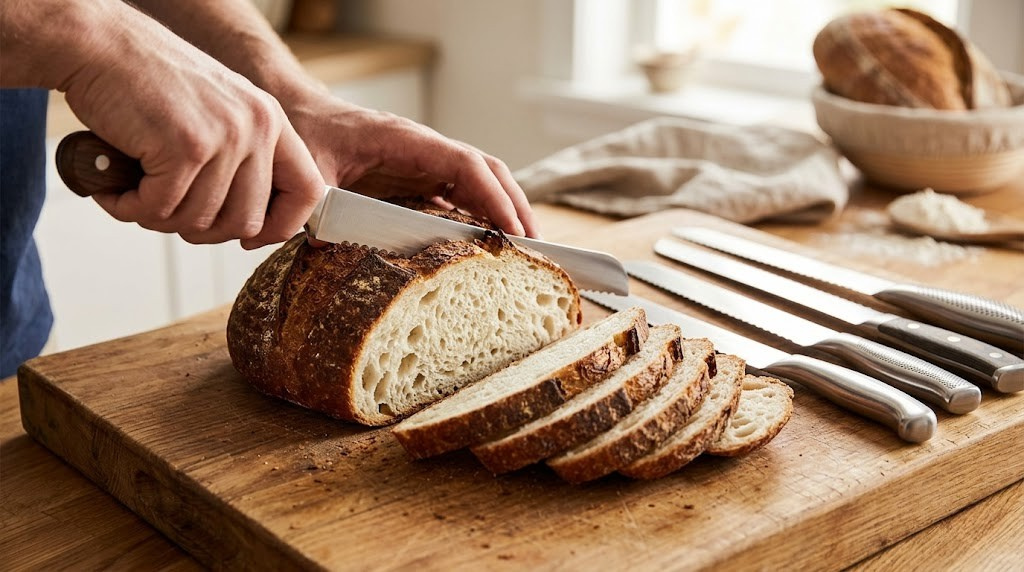
My Sourdough Saga: A Quest for the Perfect Slice
Like many people, I got deep into sourdough baking a few years ago. I obsessed over starters, hydration levels, and oven spring. I was creating these beautiful loaves with crackly, formidable crusts. But when it came time to slice them, my kitchen turned into a disaster zone. My trusty chef’s knife would skid off the crust before mangling the soft inside. The cheap bread knife I owned wasn’t much better; it would hack and tear, leaving a pile of crumbs and a squashed slice of bread.
It was incredibly frustrating. All that effort, ruined in the final step. My turning point was at a friend’s dinner party. He served a rustic boule and sliced it at the table with a long, elegant Wüsthof bread knife. It went through the crust with a satisfying *crunch* and produced a perfect, clean slice with zero effort. I knew right then that I was using the wrong tool. My journey to find the best bread knife began that night, and this guide is the culmination of everything I’ve learned about what separates a true “crust buster” from a “crumb crusher.”
Since then, I’ve baked thousands of loaves and tested dozens of serrated knives in my own kitchen, in friends’ kitchens, and during a brief return to professional cooking where I helped a small artisan bakery prep service. I’ve sliced soft milk breads at five in the morning, tackled crusty miches the size of car tires, fanned brioche so thin you could read newsprint through it, and learned the hard way which knives ruin a delicate ciabatta and which ones treat it with the respect it deserves. Everything in this guide is filtered through that experience. There are no affiliate-driven mystery picks. The knives below are the ones I would actually buy with my own money, and the ones I have, in fact, bought with my own money.
Why a Dedicated Bread Knife Changes Everything
Before we get into specific products, it’s worth understanding what’s actually happening at the cutting board when you slice bread, because once you understand the mechanics, the decision about which knife to buy becomes obvious. A loaf of bread is a structural marvel — a brittle outer shell of caramelized starches stretched around an airy, fragile interior of gas pockets and protein. The two textures could not be more different. The crust resists with hardness; the crumb collapses under the gentlest pressure. No single edge type can address both at once.
A straight-edged knife — your everyday chef’s knife or paring knife — works by pushing through material. The pressure required to break a crust is enormous, and that same pressure flattens the crumb the moment the blade reaches the soft interior. You either don’t slice the crust at all, or you crush the inside trying. This is the fundamental problem we explore in our deep-dive comparison of bread knives versus serrated utility knives: the geometry that works for one task fails for the other.
A serrated edge solves the puzzle by replacing pressure with action. Each serration is a tiny chisel, and the gullets between them are tiny grooves that pull material through the cut as you draw the blade back. The crust gets sawed apart by the points; the crumb gets eased apart by the gullets. Almost no downward pressure is needed, which means the loaf retains its shape, the crumb stays open, and the crust stays attached. This is why our broader piece on how serrated edges work is required reading for anyone who’s ever wondered why their baker’s loaf goes flat the moment they try to cut it.
Once you’ve used a properly designed bread knife, you cannot go back. The difference is dramatic enough that people frequently message me to say it has changed their entire baking practice — they bake more often because slicing is no longer the disappointing finale.
Beyond the Teeth: What We Look For in a Top-Tier Bread Knife
A bread knife might seem simple, but the details make all the difference. We didn’t just grab the most popular models; we broke down their performance based on the factors that truly matter when you’re facing down a crusty loaf or a delicate tomato.
Our Testing Philosophy: A great bread knife should feel like a saw for bread. It must bite into the crust instantly without pressure, glide through the interior without tearing, and give the user complete control over the thickness of the slice.
- Serration Type & Sharpness: This is the most critical feature. We analyzed the shape of the serrations. Are they sharp and pointed, designed to pierce the crust? Or are they wide and scalloped, which can sometimes glide over it? We looked for aggressive, sharp points that grip instantly.
- Blade Length & Thickness: A longer blade (10 inches is ideal) allows you to slice through wide loaves in a single, smooth stroke. A thin, rigid blade is also key. A thick blade creates more friction and crumbs, while a flimsy one will bow and produce uneven slices.
- Handle Design (Offset vs. Straight): We strongly prefer an “offset” handle, which is raised above the blade. This simple design choice gives your knuckles plenty of room, so you don’t bang them on the cutting board when you finish a slice. It’s a game-changing ergonomic feature.
- Balance and Feel: How does the knife feel in hand? Is it well-balanced, or does it feel clunky and blade-heavy? A comfortable handle and good balance reduce fatigue and improve control. We considered brands that are renowned for their ergonomics, which is a common theme when you compare the best chef knife brands in the world.
- Steel Composition: A bread knife uses its steel differently from a chef’s knife. The serrations protect the cutting points from board contact, so even softer European stainless can hold its sharpness for years. But the steel still matters for stiffness, rust resistance, and how the edge holds up when occasionally encountering hard ingredients like seeds or tough crust ridges. We pay attention to which alloy each blade uses (X50CrMoV15, X55CrMo14, VG-10, and so on) and what that means for the knife’s character.
- Overall Value: Just like with our search for the best budget chef knife, we’re looking for performance that exceeds the price tag. The knives on this list offer exceptional slicing power for a reasonable investment.
Quick Slices: Our Top Bread Knife Picks
In a hurry? Here are our top three recommendations that will handle any loaf you throw at them.
| Knife | Image | Best For | Price | Check on Amazon |
|---|---|---|---|---|
| Wüsthof Classic 10-Inch |  |
Overall Performance | ~ $189 | View Price |
| Mercer Culinary Millennia 10-Inch | 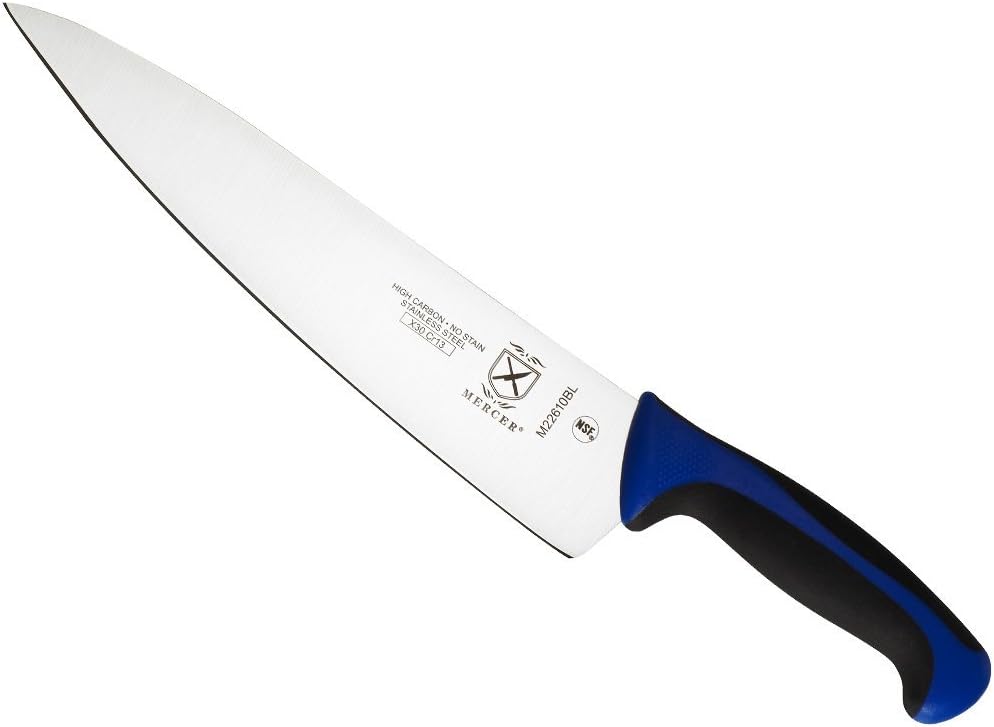 |
Best Value | ~ $22.11 | View Price |
| Tojiro Bread Slicer 235mm |  |
Precision & Sharpness | ~ $58 | View Price |
In-Depth Reviews: The Best Serrated Knives Analyzed
Let’s get into the nitty-gritty. We put these knives to the test on everything from crusty sourdough and French baguettes to soft brioche and ripe tomatoes.
1. Wüsthof Classic 10-Inch Bread Knife (Best Overall)
If you want a bread knife that will last a lifetime and perform flawlessly every single time, this is it. The Wüsthof Classic is a masterpiece of German engineering. Its forged, full-tang construction gives it a feeling of incredible sturdiness and perfect balance. The magic, however, is in the “double serrations” or “scalloped and serrated” edge. It has scallops within the serrations, allowing it to bite into the hardest crusts with zero hesitation and then slice cleanly through the soft interior with minimal tearing or crumbs.
The 10-inch length is perfect for even the largest boules, and the classic triple-rivet handle is comfortable and secure. This is a premium tool, and its price reflects that, but its performance is simply in a class of its own. It embodies the quality that makes the Wüsthof vs. Zwilling vs. Shun debate so interesting; it’s a true workhorse.
Who is this knife best for?
The serious home baker or anyone who believes in buying the best tool once and having it for life. Its performance justifies the investment.
- Exceptional “double serration” design
- Forged, full-tang for incredible durability and balance
- Long 10-inch blade handles any loaf size
- Effortlessly slices through hard crusts
- Made in Solingen, Germany
Pros
- Premium price point
- Heavier than stamped alternatives
Cons
A few extra notes on the Wüsthof from a baker’s perspective. The blade is ground from X50CrMoV15 — the same chromium-molybdenum-vanadium stainless that goes into every Wüsthof Classic chef’s knife and most premium German cutlery. At 0.5% carbon and roughly 15% chromium, it’s very rust-resistant, hardens to roughly 58 HRC, and takes a beautifully fine edge from a well-made factory grind. On a chef’s knife the relatively soft hardness means more frequent honing, but on a serrated edge that almost never sees a cutting board, it’s irrelevant. I’ve owned my Classic for almost a decade and the serrations remain frighteningly sharp without ever having been touched by a sharpening rod.
The “double serration” detail deserves attention. Look closely and you’ll see that the macro-scale wave pattern of the edge is itself made up of much finer, pointed micro-serrations within each scallop. Wüsthof grinds them precisely so that the points lead the cut while the gullets pull material through. The effect is a knife that is unusually aggressive on the bite (it digs in immediately, no skidding) but unusually gentle on the follow-through (the serrations don’t tear soft crumb the way coarse single-pattern serrations do). It is genuinely the best serrated edge I have ever used, full stop. The trade-off is that this kind of geometry is murder to resharpen if you ever wear it down — but you won’t, and even if you do in twenty years, Wüsthof’s authorized service centers can do it.
One thing worth knowing: Wüsthof also makes a “Gourmet” line, which is the stamped (not forged) version of the Classic. The Gourmet bread knife is roughly half the price and uses the same X50CrMoV15 steel. Performance is genuinely close — the serrations are nearly identical — but the Gourmet feels lighter and the handle is plastic without the integral bolster. If you love the Wüsthof aesthetic and edge but can’t justify the Classic’s price, the Gourmet is the secret-handshake budget pick.
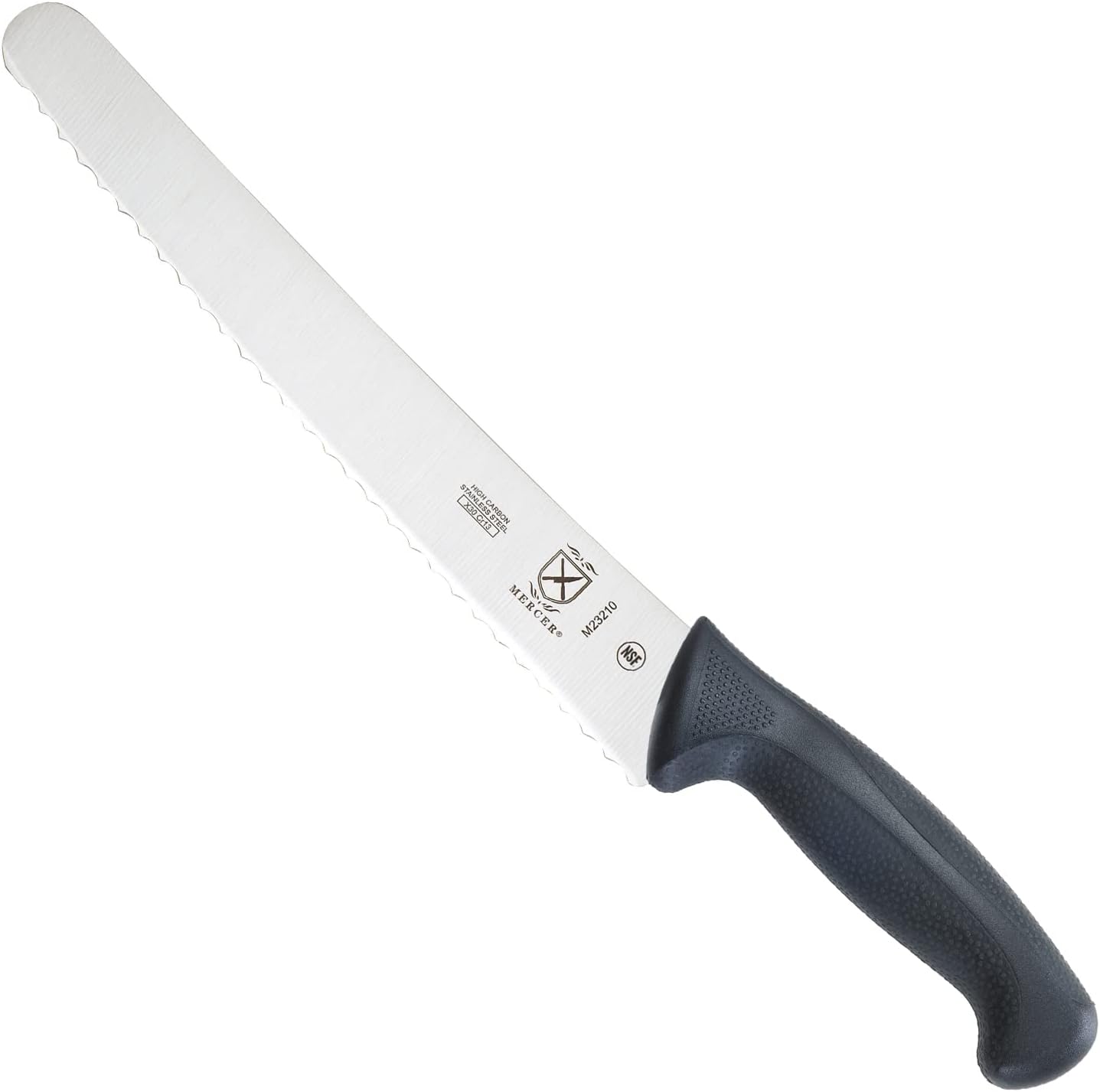
2. Mercer Culinary Millennia 10-Inch Wavy Edge (Best Value)
Just as its chef knife counterpart dominates the budget category, the Mercer Millennia bread knife offers unbelievable performance for its price. Often available for under $30, this knife is a favorite in professional kitchens and culinary schools for its no-nonsense functionality. The 10-inch blade is made from high-carbon Japanese steel and features sharp, effective serrations that make quick work of crusty bread.
The handle is its secret weapon: a comfortable, non-slip Santoprene and polypropylene blend that provides a secure grip, much like the acclaimed Victorinox Fibrox series. In fact, seeing how these two value-focused brands compare is a fascinating study, much like our Henckels vs. Victorinox analysis. It’s not a forged, heirloom piece like the Wüsthof, but for pure slicing power on a budget, it is impossible to beat.
Who is this knife best for?
Literally everyone else. If you’re not ready to invest in the Wüsthof, buy this knife. It’s the best value on the market, bar none.
- Incredible performance for the price
- Long 10-inch blade
- High-carbon Japanese steel
- Extremely comfortable and secure non-slip handle
- Lightweight and easy to handle
- NSF-certified for commercial kitchens
Pros
- Stamped blade lacks the heft of a forged knife
- Aesthetics are purely functional
Cons
Mercer Culinary doesn’t get the consumer-brand recognition that Wüsthof or Henckels enjoy, but inside any American culinary school, the brand is everywhere. Walk into the knife kit room at the Culinary Institute of America, Johnson & Wales, or any of the regional hospitality programs and you’ll see Mercer Millennia knives stacked by the dozen. There’s a reason: the school has to outfit hundreds of students at low cost, the knives have to survive both the abuse of inexperienced cooks and weekly run-throughs of an industrial dishwasher, and the school can’t tolerate a brand that will discontinue the model and orphan everyone’s matched set in three years. Mercer ticks all of those boxes, and they back it up with NSF certification on the entire Millennia line.
What that NSF certification means in practice: the handle has no crevices that trap food residue, the materials hold up to repeated chemical sanitization, and the construction is engineered for high-temperature commercial dishwasher cycles. You’d never need any of that in a home kitchen, but it’s a useful tell about how seriously the knife is built. You don’t accidentally NSF-certify a flimsy product. The fact that the Millennia bread knife passes the same engineering bar as a Wüsthof Classic in a sanitation context is a quiet achievement at the price.
The Santoprene-and-polypropylene grip is also worth a paragraph of its own. Santoprene is a thermoplastic vulcanizate — a slightly tacky rubber-like material that retains its grip even when soaked in oil, water, dough, or any other kitchen residue. The polypropylene under-grip provides the structural skeleton. Together, they create a handle that feels almost glued to your palm during use. After two hours of slicing soft sandwich bread for a catering job last summer, my forearm wasn’t tired and my grip never slipped, even when I was working faster than I should have been. That kind of confidence is what professional kitchens pay for, and it’s what Mercer delivers at the price of a decent dinner.
3. Tojiro Bread Slicer F-737 (Sharpness Champion)
This knife is a cult classic among knife enthusiasts, and for good reason. The Tojiro bread slicer is wickedly sharp. Made in Japan, its thin, flexible blade with razor-like serrations glides through bread with an eerie lack of resistance. If you want slices so thin you can read through them, this is your knife. It produces almost zero crumbs and excels at delicate tasks like slicing angel food cake or trimming brisket.
The blade is slightly shorter than others on this list (~9.25 inches), and its flexibility, while great for some tasks, can make it tricky to get a perfectly straight cut on a very wide, crusty loaf. The simple, unfinished wood handle is functional but not as ergonomic as the Mercer or Wüsthof. However, for sheer cutting ability, it’s a marvel and an incredible value.
Who is this knife best for?
The precision-obsessed cook who values sharpness above all else. It’s also an excellent choice for those who need to slice soft, delicate items without any tearing.
- Phenomenally sharp serrations
- Creates very few crumbs
- Flexible blade is great for fine slicing
- Excellent value for a Japanese-made knife
Pros
- Blade flexibility can be a drawback for rustic loaves
- Handle is very basic
- Requires hand washing and drying immediately
Cons
The Tojiro F-737 deserves more cultural context than it usually gets in Western reviews. Tojiro is based in Niigata, Japan — Tsubame-Sanjo, specifically, which is the metalworking heartland that has supplied cutlery to professional chefs in Tokyo and Osaka for over a century. The F-737 is what you’ll find on the bench of most Japanese boulangerie and pâtisserie chefs, and the Western enthusiast cult around this knife is essentially the slow trickle of a tool that’s been the professional default in its home country for decades.
The blade is hardened to roughly 60 HRC — significantly harder than any German bread knife — using a molybdenum-vanadium stainless steel. That extra hardness translates directly to edge sharpness and edge retention. The serrations are smaller, more numerous, and pointed rather than scalloped. They cut by piercing rather than by sawing, which is why the knife seems to glide through almost any material. The trade-off is that thin, hard, pointed serrations are more delicate. A careless hit against a ceramic plate, a frozen baguette, or a hidden bone in a piece of meat will chip them in a way that wouldn’t damage a Wüsthof. Treat the F-737 like the precision instrument it is and it will reward you for years.
The flexibility is genuinely useful for specific tasks. If you’ve ever tried to torte a layer cake — slice it horizontally to fill it — with a thick, rigid bread knife, you know that the blade thickness creates drag and an uneven cut. The Tojiro’s thin, flexible blade glides through cake horizontally with the precision of a deli slicer. The same flexibility is helpful for slicing roast beef thinner than your standard slicer can manage, or for separating the layers of a particularly tall ciabatta. It’s not a one-trick bread knife — it’s a precision slicer that happens to handle bread beautifully.
4. Victorinox Fibrox Pro 10.25-Inch Serrated Knife (The Ergonomic Workhorse)

It’s no surprise to see another Victorinox on a “best of” list. Known for creating some of the world’s best-value knives, their bread knife is another stellar example of performance-first design. This knife features a long 10.25-inch blade with wide, scalloped serrations and the legendary Fibrox Pro handle that is beloved by professional chefs for its comfort and non-slip grip.
The scalloped serrations are slightly less aggressive on hard crusts than the Wüsthof’s pointed teeth, but they are exceptionally good at slicing soft breads, cakes, and even roasted meats without tearing. The blade has a slight curve, making it great for long, smooth slicing motions. If you already own and love their chef’s knife, this is a natural and excellent addition to your collection. Our Victorinox chef knife reviews highlight the consistent quality across their entire line.
Who is this knife best for?
Anyone who prioritizes handle comfort and safety, or fans of the Victorinox brand looking for a reliable, long-bladed slicer for a variety of tasks beyond just bread.
- Supremely comfortable and ergonomic Fibrox handle
- Very long 10.25-inch blade
- Lightweight and easy to control
- Versatile for bread, roasts, and large fruits
- Excellent Swiss-made quality
Pros
- Wider, scalloped serrations can be less effective on very hard crusts
- Not an offset handle
Cons
One nuance about the Victorinox that often gets glossed over: it’s not just a bread knife, it’s marketed as a bread-and-tomato knife, and that dual-purpose framing tells you something about its serration geometry. The wide scallops make the knife a tomato-slicing wizard — the serrations grip the slick tomato skin instantly without the back-and-forth sawing that some narrower-toothed knives require. They’re equally good on peppers, peaches, melon halves, and any other smooth-skinned produce that defeats a chef’s knife. If you regularly process summer tomatoes for sauce, salsa, or sandwich towers, the Victorinox is in some ways the more versatile pick than even the Wüsthof.
The flip side, as noted, is that the same scalloped geometry struggles on really hard, brittle artisan sourdough crust. It works — eventually — but it requires more sawing motion than the Wüsthof’s aggressive pointed teeth. For a baker who makes high-hydration sourdough every weekend, the Victorinox is the wrong knife. For a household that mostly eats supermarket loaves, sandwich bread, ciabatta, and a lot of summer produce, the Victorinox is arguably the most useful single serrated knife you can buy.
The X55CrMo14 steel is the same alloy used across the entire Victorinox kitchen line — slightly higher carbon than X50CrMoV15, similar overall behavior, hardened to about 56 HRC. The serrations are, as expected, ground in Switzerland to Victorinox’s typical 15° per-side standard. Edge retention on a bread knife isn’t a meaningful metric (the points hardly ever touch a board), but the alloy is genuinely stainless and shrugs off long-term contact with acidic tomato juice without pitting.
Five More Bread Knives Worth Considering
The four knives above cover most needs, but there’s a wider universe of legitimately good serrated knives that deserve recognition. If you’ve been recommended one of these or you’re hunting a specific aesthetic, here’s what to know.
Shun Classic 9-Inch Bread Knife
Shun’s Classic line — the same family compared in our Wüsthof vs. Zwilling vs. Shun deep-dive — applies its VG-MAX steel and Damascus cladding to a 9-inch bread knife with a D-shaped pakkawood handle. The serrations are pointed and aggressive, and the steel is hardened to a Japanese-typical 60–61 HRC. The result is a knife with razor-sharpness and beautiful aesthetics that’s also significantly more expensive than the Wüsthof Classic. The trade-off is the typical Japanese one: harder steel cuts better but is more delicate, and the D-handle is right-hand-biased (lefties should look elsewhere). If you already own Shun chef’s knives and want a matching bread knife, this is the natural choice. If you don’t, the Wüsthof gives you 90% of the performance with more durability for less money.
Zwilling Pro / Four Star 8-Inch Bread Knife
Zwilling’s Pro and Four Star bread knives use the same X50CrMoV15 steel as Wüsthof, with similar serration geometry and a slightly different handle profile (the Four Star has a single-piece molded handle; the Pro has a curved bolster called the “Shadow Bolster”). They’re forged in Solingen, Germany, and they slice as well as any Wüsthof. The 8-inch length is what holds them back for serious bread work — too short for big artisan loaves — but if you mostly slice sandwich loaves or you want a matching addition to a Zwilling block set, the 8-inch Pro is excellent. There’s also a 10-inch Zwilling Pro bread knife sold separately that competes head-to-head with the Wüsthof Classic and is often slightly cheaper; performance is essentially identical.
Henckels International Classic Bread Knife
Henckels International (the value arm of the Zwilling group) makes a forged bread knife in their Classic line at roughly 1/3 the price of a true Zwilling Pro. It’s made in Spain rather than Germany, uses a similar X50CrMoV15-class steel hardened to about 56 HRC, and has serviceable scalloped serrations. It’s genuinely a good knife at the price — better than most generic stamped bread knives — but the serrations aren’t as sharp as Wüsthof’s double-toothed grind. For a household furnishing a kitchen on a budget where one matched-aesthetic set matters, the Henckels Classic bread knife is a reasonable add-on to a Henckels block set. As a standalone purchase, the Mercer Millennia outperforms it for less money.
Dexter-Russell Sani-Safe 10-Inch Bread Knife
The Sani-Safe is to commercial bakeries what the Mercer is to culinary schools. American-made in Massachusetts, NSF-certified, with a textured polypropylene handle designed for industrial dishwasher abuse, it’s the knife you’ll find at deli counters, sandwich shops, and small bakeries across the country. The blade is high-carbon stainless ground for absolutely zero pretension — no Damascus, no fancy bolster, no aesthetic concession. It just slices bread for ten years and goes through ten thousand dishwasher cycles. Performance is on par with the Mercer; the choice between them comes down to handle preference (the Mercer’s Santoprene grip is slightly more comfortable; the Dexter’s polypropylene is more rugged). For the right buyer, the Sani-Safe is the no-brainer working knife.
Tojiro ITK / DP / Pro Bread Knives
If you love the F-737 and want to step up, Tojiro makes more premium serrated knives in their DP and Pro lines. The DP series uses a three-layer laminated blade with a VG-10 core sandwiched between softer stainless cladding, hardened to 60–61 HRC. The Pro series adds a more refined handle. Both push performance further than the F-737, especially on edge retention, but the price climbs accordingly. For most home cooks, the F-737 remains the best Tojiro value. If you’ve owned and loved the F-737 for a few years and want to invest in something more refined, the DP bread knife is the natural upgrade.
Electric Bread Knives — When and Why
An electric bread knife (Cuisinart, Black + Decker, Hamilton Beach all make competent ones) trades the elegance of manual slicing for sheer cutting power. The vibrating dual blades cut through anything — frozen bread, hard crusts, dense meat, even tough roast vegetables — with no skill or strength required. They are ugly, loud, take up drawer space, and are emphatically not the right choice for a baker who wants to admire their loaf. But for elderly cooks with reduced grip strength, for kitchens where bread is sliced in volume (a Thanksgiving family carving turkey and sandwich rolls simultaneously), or for someone who genuinely struggles to use a manual knife, an electric is a humane and practical answer. They’re not on this main list because the audience is different, but they exist and they have their place.
Anatomy of a Great Bread Knife: Offset vs. Straight, Length, and Serrations
Understanding the key features of a bread knife will help you choose the perfect one for your needs. It’s not just about having “teeth.”
The Offset Advantage: Why Knuckle Clearance Matters
An offset handle is one of the single best features to look for. Because the handle is raised, your hand is kept far away from the cutting board. With a straight-handled knife, you often have to tilt the blade up at the end of a slice to avoid rapping your knuckles on the counter, which can lead to an uneven final piece. An offset knife (like the Mercer Millennia) solves this problem completely, allowing for a full, clean slice every time. For this reason alone, we often recommend it over straight-handled competitors.
That said, the offset advantage isn’t absolute. Offset handles usually have a slightly smaller drop than people imagine — typically half an inch to an inch — so on a thin sandwich loaf the difference is minimal. The benefit becomes meaningful when you’re slicing tall loaves like a brioche pullman, a panettone, or an artisan miche where the blade has to traverse three or four inches of vertical depth. In those situations, an offset handle keeps your wrist in a neutral, ergonomic position throughout the entire slice. A straight-handle knife forces you to angle your wrist progressively as you cut deeper, which in turn pushes the blade off-axis and produces a sloped slice. Bakers who slice frequently can develop wrist fatigue from repeated angled cuts, and the offset handle solves the problem at its source.
Serration Science: Pointed vs. Scalloped
Not all serrations are created equal. Pointed serrations, like those on the Wüsthof or Tojiro, act like tiny claws. They are extremely aggressive and excel at piercing tough, crusty exteriors. This is what you want for rustic sourdough or a crusty baguette. Scalloped serrations, like on the Victorinox, have rounded gullets. They are gentler and produce a very smooth cut, making them excellent for softer items like brioche, chiffon cake, or even tomatoes. They are less prone to tearing delicate crumb structures.
There’s a third pattern worth knowing about: compound serrations, like the Wüsthof Classic’s “double” edge. These layer fine micro-serrations on top of macro-scale scalloped waves, combining the bite of pointed teeth with the smooth follow-through of a scalloped edge. They are harder and more expensive to manufacture, which is why you only see them on premium knives. If you want one knife that handles every category of bread well — from rustic crust to soft brioche — a compound serration is the technical answer. The Wüsthof Classic is the most accessible option in this category. Some Japanese makers grind even more elaborate three-tier compound edges, but they’re rarely sold in Western markets and the practical performance gain over the Wüsthof is small.
Blade Length: Why Ten Inches Is the Sweet Spot
If you’ve never thought hard about bread knife length, here’s the rule of thumb: the blade should be longer than the diameter of the largest loaf you regularly slice. A typical artisan boule runs 8 to 10 inches across, which means an 8-inch blade is constantly back-and-forth sawing while a 10-inch blade can cleanly traverse the loaf in a single confident motion. The longer blade also acts as a better lever, multiplying your forward stroke into more effective slicing surface contact.
The downside of longer blades is storage and weight. A 10-inch bread knife doesn’t fit in many under-counter drawers or magnetic strips designed for chef’s knives. Twelve-inch professional bread knives exist (mostly sold to commercial bakeries) and they’re glorious for big miches, but they’re impractical for most home kitchens. Eight-inch bread knives are easier to store but constantly fight their own length when you’re working on anything bigger than a sandwich loaf. Ten inches is the engineering sweet spot, which is why almost every premium bread knife on the market converges on that length.
Blade Thickness and Stiffness
A bread knife’s spine is typically 2 to 3 millimeters thick — thinner than most chef’s knives. The reason is friction: a thick blade plows through soft crumb, generating drag and crumbs. A thin blade glides. But thinness has a stiffness penalty, and a thin-and-flexible blade like the Tojiro’s behaves very differently from a thin-and-rigid blade like the Wüsthof’s. Flexibility is great for cake torting and meat carving but becomes a liability when you’re trying to maintain a perfectly vertical cut through a tall, dense loaf. Rigidity is great for confident bread slicing but reduces precision on delicate horizontal cuts. Most of the knives in this guide land at “thin and rigid,” with the Tojiro standing out as the deliberate exception.
Slicing Different Breads: A Loaf-by-Loaf Guide
One of the most useful things you can do as a home baker is understand that different breads need different approaches — even with the right knife. Here’s a quick tour of the major categories.
Artisan Sourdough & Country Loaves
This is the bread that destroys most knives. The crust is thick, brittle, and structurally tough — sometimes 4 to 6 millimeters of caramelized, almost ceramic-hard shell. The crumb inside is usually open and irregular, with tender, custardy holes that crush at the slightest pressure. The right move: a long bread knife (10-inch minimum) with aggressive pointed serrations (Wüsthof Classic or Tojiro). Use long, gentle sawing strokes — let the blade do the work, no downward pressure. Start with a confident bite at the top of the crust and let gravity slide the blade through the rest. Always slice on a wood or rubber cutting board; never on stone or ceramic.
Critical timing tip: don’t slice fresh-baked sourdough until it’s fully cooled. The interior steam and starch matrix needs at least 90 minutes (often longer for big loaves) to set. Cutting a hot loaf produces a gummy, doughy interior because you’re catching the starches mid-set. The bread knife is innocent — your impatience is the problem.
French Baguette & Ciabatta
Long, narrow, crusty, and structurally fragile. A baguette will explode in showers of crust shrapnel under a dull knife. Use the Wüsthof Classic or any pointed-serration knife, and slice on a slight bias rather than perpendicular to the loaf. The biased angle gives you more cutting surface per stroke and prevents the loaf from compressing as you cut. Ciabatta is similar but tends to have an even more open crumb — be especially gentle to preserve the crumb structure.
Soft Sandwich Loaves & Brioche
These are the easy customers — soft crusts, tight crumb. Almost any bread knife handles them well. The Victorinox shines here because the scalloped serrations are gentle on the soft crumb. A pointed-serration knife will also work fine but might tear the bread slightly on the entry stroke. For brioche specifically, slicing thinner than you think is correct: ½-inch slices are ideal for most uses, and a thin blade like the Tojiro produces near-perfect ½-inch slices with zero compression.
Bagels & Hard Rolls
Slicing a bagel is genuinely dangerous — emergency rooms see thousands of bagel-related lacerations every year, almost all from one specific mistake: holding the bagel in your palm and slicing toward your hand. Don’t do this. Place the bagel flat on a cutting board, place the knife horizontally across the top, and slice horizontally with the bagel held flat by your other hand pressing down on the top half. A serrated bread knife works for this, though a dedicated bagel cutter (a guillotine-style bagel guard) is safer if you eat bagels often. For hard rolls and Kaiser rolls, treat them like miniature artisan loaves: long sawing strokes, no pressure, pointed serrations preferred.
Rye, Pumpernickel & Dense Whole-Grain Loaves
Dense, dark breads are heavy and require longer blade engagement. The bread knife works fine, but you’ll notice more drag than with airy loaves. Take your time, use the full length of the blade, and let the serrations pull the slice apart rather than forcing it. A flexible blade (Tojiro) sometimes produces uneven slices on dense rye because the blade follows the path of least resistance through the dense crumb. A rigid blade (Wüsthof) handles dense breads more predictably.
Cake & Pastry
Bread knives moonlight beautifully as cake slicers and pastry cutters. The Tojiro’s flexibility is genuinely useful for torting cake layers (slicing horizontally to create fillable layers). The Wüsthof’s compound edge handles dense cakes and pies. For very delicate things — angel food cake, chiffon, soft sponges — the Tojiro is unbeatable; the rigid German blades tend to compress soft cake structures. A separate dedicated cake slicer exists (long, very thin, sometimes with a wavy edge) for serious bakers, but a thin-bladed bread knife covers 95% of needs.
Bread Knife vs. Tomato Knife vs. Serrated Utility
Once you start paying attention to serrated edges, you’ll notice that “serrated knife” is a category, not a single tool. There are three main subcategories sold under that umbrella, and understanding the differences will save you from buying the wrong one.
The full-length bread knife (9 to 12 inches) is what we’ve been discussing — long, rigid, thin, designed for slicing through entire loaves in single strokes. The serrated utility knife (5 to 7 inches) is a smaller version with the same edge geometry, intended for sandwiches, smaller rolls, dinner-roll slicing, and the kind of casual bread-and-cheese-board work where pulling out the full bread knife feels excessive. The tomato knife (typically 4 to 6 inches) has a different serration pattern optimized specifically for slick-skinned produce — the points are sharper and more closely spaced, and the blade often has a forked or split tip for lifting tomato slices off the cutting board.
For most home cooks, owning a 10-inch bread knife covers the majority of bread tasks, but adding a 5-inch serrated utility knife is a quality-of-life upgrade. The smaller knife is what you reach for to slice a single sandwich roll without dragging out the full bread knife, and it handles tomatoes acceptably even though it’s not optimized for them. A dedicated tomato knife is genuinely useful only if you process large volumes of tomatoes (canners, sauce-makers, sandwich-shop owners). Otherwise, a serrated utility knife covers both jobs adequately. Our extended comparison of bread knives versus serrated utility knives goes deeper if you’re trying to decide between the two as a primary purchase.
Bread Knives for Specific Buyers: Lefties, Arthritis, Small Hands
Standard knife reviews assume a generic right-handed cook with average grip strength. That assumption excludes a lot of the actual cooking population. Here’s how to navigate the bread-knife market if you don’t fit the default profile.
Left-Handed Cooks
Most Western bread knives are functionally ambidextrous — the serration grind is symmetric, so the knife cuts the same regardless of which hand drives it. The handle is the variable. Ergonomic D-shaped handles like the Shun Classic are right-hand biased and uncomfortable for lefties. Symmetric oval handles like the Wüsthof Classic, the Mercer Millennia, and the Victorinox Fibrox work equally well in either hand. If you’re left-handed, prefer symmetric handles. The Mercer is particularly good because the textured grip surface has no left-right asymmetry.
Cooks with Arthritis or Reduced Grip Strength
The lighter the knife, the better. Forged knives like the Wüsthof Classic are heavy (the 10-inch weighs around 270 grams) and the heft becomes painful during long sessions for arthritic hands. Stamped knives are dramatically lighter — the Mercer Millennia weighs around 170 grams, the Victorinox Fibrox around 180 grams. The Fibrox handle’s slight tackiness also reduces the grip pressure required to maintain control, which is a real advantage for cooks with hand mobility issues. For severe cases, an electric bread knife removes the grip-strength requirement entirely.
Small Hands
The Wüsthof Classic’s thick triple-rivet handle is genuinely too large for cooks with small hands; you can’t get a confident pinch grip. The Mercer Millennia’s slimmer Santoprene handle is much friendlier to smaller grip spans. The Victorinox Fibrox sits in the middle. The Tojiro’s basic wood handle is the smallest of all and works well for most hand sizes. If your hand size is small enough that other kitchen knives feel uncomfortable, prioritize the Mercer or Tojiro and avoid the heavier German knives.
Children (Supervised) & New Cooks
A serrated knife is genuinely safer for inexperienced cooks than a sharp chef’s knife, because the serrations don’t slip on slick surfaces and the bread-knife motion (long horizontal sawing) is less likely to result in a cut than the rocking motion of a chef’s knife. For supervised teenagers learning to cook, a Mercer Millennia is the right starter knife — affordable, safe-feeling, dishwasher-tolerant, and forgiving of misuse. Don’t hand a child a Tojiro F-737; the points will chip on the first dishwasher cycle.
Preserving the Bite: How to Care for Your Serrated Knife
A high-quality serrated knife can stay sharp for years—sometimes over a decade—with proper care. The good news is that it’s simpler than caring for a straight-edged knife.
- Hand Wash Only: Just like a chef’s knife, never put a bread knife in the dishwasher. The detergents are abrasive, and the high heat can damage the handle. Wash gently with a sponge (be careful of the serrations!) and dry immediately.
- Store Safely: Don’t let it rattle around in a drawer. Use a knife block, a magnetic strip, or a simple plastic sheath to protect the serrated edge from getting dinged.
- Avoid Hard Surfaces: Only cut on wood or plastic cutting boards. Never cut on ceramic plates, glass, or stone countertops, as this will instantly dull the points of the serrations.
- To Sharpen or Not to Sharpen?: Sharpening a serrated knife is a painstaking process involving a special tapered sharpening rod. For budget knives like the Mercer or Tojiro, it’s often more cost-effective to simply replace the knife after 5-10 years of use. For a premium knife like the Wüsthof, you can send it to a professional sharpening service every decade or so.
The Dishwasher Question, Honestly
A few of the knives on this list — the Mercer Millennia and Victorinox Fibrox specifically — are technically rated for commercial dishwasher use, with NSF certification to back it up. The handles will not melt, the steel will not corrode, and the knife will survive thousands of cycles. Manufacturers tell you it’s fine. So why does every knife guide on the internet still say hand-wash only? Because the dishwasher does long-term cosmetic damage that the testing standards don’t capture: it dulls polished bolsters, dries out polymer handles over decades, and bangs the serrations against other utensils in the rack. The knife will function for ten years in the dishwasher. It will look like a tool from a high school cafeteria by year three. If you don’t care about appearance and you wash a lot of dishes, the Mercer or Fibrox can absolutely live in your dishwasher. For everyone else, the 30 seconds it takes to hand-wash a bread knife are worth it for a knife that ages gracefully over decades. This is the same logic we cover in our analysis of dishwasher-proof steak knives and the related debate about heat, detergent, and cosmetic wear.
Sharpening Serrated Edges: The Real Truth
You’ll read in many places that serrated knives “can’t be sharpened.” That’s not quite right. They can be sharpened, but the process is fundamentally different from sharpening a straight edge. Each individual serration has its own gullet that needs to be reground, which means you can’t run the blade across a flat stone. The correct tool is a small, tapered ceramic or diamond sharpening rod (sometimes called a “crock stick”) that fits inside each gullet, one at a time. You match the rod’s diameter to the gullet, work each gullet for ten to twenty light strokes, and then deburr the back of the blade with a flat stone or the side of the sharpening rod.
It’s tedious. A 10-inch bread knife has roughly 50 to 80 individual gullets depending on the pattern. Doing each one properly takes about 20 minutes for an experienced sharpener. For most home cooks, this is genuinely not worth doing on a knife under $50. The Mercer is cheaper to replace than to professionally sharpen. For premium knives — Wüsthof, Shun, the Tojiro — sending the knife to the manufacturer’s authorized service center every five to ten years is the right call. Wüsthof’s North American service is responsive and affordable. Shun’s customer service is excellent. Tojiro is harder to service in the West but their edges hold up well enough that it rarely matters.
Cutting Boards Matter More Than You Think
Bread knives spend their lives mostly above the cutting board, but the moment of contact at the bottom of each slice is when serrations get damaged. A wooden end-grain cutting board is the gold standard — soft enough to absorb the serration tips without dulling them, dense enough to resist marking. Edge-grain wood is acceptable. Plastic / polypropylene boards are fine but leave more visible knife marks. Avoid: glass, ceramic, stone, granite, marble, or any composite “stoneware” board. These will chip serration points within a single slice and there’s no way to repair them. If your kitchen has a beautiful marble countertop, treat it as a serving surface and never as a cutting surface.
Warranty, Longevity, and What You’re Really Buying
One reason quality bread knives feel expensive at first is that the per-year cost over their actual lifespan is trivially small. The Wüsthof Classic carries Wüsthof’s limited lifetime warranty against manufacturing defects. The Victorinox Fibrox has a similar lifetime warranty backed by their North American distribution arm, which has a reputation for replacing damaged knives without much fuss. The Mercer Millennia has a limited lifetime warranty as well, though the company is less consumer-facing than the German brands and the warranty process involves more paperwork. The Tojiro F-737’s warranty depends on which retailer you buy through, since Tojiro doesn’t do direct-to-consumer support in the US; reputable specialty retailers like Korin, MTC Kitchen, and Knifewear all offer their own warranty coverage on top of Tojiro’s.
“Limited lifetime warranty” generally covers manufacturing defects — handle separation, blade cracking, factory grinding errors — and excludes wear and tear. If the points dull from a decade of use, that’s wear. If a rivet pops on year three, that’s a defect, and you’ll get a replacement. None of these warranties cover dropping the knife on tile or running it through a dishwasher when the manual says hand-wash. Read the fine print before assuming any specific failure is covered.
Resale and longevity tell their own story. A Wüsthof Classic from twenty years ago in good condition still trades on the used market for nearly its retail price; the design hasn’t changed and the knife is recognized as a long-term investment. A Tojiro F-737 from ten years ago similarly holds value among Japanese-knife enthusiasts. The Mercer and Victorinox are commodity-priced — there’s no resale market because new ones are too cheap — but both are likely to outlive every appliance you currently own. None of these knives are throwaways. The cheapest knife on this list will give you better cost-per-year performance than a $5 supermarket bread knife replaced every two years.
Frequently Asked Questions (FAQ)
Do I really need a separate bread knife?
Absolutely, 100%. A serrated bread knife is a specialized tool. Its “teeth” are designed to saw through a hard, brittle crust without requiring downward pressure, which would crush the soft, airy crumb inside. Using your primary chef’s knife on bread will squash the loaf and can severely dull your blade’s fine edge.
What’s the ideal length for a bread knife?
We recommend a blade length of at least 9 inches, with 10 inches being the sweet spot. A longer blade allows you to use a smooth, single sawing motion to get through even wide, round artisan loaves. A shorter knife requires more back-and-forth sawing, which can create more crumbs and a less clean cut.
What is an offset bread knife and why is it better?
An offset bread knife has a handle that is positioned higher than the blade’s edge. This ergonomic design provides crucial knuckle clearance, which prevents your hand from hitting the cutting board as you finish slicing through the bottom of the loaf. It allows for a more comfortable, efficient, and complete cut.
Can I use a bread knife for other things?
Yes! A good serrated knife is surprisingly versatile. It’s the best tool for slicing delicate, soft-skinned fruits and vegetables like tomatoes, peaches, and bell peppers. It’s also excellent for leveling cakes, slicing sandwiches, and carving roasted meats with a tough skin, like a pork roast.
What steel are good bread knives made of?
German bread knives like the Wüsthof Classic and Zwilling Pro use X50CrMoV15 — a chromium-molybdenum-vanadium stainless steel hardened to about 58 HRC. Victorinox uses the closely related X55CrMo14. Japanese knives like the Tojiro F-737 use molybdenum-vanadium stainless or VG-10 laminated cores hardened to 60+ HRC. For a serrated knife, the steel matters less than it does for a chef’s knife, because the points rarely contact the cutting board. Any of these alloys will hold their edge for years of normal use.
Can I cut hot, freshly baked bread with a bread knife?
You can, but you shouldn’t. A freshly baked loaf is still finishing its starch gelatinization for at least 60 to 90 minutes after coming out of the oven. Slicing it hot produces a gummy, doughy interior because you’re catching the starches mid-set. The bread knife isn’t the problem — the bread is. Wait until the loaf is fully cool, then slice. This is universally true for sourdough, artisan loaves, and rich enriched breads. Sandwich bread is more forgiving but still tastes better when fully cooled.
Wüsthof vs. Mercer: which is the better bread knife?
The Wüsthof Classic is technically superior — better serrations, forged construction, finer fit and finish, longer expected lifespan. The Mercer Millennia is roughly 1/8 the price and gets you 80% of the cutting performance with NSF certification on top. If money is no object, the Wüsthof is correct. If you want the smartest dollar-per-slice value, the Mercer wins. Both will outlast most appliances you currently own.
Tojiro F-737 vs. Wüsthof Classic: how do they compare?
Different tools for different jobs. The Tojiro is sharper, thinner, and more flexible — better for delicate cake-torting, very thin slices, and meat carving. The Wüsthof is more rigid, more rugged, and has more aggressive serrations for thick artisan crust. For pure bread slicing, the Wüsthof is more versatile. For precision work on cake, soft loaves, and roasted meats, the Tojiro is unbeatable. Many serious cooks own both for different tasks.
Are bread knives dishwasher safe?
Manufacturers say yes for stamped knives like the Mercer Millennia and Victorinox Fibrox. Forged knives like the Wüsthof Classic should be hand-washed. Even when “dishwasher safe,” hand-washing extends the cosmetic life of any knife dramatically. The 30 seconds you save by using the dishwasher are paid back in handle dryness, dulled bolsters, and serration nicks over a decade of use. Hand-wash if you can.
Can a bread knife slice frozen bread?
Carefully, and not always well. A high-quality bread knife can saw through partially frozen bread — say, frozen for an hour or two — but rock-hard freezer-burned bread will damage the serrations on a delicate knife like the Tojiro and is genuinely dangerous to attempt. The blade can skid off the bread surface. The right move is to thaw the bread for 30 minutes at room temperature first, or use an electric bread knife if you slice frozen bread regularly. The serration tips on a Wüsthof or Mercer can handle occasional cold bread without damage; the Tojiro cannot.
Is a bread knife safe for slicing tomatoes?
Yes, and it’s actually one of the best tools for the job. The serrations grip the slick tomato skin instantly, where a smooth-edged chef’s knife often skids and crushes. The Victorinox Fibrox is particularly good at tomato work because of its scalloped serrations, but any sharp serrated knife outperforms a dull straight-edge on tomatoes. A dedicated tomato knife (smaller, finer serrations) is even better, but a bread knife covers the job adequately.
Why is my bread knife producing so many crumbs?
Three likely culprits. First, the knife is dull — even a serrated edge gets dull over many years and produces more crumbs as it loses its bite. Second, you’re applying downward pressure instead of letting the blade saw — let gravity do the work, no pressure on the loaf. Third, the bread is too fresh and still steaming inside. Cool the loaf fully before slicing. If all three are addressed and you’re still getting crumb explosions, the knife is genuinely worn out and a replacement is in order.
How long should a bread knife last?
A premium bread knife like the Wüsthof Classic should last 20 to 30 years of regular home use without serious sharpening, possibly longer. A Mercer Millennia or Victorinox Fibrox should last 10 to 15 years before the serrations start dulling enough to feel slow. The Tojiro F-737 falls somewhere in between depending on use. For comparison, a generic supermarket bread knife typically loses bite within 2 to 3 years. The cost-per-year math always favors the better knife.
The Final Cut: Your Best Choice for Flawless Slices
A great bread knife is a transformative tool. It brings a sense of ease and satisfaction to your kitchen, ensuring that every loaf you bake or buy is treated with the respect it deserves.
If you’re looking for the absolute best, a “buy it for life” tool that will never let you down, the Wüsthof Classic 10-Inch Bread Knife is the pinnacle of performance. Its engineering and cutting ability are second to none.
However, for the vast majority of people, the Mercer Culinary Millennia 10-Inch offers performance that comes astonishingly close for a tiny fraction of the price. It is, without question, the best value on the market and our strongest recommendation for most home kitchens.
If precision and sharpness are your priorities — if you torte cakes, slice paper-thin brioche, or carve roasts as well as bread — the Tojiro F-737 is the cult-classic specialist that no serious enthusiast regrets owning. And if you want a single serrated knife that handles bread, tomatoes, and a long list of soft produce with equal grace, the Victorinox Fibrox 10.25-inch is the most versatile pick on this list.
Whichever you choose, investing in a proper bread knife is one of the easiest ways to upgrade your entire kitchen experience. Say goodbye to crushed bread and messy countertops, and hello to perfect, effortless slices, every single time.
















Pingback: Tojiro vs Shun: Which Knife Brand Is Better?