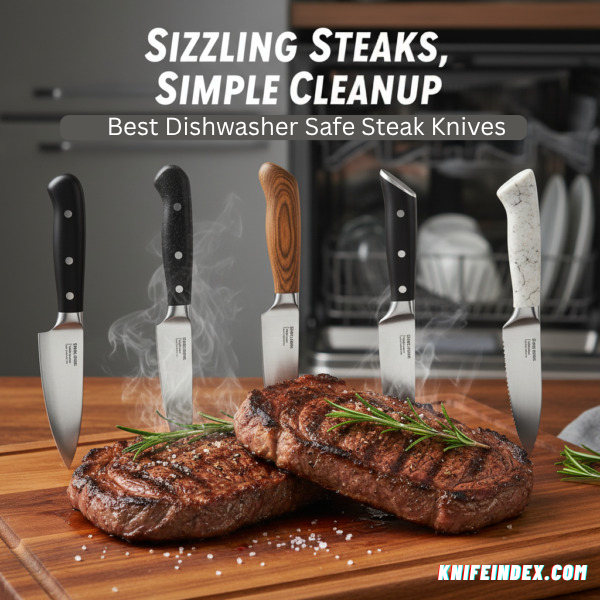
Sizzling Steaks, Simple Cleanup: The 5 Best Dishwasher Safe Steak Knives
Picture this: you’ve just hosted a fantastic steak dinner. The food was perfect, the company was brilliant, but now you’re left with a sink full of greasy plates and a pile of beautiful, delicate steak knives that need to be painstakingly hand-washed. It’s the tedious final act that nobody wants. But what if you could have it all? What if you could own a set of steak knives that glide through a ribeye like butter and can then be tossed straight into the dishwasher without a second thought? Welcome to the world of modern, high-performance, dishwasher-safe steak knives.
My Post-Dinner Party Nightmare: The Hand-Wash-Only Rule
I love hosting. My signature meal for a special occasion is a big, reverse-seared tomahawk steak. For years, I used a set of gorgeous steak knives with beautiful rosewood handles that I received as a wedding gift. They were stunning and incredibly sharp. They were also strictly “hand-wash only.” After a wonderful evening of food and wine, my guests would leave, and I’d be left standing at the sink at 11 PM, carefully washing and drying eight greasy, razor-sharp knives, terrified of slicing my hand or ruining the wood handles.
The final straw was after a big holiday dinner. I was exhausted and just wanted to relax. I looked at those eight knives in the sink and thought, “There has to be a better way.” I became obsessed with finding a set of steak knives that didn’t force me to choose between performance and convenience. I wanted a knife that felt great, cut beautifully, and could stand up to the heat and detergents of my dishwasher. This guide is the result of my quest to find the best no-compromise, dishwasher-safe steak knives on the market.
Slicing Through the Hype: Our Criteria for the Best Dishwasher Safe Steak Knives
The term “dishwasher safe” can be misleading. We didn’t just take the manufacturers’ word for it. We established a rigorous set of standards to ensure every knife on this list can truly perform at the table and survive the wash cycle without rusting, warping, or losing its edge prematurely.
Our Core Testing Philosophy: A great dishwasher-safe steak knife must first be a great steak knife. It needs to slice meat cleanly without tearing. Its dishwasher-safe properties must be a true feature, not an afterthought that compromises the quality of the blade or handle.
- Blade Material & Corrosion Resistance: This is non-negotiable. We only considered knives made from high-carbon stainless steel (like German X50CrMoV15). This type of steel is tough enough to hold a sharp edge but has enough chromium to offer excellent resistance to the rust and corrosion that a dishwasher can cause.
- Handle Construction & Material: This is where most “hand-wash only” knives fail. We exclusively selected knives with handles made from durable, non-porous synthetic materials like Polyoxymethylene (POM), polypropylene, or other high-quality polymers. These materials are impervious to heat and moisture and won’t crack, fade, or warp.
- Cutting Performance (Edge Type): We tested both serrated and straight-edge knives on a variety of cuts, from a tender filet mignon to a crusty New York strip. The knife had to initiate the cut easily and slice smoothly without shredding the meat.
- Overall Build Quality (Tang & Balance): A quality steak knife should feel solid and balanced in your hand. We prioritized knives with a full tang (where the steel of the blade extends all the way to the end of the handle), as this provides superior strength and durability.
- Real-World Dishwasher Durability: We ran our top contenders through multiple, real-world dishwasher cycles with high heat and strong detergents. We inspected them for any signs of rust spotting, handle discoloration, or loosening of components.
The Short List: The Best Dishwasher Safe Steak Knives
Ready to upgrade your steak nights? Here are our top five picks that deliver on both slicing and cleaning.
| Steak Knife Set | Image | Edge Type | Best For | Check on Amazon |
|---|---|---|---|---|
| Henckels Forged Premio 8-Piece |  |
Serrated | Best Overall Performance | View Price |
| Wüsthof Gourmet 6-Piece |  |
Straight | Best Straight Edge | View Price |
| Victorinox Swiss Army Classic 6-Piece |  |
Serrated | Best Value & Durability | View Price |
| Chicago Cutlery Fusion 6-Piece |  |
Serrated | Best Budget Option | View Price |
| Zwilling Twin Gourmet 8-Piece |  |
Straight | Best Comprehensive Set | View Price |
In-Depth Reviews: The 5 Best Dishwasher Safe Steak Knife Sets
We sliced, we diced, and we ran the dishwasher on high heat. Here’s the detailed breakdown of why these five sets earned their place at our dinner table.
1. Henckels Forged Premio 8-Piece Set (Best Overall)
This set from Henckels is the perfect marriage of performance, durability, and convenience. The knives are forged from high-quality German stainless steel, giving them a satisfying weight and balance. They feature a full tang and a comfortable, triple-riveted handle made of a durable polymer that looks classic but is completely dishwasher safe. The micro-serrated edge is incredibly effective, gripping the crust of a steak and slicing through without tearing the meat.
They feel like much more expensive knives, and the fact that they are truly “carefree” makes them a winner for any household that values both quality and convenience. They embody the practical engineering that makes the Henckels vs. Victorinox debate so compelling—both brands focus on real-world performance. The included handsome wood box also makes them a fantastic gift.
Who is this best for?
Anyone who wants a high-quality, forged steak knife with a classic look but demands the modern convenience of being fully dishwasher safe.
- Forged German stainless steel for great balance and durability
- Full tang and triple-rivet construction
- Highly effective micro-serrated edge stays sharp
- Durable polymer handles are 100% dishwasher safe
- Comes in an elegant presentation box
Pros
- Serrated edge cannot be easily re-sharpened (but holds its edge for years)
Cons
2. Wüsthof Gourmet 6-Piece Set (Best Straight Edge)
For the steak purist who demands a clean, smooth cut, a straight-edge knife is the only choice. This set from Wüsthof, one of the most respected names in cutlery, is the pinnacle of dishwasher-safe straight-edge performance. The blades are laser-cut stamped from the same high-carbon stainless steel as their more expensive forged lines. They are incredibly sharp and deliver that effortless, gliding cut that purists love. The handles are made from a highly durable polyoxymethylene (POM) that is triple-riveted to a full tang.
These knives feel light and nimble yet incredibly solid. They will require periodic honing and sharpening to maintain their edge, but that’s the nature of a fine-edged blade. This set showcases the precision that puts Wüsthof at the heart of discussions about the best knife brands in the world. For a dishwasher-safe straight edge, these are simply unmatched.
Who is this best for?
The steak connoisseur who prefers the clean cut of a straight-edge blade and wants a premium, German-made knife that can still go in the dishwasher.
- Provides a clean, smooth cut without tearing
- Made in Germany from high-carbon stainless steel
- Durable and comfortable POM handles
- Lightweight, nimble, and well-balanced
- Can be re-sharpened
Pros
- Requires periodic honing and sharpening
- Higher price point for a stamped knife
Cons
3. Victorinox Swiss Army Classic 6-Piece Set (Best Value & Durability)
If you’ve ever worked in a restaurant, you know the legendary durability of Victorinox knives. This set of steak knives is no exception. It’s a no-frills, performance-focused tool. The blades feature a wavy serrated edge that is wickedly sharp and seems to stay that way forever. The real star, however, is the handle. It’s made from the same Fibrox Pro material as their famous chef’s knives—a comfortable, non-slip polymer that is virtually indestructible and completely unfazed by the dishwasher.
These aren’t the fanciest-looking knives, but they are ruthlessly effective and will likely outlast every other knife in your kitchen. They embody the brand’s philosophy of pure function over form, a topic we explore in our Victorinox chef knife reviews. For a “buy it once, abuse it forever” dishwasher-safe set, this is the top contender.
Who is this best for?
The practical home cook who values performance and extreme durability over fancy aesthetics. Perfect for families and everyday use.
- Incredibly durable and long-lasting
- Very sharp serrated edge holds its sharpness for years
- Famous non-slip, ergonomic Fibrox handle
- Excellent value for a Swiss-made knife
- Completely and truly dishwasher safe
Pros
- Very utilitarian, minimalist appearance
- Lightweight feel may not appeal to those who prefer a heavier knife
Cons
4. Chicago Cutlery Fusion 6-Piece Set (Best Budget Option)
Proving that you don’t need to spend a fortune for a good set of dishwasher-safe steak knives, this Fusion set from Chicago Cutlery is a fantastic budget-friendly find. The knives feature a clean, contemporary design with a high-carbon stainless steel blade and a comfortable, soft-grip poly handle. The serrated edge cuts well, and they have a solid full tang construction for durability.
While the steel isn’t as premium as the German brands, these knives offer incredible performance for their very low price point. They are a massive step up from the cheap steak knives you’d find at a supermarket and can handle the dishwasher with ease. They’re a great choice if you’re looking for an affordable set for everyday meals or frequent entertaining. They prove that you don’t need to buy one of the best affordable chef knives individually to get good value.
Who is this best for?
The budget-conscious buyer, new homeowners, or anyone who needs a reliable, good-looking set of “workhorse” steak knives without a large investment.
- Excellent price point
- Modern and attractive design
- Comfortable soft-grip handles
- Full tang construction for durability
- Reliably dishwasher safe
Pros
- Steel is softer and won’t hold an edge as long as premium brands
- Lighter feel than forged knives
Cons
5. Zwilling Twin Gourmet 8-Piece Set (Best Comprehensive Set)
This set from Zwilling is for the host who frequently entertains a crowd. It provides eight high-quality, straight-edged steak knives, ensuring you always have enough for a large dinner party. The knives are precision-stamped from a single piece of Zwilling’s proprietary high-carbon stainless steel. They are ice-hardened using their FRIODUR process, which results in a harder, sharper, and more corrosion-resistant blade. The full tang and triple-rivet handle provide classic stability and balance.
Like the Wüsthof set, these straight-edged blades offer a superior, clean cut. This set offers true German quality and a large quantity, making it a great value. The subtle differences between Germany’s two top brands are always a hot topic, as our Zwilling vs. Henckels guide explores. If you need a large set of premium, dishwasher-safe, straight-edged knives, this is your best bet.
Who is this best for?
The frequent entertainer who needs a larger set of premium, German-made, straight-edged steak knives that are built to last and are fully dishwasher safe.
- Set of 8 is great for entertaining
- Ice-hardened German steel for sharpness and durability
- Classic full tang, triple-rivet design
- Excellent corrosion resistance
- Comes with a handsome presentation/storage box
Pros
- Will require sharpening to maintain peak performance
- A significant investment for a larger set
Cons
The Science Behind the Steel: What “Dishwasher Safe” Actually Means at a Molecular Level
Before you can really understand why some steak knives survive decades of dishwasher cycles while others rust within a month, it helps to understand what’s actually happening inside the metal. Stainless steel isn’t a single material — it’s a family of iron alloys, and the specific recipe used for a given blade determines almost everything about how it behaves in your kitchen, from how it holds an edge to how it reacts to hot water and detergent.
Most of the knives on our list are made from variations of high-carbon stainless steel, and the two numbers you’ll see most often in cutlery specs are chromium content and carbon content. Chromium is the element responsible for corrosion resistance. When chromium is exposed to oxygen, it forms an incredibly thin, invisible layer of chromium oxide on the surface of the blade. This passive layer is what actually stops rust from forming — it’s a self-healing shield. If you scratch the blade, the exposed chromium almost instantly reacts with oxygen in the air to rebuild that protective layer. A steel needs roughly 10.5% chromium by weight to be classified as “stainless” at all, but the better dishwasher-safe steak knives use alloys with considerably more, often in the 14 to 15% range, which is why they resist the harsh, prolonged moisture exposure of a wash cycle so much better than a cheap paring knife from a big-box discount bin.
Carbon, on the other hand, is what allows the steel to be hardened and to hold a fine, sharp edge. The tricky part of metallurgy is that carbon and chromium are somewhat in tension with one another. Add too much carbon and you can reduce corrosion resistance; add too much chromium relative to carbon and you can end up with a softer steel that dulls quickly. This is exactly why the German steel formula X50CrMoV15 (used by brands like Wüsthof, Zwilling, and Henckels) has become an industry standard for premium dishwasher-safe cutlery. Decoding that alloy name tells the whole story: X indicates a highly alloyed steel, 50 represents roughly 0.5% carbon content, Cr15 indicates approximately 15% chromium, and the addition of molybdenum (Mo) and vanadium (V) further improves toughness, wear resistance, and the steel’s ability to take and hold a keen edge. This is a steel engineered specifically to survive in commercial and home dishwashers without sacrificing performance at the table.
Japanese steels used in some premium steak knife lines take a different approach. Alloys like VG-10 or AUS-8 often push harder on the carbon side, producing a blade that can be sharpened to a finer, more acute angle and will feel sharper for cutting delicate proteins. The trade-off is that many harder Japanese-style steels are more brittle and more reactive to prolonged moisture and harsh detergents, which is part of why you’ll find fewer purely Japanese-steel steak knife sets marketed as fully dishwasher safe. When you do see one, check carefully whether the manufacturer is only referring to the handle material being water-resistant, rather than making a genuine claim about long-term blade durability in the dishwasher.
A Quick Metallurgy Cheat Sheet: Higher chromium content generally means better rust and corrosion resistance, which is exactly what you want for anything that regularly meets hot water and detergent. Higher carbon content generally means a harder edge that stays sharper longer, but can also mean more brittleness and, in some cases, more reactivity. The best dishwasher-safe steak knives strike a careful balance between the two, rather than maximizing either trait alone.
It’s also worth understanding the heat-treatment process, since two knives made from identical raw steel can perform completely differently depending on how they were hardened. Zwilling’s FRIODUR process, for example, uses an ice-hardening step that cools the blade to sub-zero temperatures during quenching. This produces a more uniform crystalline structure in the steel, which translates to better edge retention and improved resistance to the kind of micro-corrosion that can start at a molecular level after repeated dishwasher cycles. Similarly, Henckels’ “Friodur plus” and comparable in-house treatments used by other premium brands are marketing terms for proprietary heat-treatment recipes, but they all share the same underlying goal: hardening the steel enough to take and hold a good edge, without making it so hard that it becomes brittle or prone to chipping.
Forged vs. Stamped: Does Construction Method Affect Dishwasher Durability?
Ask any cutlery enthusiast about the “forged versus stamped” debate and you’ll get a passionate response, but when it comes to dishwasher-safe steak knives specifically, the distinction matters more for feel and balance than it does for pure durability in the wash cycle. Understanding the difference, though, will help you choose the right knife for your hand and your habits.
A forged knife begins life as a single, heated bar of steel that is hammered, pressed, or rolled into shape under enormous pressure, either by hand or (much more commonly today) by an industrial drop-forge. This process compresses and aligns the steel’s internal grain structure, which is why forged knives tend to feel heavier, more substantial, and better balanced in the hand. Forged blades also typically feature a bolster — that thicker piece of steel between the blade and the handle — which adds weight up front and can act as a natural finger guard.
A stamped knife, by contrast, is cut directly from a large, flat sheet of steel, much like a cookie cutter punches shapes from rolled-out dough. Because the steel isn’t compressed or hammered, stamped blades are generally thinner and lighter. For decades stamped knives had a reputation as the “cheap” option, but modern manufacturing has closed that gap dramatically. Companies like Wüsthof now stamp some of their steak knife lines from the exact same high-carbon stainless steel used in their forged knives, which is precisely why a stamped Wüsthof steak knife can still outperform many forged knives from lesser brands.
So which one holds up better in the dishwasher? In practical terms, neither construction method inherently makes a knife more or less dishwasher safe — that comes down entirely to the steel alloy and the handle material, not whether the blade was forged or stamped. What forging does influence is the presence of a full tang, since forged construction makes it easier and more natural to extend the steel all the way through the handle. A full tang matters for dishwasher durability indirectly: knives with partial tangs or knives where the blade is simply glued or pinned into a hollow handle are far more likely to develop gaps where water can seep in, sit, and eventually cause the handle to loosen, discolor, or harbor bacteria over hundreds of wash cycles. A knife with a genuine full tang and a well-sealed, riveted or bonded synthetic handle is much less likely to develop this kind of long-term wear.
- You prefer a heavier, more substantial feel in hand
- You want a visible bolster for balance and a natural finger stop
- You’re building a “forever” set you plan to keep for decades
- You enjoy the classic, traditional cutlery aesthetic
When Forged Makes Sense
- You prefer a lighter, more nimble knife for precise slicing
- You’re working with a tighter budget but still want quality steel
- You want a knife that’s easier to maneuver for smaller hands
- You’re outfitting a large set and want to control overall cost
When Stamped Makes Sense
How Many Steak Knives Do You Actually Need? A Practical Set-Size Buying Guide
One of the most common questions we get from readers is surprisingly simple: how many steak knives should I actually buy? The answer depends less on how many people live in your house and more on how you entertain.
| Set Size | Best For | Typical Household |
|---|---|---|
| 4-Piece | Small households, couples, or minimalist kitchens | 1-2 people who rarely host large groups |
| 6-Piece | The sweet spot for most families | A family of 3-5 with occasional guests |
| 8-Piece | Frequent entertainers and dinner-party hosts | Households that regularly seat 6-8 for meals |
| 12-Piece or Larger | Large gatherings, holidays, and multi-generational homes | Big families or those who host holiday dinners |
A 6-piece set is genuinely the most common choice for a reason: it covers a standard family dinner with a little room to spare for a guest or two, without taking up an excessive amount of drawer or storage space. If you regularly host dinner parties, though, buying an 8-piece set from the start is almost always smarter than buying a second 4-piece set later, since matching an older set’s exact finish, handle color, and blade profile years down the line can be surprisingly difficult if the original product has been updated or discontinued.
It’s also worth thinking about attrition. Steak knives, unlike most other kitchen cutlery, tend to get used at the table by guests who may not treat them as carefully as you would in the kitchen — a knife or two dropped, chipped on a plate edge, or simply lost in the shuffle of a big holiday cleanup is a common occurrence over the years. Buying a slightly larger set than your current household size strictly requires gives you a built-in buffer against this kind of gradual loss.
Steak Knife Etiquette, Table Setting, and Safety Considerations
A great dishwasher-safe steak knife deserves to be presented properly at the table, and a few practical safety habits will keep your dinners both elegant and accident-free.
Proper Table Setting
Traditional formal etiquette places the steak knife to the immediate right of the dinner plate, with the cutting edge facing inward toward the plate. This is a small detail, but it’s one that instantly elevates the feel of a dinner party and signals to guests that a hearty, knife-and-fork meal is coming. If you’re also serving a fish or salad course, the steak knife is typically the innermost of the right-side utensils, since diners work their way from the outside in as each course arrives.
Handling and Passing Etiquette
When passing a steak knife to another person, always offer the handle first, with the blade pointed toward yourself, never toward the person receiving it. This is one of those small courtesies that matters more than people realize, especially with a genuinely sharp blade at a crowded table. It’s also good practice to keep young children away from steak knives entirely until they’ve demonstrated the coordination and judgment to use them safely, and many households choose to skip serrated steak knives for kids’ place settings altogether in favor of a simple butter knife.
Everyday Safety in the Kitchen and Dishwasher
Steak knives are often the sharpest cutlery in a home, and that sharpness combined with dishwasher loading and unloading creates a real, if often overlooked, safety consideration. Always load steak knives tip-down in the cutlery basket, and make a habit of unloading the sharp items in your dishwasher first, before you start reaching around for plates and bowls. This simple sequencing habit dramatically reduces the odds of an accidental cut while your hand is occupied with something else. If your dishwasher’s cutlery basket doesn’t have individual slots, consider a basket insert or a dedicated caddy that separates knives from forks and spoons, both for safety and to prevent the blades from banging against other silverware during the wash cycle, which can dull an edge prematurely.
Drying and Handling After the Cycle
Even with a fully dishwasher-safe knife, it’s smart to towel-dry the blade immediately after the cycle rather than letting it air-dry in the rack. Mineral deposits from hard water can leave faint spotting on a blade if it sits wet for an extended period, and a quick wipe-down takes only a few seconds per knife while keeping the steel looking pristine.
Buying by Budget: What to Expect at Every Price Point
Steak knife sets span an enormous price range, and understanding what you’re actually paying for at each tier can help you avoid both overspending and disappointment.
Entry-Level (Under $40)
At this price point, expect stamped construction, thinner blades, and simpler handle materials. The best entry-level sets, like the Chicago Cutlery Fusion set featured above, still use genuine high-carbon stainless steel and are genuinely dishwasher safe, but the steel formula is usually a step below the premium German or Swiss alloys, meaning the edge won’t last quite as long between sharpenings. This tier is perfect for first apartments, guest sets, or households on a tight budget who still want reliable performance.
Mid-Range ($40-$120)
This is where you’ll find the bulk of genuinely excellent options, including several of our top picks. Expect either high-quality stamped construction from a premium brand or entry-level forged construction, full tangs, and well-engineered synthetic handles designed specifically to survive dishwasher use indefinitely. For most households, this is the smartest tier to shop in, since it delivers the vast majority of the performance of the ultra-premium tier at a fraction of the cost.
Premium ($120-$250+)
At the top end, you’re paying for forged construction, proprietary heat-treatment processes like ice-hardening, and often a more elaborate presentation box suitable for gifting. The performance difference between a well-made mid-range set and a premium set is real but incremental — you’re buying the last 10 to 15% of edge retention and refinement, along with the prestige and heirloom quality of a well-known cutlery house.
Our Take: Unless you’re a dedicated home chef or steak enthusiast who will genuinely notice the difference in edge geometry and steel quality, a mid-range dishwasher-safe set will deliver outstanding day-to-day performance without the premium price tag. Save the splurge for a set you plan to keep and use for the next twenty or thirty years.
Steak Knives as a Gift: Occasions and Presentation Tips
Steak knife sets have quietly become one of the most popular wedding, housewarming, and holiday gifts, and it’s easy to see why: they’re practical, they last for decades, and a genuinely nice set feels far more thoughtful than a generic gift card. If you’re buying a set as a gift, a few extra considerations can make it feel truly special.
Look for sets that ship in a proper wood or fabric-lined presentation box rather than simple retail packaging — several of the sets in our lineup, including the Henckels Forged Premio and Zwilling Twin Gourmet, include exactly this kind of gift-ready presentation. A wedding registry addition or a housewarming present is also a great opportunity to go slightly larger than the recipient might buy for themselves; an 8-piece set gives newlyweds or new homeowners room to grow into hosting their own dinner parties down the line.
For a truly personal touch, some premium cutlery brands and third-party engravers offer handle or blade engraving services for initials, a wedding date, or a short message. Just be sure to confirm that any engraving is done in a way that won’t compromise the dishwasher-safe seal of the handle, since some cheaper aftermarket engraving methods can create tiny gaps where moisture might eventually seep in.
A Brief History of the Steak Knife
The dedicated steak knife as we know it today is a relatively modern invention. For most of culinary history, a single all-purpose table knife handled every cutting task at the table, from bread to meat. The idea of a specialized, sharper knife reserved exclusively for cutting meat gained popularity in Europe in the 19th century, as formal dining etiquette became more elaborate and specialized cutlery for each course became a marker of a well-appointed table.
The serrated steak knife specifically became a mainstream household staple in the mid-20th century, driven in large part by American steakhouse culture and the postwar boom in home entertaining. Manufacturers realized that a wavy, saw-toothed edge solved a real practical problem: standard straight-edge table knives of the era dulled quickly and struggled with the seared crust of a well-cooked steak, while a serrated edge could grip and slice through that crust cleanly even after months of regular use without sharpening. This convenience factor is precisely why the serrated steak knife became so dominant in casual dining for decades, even as fine dining rooms continued to favor the cleaner cut of a straight edge.
The more recent innovation — genuinely dishwasher-safe construction — is largely a product of advances in polymer engineering from the latter half of the 20th century onward. Early “dishwasher safe” claims on cutlery were often optimistic at best, and it wasn’t until synthetic handle materials like POM and high-grade polypropylene matured that manufacturers could confidently guarantee decades of wash-cycle durability without warping, cracking, or degrading. Today’s best dishwasher-safe steak knives represent the convergence of centuries-old blade-making tradition with genuinely modern materials science.
Sustainability and Longevity: The Environmental Case for Buying Once
It’s easy to overlook, but choosing a genuinely durable, dishwasher-safe steak knife set has a real environmental upside. Cheap cutlery that rusts, cracks, or dulls beyond usability within a year or two contributes to a steady stream of discarded metal and plastic waste. A well-made set from a reputable manufacturer, properly cared for, can realistically last twenty, thirty, or even more years, meaning the manufacturing footprint of that single purchase is spread across decades of use rather than replaced every season.
Several of the manufacturers featured in this guide, including Wüsthof and Zwilling, have also made public commitments to more sustainable manufacturing practices in their German facilities, including recycled steel content and reduced water usage in production. While sustainability shouldn’t be the only factor in your buying decision, it’s a meaningful point in favor of investing in one excellent, long-lasting set rather than repeatedly replacing disposable-quality knives that don’t hold up over time.
Beyond Our Top Five: Other Notable Dishwasher-Safe Steak Knife Brands
While our five featured sets represent the best overall combination of performance and value that we tested, they aren’t the only reputable names worth knowing if you’re shopping around. A handful of other brands regularly show up in the dishwasher-safe steak knife conversation, and it’s worth understanding how they compare.
Mercer Culinary
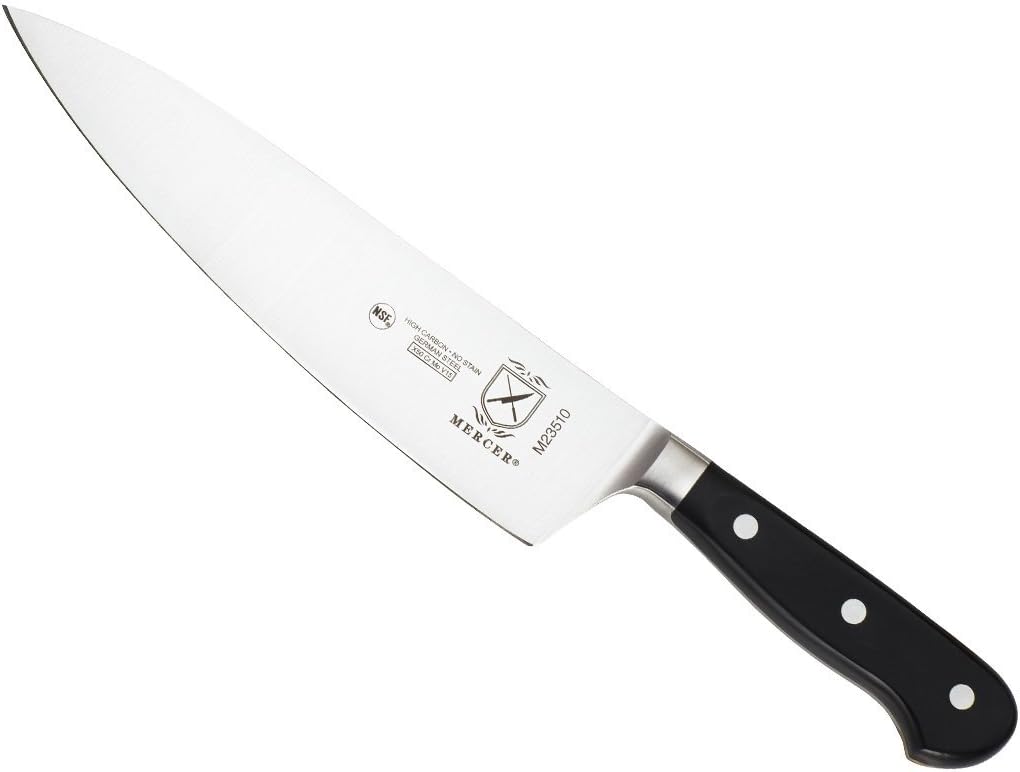
Best known for supplying professional kitchens and culinary schools, Mercer’s cutlery emphasizes function over form. Their steak knife offerings tend to favor simple, ergonomic synthetic handles and dependable, no-nonsense high-carbon steel, making them a solid budget-to-mid-range alternative to Victorinox for buyers who want a genuinely restaurant-grade tool at home.
Laguiole-Style French Knives
Traditional Laguiole knives, with their distinctive shepherd’s-cross bolster design, are iconic in French dining culture, but buyers should be cautious here. Many “Laguiole-style” sets sold online are inexpensive imports with wood or wood-look handles that are explicitly not dishwasher safe, despite the elegant appearance. If you love the Laguiole aesthetic but need dishwasher compatibility, look specifically for modern lines that have swapped the traditional horn or wood handle for a synthetic alternative, and confirm the dishwasher-safe claim directly with the manufacturer before buying.
Cuisinart and Farberware
These mainstream American brands offer some of the most widely available budget steak knife sets, often sold in big-box and department stores. Quality can vary more between individual product lines than with the dedicated cutlery brands in this guide, so it’s worth reading current buyer reviews closely and confirming the specific steel type used before purchasing, since not every set from these brands uses the same steel formula.
J.A. Henckels International
It’s worth noting that Henckels sells two distinct product tiers: the premium Zwilling J.A. Henckels line (which includes the forged set featured in our top five) and the separate, more budget-friendly “J.A. Henckels International” line, which uses different, less expensive steel and construction. Both can be genuinely dishwasher safe, but they represent very different price and performance tiers under a similar-sounding brand name, so double-check exactly which line you’re purchasing.
Matching Your Steak Knife to the Cut of Meat
It might sound like overkill, but seasoned steak lovers know that the right knife really does perform differently depending on what’s on the plate. A knife that’s perfect for a well-marbled ribeye might feel slightly less ideal for a lean, delicate filet mignon, and understanding these small differences can genuinely improve your dining experience.
Ribeye and New York Strip
These cuts typically have a thicker, well-seared crust and more marbling throughout. A serrated edge tends to shine here, since the teeth grip the crust immediately and saw through it cleanly without requiring much downward pressure, which in turn helps keep the juicy interior intact rather than squeezing it out onto the plate.
Filet Mignon
Filet is famously tender, with very little connective tissue and virtually no chew. A fine, straight-edge blade is often the better choice here, since it produces a smooth, clean cut without the slight tearing that a serrated edge can sometimes cause on very soft, delicate meat. Many steakhouse purists specifically request a straight-edge knife when ordering filet for exactly this reason.
Flank, Skirt, and Other Thin Cuts
These cuts have more connective tissue and benefit from a knife that can cut across the grain cleanly. A sharp, well-maintained straight edge or a fine micro-serration both work well here, but whichever style you choose, cutting across (rather than with) the grain is the single most important technique for tenderness, regardless of the knife.
Bone-In Cuts like Tomahawk or Porterhouse
These showstopping cuts often benefit from starting the cut with a sturdier, slightly heavier knife to help you navigate around the bone before switching to lighter, precise strokes for the tender meat itself. A full-tang, forged knife with good heft, like several of the premium options in our lineup, tends to feel more capable and confidence-inspiring here than a very lightweight stamped blade.
If you frequently serve a mix of cuts, this is actually one of the strongest arguments in favor of owning a mixed set, or even two smaller sets, with both a serrated and a straight-edge option on hand. Several premium brands now offer “mixed” boxed sets containing both edge types specifically to solve this dilemma, allowing guests at a dinner party to choose whichever style suits the cut they’ve been served.
Steak Knives vs. Chef’s Knives and Other Kitchen Cutlery: Why the Distinction Matters
New cooks and first-time cutlery buyers sometimes wonder whether a good chef’s knife could simply double as a steak knife, saving them a separate purchase. While it’s technically possible in a pinch, there are real reasons why dedicated steak knives exist as their own category, distinct from your everyday kitchen knife set.
A chef’s knife is designed primarily for prep work in the kitchen: chopping, dicing, mincing, and breaking down proteins before cooking. It’s built with a longer blade, a curved edge for a rocking chopping motion, and a handle designed for extended, repetitive use over a cutting board. A steak knife, by contrast, is designed for a completely different task: making a small number of clean, controlled cuts directly on a plate, often at an angle, with a shorter blade that’s easier to maneuver in the confined space of a table setting. The handle geometry, blade length, and even the ideal edge angle differ meaningfully between the two categories.
There’s also an etiquette dimension. Bringing a large chef’s knife to the dinner table would look, at best, unusual, and at worst, alarming to your guests. Steak knives are sized and styled specifically for table presentation, often coordinated in a matching set that looks intentional and elegant rather than borrowed from the kitchen drawer.
Finally, from a pure durability standpoint, using a chef’s knife on ceramic or ceramic-coated plates at the table (rather than a wooden or plastic cutting board) will dull the edge far faster than intended, since chef’s knives are engineered around cutting-board use. Steak knives, particularly serrated ones, are specifically engineered with this plate-contact reality in mind, which is part of why they hold up so much better over years of table use than a general kitchen knife pressed into steak-cutting duty.
Common Mistakes People Make With Dishwasher-Safe Steak Knives
Even with genuinely dishwasher-safe cutlery, a handful of common habits can shorten the useful life of a set or lead to disappointing results. Here are the mistakes we see most often, along with simple fixes.
- Overloading the cutlery basket. Cramming too many knives into too little space causes them to knock against each other throughout the wash cycle, which can chip a fine straight edge or loosen a handle over time. Give each knife its own slot whenever possible.
- Leaving wet knives in a closed drawer. Even excellent stainless steel can develop minor surface spotting if it’s shut away wet for an extended period. A quick towel-dry before storage takes seconds and prevents this entirely.
- Mixing dishwasher-safe and hand-wash-only knives in the same basket. It’s an easy mistake in a busy kitchen, but running a wood-handled knife through a full hot cycle by accident can permanently damage it. Consider a visual system, like storing hand-wash-only knives in a separate spot, to avoid mix-ups.
- Using the wrong sharpening tool on a serrated edge. A standard honing steel or whetstone won’t effectively sharpen serrated teeth and can actually damage the scalloped edge if used incorrectly. Always use a sharpener specifically designed for serrated blades.
- Assuming “dishwasher safe” means “dishwasher recommended” forever without exception. Even the toughest knives benefit from an occasional hand wash to clear away detergent buildup in handle grooves, and using the gentlest suitable cycle rather than the harshest “pots and pans” setting will extend the life of any blade.
- Storing knives loose in a utility drawer. This is one of the fastest ways to dull an edge and create nicks on the cutting surface, regardless of how good the steel is. A dedicated organizer or the original presentation box solves this cheaply and easily.
Warranties, Guarantees, and What Happens If a Knife Fails
One underappreciated benefit of buying from an established cutlery brand rather than an unknown import is the manufacturer warranty that typically comes with it. Several of the brands in our lineup, including Wüsthof, Zwilling, and Victorinox, offer lifetime warranties against manufacturing defects, meaning that if a blade genuinely fails due to a flaw in the steel or construction (as opposed to normal wear and tear, misuse, or accidental damage), the company will typically repair or replace it.
It’s worth understanding what these warranties typically do and don’t cover. Manufacturing defects, like a blade that develops rust spotting under normal use due to a genuine flaw in the steel, are usually covered. Normal wear, including the natural dulling of an edge over years of use, is not covered, since that’s an expected outcome of regular use rather than a defect. Damage from clear misuse — for instance, using a steak knife to pry open a can, or running a wood-handled “hand wash only” knife through the dishwasher against the manufacturer’s explicit instructions — will also void most warranties.
Before buying, it’s worth a quick check of the specific brand’s warranty terms, since coverage periods, registration requirements, and the process for filing a claim can vary meaningfully between manufacturers. Keeping your original receipt or order confirmation, even for a modestly priced set, is a smart habit in case you ever need to make a claim.
What Restaurants and Professional Kitchens Look For
It’s worth borrowing a page from the professional world when thinking about your own steak knife purchase. Restaurants, particularly steakhouses that go through hundreds of place settings a night, prioritize almost exactly the same qualities we’ve emphasized throughout this guide: genuine dishwasher (or commercial warewasher) durability, a full tang for long-term structural integrity, and an edge type that can withstand heavy daily use without constant sharpening.
This is precisely why brands like Victorinox and Mercer Culinary are so dominant in commercial kitchen supply catalogs — their knives are engineered from the ground up for exactly this kind of relentless, high-volume use. A knife that can survive a busy steakhouse’s industrial dishwasher, night after night, for years on end is by definition more than capable of handling the comparatively gentle demands of a home dishwasher used a few times a week. If you want a genuinely bulletproof set backed by real-world commercial-grade durability, looking at what professional kitchens actually buy is one of the best research shortcuts available to a home shopper.
Troubleshooting: Rust Spots, Discoloration, and Other Common Issues
Even the best dishwasher-safe steak knife can occasionally develop a cosmetic issue, and knowing how to address these quickly can save a knife that might otherwise seem ruined.
Small Rust Spots
If you notice tiny orange or brown spots on an otherwise good blade, don’t panic and don’t throw the knife away. This is usually surface-level “flash rust” caused by mineral deposits from hard water combined with prolonged moisture exposure, rather than deep corrosion of the steel itself. In most cases, a paste made from baking soda and a small amount of water, applied with a soft cloth and rubbed gently in the direction of the grain, will lift the spotting away completely. For more stubborn spots, a specialized stainless steel cleaner or a very fine polishing compound can help, followed by a thorough rinse and immediate drying.
Cloudy or Hazy Blade Finish
A cloudy, slightly dull-looking finish on stainless steel is almost always caused by mineral buildup from hard water, especially in households on well water or with unusually mineral-rich municipal supplies. Running knives through an occasional rinse-aid cycle, or hand-drying immediately after the dishwasher rather than letting them air-dry in the rack, typically resolves this over time. If the haze has already set in, a simple wipe with white vinegar on a soft cloth, followed by a clean water rinse and thorough drying, usually restores the shine.
Handle Discoloration
Synthetic handles can occasionally take on a faint yellowish or cloudy tint after years of dishwasher use, particularly with certain detergents that contain strong bleaching agents. This is largely cosmetic and doesn’t affect the structural integrity or dishwasher safety of the handle, but if it bothers you, switching to a milder, bleach-free dish detergent for future cycles can slow or prevent further discoloration.
A Loose or Wobbly Handle
If you ever notice a handle that feels slightly loose or wobbly relative to the blade, stop using that knife immediately and contact the manufacturer, especially if the knife is still within its warranty period. A loose handle on an otherwise well-made, full-tang knife is unusual and often indicates either a manufacturing defect or, less commonly, water infiltration around the rivets after an extremely long service life. Continuing to use a knife with a compromised handle is a genuine safety risk.
Steak Knives for Every Occasion: Holidays, Grilling Season, and Everyday Dining
While steak knives are obviously a year-round kitchen staple, certain seasons and occasions tend to put them to the test more than others, and it’s worth thinking about your set with these moments in mind.
Grilling Season
Warmer months bring backyard barbecues, grilled tomahawks, and casual outdoor entertaining, often with larger groups than a typical weeknight dinner. This is exactly the scenario where an 8-piece or larger set earns its keep, and where a durable, no-fuss serrated edge shines, since outdoor entertaining tends to be more casual and knives may see rougher handling from a crowd of guests.
Holiday Gatherings
Big holiday meals, whether centered on a standing rib roast, a holiday ham, or a celebratory steak dinner, put real pressure on cutlery, both in terms of quantity needed and the volume of dishwasher loads afterward. Having a genuinely dishwasher-safe set is arguably at its most valuable during exactly this kind of high-volume holiday hosting season, when the last thing anyone wants after a long day of cooking is an hour of careful hand-washing delicate knives at the sink.
Everyday Weeknight Dining
For regular weeknight meals, the case for dishwasher-safe cutlery is simply about time and convenience. A busy household doesn’t have the bandwidth to hand-wash and carefully dry a full set of knives every single night, and knowing you can load everything straight into the dishwasher after dinner removes one more small chore from an already full day.
Whatever the occasion, the through-line is the same: a genuinely well-made, dishwasher-safe steak knife set removes friction from your kitchen routine without asking you to compromise on the actual dining experience, which is exactly the balance every set featured in this guide was chosen to strike.
Buying Individual Knives vs. a Complete Set
Most shoppers default to buying a boxed set, and for good reason, but it’s worth knowing that many of the brands featured in this guide, including Wüsthof, Zwilling, and Victorinox, also sell their steak knives individually through both their own websites and various retailers. Understanding when each approach makes sense can save you money and hassle.
Buying a complete set is almost always the better value on a per-knife basis, since manufacturers typically discount boxed sets compared to the sum of buying each knife separately. Sets also guarantee that every knife matches in finish, handle color, and blade profile, which matters for a cohesive-looking table setting. For most first-time buyers building out a steak knife collection from scratch, a boxed set is the clear right choice.
Buying individually makes more sense in a few specific situations: replacing a single lost or damaged knife from an existing set, slowly building up to a larger set size over time as your budget allows, or mixing edge types deliberately, for instance buying a few straight-edge knives and a few serrated knives from the same brand and finish line to give guests a choice at the table. If you know you’ll eventually want a mixed-edge collection, buying individually from the start, all from the same product line, can actually work out to a more cohesive and flexible long-term collection than committing to a single boxed set upfront.
One practical tip: if you do go the individual route, buy from the same specific product line and finish generation whenever possible, since manufacturers occasionally update handle designs or blade finishes over the years, and knives purchased even a few years apart from the same nominal product line can sometimes have subtle visible differences.
Completing the Table: Complementary Tableware and Serving Pieces
A great steak knife is only one part of an outstanding steak dinner presentation, and thinking about the pieces that surround it can elevate the whole experience. Steak plates, ideally with enough weight and a slightly raised rim to contain juices, pair naturally with a quality steak knife set and prevent the frustrating slide-and-chase of a thin, lightweight plate under a firm cutting motion.
Wooden or slate serving boards have also become a popular way to present a sliced steak at the table, and they offer a genuine practical benefit alongside the aesthetic one: cutting directly on a wood or slate board, rather than on ceramic, is gentler on a fine straight edge and can meaningfully extend the time between sharpenings for anyone who regularly serves steak this way rather than plating it pre-sliced.
Finally, if you’re assembling a full steak-night table setting, consider matching steak forks, which are typically slightly shorter and sturdier than a standard dinner fork and are designed specifically to hold meat steady while cutting. Several of the brands in this guide sell matching fork-and-knife sets or complete flatware lines designed around exactly this kind of coordinated steak-night presentation, giving your table a polished, intentional look that a mismatched assortment of everyday flatware simply can’t match.
Your Dishwasher Safe Knife Questions, Answered
Is it really okay to put steak knives in the dishwasher?
Absolutely, but *only* if the manufacturer has designed them for it. A truly dishwasher-safe knife has two key features: a blade made of high-carbon stainless steel to resist rust, and a handle made of a stable, non-porous synthetic material like polymer (POM) or polypropylene. Never, under any circumstances, put a knife with a wood handle in the dishwasher. The heat and moisture will cause it to swell, warp, and crack, completely ruining the knife.
Serrated vs. Straight Edge: Which is better for a steak knife?
This is a classic debate. A serrated edge has teeth that act like a saw. It excels at gripping and cutting through the hard sear on a steak and will feel sharp for a very long time without maintenance. A straight edge (or fine edge) is like a tiny chef’s knife. It provides a much cleaner, smoother cut with no tearing, which many steak lovers prefer. The trade-off is that it requires regular honing and periodic sharpening with a tool like a good electric knife sharpener to stay in top condition.
Will the dishwasher make my knives dull?
The dishwasher is a harsh environment. The combination of high heat, caustic detergents, and the fact that the blade can knock against other items can dull the edge faster than gentle hand washing. However, the high-quality, hardened steel used in the knives on this list is designed to be tough and hold its edge well. While you may need to sharpen a straight-edged, dishwasher-safe knife a bit more frequently, for most users, the incredible convenience is well worth the minimal extra maintenance.
How should I load steak knives in the dishwasher?
For maximum safety and blade protection, place the knives in the cutlery basket with the tips pointing down. This prevents anyone from accidentally getting cut when loading or unloading the dishwasher. Also, try to give each knife its own slot so the blades aren’t clattering against each other during the wash cycle. If you want to take your knife storage to the next level, consider a dedicated knife drawer organizer to keep them perfect between uses.
What’s the difference between forged and stamped steak knives?
A forged knife is hammered or pressed from a single heated bar of steel, giving it a heavier, more balanced feel and usually a visible bolster. A stamped knife is cut from a flat sheet of steel, making it thinner and lighter. Modern stamped knives from premium brands often use the exact same high-quality steel as forged ones, so construction method has more effect on feel and balance than on how well the knife survives the dishwasher over time.
How often do I need to sharpen a dishwasher-safe steak knife?
For a straight-edge set used a few times a month, honing regularly and a full sharpening once or twice a year is typically enough. Serrated steak knives are far more low-maintenance and can often go several years before needing any professional sharpening at all, since the scalloped teeth stay effective far longer than a plain edge.
How many steak knives should I buy for my household?
A 6-piece set covers most everyday family needs with a little room for a guest or two. If you regularly host dinner parties or holiday gatherings, an 8-piece or larger set is a smarter long-term purchase than buying a second smaller set later, since matching an older set’s exact finish down the road can be difficult if it’s been discontinued.
Can dishwasher-safe steak knives still rust over time?
Genuine high-carbon stainless steel with sufficient chromium content is highly rust-resistant, but no steel is completely immune to corrosion under extreme or unusual conditions. Leaving knives wet for extended periods, storing them in an airtight space while still damp, or letting them sit in standing water can occasionally cause minor surface spotting, even on a quality blade. Towel-drying knives promptly after the wash cycle largely eliminates this risk.
Are Laguiole steak knives dishwasher safe?
Traditional Laguiole knives often use wood, horn, or bone handles that are explicitly not dishwasher safe, regardless of how elegant they look. If you want the classic Laguiole shepherd’s-cross style with true dishwasher compatibility, look for modern versions that use a synthetic handle material, and confirm the dishwasher-safe claim directly with the manufacturer before buying.
Do steak knife sets make a good wedding or housewarming gift?
Yes, steak knife sets are a popular and practical gift because they last for decades with proper care. Sets that ship in a wood or fabric-lined presentation box, like several featured in this guide, feel especially gift-worthy. For weddings or housewarmings, it’s often smart to gift a slightly larger set, such as an 8-piece, to give the recipients room to grow into hosting their own dinner parties.
The Final Verdict: The Best Knives for Your Steak and Your Dishwasher
The perfect steak dinner shouldn’t end with a tedious chore. By choosing a high-quality, dishwasher-safe steak knife set, you can finally have the best of both worlds: a blade that performs beautifully at the table and cleans up with zero effort afterward.
For the best overall combination of classic forged feel, cutting performance, and carefree maintenance, the Henckels Forged Premio 8-Piece Set is our top recommendation. It delivers a premium experience without the premium maintenance.
If you’re a purist who demands the clean cut of a straight-edge blade, the Wüsthof Gourmet 6-Piece Set offers legendary German quality in a fully dishwasher-safe package. And for those who prioritize bombproof durability and incredible value, the Victorinox Swiss Army Classic 6-Piece Set is a workhorse that will likely last a lifetime.
Upgrade your dining experience and simplify your life. Choose a set from this list, and make your next steak night memorable for all the right reasons—from the first slice to the moment you press “start” on the dishwasher.