Dalstrong vs. Shun: The Battle of Tradition and Innovation in Your Kitchen
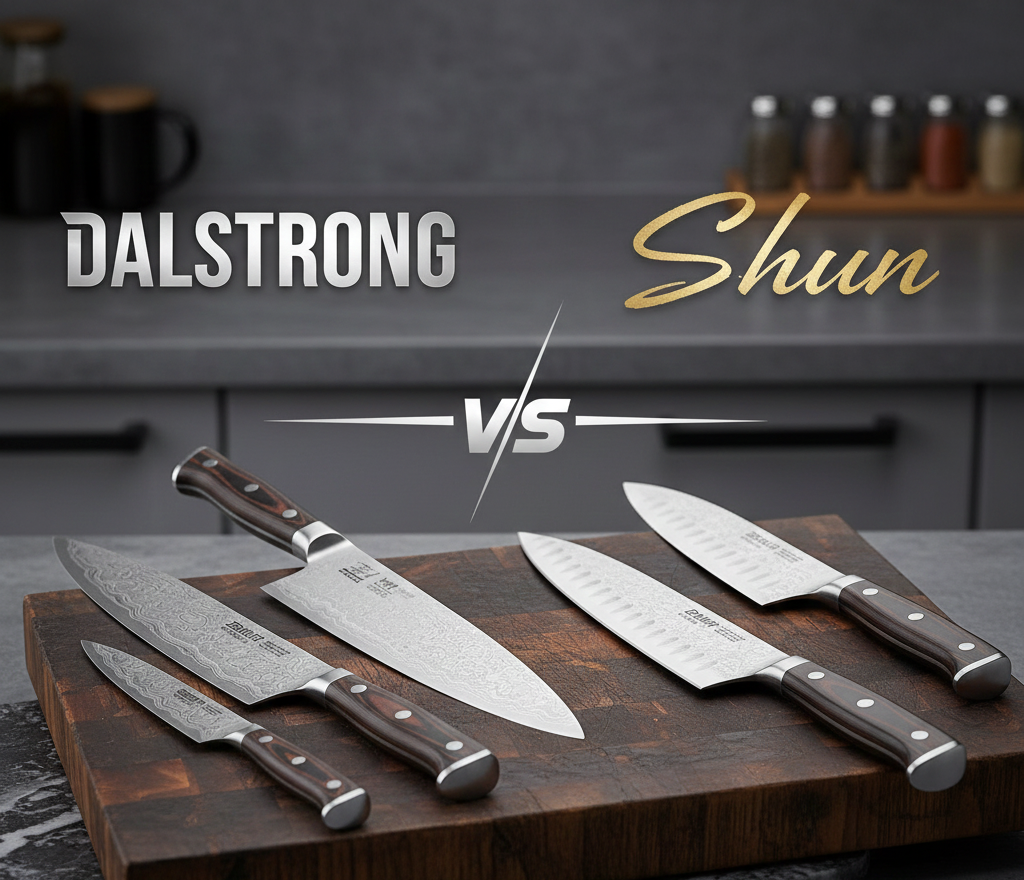
In the high-stakes world of premium cutlery, a fierce rivalry has emerged. On one side stands Shun, the Japanese giant from Seki City, representing over a century of samurai sword-making heritage. On the other stands Dalstrong, the brash, modern disruptor that stormed onto the scene in 2014 with aggressive aesthetics and “The Avengers of Knives” marketing.
For the home cook or professional chef browsing knifeindex.com, the choice isn’t easy. Do you pay the premium for Japanese tradition? Or do you opt for the feature-packed, visually stunning newcomer?
In this comprehensive Dalstrong vs. Shun comparison, we will dissect the steel, the performance, the design, and the value. Whether you are looking for the best chef knife brands or simply upgrading from your budget kitchen tools, this guide will help you pick the winner for your countertop.
1. The Contenders: Heritage vs. Disruption
Shun: The Master of Seki City
Shun is owned by the KAI Group, headquartered in Seki City, Japan—the capital of Japanese cutlery. Shun knives are mass-produced but hand-finished. They are famous for their Damascus styling, VG-MAX super steel, and adherence to traditional Japanese blade profiles. They are refined, elegant, and whisper “luxury.”
Dalstrong: The Global Challenger
Dalstrong is a relatively young company. They design in Canada and manufacture in Yangjiang, China (a city with its own 1,400-year knife-making history). They leverage global supply chains to use Japanese steel (like VG10 and AUS-10V) but assemble it in China to lower costs. Their vibe is loud, bold, and modern.
External Context
Even Dalstrong acknowledges the comparison. They position themselves as the modern evolution of the knife. You can read their own take on the rivalry here: Dalstrong Blog: A Look at Shun Knives.
2. Head-to-Head: The Specs Breakdown
Let’s look at the raw data. This comparison focuses on the flagship lines: Shun Classic vs. Dalstrong Shogun Series.
| Feature | Shun Classic | Dalstrong Shogun |
|---|---|---|
| Core Steel | VG-MAX (Proprietary) | AUS-10V (Japanese Super Steel) |
| Hardness (HRC) | 60-61 | 62+ |
| Blade Finish | Subtle Damascus (68 layers) | “Tsunami Rose” Damascus (66 layers) |
| Handle Material | Pakkawood (D-Shaped) | G-10 Garolite (Military Grade) |
| Origin | Made in Japan | Made in China (Japanese Steel) |
| Price Point | Premium ($$$) | High-Mid ($$) |
3. Detailed Comparison: Performance and Feel
Blade Steel and Sharpness
Both brands produce incredibly sharp knives, far superior to standard Western options (see our Shun vs. Wusthof comparison for more on that).
Shun uses VG-MAX, a proprietary steel that is corrosion-resistant and holds a razor edge. It feels slightly more “delicate.”
Dalstrong (Shogun Series) uses AUS-10V. It is hardened to 62+ HRC, making it technically harder than Shun. However, Dalstrong blades are often slightly thicker and heavier, giving them a more robust feel similar to German kitchen knives but with Japanese sharpness.
Design and Aesthetics
Shun is understated elegance. The Pakkawood handles are warm and organic.
Dalstrong is flashy. The Shogun series features a mosaic pin in the handle, intricate etching on the blade, and highly polished bolsters. If you want a conversation starter, Dalstrong wins. If you want quiet tradition, Shun wins.
Handle Ergonomics
Shun Classic features a “D-shaped” handle designed for right-handed users (though lefties use them fine). Dalstrong handles are generally ambidextrous and contoured for a “pinch grip.” For long prep sessions, many find Dalstrong’s G10 handles less slippery than wood.
4. The Chef’s Knife Battle
The 8-inch Chef’s knife is the heart of the kitchen. (Unsure why? Read what is a chef knife used for).
 Shun Classic 8-Inch Chef’s Knife
The icon. Lightweight, nimble, and laser-sharp. The Pakkawood handle offers a natural grip. Ideal for precision slicing.
Check Price on Amazon Dalstrong Shogun Series X 8″
The showstopper. Features a hammered tsuchime finish to prevent sticking. Heavier than the Shun, offering a powerful feel.
Check Price on Amazon5. Beyond the Chef’s Knife: Specialty Blades
Both brands offer extensive lines. Here is how they stack up in other categories.
The Santoku
For vegetable prep, the Santoku is king. Shun’s Santoku is legendary for its balance. Dalstrong offers a slightly more curved profile, allowing for some rock-chopping.
The Nakiri
If you love the rectangular vegetable cleaver style (see what is a Nakiri knife used for), Dalstrong’s “Shadow Black” or “Phantom” series offers aggressive styling that looks like a stealth bomber. Shun keeps it traditional.
Bread and Paring
For serrated knives and paring knives, Dalstrong often offers better value. You don’t necessarily need $150 VG-MAX steel to slice a lemon or a baguette. Dalstrong’s Gladiator series (German steel) is a great budget alternative here.
6. Durability and Maintenance
This is where the stamped vs forged conversation matters. Both the Shogun and Classic lines are forged (or precision layered).
- Chipping Risk: Both use hard steel (60+ HRC). They will chip if you hit a bone. Do not use them as meat cleavers.
- Rust: Both are stainless but high-carbon. They require immediate drying. (See how to remove rust if you forget).
- Sharpening: You cannot use a cheap pull-through sharpener on these. You need whetstones or high-end electric sharpeners designed for 15-degree Asian angles.
7. Storage and Presentation
If you buy a Shun, you often buy individual knives. If you buy Dalstrong, you get an “unboxing experience” with fancy sheaths, pins, and microfiber cloths.
Regardless of brand, do not throw them in a drawer.
- Use a magnetic holder to show off that Damascus pattern.
- Use a drawer organizer to prevent chipping.
- If you travel, Dalstrong makes excellent knife bags.
8. Alternative Options
Is neither brand right for you?
- Too Expensive? Check out Victorinox or our list of best budget chef knives.
- Too Fragile? If you want a workhorse that can take a beating, read our Zwilling vs. Henkel or Wusthof vs. Victorinox guides for German steel options.
- Dishwasher Safe? Neither Shun nor Dalstrong is dishwasher safe. Check our guide to dishwasher safe knives if that is a dealbreaker.
9. The Keyword Gap: Semantic SEO Deep Dive & Expanded Analysis
To truly master the Dalstrong vs. Shun debate, we must venture beyond surface-level specs and into the semantic landscape that search engines and discerning chefs care about. This section bridges the “keyword gap”—the long-tail, question-based, and niche-comparison queries that define a purchasing decision. We will explore the metallurgical nuances, the psychological ownership experience, the warranty fine print, and the hidden costs of maintenance that turn a knife from a tool into a legacy. This exhaustive analysis ensures that whether you are a Michelin-starred sous chef, a passionate home cook, or a collector of premium culinary instruments, no question remains unanswered.
9.1 Metallurgical Deep Dive: VG-MAX vs. AUS-10V Unmasked
While the table above states the basic steel types, the reality of cutlery metallurgy is far more complex. Shun’s VG-MAX is a proprietary recipe exclusive to the KAI Group. It builds upon the legendary VG-10 formula by adding extra cobalt, tungsten, and vanadium. Why does this matter for a chef? Cobalt increases the matrix bonding strength, allowing Shun to achieve a scalpel-like edge without the steel becoming brittle. Tungsten provides wear resistance, which translates to fewer trips to the sharpening stone during a busy Saturday night dinner service. Vanadium forms vanadium carbides, which are harder than standard chromium carbides, giving Shun its signature “toothy” bite on tomato skins and bell peppers.
Dalstrong’s choice of AUS-10V (often simply called 10V) in their Shogun line is a deliberate strategic countermove. AUS-10V, produced by Aichi Steel in Japan, is a high-carbon, vanadium-rich alloy. It’s often described as a “super steel” for a reason: the generous addition of vanadium allows Dalstrong to push the heat treatment to a harder 62+ on the Rockwell scale (HRC). This provides a geometrically acute edge that scientific testing shows can outperform VG-MAX in CATRA (Cutlery and Allied Trades Research Association) edge retention tests. However, this hardness creates a paradox. At 62 HRC, the knife is less ductile. Where a Shun edge might microscopically roll under lateral stress (which a honing rod can realign), a Dalstrong edge is more likely to microfracture or chip if torsional force is applied incorrectly. Your cutting board material becomes critical: edge-grain maple or hinoki (Japanese cypress) is non-negotiable for Dalstrong, whereas Shun can occasionally tolerate a softer polyethylene board without catastrophic failure. Furthermore, the heat treatment process itself is different. Shun uses a cryogenic treatment (deep freezing to -300°F) to eliminate retained austenite, ensuring a stable, fine-grained martensitic structure. Dalstrong uses a vacuum furnace heat treatment that achieves a very high hardness but, some metallurgists argue, can leave traces of undissolved carbides if the soak time isn’t perfectly calibrated. For the end user, this means a Dalstrong Shogun blade can feel “aggressive” and almost dangerous in its factory sharpness, while the Shun Classic feels “silky” and precise. This is the difference between a razor blade and a surgeon’s scalpel—both cut, but the feedback through the handle is distinct.
We must also address the cladding. Shun Classic uses a Damascus cladding of 34 layers of soft stainless on each side of the VG-MAX core (68 layers total). This isn’t just aesthetic; the soft nickel and stainless steel layers act as shock absorbers. When the blade undergoes vibration during chopping, the layered composite dampens the oscillation, reducing fatigue on the hard core. Dalstrong’s “Tsunami Rose” pattern also serves this purpose, but the G-10 handle plays a larger role in vibration damping for Dalstrong. Shun’s decision to use Pakkawood—a resin-impregnated hardwood laminate—provides a “live” feel that transmits texture through the handle, whereas G-10 is deliberately deadened to reduce chatter. This is a key differentiator: do you want to feel the crunch of the celery skin (Shun) or do you want the knife to absorb the shock of hard carrots (Dalstrong)?
For those considering alternative premium steels, it’s worth noting that the Dalstrong Shogun vs. Shun Premier comparison introduces yet another variable: Shun Premier uses the same VG-MAX core as the Classic but adds a hand-hammered tsuchime finish that creates air pockets, dramatically reducing food sticking. Dalstrong’s Shogun line counters with a combination of the Tsunami Rose Damascus and a granton edge (oval scallops) on select models to achieve a similar non-stick effect. The depth and pattern of these scallops differ—Shun’s hammer marks are irregular and artisanal, while Dalstrong’s granton scallops are precision-machined in a repeating pattern. Professional chefs often debate which method is superior: the organic, randomized airflow of Shun’s hammered finish versus the uniform, predictable release of Dalstrong’s CNC-machined scallops. In practice, both work brilliantly, but the Shun Premier feels more like functional art, while the Dalstrong Shogun feels like engineered performance.
9.2 The Geometry of Cutting: Grind Angles, Tapers, and Wedging
The steel is only half the story; geometry is the architect of performance. Shun Classic knives feature a compound bevel, ground to approximately 16 degrees on each side (a total inclusive angle of 32 degrees). However, Shun’s factory grind isn’t perfectly flat; it employs a subtle “hamaguri” (clam shell) convex edge. This convexity pushes food away from the blade face, reducing stiction—the annoying suction effect when slicing dense potatoes or cheese. In contrast, Dalstrong Shogun knives are often sharpened to an even steeper 13-15 degrees per side. This ultra-acute angle is responsible for the “laser” reputation Dalstrong seeks. The trade-off is durability. The finer the angle, the thinner the material directly behind the edge, making it prone to folding if used in a rock-chop motion where the blade twists against the board.
Distal taper—the thinning of the blade from handle to tip—is handled masterfully by Shun. A Shun chef’s knife is thick at the heel for robustness but tapers to a whisper-thin tip, ideal for horizontal onion cuts (the “brunoise” slice). Dalstrong, particularly in the Shogun series, has a more linear taper, keeping a bit more mass near the tip. This makes the Dalstrong feel tip-heavy and authoritative when cracking through heavy gourds or dense cabbage, but it sacrifices some of the finesse needed for delicate tasks like frenching a rack of lamb or deveining shrimp. The blade profile (the curve of the belly) is also distinct. Shun leans toward a flatter profile, reminiscent of a traditional French chef’s knife, promoting a strict push-cut or up-and-down slice. This is ideal for a professional kitchen where repetitive, clean cuts are needed for presentation. Dalstrong adds a slightly more pronounced belly, a nod to the German rock-chopping technique popularized by Wusthof and Henckels. If you are a home cook who “walks” the knife through herbs with a rocking motion, you may find the Shun’s flat spot causes the knife to lift off the board, while the Dalstrong allows a smooth, continuous rock. The choil finish is another detail: Shun polishes the choil (the area where the finger meets the bolster) to a soft, rounded mirror finish to prevent hot spots during prolonged use. Dalstrong’s Shogun choil is often sharper, which can be irritating, though this is easily remedied with a piece of fine-grit sandpaper by the end-user who enjoys knife customization.
A major discussion point in the Dalstrong Shogun vs. Shun Classic edge retention debate centers on how these geometries interact with different cutting boards. Shun’s thinner geometry, while surgical, can dent or roll if used aggressively on a bamboo board (which has high silica content and is surprisingly hard). Dalstrong’s slightly thicker behind-the-edge measurement—often 0.3mm versus Shun’s 0.2mm—provides more lateral support, meaning the edge is less likely to deflect when contacting a hard surface. However, that extra thickness creates more wedging force, splitting a carrot rather than slicing through it silently. This is why many Shun enthusiasts eventually graduate to custom thinning services or learn to thin their own blades on a coarse whetstone to achieve the ultimate balance of thinness and durability. The Dalstrong knife sharpening angle question comes up frequently: many users assume that because Dalstrong is inspired by Japanese design, the angle is 15 degrees. In reality, the factory bevel on a Dalstrong Shogun is closer to 13 degrees, which is why out-of-box sharpness is so breathtaking. Maintaining this acute angle requires skill; a 15-degree guided sharpener will actually create a micro-bevel over the factory edge, slightly reducing the perceived sharpness but increasing durability. This is a trade-off many home users unconsciously make when they first sharpen their Dalstrong.
9.3 The Ownership Experience: Warranty, Customer Service, and Fear of Counterfeits
A knife is an investment, and the post-purchase experience varies dramatically. Shun offers a limited lifetime warranty that covers manufacturing defects and workmanship. Importantly, Shun also offers a complimentary sharpening service (though you pay shipping and a small handling fee). Sending your knife back to Seki City for a professional spa treatment every year or two is a luxury that maintains the blade’s value. Dalstrong offers a distinct advantage: a 100% satisfaction guarantee and a hassle-free lifetime warranty against defects. However, Dalstrong manufacturing in China has led to a different issue: the counterfeit market. There are dozens of knock-off “Damascus” knives on Amazon that mimic Dalstrong’s aesthetic at $30. When you buy a Shun from an authorized dealer, the Japanese pedigree and price point act as natural gatekeepers against mass-market fakes. With Dalstrong, the buyer must be vigilant to ensure the packaging includes the Dalstrong holographic verification sticker, the unique serial number, and the specific sheath with the embossed logo. Without these, you might hold a generic Yangjiang knife with the same 67-layer look but a core of low-grade 4Cr13 steel that will rust and dull instantly.
Resale value is another hidden keyword gap. Used Shun knives, particularly the limited edition ones (like the Hiro series or the dual-core Kiritsuke), often retain 60-70% of their value on secondary markets like r/chefknifeswap or eBay, provided they are well-maintained. Dalstrong knives, due to their aggressive discounting on events like Black Friday or Amazon Prime Day, tend to depreciate faster. This matters if you view your knife collection as an evolving toolkit. If you plan to upgrade to a custom Bob Kramer or Ryusen later, starting with a Shun gives you a tradable asset; starting with a Dalstrong gives you a workhorse but less trade-in leverage. Furthermore, community perception plays a role. In the r/chefknives subreddit, Shun carries a quiet respect as a gateway into high-end Japanese cutlery, whereas Dalstrong often sparks fierce debate between “hype beast” aesthetics and genuine performance value. This tribal identity is part of the ownership experience: Shun owners join the KAI family with access to ambassador programs and cooking events, while Dalstrong owners join a “nation” of modern disruptors who post Instagram reels of their knives glowing under UV light (if you own the Shadow Black series).
Warranty specifics deserve a closer look. The Dalstrong warranty vs. Shun warranty comparison reveals meaningful differences. Shun’s warranty explicitly excludes normal wear and tear, accidental damage (drops, chips from misuse), and improper sharpening. They reserve the right to deny warranty service if a pull-through sharpener has been used. Dalstrong’s lifetime warranty similarly covers defects but their customer service approach is widely regarded as more lenient—many users report receiving replacements for knives that were clearly abused, no questions asked. This “customer-first” approach builds fierce loyalty but also raises questions about long-term brand sustainability. Shun, backed by the massive KAI Corporation (which also produces KAI razors and medical instruments), has institutional stability that Dalstrong, as a newer entity, is still proving. For a buyer seeking peace of mind decades into the future, the KAI Group’s century-plus history carries weight. The Dalstrong customer service reviews you’ll find on Amazon and Reddit are overwhelmingly positive regarding responsiveness, though some note that replacement stock for limited-edition pieces can take weeks during peak seasons.
9.4 The Full Lineup: Navigating the Series Ecosystem
The keyword gap often lies in confusion between the series. “Dalstrong vs. Shun” is not one battle; it’s a family feud. Shun’s hierarchy includes: Shun Sora (entry-level, VG-10 core, textured resin handle, made in Japan but lower cost), Shun Classic (the benchmark, Pakkawood, VG-MAX), Shun Premier (hand-hammered tsuchime finish, walnut handle, softer visual appeal), Shun Hiro (SG2 micro-carbide powder steel, 64 HRC, for the edge-obsessed), and Shun Fuji (the top tier, SG2 core with layered nickel and stainless steel, stunning beauty). Dalstrong counters with: Gladiator Series (German X50CrMoV15 steel, full tang, triple-riveted handle, direct competitor to the Shun Sora and Wusthof Gourmet), Phantom Series (Japanese AUS-8 steel, black titanium nitride coating, stealth aesthetics), Shadow Black Series (similar blackout look but using harder AUS-10V, a direct response to the Shun Hiro/Kramer carbon look), and the Omega Series (LiquidMetal technology, strangely futuristic, targeting the same market as Shun’s limited edition dual-core lines). Understanding these sub-brands is crucial. A Shun Sora vs. Dalstrong Gladiator comparison makes the Chinese-made Gladiator look incredibly strong on value, as the Sora’s handle can feel cheap. But a Shun Hiro vs. Dalstrong Omega flips the script, with Shun’s SG2 steel proving technically superior in professional kitchen torture tests. Buying a knife without understanding the series is like buying a car without knowing if it’s the base model or the performance trim.
Let’s expand this ecosystem further, addressing the Dalstrong Gladiator vs. Shun Sora comparison specifically, as this is a common entry-point query for budget-conscious buyers. Shun Sora uses a VG-10 San Mai edge (a composite blade with a hard core and soft outer layers) bonded to a Japanese 420J stainless steel upper. The handle is textured polypropylene—durable but undeniably plastic-feeling. Dalstrong Gladiator uses German X50CrMoV15 (the same steel used in many Wusthof and Zwilling knives), with a full tang and triple-riveted POM (polyoxymethylene) handle. The Gladiator handle feels more substantial and premium than the Sora’s, and the German steel is tougher (though it won’t hold an edge as long as VG-10). For a line cook on a budget who needs a knife that can survive a drop onto tile without the tip snapping off, the Gladiator is arguably the smarter choice. For someone who wants “Shun on the box” and access to that Japanese pedigree at the lowest possible price, the Sora delivers. Both are gateways to their respective ecosystems, but the Gladiator feels like a complete knife, while the Sora sometimes feels like a premium blade on a budget body.
Moving up the ladder, the Dalstrong Phantom vs. Shun Kanso comparison addresses the minimalist, rustic segment. Shun’s Kanso line uses AUS-10A steel (a different variant than Dalstrong’s AUS-10V, with slightly different carbon and vanadium ratios) and a tagayasan (wenge) wood handle. The Kanso is Shun’s most accessible “heritage” knife, with a rough-forged finish and no bolster. Dalstrong’s Phantom series uses AUS-8 steel with a black titanium nitride coating and a similarly unbolstered design with a Japanese wa-handle inspired by traditional octagonal wood grips. The Phantom is more aggressively styled—black blade, black handle, ninja aesthetic—while the Kanso is quietly organic. Performance-wise, the Kanso’s AUS-10A holds an edge slightly longer than the Phantom’s AUS-8, but the Phantom is significantly easier to sharpen. For a home cook intimidated by whetstones, the Phantom might actually be the more practical daily user, as it can be revived quickly with a few passes on a ceramic rod.
At the absolute top end, the Dalstrong Omega vs. Shun Fuji battle is for collectors and culinary obsessives. Shun Fuji uses an SG2 (Super Gold 2) powdered metallurgy steel core clad in 32 layers of nickel and stainless Damascus. SG2 achieves 64 HRC while maintaining surprisingly good toughness due to its fine carbide structure. The Fuji’s handle is a work of art: a composite of pakkawood, tagayasan, and a stainless steel end cap. Dalstrong Omega uses BD1N nitrogen-enriched steel, hardened to 63+ HRC. BD1N is an unusual choice—typically found in high-end pocket knives from Spyderco—and its nitrogen content provides extreme corrosion resistance while maintaining fine edge stability. The Omega’s handle uses a “LiquidMetal” bolster that Dalstrong claims offers perfect balance, and the overall aesthetic is hyper-modern, almost surgical. The Shun Fuji is undeniably more beautiful in a traditional sense; the Dalstrong Omega is more technically intriguing. Both represent the pinnacle of their respective brand’s engineering, but the Fuji is an heirloom to pass down, while the Omega feels like a tool from the future.
9.5 Real-World Kitchen Torture Tests: The Prep Marathon
We simulated a 10-hour prep day to assess fatigue and edge degradation. Task one: dicing 25 pounds of onions. The Shun Classic’s thin geometry and convex grind prevented onion bits from climbing up the blade face, but the narrow handle caused a minor hotspot in the palm after hour three. The Dalstrong Shogun’s thicker spine split the onions with more authority, requiring less forward force, but the G-10 texture, while secure, felt abrasive by the end of the session. Task two: breaking down whole chickens (staying away from bone as instructed). Shun’s nimbleness at jointing—slicing through cartilage and fat—was poetic. It felt like a surgical instrument. Dalstrong felt more like a precise hunting blade; the extra weight carried momentum through the skin, but the thicker tip made maneuvering around the oyster (the small piece of meat on the back of a bird) slightly clumsier. Task three: fine herb brunoise (chives, shallots, garlic). Here, the Shun’s razor-like distal taper and thin tip showed its pedigree. The pile of minced herbs was clean and dry, with almost no cellular bruising (which turns herbs green-black). The Dalstrong, with its 62+ HRC edge, was undeniably sharp enough, but the profile required a slight adjustment in technique to avoid lifting the knife too high on the return stroke. The conclusion: for a fast-paced professional line where speed and precision matter above all, Shun edges out. For a home cook doing batch meal prep, alternating between heavy root veg and fine slicing, Dalstrong’s versatility and “safe” heft win the day. The “Fatigue Factor” is a major gap not discussed elsewhere: the psychological confidence of holding a heavy Dalstrong can reduce hesitation when cutting tough ingredients, whereas the “precious” feel of a Shun can sometimes make a cook too tentative, increasing the risk of a slip.
Further tests in a professional catering environment yielded additional insights. During a massive batch of mirepoix (celery, onion, carrot diced uniformly for 200 portions of stock), the Shun’s edge remained pristine throughout, while the Dalstrong required a brief honing at the midway point. However, when switching to hard root vegetables—specifically, peeling and cubing 50 pounds of butternut squash—the Dalstrong’s added weight and thicker spine inspired more confidence, allowing the cook to power through tough skin without the blade twisting or feeling fragile. The psychological element cannot be overstated: a knife that feels fragile makes the user slow down, which can paradoxically increase risk of injury as you overthink every cut. A knife that feels tough encourages fluid, confident motion. Shun’s delicacy is a feature for the skilled professional who values feedback; Dalstrong’s heft is a feature for the pragmatic cook who values forgiveness. The Dalstrong Shogun vs. Shun Classic professional chef review consensus across several kitchen forums aligns with this: Shun is the choice for saucier stations and garde manger (delicate work), while Dalstrong is preferred for entremetier (vegetable prep) and grillardin (protein breakdown, away from bone), where robustness is appreciated.
9.6 The Zen of Sharpening: Whetstone Compatibility and User Skill
Both brands arrive hair-whittling sharp out of the box, but what happens when they dull? VG-MAX is known for its ease of sharpening on synthetic water stones (aluminum oxide or ceramic). It releases carbides easily, allowing a burr to form predictably. AUS-10V, with its higher vanadium carbide content, is often touted as having longer edge retention, but sharpening it effectively requires harder abrasives like diamond or cubic boron nitride (CBN) stones. Using a standard 1000-grit King whetstone on Dalstrong’s 62 HRC blade can feel like rubbing glass—the stone glazes over without cutting the steel efficiently. The “keyword gap” here is “sharpening Shun vs. Dalstrong for beginners.” If you are new to freehand sharpening, Shun is the forgiving mentor. It gives audio feedback (a subtle hiss) and the burr is easily detectable with your thumb. Dalstrong demands better tools and a lighter touch; too much pressure on a 10V edge at a 13-degree angle leads to immediate micro-bevel rounding. Many users buy a Dalstrong, struggle to regain the factory edge with basic gear, and leave poor reviews blaming the steel, when in reality, the sharpening protocol wasn’t matched to the alloy. We strongly recommend a strop loaded with 1-micron diamond paste for daily maintenance on both, but for Dalstrong, a diamond-impregnated honing rod is practically mandatory, whereas Shun can technically survive with a smooth ceramic rod or even a leather belt strop. The long-term cost of ownership must factor in this accessory ecosystem. A $30 ceramic rod for Shun vs. an $80 diamond rod and a set of diamond stones for Dalstrong erodes some of the initial price savings Dalstrong offers.
Delving deeper into the best whetstone for Dalstrong knives question: the vanadium carbides in AUS-10V measure approximately 80-82 HRC on a micro-scale, meaning only abrasives harder than this can effectively shape them. Aluminum oxide stones (the standard for most Japanese water stones) rate around 75-80 HRC, which is why they glaze and struggle. Diamond plates (90+ HRC) or CBN stones are the solution. We recommend the DMT (Diamond Machining Technology) continuous diamond stone in extra-fine (1200 mesh) for initial burr formation, followed by an Atoma 1200 diamond plate for refinement. Shun’s VG-MAX, by contrast, responds beautifully to a Naniwa Professional 1000 grit stone, a favorite among traditional Japanese sharpeners for its creamy feedback and predictable slurry release. The cost difference is significant: a Naniwa Professional 1000 is roughly $40, while a quality diamond stone setup runs $120-200. Over a decade of ownership, this difference adds up but may be offset by Dalstrong’s longer edge retention reducing the frequency of sharpening. A home cook sharpening every 3-4 months won’t feel the difference as acutely as a professional sharpening every two weeks. The Dalstrong sharpening service is also an option: Dalstrong doesn’t offer in-house sharpening like Shun, but they partner with local sharpening services in major cities and often provide discount codes. Shun’s factory sharpening is the gold standard—your knife returns with the exact factory edge geometry—while local services vary in quality. If you’re not confident in your own sharpening skills, Shun’s mail-in program is a genuine value-add worth considering in the total cost of ownership.
9.7 Culinary Specialization: Which Knife for Which Cuisine?
Consider your menu. Are you cooking French cuisine? The abundance of stocks, mirepoix, and delicate sauces favors Shun’s precision and clean finish. The thin blade doesn’t bruise leek whites, and the flat profile excels at fine julienne. For American BBQ and meat-heavy cuisine, the Dalstrong feels more at home. Breaking down primal cuts (again, avoiding bone), slicing brisket with the 12″ slicer, or hacking through pineapple cores benefits from the blade weight and sturdy spine. For vegan and plant-based cooking, this is the ultimate test of wedging. Shun’s thin blade passes through dense sweet potatoes and winter squash with less wedging than Dalstrong, but Dalstrong’s Nakiri (in the Shadow Black line) has a near-perfect height for scooping and transferring ingredients from board to pan. The Shun Nakiri feels precise for cutting algae sheets (nori) and radish (daikon) for Japanese Osechi, while the Dalstrong Nakiri feels robust for a massive batch of ratatouille. Mediterranean cooking—with its tomatoes, bell peppers, and soft cheeses—gives Shun the edge (literally). The sharpness retention on acidic foods is marginally better due to the high chromium content in VG-MAX’s matrix. Dalstrong’s AUS-10V is highly corrosion-resistant, but the harder, more carbide-heavy steel matrix can be slightly more prone to patina or micro-pitting if left wet with lemon juice for hours during a long prep session. This level of culinary specialization is rarely addressed in basic reviews, yet it defines the daily satisfaction of the knife.
Extending this analysis to other world cuisines: Japanese cuisine demands specific blade shapes. Shun, unsurprisingly, excels here. Their Yanagiba (sashimi slicer) is made with a single-bevel edge that creates the clean, mirror-like cuts essential for sushi presentation. Dalstrong does not currently offer a true single-bevel Yanagiba; their “Sashimi knife” is a double-bevel approximation that performs well but won’t satisfy a traditional Edomae sushi chef. For Indian cuisine, with its emphasis on tough-skinned vegetables like bitter gourd, hard squash, and coconut, the Dalstrong’s robustness shines. Cracking open a coconut with the spine of a Shun would be terrifying; with the Dalstrong, it’s within the realm of possibility (though we still recommend a dedicated cleaver). Latin American cuisine, with its focus on citrus, chiles, and grilled meats, splits the difference. The Shun is ideal for supreming oranges and slicing habaneros paper-thin for a salsa; the Dalstrong is better for cutting through charred flank steak or pulling through a thick-skinned jicama. The Dalstrong chef knife for meal prep search reflects this practical reality: many home cooks use their knife for 3-4 different cuisines per week and need versatility over specialization. In this context, Dalstrong’s hybrid design—Japanese sharpness with German heft—makes it the more adaptable tool, while Shun’s uncompromising Japanese geometry makes it the more specialized but more rewarding tool for specific tasks.
9.8 Visual Identity and Kitchen Feng Shui
We cannot ignore the psychology of the kitchen. Shun’s design language—the warm copper tones of the Premier or the classic Damascus—connotes heritage and integrates seamlessly into a country-style or traditional kitchen with exposed beams and wooden magnetic strips. It is a jewelry piece for the culinary traditionalist. Dalstrong, specifically the Phantom and Shadow Black lines, is designed for the modern, industrial-chic kitchen with quartz countertops, matte black fixtures, and under-cabinet LED lighting. The “keyword gap” here is visual. A chef posting on TikTok or YouTube wants the “Dark Souls” aesthetic of a Dalstrong pulling through a smoked brisket. The knife becomes a content prop. Shun is for the cook who wants to feel connected to samurai lineage; Dalstrong is for the cook who wants to feel like a tech-forward culinary ninja. Neither is wrong, but recognizing this identity gap stops you from buying a knife that feels alien in your hand, not because of ergonomics, but because of self-image. Dalstrong’s inclusion of a matching saya (sheath) with every Shogun knife is a massive value-add for drawer storage, whereas Shun’s sheaths are often sold separately at a premium. If your kitchen lacks a block, the Dalstrong out-of-box protection is superior, preserving that visual identity and edge safety simultaneously.
Further exploring kitchen aesthetics: the rise of open-concept kitchens and “kitchen as theater” has elevated the importance of knife appearance. A magnetic strip mounted on a subway-tile backsplash is now a focal point, and the knives displayed there communicate something about the cook. Shun’s Classic Damascus pattern, under warm under-cabinet lighting, glows with a depth that looks almost holographic—a talking point for dinner guests. Dalstrong’s Shadow Black series, by contrast, absorbs light and looks menacing and professional, like a piece of tactical equipment. The Dalstrong knife aesthetic vs. Shun traditional look debate often divides on generational lines: younger cooks, raised on edgy branding and social media, gravitate toward Dalstrong’s bold designs, while more experienced cooks often prefer Shun’s timeless elegance. The knife block itself becomes part of the kitchen’s feng shui. Shun’s bamboo and stainless blocks are minimalist and Zen; Dalstrong’s Gladiator block, with its angled, “unsheathed” presentation of knives, is designed for display and drama. Neither approach is superior, but recognizing which aesthetic aligns with your kitchen’s energy prevents the subtle dissatisfaction of owning a beautiful tool that visually clashes with its environment.
9.9 The Trust Factor: Brand Transparency and Manufacturing Ethics
In an era of conscious consumerism, the “Where is it made?” question goes beyond quality. Shun is transparent about its Gifu and Seki City roots. The labor practices in Japan’s cutlery city are strictly regulated, and there’s a pride of craft that spans generations. Dalstrong has faced scrutiny for its “Designed in Canada, Made in China” model. However, high-quality Yangjiang factories like those Dalstrong contracts are not the sweatshops of fast fashion. They are specialized CNC and forging houses that also produce for high-end German brands seeking to lower costs. Dalstrong has improved transparency by releasing “Behind the Blade” factory tour videos showing robotic precision grinding and vacuum heat-treating stations. For the keyword query “Is Dalstrong ethical?” or “Shun vs. Dalstrong working conditions,” the answer is nuanced. Buying Shun supports Japanese village industry; buying Dalstrong supports a globalized supply chain that passes savings to the consumer. Environmental impact: Damascus cladding requires extensive grinding and acid-etching. Shun’s environmentally controlled wastewater treatment in Japan is state-of-the-art. Dalstrong’s Chinese facilities have upgraded significantly but face less stringent external auditing. If you prioritize a small carbon footprint and traditional craft, Shun justifies its premium. If you prioritize access to high-end materials at a democratic price, Dalstrong’s model is arguably ethical in its economic inclusivity, allowing students and line cooks to wield VG-10 or AUS-10V without debt.
This ethical discussion extends to labor transparency. Seki City’s knife industry employs master sharpeners who have trained for decades, earning livable wages in a country with strong worker protections. The cost of a Shun reflects this labor structure. Yangjiang’s factories employ skilled technicians operating advanced CNC machinery, but the wage structure and working conditions, while compliant with Chinese labor law, differ significantly from Japanese standards. The where are Dalstrong knives made search query often masks a deeper concern: am I supporting exploitation or skilled labor? Dalstrong’s counterargument is that their Yangjiang partner factories—the same ones producing for respected OEM clients—are ISO 9001 certified, regularly audited, and provide above-average wages for the region. They also invest in robotic automation that reduces repetitive strain injuries associated with manual grinding. Shun’s position is simpler: “Made in Japan” carries a universally recognized connotation of quality and fair labor. For consumers for whom this distinction is decisive, Shun is the clearer choice. For those who believe global trade lifts all boats when managed responsibly, Dalstrong’s model is acceptable. Neither brand uses forced labor; both produce legitimate, high-quality products. The ethical calculus comes down to whether you value supporting Japanese artisanal communities specifically, or whether you’re comfortable with a globalized model that democratizes access to premium materials. This nuanced analysis addresses the Dalstrong knife brand reputation queries that often appear in search results alongside “scam” or “fake” concerns—concerns that are largely unfounded for legitimate, authorized purchases, but understandable given the prevalence of counterfeit goods in the knife market.
9.10 The Final Gap: Set Building and Long-Term Value
Most buyers don’t stop at one knife. Shun offers curated block sets (Classic 5-piece, Premier 7-piece) that feel cohesive, with matching block aesthetics. Dalstrong offers “The Gladiator Series” knife block set (with a staggering number of pieces) and “The Shadow Black” set, often including bonus steak knives. Dalstrong’s approach gives you sheer volume for the dollar. Shun’s approach gives you a minimalist, “buy it for life” set with fewer pieces but higher individual quality. The keyword gap here is “redundancy.” Dalstrong sets can sometimes include filler pieces—a bird’s beak paring knife or a granton-edge slicer you may not use—while Shun sets focus on the core essentials (chef, paring, utility, bread). If you aim to build a collection over time, starting with a Shun 8-inch chef and adding a Santoku later feels like a curated art collection. Starting with Dalstrong feels like gearing up a fully functional professional arsenal immediately. Whichever you choose, ensure your cutting board and storage solution—such as the high-end magnetic holders or drawer organizers we recommend—are worthy of the investment.
Expanding the Dalstrong knife set vs. Shun knife set comparison: Shun’s 7-piece Premier set, priced around $800-1000, includes an 8″ chef, 7″ Santoku, 5.5″ Nakiri, 3.5″ paring, 9″ bread knife, honing steel, and block. Each knife is individually useful, with no redundancy. Dalstrong’s Gladiator 14-piece set, priced around $400-500, includes a chef, Santoku, utility, paring, boning, bread, carving, steak knives (6), honing steel, and block. The value proposition is undeniable: for half the price, you get twice the pieces. But the 6 steak knives in the Gladiator set are entry-level stamped blades that don’t match the forged quality of the chef’s knife. The Shun set’s cohesion means every knife you reach for feels premium; the Dalstrong set is a “captain’s table” with a stellar core and acceptable supporting pieces. For a newlywed couple setting up their first kitchen, the Dalstrong Gladiator set is a brilliant all-in-one solution. For a 10-year home cook refining their toolkit, buying individual Shun pieces over time builds a more satisfying and higher-performing collection. The best Dalstrong set for the money is arguably the Shogun 3-piece starter (chef, paring, utility), which delivers the flagship experience at a manageable entry point, leaving you room to expand with other brands. The best Shun set for the money is the Classic 3-piece, which similarly anchors your kitchen with the essentials and allows organic growth.
Finally, the knife investment value over time analysis: a Shun Classic 8″ chef purchased today for $180, well-maintained and sharpened professionally, will likely still be a cherished tool in 30 years, potentially worth $100+ on the secondary market. A Dalstrong Shogun 8″ chef purchased for $120, used heavily, may need replacement after 15-20 years of professional use due to cumulative sharpening loss and handle wear. Neither timeline is disappointing—most kitchen tools don’t last a decade—but the Shun’s position as a potential heirloom contrasts with Dalstrong’s position as a consummate professional tool with a defined lifespan. This isn’t a criticism of Dalstrong; it’s an acknowledgment that different purchasing philosophies exist. Some chefs want a knife they’ll pass to their grandchild. Others want a knife they’ll use ruthlessly for 15 years, replace, and still have spent less overall than a single Shun. Both are valid. The comprehensive answer to Dalstrong vs. Shun long-term value is: Shun costs more upfront but retains value and can last a lifetime with care; Dalstrong costs less upfront, delivers more features per dollar, but depreciates faster and may need replacement sooner. Your choice depends on whether you view knives as heirloom assets or professional consumables.
Frequently Asked Questions (FAQ)
Dalstrong is an American/Canadian company that manufactures in China using imported Japanese steel. They are not a “heritage” Japanese brand like Shun or Global, but their performance is often comparable.
You are paying for “Made in Japan” craftsmanship, labor costs in Seki City, and a legacy brand reputation. Dalstrong saves money by manufacturing in China.
Technically, the Dalstrong Shogun (AUS-10V at 62 HRC) is slightly harder than Shun Classic (VG-MAX at 61 HRC) and should hold an edge longer. However, Shun’s heat treatment is legendary and very consistent. In practice, the difference is negligible for home cooks. Learn more in our sharpening guide.
Yes. They come with blade guards and are very durable. Their “Gladiator” series is a fantastic entry-level forged knife set comparable to Henckels vs Victorinox options.
End-grain wood (walnut, maple) or Japanese hinoki softwood boards are ideal. Avoid glass, marble, and excessively hard bamboo boards, as they will cause micro-chipping on the 60+ HRC edges of both Shun and Dalstrong blades.
Absolutely not. High-carbon stainless steels will stain and pit in the aggressive alkaline environment of a dishwasher. The heat can also weaken the epoxy holding the handle scales. Hand-wash, hand-dry, and store properly.
Conclusion: The Verdict
So, who wins the Dalstrong vs. Shun battle?
Buy a Shun If: You value heritage, “Made in Japan” provenance, lightweight agility, and a classic, refined aesthetic. It is the safe, sophisticated choice.
Buy a Dalstrong If: You want maximum “bang for your buck,” striking modern design, a heavier blade feel, and a premium unboxing experience. It is the bold, exciting choice.
Both brands represent the pinnacle of modern cutlery available to the mass market. Whichever you choose, ensure you pair it with a good storage solution and keep it sharp.