Forged vs Stamped Knives: The Complete Guide to Choosing the Right Blade
Every kitchen knife starts life one of two ways — hammered into shape from a single billet of hot steel, or punched out cold from a sheet of metal like a cookie cutter. That single manufacturing choice shapes everything about how a knife feels, cuts, holds an edge, and lasts. This guide breaks down exactly what separates a forged blade from a stamped one, and helps you decide which one actually belongs in your kitchen.
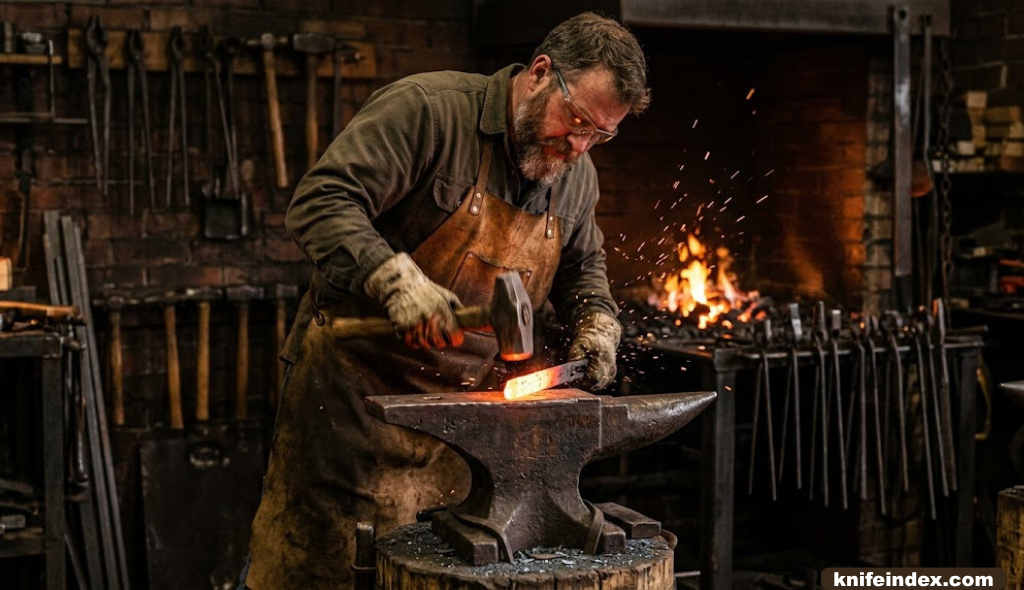
1. What Is a Forged Knife?
A forged knife begins life as a single bar of steel, heated until it glows orange, then hammered — either by a smith or by a mechanical drop hammer — into the rough shape of a blade. That hammering does more than shape the metal; it compresses and refines the steel’s internal grain structure, which is a big part of why forged blades have a reputation for strength and durability. After shaping, the blank is annealed, ground, heat-treated, tempered, and finally sharpened and finished with a handle.
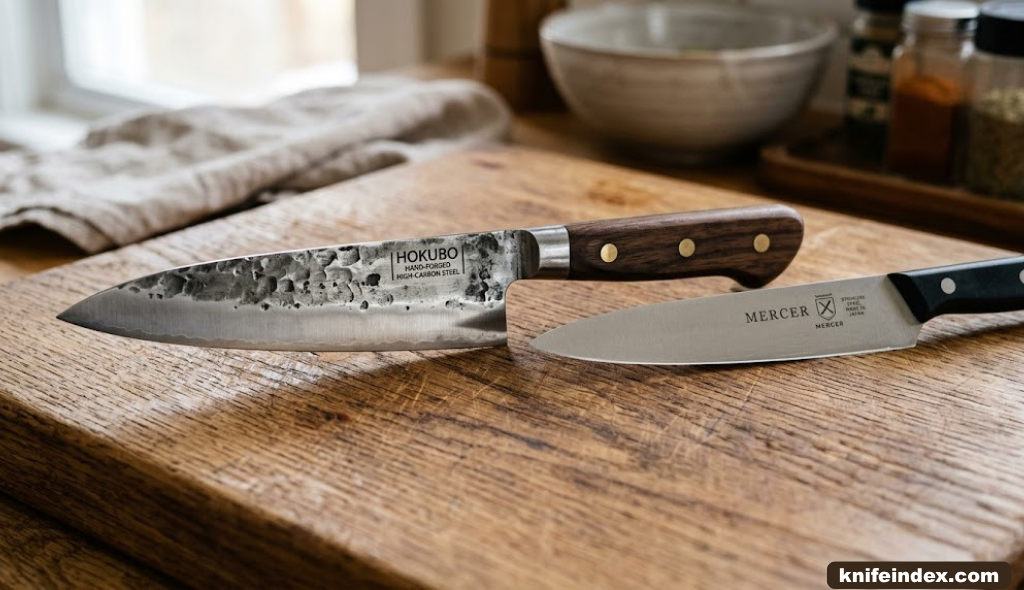
Because the process starts with a thick chunk of steel and a bolster is typically forged as part of the same piece, forged knives tend to be heavier, thicker at the spine, and taper more dramatically toward the edge. If you’ve ever picked up a Wüsthof Classic chef’s knife and felt its substantial heft, you were holding a textbook example of forged construction. The same manufacturing philosophy shows up outside the kitchen too — you can see it in hand-forged fixed blades built for outdoor and survival use, where that dense grain structure translates into serious edge strength.
The forging tradition has deep roots that stretch back centuries, long before anyone was worrying about kitchen ergonomics or Rockwell hardness charts. Blacksmiths originally forged blades because it was the only practical way to shape iron and steel into a cutting tool — there was no laser cutter, no hydraulic press, just fire, an anvil, and repeated strikes to draw the metal into a usable edge. That same basic process, refined with modern drop hammers and hydraulic presses instead of hand-swung sledges, is still how most premium Western kitchen knives are made today. Companies like Wüsthof and Zwilling run entire factory floors dedicated to this hot-forging process, using computer-controlled presses that strike a heated billet dozens of times in rapid succession to draw out the blade profile with remarkable consistency.
One detail that often gets glossed over is what forging actually does at a microscopic level. As the hot steel is repeatedly struck, the internal grain structure — the microscopic crystalline arrangement of the metal — gets compressed and aligned. Metallurgists describe this as refining the grain, and in theory it can produce a denser, tougher matrix of steel than an unworked sheet. In practice, the difference this makes to a finished, properly heat-treated knife is smaller than marketing copy often suggests, but it isn’t zero — it’s part of why forged blades have a long-standing reputation for shrugging off lateral stress at the heel and bolster, the areas that take the most abuse during hard chopping.
The Role of the Bolster
Because a forged blank starts as one continuous piece of steel, manufacturers can draw out extra material right where the blade meets the handle to form a bolster — a thick collar of steel that adds strength, protects the fingers during a pinch grip, and gives the knife a substantial, front-heavy balance point. The bolster is arguably the single most recognizable visual signature of a forged Western chef’s knife, and it’s the detail most people point to when they say a knife “feels like quality.”
2. What Is a Stamped Knife?
A stamped knife is cut — not hammered — out of a large flat sheet of steel, much like a cookie cutter punches shapes out of dough. A die press stamps the blade outline from the sheet, and the blank is then ground, heat-treated, and finished. Because there’s no hammering involved, the steel’s grain structure isn’t compressed the same way, and the blade generally stays thinner and lighter throughout.
Modern stamped knives have come a long way from the flimsy, floppy blades people picture when they hear “stamped.” High-end manufacturers now use the same premium steels in stamped lines that they use in forged ones, just with a different shaping process. Knives like the Global G-2 and many Victorinox kitchen knives are stamped, lightweight, and extremely popular with professional cooks who value speed and low fatigue over heft.
Stamping earned its reputation as the “budget” method decades ago, when manufacturers used it almost exclusively on thin, low-grade steel to hit rock-bottom price points for department store knife sets. Those early stamped knives really did flex, dull quickly, and feel cheap in the hand — and that reputation stuck around far longer than the low-quality knives that caused it. Modern industrial stamping technology has changed the equation entirely. Computer-controlled laser and die-cutting systems can now cut blade blanks from thick, high-performance steel sheets with tolerances just as tight as a forged blank, and the resulting knives can be ground to excellent edge geometry.
The efficiency of stamping is also worth appreciating on its own terms rather than treating it purely as a shortcut. Because a single sheet of steel can yield dozens of blade blanks in one pass, waste is dramatically lower than in forging, where excess steel is hammered away and ground off. That efficiency is exactly why brands can sell excellent stamped knives — like many of the workhorse blades from Dexter-Russell — at prices that would be impossible to hit with a forged process using the same steel.
Why Japanese Manufacturers Lean Toward Stamping
Many Japanese kitchen knife makers favor stamping (sometimes called “stock removal”) because Japanese culinary tradition prizes thin, precise edge geometry and light, fast handling over sheer mass. A stamped blank gives makers a consistent, thin starting point that’s easier to grind into the ultra-acute edges associated with Japanese-style knives, without needing to remove the extra bulk a forged blank would introduce near the spine.

See a Forged Chef’s Knife in Action
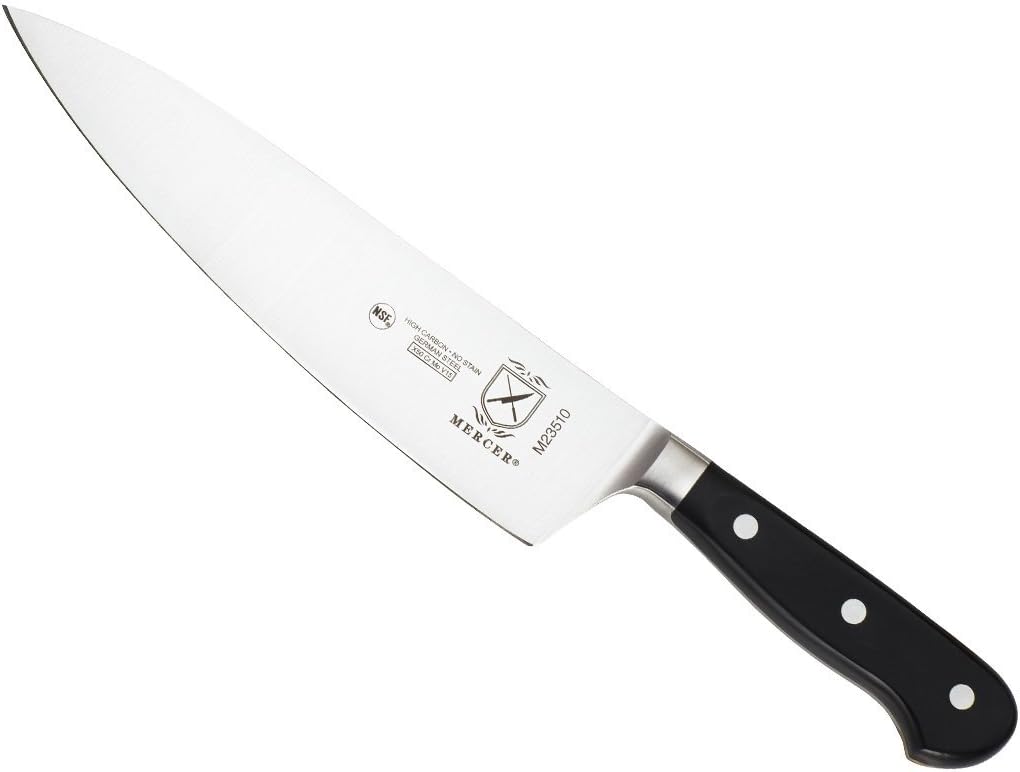
Want to feel the difference for yourself? A full-tang forged chef’s knife is the fastest way to understand what all the fuss is about.
Check Price on Amazon3. How Each Knife Is Actually Made — Step by Step
Understanding the manufacturing sequence makes the rest of this comparison much easier to follow, because nearly every performance difference between forged and stamped knives traces back to these steps.
Forged Knife Production
| Step | What Happens |
|---|---|
| 1. Billet cutting | A steel bar is cut to the right length for one knife. |
| 2. Heating | The billet is heated in a forge to around 2,000°F until it glows orange-yellow. |
| 3. Hammering/pressing | The hot steel is struck repeatedly, drawing out the blade, edge, and bolster in one continuous piece. |
| 4. Annealing | The rough blank is slow-cooled to relieve internal stress and soften it for grinding. |
| 5. Grinding & profiling | The blade is ground to its final shape and bevel. |
| 6. Heat treatment | The blade is hardened (quenched) and tempered to the target hardness. |
| 7. Finishing | Handle fitting, polishing, and final edge sharpening. |
Stamped Knife Production
| Step | What Happens |
|---|---|
| 1. Sheet selection | A large flat sheet of steel of the correct thickness is chosen. |
| 2. Stamping/laser cutting | A die press or laser cuts the blade outline out of the sheet. |
| 3. Grinding & profiling | The flat blank is ground to create the bevel and edge geometry. |
| 4. Heat treatment | The blade is hardened and tempered, same as forged blades. |
| 5. Finishing | Handle attachment (often riveted or bonded), polishing, sharpening. |
Notice that heat treatment — arguably the single biggest factor in edge retention — happens in both processes. This is exactly why a well-heat-treated stamped blade in a premium steel can out-cut a poorly heat-treated forged blade. Steel choice and heat treatment often matter more than the forging step itself, a point worth remembering when you compare something like 14C28N vs Nitro-V or D2 vs 8Cr13MoV.
Quality Control Checkpoints
Reputable manufacturers, whether forging or stamping, build in multiple quality checks throughout production: verifying steel composition on arrival, checking blank dimensions after shaping, monitoring furnace temperature during heat treatment, and testing hardness on finished blades with a Rockwell tester. A brand’s investment in these checkpoints — not the shaping method itself — is usually the real difference between a knife that performs consistently well and one that doesn’t. This is part of why buying from established, reputable brands with transparent steel specifications tends to be a safer bet than chasing the lowest price on an unfamiliar name, regardless of forged or stamped construction.
Time Investment Compared
A single forged blade can take anywhere from several minutes to well over an hour of hands-on shaping time depending on the complexity of the design and whether it’s hand-forged or press-forged, plus additional grinding and finishing time. A stamped blank, by comparison, can be cut in seconds by an automated press, with most of the remaining labor going into grinding, heat treatment, and finishing — the same steps a forged blade also requires. This time difference is the core driver of the price gap discussed later in this guide.
4. Key Differences at a Glance
| Feature | Forged | Stamped |
|---|---|---|
| Weight | Heavier, more substantial | Lighter, nimble |
| Bolster | Usually integrated/full bolster | Usually none or a false bolster |
| Blade thickness | Thicker spine, tapered edge | Uniform thin profile |
| Balance point | Often at or near the bolster | Can be handle-heavy or blade-light depending on design |
| Price range | Mid to premium | Budget to mid-range (with premium exceptions) |
| Best for | Heavy chopping, home cooks who want heft | Fast prep work, professionals, smaller hands |
| Manufacturing cost | Higher (more labor, more steel waste) | Lower (efficient, less waste) |
| Perceived prestige | Traditionally seen as “premium” | Traditionally seen as “everyday” |
Brands like Zwilling and Wüsthof built their entire reputations on forged German steel knives, while brands like Victorinox proved that stamped knives could dominate professional kitchens on value and speed alone.
A Quick Historical Note
Forging is, unsurprisingly, the older of the two methods — it dates back to the earliest days of metalworking, when smiths had no alternative but to hammer heated metal into shape by hand. Stamping only became viable at industrial scale once factories developed powerful mechanical presses capable of punching consistent shapes out of steel sheet, a shift that accelerated through the twentieth century as cutlery manufacturing scaled up to meet growing consumer demand. That history is part of why forged knives still carry an air of old-world craftsmanship, even though modern forging is now heavily automated in most large factories, and modern stamping can be every bit as precise as forging when done with quality equipment and materials.
Traditional Regional Preferences
Different culinary cultures have historically leaned toward different construction philosophies based on their cooking styles. German and French kitchen traditions, built around heavier rocking cuts and robust chopping, favored forged blades with substantial bolsters. Japanese culinary tradition, built around precise push-cuts and thin slicing, more often favored stock-removal (stamped or ground) construction that allowed for thinner, sharper edge geometry. These traditions still show up in modern product lines, though the lines have blurred considerably as manufacturers borrow techniques across both approaches.
5. Weight, Balance & Handling
Weight is the difference home cooks notice first. A forged 8-inch chef’s knife typically weighs somewhere between 8 and 10 ounces, while a comparable stamped knife often comes in at 5 to 7 ounces. That extra mass in a forged blade does real work — it helps drive the edge through dense vegetables, squash, and bone-in cuts with less arm effort, because the knife itself is contributing momentum to the cut.
Stamped knives flip that equation. Their lighter weight means less fatigue over long prep sessions, faster wrist action, and generally more nimble control for fine work like mincing herbs or breaking down delicate fish. This is part of why so many professional kitchens lean on stamped Japanese-style blades for high-volume prep — see how this plays out in German steel vs Japanese steel knives.
Balance point matters as much as raw weight. A forged knife with a full bolster often balances right at the bolster, which many cooks find comfortable for a pinch grip. Learn more about how this affects handling in our guide to understanding knife balance and why it matters.
How Hand Size and Grip Style Change the Equation
Weight preference isn’t purely objective — hand size, wrist strength, and grip style all shift which construction feels “right.” Cooks with larger hands and a strong pinch grip often barely notice the extra few ounces of a forged blade, while those with smaller hands or any wrist strain can feel the difference within minutes of continuous chopping. This is one reason keychain and EDC-style blades, like those covered in our keychain knives buyer’s guide, almost universally favor thin, stamped-style construction — low weight is the entire point of that category.
Momentum vs Control
Think of the weight difference in terms of physics rather than preference. A heavier forged blade carries more momentum through a downward chop, which means less muscular effort is needed to get through a dense butternut squash or a chicken thigh bone. A lighter stamped blade requires the cook to generate more of that cutting force through wrist speed rather than blade mass — which trades raw chopping power for faster, more controlled movement. Neither approach is objectively superior; professional kitchens that prioritize speed over brute force, such as sushi and prep stations, consistently lean toward the lighter, faster stamped or thin-ground option.
6. Edge Retention & Sharpness
Here’s where a lot of buyers get misled: edge retention is determined almost entirely by steel type, hardness (Rockwell rating), and heat treatment — not by whether the blade was forged or stamped. A stamped knife made from a premium powder steel and heat-treated to 61 HRC will out-perform a mediocre forged knife made from soft, poorly tempered steel every time.
That said, forging can indirectly support better edge geometry because the thicker spine gives manufacturers more material to work with when grinding a strong, acute edge. This is why many premium forged knives can be ground thinner behind the edge without sacrificing strength — a concept covered in depth in our blade geometry guide.
| Steel Factor | Impact on Edge Retention |
|---|---|
| Carbon content | Higher carbon generally means longer edge retention, at some cost to corrosion resistance — see high-carbon vs stainless steel |
| Rockwell hardness (HRC) | Higher HRC (58-64) holds an edge longer but can chip more easily; see Rockwell hardness explained |
| Heat treatment quality | Consistent, well-controlled quenching matters more than forging vs stamping |
| Edge geometry | Thinner edges cut better initially but may need more frequent honing |
Why “Forged Means Sharper” Is an Oversimplification
It’s easy to assume the heavier, more expensive-feeling knife must also be the sharper one, but sharpness is a function of the final edge angle and how consistently it’s applied — something that happens at the grinding stage, after forging or stamping is long finished. A skilled grinder can put an identical, razor-thin edge on either a forged or a stamped blank. What actually varies between manufacturers is quality control at that grinding and heat-treating stage, not the shaping method itself.
This is also why steel comparisons matter so much more than construction method when you’re actually shopping. Reading up on specific steel matchups — like S35VN vs S45VN, MagnaCut vs M390, or VG-10 vs AUS-10 — will tell you far more about how long a knife will hold its edge than knowing whether it was forged or stamped.
Honing and Maintenance Differences
In daily use, both forged and stamped knives benefit from regular honing with a honing steel to keep the microscopic edge aligned between full sharpenings. Neither construction method changes how often you should hone — that’s dictated by usage frequency and cutting surface (always use a wood or soft plastic board). For the actual re-sharpening process, see our comparisons of whetstone vs electric sharpeners and honing steel vs whetstone to understand which tool suits your knife collection.

Prefer a Lightweight Stamped Blade?
If speed and low fatigue matter more to you than heft, a quality stamped chef’s knife is worth a look.
Check Price on Amazon7. Durability & Long-Term Performance
Forged knives generally have an advantage in raw structural durability, particularly at the bolster and heel — the areas most prone to stress during heavy chopping or when a knife is used to pry or twist (which you shouldn’t do, but people do). The continuous grain structure from forging tends to resist stress fractures better than a blank punched from sheet steel.
Stamped knives, especially cheap ones, can flex more and are somewhat more prone to bending under lateral stress, though quality stamped knives from reputable brands are still plenty durable for everyday kitchen use — they’re simply not built for abuse. Full-tang construction, regardless of forging method, is the bigger durability factor for handle longevity; compare this to fixed-blade outdoor knives like the Ontario RAT-1, where full-tang forged-style construction is prized specifically for hard use.
Rust and corrosion resistance depend on steel composition, not manufacturing method — see our guide on how to prevent rust on knives for care tips that apply to both types.
Stress Points Worth Watching
The area most likely to fail on any kitchen knife, forged or stamped, is the transition zone where the blade meets the handle — the tang. A full tang that runs the entire length of the handle, securely riveted or bonded, will outlast a partial tang regardless of whether the blade itself was forged or stamped. If you’re evaluating a knife’s long-term durability, check the tang construction before you check the manufacturing method; it tells you more about how the knife will hold up to years of use.
Real-World Longevity
In practical terms, a well-maintained knife of either construction type can easily last a decade or more with proper care — hand washing, regular honing, occasional professional or whetstone sharpening, and dry storage. Dishwashers are the real enemy of longevity here, as the heat, moisture, and jostling degrade both edges and handles regardless of how the blade was shaped. If storage is a concern in a small kitchen, our guide to storing knives without a block covers safe options that protect the edge either way.
8. Price & Value Comparison
Forging is a more labor- and material-intensive process, which is why forged knives typically carry a higher price tag. Manufacturers lose more steel to grinding waste, and the hammering/pressing step adds equipment and time costs that get passed to the buyer.
| Price Tier | Forged Examples | Stamped Examples |
|---|---|---|
| Budget ($15-$40) | Rare — usually only in lower-tier forged lines | Common — Victorinox, Mercer, entry Dexter-Russell |
| Mid-range ($40-$120) | Zwilling Pro, Mosfiata forged lines | Global, higher-end stamped Japanese lines |
| Premium ($120+) | Wüsthof Classic, Miyabi Birchwood | Rare — premium powder-steel stamped blades |
Value isn’t purely about price, though. A $50 stamped knife with excellent steel and a good heat treatment can deliver more real-world performance than a $50 forged knife with mediocre steel. Always weigh the steel and heat treatment alongside the construction method — our budget chef knife guide walks through exactly how to spot good value at low price points.
Cost Per Year of Use
A useful way to reframe the price debate is cost-per-year rather than sticker price. A $150 forged chef’s knife that lasts 15 years with proper care works out to $10 a year. A $40 stamped knife that needs replacing every 3-4 years because the steel is soft works out to roughly the same, or worse. On the other hand, a $60 quality stamped knife from a reputable maker that also lasts a decade completely flips that math in the stamped knife’s favor. The lesson: don’t buy based on construction method alone — buy based on the specific knife’s steel, reviews, and warranty.
Where the Extra Money in Forged Knives Actually Goes
It’s worth knowing exactly what you’re paying for when you choose a premium forged knife. Beyond the labor-intensive hammering process itself, costs come from: more steel purchased upfront to account for forging/grinding waste, more skilled labor hours per unit, quality control at each forging stage, and often more elaborate handle materials and fit-and-finish work that tends to accompany premium forged lines. Compare that to brands like Mac and Global, which keep costs down by focusing that investment into steel quality and grinding precision instead of the forging process.
9. Pros and Cons Breakdown
Forged Pros
- Heavier, more substantial feel that many cooks prefer
- Full bolster often adds strength and a comfortable pinch-grip point
- Generally more resistant to bending/flexing under stress
- Associated with premium craftsmanship and traditional cutlery
Forged Cons
- More expensive due to labor-intensive manufacturing
- Heavier weight can cause fatigue during long prep sessions
- Bolster can make full blade sharpening (edge-to-heel) harder
- Not automatically “better” — quality still depends on steel and heat treatment
Stamped Pros
- Lightweight, less fatigue over long prep
- Generally more affordable
- Faster, more nimble in the hand for fine cuts
- No bolster means the full edge is usable for sharpening and slicing
Stamped Cons
- Can feel flimsy if made from thin, low-quality steel
- Less mass behind heavy chopping tasks
- Historically associated (sometimes unfairly) with “cheap” knives
- Quality varies wildly between brands
Real-World Use Case Scenarios
Specs and tables only tell part of the story. Here’s how the forged-vs-stamped decision actually plays out across common kitchen scenarios.
Scenario: Sunday Meal Prep for the Week
You’re breaking down a chicken, dicing three pounds of onions, and chopping through a couple of butternut squashes for roasting. This is squarely forged-knife territory — the added mass reduces the effort needed to power through dense, resistant vegetables, and the sturdier bolster holds up well to the repetitive, higher-force motion of a long prep session focused on volume rather than precision.
Scenario: Fast Weeknight Dinner
You need to mince garlic, slice a chicken breast, and dice some bell peppers in under ten minutes before the pan gets too hot. A lightweight stamped knife shines here — quick, controlled movements matter more than raw chopping power, and the lower fatigue means you’re less likely to rush and make a mistake.
Scenario: Small Hands or Limited Grip Strength
If wrist or hand strength is a limiting factor — whether from arthritis, a smaller frame, or simply personal comfort — a lighter stamped knife with a well-designed ergonomic handle is usually the more sustainable daily driver, reducing strain across repeated use over months and years.
Scenario: Building a “Forever” Knife Collection
If you’re investing in a knife collection meant to last decades and be passed down, a forged knife’s reputation for structural resilience at the bolster and heel — combined with premium steel and proper care — makes a compelling case for the extra upfront cost, particularly for a primary chef’s knife you’ll use daily for years.
Scenario: Outfitting a Rental Kitchen or Second Home
For a lower-stakes environment where knives may see inconsistent care or occasional misuse by guests, an affordable, durable stamped knife makes more financial sense — you get solid everyday performance without a large investment in a knife that might not get the maintenance it deserves.
11. Common Myths, Debunked
Myth 1: “Forged always means better quality.”
Not true. Forging affects shape and mass, not inherently steel quality or heat treatment. A poorly heat-treated forged knife can underperform a well-made stamped one.
Myth 2: “Stamped knives can’t hold an edge.”
Edge retention comes from steel composition and hardness, not the shaping method. Many stamped knives use the same premium steels found in forged lines.
Myth 3: “You can always tell by bending the blade.”
Flex resistance depends on blade thickness and steel temper as much as construction method — a thick stamped blank can be stiffer than a thin forged one.
Myth 4: “All professional chefs use forged knives.”
Plenty of professionals — especially in fast-paced, high-volume kitchens — prefer lightweight stamped knives specifically because they reduce fatigue over a 10-hour shift.
Myth 5: “A heavier knife is always safer to use.”
Weight and safety aren’t directly linked. What actually improves safety is control — a knife that matches your hand size, grip strength, and cutting style. Some cooks feel more in control with a lighter, faster stamped blade; others feel steadier with the extra mass of a forged one. Either can be used safely or unsafely depending on technique, not construction method.
Myth 6: “Stamped knives are a modern shortcut invented to cut costs.”
Stock-removal blade making (the broader category stamping falls under) is actually one of the oldest bladesmithing techniques in existence, used by cultures worldwide long before industrial presses existed. Modern stamping is simply a mechanized, faster version of a very old idea — grinding a blade shape from existing stock rather than working it from a heated billet.
Myth 7: “You should never buy a stamped knife for serious cooking.”
This myth falls apart the moment you walk into a professional restaurant kitchen. Many line cooks and even executive chefs choose lightweight stamped knives specifically because they move faster with less fatigue during ten-hour shifts. Brands like Victorinox have built a devoted professional following almost entirely on stamped construction.
12. Which One Should You Buy?
The right choice comes down to how you cook, not which method sounds more premium on paper.
Choose a forged knife if:
- You like a heavier knife that does some of the chopping work for you
- You cook dense vegetables, squash, or bone-in proteins regularly
- You want the classic pinch-grip feel of a full bolster
- Budget isn’t your primary constraint
Choose a stamped knife if:
- You prep for long stretches and want to avoid arm/wrist fatigue
- You want a nimble knife for fine mincing and precision cuts
- You’re working with a smaller hand size or lighter grip strength
- You want strong performance at a lower price point
Still torn? Think about the knives you already reach for most. If you gravitate toward smaller utility and paring tasks, read our breakdown of what a paring knife is used for. If you’re building out a full kitchen set, our best knife sets for professional chefs guide covers both construction styles across a full lineup.
A Practical Test Before You Buy
If you can visit a store in person, pick up both a forged and a stamped chef’s knife and mimic a chopping motion on the display counter (carefully, without an edge test). Pay attention to where the weight sits in your hand and whether your wrist tires after 30 seconds of continuous motion. That thirty-second test tells you more about your personal preference than any spec sheet ever will. If you’re shopping online, look for verified buyer reviews that specifically mention weight and balance rather than general star ratings — the details usually surface there.
Consider a Hybrid Knife Roll
Many experienced home cooks eventually stop thinking of this as an either/or decision and simply build a small collection that uses both construction styles for different jobs: a forged chef’s knife for heavy chopping and protein prep, a stamped utility or petty knife for quick, precise tasks, and a serrated knife — forging is largely irrelevant for serrated blades — for bread. If you’re just starting that collection, our guide on the three blades that can replace a full knife block is a good place to start.
Care and Maintenance: Does Construction Method Change the Rules?
One question that comes up constantly once buyers understand the forging-vs-stamping distinction is whether the two types need different care routines. The honest answer is: barely. Both forged and stamped knives benefit from the same fundamental care habits, and the differences that do exist are minor enough that they shouldn’t dictate your purchase decision on their own.
Washing and Drying
Regardless of construction, hand washing with warm water and mild soap immediately after use, followed by thorough towel drying, is the single best habit for extending any knife’s life. Dishwashers subject blades to prolonged moisture, harsh detergents, and physical jostling against other utensils, all of which accelerate corrosion and dull edges faster than normal use would. This applies equally to a $200 forged Wüsthof and a $30 stamped Victorinox.
Storage
Loose storage in a drawer is hard on any blade’s edge, since metal-on-metal contact with other utensils causes micro-chipping over time. A knife block, magnetic strip, or blade guard protects the edge on both forged and stamped knives equally. If you’re short on counter space, our comparison of magnetic knife strips and edge damage risk is worth a read before you commit to a storage method.
Sharpening Frequency
How often a knife needs sharpening depends primarily on usage frequency, cutting surface, and steel hardness — not on whether it was forged or stamped. A softer steel (lower HRC) in either construction style will need more frequent touch-ups than a harder steel, all else being equal. Most home cooks do well with monthly honing and a full sharpening session every few months, adjusted based on how often the knife sees use.
Handle Care
Wooden handles, which appear on both forged and stamped knives, need occasional oiling to prevent drying and cracking, while synthetic handles (common on many stamped budget knives) are largely maintenance-free beyond normal washing. If handle durability is a priority, look at the tang construction and handle material specifically rather than assuming forged knives automatically come with better handles — plenty of premium stamped knives use the same synthetic, dishwasher-resistant materials found on high-end forged lines.
13. Recommended Knives to Consider
| Knife | Construction | Best For |
|---|---|---|
| Wüsthof Classic 8″ Chef’s Knife | Forged | Heavy-duty home chopping, all-purpose German-style prep |
| Zwilling Pro Chef’s Knife | Forged | Balanced full-tang forged option at a mid-range price |
| Global G-2 | Stamped | Featherweight precision, Japanese-style handling |
| Victorinox Fibrox Chef’s Knife | Stamped | Best overall value, professional-kitchen favorite |
| Miyabi Birchwood | Forged | Premium hybrid Japanese/German craftsmanship |
| TUO Chef’s Knife | Forged | Budget-friendly forged option with solid steel |
Also worth comparing side by side in more detail: Zwilling vs Henckels, Shun vs Wüsthof, and Dalstrong vs Wüsthof for how forged and stamped philosophies play out across different brands.

Build a Balanced Knife Collection
Many home cooks end up owning both — a forged chef’s knife for heavy work and a stamped utility knife for speed.
Shop Knife Sets on AmazonFrequently Asked Questions
Is a forged knife always better than a stamped knife?
No, and this is probably the single most persistent misconception in the entire category. Forged knives tend to be heavier, thicker at the spine, and more durable specifically around the bolster and heel, which are the areas that see the most lateral stress during hard chopping. But overall performance — how sharp the edge gets, how long it stays sharp, and how the knife holds up over years of use — depends far more on steel quality, Rockwell hardness, and heat treatment than on whether the blade started as a hot billet or a flat sheet. A premium stamped knife can easily outperform a mediocre forged one in every measurable way except raw heft.
Why are forged knives more expensive?
Forging is simply a more resource-intensive manufacturing process from start to finish. It requires more labor hours, specialized heating and pressing equipment, and it produces more material waste, since a lot of the original steel bar gets ground away to reach the final blade shape. Stamping, by contrast, cuts blade blanks efficiently from a flat sheet with minimal waste, which keeps unit costs — and retail prices — considerably lower for comparable steel grades.
Do stamped knives bend or break more easily?
It depends heavily on quality. Cheap, thin stamped knives made from soft, low-grade steel absolutely can flex more than a forged blade and are more prone to taking a permanent bend under stress. However, quality stamped knives from reputable brands, made with thicker stock and properly hardened steel, are plenty sturdy for all normal kitchen tasks — chopping, slicing, dicing, and mincing. The failure point for most kitchen knives, forged or stamped, tends to be misuse (prying, twisting, or cutting frozen food) rather than the construction method itself.
How can I tell if a knife is forged or stamped?
The most reliable visual cue is the bolster: a forged knife usually has a substantial, integrated collar of steel where the blade meets the handle, since that bolster is drawn out of the same continuous piece of steel as the rest of the blade. Stamped knives are typically thinner throughout and either have no bolster at all or a thinner “false bolster” that’s added separately rather than forged in one piece. Weight is the second giveaway — pick the knife up, and a forged blade of comparable size will almost always feel noticeably heavier in the hand.
Do professional chefs prefer forged or stamped knives?
It genuinely varies by kitchen role and personal style, and there’s no industry-wide consensus. Line cooks working high-volume prep stations often favor lightweight stamped knives because they reduce arm and wrist fatigue over long shifts and allow faster, more repetitive motion. Other chefs, especially those doing heavier butchery or vegetable-forward prep, prefer the extra mass and momentum of a forged blade. Many professionals ultimately own both types and switch between them depending on the specific task at hand.
Does forging make a blade sharper?
Forging itself doesn’t directly affect how sharp a blade gets or how long that sharpness lasts. Sharpness comes down to the final edge angle set during grinding, and edge retention comes down to the steel’s carbon content, hardness, and how well the heat treatment was executed. A stamped blank and a forged blank made from the exact same steel, ground to the exact same edge angle, and heat-treated identically will perform virtually the same in a cutting test.
Are all Japanese knives stamped and all German knives forged?
Not at all — this is a generalization that holds some truth but plenty of exceptions. German cutlery traditions, exemplified by brands like Wüsthof and Zwilling, do lean heavily toward forging, and many recognizable Japanese kitchen knife lines use stock-removal (stamped or ground) construction. But you’ll find excellent forged Japanese knives, like many higher-end Gyuto lines, and there are also budget German-style knives on the market that use stamped construction to hit lower price points.
Can a stamped knife have a bolster?
Yes. Many manufacturers attach a separate metal or plastic collar to a stamped blade specifically to mimic the comfort and finger protection of a forged bolster, sometimes called a “false bolster.” The key difference is that this piece is manufactured and attached separately rather than being drawn out of the same continuous billet of steel as the blade itself, which is what happens during true forging.
Which is easier to sharpen, forged or stamped?
Stamped knives are often somewhat easier to sharpen along the entire length of the edge, including right up to the heel, precisely because there’s no thick bolster physically blocking that section from making full contact with a sharpening stone. On forged knives with a full, tall bolster, the heel area near the handle can be genuinely difficult to reach with a whetstone, which is why some cooks end up with an unevenly sharpened blade near the base if they aren’t careful with technique.
Is it worth paying more for a forged knife as a beginner?
Not necessarily, and in fact many culinary instructors actively recommend against it. New cooks are still developing knife skills, grip technique, and cutting board habits, and an affordable, well-reviewed stamped knife lets them build those fundamentals without a large financial investment. Once technique is solid and personal preferences around weight and balance are clearer, upgrading to a premium forged knife — or staying with a quality stamped one — becomes a much more informed decision.
Do forged knives rust more than stamped knives?
No — corrosion resistance is governed almost entirely by the steel’s chemical composition, particularly its chromium content, rather than by whether the blade was forged or stamped. Both construction methods are used across the full spectrum of steels, from highly rust-resistant stainless alloys to high-carbon steels that patina and can rust if left wet. If corrosion resistance matters to you, check the steel type specifically rather than assuming forged knives are more or less prone to rust.
What’s the best all-around choice for a home cook?
For most home cooks, a mid-range forged chef’s knife handles the bulk of everyday tasks — chopping vegetables, breaking down proteins, and general prep — extremely well thanks to its balance of weight and durability. Pairing that with a lighter, nimble stamped utility or paring knife for detail work gives you genuine versatility without needing a full knife block of specialty blades. This combination approach is exactly what many working chefs settle into after years of trial and error with different setups.
Does the country of manufacture matter more than forged vs stamped?
Country of origin can be a useful signal of manufacturing standards and quality control traditions, but it’s not a substitute for checking the actual steel type, hardness rating, and construction details of a specific knife. A well-made stamped knife from a reputable factory anywhere in the world will outperform a poorly made forged knife from a low-quality producer, regardless of country. Use origin as one data point among several, not as the deciding factor on its own.
Steel: The Variable That Actually Decides Performance
Since this entire comparison keeps circling back to the same point — that steel and heat treatment matter more than forging vs stamping — it’s worth spending a little more time on how to evaluate steel when you’re actually comparing two specific knives.
Stainless vs High-Carbon
Stainless steels, which contain enough chromium to resist rust, dominate both forged and stamped kitchen knives today because they require less maintenance. High-carbon steels can achieve slightly better edge retention and are easier to sharpen to a keener edge, but they demand more diligent drying and occasional oiling to avoid rust and staining. Our high-carbon vs stainless steel breakdown covers this trade-off in detail.
Common Steel Grades and What They Mean
| Steel | Typical Use | Notes |
|---|---|---|
| X50CrMoV15 | German forged knives (Wüsthof, Zwilling) | Good balance of toughness and edge retention, easy to sharpen |
| VG-10 | Japanese forged and stamped knives | Higher hardness, better edge retention, slightly more brittle |
| X55CrMo14 | Victorinox and similar stamped lines | Softer, very easy to sharpen, needs more frequent honing |
| AUS-8 / AUS-10 | Mid-range stamped and forged blades | Solid all-rounder, good corrosion resistance |
| Powder steels (SG2, R2, MagnaCut) | Premium knives, both construction types | Exceptional edge retention, higher cost, more careful sharpening needed |
Notice that every single one of these steels appears across both forged and stamped product lines. When you’re comparing two specific knives, look up the actual steel grade listed by the manufacturer rather than relying on forged-vs-stamped as a proxy for quality — it’s a far more reliable signal of how the knife will actually perform in your kitchen.
Conclusion: Forged vs Stamped Comes Down to Feel, Not Just Fame
Forged and stamped knives aren’t really rivals in a “good vs bad” sense — they’re two different manufacturing philosophies that produce genuinely different tools. Forging gives you weight, a substantial bolster, and a traditional feel that many cooks associate with premium craftsmanship. Stamping gives you speed, lightness, and often better value for the money. Neither wins on edge retention or sharpness alone — that comes down to steel and heat treatment, full stop.
The smartest move for most home cooks is to stop treating “forged” as a synonym for “better” and instead match the knife to how you actually cook. If you love muscling through butternut squash and root vegetables, a forged chef’s knife will feel like an extension of your arm. If you’re prepping fast and want to avoid fatigue, a quality stamped blade will serve you just as well — sometimes better.
Browse Top-Rated Chef’s Knives on Amazon