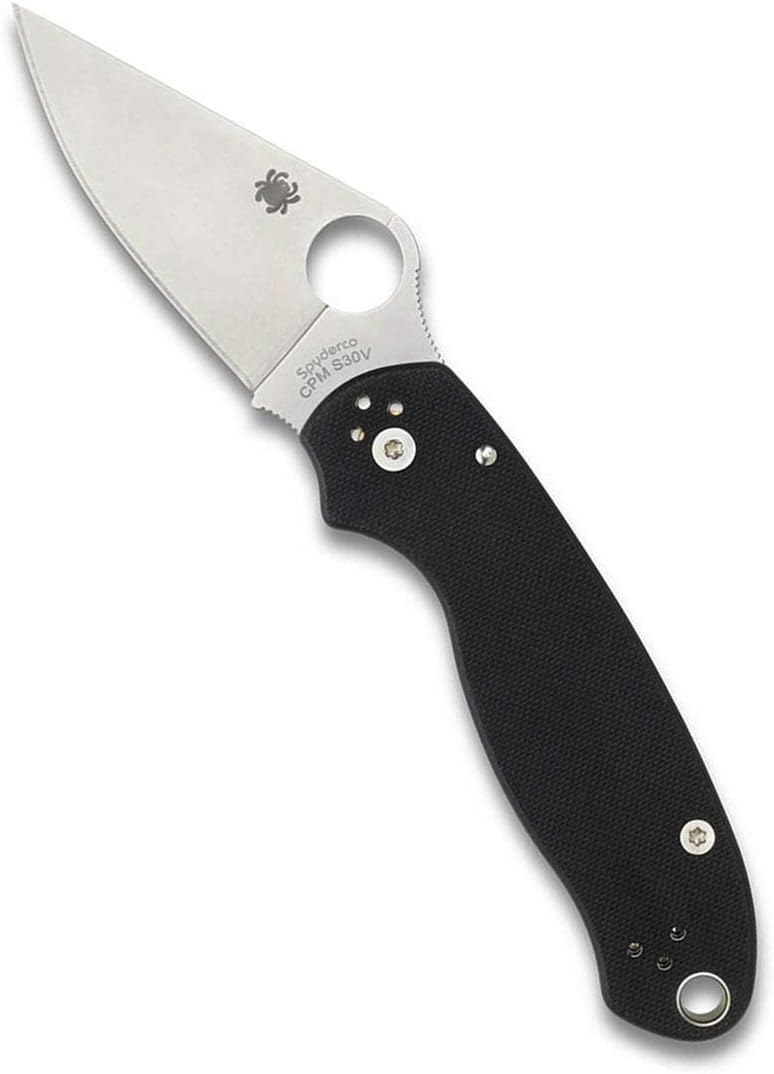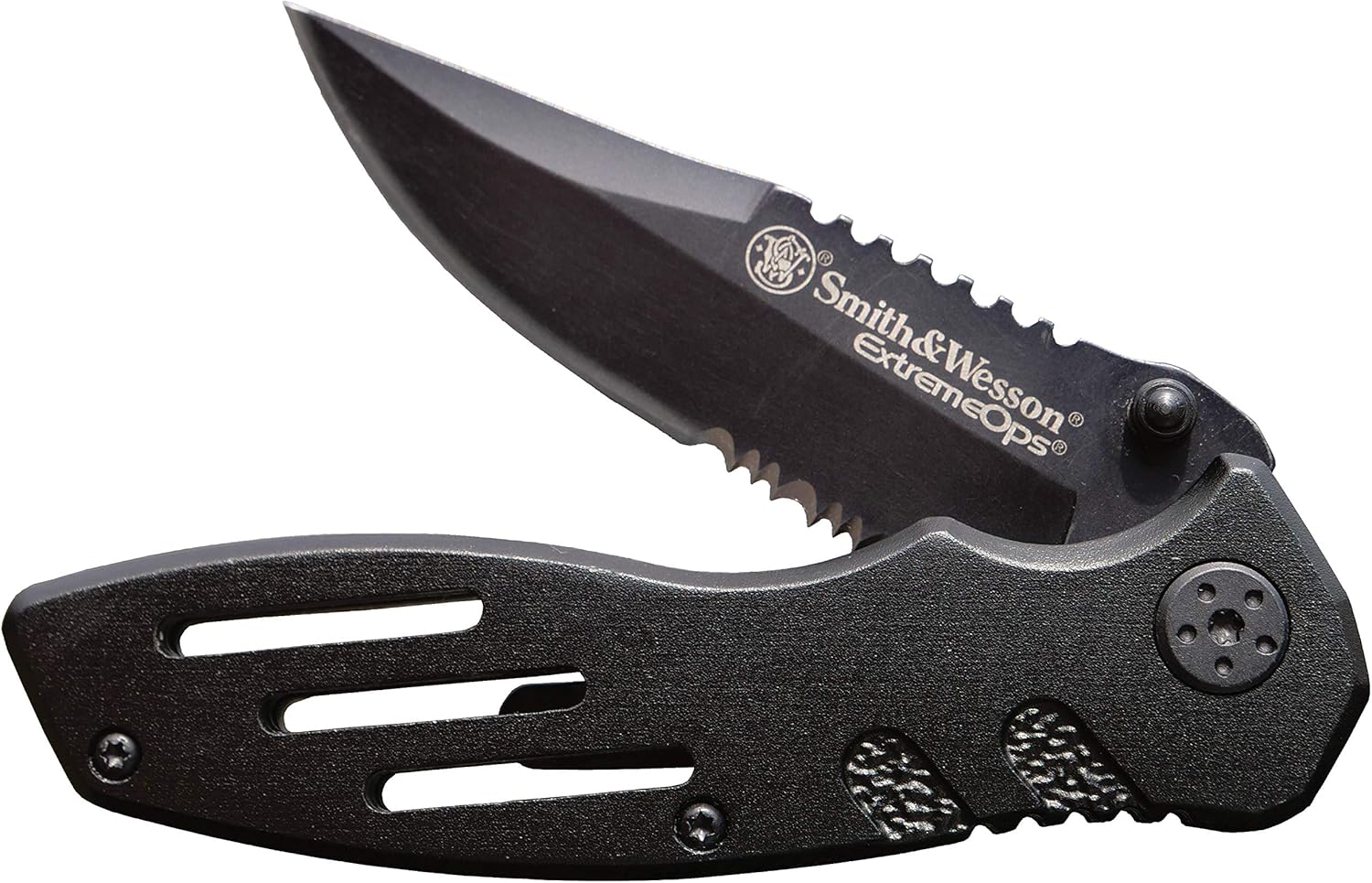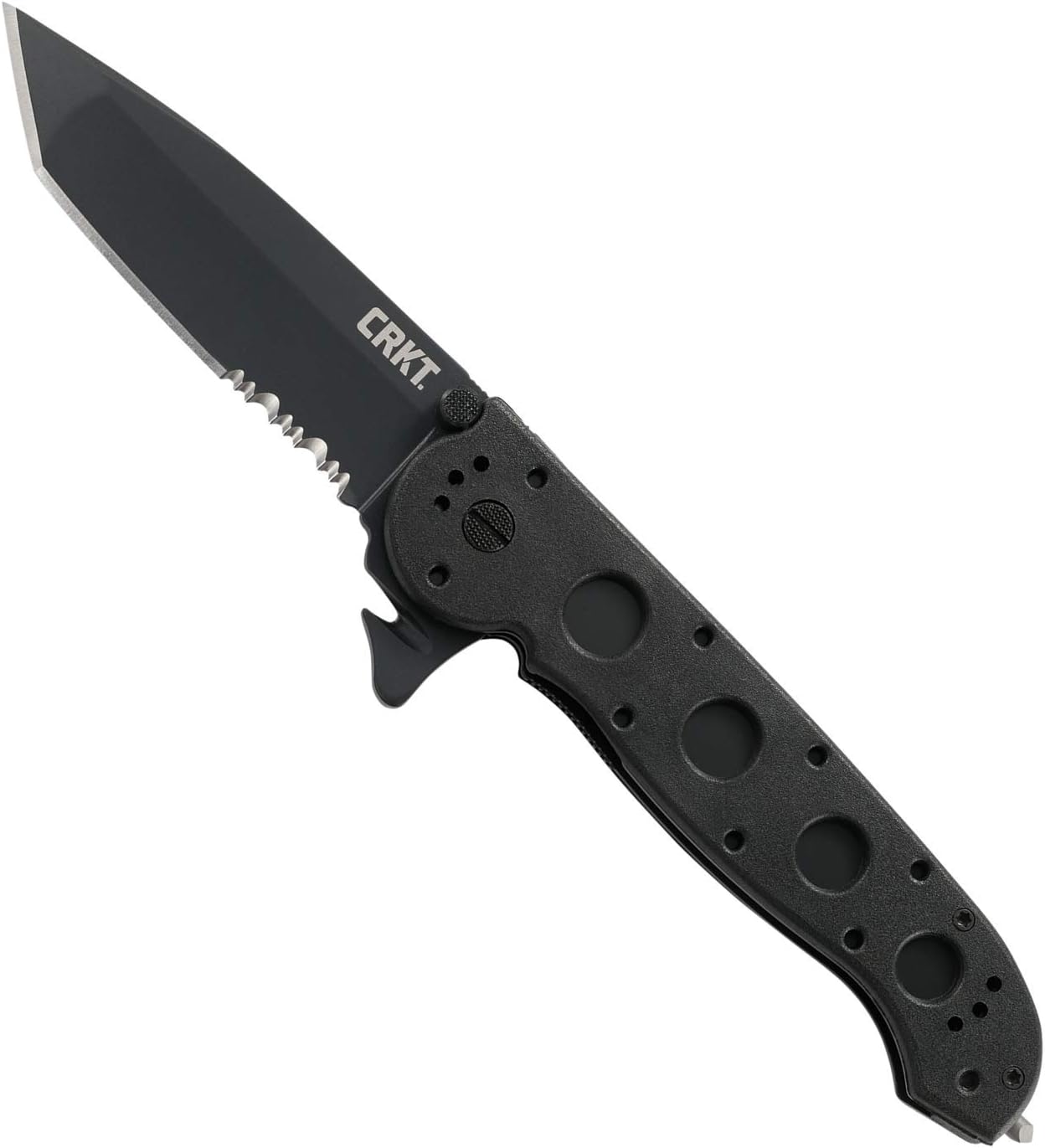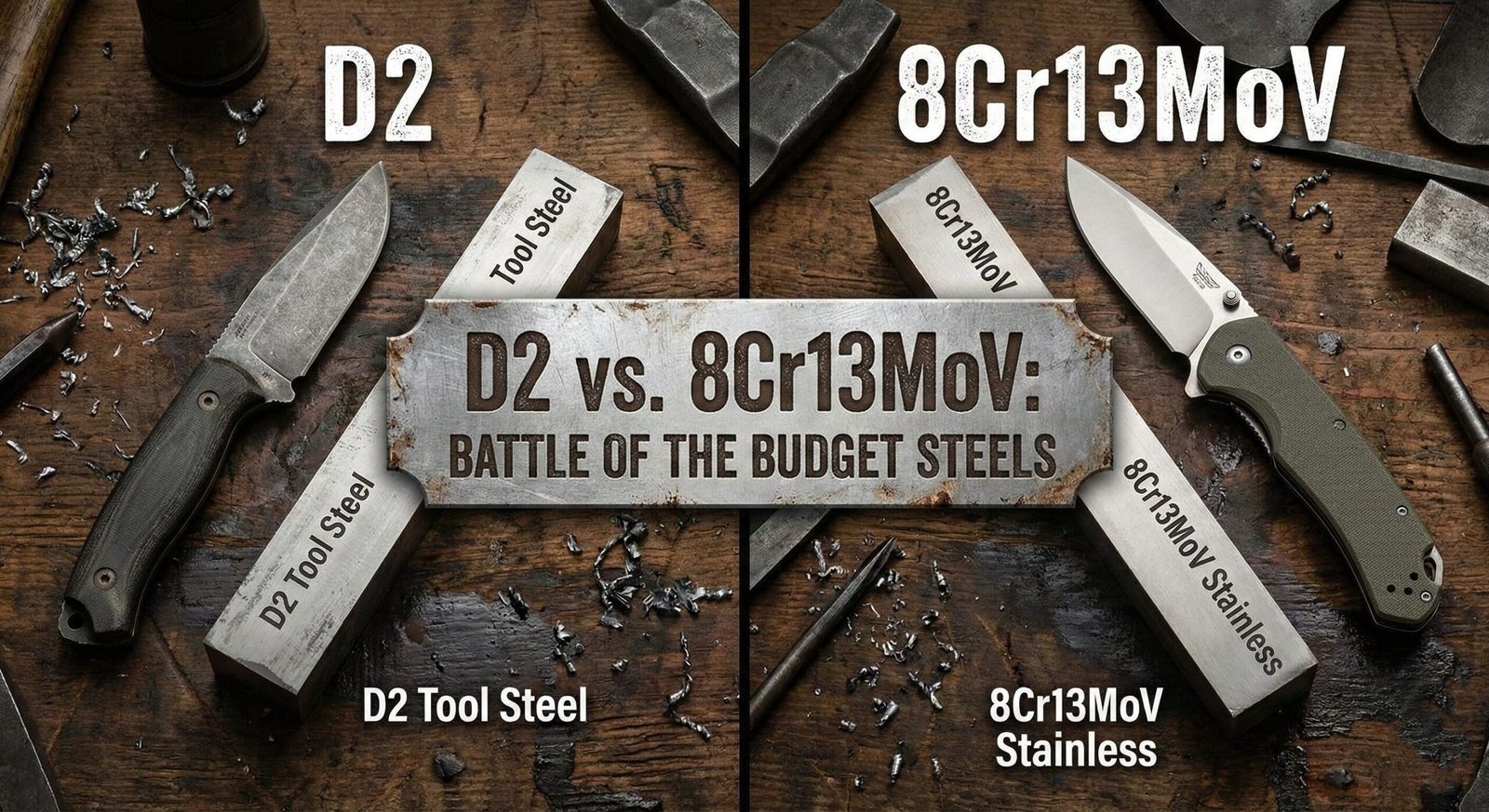
D2 vs. 8Cr13MoV: The Ultimate Battle of the Budget Steels
The Evolution of the Budget Knife Debate
If you are currently browsing for an everyday carry (EDC) pocket knife or a reliable hard-use fixed blade under the $60 price point, you will inevitably smash headfirst into a critical decision: D2 Tool Steel or 8Cr13MoV. For the better part of the 2010s, 8Cr13MoV was the absolute gold standard for affordable knives from massive production brands like Kershaw, CRKT, and Spyderco’s budget lines. It was cheap to produce, wildly easy to sharpen, and universally accepted as “good enough” for opening Amazon boxes and cutting zip ties.
However, the knife manufacturing industry—particularly operations based in China—has evolved at a breakneck pace over the last few years. High-tech CNC machining and advanced heat treatment protocols have allowed manufacturers to mass-produce blades using D2. Historically, D2 was a high-hardness tool steel reserved exclusively for expensive custom makers and premium mid-tech brands like Benchmade. Today, the market is flooded with meticulously machined D2 knives from brands like Civivi, CJRB, and QSP that directly compete with 8Cr13MoV in price.
So, is upgrading to D2 an absolute no-brainer? Or does the highly forgiving, classic 8Cr13MoV still legitimately hold a strategic place in your pocket? To find out, we must go beyond the marketing hype and aggressively break down the raw metallurgy, heat treatment science, and real-world cutting performance.
What Exactly is D2 Steel?
D2 is an extraordinarily old-school, tried-and-true “Tool Steel” that first appeared during World War II. It was originally engineered to construct industrial stamping dies and heavy machine parts used to cut, slice, and form other steels on factory assembly lines. To survive that kind of industrial violence, D2 relies on a massive amount of Carbon (up to 1.5%) and a very high level of Chromium (11-12%).
Because it possesses 11-12% Chromium, it hovers just below the universally accepted 13% threshold required to officially be classified as a “stainless steel.” Hence, D2 is widely known in the knife community as a “Semi-Stainless” steel. It is famous for forming massive, ultra-hard chromium carbides within its molecular matrix. These carbides act like microscopic diamond teeth, allowing D2 to hold a viciously aggressive cutting edge for a very long time, but they also make the steel relatively brittle and notoriously difficult to sharpen on traditional whetstones.
For a deeper understanding of where D2 sits in the grand hierarchy of cutlery materials, check out our exhaustive comparison of stainless steel vs. carbon steel knives.
What is 8Cr13MoV?
8Cr13MoV is an ingot-based stainless steel manufactured in China. It was originally formulated to act as a direct, highly cost-effective competitor to the famous Japanese AUS-8 steel. The name itself is actually a chemical recipe: it contains roughly 0.8% Carbon and 13% Chromium, along with trace additions of Molybdenum and Vanadium to aid in grain refinement.
In the knife enthusiast community, 8Cr13MoV is the very definition of “adequate.” It takes a screaming, hair-popping sharp edge very quickly, resists environmental rust exceptionally well, and keeps production costs incredibly low. However, it is relatively soft. If you spend an afternoon breaking down heavy, double-walled corrugated cardboard, you will absolutely need to sharpen it by evening. It serves as the baseline metric against which virtually all other budget steels are measured, such as in our AUS-10 vs. VG10 breakdown.
Metallurgical Chemistry Breakdown
To truly understand why these two steels behave so differently on the cutting board and the sharpening stone, we have to look at their chemical recipes.
| Element | D2 Tool Steel (%) | 8Cr13MoV (%) | What It Does For The Knife |
|---|---|---|---|
| Carbon (C) | 1.40 – 1.60 | 0.70 – 0.80 | Dictates overall hardness and wear resistance. D2 has nearly double the carbon. |
| Chromium (Cr) | 11.00 – 13.00 | 13.00 – 14.50 | Provides corrosion (rust) resistance. 8Cr crosses the “stainless” threshold. |
| Molybdenum (Mo) | 0.70 – 1.20 | 0.10 – 0.30 | Increases strength and high-temperature stability during heat treat. |
| Vanadium (V) | 0.90 – 1.10 | 0.10 – 0.25 | Forms incredibly hard vanadium carbides, boosting edge retention massively. |
The Takeaway: D2 is packed with significantly more Carbon and Vanadium. This creates huge, hard carbides that make it a cutting monster. 8Cr13MoV relies on higher Chromium and lower Carbon to prioritize rust resistance and ease of machining.
The Hidden Variable: Heat Treatment
You can have the most expensive steel chemistry in the world, but if the heat treatment is poor, the knife will perform like cheap tin. Heat treatment involves heating the blade to extreme temperatures, quenching it rapidly to lock the molecular structure, and then tempering it to relieve internal stress.
D2 is notoriously finicky to heat treat correctly. If it is rushed or improperly tempered, it becomes terrifyingly brittle and will snap under pressure. However, when done right (often involving a sub-zero Cryogenic quench to maximize hardness), D2 easily reaches 60-62 HRC (Rockwell Hardness). 8Cr13MoV is much more forgiving for manufacturers to heat treat, typically maxing out at a softer 56-58 HRC. This difference in Rockwell hardness directly correlates to how the knife will perform in the real world.
Head-to-Head Performance Stats
Here is how the chemistry and heat treatment translate into tangible, real-world utility.
| Performance Category | D2 Tool Steel | 8Cr13MoV | Clear Winner |
|---|---|---|---|
| Edge Retention | 8/10 (Excellent) | 4/10 (Low/Average) | D2 (By a landslide) |
| Toughness (Impact) | 4/10 (Brittle) | 6/10 (Moderate) | 8Cr13MoV |
| Corrosion Resistance | 4/10 (Semi-Stainless) | 6.5/10 (Decent) | 8Cr13MoV |
| Ease of Sharpening | 3/10 (Stubborn/Hard) | 9/10 (Incredibly Easy) | 8Cr13MoV |
Edge Retention: The D2 Dominance
This is the primary reason knife enthusiasts heavily favor D2. Because of its massive, ultra-hard chromium and vanadium carbides, combined with a high Rockwell hardness (60-62 HRC), D2 cuts aggressively for a very long time. In standardized CATRA (Cutlery & Allied Trades Research Association) testing—where a machine repeatedly cuts abrasive silica-impregnated cardstock—a properly treated D2 blade will routinely execute double or even triple the number of cuts compared to 8Cr13MoV before losing its working edge.
If you absolutely despise sharpening your knife, or if your job involves cutting miles of abrasive warehouse cardboard, fiberglass straps, or dirty rope, D2 is the undisputed champion here. A legendary example of a high-performance D2 folder is the Ontario Rat 1 (D2 version), which has built an empire on its relentless workhorse capabilities.
Toughness: The Battle of Chipping vs. Rolling
In knife metallurgy, “hardness” (edge retention) and “toughness” (resistance to breaking) are usually inversely correlated. Because D2 is so incredibly hard, it is also relatively brittle. If you use a thin D2 blade to pry open a paint can, twist it aggressively while carving hard wood, or accidentally strike a hidden staple inside a cardboard box, the edge is highly prone to micro-chipping. Small, jagged divots will break off the blade, which requires significant time on a sharpening stone to grind out.
Conversely, because 8Cr13MoV is much softer (56-58 HRC), it is significantly “tougher” and more ductile. If you abuse an 8Cr13MoV blade by hitting a staple, the edge will safely roll or flatten to the side rather than snapping off. A rolled edge can often be fixed in 30 seconds by simply running it over a leather strop or a steel honing rod, making 8Cr13MoV the far better choice for a pure “beater” knife that will suffer severe lateral abuse.
Corrosion Resistance: Managing the Rust Risk
If you are someone who expects to use a knife, throw it in a drawer, and forget about it for a week, D2 will punish your neglect. You must occasionally wipe D2 down with a specialized knife oil (like KPL or mineral oil) to protect the porous surface.
8Cr13MoV, possessing the requisite 13%+ Chromium, is fully classified as a stainless steel. While it certainly isn’t 100% rust-proof like elite maritime steels (such as H1, LC200N, or MagnaCut), it handles being wet, dirty, or covered in food juices vastly better than D2. If you are lazy about cleaning your gear, or if you use your pocket knife for impromptu food prep while camping, 8Cr13MoV is the substantially safer option.

The Civivi Elementum completely disrupted the budget knife market because it offers a highly optimized, perfectly heat-treated D2 blade, frictionless ceramic ball bearings, and premium G10 scales for roughly $50. It represents the absolute pinnacle of modern budget D2 manufacturing.
Check Availability on AmazonSpecific Use Case Scenarios
Still not sure? Let’s apply these steels to highly specific, real-world tasks:
- For the Office EDC/Warehouse Worker: You are breaking down 50 thick, dusty cardboard boxes a day. Cardboard is highly abrasive and destroys knife edges. Winner: D2. It will outlast 8Cr by days.
- For the Hard-Use Bushcrafter: You are in the woods, batoning your knife through logs, striking ferro rods, and scraping bark in the rain. Winner: 8Cr13MoV (or SK5/1095). D2 is too brittle for heavy impact and will rust quickly in the wet outdoors; 8Cr will bend rather than snap.
- For the Camp Chef / Fisherman: You are cutting limes, gutting trout, and slicing tomatoes in a highly humid, wet environment. Winner: 8Cr13MoV. The acid and water will severely pit and rust D2 in a matter of hours.
Rockwell Hardness (HRC) Explained for Knife Buyers
Almost every serious knife listing throws around an “HRC” number, and yet most casual buyers have no idea what it actually measures. The Rockwell C scale tests a material’s resistance to localized plastic deformation by pressing a diamond cone indenter into the surface under a fixed load and measuring the depth of the resulting indentation. A lower depth means a harder material, which translates directly into a higher HRC number. Knife steels generally range from the low-50s (very soft, very tough machetes and axes) up to the mid-60s (extremely hard, wear-resistant powder metallurgy super-steels used in premium folders).
D2, when treated correctly by a competent manufacturer, typically lands in the 60-62 HRC range. This places it firmly in “hard steel” territory, comparable to many premium powder-metallurgy steels, which is exactly why D2 punches so far above its price point in raw cutting longevity. 8Cr13MoV, by contrast, is almost always tempered softer, in the 56-58 HRC band, occasionally dipping as low as 55 HRC on cheaper import blades where manufacturers prioritize consistency and low warranty-return rates over outright performance.
It’s worth understanding that HRC is not simply “higher is always better.” A steel pushed too hard for its alloy composition becomes brittle and prone to catastrophic chipping or snapping, which is precisely the tightrope D2 manufacturers must walk. A steel kept intentionally soft, like 8Cr13MoV, sacrifices edge retention in exchange for a huge safety margin against breakage. This tradeoff is the single most important concept to internalize before choosing between these two alloys, and it explains almost every performance difference discussed elsewhere in this guide.
| HRC Range | Typical Steel Example | General Character |
|---|---|---|
| 52-56 HRC | 1075, 1095 (soft temper), cheap import stainless | Very tough, dents/rolls easily, dulls fast |
| 56-58 HRC | 8Cr13MoV, AUS-8, 420HC | Balanced toughness, easy to sharpen, moderate edge life |
| 58-60 HRC | VG-10, 154CM, CTS-BD1 | Good edge retention, moderate sharpening difficulty |
| 60-62 HRC | D2, CPM-S30V, M390 | Excellent edge retention, harder to sharpen, some brittleness risk |
| 62-64+ HRC | ZDP-189, CPM-S110V, Rex 121 | Extreme wear resistance, very difficult to sharpen, must be used carefully |
D2 vs. AUS-8: The Original Rivalry
Before 8Cr13MoV existed, the dominant budget stainless steel was Japan’s AUS-8, produced by Aichi Steel. AUS-8 shares a very similar chemical philosophy to 8Cr13MoV — both are low-carbon, high-chromium stainless alloys tempered in the mid-to-high 50s HRC range. In fact, 8Cr13MoV was essentially engineered by Chinese mills as a domestic, lower-cost alternative to AUS-8, and the two steels perform almost identically in blind cutting tests.
When comparing D2 against AUS-8, the same fundamental gap applies as with 8Cr13MoV: D2 crushes AUS-8 in outright edge retention thanks to its much higher carbon content and vanadium carbides, while AUS-8 remains easier to sharpen, more corrosion resistant, and tougher against lateral stress. The main practical difference buyers will notice is that AUS-8 knives tend to carry a slightly higher price premium than 8Cr13MoV knives of comparable quality, since AUS-8 is imported from Japan rather than mass-produced domestically in China, and Japanese steel mills historically command a reputation premium in the marketplace.
If you’re deciding between a D2 blade and an AUS-8 blade at a similar price, the decision tree is identical to the D2 vs. 8Cr13MoV debate above: choose D2 for edge-retention-critical tasks, and choose AUS-8 if you prioritize easy field maintenance and forgiving toughness.
D2 vs. 1095 High Carbon Steel
1095 is a simple high-carbon steel (no chromium to speak of) that has been the backbone of American-made fixed blades, machetes, and military knives for generations — think classic Ka-Bar and Ontario Knife Company fixed blades. Unlike D2 and 8Cr13MoV, 1095 is not stainless at all; it will rust almost on contact with moisture if left uncoated, which is why most 1095 blades ship with a protective black oxide or Cerakote coating.
Where 1095 shines is toughness and shock resistance. Because it lacks the massive chromium carbides of D2, 1095 takes a very fine, thin edge and can absorb heavy baton strikes and hard impacts without chipping, making it a favorite among bushcrafters and survivalists who need to split kindling or process game in the field. Edge retention sits somewhere between 8Cr13MoV and D2 depending on the specific heat treatment, but 1095 requires more diligent rust prevention than either of the two steels covered in this guide, since it has essentially zero corrosion resistance.
For a buyer choosing between all three, the rough hierarchy looks like this: D2 wins edge retention, 1095 wins impact toughness and thin-edge geometry performance, and 8Cr13MoV wins overall low-maintenance convenience and rust resistance for a humid or wet environment.
8Cr13MoV vs. the Rest of the “Cr” Steel Family
8Cr13MoV rarely travels alone — Chinese steel mills produce an entire family of related “Cr” stainless alloys that frequently confuse first-time buyers browsing budget knife listings. Understanding where 8Cr13MoV sits in this lineup helps clarify why some budget knives outperform others despite looking nearly identical on paper.
| Steel | Typical HRC | Relative Position |
|---|---|---|
| 3Cr13 | 52-54 HRC | Cheapest, used in kitchen cutlery and novelty knives, dulls very fast |
| 7Cr17MoV | 55-57 HRC | Slightly more chromium, common in cheaper folder lines |
| 8Cr13MoV | 56-58 HRC | The reliable mid-tier workhorse covered in this guide |
| 8Cr14MoV | 57-59 HRC | A slightly upgraded, marginally harder variant of 8Cr13MoV |
| 9Cr18MoV | 58-60 HRC | A step above 8Cr13MoV, closer to D2 territory in edge retention |
| 14C28N | 58-60 HRC | Swedish-made (Sandvik), a premium step above the Chinese Cr-family, excellent corrosion resistance |
The key takeaway is that “8Cr13MoV” is not a single monolithic performance tier — it’s the middle rung of a ladder. If a knife brand advertises 9Cr18MoV, expect performance noticeably closer to D2, while still retaining good corrosion resistance. If a knife advertises 3Cr13 or unmarked “stainless steel,” treat it as a novelty or kitchen-grade blade rather than a serious EDC tool.
Best D2 Steel Knife Brands to Shop in 2026
Not all D2 is created equal — heat treatment quality varies enormously between manufacturers, so brand reputation matters more with D2 than with almost any other steel on the market. The following brands have built consistent reputations for properly heat-treating their D2 offerings:
- Civivi: Consistently excellent, well-controlled heat treatment paired with premium fit and finish at aggressive price points, epitomized by the Elementum line.
- CJRB: A sister brand under the same parent company as Civivi, offering similarly reliable D2 heat treatment in slightly more budget-oriented packages.
- QSP Knife: Known for thin, aggressive grinds on D2 that maximize the steel’s natural cutting performance.
- Ontario Knife Company: The classic American manufacturer behind the legendary Rat 1 and Rat 2 in D2, prized for tough, no-nonsense workhorse geometry.
- Artisan Cutlery: A budget-friendly option that frequently uses D2 in traditional and tactical folder designs.
When shopping for a D2 knife, always check recent owner reviews for mentions of chipping or excessive brittleness, since these are the telltale signs of a rushed or improperly tempered heat treatment batch.
Best 8Cr13MoV Knife Brands to Shop in 2026
8Cr13MoV is far more forgiving to heat treat consistently, so brand-to-brand variance is much smaller than with D2. That said, a few manufacturers have built especially strong reputations with this steel:
- Kershaw: The brand most responsible for popularizing 8Cr13MoV in the mainstream American market, especially in assisted-opening EDC folders like the Blur and Leek.
- CRKT: Frequently pairs 8Cr13MoV with innovative locking mechanisms and unique blade shapes at very accessible price points.
- Spyderco (budget lines): Uses 8Cr13MoV in entry-level models like the Tenacious and Persistence, backed by Spyderco’s excellent overall fit and finish.
- Ganzo: A Chinese manufacturer offering extremely low-cost 8Cr13MoV folders that closely imitate premium designs at a fraction of the price.
Because 8Cr13MoV is so forgiving, budget shoppers can generally trust that even lesser-known brands will deliver reasonably consistent performance, unlike the wider quality variance seen across different D2 manufacturers.
A Practical Maintenance Schedule for Both Steels
Long-term knife performance depends as much on maintenance habits as on the steel itself. Here is a realistic upkeep schedule for owners of each steel type:
| Task | D2 Recommendation | 8Cr13MoV Recommendation |
|---|---|---|
| Wipe down after use | Every single use, especially after food or moisture contact | Recommended, but far less critical |
| Oil application | Every 1-2 weeks of regular carry, or immediately after any wet exposure | Monthly or as convenient |
| Edge touch-up (strop/rod) | Every 2-4 weeks of moderate use | Weekly for moderate use |
| Full re-sharpening | Every 3-6 months depending on use intensity | Every 4-8 weeks depending on use intensity |
| Deep clean / pivot lubrication | Every 2-3 months | Every 2-3 months |
Note how D2 demands more frequent, lighter maintenance touches (wiping, oiling) to prevent corrosion, but requires full re-sharpening far less often thanks to its superior edge retention. 8Cr13MoV flips this pattern: rust prevention is nearly a non-issue, but the edge itself needs attention much more frequently.
Price & Value Analysis: Which Steel Gives You More Per Dollar?
Both steels occupy roughly the same shelf-price bracket in finished knives, generally ranging from $15 for entry-level 8Cr13MoV folders up to $60-80 for premium-fit-and-finish D2 offerings from brands like Civivi. Because raw steel cost is a relatively small fraction of a finished knife’s retail price — machining, heat treatment consistency, handle materials, and brand overhead matter far more — the “value” comparison really comes down to cost-per-year-of-service rather than sticker price alone.
If you measure value strictly in terms of cuts-per-dollar before needing a full re-sharpening, D2 wins convincingly for high-volume cutting tasks like warehouse or retail box-breakdown work, since its edge retention advantage compounds over thousands of cuts. If you measure value in terms of total cost of ownership including replacement risk from chipping, corrosion damage, or the need to buy specialized diamond sharpening tools, 8Cr13MoV often wins for casual or infrequent users, since a basic $10 sharpening kit and zero specialized oils are all that’s required to keep it performing well indefinitely.
For most casual EDC buyers spending under $50, the honest answer is that either steel represents solid value — the bigger value drivers are handle ergonomics, lock reliability, and overall build quality, not the half-grade difference in steel performance discussed throughout this guide.
Patina vs. Rust: Understanding the Difference on D2 Blades
New D2 owners often panic the first time they notice their blade darkening slightly after cutting an apple or handling it with sweaty hands. It’s important to distinguish between two very different phenomena: patina and active rust.
A patina is a thin, stable, blue-grey or brownish oxide layer that forms on semi-stainless and carbon steels through normal use. Far from being harmful, a patina actually acts as a mild protective barrier against further, more aggressive corrosion, similar to how a cast-iron skillet’s seasoning protects the metal underneath. Patina is cosmetic, harmless, and considered a badge of honor by many carbon-steel and D2 enthusiasts.
Active rust, on the other hand, is a destructive, flaky, reddish-orange corrosion that actively eats away at the steel’s structural integrity if left unchecked. Rust typically appears as raised, textured spots rather than a smooth discoloration, and it will continue spreading and pitting the surface the longer it’s left untreated. If you notice genuine rust forming on a D2 blade, remove it promptly with a rust eraser or fine abrasive pad and immediately apply a protective oil to prevent recurrence.
Real-World Batoning & Bushcraft Stress Test Results
To settle the toughness debate beyond lab specifications, enthusiasts have repeatedly subjected both steels to batoning tests — driving a fixed blade through seasoned hardwood logs using a wooden baton. Across numerous independently published field tests, D2 blades in the 60-62 HRC range have shown a measurably higher tendency toward small edge chips when striking knots or embedded debris within the wood, particularly on thinner factory grinds under 3mm thick.
8Cr13MoV blades, tempered softer at 56-58 HRC, tend to survive the same batoning abuse with only minor edge rolling, which is easily correctable in the field with a simple steel rod or smooth stone — no chipped material needs to be ground away, unlike a D2 chip. This is precisely why most dedicated bushcraft and survival knife designs favor tougher, softer steels (whether 8Cr13MoV, 1095, or similar) over hard tool steels like D2, even though D2 would theoretically hold an edge longer for basic slicing tasks.
The practical conclusion for outdoor use: reserve D2 knives for controlled cutting tasks (rope, cardboard, food prep away from acidic exposure) and lean toward 8Cr13MoV or a dedicated carbon steel for any knife that might see impact-heavy bushcraft duty like batoning or prying.
Long-Term Ownership: What a Full Year of Carry Actually Looks Like
Specification sheets only tell part of the story — long-term ownership reveals how these steels actually age. Owners who have carried D2 folders daily for a full year consistently report that, provided they maintain a light oiling habit, the blades develop an attractive, stable grey-blue patina and require full re-sharpening only two to three times over twelve months of regular EDC use. The tradeoff is that these same owners often report at least one minor chip incident, typically from an accidental encounter with a hidden staple or unexpectedly hard material.
Owners who have carried 8Cr13MoV folders for a comparable year of daily use report virtually zero rust issues even with minimal maintenance, but describe needing to touch up the edge on a strop or rod every one to two weeks to maintain comfortable sharpness, with four to six full re-sharpening sessions typically needed across the year. Chipping incidents are exceedingly rare, even among owners who admit to occasionally misusing their knives for light prying tasks.
In practice, both steels prove to be perfectly reliable long-term EDC companions when matched to the right owner. D2 rewards owners who are willing to invest a little more maintenance discipline in exchange for dramatically less frequent full sharpening sessions, while 8Cr13MoV rewards owners who want a “set it and forget it” rust-resistant blade that they don’t mind touching up more frequently on cheap, widely available sharpening tools.
Final Verdict: Which Steel Belongs in Your Pocket?
Choose D2 Tool Steel If:
- You absolutely demand maximum cutting longevity and edge retention per dollar spent.
- Your primary cutting tasks involve highly abrasive materials like thick cardboard, heavy zip-ties, carpet, or sisal rope.
- You are disciplined enough to wipe down and lightly oil your blade periodically.
- You already own (or are willing to buy) aggressive diamond sharpening stones.
Choose 8Cr13MoV Stainless Steel If:
- You are operating on a strict, highly affordable budget (routinely finding great options under $30 from brands like Kershaw).
- You are a beginner at free-hand sharpening and need a forgiving steel to practice forming and removing a burr.
- You frequently work in wet, humid environments or use your pocket knife for impromptu food preparation.
- You tend to severely abuse your knives via light prying or twisting, heavily relying on the steel to roll harmlessly rather than shatter and chip.
Expert FAQs
Objectively, no. CPM-S30V is a true, highly advanced powder metallurgy steel designed specifically for premium cutlery. S30V offers vastly superior corrosion resistance and much better impact toughness than D2, while either matching or slightly beating D2’s edge retention. However, D2 is significantly cheaper to manufacture, which is why it dominates the sub-$60 market, while S30V dominates the $150+ market.
Yes, it can absolutely rust if severely neglected, but it is vastly more resistant than D2. 8Cr13MoV is classified as a standard stainless steel, meaning it relies on its 13% chromium content to form a passive oxide layer that resists general staining from water and air. However, it is not completely immune to highly corrosive saltwater or concentrated fruit acids left on the blade overnight.
Massive improvements in overseas manufacturing infrastructure and computer-controlled heat treating, particularly in Chinese factories supplying brands like Civivi, CJRB, and Artisan Cutlery, have made D2 highly affordable to mass-produce. This technological shift allows budget-conscious buyers to experience “premium” tool-steel edge retention without paying the exorbitant premium price tag once associated with D2 customs.
You theoretically can, but you must be extremely careful and diligent. Highly acidic foods like lemons, onions, or tomatoes will force a dark patina onto the blade very quickly. Furthermore, because D2 is highly reactive, it can occasionally impart a faint metallic taste to acidic foods if it reacts strongly. If you use it for food, you must wash and bone-dry the blade immediately after slicing.
For D2, look for a listed hardness of 60-62 HRC; anything significantly softer suggests an under-treated blade that won’t deliver D2’s signature edge retention advantage. For 8Cr13MoV, 57-58 HRC is the sweet spot most reputable brands target; hardness below 56 HRC often indicates a rushed, lower-quality heat treatment batch.
9Cr18MoV sits between the two, offering noticeably better edge retention than 8Cr13MoV while retaining true stainless-level corrosion resistance, though it typically falls just short of D2’s outright edge holding ability. It’s a strong middle-ground option if you want better performance than 8Cr13MoV without taking on D2’s brittleness and maintenance demands.
A regular aluminum oxide stone will technically work eventually, but it will glaze over quickly and take dramatically longer than sharpening a softer steel. For realistic maintenance timeframes, diamond sharpening plates or a diamond-ceramic combination stone are strongly recommended for anyone who owns a D2 blade and plans to sharpen it themselves.
8Cr13MoV is unambiguously the better learning steel. It raises a burr quickly, responds well to almost any abrasive, and is forgiving of inconsistent angles while a beginner develops muscle memory. Learning on D2 first often leads to frustration, since mistakes take far longer to correct on such a hard, wear-resistant alloy.