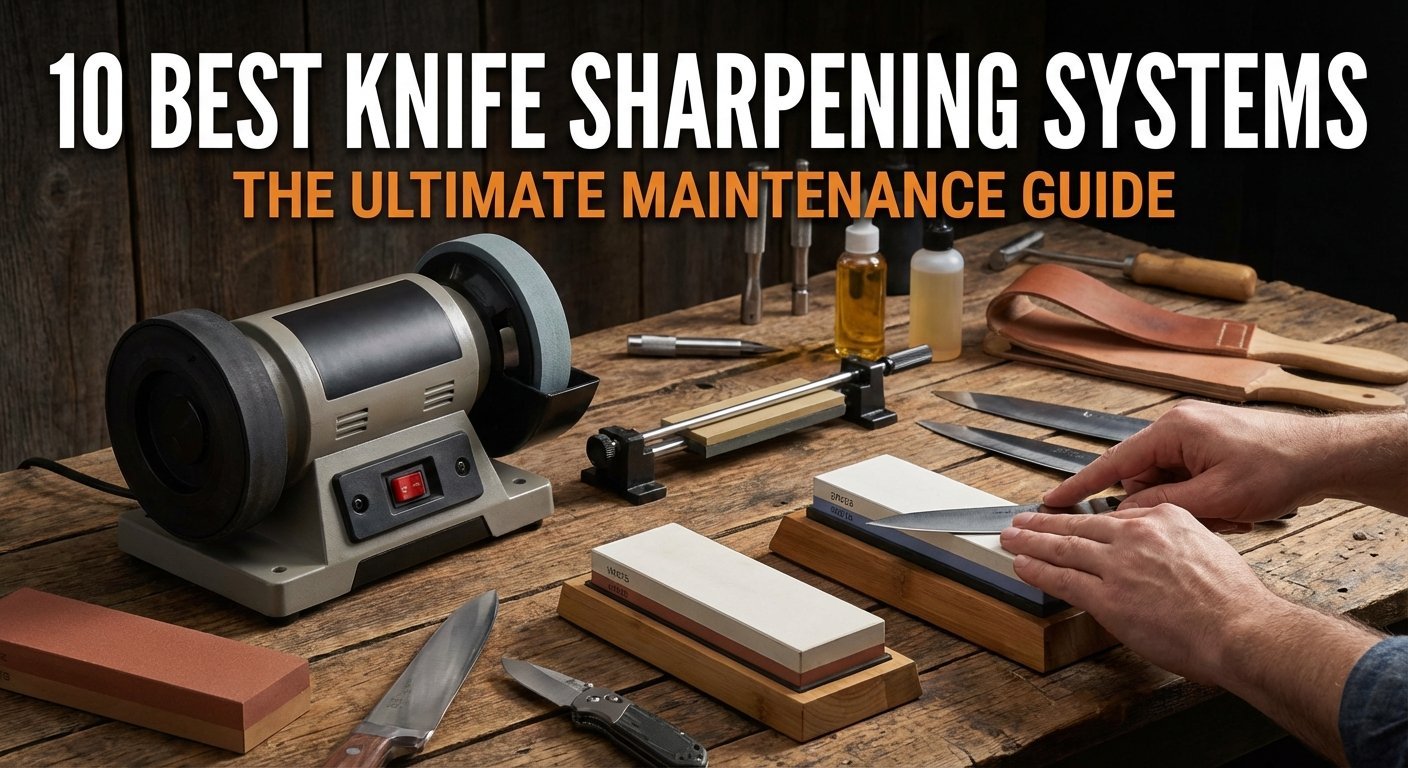
10 Best Knife Sharpening Systems: The Ultimate Maintenance Guide
A dull knife is a dangerous knife. Whether you are maintaining a high-end pocket knife or a kitchen set, these sharpening systems will restore a razor edge with precision.
Introduction: Restoring the Edge
There is a saying among outdoorsmen and chefs alike: “Don’t blame the tool, blame the maintenance.” Even the most premium blade steel—like the CPM-S30V found in our Kershaw Blur review—will eventually lose its bite. Cutting through cardboard, rope, or game hide dulls the apex of the edge, rolling it over or chipping it away.
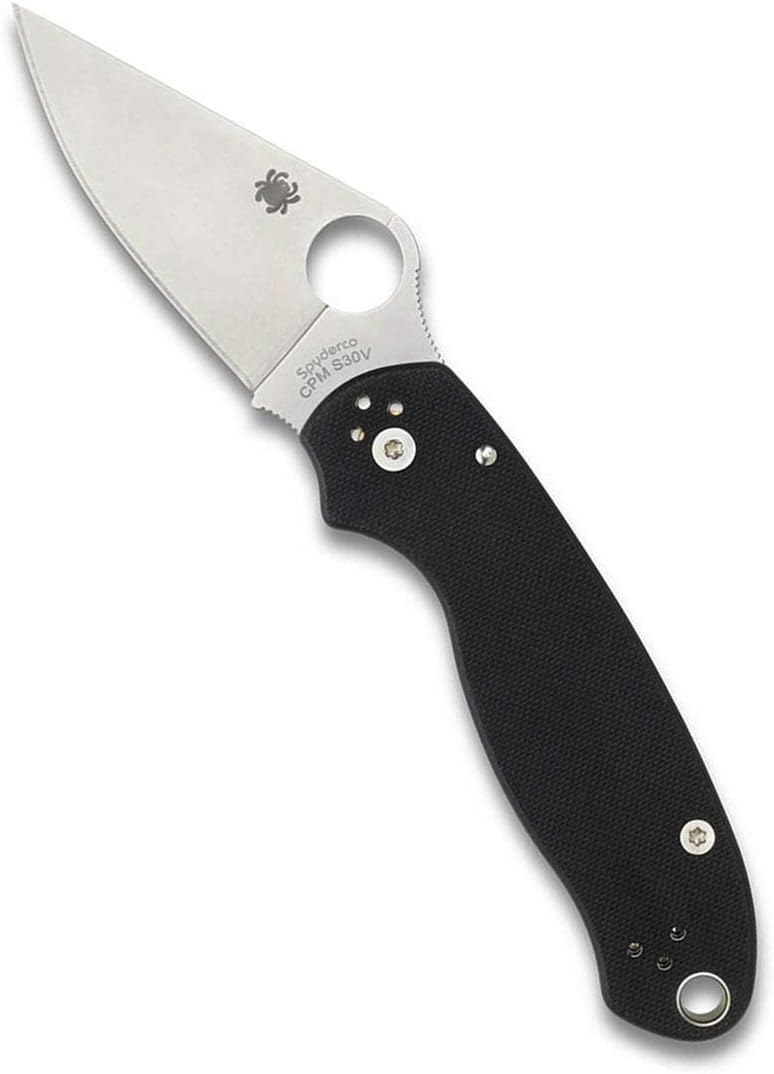
Choosing the best knife sharpening system isn’t just about buying the most expensive machine. It’s about matching the sharpener to your skill level and your specific knives. A heavy-duty Fallkniven S1 convex edge requires a different approach than the delicate Scandi grind of a bushcraft knife or the serrations of a Spyderco Caribbean.
In this guide, we have categorized the top 10 sharpeners into electric systems (for speed), guided systems (for precision angle control), and freehand stones (for the purists). Whether you are sharpening a cheap M-Tech knife or a heirloom piece, there is a solution here for you.
The Science of Sharp: Understanding Edge Geometry
Before diving into products, it’s essential to understand what “sharp” actually means from a metallurgical perspective. A knife edge is simply two intersecting planes of metal meeting at a microscopic apex. The thinner this apex—measured in microns—the sharper the blade. However, an extremely thin apex is fragile and prone to rolling or chipping. This is why understanding edge geometry is fundamental to selecting the right sharpening system.
The concept of “toothy” versus “polished” edges represents a long-standing debate in the knife community. A toothy edge, achieved by stopping at a medium grit (around 600-800), retains microscopic serrations that excel at slicing through fibrous materials like rope, meat, and cardboard. The micro-serrations act like tiny saw teeth, initiating cuts with less pressure. Conversely, a polished edge—taken up to 3000 grit or beyond—creates a mirror-smooth bevel that pushes through material rather than sawing. This type of edge shines for push-cutting applications like woodworking, sushi preparation, and straight razor shaving.
Professional sharpeners often employ a “working edge” philosophy: applying a coarse or medium-grit edge for daily utility tasks, then maintaining it with regular stropping. This approach maximizes edge longevity because a slightly toothy edge will continue cutting even as the apex microscopically rounds, whereas a polished edge loses its push-cutting ability quickly once the mirror finish degrades.
The Complete History of Knife Sharpening: From Whetstones to Diamond Plates
Understanding the evolution of sharpening technology provides valuable context for modern system selection. Archaeological evidence suggests humans have been sharpening tools for over 75,000 years, with early whetstones discovered in ancient settlements across Africa and Europe. These natural stones—sandstone, novaculite, and slate—formed the foundation of edge maintenance until the Industrial Revolution.
Natural Stones: The Original Sharpeners
Arkansas stones, quarried from the Ouachita Mountains, represent one of the most celebrated natural sharpening mediums in history. Composed of novaculite—a microcrystalline quartz—these stones come in various grades from soft (coarse) to hard black (ultra-fine). The Hard Black Arkansas stone, with a density approaching that of ceramic, produces edges rivaling modern synthetic stones for carbon steel blades. However, their slow cutting speed makes them impractical for modern high-alloy stainless and tool steels.
Japanese water stones (tennen toishi) emerged during the samurai era when sword polishers required stones that could produce both sharp edges and aesthetic hamon (temper line) polishing. The Awasedo, Nakado, and Arato classifications represent finishing, medium, and coarse stones respectively. These natural stones contain abrasive particles suspended in a clay matrix that continuously releases fresh cutting particles as the stone wears—a property modern synthetic stones attempt to replicate.
Belgian Coticule stones deserve special mention for their unique combination of sharpening speed and polishing capability. Mined from a single location in the Ardennes region, these stones contain garnet crystals that uniquely fracture to expose fresh sharp edges rather than rounding over. This property allows a single Coticule stone to perform both coarse sharpening and fine finishing by varying slurry thickness and pressure.
The Synthetic Revolution
The 20th century brought aluminum oxide and silicon carbide abrasives, enabling the mass production of consistent, predictable sharpening stones. Unlike natural stones that vary considerably even within the same quarry, synthetic stones offer repeatable grit sizes and bonding hardness. Norton’s India stones—aluminum oxide in a hard vitrified bond—became the standard for tool sharpening, while silicon carbide stones (often labeled “Crystolon”) excel at rapidly removing metal from extremely dull edges.
Diamond abrasives represent the most significant advancement in sharpening technology. Industrial diamonds—either monocrystalline or polycrystalline—bonded to steel plates provide the fastest material removal of any sharpening medium. Monocrystalline diamonds offer longer life as each crystal maintains its cutting edges longer, while polycrystalline diamonds fracture to expose new cutting points, maintaining aggressive cutting action throughout the stone’s life. For sharpening modern super-steels containing high percentages of vanadium carbides (like CPM-S90V or M390), diamond abrasives are essentially mandatory—softer abrasives like aluminum oxide simply skate over vanadium carbides without cutting them.
Cubic Boron Nitride (CBN) abrasives bridge the gap between diamond and traditional stones. Almost as hard as diamond but chemically inert, CBN doesn’t react with carbon-containing steels at high temperatures. This makes CBN ideal for high-speed electric sharpeners where friction heating occurs. The Work Sharp Ken Onion Edition’s belt system, for instance, benefits significantly from CBN-coated belts for professional-grade results.
Quick Comparison: Top Picks at a Glance
| System Name | Type | Skill Level | Best For |
|---|---|---|---|
| Work Sharp Ken Onion | Electric Belt | Intermediate | Best Overall Electric |
| Work Sharp Precision Adjust | Guided Rod | Beginner | Best Value Guided System |
| Spyderco Tri-Angle Sharpmaker | V-Stick System | Beginner | Serrations & Touch-ups |
| Wicked Edge Gen 3 Pro | Guided Rod | Expert | Professional Precision |
| Lansky Deluxe 5-Stone | Guided Clamp | Beginner | Budget Friendly |
| Chef’sChoice Trizor XV | Electric Slot | Beginner | Kitchen Knives |
| Shapton Glass Stones | Whetstone | Expert | Freehand Purists |
| Work Sharp Guided Field | Portable Plate | Intermediate | Field/Hunting Packs |
| Work Sharp Rolling Sharpener | Rolling System | Beginner | Ease of Use |
| KME Precision Knife Sharpener | Guided Rod | Advanced | Mirror Polish Enthusiasts |
Buying Guide: How to Choose a Sharpener
Before buying, you need to understand three critical factors: Abrasive type, Angle Control, and Material Removal Rate.
1. Guided vs. Electric vs. Freehand
Electric sharpeners use motor-driven belts or wheels. They are fast and create convex edges (great for choppers like the Cold Steel Wild West Bowie), but they remove a lot of steel quickly. Guided systems clamp the knife and force the stone to move at a specific angle, ensuring a perfect bevel every time. Freehand stones offer the most versatility but require significant muscle memory to master.
2. The Angle Matters
Most tactical folders, like the SOG-TAC XR, are sharpened at roughly 20-25 degrees per side. Kitchen knives are often 15 degrees. Buying a system that lets you adjust the angle is crucial if you have a diverse collection ranging from thick hunting blades to thin slicers like the Victorinox Cadet.
3. Abrasives
Diamond plates cut fast and stay flat (great for super steels). Ceramic stones polish the edge to a razor finish. Arkansas stones are natural and work slowly, best for carbon steels found in traditional knives like Buck Knives.
4. The Complete Guide to Grit Progression: From Butter-Knife Dull to Hair-Whittling Sharp
Understanding grit progression separates competent sharpeners from exceptional ones. The fundamental principle is scratch pattern refinement: each successive grit removes the scratches left by the previous grit while leaving finer scratches of its own. Skipping grits—jumping from 220 to 3000, for example—leaves deep scratches underneath a superficial polish, creating an edge that appears sharp initially but degrades rapidly because the deep scratches create stress risers in the steel.
Extra Coarse (80-220 grit): Reserved for repairing significant edge damage—chips larger than 0.5mm, broken tips, or complete edge reprofiling. Diamond plates in this range remove steel aggressively. A typical 120-grit diamond stone can remove 0.001 inches of steel per 10 strokes under moderate pressure. Use these grits sparingly; they’re for fixing problems, not routine maintenance.
Medium (300-600 grit): The workhorse range for establishing the primary edge bevel. If a knife fails to slice printer paper cleanly, start here. The 400-600 grit range creates the ideal “toothy working edge” that many professional chefs and outdoorsmen prefer for everyday cutting tasks. The microscopic serrations at this grit range excel at initiating cuts in fibrous and tough materials.
Fine (800-2000 grit): Transitioning into refinement territory, these grits begin polishing the bevel while maintaining some slicing aggression. Japanese kitchen knives, particularly those used for fish and vegetable preparation, often stop at 1000-2000 grit to balance push-cutting ability with edge retention. At this range, the edge begins to reflect light, indicating decreasing scratch depth.
Ultra-Fine (3000-8000 grit): Entering the polishing range, these grits produce mirror-finished bevels capable of whittling individual hairs. However, this level of refinement is application-specific. A straight razor requires 8000+ grit polishing for comfortable skin contact; a hunting knife used for field dressing may perform worse at this polish level because the ultra-smooth edge lacks the micro-aggression needed to initiate cuts in tough hide and sinew.
Super-Fine (10000-30000 grit): Primarily the domain of straight razor honing, Japanese woodworking tools, and competitive sharpening demonstrations. At 30000 grit (approximately 0.5-micron particle size), the edge bevel becomes optically reflective. Only specific sharpening systems—the Wicked Edge with lapping films or high-end water stones like Shapton’s 30000 grit Glass Stone—can achieve this level of refinement.
The most reliable indicator of proper apex formation is creating a consistent burr along the entire edge. A burr—a microscopic curl of metal folded over the edge apex—indicates that you’ve sharpened one side sufficiently to create a zero-thickness edge. Flip the knife and repeat until a burr forms on the opposite side, then use progressively lighter strokes to remove the burr without creating a new one. Mastering burr detection and removal is the single most important sharpening skill regardless of which system you choose.
5. Knife Steel Types and Their Sharpening Requirements
The steel composition of your knife dramatically affects sharpening strategy. Understanding basic steel metallurgy helps match your sharpening system to your knife collection.
Simple Carbon Steels (1095, 1084, O1, A2): These steels sharpen easily on virtually any abrasive type—natural Arkansas stones, synthetic water stones, or diamond plates all work effectively. The absence of hard carbides means aluminum oxide abrasives cut these steels efficiently. However, the trade-off is lower wear resistance; carbon steel edges require more frequent maintenance. Traditional Buck Knives using 420HC steel sharpen similarly to carbon steels but offer slightly better stain resistance.
Mid-Range Stainless Steels (440C, VG-10, 154CM, 14C28N): These steels contain chromium carbides that are harder than aluminum oxide but softer than diamond or CBN. Silicon carbide and aluminum oxide stones will eventually sharpen these steels, but diamond plates dramatically reduce effort and time. The VG-10 steel found in many Spyderco knives responds particularly well to ceramic abrasives like the Sharpmaker’s rods because ceramic particles are harder than chromium carbides.
High-Alloy Powder Metallurgy Steels (CPM-S30V, S35VN, S45VN, S90V, S110V, M390, 20CV, 204P): These modern super-steels contain significant percentages of vanadium, tungsten, and niobium carbides. Vanadium carbide measures approximately 82 HRC on the Rockwell scale—far harder than aluminum oxide (approximately 75 HRC) and even slightly harder than silicon carbide. Diamond or CBN abrasives are practically mandatory for efficient sharpening of these steels. Attempting to sharpen CPM-S110V on traditional water stones results in the abrasive particles being crushed by the carbides rather than cutting them—a frustrating experience that leads many to falsely conclude their technique is flawed when the abrasive type is the issue.
Tool Steels (D2, M2, M4, CPM-CruWear, CPM-3V): D2 presents a unique sharpening challenge because its large chromium carbides—often 20-40 microns in diameter—create a “toothy” edge naturally. Polishing D2 beyond 600-800 grit provides diminishing returns because the carbides themselves create the cutting aggression. Diamond stones cut D2’s carbides cleanly, while softer abrasives tend to pluck entire carbides from the matrix, creating micro-chipping along the edge.
Carbide pull-through sharpeners use two opposing carbide blades that literally scrape steel from both sides of the edge simultaneously. While fast, this process tears metal at the microscopic level, creating a jagged, weakened edge that dulls quickly and is prone to chipping. The carbide scrapers also create stress fractures in the steel matrix, progressively weakening the blade with each use. For budget kitchen knives destined for replacement, these sharpeners have a place; for any knife you value, they’re destructive.
Advanced Sharpening Techniques: Beyond Basic Edge Restoration
The Micro-Bevel Advantage
Micro-beveling involves sharpening the primary edge at one angle (typically 15-20 degrees per side for maximum cutting performance) and then applying a secondary, slightly steeper micro-bevel (2-5 degrees higher) with just a few light strokes at a very fine grit. This technique provides the best of both worlds: the thin geometry behind the edge allows easy cutting, while the micro-bevel strengthens the actual apex against rolling and chipping.
The Spyderco Sharpmaker excels at micro-bevel application due to its fixed 30 and 40-degree inclusive settings. Sharpen your primary edge on another system at 30 degrees inclusive (15 per side), then apply 3-4 ultra-light strokes on the Sharpmaker’s 40-degree setting with fine ceramic rods. The result is an edge that push-cuts like a 15-degree bevel but withstands lateral stress like a 20-degree bevel. This technique transformed how many experienced sharpeners approach edge maintenance.
Convex Edge Sharpening: The Geometry of Toughness
Convex edges—where the bevel curves outward rather than forming a flat V-shape—offer superior strength because the curved geometry supports the apex against lateral forces. The Work Sharp Ken Onion Edition naturally creates convex edges through belt flex, which is one reason it’s so popular among outdoorsmen and heavy-use knife owners. However, creating a convex edge on a guided system requires deliberate technique.
To convex an edge on any guided system: sharpen at your desired angle until the bevel is fully set, then reduce the angle by 1-2 degrees and make a few light strokes that blend the shoulder of the bevel into the primary grind. Repeat this process, reducing the angle incrementally, to create a smooth convex curve. This technique works particularly well on the KME and Wicked Edge systems, though it requires patience and a steady hand.
Scandi Grind Considerations
Scandinavian grinds—common on Mora knives, Helle blades, and many bushcraft knives—present a unique sharpening challenge because the entire bevel face contacts the stone rather than just the edge. This large contact area requires either exceptional angle control (difficult freehand) or a guided system with wide stones. The Work Sharp Precision Adjust handles Scandi grinds well because the user can match the factory angle exactly and maintain consistent stone-to-bevel contact across the full bevel width.
Many Scandi grind enthusiasts prefer maintaining the zero-grind (no secondary bevel) for maximum carving control, but this geometry is fragile when encountering hard materials. Adding a micro-bevel to a Scandi grind—controversial among traditionalists—significantly improves edge durability with minimal impact on carving performance. The Lansky system’s fixed angle holes simplify this process for budget-conscious bushcrafters.
Sharpening Accessories: The Tools That Elevate Results
Strops and Stropping Compounds
Stropping represents the final frontier of sharpness—the difference between a working edge and a truly refined edge. A strop is simply a substrate (leather, balsa wood, denim, or even cardboard) charged with an abrasive compound. The compressible nature of the substrate allows it to conform slightly to the edge, polishing the apex without creating a new bevel angle.
Leather strops remain the traditional choice. Vegetable-tanned leather mounted on a flat backing board provides the ideal combination of slight compression and durability. The flesh side (rough) holds more compound and cuts slightly more aggressively; the grain side (smooth) provides finer polishing. Many experienced sharpeners use both: flesh side with a 1-micron diamond spray for initial stropping, grain side with 0.5-micron compound for final refinement.
Balsa wood strops have gained popularity for their unique properties. End-grain balsa, when sanded perfectly flat and charged with diamond paste, provides an almost non-compressible stropping surface that prevents edge rounding while still polishing the apex. This makes balsa ideal for maintaining precise angles on guided systems. The KME system includes balsa strops in many of their accessory kits specifically for this reason.
Stropping compounds range from traditional jeweler’s rouge (iron oxide, approximately 0.5-1 micron) to modern diamond suspensions as fine as 0.1 micron. Diamond compounds offer consistent particle size and aggressive cutting action on all steel types, including high-carbide super steels. For general knife maintenance, a 1-micron diamond compound provides an excellent balance of polishing speed and final edge quality.
Angle Guides and Digital Tools
Laser angle finders—essentially digital protractors that project a laser line—have revolutionized angle verification. Devices like the Klein Tools Digital Angle Gauge allow freehand sharpeners to check their stone-to-blade angle in real-time, dramatically accelerating the learning curve. Similarly, USB microscope cameras (20x-200x magnification) connect to smartphones and provide immediate visual feedback on scratch patterns and burr removal. These tools transform sharpening from an art into a reproducible science.
Stone Flattening and Maintenance
All sharpening stones—except diamond plates—eventually dish out from repeated use. A dished stone creates inconsistent angles along the blade length, effectively changing your sharpening angle with each stroke position. Stone flattening is therefore not optional; it’s essential maintenance.
Flattening methods vary by stone type. Silicon carbide powder on a glass plate (the “scary sharp” method reversed) provides an economical flattening solution for water stones. Dedicated diamond flattening plates from companies like Atoma and DMT offer convenience and speed at a higher cost. For Shapton Glass Stones, the hard glass backing resists dishing exceptionally well, but periodic flattening is still necessary for absolute precision.
The pencil grid method verifies flatness: draw a pencil grid across the stone surface, then flatten until all pencil marks disappear simultaneously. If marks disappear from the edges first, the stone is convex; if from the center, it’s concave. Both conditions require correction for consistent sharpening results.
Regional Sharpening Traditions: Global Perspectives on Edge Maintenance
Japanese Sharpening Philosophy
Japanese sharpening tradition extends beyond technique into philosophy. The concept of “sharpen until the burr falls away naturally” reflects a patient approach that values process over speed. Japanese water stones—both natural and synthetic—are used with abundant water to float away swarf (metal particles) and prevent clogging. The emphasis on single-bevel edges for traditional Japanese knives (yanagiba, deba, usuba) requires entirely different sharpening techniques compared to Western double-bevel blades.
Single-bevel sharpening involves maintaining the flat back side (urasuki) perfectly flat against the stone while establishing the bevel on the front side (shinogi). This creates the characteristic hollow-ground back that allows precise slicing. The Shapton Glass Stone series, being a Japanese product, was designed with these traditional requirements in mind while incorporating modern abrasive technology.
German Sharpening Practices
German knife manufacturers—Wüsthof, Zwilling, Henckels—traditionally ship knives with a more obtuse edge angle (approximately 22 degrees per side) compared to Japanese knives, reflecting the European preference for edge durability over ultimate sharpness. German sharpening steels—those ribbed metal rods included in most knife block sets—are designed to realign rather than remove metal. The Chef’sChoice Trizor XV specifically addresses this market by offering the ability to convert these traditional edges to higher-performance 15-degree geometry.
Scandinavian Edge Culture
Sweden and Norway’s knife culture emphasizes practical bushcraft utility. The Scandi grind—flat bevel extending from approximately one-third up the blade—remains popular because it’s easy to maintain in the field on a single flat stone. Mora of Sweden has sold millions of knives with this grind, and many owners learn to sharpen specifically on these affordable yet capable blades. The Work Sharp Guided Field Sharpener was directly inspired by Scandinavian outdoor knife culture, packaging a complete maintenance kit into a pocketable form factor.
American Sharpening Innovation
The United States has driven most modern sharpening system innovation. From Lansky’s original guided system in the 1970s to Work Sharp’s recent rolling sharpener design, American companies have focused on making consistent sharpening accessible to beginners. The Wicked Edge represents the pinnacle of American precision engineering applied to sharpening, while the Work Sharp Ken Onion Edition exemplifies the American “faster is better” approach without sacrificing edge quality.
Common Sharpening Mistakes and How to Avoid Them
Mistake #1: Inconsistent Angle
The most common error among beginners is varying the sharpening angle during each stroke. Even a 2-degree variation creates a rounded, inconsistent edge that never achieves full sharpness. The Sharpie marker test—coloring the edge bevel with permanent marker before sharpening—provides immediate visual feedback. If the marker is removed unevenly, your angle is inconsistent. Guided systems eliminate this problem entirely, which explains their popularity among beginners and even experienced sharpeners who value consistency.
Mistake #2: Excessive Pressure
Applying too much pressure during sharpening creates several problems simultaneously: it forms a large stubborn burr, generates heat that can affect heat treatment (especially on thin edges), and causes premature stone wear. The ideal pressure is approximately 2-4 pounds—about the weight of pressing a doorbell. Electric sharpeners like the Work Sharp Ken Onion require even lighter touch due to the high belt speed; let the abrasive do the work.
Mistake #3: Neglecting Stone Condition
Sharpening on a loaded (clogged) stone drastically reduces cutting efficiency. Metal particles embed in the stone’s pores, reducing abrasive contact with the blade. Dressing water stones with a nagura stone periodically exposes fresh abrasive particles. Cleaning diamond plates with an eraser or warm soapy water removes trapped metal swarf. Ceramic rods can be cleaned with abrasive cleanser like Bar Keepers Friend applied with a scouring pad.
Mistake #4: Incomplete Burr Formation
Sharpening one side without developing a burr along the entire edge means you haven’t actually reached the apex. Many beginners switch sides prematurely, creating a shiny bevel that’s not actually sharp. Developing a detectable burr—which you can feel by dragging your thumb gently across the edge (not along it!)—confirms you’ve fully apexed. Only then should you flip and repeat on the opposite side.
Mistake #5: Improper Burr Removal
Leaving a burr on the edge creates a blade that feels sharp initially but dulls after minimal use because the burr folds over or breaks off, leaving a rounded apex. Proper burr removal involves progressively lighter strokes, alternating sides, and finishing with edge-trailing strokes on a strop. The goal is to abrade the burr away without forming a new one. This is where many novice sharpeners fall short—they remove the visible burr but leave a microscopic wire edge that fails under use.
Professional Sharpening Services: When to Outsource
While this guide emphasizes DIY sharpening, certain situations warrant professional intervention. Severely damaged edges with chips exceeding 1mm depth require removing significant material—a task that tests patience even with coarse diamond plates. Professional sharpeners using belt grinders with water cooling can reprofile damaged edges in minutes versus hours of manual work.
Collectible and antique knives represent another category where professional sharpening makes sense. Improper technique can permanently alter geometry or damage patina on vintage blades. Professionals experienced with traditional knives understand how to preserve collector value while restoring cutting performance.
When selecting a professional sharpener, ask about their equipment and process. Avoid services that use high-speed dry grinding wheels—the heat generated can ruin heat treatment. Quality professionals use water-cooled belts, guided systems, or water stones, and should be able to match your desired edge angle rather than applying their one-size-fits-all setting. Expect to pay $1-2 per inch of blade length for basic sharpening, more for serrated blades or significant damage repair.
Knife Storage and Edge Preservation
Sharpening effort is wasted without proper storage. Knives stored loose in drawers bang against each other, dulling edges and creating chips. Magnetic knife strips provide excellent edge protection while displaying your collection. For portable storage, individual blade guards or knife rolls prevent edge-on-edge contact.
Humidity control matters significantly for carbon steel blades. A light coating of food-grade mineral oil or specialized knife oil prevents rust formation on carbon steel edges. Even stainless steels benefit from light oiling in humid environments—the edge apex, being the thinnest point, corrodes fastest. Desiccant packs in storage drawers provide additional protection for long-term storage.
Edge guards deserve careful selection. Avoid guards with hard plastic interiors that can scratch or dull edges during insertion and removal. Felt-lined guards or soft rubberized interiors protect edges effectively. For kitchen knife blocks, horizontal slots prevent edge contact with the block material, unlike vertical slots where the edge rests on wood or plastic under the knife’s weight.
In-Depth Reviews: The Top 10 Systems
1. Work Sharp Ken Onion Edition

The Work Sharp Ken Onion Edition is arguably the most versatile electric sharpener on the market. Unlike standard pull-through electric sharpeners that use grinding wheels, this uses flexible abrasive belts. This creates a “convex” edge, which is stronger and stays sharp longer.
It features a variable speed motor and an adjustable angle guide (15° to 30°). It can handle everything from a heavy machete to delicate scissors. If you have a lot of knives and limited time, this is the answer.
Technical Deep Dive: The Ken Onion Edition’s belt system operates at speeds from 1200 to 2800 surface feet per minute (SFPM). At higher speeds, the abrasive grains cut more aggressively but generate more heat; at lower speeds, control increases while material removal decreases. The included P120, X65, X22, and X4 belts (equivalent to approximately 120, 220, 6000, and stropping grit respectively) provide a complete progression from repair to polishing. The convex edge geometry produced by belt flex typically measures 3-5 degrees per side at the apex, transitioning smoothly to the primary grind angle within 1-2mm behind the edge. This geometry explains the edge’s exceptional durability—force is distributed through the curved bevel rather than concentrating at a sharp V-apex.
Who Should Buy This: Knife collectors with large collections, professional sharpeners doing volume work, and anyone who values time over the meditative aspect of manual sharpening. The Ken Onion excels at maintaining edges on working knives—hunting, landscaping, kitchen prep—where speed matters. It’s less suited for collectors who enjoy the sharpening process itself or those with extremely valuable custom knives where every micron of steel matters.
Pros
- Fastest way to sharpen dull knives.
- Convex edge is superior for retention.
- Versatile (scissors, tools, axes).
Cons
- Can scratch the blade face if not careful.
- Removes material quickly (easy to round a tip).
2. Work Sharp Precision Adjust Elite

This system disrupted the market by offering a high-quality guided system at an entry-level price. It uses a clamp to hold the knife and a rod-guided abrasive that ensures you hit the exact angle every stroke. The “Elite” version comes with more stones, including ceramic and leather strops.
It is perfect for EDC enthusiasts. Whether you are touching up a QSP Hawk or re-profiling a harder steel, the Tri-Brasive rod makes switching grits instant.
System Analysis: The Precision Adjust’s clamp design accommodates blade thicknesses from 0.02 to 0.25 inches, covering virtually all folding knives and most fixed blades. The Elite upgrade includes a 220-grit diamond stone for aggressive material removal, 320 and 400-grit diamond for bevel refinement, and a ceramic hone plus leather strop with micron compound for final polishing. The angle adjustment mechanism—a simple thumbscrew with laser-etched degree markings—provides repeatable settings without tools. While some critics note the plastic construction, the engineering focuses material where it matters: the clamp jaws are metal-reinforced, and the guide rod uses a precision-ground steel shaft that maintains consistent angle throughout the stroke length. For knives under 8 inches blade length, this system performs comparably to systems costing three times as much.
Pros
- Incredible value for the price.
- Very stable clamping system.
- Foolproof angle consistency.
Cons
- Plastic construction feels light.
- Not ideal for very long kitchen knives (flex).
3. Spyderco Tri-Angle Sharpmaker
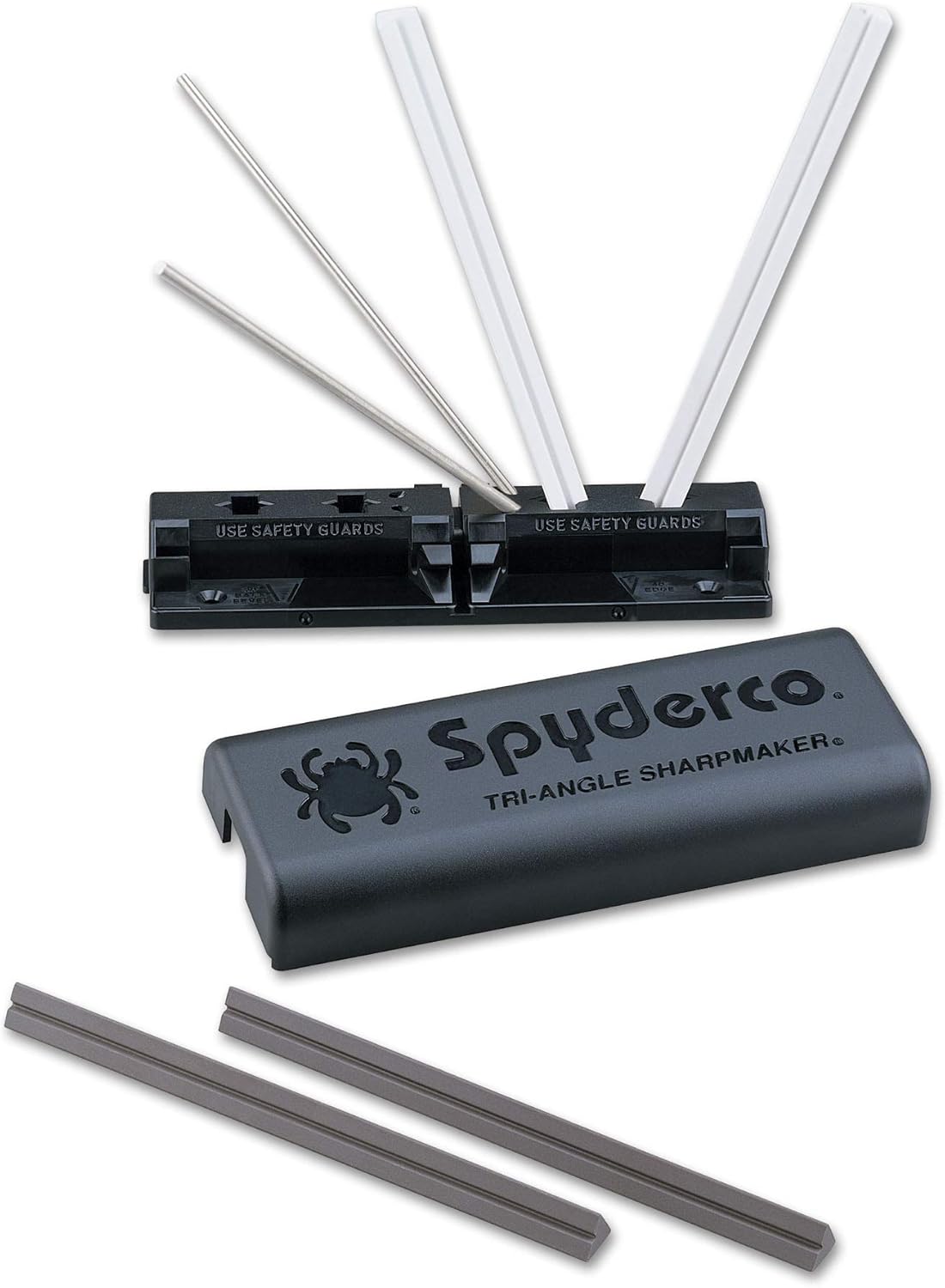
The Sharpmaker is a legend. It sets up in seconds and uses ceramic rods set at pre-determined angles (30° and 40° inclusive). You simply keep the knife vertical and slice down the rods. It is hands-down the best system for maintaining serrated edges, like those found on rescue knives or the Spyderco Caribbean.
It acts more as a honing system than a re-profiling system. It keeps sharp knives sharp but struggles to bring a butter-knife dull blade back to life without purchasing the extra Diamond rods.
Design Philosophy: Spyderco’s founder Sal Glesser designed the Sharpmaker around the concept that consistent angle matters more than stone type or sharpening medium. By fixing the rod angle and requiring only that the user hold the knife vertically, the Sharpmaker eliminates the primary variable in freehand sharpening—angle consistency. The triangular rod shape provides both flat surfaces for standard edges and corners for serrations, recurve blades, and tight curves. The rods can be rotated to present fresh abrasive surface, extending their effective life significantly. Brass safety rods included in the kit serve as training wheels, preventing the knife edge from contacting the plastic base during learning. With the optional diamond rods installed, the Sharpmaker transforms from maintenance tool to complete sharpening system capable of reprofiling edges, though the process remains slower than dedicated guided systems due to the small contact area.
Pros
- Best for serrations and recurve blades.
- No oil or water needed.
- Packable and simple setup.
Cons
- Slow material removal.
- Limited angle options (only two settings).
4. Wicked Edge Gen 3 Pro

If budget is no concern and you want the absolute sharpest edge scientifically possible, you buy a Wicked Edge. It clamps the knife vertically and allows you to work both sides of the blade simultaneously with diamond paddles. The precision is microscopic.
This is the system for the super-steel nerd. If you are trying to get a mirror polish on a ZT Knife or other high-vanadium steels, the Wicked Edge provides the stability required to not roll the edge.
Engineering Excellence: The Gen 3 Pro’s dual-sided design halves sharpening time while ensuring perfect edge symmetry—each stroke on one side is mirrored on the other, eliminating the asymmetrical bevels that plague single-arm guided systems. The micro-adjustable angle mechanism uses a ball-detent system providing 0.5-degree increments, allowing precise angle matching for factory edges or custom bevel preferences. The clamp system incorporates rubber-lined jaws and a center support that prevents blade flex during sharpening—critical for thin kitchen knives that would otherwise deflect under stone pressure. Interchangeable cam jaws accommodate full-flat, hollow, and convex grinds. The diamond stone progression ranges from 100 grit (serious repair work) to 1000 grit (mirror polish preparation), with optional lapping films extending refinement to 0.1 micron for literal optical-quality edges. At this price point, the Wicked Edge competes with professional sharpening services on a cost-per-sharpening basis for collectors with large high-end knife collections.
Pros
- Unmatched precision and repeatability.
- Fast stock removal with coarse stones.
- Works both sides at once (symmetry).
Cons
- Extremely expensive.
- Large footprint (requires dedicated space).
5. Lansky Deluxe 5-Stone System

The Lansky system has been the entry point for guided sharpening for decades. It uses a clamp with various holes representing angles (17, 20, 25, 30). While it can be a bit finicky to set up, and the rods can bend if you aren’t careful, the results per dollar are undeniable.
It is excellent for smaller blades like keychain knives but struggles with large kitchen knives due to the narrow clamp width.
Legacy System Evaluation: Lansky’s guided system—patented in 1979—established the template that virtually all subsequent guided systems follow. The color-coded angle slots eliminate guesswork: red (17°), yellow (20°), green (25°), and blue (30°). The 5-stone Deluxe kit includes extra-coarse (70 grit), coarse (120), medium (280), fine (600), and ultra-fine (1000) alumina oxide stones, providing a complete grit progression at an entry-level price. The stones are mounted on brass rods with plastic guides that ride in the clamp slots; while functional, the rod mounting system introduces slight angle variation depending on how the guide engages the slot. Enthusiasts often upgrade to the Lansky diamond stones for faster cutting action, though the diamond stone cost approaches the price of the complete Deluxe kit. Despite its limitations, thousands of knife enthusiasts learned sharpening fundamentals on a Lansky system, and the skills transfer directly to more expensive guided systems.
Pros
- Very affordable.
- Wide variety of hones available (diamond, Arkansas).
- Great for learning the basics of angles.
Cons
- Clamp can scratch blades (use tape).
- Setup time is slow.
6. Chef’sChoice Trizor XV
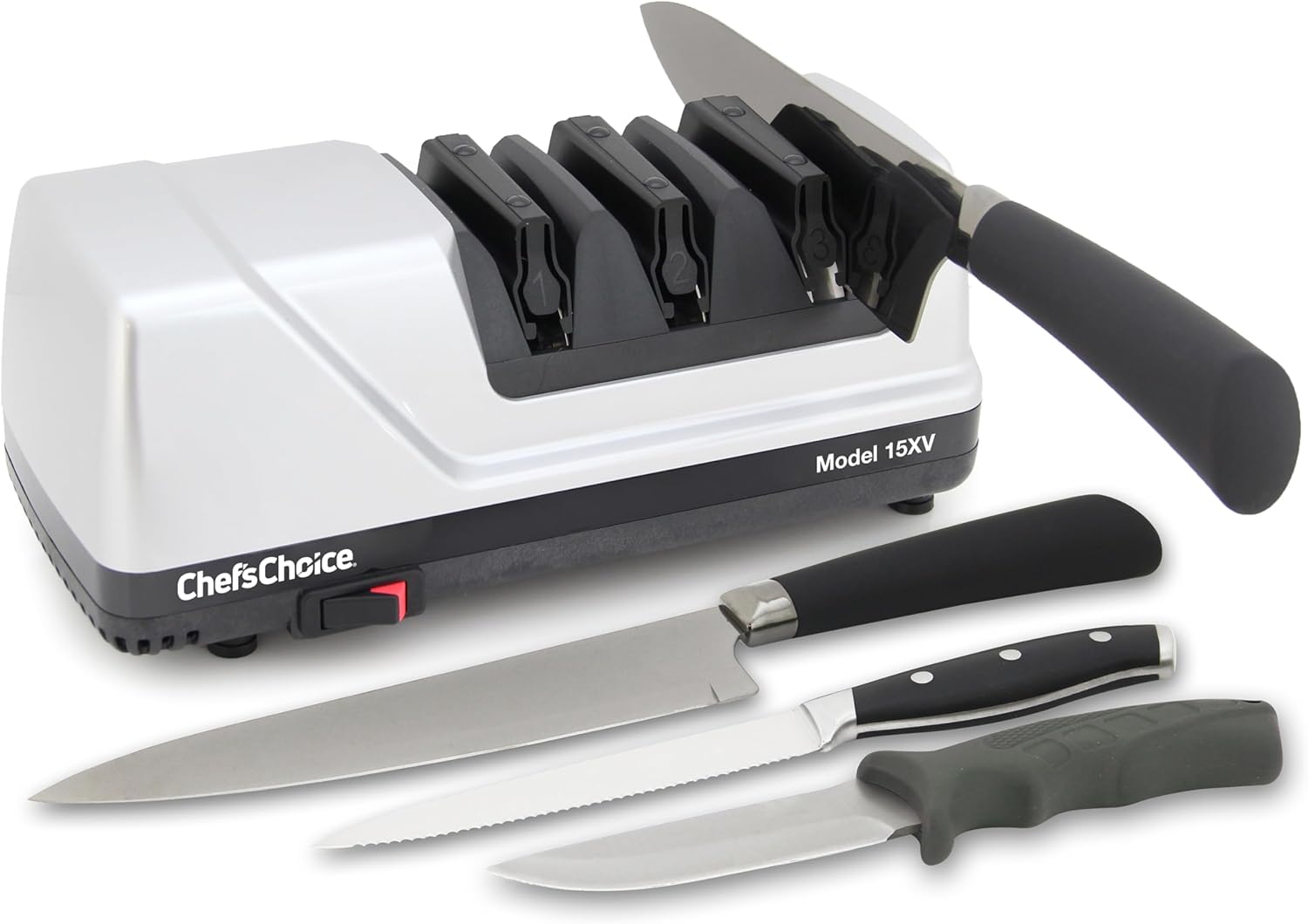
This is the king of kitchen sharpeners. The Trizor XV is designed to convert standard 20-degree factory edges into high-performance 15-degree edges (the “XV” stands for 15). It uses 100% diamond abrasives and a stropping stage.
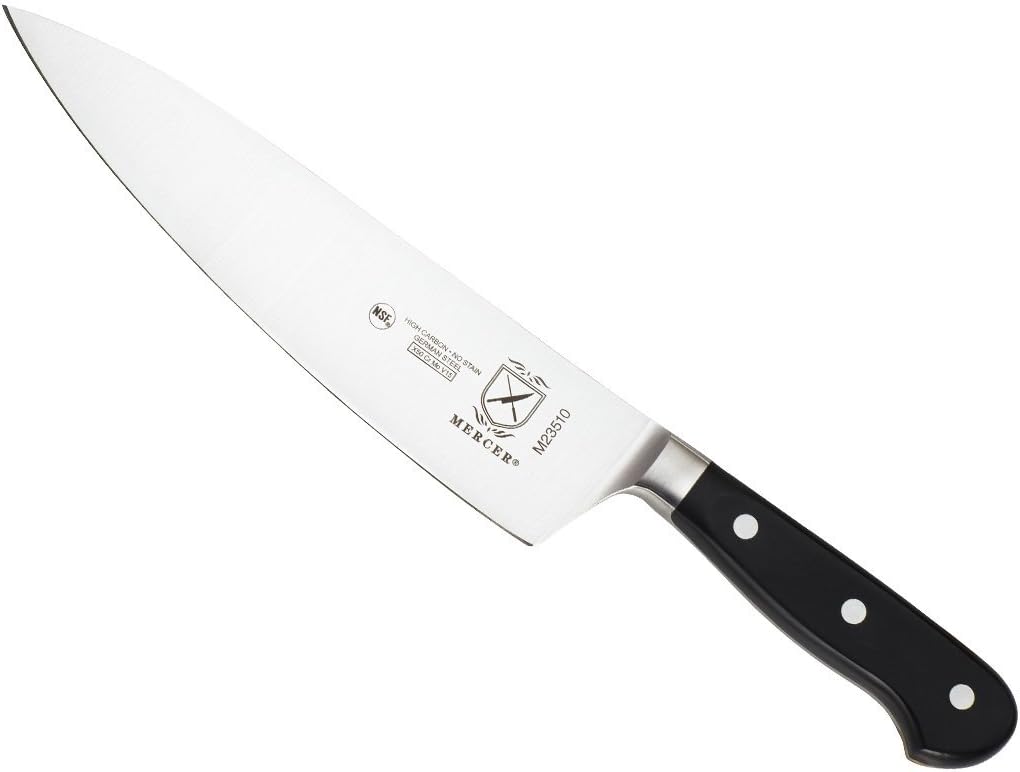
While we usually prefer guided manual systems for hunting knives, for the culinary world, the speed and consistency of the Trizor XV are unmatched. It creates a triple-bevel edge that slices effortlessly.
EdgeSelect Technology Explained: Chef’sChoice patented EdgeSelect system uses three distinct sharpening stages, each with dedicated diamond abrasive wheels precisely angled to create a compound bevel geometry. Stage 1 shapes the primary bevel at approximately 15 degrees using medium diamond particles (equivalent to 320-400 grit). Stage 2 refines with fine diamonds at a slightly steeper angle, creating the secondary bevel. Stage 3—the secret sauce—applies a flexible stropping disk charged with micron-scale diamond compound that creates a microscopic third bevel, essentially burnishing the edge to extreme sharpness. The result is a triple-bevel edge with the thin geometry of a 15-degree primary bevel but the durability reinforcement of the secondary and tertiary bevels. This edge geometry explains the Trizor’s reputation for transforming mediocre kitchen knives into high-performance cutters. The fixed 15-degree angle limits versatility but optimizes performance for Western and Japanese-style kitchen knives designed for this angle range.
Pros
- Fools-proof operation.
- Converts knives to a high-performance 15° edge.
- Polishing stage creates a razor edge.
Cons
- Removes a lot of metal over time.
- No angle adjustment (stuck at 15°).
7. Shapton Glass Stone Series

For the purist who wants to master freehand sharpening, Shapton Glass Stones are the pinnacle. Unlike traditional water stones that need soaking (and create a muddy mess), these are “Splash and Go.” You spritz water on them and sharpen immediately.
The abrasive particles are extremely uniform, cutting fast and leaving a brilliant polish. They are mounted on tempered glass, ensuring they stay flat longer than other stones. This is the choice for sharpening a classic collected knife where you want total control.
Material Science Behind Shapton: Shapton’s proprietary ceramic abrasive manufacturing process produces particles with exceptional uniformity—each grain within a specified grit range varies less than 5% from the target size, compared to 15-20% variation in conventional water stones. This uniformity translates to faster cutting speeds because more abrasive particles engage the steel simultaneously rather than just the largest particles doing all the work. The glass backing plate—made from tempered soda-lime glass identical to smartphone screen material—provides a dead-flat reference surface that eliminates the dishing problems plaguing softer stones. The HR (High Rigidity) series uses a harder bond matrix than the standard series, prioritizing stone longevity and flatness over the “creamy” feedback some sharpeners prefer. Shapton’s grit rating system uses the JIS (Japanese Industrial Standard) scale, which is approximately 1.5x coarser than the American CAMI scale at equivalent numbers—a Shapton 1000 grit behaves more like a conventional 600-800 grit stone in terms of scratch depth, though with superior scratch pattern uniformity.
Pros
- Fast cutting and slow wearing.
- No soaking required.
- Ideal for high-hardness steels.
Cons
- Requires significant skill to hold angles.
- Expensive (sold individually).
8. Work Sharp Guided Field Sharpener
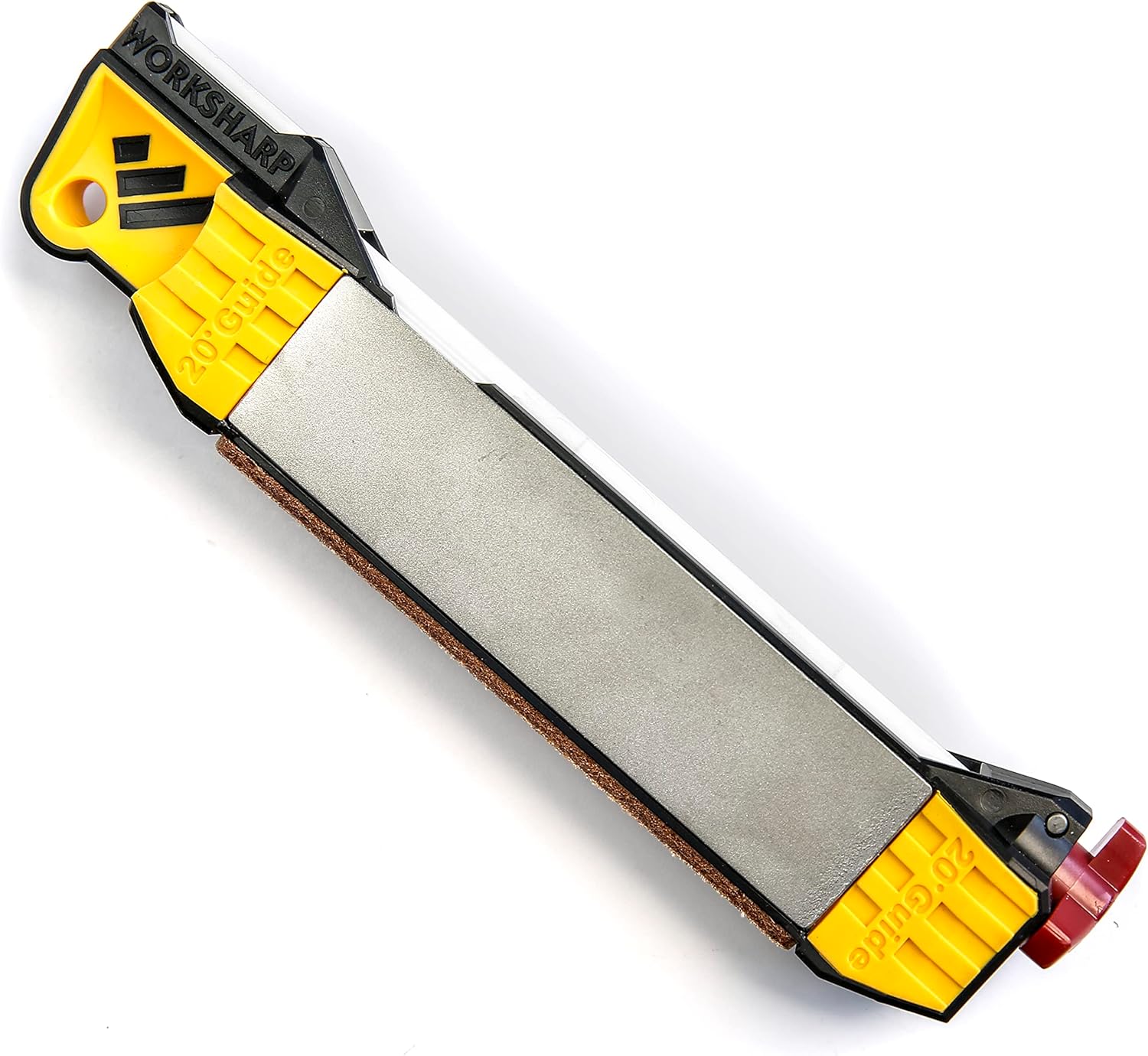
This is the sharpener you throw in your pack. It is a compact unit featuring two diamond plates (coarse/fine), a ceramic rod (with fish hook grooves), and a leather strop. Most importantly, it has built-in 20° and 25° angle guides at the ends of the plates.
If you are in the middle of processing game and need to touch up one of our recommended knives for field dressing, this is the tool. It’s rugged, lightweight, and effective.
Field Use Analysis: The Guided Field Sharpener solves the primary challenge of field sharpening—maintaining consistent angle without a bench or dedicated setup. The integrated angle guides at each end of the diamond plates force the knife to engage the abrasive at the correct angle, essentially turning a portable stone into a mini-guided system. The 20-degree guide suits most hunting and tactical knives, while the 25-degree guide accommodates heavier-duty blades and those sharpened at more obtuse factory angles. The ceramic rod serves triple duty: the main rod section hones straight edges, the tapered tip accesses serrations and recurves, and a small groove designed for fish hooks doubles as a micro-serrator for emergency edge restoration. The leather strop impregnated with polishing compound provides final edge refinement without carrying separate stropping equipment. At 1.5 ounces and smaller than a deck of cards, it represents minimal weight penalty for guaranteed edge maintenance capability. Field dressing an elk or processing multiple deer typically dulls even premium steel; having immediate touch-up capability extends effective cutting time significantly.
Pros
- Complete system in your pocket (Strop included).
- Built-in guides help maintain angles in the field.
- Very durable.
Cons
- Small surface area requires short strokes.
- Not suitable for major edge repairs.
9. Work Sharp Rolling Knife Sharpener

Rolling sharpeners are the latest trend, and Work Sharp has perfected the design. You attach a magnetic block to the knife to hold the angle (15, 17, 20, or 25 degrees), and then roll the abrasive cylinder back and forth along the edge.
It bridges the gap between the simplicity of a pull-through and the quality of a stone. It looks great on a counter and is incredibly fun to use. It’s far safer and more effective than cheap alternatives.
Innovation Assessment: The rolling sharpener concept originated with boutique manufacturers charging premium prices; Work Sharp’s entry democratized the design at mass-market pricing. The magnetic angle block eliminates the learning curve of freehand sharpening while avoiding the setup complexity of clamp-based guided systems. The angle selection—15° for Japanese kitchen knives, 17° for Western chef’s knives, 20° for EDC folders, and 25° for heavy-duty fixed blades—covers the vast majority of common edge geometries. The abrasive cylinder contains coarse diamond (for edge repair and bevel setting), fine diamond (for refinement), and ceramic (for final honing), providing complete grit progression in a single rotating assembly. The rolling action naturally follows curved blade profiles including belly sections and even gentle recurves, which challenge flat stone systems. However, the fixed cylindrical diameter limits access to deep recurves and tight inside curves. The magnetic attachment system, while innovative, requires flat blade faces for optimal hold—knives with pronounced distal taper or complex grinds may not achieve secure magnetic contact.
Pros
- Zero learning curve.
- Aesthetically pleasing design.
- Magnetic angle block is very secure.
Cons
- Struggles with very small knives (like neck knives).
- Can be expensive for what it is.
10. KME Precision Knife Sharpener

The KME system is often compared to the Wicked Edge but comes in a smaller, more portable package. It uses a rotating clamp that allows you to flip the knife instantly to sharpen the other side. It is famous for its ability to create mirror-polished edges using their lapping films.
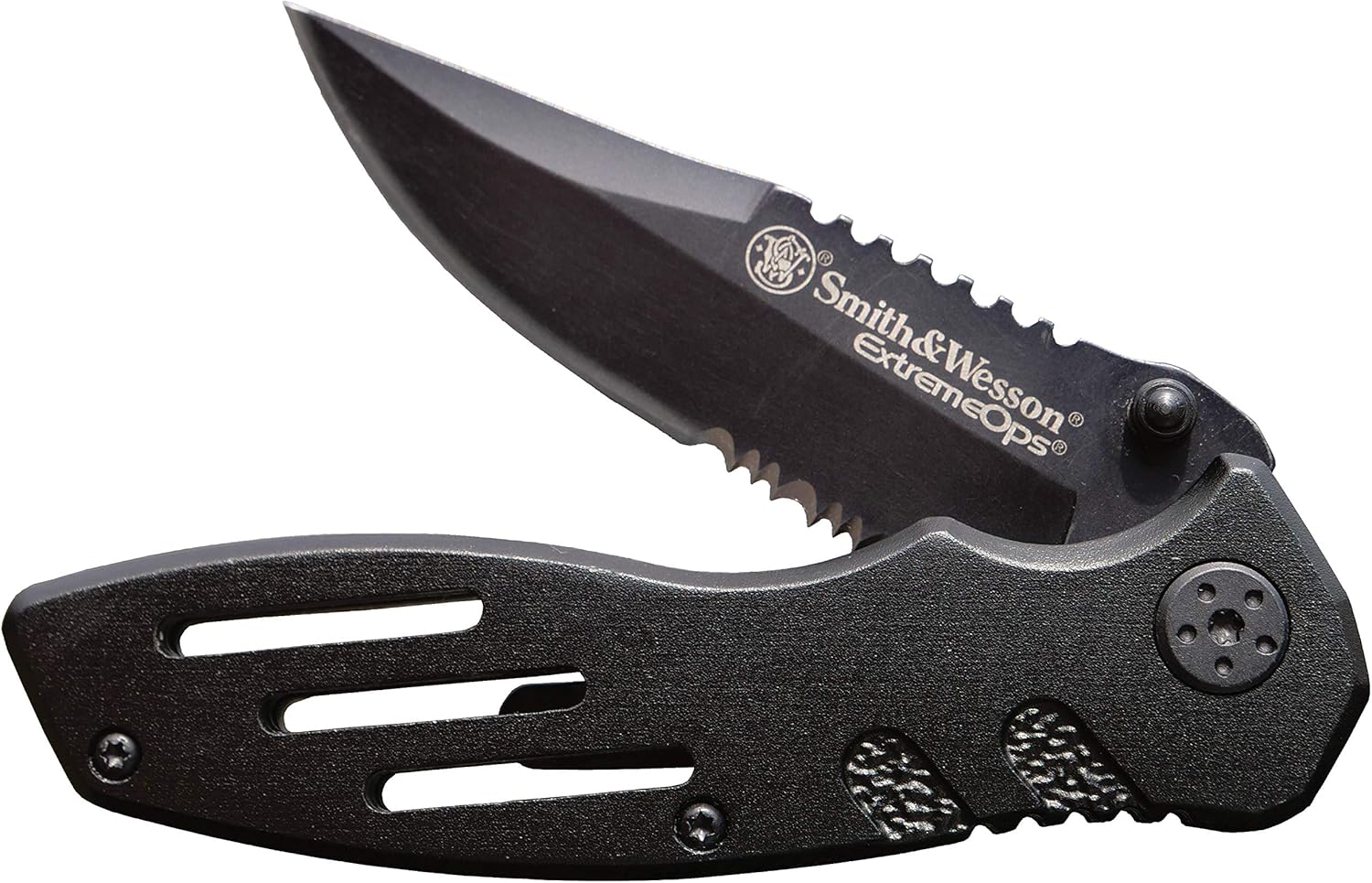
It is particularly good for reprofiling blade angles. If you have a Smith & Wesson knife with a thick uneven grind, the KME can fix it into a laser beam.
System Comparison: The KME occupies a sweet spot between the Work Sharp Precision Adjust and the Wicked Edge in both price and capability. The rotating clamp—a feature absent on many competitors—allows the user to flip the knife 180 degrees without removing it from the clamp, maintaining exact positioning between sides. This seemingly simple feature dramatically improves edge symmetry. The Gold Series diamond stones use monocrystalline diamond electroplated onto precision-ground aluminum blanks, providing consistent abrasive exposure throughout the stone’s life. The stone thickness is calibrated precisely so that switching between grits doesn’t require angle adjustment—each stone presents the abrasive at exactly the same height relative to the pivot point. The extensive accessory ecosystem includes convex edge attachments, scissor sharpening adapters, and lapping films down to 0.1 micron for optical-grade polish. For knife enthusiasts who want professional results without the Wicked Edge’s price tag or footprint, the KME represents the optimal balance of capability and value.
Pros
- Compact carrying case holds everything.
- Rotating clamp is a brilliant feature.
- Huge ecosystem of aftermarket stones (lapping films, curves).
Cons
- Height limit on blade thickness for clamp.
- Learning curve to get the clamp tight.
Watch: Sharpener Comparison & Technique
Seeing these systems in action is the best way to decide. Watch this expert breakdown to see the workflow differences between electric, guided, and stone sharpening.
Maintenance Tips: Keeping the Edge
Sharpening removes metal; honing realigns it. You shouldn’t be using a coarse diamond stone every week. Between sharpenings, use a leather strop or a ceramic hone.
- Clean Your Stones: Diamond plates should be cleaned with water and a toothbrush to remove metal swarf. Ceramics can be cleaned with an eraser or scouring powder.
- Don’t Overheat: If using electric sharpeners like the Work Sharp Ken Onion, use quick passes. If the blade gets hot to the touch, you could ruin the heat treatment, making the steel soft.
- Marker Trick: When learning a guided system, color the edge of your blade with a Sharpie. Do one pass with the stone. If the ink is removed at the shoulder, your angle is too low. If at the very edge, it’s perfect.
Edge Longevity Strategies
Maximizing time between sharpenings involves more than technique—it requires understanding how edges degrade. Cutting on appropriate surfaces dramatically affects edge life. End-grain wooden cutting boards (maple, walnut, cherry) allow the edge to slide between wood fibers rather than impacting them, preserving sharpness. Edge-grain boards are acceptable; bamboo, despite marketing claims, contains silica that accelerates dulling. Glass, granite, and ceramic cutting surfaces destroy edges rapidly—a single heavy chopping session on glass can require complete resharpening.
Cutting technique influences edge retention equally. Twisting or prying with the edge applies lateral forces that steel is specifically poor at resisting—hence the saying “use the right tool for the job.” Scraping the edge across the cutting board to move food uses the edge in a direction it wasn’t designed for; flip the knife and use the spine instead. These small habit changes extend edge life more than any sharpening system upgrade.
Frequently Asked Questions
Final Verdict
The best sharpening system is the one you will actually use. If you want a fast, effortless edge for your entire collection, the Work Sharp Ken Onion Edition is the clear winner. For enthusiasts who want precision and value, the Work Sharp Precision Adjust cannot be beaten for the price.
If you take pride in the meditative process of sharpening and own high-end Japanese steel, investing in Shapton Glass Stones or a Wicked Edge system will reward you with edges that defy physics. Stay sharp, and stay safe.
Our Recommendation Hierarchy: For beginners intimidated by sharpening, start with the Work Sharp Precision Adjust—its guided system guarantees success while teaching angle fundamentals that transfer to any future system. For those who cook daily and need kitchen knives maintained with zero learning curve, the Chef’sChoice Trizor XV delivers professional results at the push of a button. For outdoorsmen who process game and need field maintenance capability, the Work Sharp Guided Field Sharpener provides complete sharpening capability in a package smaller than an energy bar. And for the enthusiast who views sharpening as craft rather than chore, the progression from Shapton Glass Stones to KME to Wicked Edge offers a lifetime of skill development and increasingly perfect edges.
Remember: the sharpest knife in the world is useless if it’s too dull to cut. Whatever system you choose, commit to using it regularly. A mediocre sharpener used consistently produces better real-world results than the world’s finest system gathering dust in a drawer.