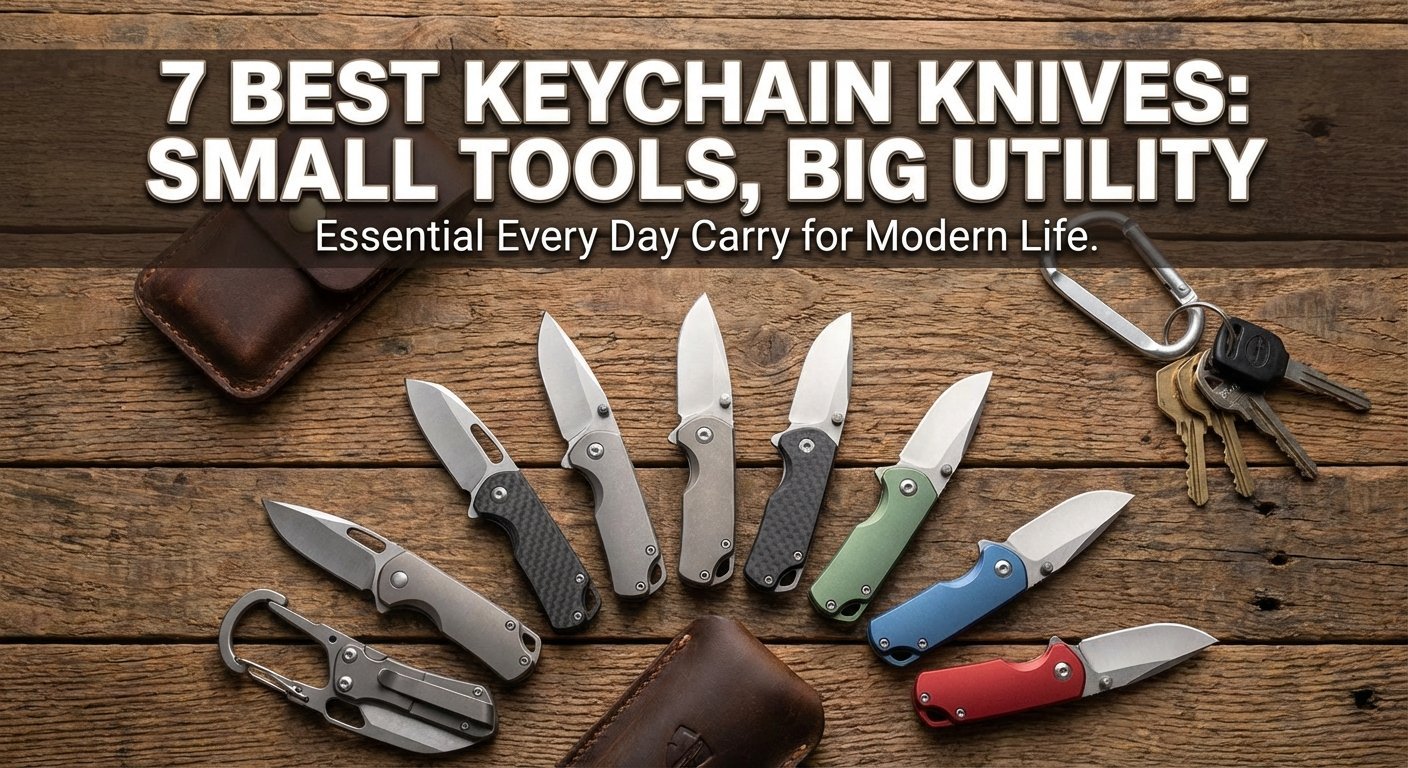
7 Best Keychain Knives: Small Tools, Big Utility
Don’t let the size fool you. These micro-blades offer serious cutting power for your everyday carry (EDC) without the bulk.
Introduction: Why You Need a Keychain Knife
The philosophy of Everyday Carry (EDC) is simple: have what you need, when you need it. While many knife enthusiasts pride themselves on carrying substantial folders like the SOG-TAC XR or the robust ZT knives, reality often dictates a more discreet approach. Whether you are working in an office environment where a large blade raises eyebrows, or you simply want a backup tool that disappears into your pocket until called upon, a keychain knife is the answer.
A keychain knife isn’t just a novelty item. Modern metallurgy and engineering have allowed manufacturers to shrink high-performance tools into packages smaller than a car key fob. We aren’t talking about the cheap, novelty blades you find at gas stations—often associated with low-tier brands like M-Tech. We are talking about genuine cutting instruments from industry titans like Spyderco, Kershaw, and Victorinox.
In this guide, we evaluate the 7 best keychain knives based on steel quality, ergonomics, locking mechanisms, and the “fidget factor.” We’ve tested these against cardboard, clamshell packaging, and paracord to ensure they aren’t just jewelry—they are tools.
Beyond the seven picks above, this guide goes deep on everything you need to know before you clip a blade to your keyring: the metallurgy behind blade steel, the difference between a slipjoint and a locking mechanism, how blade shape affects real-world cutting, what handle materials hold up best in a pocket full of loose change, and where the legal lines are drawn depending on where you live. We also cover maintenance, so your budget-friendly Kershaw Cinder or your premium James Brand Elko lasts for years instead of rusting shut after one humid summer. If you’ve ever searched for “best knife keychain,” “what to look for in a knife keychain,” or “is a keychain knife legal,” you’re in the right place — we address all of it below.
What Exactly Counts as a “Keychain Knife”?
The term covers a surprisingly broad category. At the narrow end, you have true micro-folders with blades under 1.5 inches, designed to attach directly to a keyring loop and disappear among your house keys. At the wider end, some enthusiasts stretch the definition to include small multitools, mini pry bars, and even folding scissors that happen to ship with a keyring hole drilled into the handle. For the purposes of this guide, we’re focused on genuine folding or fixed micro-blades — tools with an actual cutting edge, not just a keyring gadget that happens to have a dull edge tacked on as an afterthought.
The rising popularity of the category tracks closely with the broader growth of everyday carry culture. As more people look for minimalist, low-profile solutions to everyday problems — slicing open a delivery box, trimming a hangnail, cutting free a tangled shoelace — the appeal of a discreet, always-on-hand tool has only grown. Urban commuters, students on campuses with strict weapon policies, and office workers in business-casual environments have all driven demand for something smaller and less conspicuous than a traditional 3.5-inch folder.
The Rise of the Keychain Knife: A Brief History and EDC Culture
Small folding blades attached to keyrings are not a new invention. Watch-fob knives and “gentleman’s knives” date back well over a century, when a pocket watch chain often carried a tiny blade alongside a cigar cutter or a compass. What has changed is not the concept but the engineering behind it. Where a Victorian-era fob knife was little more than a stamped steel blade riveted to a brass handle, today’s keychain knives borrow directly from full-sized flagship folders: ball-bearing pivots, premium powder-metallurgy steels, and locking mechanisms once reserved for tactical folders costing hundreds of dollars.
The modern boom traces back to the broader Everyday Carry movement that took off in online forums and, later, on Instagram and YouTube. EDC culture is built around the idea of curating a small, deliberate set of tools you carry daily — a wallet, a flashlight, a pen, and a knife. As “gear” content became more visual and more mainstream, manufacturers noticed that a huge segment of that audience wanted the polish of a premium folder without the bulk, the price, or the social friction of pulling out a full-sized blade at the office. Brands responded by shrinking their existing best-sellers: Spyderco’s Ladybug is a scaled-down sibling of the larger Delica, and Civivi’s Mini Elementum borrows its handle profile almost directly from the full-sized Elementum that made the brand’s name.
There’s also a practical driver behind the trend that has nothing to do with aesthetics: liability and workplace policy. Many offices, schools, and warehouses have blanket bans on “knives,” but a sub-2-inch folding blade used strictly for opening mail and boxes tends to fly under the radar in a way a 4-inch tactical folder never will. For delivery drivers, warehouse pickers, and office administrators who process a steady stream of packages, a keychain knife solves a genuine productivity problem without triggering a policy violation.
Social media has also reshaped how these knives are marketed and discovered. “Pocket dump” videos, in which EDC enthusiasts lay out everything they carry that day, routinely feature keychain knives as the accent piece — the small flash of brass, titanium, or carbon fiber that signals a curated setup. That visibility has pushed manufacturers to treat keychain knives less like an afterthought accessory and more like a legitimate product category worth premium materials, limited-edition handle scales, and dedicated marketing campaigns.
Understanding Blade Steel: A Deeper Look at Metallurgy
Steel choice is the single biggest factor separating a knife that holds an edge for months from one that needs sharpening every other week. On a full-sized folder, steel selection is often a matter of preference between edge retention, ease of sharpening, and corrosion resistance. On a keychain knife, corrosion resistance jumps to the top of the priority list, because these blades live in the most hostile environment a knife can occupy: a warm, sweaty pocket, jostled constantly against metal keys, exposed to pocket lint, and rarely oiled.
Budget Stainless Steels (3Cr13, 8Cr13MoV, 5Cr15MoV)
These Chinese-origin chromium steels dominate the budget end of the market, and for good reason. They’re inexpensive to produce, easy to sharpen with basic tools, and reasonably resistant to rust thanks to their higher chromium content. The tradeoff is edge retention — a knife in 3Cr13, like the Kershaw Cinder, will dull noticeably faster than a premium alternative when used on abrasive materials like cardboard. For light-duty tasks like opening letters or trimming loose threads, this is a fair compromise, and the ease of touch-up sharpening on a budget steel is arguably an advantage for casual users who don’t own a proper sharpening system.
Mid-Tier Performance Steels (14C28N, Sandvik 12C27)
Sandvik’s Swedish steels occupy a well-regarded middle ground. 14C28N, developed specifically with knife manufacturers in mind, offers a noticeably better balance of edge retention and corrosion resistance than the budget Chinese steels, without a significant jump in sharpening difficulty. It’s become something of a sweet spot for value-conscious premium brands like Civivi, and its cousin 12C27 shows up in more traditional, slipjoint-style knives like The James Brand Elko, where a slightly softer, easier-to-maintain edge suits the gentleman’s-knife use case.
Premium Japanese Steels (VG-10, K390)
VG-10 is a Japanese stainless steel prized for its fine grain structure, which allows it to take an extremely sharp, refined edge and hold it significantly longer than budget alternatives. Spyderco has used it for decades across its lineup, including the Ladybug 3, and it remains one of the most trusted choices for a knife that needs to perform, not just look good. The tradeoff is cost and, to a lesser degree, sharpening difficulty — VG-10 benefits from a proper whetstone or a guided sharpening system rather than casual freehand touch-ups.
What About Titanium Blades?
Occasionally you’ll see keychain knives advertised with titanium blades rather than titanium handles. It’s worth understanding that pure titanium is a poor blade material on its own — it’s too soft to hold a fine edge. Most “titanium blade” keychain knives use a titanium alloy or a titanium coating over a steel core, primarily for corrosion resistance and a distinctive gray or bronze finish rather than genuine cutting performance gains. If sharpness and edge retention matter more to you than looks, prioritize the base steel over any titanium marketing claim.
Carbon Steel: Why It’s Rare on Keychain Knives
High-carbon steels like 1095, common on fixed-blade bushcraft knives, take an exceptionally sharp edge and are easy to sharpen in the field, but they are highly reactive to moisture and will develop surface rust within days if left unprotected in a damp pocket. That’s precisely why you almost never see carbon steel on a true keychain knife — the maintenance burden simply doesn’t match the low-attention, grab-and-go nature of the category. If corrosion resistance is a priority (and for a keychain knife, it always should be), stick to stainless or semi-stainless options.
Blade Shapes and Grinds Explained
Steel gets most of the attention in marketing copy, but blade shape has just as much impact on how a knife performs for a specific task. Keychain knives tend to use one of a handful of common profiles, each suited to slightly different jobs.
Drop Point
The most common and most versatile shape, found on knives like the Civivi Mini Elementum. The spine curves gently down to meet the edge, creating a strong tip that resists snapping under lateral pressure while still offering a broad belly for slicing. For a knife that needs to do a little bit of everything, drop point is the safest, most forgiving choice.
Wharncliffe and Sheepsfoot
These flat-spined shapes, with the edge curving up to meet a straight or near-straight spine, are popular on traditional slipjoints like the Victorinox Classic SD and The James Brand Elko. The lack of a sharp point makes them safer for tasks like opening letters or cutting twine, since there’s less risk of accidentally puncturing something (or someone) you didn’t intend to. It’s a deliberate safety tradeoff that makes sense on a knife that spends most of its life doing light-duty, high-frequency tasks.
Tanto and Modified Tanto
Borrowed from Japanese sword geometry and popularized in Western tactical knives, a tanto grind features a high, angled point rather than a curved belly. The Gerber Key Note uses a stubby, chisel-ground variant of this shape specifically because the reinforced tip holds up better to scraping through packing tape and cardboard than a fine, thin point would. The tradeoff is reduced slicing performance on curved surfaces compared to a drop point or clip point.
Clip Point
Less common on true keychain knives but present on some tactical-styled micro-folders, a clip point has a concave curve cut into the spine near the tip, creating a thinner, sharper point ideal for piercing cuts. It sacrifices a bit of tip strength for precision.
Chisel Grind vs. V-Grind
Most keychain knives use a traditional V-grind, where both sides of the blade taper evenly to the edge. The Gerber Key Note is a notable exception, using a chisel grind where only one side is beveled. Chisel grinds are simpler to sharpen (you’re only maintaining a single bevel) but they don’t cut in a straight line as naturally, since the flat side pushes the blade to one side as it slices — something worth knowing before you try to make a precise cut with one.
At a Glance: Top Picks Comparison
| Model | Blade Steel | Lock Type | Weight | Best For |
|---|---|---|---|---|
| Victorinox Classic SD | Stainless (Inox) | Slipjoint | 0.7 oz | Overall Utility |
| Spyderco Ladybug 3 | VG-10 | Back Lock | 0.6 oz | Slicing Performance |
| Kershaw Cinder | 3Cr13 | Liner Lock | 0.9 oz | Budget & Bottle Opener |
| Civivi Mini Elementum | 14C28N | Frame Lock | 1.4 oz | Modern EDC Style |
| James Brand Elko | Sandvik 12C27 | Slipjoint | 1.3 oz | Minimalist Aesthetics |
| Cold Steel Micro Recon 1 | 4034SS | Tri-Ad Lock | 1.1 oz | Heavy Duty Use |
| Gerber Key Note | 5Cr15MoV | Liner Lock | 2.3 oz | Box Opening |
How We Tested These Keychain Knives
Every knife on this list spent a minimum of several weeks on an actual keyring, carried through normal daily routines rather than evaluated only in a single sit-down review session. We wanted to know not just how sharp a blade was out of the box, but how it held up to the specific abuse a keychain knife endures that a pocket-clipped EDC folder never does: constant jostling against metal keys, repeated pocket-and-out cycles, and long stretches of neglect between uses.
Cutting Performance Tests
Each knife was run through a standardized set of cutting tasks: breaking down cardboard boxes, slicing through clamshell plastic packaging, cutting free zip ties, trimming paracord, and slicing printer paper for a basic sharpness baseline. We tracked how many cuts each blade could make before a noticeable drop-off in performance, giving us a rough real-world proxy for edge retention beyond manufacturer steel specifications alone.
Ergonomics and Grip Testing
Because keychain knives are almost always held in a pinch grip rather than a full hand grip, we paid close attention to how secure each knife felt under increasing pressure, and whether any handle texture or shape created hot spots or slipping during extended use. Knives with pronounced jimping or aggressive handle texture, like the Cold Steel Micro Recon 1, scored well here; smoother, more minimalist handles like the anodized aluminum on The James Brand Elko required slightly more deliberate grip attention during firmer cuts.
Lock Strength and Wobble Testing
For every locking model, we applied lateral and vertical pressure to the open blade to check for play or wobble, and tested how much force was required to accidentally disengage the lock — an important safety consideration given how small these blades are to begin with. The Cold Steel Micro Recon 1’s Tri-Ad lock and the Spyderco Ladybug 3’s back lock both showed essentially zero detectable play, while some budget liner locks exhibited minor lateral wobble that, while not dangerous, was noticeable in hand.
Long-Term Wear Assessment
Beyond initial performance, we tracked how each knife held up after weeks of contact with metal house keys — a factor most single-session reviews never account for. Handle materials like G10 and anodized aluminum showed minimal wear, while some painted or coated finishes on budget knives began showing light scuffing after a few weeks of constant key contact.
Grip Technique and Safety Habits for Micro-Blades
Because keychain knives are so small, they demand a slightly different grip and handling approach than a standard EDC folder, and a few basic habits go a long way toward avoiding minor injuries.
The Pinch Grip
Most keychain knives are too small for a full four-finger grip, so they’re typically held in a pinch grip between the thumb and first two fingers. This grip sacrifices some leverage compared to a full grip, which is part of why textured handle materials like G10 and FRN matter so much at this scale — they compensate for reduced hand contact area with better friction.
Cutting Away From the Body
It’s a basic rule with any blade, but it matters more with a keychain knife specifically because the reduced leverage of a pinch grip makes it easier for a blade to slip unexpectedly under load. Always orient cuts moving away from your hand and body, particularly when using a non-locking slipjoint where there’s no mechanical lock backing up your grip.
Respecting the Lock (or Lack Thereof)
On locking models, get in the habit of visually and physically confirming the lock has fully engaged before applying pressure, since a partially engaged liner lock can fail under load in a way that’s much harder to predict than a fully seated one. On non-locking slipjoints, never apply pressure in a direction that could push the spine of the blade back toward closing, since that’s exactly the failure mode these knives are designed without protection against.
Deployment Habits That Prevent Accidents
When opening a flipper or thumb-stud knife one-handed, keep your other fingers well clear of the blade’s arc until it’s fully open and, on locking models, audibly or tactilely confirmed locked. This sounds obvious, but rushed one-handed openings in a pocket or bag, without visual confirmation, are a common source of minor nicks among even experienced knife owners.
Sizing Chart: Blade Length and Weight at a Glance
If weight and pocket footprint are your top priorities, this quick reference converts each knife’s specifications into an easy side-by-side comparison, from lightest to heaviest.
| Model | Blade Length | Closed Length | Weight (oz) | Weight (g) |
|---|---|---|---|---|
| Spyderco Ladybug 3 | ~1.9 in | ~2.4 in | 0.6 | ~17 |
| Victorinox Classic SD | ~1.5 in | ~2.3 in | 0.7 | ~20 |
| Kershaw Cinder | ~1.4 in | ~2.4 in | 0.9 | ~26 |
| Cold Steel Micro Recon 1 | ~2.0 in | ~2.9 in | 1.1 | ~31 |
| The James Brand Elko | ~2.0 in | ~2.9 in | 1.3 | ~37 |
| Civivi Mini Elementum | ~2.0 in | ~2.9 in | 1.4 | ~40 |
| Gerber Key Note | ~0.8 in | ~2.2 in | 2.3 | ~65 |
Note that closed length and blade length don’t always scale together — the Gerber Key Note has the shortest blade on this list but the highest overall weight, a reflection of its reinforced, chunkier construction built for repetitive scraping and cutting rather than fine slicing.
Brand Spotlight: Who Makes These Knives, and Why It Matters
Understanding a brand’s broader reputation can tell you a lot about what to expect from its smallest products, since a keychain knife is often a scaled-down expression of a company’s larger design philosophy.
Victorinox
The Swiss company behind the original Swiss Army Knife has been manufacturing pocket tools since 1884, and that manufacturing pedigree shows in the Classic SD’s fit and finish despite its low price point. Victorinox’s reputation for reliability is built on more than a century of continuous refinement rather than recent EDC-culture marketing.
Spyderco
Spyderco built its reputation on function-forward design, having pioneered the thumb hole opening mechanism that’s now an industry standard across the knife world. The Ladybug reflects that same philosophy at a smaller scale — every design choice, from the FRN handle texture to the back lock placement, is oriented around practical performance rather than styling for its own sake.
Kershaw
A KAI Group brand with a strong track record of collaborating with independent knife designers, Kershaw has built a reputation for delivering designer-level ergonomics at accessible price points. The Cinder’s Rick Hinderer-designed grip is a direct example of that strategy applied to the keychain category.
Civivi
A sub-brand of We Knife Co., Civivi emerged relatively recently but quickly built a following for offering premium materials and modern manufacturing — like ceramic ball bearing pivots — at prices well below traditional premium knife brands. The Mini Elementum is a clear example of that value proposition applied to a smaller form factor.
Cold Steel
Known historically for oversized, dramatically tested blades and its proprietary Tri-Ad lock, Cold Steel’s inclusion of that same lock design on the Micro Recon 1 signals a genuine attempt to bring hard-use durability down to keychain scale, rather than simply shrinking a design without adapting its core engineering.
The James Brand
A newer, design-focused brand founded on the idea that everyday tools deserve the same design attention as furniture or watches, The James Brand has built a following among buyers who care as much about how a knife looks on a desk as how it performs in hand. The Elko is representative of that ethos, prioritizing clean lines and minimalist proportions.
Gerber
An American brand with deep roots in both military contracting and mainstream outdoor gear, Gerber has a long history of function-first, sometimes unconventional designs. The Key Note’s unusual chisel-ground, tanto-inspired blade reflects that willingness to depart from convention when a specific use case calls for it.
Deep Dive Reviews
1. Victorinox Classic SD

No list of keychain tools is complete without the Swiss Army Knife. While we have extensively reviewed the larger Victorinox Cadet, the Classic SD is the undisputed king of the keyring. It is ubiquitous for a reason. It packs a small blade, scissors, a nail file, tweezers, and a toothpick into a package that weighs less than an ounce.
The steel is soft enough to sharpen easily on the bottom of a coffee mug if needed, but resistant enough to corrosion to survive years in a pocket full of lint and moisture. It’s not a tactical blade, but for trimming a loose thread or opening a letter, it is perfection.
In daily use, the scissors end up being the most reached-for tool on the Classic SD, not the blade. Opening blister packaging, snipping a loose thread on a shirt cuff, trimming a receipt down to size — these are the tasks that make this little tool earn its place on a keyring. The nail file doubles surprisingly well as a flathead screwdriver for small screws, like the kind found on eyeglass hinges, which is a party trick that has saved more than one pair of glasses in our testing. Because there’s no locking mechanism, it’s also one of the least legally complicated options on this list, which is part of why it remains the default recommendation for students, travelers, and anyone carrying across jurisdictions with varying knife laws.
Pros
- Includes excellent scissors (often more useful than the blade).
- Non-threatening appearance acceptable in almost all environments.
- Extremely lightweight (0.7 oz).
Cons
- Slipjoint mechanism (non-locking blade).
- Plastic scales can pop off with heavy abuse.

2. Spyderco Ladybug 3

If you want a “real knife” that just happens to be tiny, the Spyderco Ladybug is the gold standard. Unlike many keychain knives that use cheap steel, the Ladybug utilizes VG-10, a premium Japanese stainless steel known for great edge retention. If you hunt around, you can even find salt-water versions using H-1 steel, similar to the technology found in the Spyderco Caribbean.
The ergonomics are surprising; the FRN (Fiberglass Reinforced Nylon) handle has bi-directional texturing that locks into your fingers. It features a legitimate back lock mechanism, making it safer for piercing cuts than a standard slipjoint.
Where the Ladybug 3 really separates itself is edge retention under repeated abrasive cutting — slicing through cardboard boxes day after day, a task that dulls a budget steel like 3Cr13 within a couple of weeks, barely touches the VG-10 edge here. Anglers in particular have adopted this knife as an unofficial standard for keychain carry, since the fine, durable edge slices through monofilament and braided fishing line cleanly without fraying it, and the compact thumb hole opening is fast even with cold, wet hands on the water. The back lock also means you can apply real pressure through a cut without worrying about the blade folding back on your fingers, something that can’t be said for the slipjoint options on this list.
Pros
- Superior VG-10 steel holds a razor edge.
- Ergonomic thumb ramp allows for surprising force.
- Strong lock-back mechanism.
Cons
- Pricey for its size.
- The thumb hole is small for large hands.
3. Kershaw Cinder

Designed by Rick Hinderer, a name usually associated with overbuilt tactical folders (like those competing with ZT Knives), the Cinder is a budget-friendly masterpiece of geometry. It doesn’t use premium steel—sticking to 3Cr13—but at this price point and size, it doesn’t need to.
The brilliance lies in the grip. It allows a three-finger hold that feels incredibly secure. Plus, the integrated bottle opener is robust and works without opening the blade. It rivals the utility of budget favorites like the Ka-Bar Dozier but at a fraction of the size.
At under $10 in most cases, the Cinder is the easiest recommendation on this list for anyone who isn’t sure they’ll stick with keychain-knife carry long-term. It’s cheap enough to treat as disposable if it gets lost, yet the Hinderer-designed grip and recurved blade genuinely outperform its price point in actual cutting tests. The liner lock does introduce slightly more lateral wobble than the frame lock or Tri-Ad options on this list, though nothing that compromises safety for the light-duty tasks this knife is meant for. Because the bottle opener works independently of the blade, it also tends to be the single most-used feature day to day for casual owners — a detail that surprises first-time buyers who assumed the blade would get the most use.
Pros
- Integrated bottle opener is always ready.
- Very affordable.
- Hinderer design provides excellent grip.
Cons
- 3Cr13 steel requires frequent sharpening.
- Bulky compared to the Victorinox.
4. Civivi Mini Elementum

The full-sized Elementum took the knife world by storm, challenging established brands like Kizer and QSP (see our QSP Hawk review). The Mini Elementum shrinks that winning formula down to keychain size.
It features 14C28N steel, which is an excellent budget stainless steel that outperforms the standard 8Cr13MoV found on many competitors. The action is snappy, running on ceramic ball bearings, and the fit and finish are superb. The frame lock is solid, turning this into a fidget-friendly, functional piece of jewelry.
This is the knife we’d point toward anyone coming from the broader modern EDC knife world who wants a keychain option that still feels like a “real” flipper rather than a scaled-down novelty. The ceramic bearing pivot means the blade practically falls open with a light flick of the flipper tab, a satisfying sensation that’s rare to find below the $30 price point. The brass and copper handle variants also mean this knife actively improves with age — the patina that develops from months of pocket carry gives each owner’s knife a genuinely unique look that no factory finish can replicate. The one consistent complaint in long-term ownership is the flipper tab occasionally catching on pocket fabric during retrieval, worth noting if you carry it loose in a pocket rather than clipped to a keyring.
Pros
- Premium 14C28N steel.
- Beautiful brass or copper handle options available.
- Smooth flipper action.
Cons
- The flipper tab can snag in the pocket.
- The handle is very small, requiring a pinch grip.
5. Cold Steel Micro Recon 1

Cold Steel is famous for excess—giant swords and the massive Wild West Bowie. But they also make the Micro Recon 1, which might be the toughest keychain knife on the planet. It mimics the tactical look of its bigger brothers, featuring G10 scales (rare on keychain knives) and the Tri-Ad lock.
While the Tri-Ad lock on this micro version isn’t quite as indestructible as the full-sized version due to physics, it is still vastly stronger than any liner lock in this category. It brings a tactical pedigree to your keyring.
Tradespeople who put genuine cutting force behind their keychain knife — stripping wire insulation, scoring drywall paper, cutting through zip ties under tension — consistently prefer this knife over the more delicate options on this list, because the Tri-Ad lock simply doesn’t budge under pressure the way a liner lock can. The 4034SS steel isn’t the most exotic on this list, but Cold Steel’s heat treatment gets solid performance out of it, and the corrosion resistance is excellent, which matters given how often this knife ends up in a tool bag or truck console rather than a clean pocket. The tradeoff for that durability is a lock release that requires a firm, deliberate push, which some owners find stiff at first but which we’d argue is a feature, not a bug, for a knife meant to survive real work.
Pros
- G10 scales offer incredible traction.
- Looks and feels like a shrunken tactical knife.
- Very secure locking mechanism.
Cons
- The tactical “aggressive” look isn’t for everyone.
- Stiff lock release.
6. The James Brand Elko

For the minimalist who cares about aesthetics as much as function, The James Brand Elko is the answer. It is sleek, modern, and typically found in the pockets of designers and architects. But don’t let the looks deceive you; it uses Sandvik 12C27 steel, a respectable European stainless.
It acts as a slipjoint knife but also includes a pry bar/screwdriver/bottle opener on the keyring loop. It bridges the gap between a tool and a fashion accessory, much like the Victorinox Cadet does for the gentleman’s carry.
Because it’s a non-locking slipjoint, the Elko is also one of the more legally conservative choices on this list, making it a favorite among buyers who travel frequently between jurisdictions with different stances on locking blades. The anodized aluminum handle takes scratches gracefully, aging into a lightly worn patina of its own rather than looking damaged, which suits the knife’s understated design philosophy. The included pry bar tool on the keyring loop turns out to be more useful in practice than it sounds on paper, handling everything from popping open a stubborn phone case to leveraging a stuck battery cover, tasks the blade itself isn’t well suited for given the slipjoint’s lack of a lock.
Pros
- Stunning minimalist design.
- Useful pry bar tool included.
- High quality anodized aluminum handles.
Cons
- Expensive for what you get (the “hipster tax”).
- No locking mechanism.
7. Gerber Key Note

The Gerber Key Note is unique. It doesn’t try to be a miniature hunting knife (you won’t be using this like a skinning knife for deer). Instead, it is a dedicated package opener with a chisel grind.
The blade is stout, short, and blunt-nosed, designed specifically for scraping and slicing tape. It can be deployed with a flipper tab or a nail nick. It’s bulky compared to the Ladybug, but it feels substantial in hand, perfect for warehouse workers or anyone who opens a lot of Amazon boxes.
This is a knife built around a single job, and it does that job better than any general-purpose keychain blade on this list. The double-ground chisel edge scrapes shipping labels and stubborn tape residue cleanly without digging into cardboard the way a finer, sharper point tends to, and the blunt nose means you can apply real downward pressure while scoring a box seam without worrying about punching through into the contents. It’s noticeably the heaviest and bulkiest knife here, which is a fair tradeoff for anyone processing dozens of packages a day, but it’s probably overkill for someone who just wants to occasionally trim a loose thread or open a letter.
Pros
- Dual-purpose blade (scrape and cut).
- Safe, blunt tip prevents accidental stabs.
- Robust build quality.
Cons
- Heavy for a keychain (2.3 oz).
- Chisel grind can be annoying to sharpen for beginners.
Watch: Keychain Knives in Action
Seeing is believing. Watch this detailed breakdown to see how some of these micro-blades handle real-world tasks compared to full-sized options.
Handle Materials Compared
The handle does more than look good — it determines how the knife feels in a pinch grip (which is how most keychain knives are held, given their tiny size), how it wears against your keys over years of contact, and how much it adds to the overall weight on your ring.
FRN and Glass-Filled Nylon
Fiberglass Reinforced Nylon, used on the Spyderco Ladybug 3, and glass-filled nylon, used on the Kershaw Cinder, are both textured polymer handles that prioritize grip and low weight over premium looks. They’re nearly indestructible for the light-duty tasks a keychain knife handles, resistant to cracking, and add almost nothing to the overall weight of the knife — a meaningful advantage when every fraction of an ounce matters on a keyring.
G10
A fiberglass laminate compressed under heat and resin, G10 is a step up in both texture and perceived quality. The Cold Steel Micro Recon 1 uses G10 scales specifically because the aggressive texture provides confident traction even with wet or gloved hands, a feature normally reserved for full-sized tactical folders.
Anodized Aluminum
The James Brand Elko uses anodized aluminum handles, which offer a clean, minimalist look and excellent durability against scratching, at the cost of being slightly more slippery than a textured polymer or G10 handle. Aluminum handles are also a factor in why some premium slipjoints feel colder to the touch when pulled from a pocket on a winter morning — a minor but noticeable detail for daily users.
Brass and Copper
Popular in limited-edition and collector-oriented releases, brass and copper handle scales (an available option on the Civivi Mini Elementum) develop a natural patina over time as the metal oxidizes from skin oils and handling. Enthusiasts often prize this patina as a form of personalization — no two patinaed handles age exactly the same way — though it does add noticeably more weight compared to polymer options.
Titanium
Titanium handle scales offer an excellent strength-to-weight ratio and natural corrosion resistance, and they’re common on the frame-lock side of a knife where the metal itself doubles as the locking bar. Titanium is lighter than steel but heavier than most polymers, so it tends to show up on knives — like some frame-lock keychain folders — where the maker is prioritizing a premium feel over absolute minimalism.
Stainless Steel Handles
Full steel handles, seen on knives like the Smith & Wesson Stonewash Keychain, deliver a rock-solid, tank-like feel but add the most weight of any handle material on this list. They make sense on knives designed to survive genuine abuse, less so on a knife whose entire purpose is to disappear unnoticed on a keyring.
Buying Guide: What to Look for in a Keychain Knife
Choosing a keychain knife is different from choosing a primary EDC like the Kershaw Blur. You have to balance weight, size, and utility.
1. Weight and Bulk
This is the most critical factor. If the knife is too heavy, it will ruin your ignition switch or weigh down your pocket. Aim for under 1.5 ounces. Knives like the Gerber Key Note push the limit but offer more utility, whereas the Victorinox Classic SD is featherlight.
2. Steel Selection
Don’t expect super-steels like CPM-20CV or M390 on most keychain knives, although Spyderco pushes boundaries with VG-10 and K390. For budget options, 8Cr13MoV or 420HC (like in Buck Knives) is acceptable because you likely won’t be processing wood or game with these blades.
3. Locking Mechanism
Safety matters. A slipjoint (non-locking) is fine for light tasks, but if you plan on putting pressure on the blade, opt for a lock-back (Spyderco Ladybug) or a frame lock (Civivi Mini Elementum). A collapsible blade on your fingers is a painful lesson.
4. Deployment
How do you open it? Two-handed opening (nail nick) is slower but safer in a pocket full of keys. One-handed opening (thumb stud or flipper) is convenient but carries a slight risk of accidental deployment if the detent is weak. Brands like Smith & Wesson often prioritize speed, but on a keychain, security is paramount.
5. Blade Length and Overall Size
Most true keychain knives fall between 1.4 and 2.0 inches of blade length, translating to roughly 3.5 to 5 centimeters. Anything longer starts to push into standard EDC folder territory and defeats the purpose of a discreet, keyring-friendly tool. As a rough sizing reference: the Victorinox Classic SD’s blade measures about 1.5 inches (3.8 cm), the Spyderco Ladybug 3 sits around 1.9 inches (4.8 cm), and the Gerber Key Note’s stubby blade is just 0.8 inches (2 cm) — short even by keychain standards, but intentionally so given its scraping-focused design.
6. Keyring Attachment Style
How the knife actually attaches to your keys matters more than most buyers expect. A simple keyring hole drilled through the handle, as seen on the Victorinox Classic SD, is the most secure option since it uses the same split-ring hardware as your house keys. Some knives instead ship with a small chain or ball-chain connector; these look elegant but are also the first point of failure — a worn ball-chain link is a common complaint among long-term keychain knife owners, and a lost knife on a failed chain is a frustratingly common story in owner reviews. If your knife arrives with a ball chain and you plan to carry it daily, consider swapping it for a solid split ring or a small carabiner clip for extra security.
7. Assisted Opening and Retention Features
A handful of modern keychain knives use assisted-opening mechanisms — a spring that takes over once the blade is manually started past a certain point — to make one-handed deployment faster without requiring the aggressive detent tension of a pure flipper. Others use magnetic retention in the closed position as a secondary safeguard against accidental opening in a pocket. These features add a small amount of mechanical complexity, and by extension a small amount of long-term failure risk, but for users who prioritize fast, confident deployment over pure simplicity, they’re worth seeking out.
8. Price Tiers: What You’re Actually Paying For
Keychain knives roughly break into three price tiers. Budget models, typically under $15, use basic chromium steels and simple liner locks or slipjoints — perfectly serviceable for light use but not built for years of hard abuse. Mid-tier models, in the $20–$40 range, start introducing better steels like 14C28N, smoother bearing pivots, and more refined fit and finish. Premium models, from roughly $50 and up, bring in genuine flagship-grade steels like VG-10, finer machining tolerances, and premium handle materials like titanium or brass. The jump in performance from budget to mid-tier is usually very noticeable; the jump from mid-tier to premium is smaller and increasingly about finish, materials, and brand pedigree rather than raw cutting performance.
Is a Keychain Knife Legal? A Closer Look at the Rules
Knife law is a genuine patchwork, and the short answer — “usually, yes” — deserves a more careful explanation, because the details vary by locking mechanism, blade length, and location in ways that catch a lot of first-time buyers off guard.
Blade Length Thresholds
Most U.S. states set no minimum blade length restriction at all for pocket knives, and the ones that do regulate length typically draw the line well above where keychain knives sit — commonly around 3 to 4 inches. Since nearly every knife in this guide has a blade under 2 inches, length alone is rarely the issue. Some cities and municipalities, however, layer on their own stricter local ordinances, so it’s worth a quick search for your specific city if you plan to carry daily.
Locking Blades vs. Non-Locking Blades
This is where things get more nuanced. A handful of jurisdictions, including some in California and parts of Canada and the UK, treat any locking folding knife more strictly than a traditional non-locking slipjoint, on the theory that a lock makes a blade more suitable for use as a weapon. This is precisely why classic slipjoints like the Victorinox Classic SD and The James Brand Elko remain popular choices for the most legally cautious buyers — they use spring tension rather than a mechanical lock to stay open, which sidesteps this category of restriction entirely in most places that draw this distinction.
Workplace and Campus Policies
Even where a knife is perfectly legal under local law, many employers, schools, and government buildings maintain their own blanket “no knives” policies that don’t distinguish between a 1.5-inch keychain blade and a 6-inch hunting knife. If you carry for work, it’s worth checking your employee handbook or asking HR directly rather than assuming legality equals workplace permission.
International Travel Considerations
Knife laws outside the U.S. vary even more widely. The UK generally permits non-locking folding knives with blades under 3 inches to be carried without a specific reason, which is one reason slipjoint-style keychain knives remain especially popular there. Other countries maintain far stricter blanket bans on carrying any knife in public without a demonstrated need. If you’re traveling internationally, research the destination country’s specific knife laws well before you pack — customs enforcement varies, but the consequences of getting it wrong range from confiscation to more serious legal trouble.
Air Travel: TSA and Airport Security
Regardless of blade length, locking mechanism, or local legality, the TSA prohibits any knife in carry-on luggage in the United States. This applies just as strictly to a half-ounce Victorinox Classic SD as it does to a full-sized tactical folder. If you’re flying, pack your keychain knife in checked luggage, or plan to remove it from your keyring before heading to the airport — travelers who forget end up surrendering knives at the checkpoint on a regular basis, and TSA does not mail confiscated items back.
Care and Maintenance: Keeping Your Micro-Blade Sharp and Rust-Free
A keychain knife lives a harder life than almost any other blade you own. It’s jostled against metal keys dozens of times a day, exposed to pocket lint and sweat, and — unlike a dedicated EDC folder that gets pulled out and put away deliberately — it’s easy to simply forget it needs attention at all.
Cleaning
A quick rinse under warm water followed by a thorough dry is usually enough to clear out accumulated pocket lint and grime. For knives with exposed pivots, like liner locks and frame locks, an occasional blast of compressed air around the pivot area helps dislodge debris that a rinse alone won’t reach. Avoid submerging wood or brass-scaled knives for extended periods, since prolonged moisture exposure can affect the finish.
Lubrication
A single drop of knife-specific oil on the pivot every few months keeps the action smooth and helps displace moisture before it causes corrosion. This matters more for knives with ball-bearing pivots, like the Civivi Mini Elementum, where dried-out or contaminated bearings can noticeably slow down the flipping action. A traditional slipjoint like the Victorinox Classic SD is more forgiving and tends to need lubrication far less frequently.
Sharpening Recurve and Small Blades
Small blades with any degree of recurve, like the Kershaw Cinder, are notoriously difficult to sharpen on a flat stone because the curve doesn’t sit flush against the surface. A ceramic sharpening rod, a pull-through style sharpener designed for curved edges, or a guided system like the Spyderco Sharpmaker will get better results with far less frustration than trying to freehand a flat stone against a curved edge.
Preventing Rust
Even genuinely stainless steels aren’t fully rust-proof — “stainless” means rust-resistant, not rust-immune. If your keychain knife gets wet (from rain, a pool, or an accidental trip through the wash), dry it thoroughly and open and close the blade a few times to work moisture out of the pivot area rather than letting it sit closed and damp. For knives that see regular water exposure, a light coat of oil on the blade itself, wiped down after application, adds a meaningful extra layer of protection.
Storage When Not in Daily Carry
If you rotate keychain knives seasonally or keep a backup, store them dry and, ideally, with the blade lightly oiled. A knife left folded and untouched in a junk drawer for months is actually more prone to a stuck pivot or surface corrosion than one in daily use, simply because daily handling naturally works oils from your skin into the mechanism and keeps moisture from settling in one spot.
Keychain Knives vs. Multitools vs. Standard Pocket Knives
A keychain knife isn’t the only way to keep a cutting tool within reach, and it’s worth understanding how the category stacks up against its closest competitors before you commit.
Keychain Knife vs. Keychain Multitool
Keychain multitools trade a dedicated cutting edge for a broader spread of functions — often a bottle opener, a small pry bar, a couple of hex wrench cutouts, and sometimes a token blade that’s more decorative than functional. If your daily tasks lean toward light hardware fixes and bottle opening rather than cutting, a multitool may serve you better. But for genuine cutting performance — slicing tape, trimming thread, breaking down boxes — a dedicated keychain knife with quality steel, like the Spyderco Ladybug 3, will consistently outperform a multitool’s afterthought blade.
Keychain Knife vs. Full-Sized Multitool (Leatherman-Style)
Full-sized multitools like a Leatherman pack pliers, screwdrivers, and a genuinely usable blade into one folding package, but they weigh several ounces and don’t fit comfortably on a keyring — they’re built for a belt sheath or a bag, not a pocket full of house keys. Many EDC enthusiasts carry both: a full multitool in a bag or glovebox for occasional heavier jobs, and a keychain knife for the dozens of small daily cuts that don’t justify pulling out a bulkier tool.
Keychain Knife vs. Standard 3-4 Inch EDC Folder
A standard-sized EDC folder, like a Kershaw Blur, will out-cut any keychain knife on tougher materials thanks to a longer blade and more leverage in hand. The tradeoff is discretion and weight — a 3.5-inch folder clipped to your pocket is far more visible and, at 3-4 ounces, adds meaningfully more bulk than a sub-1.5-ounce keychain knife. Many serious EDC carriers run both simultaneously: a primary folder for real cutting tasks and a keychain knife as a low-profile backup that never gets left behind, even on days the primary knife stays at home.
Keychain Knife vs. Traditional Swiss Army Knife (Full-Sized)
Larger Swiss Army Knives, like the Victorinox Cadet, pack in more tools — often a corkscrew, a larger blade, and additional screwdriver bits — at the cost of noticeably more pocket bulk than the featherweight Classic SD. If you want the largest possible tool spread that still technically qualifies as “keychain-adjacent,” a Cadet-class SAK is worth considering, but it stretches the definition of discreet EDC.
Best Keychain Knife for Specific Users
The “best” keychain knife genuinely depends on who’s carrying it and what they’re cutting on a daily basis. Here’s how we’d steer a few common use cases.
For Office Workers and Administrators
Prioritize a non-threatening profile and light weight over raw cutting power. The Victorinox Classic SD is close to ideal here — its scissors handle most desk tasks, and its innocuous appearance won’t raise eyebrows in a conference room.
For Warehouse Workers and Delivery Drivers
Box-opening volume matters more than finesse. The Gerber Key Note‘s reinforced, blunt-nosed blade is purpose-built for repeatedly slicing tape and scraping labels without the tip damage a finer point would suffer under that kind of repetitive abuse.
For Students
Campus weapon policies are often stricter than local law, so a non-locking slipjoint tends to be the safest choice both legally and socially. The Victorinox Classic SD or The James Brand Elko both fit this brief, with the Elko offering a more grown-up aesthetic for anyone carrying it visibly on a backpack clip.
For Outdoor and Fishing Use
Anglers who need a quick blade for cutting line, trimming leader, or cleaning small catch benefit from a genuinely sharp, corrosion-resistant edge. The Spyderco Ladybug 3‘s VG-10 steel handles fishing line cleanly, and Spyderco even offers salt-water-oriented variants in H-1 steel for buyers who want maximum rust resistance near saltwater.
For Tradespeople and Electricians
Stripping wire, scoring drywall, and cutting zip ties call for a stronger lock and a sturdier tip than a slipjoint offers. The Cold Steel Micro Recon 1‘s Tri-Ad lock and G10 handle bring genuine tactical-folder durability down to keychain scale.
For Minimalists and Style-Conscious Carriers
If the knife is as much an accessory as a tool, The James Brand Elko or the brass/copper-scaled Civivi Mini Elementum deliver a level of design polish that a purely utilitarian pick can’t match.
As a Gift
Keychain knives make popular, low-commitment gifts precisely because they’re useful without being intimidating. The Victorinox Classic SD is an especially safe gift choice thanks to its universal recognizability and non-threatening scissors-and-blade combo, while a brass Civivi Mini Elementum makes a more distinctive gift for a knife enthusiast who already owns the basics.
Alternative Picks We Considered
Our final seven aren’t the only worthwhile options on the market. A few other knives came close to making the list and are worth a mention if none of our top picks quite fit your needs.
SOG Micron
A frequent runner-up in keychain knife roundups, the SOG Micron uses AUS-8A stainless steel with a black Tuff-Ex coating for added corrosion resistance, wrapped in a thermoplastic handle that stays grippy even when wet. It’s a strong middle-ground pick between the budget Kershaw Cinder and the premium Spyderco Ladybug.
Victorinox Rambler
A step up from the Classic SD, the Rambler swaps the scissors and nail file for a small screwdriver and bottle opener, making it a favorite among owners who use their keychain tool for light hardware fixes more often than grooming tasks.
Smith & Wesson Stonewash Keychain
The largest and heaviest knife in this general category, the Stonewash Keychain trades true keychain discretion for a scaled-down tactical-folder feel, complete with a frame lock and a stonewashed steel finish. It’s a better fit for a bag or glovebox than a daily keyring, but it’s worth considering for buyers who want maximum durability and don’t mind the extra heft.
Schrade Little Bear
A budget traditional slipjoint with a loyal following among owners who value old-school simplicity and repairability over modern materials — several long-term owners report decades of daily carry on a single Little Bear, with the manufacturer even repairing worn keyring bails on request.
How to Properly Attach a Knife to Your Keyring
It sounds trivial, but the way you physically attach a keychain knife has a real effect on both security and day-to-day convenience, and it’s worth a few extra minutes of setup rather than just clipping it on however it arrives in the packaging.
Step 1: Assess the Stock Hardware
Check whether your knife shipped with a solid split ring, a jump ring, or a ball chain. Split rings, identical to the ones on your house keys, are the most secure option and the easiest to trust for daily carry. Ball chains and thin jump rings are more prone to fatigue and failure over months of use.
Step 2: Position the Knife for Access
Rather than burying the knife in the middle of a thick key ring where it’s hard to isolate one-handed, position it toward one end, ideally attached through a secondary connector like a small carabiner or a keyring “quick release” so you can access it without fumbling through every house key first.
Step 3: Consider a Two-Ring System
Many experienced EDC carriers use a small connector ring between the knife and the main keyring, rather than attaching the knife directly to the same ring as their keys. This isolates the knife’s wear and tear from the rest of the keyring and makes it trivial to remove before air travel or a security checkpoint without having to strip your whole keyring apart.
Step 4: Balance for Weight Distribution
If you carry your keys in a pocket, try to keep the heaviest items, including your knife, positioned so the keyring hangs relatively flat rather than twisting to one side. This reduces the awkward “lump” feeling in a pocket and minimizes the chance of a heavier knife working the keyring’s mechanism loose over time.
Step 5: Periodically Inspect the Connection Point
Every few months, take thirty seconds to check the ring or chain for signs of wear, especially any thinning or deformation at the point where it flexes most. Catching a nearly-failed connector before it snaps is far better than discovering it after your knife has already fallen off somewhere unrecoverable.
A Note on Materials and Manufacturing Origin
Buyers researching keychain knives often want to understand where and how these tools are actually made, since manufacturing origin can be a meaningful factor in both quality consistency and price. Victorinox manufactures its knives in Switzerland, a fact that’s reflected in both the brand’s premium positioning within the budget-friendly SD lineup and its long-standing reputation for consistency across production runs. Spyderco knives are manufactured across several facilities, with certain lines produced in the United States and others produced overseas to different specifications, so it’s worth checking a specific model’s country of origin if that’s a priority for you. Budget Chinese manufacturing, which produces knives like the Kershaw Cinder and the Civivi Mini Elementum, has improved dramatically over the past decade, and modern quality control at established factories now regularly matches or exceeds what was historically only available from Western manufacturing at a much higher price point. Cold Steel sources production from multiple countries depending on the specific line, and The James Brand assembles its knives using components sourced from established supply chains with an emphasis on consistent tolerances rather than a single-country manufacturing story.
Glossary of Keychain Knife Terms
- Slipjoint: A non-locking folding mechanism held open by spring tension alone, closed by applying pressure to the spine.
- Liner Lock: A locking mechanism where a spring-loaded metal liner inside the handle shifts to block the blade from folding closed.
- Frame Lock: Similar to a liner lock, but the locking bar is machined directly from the handle’s structural frame rather than a thin separate liner, generally offering more strength.
- Back Lock (Lock Back): A locking mechanism using a spine-mounted latch that must be depressed to release the blade, common on traditional and Spyderco folders.
- Tri-Ad Lock: Cold Steel’s proprietary reinforced lock-back design, engineered for extra strength under lateral stress.
- Detent: A small ball bearing or raised feature that holds a folding blade closed under light spring tension, preventing accidental opening in a pocket.
- Flipper: A small protruding tab on the blade’s spine used to flick the blade open one-handed.
- Thumb Stud: A small post mounted on the blade, used to push the blade open one-handed with a thumb.
- Nail Nick: A small indentation in a blade, used to catch a fingernail for two-handed opening on traditional slipjoints.
- Belly: The curved portion of a blade’s edge, which affects slicing performance on rounded cuts.
- Jimping: Small traction grooves cut into a blade’s spine or handle to improve grip control.
- Patina: A natural discoloration that develops on certain metals like brass or carbon steel from oxidation and handling.
- EDC (Everyday Carry): The curated set of tools, typically including a wallet, light, pen, and knife, that a person carries on their person daily.
Seasonal and Climate Considerations for Keychain Knife Carry
Climate has a bigger effect on keychain knife maintenance than most owners expect, since these blades don’t get the periodic cleaning and inspection that a dedicated EDC folder typically receives.
Humid and Coastal Climates
Owners in humid or coastal regions should lean toward the more corrosion-resistant steels on this list, like VG-10 or 14C28N, and should plan on more frequent light oiling than the general guidance above suggests. Salt air in particular accelerates corrosion on any exposed steel, which is part of why Spyderco offers dedicated H-1 salt-resistant steel variants for buyers who spend significant time near the ocean.
Cold Weather Carry
Extreme cold can make thin lubricants thicken slightly, occasionally slowing down a ball-bearing pivot’s action. It’s a minor effect on most knives in this guide, but if you notice a flipper action feels sluggish specifically in winter, a lighter, cold-rated knife oil can restore normal performance.
Hot, Dry Climates
Dry heat is generally the friendliest environment for these tools, since low humidity slows corrosion significantly. The main consideration in hot climates is simply more frequent handle cleaning, since dust and grit tend to accumulate more readily in dry conditions and can work into pivot mechanisms over time.
Frequent Water Exposure
Anyone whose daily routine includes regular water exposure — swimmers, anglers, or anyone who bikes or runs in the rain — should treat their keychain knife the way they’d treat any other piece of gear that gets wet regularly: thorough drying after exposure, more frequent light oiling, and periodic inspection of the pivot for any developing stiffness that could indicate internal moisture buildup.
Common Mistakes First-Time Buyers Make
Buying Based on Looks Alone
A striking anodized finish or a limited-edition brass handle is easy to fall for online, but it’s worth checking the underlying steel and lock type before checkout. A gorgeous knife with a mystery steel that dulls after three uses will end up back in a drawer within a month.
Ignoring the Keyring Attachment
As covered above, a weak ball chain is one of the most common reasons owners lose a keychain knife entirely. Check what hardware the knife ships with, and don’t assume it’s built to survive years of daily jostling against your house keys.
Overlooking Local Locking-Blade Restrictions
Buyers in jurisdictions that treat locking blades more strictly often don’t realize their new frame-lock or liner-lock knife falls into a different legal category than the slipjoint SAK they grew up carrying. A five-minute search before buying saves a potential headache later.
Choosing Too Much Knife
It’s tempting to buy the toughest, most tactical-looking option on the list regardless of actual use case. If your daily tasks are opening letters and trimming thread, a Tri-Ad lock and G10 scales are solving a problem you don’t have, at the cost of extra weight and a more aggressive look than the situation calls for.
Neglecting Maintenance Because “It’s Just a Keychain Knife”
Because these knives are small and inexpensive relative to a primary EDC folder, it’s easy to assume they don’t need the same care. In reality, their harsh daily environment — constant contact with keys, frequent pocket exposure — means they arguably need more consistent attention than a knife that spends most of its life sitting still in a drawer.
Frequently Asked Questions
Sharpening Angles: Getting the Most Out of Each Steel
Sharpening angle has a direct effect on both how sharp an edge gets and how long that sharpness lasts, and it’s worth matching the angle to the steel and the intended task rather than using a single generic angle for every knife on your keyring.
Why Angle Matters More on Small Blades
On a small blade, edge geometry is compressed into a shorter cutting length, so any inconsistency in angle is more visible in the finished edge than it would be on a longer blade. A slightly uneven bevel on a 6-inch chef’s knife might go unnoticed; the same inconsistency on a 1.5-inch keychain blade is immediately obvious both in appearance and cutting performance.
Recommended Angles by Steel Type
Softer budget steels like 3Cr13, found on the Kershaw Cinder, generally do well with a slightly wider edge angle, often in the 20-22 degree range per side, because a thinner edge on a softer steel rolls and dulls faster. Mid-tier steels like 14C28N and Sandvik 12C27 can comfortably handle a slightly narrower angle, around 17-20 degrees, striking a good balance between sharpness and edge durability. Premium steels like VG-10 can be taken down to 15-17 degrees per side and still hold up well, since the finer grain structure resists chipping at more acute angles better than budget alternatives.
Maintaining a Consistent Angle Without a Guided System
If you’re sharpening freehand on a stone or ceramic rod without a guide, a simple trick is to color the edge bevel with a permanent marker before your first pass. As you sharpen, the marker wears away exactly where the stone is making contact, giving you immediate visual feedback on whether you’re holding a consistent angle across the full length of the blade.
When to Use a Guided System Instead
For anyone who sharpens infrequently and wants reliable results without practicing freehand technique, a guided system like the Spyderco Sharpmaker removes angle guesswork almost entirely, using fixed-angle ceramic rods that are especially well suited to the short, sometimes recurved blades common in the keychain knife category.
Where to Buy: Avoiding Counterfeits and Gray-Market Knives
Popular knife models, especially from well-known brands like Spyderco and Victorinox, are unfortunately common targets for counterfeiters, and keychain-sized knives are no exception given how cheaply low-quality clones can be produced at small scale.
Signs of a Counterfeit or Clone
Watch for pricing that’s dramatically below the typical market range for a given model, inconsistent or blurry logo stamping on the blade, handle screws that don’t match the manufacturer’s typical hardware, and packaging that looks slightly off compared to official product photography. A counterfeit VG-10 Spyderco Ladybug, for instance, will almost never actually contain VG-10 steel — it’s typically a much softer, unmarked stainless substitute that dulls quickly and doesn’t hold the fine edge the real steel is known for.
Buying from Authorized Retailers
Purchasing directly from a manufacturer’s website, or from large, established retailers with clear return policies, remains the most reliable way to guarantee authenticity. Third-party marketplace listings can be legitimate, but it’s worth checking seller ratings and reviews specifically for authenticity complaints before buying a premium model from an unfamiliar seller.
Warranty Implications
Most manufacturer warranties, including the limited lifetime warranties offered by brands like Victorinox and Spyderco, only apply to knives purchased through authorized channels. A counterfeit or gray-market knife won’t be eligible for warranty service even if it happens to be a reasonably close copy, which is one more reason authenticity matters beyond simple performance concerns.
Where the Keychain Knife Category Is Headed
Manufacturers continue to push materials and mechanisms that were once reserved for full-sized flagship folders down into the keychain category. Ceramic bearing pivots, once a genuine luxury feature, are now common at the sub-$40 price point, as seen on the Civivi Mini Elementum. Premium powder-metallurgy steels remain rare at this scale mostly due to the cost of machining such small blades to tight tolerances, but as manufacturing techniques improve and costs come down, it’s reasonable to expect more true super-steel options entering the keychain category over the coming years, following the same trajectory that brought VG-10 and 14C28N down from flagship-only status to widely available mid-tier options. Handle material experimentation is also accelerating, with more brands offering brass, copper, and titanium options that were once exclusive to custom and semi-custom makers, reflecting just how much the broader EDC community has embraced keychain knives as a legitimate, design-worthy category rather than a throwaway accessory.
Final Verdict: Which One Should You Buy?
The world of keychain knives is vast, but your choice should be driven by your daily needs.
- The All-Rounder: If you want versatility, buy the Victorinox Classic SD. It remains the champion of utility.
- The Cutter: If you need real slicing performance, the Spyderco Ladybug 3 is a miniature lightsaber.
- The Budget Pick: The Kershaw Cinder offers incredible ergonomics and a bottle opener for less than the cost of lunch.
- The “Cool” Factor: The Civivi Mini Elementum brings modern flipper joy to your keyring.
- The Heavy-Duty Pick: The Cold Steel Micro Recon 1 is the toughest option here, ideal for tradespeople who put real pressure on a blade.
- The Minimalist’s Choice: The James Brand Elko is the pick for anyone who treats their EDC as a design statement.
- The Package Opener: The Gerber Key Note is purpose-built for anyone drowning in cardboard boxes.
A Quick Decision Framework
If you’re still torn between two or three options, work through these questions in order. First, ask whether your local laws or workplace policy have any opinion on locking blades — if so, default to a slipjoint like the Victorinox Classic SD or The James Brand Elko and skip the locking options entirely. Second, ask what you’ll actually be cutting most often: light desk tasks point toward the Classic SD’s scissors, fishing line and rope point toward the Spyderco Ladybug’s VG-10 edge, and cardboard in volume points toward the Gerber Key Note’s reinforced tip. Third, weigh your budget against how long you expect to own the knife — a $10 Kershaw Cinder is a low-risk way to try the category, while a $50-plus Spyderco or James Brand purchase makes more sense once you already know you’ll carry a keychain knife daily for years.
Finally, don’t overlook the keyring hardware itself. Even the best knife on this list becomes a liability if it’s attached with a flimsy ball chain that snaps loose in a pocket. If your chosen knife doesn’t ship with a solid split ring, it’s worth the extra few dollars to swap in one that does — losing a $70 knife to a five-cent chain failure is a genuinely common and entirely avoidable story among long-term EDC carriers.
Whichever you choose, remember that the best knife is the one you have with you. A keychain knife ensures you are never caught unprepared, whether that means a stubborn box, a knotted shoelace, or a dinner reservation with a bottle that needs opening.