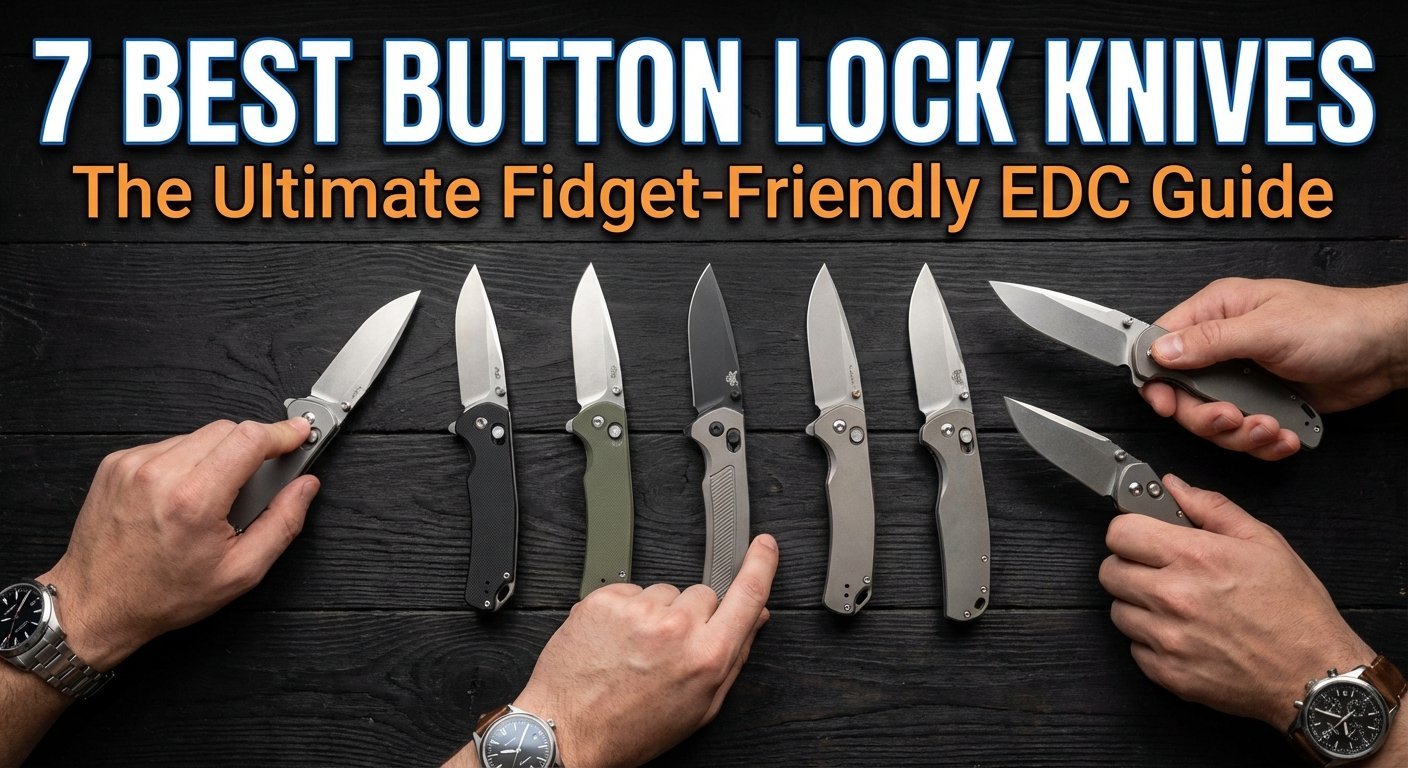
7 Best Button Lock Knives: The Ultimate Fidget-Friendly EDC Guide
Experience the perfect blend of safety, speed, and addictive action. We’ve tested the top contenders to bring you the definitive list of button lock folders.
On This Page
- The Rise of the Button Lock
- A Brief History of the Mechanism
- Quick Comparison Table
- In-Depth Reviews
- Button Lock vs. Other Locks
- Anatomy of a Button Lock
- Blade Steel Guide
- Maintenance & Disassembly
- Legality Deep Dive
- Honorable Mentions
- Best Picks by Use Case
- Modding & Community Tips
- Buying Guide
- FAQ
Introduction: The Rise of the Button Lock
For decades, the knife world was dominated by liner locks and frame locks. While effective, they required putting your thumb in the path of the closing blade. Enter the button lock (or plunge lock). Originally reserved for automatic switchblades found in Smith & Wesson knife reviews, this mechanism has recently exploded into the manual folding knife market.
Why the sudden surge in popularity? It comes down to two factors: safety and “fidget factor.” A button lock allows you to keep your fingers clear of the blade’s rotation path while closing it. Furthermore, simply pressing the button releases the tension, allowing the blade to swing freely—often called “drop-shut” action—which makes these knives incredibly addictive to open and close.
However, not all button locks are created equal. Some suffer from “lock stick,” while others have weak detents that allow the blade to fall open in your pocket. In this guide, we dive deep into the 7 best button lock knives currently on the market, ranging from budget-friendly beaters to premium steels. Whether you are upgrading from a basic Victorinox Cadet or looking for an alternative to the tactical SOG-TAC XR, there is a button lock here for you.
A Brief History of the Button Lock Mechanism
To understand why button locks feel so satisfying, it helps to know where they came from. The plunge-lock mechanism has its roots in mid-20th-century automatic knives, where a spring-loaded blade needed a robust, single-point release. Italian stiletto makers and American switchblade manufacturers refined the plunge lock throughout the 1950s and 1960s, prizing it for its simplicity: a single steel pin dropping into a notch machined into the blade tang.
For a long time, this mechanism stayed almost exclusively in automatic and assisted-opening knives because of the legal gray area surrounding “switchblades” in the United States. Manual folding knives instead relied on liner locks, popularized by Michael Walker in the 1980s, and later frame locks, which Chris Reeve helped bring into the mainstream with the Sebenza in the 1990s.
The manual button lock as we know it today really began gaining traction in the mid-2010s. Chinese manufacturing houses such as Kizer, Civivi (a Kizer sub-brand), and CJRB began experimenting with plunge-lock mechanisms in manual folders, stripping out the spring found in automatics but keeping the smooth, low-friction release action. Designers realized that removing the thumb from the blade’s closing arc solved one of the biggest safety complaints about liner locks, where users occasionally sliced themselves while closing the knife one-handed.
By the early 2020s, button locks had become a full-blown trend. Spyderco entered the space with the compression-lock-adjacent Smock. Vosteed built an entire brand identity around crossbar and button locks. Even legacy brands that once relied exclusively on frame locks, like Kizer’s flagship lineup, began releasing button lock variants of their most popular frame lock models — the Sheepdog being a prime example. Today, the button lock is no longer a novelty; it is considered a mainstream locking mechanism with its own passionate community of “fidgeters” who collect knives purely for the tactile pleasure of opening and closing them.
Understanding this lineage matters because it explains a lot about how modern button locks are engineered. Because they descend from automatic knife mechanisms, today’s best manual button locks retain incredibly tight tolerances and smooth internal geometry — features that took automatic knife makers decades to perfect and that manual button lock brands inherited almost overnight.
Quick Comparison: Top Picks at a Glance
| Knife Model | Blade Steel | Handle Material | Best For |
|---|---|---|---|
| Kizer Sheepdog C01C | 154CM | Micarta / G10 | Heavy Duty / Cleaver Utility |
| Civivi Elementum Button Lock | 14C28N | G10 / Micarta | Best All-Rounder |
| CJRB Pyrite | AR-RPM9 | Steel / G10 | Budget King |
| Kizer Cormorant | S35VN | G10 | Fidget Factor |
| Spyderco Smock | CPM-S30V | Carbon Fiber/G10 | Tactical / Precision |
| Vosteed Raccoon | 14C28N | Micarta | Ergonomics |
| Kizer Original | 154CM | Aluminum/Copper | Gentleman’s Carry |
In-Depth Reviews: The Top 7 Button Locks
Below, we break down each knife in detail — covering fit and finish, steel performance, ergonomics, and how the button lock mechanism itself feels in daily use. We carried each of these knives for at least two weeks of real-world EDC tasks: breaking down boxes, opening mail, food prep, and yes, plenty of idle fidgeting at the desk.
1. Kizer Sheepdog C01C (Button Lock Version)

The Kizer Sheepdog is legendary. Originally a frame lock flipper designed by Chris Conaway of Sheepdog Knives, Kizer recently updated it with a button lock mechanism, and it is a masterpiece. Unlike the slender profiles of many button locks, the Sheepdog offers a massive sheepsfoot/cleaver blade that excels at push-cutting and food prep.
Despite its visual bulk, the button lock allows the heavy blade to drop shut with incredible smoothness. It creates a satisfying acoustic “thwack” upon opening that rivals knives three times the price. It uses 154CM steel, a robust American steel that is easy to sharpen and holds a great edge.
Carrying the Sheepdog for two weeks straight, what stood out most was how the wide belly of the blade handled kitchen-adjacent tasks — breaking down cardboard, slicing citrus, and trimming rope — better than any other knife on this list. The trade-off is pocket presence: this is not a knife you forget you’re carrying. If you want the cleaver silhouette without the width, Kizer also sells a smaller “Sheepdog Jr.” in some markets, though it is harder to find and often sells out quickly.
The pivot on our test unit broke in beautifully after about 100 open-close cycles, settling into a buttery, low-friction action that many reviewers compare favorably to knives costing well over $150.
- Iconic “Cleaver” blade shape is very useful.
- Thumb hole allows for multiple deployment methods.
- Action is exceptionally smooth for a heavy blade.
2. Civivi Elementum Button Lock

The original Elementum is arguably the most popular EDC knife of the last five years. Civivi took that winning formula and upsized it slightly, replacing the liner lock with a button lock. The result is a knife that fits perfectly in hand and works effortlessly.
It uses 14C28N steel, which is arguably the best budget stainless steel available—taking a razor edge much easier than the D2 found on older budget knives. Note that the standard version has no flipper tab; it is deployed by pressing the button and flicking your wrist, or using the thumb stud (on newer versions).
What makes the Elementum Button Lock stand out in a crowded field is how unremarkable it feels in the best possible way — the handle shape disappears in your grip, the pocket clip tension is spot-on, and the blade centering was dead-perfect out of the box on our unit. For anyone who found the original liner-lock Elementum a little too common, this version offers the same beloved ergonomics with a mechanism that feels noticeably more modern.
- Incredible value for the money.
- Very neutral, comfortable handle.
- Deep carry pocket clip is standard.
3. CJRB Pyrite

The CJRB Pyrite is often called the “Budget King” of button locks. It offers 90% of the fidget factor of high-end knives for a fraction of the price. It features AR-RPM9 steel, a proprietary powder metallurgy steel that resists corrosion exceptionally well—making it a great alternative to the salt-proof Spyderco Caribbean for humid environments, albeit at a lower hardness.
The Pyrite is available in steel handles (for a hefty feel) or G10 (for lightweight carry). It has become the gold standard for entry-level button locks.
We tested the steel-handle version and found the extra heft actually helps the “drop shut” action feel even more satisfying, since the added mass carries the blade through its arc with authority. First-time button lock buyers consistently name the Pyrite as their gateway knife into the category, and it’s easy to see why: at its price point, nothing else offers comparable fit, finish, and bearing-smooth action.
- Extremely smooth ceramic ball bearings.
- Perfect size for EDC.
- Powder steel at a budget price.
4. Kizer Cormorant

If you get bored easily, the Kizer Cormorant is your cure. It features a unique handle shape and blade hole that allows for three different deployment methods: front flipper, standard flipper, and reverse flick. Kizer Knives has truly mastered the production button lock, and the Cormorant is their showcase piece.
While the design is polarizing (it looks a bit like a video game controller pattern), the ergonomics are surprisingly good. The S35VN steel is a massive step up from the budget steels found in knives like the Ka-Bar Dozier.
The Cormorant’s real party trick is how confidently it handles reverse-flick deployment, a motion that feels awkward or even dangerous on lesser button locks. The detent here is tuned specifically to support that motion, so the blade snaps out crisply every time rather than requiring a forceful wrist snap. For collectors who enjoy showing off different opening styles, this is the single best knife on our list.
- Multiple deployment methods (Fidget King).
- S35VN is a premium steel.
- Excellent jimping for grip.
5. Spyderco Smock

Technically, the Spyderco Smock uses a “button-actuated compression lock,” but for the user, it functions identically to a button lock. Designed by Kevin Smock, this knife is unique in the Spyderco lineup. It departs from their usual leaf-shape blades for a hollow-ground wharncliffe profile.
It includes a second detent ball which makes the break extremely crisp, though some fidget-lovers remove this second spring to make it swing freer. Compared to the lightweight ZT knives, the Smock has a dense, quality feel thanks to the carbon fiber/G10 laminate scales.
Because the compression lock engages the tang from above rather than below, it is widely regarded by knife engineers as one of the strongest folding lock designs available, rivaling even robust frame locks in lateral strength testing. That extra margin of safety, combined with Spyderco’s famously tight quality control, makes the Smock the pick for buyers who want button-lock convenience without giving up any structural confidence.
- Safest lock mechanism on the list (Compression).
- Unique hollow grind is an incredible slicer.
- High customization potential (scales, hardware).
6. Vosteed Raccoon

Vosteed is a newer brand that has made waves by listening intently to community feedback. The Raccoon is their answer to the “camp knife” aesthetic—simple, rugged, and effective. Think of it as a modernized version of the ESEE JG3 but in a folding, button-lock format.
It features a cross-bar lock version, but the button lock variant (Top Liner Lock) is the one to get for smooth action. The Micarta feels warm and grippy, perfect for outdoor tasks where metal handles get too cold.
Vosteed’s engagement with online knife communities shows in small but meaningful details: the jimping pattern was adjusted after early user feedback, and the clip tension was revised between production runs to reduce pocket wear on pants. It’s a great example of a brand iterating quickly based on real owner experience rather than releasing once and moving on.
- Fantastic blade geometry for slicing.
- Very affordable.
- Simple, non-threatening look.
7. Kizer Original

The Kizer Original (formerly the standard by which budget button locks were measured) remains a top contender. It is sleek, compact, and ideal for office carry. It lacks the aggression of a Cold Steel Bowie or the bulk of a dedicated skinning knife.
The 154CM steel is a great middle-ground performer, used heavily by brands like Benchmade in the past. If you find the Elementum too generic and the Cormorant too weird, the Original is your “just right” porridge.
The aluminum-and-copper handle combination gives this knife a noticeably different in-hand feel from the G10 and Micarta options elsewhere on this list — colder to the touch initially, but with a premium, almost jewelry-like presence that makes it feel appropriate at a business dinner in a way the Sheepdog or Raccoon simply wouldn’t.
- Under 3 inches (legal in many restricted areas).
- Classy aesthetic for dress carry.
- Snappy action.
Watch: Button Locks Explained
Still wondering how a button lock differs from a liner lock or an automatic? Watch this detailed breakdown to see the mechanics in action and why they are safer for your fingers.
Button Lock vs. Other Locking Mechanisms
One of the most common questions we get is how a button lock actually stacks up against the locks people already know. Below is a breakdown of how the button lock compares to the five other mechanisms you’re most likely to encounter while shopping for a folding knife.
Button Lock vs. Liner Lock
A liner lock uses a spring-tensioned metal liner inside the handle that snaps behind the base of the blade tang when opened. To close it, you push the liner aside with your thumb while folding the blade in — placing your thumb directly in the blade’s path for a split second. Button locks eliminate this entirely. You press a button on the spine or scale, and the blade swings free without any finger ever entering the closing arc. Liner locks are generally cheaper to manufacture and have been proven reliable for decades, but for pure one-handed safety, the button lock wins.
Button Lock vs. Frame Lock
Frame locks work similarly to liner locks but use a cut section of the actual titanium or steel handle scale as the locking bar, making them stronger and more resistant to lock wear over time. Many premium American-made knives, like the Chris Reeve Sebenza, rely on frame locks. The trade-off is the same as with liner locks: your thumb is exposed during closing. Button locks trade a small amount of raw lateral strength for a dramatic improvement in day-to-day safety and speed of use. For hard use tasks like batoning or heavy prying, a good frame lock still edges out most button locks; for everyday carry and fidgeting, the button lock is more practical.
Button Lock vs. Axis Lock / Crossbar Lock
Benchmade’s Axis lock and its many clones (often called crossbar locks) use a spring-loaded bar that rides in a track cut into both liners, engaging a notch in the blade tang. Like button locks, axis-style locks keep fingers away from the blade during closing, and they are ambidextrous by design. The main functional difference is feel: axis locks require you to pull a bar rearward, while button locks require a straight downward or inward push. Many users find button locks slightly quicker to actuate one-handed, while axis locks are often regarded as marginally stronger under heavy lateral stress.
Button Lock vs. Compression Lock
The compression lock, developed by Spyderco, is mechanically similar to a liner lock but engages from above the tang rather than below it, which distributes closing force differently and is widely considered one of the strongest lock types available. The Spyderco Smock reviewed above technically uses a button-actuated version of this lock. Functionally, it delivers the same finger-safety benefit as a true button lock while offering the added lateral strength compression locks are known for.
Button Lock vs. OTF (Out-The-Front) Mechanisms
OTF knives deploy the blade straight out of the front of the handle, either automatically or via a manual slider. While OTFs share some DNA with button locks — both descend from automatic knife engineering — they are mechanically distinct and, in many jurisdictions, subject to much stricter legal restrictions. If you like the “engineered mechanism” feel of an OTF but want something that is legal to carry in more places, a manual button lock folder is usually the safer choice from a legal standpoint. Always check local laws before buying either style.
Button Lock vs. Slip Joint
Slip joints, found on traditional pocket knives like classic Case and Buck trapper patterns, have no true “lock” at all — a spring provides tension to hold the blade open, but firm pressure can fold it closed. Slip joints are legal in more jurisdictions and often preferred by collectors of traditional knives, but they are not intended for hard-use tasks where the blade could fold back onto your fingers under load. Button locks provide genuine lock-up security that slip joints simply cannot match.
Anatomy of a Button Lock: How It Actually Works
Understanding the internal geometry of a button lock helps explain both its appeal and its occasional quirks. Here are the core components found in nearly every plunge-style button lock knife.
- The Plunge Pin: A hardened steel cylinder that sits inside a channel in the handle, spring-loaded to press downward (or inward, depending on orientation) into a notch cut in the blade tang.
- The Tang Notch: A precisely machined groove in the blade’s tang that the plunge pin drops into when the blade is fully open, physically preventing rotation until the pin is lifted.
- The Button: The external actuator, usually located on the show-side scale or the spine, connected directly to the plunge pin. Pressing it lifts the pin out of the tang notch.
- The Detent Ball or Spring: A small ball bearing or leaf spring that provides resistance when the knife is closed, keeping the blade from swinging open accidentally in your pocket.
- The Pivot Bearings: Most modern button locks use caged or washer-style ball bearings at the pivot, which is what gives them that signature low-friction, “drop-shut” swing.
When you press the button, the plunge pin retracts out of the tang notch, and the detent’s resistance is simultaneously overcome, allowing the blade to swing freely on its bearing pivot. Release the button while the blade is open, and spring tension drives the pin back down into the tang notch the instant it re-aligns, locking the blade solid. This is why a quality button lock produces that satisfying, almost mechanical “click” — you’re hearing precision-machined steel seating into a notch with very little tolerance for play.
“Lock stick” — a common complaint among cheaper button locks — happens when the plunge pin’s channel accumulates lint, dust, or dried lubricant, increasing friction and causing the pin to hang up rather than retract instantly. This is almost always solvable with basic maintenance, which we cover in detail later in this guide.
Blade Steel Guide: Understanding What’s Inside Your Button Lock
Steel choice affects edge retention, corrosion resistance, ease of sharpening, and overall toughness. Here’s a closer look at the steels used across the knives in this guide, plus a few others you’ll commonly see when shopping for button locks.
154CM
An American-made stainless steel that has been a workhorse in the knife industry since the 1990s. It offers a great balance of edge retention, toughness, and ease of sharpening, which is why it appears on both the Kizer Sheepdog and the Kizer Original in this guide. It’s not the flashiest steel on paper, but its real-world performance and easy touch-up sharpening make it a favorite among people who actually use their knives daily.
14C28N
A Swedish stainless steel from Sandvik, designed specifically with knife makers in mind. It sharpens easily, resists corrosion well, and holds a working edge respectably for a budget-tier steel. Both the Civivi Elementum and Vosteed Raccoon use 14C28N, and it’s a big part of why those two knives feel so easy to live with — you can touch up the edge on a pocket stone in under a minute.
AR-RPM9
A proprietary powder-metallurgy stainless steel used by CJRB (a sister brand to Kizer). Powder metallurgy steels have a finer, more uniform grain structure than traditionally forged steels, which generally improves edge stability and corrosion resistance. AR-RPM9 punches above its price point, which is a major reason the CJRB Pyrite earns its “Budget King” title.
CPM-S35VN
A premium American powder steel from Crucible, designed as an improvement on the popular S30V with added niobium for better toughness and chip resistance. Found on the Kizer Cormorant, S35VN holds an edge significantly longer than budget steels and resists corrosion well, at the cost of being slightly more effort to sharpen from scratch (though maintenance touch-ups remain easy).
CPM-S30V
One of the most respected mid-to-premium powder steels in the knife world, used on the Spyderco Smock. It offers excellent edge retention and corrosion resistance, and has been a benchmark steel that other premium steels are frequently compared against since its introduction in the early 2000s.
How to Choose a Steel for Your Use Case
If you live somewhere humid or coastal, prioritize steels with strong corrosion resistance like AR-RPM9 or 14C28N. If you want the longest possible edge retention and don’t mind occasional professional sharpening, S30V or S35VN are excellent choices. If you want a steel that is easy to maintain yourself with basic stones, 154CM and 14C28N are both beginner-friendly and forgiving.
How to Maintain and Disassemble Your Button Lock Knife
Button locks are mechanically simple, but the plunge pin channel does need occasional attention to stay smooth. Here’s how to keep yours performing like new.
Routine Cleaning (Every 1–3 Months of Regular Carry)
- Use a can of compressed air to blow out the pivot area, the button channel, and the liner cavities. This removes the majority of lint and pocket debris that causes lock stick.
- Open and close the knife 10–15 times to work any loosened debris out through the pivot gap.
- Apply a single drop of light knife-specific oil to the pivot from both sides, then open and close the blade several times to distribute it evenly.
- Wipe away excess oil with a microfiber cloth to prevent it from attracting more dust.
Deep Cleaning and Disassembly
Most button lock knives use standard T6, T8, or T10 Torx screws for the pivot and scale hardware. To fully disassemble:
- Lay the knife on a towel with the pivot facing up, and photograph the assembly before starting so you have a reference for reassembly.
- Remove the pocket clip screws first, then the scale screws opposite the show side.
- Carefully remove the pivot screw, keeping track of any washers or bearing races, which can be caged (won’t fall apart) or loose (will scatter if you’re not careful).
- Lift the scale away, exposing the plunge pin assembly, detent spring, and pivot bearings.
- Clean all components in isopropyl alcohol or a dedicated degreaser, then dry thoroughly before reassembly.
- Reassemble in reverse order, applying a small drop of oil to the pivot bearings and a tiny amount of blue threadlocker to the pivot screw if your model tends to loosen over time (this was a noted issue on the CJRB Pyrite in our testing).
If you’re not comfortable with full disassembly, most lock-stick issues can be resolved with compressed air and a drop of oil alone — you rarely need to go further than routine cleaning unless the knife has been exposed to sand, salt water, or heavy grime.
Signs Your Button Lock Needs Service
- The button feels gritty or requires unusually firm pressure to actuate.
- The blade doesn’t drop shut freely even after the button is fully pressed.
- You notice blade play (up-down or side-to-side wiggle) when the knife is locked open.
- The detent feels weak, and the blade can be shaken open in your pocket.
Legality Deep Dive: Button Locks by Jurisdiction
Knife law in the United States is a patchwork of state and municipal regulations, and mechanism type can matter as much as blade length. While this section is for general informational purposes and not legal advice, here are the broad categories worth understanding before you buy or travel with a button lock knife.
The “Gravity Knife” Classification Risk
Because pressing the button on many plunge-lock knives allows the blade to swing open under its own weight or with a flick of the wrist, some older statutes originally written to target true gravity knives and switchblades have occasionally been applied to manual button locks by overzealous enforcement, particularly in cities that once had strict gravity knife bans (New York City’s now-repealed gravity knife law is the most famous example). Always check current local statutes, since these laws have shifted significantly over the past decade.
Blade Length Restrictions
Many states and cities cap legal blade length for concealed or open carry, commonly somewhere between 2.5 and 4 inches. Knives like the Kizer Original, with its sub-3-inch blade, are more likely to comply with stricter local caps than longer options like the Civivi Elementum Button Lock.
Automatic vs. Manual Classification
It’s worth repeating: every knife in this guide is a manual folder. None of them open automatically via spring tension when the button is pressed while closed — the button only releases the lock so the blade can swing open manually or be closed. This distinction matters enormously in states with strict automatic knife bans, since manual button locks are almost always treated the same as any other manual folder.
Traveling With Button Locks
If you travel between states or internationally, research local laws before your trip rather than assuming your home state’s rules apply everywhere. Airport security (TSA in the US) prohibits all folding knives in carry-on luggage regardless of lock type, so button locks must go in checked baggage when flying.
Honorable Mentions: Button Locks Worth Watching
Beyond our top 7, a handful of other button lock knives regularly come up in community discussions and deserve a mention, even though they didn’t make our primary list for this round of testing.
Kizer Gemini
A slimmer, more understated sibling to the Cormorant, the Gemini trades some of that model’s flashy deployment options for a more traditional silhouette while keeping the same premium S35VN steel and buttery button lock action.
Civivi Baklash Button Lock
A larger, more tactical-leaning option from Civivi with a drop point blade and aggressive G10 texturing, popular among users who want button lock convenience in a bigger, more purpose-built package than the Elementum.
QSP Hawk Button Lock
QSP has built a strong reputation for value, and their button lock take on the popular Hawk pattern brings the same clean lines and comfortable ergonomics found in their frame lock version, at an accessible price point.
Artisan Cutlery Small Ratel
A compact, gentleman’s-carry option with a button lock mechanism and a distinctive drop point blade, offering a nice middle ground in size between the Kizer Original and the CJRB Pyrite.
We’ll continue evaluating these and other emerging button lock releases for future updates to this guide, so check back periodically if you’re shopping around for something beyond our current top 7.
Best Button Lock Knives by Use Case
Not every button lock is built for the same job. Here’s how we’d recommend matching a knife from this guide to specific everyday scenarios.
Best for Office and Dress Carry
The Kizer Original is the clear pick here. Its compact blade length, refined aluminum-and-copper handle, and low-profile pocket presence make it appropriate for a business setting where a bulkier tactical folder would look out of place.
Best for Kitchen and Food Prep Tasks
The Kizer Sheepdog‘s wide, sheepsfoot-style blade is unmatched on this list for push-cutting fruit, vegetables, and other food prep tasks, closely mimicking the geometry of a small kitchen paring knife.
Best for Outdoor and Camp Use
The Vosteed Raccoon‘s rugged Micarta handle and simple, durable blade shape make it well suited to campsite chores like cutting cordage, prepping kindling, or general bushcraft-adjacent tasks.
Best for First-Time Button Lock Buyers
The CJRB Pyrite offers the smoothest introduction to the mechanism at the lowest financial risk, making it the ideal knife to buy if you’re not yet sure whether you’ll like button locks.
Best for Maximum Safety Margin
The Spyderco Smock, with its compression-lock-derived design, offers the strongest lock-up of anything on this list while still delivering the finger-safe closing action button lock fans want.
Best for Fidgeting and Collecting
The Kizer Cormorant‘s multiple deployment methods make it the most entertaining knife to handle repeatedly, which is exactly what collectors and fidgeters are looking for.
Best All-Around Everyday Carry
The Civivi Elementum Button Lock remains our top overall recommendation for most people, balancing size, steel performance, ergonomics, and price better than anything else on this list.
Modding and Community Tips
The button lock community online — particularly on knife-focused forums and social media groups — has developed a number of tricks to further improve action and customize these knives. A few worth knowing about:
- Detent Spring Swaps: Some enthusiasts replace factory detent springs with lighter aftermarket options to reduce the force needed to release the blade, resulting in an even smoother “drop shut.” This can reduce how securely the blade stays closed in your pocket, so it’s a trade-off best suited to knives you carry in a dedicated pocket or sheath.
- Bearing Upgrades: Aftermarket ceramic bearing sets are available for many popular models and can further reduce pivot friction, though most stock bearings (like those on the CJRB Pyrite) are already quite good out of the box.
- Aftermarket Scales: Knives like the Spyderco Smock, with widely available aftermarket titanium and carbon fiber scales, are popular platforms for a full custom look without touching the internals.
- Button Resizing: A small but devoted subset of users file down or reshape factory buttons for a more ergonomic press angle, though this should only be attempted by those comfortable modifying handle materials permanently.
- Lubrication Experiments: Beyond standard knife oil, some community members experiment with dry PTFE-based lubricants for pivots, which resist attracting lint and dust better than traditional oils in dusty environments.
As with any modification, altering the factory detent or lock geometry can affect how securely your knife locks up. Proceed cautiously, and never modify the plunge pin or tang notch geometry itself, as this is the core safety mechanism of the entire knife.
Buying Guide: What to Look For
1. Plunge Lock vs. Button-Actuated Liner Lock
True button locks use a “plunge” cylinder that interfaces with a notch in the blade tang. This is what you find on the Kizer Sheepdog and Civivi Elementum. However, some knives (like the Spyderco Smock) use a button to push a liner or compression tab out of the way. Both are great, but the plunge lock typically offers that “free-swinging” action that fidgeters love.
2. Blade Detent
Unlike liner locks that use a ball bearing pressed against the blade to keep it closed, button locks rely on the plunge mechanism or a spring. A weak detent means the knife might shake open in your pocket—a dangerous flaw. Brands like QSP and Kizer have dialed this in perfectly, but cheap gas station knives often fail this test.
3. Legalities: The “Gravity Knife” Issue
Because button locks allow the blade to swing freely when the button is pressed, some law enforcement officers might classify them as “gravity knives.” While they are generally legal manual folders, be aware of your local laws, especially compared to stricter bans on automatics or fixed blades like the Fallkniven S1.
4. Size Matters
Are you looking for a keychain companion (see our Best Keychain Knives guide) or a primary EDC? Button locks tend to be slightly wider to accommodate the mechanism, so check the pocket profile if you wear slim-fit pants.
5. Bearing System Quality
Most modern button locks use caged ball bearings at the pivot, but bearing quality varies between brands and even between production runs. Higher-end knives tend to use tighter-tolerance bearing races that reduce blade play and improve smoothness over the knife’s lifespan, while budget knives may use looser tolerances that develop wobble sooner.
6. Ambidexterity
Because the button itself can typically be pressed with either hand, most button locks are functionally ambidextrous for closing, even if the pocket clip or thumb stud placement favors right-handed carry. If true ambidextrous deployment matters to you, look specifically for models advertising reversible or dual thumb studs.
7. Warranty and Brand Support
Established brands like Kizer, Civivi, and Spyderco typically offer strong warranty support for lock or pivot issues, while newer or lesser-known brands may have inconsistent after-sales service. It’s worth checking a brand’s warranty policy before investing in a premium-steel button lock.
Frequently Asked Questions
Final Verdict
The button lock revolution is here to stay. These knives offer a level of safety and enjoyment that older lock mechanisms simply can’t match. If you want a knife that feels substantial and offers unique utility, the Kizer Sheepdog is a standout choice. For the absolute best value and all-around performance, the Civivi Elementum Button Lock or CJRB Pyrite are impossible to beat.
Whether you are slicing apples or breaking down boxes, upgrading to a button lock will change your EDC game forever. Just be warned: once you start fidgeting with one, you won’t be able to put it down.