Single Bevel vs Double Bevel Knives Explained
A deep, practical breakdown of how these two edge geometries are ground, why they cut so differently, and which one actually belongs in your kitchen.
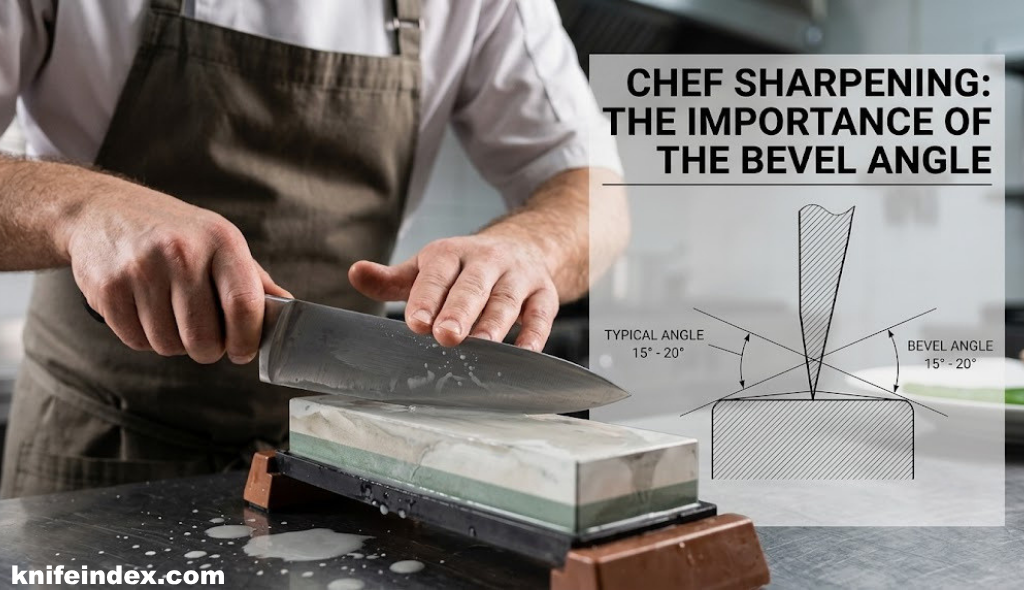
What Exactly Is a “Bevel”?
Every knife blade tapers down from a thicker spine to a thin cutting edge, and the angled surface that creates that taper is called the bevel. It’s the ground face you see catching the light just above the edge, and it’s the part of the blade that actually does the work of splitting whatever you’re cutting into two halves. Everything else — the steel type, the handle material, the brand name stamped on the spine — is secondary to this one geometric decision. Once you understand bevels, you understand why a $40 Japanese vegetable knife can out-slice a $200 Western chef’s knife on a tomato, and why that same $40 knife might struggle with a butternut squash.
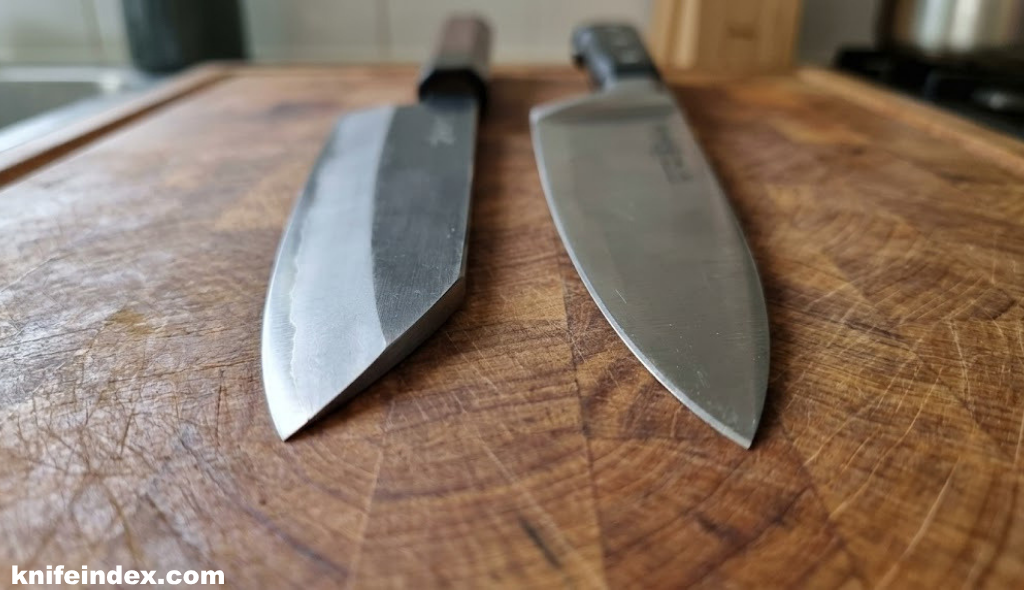
There are two dominant philosophies for how that bevel is ground, and they represent genuinely different engineering approaches to the same problem: single bevel and double bevel. A single bevel blade is ground on one side only, leaving the other side almost completely flat. A double bevel blade — sometimes called a “V-grind” — is ground symmetrically on both sides, meeting in the middle to form the edge. This single design choice cascades into nearly every other characteristic of a knife: how it tracks through food, how it’s sharpened, who can comfortably use it, and even how it should be stored.
Before diving into the mechanics, it helps to picture the cross-section of each blade as if you sliced straight through it and looked at the end. A double bevel knife looks like a narrow letter “V” tapering to a point. A single bevel knife looks lopsided — flat on one face, angled on the other, like a chisel. That chisel-like shape is not an accident or a manufacturing shortcut; it’s a deliberate design descended from centuries of Japanese blade-smithing tradition, refined for tasks that demand extreme precision, such as slicing raw fish for sashimi or peeling a single continuous ribbon of daikon radish.

Curious what a true single bevel edge feels like? This traditional Yanagiba is a great entry point into single bevel geometry without a professional price tag.
Check Price on AmazonSingle Bevel Knives Explained
A single bevel knife, called kataba in Japanese, is ground almost entirely on one face of the blade. The opposite face — referred to as the “ura” — is left flat or very slightly concave, a feature called urasuki. This hollow-ground back reduces surface contact with whatever is being cut, which lowers friction and helps prevent the blade from sticking to food as it slices through. The entire cutting geometry lives on one side of the blade, which means the knife inherently wants to steer toward that flat back face as it moves forward.
This steering effect is actually the point. In traditional Japanese cutting techniques, that natural pull is used deliberately to guide paper-thin, continuous cuts — the kind needed for sashimi, katsuramuki (rotary peeling), or ultra-fine julienne. A skilled sushi chef isn’t fighting the blade’s tendency to drift; they’re using it as a built-in steering mechanism, letting the geometry do part of the work that a Western knife would require pure hand control to achieve.
Common Single Bevel Knife Types
The single bevel family includes several purpose-built shapes, each optimized for a narrow task rather than general-purpose use:
- Yanagiba — a long, narrow slicing knife for raw fish, designed for a single smooth draw-cut rather than a sawing motion.
- Deba — a heavier single bevel knife used for breaking down whole fish, including cutting through small bones.
- Usuba — a flat-edged vegetable knife favored for precision peeling and paper-thin vegetable cuts; see how it compares to the double bevel Nakiri for vegetable work.
- Takobiki — a squared-off relative of the Yanagiba, popular in the Kanto region of Japan.
Because the geometry is so specialized, single bevel knives are traditionally handmade for either right-handed or left-handed use, and the two are not interchangeable — a topic worth understanding fully before buying, which we cover later in the handedness section of this guide.
Double Bevel Knives Explained
A double bevel knife, known as ryoba in Japanese or simply a “V-grind” in Western knife-making, is ground symmetrically on both sides of the blade. The two angled faces meet at the center to form the edge, and — assuming the grind is even — the geometry is a mirror image on each side. This is the design almost every Western kitchen knife uses, from a basic Wusthof paring knife to a premium Bob Kramer chef’s knife, and it’s also used by the majority of modern Japanese knives built for versatility, such as the Santoku and Nakiri.
Because the bevel is symmetrical, the blade doesn’t have an inherent sideways pull the way a single bevel knife does. It tracks straight down through food, which makes it far more forgiving and intuitive for someone who hasn’t spent years training their hand to compensate for a knife’s natural drift. This is a major reason double bevel knives dominate both home kitchens and professional Western-style kitchens: the learning curve is dramatically shorter.
Common Double Bevel Knife Types
- Chef’s knife / Gyuto — the all-purpose workhorse of any kitchen, Western or Japanese-hybrid.
- Santoku — a shorter, flatter-profile all-purpose knife popular for its rocking and push-cutting versatility.
- Nakiri — a rectangular double bevel vegetable knife, the double bevel counterpart to the Usuba.
- Paring, boning, and utility knives — nearly all Western task-specific blades use double bevel grinds for predictable, symmetrical control.
Double bevel edges also vary in the angle they’re ground to. A Western chef’s knife is commonly sharpened somewhere around 20 degrees per side, while many Japanese double bevel knives are ground closer to 12–15 degrees per side, giving them a thinner, more acute edge. This is one reason a Japanese double bevel Gyuto often out-slices a German chef’s knife on delicate produce, even though both are technically the same “double bevel” category.

Want the versatility of a double bevel edge? A Gyuto-style chef’s knife gives you thin, precise geometry without the single-sided learning curve.
Check Price on AmazonThe Core Differences
Stripped down to essentials, the difference between single and double bevel knives comes down to symmetry, and that one variable radiates outward into everything else about how the knife performs. Below is a side-by-side comparison covering the factors that actually matter when you’re deciding between the two.
| Factor | Single Bevel | Double Bevel |
|---|---|---|
| Edge angle per side | Very acute, often 5–10° | Typically 12–20° per side |
| Cutting path | Naturally curves toward flat side | Tracks straight down |
| Learning curve | Steep; requires technique | Beginner-friendly |
| Best use case | Precision slicing, fish, garnish work | General-purpose chopping, dicing, mincing |
| Sharpening difficulty | Specialized, one-sided technique | Straightforward, symmetrical strokes |
| Handedness | Right or left-specific | Ambidextrous |
| Typical origin | Traditional Japanese | Western and modern hybrid Japanese |
| Food release | Excellent on thin slices due to urasuki hollow | Good, varies with grind width |
What this table doesn’t fully capture is how these differences feel in actual use. A single bevel edge, because it’s so acute on one face, can achieve a level of sharpness that’s genuinely hard to replicate on a double bevel blade — but that sharpness is fragile and task-specific. A double bevel edge trades a bit of that ultimate sharpness for durability and predictability across a much wider range of cutting tasks, which is exactly why it became the default for general kitchen work worldwide.
Cutting Performance Compared
When people ask which knife “cuts better,” the honest answer is that it depends entirely on what’s being cut and how. A single bevel Yanagiba, drawn in one long stroke through a fillet of tuna, produces a cut face so clean it looks almost polished — no sawing marks, no compression of the delicate flesh, just a single smooth plane. Try to use that same knife to dice an onion the way you would with a chef’s knife, and the experience falls apart quickly; the blade wants to veer sideways with every push cut, and repeated straight-down chopping motions aren’t what the geometry was built for.
A double bevel chef’s knife, on the other hand, is engineered for exactly that kind of repetitive, straight-down or rocking motion. Because the bevel is symmetrical, the resistance on both sides of the blade is roughly equal, so the edge doesn’t hunt for a direction to drift. This is why double bevel knives dominate tasks like mincing garlic, breaking down a whole chicken, or rapid julienne work where speed and control matter more than a mirror-polished cut face.
Where things get interesting is in the middle ground — vegetables. A single bevel Usuba can produce a katsuramuki peel (a continuous, paper-thin ribbon of daikon or cucumber) that a double bevel Nakiri simply cannot replicate, because the flat back face of the Usuba rides along the vegetable’s surface as a built-in depth guide. But for everyday dicing, slicing, and rough prep, the double bevel Nakiri is faster to use and far more forgiving of imperfect technique. If you’re weighing these two specifically for vegetable prep, the Nakiri vs Usuba comparison goes deeper into which shape suits which cook.
Why the Acute Angle Matters
Single bevel edges can be ground to angles as low as 5 to 8 degrees on their single working face, which is dramatically thinner than most double bevel edges. A thinner edge meets less resistance as it enters food, which is why single bevel slices often look and feel “cleaner” — there’s less wedge-shaped displacement of the material being cut. The trade-off is that thinner edges are inherently more fragile; they chip more easily on hard contact and require more careful handling, which is one reason single bevel knives are rarely used for tasks involving bone or frozen food.

Serious about vegetable precision? An Usuba delivers the flat, continuous peeling cuts a double bevel blade can’t match.
Check Price on AmazonSteel Choice and Hardness
Bevel style and steel choice are separate decisions, but they’re closely linked in practice. Traditional single bevel knives are almost always made from high-carbon steel rather than stainless, because carbon steel can be hardened to a higher Rockwell rating and holds a more acute edge for longer. That hardness typically lands somewhere in the 61–64 HRC range for a quality single bevel blade, compared to the 56–60 HRC range common in many Western double bevel knives.
The trade-off is reactivity. High-carbon steel single bevel blades patina and can rust if left wet, which means they demand more attentive care than a stainless double bevel knife you can leave in a drying rack overnight without much worry. If corrosion resistance matters to you, it’s worth reading our comparison of high-carbon vs stainless steel before committing to a traditional single bevel blade, since the maintenance commitment is real and ongoing.
Double bevel knives span a much wider range of steel options, from soft, easy-to-sharpen stainless alloys like 420J2, to harder Japanese powder steels like VG-10, SG2, and even super-steels such as those compared in our MagnaCut vs M390 and S35VN vs S45VN guides. Because double bevel geometry is more forgiving of edge angle variation, it pairs well with a huge range of steels — soft and easy for beginners, or exotic and edge-retentive for enthusiasts.

Want the edge-holding benefits of high-carbon steel? These blades sharpen to a razor edge but need a bit more care than stainless.
Check Price on AmazonHandedness and Chirality
This is the single biggest practical hurdle for anyone considering a traditional single bevel knife: they are handed. A single bevel knife ground for right-handed use has its beveled face on the right side of the blade and its flat back on the left; a left-handed version is the mirror opposite. Using a right-handed single bevel knife in your left hand doesn’t just feel awkward — it actively fights the geometry, causing the blade to steer in the wrong direction and produce ragged, uneven cuts.
Most single bevel knives sold internationally are made for right-handed users by default, since that’s the larger market, and left-handed versions typically need to be special-ordered or sourced from makers who explicitly offer them. This is worth confirming before you buy, since returning a custom-ground single bevel knife is far more difficult than returning a standard double bevel blade.
Double bevel knives sidestep this problem entirely. Because the grind is symmetrical, the same knife performs identically whether it’s held in a right or left hand. This ambidextrous quality is a major, underappreciated reason double bevel knives are the default recommendation for beginners and for anyone buying a knife as a gift without knowing the recipient’s dominant hand.
Food Release and Sticking
Anyone who’s tried to slice a cucumber with a knife that grips and drags instead of releasing cleanly knows how frustrating poor food release can be. This is one area where single bevel design has a genuine structural advantage: the concave urasuki hollow on the back face reduces the surface area in contact with the food, creating a thin cushion of air that helps thin slices peel away from the blade instead of sticking to it.
Double bevel knives can achieve similar food release through other means — a hollow-ground edge, dimpled Granton edges (the small oval indentations you sometimes see along a blade), or simply a thinner overall profile. But without one of those features, a flat-ground double bevel blade can struggle with sticky or starchy foods like potato or squash, where the food clings to both sides of the blade as it descends.
If food release is a priority for you specifically — say, you slice a lot of raw fish or delicate produce at home — this is a strong point in favor of single bevel geometry, or at minimum a double bevel knife with a Granton or hollow-ground edge designed to mimic the same air-pocket effect.
Maintenance and Longevity
Because single bevel knives are typically made from higher-hardness carbon steel and ground to a thinner, more fragile edge, they demand a more disciplined maintenance routine. That means hand-washing and drying immediately after use, storing in a way that protects the edge (a saya sheath or blade guard rather than tossing it in a drawer), and periodic honing on a whetstone rather than a steel rod, which can be too aggressive for the thin geometry. Rust prevention is a real, ongoing concern — our guide on how to prevent rust on knives is essential reading if you’re taking on a carbon steel single bevel blade for the first time, and if you’ve already let a blade develop surface rust, this removal guide walks through safe recovery steps.
Double bevel knives, especially stainless varieties, are considerably more forgiving. Many can tolerate a quick rinse and towel-dry without immediate consequences, and their thicker, more durable edge angle means occasional contact with a cutting board’s harder spots or a stray bone fragment is less likely to cause a chip. That said, “more forgiving” doesn’t mean “no maintenance required” — a double bevel knife left wet for extended periods, or run through a dishwasher repeatedly, will still degrade faster than one that’s properly cared for.
Storage matters for both types, but the stakes are higher for single bevel blades given their thinner edges. A magnetic strip, a slotted block, or an in-drawer organizer all work well, provided the blade isn’t rattling against other tools. For smaller kitchens, our guide to compact magnetic strip layouts covers space-efficient options that protect delicate edges without eating up counter space.
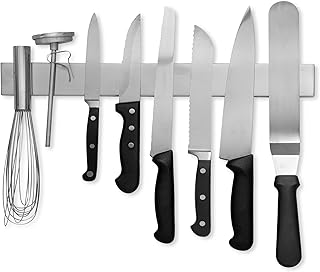
Protect your edge investment. A magnetic strip keeps blades — single or double bevel — from dulling against other tools in a drawer.
Check Price on AmazonWho Should Buy Which
The honest recommendation depends heavily on how you actually cook, not on which knife sounds more impressive. If your kitchen routine is mostly general prep — dicing onions, mincing garlic, breaking down proteins, chopping vegetables into uniform pieces for a stir fry — a double bevel knife is the correct tool, full stop. It’s forgiving, ambidextrous, and versatile enough to handle nearly everything a home cook throws at it in a single blade.
A single bevel knife makes sense when your cutting tasks are narrow and precision-focused: slicing sashimi-grade fish, producing continuous vegetable ribbons for garnish, or any task where the visual and textural quality of the cut face genuinely matters to the final dish. It’s also a legitimate choice for someone who’s already comfortable with knife technique and wants to develop a new skill set, since learning to control a single bevel blade is a rewarding process in its own right.
Choose Single Bevel If You…
- Regularly prepare raw fish or sashimi at home
- Want ultra-thin, continuous vegetable cuts
- Are willing to learn whetstone sharpening properly
- Don’t mind carbon steel maintenance
- Have a confirmed dominant hand match for the blade
Choose Double Bevel If You…
- Want one knife for general everyday prep
- Are new to whetstone sharpening
- Prefer stainless steel’s lower maintenance
- Need a knife that works for any user, any hand
- Cook a wide variety of foods, not just fish or produce
Many serious home cooks eventually land on a hybrid setup: a double bevel Gyuto or Santoku as the daily workhorse, paired with a single bevel Yanagiba or Usuba reserved for specific precision tasks. This mirrors how professional Japanese kitchens are often organized, with each knife earning its place through a specific job rather than trying to be everything at once.
Common Knife Types by Bevel
To make the abstract concepts above concrete, here’s how bevel style maps onto the knives you’re most likely to encounter while shopping, including several styles worth comparing directly if you’re still narrowing down a purchase.
| Knife Type | Bevel Style | Primary Use |
|---|---|---|
| Yanagiba | Single | Sashimi and raw fish slicing |
| Deba | Single | Breaking down whole fish |
| Usuba | Single | Vegetable peeling and precision cuts |
| Gyuto / Chef’s Knife | Double | General-purpose prep |
| Santoku | Double | All-purpose home cooking |
| Nakiri | Double | Vegetable chopping and dicing |
| Sujihiki | Double | Slicing cooked meats and proteins |
| Kiritsuke | Either (varies by maker) | Hybrid slicing and chopping |
Notice that the Kiritsuke is something of an outlier — depending on the maker, it can be ground as either single or double bevel, which makes it a fascinating middle-ground option for cooks who want a taste of single bevel precision without fully committing to the handedness and maintenance demands of a true Yanagiba. Read more about how it’s used in our dedicated Kiritsuke knife uses guide.
If your interest in raw fish preparation is what’s driving this whole comparison in the first place, it’s worth reading the dedicated Yanagiba vs Sujihiki breakdown, since it compares a true single bevel slicer against its double bevel equivalent for the exact same task, which illustrates these principles in a very concrete way.
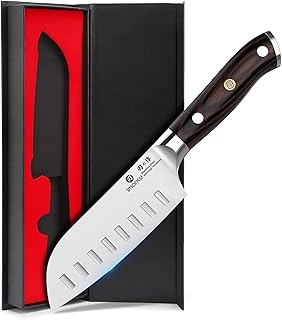
Not sure where to start? A Santoku is one of the most forgiving double bevel shapes for everyday home cooking.
Check Price on AmazonBuying Guide and Tips
Shopping for either style comes with its own checklist. For single bevel knives, confirm the handedness before purchasing — reputable sellers will clearly state “right-handed” or “left-handed” in the listing, and if it isn’t specified, it’s worth contacting the seller directly rather than guessing. Also pay attention to the steel: entry-level single bevel knives are often made from simpler carbon steels like white steel (Shirogami), while higher-end options use blue steel (Aogami) or powder steels for improved edge retention.
For double bevel knives, the buying decision is less about handedness and more about matching the edge angle and steel to your use case. A thinner Japanese-style double bevel edge (12–15 degrees per side) will out-slice a thicker Western edge (20 degrees per side) on delicate produce, but it’s also more prone to chipping if used carelessly on bone or frozen food. If you cook a wide variety of proteins including bone-in cuts, a slightly more robust Western-style double bevel angle may serve you better long-term.
Whichever style you land on, don’t overlook the handle. Traditional single bevel knives are often paired with a lightweight wa-handle (octagonal or D-shaped wood), which shifts the balance point closer to the blade for finer control. Double bevel Western knives typically use a heavier bolstered handle that balances closer to the bolster itself. Neither is objectively better — it’s a matter of what feels natural in your hand — but it’s worth testing both if you have the opportunity, since handle balance affects fatigue over long prep sessions just as much as the bevel itself does.
Finally, think about your existing knife collection. If you already have a strong all-purpose double bevel chef’s knife, adding a single bevel Yanagiba or Usuba as a specialty tool makes more sense than replacing what’s already working. If you’re starting from scratch with only one knife budget, a quality double bevel chef’s knife or Santoku will cover far more ground for the money.
How Each Bevel Style Is Actually Made
The manufacturing process behind these two blade types diverges almost as much as the finished products do. A quality single bevel knife is typically hand-forged, starting with a billet of steel — sometimes a single high-carbon steel, sometimes a laminated construction pairing a hard cutting-edge core with a softer, tougher outer cladding for shock resistance. The smith hammers and shapes the blade, then hardens it through a controlled heating and quenching process before the long, careful work of hand-grinding the single bevel face on a series of progressively finer stones. The flat back is left largely untouched except for the shallow urasuki hollow, which itself is a deliberate grinding step requiring real skill to execute correctly.
This process is labor-intensive by design, and it’s a major reason traditional single bevel knives command higher prices than comparable double bevel blades. A skilled artisan might spend hours on a single knife’s bevel alone, and reputable workshops often apprentice smiths for years before they’re trusted to finish blades independently. Mass-produced single bevel knives do exist at lower price points, typically using stamped rather than forged blanks and machine-assisted grinding, but purists generally consider hand-forged construction essential to getting the geometry — and therefore the performance — right.
Double bevel manufacturing spans a much wider spectrum, from fully automated stamping and grinding lines that can produce thousands of consistent, symmetrical blades per day, to hand-forged artisan Gyutos made with the same care as a fine single bevel knife. This flexibility is part of why double bevel knives are available at nearly every price point, from budget stainless kitchen sets to premium powder-steel Japanese chef’s knives costing hundreds of dollars. The symmetry of the grind also makes quality control more straightforward on a production line — a machine can check that both bevel angles match far more easily than it can verify the nuanced, one-sided geometry of a single bevel edge.
Heat treatment matters enormously for both styles, arguably more than the grinding process itself. A blade hardened unevenly, or tempered incorrectly, will underperform regardless of how precisely its bevel is ground. This is one reason buying from an established, reputable maker matters more than chasing the lowest price — inconsistent heat treatment is difficult to detect by looking at a knife, but it shows up immediately in how the edge holds up under real use.
Cost and Value: What You’re Actually Paying For
Price comparisons between single and double bevel knives can be misleading if you’re not accounting for what drives the cost on each side. With single bevel knives, price correlates heavily with the labor intensity of hand-forging and hand-grinding described above, along with the steel type and whether the blade is a laminated construction or a single homogenous steel. Entry-level single bevel knives using simpler stamped construction and basic carbon steel can be surprisingly affordable, while hand-forged blades from established workshops using premium steels like Aogami Super can run into hundreds of dollars for a single knife.
Double bevel knives show an even wider price spread because manufacturing methods vary so dramatically. A basic stamped stainless chef’s knife can cost less than the price of a nice dinner out, while a hand-forged, powder-steel double bevel Gyuto from a boutique Japanese workshop can rival or exceed the cost of a premium single bevel blade. What you’re paying for in the higher tiers of either category is consistency: tighter tolerances on the bevel angle, better heat treatment, higher-purity steel, and — often — the reputation and accountability of an established maker who stands behind their work.
For most home cooks, value is maximized by matching spend to actual use frequency. A knife used daily for years justifies a higher investment, since the cost amortizes across thousands of meals and the improved edge geometry pays off in reduced prep fatigue and better results. A specialty single bevel knife used occasionally for a specific technique doesn’t need to be the most expensive option on the market — a mid-tier hand-forged blade from a reputable maker will deliver the geometry benefits without the premium price tag of a master smith’s signature piece.
Common Mistakes to Avoid
- Buying the wrong handedness. A right-handed single bevel knife in a left hand (or vice versa) will never cut correctly, no matter how good your technique is.
- Over-sharpening the flat back of a single bevel blade. This destroys the urasuki hollow and permanently changes the knife’s food-release performance.
- Using a single bevel knife for tasks it wasn’t built for. Chopping through bone or frozen food with a thin single bevel edge risks chipping that’s difficult or impossible to fully repair.
- Assuming “Japanese knife” always means single bevel. Most modern Japanese knives, including the Santoku and Nakiri, are double bevel — don’t assume based on origin alone.
- Neglecting carbon steel maintenance. Letting a high-carbon single bevel blade sit wet, even briefly, invites rust that can pit the surface permanently.
- Using a pull-through or electric sharpener on a single bevel knife. These tools are built for symmetrical double bevel edges and will damage the geometry of a single bevel blade.
Frequently Asked Questions
Is a single bevel knife sharper than a double bevel knife?
A single bevel knife can be ground to a more acute angle on its single working face, which often makes it feel sharper on delicate materials like raw fish. However, “sharper” depends on the specific angle and steel used on both knives — a well-sharpened double bevel edge can be just as keen, especially thinner Japanese-style double bevel grinds.
Can a left-handed person use a right-handed single bevel knife?
Technically yes, but it’s not recommended. The blade’s natural steering will pull in the wrong direction, making clean, controlled cuts much harder to achieve. Left-handed single bevel knives exist and are worth seeking out specifically.
Do double bevel knives work for both right and left hands?
Yes. Because the grind is symmetrical, a double bevel knife performs identically regardless of which hand holds it, making it the safer and more practical choice for households with mixed dominant hands.
Why do single bevel knives rust more easily?
Most traditional single bevel knives are made from high-carbon steel rather than stainless, because carbon steel holds a finer, harder edge. That same steel is more reactive to moisture and acidity, so it requires prompt drying and occasional oiling to prevent rust.
What is the flat side of a single bevel knife called?
It’s called the “ura,” and it often has a slight concave hollow ground into it known as urasuki. This hollow reduces surface contact with food, improving release and reducing sticking during thin slices.
Can I sharpen a single bevel knife on a normal pull-through sharpener?
No. Pull-through and most electric sharpeners are designed for symmetrical double bevel edges and will grind both sides of a single bevel blade evenly, which ruins the intended geometry. Single bevel knives should only be sharpened by hand on whetstones.
Is a Santoku single bevel or double bevel?
A Santoku is a double bevel knife. It’s a Japanese-influenced but generally symmetrical, ambidextrous design meant for versatile all-purpose home cooking, unlike the traditional single bevel Yanagiba or Usuba.
Which is better for beginners, single or double bevel?
Double bevel is almost always the better starting point. Its symmetrical, ambidextrous geometry is far more forgiving of imperfect technique, and sharpening it is a much shorter learning curve than mastering a single bevel edge.
Do professional sushi chefs only use single bevel knives?
Primarily, yes, for tasks like filleting and slicing raw fish, where the single bevel’s clean cut face and food release matter most. But many professional kitchens, including sushi restaurants, also keep double bevel knives on hand for prep work that doesn’t require single bevel precision.
Does bevel style affect how the blade should be stored?
Bevel style itself doesn’t dictate storage, but the thinner, more fragile edges common on single bevel knives benefit from extra protection, such as a saya sheath or padded blade guard, more than a typical double bevel edge would strictly require.
Can a double bevel knife be reground into a single bevel?
Technically it’s possible with significant material removal by a skilled sharpener, but it fundamentally changes the balance, weight distribution, and intended use of the knife. It’s rarely worth doing compared to simply purchasing a purpose-built single bevel blade.
Are single bevel knives more expensive than double bevel knives?
Generally, yes, particularly for hand-forged, handedness-specific single bevel knives from established Japanese makers. Mass-produced double bevel knives, especially Western brands, tend to offer more affordable entry points at comparable quality.
Where This Distinction Actually Came From
To understand why single bevel and double bevel knives diverged so sharply, it helps to look at where each tradition was born. Japanese blade-smithing grew out of centuries of sword-making culture, where blacksmiths refined techniques for producing extremely hard, extremely thin edges using differential hardening and painstaking hand-forging. When that expertise turned toward kitchen tools, it carried the same obsession with edge geometry and cutting precision. A single bevel kitchen knife is, in a sense, a direct descendant of that sword-making lineage — an edge optimized for a single, decisive motion rather than repeated abrasive contact.
Western blade-making followed a different trajectory, shaped heavily by butchery, farm work, and eventually industrial manufacturing. The priority was durability and general usefulness across a huge range of tasks, from splitting bone to trimming fat to chopping vegetables, often by cooks who couldn’t afford to own five or six specialized blades. A symmetrical, double bevel edge was the practical answer: one geometry, reasonably durable, usable by anyone regardless of technique or handedness, and simple enough to mass-produce at scale once knife-making industrialized in cities like Solingen, Germany.
Modern kitchens have blurred these traditions considerably. Japanese makers now produce double bevel knives specifically for export markets and home cooks who want Japanese steel and thinness without the single bevel learning curve, while some Western-trained chefs seek out single bevel knives specifically for the precision they offer in fine dining presentation work. The result is a global marketplace where both philosophies coexist, often in the same knife roll, each earning its place through the specific job it does best rather than through cultural origin alone.
The Physics Behind Why These Edges Cut Differently
It’s worth slowing down on the actual mechanics of cutting, because that’s what explains why bevel symmetry matters so much more than most buyers assume. When a blade meets food, it isn’t just “cutting” in an abstract sense — it’s wedging material apart along the thinnest possible line, and the shape of that wedge determines how much resistance the food pushes back with. A symmetrical double bevel edge distributes that wedging force evenly on both sides, which is why the blade travels in a predictable, straight path as long as your hand applies even downward pressure.
A single bevel edge does something structurally different. Because nearly all of the wedge angle is concentrated on one face, the resistance from the food is asymmetrical too — more material is being displaced on the beveled side than on the flat side. That imbalance is exactly what creates the blade’s tendency to curve toward the flat face as it moves forward. In double bevel terms, this would be considered a flaw; in single bevel terms, it’s an intentional feature that skilled hands learn to use as a built-in steering mechanism for continuous slicing motions.
This also explains why single bevel blades excel at “draw cuts” — long, single-motion slices pulled backward through food — rather than the push-cutting or rocking motions common with Western double bevel chef’s knives. A draw cut lets the blade’s natural curve work in your favor across the full length of the stroke, producing one continuous, unbroken cut face. Try to replicate a rocking chop motion with a single bevel blade and that same asymmetry works against you, causing the edge to wander unpredictably with each short stroke.
Edge thinness compounds this effect. A single bevel edge ground down to a handful of degrees on its one working face requires dramatically less force to initiate a cut than a thicker double bevel edge does, which is part of why professional sushi chefs describe the sensation as the knife “falling through” the fish rather than being pushed through it. That same thinness, however, means the edge has far less material behind it to absorb lateral stress, which is precisely why single bevel blades chip more readily on hard contact — there’s simply less steel supporting the edge line.
How Professionals Actually Choose Between the Two
Watching a professional kitchen in action is one of the best ways to understand how these two bevel styles genuinely get used side by side rather than treated as competing options. In a high-volume Western brigade kitchen, you’ll rarely see a single bevel knife at all — the pace of service, the variety of proteins and vegetables being processed, and the number of different hands touching shared equipment all favor the predictability of double bevel blades. A chef’s knife, a boning knife, and a paring knife, all double bevel, typically cover 90 percent or more of daily tasks.
In a traditional Japanese kitchen, particularly one focused on sushi or kaiseki cuisine, the calculus shifts. Apprentices often spend years working exclusively with vegetable prep on an Usuba before ever being trusted with fish, precisely because the single bevel technique takes so long to internalize. Once trained, a sushi chef might use a Yanagiba for dozens of fish portions in a single service, relying on muscle memory built from thousands of repetitions to control the blade’s natural drift with total consistency.
Fine dining kitchens that blend both traditions — a growing trend in contemporary restaurants — often keep both styles on hand deliberately. A double bevel Gyuto handles the bulk of prep work throughout the day, while a single bevel slicer is reserved specifically for plating moments where the visual quality of a cut face becomes part of the dish’s presentation. This dual approach mirrors what we recommend for ambitious home cooks: build your foundation with a versatile double bevel knife, then add single bevel tools deliberately, for specific purposes, rather than trying to replace one with the other.
Myths and Misconceptions Worth Clearing Up
A few persistent myths tend to muddy this topic, and it’s worth addressing them directly. The first is the assumption that “Japanese knife” is synonymous with “single bevel.” In reality, the majority of Japanese knives sold today, including hugely popular styles like the Santoku and Nakiri, are double bevel. Single bevel construction is reserved for a specific subset of traditional knives, mostly related to fish and vegetable precision work, not the entire Japanese knife category.
The second myth is that single bevel automatically means “better” or “more premium.” Sharpness, edge retention, and cutting performance depend on steel quality, heat treatment, and grind angle just as much as bevel symmetry. A poorly made single bevel knife from an inexperienced maker can easily underperform a well-made double bevel knife from a reputable brand. Bevel style is a design choice suited to specific tasks, not a hierarchy of quality.
A third misconception is that double bevel knives can’t achieve fine, precise cuts. Thin, well-ground double bevel Japanese knives — particularly Gyutos ground to 12 to 15 degrees per side — can produce remarkably clean slices on delicate ingredients, closing much of the performance gap people assume only exists on the single bevel side. The gap narrows even further with proper sharpening maintenance and technique.
Finally, there’s a common belief that single bevel knives are inherently more dangerous or harder to control safely. In truth, once a user has learned the technique, a single bevel knife is no less safe than any other sharp blade — the risk comes primarily from unfamiliarity, not from the geometry itself. Anyone picking up a single bevel knife for the first time should simply expect a short adjustment period before their cuts feel as controlled as they do with a familiar double bevel blade.
Long-Term Ownership: What to Expect Over Years of Use
Buying either style of knife is really a decision about the relationship you’re willing to build with that tool over time, not just a one-time purchase decision. A double bevel stainless knife is closer to a “buy it and use it” tool — it tolerates occasional lapses in care, sharpens up reasonably well even with a mediocre technique, and degrades slowly and predictably over years of home use. It’s the kind of knife you can hand to a house-sitter or a visiting relative without much anxiety.
A single bevel carbon steel knife asks for more from its owner in exchange for its performance. Expect visible patina to develop on the blade over weeks and months of use, which is normal and, for many owners, considered part of the knife’s character rather than a flaw. Expect to sharpen more frequently on whetstones rather than relying on quick honing, and expect to store it thoughtfully — ideally with a saya sheath — to protect both the edge and anyone reaching into a drawer.
Over a decade of ownership, a well-maintained single bevel knife can actually outlast a double bevel knife of similar quality, precisely because whetstone sharpening removes far less material per session than aggressive pull-through or electric sharpening methods often used on double bevel blades. The knife gradually gets thinner and more refined with each careful sharpening, sometimes becoming even more precise with age in the hands of an attentive owner. That said, this benefit only materializes if the maintenance routine is actually followed consistently — a neglected single bevel knife degrades faster and less gracefully than a neglected double bevel one.
Conclusion: Which One Belongs in Your Kitchen?
Single bevel and double bevel knives aren’t competing designs trying to win the same contest — they’re specialized tools built around different philosophies of what a cutting edge should do. A single bevel knife trades versatility for precision, rewarding patience and technique with cuts a double bevel blade simply can’t replicate. A double bevel knife trades some of that ultimate precision for forgiveness, symmetry, and everyday reliability that works in any hand, for nearly any task.
If you’re building a first knife collection or want one blade that handles everything from onions to proteins, start with a quality double bevel chef’s knife or Santoku. If you already have that foundation covered and want to explore what dedicated single bevel geometry can do for fish or vegetable precision work, a Yanagiba or Usuba is a genuinely rewarding next step — just be sure to confirm handedness and commit to learning proper whetstone technique before you buy.
Browse Japanese Kitchen Knives on Amazon