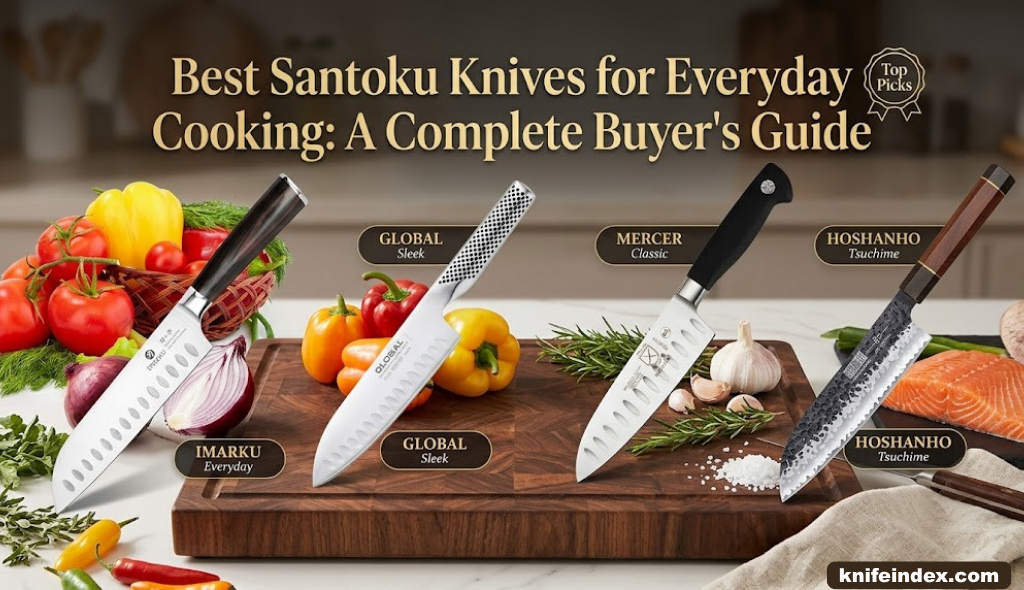
Best Santoku Knives for Everyday Cooking: A Complete Buyer’s Guide
Twelve santoku knives tested against the traits that actually matter in a home kitchen — balance, edge retention, comfort, and everyday versatility.

What Is a Santoku Knife?
The santoku is a Japanese kitchen knife whose name roughly translates to “three virtues” or “three uses,” referring to its ability to handle slicing, dicing, and mincing with equal confidence. Unlike a Western chef’s knife, which is designed around a rocking motion that pivots on a curved belly, the santoku has a flatter profile with a distinctive sheepsfoot-style tip that drops gently from spine to point. This shape encourages a straight up-and-down chopping motion rather than a rocking one, which many home cooks find more intuitive and less fatiguing during long prep sessions.
Most santoku blades run between 5 and 7 inches, noticeably shorter than the 8-inch standard for a Western chef’s knife. That shorter length isn’t a limitation — it’s a deliberate design choice that improves control, reduces wrist strain, and makes the knife easier to maneuver in smaller kitchens or on compact cutting boards. If you’ve ever wondered what a santoku knife is actually used for, the short answer is: nearly everything a home cook does on a daily basis, from breaking down vegetables to portioning proteins.
Many santoku blades also feature a granton edge — the shallow oval dimples you’ll see running along the side of the blade near the cutting edge. These pockets create small air gaps that reduce suction between the blade and whatever you’re slicing, which is especially useful when working through starchy vegetables like potatoes or sticky items like cheese.
Why a Santoku Belongs in Every Kitchen
If you already own a chef’s knife, you might wonder whether a santoku is a redundant purchase. In practice, the two knives complement rather than duplicate each other. The santoku’s flatter profile and lighter weight make it a natural fit for cooks who primarily work with vegetables, herbs, and boneless proteins rather than breaking down whole birds or thick cuts of meat.
The lighter blade also matters for anyone dealing with wrist fatigue or limited grip strength. Because the santoku relies less on the rocking motion and more on a controlled push-cut or chop, it puts less strain on the wrist joint during repetitive tasks like dicing an onion or julienning carrots. This is one of the essential knife skills every home cook should master, and a well-balanced santoku makes the learning curve considerably shorter.
There’s also a practical size argument. A 7-inch santoku is easier to store, easier to control for smaller hands, and less intimidating for cooks transitioning away from cheap Western knife sets. If you’re building out a rotation of specialty blades, pairing a santoku with a nakiri for dedicated vegetable prep gives you excellent coverage across nearly every task in the kitchen.
How We Chose These Knives
Selecting the best santoku knives for everyday use comes down to a handful of criteria that matter more than marketing claims. We weighted each knife against steel quality and expected edge retention, blade geometry and how it performs during a rock-free chopping motion, handle ergonomics across a range of hand sizes, balance point relative to the bolster, and overall value against comparable knives in the same price bracket.
We also paid attention to how each knife handles maintenance. Some santoku knives ship with high-hardness Japanese steel that holds an edge longer but requires more careful sharpening, while others use tougher, more forgiving stainless alloys that sacrifice a bit of edge retention for ease of upkeep. Understanding Rockwell hardness in kitchen knives helps explain why two knives that look nearly identical can behave very differently after a few months of regular use.
| Criteria | What We Looked For |
|---|---|
| Steel Quality | Edge retention, corrosion resistance, ease of sharpening |
| Blade Geometry | Flat profile, granton dimples, tip control |
| Handle Comfort | Grip material, weight distribution, hand fatigue over time |
| Balance | Bolster-to-blade weight ratio for control |
| Value | Price relative to comparable competitors |
Top Santoku Knife Picks

imarku Santoku Knife
The imarku santoku consistently comes up as a favorite for cooks who want Japanese-style geometry without a premium price tag. The high-carbon stainless steel blade takes an edge quickly and holds it reasonably well through weeks of daily vegetable prep, while the ergonomic handle keeps the knife from feeling front-heavy even during extended chopping sessions.
Pros
- Excellent value for the steel quality offered
- Comfortable, non-slip handle
- Sharp out of the box
Cons
- Handle finish can wear over years of use
- Not dishwasher recommended

Global 7″ Hollow Ground Santoku Knife
Global knives are instantly recognizable by their one-piece stainless steel construction and dimpled handle, and this santoku is no exception. The hollow-ground edge reduces drag through dense vegetables, and the lightweight build makes it one of the most nimble options in this roundup. It’s a favorite among cooks who prioritize speed and precision over heft.
Pros
- Exceptionally lightweight and agile
- Hollow-ground edge reduces sticking
- Seamless, easy-to-clean construction
Cons
- Thin handle may not suit larger hands
- Premium price point

Mercer Culinary M20707 Genesis 7-Inch Santoku Knife
Mercer’s Genesis line is a staple in culinary schools for good reason: consistent quality control, a forgiving high-carbon German steel blade, and a textured Santoprene handle that stays grippy even when wet. This santoku strikes a practical middle ground between Japanese-style geometry and Western durability.
Pros
- Textured grip stays secure when wet
- Full tang for balance and durability
- NSF certified
Cons
- Slightly heavier than pure Japanese-style santokus
- Bulkier handle profile

SHAN ZU 7 Inch Japanese Santoku Knife
SHAN ZU has built a reputation for delivering high-carbon stainless blades at prices that undercut most of the competition without an obvious drop in performance. This santoku arrives with a clean, minimalist profile and enough heft to power through root vegetables while remaining light enough for delicate herb work.
Pros
- Strong value-to-performance ratio
- Comfortable pakkawood-style handle
- Sharp factory edge
Cons
- Edge retention trails premium options
- Limited long-term brand track record

HOSHANHO 7″ Santoku Knife
HOSHANHO’s santoku leans into a traditional Japanese aesthetic, with a hammered Damascus-style pattern on the blade face and a well-balanced octagonal handle. It performs admirably on everyday vegetable and protein prep, and the visual detailing makes it a nice option for cooks who want their tools to look as good as they perform.
Pros
- Attractive Damascus-pattern finish
- Well-balanced octagonal handle
Cons
- Pattern is often etched rather than forged
- Requires hand-washing to preserve finish

WICKWILLOW 7″ Santoku Knife
WICKWILLOW’s santoku is aimed squarely at cooks who want a lightweight, no-frills option that still delivers a clean, precise cut. It’s a straightforward workhorse blade without much brand recognition, but the fundamentals — a properly ground edge and a balanced handle — are all in place.
Pros
- Lightweight and easy to maneuver
- Affordable entry point
Cons
- Less refined fit and finish than name brands
- Thinner steel may chip on hard contact

Shun Classic 7″ Hollow Ground Santoku Knife
Shun’s Classic line remains one of the most respected names in Japanese-style cutlery, and this santoku shows why. The VG-MAX steel core delivers excellent edge retention, while the hollow-ground granton edge minimizes sticking on everything from cucumber to sweet potato. The pakkawood handle feels premium without being slippery.
Pros
- Outstanding edge retention from VG-MAX steel
- Beautiful Damascus cladding
- Excellent balance and control
Cons
- Higher price point
- Requires more careful sharpening technique

Victorinox Swiss Classic 7 Inch Santoku Knife
Victorinox has a well-earned reputation for producing dependable, easy-to-sharpen knives at accessible prices, and this santoku follows that formula closely. The stamped blade is lighter than forged alternatives, and the textured Fibrox-style handle offers a secure grip even with wet or greasy hands, making it a strong choice for beginners still building confidence with a santoku’s chopping motion.
Pros
- Extremely easy to sharpen and maintain
- Trusted, long-standing brand reputation
- Lightweight for extended prep sessions
Cons
- Stamped blade lacks the heft of forged options
- Edge retention is average

WÜSTHOF Classic 7″ Santoku Knife
WÜSTHOF brings its signature full-tang, triple-riveted construction to the santoku format, resulting in a blade that feels noticeably more substantial than most Japanese-style competitors. The precision-forged high-carbon steel takes a very fine edge and holds it well for a German-made knife, making this a favorite among cooks who already prefer the WÜSTHOF ecosystem for their other blades.
Pros
- Excellent build quality and durability
- Full tang, triple-riveted handle
- Well-suited to heavier chopping tasks
Cons
- Heavier than traditional Japanese santokus
- Premium pricing

Tojiro Professional Santoku 6.7″
Tojiro is well known among enthusiasts for offering genuinely high-quality Japanese steel at prices that undercut most competitors. This slightly shorter santoku uses a VG-10 core clad in softer stainless steel, giving it excellent edge retention while remaining easy to sharpen — a combination that’s harder to find than it should be at this price.
Pros
- VG-10 core delivers strong edge retention
- Excellent value for genuine Japanese steel
- Compact size suits smaller hands
Cons
- Basic handle lacks premium finishing
- Slightly shorter blade than standard santokus

Mercer Culinary M23590 Renaissance Santoku
The Renaissance line is Mercer’s step up from the Genesis series, offering a fully forged high-carbon German steel blade with a bolster for added balance and finger protection. It’s a dependable option for cooks who want the durability of a forged Western-style knife with the flatter, chop-friendly geometry of a santoku.
Pros
- Forged construction with protective bolster
- Balanced weight distribution
Cons
- Heavier feel compared to Japanese-style options
- Handle can feel bulky for smaller hands

ZWILLING Pro 5.5-Inch Hollow Edge Santoku
ZWILLING’s Pro line takes a slightly smaller approach to the santoku format, and the result is a remarkably nimble knife for fine dicing and mincing work. The precision-forged blade uses ZWILLING’s proprietary steel formula, and the hollow-edge design reduces food sticking during rapid, repetitive cuts.
Pros
- Excellent for fine dicing and mincing
- Trusted German engineering
- Hollow edge reduces sticking
Cons
- Shorter blade limits use for larger produce
- Premium price for the size

KYOKU Santoku Knife
KYOKU has built a loyal following by pairing high-carbon Japanese steel with striking G10 handles more commonly seen on outdoor and tactical knives. This santoku benefits from that crossover design, offering a full-tang construction that’s noticeably more durable than many competitors in its price range, along with a grippy handle that performs well in wet kitchen conditions.
Pros
- Durable G10 handle resists moisture
- Full-tang construction for balance
- Comes with a protective sheath
Cons
- Aggressive handle styling may not suit every kitchen aesthetic

Cutluxe Santoku Knife
Cutluxe rounds out this list with a forged high-carbon steel santoku that emphasizes comfort above all else. The full-tang, ergonomic Pakkawood handle is shaped to reduce hand fatigue, and the blade’s slightly thicker spine gives it a confident, substantial feel without tipping into unwieldy territory.
Pros
- Comfortable ergonomic handle shape
- Solid full-tang construction
- Good balance for extended prep
Cons
- Thicker spine reduces slicing finesse slightly
Full Comparison Table
| Knife | Blade Length | Steel Type | Best For |
|---|---|---|---|
| imarku Santoku | 7″ | High-carbon stainless | Everyday value |
| Global Hollow Ground | 7″ | CROMOVA 18 stainless | Lightweight precision |
| Mercer Genesis | 7″ | High-carbon German steel | Culinary students |
| SHAN ZU | 7″ | High-carbon stainless | Budget shoppers |
| HOSHANHO | 7″ | Damascus-pattern stainless | Style-conscious cooks |
| WICKWILLOW | 7″ | Stainless steel | Entry-level buyers |
| Shun Classic | 7″ | VG-MAX steel | Premium performance |
| Victorinox Swiss Classic | 7″ | Stamped stainless | Beginners |
| WÜSTHOF Classic | 7″ | High-carbon forged steel | Heavier chopping |
| Tojiro Professional | 6.7″ | VG-10 core | Value Japanese steel |
| Mercer Renaissance | 7″ | Forged high-carbon German steel | Bolster balance |
| ZWILLING Pro | 5.5″ | Proprietary German steel | Fine dicing/mincing |
| KYOKU | 7″ | High-carbon Japanese steel | Durability |
| Cutluxe | 7″ | Forged high-carbon steel | Comfort-focused prep |
Understanding Santoku Steel Types
Steel choice is arguably the single biggest factor separating a great santoku from a mediocre one. Most santoku knives fall into one of two broad camps: high-carbon Japanese steels like VG-10 and VG-MAX, or German-style high-carbon stainless alloys. Japanese steels typically run harder on the Rockwell scale, which means they hold a fine edge longer but can be more prone to chipping if used carelessly on bone or frozen food. German steels trade a bit of that edge retention for added toughness and easier sharpening.
If you’re comparing specific alloys across your knife collection, resources like our breakdown of VG-10 vs. AUS-10 or the more advanced MagnaCut vs. M390 comparison can help you understand how kitchen steels relate to the same principles used in pocket knife steel selection. The underlying chemistry — carbon content, chromium for corrosion resistance, and trace elements like vanadium — behaves consistently whether the blade ends up in your pocket or your kitchen drawer.
For cooks who want a deeper technical dive, our guide to common knife steel types explains how VG-10, AUS-8, and 440C compare across hardness, edge retention, and price. Most santoku knives in the mid-range and premium categories use some variation of these three steels, so understanding their tradeoffs will help you interpret manufacturer claims more critically.
Santoku vs. Chef’s Knife vs. Nakiri
It’s worth clarifying how the santoku fits alongside two other common kitchen blades. A chef’s knife typically ranges from 8 to 10 inches, with a curved belly designed for a rocking cutting motion — ideal for cooks who need to break down larger cuts of meat or work through high-volume prep at speed. Our comparison of the chef’s knife vs. santoku goes deeper into how the rocking motion differs from the santoku’s push-cut style.
The nakiri, on the other hand, is a rectangular, single-purpose vegetable knife with a completely flat edge and no point at all. It excels at straight-down chopping but isn’t well suited to slicing proteins or performing precision tip work. If you’re deciding between the two, our detailed nakiri vs. santoku vegetable cutting comparison breaks down exactly where each blade shines. In short: the santoku is the more versatile all-rounder, while the nakiri is a specialist tool best suited to cooks who prep enormous quantities of vegetables regularly.
| Feature | Santoku | Chef’s Knife | Nakiri |
|---|---|---|---|
| Blade Length | 5–7″ | 8–10″ | 5–7″ |
| Cutting Motion | Push-cut / chop | Rocking motion | Straight chop |
| Tip Shape | Sheepsfoot | Curved point | Flat, no point |
| Best For | General everyday tasks | Meat, high-volume prep | Dedicated vegetable prep |
History & Origin of the Santoku
The santoku’s story begins in post-war Japan, sometime in the mid-twentieth century, when Japanese cutlery makers set out to design a knife that could replace several traditional single-purpose blades with one general-use tool. Historically, Japanese kitchens relied on separate knives for different tasks: the nakiri for vegetables, the deba for fish and poultry, and the yanagiba for slicing sashimi. Each excelled at its job but required a dedicated blade, a rack of tools, and a fair amount of specialized skill to use correctly.
The santoku emerged as a practical compromise — a knife accessible enough for home cooks who didn’t want to master three or four separate blade shapes, yet capable enough to handle the bulk of everyday kitchen work. Its name, often translated as “three virtues” or “three uses,” is generally understood to reference its versatility across meat, fish, and vegetables, though some food historians argue it more accurately reflects its three core techniques: slicing, dicing, and mincing.
By the late twentieth century, the santoku had crossed over into Western kitchens, aided in part by cooking shows and culinary schools that recognized its ergonomic advantages over the traditional chef’s knife. Today it sits alongside the chef’s knife as one of the two most commonly recommended all-purpose blades for home cooks, and its popularity has only grown as more manufacturers — from budget-friendly brands to premium Japanese cutlery houses — have added santoku options to their lineups. Understanding this lineage also helps explain why so many santoku knives borrow design cues from older single-purpose blades; the history of Japanese knife making from samurai to sushi traces this evolution in far more detail, showing how centuries of Japanese metallurgy and blade philosophy fed directly into the tools sitting in kitchens today.
It’s worth noting that the santoku isn’t a single standardized design the way, say, a chef’s knife largely is. Different regions and different makers have historically interpreted the “three virtues” concept slightly differently, which is part of why you’ll see variation in tip curvature, spine thickness, and even handle shape across the fourteen knives reviewed above. Some lean closer to a traditional Japanese profile with a thinner, harder edge; others, particularly from German and American manufacturers, adapt the santoku shape onto a more familiar Western-style full-tang construction.
Santoku Blade Geometry Explained
Blade geometry is the single most important factor determining how a santoku actually feels and performs in your hand, and it’s often the least understood by first-time buyers. Three measurements matter most: blade height (the distance from edge to spine), edge angle (how acute the cutting bevel is), and spine thickness (how much steel remains before it tapers into the edge).
Santoku knives typically have a taller blade than a comparable chef’s knife, which gives your knuckles more clearance above the cutting board — a small detail that makes a noticeable difference during long prep sessions. That extra height also creates a larger flat “belly” area, reinforcing the santoku’s straight-down chopping motion rather than the rocking cut associated with curved Western blades.
Edge angle is where Japanese and German philosophies diverge most sharply. Traditional Japanese santoku blades are often sharpened to a narrower angle, sometimes as acute as 12 to 15 degrees per side, which produces an extremely fine, precise edge at the cost of some durability. German-style santokus, including options like the WÜSTHOF Classic reviewed above, typically use a slightly wider angle closer to 17 to 20 degrees per side, sacrificing a bit of cutting finesse for an edge that resists chipping and rolling under heavier use. Neither approach is universally “better” — the right choice depends on how carefully you’re willing to handle and maintain the blade.
Spine thickness, meanwhile, affects how a knife feels pushing through dense vegetables like butternut squash or sweet potato. A thinner spine, tapering aggressively toward the edge, slices through resistance with less effort but offers less structural strength. Thicker spines, common on knives like the Cutluxe or Mercer Renaissance, feel more substantial and are more forgiving of minor technique lapses, though they require slightly more force to push through dense produce. If you want to understand how these principles apply more broadly across the knife world, our explainer on thin vs. thick behind the edge covers the tradeoffs in more depth, and the concepts translate directly to choosing between the santoku options above.
Blade Size Guide: Which Length Fits You
Most santoku knives fall between 5 and 7 inches, but that two-inch range covers a surprisingly wide spectrum of use cases. A shorter blade, like the 5.5-inch ZWILLING Pro reviewed above, trades cutting surface for maneuverability — it’s an excellent choice for cooks with smaller hands, for fine mincing work like garlic or shallots, or for anyone who finds a full-size chef’s knife intimidating to control.
The 7-inch length is the most common santoku size for a reason: it strikes a practical balance between cutting capacity and control, handling everything from a whole cabbage to a single scallion without feeling oversized or underpowered. Nearly all of the knives in this guide, including the imarku, Shun Classic, and WÜSTHOF Classic, land in this range for good reason.
Slightly shorter options in the 6.5 to 6.7-inch range, like the Tojiro Professional, sit in a comfortable middle ground — long enough for most everyday tasks, but noticeably lighter and quicker to maneuver than a full 7-inch blade. If you’re unsure which length to choose, consider your typical prep volume: cooks who regularly break down larger vegetables or prep for multiple people will likely prefer the reach of a 7-inch blade, while those focused on smaller portions, precision work, or who simply have smaller hands may find a 5.5 to 6.5-inch santoku more comfortable for daily use.
| Blade Length | Best Suited For | Example From This Guide |
|---|---|---|
| 5.5″ | Fine mincing, small hands, precision tasks | ZWILLING Pro |
| 6.5″–6.7″ | Balanced control and reach | Tojiro Professional |
| 7″ | General everyday versatility | imarku, Shun Classic, WÜSTHOF Classic |
Left-Handed & Ambidextrous Considerations
Left-handed cooks often assume Japanese knives are automatically off-limits because of the single-bevel grinds used on traditional specialty blades like the yanagiba or usuba. The good news is that nearly every santoku knife on the market — including all fourteen reviewed in this guide — uses a double-bevel edge, meaning the blade is sharpened symmetrically on both sides. That makes them fully ambidextrous and just as comfortable for left-handed cooks as right-handed ones.
Where handedness can matter slightly is in handle shape. Most Western-style handles, including the ones found on the Mercer Genesis, Cutluxe, and Victorinox Swiss Classic, are symmetrical and work equally well in either hand. Traditional octagonal or D-shaped Japanese handles, occasionally seen on more specialty blades, are sometimes contoured for a specific hand — but none of the santokus featured in this roundup use that asymmetrical handle style, so left-handed cooks can shop from this entire list without reservation.
For readers curious about single-bevel blades and why they behave differently, our comparison of single-bevel vs. double-bevel knives explains the mechanics in detail — useful context if you ever expand your collection into more specialized Japanese blade shapes down the line.
Santoku vs. Gyuto vs. Bunka
Beyond the chef’s knife and nakiri comparisons covered earlier, two other Japanese blade shapes frequently come up when cooks are deciding on their next knife: the gyuto and the bunka. The gyuto is essentially the Japanese interpretation of a Western chef’s knife — longer, with more blade curvature than a santoku, designed for a rocking motion and better suited to larger cuts of meat or high-volume prep. Our comparison of the gyuto vs. chef’s knife explains how the gyuto splits the difference between Japanese steel and Western-style geometry.
The bunka, meanwhile, is closer kin to the santoku but swaps the rounded sheepsfoot tip for an angular, reverse-tanto-style point, sometimes called a “K-tip.” That sharper point gives the bunka slightly more precision for detail work — scoring fish skin, trimming fat, or making fine decorative cuts — while retaining much of the santoku’s flat-profile chopping efficiency. Our detailed breakdown of bunka vs. santoku geometry and precision is a useful next read if any of the pointier tip shapes in this roundup, like the KYOKU or HOSHANHO, have you curious about how far you could push that design further.
In practice, most home cooks are well served by a standard santoku’s rounded profile. The bunka and gyuto are worth exploring once you’ve developed a clear sense of what you wish your santoku did differently — whether that’s more point control or a longer reach for bigger cuts of protein.
Handle Materials & Balance
Handle material has an outsized influence on how a santoku feels during real use. Pakkawood — a resin-infused wood composite — is common on premium Japanese-style santokus because it resists moisture while retaining a warm, natural feel. Composite handles like Santoprene or G10 trade some of that warmth for superior grip in wet or greasy conditions, which is why they show up frequently on knives designed for heavier daily use, similar to the reasoning behind handle material comparisons across the broader knife world.
Balance point matters just as much as material. A santoku that balances at or just in front of the bolster feels more controllable during rapid chopping, while a blade-heavy knife can tire out your wrist faster during long prep sessions. Our deeper explainer on why knife balance matters is worth reading if you’re torn between two santokus with similar specs on paper.
Mastering Santoku Cutting Techniques
Getting the most out of a santoku means adjusting your technique slightly from what you may have learned with a curved chef’s knife. Because the santoku’s blade profile is flatter, the most efficient motion is a controlled push-cut: lift the knife slightly, then drive it forward and down through the food in one continuous motion, letting the tip lead just enough to maintain contact with the board. This differs from the rock-and-roll motion used with a curved chef’s knife, where the heel of the blade stays anchored on the board as the tip pivots up and down.
For fine dicing work — onions, shallots, garlic — the santoku’s shorter, lighter profile actually gives you an advantage over a full-size chef’s knife. Guide the blade with your knuckles as a fence, moving your fingers back incrementally as you work through the ingredient, and let the knife’s own weight do most of the cutting rather than pressing down forcefully. This technique pairs especially well with lighter blades like the Global or ZWILLING Pro, where the reduced mass makes rapid, repetitive cuts less fatiguing.
Julienne and brunoise cuts — thin matchsticks and small, uniform cubes, respectively — benefit from the santoku’s flat belly, which makes it easier to produce consistent, parallel slices before turning the stack ninety degrees for the final cut. Chiffonade, the technique used for thinly ribboning leafy herbs like basil or mint, works especially well with a santoku’s sharp, precise edge; stack and roll the leaves tightly, then use smooth, even strokes rather than a sawing motion to avoid bruising the leaf.
Whichever cuts you’re practicing, resist the urge to force the blade through resistance. A properly sharpened santoku, paired with correct technique, should glide through most vegetables with minimal downward pressure. If you find yourself needing to lean into the cut, that’s usually a sign the edge needs honing or the technique needs adjusting rather than a sign you need a heavier knife. For a broader technique refresher, our guide to essential knife skills every home cook must master covers grip, board setup, and safety fundamentals that apply directly to santoku use.
Care, Sharpening & Maintenance
A santoku knife, like any quality kitchen blade, rewards proper maintenance with years of reliable performance. Hand-washing immediately after use, drying thoroughly, and storing on a magnetic strip or in a knife block rather than loose in a drawer will dramatically extend the life of the edge and prevent unnecessary corrosion, especially on higher-carbon steels that are more reactive than standard stainless.
Sharpening frequency depends heavily on steel hardness. Softer, more forgiving steels like those found on the Victorinox or Mercer Genesis models can be touched up on a honing rod between full sharpenings, while harder Japanese steels like VG-10 or VG-MAX benefit more from periodic whetstone sessions. Our guide comparing a whetstone vs. electric sharpener explains the tradeoffs between control and convenience, and our breakdown of honing steel vs. whetstone clarifies the difference between realigning an edge and actually regrinding it.
If you notice surface discoloration or light rust spots developing on a high-carbon blade, don’t panic — this is common and usually cosmetic. Our guide on removing rust from kitchen knives covers safe methods that won’t damage the underlying steel, and our broader piece on preventing rust on knives offers habits that will keep your santoku looking new for years.
For long-term sharpness, investing in one of the best knife sharpeners on the market pays for itself many times over compared to the cost of replacing a dulled blade prematurely.
Price Tiers Explained
Santoku knives span a wide price range, and understanding what you’re actually paying for at each tier makes it much easier to avoid both overspending and underspending. At the budget end, knives like the WICKWILLOW and SHAN ZU typically use simpler stamped or basic forged construction with stainless steel that prioritizes corrosion resistance and ease of sharpening over maximum edge retention. These are perfectly capable knives for everyday use, but you’ll likely need to hone or sharpen them more frequently than a premium option.
The mid-range tier — where the imarku, Mercer Genesis, HOSHANHO, and KYOKU sit — introduces better steel formulations, more refined handle ergonomics, and often full-tang construction for improved balance. This is typically the sweet spot for home cooks who use their santoku daily but don’t necessarily need the absolute best edge retention on the market.
Premium santokus, including the Shun Classic, Global, and WÜSTHOF Classic, justify their higher price through superior steel formulations like VG-MAX or precision-forged German alloys, tighter manufacturing tolerances, and often a more refined balance point that becomes noticeable only after you’ve used a lesser knife for comparison. Whether that premium is worth paying depends largely on how frequently you cook and how much you value the marginal improvements in edge retention and feel. Cooks who prep meals daily will likely notice — and appreciate — the difference far more than occasional cooks who use a santoku a few times a month.
| Tier | Typical Price Range | What You’re Paying For |
|---|---|---|
| Budget | Under $30 | Basic stainless steel, simple construction |
| Mid-Range | $30–$70 | Better steel, full tang, refined ergonomics |
| Premium | $70+ | Superior steel formulations, precision grinding, brand craftsmanship |
Building a Knife Set Around Your Santoku
A santoku makes an excellent anchor for a small, purposeful knife collection rather than a bulky twelve-piece block set filled with knives you’ll rarely touch. Once your santoku is handling daily vegetable and protein prep, the next most useful addition for most cooks is a paring knife for small, detail-oriented tasks like deveining shrimp, hulling strawberries, or peeling garlic — jobs where a full-size santoku is simply too large to control precisely.
From there, a serrated bread knife fills a gap no santoku can, since the smooth edge of a santoku will crush rather than cleanly slice through crusty bread or delicate cakes. Our comparison of blade edge types and our dedicated serrated bread knife roundup can help you round out this second tier of your collection.
Cooks who frequently work with fish or want more precision for detail cutting might consider adding a boning or utility knife next; our utility knife uses guide explains where that blade shape fits relative to a santoku. And if you find yourself drawn toward more specialized Japanese blade shapes after living with a santoku for a while, the 10 knife types and how their edge geometry fits specific tasks is a useful map for planning your next few purchases. Most home cooks find that three to five well-chosen knives — anchored by a versatile santoku — outperform a large mismatched set purchased all at once.
Storage Solutions Compared
How you store a santoku knife between uses has a direct impact on both edge longevity and kitchen safety. Traditional knife blocks remain popular because they keep blades separated and protected, but they take up significant counter space and can harbor moisture if knives are stored before they’re fully dry. A magnetic knife strip solves the space and moisture issues elegantly, though it does expose the edge to potential contact damage if knives are placed and removed carelessly; our guide on magnetic strips and edge damage explains how wood-encased bars reduce that risk considerably.
For smaller kitchens, a compact in-drawer organizer can be the most space-efficient option, keeping blades separated and preventing the “junk drawer” scenario where a santoku edge dulls quickly from contact with other metal utensils. Our comparison of small kitchen knife storage layouts covers several practical configurations worth considering if counter space is limited.
If you travel with your santoku — for example, taking it along on vacation rentals or to a friend’s kitchen for meal prep — a dedicated blade guard or padded knife roll is essential for both safety and edge protection. Our guide to traveling with kitchen knives safely covers the practical logistics, including how to handle airline and rental car restrictions if your trip involves flying.
Santoku Myths Debunked
A handful of persistent myths tend to follow santoku knives around, and clearing them up can save you from making decisions based on outdated or inaccurate information. The first is the idea that a santoku is strictly a “beginner” knife not suited for serious cooking. In reality, premium options like the Shun Classic and Global are used extensively in professional kitchens, particularly by chefs who specialize in vegetable-forward cuisine or who simply prefer the santoku’s flatter, more controlled chopping motion over a traditional chef’s knife.
Another common misconception is that all santoku knives are dishwasher safe simply because they’re marketed as low-maintenance. Even knives labeled dishwasher safe generally perform and last better with hand-washing, since dishwasher detergents and prolonged heat exposure can degrade handle materials and dull edges faster than gentle hand care.
Finally, many shoppers assume a higher price always means a sharper or longer-lasting edge. While premium steel formulations like VG-MAX genuinely do offer better edge retention on average, a well-maintained budget santoku with proper honing habits can outperform a neglected premium blade. Skill and consistency in maintenance frequently matter more than the number printed on the price tag.
Sustainability & Handle Materials
Sustainability is an increasingly common consideration for cooks choosing a santoku, particularly around handle materials. Pakkawood, used on several knives in this roundup including the Shun Classic and Cutluxe, is a composite material made from wood fibers infused with resin, which allows manufacturers to use less old-growth hardwood per handle while still achieving a durable, moisture-resistant result. This makes it a reasonably sustainable middle ground between solid wood and full synthetic composites.
Synthetic materials like G10, found on the KYOKU, and Santoprene, used on the Mercer lines, are typically petroleum-based composites. While not biodegradable, they’re extremely long-lasting, which arguably offsets some of their environmental footprint by reducing how often the knife — and its packaging — needs replacing. Stainless steel blades themselves are highly recyclable at the end of a knife’s usable life, unlike some composite or plastic-handled alternatives that are harder to break down for recycling.
For cooks who weigh sustainability heavily in their purchasing decisions, prioritizing durability and repairability — buying a knife you’ll actually keep sharpened and maintained for a decade or more, rather than replacing a cheaper option every year or two — is often the most meaningful sustainability decision you can make in the kitchen.
Gift Guide: Santoku for Every Cook
A santoku knife makes a genuinely useful gift, but matching the right model to the recipient matters. For a new home cook just starting to build confidence in the kitchen, the Victorinox Swiss Classic or Mercer Genesis are safe, forgiving choices that won’t punish inexperience with a difficult sharpening process or an unforgivingly hard edge.
For the cook who already has a full knife collection and appreciates finer craftsmanship, the Shun Classic or Global stand out as gifts that feel genuinely special without straying into impractical territory — both are knives that see daily use rather than sitting in a display case. And for someone who cooks in high volume or has a larger household to feed regularly, the WÜSTHOF Classic or KYOKU offer the added durability and heft that heavier use demands.
If you’re shopping for someone who already owns a santoku and want to round out their collection instead, consider pairing your gift with a complementary tool, such as one of the best knife sharpeners or a quality cutting board — practical additions that show thoughtfulness without duplicating a knife they may already own.
Who Should Buy Which Santoku
Not every santoku suits every cook, and matching the right knife to your habits in the kitchen matters more than chasing the highest-rated option on paper. Beginners who are still building confidence with knife skills will generally do best with a lighter, easier-to-sharpen option like the Victorinox Swiss Classic or the Mercer Genesis, both of which forgive minor technique errors without punishing you with a difficult sharpening process.
Cooks who already have some experience and want to step up their performance should look toward the Shun Classic or Tojiro Professional, both of which use genuine Japanese steel cores that reward proper technique with noticeably longer edge retention. Meanwhile, anyone who does heavier daily chopping — thick-skinned squash, dense root vegetables, or larger batches of prep — will likely prefer the added heft and durability of the WÜSTHOF Classic or KYOKU.
If your kitchen doubles as a training ground for the next generation of home cooks, our roundup of best chef knives for home cooks pairs nicely with a santoku pick as a complementary two-knife starter set.
Style-conscious cooks who want their tools to look as good on a magnetic strip as they perform at the cutting board often gravitate toward the HOSHANHO, whose Damascus-pattern finish adds visual interest without sacrificing everyday usability. Meanwhile, cooks who value compactness above all else — smaller hands, tighter kitchen storage, or a preference for finer, more controlled cuts — will likely find the ZWILLING Pro’s 5.5-inch profile the most comfortable daily companion in this entire lineup.
It’s also worth considering how a santoku fits into a household with multiple cooks of varying skill levels and hand sizes. In shared kitchens, a mid-weight, ergonomically neutral option like the imarku or SHAN ZU tends to accommodate the widest range of users comfortably, whereas more specialized picks — like the ultra-light Global or the heavier WÜSTHOF — may suit one household member noticeably better than another. If your kitchen serves multiple cooks regularly, it may be worth owning two santokus at different weight and size profiles rather than expecting a single blade to satisfy everyone equally.
What Professional Chefs Say About Santoku Knives
Professional kitchens tend to favor longer chef’s knives and gyutos for high-volume line work, but that doesn’t mean the santoku is absent from professional settings. Many chefs keep a santoku in personal rotation specifically for vegetable-forward prep, plating garnishes, or tasting-menu work where precision matters more than raw cutting speed. The flatter profile and lighter weight make it a natural fit for the kind of controlled, repetitive cuts required when prepping delicate garnishes or portioning components for plated dishes.
Culinary instructors also frequently introduce students to knife fundamentals using a santoku rather than a full-size chef’s knife, precisely because the more intuitive push-cut motion is easier to teach and easier for beginners to execute safely. This is part of why brands like Mercer, which supplies a large share of culinary school programs, put so much engineering effort into their Genesis and Renaissance santoku lines — consistency and safety matter enormously when a knife is being used by dozens of students with varying skill levels every semester.
That said, professional opinion is far from unanimous. Some chefs trained primarily in French technique find the santoku’s flat profile awkward compared to the rocking motion they’ve spent years perfecting with a curved chef’s knife, and prefer to reserve their santoku for specific tasks rather than making it their primary blade. This is a useful reminder that “best” is highly dependent on your existing technique and preferences — there’s no single correct answer, only what works best for your own hands and habits.
Santoku Knives for Wrist Comfort and Limited Grip Strength
For cooks managing wrist pain, arthritis, or general grip fatigue, blade choice can make a meaningful difference in how comfortable and sustainable daily cooking feels. The santoku’s lighter overall weight compared to a full-size chef’s knife reduces the cumulative strain of repetitive chopping motions, and its straight, controlled push-cut requires less wrist rotation than the rocking motion associated with curved blades.
Handle diameter and shape also matter significantly here. Thicker, contoured handles — like those found on the Mercer Genesis or Cutluxe — distribute grip pressure across a larger surface area, which can reduce strain for cooks with limited hand strength or joint sensitivity. Thinner, more minimalist handles, like those on the Global or Tojiro Professional, offer excellent control for cooks without grip limitations but may feel less forgiving during extended use for those managing hand pain.
If wrist comfort is a significant concern, it’s also worth paying attention to blade weight distribution rather than just overall weight. A santoku that balances closer to the handle, rather than being blade-heavy, requires less wrist effort to control through each cutting motion, since you’re not constantly fighting the knife’s tendency to tip forward. Testing a knife in-hand before buying — or reading detailed reviews that specifically mention balance point, like the comparisons throughout this guide — can help you avoid a purchase that looks appealing on paper but proves fatiguing in daily use.
How to Test Whether Your Santoku Needs Sharpening
Knowing when a santoku actually needs sharpening — rather than just a quick honing touch-up — prevents both premature resharpening, which wastes steel, and delayed maintenance, which makes the eventual sharpening session more difficult. The simplest at-home test is the paper test: hold a sheet of standard printer paper by one edge and attempt a smooth slicing motion through it near the top. A properly sharp santoku should glide through cleanly with minimal tearing or snagging; if the blade catches, folds the paper, or requires noticeable sawing, it’s time for at least a honing session.
A second reliable indicator is how the blade handles a ripe tomato. This has become something of an informal industry standard specifically because tomato skin is thin but resilient — a sharp blade should pierce the skin cleanly with almost no downward pressure, while a dull edge tends to squash the surface before finally breaking through. If you find yourself pressing down significantly harder than usual to get through a tomato’s skin, your santoku likely needs attention.
Visual inspection under good light can also reveal early warning signs. Run your eye along the edge looking for tiny reflective glints or flat spots — a truly sharp edge is so thin it won’t reflect light directly back at you, while a dulled or rolled edge often catches and reflects light in small, visible points along its length. Catching this early, before the edge becomes visibly damaged, makes maintenance quicker and less invasive on the steel.
Warranty & Return Considerations
Warranty coverage varies meaningfully across the brands featured in this roundup, and it’s worth checking before you buy, particularly for higher-priced options. Established cutlery brands like WÜSTHOF, ZWILLING, and Shun typically offer lifetime warranties against manufacturing defects, covering issues like blade delamination or handle failure under normal use, though these warranties generally exclude damage from misuse, such as chipping caused by cutting bone or frozen food.
Newer or smaller brands, including several of the value-oriented options in this guide, often provide more limited coverage — commonly ranging from one to a few years — but frequently compensate with more flexible return policies through Amazon’s standard marketplace protections. Reading the specific manufacturer warranty terms listed on each product page before purchasing is always worthwhile, especially if you’re investing in a premium option you expect to use for a decade or more.
Regardless of warranty length, keeping your original packaging and purchase confirmation for the first several weeks after a purchase is good practice, since most return windows for quality or defect issues are relatively short even when a longer warranty exists for genuine manufacturing problems that surface later.
Buying Checklist Before You Order
| Question | Why It Matters |
|---|---|
| What’s your primary use case — vegetables, proteins, or both? | Determines blade weight and geometry needs |
| Do you want a granton edge? | Reduces food sticking on dense or starchy items |
| Are you comfortable sharpening harder steels? | Impacts long-term maintenance effort |
| What’s your hand size? | Affects handle comfort and control |
| Is dishwasher safety a requirement? | Most quality santokus require hand-washing |
Seasonal and Diet-Specific Uses for a Santoku
A santoku’s versatility shines particularly well across seasonal cooking shifts. During colder months, when meal prep tends to revolve around dense root vegetables — squash, turnips, celeriac, and thick-skinned potatoes — the added blade height and flat profile make quick work of stabilizing and slicing through irregular, hard-to-balance produce. Knives with a bit more spine thickness, like the Cutluxe or WÜSTHOF Classic, tend to feel especially confident during this kind of heavy winter prep.
In warmer months, when cooking shifts toward salads, fresh herbs, and quick-prep proteins for grilling, the santoku’s precision and lighter weight become the bigger asset. A hollow-ground or granton-edge option, such as the Global or Shun Classic, minimizes sticking when slicing through cucumber, zucchini, and other high-moisture summer produce, keeping prep fast even when you’re cutting large batches for a cookout or meal-prep session.
Plant-forward and vegetarian cooking in particular tends to lean heavily on a santoku’s core strengths. Because so much of a vegetable-centric diet revolves around dicing, mincing, and thin slicing rather than breaking down large cuts of meat, a santoku can realistically serve as a primary knife for cooks eating this way, with a paring knife handling the remaining detail work. For cooks who eat a more protein-heavy diet, the santoku still handles boneless cuts capably, though pairing it with a dedicated boning or butcher knife for bone-in work rounds out the kitchen more completely — a combination covered in our best boning knives guide.
Common Mistakes to Avoid
One of the most frequent mistakes home cooks make with a new santoku is treating it like a cleaver — using it to hack through bone-in poultry or frozen items. The thinner, harder edges common on Japanese-style santokus are simply not designed for that kind of abuse, and doing so risks chipping the blade. Reserve heavier-duty tasks for a dedicated cleaver or your chef’s knife instead, and consult our best cleaver knives guide if bone-in prep is a regular part of your cooking routine.
Another common error is skipping regular maintenance until the knife feels genuinely dull. Light, frequent honing sessions keep an edge performing well far longer than waiting until a full resharpening is unavoidable. A related mistake is applying far too much downward pressure during cuts, which is usually an unconscious compensation for a dull edge rather than a deliberate technique choice — if you notice yourself leaning your body weight into routine cuts, it’s a strong signal your santoku needs sharpening rather than more force.
Cutting on unsuitable surfaces is another overlooked issue. Glass, stone, and ceramic cutting boards may look attractive, but they’re significantly harder than the steel in your santoku’s edge and will dull it far faster than a wood or plastic board. Sticking to an appropriately soft cutting surface is one of the simplest, most overlooked ways to extend the interval between sharpenings.
Finally, storing a santoku loose in a drawer alongside other utensils is one of the fastest ways to damage a fine edge — a proper knife block, magnetic strip, or blade guard will pay for itself quickly, both in edge longevity and in reduced risk of an accidental cut while reaching into a cluttered drawer.
Frequently Asked Questions
What makes a santoku different from a chef’s knife?
The santoku has a flatter blade profile and a sheepsfoot tip, encouraging a push-cut or straight-down chopping motion rather than the rocking motion typical of a Western chef’s knife. It’s also generally shorter and lighter.
Is a santoku knife good for beginners?
Yes. Its lighter weight and more intuitive chopping motion make it especially approachable for cooks who are still developing confidence with knife skills.
Can a santoku replace a chef’s knife entirely?
For many home cooks, yes — especially those who primarily prep vegetables and boneless proteins. Cooks who regularly break down larger cuts of meat may still prefer keeping a chef’s knife on hand as well.
What does the granton edge on a santoku do?
The dimpled granton edge creates small air pockets that reduce suction between the blade and food, helping prevent sticky or starchy items from clinging to the sides of the blade.
How often should I sharpen my santoku knife?
This depends on frequency of use and steel hardness, but most home cooks should hone their santoku every few uses and fully resharpen every few months with regular daily use.
Are santoku knives dishwasher safe?
Most manufacturers recommend hand-washing to protect both the edge and the handle material, even on models advertised as dishwasher safe.
What blade length is best for a santoku?
7 inches is the most common and versatile length for home cooks, though shorter 5.5-inch options can offer added control for fine dicing work.
Is Japanese steel better than German steel for a santoku?
Neither is objectively better — Japanese steel typically offers superior edge retention but requires more careful maintenance, while German steel is tougher and easier to sharpen.
Can a santoku knife be used for slicing meat?
Yes, a santoku handles boneless proteins well, though it isn’t ideal for breaking down bone-in cuts, which are better suited to a boning or butcher knife.
What’s the difference between a santoku and a nakiri?
A nakiri is a rectangular, pointless vegetable-only knife, while a santoku has a sheepsfoot tip and handles a broader range of everyday kitchen tasks.
Do I need a bolster on a santoku knife?
A bolster adds balance and finger protection but isn’t strictly necessary. Many premium Japanese-style santokus skip it in favor of a lighter, more agile blade.
How do I know if a santoku knife is high quality?
Look for a clearly identified steel type, consistent bevel grinding, a comfortable and securely fitted handle, and manufacturer transparency about hardness and construction.
What sharpening angle should I use for a santoku knife?
Japanese-style santokus are typically ground between 12 and 16 degrees per side, while German-style santokus usually sit closer to 17 to 20 degrees per side. Matching your sharpening angle to the original factory grind preserves the blade’s intended performance.
Is a santoku knife suitable for left-handed cooks?
Yes. Nearly all santoku knives, including every option in this guide, use a symmetrical double-bevel edge and a symmetrical handle, making them fully comfortable for left-handed use.
Can a santoku knife help with wrist pain while cooking?
Many cooks managing wrist strain or limited grip strength find a santoku more comfortable than a full-size chef’s knife, thanks to its lighter weight and more controlled, less rotational cutting motion.
How can I tell if my santoku needs sharpening?
A simple paper test or tomato test can reveal a dull edge quickly — a sharp santoku should slice cleanly through paper or tomato skin with minimal pressure. Visible reflective glints along the edge under good light are another reliable warning sign.
Santoku Performance by Ingredient
Different ingredients put different demands on a santoku’s geometry and edge, and understanding these nuances can help you get more consistent results across your daily cooking. Onions, for instance, benefit enormously from a granton edge — the dimpled surface reduces the suction that would otherwise cause thin onion slices to cling stubbornly to the blade face, which is one reason the Global and Shun Classic, both hollow-ground options, feel noticeably more efficient during onion-heavy prep than flat-faced alternatives.
Leafy greens and fresh herbs reward a razor-sharp, thin edge more than raw blade weight. A dull or thick edge tends to bruise and tear delicate leaves like basil or cilantro rather than slicing them cleanly, which accelerates browning and dulls flavor. Premium Japanese steels like the VG-MAX in the Shun Classic or the VG-10 in the Tojiro Professional hold that fine edge longer through repeated herb prep than softer stainless alternatives.
Root vegetables — carrots, potatoes, beets, and similar dense produce — put more strain on the blade and benefit from a slightly thicker spine and more substantial handle for added leverage. The WÜSTHOF Classic and Cutluxe, both built with a bit more heft than the lighter Japanese-style options, tend to feel most confident working through these denser ingredients in volume.
Tomatoes and other thin-skinned, soft-fleshed produce are a genuine test of sharpness, since even a slightly dulled edge tends to squash rather than pierce the skin cleanly. Keeping any santoku properly honed is especially important if tomatoes are a frequent part of your prep, since a struggling cut here is often the earliest visible sign that maintenance is overdue.
Soft cheeses and similarly sticky ingredients behave much like starchy vegetables — a granton or hollow-ground edge reduces clinging considerably. For very soft or crumbly cheeses, a gentle sawing motion combined with light pressure tends to produce cleaner results than a single forceful chop, regardless of which santoku you’re using.
Final Verdict
A quality santoku knife earns its place in a home kitchen by doing the unglamorous daily work — dicing onions, slicing cucumbers, portioning chicken breasts — with more comfort and control than a heavier chef’s knife typically offers. Among the twelve knives covered here, the imarku Santoku stands out as the best overall pick for most home cooks thanks to its balance of price, steel quality, and comfort, while the Shun Classic remains the knife to reach for if premium edge retention is the priority. Beginners will find the Victorinox Swiss Classic the easiest to live with day to day.
Whichever santoku you choose, pairing it with proper care — regular honing, hand-washing, and safe storage — will ensure it performs at its best for years of everyday cooking.