Bunka Knife vs. Santoku: Which Japanese Multi-Purpose Blade is Right for You?
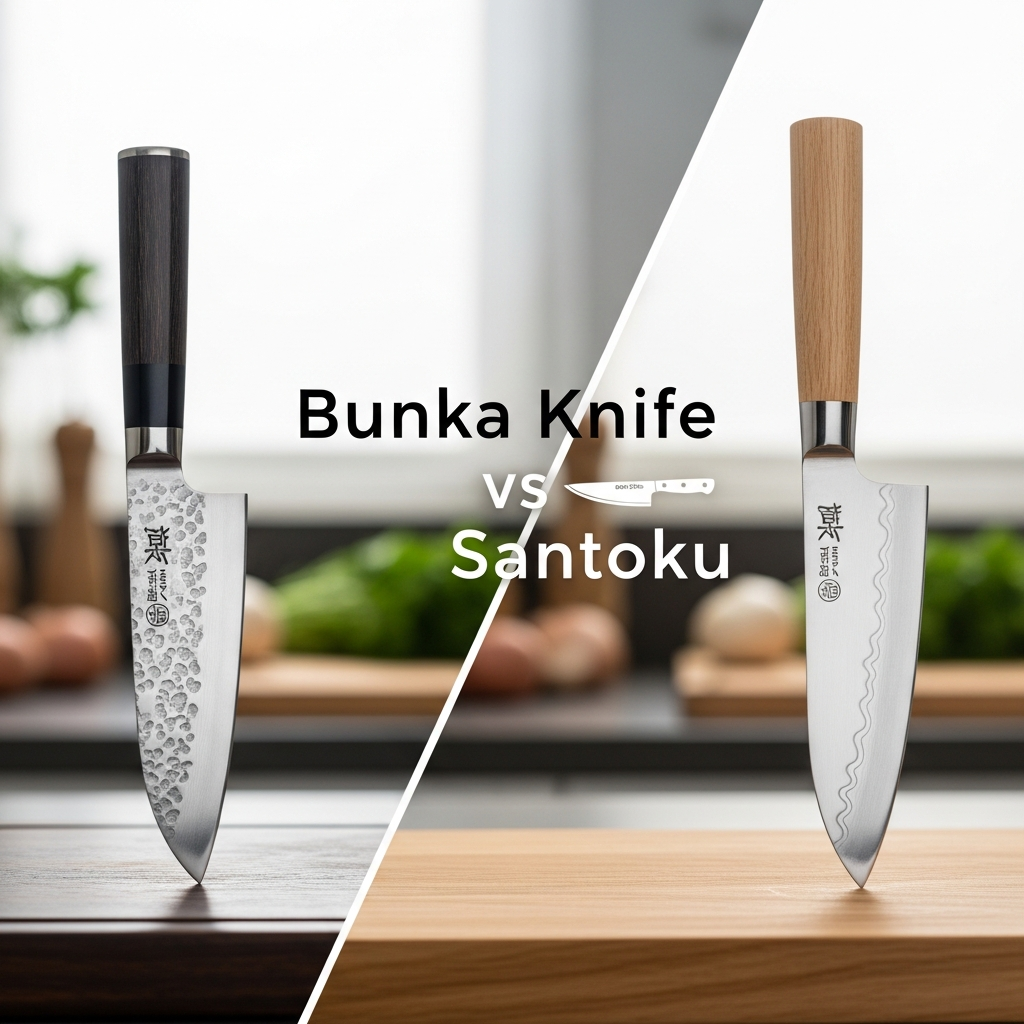
In the expansive and beautifully crafted world of Japanese kitchen knives, the mighty Chef’s Knife (the Gyuto) often steals the mainstream spotlight. But for home cooks and culinary professionals who value agility, precision, and a blade that doesn’t feel like wielding a medieval sword on a small cutting board, the mid-sized multi-purpose knives are truly the kings of the kitchen.
If you are browsing knifeindex.com looking for the perfect daily driver to upgrade your culinary arsenal, you have likely narrowed your search down to two formidable contenders: the legendary and ubiquitous Santoku, and its edgier, visually striking cousin, the Bunka.
At a passing glance, they look remarkably similar. They perform similar tasks. They are often forged by the same master blacksmiths using the same high-carbon steels. Yet, they possess entirely distinct personalities and handling characteristics. One is the safe, highly reliable family sedan of the knife world; the other is the sharp, aggressive, high-performance sports coupe. In this deeply comprehensive Bunka vs. Santoku guide, we will break down the geometry, the history, the “cool factor,” the metallurgy, and the real-world performance of each to help you make the perfect choice for your cutting board.
1. The Santoku: The “Three Virtues” Explained
The Santoku (Santoku Bocho) is undeniably the most common and recognizable Japanese knife shape found in Western kitchens today. Translated directly, “Santoku” means “Three Virtues” or “Three Uses.” Depending on who you ask, this refers to its mastery over slicing, dicing, and mincing, or its versatility in handling meat, fish, and vegetables.
Historically, the Santoku is a relatively modern invention. Emerging in Japan during the post-World War II economic boom, Japanese home cooks began incorporating more Western ingredients (like beef and pork) into their traditional fish and vegetable diets. The traditional Japanese vegetable cleaver (the Nakiri) struggled with meat, and the traditional fish slicer (the Yanagiba) was terrible for vegetables. The Santoku was born as a hybrid, taking the height of a Nakiri and adding a tip, creating a single blade that could do it all.
It typically features a relatively flat edge with a subtle curve (a “belly”) towards the front, and a rounded “sheep’s foot” tip that slopes gently down to meet the cutting edge. This specific geometry makes it incredibly user-friendly. It is the perfect bridge between a heavy Western Chef’s knife and a delicate Japanese slicer. If you are transitioning away from heavy, clunky German knives, the Santoku feels immediately friendly, safe, and intuitive. For a deeper dive into its exact uses, read our dedicated guide: What is a Santoku Knife Used For?.
The Santoku knife has become a staple in professional kitchens and home cooking environments across the globe. Its balanced design philosophy draws from centuries of Japanese bladesmithing tradition while incorporating modern ergonomic principles. The blade height, typically ranging from 44mm to 50mm, provides excellent knuckle clearance when chopping on a cutting board, preventing your fingers from making uncomfortable contact with the work surface. This generous height also allows the knife to double as a bench scraper, easily transferring diced vegetables from the cutting board directly into a waiting sauté pan or stock pot.
One of the most appealing aspects of the Santoku knife for beginners and experienced cooks alike is its forgiving nature. The rounded spine near the tip creates a natural safety feature that prevents accidental piercing injuries during rapid chopping motions. Additionally, many modern Santoku knives incorporate a Granton edge, also known as a kullenschliff pattern. These hollow-ground indentations along the blade face create small air pockets that reduce surface friction, allowing thin slices of starchy vegetables like potatoes, zucchini, and cucumbers to release cleanly from the blade rather than sticking and accumulating. This seemingly minor design element dramatically improves efficiency during high-volume prep work.
The Santoku excels in the push-cutting technique that is fundamental to Japanese culinary tradition. Rather than the rocking motion popularized by French and German knife designs, the push cut involves a straightforward downward and slightly forward motion. This technique preserves the cellular structure of delicate ingredients like herbs, preventing the bruising and discoloration that can occur when a curved blade crushes cell walls during a rocking chop. Professional sushi chefs and kaiseki practitioners have long understood that clean, precise cuts maintain the texture and appearance of ingredients, and the Santoku’s geometry is optimized for exactly this purpose.
2. The Bunka: The “Cultural” Knife
If the Santoku is the reliable workhorse, the Bunka Bocho (meaning “Cultural Knife”) is its badass, traditional ancestor. Like the Santoku, it is a general-purpose utility knife designed to tackle a wide variety of ingredients. However, the defining characteristic of the Bunka is its tip.
Instead of a gentle, rounded slope, the Bunka features a “K-Tip” (Reverse Tanto). The spine of the knife stays completely straight until the very end, where it abruptly and sharply angles down to meet the cutting edge at a fine point.
This sharp, aggressive, needle-like tip makes the Bunka an absolute master of detail work. It allows you to score onions horizontally with zero resistance, delicately trim silver skin off a pork tenderloin, cleanly slice garlic paper-thin, and perform intricate brunoise cuts that the rounded, blunt nose of a Santoku simply struggles to execute.
Historically, the Bunka was actually more popular in Japanese households than the Santoku prior to the 1950s. The name “Cultural Knife” stems from its role in the shifting culinary culture of Japan as it opened up to Western influences. Today, it has seen a massive resurgence among knife enthusiasts purely because of its aggressive aesthetic and high-performance feel.
The Bunka knife represents a fascinating intersection of traditional Japanese swordsmithing techniques and modern culinary demands. The K-tip design traces its lineage back to the tanto-style points found on traditional Japanese swords and daggers, where the angular geometry provided exceptional piercing capability while maintaining structural integrity along the spine. In the context of a kitchen knife, this design philosophy translates to a blade that can perform delicate tip work with surgical precision while still offering the substantial blade height necessary for general-purpose chopping and slicing tasks.
Many professional chefs who specialize in intricate vegetable work, such as tournée cuts, decorative garnishes, and precise julienne strips, prefer the Bunka precisely because of the enhanced visibility and control the straight spine provides. When looking down at the blade during fine work, the straight spine creates a clear visual reference point, allowing the cook to align cuts with remarkable accuracy. The rounded spine of a Santoku, while safer, can obscure the precise point of contact between the blade tip and the ingredient. For cooks who value absolute precision over safety margins, the Bunka offers a compelling advantage.
The Bunka’s flat profile also makes it an exceptional tool for the draw-cutting technique. By placing the heel of the blade on the cutting board and drawing the knife backwards toward the body, the cook can create uniform, paper-thin slices of raw fish for sashimi, carpaccio, or crudo preparations. This technique leverages the entire length of the cutting edge in a single, fluid motion, resulting in cleaner cuts and better texture preservation compared to the sawing motion often employed with curved blades.
External Insight
Knifewear, a premier purveyor of Japanese steel, describes the Bunka as a knife that “looks cool and performs even better.” They correctly note that the K-Tip is not just for aggressive aesthetics—it provides genuine, tangible utility for detailed tip work that home cooks and professional chefs deeply appreciate. Read their excellent comparison here: Bunka vs. Santoku: What’s the Difference?
3. Head-to-Head: The Specs Breakdown
To truly understand which knife suits your cooking style, we need to look at the raw specifications. While they share a similar footprint on the cutting board, the slight variations in their design dictate how they should be used.
| Feature | Santoku | Bunka |
|---|---|---|
| Tip Shape | Rounded (Sheep’s Foot) – Very forgiving. | Pointed (K-Tip / Reverse Tanto) – Precision focused. |
| Blade Profile | Mostly flat with a slight belly for mild rocking. | Extremely Flat. A pure push-cut specialist. |
| Common Length | 165mm – 180mm (6.5″ – 7″) | 165mm – 180mm (6.5″ – 7″) |
| Durability | High. The rounded tip is highly resistant to snapping. | Moderate. The fine K-tip is delicate and requires care. |
| Aesthetic / Cool Factor | Standard / Traditional | High / Aggressive / Enthusiast |
| Best For | All-purpose daily prep for the average home cook. | Prep + Precision Tip Work for meticulous cooks. |
Beyond these surface-level characteristics, there are deeper engineering considerations that distinguish these two blade styles. The weight distribution and balance point of a knife significantly influences how it feels during extended use. Traditional Santoku knives often feature a slightly blade-forward balance, with the center of gravity located approximately one to two centimeters in front of the bolster or ferrule. This forward weighting provides natural momentum during chopping motions, reducing the amount of downward force the cook must apply and minimizing fatigue during long prep sessions.
Bunka knives, particularly those crafted with traditional Wa-handles, typically achieve a neutral balance point directly at the pinch grip location where the thumb and index finger naturally rest. This neutral balance provides exceptional maneuverability and allows the cook to make rapid directional changes when performing intricate cuts. The lighter overall weight of many traditional Bunka knives, often between 120 and 150 grams compared to the 160 to 200 grams common for Western-handled Santokus, contributes to a feeling of agility and responsiveness that experienced cooks find addictive.
Spine thickness at the heel is another metric where these two knife styles diverge. Santoku knives intended for the mass market often feature a relatively robust spine, measuring 2.0mm to 2.5mm at the heel, providing confidence-inspiring rigidity during heavy chopping. In contrast, many artisan-crafted Bunka knives feature thinner spines, sometimes as slender as 1.6mm at the heel, tapering to a wisp-thin tip. This distal taper, where the blade gradually thins from heel to tip, is a hallmark of high-quality Japanese knife craftsmanship and contributes significantly to cutting performance, particularly when slicing dense vegetables like carrots and sweet potatoes.
4. Cutting Performance: The Mechanics of How They Feel
Owning a Japanese knife isn’t just about sharpness; it’s about altering your cutting technique to match the blade geometry. Let’s look at how the Bunka and Santoku handle specific kitchen tasks.
Vegetable Prep: Push Cutting vs. Rock Chopping
Both of these knives are absolute vegetable slayers. Because they have much flatter profiles than a traditional Western Chef’s Knife, they cleanly sever vegetables against the cutting board. This eliminates the dreaded “accordion” effect—where your bell pepper or celery slices remain connected by a microscopic thread of skin at the bottom.
However, the Bunka is almost always forged with a flatter profile than modern, Westernized Santokus. This makes the Bunka a pure “push-cutter’s” dream. If you naturally chop straight up and down, or push forward and down (similar to the motion used with a Nakiri), the Bunka will feel like a laser beam. The Santoku, with its slightly curved belly near the tip, allows for a very mild “rocking” motion, which many Western cooks find comforting and familiar.
When working with dense root vegetables like butternut squash, rutabaga, or celeriac, the cutting technique becomes critically important. These hard, fibrous vegetables can cause thinner blades to wedge or steer off course if improper technique is applied. The Santoku’s slightly more robust geometry and forgiving tip profile can provide an advantage here, as the additional thickness behind the edge resists lateral deflection. However, a well-crafted Bunka with proper distal taper and a thin grind behind the edge can ghost through these same vegetables with significantly less force, provided the cook maintains a straight, confident push-cutting motion. The key lies in matching the tool to the technique rather than forcing a preferred technique onto an incompatible tool.
For herb preparation, both knives excel but in subtly different ways. The Santoku’s slightly curved belly allows for a gentle rocking motion when mincing parsley, cilantro, or chives, keeping the tip in contact with the cutting board while the cook rocks the blade back and forth. The Bunka’s flatter profile requires a more deliberate chopping motion for herbs, lifting the blade completely between cuts. While this may initially feel less efficient, many cooks find that the Bunka’s sharper tip and thinner overall geometry actually produce cleaner herb cuts with less bruising, preserving the bright, fresh flavors of delicate herbs.
Meat and Fish Processing
The Santoku is fantastic for slicing boneless chicken breasts, portioning steaks, or cutting fillets of fish. Its taller blade height gives you great knuckle clearance on the cutting board.
But this is where the Bunka’s K-Tip truly shines. That needle-point tip gives it a distinct advantage for detail work. It acts almost exactly like a boning knife tip seamlessly attached to a chef’s knife body. You can use the Bunka to cleanly remove the silverskin from a rack of ribs, score the fat cap on a duck breast, or easily slide between joints to break down a whole chicken. The rounded tip of the Santoku makes these specific tasks much clumsier.
When breaking down whole fish, the Bunka’s K-tip demonstrates extraordinary utility. The fine point can precisely follow the lateral line of a fish, separating the dorsal fillet from the rib cage with minimal flesh loss. The straight spine provides a visual guide that helps maintain consistent cutting depth throughout the filleting process. For home cooks who regularly prepare whole fish, whether snapper, branzino, or salmon, the Bunka can effectively replace a dedicated fillet knife for all but the most delicate tasks.
Protein fabrication extends beyond simple slicing. When preparing beef tenderloin for tournedos or breaking down a pork loin into chops, the ability to trim fat caps, remove silver skin, and portion with precision directly impacts both the cooking performance and the final presentation of the dish. The Santoku can certainly perform these tasks adequately, but the Bunka’s surgical tip provides a level of control that transforms protein fabrication from a chore into a genuine pleasure. The flat profile also excels at the single, clean drawing cuts preferred for slicing raw fish for sashimi, where a back-and-forth sawing motion would tear the delicate flesh.
5. Handle Styles and Steel Types: What to Look For
When choosing between a Bunka and a Santoku, you also need to consider the anatomy of the knife itself—specifically the handle and the metallurgy.
Wa-Handle vs. Yo-Handle
Japanese knives generally come with two handle types. A Wa-Handle is the traditional Japanese wooden handle. It is lightweight, usually octagonal or D-shaped, and shifts the balance point of the knife forward into the blade, which aids in a pinch grip. Bunkas are almost exclusively found with Wa-handles, honoring their traditional roots.
A Yo-Handle is a Western-style handle. It features a full tang, rivets, and is usually made of composite materials like Micarta or Pakkawood. This makes the knife heavier and shifts the balance toward the handle. Many popular Santokus (like those from Shun or Miyabi) use Yo-handles or hybrid designs to appeal to Western consumers.
The choice between Wa and Yo handles extends beyond mere aesthetics and weight distribution. Wa-handles, traditionally crafted from magnolia wood, ho wood, or rosewood with a buffalo horn ferrule, develop a unique patina over time. The natural oils from the cook’s hands gradually darken the wood, creating a personalized appearance that tells the story of countless meals prepared. These handles are also relatively easy to replace if damaged, as they are friction-fit onto a hidden tang rather than riveted in place. A skilled knife maker can replace a Wa-handle in minutes, extending the functional lifespan of a cherished blade indefinitely.
Yo-handles, with their full tang construction and riveted scales, offer a different set of advantages. The added weight in the handle provides a counterbalance that some cooks find reassuring during heavy chopping tasks. The molded contours of Western handles, designed to fill the palm of the hand, can reduce grip fatigue during marathon prep sessions. Additionally, materials like Micarta and G10 are virtually impervious to moisture, heat, and chemical attack, making them ideal choices for busy commercial kitchens where knives may encounter harsh sanitizing solutions and frequent temperature fluctuations.
Carbon Steel vs. Stainless Steel
The soul of the knife is its steel. Many traditional Bunkas are forged from High-Carbon steel (like Aogami Blue Paper or Shirogami White Paper steel). These steels get unimaginably sharp and are easy to hone, but they will rust if left wet. They require wiping down immediately after cutting acidic foods like lemons or tomatoes, and they develop a dark patina over time.
Santokus aimed at the Western market are frequently made from high-end stainless steels (like VG-10, SG2, or AUS-10). These offer fantastic edge retention without the anxiety of rust. If you want a low-maintenance blade, look for stainless. If you want peak sharpness and don’t mind the care routine, look for carbon steel.
The patina that forms on carbon steel blades deserves special attention, as it is often misunderstood by those new to Japanese knives. Far from being a defect or sign of neglect, a well-developed patina is a protective layer of oxidized iron that actually shields the underlying steel from more aggressive forms of corrosion like red rust. The patina creates a spectrum of colors—blues, purples, grays, and golds—that are unique to each knife and reflect the ingredients it has cut. Onions produce different coloration than raw beef, which differs from acidic citrus. Many knife enthusiasts intentionally force patina development using mustard, vinegar, or coffee to create dramatic visual effects that make their knife truly one-of-a-kind.
Between the various carbon steel formulations, significant performance differences exist. White Paper steel (Shirogami) is a nearly pure carbon steel with minimal alloying elements. It sharpens more easily than any other knife steel, reaching extraordinary levels of sharpness with minimal effort on water stones. However, this purity comes at a cost: edge retention is moderate, and the steel is highly reactive. Blue Paper steel (Aogami) adds chromium and tungsten to the carbon steel matrix, dramatically improving edge retention and wear resistance at the cost of slightly more effort during sharpening. For professional cooks who use their knives for hours daily, the enhanced edge retention of Blue Paper steel often justifies the additional sharpening effort. For home cooks who enjoy the meditative ritual of sharpening, White Paper steel offers a more engaging and responsive sharpening experience.
Stainless steel formulations have advanced dramatically in recent decades, narrowing the performance gap with carbon steels. Powder metallurgy steels like SG2 (also known as R2) achieve fine carbide structures that rival the sharpness potential of traditional carbon steel while offering exceptional corrosion resistance and edge retention. VG-10, the workhorse stainless steel of the Japanese knife industry, provides an excellent balance of sharpenability, edge retention, and stain resistance that satisfies the vast majority of home cooks and professional chefs. The choice between carbon and stainless has become less about absolute performance differences and more about personal preference regarding maintenance rituals and aesthetic values.
6. Top Product Recommendations
We have rigorously analyzed the best brands in the culinary world to find the top-performing examples of each style for your kitchen.
 Shun Classic 7″ Santoku
The absolute standard-bearer of the modern premium kitchen. Forged in Seki, Japan, featuring a VG-MAX cutting core surrounded by 34 layers of Damascus cladding. It features a slight belly for comfortable rocking and hollow-ground indentations (Granton edge) to drastically improve food release. A safe, beautiful, and highly effective choice for any level of cook.
Pros
- Highly durable tip profile
- Incredible warranty and easy to find
- Comfortable for mild rock-chopping
- Corrosion resistant VG-MAX steel
Cons
- Less precise tip for detail work
- Very common, lacks the “unique” enthusiast factor
 Dalstrong Shogun Series 8″ Bunka
The visual showstopper. Crafted from premium Japanese AUS-10V super steel with a breathtaking Tsunami Rose Damascus finish. The aggressively angled K-tip allows for surgical precision on garlic, shallots, and proteins. It features an ergonomic G10 Garolite handle that is virtually impervious to heat, cold, and moisture, making it a rugged yet precise beast.
Pros
- Incredible tip control for fine dicing
- Unique, aggressive, head-turning aesthetic
- Very flat edge for flawless push-cutting
- Robust AUS-10V stainless core
Cons
- K-Tip is fragile if dropped or twisted
- Flat profile makes rock-chopping awkward
When evaluating premium Japanese kitchen knives, it’s essential to understand the broader ecosystem of brands and their respective specialties. The Shun Classic series represents the entry point into high-end Japanese cutlery for many Western consumers, and for good reason. Kai Corporation, Shun’s parent company, has mastered the art of producing consistent, high-quality knives at scale while maintaining the hand-finished details that distinguish Japanese blades from their mass-produced Western counterparts. The VG-MAX steel used in the Shun Classic is a proprietary formulation that builds upon the VG-10 standard by increasing the carbon, chromium, and cobalt content for improved edge retention and corrosion resistance. The 34-layer Damascus cladding, while undeniably beautiful with its flowing water-like patterns, also serves a functional purpose by providing additional strength and flexibility to the harder, more brittle core steel.
Dalstrong, a relative newcomer to the premium knife market, has rapidly established itself as a disruptive force by combining aggressive, modern aesthetics with competitive pricing and comprehensive customer support. The Shogun Series represents their flagship offering, and the 8-inch Bunka is perhaps the most visually striking knife in their entire catalog. The AUS-10V steel used in the core is a high-carbon stainless formulation that offers a compelling compromise between the extreme sharpness potential of carbon steel and the low-maintenance convenience of stainless. The Tsunami Rose Damascus pattern, achieved through an intricate layering and acid-etching process, creates a three-dimensional visual effect that catches and reflects light differently depending on the viewing angle. While traditionalists may prefer the understated elegance of a simple kasumi finish, there’s no denying the conversation-starting impact of the Dalstrong aesthetic in a modern kitchen.
7. Durability: The K-Tip Risk Assessment
This section outlines the primary reason many professional chefs and home cooks choose a Santoku over a Bunka: **Tip Durability**.
The Santoku’s rounded sheep’s foot tip is inherently robust due to its geometry. There is more steel supporting the point. If you accidentally drop the knife in the sink, bump it against a heavy cast iron pot, or aggressively drag the tip across a wooden board, it is highly likely to survive without a scratch.
The Bunka’s K-Tip, conversely, is exceedingly thin and needle-like. This is what gives it its laser-like precision, but it is also its Achilles heel. It is fragile. You must *never* use a Bunka to pry open jars, separate frozen foods, or cut near dense bones. If you are a clumsy cook, or if you have a chaotic, crowded knife drawer where blades clink together, the Bunka is a significant risk. (We highly recommend reading our guide on how to store knives to protect such delicate tips using magnetic strips or sayas).
Understanding the metallurgical reasons behind the K-tip’s fragility helps inform proper usage and care. The extreme thinness at the tip, often measuring less than 0.3mm just behind the point, means that the steel’s structural integrity relies entirely on the uniformity of the heat treatment and the absence of micro-fractures. High-quality Bunka knives undergo careful heat treatment protocols that stress-relieve the steel after quenching, reducing internal tensions that could cause spontaneous tip failure. However, even the most carefully crafted K-tip remains vulnerable to lateral forces. When a Bunka tip encounters a sudden twist or sideways impact, the stress concentrates at the thinnest cross-section, potentially causing the tip to snap cleanly off.
Repairing a broken K-tip is possible but requires significant skill and permanently alters the knife’s profile. A talented knife sharpener can grind the spine down to recreate a new tip, but this process shortens the blade slightly and may change the angle of the K-tip relative to the original design. For expensive artisan knives, this repair can be emotionally and financially costly. For this reason, many professional kitchens that operate at high speed and high volume prefer the Santoku’s robust tip, accepting the minor precision trade-off in exchange for reduced anxiety during busy service periods.
If you are determined to embrace the Bunka lifestyle despite its fragility, certain habits can dramatically reduce the risk of tip damage. Always store your Bunka in a saya (a traditional Japanese wooden sheath) or on a magnetic strip where it cannot contact other tools. Develop the habit of setting the knife down with the spine facing away from you and the edge facing the back of the cutting board when pausing during prep. Never, under any circumstances, place a Bunka in a sink full of soapy water where it might collide with pots, pans, or other utensils. These small behavioral adjustments become second nature with practice and allow you to enjoy the Bunka’s exceptional performance without constant fear of catastrophe.
8. Brand Battles: Finding the Best Bunka and Santoku
Because the Bunka is a more traditional, enthusiast-focused shape, mass-market Western brands (like Wüsthof or Zwilling) rarely manufacture true Bunkas. To find a good one, you need to look at dedicated Japanese makers or modern hybrid brands.
- Shun Cutlery: Shun dominates the high-end consumer market. While they are famous for Santokus, they also make a “Master Utility” blade that is essentially a smaller Bunka/Kiritsuke hybrid, offering that K-tip precision in a smaller package. (For brand comparisons, see Shun vs Wusthof).
- Miyabi: Owned by Zwilling, Miyabi creates some of the most stunning factory knives in the world. They offer gorgeous, high-performance Bunkas in their Birchwood (SG2 steel) and Black (MC66 steel) lines. These are literal works of functional art. (See Miyabi vs Shun).
- Tojiro: Known globally for their incredible quality-to-price ratio. Tojiro’s DP line features high-value VG10 blades. Their DP Bunka is a massive favorite among professional line cooks who need a workhorse that won’t break the bank. (See Tojiro vs Shun).
- Global: If you love the all-steel look of Global knives, stick to their classic Santoku (the G-46) or their specialized Vegetable Knife (the G-5). Global does not typically produce a classic Bunka profile. (See Global vs Wusthof).
Beyond these major brands, the world of artisan Japanese knife makers offers a dizzying array of options for the dedicated enthusiast. Blacksmiths and sharpeners in traditional knife-making centers like Sakai, Seki, and Echizen produce handcrafted blades that reflect generations of accumulated expertise. These knives often bear the maker’s personal stamp or signature and are produced in limited quantities. Purchasing a Bunka from a craftsman like Yoshimi Kato, Yu Kurosaki, or Shiro Kamo connects you directly to a living tradition that dates back to the samurai sword-making era. These artisan blades typically feature hand-laminated san-mai or warikomi construction, where a hard carbon steel core is forge-welded between layers of softer iron or stainless steel, creating a blade that combines exceptional cutting performance with structural durability.
The price spectrum for Japanese kitchen knives spans a remarkable range, from the surprisingly affordable Tojiro DP series at around $70 to custom honyaki blades that can command prices exceeding $2,000. Honyaki knives, forged from a single piece of high-carbon steel and differentially hardened using a clay-coating process borrowed directly from traditional sword-making, represent the absolute pinnacle of the knife maker’s art. The differential hardening creates a visible hamon line, a wavy border between the hard, sharp edge steel and the softer, more flexible spine. These knives are extraordinarily difficult to produce, with failure rates during quenching that can exceed 50%, which explains their rarity and expense. While few home cooks need a honyaki Bunka, understanding this category provides context for appreciating the craft that informs even entry-level Japanese knives.
9. Maintenance: Keeping the Razor Edge
Whether you choose the Bunka or the Santoku, these Japanese knives are usually forged to a much higher Rockwell Hardness (typically HRC 60-63) than German knives (HRC 56-58). This changes how you must care for them:
- Sharpening Angles: Japanese knives are usually sharpened at a steep 12 to 15-degree angle per side, making them incredibly sharp but slightly more brittle. You must use water whetstones to sharpen them. Do NOT use aggressive carbide pull-through sharpeners, as these will severely chip the hard steel, and will absolutely destroy the delicate tip of a Bunka. (Read our guide on Whetstone vs Electric).
- Honing: Throw away your grooved steel honing rod. Steel rods are for softer German knives. For hard Japanese steel, you must use a fine Ceramic honing rod, or better yet, a leather strop loaded with polishing compound to realign the micro-edge. (Read Stone vs Steel).
- Rust Prevention: If you venture into the world of traditional Bunkas forged from reactive carbon steel, you must dry the knife completely after every single use and occasionally apply a food-safe mineral oil (like Tsubaki oil) to the blade before storing. If you slip up, learn how to remove rust safely.
Water whetstone sharpening is a skill that rewards patience and practice. Unlike pull-through sharpeners that scrape away steel indiscriminately, whetstones allow the user to control every aspect of the sharpening process: the angle, the pressure, the progression through grit sizes, and the final polishing of the edge. A typical sharpening progression for a Japanese knife begins with a medium-grit stone in the 800 to 1000 range to establish the edge geometry and remove any micro-chips. This is followed by a fine stone in the 3000 to 6000 range to refine the edge and remove the microscopic scratches left by the coarser stone. Finally, a leather strop loaded with micron-scale abrasive compound polishes the edge to a mirror finish, removing any remaining burr and aligning the carbides at the very apex of the cutting edge.
The angle at which you sharpen significantly influences the knife’s performance characteristics. The traditional Japanese sharpening angle of 12 to 15 degrees per side creates an incredibly acute edge that glides through ingredients with minimal resistance. However, this acute angle is more susceptible to rolling or chipping under lateral stress. Some professional cooks who use their Japanese knives for heavy prep work prefer a slightly more conservative angle of 16 to 18 degrees per side, sacrificing a small amount of initial sharpness for improved edge stability. Experimentation with different angles, informed by the specific steel type and your personal cutting style, allows you to optimize the edge for your particular needs.
The importance of proper storage cannot be overstated, particularly for carbon steel blades. Humidity is the enemy of reactive steel, and even a few hours of exposure to a damp environment can initiate rust formation. Magnetic knife strips provide excellent storage that keeps blades separated and allows air circulation to keep them dry. Wooden knife blocks, while popular, can trap moisture and should only be used with completely dry knives. For long-term storage or transportation, a light coating of camellia oil creates an effective moisture barrier. This traditional Japanese practice, using oil pressed from camellia seeds, has protected fine blades for centuries and continues to be the preferred method among Japanese knife enthusiasts worldwide.
10. Comparison with Other Popular Knife Shapes
Still on the fence? Let’s quickly see how the Bunka and Santoku stack up against other popular shapes to ensure you are buying exactly what you need.
- Bunka/Santoku Vs. Nakiri: The Nakiri is a dedicated vegetable cleaver with an entirely flat profile and NO pointed tip whatsoever. It is safer to use rapidly but far less versatile than either the Bunka or Santoku, as it cannot score meat or pierce the skin of a tomato easily. The Bunka is essentially a Nakiri with a highly functional tip. (See Santoku vs Nakiri).
- Bunka Vs. Kiritsuke: A Kiritsuke is basically an extra-long Bunka (usually 8 to 10 inches), traditionally featuring a single-bevel edge. In Japan, the true Kiritsuke is considered a master chef’s knife and is notoriously difficult to use. The double-bevel Bunka is the home-friendly, shorter, more approachable version of the Kiritsuke. (See Kamikoto vs Shun for more on single-bevel blades).
- Bunka/Santoku Vs. Gyuto (Chef Knife): The Western-style Chef knife features a prominent curve (belly) across the front half of the blade, designed specifically for a rhythmic “rock chopping” motion. The Bunka and Santoku are flatter, designed for up-and-down “push cutting.” Choose based on your natural wrist motion. (See Chef vs Santoku).
Understanding the broader knife taxonomy helps contextualize the Bunka and Santoku within the complete culinary toolkit. The Gyuto, the Japanese interpretation of the Western chef’s knife, typically features more belly than either the Bunka or Santoku, making it the preferred choice for cooks who rely heavily on rock-chopping technique. However, the Gyuto’s longer blade (commonly 210mm to 240mm) can feel unwieldy on smaller cutting boards or when processing small quantities of ingredients. This is precisely where the mid-sized Bunka and Santoku excel—they provide sufficient blade length for most home cooking tasks while remaining nimble enough for intricate work.
The Petty knife, a Japanese utility knife typically measuring 120mm to 150mm, serves as a complementary blade to either the Bunka or Santoku. While the Bunka and Santoku handle the majority of cutting board work, a small Petty knife excels at in-hand tasks like trimming strawberries, segmenting citrus, or peeling shallots. Many home cooks who invest in a premium Bunka or Santoku eventually add a matching Petty to their collection, creating a versatile two-knife setup that handles virtually every kitchen task.
For those who frequently prepare large roasts or whole fish, a Sujihiki (slicing knife) or Yanagiba (traditional sashimi knife) may eventually join the collection. These long, narrow blades are designed for single, clean drawing cuts that preserve the texture and appearance of cooked meats and raw fish. While neither the Bunka nor Santoku can fully replicate the performance of a dedicated slicer, both can serve adequately for occasional carving tasks, particularly when working with smaller roasts like pork tenderloins or chicken breasts.
11. The Steel Deep Dive: Understanding Japanese Knife Metallurgy
The steel used in Japanese kitchen knives represents a fascinating intersection of materials science, traditional craftsmanship, and modern manufacturing technology. Understanding the properties of different steel formulations empowers you to make informed purchasing decisions and optimize your maintenance routine.
The Rockwell Hardness Scale Explained
The Rockwell C scale (HRC) measures the hardness of steel by determining the depth of penetration of a diamond indenter under a specific load. Soft German knives typically measure HRC 56-58, meaning the steel deforms relatively easily under pressure but is correspondingly tough and resistant to chipping. Japanese knives, hardened to HRC 60-63 or even higher, resist deformation exceptionally well, allowing them to maintain acute edge angles. However, this hardness comes with reduced toughness, making Japanese blades more susceptible to chipping when subjected to lateral forces or impact.
The heat treatment process that determines final hardness is as important as the steel formulation itself. Japanese bladesmiths often employ differential hardening techniques, particularly for honyaki blades, where clay is applied to the spine before quenching. This clay coating insulates the spine during the rapid cooling process, allowing the edge to fully harden while the spine remains relatively soft and flexible. The result is a blade that combines a supremely hard, long-wearing edge with a resilient body that can absorb shock without catastrophic failure.
Carbide Structure and Edge Retention
At the microscopic level, steel consists of iron crystals interspersed with carbide particles—compounds of carbon and alloying elements like chromium, tungsten, and vanadium. These carbides are extremely hard, often exceeding HRC 70, and they act as wear-resistant particles that help the edge resist abrasion and deformation. The size, distribution, and composition of carbides significantly influence sharpening behavior and edge retention.
Traditional carbon steels like White Paper #2 feature relatively few, small carbides, which allows them to take an extraordinarily fine edge but means that edge wears relatively quickly through abrasive contact with cutting boards and ingredients. Modern powder metallurgy steels like SG2 and HAP40 feature extremely fine, uniformly distributed carbides produced through an atomization process that creates a homogeneous microstructure. These steels offer dramatically improved edge retention while maintaining sufficient sharpenability for home use.
Stainless vs. Semi-Stainless: The Spectrum of Corrosion Resistance
The distinction between carbon and stainless steel is not binary but rather a spectrum defined by chromium content. Steel becomes “stainless” when chromium content exceeds approximately 12-13%, at which point a passive chromium oxide layer forms on the surface, protecting the underlying steel from corrosion. Traditional carbon steels contain negligible chromium and rely entirely on the user’s maintenance habits for rust prevention. Semi-stainless steels like SKD and SLD contain chromium levels approaching but not exceeding the stainless threshold, offering partial corrosion resistance while maintaining some of the sharpening characteristics of carbon steel.
The practical implications of this spectrum become apparent in daily use. A pure carbon steel Bunka will develop a patina within the first few uses, particularly when cutting acidic ingredients. This patina provides some corrosion protection but requires the user to wipe the blade frequently during use and dry it completely before storage. A stainless Santoku, by contrast, can sit on a cutting board after cutting tomatoes without immediate concern. However, even stainless steel is not completely immune to corrosion—prolonged exposure to salt water or acidic environments can eventually cause pitting, particularly in lower-chromium formulations.
12. The Geometry of Cutting: Why Shape Matters More Than Sharpness
While much of the knife enthusiast discourse focuses on steel types and sharpness, the geometry of the blade—its cross-sectional shape, thickness behind the edge, and distal taper—has a more profound impact on cutting performance than any other factor. A well-designed blade made from mediocre steel will outperform a poorly designed blade made from premium steel in almost every real-world cutting task.
Understanding the Grind
The grind refers to how the blade tapers from the spine to the cutting edge. Common grinds include the full flat grind, where the blade tapers in a straight line from spine to edge; the convex grind, where the taper follows a gentle curve; and the hollow grind, where material is removed to create concave surfaces that reduce friction. Japanese knives often feature compound grinds that combine elements of multiple approaches, optimizing different sections of the blade for different tasks.
The thickness immediately behind the edge, often referred to as “behind-the-edge thickness,” is perhaps the single most important determinant of cutting feel. A blade measuring 0.2mm behind the edge will ghost through carrots and potatoes with minimal resistance, while a blade measuring 0.5mm behind the edge will wedge and require significantly more force, regardless of how sharp the very edge might be. Artisan Japanese knife makers typically grind their blades much thinner behind the edge than Western manufacturers, contributing significantly to the legendary cutting performance of Japanese knives.
Distal Taper: The Invisible Performance Feature
Distal taper describes the gradual thinning of the blade from heel to tip. In a well-executed distal taper, the spine thickness at the heel might measure 2.5mm, tapering to 1.5mm at the midpoint, and finally to a needle-like 0.5mm just behind the K-tip. This gradual reduction in thickness serves multiple purposes: it reduces weight for improved maneuverability, it places material where it’s needed for structural support, and it allows the tip to perform delicate work while the heel handles heavier chopping.
Bunka knives, with their emphasis on tip work, typically feature more aggressive distal taper than Santoku knives. The extreme thinness of the K-tip area, combined with the straight spine geometry, creates a section of the blade that behaves almost like a surgical scalpel. This is why Bunka enthusiasts speak so passionately about the knife’s performance in tasks requiring tip precision—the geometry enables cutting capabilities that thicker-tipped blades simply cannot match.
13. Mastering Japanese Cutting Techniques
Owning a Japanese knife invites a reconsideration of fundamental cutting techniques. The Western culinary tradition, heavily influenced by French technique, emphasizes the rocking chop as the foundational knife skill. Japanese cuisine, by contrast, has developed a repertoire of techniques optimized for flatter, sharper blades.
The Push Cut (Oshi-Giri)
The push cut is the workhorse technique for both Bunka and Santoku knives. Starting with the heel of the blade on the cutting board, the cook pushes forward and downward in a single fluid motion, using the entire length of the edge. This technique produces clean, accurate cuts and is particularly effective for dense vegetables like carrots, daikon, and sweet potatoes. The push cut eliminates the accordion effect entirely because the flat blade profile makes complete contact with the cutting board across its entire length.
The Draw Cut (Hiki-Giri)
The draw cut reverses the direction of the push cut, starting near the tip and pulling the blade backward toward the body. This technique is preferred for slicing proteins, particularly raw fish for sashimi, because the drawing motion creates a cleaner cut with less cellular damage. The Bunka’s straight spine provides an excellent visual reference for maintaining consistent slice thickness during draw cuts.
The Chop (Tataki-Giri)
For rapid processing of herbs, nuts, and aromatics, the straight up-and-down chop allows for tremendous speed once the cook develops rhythm and confidence. The flat profile of both Bunka and Santoku knives makes them more suitable for this technique than curved Western blades, which tend to leave ingredients connected at the bottom of the cut.
The Horizontal Score
When dicing onions, the horizontal cut parallel to the cutting board is often the most challenging for home cooks. The Bunka’s K-tip excels here, allowing the cook to pierce the onion at a precise depth and draw the blade through with minimal resistance. The rounded tip of a Santoku makes this horizontal scoring more difficult, as the tip tends to push ingredients rather than cleanly penetrating them.
14. The Aesthetics of Japanese Kitchen Knives
The visual appeal of Japanese kitchen knives extends beyond mere ornamentation. Traditional Japanese aesthetics, informed by principles like wabi-sabi (the beauty of imperfection) and shibui (understated elegance), influence every aspect of knife design from the choice of handle materials to the texture of the forged finish.
Kurouchi Finish: Rustic Beauty
Kurouchi, meaning “blacksmith’s finish,” preserves the dark oxide scale that forms on the blade during the forging process. This rustic finish is not merely decorative—the oxide layer provides some corrosion resistance and creates a non-stick surface that helps ingredients release from the blade. Kurouchi-finished blades are particularly popular among Bunka enthusiasts who appreciate the connection to traditional forging practices that the finish represents.
Damascus and Suminagashi: Pattern-Welded Art
Damascus cladding, created by forge-welding alternating layers of different steel compositions and then etching the finished blade to reveal the pattern, transforms each knife into a unique work of functional art. Traditional Japanese suminagashi, meaning “floating ink,” achieves similar visual effects through slightly different techniques. While Damascus cladding adds cost and complexity without directly improving cutting performance, the aesthetic pleasure it provides enhances the overall cooking experience for many users.
Kasumi and Migaki: The Beauty of Simplicity
At the opposite end of the aesthetic spectrum, kasumi (mist) and migaki (polished) finishes emphasize the pure beauty of steel. A kasumi finish, created by careful polishing with natural stones, produces a soft, hazy appearance that highlights the lamination line between the hard core steel and the softer cladding. A migaki finish, achieved through progressive polishing with synthetic abrasives, creates a bright, reflective surface that showcases the steel’s inherent luster. Both finishes represent the Japanese aesthetic principle that beauty emerges from the honest expression of materials and craftsmanship.
15. Building Your Japanese Knife Collection
For many cooking enthusiasts, purchasing a Bunka or Santoku represents the beginning of a lifelong journey into the world of Japanese cutlery. Understanding how these mid-sized utility knives fit into a broader collection helps inform future purchasing decisions.
The Minimalist Three-Knife Setup
A Bunka or Santoku serves as the centerpiece of a minimalist collection, capable of handling 80-90% of kitchen tasks. Pair it with a Petty knife (120-150mm) for in-hand work and small cutting board tasks, and a bread knife for crusty loaves and delicate pastries, and you have a complete kitchen toolkit. This three-knife approach covers virtually every home cooking scenario while minimizing clutter and maintenance overhead.
The Enthusiast’s Collection
As your appreciation for Japanese knives deepens, you may find yourself drawn to specialized blades. A Nakiri adds a dedicated vegetable specialist to your lineup, while a Sujihiki provides a slicer for roasts and fish. A Deba, the traditional Japanese fish-butchering knife, opens the door to whole-fish preparation. Each addition brings new capabilities and new appreciation for the specialized designs developed over centuries of Japanese culinary tradition.
Caring for a Collection
As your collection grows, so does the maintenance commitment. Magnetic knife strips offer excellent storage that keeps blades visible, accessible, and protected from contact damage. Regular inspection for signs of rust or damage allows early intervention before problems become serious. A collection of water stones in various grits becomes an investment that pays dividends in perpetuity, allowing you to maintain every blade in your collection to peak sharpness.
16. The Environmental and Ethical Dimensions
Increasingly, consumers consider the environmental and ethical implications of their purchases. Japanese knife production, particularly at the artisan level, generally aligns well with sustainable consumption values.
Longevity as Sustainability
A well-made Japanese knife, properly maintained, can last a lifetime or longer. This inherent durability stands in stark contrast to the disposable culture that characterizes much of modern consumer goods manufacturing. When you purchase a quality Bunka or Santoku, you are acquiring a tool that your grandchildren could potentially inherit, assuming proper care and periodic maintenance.
Traditional Craft Preservation
Purchasing knives from traditional Japanese makers supports the continuation of skills and knowledge that have been transmitted across generations. In knife-making centers like Sakai, Takefu, and Seki, master craftsmen are actively training apprentices who will carry these traditions forward. Every purchase of a handcrafted Japanese knife contributes to the economic viability of these traditional crafts, helping ensure their survival in an increasingly mechanized world.
Material Sourcing Considerations
The exotic hardwoods used in some Wa-handles raise legitimate questions about sustainability. Rosewood, ebony, and other tropical hardwoods may originate from unsustainable logging operations. Reputable Japanese knife makers increasingly source handle materials from certified sustainable forestry operations or use domestic alternatives like magnolia and ho wood. When possible, inquire about handle material sourcing when making purchasing decisions.
Frequently Asked Questions (FAQ)
It depends entirely on your cutting style. For intricate detail work, scoring proteins, and fine dicing, yes, the Bunka is better because the K-Tip allows you to execute techniques a Santoku physically cannot. For general, rapid chopping where you don’t want to worry about snapping your blade tip, the Santoku is superior.
Not effectively, and we don’t recommend it. Most Bunkas have a remarkably flat cutting edge. If you try to force a rocking motion, the sharp K-tip will invariably dig aggressively into your wooden cutting board, which can cause the delicate tip to snap off. The Bunka is designed almost exclusively as a push-cut tool.
The industry standard for both shapes is between 165mm and 180mm (roughly 6.5 to 7 inches). This length is the perfect “goldilocks” zone—it makes the knife nimble enough for small tasks like mincing garlic, but retains enough blade length to comfortably slice through a large onion or a chicken breast in a single stroke.
Yes, the vast majority of Bunkas and Santokus sold today (especially to Western markets) are double bevel, meaning they are symmetrically sharpened on both sides like a standard Western knife. This makes them highly intuitive and easy for anyone (left or right-handed) to use. Traditional single-bevel versions exist but are highly specialized and rare.
Because the steel is so hard and the edges are so thin, you must use a forgiving cutting surface. Never use glass, granite, marble, or hard bamboo. Stick to high-quality end-grain wood (like Walnut, Maple, or Hinoki) or professional synthetic rubber boards (like Hasegawa or Asahi) to protect your Bunka’s delicate tip.
Sharpening frequency depends entirely on usage volume, cutting technique, and the steel type. A home cook using their knife for daily meal preparation might need to sharpen every 3-6 months. Professional cooks using their knives for hours daily may sharpen weekly or even more frequently. The key indicator is not a calendar but performance—when the knife no longer cleanly slices through tomato skin or newspaper with minimal pressure, it’s time to sharpen.
Absolutely not. The combination of high heat, aggressive detergents, and contact with other items in the dishwasher will destroy both the edge and the handle of any quality kitchen knife. Japanese knives, with their harder, more brittle steel and often natural wood handles, are particularly vulnerable. Always hand wash with mild soap and warm water, and dry immediately with a soft cloth.
The price difference reflects variations in materials, craftsmanship, and production volume. A $50 Bunka is likely factory-made with stamped steel, a basic heat treatment, and minimal hand-finishing. A $500 Bunka likely features hand-forged construction, premium steel (possibly hand-laminated), extensive hand-grinding and polishing, and an artisan-made handle. The performance difference, while noticeable to experienced users, is not proportional to the price difference—diminishing returns set in rapidly above the $200-300 range. For most home cooks, knives in the $100-200 range offer the best balance of performance and value.
Most modern Bunkas, being double-bevel with symmetrical grinds, are equally suitable for left and right-handed users. However, some traditional Japanese Wa-handles are D-shaped and handed—a right-handed D-handle will feel uncomfortable for a left-handed user. When purchasing, verify that the handle is either octagonal (truly ambidextrous) or specifically designated for your handedness. The blade itself, being double-bevel, presents no handedness issues.
For professional cooks traveling between kitchens, or for home cooks attending cooking classes, proper knife transport is essential. Blade guards, also known as edge guards, provide basic protection when knives are carried in a knife roll or bag. For maximum protection, individual sayas (wooden sheaths) offer rigid protection that prevents the edge from contacting anything. Always ensure knives are completely dry before placing them in any protective covering, as trapped moisture can cause rust even on stainless steel blades.
Conclusion: The Final Verdict
The ultimate Bunka vs. Santoku decision is a classic battle between Utilitarian Practicality and Enthusiast Personality.
Choose the Santoku If: You want a safe, incredibly reliable daily driver. You want a knife that is widely available from almost any brand, is less prone to accidental tip damage, and is slightly more forgiving with sloppy cutting technique. It is the logical, foolproof choice for the majority of home kitchens.
Choose the Bunka If: You want to fall deeply in love with your prep work. The aggressive, striking look, the laser-like precision of the K-Tip, and the buttery smoothness of the flat push-cutting profile make it an absolute joy to use. It is the undisputed choice for the culinary enthusiast who respects their tools.
Whichever blade you ultimately choose, treat it with the respect it deserves. Hand wash it immediately, dry it thoroughly, store it safely on a magnetic strip to show it off, and learn how to keep it razor-sharp on a whetstone. Your cooking—and your ingredients—will thank you.
Remember that the best knife is ultimately the one that feels right in your hand and inspires you to cook. The Santoku’s broad appeal and forgiving nature have earned it a permanent place in kitchens worldwide, while the Bunka’s precision and personality continue winning over converts among serious cooking enthusiasts. There is no wrong choice here—only the choice that best aligns with your cooking style, your aesthetic preferences, and your willingness to adapt your technique to your tool.