Kamikoto vs. Shun: The Truth Behind the Marketing
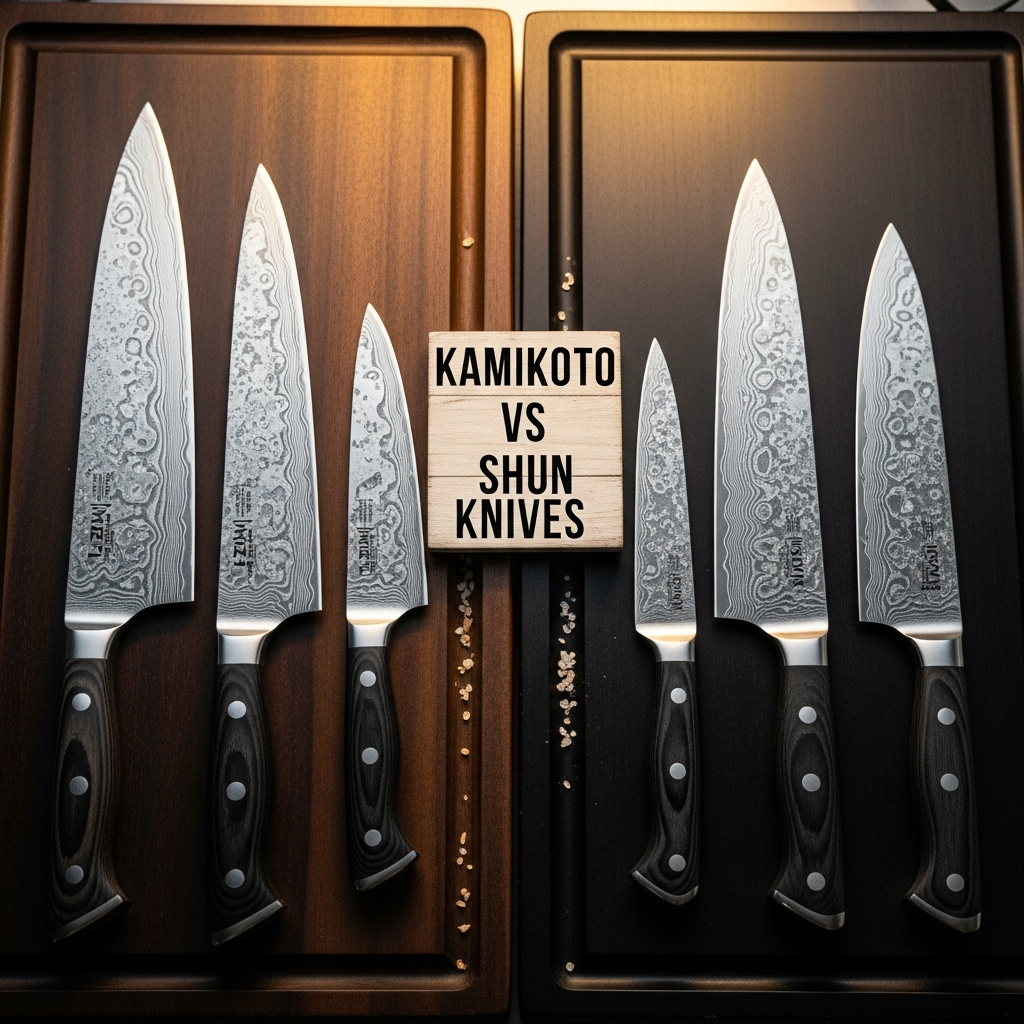
If you have spent any time on social media lately, you have likely seen an ad for Kamikoto. They are often presented as ultra-luxury Japanese knives with massive “limited time” discounts—dropping from $1,200 to $200. On the other hand, you have Shun, the established giant of the culinary world, ubiquitous in premium kitchenware stores and pro kitchens.
The Kamikoto vs. Shun debate is one of the most controversial topics in the cutlery community. Are Kamikoto knives a hidden gem of Japanese craftsmanship? Or are they a marketing masterclass that falls short of the performance offered by traditional makers like Shun?
At knifeindex.com/, we believe in transparency. In this comprehensive guide, we will strip away the advertising hype. We will analyze the steel, the manufacturing origin, and the real-world performance to help you decide if you should buy the deal or invest in the legend.
1. Brand Philosophy: Heritage vs. Hype
Shun: The Seki City Legend
Shun is owned by the Kai Group, which has been making blades in Seki City, Japan (the samurai sword capital) for over 110 years. Shun knives are widely considered the benchmark for mass-market high-end Japanese cutlery. They focus on advanced metallurgy (VG-MAX, SG2), intricate Damascus cladding, and strict quality control. They are the leaders in our best Japanese kitchen knives lists.
Kamikoto: The “Gentileschi”
Kamikoto presents itself as a luxury brand using “Honshu Steel.” They are famous for their heavy, single-bevel knives and elaborate wooden boxes. While they market heavily on Japanese heritage, they are a newer company. Their business model relies on high MSRPs (Manufacturer’s Suggested Retail Price) that are perpetually “slashed” to create a sense of value.
Deep Dive
For a brutally honest breakdown of the marketing vs. the reality of these two brands, check out this external analysis from Prudent Reviews: Shun vs. Kamikoto: The Definitive Comparison.
2. Head-to-Head: The Specs Breakdown
We are comparing the flagship Shun Classic against the commonly advertised Kamikoto Kanpeki set.
| Feature | Shun Classic | Kamikoto Kanpeki |
|---|---|---|
| Core Steel | VG-MAX (High Carbon Stainless) | 420J2 (Soft Stainless) |
| Hardness (HRC) | 61 (Very Hard) | 53-55 (Soft) |
| Edge Grind | Double Bevel (50/50) | Single Bevel (Chisel Grind) |
| Construction | Damascus Clad | Mono-steel |
| Handle | Pakkawood (D-Shape) | G10 / Black Resin |
| Weight | Light / Balanced | Heavy / Substantial |
3. The Steel: The Critical Difference
This is where the brands diverge significantly.
Shun (VG-MAX)
Shun uses a proprietary super-steel called VG-MAX. It is hard (61 HRC), which means it can take a razor-sharp edge and hold it for a long time. It is brittle, however, so you cannot hack bones. It features real Damascus layering, which is both beautiful and functional (prevents sticking). This is similar to what you find in Miyabi vs Shun comparisons.
Kamikoto (420J2)
Kamikoto knives are typically made from 420J2 steel. This is a highly corrosion-resistant steel, often used in diving knives or budget cutlery. It is soft (approx 53 HRC).
The Good: It is tough and won’t chip easily.
The Bad: It loses its edge very quickly compared to VG-MAX. You will need to sharpen it frequently. This steel is generally not found in premium knives in the $100+ range.
4. The Edge: Double vs. Single Bevel
Most Western and modern Japanese knives (like Shun, Global, Mac) are Double Bevel (sharpened on both sides). This makes them intuitive to use and cuts straight.
Kamikoto knives are often Single Bevel (sharpened on one side only). Traditionally, single bevel knives (like a Yanagiba) are used by sushi masters for specific cuts.
The Challenge: Single bevel knives steer to the left or right when cutting dense vegetables (like squash). For the average home cook, this can be frustrating. Shun is much easier to use for general tasks like those described in what is a chef knife used for.
5. The Chef’s Knife Comparison
 Shun Classic 8-Inch Chef’s Knife
The gold standard. VG-MAX core, 68 layers of Damascus cladding, and a comfortable Pakkawood handle. It cuts like a laser and holds its edge for months.
Check Price on Amazon Kamikoto Kanpeki Knife Set
Known for its heavy weight and single-bevel chisel edge. Comes in a wooden display box. Requires frequent honing due to softer steel composition.
Check Price on Amazon6. Specialty Knives and Sets
Vegetable Knives
Shun’s Nakiri is a double-bevel vegetable slicer that is easy to control. Kamikoto offers Nakiri-style blades that are heavy and single-bevel. If you want straight cuts on carrots, Shun is superior.
Paring and Utility
For detail work (see what is a paring knife used for), Shun offers lightweight, nimble tools. Kamikoto sets often include a utility knife, but the weight can make delicate work tiring.
7. Competitors: Who Else Should You Consider?
If the Kamikoto marketing caught your eye, but the specs of Shun seem better, consider these alternatives:
- Dalstrong: Like Kamikoto, they are marketing-heavy, but they offer genuine high-end steels (VG10, AUS-10V) in their Shogun series. (See Dalstrong vs Shun).
- Tojiro: If you want authentic Japanese sharpness for a lower price than Shun, Tojiro is the real deal. (See Tojiro vs Shun).
- Zwilling/Wusthof: If you prefer the heavy weight of Kamikoto but want premium steel, go German. (See Zwilling vs Henkel or Wusthof vs Victorinox).
8. Maintenance: Sharpening and Care
Because the steel is so different, maintenance is different.
- Sharpening Shun: Requires patience. The steel is hard. You need water stones or a high-end electric sharpener. (See best electric sharpeners).
- Sharpening Kamikoto: Easy but frequent. The soft 420J2 steel sharpens very quickly but dulls quickly. You must learn to sharpen a single bevel (flat on one side, angled on the other).
- Rust: Both are stainless. Kamikoto is highly rust-resistant (low carbon). Shun is resistant but can spot if neglected. See how to remove rust.
- Storage: Shun deserves a magnetic strip to show off the Damascus. (See how to store knives without a block).
9. Real World Value
Shun: Expensive ($150+ for a chef’s knife), but you are paying for manufacturing in Japan, lifetime warranty, and premium materials.
Kamikoto: The “deal” is the selling point. If you get a set for $200 that lists for $1000, it feels like a steal. However, knife enthusiasts argue that the materials (420J2 steel) are only worth the discounted price (or less), not the MSRP. For the same $200, you could get a high-end chef knife brand like Wusthof or Mac.
10. Who Actually Makes These Knives? Manufacturing and Supply Chain
One of the most searched questions in this comparison is simply: where are these knives actually made? The answer matters more than most shoppers realize, because manufacturing origin tends to track directly with steel sourcing, quality control, and after-sale support.
Shun’s Manufacturing Chain
Shun is not a marketing entity layered on top of a contract factory. It is a product line manufactured directly by Kai Industries in Seki City, Gifu Prefecture, Japan. Seki has been a center of blade production since the 14th century, originally forging samurai swords before pivoting to cutlery, scissors, and razors as firearms and industrialization changed demand for edged weapons. Kai’s factories handle everything from steel lamination to final polishing under one roof, which is why Shun can maintain tight tolerances on blade geometry and consistent Rockwell hardness readings from knife to knife. When you buy a Shun, the company that stamps the logo on the blade is the same company that forged it.
Kamikoto’s Manufacturing Chain
Kamikoto’s supply chain is murkier, and that opacity is itself a signal worth paying attention to. The company markets a story about Honshu, an island in Japan, and about steel with samurai-era roots. However, teardown investigations, import records, and community sleuthing on forums like r/chefknives and r/BuyItForLife have repeatedly pointed to contract manufacturing in China, with final assembly and packaging handled separately from the marketing and design operation, which is largely US-based. This is not automatically disqualifying on its own; plenty of respectable knives are made in China or Taiwan (Cangshan and some Zwilling lines, for example, are manufactured outside Japan or Germany respectively). The issue is the gap between the story being sold (“Honshu steel,” “ancient techniques”) and the documented reality (mass-produced 420J2 stock knives dropshipped through a marketing brand). Transparency, not country of origin, is the real problem here.
Deep Dive
If you want to see how sourcing questions play out for other DTC “luxury” knife brands, our Dalstrong vs Wusthof comparison covers similar territory, since Dalstrong also faced early scrutiny over factory transparency before establishing a more credible track record.
11. Understanding Hardness: What HRC Actually Means for Your Cooking
We’ve mentioned HRC (Rockwell Hardness C-scale) a few times, but it is worth explaining in plain terms, because it is the single number that predicts almost everything else about how a knife will feel and perform in your hand.
HRC measures how much a standardized diamond indenter deforms the steel under a fixed load. Higher numbers mean the steel resists deformation more, which in a knife translates to: the edge can be ground thinner without folding over, it holds that thin edge longer under repeated cutting, and it feels “grippier” when it bites into food because it doesn’t roll or micro-chip the way soft steel does. The tradeoff is toughness. Harder steel is more brittle, so it is more prone to chipping if you twist the blade, hit bone, or drop it on a tile floor.
- Below 56 HRC (Kamikoto territory, 53-55): Very tough, nearly impossible to chip through normal misuse, but the edge rolls quickly. You will be honing on a steel rod or ceramic rod every few uses just to keep it working, and a full resharpen every few weeks with moderate use.
- 58-60 HRC (most German knives, some entry Japanese): A reasonable middle ground. Good toughness, moderate edge retention.
- 61-63 HRC (Shun VG-MAX, most premium Japanese cutlery): Excellent edge retention, takes a very fine angle (Shun ships at roughly 16 degrees per side versus the 20-22 degrees typical of German knives), but requires more careful use and a slightly gentler sharpening touch.
- 64+ HRC (powdered steels like SG2/R2, some high-end custom knives): Exceptional edge life, but demands real skill to sharpen and is genuinely fragile against lateral stress.
When you see Kamikoto’s 53-55 HRC next to Shun’s 61 HRC, you are looking at two knives built for different philosophies entirely. Kamikoto prioritizes durability and forgiveness. Shun prioritizes cutting performance and edge longevity. Neither is “wrong,” but only one of them is being marketed as a premium performance knife while actually being specced like a budget one.
12. Damascus Steel: Real Pattern-Welding vs. Cosmetic Etching
Both brands lean on the word “Damascus” in their marketing, so it deserves its own section, because the term gets used loosely across the industry and shoppers are often misled by it.
True Damascus cladding, which is what Shun uses, is created by folding and forge-welding multiple layers of two or more different steel alloys together, then grinding and etching the surface so the layer pattern becomes visible. On a Shun blade, this cladding wraps around a hard VG-MAX or SG2 core, so the pattern you see is functional evidence of the sandwich construction: a hard, thin cutting core protected by softer, more flexible outer layers that add strength and resist chipping. It is genuinely 68 layers on many Shun Classic pieces, and you can verify this by looking at the edge profile under magnification, where the layer lines are visible running into the core.
Kamikoto’s knives, by contrast, are mono-steel; a single piece of 420J2 with no layered cladding at all. Any “Damascus-style” pattern seen on some of their SKUs or promotional photography is either absent entirely on the base Kanpeki line or achieved through surface etching or printing on separate, higher-tier product lines, rather than through actual pattern-welded lamination. This distinction matters because true Damascus cladding contributes measurably to the knife’s flex resistance and corrosion behavior at the cutting edge, while cosmetic patterning is purely aesthetic and adds nothing to performance.
13. Blade Shapes Beyond the Chef’s Knife: Gyuto, Santoku, and Nakiri
Comparisons like this one tend to focus on the chef’s knife, but most people buying a set will use several blade shapes weekly. It’s worth understanding how Shun and Kamikoto differ across the full lineup, not just the flagship 8-inch blade.
Gyuto (Japanese Chef’s Knife)
The Gyuto is the Japanese answer to the Western chef’s knife, generally thinner behind the edge and with a flatter profile toward the heel, which suits push-cutting rather than heavy rocking motions. Shun’s Classic line is built on Gyuto geometry adapted with a Western-style handle, giving you Japanese cutting performance without forcing you to relearn your grip. Kamikoto does not really offer a true Gyuto in its core lineup; its “chef knife” equivalents lean toward a thicker, single-bevel profile that behaves more like a traditional deba or usuba hybrid than a Western-friendly Gyuto.
Santoku
The Santoku (“three virtues”: meat, fish, vegetables) is a shorter, flatter-profile all-purpose blade popular with home cooks who prefer a lighter knife with less rocking motion. Shun’s Santoku uses the same VG-MAX core and Damascus cladding as its chef’s knife, just in a shorter, often granton-edged (dimpled) format that reduces food sticking. Kamikoto does not typically list a dedicated Santoku in its Kanpeki set, which is itself a gap worth noting for anyone doing a side-by-side; if you specifically want a Santoku, Shun (or alternatives covered in our best Japanese kitchen knives guide) is the more complete option out of the box.
Nakiri and Vegetable Prep
We touched on this earlier, but it’s worth reiterating in the context of blade shape specifically. A Nakiri is a rectangular, double-beveled vegetable knife designed to go straight down through produce in a single chop, then lift straight back up, unlike a rocking Western prep knife. Because Shun’s Nakiri is double-beveled, it tracks straight through the cut every time. Kamikoto’s vegetable-oriented blades, being single-bevel, will drift toward one side unless you compensate with technique, which is a skill most home cooks never develop because they never needed to with a Western knife.
14. Handle Ergonomics and Left-Handed Use
Handle design and bevel orientation are closely linked, and this is an area where the Kamikoto vs. Shun gap becomes a real usability issue rather than just a specs conversation.
Shun’s Pakkawood D-shaped handles are contoured for a comfortable pinch grip and are functionally ambidextrous across most of the line, since the blades are double-beveled and symmetrical. A left-handed cook and a right-handed cook get the same cutting performance from the same knife.
Kamikoto’s single-bevel knives are typically ground for right-handed use. A left-handed cook using a right-handed single-bevel knife will find the blade steering aggressively in the wrong direction, essentially fighting the user’s natural cutting motion on every stroke. Some single-bevel Japanese specialists do offer left-handed grinds on request, but Kamikoto’s mass-market Kanpeki sets are not typically sold this way, meaning left-handed buyers are at a structural disadvantage with this brand that doesn’t exist with Shun.
15. Warranty, Returns, and Customer Support
Performance aside, after-sale support is a major differentiator that rarely gets discussed in flashy unboxing videos.
Shun’s Warranty
Shun knives are backed by a limited lifetime warranty against manufacturing defects, administered directly by Kai USA. Because Shun is sold through established retail channels (Williams Sonoma, Sur La Table, Amazon, and authorized dealers), warranty claims and returns follow standard, well-documented retail processes, and the company has decades of institutional history handling them.
Kamikoto’s Warranty
Kamikoto sells primarily direct-to-consumer through its own website and social ad funnels, with a smaller footprint on marketplaces. Return and warranty policies have shifted over the years and are typically time-limited (commonly a 30-day satisfaction window plus a separate, narrower defect warranty), and customer service is handled through the DTC brand itself rather than a manufacturer with a century of retail infrastructure behind it. Buyers considering Kamikoto should read the current return policy carefully on the brand’s own site before purchasing, since DTC-only warranty terms are more prone to change without much public notice compared to an established retail brand like Shun.
16. Price Per Use: A Long-Term Value Calculation
Sticker price alone is misleading. A more honest way to compare these knives is cost divided by expected years of useful service before the steel needs replacing or the knife needs professional reprofiling.
| Consideration | Shun Classic | Kamikoto Kanpeki |
|---|---|---|
| Typical Street Price | $140-$180 (chef’s knife) | $150-$250 (discounted set) |
| Sharpenings Needed / Year | 1-2 (with regular honing) | 4-8 (soft steel dulls fast) |
| Expected Lifespan | Decades with care | Years, edge geometry degrades faster with frequent resharpening |
| Resale Value | Moderate; recognized brand on secondhand markets | Low; limited resale demand, DTC-only brand recognition |
Because soft steel needs resharpening far more often, and each resharpening removes a small amount of material and can subtly alter the factory bevel angle over time, a Kamikoto knife sharpened aggressively every month will likely need full reprofiling or replacement well before a Shun knife sharpened once or twice a year does. This is the hidden cost that the “$1,200 slashed to $200” marketing conveniently never mentions.
17. What Actual Owners and Chefs Say
Beyond specs, it helps to look at how these knives perform in the hands of people who use them daily.
Professional kitchens overwhelmingly stock Shun, Global, Mac, and Misono over Kamikoto, and it is rare to find a working line cook or culinary school graduate recommending Kamikoto for daily production use; the softer steel simply can’t keep pace with the volume of prep a professional kitchen demands without constant sharpening breaks. On enthusiast forums and knife subreddits, Kamikoto is frequently cited as a cautionary tale about influencer marketing outpacing product substance, while Shun is consistently recommended as a reliable “first serious knife” for someone graduating from big-box store cutlery.
That said, plenty of home cooks who own Kamikoto sets are perfectly happy with them for light, occasional use; chopping a salad a few times a week is a very different stress test than nightly restaurant-style prep, and the softer steel’s resistance to chipping does make it more forgiving for someone still learning proper knife handling and cutting board habits.
18. Gift Buying Guide: Which One Should You Actually Buy Someone?
A large share of searches for this comparison come from gift shoppers around the holidays, so it’s worth addressing directly.
- Buying for a serious home cook or aspiring chef: Choose Shun. They will notice and appreciate the difference in edge retention and cutting feel immediately, and the lifetime warranty means it’s a gift that keeps performing for decades.
- Buying for someone who just wants a nice-looking display piece or a first “grown-up” knife: Kamikoto’s presentation (the wooden box, the heft, the story) has genuine gift appeal, especially for someone who isn’t going to be a heavy daily user and who will enjoy showing it off more than pushing it through onions every night.
- Buying on a budget but wanting genuine Japanese performance: Skip both flagship price points and look at Tojiro, covered in our Tojiro vs Shun comparison, which delivers real VG-10 core steel at a lower price than either Shun’s premium lines or Kamikoto’s “discounted” MSRP.
19. Frequently Overlooked Maintenance Tools
Whichever knife you choose, the tools you pair it with matter almost as much as the blade itself.
- Honing rods: A ceramic honing rod is gentler on hard VG-MAX steel than a traditional steel rod, and is the better daily-maintenance choice for a Shun. Kamikoto’s softer steel tolerates a traditional steel rod without issue.
- Cutting boards: Both knives should only ever touch wood or soft plastic boards; glass and stone boards will chip a hard Shun edge almost instantly and will dull a soft Kamikoto edge even faster than normal use already does.
- Sharpening stones: A 1000/6000 grit combination whetstone is the standard recommendation for Shun’s harder steel, while Kamikoto’s softer 420J2 can be maintained with a coarser, lower-grit stone since it doesn’t hold a fine polish as long anyway. Our best electric sharpeners guide covers machine options for cooks who don’t want to learn freehand stone sharpening.
Frequently Asked Questions (FAQ)
Kamikoto states they use “steel from Japan.” However, the manufacturing origin is widely believed to be China (Yanjiang), similar to Dalstrong. Shun knives are forged and assembled in Seki City, Japan.
Single bevel edges can be sharper, but they are traditionally reserved for specific Japanese tasks (sashimi, vegetable peeling). Kamikoto uses this for marketing distinction, but it can make the knife harder to use for general tasks like chopping onions compared to a double-bevel Shun.
Yes. Shun uses VG-MAX steel hardened to 61 HRC with a 16-degree angle. It holds a finer edge for much longer. Kamikoto uses softer steel which cannot support as thin of an edge without rolling.
No. Never put Shun (wood handles) or Kamikoto in the dishwasher. See our guide on dishwasher safe knives for alternatives.
At the heavily discounted price (often $150-$250 for a set), Kamikoto can be a reasonable buy for someone who wants a heavy, low-maintenance, good-looking knife for occasional home use. It is not worth anywhere near the original MSRP, and it is not a substitute for a true high-performance Japanese knife like Shun in terms of edge retention or cutting precision.
No. Shun offers a limited lifetime warranty against manufacturing defects through Kai USA. Kamikoto’s warranty and return terms are narrower and are handled directly by the DTC brand, so buyers should check the current policy on Kamikoto’s own site before purchasing.
Shun, without much debate. Its double-bevel blades are symmetrical and perform identically for left- and right-handed users. Kamikoto’s single-bevel blades are typically ground for right-handed use and will steer noticeably for a left-handed cutter.
Shun, thanks to its hard VG-MAX core, typically needs a full sharpening only once or twice a year with regular honing in between. Kamikoto’s softer 420J2 steel dulls much faster and often needs sharpening every few weeks under regular use.
Conclusion: The Verdict
The battle of Kamikoto vs. Shun is a battle between marketing and metallurgy.
Choose Shun If: You want a genuine, high-performance Japanese knife. You value edge retention, history, and the ability to cut effortlessly through food. It is an investment that matches its price tag in performance.
Choose Kamikoto If: You want a heavy, substantial knife and you like the aesthetic of the single-bevel blade. If you are buying it, ensure you are paying the “discounted” price, as that reflects the true value of the 420J2 steel.
For most serious cooks, Shun (or alternatives like Tojiro and Mac) remains the superior culinary tool.