High Carbon vs Regular Stainless Steel Knives: The Complete Comparison
What actually separates these two blade materials, and which one deserves a spot in your knife block.
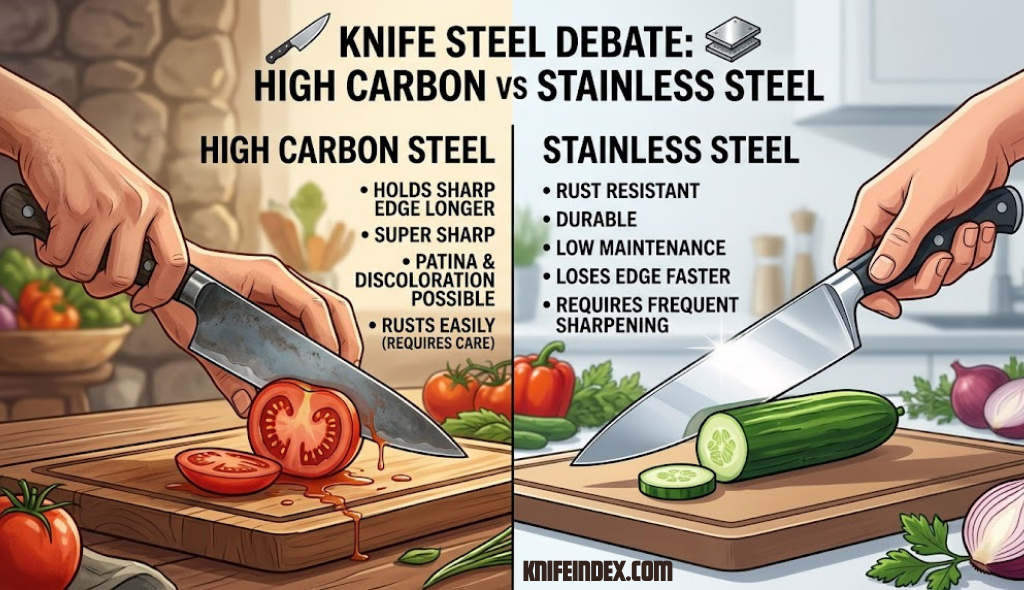
1. What Is High Carbon Steel?
High carbon steel is, at its core, a fairly simple alloy: mostly iron with a carbon content typically ranging from about 0.5% to over 1%, plus small amounts of manganese and other trace elements that assist with hardening. There’s no meaningful chromium added, which is the critical detail that separates it from stainless steel. That absence of chromium is exactly why high carbon steel behaves the way it does on a cutting board, in a sharpening session, and in a damp kitchen sink.
Blacksmiths and bladesmiths have relied on carbon steel for centuries because it responds predictably to heat treatment. When you quench and temper a carbon steel blade correctly, you get a fine, tight grain structure that takes an extremely keen edge. This is part of why so many traditional Japanese kitchen knives, French carbon steel chef’s knives, and bushcraft blades are built around simple high carbon formulations like 1095, White Steel (Shirogami), or Blue Steel (Aogami).
If you want a deeper technical breakdown of how these alloys stack up against one another, our complete high carbon vs stainless steel breakdown goes further into individual steel grades and their hardening behavior.
It helps to think of high carbon steel less as a single material and more as a family of closely related alloys sharing one defining trait: a carbon percentage high enough to allow significant hardening through heat treatment, without enough chromium to qualify as stainless. Within that family there’s real diversity. American 1095 is prized for toughness and simplicity in outdoor knives. Japanese White Steel (Shirogami) is prized in the kitchen for purity and edge fineness, since it contains very few alloying impurities beyond iron and carbon. Blue Steel (Aogami) adds a touch of chromium and tungsten for slightly improved edge retention and toughness while still falling short of the threshold that would classify it as stainless.
This variety matters because a blanket statement like “carbon steel is tougher” or “carbon steel sharpens faster” is only really true when comparing similar tiers of steel. A premium carbon steel forged and heat treated by an experienced smith will behave very differently from a mass-produced budget blade stamped out cheaply, even though both technically belong to the same broad category.
Historically, before stainless steel existed at all, every knife — kitchen, military, agricultural — was some form of carbon steel. Stainless steel wasn’t developed until the early 20th century, and it took decades before metallurgists refined stainless formulations enough to compete with carbon steel’s cutting performance. That history is part of why carbon steel still carries a certain traditionalist appeal among chefs and collectors who see it as the more authentic blade material, even though that’s more a matter of preference than a purely performance-based conclusion.

Want to try a traditional high carbon blade?
See top-rated carbon steel kitchen knives with real edge-retention reviews.
Shop High Carbon Knives on Amazon2. What Is Regular Stainless Steel?
Regular stainless steel — the kind found in the overwhelming majority of mass-market kitchen knives — contains at least 10.5% chromium by definition, though most knife-grade stainless steels run higher, often in the 13-18% range. That chromium reacts with oxygen to form an invisible, self-healing passive layer on the steel’s surface. This layer is what keeps the blade from developing rust spots after a night in a wet sink.
“Regular” stainless steel in this context refers to common, budget-to-midrange grades like 420HC, 440A, 8Cr13MoV, or X50CrMoV15, as opposed to premium powder-metallurgy super-steels like S35VN, M390, or MagnaCut. Those advanced steels blur the line between stainless and high-performance, but they’re a different conversation entirely — you can read more about how a modern stainless performer compares to a supersteel in our S35VN vs S45VN comparison.
Regular stainless is the steel most home cooks actually own. It’s in the block set from the department store, the chef’s knife from the big box retailer, and most dishwasher-safe steak knives. Its defining trait isn’t extreme performance — it’s convenience.
It’s worth pointing out that “stainless” doesn’t mean “stain-proof.” The term is a bit of a historical misnomer that stuck. Even high-chromium stainless steels can develop surface pitting or discoloration under sustained exposure to salt, acid, or chlorine, especially if the blade is low-quality or the passive chromium oxide layer has been disrupted by scratches or aggressive cleaning chemicals. What stainless steel actually offers is dramatically improved resistance compared to carbon steel, not total immunity.
Within the “regular stainless” bucket, there’s also a meaningful quality spread. Steels like 420J2 sit at the more affordable, softer end and are common in inexpensive gift-set knives that prioritize looks over performance. Steels like X50CrMoV15, used by brands such as Wüsthof and Zwilling, or 8Cr13MoV, common among budget-friendly Chinese manufacturers, represent a solid middle tier that balances reasonable edge retention with dependable corrosion resistance. Our Dalstrong vs Wüsthof X50CrMoV15 heat treatment comparison is a good example of how the same base steel can perform differently depending on how a manufacturer heat treats it.
3. The Chemistry Behind the Difference
The entire high carbon vs stainless conversation boils down to one trade-off: chromium versus carbide simplicity. Chromium is a fantastic corrosion inhibitor, but it also forms large, hard chromium carbides throughout the steel’s microstructure. These carbides increase wear resistance in some cases, but they can also make the steel more brittle and, in cheaper stainless formulations, harder to bring to a truly fine apex on a sharpening stone.
Carbon steel, without that chromium interference, tends to form a finer, more homogeneous grain structure. This is why bladesmiths often describe carbon steel as sharpening “cleaner” — the stone is cutting through a more uniform matrix rather than grinding around large embedded carbide clusters.
It’s worth noting that carbon content alone doesn’t define stainless versus non-stainless. Many stainless steels, like D2 (technically semi-stainless) or VG-10, actually have higher carbon content than basic carbon steels — they just also have enough chromium to be corrosion resistant. If you want to see how carbon content interacts with chromium in a specific matchup, check our D2 vs 8Cr13MoV comparison.
| Element | Role in High Carbon Steel | Role in Regular Stainless Steel |
|---|---|---|
| Carbon | Primary hardening agent, 0.5%–1.2%+ | Present but balanced against chromium, typically 0.4%–0.75% |
| Chromium | Minimal or absent | 10.5%+ for corrosion resistance |
| Manganese | Improves hardenability | Similar role, smaller effect on stain resistance |
| Vanadium | Sometimes added for grain refinement | Sometimes added in premium stainless for wear resistance |
There’s also a heat treatment story here that’s easy to overlook. Chromium doesn’t just sit passively in the steel — it actively affects how the steel responds to quenching and tempering. High-chromium stainless steels often require more precise, often more expensive heat treatment processes, including sub-zero cryogenic treatments in premium cases, to fully convert retained austenite into hardened martensite. Get that process slightly wrong, and a stainless blade can end up with inconsistent hardness across the edge, contributing to the “soft stainless knife” reputation that budget kitchen sets sometimes earn.
Carbon steel’s simpler chemistry makes it comparatively more forgiving to heat treat consistently, which is one reason small-batch and artisan bladesmiths gravitate toward it — the process is less dependent on industrial-grade furnace precision to get a reliably hard, fine-grained result. This doesn’t mean carbon steel is easier to make a good knife from overall; forging technique, grain refinement, and tempering timing still require serious skill. It simply means the chemistry itself introduces fewer variables to control.
4. Hardness and Edge Geometry
Hardness is measured on the Rockwell C scale (HRC), and both steel families can be heat treated across a wide range depending on the manufacturer’s goals. Traditional carbon steel kitchen knives often land in the 58-64 HRC range, especially Japanese carbon steels like White #2 or Blue #2. Regular stainless knives are frequently tempered softer, often in the 54-58 HRC range, to prioritize toughness and chip resistance over raw hardness.
Higher hardness generally supports a thinner edge geometry without immediate rolling or chipping, which is part of why many carbon steel Japanese knives can be ground to remarkably acute edge angles. Softer stainless blades are often given a slightly more obtuse edge angle to compensate for their lower hardness, which can make them feel less “bitey” through dense produce.
For a deeper look at how hardness numbers actually translate to real cutting performance, our guide to understanding Rockwell hardness in kitchen knives breaks down what HRC ranges mean for different knife types.
Edge geometry and hardness are inseparable in practice. A blade ground to a thin, acute angle but tempered too soft will roll or fold under lateral pressure rather than holding its shape. This is why you rarely see very soft stainless steels paired with ultra-thin Japanese-style edge grinds — manufacturers know the edge would deform almost immediately. Instead, softer stainless blades are typically paired with slightly thicker edge geometry and a more obtuse angle, trading some slicing finesse for durability.
Harder carbon steel blades can support thinner grinds because the edge itself resists deformation better, even though it may be more prone to chipping if it strikes something unexpectedly hard, like bone or a ceramic plate. This is the classic hardness tradeoff in blade metallurgy: harder generally means better edge retention and finer geometry potential, but at some cost to toughness. Manufacturers on both sides of the carbon/stainless divide are constantly trying to push that tradeoff curve outward through better alloy design and heat treatment refinement, which is part of why newer steels — stainless and carbon alike — keep improving year over year.
If you’re comparing knives with very different stated hardness numbers, it helps to also check blade thickness behind the edge, since a thin stainless blade at 56 HRC can sometimes out-perform a thicker carbon blade at 60 HRC in actual slicing feel. Our blade geometry guide on thin vs thick behind the edge explains this relationship in more depth.
5. Edge Retention Compared
Edge retention is where things get genuinely nuanced, and where a lot of online debates go wrong by treating “carbon steel” and “stainless steel” as if they’re single materials rather than broad categories. In reality, edge retention depends far more on the specific alloy, its carbide volume, and its heat treatment than on whether it’s technically stainless.
That said, some general trends hold up under repeated kitchen and workshop testing:
- Simple high carbon steels (1095, White Steel) tend to lose their edge faster under heavy use than premium stainless steels, but they’re also dramatically faster to bring back to sharp.
- Basic regular stainless steels (420HC, 440A) often hold a working edge longer than simple carbon steel in day-to-day kitchen tasks, thanks to their chromium carbides resisting abrasive wear.
- High carbon stainless steels (VG-10, AUS-10) combine carbon content with chromium and frequently outperform both simple carbon steel and basic stainless steel in pure edge retention.
If edge retention is your primary decision factor, it’s worth comparing specific steels rather than categories. Our VG-10 vs AUS-10 comparison and 14C28N vs Nitro-V breakdown are good starting points for seeing how modern stainless alloys close the gap with — or exceed — traditional carbon steel.
Real-world edge retention testing, like rope-cutting or cardboard-slicing benchmarks used by knife reviewers, tends to reveal how much carbide volume and type matter more than the stainless label itself. A steel loaded with hard vanadium carbides, whether stainless or not, will typically outlast a plain carbon steel with minimal alloying in an abrasive cutting test. This is why premium powder-metallurgy stainless steels like S35VN or M390 routinely beat simple carbon steels like 1095 in edge retention charts, even though both are technically “just steel” — the microstructure engineering makes the difference, not the corrosion resistance category.
That said, kitchen use rarely resembles a rope-cutting benchmark. Cutting through soft produce, proteins, and herbs is a much gentler wear environment than repeated passes through abrasive synthetic rope. In that kitchen-specific context, the practical edge retention gap between a well-heat-treated carbon steel and a mid-tier stainless steel often narrows considerably, and many home cooks report similar resharpening intervals between the two when used for typical daily meal prep.
Cutting board material also influences perceived edge retention more than most people realize, regardless of steel type. Glass and stone cutting boards will dull any blade — carbon or stainless — far faster than wood or quality plastic boards, simply because the board surface itself is harder than the steel’s edge. If you’re trying to fairly evaluate how long a specific knife holds its edge, standardizing on a wood or soft composite cutting board removes a major confounding variable from the comparison. This is a common oversight in casual online reviews claiming one steel or knife “dulls too fast,” when the actual culprit is an unforgiving cutting surface rather than the blade itself.
Where Carbon Steel Wins
- Faster to resharpen to a hair-splitting edge
- Finer, cleaner apex achievable on stones
- Preferred by many sushi chefs for slicing precision
Where Stainless Wins
- Longer working edge under repeated abrasive contact
- Better resistance to micro-chipping on bone or hard produce
- More forgiving for less frequent sharpening

Prefer low-maintenance edge retention?
Browse top stainless steel kitchen knife sets built for everyday reliability.
Shop Stainless Steel Knives on Amazon7. Rust, Staining, and Patina
Corrosion resistance is the single biggest lifestyle difference between these two steel families, and it’s usually the deciding factor for home cooks choosing between them.
High carbon steel will rust if left wet, especially after contact with acidic ingredients like tomatoes, citrus, or vinegar-based marinades. Left unattended overnight in a sink, a carbon steel blade can develop visible rust spots within hours in humid conditions. The upside is that carbon steel develops what’s called a patina — a thin, stable, gray-to-blue oxide layer that forms naturally with use. Far from being damage, a well-developed patina actually acts as a protective barrier against deeper corrosion and is considered a badge of honor among carbon steel enthusiasts. Our dedicated guide on what patina is and how to develop it walks through the process step by step.
Regular stainless steel simply doesn’t have this problem to nearly the same degree. Its chromium oxide layer actively resists rust formation, so it can tolerate a night in the sink, contact with acidic food, and general kitchen carelessness far better. It’s not entirely immune to corrosion — pitting can still occur with prolonged salt or acid exposure, or with poor-quality stainless — but for most home use, it’s dramatically lower maintenance.
For anyone who already owns carbon steel and is dealing with early corrosion, our guides on how to prevent rust on knives and how to get rust off a knife cover both prevention and remediation in detail.
It’s worth distinguishing between surface staining and structural rust, since the two are often confused. Staining is typically cosmetic — a darkening or discoloration from oxidation and food acid reactions that doesn’t compromise the blade’s integrity or cutting performance. Structural rust, on the other hand, involves actual material loss through pitting and flaking, which can eventually affect the edge and even the blade’s structural strength if left unaddressed for a long time. Most of what new carbon steel owners panic about is staining, not structural rust, and staining is both normal and largely harmless.
Many experienced carbon steel users actually accelerate the patina process deliberately, using techniques like wiping the blade with diluted vinegar or mustard to force an even, controlled oxide layer rather than waiting for random blotchy staining to occur naturally through everyday use. This forced patina tends to be more uniform and, once established, provides meaningfully better protection than a bare, freshly sharpened carbon steel edge.
Stainless steel isn’t entirely exempt from this conversation either. Cheaper stainless blades with thin or poorly formed chromium oxide layers can still develop what’s sometimes called “tea staining” or light surface pitting, especially in coastal or humid climates with high salt content in the air. This is less common and less severe than carbon steel corrosion, but it’s a reminder that “stainless” exists on a spectrum rather than being a binary guarantee.
8. Toughness and Chipping
Toughness — the ability to resist fracturing or chipping under lateral stress — doesn’t map neatly onto the carbon/stainless divide either, but there are useful generalizations. Simple carbon steels, when tempered appropriately, tend to have relatively fine, clean grain structures that resist chipping well for their hardness level. This is part of why 1095 carbon steel is a staple in bushcraft and survival knives that need to handle batoning and prying, not just slicing.
Regular stainless steel toughness varies enormously by grade. Budget stainless like 420HC is often tempered on the softer side specifically to improve toughness and forgive less-careful use, which is common in knives aimed at outdoor or field-dressing tasks. You can see this design philosophy in knives like the Morakniv Garberg, which balances stainless practicality with a tough, reliable edge for bushcraft use.
Where stainless can struggle is in higher-carbide, higher-hardness formulations pushed for extreme edge retention — those can become more prone to micro-chipping under lateral stress compared to a simpler carbon steel at a similar hardness.
Toughness testing in the knife community often takes the form of batoning tests, lateral stress tests (like the notorious “whack a 2×4 sideways” test), and edge-on-edge contact tests. Across these informal but widely referenced tests, simple high carbon steels like 1095 and 5160 consistently perform well, largely because their fine, homogeneous grain structure resists crack propagation. This toughness is a major reason carbon steel remains the default choice for large outdoor knives, machetes, and axes — tools that regularly encounter impact and lateral stress that a kitchen knife never will. Our reviews of the Fiskars X27 vs Super Splitting Axe and Fiskars vs Estwing shock reduction comparison touch on how steel toughness plays into heavy-impact tool design.
For kitchen knives specifically, toughness matters less than it does for outdoor tools, since kitchen knives are rarely subjected to prying or batoning. Even so, a tougher blade is more forgiving of accidental drops, contact with bone during butchery, or an inadvertent twist while a knife is lodged in dense squash or root vegetables. This is one reason some cooks specifically prefer a slightly softer, tougher stainless blade like the Victorinox chef knife for rough, high-volume prep work, reserving a harder, more brittle premium blade for delicate tasks only.
9. Day-to-Day Maintenance
Maintenance philosophy is really the heart of this whole comparison. Carbon steel asks for a small daily ritual: hand wash immediately after use, dry thoroughly with a towel, and occasionally apply a thin coat of food-safe mineral oil if the blade will sit unused for a while. Skipping this even once or twice usually won’t ruin the knife, but consistent neglect will lead to rust that requires more aggressive remediation.
Regular stainless steel is comparatively forgiving. Hand washing is still recommended over the dishwasher for edge and handle longevity, but stainless tolerates lapses in drying and short periods of dampness without meaningful consequence. This is precisely why so many entry-level and mid-range kitchen knife sets — the kind aimed at people who don’t want a maintenance hobby attached to their cutlery — default to stainless.
| Maintenance Task | High Carbon Steel | Regular Stainless Steel |
|---|---|---|
| Hand wash after use | Required, ideally immediately | Recommended, more flexible |
| Dry immediately | Essential to prevent rust | Good practice, less critical |
| Occasional oiling | Recommended for storage | Optional |
| Dishwasher safe | No | Sometimes, though not ideal for edge life |
| Tolerates acidic food contact | Poorly without quick rinsing | Well |
Storage also plays a bigger role in carbon steel longevity than most new owners expect. A carbon steel blade stored in a humid drawer, especially near a sink or dishwasher where ambient moisture is higher, will develop surface rust noticeably faster than the same blade stored in a dry knife block or a sheath with moisture-wicking material. Some carbon steel owners keep small silica gel packs in their knife storage to further reduce ambient humidity, particularly in coastal or tropical climates. For general storage approaches that work well for both steel types, our guide on how to store knives without a block and our magnetic knife strip guide cover practical, edge-safe storage options.
Stainless steel’s lower maintenance ceiling doesn’t mean zero maintenance is ideal — it just means the consequences of imperfect care are far less severe. A stainless blade left briefly wet won’t develop a rust bloom overnight the way carbon steel might, but consistently poor care will still eventually degrade edge performance and handle integrity over the life of the knife, regardless of steel type.
Handle material and construction also interact with this maintenance conversation, since a knife is more than just its blade steel. Wooden handles on either steel type need their own care to prevent cracking or swelling from repeated moisture exposure, while synthetic handles like G-10 or textured polymer are essentially maintenance-free regardless of what blade steel they’re paired with. When evaluating total knife upkeep, it’s worth weighing blade steel and handle material together rather than focusing on the blade alone, since a low-maintenance stainless blade paired with a moisture-sensitive wood handle can still demand real attention over time.
10. Which One Performs Better in the Kitchen?
In professional kitchens, you’ll actually find both steel types thriving, but in different roles. Carbon steel gyutos and yanagibas are common among chefs who prioritize razor-sharp precision slicing, especially in Japanese culinary traditions where fish and vegetable presentation depend on clean, unbruised cuts. Our comparison of the yanagiba vs sujihiki for slicing raw fish highlights how carbon steel’s fine edge plays into that precision.
Stainless steel dominates in high-volume, fast-paced environments where knives get handed between cooks, splashed with acidic sauces, and don’t always get immediate attention after use. It’s simply more resilient to the chaos of a busy line. This is also why most Western-style production kitchen knife sets, and nearly all home cook starter sets, default to stainless.
If you’re deciding what to actually buy for home cooking, our best chef knives for home cooks guide and German steel vs Japanese steel comparison both dig further into how steel choice interacts with blade geometry and knife style, not just corrosion resistance.
Task specificity also plays a role. Chopping through dense root vegetables, breaking down poultry, or cutting through packaging and boxes — tasks that involve harder, more abrasive, or unpredictable materials — tend to favor tougher, more forgiving stainless steel. Delicate tasks like fine herb chiffonade, precision fish butchery, or thin protein slicing benefit more from carbon steel’s superior edge fineness. Many households naturally develop this exact split without even thinking about the underlying metallurgy: the stainless chef’s knife handles the bulk of daily chopping, while a carbon steel santoku or slicer comes out for finer work. Our guides on the best santoku knives and best nakiri knives for vegetable prep both cover knives available in each steel category.
Restaurant dishwashing culture is another practical factor. In commercial kitchens, knives frequently get set down on wet, busy counters between tasks, sometimes for longer stretches than a home cook would tolerate. Carbon steel in that environment demands a level of vigilance that’s often simply impractical during a dinner rush, which is a major reason stainless dominates Western commercial kitchens even among chefs who personally prefer the feel of carbon steel for solo prep work at home.

Curious about Japanese-style carbon steel blades?
Check current pricing and reviews on gyuto-style carbon steel chef knives.
Shop Carbon Steel Gyuto Knives11. Outdoor and EDC Considerations
Outside the kitchen, the carbon vs stainless debate takes on a slightly different shape because moisture exposure, impact resistance, and field sharpening access matter more than kitchen-specific concerns like acidic food contact.
For bushcraft and survival knives, simple carbon steels like 1095 remain hugely popular because they’re tough, easy to sharpen with minimal gear in the field, and spark well against ferro rods in some formulations. Knives like the Ontario RAT-1 and the ESEE JG3, discussed in our ESEE JG3 review covering 1095 rust prevention and field sharpening, illustrate how outdoor users manage the corrosion tradeoff with diligent care routines.
For everyday carry (EDC) folding knives, stainless steel is overwhelmingly dominant, and for good reason — pocket knives get exposed to sweat, humidity, pocket lint, and inconsistent maintenance far more than a kitchen knife stored in a block. Modern EDC steels like 14C28N, D2, and AUS-10 (all discussed in our steel comparison library) blend reasonable edge retention with practical corrosion resistance for daily carry. If you’re shopping for a dependable everyday folder, our QSP Hawk review covering 14C28N as a budget EDC steel is a good reference point.
Fixed-blade survival and bushcraft knives sit somewhere in between these two worlds. Some users deliberately choose carbon steel for its field-sharpening ease and toughness, accepting the rust-management tradeoff as part of the outdoor skill set. Others prefer stainless fixed blades specifically because a survival situation is the worst possible time to be fighting unexpected rust on a blade you’re depending on. Knives like the Morakniv Companion are offered in both carbon and stainless variants specifically to let buyers make this call for themselves, and comparing the two versions side by side is one of the clearest real-world illustrations of this whole article’s central tradeoff.
Hunting and field-dressing knives add another wrinkle, since they’re regularly exposed to blood, tissue, and moisture in conditions where a full wash-and-dry routine often isn’t immediately possible. Our field dressing knife buyer’s guide and field dressing blade shape and steel guide both discuss how steel choice interacts with these specific outdoor demands.
12. Cost and Value
Cost doesn’t track neatly with corrosion resistance either. Simple carbon steel is often cheaper to produce than premium stainless because it requires fewer expensive alloying elements. That’s part of why traditional carbon steel kitchen knives, particularly imported options, can sometimes be found at surprisingly affordable price points relative to their performance.
On the other end, premium stainless and high-carbide “supersteels” like S35VN, M390, or MagnaCut are considerably more expensive due to the cost of alloying elements like vanadium, niobium, and molybdenum, plus the more demanding powder-metallurgy production process. Mid-range regular stainless steels like 8Cr13MoV or X50CrMoV15 sit in a comfortable, budget-friendly middle ground, which is why they show up so often in mass-market knife blocks.
In short: the carbon-vs-stainless label alone won’t tell you whether a knife is expensive or cheap. Alloy complexity, brand, construction method (forged vs stamped — see our forged vs stamped knives comparison), and craftsmanship matter far more to final price than the corrosion-resistance category.
There’s also a long-term value dimension worth considering beyond the sticker price. A well-maintained carbon steel knife can be resharpened many, many times over its lifespan, and because material removal per sharpening session is relatively modest with proper technique, a quality carbon steel blade can realistically outlast its original owner with consistent care. Stainless steel knives are similarly long-lived when properly maintained, though the resistance to corrosion means a stainless knife is more likely to survive periods of owner neglect without permanent damage — an important consideration for anyone buying a knife as a long-term investment rather than a project to actively manage.
Resale and collector value is another niche but real factor. Vintage and artisan carbon steel knives, particularly hand-forged Japanese blades, often command strong collector interest and hold value well, sometimes appreciating over time as a craft object. Mass-produced stainless kitchen knives rarely carry the same collector appeal, though premium stainless brands with strong reputations, like Wüsthof or Shun, do hold resale value reasonably well within the used kitchenware market.
13. Side-by-Side Comparison Table
| Attribute | High Carbon Steel | Regular Stainless Steel |
|---|---|---|
| Corrosion resistance | Low — requires active care | High — low maintenance |
| Sharpening speed | Fast, easy to apex | Slower, more abrasion resistant |
| Typical hardness | 58–64 HRC | 54–58 HRC (varies by grade) |
| Edge retention (simple grades) | Moderate, needs frequent touch-ups | Moderate to good, depends on alloy |
| Toughness | Generally good for hardness level | Varies widely by grade |
| Maintenance routine | Dry immediately, occasional oiling | Minimal, dishwasher-tolerant in some cases |
| Best suited for | Precision slicing, traditional cooking, bushcraft | Everyday kitchen use, busy households, EDC |
| Typical cost range | Budget to mid-range | Budget to premium, wide range |
14. Who Should Buy Which?
Choose High Carbon Steel If You…
- Enjoy sharpening as part of your routine
- Want the finest possible edge for precision slicing
- Don’t mind hand-washing and drying immediately
- Appreciate the look and function of a developed patina
Choose Regular Stainless Steel If You…
- Want a low-maintenance daily driver
- Share kitchen duties with people who won’t baby a blade
- Cook frequently with acidic ingredients
- Prefer fewer sharpening sessions over ultimate sharpness
Many serious cooks actually end up owning both — a stainless workhorse for daily prep and cleanup convenience, and a carbon steel blade reserved for precision tasks like breaking down fish or fine julienne work. If you’re building out a rotation like this, our guide on the three essential chef knife blades that replace a full block is a useful starting framework, and our piece on high carbon vs regular stainless steel knives covers more scenario-based recommendations for mixed collections.
Beginners often benefit from starting with regular stainless steel simply because it lowers the stakes while they’re still building fundamental knife skills — proper grip, cutting technique, and basic care habits. Once those fundamentals feel natural, introducing a carbon steel blade becomes a much smoother transition, since the added maintenance step is no longer competing for mental bandwidth with more basic kitchen skills.
Households with children or multiple cooks sharing kitchen duties also tend to lean toward stainless steel for practical reasons — it’s simply harder to accidentally ruin a stainless blade through inconsistent care, and fewer members of a busy household will remember to dry and oil a carbon steel knife every single time it’s used. On the other hand, a single dedicated home cook who treats knife care as part of the cooking ritual itself often finds carbon steel deeply rewarding rather than burdensome.
Climate is a factor that’s easy to overlook. Cooks in consistently dry climates will find carbon steel maintenance considerably easier than cooks in humid, coastal, or tropical regions, where ambient moisture alone can accelerate oxidation even with diligent drying habits. If you live somewhere humid and still want the sharpening benefits of carbon steel, a semi-stainless carbon steel like Blue Steel or a modern high-carbon stainless like AUS-10 can offer a reasonable middle ground.
Skill level with a whetstone is another honest factor to weigh. If you already sharpen your own knives regularly and enjoy the process, carbon steel simply gives you faster, more satisfying results for the same amount of stone time. If you rely on pull-through sharpeners, sharpening services, or infrequent honing rather than a dedicated stone routine, the slower-wearing nature of stainless steel works in your favor, since it stays usable longer between those less-frequent sharpening events.
Finally, consider how the knife will actually be handled day to day. A knife that gets tossed in a drawer with other utensils, used by multiple family members, or occasionally left in a sink is going to fare much better as stainless steel over its lifetime. A knife that lives on a magnetic strip, gets used by one attentive cook, and is treated more like a tool than an appliance is a strong candidate for carbon steel, where the extra care required actually fits naturally into how it’s already being used.

Whichever steel you choose, keep it sharp.
A quality whetstone set works for both carbon and stainless blades.
Shop Whetstone Sharpening Sets15. Frequently Asked Questions
Is high carbon steel better than stainless steel for knives?
Neither is universally better. High carbon steel generally sharpens faster and takes a keener edge, while regular stainless steel resists rust and stains with far less maintenance. The right choice depends on how much upkeep you’re willing to do.
Does high carbon steel rust easily?
Yes, high carbon steel is prone to rust and staining if left wet or exposed to acidic foods for extended periods. It requires drying immediately after use and occasional light oiling to prevent corrosion.
Why do professional chefs prefer carbon steel knives?
Many professional chefs favor carbon steel because it sharpens quickly, holds a fine edge through long prep sessions, and develops a protective patina over time. The tradeoff is more careful maintenance.
Can stainless steel knives get as sharp as carbon steel?
Modern high-quality stainless steels can reach comparable sharpness, though many traditional carbon steels are easier to bring to a fine apex because they are softer and less abrasion resistant to sharpening stones.
What is a patina and is it bad?
A patina is a thin oxide layer that forms naturally on carbon steel from contact with food acids and air. It is not bad — it actually protects the blade from deeper rust and is considered normal, even desirable, by carbon steel users.
Which steel holds an edge longer, carbon or stainless?
This depends heavily on the specific alloy and heat treatment rather than the carbon-vs-stainless label alone. Some high-carbon stainless steels outperform basic carbon steels in edge retention, while simple carbon steels often outperform basic stainless steels.
Is carbon steel more brittle than stainless steel?
Carbon steel can actually be tougher than many stainless steels at comparable hardness, because it typically has a simpler, cleaner microstructure with fewer large carbides that can act as fracture points.
Do I need to oil a stainless steel knife?
Regular stainless steel knives generally do not require oiling for rust prevention, though light oiling can still help preserve the edge and prevent micro-corrosion in humid environments.
Are carbon steel knives more expensive than stainless?
Not necessarily. Many traditional carbon steel knives are actually more affordable than premium stainless options, because the alloying elements in high-performance stainless steels raise material and manufacturing costs.
What foods should I avoid cutting with carbon steel knives?
Highly acidic foods like citrus, tomatoes, and onions can accelerate discoloration and staining on carbon steel if left in contact for too long. Rinsing and drying the blade promptly after cutting these foods minimizes the effect.
Can I put a stainless steel knife in the dishwasher?
Most stainless kitchen knives will survive a dishwasher cycle without rusting, but the heat, detergent, and jostling against other items can dull the edge and damage handles over time, so hand washing is still recommended for longevity.
How do I know if my knife is carbon steel or stainless?
Carbon steel typically develops a gray or blue patina and shows visible reactivity when cut against acidic food, while stainless steel stays bright and shiny with minimal discoloration under the same conditions. Manufacturer specs or the steel type printed on the blade or packaging are the most reliable source.
Can I convert a stainless knife into a carbon steel knife or vice versa?
No, the steel composition is fixed during manufacturing and cannot be changed afterward. If you want the properties of the other steel type, you’ll need a separate knife made from that material.
Is it safe to cook acidic food with a carbon steel knife once in a while?
Yes, occasional contact with acidic food is generally fine as long as you rinse and dry the blade promptly afterward. The risk comes from prolonged, repeated exposure without cleaning, not a single instance of cutting a lemon or tomato.
16. Conclusion
There’s no single correct answer to the high carbon vs regular stainless steel debate — only the right answer for how you actually cook and how much maintenance you’re willing to commit to. High carbon steel rewards attentive care with exceptional sharpness and a fast, satisfying sharpening experience. Regular stainless steel rewards busy, imperfect kitchens with reliability and forgiveness. Many experienced cooks eventually land on owning both, using each steel where it naturally performs best.
Whichever direction you lean, understanding the underlying chemistry — chromium versus carbide simplicity — will help you evaluate any specific knife you’re considering, well beyond generic marketing labels.
Think back through the tradeoffs one more time: hardness and edge geometry potential, sharpening speed versus sharpening effort, patina as protection versus chromium oxide as protection, and the toughness differences that show up under real lateral stress. None of these favor one steel category outright — they simply describe two different philosophies for how a blade should be built and cared for. A knife collection that includes both, used deliberately for the tasks each excels at, will almost always outperform a collection built around a single steel type used for everything.
If you’re still undecided, a practical starting point is to buy one dependable stainless chef’s knife for daily reliability, then add a single carbon steel blade — a smaller petty knife, a nakiri, or a slicer — once you’re ready to build a sharpening routine around it. That approach lets you experience both steel families directly, rather than relying entirely on specs and reviews, and it usually clarifies which direction suits your actual cooking habits far faster than any comparison article can.
Browse Top-Rated Chef Knives on Amazon