Fiskars vs Estwing Axe: Modern Engineering Meets American Tradition
One is a space-age composite tool from Finland; the other is a solid steel tank from Illinois. We pit these two titans against each other to find the ultimate wood-processing tool.
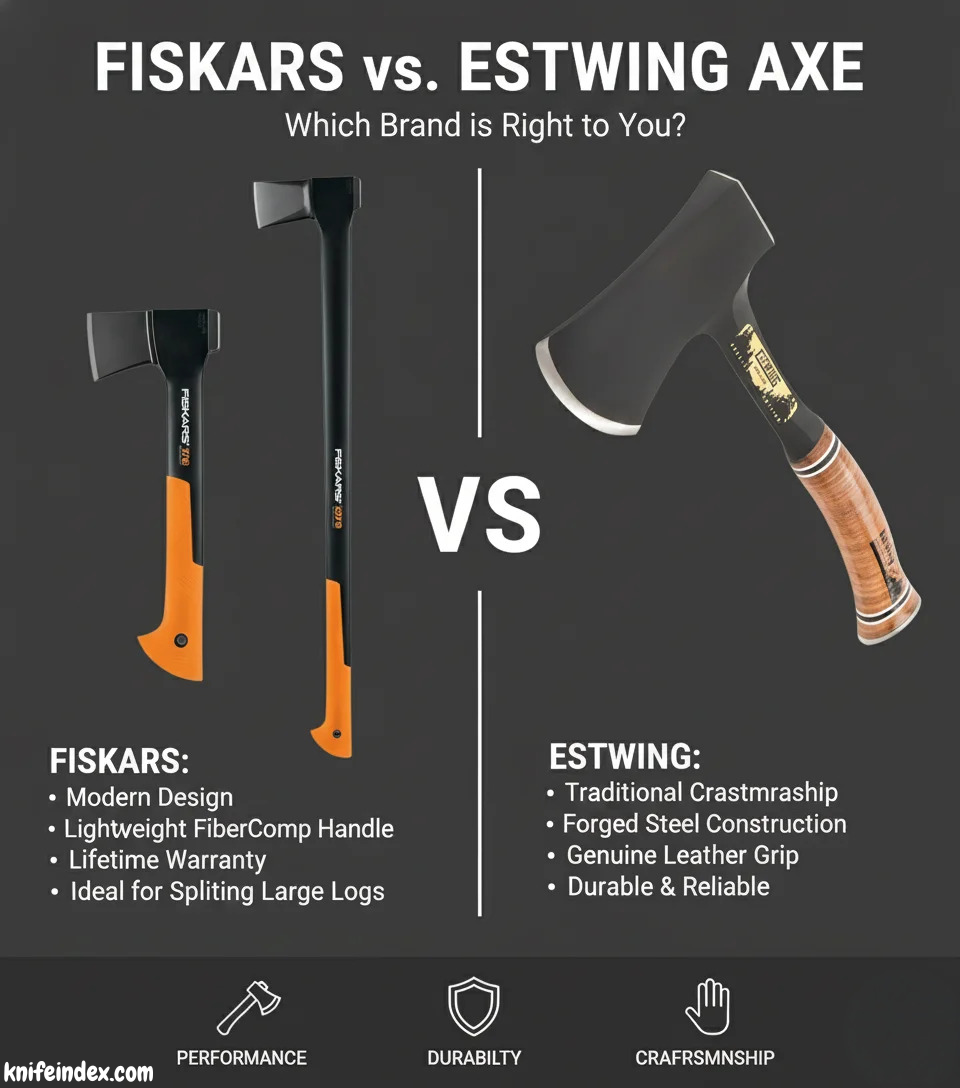
Introduction: The Clash of Philosophies
If you ask a group of woodsmen to recommend a durable, affordable axe, the room will immediately split into two camps. On one side, you have the Fiskars loyalists, who swear by the lightweight, indestructible FiberComp handles and modern wedge geometry. On the other side, you have the Estwing purists, who believe that an axe should be forged from a single piece of American steel and last long enough to be buried with you.
This isn’t just a comparison of two brands; it is a comparison of two completely different engineering philosophies. Fiskars represents the modern approach: using advanced materials to reduce weight and maximize kinetic energy. Estwing represents the traditional approach: using brute strength, mass, and time-tested metallurgy to create a tool that literally cannot fail.
In this comprehensive Fiskars vs Estwing axe comparison, we are going to break down everything—from vibration dampening and edge retention to splitting efficiency and price. Whether you are looking for a Fiskars X7 for your backpack or an Estwing Fireside Friend for your hearth, this guide will help you decide.
Understanding Axe Terminology: A Prerequisite for Smart Buying
Before diving deeper into the Fiskars versus Estwing debate, it’s essential to understand the terminology that surrounds axe purchasing decisions. Many first-time buyers confuse hatchets with axes, splitting mauls with felling axes, and edge geometry with grind angle. Let’s clarify these fundamental concepts so you can make an informed decision when browsing the best axe for splitting wood or the ideal camping axe for your next outdoor adventure.
A hatchet is typically defined as a small, one-handed axe with a handle length between 12 and 18 inches. These compact cutting tools excel at limbing branches, preparing kindling, and light chopping tasks around the campsite. The Fiskars X7 hatchet and Estwing Sportsman’s Axe both fall into this category, though they approach the design challenge from vastly different perspectives. A full-size axe features handles ranging from 24 to 36 inches and is designed for two-handed operation, providing significantly more leverage and power for felling trees or processing large rounds of firewood.
The splitting maul represents a specialized category entirely, combining the cutting edge of an axe with the sledgehammer-like poll of a maul. These heavy-duty tools prioritize wedge geometry over sharpness, using their substantial weight and wide profile to force wood fibers apart along the grain. The Fiskars X27 Super Splitting Axe, despite its name, functions more like a maul than a traditional axe, which explains its remarkable efficiency in processing firewood.
When evaluating edge geometry, you’ll encounter terms like “convex grind,” “flat grind,” and “Scandi grind.” Fiskars employs a convex grind on most of their axes, meaning the blade curves gently from the cutting edge through the cheeks of the axe head. This profile excels at splitting because it forces wood apart rather than digging in and getting stuck. Estwing traditionally uses a flatter grind profile that cuts more aggressively but can bind in tough, knotty wood. Understanding these distinctions helps explain why some axes excel at specific tasks while struggling at others.
The poll of an axe—the back portion opposite the cutting edge—deserves special attention when comparing these two brands. Estwing’s one-piece steel construction means the poll is integral to the tool’s design and can safely be used for hammering tasks. This versatility makes the Estwing Sportsman particularly valuable for campers who need to drive tent stakes or adjust equipment. Fiskars explicitly warns against using their axes as hammers, as the polymer housing surrounding the poll area isn’t designed to withstand repeated impact stress.
The Science of Axe Design: Physics Meets Practical Application
The battle between Fiskars and Estwing ultimately comes down to physics—specifically, how each brand manages the transfer of energy from your body into the wood. When you swing an axe, you’re converting chemical energy from your muscles into kinetic energy, which is then transferred through the axe head into the target material. The efficiency of this energy transfer determines how much work you actually accomplish with each swing.
Moment of inertia plays a crucial role in axe performance. Fiskars engineers their axes with a distinct head-heavy balance by making the FiberComp handle exceptionally light and hollow. This concentrates mass near the cutting edge, increasing the moment of inertia and allowing the head to maintain velocity through the cutting arc. The result is an axe that feels almost whip-like in its delivery of force, with the lightweight handle allowing for rapid acceleration and the heavy head providing impact force disproportionate to the tool’s overall weight.
Estwing takes the opposite approach, distributing mass evenly along the entire length of the tool through their one-piece steel construction. This creates a higher overall weight but provides a different type of mechanical advantage. The balanced feel of an Estwing axe gives the user more control during precise cutting tasks, and the weight of the steel handle contributes to the overall momentum of the swing. While this design requires more energy to accelerate initially, it maintains momentum through the cut with impressive authority, particularly in hardwoods like oak, hickory, and maple.
The coefficient of friction between the axe head and the wood being cut represents another critical factor that distinguishes these brands. Fiskars applies a proprietary low-friction coating to their axe heads, which significantly reduces the surface friction coefficient. This means the blade slides through wood fibers more easily and, crucially, is less likely to become stuck in a partially split log. Estwing’s painted finish offers no such friction-reducing properties, which explains why users sometimes report binding issues when processing particularly stringy or green wood.
Quick Comparison: At A Glance
Before we start swinging, let’s look at the tale of the tape. Here are the fundamental differences between these two manufacturing giants.
| Feature | Fiskars (X-Series) | Estwing (Sportsman/Camper) |
|---|---|---|
| Construction | Two-piece (Insert Molded Head) | One-piece Solid Forged Steel |
| Handle Material | FiberComp (Hollow Polymer) | Leather Washers or Blue Vinyl |
| Weight Distribution | Head-heavy (Max Velocity) | Balanced/Handle-heavy |
| Shock Absorption | Excellent (Dampens vibration) | Poor (Transmits vibration) |
| Maintenance | Zero (Weatherproof) | Low to Medium (Rust prone) |
| Durability | High (Handle is unbreakable) | Extreme (Literally a steel bar) |
| Origin | Finland (mostly) | USA (Rockford, IL) |
Beyond the Basics: Detailed Specification Analysis
While the quick comparison table provides a useful overview, serious axe buyers need to understand the nuanced specifications that separate these two legendary brands. Let’s examine the detailed technical specifications that affect real-world performance in the woodshed, at the campsite, or during emergency survival situations.
Steel Composition and Heat Treatment: Fiskars uses a proprietary carbon steel formulation that undergoes precise heat treatment to achieve a Rockwell hardness between 54-58 HRC. This hardness range represents a deliberate compromise between edge retention and ease of sharpening. A softer steel (below 54 HRC) would require frequent sharpening but resist chipping, while harder steel (above 58 HRC) would hold an edge longer but risk catastrophic chipping when striking rocks, knots, or frozen wood. Fiskars has identified this sweet spot through decades of Scandinavian forestry experience.
Estwing employs American-made tool steel with a slightly different metallurgical profile. Their heat treatment process results in steel that tends toward the upper end of the hardness spectrum, typically 56-60 HRC depending on the specific model and production batch. This harder edge retains sharpness exceptionally well during extended use but requires more attention during the sharpening process. The difference is subtle but noticeable to experienced users who process large volumes of wood.
Handle Length Options and Applications: While many buyers focus exclusively on the axe head, handle length dramatically affects usability and should be matched to both the user’s height and the intended application. Fiskars offers handle lengths ranging from 14 inches (X5 Camping Hatchet) to 36 inches (X27 Super Splitting Axe), with intermediate options like the 22-inch X11 and 28-inch X25. This comprehensive size range accommodates users from backpackers seeking ultralight tools to professional arborists needing maximum leverage.
Estwing’s handle length options are more constrained by their forging process. Their most popular models feature handles between 12 and 16 inches for hatchets and camp axes, with the Long Handle Camper’s Axe extending to approximately 19 inches. Estwing doesn’t produce true full-size felling axes, focusing instead on the camp and sport utility market. This limitation means buyers specifically seeking a 28-inch or longer axe will naturally gravitate toward Fiskars or traditional wooden-handled alternatives.
Round 1: Construction & Materials
Fiskars: The Composite Revolution
Fiskars axes are famous for their orange and black handles made from FiberComp. This is a fiberglass-reinforced polyamide that is lighter than wood and stronger than steel (by weight). The handle is hollow, which unnerves traditionalists, but this design shifts the balance point towards the head.
Because the handle is light, you can swing a Fiskars axe faster. In physics terms, kinetic energy equals $1/2 mass \times velocity^2$. By increasing velocity, Fiskars generates massive splitting power without needing a heavy tool. The head is “insert molded,” meaning the plastic is formed around the steel head, making it impossible for the head to fly off.
The Engineering Behind FiberComp: More Than Just Plastic
When traditionalists dismiss Fiskars handles as “plastic,” they’re overlooking the sophisticated materials science that makes FiberComp one of the most advanced axe handle materials ever developed. The FiberComp compound consists of fiberglass strands suspended in a polyamide matrix, creating a composite material with properties that neither component could achieve alone. The fiberglass provides tensile strength and stiffness, while the polyamide offers impact resistance and vibration dampening capabilities.
The manufacturing process for FiberComp handles involves injection molding under precise temperature and pressure conditions. During this process, the steel axe head is positioned within the mold cavity, and the molten composite material flows around specially designed retention features on the head. As the material cools and crystallizes, it forms a molecular bond with the steel surface that is, for all practical purposes, permanent. This insert molding technique eliminates the need for wedges, epoxy, or mechanical fasteners that can fail over time in traditional axe construction.
Temperature performance represents another area where FiberComp excels. The material maintains its structural integrity from -40°F to over 200°F, making it suitable for use in environments ranging from Arctic winter camping to desert survival scenarios. Traditional wooden handles can become brittle in extreme cold, swelling and cracking as moisture within the wood fibers expands and contracts. Hickory handles, while traditional and aesthetically pleasing, require seasonal maintenance with linseed oil to prevent checking, splitting, and degradation. FiberComp requires no such maintenance, which explains why many professional arborists and forestry workers have adopted Fiskars tools despite their modern appearance.
The hollow core design of Fiskars handles, often criticized by those who equate weight with durability, actually serves multiple engineering purposes. The cavity reduces overall handle weight by approximately 40% compared to a solid design, which directly improves swing speed and reduces user fatigue during extended work sessions. Additionally, the hollow structure acts as a tuned vibration damper, disrupting the transmission of shock waves from the axe head to the user’s hands. This principle is similar to how hollow tennis rackets and golf club shafts are engineered to manage vibration while maintaining structural rigidity.
Estwing: The Solid Steel Bar
Estwing axes are forged from a single piece of tool steel. From the cutting edge to the bottom of the handle, it is one continuous bar of metal. There is no joint to fail. There is no head to loosen. This construction makes Estwing axes arguably the most durable striking tools on the planet.
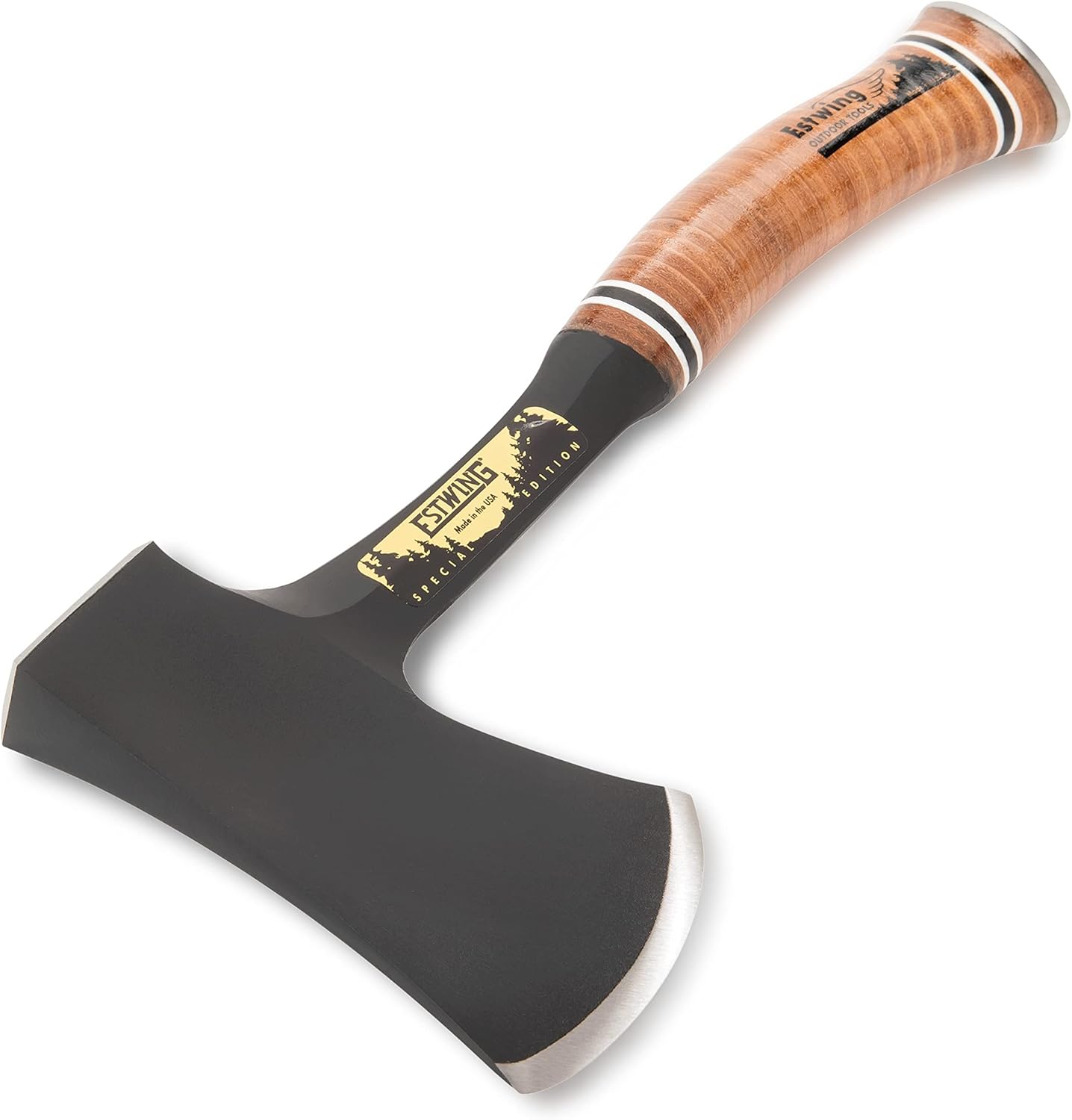
The handle is typically wrapped in their iconic stacked leather washers (lacquered for protection) or their blue shock-reduction vinyl grip. While this makes the tool heavy, it gives it a feeling of invincibility that plastic simply cannot replicate.
Estwing’s Forging Process: A Century of Refinement
The Estwing Manufacturing Company has operated continuously in Rockford, Illinois since 1923, making it one of America’s oldest surviving tool manufacturers. Their forging process begins with American-made tool steel bars that are heated to approximately 2,200 degrees Fahrenheit in gas-fired furnaces. At this temperature, the steel becomes plastic enough to be shaped under enormous pressure from drop hammers and hydraulic presses.
What makes Estwing’s process unique is their commitment to single-piece forging. Most axe manufacturers forge the head separately from the eye (the hole where the handle attaches), then join the two components. Estwing eliminates the joint entirely by forging the entire axe—head, eye, and handle—from a single billet of steel. This requires sophisticated die design and precise control of material flow during the forging operation, as the steel must transition smoothly from the thick cross-section of the head to the relatively thin profile of the handle without creating stress risers or weak points.
After forging, Estwing axes undergo a carefully controlled heat treatment process that determines their final hardness and toughness. The axes are heated to their critical temperature (the point at which the steel’s crystalline structure transforms to austenite), then quenched rapidly to lock in a hard martensitic structure. This is followed by tempering—a lower-temperature heat treatment that reduces brittleness while maintaining useful hardness. The result is an axe head that combines excellent edge retention with the toughness needed to withstand impact forces without chipping or cracking.
The leather handle assembly on Estwing’s classic models represents another hallmark of their craftsmanship. Each handle consists of dozens of individual leather washers, cut from high-quality cowhide and stacked onto the forged steel tang under significant pressure. The washers are compressed and then shaped on a lathe to create the comfortable, contoured grip that Estwing users have appreciated for generations. Multiple coats of lacquer seal the leather against moisture while providing the glossy finish that characterizes these tools. The process is labor-intensive and increasingly rare in modern manufacturing, which contributes to the premium price point of leather-handled Estwing axes.
Round 2: Ergonomics and Shock Reduction
If you are processing a cord of wood, how your arm feels afterwards matters more than how cool the axe looks.
The Estwing “Sting”
The biggest criticism of Estwing axes is the vibration. Because they are solid steel, when you strike a hard log, the shockwave travels straight down the handle and into your elbow. Estwing’s “Shock Reduction Grip” (the blue vinyl) helps, but it cannot eliminate the resonance of a steel bar. The leather-handled versions are beautiful, but they offer even less damping. Extended use can lead to elbow fatigue faster than with other handles.
The Fiskars “Flow”
Fiskars FiberComp handles are naturally shock-absorbing. The composite material dampens the vibration before it reaches your hand. Furthermore, because the handle is lighter, there is less mass for your wrist to arrest at the end of a swing. For high-repetition tasks, like using the Fiskars X25 or X27, the ergonomic advantage is undeniable.
Hand-Arm Vibration Syndrome: Why Shock Absorption Matters
The discussion of axe vibration isn’t merely academic—it has real medical implications for anyone who processes firewood regularly. Hand-Arm Vibration Syndrome (HAVS) is a recognized occupational disease that affects workers who use vibrating tools for extended periods. The condition involves damage to blood vessels, nerves, and joints in the hands and arms, potentially leading to permanent numbness, reduced dexterity, and chronic pain. While HAVS is most commonly associated with pneumatic tools and chainsaws, the cumulative effect of thousands of axe strikes over a heating season can contribute to similar symptoms.
The vibration frequency transmitted by axes typically falls in the 8-500 Hz range, with peak transmission occurring at the handle’s natural resonant frequency. Steel handles, like those on Estwing axes, have a relatively high natural frequency (typically 200-400 Hz for the handle sizes used in camp axes) and very low material damping. This means vibrations pass through the steel with minimal attenuation, delivering sharp, high-frequency impulses directly to the user’s hand. These high-frequency vibrations are particularly effective at causing the vasospastic episodes characteristic of vibration white finger, a component of HAVS.
Composite materials like Fiskars FiberComp exhibit significantly higher material damping coefficients than steel. The viscoelastic nature of the polymer matrix converts vibration energy into small amounts of heat as the material flexes microscopically with each impact. Additionally, the hollow core design introduces impedance mismatches that reflect and scatter vibration waves, further reducing transmission to the grip area. The result is a dramatically lower vibration dose delivered to the user, even during extended splitting sessions involving hundreds of swings.
For users with pre-existing conditions such as carpal tunnel syndrome, tennis elbow (lateral epicondylitis), or arthritis, the vibration difference between these brands becomes critically important. The repetitive shock loading from steel-handled tools can exacerbate inflammation in already compromised joints and connective tissues. Many physical therapists and occupational health specialists specifically recommend composite-handled tools for patients who need to continue wood processing activities while managing these conditions.
Grip Design and Hand Fatigue
Beyond vibration, grip design significantly influences user comfort and safety during extended axe use. Fiskars has invested considerable research into the ergonomics of their handle shapes, incorporating subtle contours that match the natural gripping position of the human hand. The textured surface of FiberComp provides secure traction even when wet or when the user is wearing gloves, reducing the grip force required to maintain control during powerful swings. This reduced grip requirement translates directly to less hand fatigue over time.
Estwing’s leather handles, while aesthetically superior and traditional, present a mixed ergonomic picture. The stacked leather construction conforms to the user’s hand over time, creating a personalized grip that many owners describe as uniquely comfortable. However, the smooth lacquered finish can become slippery in wet conditions, requiring users to grip more tightly and contributing to premature hand fatigue. The blue vinyl Shock Reduction Grip addresses some of these concerns with a more aggressive texture pattern, though it lacks the classic appeal of leather.
The diameter of the grip also affects comfort and control. Fiskars handles tend to be slightly thinner than Estwing grips, which suits users with smaller hands but may feel insubstantial to those with larger palms. Estwing’s leather grips typically build up to a more substantial diameter that fills the hand completely, providing a secure feeling during heavy chopping. Neither approach is universally superior—the optimal grip diameter depends on individual hand size and personal preference, which is why many experienced outdoorsmen recommend handling both brands before making a purchasing decision.
Round 3: Splitting vs. Chopping
Splitting Firewood
Fiskars dominates the splitting game. Their X-series axes feature a distinct wedge geometry with a convex grind. The cheeks of the axe flare out rapidly. Combined with the high swing speed and the low-friction PTFE (Teflon-like) coating, a Fiskars axe rarely gets stuck. It pops wood apart explosively.
Estwing axes generally have a thinner, more traditional profile (except for the Fireside Friend). While they are capable splitters, the painted coating on Estwing heads creates more friction than the Fiskars coating, meaning they are more likely to bind in green or knotty wood.
Chopping and Felling
For chopping down small trees or limbing branches, the contest is closer. The Fiskars X7 is a biting machine due to its razor-sharp factory edge. However, the weight of an Estwing Sportsman’s axe can be advantageous here. The momentum of the heavy steel handle helps drive the cut through dense hardwoods, whereas the light Fiskars handle requires you to provide all the power.
The Physics of Wood Splitting: Why Geometry Matters More Than Weight
Understanding why Fiskars excels at splitting requires examining the mechanical properties of wood itself. Wood is an anisotropic material, meaning its properties vary depending on the direction of applied force relative to the grain. The tensile strength of wood perpendicular to the grain (the force required to pull fibers apart) is typically only 5-10% of its tensile strength parallel to the grain. This enormous disparity explains why splitting, which forces wood apart along its natural grain lines, requires dramatically less energy than chopping across the grain.
The key to efficient splitting is converting the axe’s forward momentum into lateral force that exploits wood’s weakness perpendicular to the grain. This is where Fiskars’ aggressive wedge geometry proves decisive. The wide cheek angle (typically 30-35 degrees on Fiskars splitting axes) acts as a mechanical advantage, translating forward motion into outward pressure that tears wood fibers apart along their natural cleavage planes. The faster the axe enters the wood and the wider its profile, the more effectively it converts kinetic energy into splitting force.
Estwing’s thinner profile (typically 20-25 degrees at the cheek) was originally designed for general-purpose camp tasks rather than dedicated splitting. While this geometry penetrates wood more deeply during chopping operations, it generates less lateral spreading force during splitting, requiring more strikes to completely separate a round. The painted finish on Estwing heads, while protective against corrosion, increases the coefficient of friction between the axe and the wood. This additional friction consumes energy that would otherwise go toward splitting and increases the likelihood of the axe becoming lodged in a partially split log.
The species of wood being processed also influences which axe design performs better. Softwoods like pine, fir, and spruce split relatively easily regardless of axe design, as their straight grain and low density offer minimal resistance. Hardwoods present a greater challenge, particularly species with interlocking grain patterns like elm, sweetgum, and some varieties of oak. These woods resist splitting even with optimal technique, and the advantage of Fiskars’ wedge geometry becomes proportionally more significant. For users processing primarily hardwoods, the performance gap between Fiskars and Estwing widens considerably.
Seasonal Considerations: Frozen Wood and Green Wood
The season in which you process firewood dramatically affects splitting difficulty and may influence your choice between these two brands. Frozen wood, a common reality for winter firewood preparation in northern climates, presents unique challenges and opportunities. When the moisture within wood fibers freezes, it expands and weakens the bonds between fibers, making frozen rounds paradoxically easier to split than their room-temperature counterparts. However, the frozen wood is also harder and more resistant to initial penetration, which favors axes with sharp, thin profiles that can initiate a cut in the frozen surface.
Fiskars’ sharp factory edge and high swing speed provide excellent initial penetration into frozen rounds, while the wide cheek geometry then exploits the weakened fiber bonds to complete the split efficiently. Estwing’s heavier weight helps drive through the frozen surface despite the blunter profile, though the thinner cheek geometry may require more strikes to fully separate a frozen round. Many experienced wood processors actually prefer splitting in winter conditions, as the cold temperatures make the work more comfortable and the wood more cooperative.
Green wood—freshly cut timber with high moisture content—presents the opposite challenge. The water-filled fibers are flexible and resist the spreading action of a splitting wedge, causing many axes to bounce off or become hopelessly stuck. Fiskars’ low-friction coating provides a significant advantage here, allowing the axe head to slide out of a partial split rather than binding. Estwing’s painted surface can struggle with green wood, particularly in species known for stringy fiber structure like hickory or ash. For users who process green wood regularly, the Fiskars coating technology alone may justify choosing that brand.
Fiskars X27 Super Splitting Axe

The King of Splitting.
If your main goal is processing firewood, nothing beats the efficiency of the X27.
Mastering Splitting Technique: Getting the Most from Your Axe
Even the best axe cannot compensate for poor technique, and understanding proper splitting mechanics will improve your results regardless of which brand you choose. The most common mistake among novice wood splitters is attempting to split rounds in the center. Experienced woodsmen know that the outer portions of a round split more easily than the center, as the wood fibers are under less compressive stress near the bark. Beginning your split near the edge and working inward systematically processes rounds more efficiently than attacking the center directly.
Reading the grain of each round before striking represents another advanced technique that dramatically improves efficiency. Look for radial checks—small cracks that form in the end grain as wood dries—as these indicate natural cleavage planes where the wood wants to separate. Aligning your axe strike with these existing checks often results in a clean split with a single blow. Knots present the greatest challenge, as the swirling grain around a branch junction resists splitting from any direction. When encountering knotty rounds, aim to split parallel to the knot rather than through it, isolating the knotty section for separate processing.
The height of your splitting block significantly affects both comfort and efficiency. An ideal splitting block raises the round to approximately knee height, allowing you to deliver powerful, accurate swings without excessive bending or reaching. A block that’s too low forces you to stoop, straining your back during extended sessions. Too high, and you lose the mechanical advantage of your full swing arc. Many experienced wood processors keep multiple blocks of different heights to accommodate rounds of varying sizes, maintaining optimal ergonomics throughout their processing session.
Tire-assisted splitting has gained popularity among home firewood processors as a method to increase efficiency and reduce frustration. The technique involves placing a round inside an old automobile tire on top of your splitting block. The tire holds the pieces upright after the initial split, eliminating the need to reset partially split rounds for additional strikes. This technique works particularly well with Fiskars axes, as their rapid swing speed and aggressive wedge geometry complete splits before the round has a chance to fall over. Estwing axes, with their slower swing speed due to greater weight, benefit less dramatically from tire assistance but still see improved efficiency.
Round 4: Durability and Longevity
The Myth of Plastic Fragility
Skeptics often worry the Fiskars handle will snap in cold weather. In reality, FiberComp is rated for temperatures as low as -40°F and is widely used in the Nordic arctic. It is incredibly difficult to break. However, if you do manage to break it (usually by a massive overstrike on a steel wedge), the axe is finished. You cannot re-handle a Fiskars.
The Estwing Guarantee
You can run an Estwing over with a tank. You can leave it in a fire (though you’ll ruin the temper). It is a crowbar with an edge. The only failure point is the grip. Leather washers can rot if left in the rain, and vinyl grips can eventually peel after decades of abuse. But the steel core? It will outlive your grandchildren.
One distinct advantage Estwing has is the poll (the back of the axe). You can use an Estwing to hammer in tent stakes or even light nails. Fiskars warns against using the back of their axes as a hammer, as the polymer housing can crack.
Warranty Comparison: What Happens When Things Go Wrong
Both Fiskars and Estwing stand behind their products with lifetime warranties, but the specifics of these warranties reveal important differences in how each company views their tools. Fiskars offers a lifetime warranty against defects in materials and workmanship, covering any failure that occurs under normal use conditions. The company has earned a reputation for honoring warranty claims promptly, often shipping replacement tools without requiring the return of the damaged item. However, the warranty specifically excludes damage from abuse, misuse, or using the tool for purposes other than its intended application.
Estwing’s lifetime warranty similarly covers manufacturing defects but reflects the company’s confidence in their one-piece steel construction. The warranty explicitly covers the steel portion of the tool for life, with reasonable expectations for the leather or vinyl grip components, which are considered wear items. Estwing’s customer service operates from their Rockford, Illinois headquarters, and many users report positive experiences with warranty claims, often receiving replacements with minimal hassle. The company’s longevity—nearly a century in business—provides confidence that they’ll be around to honor future warranty claims.
The practical implications of these warranties differ based on the tools’ construction methods. A Fiskars warranty claim typically results in a complete replacement tool, since the axe cannot be repaired. An Estwing warranty claim for grip deterioration might result in either replacement or repair, as the leather washers can theoretically be replaced by skilled craftspeople. Neither warranty covers normal wear and tear on the cutting edge, which is considered a maintenance item subject to the user’s sharpening practices.
Overstrike Damage: The Achilles Heel of All Axes
Overstrike—when the axe misses the intended target and strikes the wood with the handle rather than the head—represents the most common cause of catastrophic axe failure across all brands and construction methods. Traditional wooden handles are particularly vulnerable to overstrike damage, as the sharp edge of the axe head acts as a fulcrum that can snap a hickory handle cleanly. This vulnerability explains why many traditional axes feature protective collars or metal guards below the head.
Fiskars addresses overstrike vulnerability through material selection rather than protective hardware. The FiberComp material resists the type of sudden fracture that characterizes wooden handle failure, instead deforming and absorbing energy without complete separation. Severe overstrikes can damage the FiberComp surface, creating cosmetic blemishes that don’t affect structural integrity. However, repeated severe overstrikes can eventually compromise the handle, and because the head is permanently molded into the handle, this damage cannot be repaired. The entire tool must be replaced under warranty or through purchase of a new axe.
Estwing’s one-piece steel construction eliminates the overstrike vulnerability entirely. Since the handle and head are the same piece of metal, there is no joint to fail and no leverage point for catastrophic breakage. An overstrike with an Estwing simply transfers impact force through the handle, potentially causing discomfort to the user but causing no damage to the tool. This indestructibility under any conceivable use scenario represents Estwing’s strongest selling point for users who subject their tools to extreme conditions or who simply prefer tools that require no special care or technique to maintain.
Long-Term Ownership Costs and Value Retention
Evaluating durability requires considering not just whether a tool can survive abuse, but the total cost of ownership over decades of use. Fiskars axes, with their weatherproof construction and zero-maintenance design, incur essentially no ongoing costs beyond occasional sharpening. Leave them outside in the rain, in the bed of a pickup truck through winter, or in an unheated shed—the FiberComp handle and coated steel head remain unaffected. This neglect-tolerance reduces the effective cost of ownership and makes Fiskars particularly appealing for casual users who don’t want to develop axe maintenance skills.
Estwing axes require more attentive care to maintain their condition, particularly the leather-handled models. Leather washers need periodic conditioning with appropriate leather treatments to prevent drying and cracking. The steel surface requires oiling to prevent rust, especially if the axe is stored in humid conditions or exposed to moisture regularly. These maintenance requirements add modest ongoing costs and time investment but are unlikely to deter enthusiasts who enjoy caring for quality tools. The blue vinyl grip models reduce maintenance requirements but sacrifice the classic aesthetics that many Estwing buyers specifically seek.
Resale value represents another dimension of long-term ownership economics. Quality axes, well-maintained, can retain significant value over decades. Vintage Estwing axes from the mid-20th century command premium prices among collectors, particularly leather-handled models with patina that demonstrates authentic use rather than neglect. Fiskars axes, as newer entrants to the market and with their modern synthetic materials, have not yet developed a collector following, though their functional value remains high on the used market. For buyers who view their tools as potential heirlooms, Estwing’s collectibility adds an intangible value that the purchase price alone doesn’t capture.
Specific Model Matchups
1. The Hatchet Battle: Fiskars X7 vs Estwing Sportsman
The Fiskars X7 is the ultralight backpacker’s choice. It weighs 1.4 lbs and disappears in a pack. It cuts aggressively but lacks “soul.” The Estwing Sportsman (leather handle) is a piece of Americana. It is heavier but feels balanced and looks beautiful in a leather sheath.
Verdict: X7 for hiking; Estwing for car camping and nostalgia.
2. The Splitting Battle: Fiskars X27 vs Estwing Fireside Friend
This is apples and oranges, but they are often compared. The X27 is a 36-inch monster meant for two-handed splitting of large rounds. The Fireside Friend is a handheld 4lb maul designed for kindling. A better comparison is the Fiskars X11 vs the Fireside Friend.
Verdict: For large logs, the Fiskars X27 is unmatched (see our X27 vs Super Splitting Axe guide). For kindling at the hearth, the Estwing Fireside Friend is safer and more effective due to its weight.
3. Fiskars X11 vs Estwing Camper’s Axe: The Mid-Size Showdown
For users seeking a versatile tool that splits kindling as effectively as it processes small rounds, the mid-size category offers compelling options from both manufacturers. The Fiskars X11 features a 17-inch handle and a 2.2-pound head, striking a balance between the compact X7 hatchet and the full-size X27 splitting axe. This intermediate size makes it suitable for one-handed operation during precise tasks while still providing enough weight for modest splitting duties.
The Estwing Camper’s Axe, available in both leather and blue vinyl grip configurations, fills a similar niche with an 18-inch handle and approximately 3-pound overall weight. The additional weight of the steel handle gives the Camper’s Axe more authority during splitting and chopping operations, though at the cost of increased fatigue during extended use. The Camper’s Axe also features a more pronounced curve to the cutting edge compared to Estwing’s smaller hatchet models, improving its performance during limbing and brush clearing tasks.
For backpackers counting ounces, the Fiskars X11’s lighter weight makes it the obvious choice. For car campers who value versatility and don’t mind additional weight, the Estwing Camper’s Axe offers a compelling combination of chopping power and splitting capability in a package that still fits easily in vehicle storage. Both models accept aftermarket sheaths and sharpening accessories, though the Estwing’s poll hammering capability gives it a slight edge in campsite versatility.
4. Fiskars X5 vs Estwing E24A: Ultralight Hatchet Comparison
The ultralight hatchet category tests each manufacturer’s ability to minimize weight without sacrificing functionality. The Fiskars X5 Camping Hatchet weighs just 1.0 pound with a 14-inch handle, making it one of the lightest full-featured hatchets available. Despite its featherweight construction, the X5 maintains the same FiberComp handle technology and insert-molded head design as its larger siblings, ensuring that weight reduction hasn’t compromised structural integrity.
Estwing’s E24A Sportsman’s Hatchet weighs significantly more at approximately 1.7 pounds with its 12-inch handle. The one-piece steel construction inherently limits how light the tool can be, as the steel handle must maintain sufficient cross-section for strength. However, the E24A’s compact size makes it more maneuverable in tight quarters than the longer-handled X5, and its solid steel construction provides the hammering capability that ultralight backpackers often need for tent stake installation.
Ultralight backpackers who count every gram will gravitate toward the Fiskars X5 without hesitation. The one-pound weight penalty for the Estwing may seem modest in isolation but becomes significant when considering overall pack weight for extended trips. Hunters and bushcrafters who prioritize tool versatility and durability over pure weight savings will find the Estwing’s indestructibility and multi-purpose functionality more compelling, accepting the weight penalty as payment for capabilities the lighter tool cannot match.
5. Fiskars X25 vs Estwing Long Handle Camper: Two-Handed Versatility
The Fiskars X25 occupies the sweet spot in their splitting axe lineup, featuring a 28-inch handle and 4.5-pound head that provides excellent leverage without the unwieldy length of the 36-inch X27. This intermediate length suits users of average height and provides a comfortable two-handed swinging platform for processing moderate-sized rounds. The X25’s popularity stems from its ability to handle 90% of home firewood processing tasks without the specialized length of its larger sibling.
Estwing’s Long Handle Camper’s Axe represents their entry into the two-handed category, stretching to 19 inches with an overall weight approaching 4 pounds. While significantly shorter than the X25, the Long Handle Camper provides enough grip length for two-handed operation during chopping and splitting tasks. The tool’s primary advantage lies in its versatility—it remains compact enough for one-handed use during limbing and brush clearing while providing two-handed capability when additional power is needed.
The substantial handle length difference between these models reflects their divergent design philosophies. The X25 prioritizes splitting efficiency through maximum leverage, accepting the bulk and storage requirements of a 28-inch tool. The Long Handle Camper prioritizes portability and multi-role functionality, providing two-handed capability in the most compact possible package. For homeowners who process firewood as a primary activity, the X25’s leverage advantage proves decisive. For campers and outdoorsmen who need occasional two-handed capability without sacrificing packability, the Estwing offers a pragmatic compromise.
Estwing Sportsman’s Axe

The Heritage Choice.
Beautiful leather grip, forged steel, and made in the USA.
Pros and Cons Summary
✅ Fiskars Pros
- Efficiency: Splits wood with less effort than any other axe.
- Weight: Extremely light, perfect for mobile use.
- Ergonomics: Absorbs shock, saving your joints.
- Weatherproof: Leave it in the rain, it doesn’t care.
- Price: Generally cheaper than Estwing.
❌ Fiskars Cons
- Repairability: Cannot replace the handle if broken.
- Utility: Cannot use the back as a hammer.
- Aesthetics: Looks like a gardening tool, not a heritage piece.
✅ Estwing Pros
- Indestructible: One-piece forged steel construction.
- Multipurpose: Can be used for light hammering tasks.
- Heritage: Beautiful leather options that age well.
- Made in USA: Supports American manufacturing.
❌ Estwing Cons
- Vibration: Transmits shock to the hand (“the sting”).
- Weight: Heavy to carry for long distances.
- Binding: Painted heads tend to stick in wood more than Teflon.
- Rust: Requires oiling to prevent corrosion.
Beyond the Big Two: Other Brands Worth Considering
While Fiskars and Estwing dominate the modern axe market, several other manufacturers produce tools that merit consideration depending on your specific needs and preferences. Understanding where these alternatives fit in the marketplace helps contextualize the Fiskars vs Estwing decision and may reveal options that better suit your particular requirements.
Council Tool: Based in North Carolina, Council Tool produces traditional American axes with hickory handles and forged steel heads. Their Velvicut line represents the premium end of American axe manufacturing, featuring hand-sharpened edges and carefully selected hickory. Council Tool axes provide the traditional look and feel that Estwing’s steel handles cannot match, while offering the repairability (replaceable handles) that Fiskars lacks. The trade-off comes in weight and maintenance requirements—hickory handles require seasonal oiling and are vulnerable to overstrike damage.
Husqvarna: The Swedish manufacturer known primarily for chainsaws also produces quality axes at competitive price points. Husqvarna axes feature hickory handles with forged steel heads, often manufactured by Hults Bruk or other established Swedish forges. The quality-to-price ratio makes Husqvarna an attractive option for buyers who want traditional axe aesthetics without premium pricing. However, individual examples may require edge reprofiling out of the box, as factory sharpening can be inconsistent.
Gerber: As a competitor to Fiskars in the modern composite axe category, Gerber offers similar FiberComp-style handles with different head geometries and price points. Gerber axes tend to be positioned slightly below Fiskars in both price and performance, making them an option for budget-conscious buyers who want the benefits of composite construction without the Fiskars premium. The warranty and customer support from Gerber generally don’t match Fiskars’ reputation, which may factor into long-term ownership satisfaction.
Gransfors Bruk: For buyers seeking the absolute pinnacle of axe craftsmanship, the Swedish forge Gransfors Bruk produces hand-forged axes that are essentially functional works of art. Each axe bears the smith’s initials, and the edge geometry is hand-ground to perfection. The price—typically three to four times that of comparable Fiskars or Estwing models—reflects the labor-intensive manufacturing process. Gransfors Bruk axes offer the vibration dampening of hickory, the edge retention of premium Swedish steel, and the aesthetic beauty of traditional craftsmanship. For many enthusiasts, the question isn’t whether to buy Fiskars or Estwing, but whether to stretch the budget for a Gransfors Bruk.
Are There Other Options?
If neither of these fits your style, there is a third way: Traditional Swedish Axes.
Brands like Hultafors and Hults Bruk offer hand-forged heads on hickory handles. They offer the vibration dampening of wood (like Fiskars) with the heritage feel of steel (like Estwing). However, they require maintenance (oiling the wood) and are generally more expensive. If you are interested, check out our comparison of Hultafors vs Hults Bruk or our Hultafors Hatchet review.
Price-to-Performance Analysis: Getting the Most for Your Money
The axe market spans an enormous price range, from $20 hardware store specials to $300 hand-forged Swedish masterpieces. Understanding where Fiskars and Estwing sit in this spectrum helps buyers determine whether they’re receiving appropriate value for their investment. Both brands occupy the middle-to-upper range of mass-market axes, offering significant quality advantages over budget alternatives while remaining accessible to typical consumers.
At the time of writing, the Fiskars X27 Super Splitting Axe typically retails between $55 and $75, while the Estwing Sportsman’s Axe with leather grip falls in the $45-$65 range. These prices place both tools well above discount store axes ($15-$25) but substantially below premium hand-forged options ($150-$300). For the typical homeowner who processes one to three cords of firewood annually, either tool represents excellent value, likely to provide decades of service with basic care.
The value proposition shifts when considering frequency of use and specific applications. Professional arborists and forestry workers who use axes daily may find that premium Swedish axes justify their higher cost through superior edge retention and the ability to replace handles rather than entire tools. Weekend campers who use their axe a few times per year may find that even the moderate investment in a Fiskars or Estwing exceeds their actual needs. Understanding your realistic usage pattern prevents both under-investing in inadequate tools and over-investing in capabilities you’ll never utilize.
Where to Buy: Retail Options and Price Shopping Strategies
Both Fiskars and Estwing maintain wide retail availability through hardware stores, outdoor retailers, and online marketplaces. Brick-and-mortar retailers like Home Depot, Lowe’s, and Ace Hardware typically stock Fiskars axes, while Estwing products appear at farm supply stores, independent hardware stores, and outdoor retailers like REI and Cabela’s. The advantage of local purchase is the opportunity to handle the tool before buying, assessing grip comfort and balance in person rather than relying on specifications alone.
Online purchasing through Amazon offers convenience and often competitive pricing, particularly during seasonal sales events. Amazon’s customer review system provides insight into long-term durability and real-world performance that manufacturer specifications cannot convey. However, buyers should exercise the same caution with online axe purchases as with any tool—verify that the seller is authorized by the manufacturer to ensure warranty coverage, and be aware that counterfeit products occasionally appear on major marketplaces.
Seasonal price fluctuations create opportunities for strategic buyers. Axe prices typically dip during late winter and early spring, after peak firewood season has passed and retailers are clearing inventory. Conversely, prices often rise in early fall as homeowners prepare for heating season. If your axe purchase isn’t urgent, waiting for off-season pricing can yield significant savings. Additionally, both manufacturers occasionally offer rebates or bundle deals, particularly around Father’s Day and the holiday shopping season.
Frequently Asked Questions
Which axe is better for beginners, Fiskars or Estwing?
Fiskars is generally better for beginners. It is lighter, comes sharper out of the box, and the wedge geometry makes splitting success much easier, which builds confidence. The shock absorption is also more forgiving on untrained muscles.
Can I leave my Estwing axe outside?
It is not recommended. Estwing axes are made of carbon steel, which will rust if exposed to moisture. Leather handles can also rot or dry rot. Fiskars axes, however, are largely impervious to weather.
Why does my arm hurt after using my Estwing axe?
This is likely due to the lack of shock absorption in the solid steel handle. The vibration from impact travels up the arm (often called “axe sting”). Using gloves or switching to the blue vinyl grip version can help, but Fiskars or wooden handles are superior for joint comfort.
Do Fiskars axes really hold an edge?
Yes, Fiskars uses decent quality carbon steel. It is slightly softer than premium Swedish steel to prevent chipping, meaning it may roll if it hits a rock, but it is very easy to sharpen back to a razor edge.
Can I re-handle a Fiskars axe if it breaks?
No. Because the head is molded into the handle, they are permanently fused. However, Fiskars offers a lifetime warranty, and breakage is extremely rare under normal use conditions.
Additional Frequently Asked Questions
How do I sharpen a Fiskars axe properly?
Fiskars axes respond well to standard sharpening techniques using files, whetstones, or diamond sharpeners. The key is maintaining the original convex bevel rather than converting to a flat grind. Use a round file for any nicks, then refine with progressively finer stones. A leather strop loaded with polishing compound creates a razor edge. The Fiskars sharpener (sold separately) is designed specifically for their edge geometry. Always sharpen away from the edge, and maintain consistent angle throughout the process. With regular touch-ups, a Fiskars axe will maintain its edge for years of heavy use.
What’s the best axe for camping and backpacking?
For backpacking where weight is critical, the Fiskars X7 (1.4 lbs) is the clear winner. Its lightweight FiberComp construction won’t weigh down your pack, and the sharp factory edge makes quick work of campfire wood preparation. For car camping where weight matters less, the Estwing Sportsman’s Axe offers greater durability and the ability to hammer tent stakes, making it more versatile for established campsites. Consider your pack weight limitations and the tasks you’ll actually perform—many backpackers find a quality folding saw paired with a sturdy fixed-blade knife handles campfire needs without the weight of even a lightweight hatchet.
How do I maintain the leather handle on my Estwing axe?
Estwing leather handles require periodic conditioning to prevent drying, cracking, and separation of the leather washers. Apply a quality leather conditioner or neatsfoot oil sparingly—excessive oil can soften the leather to the point where washers lose their compression. Wipe away excess conditioner after allowing it to absorb for several hours. Avoid soaking the handle in water, and store the axe in a dry environment. If the lacquer finish begins to wear, reapply a thin coat of clear lacquer to restore protection. With proper care, Estwing leather handles develop a beautiful patina and can last for decades.
Is a Fiskars axe good for felling trees?
Fiskars axes can fell small trees (up to approximately 6-8 inches in diameter) effectively, particularly the longer-handled models like the X25 and X27. However, Fiskars primarily designs their axes for splitting rather than felling, and the wide wedge geometry isn’t optimal for the deep, narrow cuts required in felling operations. For serious felling work, consider a traditional felling axe with a thinner profile from manufacturers like Council Tool, Hults Bruk, or Gransfors Bruk. For occasional felling of small trees during trail maintenance or campsite clearing, Fiskars axes perform adequately but aren’t the ideal tool for the task.
Can I use a Fiskars axe for kindling?
Fiskars axes work well for kindling production, particularly the smaller models like the X5 and X7. The sharp factory edge bites cleanly into small-diameter wood, creating precise kindling pieces with minimal effort. However, the lightweight construction that makes Fiskars axes so efficient for splitting works against them for delicate kindling work, as the reduced mass provides less control during precise cuts. The Estwing Fireside Friend, with its 4-pound weight and compact size, offers superior control for kindling production, allowing you to place the edge exactly where you want it and drive through with controlled force. Many experienced fire-tenders actually prefer a dedicated kindling hatchet like the Fireside Friend for this specialized task.
What safety gear should I use when splitting wood?
Safety should always be your primary concern when using any axe, regardless of brand. Essential safety equipment includes safety glasses or goggles to protect against flying wood chips and splinters, sturdy work boots with steel toes if possible, and heavy-duty work gloves that provide grip without restricting movement. Long pants protect your legs from errant strikes and flying debris. Consider hearing protection if splitting for extended periods, as the ringing sound of repeated strikes can contribute to hearing damage over time. Always split on a stable, level surface with adequate clearance around your swing arc, and never allow bystanders within the danger zone of your swing. Proper technique—keeping your feet planted, using controlled swings, and never overreaching—prevents far more injuries than any protective equipment.
Complete Axe Maintenance Guide: Keeping Your Tool Battle-Ready
Sharpening Fundamentals: Files, Stones, and Technique
A sharp axe is a safe axe. Dull edges require more force to cut, increasing the likelihood of glancing blows and loss of control. Fortunately, maintaining a sharp edge on both Fiskars and Estwing axes requires only basic tools and consistent technique. The fundamental principle of axe sharpening is maintaining the original edge geometry while removing the minimum amount of material necessary to restore sharpness.
For routine edge maintenance, a fine-cut mill file (8-10 inches long) provides the fastest method for restoring a working edge. File in one direction only—away from the edge—using long, smooth strokes that follow the existing bevel angle. Avoid the temptation to use a back-and-forth sawing motion, which creates inconsistent results and can damage the file. After filing, refine the edge with progressively finer sharpening stones, starting with medium grit (around 400) and progressing to fine grit (1000 or higher). A leather strop charged with polishing compound creates the final razor edge that makes wood processing nearly effortless.
Fiskars axes benefit from their proprietary sharpener, which features ceramic wheels set at the correct angle for Fiskars edge geometry. This tool simplifies maintenance for users who don’t want to develop freehand sharpening skills. Estwing axes, with their harder steel, respond well to diamond sharpening stones, which cut more aggressively than traditional whetstones and reduce the time required for edge maintenance. Regardless of which sharpening system you choose, consistency in maintaining the edge angle matters more than the specific tools employed.
Rust Prevention and Treatment: Protecting Your Investment
Carbon steel axe heads, including those from both Fiskars and Estwing, will rust if exposed to moisture without protection. The development of surface rust doesn’t indicate poor quality—even premium Swedish axes rust without care—but prevention is far easier than correction. After each use, wipe down the axe head with a dry cloth to remove moisture and any sap or debris that might trap water against the steel surface. A light coating of oil (mineral oil, 3-in-1 oil, or even vegetable oil in a pinch) creates a barrier against atmospheric moisture.
If rust does develop, address it promptly before it progresses beyond surface discoloration to pitting, which permanently damages the steel surface. Light surface rust responds well to scrubbing with steel wool or fine-grit sandpaper, followed by re-oiling. More established rust may require chemical rust removers or electrolysis for severe cases. After removing rust, the affected area may show a darkened patina where the rust formed—this is cosmetic and doesn’t affect function, though some users prefer to polish until all discoloration is removed.
Storage conditions dramatically affect rust development. Axes stored in unheated garages, sheds, or vehicle tool boxes experience temperature fluctuations that cause condensation, accelerating rust formation. If possible, store your axe indoors in a climate-controlled environment. When indoor storage isn’t practical, increase the frequency of oil applications and consider using vapor corrosion inhibitor (VCI) products, which emit molecules that form a microscopic protective layer on metal surfaces.
Sheath Selection and Protection
A quality sheath protects both the axe edge and the user during transport and storage. Both Fiskars and Estwing include basic sheaths with their axes, but aftermarket options often provide superior protection and convenience. Leather sheaths offer traditional aesthetics and excellent durability, though they require occasional conditioning like any leather product. Kydex and molded plastic sheaths provide weatherproof protection and secure retention without maintenance requirements.
The most important feature of any axe sheath is secure retention—the sheath should stay in place during transport without relying on your hand to hold it. Look for sheaths with positive retention mechanisms like straps, snaps, or friction locks. A poorly designed sheath that falls off during transport exposes both the edge to damage and anyone reaching into a pack or tool bag to potential injury. Invest in quality protection for both your tool and yourself.
The Complete Firewood Processing Guide: From Tree to Hearth
Understanding Wood Species: Hardwoods vs Softwoods for Heating
The species of wood you burn dramatically affects both your processing experience and heating efficiency. Hardwoods like oak, hickory, maple, and ash provide the highest heat output per cord and produce long-lasting coals that maintain firebox temperature overnight. The density that makes these woods excellent fuel also makes them challenging to split, favoring axe designs with aggressive wedge geometry like Fiskars’ X-series.
Softwoods like pine, fir, and spruce split easily and ignite quickly, making them excellent for kindling and shoulder-season heating when full heat output isn’t necessary. However, softwoods burn faster and produce less total heat per cord, requiring more frequent reloading. The resin content in softwoods creates more creosote buildup in chimneys, increasing maintenance requirements. Most experienced wood burners mix species, using softwoods for quick heat and hardwoods for sustained overnight burns.
Regional availability largely determines which species you’ll process. Northeastern forests provide abundant maple, birch, and beech. The Midwest offers oak, hickory, and ash (though emerald ash borer has devastated ash populations in many areas). Western forests feature Douglas fir, lodgepole pine, and aspen. Learning to identify local species and understanding their burning characteristics optimizes both your processing efficiency and heating satisfaction.
Seasoning Firewood: The Critical Year-Long Process
Freshly cut wood contains 40-60% moisture by weight, making it nearly impossible to burn efficiently. Proper seasoning—allowing the wood to dry naturally—reduces moisture content to the 15-20% range where efficient combustion occurs. The seasoning timeline depends on species, climate, and processing methods, but plan for at least 6-12 months of drying time for wood split and stacked properly.
Splitting wood accelerates seasoning by exposing interior surfaces to airflow and sunlight. This is where your choice between Fiskars and Estwing directly affects your firewood operation. The faster you can split your wood after felling or delivery, the sooner the seasoning process begins. Fiskars’ splitting efficiency means you process more wood in less time, getting your firewood seasoning earlier in the season. Estwing’s heavier weight may slow your processing rate but provides a more thorough workout—some users consider this a feature rather than a drawback.
Proper stacking technique maximizes airflow and protects against ground moisture. Stack wood on pallets or rails that elevate it above soil contact, and orient split surfaces upward to expose them to sun and wind. Cover only the top of the stack to protect against rain while leaving sides open for ventilation. A well-constructed woodpile is both functional and aesthetically pleasing—a point of pride for dedicated wood burners.
Wood Processing Safety: Protecting Yourself During Extended Sessions
Extended wood processing sessions demand attention to safety and ergonomics beyond basic axe handling. Warm up before beginning with light stretching, focusing on shoulders, back, and wrists—the areas most stressed during splitting. Take regular breaks to prevent fatigue-related accidents, which typically occur during the last hour of a session when concentration wanes and muscles tire. Stay hydrated even in cold weather, as the physical exertion of splitting generates significant metabolic heat and fluid loss.
Proper lifting technique during wood handling prevents back injuries that can end a processing session—or a season—prematurely. Lift with your legs, keep the load close to your body, and avoid twisting while carrying heavy rounds. Use mechanical advantage whenever possible: splitting large rounds where they lie rather than lifting them onto a block, using a pickaroon or hookaroon to move rounds without bending, and employing a wood cart or wheelbarrow for transport rather than carrying armloads.
Personal protective equipment becomes increasingly important as processing volume increases. In addition to eye protection and sturdy footwear, consider hearing protection for extended splitting sessions—the cumulative noise exposure from hundreds of axe strikes can contribute to hearing damage. Anti-vibration gloves provide additional protection against the shock transmitted through steel-handled tools like Estwing axes. Chaps or protective pants designed for chainsaw use offer insurance against glancing axe strikes that could cause serious leg injuries.
Axes in Emergency and Survival Situations
The Survival Axe: Features That Matter When It Counts
In emergency situations—whether a vehicle breakdown in remote areas, an unexpected night in the wilderness, or a natural disaster that disrupts normal services—an axe transitions from a convenience tool to potentially life-saving equipment. The features that matter in survival contexts often differ from those prioritized during recreational use, and understanding these differences informs which axe belongs in your emergency kit.
Reliability trumps all other considerations in survival scenarios. An axe that fails when you need it most offers no value, regardless of its theoretical advantages. This is where Estwing’s indestructible construction provides genuine peace of mind—the tool will function regardless of conditions, abuse, or neglect. Fiskars’ weatherproof construction offers similar reliability benefits, though the inability to repair a damaged handle introduces a theoretical failure mode that Estwing’s design eliminates.
Multi-function capability becomes disproportionately valuable when you’re carrying limited equipment. Estwing’s ability to function as a hammer expands the tool’s utility without additional weight. The ability to drive stakes, break rocks, or pound metal components back into alignment provides capabilities beyond wood processing. Fiskars’ warning against hammering with their axes eliminates these functions, meaning you’d need to carry additional tools or improvise alternatives.
Emergency Shelter Construction
In survival situations requiring improvised shelter, an axe dramatically accelerates construction compared to improvised tools or bare hands. Cutting poles for shelter frames, harvesting boughs for insulation and waterproofing, and processing firewood for warmth all become practical tasks rather than desperate struggles. The speed advantage of Fiskars axes becomes particularly valuable in deteriorating weather conditions, where getting shelter established quickly affects survival outcomes.
Shelter construction often requires precise cuts that test axe control as much as raw power. Notching poles for lashing, trimming branches flush with the trunk, and splitting small-diameter wood for pegs all demand accuracy that rewards experience and tool familiarity. Regardless of which brand you choose, practice these skills under non-emergency conditions to build muscle memory that will serve you when stress and fatigue complicate fine motor tasks.
Vehicle Emergency Kits: Choosing the Right Tool
Many outdoorsmen and rural residents keep an axe in their vehicle for emergencies ranging from fallen trees blocking roads to getting stuck in remote areas. Vehicle-based tools face unique challenges: extreme temperature fluctuations, long periods of neglect, and the need to function reliably after months or years of disuse. These conditions favor tools that require minimal maintenance and tolerate environmental exposure.
Fiskars axes excel in vehicle emergency kit applications due to their weatherproof construction. A Fiskars axe stored in a truck tool box through summer heat and winter cold requires no maintenance and performs immediately when needed. The FiberComp handle won’t rot, the coated head won’t rust significantly, and the edge (if protected by a sheath) remains ready for use. Estwing axes require more attention to prevent rust in these conditions, though a light oil coating before storage largely addresses this concern.
Space constraints in vehicle kits often favor compact tools. The Fiskars X7 hatchet provides substantial capability in a package small enough to fit in a glove box or under-seat storage compartment. Estwing’s Sportsman’s Axe, while compact, is significantly heavier and more awkward to store securely in a vehicle. For dedicated vehicle kits, the weight penalty of steel-handled tools matters less than for backpacking, but storage space remains a consideration that favors compact composite designs.
Final Verdict: Which One Should You Buy?
The battle of Fiskars vs Estwing ends not with a knockout, but with a preference of style.
Buy a Fiskars IF:
- You prioritize performance and efficiency above all else.
- You want the best wood splitting capability on the market.
- You are hiking or backpacking and need to save weight.
- You have joint issues and need shock reduction.
Buy an Estwing IF:
- You want a tool that is virtually indestructible.
- You need an axe that can double as a hammer for tent stakes.
- You appreciate American-made heritage tools.
- You are doing general camp chores rather than splitting cords of wood.
Ultimately, many outdoorsmen own both: an Estwing for the belt and a Fiskars for the woodpile. You can’t go wrong with either legend.
Recommendations by User Profile
The Weekend Firewood Warrior: If you process one to three cords annually for a fireplace or wood stove, the Fiskars X25 or X27 represents the optimal tool for your needs. The splitting efficiency and reduced fatigue will make your processing sessions more productive and enjoyable. Supplement with a Fiskars X7 for kindling production and you’ll have a complete firewood system that handles everything from large rounds to fine kindling.
The Traditionalist Camp Craftsman: If you value aesthetics, heritage, and multi-function capability over pure splitting efficiency, the Estwing Sportsman’s Axe with leather grip will serve you for decades. The tool’s beauty improves with age, the leather grip conforms to your hand, and the ability to hammer tent stakes adds campsite utility. Accept the vibration and weight as part of the authentic experience.
The Ultralight Adventurer: Weight-conscious backpackers and long-distance hikers should choose the Fiskars X5 or X7 without hesitation. The weight savings compared to steel-handled alternatives are too significant to ignore, and the cutting performance of the sharp factory edge handles trail maintenance and campfire preparation efficiently. Pair with a lightweight folding saw for processing larger deadfall.
The Prepper and Emergency Planner: For emergency kits where reliability trumps all other considerations, the Estwing’s indestructibility provides genuine peace of mind. The hammering capability adds functionality without additional tools, and the Made-in-USA heritage supports domestic manufacturing. Accept the weight penalty as insurance against tool failure when it matters most.
The Gift-Giver: Estwing axes, particularly the leather-handled models, make exceptional gifts that convey quality, tradition, and thoughtfulness. The presentation of a beautifully crafted American tool creates an impression that functional-but-plastic alternatives cannot match. Include a bottle of leather conditioner and a quality sharpening stone to complete the gift package.