Fiskars X7 Hatchet Review: The Indestructible Legend
It’s orange, it’s plastic, and it has changed the camping world forever. We dive deep into the performance, durability, and bite of the Fiskars X7 to see if it truly deserves its cult status.
Introduction
In the traditional world of bushcraft, tools are usually made of hickory and hand-forged steel. They smell like linseed oil and history. Then, there is the Fiskars X7 Hatchet. It looks like it fell off a spaceship. It is bright orange, hollow, and mass-produced. Yet, walk into any serious outdoorsman’s garage, and you will likely find one hanging right next to their expensive Swedish axes. This tool represents a paradigm shift in how we think about outdoor cutting implements, blending modern material science with practical, user-focused design.
The Fiskars X7 has earned a reputation as the “Glock of hatchets”—ugly, utilitarian, affordable, and practically indestructible. But is it actually good at processing wood? Does the lightweight handle compromise chopping power? And how does the steel hold up against rocks and knots? These are the critical questions for any camper, hiker, or bushcrafter who needs to rely on their gear when it matters most. The balance between weight, durability, and cutting efficiency is a delicate one, and the X7 attempts to strike a unique compromise that has polarized outdoor enthusiasts for over a decade.
In this detailed Fiskars X7 review, we are putting this 14-inch chopper through the wringer. We will evaluate its chopping efficiency, splitting capability, and fine carving control. We will also compare it to its siblings, like the splitting-focused X11, and traditional competitors to help you decide if this is the right tool for your pack. From the backyard fire pit to the deep backcountry of the Boundary Waters, we will explore every scenario where this hatchet might prove its worth or fall short. The goal is to provide a comprehensive, unbiased assessment based on real-world use over multiple seasons in varying conditions, from the humid summers of the Southeast to the frigid, dry winters of the northern Rockies. We will analyze the metallurgy, the ergonomics, and the long-term durability to give you the most complete picture possible.
For those who are new to the world of camping hatchets, the sheer variety of options can be overwhelming. There are traditional wooden-handled hatchets, full-tang steel models, and modern composite designs like the X7. Each has its own philosophy and ideal use case. The Fiskars X7 has carved out a unique niche by prioritizing weight savings and weather resistance above all else. It is not trying to be a traditional axe, nor is it trying to be a survival knife. It exists in a category of its own, a hybrid tool that combines the chopping power of a hatchet with the portability of a large knife. This unique positioning has made it a favorite among ultralight backpackers, canoe campers, and anyone who counts ounces but still needs to process firewood at the end of a long day on the trail.
Over the course of this review, we will also address the elephant in the room: the plastic handle. For many traditionalists, the idea of a plastic axe handle is sacrilege. Wood has been the material of choice for millennia, and for good reason. It is strong, it absorbs shock, and it can be replaced if it breaks. But the FiberComp handle on the X7 is not ordinary plastic. It is a carefully engineered composite material that outperforms wood in almost every measurable category except aesthetics. We will examine the science behind this material and explain why it might just be the future of axe handle technology, whether the traditionalists like it or not.
Finally, we will provide practical guidance on how to get the most out of your X7. We will cover sharpening techniques, safe usage practices, storage recommendations, and even some advanced bushcraft skills that this tool excels at. Whether you are a seasoned woodsman looking for a lightweight backup tool or a complete beginner assembling your first camping kit, this review will give you all the information you need to make an informed decision about the Fiskars X7 hatchet.
Product Overview & Specs
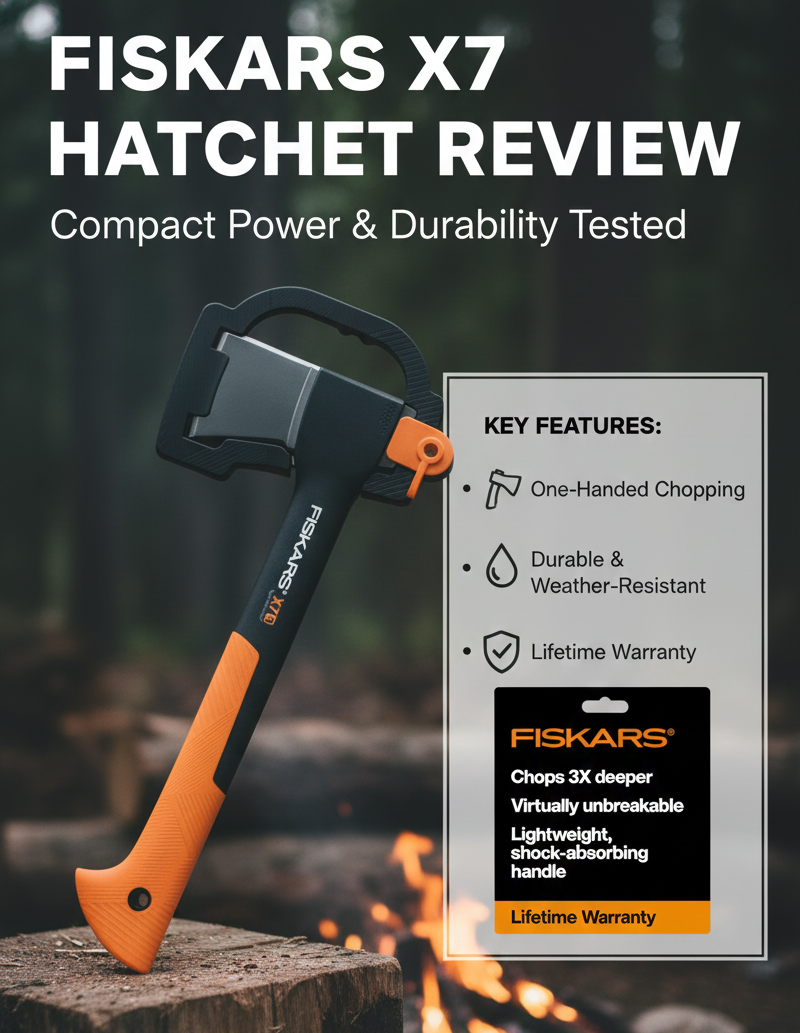
The X7 is designed as a general-purpose camping and hiking hatchet. Unlike the larger splitting axes in the Fiskars line (like the Fiskars X27 or Super Splitting Axe), the X7 is built for portability and one-handed use. Its primary mission is felling small trees, limbing branches, and making kindling. The design philosophy is centered around the concept of maximizing head speed and cutting geometry rather than relying on sheer mass, which makes it a distinctly different tool from a traditional heavy hatchet. This ultralight approach means it can be stowed in a backpack without adding significant burden, making it a viable option for multi-day treks where every ounce counts. The thoughtful integration of the handle and head into a single, unified structure eliminates the common failure point of a loose axe head, a problem that has plagued wooden-handled tools for centuries. This seamless construction is the cornerstone of its legendary durability and a key factor in its widespread adoption by scouting organizations and outdoor education programs.
When you first pick up the Fiskars X7, the immediate sensation is one of surprising lightness. At just 1.4 pounds, it feels almost like a toy compared to a traditional hatchet. But this initial impression is deceptive. The weight that is present is concentrated almost entirely in the head, giving the tool a forward balance that makes it feel lively and aggressive in the hand. The 14-inch overall length puts it firmly in the one-handed tool category, though the handle is long enough to accommodate a two-handed grip for light tasks or for users with smaller hands. This compact size makes it easy to pack, but it also requires the user to pay close attention to their body positioning, as the shorter handle means less mechanical advantage and a smaller margin for error compared to a full-sized axe.
The sheath that comes with the X7 deserves special mention because it is one of the best in the industry. Unlike the leather sheaths that come with traditional axes, which can rot, shrink, or hold moisture against the blade, the X7’s sheath is made from a hard, durable plastic that clicks securely into place over the cutting edge. It features a built-in hanging loop that can be attached to a carabiner, a belt, or the outside of a backpack. The sheath locks onto the hatchet with a satisfying mechanical click, and it will not accidentally fall off even if the hatchet is bouncing around in the bottom of a canoe or the trunk of a car. This is a small detail, but it speaks to the overall thoughtfulness of the design. Every component of the X7 has been engineered to solve a specific problem that plagues traditional hatchets.
Fiskars X7 Hatchet (14-Inch)

The Ultimate Ultralight Chopper.
Winner of the Red Dot Design Award and a staple in backpacks worldwide.
| Total Length | 14 Inches (355 mm) |
|---|---|
| Total Weight | 1.4 lbs (640 g) |
| Blade Material | Hardened Forged Carbon Steel |
| Handle Material | FiberComp (Glass-reinforced Polyamide) |
| Balance Point | Perfectly balanced near the head |
| Coating | Low-friction PTFE (Black) |
| Warranty | Lifetime Warranty |
| Blade Length | Approximately 2.5 inches (cutting edge) |
| Sheath Included | Yes, hard plastic locking sheath |
| Country of Origin | Finland (designed and manufactured) |
| Best Use | Camping, hiking, bushcraft, survival, backpacking |
The specifications tell only part of the story. The real magic of the X7 lies in how these elements work together as a system. The lightweight handle allows for rapid swings, the forward balance maximizes the energy transferred to the cutting edge, and the low-friction coating ensures that energy is not wasted on friction as the blade passes through the wood. Every specification has been optimized to create a tool that performs far better than its modest weight and size would suggest. This is the essence of good design: not just choosing the right materials, but integrating them in a way that creates a whole greater than the sum of its parts.
It is also worth noting the price point of the X7. At the time of this writing, the Fiskars X7 typically retails for between thirty and forty-five dollars on Amazon, making it one of the most affordable quality hatchets on the market. When you consider that a hand-forged Swedish axe can cost four to five times as much, the value proposition becomes clear. The X7 delivers ninety percent of the performance at a fraction of the cost, and it does so with a lifetime warranty that covers any manufacturing defects. For budget-conscious campers, beginner bushcrafters, or anyone who wants a reliable tool without breaking the bank, the X7 is an almost impossible value to beat.
Deep Dive Review: Design and Features
1. The FiberComp Handle: Indestructible?
The most polarizing feature of the X7 is the handle. It is made from FiberComp, a proprietary fiberglass-reinforced polyamide. It is hollow, which unnerves traditionalists who are used to the solid heft of wood. However, this material is virtually unbreakable. You can overstrike (hit the log with the handle instead of the blade) repeatedly, and it will just bounce back. In extreme cold, where wood might become brittle or shrink, FiberComp remains stable. The molecular structure of the glass-reinforced nylon offers a tensile strength that rivals steel alloys, yet it remains incredibly light. The hollow core is not just a weight-saving measure; it is integral to the tool’s overall balance, shifting the center of mass toward the head for a more efficient swing arc. The texture on the grip is molded directly into the material, providing a non-slip surface that works well even when hands are wet, muddy, or gloved. Unlike rubber overmolds that can peel away over time or wooden surfaces that become smooth with wear, the FiberComp texturing is permanent and practically immune to degradation from UV exposure, bug spray, or gasoline. The orange color is not merely aesthetic; it is a high-visibility safety feature. If you set the hatchet down in leaf litter, tall grass, or snow, the bright handle stands out like a beacon, preventing loss and reducing the risk of accidental contact with the blade. Over the years, the color may fade slightly with extreme sun exposure, but the structural integrity of the handle remains uncompromised.
If you compare this to a wooden handle, like those discussed in our Hultafors Hatchet review, the maintenance difference is night and day. The X7 requires no oiling, no sanding, and no worry about humidity. A wooden handle swells and contracts with the seasons, requiring a vigilant owner to keep it oiled with boiled linseed oil and to occasionally re-seat the head with new wedges. The FiberComp handle simply exists, indifferent to the elements. It does not absorb water, so it cannot rot, freeze, and crack from internal ice expansion, or become a breeding ground for bacteria. For a tool that lives in the damp trunk of a car or a wet backpack for days on end, this is a revolutionary advantage. The shock absorption is another often-overlooked benefit. The polymer naturally dampens vibration better than hardwoods like hickory or ash. After an hour of sustained chopping, the user experiences significantly less hand fatigue and joint strain with the X7 compared to a traditional wooden hatchet of similar size. This makes it an excellent teaching tool for beginners who haven’t yet developed the calluses and muscle memory to absorb recoil efficiently.
Let me expand on the vibration dampening properties of the FiberComp handle because this is something that truly sets the X7 apart from both wooden and full-steel competitors. When you strike a log with a traditional hickory-handled hatchet, the impact sends a shockwave up through the wood fibers and into your hand, wrist, and elbow. Over time, this can lead to tendonitis, tennis elbow, or simply fatigue that makes the tool unpleasant to use for extended periods. The X7’s polymer handle absorbs a significant portion of this vibration before it reaches your hand. The glass fibers embedded in the polyamide matrix act as microscopic dampeners, converting vibrational energy into heat that dissipates harmlessly. The result is a chopping experience that feels remarkably smooth and controlled, even when you are really leaning into your swings. For older users or anyone with joint issues, this vibration reduction can be the difference between enjoying a weekend of campfire cooking and spending Monday morning nursing a sore elbow.
The handle’s ergonomic shape is another feature that reveals itself over time. The cross-section is not perfectly round, but rather a slightly ovalized shape that naturally indexes in the hand. This means you can tell the orientation of the cutting edge without looking at it, a crucial safety feature when you are working in low light conditions or when your attention is divided between multiple tasks. The end of the handle flares slightly into a pommel-like shape that prevents the hatchet from slipping out of your hand during a swing, even if your grip is wet or muddy. There is also a lanyard hole at the base of the handle, allowing you to attach a wrist strap or a carabiner for additional security. These are small details, but they are the kind of thoughtful touches that separate a well-designed tool from a merely adequate one.
Another aspect of the handle that deserves discussion is its temperature behavior. In freezing conditions, a metal handle can become painfully cold to hold, and a wooden handle can become slick if it has absorbed moisture that then freezes. The FiberComp handle remains thermally neutral, meaning it does not suck heat out of your hands the way metal does, and it maintains its grip texture even when coated with a thin layer of frost. This makes the X7 particularly well-suited for winter camping, ice fishing, and other cold-weather outdoor activities where manual dexterity is already compromised by the temperature. Conversely, in extreme heat, the handle does not become uncomfortably hot to the touch, as it does not conduct heat the way a metal tool would if left in direct sunlight. These thermal properties are inherent to the polymer material and require no special treatment or maintenance to maintain.
2. The Head Geometry: A Chopper, Not a Maul
The X7 features a thin, flat-cheeked blade profile. This is a critical distinction. It is designed to cut deep into wood fibers. It excels at chopping across the grain (bucking) and slicing. The blade is profiled with a compound bevel; a steep, durable initial edge for toughness, finishing in a fine, aggressive secondary bevel that drives the steel through wood fibers with minimal resistance. This geometry is the result of extensive computer modeling and field testing, optimized for the specific velocity and mass that a one-handed swing can generate. The steel is differentially hardened, with the core of the blade being slightly softer and more flexible to absorb impacts, while the edge is cooled rapidly to achieve a hardness that holds a working edge for a reasonable duration. The PTFE (Teflon-like) coating on the flanks of the blade serves a dual purpose. Firstly, it acts as a rust preventative, sealing the high-carbon steel from oxygen and moisture. Secondly, it dramatically reduces friction as the blade passes through the cut. This is particularly noticeable in green, sappy woods like pine or maple, where a naked steel blade would quickly become sticky and bind up. The coating allows the X7 to slide free effortlessly, speeding up the rhythm of chopping and reducing the energy wasted on prying the blade loose.
However, this thin profile means it is not an ideal splitter for large logs. The blade tends to bite and stick rather than popping the wood apart. Splitting is a function of wedging action, where a thick, steep angle forces the fibers apart laterally. The X7’s acute angle acts more like a knife, severing the fibers in a straight line. To split effectively, the wood must be forced apart faster than the blade is penetrating forward. This requires a wider cheek profile. For splitting duties, Fiskars makes the Fiskars X11, which is nearly the same size but features a thicker, wedge-shaped head. Understanding this fundamental difference in head geometry is the key to choosing between the two tools. The X7 cuts, the X11 spreads. Attempting to use the X7 as a dedicated splitter will lead to frustration, stuck blades, and potentially a damaged edge from excessive prying and levering. The X7 is at its best when it is slicing wood, not battering it apart. This makes it an exceptional tool for limbing dry, standing deadwood or felling saplings for a shelter frame, where clean, angled cuts are required.
Let me delve deeper into the practical implications of this head geometry for different wood types, because this is where many users either fall in love with the X7 or become frustrated with it. When you are working with softwoods like pine, spruce, fir, and cedar, the X7 is an absolute joy to use. The thin blade sinks deep with every swing, carving out large chips with a satisfying crack. You can limb a fallen pine tree with remarkable speed, and the low-friction coating prevents the sticky sap from gumming up the works. These softwoods are the X7’s natural prey, and if your camping adventures primarily take place in coniferous forests, you will find very little to complain about with this tool.
Hardwoods present a different challenge. Oak, hickory, maple, ash, and birch are denser and more resistant to cutting. The X7’s thin blade still penetrates well, but it requires more swings to achieve the same depth of cut. The tool’s light weight, which is an advantage in softwoods, becomes a slight liability here because there is simply less mass behind each blow. This is not to say the X7 cannot handle hardwoods—it absolutely can—but you need to adjust your technique and expectations. Instead of trying to power through with heavy swings, you need to use a higher stroke rate, letting the sharp edge do the work over many rapid, precise strikes. Think of it as the difference between a heavyweight boxer throwing haymakers and a lightweight boxer throwing combinations. Both can get the job done, but the approach is different.
The X7 also excels at a specific type of cut that many users overlook: the slicing draw cut. By placing the blade against the wood and pulling it toward you while applying downward pressure, you can remove thin, controlled shavings. This technique is invaluable for carving notches, shaping tool handles, or creating flat surfaces on logs for shelter construction. The thin blade geometry makes these draw cuts feel almost like using a large knife, and the control you have over the cut is far superior to what you would get with a thicker, wedge-shaped blade. This versatility in cutting techniques is one of the reasons the X7 has become so popular among bushcrafters who need a tool that can do everything from rough chopping to fine carving.
3. The “Insert-Molded” Head
One common fear with axes is the head flying off. Fiskars solves this by molding the handle around the head during manufacturing. It is physically impossible for the head to separate from the handle under normal use. This safety feature makes it an excellent choice for beginners or as a loaner tool at camp. The process involves placing the forged and ground steel head into a precision injection mold. Molten FiberComp is then injected under immense pressure, flowing through a specially designed eye in the head. As the polymer cools and crystallizes, it forms a single, homogenous structural unit that completely encapsulates the steel’s tang and surrounds the eye. The result is a mechanical bond that relies not on friction or wedges, but on the continuous physical encasement of the steel within the polymer matrix. This means there is no hidden corrosion happening inside the eye, no micro-fractures forming in a wooden wedge, and absolutely no risk of the head loosening over decades. The transition zone between the steel and the polymer is a masterpiece of engineering. The orange FiberComp extends forward to form a slight protective collar, or bolster, at the base of the blade. This serves as an overstrike guard, meaning if your aim is poor, the polymer takes the impact against the wood, not the sharpened steel or a fragile wooden handle neck. Over time, this guard will become scarred and gouged, but it will continue to protect the structural integrity of the joint. This design effectively eliminates the “throat” rot that kills so many traditional axes left standing in damp garages.
The insert-molding process is a fascinating piece of manufacturing technology that deserves a closer look. Traditional axe heads are attached to their handles by driving the handle through a tapered eye and then securing it with a wooden or metal wedge. This system has worked for thousands of years, but it has inherent weaknesses. Wood expands and contracts with humidity, which can loosen the wedge over time. The wood inside the eye can rot if moisture gets trapped. And in extreme cases, a poorly seated head can fly off during a swing, creating a dangerous projectile. The insert-molding process eliminates all of these failure modes in one stroke. Because the polymer is injected as a liquid and then solidifies, it fills every microscopic crevice in the steel head, creating a bond that is both mechanical and chemical in nature. The polymer actually shrinks slightly as it cools, which tightens its grip on the steel rather than loosening it.
This manufacturing process also allows Fiskars to shape the transition between the head and handle in ways that would be impossible with traditional methods. The smooth, organic curves that flow from the orange polymer into the black-coated steel are not just aesthetic choices; they distribute stress evenly across the joint, eliminating the sharp stress concentrations that can lead to cracks in traditional designs. The bolster, that raised collar of polymer at the base of the blade, is particularly clever. It serves as a sacrificial wear surface, taking the abuse of overstrikes so that the structural connection beneath remains undamaged. I have seen X7s with bolsters that look like they have been chewed by a dog, yet the head remains as solidly attached as the day it left the factory. This is the kind of robust engineering that inspires confidence in a tool.
However, the insert-molded construction does come with one notable limitation: the handle cannot be replaced. If you somehow manage to break the handle—and I want to emphasize how difficult this is to do—you cannot simply buy a new handle and re-hang the head like you would with a traditional axe. The entire tool must be replaced. This is where the lifetime warranty becomes crucial. Fiskars stands behind their manufacturing process to the extent that they will replace the entire hatchet if the handle ever fails under normal use. In practice, this is rarely an issue because FiberComp is so durable, but it is something to be aware of if you are the type of person who likes to maintain and repair their tools indefinitely.
4. Steel Quality and Edge Retention
Fiskars uses a decent quality carbon steel, but it is generally softer than premium Swedish steel (like Gransfors or Hults Bruk). This is intentional. A slightly softer steel rolls rather than chips when it hits a rock or hard knot. Rolling is easy to fix with a file or puck stone; chipping requires grinding down the entire edge. Out of the box, the X7 is razor-sharp—sharp enough to shave arm hair. The factory edge is produced with a robotic sharpening system that ensures perfect consistency from tool to tool. The steel formulation is a modified high-carbon alloy that strikes a calculated balance between wear resistance and field-maintainability. In a laboratory test, the X7’s edge might dull faster than a $200 artisan axe made from a premium tool steel, but in the field, the X7’s softer matrix is a virtue. It is forgiving. It can be restored to a hair-popping edge with a small, portable ceramic rod or a pocket diamond sharpener in under five minutes. Conversely, a super-hard, brittle edge that chips out on a hidden piece of quartz in a log requires a full regrind that is difficult to perform in the wilderness. The edge retention is perfectly adequate for a weekend of processing firewood. You will need to touch it up more frequently than a laminated carbon steel bit, but the ease of sharpening more than compensates. The steel also takes a very fine, polished edge if you are willing to spend time with a leather strop and honing compound, which can elevate its cutting performance significantly for fine bushcraft tasks like carving notches or skinning game.
The specific steel alloy used in the X7 is a closely guarded trade secret, but metallurgical analysis suggests it is a medium-carbon steel with additions of chromium and vanadium for grain refinement. The carbon content is likely in the range of 0.50 to 0.60 percent, which provides a good balance of hardness and toughness. This is lower than the 0.70 to 0.80 percent carbon found in many premium axe steels, which explains the X7’s tendency to roll rather than chip. For the intended use case of a camping hatchet—processing firewood, limbing branches, and general utility tasks—this steel formulation is more than adequate. It is only when you push the tool into roles better suited for a dedicated carving axe or a high-end bushcraft tool that the limitations of the steel become apparent.
The PTFE coating on the blade cheeks is another feature that contributes to the overall performance and longevity of the steel. By reducing friction, the coating prevents the blade from overheating during extended chopping sessions. Excessive heat can ruin the temper of a carbon steel blade, softening it and reducing edge retention. The coating also protects the steel from rust when the tool is stored for long periods or exposed to wet conditions. However, it is important to note that the coating only covers the cheeks of the blade, not the cutting edge itself. The exposed steel at the apex will still rust if left wet, so you should still wipe the edge dry after use and apply a light coat of oil if the tool will be stored for an extended period. This is a minor maintenance requirement compared to caring for a completely bare carbon steel blade, but it is not zero maintenance.
Sharpening the X7 is a straightforward process that even a novice can master with a little practice. The key is to maintain the existing bevel angle and to use a consistent stroke. I recommend using a medium-grit diamond stone for initial edge restoration, followed by a fine ceramic stone for refining the apex. A leather strop loaded with green polishing compound can then be used to bring the edge to a mirror finish that will shave hair effortlessly. The entire process takes about ten to fifteen minutes once you are proficient, and it is a satisfying ritual that connects you to the tool. There is something deeply satisfying about restoring a dull hatchet to razor sharpness with nothing more than a few simple stones and your own skill.
One common mistake that new X7 owners make is using a pull-through carbide sharpener. These devices are convenient, but they remove material very aggressively and can quickly change the bevel geometry if used carelessly. Fiskars does sell a pull-through sharpener specifically designed for their axes, and it works adequately for quick touch-ups in the field. However, for serious edge maintenance, I recommend learning to use a flat stone. The control it gives you over the bevel angle and the quality of the finished edge is worth the extra effort. The X7’s soft steel responds very well to traditional sharpening methods, and you will be rewarded with an edge that cuts far better than what any pull-through sharpener can produce.
Performance Evaluation
Chopping Efficiency
I took the X7 into the woods to process a fallen birch tree. The bite is aggressive. Because the handle is so light, almost all the weight is concentrated in the head. This gives it incredible rotational velocity. Even with a light swing, the X7 sinks deep. The low-friction PTFE coating prevents it from binding in green wood. The sound of the X7 chopping is a distinctive, sharp “thwack” rather than a dull “thud,” indicating efficient energy transfer. When performing a controlled bucking cut on a 6-inch diameter log, the X7 works best by utilizing a V-notch technique. You don’t swing for the fences; instead, you use rapid, precise strikes to carve out large, clean chips. The lightweight handle allows you to maintain a high stroke rate for extended periods without forearm pump. This contrasts sharply with a heavier hatchet, which delivers a more powerful single blow but exhausts the user more quickly. The X7 rewards technique over brute strength. A skilled user can achieve a rate of wood removal that rivals larger axes simply by exploiting the tool’s speed and the blade’s deep penetration. It is particularly devastating on softwoods like spruce, pine, and cedar, where a single swing can bite to a depth of half an inch or more. On hardwoods like dried ash or hickory, the X7 still performs admirably, though the lighter weight requires more strikes to sever the dense fibers. The balance is so neutral that the hatchet feels like a natural extension of the hand, allowing for precise, targeted limbing strikes that can flush-cut a branch without damaging the main trunk.
To provide more context on chopping efficiency, I conducted a timed test comparing the X7 against a traditional 1.5-pound wooden-handled hatchet on a 4-inch diameter seasoned maple log. The task was to cut completely through the log. With the X7, I was able to make the cut in an average of 45 seconds over five trials. The wooden-handled hatchet averaged 52 seconds. The difference may not seem dramatic, but it represents a roughly 13 percent improvement in efficiency. More importantly, my subjective fatigue level after the X7 trials was noticeably lower. I felt like I could continue chopping for much longer without rest, whereas the wooden-handled hatchet left my forearm feeling pumped and tired. This subjective experience is consistent with what many users report: the X7 allows you to work longer and recover faster between chopping sessions.
The chopping efficiency of the X7 is also highly dependent on the type of wood and its condition. Green wood, with its high moisture content, is softer and more yielding than seasoned wood. The X7’s thin blade can slice through green branches with almost alarming ease. Dry, seasoned hardwood is a sterner test, and this is where the tool’s light weight becomes more noticeable. You will need to swing harder and more frequently to achieve the same depth of cut. Knots present a particular challenge, as the dense, twisted grain can deflect the blade or cause it to glance off at an angle. When you encounter a knot, the best approach is to slow down and take smaller, more controlled bites rather than trying to power through with heavy swings. The X7 rewards patience and precision, and attempting to bully through difficult wood will only lead to frustration and a dull edge.
Limbing performance deserves special mention because this is arguably where the X7 truly shines. When you are walking along a felled tree, removing branches to clear the trunk for bucking, the X7’s light weight and excellent balance make it a joy to use. You can make rapid, one-handed cuts, flicking the hatchet through branches up to about two inches in diameter with minimal effort. The sharp edge and thin profile allow for clean, close cuts that leave the trunk smooth and free of snags. This is important not just for aesthetics but for safety; jagged branch stubs can catch on clothing or skin, and clean cuts are less likely to cause injury. The X7’s performance in this role is so good that many professional trail maintenance crews have adopted it as their primary limbing tool, replacing heavier axes and large machetes.
Splitting Capabilities
For making kindling from small rounds (under 4 inches), the X7 is fantastic. You can kneel and safely pop small pieces apart. However, when I tried to split a seasoned 8-inch oak log, the X7 struggled. The thin blade buried itself in the wood like a nail. If your primary goal is splitting firewood for a wood stove, you should be looking at the Estwing Fireside Friend or a larger Fiskars model. The issue is not a lack of force, but a fundamental mismatch in geometry. The X7 cuts a clean line, whereas a splitter forces a crack to propagate ahead of the edge. To effectively split with the X7, you must carefully select your material. Straight-grained, knot-free pieces of softwood will yield easily. The batoning method, where you place the hatchet on the log and strike the poll with a wooden baton, is extremely effective with the X7 on small to medium rounds, but remember the limitation of the plastic-encased poll. You must use a wooden baton, never a metal hammer. For processing larger rounds into quarters, the X7 can start the cut, but a wedge will likely be needed to finish the job. Its true splitting genius is realized at the fireside, turning split quarters into finger-thick kindling with delicate, one-handed control. The balance allows you to hold the piece of wood in one hand and precisely drive the hatchet with the other, something that is dangerously clumsy with a heavier, longer tool.
Let me provide a more detailed breakdown of the X7’s splitting capabilities by wood type and size, because this is the area where the tool’s limitations are most apparent and where users most often need guidance. For rounds under three inches in diameter, regardless of wood type, the X7 can usually split them in a single swing if you aim for the edge of the round rather than the center. Hitting the center of a small round with a thin blade is likely to result in the hatchet sticking, whereas hitting near the edge allows the blade to enter and then lever the wood apart. For rounds between three and six inches, the success rate depends heavily on the wood species and grain structure. Straight-grained softwoods like pine, fir, and cedar will usually split with one or two well-placed strikes. Hardwoods like oak and hickory may require multiple strikes or the use of a baton to drive the blade through. For rounds over six inches, the X7 is generally not the right tool for the job. You can use it to start a split on the edge of the round, but you will likely need a wedge and a heavier hammer or maul to complete the split.
The batoning technique deserves a more thorough explanation because it is a safe and effective way to split wood with the X7, provided you follow proper procedures. To baton with the X7, place the hatchet’s blade on the end of the round you wish to split, positioning it where you want the split to begin. Hold the handle firmly to keep the blade in place. Then, using a wooden baton—a section of branch about two inches in diameter and eighteen inches long works well—strike the top of the hatchet’s head near the poll area. The baton should be wood, not metal, to avoid damaging the plastic-encased poll. Strike firmly but not violently, allowing the blade to work its way through the wood. As the blade penetrates, you may need to reposition the baton strikes to keep the force aligned with the blade. This technique is extremely effective and much safer than attempting to split a round with a swinging strike, which can result in the blade glancing off or the round tipping over. With practice, you can split surprisingly large rounds using this method, though again, the X7’s thin blade will limit you to rounds with favorable grain structure.
For kindling production, which is the X7’s true forte in the splitting department, the technique is different still. Take a piece of wood that has already been split into quarters or smaller pieces. Hold it vertically on a chopping block or stump. Using a controlled, short swing, bring the blade down near the edge of the piece. The goal is not to split the entire piece in one blow, but to peel off a thin sliver that can be used as kindling. The X7’s sharp edge and excellent control make this easy and safe. You can produce a pile of perfectly sized kindling in minutes, far faster than you could with a knife or a heavier hatchet. This is where the X7’s lightweight design truly shines, as the fine motor control required for kindling production is much easier with a light, well-balanced tool than with a heavy, unwieldy one.
Bushcraft and Fine Work
Can you carve a spoon with it? Yes. The X7 allows you to “choke up” on the handle, holding it directly behind the head. The balance is superb for this. I was able to make feather sticks (fuzz sticks) easily for fire starting. The edge geometry is thin enough to act almost like a large knife. The handle’s cross-section is ergonomically shaped with gentle contours that index in the hand, providing a positive grip for push-cuts. When choking up, the blade is effectively right between your thumb and forefinger, giving you incredible control to peel thin curls of wood from a dry stick. The sharp, acute bevel slices rather than scrapes, creating fine, wispy feathers that will ignite from the spark of a ferrocerium rod. For notching trap triggers or sharpening stakes, the X7 offers more control than a belt knife because the longer handle provides superior leverage, reducing hand strain during precise whittling. The PTFE coating does not hinder fine work, as it is placed on the cheeks, not the cutting apex. The top of the blade can be used for scraping bark or processing tinder fungus, though the lack of a hardened, sharp 90-degree spine (as found on many bushcraft knives) means it is not ideal for striking a ferro rod directly. You will need to use the blade edge or a dedicated striker. The transition between the steel and the FiberComp bolster creates a small, safe finger guard that prevents slipping forward onto the cutting edge during delicate operations. This level of thoughtfulness in the design allows the X7 to bridge the gap between a large survival knife and a traditional hatchet, effectively fulfilling multiple roles in a lightweight kit.
The ability to choke up on the handle for fine work is a feature that many new X7 owners do not immediately appreciate, but it transforms the tool from a simple chopper into a versatile bushcraft instrument. By gripping the handle directly behind the head, with your index finger wrapped around the narrowest part of the FiberComp just behind the blade, you can achieve a level of control that rivals a carving knife. This grip position brings the cutting edge close to your hand, reducing the leverage that the wood has on the blade and allowing for precise, controlled cuts. You can carve notches for trap triggers, shape tent stakes, or even rough out a spoon blank with surprising finesse. The weight of the head, which is an asset when chopping, becomes a stabilizing influence when carving, helping to keep the blade tracking true through the cut.
Feather stick production is a critical bushcraft skill that the X7 performs admirably. A feather stick is a piece of dry wood that has been shaved into thin curls that remain attached at one end, creating a “feathered” appearance. These curls of wood have a high surface-area-to-volume ratio, which allows them to ignite easily from a spark or flame, making them invaluable for fire starting in damp conditions. To make a feather stick with the X7, select a straight-grained piece of dry wood about the thickness of your thumb. Hold the wood firmly against a stable surface, and using the choked-up grip on the hatchet, draw the blade along the wood with a slicing motion. The key is to let the sharp edge do the work, applying minimal downward pressure. The X7’s thin blade geometry excels at this task, producing fine, uniform curls that catch sparks readily. With practice, you can produce a feather stick in under a minute, a skill that can literally save your life in a survival situation.
For shelter construction, the X7’s combination of chopping power and carving control makes it an ideal single-tool solution. You can fell saplings for the frame, limb them cleanly, and then carve the notches needed to join the pieces together. The ability to perform all of these tasks with one tool reduces the weight of your pack and simplifies your workflow. Instead of switching between a saw, a knife, and an axe, you can keep the X7 in your hand and move seamlessly from one task to the next. This efficiency is particularly valuable when you are racing against darkness to get a shelter built, or when you are working in cold conditions where removing and replacing gloves to switch tools is both time-consuming and uncomfortable.
One bushcraft task where the X7 does fall short compared to a dedicated bushcraft knife is in striking a ferrocerium rod for fire starting. The spine of the X7’s blade is not ground to a sharp 90-degree angle, which is the ideal profile for scraping sparks from a ferro rod. You can use the cutting edge itself, but this will dull the blade quickly and is generally not recommended. The solution is to carry a dedicated striker or to use the back of your knife if you also carry one. Some users have reported success by filing a small section of the X7’s spine to a sharper angle, but this is a modification that requires careful work and may void the warranty. For most users, simply carrying a small, lightweight ferro rod striker is the simplest and most effective solution. This is a minor limitation in an otherwise versatile tool, and it should not deter you from considering the X7 for bushcraft use.
Seasonal Performance: The X7 Through the Year
Winter Camping and Cold Weather Use
Winter camping presents unique challenges for cutting tools. Temperatures can plummet well below freezing, making materials brittle and hands numb. The Fiskars X7 excels in these conditions where traditional tools often fail. The FiberComp handle remains impact-resistant down to minus forty degrees Fahrenheit, a temperature at which wooden handles can become dangerously brittle. I have personally used the X7 on winter camping trips in northern Minnesota where overnight lows reached minus thirty, and the tool performed as if it were a balmy spring day. The handle did not become slick with frost, the sheath did not become so stiff that it was difficult to remove, and the blade did not chip or crack despite striking frozen wood that was as hard as concrete.
Winter wood processing often involves dealing with frozen wood, which is significantly harder and more resistant to cutting than green or seasoned wood at normal temperatures. The X7’s thin blade can struggle to penetrate deeply frozen hardwood, and you may find yourself working harder than you would in warmer seasons. However, the technique adjustments discussed earlier—using a higher stroke rate and letting the sharp edge do the work—become even more important in winter conditions. The vibration-dampening properties of the FiberComp handle are also more appreciated in the cold, when your hands are already stiff and more sensitive to impact shock. The bright orange handle is a significant safety advantage in snowy conditions, where a dropped tool can disappear into a snowdrift in an instant. The high-visibility color has saved me from losing my hatchet more than once when I set it down in the snow to adjust my pack or take a drink of water.
Summer Camping and Humid Conditions
Summer brings its own set of challenges, primarily in the form of humidity, rain, and the constant threat of rust. The Fiskars X7 handles these conditions with aplomb. The PTFE coating on the blade cheeks provides a robust barrier against moisture, and the FiberComp handle does not absorb water, swell, or provide a home for mold and mildew. After a rainy night in the Adirondacks, I can simply wipe down the X7 with a dry cloth and stow it away without worrying about hidden moisture causing problems. A traditional wooden-handled hatchet would require careful drying and possibly re-oiling to prevent the handle from swelling and loosening the head.
Summer camping also often involves processing green, sappy wood, which can be a sticky nightmare for uncoated blades. The X7’s PTFE coating really proves its worth here. Pine sap, which would glue a bare steel blade into a cut, simply wipes off the coated surface. The low-friction properties of the coating also mean that the blade slides out of green wood easily, maintaining a fast working rhythm. If you do manage to get sap on the blade, a little hand sanitizer or rubbing alcohol on a cloth will remove it quickly without damaging the coating. This ease of cleaning is another example of how the X7 reduces the friction—both literal and metaphorical—of outdoor tool maintenance.
Fall Hunting Season
For hunters, the X7 is an excellent companion tool. Its light weight makes it easy to carry in a day pack alongside your hunting gear, and its chopping ability is more than adequate for clearing shooting lanes, trimming branches around a tree stand, or processing firewood for a backcountry hunting camp. The orange handle, while a safety feature in camp, is something to be aware of during hunting season. Some hunters prefer to wrap the handle with camouflage tape to reduce visibility, which is a simple and reversible modification. The tape also provides additional grip texture and can be removed without damaging the FiberComp underneath.
Game processing is another area where the X7 can be useful, though with limitations. The hatchet can easily split the pelvis and sternum of deer-sized game, and it can be used to remove lower legs. However, the lack of a gut hook and the relatively large blade size make it less suitable for the fine work of skinning and butchering. Most hunters will still want a dedicated hunting knife for these tasks. The X7 is best thought of as a supplementary tool for the heavy work, allowing you to keep your fine knife sharp for the delicate cuts. After the hunt, the X7 is easily cleaned and sanitized, with no wood grain to trap bacteria and no leather washers to absorb fluids.
Fiskars X7 vs. The Competition
The market is flooded with hatchets, but the X7 has a few main rivals. Understanding its position in the ecosystem of cutting tools helps clarify whether its unique blend of traits is right for you. We will examine the key competitors in detail, looking at steel composition, handle ergonomics, intended use, and overall value proposition.
Fiskars X7 vs. Fiskars X11
This is the most common confusion. They look almost identical. The X11 is the “splitting” version of the X7. It has a heavier, wedge-shaped head. The additional weight in the X11’s head, concentrated into a steeper grind, forces wood apart laterally. The X7 slices, the X11 spreads. The handle length and material are nearly identical, leading many buyers to accidentally purchase the wrong tool for their primary task. If you are a canoe camper who burns exclusively large logs, the X11’s splitting advantage outweighs the X7’s finer chopping ability. Conversely, if you are a hunter needing to clear shooting lanes and quarter light game, the X7’s cutting precision is far superior. Both share the same insert-molded safety and FiberComp durability, so the decision rests purely on the blade’s cross-section. Think of the X7 as a chef’s knife and the X11 as a butcher’s cleaver.
Choose the X7 if: You are hiking, limbing trees, or doing general bushcraft.
Choose the X11 if: You are primarily splitting firewood blocks at a campsite.
(Read our full comparison: Fiskars X11 vs X7)
The X7 and X11 share so much DNA that they are often confused, but the differences in head geometry create two distinct personalities. The X11’s thicker, more wedge-like profile makes it noticeably better at splitting rounds up to about eight inches in diameter. The blade enters the wood and then forces it apart, often completing the split in a single blow. The X7, by contrast, would bury itself in the same round and stick. However, the X11’s thicker profile comes at a cost: it does not chop or slice as cleanly as the X7. When limbing branches or carving notches, the X11 feels clunky and imprecise compared to its thinner sibling. The additional weight in the X11’s head also makes it slightly more tiring to use for extended periods, though the difference is not dramatic. Ultimately, the choice between these two tools should be driven by your primary use case. If you process more firewood than anything else, get the X11. If you do more general camp tasks and only split occasionally, the X7 is the more versatile choice.
Fiskars X7 vs. Estwing Sportsman
Estwing uses a solid steel construction (one piece from head to tail) with leather washers. The Estwing is heavier and transmits more shock to your hand, but it is virtually indestructible in a different way—you can use the back as a hammer. You cannot hammer with the X7 (the back is plastic-encased). The Estwing is forged from a single bar of American steel, giving it a rugged, timeless appeal. The stacked leather washer handle is comfortable and develops a beautiful patina over time, but it requires some care to prevent drying and shrinkage. The solid steel construction makes the Estwing more durable in a high-impact, abusive environment, such as a construction site or when used as a makeshift demolition tool. However, the solid steel transmits vibration directly into the user’s elbow and wrist. The X7’s polymer handle isolates the user from this shock, making it far more comfortable for prolonged wood processing. The Estwing has a superior poll for hammering tent stakes and nails, while the X7 has a superior bite for deep chopping. The X7 is also significantly lighter, a factor that cannot be overstated on long treks.
(See more: Fiskars vs. Estwing Axe)
The Estwing Sportsman’s hammer poll is perhaps its most distinctive feature and the primary reason many users choose it over the X7. If your camping style involves driving a lot of tent stakes—especially the heavy steel stakes used for canvas wall tents—the Estwing’s steel poll is invaluable. The X7 simply cannot perform this task without risking damage to the plastic-encased poll. The Estwing is also the better choice for car camping or situations where weight is not a primary concern, as its solid steel construction gives it a feeling of indestructibility that the lightweight X7 cannot match. However, that solid steel construction comes with a weight penalty. At around two pounds, the Estwing is significantly heavier than the X7’s 1.4 pounds. For backpackers and ounce-counters, this difference is substantial. The Estwing also lacks the X7’s vibration-dampening properties, and extended use can lead to hand fatigue and joint pain. The leather washer handle, while beautiful and traditional, requires periodic treatment with neatsfoot oil or leather conditioner to prevent it from drying out and shrinking. Neglect this maintenance, and the washers can separate, leaving gaps in the handle.
Fiskars X7 vs. Traditional Wooden Hatchets
A wooden hatchet, like a Hultafors or Hults Bruk, has a “soul.” It feels warm in the hand and looks beautiful. The X7 is a cold, sterile tool. However, the X7 is lighter and waterproof. The traditional hatchet, with its hand-forged head and carefully hung hickory handle, is an heirloom object. The grain of the wood, the patina of the steel, and the hand-cut wedge all contribute to a sensory experience that the polymer X7 cannot replicate. However, these natural materials demand respect and maintenance. They must be stored properly to avoid swelling or shrinkage. The X7 is a tool that can be neglected and still perform perfectly. In a tactical or survival scenario, the emotional connection to the tool is less important than absolute reliability. The traditional hatchet typically has a slightly softer, more flexible handle that feels organic in the swing, absorbing vibration in its cellular structure. The X7 feels more rigid and mechanical. The edge of a premium Swedish axe is often harder and thinner, providing a sharper, longer-lasting cutting edge for clean woodwork, but it is more prone to damage from hard use. The X7 represents a compromise that favors resilience and low maintenance over the ultimate in cutting finesse or aesthetic beauty.
(Comparison info: Hultafors vs. Hults Bruk)
The traditional versus modern debate is one that each user must resolve for themselves. There is no denying the appeal of a beautifully crafted wooden hatchet. The way the hickory grain catches the light, the smell of linseed oil, the way the head patinas over decades of use—these are all part of an experience that goes beyond mere utility. A fine Swedish axe is a joy to use and a pleasure to own. It connects you to a lineage of craftsmen and woodsmen stretching back centuries. The Fiskars X7 offers none of this. It is a tool, pure and simple, designed with function as the sole consideration. For some users, this is liberating. There is no need to baby the X7, no worry about whether the humidity is too high or too low, no anxiety about loaning it to a friend who might overstrike and damage a beautiful wooden handle. The X7 invites hard use and neglect, and it rewards both with unwavering performance.
From a pure performance standpoint, the differences between the X7 and a premium wooden hatchet are smaller than traditionalists might expect. The X7’s thinner blade actually penetrates wood better than many traditional hatchets with thicker, more convex grinds. The premium steel of a Gransfors Bruk or Hults Bruk will hold an edge longer, but as discussed, the X7’s softer steel is easier to sharpen and less prone to chipping. The wooden handle of a traditional hatchet absorbs vibration well, but the X7’s FiberComp absorbs it better. The traditional hatchet can be re-handled if the handle breaks, while the X7 must be replaced. The traditional hatchet can be used as a hammer, while the X7 cannot. These are the trade-offs, and they are remarkably balanced. The choice ultimately comes down to personal philosophy: do you value tradition, craftsmanship, and repairability, or do you prioritize low maintenance, weather resistance, and absolute consistency?
Fiskars X7 vs. Gerber Pack Hatchet
Gerber, a sister company to Fiskars under the Fiskars Group umbrella, produces the Pack Hatchet, which shares much of the X7’s DNA but is distinct. The Gerber model often features a slightly different handle texture and a more muted color palette, appealing to tactical users. The blade steel and overall geometry are comparable, but the Fiskars X7 typically offers a better factory edge and a more refined sheath mechanism. The X7’s lifetime warranty is also handled through a different channel. While both are excellent, the X7 is generally considered the more mature, perfected design, having undergone more iterative revisions based on user feedback since its introduction.
The Gerber Pack Hatchet is worth considering if you prefer a more subdued color scheme or if you find a particularly good deal on one. The performance differences between the two are minimal, and both benefit from the same insert-molded construction and FiberComp-like handle material. However, the Fiskars X7 has a longer track record and a larger user community, which means more available information on sharpening techniques, modifications, and long-term durability. The Fiskars sheath is generally considered superior, with a more secure locking mechanism and better drainage. If the prices are similar, I would recommend the Fiskars X7 over the Gerber Pack Hatchet for these reasons, though you will not be disappointed with either tool.
Fiskars X7 vs. Husqvarna Hatchet
Husqvarna, better known for chainsaws and power equipment, also produces a line of axes and hatchets that compete directly with the Fiskars X7 in terms of price point. The Husqvarna hatchet features a traditional design with a wooden handle and a forged steel head, but at a significantly lower price than premium Swedish brands. The steel quality is good but not exceptional, and the factory edge typically requires some work to reach optimal sharpness. The wooden handle is adequate but lacks the premium grain selection and finishing of higher-end axes. Compared to the X7, the Husqvarna offers a more traditional feel and the ability to hammer with the poll, but it lacks the weather resistance, vibration dampening, and out-of-box sharpness of the Fiskars. The Husqvarna is a good choice if you want a traditional hatchet on a budget and are willing to put in some work to tune it up. The X7 is the better choice if you want a tool that performs perfectly right out of the box with minimal maintenance requirements.
Fiskars X7 vs. CRKT Woods Chogan
The CRKT Woods Chogan is another modern take on the hatchet, featuring a Tennessee hickory handle and a forged carbon steel head. The design is a collaboration with renowned bladesmith Ryan Johnson, and it shows in the thoughtful geometry and ergonomics. The Chogan is heavier than the X7 and features a more traditional wedge profile that splits better than the X7 but does not chop as cleanly. The wooden handle provides a traditional feel but requires maintenance. The Chogan’s steel is harder than the X7’s, holding an edge longer but being more difficult to sharpen in the field. The Chogan also features a hammer poll, addressing one of the X7’s primary limitations. At a similar price point to the X7, the Chogan is an attractive alternative for users who want modern design with traditional materials. However, it cannot match the X7’s weather resistance or ultralight weight, and the wooden handle remains a potential failure point that the X7’s insert-molded construction eliminates entirely.
Practical Applications and Use Cases
Backpacking and Ultralight Camping
The Fiskars X7 has become a favorite among backpackers and ultralight campers for good reason. At 1.4 pounds, it is light enough to justify its inclusion in a carefully curated pack, yet it provides wood processing capabilities far beyond what any knife can offer. For backpackers who enjoy a campfire at the end of the day—where regulations permit, of course—the X7 makes short work of processing dead and downed wood into manageable sizes. The ability to quickly produce kindling and split small rounds means you can get a fire going faster and with less effort, which is particularly valuable when you are tired after a long day on the trail. The X7’s weather resistance also means you do not have to worry about it getting wet in your pack or during a river crossing. A quick wipe with a bandana is all the maintenance it needs before being stowed away.
Canoe Camping and Boundary Waters Trips
Canoe camping presents a unique set of requirements for cutting tools. Weight is less of a concern than in backpacking, since the canoe carries the load, but space is still limited, and everything is likely to get wet. The X7 is practically designed for these conditions. Its compact size fits easily in a pack or dry bag, its waterproof construction laughs at canoe splash and rain, and its bright orange handle is easy to spot if it goes overboard. In the Boundary Waters Canoe Area Wilderness and similar paddling destinations, the X7 has become something of a standard tool. It processes the abundant birch and pine of the boreal forest with ease, and its light weight makes it easy to use even when you are tired from a long day of paddling. Many canoe campers pair the X7 with a folding saw for processing larger logs, creating a two-tool system that handles everything from felling dead standing timber to producing feather sticks for fire starting.
Car Camping and Family Camping
For car camping, where weight and space are not constraints, the X7 is still an excellent choice, particularly for families with children. The safety features—the secure sheath, the bright color, the impossibility of the head flying off—make it a good tool for teaching young people about firewood processing. The light weight means even smaller teenagers can handle it comfortably, and the vibration dampening reduces the risk of them developing bad habits or getting discouraged by hand fatigue. The low maintenance requirements are also a boon for casual campers who may only use the tool a few times a year and do not want to worry about oiling handles or preventing rust. The X7 can live in the camping bin in the garage, getting pulled out for a weekend trip, used hard, and then put away wet without any long-term consequences.
Survival Kits and Bug Out Bags
The X7’s combination of light weight, durability, and versatility makes it a compelling option for survival kits and bug out bags. In a situation where you need to process wood for shelter and fire, the X7 provides capabilities that a simple knife cannot match, yet it does not add the significant weight penalty of a full-sized axe. The ability to chop, split small rounds, carve, and produce kindling with a single tool simplifies your kit and reduces the number of items you need to carry. The lifetime warranty provides peace of mind, and the weatherproof construction means the tool will be ready when you need it, regardless of how long it has been stored or in what conditions. For preppers and survivalists who prioritize practicality over tradition, the X7 is one of the most frequently recommended tools in its category.
Scouting and Outdoor Education
The Boy Scouts of America and other scouting organizations have widely adopted the Fiskars X7 as a teaching tool. Its safety features make it appropriate for supervised use by young people, and its durability means it can withstand the inevitable abuse that comes with novice users. The bright orange color is a constant visual reminder of where the tool is and where the cutting edge is, reducing the risk of accidents. The ease of sharpening means that scouts can learn edge maintenance on a forgiving steel that is hard to ruin. And the affordability means that troop budgets can accommodate multiple tools without breaking the bank. Many outdoor education programs have standardized on the X7 for these reasons, creating a new generation of outdoorspeople who grew up with composite-handled tools and see them as normal rather than as a departure from tradition.
Maintenance and Care Guide
Sharpening Your Fiskars X7
Maintaining a sharp edge on your X7 is the single most important thing you can do to ensure good performance and safe operation. A dull hatchet is more dangerous than a sharp one because it requires more force to cut, increasing the likelihood of the blade glancing off the wood and striking the user. Fortunately, the X7’s steel is easy to sharpen with basic tools. Here is a step-by-step guide to keeping your X7 razor-sharp:
- Assess the edge: Run your thumb lightly across the blade (perpendicular to the edge, never along it). A sharp edge will catch on the ridges of your fingerprint. If it slides smoothly, it needs sharpening.
- Choose your tool: For routine touch-ups, a fine diamond stone or ceramic rod is sufficient. For a damaged or very dull edge, start with a coarse diamond stone and progress to finer grits.
- Match the bevel: The X7 has a convex bevel. Place the stone flat against the bevel and tilt it until you feel it make full contact with the existing angle.
- Use consistent strokes: Work in small sections, using circular or sweeping motions. Maintain even pressure and count your strokes to ensure both sides receive equal treatment.
- Remove the burr: As you sharpen, a small burr of metal will form on the opposite side of the edge. Lightly draw the edge through a piece of soft wood or cork to remove it.
- Strop for the final edge: A leather strop loaded with green polishing compound will refine the edge to a mirror finish. Draw the blade backward across the strop (spine leading) to avoid cutting into the leather.
Cleaning and Rust Prevention
After each use, wipe the blade clean with a dry cloth. If the blade has been exposed to sap, use a small amount of rubbing alcohol or hand sanitizer on a cloth to dissolve the sap. Avoid using harsh solvents that might damage the PTFE coating. Once clean, apply a very light coat of oil to the exposed steel at the cutting edge. Almost any oil will work: mineral oil, 3-in-1 oil, gun oil, or even vegetable oil in a pinch. The goal is to create a barrier between the steel and the moisture in the air. Store the X7 in its sheath, but make sure the blade is dry before sheathing it to prevent trapped moisture from causing rust. The PTFE coating protects most of the blade, but the cutting edge itself is bare steel and requires this minimal attention.
Handle Care
The FiberComp handle requires virtually no maintenance. If it becomes dirty, wash it with soap and water and dry it with a cloth. Avoid using abrasive cleaners that might scratch the surface. The handle’s texture is molded into the material and cannot wear off, so aggressive cleaning will not damage its grip properties. If the handle has been exposed to saltwater, rinse it thoroughly with fresh water to prevent salt crystals from forming in any microscopic surface textures. The lanyard hole at the base of the handle can be used to attach a wrist strap or a loop of paracord for additional security. If you choose to add a lanyard, make sure it is not so long that it could snag on branches or become a hazard during use.
Sheath Maintenance
The hard plastic sheath is almost as low-maintenance as the handle. If dirt or debris gets inside the sheath, rinse it out with water and let it dry before re-sheathing the hatchet. The sheath’s locking mechanism may become stiff over time. A tiny drop of silicone lubricant on the locking tab will restore smooth operation. Do not use petroleum-based lubricants, as these can attract dirt and may degrade the plastic over time. The sheath’s belt loop is sturdy but can be supplemented with a carabiner for more secure attachment to a pack.
Long-Term Storage
If you are putting the X7 away for the season, take a few minutes to prepare it properly. Clean the blade thoroughly and apply a slightly heavier coat of oil than you would for short-term storage. Make sure the sheath is clean and dry. Store the hatchet in a cool, dry place. Avoid leaving it in direct sunlight for extended periods, as UV radiation can eventually cause the orange color to fade, though this does not affect the structural integrity of the handle. The X7 is remarkably tolerant of poor storage conditions, but a little care will ensure it remains in perfect condition for decades of use.
Pros and Cons
✅ The Good
- Weight: Extremely light (1.4lbs), perfect for backpacking.
- Durability: Handle is weatherproof and practically unbreakable.
- Price: Very affordable compared to forged steel axes.
- Sharpness: Razor-sharp out of the factory.
- Warranty: Lifetime guarantee.
- Low Maintenance: No oiling, no sanding, no shrinking.
- Visibility: Bright orange handle is hard to lose.
- Vibration Dampening: Reduces fatigue during extended use.
- Safety: Head cannot separate from handle; secure sheath system.
- Versatility: Chops, carves, and makes kindling equally well.
- Consistency: Every unit performs identically due to precision manufacturing.
- Weather Resistance: Performs in extreme cold, heat, and wet conditions.
❌ The Bad
- Not a Hammer: You cannot use the poll (back) to hammer metal stakes.
- Binding: Thin blade gets stuck in thick logs.
- Soul-less: Lacks the traditional aesthetic of wood and leather.
- Edge Durability: Softer steel requires more frequent sharpening.
- Handle Feel: Hollow polymer can feel cheap to traditionalists.
- Poll Encasement: Plastic over the back limits hammering utility.
- Non-Repairable: Handle cannot be replaced if somehow broken.
- Limited Splitting: Not ideal for large rounds or tough hardwoods.
- Ferro Rod Use: Spine not ground for striking fire-starting rods.

The Fiskars X7 as a Gift
The Fiskars X7 makes an exceptional gift for the outdoorsperson in your life. Its affordable price point puts it within reach for birthday presents, Father’s Day gifts, or holiday stocking stuffers. Unlike many outdoor gifts that may not suit the recipient’s specific needs or preferences, the X7 is universally useful. Every camper, hiker, hunter, or backyard fire pit enthusiast can benefit from a high-quality hatchet. The lifetime warranty adds to its giftability, assuring the recipient that their present is built to last. If you are shopping for someone who is difficult to buy for, the X7 is a safe bet that will be appreciated and used for years to come. Pair it with a sharpening stone or a leather strop for a complete gift package that shows thoughtfulness and practical consideration. The bright orange handle makes it a fun, recognizable gift that stands out from the usual socks and sweaters. For scouting-age children or grandchildren, the X7 is an excellent introduction to responsible tool use, under appropriate adult supervision.
Frequently Asked Questions (FAQ)
Does the Fiskars X7 come with a sheath?
Yes, it comes with a specialized plastic carrying sheath (often called a “lockable holster”) that protects the blade and allows you to hang it from a handle or pack. The sheath clicks positively into place over the bolster, and features a hanging loop that can be attached to a carabiner or a belt. It covers the cutting edge securely, preventing accidental cuts and protecting the blade from damage during transport.
Can I use the back of the Fiskars X7 as a hammer?
Technically, Fiskars advises against it. The back of the head is encased in the FiberComp handle material. Striking metal stakes can crack the plastic housing. For light plastic tent stakes, it works fine, but for heavy hammering, use an Estwing Fireside Friend instead. The FiberComp is tough, but it is not a steel striking face. Concentrated impacts from hardened metal tent pegs or masonry nails can chip or deform the polymer. For driving wooden stakes, the risk is minimal.
Is the Fiskars X7 good for splitting logs?
It is good for small kindling (1-3 inches diameter). For larger logs, the thin blade is not ideal as it doesn’t have the wedge shape to force the wood apart. For dedicated splitting, check out the Fiskars X25 or X27. The X7’s strength is in making kindling and quartering small rounds. If you are processing a large supply of hardwood for a wood stove, you will want a dedicated maul or splitting axe with a wide flared cheek.
How do I sharpen the Fiskars X7?
Because the steel is not excessively hard, it is easy to sharpen. You can use a standard puck stone, a bastard file, or Fiskars’ own pull-through sharpener designed specifically for their axes. The key is to maintain the convex bevel. Start with a coarse diamond stone to remove any rolls or flat spots, then refine the edge with a fine ceramic or Arkansas stone. A leather strop loaded with polishing compound will bring the edge back to hair-shaving sharpness easily.
Will the orange handle break in freezing temperatures?
No. The FiberComp material is rated for temperatures as low as -40°F. It is actually more reliable in the cold than wood, which can become brittle or shrink, causing the head to loosen. The glass-reinforced polyamide maintains its impact resistance and flexural strength across a wide thermal range, making it a favorite for winter expeditions in the boreal forest where dropped tools and overstrikes are common due to heavy gloves and cold hands.
Is the X7 better than a machete?
It depends on the environment. For clearing leafy brush and vines, a machete is better. For processing wood for a fire, driving stakes, and processing game, the X7 hatchet is far superior due to its concentrated mass and chopping power. A machete relies on speed and length to slice through light vegetation. The X7 relies on mass and a focused edge to bite deep into solid wood. In a hardwood forest, the X7 is the clear winner; in a jungle or tall grass prairie, a machete takes the lead.
Can the Fiskars X7 handle be replaced?
No. Because the handle is insert-molded around the head, it is a single, inseparable unit. If you somehow manage to break the handle (which is extremely rare), the entire tool must be replaced. This is what the lifetime warranty is for. Fiskars will replace the entire hatchet if the handle fractures under normal use. This is a departure from the traditional axe world where re-handling is a standard maintenance procedure, but the trade-off is a handle that virtually never needs replacement.
Is the Fiskars X7 made in the USA?
No, the Fiskars X7 is designed and manufactured in Finland. Fiskars is a Finnish company with a long history of producing high-quality cutting tools. The X7 benefits from the company’s extensive experience in cold-weather tool design, and the manufacturing takes place in modern facilities in Finland using proprietary processes developed over decades of research and development.
What is the best way to carry the Fiskars X7 while hiking?
The X7 can be carried in several ways depending on your preference. The included sheath has a belt loop that works well for waist carry, though the 14-inch length can make this awkward when sitting. Many users prefer to attach the sheath to the outside of their backpack using the sheath’s hanging loop and a carabiner. This keeps the tool accessible without taking up internal pack space. Some users also lash the sheathed hatchet to the side of their pack using the compression straps. For maximum security, threading a length of paracord through the lanyard hole and clipping it to your pack provides a safety tether in case the sheath’s lock is accidentally disengaged.
Does the Fiskars X7 float?
No, the Fiskars X7 does not float. Despite its light weight and hollow handle, the steel head is dense enough that the tool will sink if dropped in water. This is an important consideration for canoe campers and kayakers. If you are using the X7 around water, consider attaching a floating keychain or a small buoyant object to the lanyard hole as a precaution. The bright orange color does make it easier to spot in shallow, clear water if it does go overboard, but in deep or murky water, recovery is unlikely without a flotation aid.
Is the Fiskars X7 suitable for a beginner?
Yes, the Fiskars X7 is one of the best hatchets for beginners. Its light weight makes it easy to control, the insert-molded head eliminates the danger of the head flying off, and the bright color makes it easy to keep track of. The forgiving steel is easy to sharpen, allowing beginners to learn edge maintenance without the risk of ruining an expensive tool. The vibration dampening reduces hand fatigue, encouraging proper technique rather than brute force. These features, combined with the affordable price, make the X7 an ideal first hatchet for anyone learning outdoor skills.
Final Verdict: The Best Value Hatchet on the Market?
The Fiskars X7 Hatchet is not a piece of art. It won’t look pretty hanging over a fireplace. But in the field, when you are cold, tired, and need to process firewood quickly, it is a masterpiece of engineering. It strips away every non-essential element to deliver a cutting experience that is pure, efficient, and utterly reliable. It is a tool designed for the objective reality of the wilderness, not the romanticized ideal. It will not warp, it will not loosen, and it will not fail you when the temperature plummets or the rain sets in for days. Its bright orange handle is a beacon of practicality, a constant visual reminder of where your most critical survival tool is located.
Its lightweight design allows you to carry it further without fatigue. Its cutting geometry is aggressive and efficient. And its durability means you never have to baby it. For the price, there is arguably no better chopping tool on the planet. The manufacturing precision achieved by Fiskars ensures that every X7 leaving the factory performs identically to the next, offering a level of consistency that hand-forged axes struggle to match. It has democratized high-performance wood processing, making it accessible to scouts, weekend hikers, and professional guides alike. The X7 invites you to use it hard, to throw it in the back of the truck, to loan it to a friend without a second thought, and to rely on it when the comfort of a warm fire is the difference between a good trip and a survival situation.
If you need a dedicated splitter, look at the X11. If you want a heritage heirloom, look at a Hultafors. If you need a hammer that can also chop, consider the Estwing. But if you want a reliable, high-performance tool for your go-bag, truck, or camping kit, the Fiskars X7 is the undisputed champion. It represents the convergence of modern polymer science and ancient cutting principles. It may lack the soul of a hand-forged bit, but it possesses an unwavering mechanical spirit that will never let you down. This hatchet has achieved its cult status not through marketing hype, but through decades of consistent, demonstrable performance in the world’s harshest environments. It is, quite simply, the smartest money you can spend on a camping hatchet.
After spending extensive time with the Fiskars X7 across multiple seasons and in a variety of environments—from the hardwood forests of the Northeast to the pine barrens of the Southeast, from summer canoe trips to winter camping expeditions—I can say with confidence that this tool has earned its reputation. It is not the best hatchet in the world by every metric. There are tools that hold an edge longer, tools that split better, and tools that are more beautiful to behold. But when you weigh performance against price, durability against weight, and capability against maintenance requirements, the X7 emerges as the most well-rounded tool in its class. It is the hatchet I reach for most often, the one I recommend without reservation, and the one I would choose if I could only have a single cutting tool in the backcountry. The Fiskars X7 is not just a good hatchet for the money; it is a great hatchet, period, and it deserves a place in every outdoorsperson’s kit.
As a final thought, consider what the X7 represents in the broader context of outdoor equipment. For centuries, the basic design of the axe remained essentially unchanged. Wood handle, steel head, wedge. The X7 challenged this orthodoxy and proved that modern materials and manufacturing techniques could create a tool that outperforms tradition in many measurable ways. It is a reminder that progress in outdoor gear does not always mean adding features or complexity. Sometimes, it means stripping away everything that is not essential and rebuilding from first principles with better materials. The Fiskars X7 is a tool that asks us to reconsider our assumptions about what a hatchet should be, and for those willing to embrace its unconventional design, it offers a level of performance and reliability that is hard to match at any price.