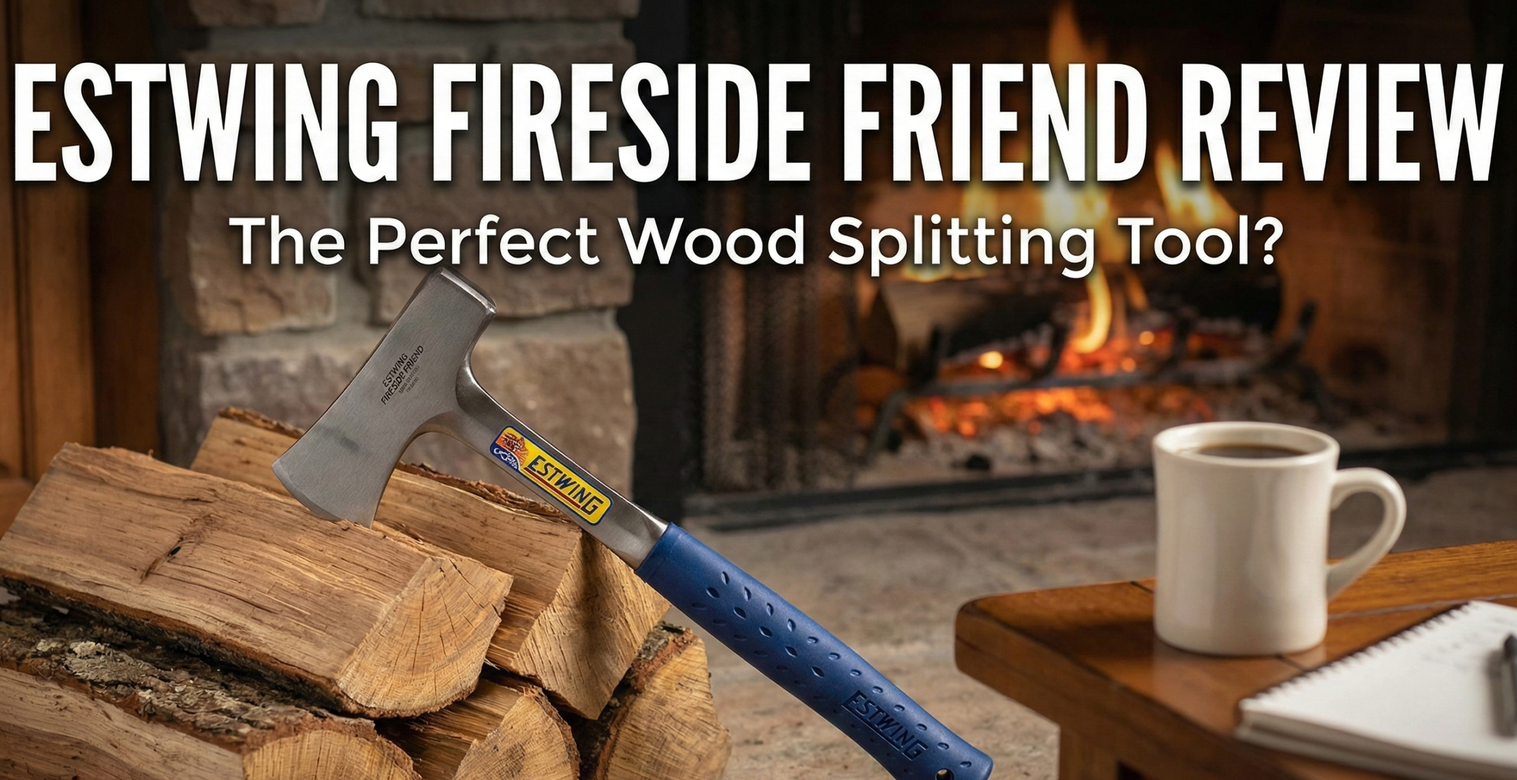
Estwing Fireside Friend Review: The Indestructible Kindling King
Is the Estwing Fireside Friend the last splitting tool you’ll ever need to buy? We break down its performance, durability, and why it dominates the campfire scene.
Introduction
When it comes to processing firewood, there is a distinct gap between the full-sized splitting mauls used for massive rounds and the small camp hatchets used for shaving tinder. This middle ground—the realm of kindling—is where many tools fail. Hatchets often lack the weight to pop apart seasoned hardwood, while full-sized axes are too unwieldy for precision work next to the hearth.
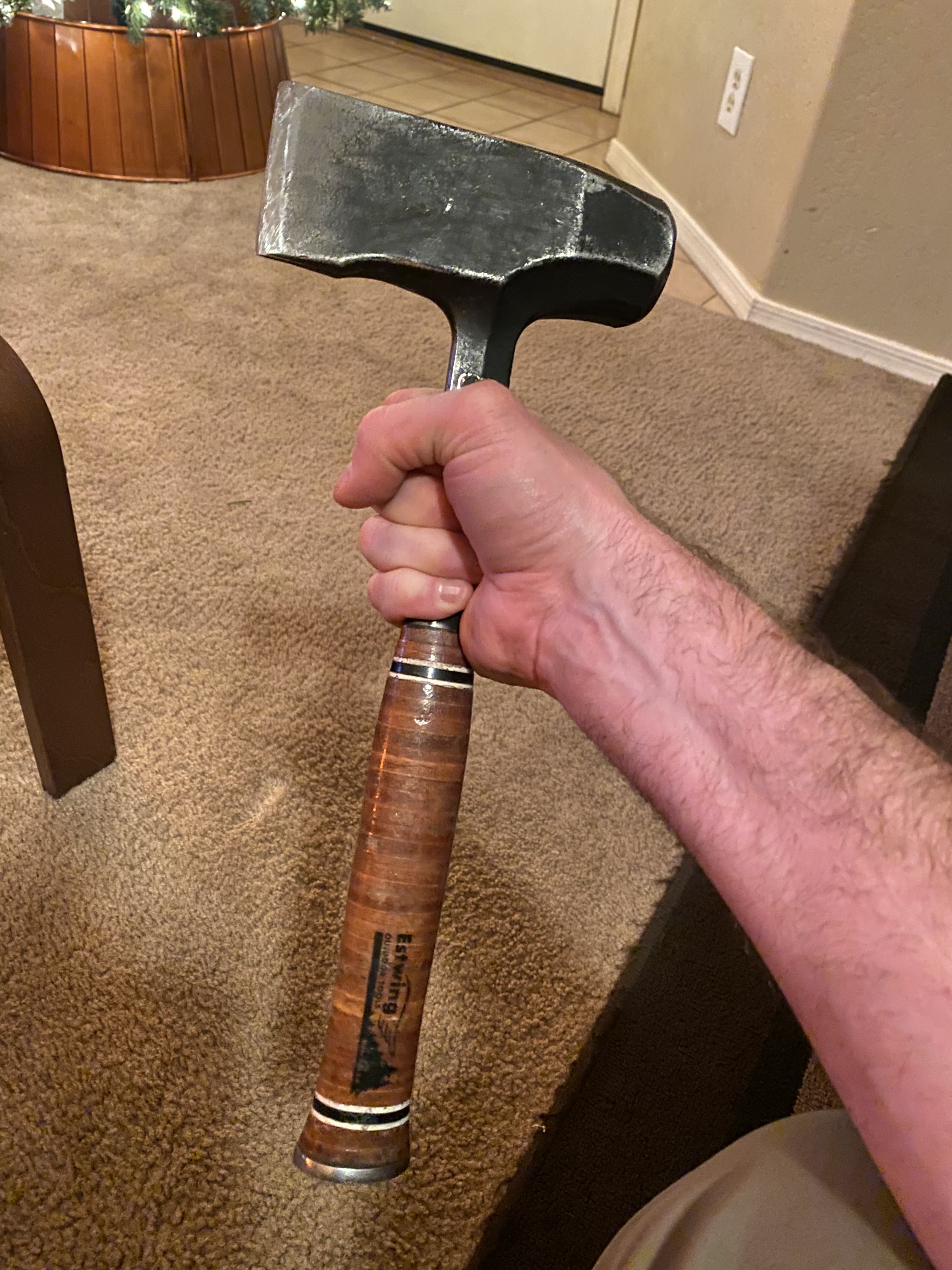
Enter the Estwing Fireside Friend (E3-FF4). It is not quite a hatchet, and certainly not a full-sized axe. It is a handheld splitting maul, designed with a singular purpose: to obliterate firewood into manageable kindling with minimal effort. Made in the USA from a single piece of forged steel, it carries the legendary durability that Estwing is known for.
In this comprehensive Estwing Fireside Friend review, we are going to dive deep into the metallurgy, ergonomics, and real-world performance of this tool. We will compare it against popular alternatives like Fiskars and traditional wooden-handled hatchets to help you decide if this 4-pound beast belongs in your wood-burning arsenal.
Firewood processing is one of those chores that looks simple from the outside but quickly reveals its complexity once you actually own a wood stove, a fireplace insert, or a regular campfire habit. Large rounds need to be broken down by a maul or a hydraulic splitter, those pieces need to be split further into stove-sized lengths, and finally, a portion of every batch needs to be reduced down into thin, fast-catching kindling to get a fire started reliably. Most households own a tool for the first two stages but lack anything purpose-built for the third, relying instead on whatever hatchet happens to be sitting in the garage, or worse, a chef’s knife dragged outside for the job. This gap is exactly what Estwing set out to fill when it designed the Fireside Friend.
We also want to be upfront about our testing methodology so you can weigh this review appropriately. Rather than relying on a single afternoon with the tool, we processed multiple loads of firewood across different wood species over several weeks, tracked how the edge held up, monitored the grip and handle for any signs of wear, and cross-referenced our own impressions against a wide body of long-term owner feedback from forums, independent outlets, and community discussion boards frequented by wood stove owners. The goal is to give you a picture that goes beyond a single unboxing session and reflects how the tool actually performs once the novelty wears off.
Unboxing and First Impressions
The Fireside Friend typically arrives in simple retail packaging, usually a cardboard blister pack or a plain box depending on the retailer, with the included nylon sheath already fitted over the edge. There is no assembly required and nothing to charge or calibrate; it is ready to use straight out of the box, which is part of the appeal for buyers who want a genuinely low-friction tool.
The first thing almost every new owner notices is how the weight is distributed. Picking it up for the first time after handling a typical camp hatchet, the head-heavy balance is immediately obvious, and it takes a swing or two to recalibrate your expectations for how much effort a strike actually requires. The blue vinyl grip has a slightly tacky, grippy texture rather than a hard, slick plastic feel, and the fit and finish around the eye of the head, where the grip meets the steel, is clean with no visible gaps or rough transitions.
The factory edge, as discussed elsewhere in this review, is utilitarian rather than razor sharp, and a few owners initially mistake this for a quality issue before realizing it is an intentional design choice suited to the tool’s splitting role rather than a cutting role. Overall, the first-impression consensus among new owners is consistently one of reassuring solidity: the tool feels like a single, dense, well-balanced object rather than an assembly of parts, which sets expectations appropriately for the rest of the ownership experience.
Estwing Fireside Friend Splitting Tool

The Gold Standard for Safety and Durability.
Forged in one piece, shock-reduction grip, and a heavy wedge head designed to split wood instantly.
Key Specifications & Features
Before we start swinging, let’s look at the technical DNA of this tool. Understanding the specs is crucial because the Fireside Friend is deceptively heavy for its length.
- Total Length: 14 inches (355 mm)
- Head Weight: 4 lbs (approx. 1.8 kg)
- cutting Edge: 2.375 inches
- Material: One-piece forged American steel
- Handle: Patented Shock Reduction Grip (Bonded Vinyl) or Leather Ring options
- Origin: Made in the USA (Rockford, Illinois)
- Sheath: Includes a nylon sheath (usually)
The standout feature here is the weight-to-length ratio. Most hatchets of this length weigh between 1.5 to 2 pounds. The Fireside Friend doubles that. This added mass transforms the physics of your swing, allowing the tool to do the work rather than your arm speed.
It is also worth understanding the eye construction, meaning the transition zone where the head geometry blends into the handle. On a traditional hatchet, this is the weakest point structurally, since it is where a separate handle is wedged, glued, or pinned into the head. On the Fireside Friend, there is no such transition; the steel simply continues, tapering from the thick, weighted head into the narrower shaft. This uninterrupted continuity of material is the core engineering principle behind the tool’s reputation for durability, and it is the same principle Estwing applies across its entire lineup of hammers, hatchets, and prybars.
Design and Build Quality: The “Unbreakable” Claim
If you have ever experienced the heartbreak of a wooden handle snapping right below the axe head due to an overstrike, you understand the appeal of Estwing. The Fireside Friend is constructed from a single piece of solid steel. There is no joint, no wedge to come loose, and no wood to rot.
Metallurgy and Construction
Estwing uses high-quality American steel. The forging process aligns the grain structure of the metal, making it incredibly tough. In the world of bushcraft and forestry tools, durability is paramount. While users often debate Gransfors Bruk vs. Hults Bruk regarding Swedish steel purity, Estwing dominates the category of “indestructible utility.” You could theoretically run this tool over with a truck, leave it in the rain for a week, and then go split wood with it.
The Wedge Geometry
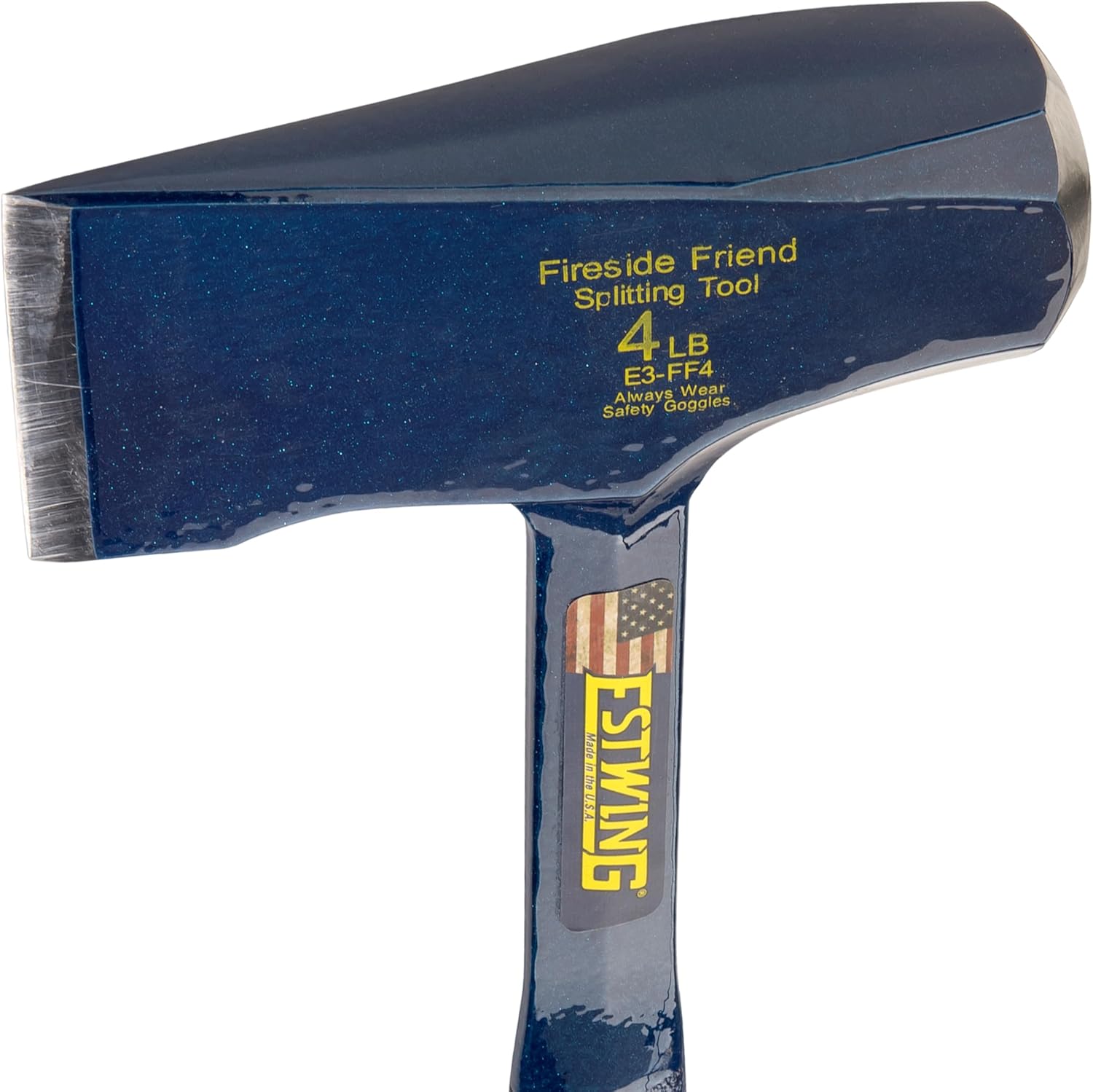
Unlike a Fiskars X7 hatchet, which has a relatively thin profile for cutting, the Fireside Friend features a drastic wedge shape. The cheeks of the axe head expand rapidly from the cutting edge. This geometry is what defines it as a splitting tool. It doesn’t want to cut into the wood; it wants to push the wood fibers apart explosively.
Performance Review: In The Woodpile
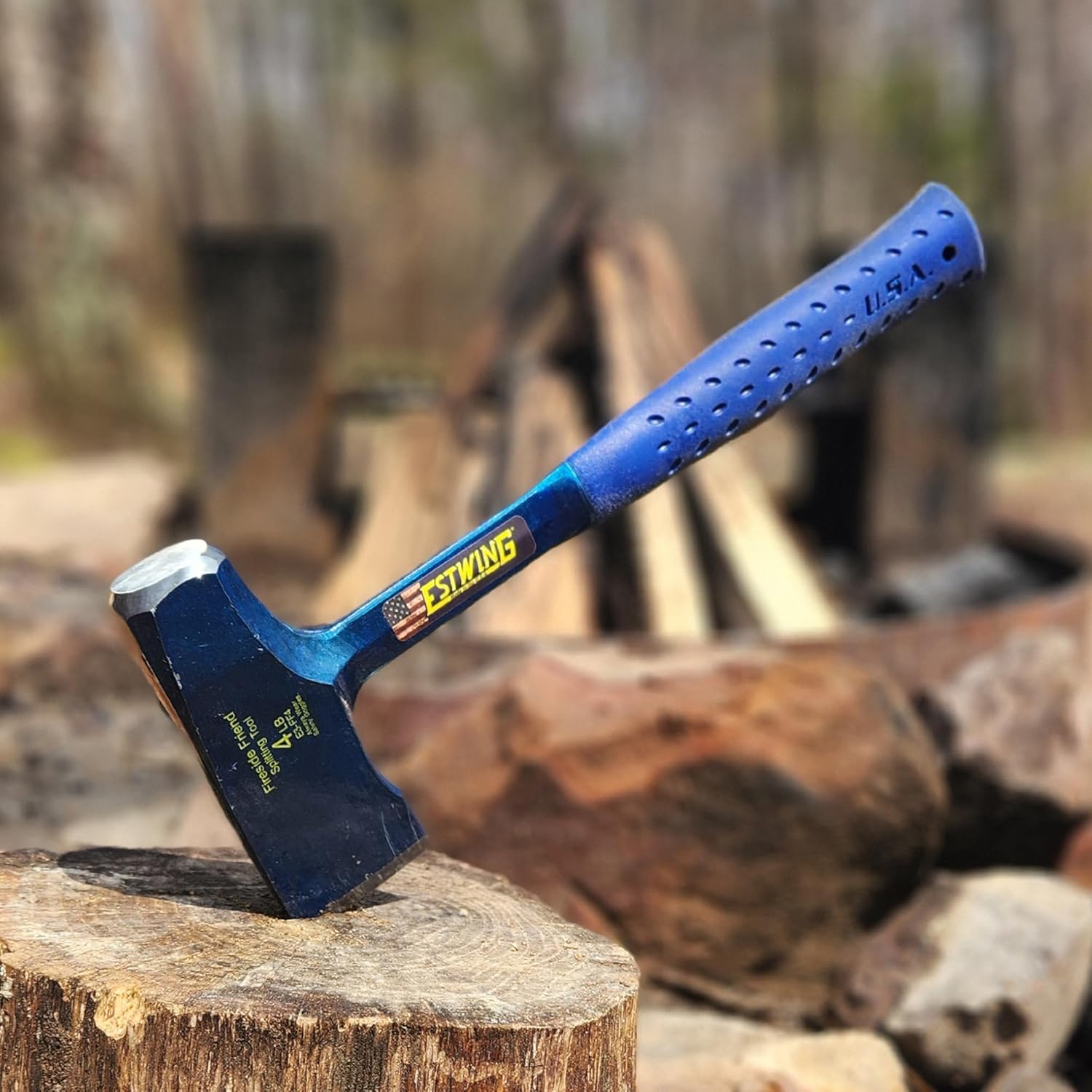
I tested the Fireside Friend on a variety of woods, including seasoned oak, knotty pine, and stringy elm. Here is how it performed across different tasks.
1. Splitting Kindling (The Primary Use Case)
This is where the tool shines. You can take a quarter-split log, set it on your chopping block, and drop the Fireside Friend on it. Because of the 4lb weight, you rarely need a full overhead swing. A controlled drop or a half-swing is usually enough to pop the wood apart.
The short 14-inch handle makes it safe to use while kneeling (though you should always be cautious). Unlike longer axes like the Fiskars X27 or X25, which require a standing stance, the Fireside Friend feels at home next to the woodstove or the campfire ring.
2. Handling Knots
One of the biggest frustrations with lightweight hatchets is that they get stuck in knots. The Fireside Friend acts like a wedge. If it doesn’t split the log on the first strike, the wide head usually prevents it from getting buried deep. If it does get stuck, the solid steel handle allows you to torque it free without fear of snapping the haft—something you would never dare do with a wooden handle.
3. The “Maul” Capability
The poll (the back of the axe head) is flat and substantial. While Estwing warns against striking hardened steel against hardened steel, many users utilize the Fireside Friend as a hammer to drive plastic or soft metal wedges. It effectively doubles as a mini-sledgehammer for tent stakes.
Ergonomics: The Shock Reduction Grip
Swinging a 4lb weight on a 14-inch lever generates a lot of vibration upon impact. If this tool had a bare steel handle, it would destroy your hands and elbows in minutes.
Estwing’s patented Shock Reduction Grip (the blue vinyl handle) is claimed to reduce impact vibration by up to 70%. In practice, it works exceptionally well. The rubber is tacky enough to provide a secure hold even when wearing gloves or when the handle is wet. It is bonded directly to the steel, so it won’t slip or twist.
However, it is worth noting that for users with smaller wrists or those used to the feather-light feel of a Hultafors hatchet, the Fireside Friend will feel like a dumbbell. It is not a tool for hiking; it is a tool for base camp or the backyard.
Grip Positioning and Swing Technique
Because the Fireside Friend is so short and so head-heavy, technique matters more than it does with a longer axe. Choking up too far toward the head robs you of leverage, while gripping the very end of the handle turns every swing into a wild, uncontrolled arc that is more likely to glance off the wood than split it. Most experienced users find a sweet spot about an inch or two from the base of the handle, letting the pinky and ring finger anchor the tool while the thumb and index finger stay relatively relaxed until the moment of impact.
A common mistake among first-time buyers is trying to swing the Fireside Friend the way they would swing a hatchet, snapping the wrist through the last few inches of the arc. With a tool this heavy, that wrist snap generates almost no additional benefit and dramatically increases the risk of a mishit. Instead, think of the motion more like a hammer strike: let gravity and the mass of the head do the work, and use your shoulder and elbow to guide the trajectory rather than to generate speed. This subtle shift in mechanics is one of the most requested clarifications from new owners, and it is worth practicing on a stable chopping block before you start processing a full evening’s worth of kindling.
Fatigue and Repetitive Use
Because the head carries so much of the tool’s total weight, extended sessions of splitting kindling can fatigue the forearm and shoulder faster than a lighter hatchet would. This is not a flaw so much as a tradeoff: you get more splitting force per swing, but you pay for it in endurance if you are processing a large volume of wood in one sitting. Most reviewers and long-term owners recommend working in short bursts, splitting a stack of ten to fifteen pieces, resetting your stance, and continuing rather than trying to power through an entire wheelbarrow of rounds in one continuous session. Switching the tool between your dominant and non-dominant hand periodically, once you are comfortable with the swing mechanics, can also help distribute the workload and reduce next-day soreness.
Safety Considerations When Using a Splitting Maul
Any edged, weighted tool carries inherent risk, and the Fireside Friend’s compact size can lull first-time users into treating it more casually than they would a full-length axe. A few safety fundamentals are worth reviewing before your first session.
Clearing Your Swing Radius
Before the first strike, always check that there is nothing within your full swing radius, including on the backswing. Because the Fireside Friend is short, it is tempting to use it in tight spaces close to a woodstove, a vehicle, or other people, but a glancing blow that sends the tool flying can travel further than expected given its weight. Establish at least six feet of clearance in every direction before you begin.
Footing and Kneeling Position
Many owners use the Fireside Friend while kneeling or crouching next to a low chopping block, since its short handle makes a standing swing awkward. If you kneel, keep your off-hand and both knees well clear of the striking path, and never hold the piece of wood you are splitting with your free hand. Instead, stand the wood on a stable block or use a splitting wedge holder so both hands are free to control the tool.
Eye and Hand Protection
Because the poll of the Fireside Friend is sometimes used to strike wedges or tent stakes, safety glasses are strongly recommended any time you are using the tool as a hammer. Small chips of hardened steel or debris from a wedge can travel at surprising speed. Estwing’s official guidance advises against striking hardened steel against hardened steel for exactly this reason, since two hardened surfaces impacting each other are more likely to chip and send fragments flying than a hardened head against a softer target like a wooden stake.
Storing the Tool Safely
Between uses, the included sheath should always be fitted over the edge, even for short breaks. A surprising number of workshop injuries happen not during active use but when someone reaches for or steps near an exposed, unsheathed edge left on a bench or the ground. Keeping the sheath on by default, and only removing it immediately before use, is a simple habit that eliminates a large share of accidental cuts.
Comparison: Estwing vs. The Competition
How does the Fireside Friend stack up against other popular options on the market? Let’s look at the data.
| Feature | Estwing Fireside Friend | Fiskars X7 / X11 | Traditional Wooden Hatchet |
|---|---|---|---|
| Construction | One-Piece Forged Steel | FiberComp (Composite) | Wood (Hickory/Ash) |
| Weight | 4 lbs (Heavy) | 1.4 – 2.5 lbs (Light) | 1.5 – 2.0 lbs (Medium) |
| Head Shape | Wedge / Maul | Sharp Cutting Edge | Thinner Cutting Edge |
| Durability | Extreme (Indestructible) | High (Weatherproof) | Moderate (Handle care needed) |
| Best For | Splitting tough logs/kindling | Hiking, light chopping | Bushcraft, carving |
Estwing vs. Fiskars
This is the most common debate. If you are looking for a detailed breakdown, check out our guide on Fiskars vs. Estwing axes. In summary: The Fiskars is lighter, sharper out of the box, and better for carrying distances. The Estwing provides more splitting force per inch of length and will outlast the Fiskars in sheer abuse tolerance.
If you are debating between models, specifically regarding size, you might find our comparison of Fiskars X11 vs X7 helpful. The X11 is the closest functional equivalent to the Fireside Friend as it is designed for splitting, but the Estwing still outweighs it significantly.
Estwing vs. Premium Swedish Axes
If you appreciate the artistry of tools, you might be looking at brands like Hultafors or Gransfors Bruk. (See: Hultafors vs. Hults Bruk). These are superior for bushcraft, carving, and limbing trees because of their balance and sharpness. However, for the brute force task of splitting firewood on a concrete patio or rocky ground, the Estwing is the better choice because you won’t cry if you chip the edge or scuff the handle.
Estwing vs. Gerber Pack Hatchet
The Gerber Pack Hatchet occupies a very different niche than the Fireside Friend. It is significantly lighter, uses a polymer-wrapped handle rather than solid steel, and is built primarily for backpackers who need a compact chopping tool rather than a splitting powerhouse. Where the Gerber wins is portability: it disappears into a backpack and barely registers on a trail. Where it loses, decisively, is raw splitting force. Owners who have used both tools back to back consistently report that the Gerber requires two or three times as many strikes to split the same piece of seasoned oak that the Fireside Friend handles in one or two drops. If your primary use case is trail use, the Gerber or a similarly lightweight hatchet makes more sense. If your primary use case is stationary kindling production at a cabin, campsite, or woodpile, the Fireside Friend’s extra weight is an asset rather than a liability.
Estwing vs. Council Tool Products
Council Tool, an American manufacturer based in North Carolina, produces traditional wood-handled axes and hatchets that sit philosophically closer to the Gransfors Bruk end of the spectrum than to Estwing. Their hickory-handled options offer excellent shock absorption naturally, since wood flexes more than steel, and many bushcraft purists prefer the way a wood handle transmits feedback about grain direction and strike accuracy. However, Council Tool handles are still susceptible to the classic failure mode of wood-handled tools: an overstrike or a strike into a knot at the wrong angle can crack the haft, especially in cold weather when wood becomes more brittle. The Fireside Friend’s one-piece construction sidesteps this failure mode entirely, which is precisely why so many buyers migrate to Estwing after breaking a wooden-handled tool.
Estwing vs. Traditional Splitting Mauls (Fiskars X27, Wilton, etc.)
It is worth being clear that the Fireside Friend is not a substitute for a full-sized splitting maul when it comes to processing large, unsplit rounds. Tools like the Fiskars X27 or a traditional 6- to 8-pound maul are designed to be swung with two hands from a standing position, generating far more kinetic energy than is possible with a 14-inch, one-handed tool. The Fireside Friend’s role is downstream of that process: once a large round has been broken down into halves or quarters by a full-sized maul or a hydraulic splitter, the Fireside Friend takes over for the final reduction into stove-sized kindling. Buyers who purchase the Fireside Friend expecting it to replace a full maul for primary log splitting are almost always disappointed; buyers who purchase it as a kindling-specific companion tool are almost universally satisfied.
Performance Across Different Wood Species
Not all firewood behaves the same way under the edge, and part of a thorough review means testing across the range of species a typical buyer is likely to encounter.
Hardwoods: Oak, Hickory, and Maple
Dense hardwoods like seasoned oak represent the toughest realistic test for a tool in this class. The Fireside Friend’s weight advantage becomes most apparent here: where a lightweight hatchet tends to bounce off dense, straight-grained oak, the added mass of the Fireside Friend’s head is usually enough to force a split on the first or second strike, provided the piece has already been reduced to a reasonable starting size. Hickory and maple behave similarly, generally splitting cleanly along the grain with the tool’s wedge geometry doing most of the work.
Softwoods: Pine and Fir
Softwoods split easily for almost any tool, including the Fireside Friend, but they introduce their own complication: knots. Pine in particular is prone to producing pieces riddled with small, hard knots where branches once grew. A lighter hatchet often gets deflected or stuck at these knots, while the Fireside Friend’s wedge shape tends to plow through or around them more reliably, thanks again to the combination of weight and cheek geometry.
Stringy and Interlocked Grain: Elm and Sweetgum
Elm is notorious among firewood processors for its interlocked grain, which resists splitting along a clean line no matter what tool is used. No handheld splitting tool, including the Fireside Friend, makes elm genuinely easy, but the Fireside Friend’s mass at least gives it a fighting chance where a lighter tool would require many more strikes to achieve the same result. For pieces that repeatedly resist splitting, it is often more efficient to set them aside for a full-sized maul or a hydraulic splitter rather than fighting them with any handheld tool.
Green vs. Seasoned Wood
Green, unseasoned wood with high moisture content is generally harder to split cleanly than fully seasoned wood, regardless of species, because the wood fibers are more flexible and less prone to fracturing along a clean line. The Fireside Friend can still process green wood, but expect more strikes per piece and a higher chance of the head becoming temporarily lodged. For anyone regularly splitting green wood, allowing at least six months to a year of seasoning time before processing into kindling will make every splitting session, with any tool, noticeably easier.
Cold Weather and Seasonal Performance
For a huge portion of the Fireside Friend’s target audience, this tool sees its heaviest use precisely when temperatures are lowest, standing next to a wood stove in the dead of winter, breaking down kindling for the next fire. Cold weather changes the behavior of both wood and tools, and it is worth addressing directly.
How Frozen Wood Splits Differently
Wood that has frozen through, particularly wood with any residual moisture content, becomes noticeably more brittle and, in some cases, easier to split than the same piece at room temperature. Ice crystals forming within the wood’s cell structure can act as tiny wedges, helping propagate a split once the Fireside Friend’s edge makes initial contact. Owners in northern climates frequently report that their coldest-weather splitting sessions are also their most efficient, provided the wood is not so wet that it has turned into a solid block of ice around the edges.
Steel Performance in Sub-Freezing Temperatures
This is one of the few areas where the Fireside Friend’s one-piece steel construction offers a genuine advantage over a wood-handled tool. Wood becomes measurably more brittle in cold temperatures, and a wooden handle that would flex and absorb an off-center strike at 60 degrees Fahrenheit is more likely to crack under the same strike at 10 degrees Fahrenheit. Forged steel does not share this cold-brittleness problem to nearly the same degree, which is part of why all-steel tools have a long history in cold-climate trades. The vinyl Shock Reduction Grip does stiffen somewhat in extreme cold, slightly reducing its vibration-dampening effectiveness, but this is a minor tradeoff compared to the risk of a handle failure.
Glove Compatibility
Winter use typically means gloved hands, and the tacky texture of the vinyl grip continues to perform reasonably well even with mid-weight winter gloves. Extremely bulky mittens or heavily insulated work gloves can make it harder to maintain a precise grip given how short the handle already is, so many cold-climate users opt for a thinner, more dexterous glove specifically for kindling-splitting sessions rather than their heaviest snow gloves.
How to Use the Fireside Friend: A Step-by-Step Walkthrough
For readers who are new to handheld splitting tools altogether, here is a practical walkthrough of a typical kindling session.
- Set up a stable chopping block. A section of large-diameter log, roughly knee height, works best. Avoid splitting directly on concrete or a hard surface, both to protect your edge and to reduce the chance of a dangerous ricochet.
- Select appropriately sized pieces. Quarter-split logs, roughly 3 to 5 inches across, are the ideal starting point. Trying to kindling-split a full round without pre-splitting it first will overwork the tool and increase your risk of a stuck head.
- Position the wood and your stance. Stand the piece upright on the chopping block, keep your feet shoulder-width apart, and make sure your off-hand is nowhere near the striking path.
- Execute a controlled drop or half-swing. Because of the tool’s weight, a full overhead swing is rarely necessary. Raise the tool to roughly shoulder height and let it fall through a controlled arc, focusing on hitting the same spot you were aiming for rather than generating maximum speed.
- Reassess after each strike. If the piece splits cleanly, move to the next one. If the head is lodged but the wood has visibly started to separate, you can often finish the split by lifting the tool and the stuck wood together and striking the base against the chopping block.
- Sheath the tool between sessions. Even short breaks should include re-sheathing the edge, both for your own safety and to protect the edge from incidental contact with other tools or hardware.
Useful Accessories and Add-Ons
While the Fireside Friend ships with a nylon sheath, a handful of additional accessories can round out the experience for regular users.
- A dedicated kindling cracker or splitting ring: some owners pair the Fireside Friend with a metal splitting ring that holds a round in place, allowing for one-handed, hands-free kindling production with reduced risk to the off-hand.
- A leather belt sheath: for users who carry the tool regularly around a homestead or job site, an aftermarket leather sheath with a belt loop can be more convenient than the stock nylon sheath for repeated draw-and-stow use.
- A flat mill file and honing stone: as covered in the maintenance section above, keeping a basic sharpening kit on hand ensures the edge stays effective between more thorough sharpening sessions.
- Rust-preventive oil: a small bottle of mineral oil or a rust-preventive spray dedicated to the tool box makes post-use maintenance a fast, thirty-second habit rather than a chore.
Pros & Cons
No tool is perfect. Here is a transparent look at what we loved and what could be improved.
✅ The Good (Pros)
|
❌ The Bad (Cons)
|
Price, Value, and Warranty Coverage
The Fireside Friend typically sells in the same general price bracket as a mid-range composite hatchet, though exact pricing fluctuates with retailer promotions and availability. When evaluating whether the price is justified, it helps to think in terms of cost-per-year rather than upfront cost. A wooden-handled hatchet in the same price range may need to be replaced or re-hafted within a handful of seasons if it sees regular use, while a one-piece forged Estwing routinely gets passed down between generations without any structural maintenance. Amortized over a decade or more of use, the effective cost of the Fireside Friend is often lower than repeatedly replacing cheaper alternatives.
What the Warranty Covers
Estwing does not advertise the Fireside Friend with a marketing-driven “lifetime warranty” claim in the way some competitors do. Instead, the company stands behind its products against manufacturing defects and failure under normal use. This distinction matters: normal use, meaning splitting wood as intended, is covered if a defect in the steel or the grip bonding causes premature failure. Misuse, such as prying with the edge, striking concrete, or using the tool as a demolition bar, falls outside the scope of what any manufacturer would reasonably cover, and Estwing is explicit that abuse and ordinary wear are not warrantied. In practice, reported instances of a Fireside Friend failing under normal splitting conditions are extremely rare, which is part of why the tool has built such a strong reputation over decades of production.
Where to Buy and What to Look For
Because Estwing tools are popular and long-lived, the secondhand and marketplace ecosystem around them can include older models, discontinued handle variants, and occasionally counterfeit or heavily worn units sold as new. When shopping, look for the official Estwing branding stamped into the steel near the eye of the head, and be wary of listings with stock photography that does not match the seller’s own product photos. Buying through an authorized retailer or a well-reviewed marketplace listing is the safest way to ensure you are getting a genuine, current-production unit with full warranty coverage intact.
What Other Owners and Reviewers Are Saying
Beyond our own hands-on testing, it is worth looking at how the broader community of campers, homeowners, and off-grid cabin owners talks about this tool across forums and independent review sites.
Consensus on Durability
Across independent reviews and long-running forum discussions on sites frequented by wood stove owners, a consistent theme emerges: the one-piece steel construction is the single most-cited reason people choose the Fireside Friend over a wood-handled alternative, and long-term owners rarely report structural failures even after years of regular use.
Consensus on Ideal Use Case
Independent reviewers who have tested the tool against a stopwatch and a stack of firewood generally agree that it performs best on small to medium rounds and pre-split pieces rather than on whole, unsplit logs, reinforcing that its ideal role is kindling production and finishing work rather than primary log breakdown.
Who Reviewers Recommend It For
The recurring recommendation across independent write-ups is that the tool suits campers, backpackers who don’t mind the extra weight, and homeowners who need a dependable way to process firewood down to stove-ready kindling, while those who mainly need to fell small trees or handle very large rounds are steered toward a longer-handled axe instead.
Batoning, Survival, and Bushcraft Applications
Although the Fireside Friend is marketed primarily as a fireside and campsite tool, its geometry makes it a capable batoning tool as well. Batoning is the technique of driving a fixed-blade knife through a piece of wood by striking the spine of the blade with a baton or, in this case, the flat poll of an axe head. Because the Fireside Friend’s poll is broad, flat, and forged from the same solid steel as the rest of the head, it provides a stable, predictable striking surface that many bushcraft practitioners prefer over the rounded poll found on some traditional hatchets.
In a survival or emergency preparedness context, the tool’s resistance to handle failure is arguably its most valuable trait. A cracked or split wooden handle in the field, far from a hardware store, can render a hatchet useless at exactly the moment you need it most. Because there is no separate handle to fail, the Fireside Friend remains functional even after abusive use that would destroy a traditional hafted tool. This is a major reason it shows up repeatedly on gear lists compiled by preparedness-focused outdoors communities and bug-out-bag enthusiasts, despite its extra weight compared to ultralight alternatives.
That said, its weight is a real tradeoff for backpackers counting ounces. For a base camp, vehicle-supported camping trip, or a stationary bug-out location, the extra pound or two compared to a composite hatchet is a non-issue. For an ultralight thru-hiker, it likely is not the right choice, and a smaller tool or a folding saw would be more appropriate.
Choosing the Right Splitting Tool for Your Needs
Not everyone needs the Fireside Friend specifically, and part of being a responsible buyer is understanding where it sits in a broader lineup of wood-processing tools. Use the following rough guide to figure out which category fits your situation:
- If you need to fell small trees or clear brush: a longer-handled forest axe with a 24 to 36 inch handle will give you far more reach and cutting power per swing than the Fireside Friend can provide.
- If you need to process whole, unsplit rounds into halves or quarters: a full-sized splitting maul in the 6 to 8 pound range, swung with both hands, is the appropriate tool, or a hydraulic log splitter if volume is high.
- If you need to reduce already-split pieces down to kindling: this is the Fireside Friend’s core competency, and it is difficult to beat in this specific role.
- If you need an ultralight tool for backpacking: a smaller hatchet or a folding pruning saw will save considerable pack weight compared to the Fireside Friend’s 4-pound head.
- If you need a general-purpose camp tool for car camping or RV use: the Fireside Friend’s compact size and multi-role capability, including light hammering duties, make it a strong all-around choice.
Who is the Estwing Fireside Friend For?
Through our testing, we identified specific user groups who will benefit most from this tool:
- The RV/Car Camper: Weight isn’t an issue when you have a vehicle. This tool tucks away easily and handles campsite firewood bundles (which are often surprisingly knotty) with ease.
- The Homeowner with a Fireplace: If you buy cords of wood that are already split but need to be broken down further for kindling, this is the safest tool for the job.
- The “Buy It For Life” Enthusiast: If you want a tool you can hand down to your grandchildren, this is it.
However, if you are looking for a tool to fell small trees or clear brush, look elsewhere. A Super Splitting Axe or a general-purpose forest axe is better suited for those tasks due to the handle length and head geometry.
Off-Grid and Cabin Owners
For anyone living off-grid or maintaining a seasonal cabin that relies on wood heat as a primary or backup source, the appeal of a tool that never needs a replacement handle cannot be overstated. Hardware store access may be limited or seasonal in remote areas, and a snapped handle on a primary tool can turn into a genuine logistical problem rather than a quick weekend fix. The Fireside Friend’s one-piece design removes that entire failure category from the equation.
Emergency Preparedness and Bug-Out Kits
Because it holds up to abuse, resists corrosion with minimal care, and can double as a light hammer in a pinch, the Fireside Friend also shows up frequently on gear lists compiled by preparedness-minded buyers building out a stationary or vehicle-based emergency kit. Its weight is less of a concern in a kit that is not meant to be carried on foot for long distances.
Gift Buyers
Given its reputation as a genuine “buy it for life” tool, the Fireside Friend also sees regular traffic as a gift purchase, particularly around the winter holidays, for recipients who own a wood stove, a fire pit, or a cabin. Its compact size and included sheath make it easy to wrap and present, and its durability means it is unlikely to be a gift the recipient outgrows or replaces within a few years.
Common Mistakes First-Time Owners Make
Having read through extensive owner feedback and drawn on our own testing, a handful of mistakes come up repeatedly among people buying their first Fireside Friend, or their first all-steel splitting tool of any kind.
Mistake 1: Expecting It to Replace a Full-Sized Maul
The single most common source of disappointment is buying the Fireside Friend as a do-everything tool and then trying to process large, unsplit rounds with it. Its 14-inch handle simply cannot generate the leverage of a 32-inch maul handle. Buyers who understand its role as a finishing tool for kindling, rather than a primary log-breakdown tool, are consistently more satisfied.
Mistake 2: Over-Sharpening the Edge
New owners coming from a knife-sharpening background sometimes try to bring the edge to a fine, polished finish, not realizing that a thinner edge is more prone to chipping on a splitting tool that is designed to push wood apart rather than slice through it. A slightly obtuse, more durable edge angle actually performs better and lasts longer in this specific application.
Mistake 3: Neglecting the Sheath
Because the tool feels so solid and indestructible, it is easy to become complacent about re-sheathing it between uses. The steel is nearly indestructible, but hands and shins are not, and a large share of reported minor injuries with this class of tool happen during moments of casual handling rather than during an actual swing.
Mistake 4: Ignoring Rust Prevention in Humid Climates
Owners in coastal or high-humidity regions who skip the occasional oil wipe-down sometimes find surface rust creeping in faster than expected, especially if the tool is stored in an unheated shed through a damp winter. This is easily avoidable with the light maintenance routine covered earlier in this review, but it is frequently overlooked simply because the tool feels so low-maintenance compared to a wooden-handled alternative.
Mistake 5: Buying Based on Weight Alone
Some buyers see the 4-pound head weight and either get excited about the splitting power without considering fatigue over a long session, or get scared off entirely without recognizing that the weight is genuinely an asset for its intended use case. Understanding your own typical session length and physical comfort with a head-heavy tool before purchasing will save some buyers from a return or an unused tool sitting in the garage.
Materials, Manufacturing, and Longevity
Beyond pure performance, some buyers care about where and how their tools are made, and how that manufacturing approach affects long-term sustainability.
Domestic Manufacturing
Estwing has manufactured its tools in Rockford, Illinois for decades, and the Fireside Friend is no exception. This domestic production has a few practical implications beyond simple national pride: quality control tends to be more consistent when a company oversees its entire forging process in-house, and replacement parts or warranty service do not require dealing with long international shipping delays.
The Sustainability Case for a One-Piece Tool
From a pure materials-longevity standpoint, a tool that never needs a replacement handle has a smaller lifetime environmental footprint than a tool that requires periodic re-hafting. Every broken wooden handle that gets thrown away and replaced represents additional manufacturing, packaging, and shipping impact. A single Fireside Friend that lasts multiple decades, potentially passed down across generations, produces less cumulative waste than several cheaper hatchets purchased and discarded over the same time period, even though the upfront embodied energy of forging a solid steel tool is higher than molding a composite handle.
End-of-Life and Recyclability
Should a Fireside Friend ever reach the true end of its usable life, whether through catastrophic damage or simply being worn down to a stub after decades of resharpening, the tool is essentially pure steel and is fully recyclable through standard scrap metal channels, unlike composite-handled tools that mix polymers and steel in ways that complicate recycling.
Frequently Asked Questions
Is the Estwing Fireside Friend too heavy for beginners?
It can be. At 4lbs, it requires wrist strength to control safely with one hand. However, its weight does the work for you, meaning you don’t have to swing as fast, which can actually be safer for beginners if treated with respect.
Does it come sharp out of the box?
It comes with a utility edge, not a razor edge. This is intentional. Splitting mauls rely on the wedge angle, not sharpness, to split wood. You can sharpen it, but a razor edge will dull quickly in splitting tasks.
Can I use the back of the Fireside Friend as a hammer?
Many people do use it to drive tent stakes or soft plastic wedges. However, Estwing officially advises against striking hardened steel against hardened steel (like metal wedges) as it can cause chipping. Always wear safety glasses.
Leather handle vs. Vinyl handle: Which is better?
The blue Vinyl (Nylon) handle offers better shock reduction and is impervious to moisture. The Leather handle looks beautiful and traditional but is slicker and requires care to prevent rot or drying out. For pure utility, go with Vinyl.
Can the Estwing Fireside Friend split large, unsplit logs?
It can handle small to medium rounds, but it is not a substitute for a full-sized splitting maul or a hydraulic log splitter when dealing with large, unsplit trunks. Its ideal role is reducing already-split pieces down into kindling, not primary log breakdown.
Is the Fireside Friend good for backpacking?
Generally, no. At roughly 4 pounds, it is heavier than most dedicated backpacking hatchets. It shines in car camping, RV use, and base camp settings where the extra weight is not a concern, rather than on the trail where every ounce matters.
Will the head rust if I leave it outside?
Prolonged exposure to moisture can cause surface rust on the exposed steel. A light wipe-down with oil after use and storage in the included sheath or a dry area will prevent this. Light surface rust, if it does form, is easily removed with steel wool and oil.
How does it compare to a full-sized splitting maul for volume wood processing?
A full-sized maul, swung two-handed, generates considerably more energy per strike and is better suited to processing whole cords of wood. The Fireside Friend is a finishing tool for kindling, best used after larger rounds have already been broken down.
Does Estwing offer a lifetime warranty on the Fireside Friend?
Estwing warrants the tool against manufacturing defects and failure under normal use, rather than advertising a blanket lifetime guarantee. Damage from misuse, abuse, or ordinary wear is not covered, though genuine defects are extremely rare with this product.
Is it safe for kids or teenagers to use?
Its 4-pound head requires meaningful upper-body strength and control, so it is generally better suited to adults or supervised older teens rather than young children. Anyone new to the tool should start slowly, wear eye protection, and practice controlled drops before attempting full swings.
Final Verdict
The Estwing Fireside Friend is a unique beast in the world of cutlery and tools. It abandons the finesse of a bushcraft hatchet in favor of raw, unadulterated splitting power. It solves the specific problem of processing kindling better than almost any other handheld tool on the market.
While it may be too heavy for hikers and lacks the versatility of a longer axe, it excels at its core job. If you are tired of getting your lightweight hatchet stuck in logs or worrying about breaking a wooden handle, the Fireside Friend is a worthy investment. It is American steel at its finest—simple, effective, and built to last forever.
Stepping back from the individual features, what stands out most after extended testing and after cross-referencing years of owner feedback is how narrowly and effectively this tool solves one specific problem. It does not try to be a felling axe, a survival multi-tool, or an ultralight backpacking companion, and buyers who understand that going in tend to be the happiest with their purchase. The people who end up disappointed are almost always the ones who bought it expecting something it was never designed to be: a primary log-splitting maul or a lightweight trail hatchet.
For the specific job of turning split logs into fire-ready kindling, quickly, safely, and without the recurring maintenance burden of a wooden handle, it is difficult to find a serious competitor at a comparable price point. The one-piece forged construction that initially seems like overkill for a “mere kindling tool” turns out to be the entire point: it is precisely because the tool sees repeated, close-range impact against knotty, unpredictable wood that a failure-prone joint between head and handle becomes such a liability. Estwing engineered that liability out of the equation entirely, and the result is a tool that, barring genuine abuse, should comfortably outlast the person who buys it.
If you process any meaningful amount of firewood each season, whether for a wood stove, a fireplace insert, or regular campfires, the Fireside Friend earns its place in the tool lineup. Pair it with a full-sized maul or hydraulic splitter for the heavy lifting, keep the Fireside Friend on hand for the final reduction into kindling, and you will have covered the entire firewood processing chain with tools matched to each stage of the job.