ESEE JG3 Review: Is This the Ultimate Nessmuk Camp Knife?


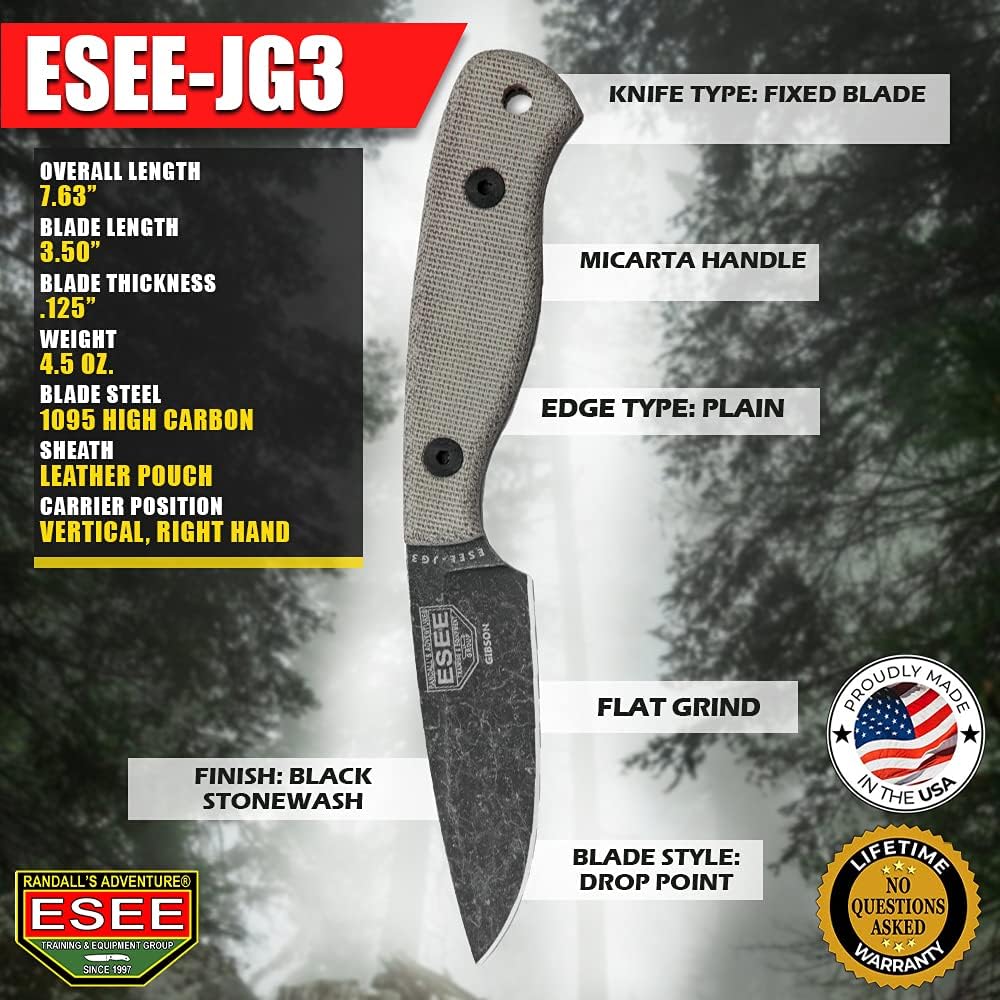
When you think of ESEE Knives, you usually think of apocalypse-proof pry bars like the ESEE 5 or tactical survival tools. You imagine coated blades, skull crushers, and Kydex sheaths. But the ESEE JG3 is a different beast entirely. Part of the “Camp Lore” series, this knife was designed by James Gibson, a bushcraft instructor who values finesse over brute force.
In this detailed ESEE JG3 review, we are heading into the woods. We are trading the tactical vibes of a SOG TAC XR for the smell of campfire smoke and leather. We will analyze the 1095 carbon steel, the controversial “Nessmuk” blade shape, and see if this USA-made tool deserves a spot on your belt alongside classics like the Fallkniven S1.
This is not a quick first-impressions writeup. Over the following sections we will dig into every question that shows up in owner forums and comment sections: whether the JG3 can baton firewood despite its modest 3.5-inch blade, how the black-oxide JG3-BO differs from the uncoated original, what sharpening angle actually works best on 1095, whether the leather sheath can be adapted for a Tek-Lok or dangler carry, how the knife stacks up against other short bushcraft blades like the ESEE Izula II and the PR4, and who this knife is — and isn’t — a good fit for. If you have been Googling “ESEE JG3 batoning,” “JG3 vs JG3-BO,” or “ESEE JG3 sharpening angle,” you are in the right place.
Technical Specifications
| Feature | Details |
|---|---|
| Designer | James Gibson (Camp Lore Series) |
| Overall Length | 7.63 inches |
| Blade Length | 3.50 inches |
| Blade Steel | 1095 Carbon Steel (55-57 RC) |
| Blade Finish | Black Oxide Stone Washed |
| Handle Material | Micarta |
| Weight | 4.5 oz (Knife Only) |
| Sheath | USA Made Leather Pouch |
| Blade Thickness | Approx. 0.125 inches (1/8″) |
| Grind | Full Flat Grind |
| Tang | Full Tang |
| Country of Origin | Made in USA (Golden, Idaho) |
| Warranty | Unconditional Lifetime Warranty |
A quick note on why we are re-listing some of these specs with more precision than a typical spec sheet: search intent around the JG3 is unusually detailed. People aren’t just asking “what steel is it,” they’re asking “is 1/8-inch blade stock enough to split kindling,” and “is a 55-57 Rc hardness too soft for edge retention.” We’ll answer both of those, and more, as we go.
The Design Philosophy: What is a “Nessmuk”?
The ESEE JG3 is heavily inspired by the “Nessmuk” knife carried by George Washington Sears (pen name Nessmuk), a famous 19th-century outdoorsman. The philosophy is simple: a knife should be a slicing tool, not a chopping axe.
The blade features a sweeping belly and a slight hump on the spine. This shape is exceptional for skinning game (hence the resemblance to skinners) and food preparation. It slices meat and vegetables significantly better than the thick, wedge-like geometry found on tactical knives like the Smith & Wesson Border Guard. The tip is dropped, making it less prone to accidental punctures when dressing game, though it sacrifices some piercing ability.
Sears’s original argument, laid out in his writings for Forest and Stream magazine in the 1880s, was that most outdoorsmen carried far too much knife. He advocated for a compact trio: a light hatchet for heavy chopping, a folding knife for small tasks, and a fixed “Nessmuk” blade for skinning and food work. The idea was division of labor — let the axe baton the big rounds, let the Nessmuk do what it does best, which is push cuts and slicing arcs. James Gibson leaned into that history rather than fighting it, and it shows in every dimension of the JG3.
Compare the belly curve on the JG3 to a straight-backed utility blade like a classic Mora Companion, and the difference in intended use becomes obvious. A straight edge is efficient for batoning and for running along a straightedge when carving flat surfaces. A swept Nessmuk belly is efficient for rolling the blade through a cut — think slicing an onion, skinning a rabbit, or shaving bark off a stick in one continuous arc rather than a series of short push cuts. Neither approach is “better” in the abstract; they’re built for different jobs. That’s the central fact anyone comparing the JG3 to a general-purpose bushcraft knife needs to internalize before they judge it on the wrong criteria.
The Steel: 1095 Carbon Performance
ESEE is famous for its heat treatment of 1095 Carbon Steel. While modern super-steels get all the hype, 1095 remains a favorite among bushcrafters for two reasons: toughness and ease of sharpening.
In the field, you can bring the JG3 back to a shaving edge using a simple river stone or the bottom of a ceramic mug. Try doing that with the S30V steel we reviewed in the Kershaw Blur post. However, there is a trade-off. 1095 rusts. If you look at it wrong, it might rust.
Let’s put some numbers behind “toughness” and “edge retention,” since those two words get thrown around loosely in knife marketing. ESEE hardens its 1095 to roughly 55-57 on the Rockwell C scale. That is intentionally on the softer end for a carbon tool steel. Compare that to something like CPM-3V, which many custom bushcraft makers push to 58-60 Rc, or a premium stainless like CPM-S35VN sitting in the same range. The JG3’s lower hardness sacrifices some edge-holding — you will feel the edge start to roll or dull sooner during long sessions of rope cutting or cardboard breakdown than you would with a harder, more wear-resistant steel.
What that lower hardness buys you is impact resistance. A blade at 55-57 Rc flexes and deforms slightly under stress rather than chipping or snapping. If you drive the spine into a knot while making a notch, or if the edge meets a hidden nail in scrap wood, a softer 1095 edge is more likely to roll over (which you can fix with a few strokes on a stone) than to fracture (which you cannot fix at all in the field). This is precisely why 1095 has remained the default choice for hard-use bushcraft and survival knives for decades, even as newer powder-metallurgy steels have taken over the high end of the folding knife market.
The trade-off, of course, is corrosion. 1095 is a plain high-carbon steel with essentially no chromium content, which means it has almost no built-in corrosion resistance. Left wet overnight, especially after contact with acidic foods like citrus or tomato, a 1095 blade will develop surface rust within hours. This isn’t a manufacturing defect or a quality control issue — it’s the nature of the alloy, full stop. Owners who come from stainless folders are sometimes caught off guard by how quickly a patina (or outright rust, if neglected) forms on a fresh 1095 edge.
JG3 vs. JG3-BO: Which Finish Should You Buy?
One detail that trips up first-time buyers is that the JG3 is actually sold in two distinct finishes, and the listings aren’t always clear about the difference. The standard JG3 ships with an uncoated 1095 blade, left bare so it will develop a natural gray-blue patina with use. The JG3-BO (“Black Oxide”) adds a black oxide coating to the blade faces while deliberately leaving the 90-degree spine uncoated.
Why leave the spine bare on the BO model? Two reasons. First, a coated spine is slightly less effective at throwing sparks off a ferro rod — the coating can gum up and dull the scraping edge over repeated strikes. Second, it’s a visual and tactile cue: bare steel on the spine tells you at a glance where the fire-starting edge is, and it gives you a small uncoated reference patch to gauge how quickly the rest of the blade would patina if the coating weren’t there.
In terms of raw corrosion resistance, the black oxide coating on the JG3-BO does help somewhat — it adds a thin protective layer over the blade flats — but it is not a substitute for maintenance. Oxide coatings are cosmetic and mildly protective, not a rust-proofing treatment like the DLC or Cerakote coatings found on some tactical fixed blades. Either version of the JG3 still needs to be dried and lightly oiled after use. If you like the look of a deep black stonewash and don’t mind that it will show scratches as bright bare-steel scuffs over time, get the BO. If you’d rather let the blade patina naturally and don’t mind the extra “raw” look, the uncoated JG3 is the one to choose. Performance-wise, in terms of edge geometry, heat treatment, and handle, the two are identical.
Handle Ergonomics: The Broomstick Effect
The handle scales are made of Micarta, a material that grips better when wet. The profile is simple—almost like a broomstick. It lacks the finger grooves and guards found on tactical knives.
This is intentional. A neutral handle allows you to hold the knife in a hammer grip, chest lever grip, or reverse grip comfortably for hours of wood carving without creating “hot spots.” However, because there is no finger guard, you must be careful not to let your hand slide forward onto the blade during heavy stabbing motions—though, again, this knife isn’t designed for stabbing.
The absence of jimping (those small traction grooves cut into the spine or handle that some knives use for thumb placement) is worth calling out specifically, since it’s a recurring question in owner discussions. Some competing bushcraft knives, including a few other entries in ESEE’s own catalog, add jimping along the spine near the handle to give the thumb extra purchase during fine carving work. The JG3 skips this entirely. In practice, this keeps the spine smooth and comfortable for choking up and running a thumb along the back of the blade during detail cuts, but it also means you’re relying purely on the Micarta texture and grip shape for control — there’s no mechanical “stop” for your thumb. Most reviewers land on this being a net positive for comfort during long carving sessions, since jimping can dig into skin uncomfortably after extended use, but it’s a legitimate trade-off worth knowing about before you buy.
Circumference and shape also matter more than people expect on a knife this size. The JG3’s handle is close to cylindrical, with only a very slight palm swell, rather than the more contoured, ergonomically molded handles you’ll find on knives designed primarily for a single grip (like a hammer-grip-only chopping tool). This is a deliberate nod to traditional woodcraft handle design, where a simple round or oval cross-section allows the knife to rotate freely in the hand for skinning, carving, and food prep without the handle shape fighting you when you change grip angle mid-task.
Field Test: Wood & Food
We took the JG3 out for a weekend trip.
- Fire Prep: The 90-degree spine is sharp! It throws massive sparks from a ferro rod, arguably better than the Fallkniven S1 which uses a laminated spine. It makes feather sticks effortlessly.
- Food Prep: This is where the JG3 shines. Slicing potatoes, onions, and steak was a joy. The wide blade allows you to scoop up cut veggies to drop them in the pot.
- Carving: The blade is short enough (3.5 inches) to offer excellent control for making notches and trap triggers.
Let’s dwell a little longer on feather sticks, since it’s one of the most commonly searched skills tied to this knife. A good feather stick needs a blade that can take a very shallow, controlled bite into dry softwood and peel a long, thin curl without snapping it off. The JG3’s flat grind and modest 1/8-inch blade stock make this almost trivially easy once the edge is properly honed — the geometry is thin enough behind the edge that you don’t need to fight the wood. Where thicker survival blades (think anything ground for prying, like the ESEE 5 or 6) tend to push through the wood fibers and snap curls short, the JG3 slices through cleanly, producing the long, tightly-curled feathers that catch a spark and hold a flame.
Food prep deserves a bit more detail too. The drop point profile and the belly curve mean the JG3 handles a rock-chop motion (rocking the tip on the board while lifting the heel) reasonably well for a knife this size, though the handle length limits how much leverage you get compared to a full-size kitchen knife. Where it really excels is in tasks that mimic classic Nessmuk use: breaking down a whole fish, skinning small game, trimming fat off a cut of meat, or slicing camp bread and cheese. If your camp cooking mostly involves opening packets and stirring a pot, you won’t notice much difference between the JG3 and a cheaper knife. If you’re actually processing whole food items at camp, the thin, sharp, belly-heavy blade earns its keep.
Check out the video above to see the JG3 in action against various types of wood.
Can the ESEE JG3 Baton Wood?
This is probably the single most common question we see about the JG3, so let’s answer it directly: yes, you can baton with the JG3, but you need to set your expectations correctly based on blade length.
Batoning — striking the spine of a fixed blade with a wooden baton to drive it through a log lengthwise, splitting it into smaller pieces for kindling — works best with a blade that is at least as long as the diameter of the wood you’re splitting, ideally longer. With a 3.5-inch blade, the JG3 is well suited to splitting branches and small-diameter rounds in roughly the 2 to 3.5 inch range. Push it toward 4-inch rounds and you’ll find the tip exits the far side of the wood before the cut is fully open, which makes the split unpredictable and can put lateral stress on the tip.
The 1/8-inch blade stock and full flat grind hold up fine to this kind of use on appropriately-sized wood — the toughness of 1095 at this hardness is exactly why ESEE knives have a reputation as batoning-friendly tools in the first place. Full tang construction means there’s no weak point at the handle junction where energy from the baton strikes could cause a failure. That said, if splitting large rounds of firewood is your primary camp task, a longer, thicker knife (or, frankly, a hatchet) is the better tool, and the JG3 was never designed to replace one. Think of it as a knife that can baton kindling-sized wood competently, not a knife built around batoning as its core function the way something like the ESEE 6 or a Junglas is.
One practical tip: because the spine is a crisp, sharp 90-degree edge (intended for ferro rod use), it can be a little unkind to a soft wooden baton over repeated strikes, biting slightly into the baton wood rather than gliding off it. This isn’t a functional problem, but if you’re batoning for an extended session, expect your baton to show some chew marks where it’s contacted the spine.
Sharpening & Field Maintenance
Because 1095 is a simple, low-alloy carbon steel, it is genuinely one of the easier steels to sharpen by hand, but there are a few specifics worth knowing so you don’t waste time guessing at angles.
ESEE ships the JG3 with a fairly acute factory edge, generally measured in the neighborhood of 20 to 22 degrees per side, which suits its role as a slicing and food-prep knife well. If you plan to use the JG3 mostly for carving, skinning, and kitchen-style tasks, maintaining that factory angle (or even taking it slightly more acute, down toward 15-18 degrees per side) will maximize slicing performance. If you plan to lean harder into batoning and rougher wood tasks, bumping the edge angle up to 22-25 degrees per side will trade a little slicing sharpness for more durability against edge rolling and micro-chipping.
In terms of technique, a simple two-stage approach works well for most owners: a medium-grit stone (roughly 400-600 grit, or a fine-grit river stone in a pinch) to reset the edge and remove any rolling or minor damage, followed by a higher-grit stone or a leather strop loaded with honing compound to polish and true up the final edge. Because 1095 is relatively soft compared to premium powder-metallurgy steels, it raises a burr quickly and is easy to feel with a fingernail test, which makes it a genuinely beginner-friendly steel to learn freehand sharpening on. Many owners report being able to bring the JG3 back to hair-shaving sharpness with nothing more than a smooth creek stone, which is exactly the kind of field-expedient maintenance the Nessmuk design philosophy was built around in the first place.
Rust prevention is the other half of the maintenance equation, and it deserves a routine, not just a one-time treatment. After any use — especially contact with food, saltwater, or damp wood — wipe the blade dry immediately, then apply a light coat of a food-safe mineral oil or a dedicated rust inhibitor like Ballistol or Tuf-Glide. Store the knife outside its leather sheath when it’s not in active use for extended periods, since leather can trap residual moisture against the blade and accelerate corrosion rather than prevent it. Some owners deliberately encourage an even gray-black patina early on (by wiping the blade with diluted vinegar or mustard) because a stable patina actually slows further active rusting compared to bare, freshly-ground steel. This is optional, but it’s a well-established trick in the carbon steel community and works just as well on the JG3 as on any other 1095 blade.
Sheath, Carry Options & Retention
The JG3 ships with a traditional USA-made leather pouch sheath, a deep, snug-fitting pocket that relies on friction rather than a snap strap for retention. This is a deliberate, old-school design choice consistent with the Nessmuk theme, but it’s also one of the more debated aspects of the knife among buyers coming from more tactical gear.
Leather pouch sheaths hold the blade via friction fit, meaning the leather is molded tightly around the handle and blade shoulder so the knife has to be pulled out against resistance. New, this provides excellent retention — the JG3 will not fall out even upside down. Over months of use, leather naturally breaks in and stretches slightly, which can loosen that friction fit. Most owners find this manageable with basic care (keeping the sheath dry, avoiding over-oiling the leather, and occasionally conditioning it), but if you plan to use the knife for activities with a lot of movement, like hiking off-trail or working from an ATV, it’s worth checking retention periodically rather than assuming day-one tightness will last forever.
A frequent question is whether the stock leather sheath can be swapped for a more modern carry system like a Tek-Lok or a horizontal dangler. Because the leather pouch is a fixed, molded piece rather than a modular Kydex shell, there’s no simple drop-in Tek-Lok adapter the way there is for many of ESEE’s Kydex-sheathed models. Owners who want a more MOLLE-compatible or belt-adjustable carry generally go one of two routes: having a local leatherworker add a Tek-Lok-compatible backing plate to the existing pouch, or commissioning a custom Kydex sheath from one of the many aftermarket sheath makers who cut patterns for ESEE blades. Neither is a five-minute fix, so if a modular carry system is a hard requirement for you, factor that into your buying decision, or consider the JG3-BO with a third-party Kydex sheath from the outset.
Blade Length & Legal Carry Considerations
With a 3.5-inch blade, the JG3 sits in a length range that is legal to carry openly in the majority of U.S. states without a specific permit, though knife laws vary meaningfully by state and even by city or county ordinance, so this is not a substitute for checking your local statutes. Fixed blades under 4 inches are frequently exempt from the stricter concealed-carry restrictions that apply to larger fixed blades in many jurisdictions, which is one reason short bushcraft and Nessmuk-style knives like the JG3, the ESEE-3, and the Izula II have remained popular as daily “camp and truck” knives rather than purely backcountry tools.
If you’re traveling with the JG3, remember that fixed blades of any length are prohibited in carry-on luggage under TSA rules in the United States and must go in checked baggage, and that international travel introduces an entirely separate set of national and regional knife laws that have nothing to do with U.S. state statutes. This is a knife-agnostic point that applies to every fixed blade in this review, not something unique to the JG3, but it comes up often enough in reader questions that it’s worth stating plainly here.
The ESEE Lifetime Warranty, Explained
ESEE’s warranty is frequently cited as one of the best in the entire knife industry, and it’s worth explaining exactly what it covers, since “lifetime warranty” gets used loosely by a lot of brands. ESEE’s policy is unconditional: if the knife breaks during use, for any reason, they will repair or replace it, with no proof of purchase or warranty card required, and the coverage follows the knife for its entire life, even through resale.
What “unconditional” does not cover is cosmetic wear and tear from normal use — patina, scratches on the blade or handle, worn or stretched leather in the sheath, or an edge that’s simply gotten dull. Those are expected consequences of using a carbon steel bushcraft knife the way it’s meant to be used, not defects. What it does cover is genuine breakage: a snapped tip from an unusual stress, a handle scale that cracks, or any structural failure during legitimate use, including hard use like batoning within the knife’s size limits. In practice, this means the JG3 is one of the lower-risk buys in the bushcraft knife category — if you genuinely break it doing camp tasks, ESEE will make it right, which is a meaningfully different value proposition than a knife with a standard one-year manufacturer’s defect warranty.
Comparison: JG3 vs. The Competition
ESEE JG3 vs. ESEE 4
The ESEE 4 is the brand’s flagship. It is thicker, longer, and coated with a rough powder coat. The ESEE 4 is a survival knife; it can pry open a crate. The JG3 is a bushcraft knife; it carves a spoon. If you want a tank, get the 4. If you want a precise tool, get the JG3.
ESEE JG3 vs. Fallkniven S1
We recently reviewed the Fallkniven S1. The S1 uses stainless laminated VG10 and a convex grind. It is superior in wet environments (snow/swamp) because it won’t rust. The JG3, however, is easier to sharpen in the field and has a better warranty (ESEE’s warranty is lifetime, unconditional).
ESEE JG3 vs. Budget Options
You can find “bushcraft” knives in Blue Ridge Knives catalogs or from brands like M-Tech. The difference is the heat treat. Cheap 1095 is brittle or too soft. ESEE’s 1095 is the gold standard for consistent toughness.
ESEE JG3 vs. ESEE-3
The ESEE-3 is arguably the JG3’s closest sibling in the ESEE lineup, and the comparison comes up constantly. The ESEE-3 has a straighter drop-point profile, comes standard with a Kydex sheath and a choice of handle materials including canvas Micarta or G10, and is available with a plain or partially serrated edge. It’s a more general-purpose, slightly more “tactical-adjacent” shape, whereas the JG3’s swept Nessmuk belly is purpose-built for skinning and slicing. If you want one knife to do a bit of everything — light batoning, self-defense-adjacent utility, EDC carry in a modular sheath — the ESEE-3 is the more versatile all-rounder. If your priority is food prep, game processing, and traditional woodcraft, the JG3’s belly curve and leather sheath are the better fit for that specific job.
ESEE JG3 vs. ESEE Izula II
The Izula II is smaller and lighter still, with a 2.6-inch blade and a skeletonized handle designed for paracord wrapping, making it one of the most packable fixed blades ESEE sells. It’s an excellent minimalist neck knife or backup blade, but its tiny handle and blade length make it a poor choice as a primary camp knife for food prep or any batoning at all. The JG3 sits a clear step above it in capability: still compact and light, but with enough blade length and a full Micarta handle to serve as a true primary tool rather than a backup.
ESEE JG3 vs. Morakniv Garberg
The Morakniv Garberg is a fair budget-to-mid-tier comparison, since it’s also a full-tang, Scandi-adjacent bushcraft blade with a simple, no-frills handle. The Garberg uses Sandvik 14C28N stainless steel, which trades some of 1095’s ease-of-sharpening and toughness for genuine rust resistance and lower maintenance. If you camp in consistently wet or coastal environments and don’t want to think about oiling a blade, the Garberg’s stainless construction is arguably the more practical daily tool. The JG3 counters with a more refined, slicing-optimized blade shape, a nicer traditional leather sheath, and ESEE’s unconditional warranty versus Morakniv’s more standard coverage.
Who Should (and Shouldn’t) Buy the ESEE JG3
The JG3 is not trying to be everything to everyone, and being honest about that is more useful than a blanket recommendation. Here’s who tends to be genuinely happy with this knife, and who is better served looking elsewhere.
Good fit if: You primarily camp, hike, or hunt and want a dedicated food-prep and skinning knife rather than a pry bar. You value a knife that’s easy to touch up on a stone or a river rock without specialty equipment. You appreciate traditional materials — leather, Micarta, an uncoated or lightly coated carbon blade — over tactical coatings and Kydex. You’re comfortable with a maintenance routine (oil after use, dry before storage) as part of owning a carbon steel tool, the same way a cast iron pan owner accepts seasoning as part of the deal.
Poor fit if: You want a single knife that can baton full-size firewood rounds — get a longer, thicker ESEE model or a small hatchet instead. You need a knife you can genuinely ignore for weeks at a time without any rust risk — a stainless bushcraft knife like the Fallkniven S1 or a Morakniv in 14C28N stainless will serve you better with less upkeep. You want a modular, MOLLE/Tek-Lok-compatible carry system out of the box — the stock leather pouch sheath is traditional, not tactical, and adapting it takes extra work. You spend a lot of time in humid, coastal, or saltwater environments and don’t want to babysit a carbon edge.
Pros and Cons Verdict
✅ The Good
- Warranty: Best in the industry. You break it, they replace it.
- Blade Shape: The Nessmuk shape is a slicing machine.
- Spine: Sharp 90-degree spine for fire starting.
- Sheath: High-quality USA leather (very traditional).
- Agility: Light and nimble in the hand.
- Easy Sharpening: 1095 responds well to simple stones and stropping.
- Batoning Kindling: Handles small-diameter rounds confidently.
❌ The Bad
- Rust: 1095 requires constant care.
- Handle: Can be slippery; lacks a finger guard.
- Sheath Retention: Leather stretches over time; not as secure as Kydex.
- Price: Expensive for a “simple” knife.
- Limited Batoning: Not suited to splitting large firewood rounds.
- No Modular Carry: No factory Tek-Lok or MOLLE option.
Recommended Gear & Alternatives
If you are looking to build a complete kit, we recommend pairing the JG3 with a smaller multitool like the Victorinox Cadet for fine tasks. Here are the best buying options:
ESEE JG3 Camp Lore
The star of the show. 1095 Carbon steel, Micarta scales, and leather sheath.
Check Price on Amazon
ESEE 4
The tactical alternative. Thicker, longer, and coated for heavy survival use.
Check Price on Amazon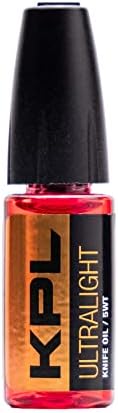
Tuf-Glide Prevention
Essential for 1095 steel. Keeps the rust away without leaving a sticky residue.
Check Price on Amazon
Morakniv Bushcraft
The budget king. If the JG3 is too pricey, the Mora offers 90% of the performance for 20% of the cost.
Check Price on AmazonFrequently Asked Questions (FAQ)
Is the ESEE JG3 full tang?
Yes, the ESEE JG3 is full tang. The steel runs through the entire length of the handle, ensuring maximum strength and durability.
Can I strike a ferro rod with this knife?
Absolutely. The JG3 is famous for its sharp 90-degree spine. It scrapes ferrocerium rods effectively to produce showers of sparks for fire starting.
Does the leather sheath have a belt loop?
Yes, the leather sheath is a deep pouch style with a belt loop. It is designed for right-handed carry but can be worn on the left side (cross-draw).
How do I prevent the blade from rusting?
Keep the blade clean and dry. After use, especially with food or wet wood, wipe it down and apply a thin coat of mineral oil (food safe) or a rust inhibitor like Tuf-Glide.
What’s the difference between the JG3 and the JG3-BO?
The standard JG3 has an uncoated 1095 blade that will patina naturally. The JG3-BO adds a black oxide coating to the blade flats while leaving the 90-degree spine bare for ferro rod use. Handle, grind, and heat treatment are identical between the two.
Can the ESEE JG3 baton wood?
Yes, within reason. The 3.5-inch blade and 1/8-inch stock handle small-diameter rounds (roughly 2-3.5 inches) confidently for kindling prep. It is not designed to split large firewood rounds; a longer knife or a hatchet is better suited to that job.
What sharpening angle should I use on the JG3?
The factory edge is roughly 20-22 degrees per side. Slicing and food-prep users can go slightly more acute (15-18 degrees per side), while those who baton more can bump it up to 22-25 degrees per side for added edge durability.
Is 1095 steel good for an outdoor knife?
Yes. 1095 is prized in bushcraft and survival knives for its toughness and ease of field sharpening, at the cost of needing more active rust prevention than a stainless steel blade.
Can I fit the JG3 into a Tek-Lok or MOLLE sheath system?
Not out of the box. The stock sheath is a traditional leather pouch without a modular backing. Owners who want Tek-Lok compatibility typically have a leatherworker modify the sheath or commission an aftermarket Kydex sheath.
Is the ESEE JG3 legal to carry?
Its 3.5-inch blade falls under the length threshold used by many U.S. states to distinguish everyday fixed blades from more heavily restricted large knives, but knife laws vary by state, city, and country, so always check your local statutes before carrying.
What does the ESEE warranty actually cover?
ESEE’s unconditional lifetime warranty covers genuine breakage during use, with no receipt required, for the life of the knife. It does not cover cosmetic wear like patina, scratches, or a sheath that’s stretched from normal use.
Conclusion
The ESEE JG3 is a breath of fresh air in a market saturated with “tactical” pry bars. It returns to the roots of what a knife should be: a cutting tool. James Gibson and ESEE have created a knife that feels like an extension of the hand.
It is not perfect—the lack of a finger guard requires mindful usage, and the steel demands respect and maintenance. But for the woodsman who values skill over gear, the JG3 is a masterpiece. It bridges the gap between the modern durability of ESEE and the traditional soul of Nessmuk.
Whether you are comparing it to the Fallkniven S1 or looking for a fixed blade to complement your Victorinox Cadet, the JG3 earns its place in the Camp Lore hall of fame. And if you’ve read this far wondering whether it can handle your specific use case — whether that’s batoning kindling, skinning a deer, or just prepping dinner at camp — the honest answer is that it does all three competently, as long as you respect what it was actually built to do.