The Anatomy of a Kitchen Knife: Every Part Explained
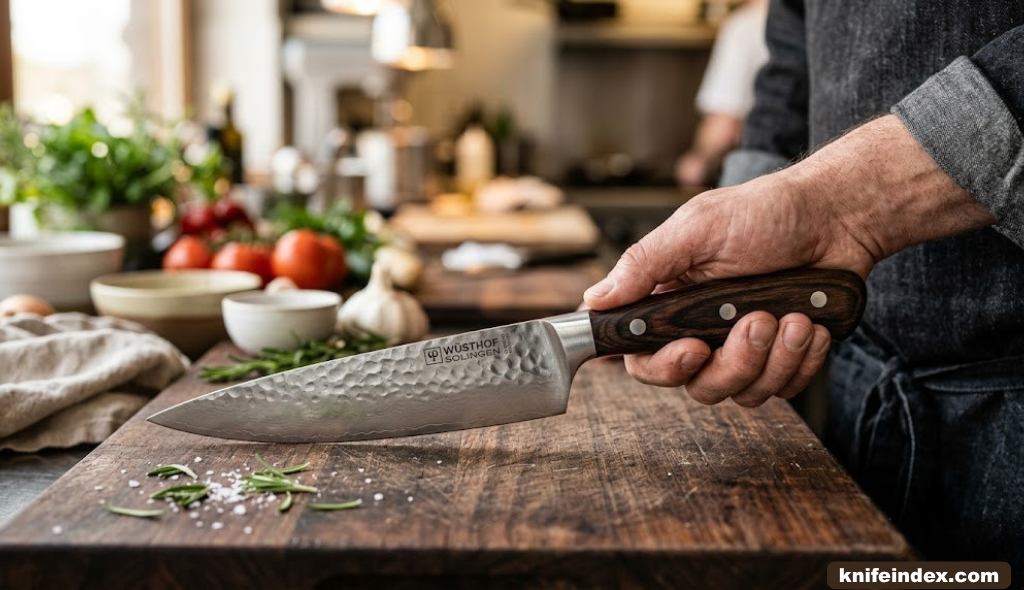
Pick up almost any kitchen knife and you’ll notice it feels different from every other blade in the block — heavier here, thinner there, a handle that fills your palm in a particular way. None of that is an accident. Every kitchen knife, from a ten-dollar paring knife to a hand-forged Damascus gyuto, is built from the same handful of components, and understanding what each one does is the fastest way to become a smarter buyer, a safer cook, and a better sharpener. This guide walks through every part of a kitchen knife — tip to butt, edge to spine — and explains why each detail matters more than you might think.
1. Why Knife Anatomy Matters
Most home cooks buy a knife based on brand name or looks, then wonder later why it feels wrong in the hand or dulls after two weeks of onions. The truth is that a knife’s performance is dictated almost entirely by its anatomy — the shape of the blade, the geometry of the edge, the way the tang is built into the handle, and the steel the whole thing is forged or stamped from. Learning these parts isn’t just trivia for knife nerds; it’s the difference between choosing a knife that fits your hand and cutting style versus one that fights you at every cut.
This becomes especially clear once you start comparing knives side by side. A German-style chef’s knife and a Japanese gyuto can look similar in silhouette but behave completely differently because of how their bevels, tangs, and steels are engineered. Understanding anatomy lets you read between the marketing lines and evaluate any knife on its actual merits.
We’ll go part by part, starting at the tip of the blade and working back to the butt of the handle, then close with a full comparison table, buyer FAQs, and practical guidance for matching anatomy to your own kitchen habits.

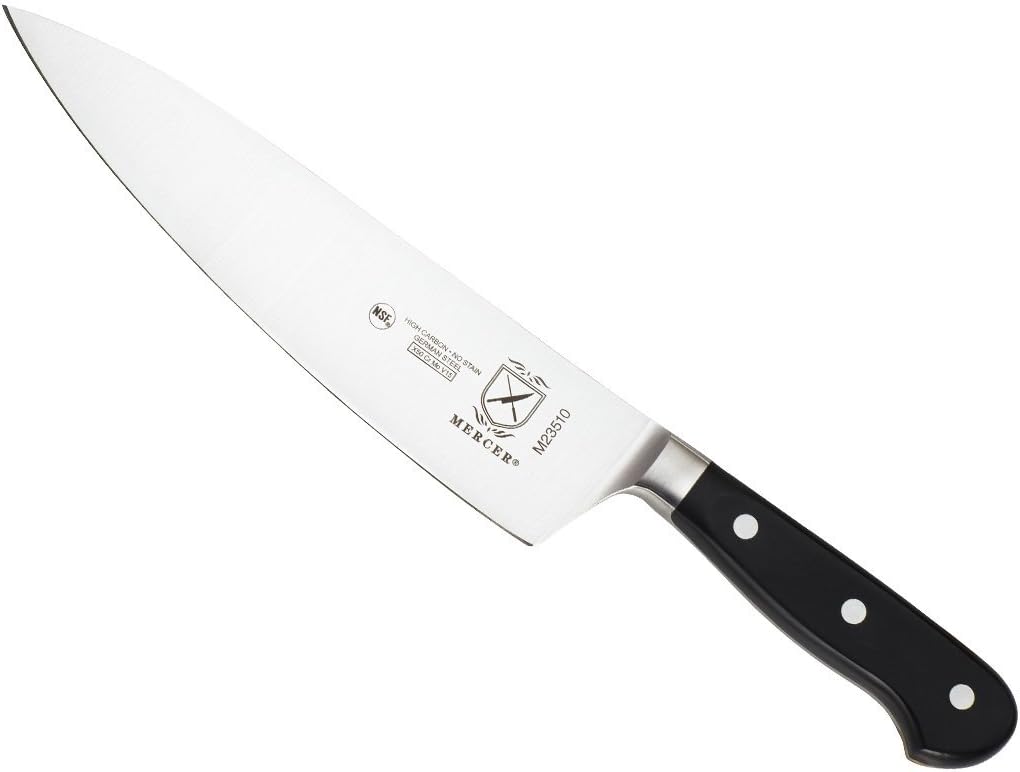
Want to feel these parts in your own hand before reading further? A well-balanced 8-inch chef’s knife is the best way to learn knife anatomy hands-on.
Check Price on Amazon2. The Blade: Tip, Point, and Belly
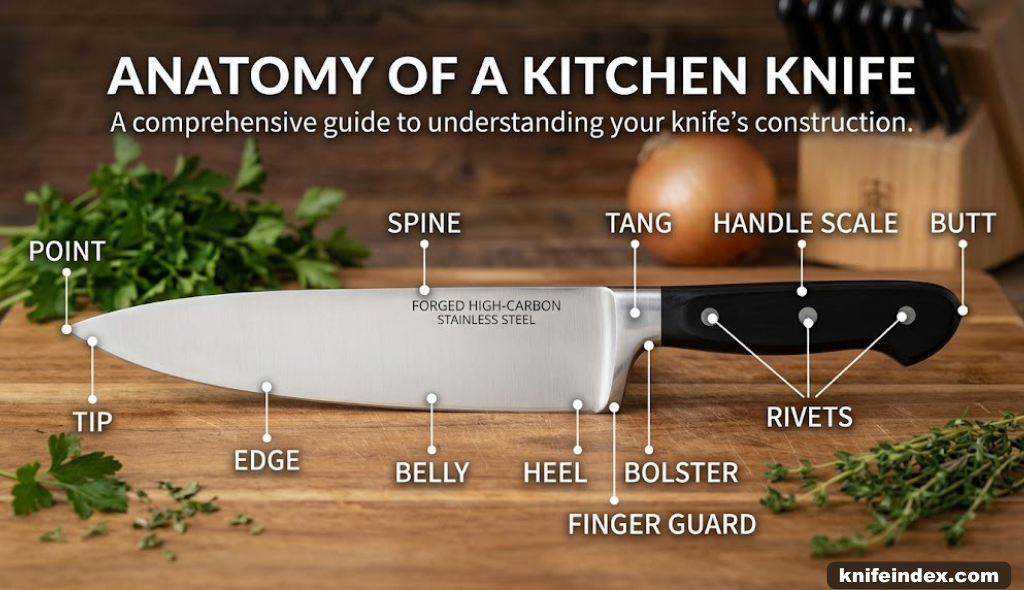
The blade is the most obvious part of any knife, but it’s actually made up of several distinct zones, each suited to a different motion in the kitchen. The tip is the very front of the blade, used for delicate, precise work like scoring fish skin, deveining shrimp, or trimming fat from a cutlet. The point refers to where the edge and spine converge; a fine, acute point (like on a paring knife) offers precision, while a blunter point (like on a kiritsuke) trades some delicacy for strength.
Moving back from the tip, the belly is the curved section of the blade used for the classic rocking motion of Western chopping. A pronounced belly, as seen on many German-pattern knives, lets the blade rock smoothly on the board through onions, herbs, and garlic. Japanese-style knives like the santoku and nakiri flatten this curve considerably, favoring a push-cut motion instead.
The choice between a curved belly and a flatter profile isn’t just aesthetic — it fundamentally changes your cutting technique. Cooks who grew up rock-chopping often struggle initially with flat-profile Japanese knives, and vice versa, which is worth considering before buying a santoku if you’ve only ever used a Western chef’s knife.
3. The Edge and Bevel Types
The edge is where the actual cutting happens, and it’s shaped by the bevel — the angled surface ground into the steel to create sharpness. Most Western kitchen knives use a double bevel, meaning both sides of the blade are ground symmetrically, which makes them easier to sharpen and more forgiving for both left- and right-handed cooks. Traditional Japanese knives, particularly single-purpose blades like the yanagiba, often use a single bevel, where only one side is ground flat and the other stays nearly flat, producing an extremely fine edge ideal for slicing raw fish. You can read a full breakdown of this in our guide to single-bevel vs double-bevel knives.
Edge Angle and Its Effect on Cutting
Edge angle — typically measured per side — also matters enormously. A narrower angle (around 12-15 degrees) produces a razor-sharp, slicing-focused edge common on yanagiba and sujihiki knives, but is more prone to chipping on hard ingredients. A wider angle (18-22 degrees per side) trades some sharpness for durability, which is why many German chef’s knives use this range for chopping through bone-in poultry or dense root vegetables.
Narrow Edge Angle Pros
- Exceptional slicing sharpness
- Cleaner cuts on delicate proteins
- Less resistance through produce
Narrow Edge Angle Cons
- More prone to chipping
- Requires more careful sharpening
- Not ideal for bone or frozen food
Whichever geometry you choose, edge retention is closely tied to steel choice, which we’ll cover in Section 10 — comparisons like VG10 vs AUS10 or S35VN vs S45VN are really about how long a given bevel angle stays sharp under real kitchen use.
4. The Spine
The spine is the thick, unsharpened top edge of the blade, running from the heel to the tip. It plays a bigger role than most cooks realize. A thicker spine adds strength and a satisfying heft, while a thinner, tapered spine reduces weight toward the tip and improves maneuverability for detail work. Many premium knives taper the spine gradually from heel to tip — a subtle but expensive detail to machine correctly, and one of the reasons blade geometry behind the edge is such a major factor in cutting performance.
Some cooks also use the spine as a guide surface, resting a finger along it during precision cuts, or using it to crush garlic cloves flat with the side of the blade. A rounded, polished spine is more comfortable for this than a sharp, unfinished one — a small detail that separates budget knives from refined ones.
5. The Heel and Choil
The heel is the back portion of the cutting edge, closest to the handle, and it’s where you generate the most force — ideal for cutting through tougher items like squash or dense bread crusts. Just above the heel, many knives feature a choil: a small, often finger-sized notch where the edge meets the bolster or handle. A finger choil lets you “choke up” on the blade, gripping closer to the edge for better control during fine cuts, a technique used constantly by professional chefs.
Not every knife has a choil — many paring knives and budget chef’s knives skip it entirely — but once you’ve used a knife with a proper finger choil, it’s hard to go back, especially for detailed vegetable work or boning tasks similar to what’s discussed in our guide to best boning knives.
6. The Bolster
The bolster is the thick collar of metal (or sometimes synthetic material) between the blade and the handle. Traditionally found on forged German knives, it serves three purposes: it protects your fingers from sliding onto the blade, it adds balancing weight near the handle, and on fully forged knives, it’s literally part of the same piece of steel as the blade itself. You can see this clearly in reviews like our Zwilling Pro chef knife review, where the bolster is a defining structural feature.
Full Bolster vs Half Bolster
A full bolster extends the entire height of the blade at the heel, offering maximum protection but making the knife harder to sharpen all the way to the heel over time (the edge can develop a “recurve” as the middle wears faster than the blocked heel). A half bolster stops partway up, leaving the heel of the edge exposed for full sharpening access — a compromise increasingly favored by manufacturers and sharpeners alike. Some Japanese-style knives skip the bolster entirely in favor of a lighter, choil-forward design, as seen in the stamped vs forged bolster geometry breakdown.
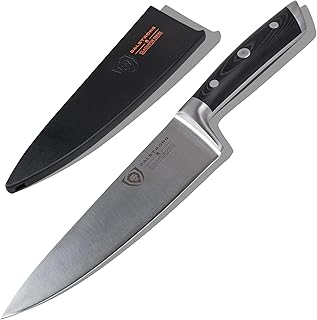
A full-bolster forged knife is a great way to feel the balance benefits of this design firsthand.
Shop Forged Chef Knives7. The Tang: Full vs Partial
The tang is the portion of the blade steel that extends into the handle, and it’s one of the single biggest indicators of a knife’s durability. A full tang runs the entire length of the handle, usually visible as a strip of steel sandwiched between the handle scales — this is the gold standard for strength, balance, and resistance to snapping under stress. A partial tang (sometimes called a rat-tail or hidden tang) extends only partway or is a thin rod embedded in the handle, which reduces cost and weight but can compromise long-term durability, especially on knives that see heavy use like hunting or outdoor knives.
For kitchen knives specifically, this matters most on knives that get twisted, pried, or used for heavier tasks — like cleavers or thick full-tang vs partial-tang chef’s knives — where a weak tang connection is the most common failure point. Outdoor and bushcraft-style fixed blades like the Ontario RAT-1 or Morakniv Companion are almost always full tang for this exact reason, even outside the kitchen.
8. The Handle and Scales
The handle is where feel, grip, and comfort converge, and it’s built from either a single molded piece (common in stamped and polymer-handled knives) or two scales riveted or bonded onto a full tang. Handle material dramatically affects grip security, weight distribution, and even hygiene, since porous materials can harbor bacteria if not sealed properly. Our detailed handle materials comparison covers wood, G-10, Micarta, and synthetic polymer in depth, but here’s the short version:
| Material | Grip Feel | Water Resistance | Typical Use |
|---|---|---|---|
| Pakkawood | Warm, natural | Good (sealed) | Mid-to-premium chef knives |
| G-10 | Textured, secure | Excellent | Outdoor & heavy-use knives |
| Micarta | Smooth, classic | Very good | Traditional & custom knives |
| ABS Plastic / POM | Light, consistent | Excellent | Budget & commercial kitchens |
| Stainless Steel (molded) | Firm, can be slippery wet | Excellent | Fully forged premium lines |
Handle shape matters just as much as material. An oval or D-shaped handle (common on Japanese wa-handles) encourages a precise pinch grip, while a more contoured Western handle fills the palm for a firmer, power-oriented grip. If you’ve ever compared a Shun to a Wüsthof, you’ve felt this difference directly.
9. Rivets, Pins, and Butt Cap
On full-tang knives with separate scales, rivets (or pins) are what mechanically hold the handle scales to the tang, usually made of nickel silver, stainless steel, or brass for a decorative contrast. Quality rivets sit flush with the handle surface — proud or recessed rivets are usually a sign of a lower-cost production run. At the very back of the handle sits the butt cap or pommel, which can add counterbalancing weight, protect the tail of the tang from moisture, and in some designs, provide a flat striking surface.
These small components rarely make it into marketing copy, but they’re often the first place a poorly made knife fails — loose rivets, gaps at the butt cap, or scales that swell and separate from the tang after repeated washing. When evaluating a used or budget knife, checking these details tells you more about long-term durability than the steel type ever will.
10. Steel Types and Heat Treatment
Every anatomical feature we’ve covered is built from steel, and the steel’s composition and heat treatment determine hardness, edge retention, corrosion resistance, and how the blade responds to sharpening. Steels are broadly split into stainless and high-carbon categories, and within each, dozens of specific alloys trade off these properties differently. Comparisons like D2 vs 8Cr13MoV, 14C28N vs Nitro-V, and MagnaCut vs M390 are really about finding the right balance point for your use case and maintenance habits.
Hardness and Rockwell Rating
Steel hardness is measured on the Rockwell C scale (HRC). Softer steels (54-58 HRC) are easier to sharpen and more chip-resistant but dull faster. Harder steels (60+ HRC) hold an edge far longer but require more skill and the right sharpening tools to restore. Our guide to Rockwell hardness in kitchen knives breaks this down in more detail, and it directly explains why premium Japanese blades often outlast cheaper knives edge-for-edge, despite costing more upfront.
| Steel Category | Typical HRC | Edge Retention | Corrosion Resistance |
|---|---|---|---|
| Budget Stainless (420J2, 3Cr13) | 52-56 | Low | High |
| Mid Stainless (VG10, AUS-8) | 58-61 | Medium-High | High |
| Premium Powder Steel (M390, MagnaCut) | 61-64 | Very High | High |
| High-Carbon (1095, White Steel) | 58-64 | High | Low (needs upkeep) |
If you’re prone to leaving a knife wet in the sink, our guide on how to prevent rust on knives is worth reading before choosing a high-carbon blade, and if it’s already too late, we also cover how to get rust off a knife safely.
Curious how a premium powder steel blade feels compared to standard stainless? It’s a noticeable upgrade in edge retention.
Browse Premium Steel Knives11. Forged vs Stamped Construction
How a blade is manufactured shapes nearly every anatomical feature we’ve discussed. Forged knives are made by heating a steel billet and hammering (or press-forging) it into shape, which allows for integrated bolsters, tapered spines, and generally denser, more durable steel. Stamped knives are cut from a flat sheet of pre-rolled steel, like cookie-cutter shapes, which is faster and cheaper but usually results in a lighter blade without a integrated bolster. Our full forged vs stamped pros and cons breakdown covers this in depth.
Forged Knife Advantages
- Integrated bolster and better balance
- Generally denser, stronger steel
- Often better edge retention
Stamped Knife Advantages
- Lighter, faster in the hand
- Lower cost
- Easier for factories to produce consistently
It’s a common myth that all stamped knives are inferior — many respected modern lines, including certain Misen and Made In knives, use high-quality stamped blanks with excellent heat treatment, proving that construction method is only one variable among many.
12. Balance, Weight, and Grind
Finally, all of these individual parts come together to determine a knife’s overall balance — where the center of mass sits relative to your grip. A well-balanced knife typically balances at or near the bolster/heel junction, letting the blade do the work without feeling front-heavy or handle-heavy. This is closely tied to grind type as well: a full flat grind tapers evenly from spine to edge, a hollow grind curves inward for extra thinness behind the edge, and a convex grind bulges slightly outward for added strength, common on outdoor blades like the Morakniv Garberg.
Understanding why knife balance matters is especially useful once you start comparing knives in person rather than online — a knife can have great steel and a gorgeous handle on paper and still feel wrong if the balance point doesn’t suit your grip style. This is exactly why in-hand testing (or at minimum, carefully reading reviews that mention balance, like our Miyabi Birchwood review) is worth the extra effort before buying.
13. Comparison Table: Anatomy Across Knife Types
To bring everything together, here’s how blade anatomy typically shifts across the most common kitchen knife categories:
| Knife Type | Belly | Bolster | Typical Tang | Common Bevel |
|---|---|---|---|---|
| German Chef’s Knife | Pronounced | Full | Full | Double, ~20° |
| Japanese Gyuto | Moderate | Half / None | Full | Double, ~15° |
| Santoku / Nakiri | Flat | None / Half | Full | Double, ~16° |
| Yanagiba | Flat, long | None | Partial (wa-handle) | Single |
| Paring Knife | Slight | None | Full or partial | Double, ~15-18° |
| Cleaver | Flat | Full (some) | Full | Double, ~20-25° |
If you’re building out a full kitchen roll rather than a single blade, our best knife sets for professional chefs guide and our piece on the three essential blades that can replace a full block both apply everything covered here to real-world buying decisions.
Ready to apply everything you’ve learned? A well-rounded knife set covers most of these anatomical variations in one purchase.
Shop Kitchen Knife SetsFrequently Asked Questions
What is the most important part of a kitchen knife?
There’s no single “most important” part — the edge determines sharpness, the tang determines durability, and the handle determines comfort. Together they form a system, and a weakness in any one area limits the knife’s overall performance.
Does a bolster make a knife better?
Not necessarily. A bolster adds finger protection and can improve balance on forged knives, but it can also make sharpening the heel more difficult over time. Many excellent knives, especially Japanese-style blades, skip the bolster entirely in favor of a lighter, choil-forward design.
What’s the difference between full tang and partial tang?
A full tang means the blade steel extends the entire length of the handle, offering superior strength and balance. A partial tang only extends partway, which reduces weight and cost but can be more prone to breaking under stress over years of use.
Why do some knives have a curved belly and others don’t?
The curved belly supports a rocking chop motion common in Western cooking, while flatter-profile knives, like the santoku or nakiri, are designed for a push-cut motion favored in Japanese knife technique.
Is a heavier knife always better?
No. Weight preference is personal and task-dependent. A heavier, bolstered knife can help power through dense vegetables, while a lighter blade offers speed and reduces fatigue during long prep sessions.
What does the choil do on a knife?
A finger choil is a small notch near the heel that lets you choke up on the blade for finer control, a grip style widely used by professional chefs for detail work.
Why does steel type matter so much?
Steel composition and heat treatment determine hardness, edge retention, and corrosion resistance. A knife with excellent geometry can still underperform if the underlying steel is soft or poorly heat-treated.
What’s better: forged or stamped knives?
Neither is universally better. Forged knives typically offer integrated bolsters and denser steel, while quality stamped knives can be lighter, more affordable, and still perform excellently when properly heat-treated.
How do I know if a knife is well balanced?
Hold the knife with a relaxed pinch grip near the bolster; a well-balanced knife should feel neutral, neither tipping toward the blade nor the handle, without requiring extra wrist effort to control.
What handle material is best for a kitchen knife?
It depends on your priorities. Pakkawood offers a warm, classic feel; G-10 and Micarta offer superior grip and water resistance; synthetic polymer handles are the most hygienic and low-maintenance option for daily kitchen use.
Why do some blades have a single bevel instead of a double bevel?
Single-bevel blades, common in traditional Japanese slicing knives, create an extremely fine edge ideal for clean slices through delicate proteins like raw fish, though they require more specialized sharpening skills.
How often should I learn to reassess a knife’s anatomy before buying a new one?
Anytime you’re shopping for a new knife, it’s worth reassessing bevel type, tang construction, steel, and balance against your specific cooking style rather than relying on brand reputation alone.
Conclusion: Reading a Knife Like a Pro
Once you can name and evaluate every part of a kitchen knife — the tip, belly, edge, spine, heel, choil, bolster, tang, handle, rivets, and steel — you stop shopping on brand alone and start shopping on substance. The next time you pick up a knife, whether it’s a budget stamped blade or a hand-forged premium gyuto, you’ll be able to tell within seconds whether its anatomy actually matches how you cook.
If you’re ready to put this knowledge into practice, our guide to finding the best budget chef’s knife and our deep dive into the five essential knife skills every home cook must master are the perfect next steps.

Put this anatomy knowledge to work — find a chef’s knife with the balance, tang, and steel that fit the way you cook.
Shop Top-Rated Chef Knives