Full Tang vs Partial Tang Knives Compared: Which Construction Actually Holds Up?
A no-nonsense breakdown of blade construction, strength, balance, and which build wins for kitchen work, hunting, bushcraft, and everyday carry.
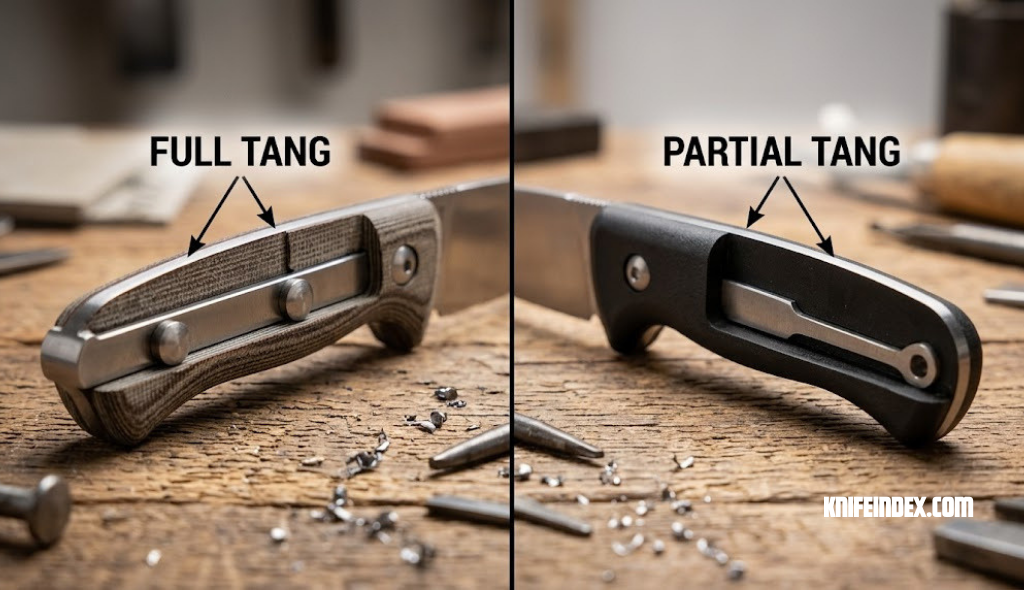
Walk into any knife forum, comment section, or gear store, and you’ll eventually hit the same argument: full tang versus partial tang. It sounds like a technical footnote, but it’s actually one of the most important construction decisions a knife maker makes, and it quietly determines how a blade performs for the next twenty years. A full tang knife and a partial tang knife can look nearly identical from the outside — same steel, same handle scales, same price bracket even — yet behave completely differently the moment you put real force behind them.
This guide breaks down exactly what a tang is, how full and partial tang construction differ at the manufacturing level, and — more importantly — which one actually makes sense for your use case, whether that’s breaking down a chicken in the kitchen, field dressing a deer, building a bushcraft camp, or just carrying something reliable in your pocket every day. We’ll also clear up a few persistent myths, because “full tang is always better” is repeated so often that people forget it isn’t strictly true.
Understanding knife tang construction isn’t just academic knowledge reserved for metallurgists and custom bladesmiths. It directly impacts how a knife feels in your hand during extended cutting sessions, how much abuse the tool can absorb before catastrophic failure occurs, and whether that expensive blade you’re eyeing is actually worth its price tag or simply riding on marketing hype. The tang is, in many respects, the hidden skeleton of any fixed blade knife — invisible during casual inspection, yet absolutely fundamental to the knife’s entire personality and performance envelope. Throughout this comprehensive guide, we’ll explore not just the binary full-versus-partial distinction, but the entire spectrum of tang designs that knife manufacturers employ, the manufacturing processes that create them, the historical traditions that shaped their development, and the real-world testing data that reveals which construction methods actually deliver on their promises when subjected to demanding field conditions.
What Is a Knife Tang, Really?
The tang is simply the portion of the blade’s steel that extends into the handle. Picture the knife blade as one continuous piece of metal — the sharpened edge is the part you see and use for cutting, and the tang is the part hidden underneath the grip material, doing the structural work of holding the whole tool together.
Every fixed blade knife has a tang of some kind. The difference between “full” and “partial” simply describes how much of that steel actually runs through the handle, how it’s shaped, and how it’s attached to the grip material. This single decision affects strength, balance, weight distribution, and even how the knife is manufactured in the first place.
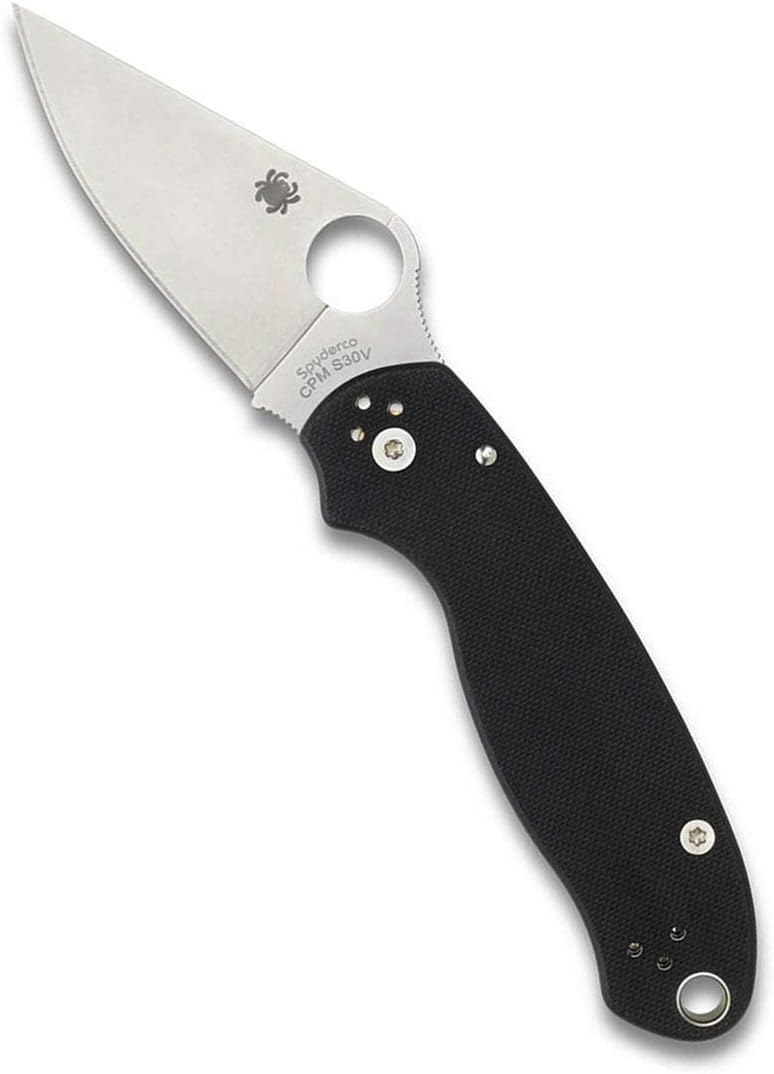
Understanding tang construction matters just as much for folding knives, where the internal frame plays a similar structural role even though there’s no exposed tang to look at. If you’re curious how that translates to folders, our breakdown of the Spyderco Paramilitary 2’s internal build is a good companion read once you’ve got the fixed-blade fundamentals down.
To truly appreciate what a tang does, it helps to visualize the forces traveling through a knife during use. When you grip the handle and apply pressure to cut through a tough material — say, a thick winter squash or a seasoned hardwood branch — the resistance at the blade edge creates a lever effect. The point where blade meets handle becomes a fulcrum, and every pound of cutting force you apply translates into bending stress concentrated right at that junction. A well-designed tang distributes this stress across the entire handle structure rather than focusing it at a single vulnerable point. This is why tang design isn’t just about how much steel exists inside the handle, but about how that steel is shaped, how smoothly it transitions from the blade profile, and how effectively it transfers load into the grip material without creating stress risers — sharp internal corners or abrupt cross-section changes where cracks can initiate over time. Even among knives that technically qualify as “full tang,” there exists a wide spectrum of execution quality that separates designs capable of surviving decades of hard use from those that will eventually develop handle looseness or outright separation under demanding conditions.
The metallurgical history of knife tangs stretches back thousands of years, with archaeological evidence showing that ancient swordsmiths in cultures from Japan to Scandinavia to the Middle East independently developed tang construction techniques optimized for their specific combat and utility needs. Viking swords, for example, often featured a tapered tang that was peened over the pommel — a technique that created a remarkably secure mechanical lock while allowing the blade to flex slightly under impact without fracturing. Japanese katana makers developed an entirely different approach, using a narrow tang secured with bamboo pegs through the handle, which allowed the blade to be easily removed for maintenance while still providing sufficient structural integrity for the sword’s intended cutting dynamics. These historical precedents directly inform modern knife tang design, and many of today’s most respected knife makers explicitly reference centuries-old construction techniques when explaining their engineering choices.
What Is a Full Tang Knife?
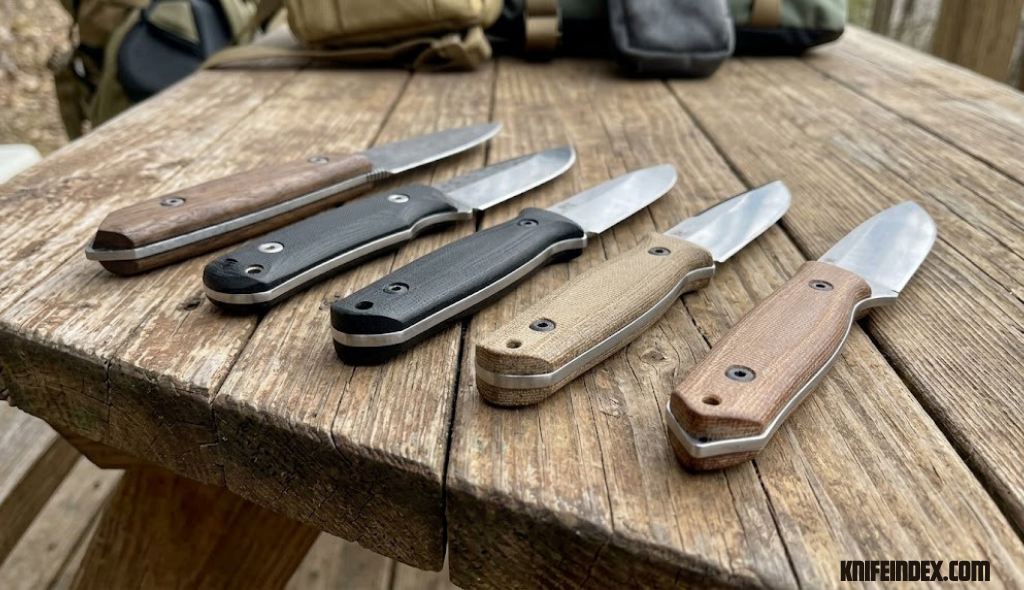
A full tang knife is built from a single piece of steel that runs the entire length of the handle, typically matching the outline of the grip almost exactly. On most full tang knives, you can actually see a thin strip of steel running along the top, bottom, and sometimes the butt of the handle, sandwiched between two handle scales that are riveted, bolted, or pinned in place.
Because the steel itself forms the structural core of the handle, a full tang knife essentially has no weak point between blade and grip. There’s no glue joint, no narrow pin, and no tapering steel rod holding things together — it’s one continuous piece from tip to butt. This is the construction style you’ll find on the vast majority of premium bushcraft, survival, and hard-use kitchen knives, including popular fixed blades like the Morakniv Companion and the Ontario RAT-1-adjacent product lines.
The manufacturing process for a full tang knife is considerably more involved than what goes into partial tang construction. It begins with a blank of knife steel — typically a flat bar of the chosen alloy — which is cut, ground, or stamped to create the combined blade and tang profile in a single flat piece. The blade portion receives the primary bevel grinding, heat treatment, and edge finishing, while the tang portion is drilled with holes for the handle fasteners. These holes serve multiple purposes beyond simply holding the scales in place: they reduce weight in the tang area, provide mechanical anchoring points for epoxy to grip, and in some designs, create balanced weight distribution that prevents the knife from feeling excessively handle-heavy. After heat treatment, the tang is often given a slightly different surface finish than the blade — sometimes left rougher to improve epoxy adhesion, or treated with a corrosion-resistant coating since it will be sealed away from routine maintenance access once the handle scales are attached. The scales themselves, whether made from G-10, Micarta, carbon fiber, stabilized wood, or synthetic materials, are then mechanically fastened and often additionally bonded with high-strength epoxy to create a handle assembly that is, for all practical purposes, a single unified structure. This multi-step process, combined with the additional steel material required to extend the tang through the full handle profile, contributes directly to the higher manufacturing cost typically associated with quality full tang knives.
Within the full tang category, several sub-variations exist that knife buyers should recognize. The skeletonized full tang features cutouts or holes drilled through the tang to reduce weight while maintaining the continuous steel structure — a technique commonly seen on bushcraft knives where overall weight matters for extended carry. The tapered full tang gradually reduces in thickness from the blade junction toward the butt, providing an elegant weight distribution solution that maintains strength while improving balance. The extended tang or exposed pommel tang intentionally protrudes slightly beyond the handle scales at the butt end, creating a striking surface for glass breaking, hammering tent stakes, or emergency signaling. Each of these variations represents a deliberate engineering tradeoff rather than a compromise on quality, and understanding which variant suits your needs requires thinking carefully about how you’ll actually use the knife in practice rather than simply defaulting to the assumption that more steel always equals better performance.

What Is a Partial Tang Knife?
A partial tang knife uses a shorter, narrower, or tapered piece of steel that extends only partway into the handle rather than running its full length. There are several common sub-styles within this category — push tangs, rat-tail (or stick) tangs, and half tangs — and each one changes how much steel is actually embedded in the grip.
Partial tang construction isn’t automatically a sign of a cheap knife. It’s a deliberate manufacturing choice that reduces weight toward the handle end, shifts balance forward toward the blade, and often lowers material and labor costs. Many traditional and Japanese-style kitchen knives, along with a large share of budget-friendly hunting and utility knives, use partial tang designs successfully. The Kiwi kitchen knife line and several entries in our Dexter-Russell review are well-known partial tang performers that professional cooks rely on daily.
The world of partial tang knives is far more nuanced and sophisticated than most casual knife buyers realize. To dismiss all partial tang construction as inferior would be to dismiss centuries of cutlery tradition, including some of the most revered knife-making cultures in human history. Japanese kitchen knives, particularly the traditional styles produced in Sakai, Seki, and Echizen, overwhelmingly use partial tang construction — and these are knives that routinely command prices in the hundreds or even thousands of dollars. The reasoning is not about cutting costs but about achieving specific performance characteristics that full tang construction actively works against. A traditional Japanese gyuto or santoku with a partial tang achieves a blade-forward balance point that makes the knife feel almost weightless in the hand during extended prep sessions. The lighter handle reduces overall fatigue, allows for more precise tip control during delicate knife work, and creates a feedback loop between blade and user that many professional chefs describe as more communicative and responsive than what they experience with heavier full tang Western-style knives.
The engineering reality of partial tang knives centers on understanding exactly where the structural vulnerabilities lie and designing around them intelligently. When a partial tang fails, it almost always fails at one of three specific locations: the transition point where the blade width narrows down to the tang stub, the mechanical or chemical connection between the tang and the handle material, or within the handle material itself if the tang creates internal stress concentrations that crack the surrounding grip. Quality manufacturers address each of these potential failure modes through careful design. The tang transition is radiused rather than sharp-cornered to prevent stress concentration. The tang stub is given mechanical features — notches, holes, or textured surfaces — that provide positive mechanical locking even if the bonding adhesive eventually degrades. And the handle material is selected and shaped to distribute forces evenly rather than channeling them into a single fracture-prone zone. When these engineering principles are properly executed, a partial tang knife can comfortably serve its intended function for decades without developing the looseness or outright separation that partial tang detractors predict.
The historical development of partial tang construction parallels the broader history of cutlery manufacturing, particularly the transition from hand-forged blades produced by individual craftsmen to industrialized production methods that emerged during the 19th and early 20th centuries. Before modern adhesives existed, partial tang knives relied entirely on mechanical fastening — pins through the handle material, peened tang ends, or wedged construction — to keep the blade secured. The development of reliable epoxy adhesives in the mid-20th century dramatically expanded what partial tang designs could achieve, allowing for shorter tang stubs and lighter overall construction while maintaining acceptable durability for the knife’s intended use case. This technological evolution explains why so many mid-century kitchen knives feature partial tang construction: the combination of improved adhesives and mass-production stamping techniques made it possible to produce perfectly functional knives at price points that put quality cutlery into far more households than ever before.
Other Tang Styles You’ll See
“Full” and “partial” aren’t the only two categories — they’re really the two ends of a spectrum. Here’s how the most common variations break down:
| Tang Type | Description | Typical Use |
|---|---|---|
| Full Tang | Steel runs the entire length and outline of the handle | Bushcraft, survival, hard-use kitchen and hunting knives |
| Extended Tang | Full tang that protrudes slightly from the butt for hammering or striking | Survival and batoning knives |
| Half Tang | Steel extends roughly halfway into the handle, often widening tapered | Traditional fixed blades, some hunting knives |
| Push Tang | Short, narrow steel stub pushed and glued/pinned into a handle cavity | Budget kitchen knives, decorative or lightweight knives |
| Rat-Tail (Stick) Tang | Thin, tapering rod of steel threaded through the handle and often peened at the end | Traditional Scandinavian and Japanese knives |
| Encapsulated/Hidden Tang | A shortened tang fully enclosed within a molded or bonded handle | Modern budget and outdoor knives |
Knowing which sub-type you’re dealing with matters more than the blanket “full vs partial” label suggests, because a well-executed rat-tail tang on a quality Scandinavian knife can outperform a poorly bonded push tang labeled as “full tang” by a budget brand.
Beyond these commonly recognized categories, several specialty tang designs deserve attention from serious knife enthusiasts. The through tang, sometimes called a complete tang, extends not just the full length of the handle but all the way through and out the back, where it’s secured with a threaded pommel nut or cap. This design, common on certain military and tactical knives like the classic KA-BAR fighting knife, combines the structural benefits of full tang construction with the ability to completely disassemble the handle for cleaning or component replacement — a significant advantage in field conditions where blood, moisture, and debris can accumulate inside handle assemblies over time. The frame tang, used primarily in folding knife construction but conceptually relevant to fixed blade design, uses a partial steel frame embedded within a larger handle structure, distributing stress across multiple contact points rather than relying on a single tang-to-handle junction. The integral tang, found almost exclusively on high-end custom and semi-custom knives, is machined from a single billet of steel that includes both the blade and the handle framework as one monolithic piece, with handle scales attached purely for comfort rather than structural necessity — this represents the absolute pinnacle of tang strength but comes with a corresponding price premium that puts it beyond the reach of most knife buyers.
The Scandinavian knife-making tradition deserves particular attention in any discussion of tang types, as it has produced some of the most elegant and time-tested partial tang designs in existence. Traditional Swedish, Norwegian, and Finnish knives — the mora, puukko, and sami knives that have served Scandinavian outdoorspeople for centuries — overwhelmingly use a rat-tail or stick tang construction that would strike many modern knife buyers as suspiciously thin and fragile. Yet these knives have proven themselves across generations of hard use in some of the most demanding environments on earth, from Arctic reindeer herding camps to boreal forest homesteads. The secret lies in the holistic approach to knife design that characterizes Scandinavian cutlery: the tang is relatively thin, yes, but it’s made from high-quality carbon or laminated steel, properly heat-treated for toughness rather than maximum hardness, and fitted into a birch or antler handle that absorbs shock and distributes force in ways that synthetic materials often fail to replicate. The result is a knife that may not survive being clamped in a vise and twisted to destruction — the sort of abstract strength test that knife forum debates love to cite — but which excels at every task its designers and users actually intended it to perform.
Strength & Durability Compared
This is where the debate actually matters. In raw lateral and torsional strength — meaning resistance to snapping, twisting, or prying — a properly built full tang knife wins decisively. Because the steel is continuous and unbroken through the handle, there’s no glue joint or narrow rod acting as a stress concentration point. Full tang knives can typically withstand batoning through wood, prying, and heavy chopping without the blade separating from the handle.
Partial tang knives are not inherently fragile, but they do have a defined failure point: the transition where the steel narrows or where it meets the handle material. Under enough lateral stress — twisting the blade sideways while it’s stuck in something, for example — this is where a partial tang is most likely to loosen or, in worst cases, snap. That said, for tasks the knife was actually designed for (slicing, dicing, controlled cutting), a quality partial tang knife from a reputable maker rarely fails within its intended use case.
For a deeper look at how steel choice interacts with structural durability, our comparison of MagnaCut vs M390 covers how edge steel and heat treatment affect overall blade toughness — a factor that compounds with tang design rather than replacing it.
Full Tang Strength Advantages
- No glue joint or narrow stress point to fail
- Handles prying, batoning, and chopping reliably
- Better survives drops and impacts
Partial Tang Strength Limitations
- Defined weak point at the taper or stub
- Not built for prying or batoning
- Quality of bonding/pinning varies widely by brand
The quantitative testing data available on knife tang strength tells a more nuanced story than the simple binary most discussions assume. Independent knife testers and YouTube reviewers have conducted destructive testing on hundreds of production knives, and the results consistently show that tang design alone doesn’t determine failure load — the interaction between tang geometry, steel type, heat treatment, and handle attachment method creates outcomes that sometimes surprise even experienced knife makers. A well-designed partial tang knife made from tough, properly heat-treated steel and secured with mechanical fasteners plus modern epoxy can withstand forces that exceed what most users will ever apply in normal use, while a poorly executed full tang knife made from brittle, overheated steel can snap catastrophically at the blade-tang junction under loads that a quality partial tang design would shrug off. The lesson here isn’t that tang type doesn’t matter — it absolutely does — but rather that tang type should be evaluated as one component within a larger quality system rather than treated as a standalone guarantee of performance. When you’re evaluating a knife for strength-critical applications like bushcraft or survival, you need to look at the complete package: the manufacturer’s reputation for heat treatment, the specific steel alloy being used, the tang geometry and any stress risers it contains, the handle attachment method, and the intended use case as stated by the maker. Only then can you make a genuinely informed judgment about whether a given knife will hold up under the conditions you plan to subject it to.
One of the most misunderstood aspects of knife strength testing is the concept of failure mode — not just how much force a knife can take before breaking, but what happens when it does break. Full tang knives, when they fail, typically snap at the blade-tang junction or somewhere along the blade itself, often producing a sharp broken edge that can still function as a crude cutting tool in an emergency. Partial tang knives, when they fail, are more likely to separate completely at the tang-handle interface, leaving the user holding a handle with no blade attached — a far more problematic failure in a survival situation. This distinction matters enormously for anyone selecting a knife for emergency preparedness, backcountry travel, or military/ tactical applications, where the consequences of knife failure extend far beyond mere inconvenience. It matters considerably less for kitchen use, where a broken knife means reaching for another one from the block rather than facing a genuine safety emergency.
Balance, Weight, and Feel
Strength isn’t the only factor that matters, and this is where partial tang knives quietly win a category most people don’t think about: control and fatigue reduction. Because a full tang knife carries steel through the entire handle, it’s inherently heavier and often blade-heavy or evenly balanced depending on design. That extra weight adds durability, but it also adds fatigue over long cutting sessions.
A partial tang knife, especially a push tang or rat-tail design, shifts weight forward toward the blade and lightens the rear of the handle considerably. For repetitive, precise tasks — think a chef breaking down vegetables for hours, or a hunter making delicate cuts around joints — that lighter, more forward-balanced feel can actually improve control and reduce wrist fatigue. This is a big reason many professional-grade Japanese kitchen knives intentionally use partial tang construction rather than full tang, even at high price points.
If you’re specifically shopping for kitchen performance where balance is king, it’s worth reading our breakdown of yanagiba vs sujihiki blade balance, which illustrates how tang length directly changes handling on precision slicing knives.
The ergonomic implications of tang design extend far beyond simple weight and balance measurements. The way a knife transmits vibration and feedback from the cutting edge to the user’s hand — what knife enthusiasts sometimes call “feel” or “communication” — is profoundly influenced by tang construction. Full tang knives, with their continuous steel core, tend to transmit cutting feedback directly and immediately, which some users find confidence-inspiring and others find fatiguing over long sessions. Partial tang knives, particularly those with wood or synthetic handles that fully encapsulate the tang stub, dampen vibration and create a smoother, more muted feedback profile that many professional users prefer for extended repetitive cutting tasks. This isn’t a question of which approach is objectively better but rather which subjective experience matches your personal preferences and the specific cutting tasks you perform most frequently. A sushi chef making thousands of precise, delicate cuts per shift will likely gravitate toward the damped feedback of a traditional partial tang design, while a bushcrafter carving feather sticks and processing firewood may prefer the direct mechanical communication of a full tang knife that telegraphs exactly what’s happening at the cutting edge.
Full Tang vs Partial Tang: Side-by-Side Comparison
| Factor | Full Tang | Partial Tang |
|---|---|---|
| Structural Strength | Excellent — no weak joint | Good, but has a defined stress point |
| Weight | Heavier overall | Lighter, especially toward the handle |
| Balance | Often neutral or slightly handle-heavy | Often blade-forward, precise |
| Best For | Bushcraft, survival, hunting, heavy kitchen tasks | Precision slicing, everyday kitchen prep, lightweight EDC |
| Prying/Batoning Capable | Yes, when properly heat treated | Not recommended |
| Manufacturing Cost | Generally higher (more steel, more machining) | Generally lower (less steel used) |
| Common Price Range | Mid to premium | Budget to premium (varies widely) |
| Handle Repair/Replacement | Difficult — handle is structural | Often easier on some rat-tail designs |
Pros and Cons Breakdown
Full Tang Knives
Pros
- Maximum structural strength and reliability
- Handles abuse: prying, batoning, chopping
- No risk of the blade separating from the handle
- Feels solid and confidence-inspiring in hand
Cons
- Heavier, which can fatigue the wrist over long sessions
- Generally more expensive to manufacture
- Can feel bulky for fine, precise slicing tasks
Partial Tang Knives
Pros
- Lighter weight, better for extended precision work
- Often more forward-balanced for controlled cuts
- Usually less expensive to produce
- Common on high-end traditional kitchen knives
Cons
- Weaker under lateral stress or twisting force
- Not suited to prying, batoning, or heavy-duty outdoor tasks
- Quality varies significantly depending on manufacturer

Which Wins in the Kitchen?
In the kitchen, the answer genuinely depends on what you’re cutting. For heavy-duty tasks like breaking down whole chickens, splitting squash, or cutting through joints, a full tang chef’s knife or cleaver gives you the structural confidence to apply real force without worrying about the blade loosening. For general prep — dicing onions, slicing proteins, mincing herbs — a well-made partial tang knife, particularly traditional Japanese-style knives, often feels lighter and faster in hand over a long cooking session.
Professional kitchens frequently run a mix of both. A full tang cleaver or Western-style chef’s knife handles the rough work, while a partial tang santoku or nakiri handles the finesse work. If you’re building out a home kitchen knife set, our guide on the five essential knife skills every home cook must master is a useful next step once you’ve settled on construction preferences.
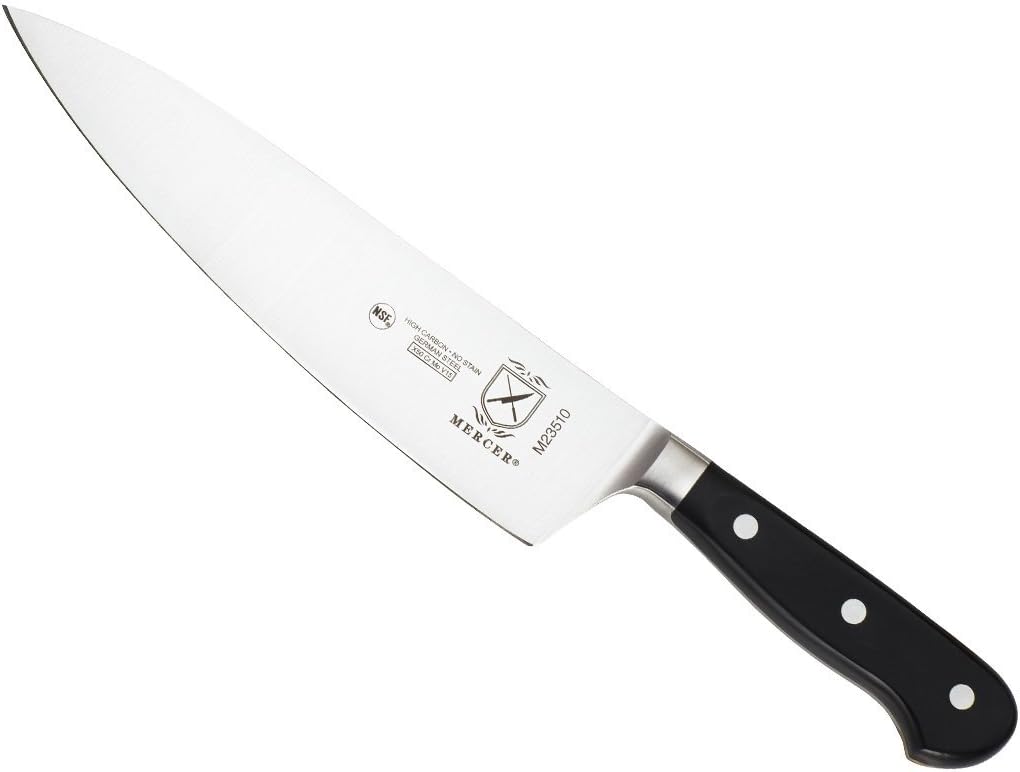
The kitchen knife landscape reveals perhaps the clearest illustration of how tang design philosophy varies across culinary traditions. Western kitchen knives — German, French, and American patterns — have largely converged on full tang construction as the default standard, driven by consumer expectations of heft and durability and by the practical demands of Western cooking techniques that frequently involve forceful cutting through dense ingredients and occasional bone contact. The classic Wüsthof and Zwilling J.A. Henckels chef knives that dominate Western kitchen knife sales feature full tangs with triple-riveted handles, and their marketing materials prominently highlight this construction feature as evidence of quality and longevity. Japanese kitchen knives, by contrast, emerged from a culinary tradition that emphasizes precision, control, and minimal force application — sushi chefs don’t hack through bones, they glide through flesh with pulling cuts that require finesse rather than power. The partial tang construction common in Japanese knives reflects this fundamentally different approach to cutting, and it’s telling that as Japanese knife designs have been adapted for Western markets, many manufacturers have introduced “Western-handled” versions that pair traditional Japanese blade geometry with full tang Western-style handles — a hybrid approach that attempts to capture the best of both traditions for users who want Japanese cutting performance with Western structural expectations.
For home cooks trying to navigate this landscape, the most practical approach is to think about your actual cooking habits rather than abstract notions of knife quality. If your cooking regularly involves breaking down whole poultry, cutting through winter squash, or processing large quantities of dense root vegetables, a full tang chef’s knife will serve you well and hold up to the lateral forces these tasks generate. If your cooking centers on vegetable prep, fish butchery, and precise protein slicing — and if you’re willing to develop proper knife skills that minimize lateral blade stress — a quality partial tang Japanese-style knife may offer superior cutting performance and reduced fatigue during extended prep sessions. Many experienced home cooks eventually build a collection that includes both types, reaching for the full tang workhorse when force matters and the nimble partial tang blade when precision and speed take priority.
Which Wins Outdoors & Hunting?
For hunting, bushcraft, and survival applications, full tang construction is the clear standard for a reason. Field dressing game, batoning firewood, and general camp tasks all put lateral stress on a blade that a partial tang simply isn’t designed to absorb repeatedly. This is why nearly every serious bushcraft and survival knife recommendation — including entries in our guide to the 10 best knives for field dressing — leans heavily toward full tang builds.
That doesn’t mean partial tang knives have no place outdoors. Traditional Scandinavian puukko-style knives use a rat-tail tang and have been used for generations in demanding wilderness environments — the design has simply earned trust through proven heat treatment and quality steel rather than brute structural mass. Still, for anyone prioritizing worst-case durability over a bonfire or in a survival scenario, full tang remains the safer bet, and it’s the primary reason knives like the Ontario RAT-2 and similar hard-use blades default to that construction.
The specific demands of hunting and field dressing create a particularly compelling case for full tang construction that goes beyond the general durability argument. Field dressing large game involves working in confined spaces inside the animal’s body cavity, often by feel rather than sight, with the blade encountering bone, cartilage, and dense connective tissue at unpredictable angles. The twisting and prying forces generated during these operations — separating joints, cutting through the sternum or pelvic bone, maneuvering the blade around internal organs — subject the knife to exactly the kind of multidirectional stress that partial tang designs handle least effectively. A blade that separates from its handle during field dressing is not merely inconvenient; it creates a genuine safety hazard in a remote location, potentially miles from medical assistance, with hands slippery from blood and fat making the situation even more dangerous. This risk profile, combined with the potentially life-saving role a knife plays in survival scenarios, explains why experienced hunters and outdoorspeople consistently choose full tang knives despite their weight penalty and higher cost. The extra ounces and dollars represent an insurance policy against a failure mode that, while statistically unlikely with any quality knife, carries disproportionately severe consequences when it does occur.
Batoning — the practice of using a knife to split wood by striking the spine with another piece of wood — deserves specific mention because it represents perhaps the most demanding test of tang integrity that a knife can face in outdoor use. When you baton a knife through a log, you’re essentially using the blade as a wedge and applying repeated impact forces that travel through the entire length of the tool from spine to cutting edge and from tip to handle butt. Every strike sends a shock wave through the tang-handle interface, and over dozens or hundreds of strikes, any weakness in that junction will progressively worsen until failure occurs. Full tang knives distribute these forces across a much larger contact area between steel and handle, while partial tang knives concentrate them at the relatively small surface where the tang stub meets the handle material. This is why even knife makers who enthusiastically defend partial tang construction for general outdoor use will typically advise against using their partial tang knives for serious batoning work — it’s simply not what the design was engineered to withstand.
Which Wins for EDC & Pocket Knives?
Everyday carry is a slightly different conversation, since most pocket knives are folders rather than fixed blades, and folding knives don’t have a traditional exposed tang at all — their strength instead comes from the liner, frame lock, or backspacer construction. Still, the underlying philosophy carries over: knives built for harder use, like the Benchmade Bugout or the CIVIVI Elementum, use robust internal frames analogous to full tang construction, while lighter gentleman’s folders prioritize slimness and weight savings the way a partial tang kitchen knife does.
If you carry a fixed blade neck knife or small EDC fixed blade, full tang is almost always the smarter choice given the smaller handle size leaves little margin for error in a partial tang design. Our survival neck knife buyer’s guide covers several excellent full tang options built specifically for that compact category.
The EDC fixed blade market has exploded in recent years, driven by advances in small-scale manufacturing that make it economically viable to produce compact fixed blades with full tang construction at accessible price points. Knives like the ESEE Izula, Bradford Guardian 3, and CRKT Minimalist series have demonstrated that full tang construction doesn’t have to mean heavy or bulky — clever skeletonization, judicious material selection, and ergonomic handle design can produce a fixed blade EDC knife that weighs less than many folding knives while offering superior structural integrity. For anyone considering the increasingly popular transition from folder to small fixed blade for everyday carry, tang construction should be a primary evaluation criterion, precisely because the smaller dimensions of these knives mean there’s less handle material to anchor a partial tang stub. A neck knife or boot knife with a push tang may look identical to its full tang counterpart on the outside, but the internal difference in structural reliability is proportionally larger on these small knives than it would be on a full-sized bushcraft blade.
Price & Manufacturing Differences
Full tang knives generally cost more to produce because they require more raw steel and additional machining to shape, grind, and drill the extended tang for handle attachment. Partial tang knives use less material and can be manufactured faster, which is part of why so many budget kitchen and utility knives default to that construction style.
However, price and tang type don’t always correlate the way people assume. Plenty of affordable full tang knives exist at reasonable price points, and plenty of expensive, premium partial tang knives exist in the traditional Japanese cutlery world where craftsmanship and steel quality — not tang length — drive the price tag. When evaluating price, it helps to also weigh steel type; our comparison of D2 vs 8Cr13MoV shows how much steel selection alone can shift a knife’s cost and performance independent of tang construction.
The economics of knife manufacturing reveal some counterintuitive truths about tang construction and pricing. While it’s true that full tang knives require more raw material, the cost of knife steel — even premium powder metallurgy steels — typically represents a relatively small fraction of a production knife’s total manufacturing cost. The larger cost drivers are labor, tooling, quality control, and finishing, and these factors don’t always scale linearly with tang length. A highly finished partial tang kitchen knife with a hand-polished blade, premium handle material, and meticulous fit and finish from a respected Japanese workshop may cost far more to produce than a utilitarian full tang bushcraft knife with a basic stonewash finish and molded plastic handle scales, even though the latter uses more steel. This is why evaluating a knife’s value based solely on tang type is misleading — you need to consider the total manufacturing quality, the brand’s reputation, the steel type and heat treatment, and the intended use case to determine whether a given price is justified.
The globalized nature of modern knife manufacturing has also blurred traditional distinctions between tang types and price points. Chinese manufacturers, in particular, have become extremely proficient at producing full tang knives at budget price points that would have been impossible a decade ago, thanks to advanced CNC machining, efficient supply chains, and economies of scale that individual Western makers cannot match. A $30 full tang fixed blade from a reputable Chinese OEM may offer better structural integrity than a $60 partial tang knife from a traditional manufacturer — or it may cut corners on heat treatment, steel quality, or handle attachment in ways that negate the apparent advantage of its full tang design. As with so many aspects of knife evaluation, there’s no substitute for researching specific models rather than relying on broad generalizations about construction types and their associated costs.
Common Myths, Debunked
Myth 1: “Full tang always means better quality”
Not true. Tang construction is one factor among many. A poorly heat-treated full tang knife with soft steel can still underperform a well-made partial tang knife with premium steel and a properly executed bond or peen.
Myth 2: “Partial tang knives always break”
Also false. Within their intended use — cutting, slicing, controlled kitchen or utility work — quality partial tang knives are perfectly durable. They fail under stress they were never designed to handle, not under normal use.
Myth 3: “You can always tell by looking at the handle”
Sometimes a full-length visible spine along the handle is actually a decorative liner rather than true structural tang steel, particularly on some budget “tactical-style” knives. This is a known marketing shortcut, so it’s worth verifying with the manufacturer’s specs rather than assuming from visuals alone.
Myth 4: “Tang length is the only thing that determines strength”
Steel type, heat treatment, blade geometry, and handle material all factor into overall durability. A thin, poorly tempered full tang can still snap under enough stress. Tang length is one variable, not the whole equation.
Myth 5: “Expensive knives always use full tang construction”
This myth persists despite abundant evidence to the contrary, and it’s worth examining why. The association between full tangs and premium pricing comes largely from the Western fixed blade market, where brands like Chris Reeve, Bark River, and Fallkniven have established full tang construction as a hallmark of quality that consumers have learned to associate with higher price tags. But step into a traditional Japanese knife shop in Tokyo’s Kappabashi district, and you’ll find partial tang knives commanding prices that rival or exceed those of any Western full tang equivalent — and being purchased by professional chefs who stake their livelihoods on their knives’ performance and reliability. The lesson here is that tang construction is a design choice driven by performance goals and manufacturing tradition, not a simple proxy for overall quality or value.
Myth 6: “You should never buy a partial tang knife for any reason”
This absolutist position ignores the reality that millions of people use partial tang knives every day — in professional kitchens, in home cooking, in woodworking shops, in craft studios — without experiencing failures. A partial tang paring knife, for instance, will almost certainly never encounter the kind of forces that would challenge its structural integrity during normal use. Recommending against all partial tang knives is like recommending against all sedans because they can’t off-road — it confuses specialized limitations with universal flaws.
Maintenance & Longevity
Full tang knives tend to be lower maintenance over the long run since there’s no glue joint to fail and no loose pin to re-tighten. Handle scales can loosen over years of use, but the core structure remains sound. Partial tang knives, particularly older or lower-quality push tang designs, are more prone to handle wobble over time as the bonding agent degrades or the tang stub shifts slightly within its cavity.
Regardless of tang type, proper storage and rust prevention extend the life of any blade significantly. If you’re storing knives long term or displaying a collection, our guides on how to prevent rust on knives and building a proper knife block are worth reviewing alongside this guide.
The long-term maintenance implications of tang choice extend beyond the simple question of whether the handle might eventually loosen. Full tang knives, with their exposed steel edges along the handle profile, can develop rust along those exposed tang surfaces if they’re not properly cleaned and dried after use — particularly in humid environments or when the knife has been used with acidic foods. This isn’t typically a structural concern, as surface rust on the tang edges rarely penetrates deeply enough to compromise integrity, but it can be unsightly and, in extreme cases, may cause the handle scales to lift slightly as corrosion builds up between steel and scale. Partial tang knives avoid this particular issue since their tang stubs are fully encapsulated within the handle material, but they introduce a different maintenance concern: the impossibility of inspecting the tang-to-handle bond without destructive disassembly. With a full tang knife, you can visually check the condition of the entire steel structure. With a partial tang, you’re trusting that everything inside the handle remains sound — a leap of faith that’s usually justified with quality manufacturers but represents an inherent limitation of the design.
How to Check a Knife’s Tang Before You Buy
- Look at the handle profile. If you can see a visible metal line running along the top, bottom, or butt of the handle beneath the scales, that’s a strong indicator of full tang construction.
- Check the manufacturer’s spec sheet. Reputable brands explicitly state tang type in product descriptions; vague listings that avoid the term are worth questioning.
- Weigh the knife in hand. Full tang knives typically feel noticeably heavier and more substantial toward the handle than comparable partial tang models.
- Ask about the pommel/butt. If the knife is marketed for batoning or striking with a solid steel pommel, it’s almost certainly full tang, since a partial tang couldn’t safely support that use.
- Read verified reviews. Independent reviewers and forums often disassemble or X-ray budget knives to verify manufacturer claims, which is useful since misleading “full tang” marketing does happen on lower-end products.
One additional verification method that experienced knife buyers employ is the temperature test, though it requires having physical access to the knife. Because steel conducts heat far more efficiently than wood, plastic, or composite handle materials, a full tang knife left in a cold environment will feel noticeably cold along the entire handle profile, not just at the visible blade. Run your fingers along the spine of the handle — if the temperature feels uniform with the exposed blade steel, you’re likely feeling a full tang. If the handle spine feels noticeably warmer than the blade, you’re probably holding a partial tang where the steel stops short and handle material fills the rest of the profile. This method isn’t foolproof — some handle materials have thermal properties that can mimic steel’s temperature response — but it provides a useful additional data point when combined with visual inspection and manufacturer research.
Buying Guide: Which Should You Pick?
| Your Primary Use | Recommended Tang Type |
|---|---|
| Bushcraft / camping / batoning | Full tang |
| Hunting & field dressing | Full tang |
| Everyday kitchen prep | Either — quality partial tang is fine |
| Precision slicing (sushi, fish, produce) | Partial tang (traditional Japanese style) |
| Heavy-duty kitchen chopping | Full tang |
| Compact EDC / neck knife | Full tang |
| Budget-friendly starter knife | Either — check reviews and steel quality first |
If you’re still weighing steel type alongside tang construction, it’s worth cross-referencing our guides on 14C28N vs Nitro-V and S35VN vs S45VN, since edge performance and tang durability together determine how a knife actually holds up over years of use.
For those building their first serious knife collection, the most common mistake is over-prioritizing tang type while under-prioritizing the factors that actually determine day-to-day satisfaction with a knife: ergonomics, blade geometry, steel type, and edge retention. A perfectly balanced full tang bushcraft knife that doesn’t fit your hand will gather dust while a “lesser” partial tang design that feels like a natural extension of your arm becomes the tool you reach for instinctively. When evaluating any knife purchase, start by clarifying exactly what you’ll use it for, then work backward to the construction features that support that use case — rather than starting with tang type as a non-negotiable requirement and trying to find a knife that fits that constraint while hopefully also meeting your actual needs.
Frequently Asked Questions
Is a full tang knife always stronger than a partial tang knife?
In terms of resisting lateral stress, prying, and impact, yes — full tang construction is structurally stronger in nearly every case. However, “stronger” doesn’t automatically mean “better” for every task, especially precision cutting where a lighter partial tang design may perform better.
Can a partial tang knife be used for batoning wood?
It’s not recommended. Batoning applies repeated shock and lateral stress that partial tang knives, particularly push tang or narrow rat-tail designs, aren’t built to withstand safely over time.
Why do so many expensive Japanese kitchen knives use partial tang?
Traditional Japanese knife-making prioritizes blade-forward balance, lighter weight, and precision control over brute structural strength, since these knives are designed for controlled slicing rather than heavy prying or chopping.
How can I tell if a knife is full tang without disassembling it?
Look for a visible steel line running the length of the handle beneath the scales, check the manufacturer’s product description, and compare the weight against similar full tang models — full tang knives are typically noticeably heavier.
Are all “tactical” looking knives full tang?
No. Some budget tactical-style knives use a decorative exposed liner to visually mimic full tang construction without the structural steel actually running the full handle length. Always verify with trusted reviews or manufacturer specs.
Do full tang knives weigh significantly more?
Generally yes, since more steel runs through the handle. The difference is usually modest on smaller knives but becomes more noticeable on larger fixed blades.
Is a rat-tail tang the same as a partial tang?
A rat-tail (or stick) tang is a specific type of partial tang — a thin, tapering rod of steel that runs through the handle rather than a shortened stub. It’s a distinct sub-category worth understanding on its own.
Which is better for hunting and field dressing?
Full tang knives are generally preferred for hunting because field dressing can involve twisting, prying, and unpredictable resistance that a full tang handles far more reliably than a partial tang.
Do partial tang knives break easily during normal kitchen use?
No, not when they’re well made. Within their intended use case of controlled cutting and slicing, quality partial tang kitchen knives are perfectly durable and used professionally around the world.
Does tang type affect how a knife is sharpened?
No, tang construction doesn’t affect sharpening. Sharpening is determined by blade geometry, steel type, and edge angle, not by how much steel extends into the handle.
Are folding pocket knives considered full tang or partial tang?
The terms don’t apply directly to folders in the traditional sense, since folding knives rely on liners, frame locks, or backspacers rather than an exposed tang. The structural principle — a continuous, robust internal frame versus a lighter, more minimal build — is conceptually similar though.
Is full tang construction worth the extra cost?
If your use case involves outdoor survival tasks, hunting, batoning, or heavy prying, yes, the extra durability is worth it. For general kitchen prep or lighter tasks, a quality partial tang knife can offer excellent value without overpaying for strength you won’t use.
Conclusion: There’s No Universal Winner
Full tang and partial tang knives aren’t competing for the same job. Full tang construction earns its reputation through raw structural strength — it’s the obvious choice for bushcraft, hunting, batoning, and any task where the blade might face real lateral stress. Partial tang construction earns its place through weight savings, forward balance, and precision, which is exactly why it remains the standard for many high-end traditional kitchen knives.
The smartest approach isn’t picking a “winner” once and applying it to every knife you own. It’s matching tang construction to the actual job: full tang for hard outdoor and heavy-duty use, and quality partial tang for controlled, precision cutting where weight and balance matter more than brute durability. Once you know what you’re using the knife for, the right construction usually becomes obvious.
Compare Full Tang & Partial Tang Knives on Amazon