German Steel vs Japanese Steel Knives: The Complete Comparison
Everything home cooks and professional chefs need to know before choosing a blade philosophy.
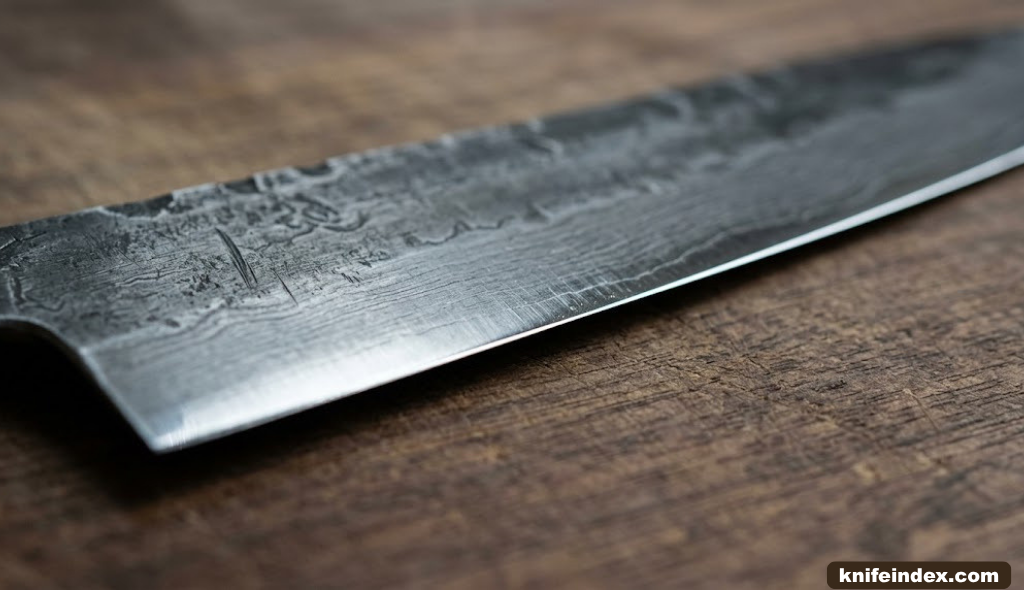
Introduction: Two Philosophies, One Goal
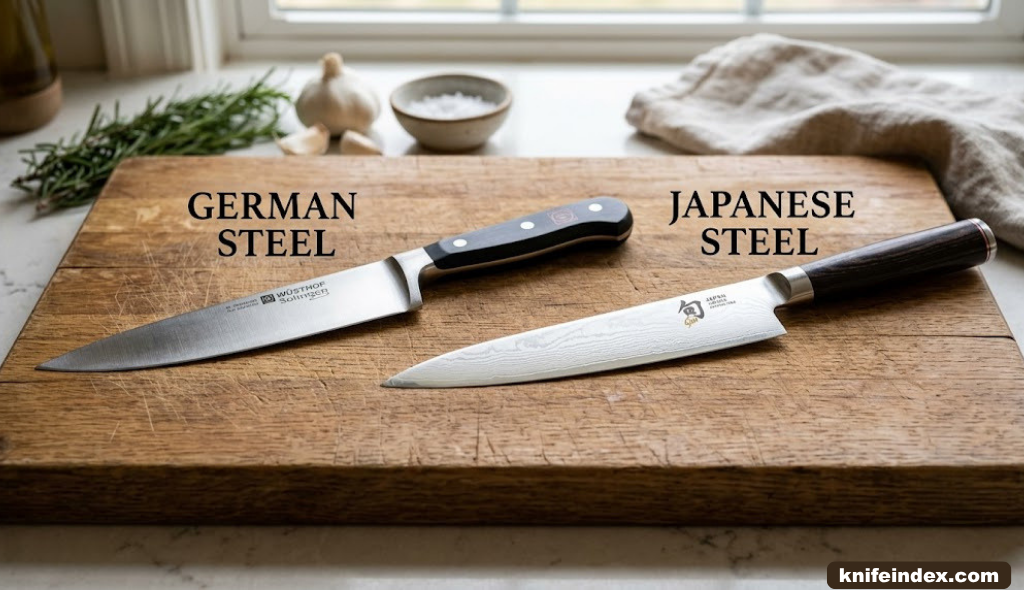
Walk into any serious kitchen supply store and you’ll notice the knife wall splits almost naturally into two camps. On one side sit the thick-spined, full-bolstered workhorses associated with German manufacturers. On the other, thinner, lighter blades with a distinctly different silhouette, tracing their lineage back to Japanese bladesmithing. Both are capable of extraordinary performance. Both have devoted followings. And both represent a genuinely different answer to the same question: what makes a great kitchen knife?
This guide breaks down the real, practical differences between German steel and Japanese steel knives — not the marketing claims, but the metallurgy, the geometry, the maintenance routines, and the day-to-day handling characteristics that actually matter once the knife is in your hand and there’s a pile of onions in front of you. If you’ve been comparing options like the Wüsthof Classic against a Shun Classic, or you’re simply trying to understand why one knife costs three times as much as another that looks nearly identical, this article will give you the full picture.
We’ll also touch on hybrid designs that borrow from both traditions, because the line between “German” and “Japanese” has blurred considerably over the past two decades as manufacturers on both continents have cross-pollinated ideas, steels, and manufacturing techniques.

The Wüsthof Classic is the reference point most reviewers compare everything else against.
Check Price on AmazonA Brief History of Both Traditions
German cutlery traces its industrial roots to Solingen, a city that has been synonymous with blade-making since the medieval period, when access to the Wupper river’s water power and nearby ore deposits allowed forges to flourish. By the 19th and 20th centuries, Solingen had industrialized knife production, standardizing full-tang, triple-riveted designs built for heavy, repetitive use in butcheries, restaurants, and home kitchens across Europe. The forging process these houses refined emphasized thick spines and robust bolsters that could survive decades of daily abuse.
Japanese knife-making has a very different origin story, one closely tied to swordsmithing traditions that date back over a thousand years. When sword demand declined during the Meiji era, many smiths in regions like Sakai redirected their metallurgical expertise toward kitchen cutlery, applying sword-hardening techniques to knife blades. This produced knives with far higher hardness ratings, thinner edges, and a razor-like sharpness that European forging methods of the same era rarely matched.
Understanding this history matters because it explains why the two traditions optimized for different things. German smiths were solving for durability under heavy, imprecise use. Japanese smiths were solving for precision cutting performance, often for delicate ingredients like raw fish. Neither approach is “better” in the abstract — they were built for different jobs, and that legacy still shapes the knives sold today.
The Metallurgy Behind the Steel
The single biggest driver of how a knife performs is the steel itself. German manufacturers overwhelmingly favor softer, more chromium-heavy stainless alloys such as X50CrMoV15 (Wüsthof, Zwilling) or 1.4116 steel. These alloys prioritize corrosion resistance and toughness, sacrificing some of the maximum achievable hardness in exchange for a blade that resists chipping and rusting even with imperfect care.
Japanese manufacturers span a much wider spectrum. Entry and mid-tier Japanese knives often use steels like VG-10 or AUS-8, which you can read more about in our complete guide to knife steel types. Premium Japanese cutlery frequently uses powdered steels such as SG2/R2 or high-carbon steels like Shirogami (White steel) and Aogami (Blue steel), which allow for exceptional hardness and edge retention but require more careful maintenance. If you want a deep technical breakdown of how carbon content changes performance, our article on high-carbon steel vs stainless steel covers the tradeoffs in detail.
It’s worth noting that steel choice isn’t strictly tied to country of origin anymore. Some German brands now produce Japanese-style lines using powdered steel, and some Japanese factories still produce softer, tougher stainless blades aimed at Western kitchens. The steel matters more than the flag on the box, but flag-associated conventions remain a useful shorthand because they still hold true in the vast majority of product lines.
Hardness, HRC, and What It Really Means
Hardness is measured on the Rockwell C scale (HRC), and it’s the number most enthusiasts fixate on. German stainless blades typically sit in the 56–58 HRC range. Japanese blades commonly range from 60 HRC on the softer end up to 63–66 HRC for premium powdered and high-carbon steels. Our detailed explainer on Rockwell hardness in kitchen knives goes further into how this number is tested and why it isn’t the whole story.
Higher HRC generally means the edge holds its sharpness longer between sharpenings, because a harder steel matrix resists the microscopic deformation that dulls an edge during normal cutting. But hardness is a tradeoff, not a straightforward upgrade. As HRC climbs, steel becomes more brittle, meaning the edge is more prone to chipping if it strikes a bone, a frozen block of food, or gets twisted during a cut. This is why German knives, despite lower HRC numbers, are frequently recommended for tasks involving winter squash, poultry with bone-in cuts, or less careful home cooks — the softer steel bends slightly rather than chipping.
| Category | Typical HRC Range | Practical Effect |
|---|---|---|
| German Stainless (X50CrMoV15) | 56–58 HRC | Forgiving, resists chipping, needs more frequent honing |
| Mid-Tier Japanese (VG-10, AUS-8) | 59–61 HRC | Balanced edge retention with moderate care needs |
| Premium Japanese (SG2, R2, Aogami Super) | 62–66 HRC | Exceptional edge retention, requires careful handling |
Edge Geometry and Grind Differences
Beyond the steel itself, the way a blade is ground has an enormous effect on cutting performance. German knives are typically full-bolster, double-beveled, and ground to a wider edge angle, often somewhere around 20–22 degrees per side. This wider angle contributes to the blade’s durability but means the edge is comparatively thick behind the cutting line.
Japanese knives tend to be ground much thinner, often 12–16 degrees per side, and many traditional styles use a single-bevel edge rather than a symmetrical double bevel. Single-bevel knives, common in traditional Yanagiba and Usuba blades, are ground almost entirely on one face, producing an extremely clean, low-friction cut ideal for slicing raw fish or delicate vegetables. Our comparison of Yanagiba vs Sujihiki for slicing raw fish explores this in more depth, and if you’re curious how thinness behind the edge affects everyday cutting resistance, the article on blade geometry explained is essential reading.
The practical result: a thin Japanese edge slices through produce with less resistance and cleaner separation, while a thicker German edge pushes through denser or harder ingredients — like winter squash or bone-in poultry — with less risk of the edge rolling or chipping.
Edge Retention and Sharpening Frequency
Edge retention is where Japanese steel typically wins on paper. Higher hardness combined with a thinner grind means a well-maintained Japanese knife can go significantly longer between full sharpenings — sometimes weeks of daily home use versus days for a comparable German blade under similar conditions. This is a major reason sushi chefs and precision-focused cooks gravitate toward Japanese steel; a Yanagiba that needs re-sharpening mid-service is a serious inconvenience.
That said, edge retention numbers are highly dependent on what you’re actually cutting, your cutting board material, and technique. A German knife used carefully on a soft end-grain board will outlast a Japanese knife abused on glass or stone. The science of why some blades simply hold an edge longer than others, independent of brand, is explained well in our piece on edge retention.

Shun’s VG-MAX core is a common benchmark for high-hardness, high-retention Japanese blades.
Check Price on AmazonDurability, Chipping, and Everyday Toughness
Toughness and hardness sit at opposite ends of a spectrum, and this is the crux of the German vs Japanese debate. German knives, with their lower hardness and thicker edge geometry, absorb lateral stress well. You can twist a German blade slightly in a cut, hit a stray bone, or use it for light prying, and it’s far less likely to chip than a hard Japanese blade doing the same thing.
Japanese knives, particularly single-bevel and high-HRC designs, are considerably less forgiving of lateral stress, bone contact, or being used as a general-purpose tool. Chipping is the most common failure mode reported by new owners transitioning from German to Japanese cutlery, almost always caused by twisting motions or cutting against bone rather than straight-down slicing motion. This isn’t a defect — it’s the tradeoff for the superior sharpness and edge retention the harder steel provides.
German Steel Strengths
- Resists chipping under lateral stress
- Forgiving for less careful users
- Handles bone-in poultry and dense vegetables well
- Simple maintenance routine
German Steel Weaknesses
- Duller edge retention between sharpenings
- Thicker edge creates more resistance in produce
- Heavier overall feel in the hand
Japanese Steel Strengths
- Exceptional sharpness and edge retention
- Thin, precise cuts with minimal drag
- Lighter, more nimble handling
Japanese Steel Weaknesses
- More prone to chipping on bone or twisting motion
- Requires more careful sharpening technique
- Some high-carbon versions need active rust prevention
Maintenance, Rust Resistance, and Care
Most German knives use highly chromium-rich stainless steel, making them extremely resistant to rust and corrosion. They tolerate a quick hand wash and towel dry without much drama, which is part of why they’ve remained the default choice for busy restaurant kitchens and households that want a low-maintenance tool.
Japanese knives vary more here. Stainless options like VG-10 or SG2 are reasonably corrosion-resistant, though generally less so than thick German stainless. High-carbon traditional steels like Shirogami and Aogami are not stainless at all — they will rust if left wet, and many owners intentionally develop a protective patina over time. If that sounds intimidating, our guide on knife patina explains how to manage it, and our practical guides on preventing rust on knives and removing rust from kitchen knives are worth bookmarking regardless of which style you choose.
Storage matters too. Both styles benefit from proper storage that avoids blade-on-blade contact; see our guides on building a knife block and storing knives without a block for practical setups.
Weight, Balance, and Handling Feel
German knives are generally heavier, with a full bolster and a balance point that sits closer to the handle. This weight can do some of the cutting work for you on tougher ingredients, and many home cooks find the heft reassuring and stable. Understanding why knife balance matters helps explain why some cooks prefer a blade-heavy or handle-heavy feel depending on their cutting style.
Japanese knives are typically lighter and thinner throughout, with a balance point that often sits closer to the blade or feels neutral at the bolster-free junction. This makes them well suited to precise push cuts and fine slicing work, but some cooks initially find them less substantial for rock-chopping motions. The Nakiri vs Santoku comparison is a great example of how even within Japanese-style knives, weight and profile change the cutting motion they’re built for.
Handle materials also differ by tradition. German knives commonly use synthetic polymer handles riveted to a full tang, prioritizing durability and a secure, ergonomic grip. Japanese knives often use lighter wooden handles (wa-handles) that are octagonal or D-shaped, designed for a lighter, more precise pinch grip rather than a full-fist hold. Comparing knife handle materials side by side can help you decide which grip style suits your hands and cooking habits.

Zwilling’s Pro line offers German durability with a slightly thinner, more refined edge.
Check Price on AmazonNotable Brands from Each Tradition
German Brands
Wüsthof and Zwilling J.A. Henckels remain the two most recognized Solingen manufacturers, both producing full lines from entry-level to premium forged knives. Our head-to-head Zwilling vs Wüsthof comparison and the more general Zwilling vs Henckels breakdown cover the nuances between their respective product lines. Victorinox, while Swiss rather than German, produces stamped stainless knives in a similar performance category and is frequently compared in the same conversations — see Victorinox vs Zwilling and Wüsthof vs Victorinox for more.
Japanese Brands
Shun and Miyabi represent two of the most prominent Japanese-style brands sold internationally, both known for VG-MAX and SG2 powdered steel lines respectively. Our Miyabi vs Shun steel comparison dives into the metallurgical differences. Global, known for its distinctive one-piece stainless construction, offers a lighter alternative explored in our Mac vs Global comparison and Shun vs Global comparison. MAC’s hybrid approach, blending Japanese sharpness with a slightly heavier German-influenced profile, is reviewed in our MAC chef knives review.
Hybrid and Value Brands
Several brands deliberately blend both traditions. Dalstrong, Tojiro, and Kamikoto all borrow Japanese steel science while adopting more Western-friendly geometry and price points. Our comparisons of Dalstrong vs Wüsthof, Tojiro vs Wüsthof, and Kamikoto vs Shun are useful if you’re deciding whether to go full-tradition or pick a hybrid.
Which Style Fits Which Kitchen Task
Neither tradition is objectively correct — the right choice depends heavily on what you actually cook. If your kitchen routine regularly involves breaking down whole chickens, cutting through winter squash, or general rough prep where durability matters more than surgical sharpness, a German-style blade will likely serve you better and require less careful handling. Our guide to the best chef knives for home cooks leans toward this kind of forgiving, all-purpose recommendation for beginners.
If your cooking leans toward fine vegetable prep, sushi or sashimi preparation, or precise slicing where cut quality directly affects presentation and texture, a Japanese-style blade will reward the extra care with noticeably cleaner results. Specialized shapes like the Nakiri for vegetables or a dedicated sushi knife illustrate how specialized Japanese blade shapes can outperform a general chef’s knife for specific tasks.
Many serious home cooks eventually land on a hybrid collection — a tough German or hybrid knife for rough prep and bone contact, paired with a thinner Japanese knife reserved for produce and protein slicing. This “two knife” strategy is increasingly common and mirrors how many professional kitchens are equipped; our piece on three blades that can replace a full block outlines a similar minimalist philosophy.
“The knife should match the cutting board, the cutting board should match the ingredient, and the ingredient should match the technique. Steel choice is really the last domino, not the first.” — a sentiment echoed by professional line cooks across both German and Japanese knife communities.
Price, Value, and Longevity
Entry-level German stainless knives are widely available at accessible price points and, thanks to their durability and low maintenance needs, often represent excellent long-term value for cooks who don’t want to think much about their tools. Premium forged German lines climb significantly in price but are built to last decades with proper care.
Japanese knives span an even wider price range. Mass-produced VG-10 or AUS-8 blades can be surprisingly affordable, while hand-forged, single-bevel, powdered-steel knives from artisan smiths can run into the thousands of dollars. Whether that premium is worth it depends entirely on how much you value the incremental sharpness and edge retention gains — for most home cooks, a mid-tier Japanese knife delivers the bulk of the performance benefit without artisan pricing.
Full Comparison Table
| Attribute | German Steel Knives | Japanese Steel Knives |
|---|---|---|
| Typical Hardness (HRC) | 56–58 | 59–66 |
| Edge Angle | ~20–22° per side | ~12–16° per side |
| Edge Retention | Moderate | Excellent |
| Chip Resistance | High | Lower on hard steels |
| Rust Resistance | Excellent | Varies (excellent to low on carbon steel) |
| Weight | Heavier | Lighter |
| Best Sharpening Tool | Honing steel + guided system | Whetstone |
| Best For | Rough prep, bone contact, beginners | Precision slicing, produce, sushi |
| Typical Price Range | Budget to mid-premium | Budget to ultra-premium artisan |

Miyabi’s Birchwood line is a popular entry point into SG2 core construction.
Check Price on AmazonBuying Guide: How to Choose
Start by being honest about your maintenance habits. If you want a knife you can wash, dry, and forget about for months at a time without worrying about chips or rust, lean German or hybrid stainless. If you’re willing to learn whetstone sharpening and handle your knife with a bit more intention, Japanese steel will reward you with sharper, longer-lasting edges.
Next, think about your typical cutting board. Glass, stone, or bamboo boards are noticeably harder on thin, high-hardness edges and will accelerate chipping regardless of brand. A softer end-grain wood or quality composite board is the better partner for Japanese steel specifically, though it benefits German knives too.
Finally, consider trying before you commit to a premium purchase. Handling both styles — ideally cutting the same vegetable with each — makes the weight, balance, and edge feel differences immediately obvious in a way that no spec sheet can convey. If you’re still narrowing options, our broader buyer’s guide on the best Santoku knives for everyday cooking is a good next stop for a versatile, easier-to-love entry point into Japanese-style blades.
Regional Sub-Styles Within Each Tradition
It’s easy to talk about “German steel” and “Japanese steel” as if each represents a single, uniform product, but both traditions actually contain meaningful internal variation shaped by regional history, guild practices, and local cutting habits. Understanding these sub-styles helps explain why two knives from the same country can feel completely different in the hand.
Within Germany, the vast majority of internationally recognized cutlery comes out of Solingen, but even within that single city there are distinct manufacturing philosophies. Some houses lean heavily into a classic, bolster-forward, triple-riveted design meant to survive decades of institutional kitchen use, prioritizing a thick spine and a rounded heel for stability during rock-chopping. Others, especially newer product lines aimed at home cooks, have deliberately thinned the blade stock and reduced bolster size to shave weight and bring the knife closer to a hybrid profile. This shift has been driven partly by consumer demand — many home cooks who grew up watching Japanese-influenced culinary content now expect a German knife to feel a little less like a cleaver and a little more like a precision tool, even while retaining the classic stainless alloy and full tang construction.
Japan’s regional variation is even more pronounced, largely because Japanese knife-making never fully consolidated into a handful of industrial giants the way German cutlery did. Sakai, in Osaka Prefecture, is historically associated with professional-grade single-bevel knives made using a division-of-labor system where the forging, sharpening, and handle-fitting are handled by separate specialized craftspeople. Seki City, sometimes called the “Solingen of Japan,” took a more industrialized path similar to Germany’s, producing double-bevel, stainless, mass-manufacturable knives that are easier for Western kitchens to adopt without extensive retraining. Tsubame-Sanjo is known for its metalworking heritage and produces knives with a distinct emphasis on precise machining tolerances. When you buy a “Japanese knife,” you may be getting a hand-forged, single-bevel Sakai blade meant for a sushi counter, or a factory-produced, double-bevel Seki blade meant to compete directly with a German-style chef’s knife — and the two can feel almost as different from each other as they do from a German knife.
This regional nuance is worth researching before a premium purchase, because a knife marketed simply as “Japanese steel” doesn’t tell you nearly as much as knowing its specific region, forging method, and bevel style. A single-bevel Sakai Yanagiba and a double-bevel Seki gyuto are both unmistakably Japanese, but they demand entirely different sharpening angles, grip techniques, and use cases.
Left-Handed Use Considerations
One of the most overlooked differences between German and Japanese knives involves left-handed cooks, and it’s a distinction that catches a lot of first-time Japanese knife buyers off guard. Nearly all German knives use a symmetrical double-bevel edge, meaning the blade is ground evenly on both sides. This symmetry makes German knives fully ambidextrous out of the box — a left-handed cook and a right-handed cook will experience identical cutting performance, edge tracking, and food release from the same knife.
Japanese double-bevel knives, such as most Santoku and Gyuto styles, are also typically symmetrical or very close to it, and function well for left-handed cooks without modification. The real complication arises with traditional single-bevel Japanese knives, such as the Yanagiba, Usuba, and Deba. These blades are ground almost entirely on one face, which means the knife is inherently handed. A standard single-bevel knife is ground for right-handed use, and using it left-handed will cause the blade to steer off-line during cuts, produce uneven slices, and make food release noticeably worse, since the flat back face is meant to ride flush against the cutting board on a specific side.
The good news is that most reputable Japanese single-bevel manufacturers offer left-handed versions on request or as a standard catalog option, particularly for Usuba and Yanagiba styles aimed at professional use. If you’re left-handed and interested in traditional single-bevel Japanese cutlery, it’s worth explicitly searching for or requesting a left-handed grind rather than assuming a standard model will perform the same. For everyday cooking, sticking with double-bevel knives — whether German or Japanese — sidesteps this issue entirely and remains the simplest, most forgiving choice for left-handed home cooks who don’t want to deal with handedness-specific sharpening or ordering constraints.
Warranty and Customer Support Compared
Warranty coverage is rarely the deciding factor in a knife purchase, but it says a lot about how each tradition thinks about product longevity, and it’s worth factoring into a premium purchase decision. German manufacturers, largely because of their long industrial history and centralized production, tend to offer some of the strongest warranty programs in the cutlery world. It’s common for flagship German lines to carry lifetime warranties against manufacturing defects, with established repair and resharpening services available directly through the manufacturer or authorized retailers. This reflects the German philosophy of a knife as a multi-decade household tool that should be supportable for as long as it’s in service.
Japanese warranty support is more fragmented, largely because the market includes everything from massive industrial factories to single-person artisan workshops. Larger, internationally distributed Japanese brands typically offer warranties in the one-to-several-year range against manufacturing defects, similar to general consumer goods coverage, though these warranties usually exclude the kind of chipping or edge damage that results from normal high-hardness steel use rather than a manufacturing flaw. Smaller artisan makers may offer no formal written warranty at all, instead relying on direct relationships with retailers or the maker themselves to handle any issues — which can mean exceptional, highly personal service, but also less predictable or documented recourse if something goes wrong internationally.
Regardless of brand, most warranties on either side of the debate explicitly exclude damage from improper use, including bone contact, prying, dishwasher damage, or dropping the knife. Reading the specific warranty terms before a premium purchase — especially for hand-forged Japanese knives purchased directly from smaller workshops — is worth the five minutes it takes, since the assumptions baked into “lifetime warranty” language can vary considerably between a mass-market German manufacturer and a boutique Japanese forge.
Professional and Community Perspectives
Talk to enough working chefs and knife enthusiasts, and a fairly consistent pattern emerges, even though individual preferences vary widely. Line cooks working in fast-paced, high-volume restaurant environments — where knives get dropped, used to pry open packaging, or handed off to inexperienced prep cooks — very often default to German or hybrid stainless knives specifically because of their tolerance for abuse. In that environment, a knife that resists chipping and doesn’t require careful whetstone maintenance between every shift is simply more practical, even if it means slightly more frequent honing.
Sushi chefs and cooks specializing in fine knife work occupy the opposite end of the spectrum. For a sushi chef, the incremental sharpness and clean release a well-maintained single-bevel Japanese blade provides directly affects the texture and presentation of the fish, which is central to the craft itself. In that context, the extra maintenance burden isn’t a downside — it’s simply part of the job, treated with the same seriousness as maintaining any other precision instrument.
Enthusiast communities online tend to be more polarized than working professionals, in part because hobbyists often collect knives for the pleasure of the craft itself rather than pure practicality. It’s common to see passionate, sometimes heated debates over whether a given steel’s HRC rating “should” be pushed higher, or whether a stamped blade can ever truly compete with a forged one. Most professional chefs, by contrast, tend to speak about knives in more pragmatic, task-specific terms — asking not “which is better” but “which is better for this specific job, in this specific kitchen, given how careful my team actually is.” That pragmatic framing is generally the most useful lens for home cooks to adopt as well.
Common Myths, Debunked
A number of persistent myths circulate around German and Japanese knives, and clearing a few of them up can save you from making a purchase decision based on outdated or oversimplified information.
Myth: German knives are always heavier and clumsier than Japanese knives. While this was more broadly true a couple of decades ago, many modern German product lines have deliberately thinned their blade stock and reduced bolster mass to compete with the lighter feel Japanese knives are known for. Weight now varies significantly by specific model, not just by country of origin.
Myth: Higher HRC always means a better knife. Hardness is only one variable in a larger system that includes edge geometry, heat treatment quality, and toughness. A knife with a very high HRC but poor heat treatment can actually chip more easily and perform worse in practice than a moderately hard knife that’s been expertly tempered.
Myth: Japanese knives are too fragile for everyday home use. Most mid-tier Japanese stainless knives, such as those using VG-10, are entirely reasonable for daily home cooking as long as you avoid bone contact and twisting motions. Fragility concerns are most relevant for ultra-high-hardness premium steels and traditional single-bevel blades, not the broader Japanese knife category as a whole.
Myth: A stamped blade is always inferior to a forged blade. Forging and stamping are manufacturing processes, not direct indicators of quality. Some of the most respected Japanese knife brands intentionally use stamped, monobloc construction to achieve a specific lightweight balance, not as a cost-cutting measure.
Myth: You need a whetstone to properly own a Japanese knife. While a whetstone will get the best results, professional sharpening services and carefully chosen guided systems can maintain a Japanese edge perfectly well for cooks who aren’t ready to learn freehand stone sharpening.
Gift-Buying Guide for Either Style
Knives make a genuinely memorable gift, but choosing between a German and Japanese-style option for someone else requires a bit more thought than buying for yourself, since you’re guessing at their maintenance habits and cutting style rather than knowing them firsthand.
For a home cook who isn’t particularly knife-obsessed, or for someone just starting to build out their first real kitchen, a mid-range German or hybrid stainless chef’s knife is almost always the safer gift. It tolerates imperfect care, doesn’t demand a sharpening ritual the recipient may never adopt, and performs reliably across nearly every everyday task without much thought. It’s the kind of gift that gets used constantly rather than admired and set aside out of fear of damaging it.
For a more experienced home cook, a food enthusiast, or someone who has specifically expressed interest in Japanese culinary techniques, a mid-tier Japanese knife can be a genuinely exciting gift — but it’s worth pairing it with a basic whetstone or an offer to cover a professional sharpening service, since the recipient may not already have the tools or knowledge to maintain it properly. Gifting an ultra-premium, single-bevel artisan Japanese knife to someone without prior experience can backfire, since the learning curve and maintenance demands may feel more like a burden than a gift.
A specialized shape tied to a specific hobby also makes a thoughtful gift — a dedicated Nakiri for someone who loves vegetable-forward cooking, or a quality boning or fillet knife for someone who regularly breaks down whole proteins. Pairing any knife gift with a proper cutting board and a basic honing rod rounds out the gift into a complete, ready-to-use setup rather than a single isolated tool.
Frequently Asked Questions
Is Japanese steel actually sharper than German steel?
Japanese steel can be sharpened to a finer, more acute edge because of its higher hardness and thinner grind, and it holds that sharpness longer under normal use. German steel can be made just as sharp initially, but the wider edge angle and lower hardness mean it dulls a bit faster in comparison.
Which is more durable, German or Japanese steel?
It depends on what “durable” means to you. German steel resists chipping and physical abuse better because it’s softer and more flexible. Japanese steel resists dulling better because it’s harder, but that same hardness makes it more prone to chipping under lateral stress or bone contact.
Do Japanese knives rust more easily than German knives?
Traditional high-carbon Japanese steels like Shirogami and Aogami will rust if not dried immediately, while modern stainless Japanese steels like VG-10 and SG2 resist rust nearly as well as German stainless. Most German knives use highly chromium-rich stainless steel and are extremely rust resistant.
Can I use a honing steel on a Japanese knife?
You can, but gently and infrequently. The thinner, harder edge on most Japanese knives is more delicate than German steel, so aggressive honing can actually damage the edge rather than realign it. A ceramic honing rod or ultra-light touch is generally safer than a traditional steel rod.
Why are some Japanese knives so much more expensive than German knives?
Premium Japanese knives are often hand-forged by individual artisans using labor-intensive traditional techniques and premium powdered or high-carbon steels, which drives up cost significantly compared to the largely automated, mass-manufactured production lines used for most German cutlery.
Is a heavier or lighter knife better for beginners?
Most beginners find a moderately weighted knife easier to control, which is part of why German-style knives are frequently recommended as a first “serious” chef’s knife. Lighter Japanese knives require slightly more technique refinement but are not inherently harder to use once the grip and cutting motion are learned.
Can German and Japanese knives be sharpened on the same whetstone?
Yes, the same whetstone works for both, but you’ll typically use a wider angle guide for German knives (around 20 degrees per side) and a narrower angle for Japanese knives (around 15 degrees or less per side) to match each blade’s original grind.
Should I buy a full set or individual knives from each tradition?
Most experienced cooks recommend against buying a full boxed set from either tradition and instead building a small, purposeful collection — for example, a durable German or hybrid chef’s knife for general prep alongside a thinner Japanese knife or Santoku for precision slicing.
What cutting board should I use with a Japanese knife?
Soft end-grain wood or a quality composite cutting board is ideal, since it’s gentle on a thin, hard edge. Avoid glass, stone, ceramic, or bamboo boards, which are considerably harder and will accelerate dulling and chipping on high-hardness steel.
Are stamped Japanese knives worse than forged German knives?
Not necessarily. Stamping versus forging affects weight and bolster construction more than fundamental cutting performance, and many respected Japanese brands, including Global, use stamped monobloc construction to intentionally produce lighter, well-balanced knives rather than as a cost-cutting shortcut.
Which is better for cutting raw fish, German or Japanese steel?
Japanese steel is strongly preferred for raw fish preparation. The thin, often single-bevel edge produces clean, low-friction slices that preserve the texture and presentation of delicate fish in a way that thicker German edges typically cannot replicate.
Conclusion
German and Japanese steel represent two well-refined, historically grounded approaches to kitchen cutlery, and neither one is a universal upgrade over the other. German steel offers durability, forgiveness, and low-maintenance reliability that suits busy kitchens and heavier prep work. Japanese steel offers exceptional sharpness and edge retention that rewards careful handling and precise technique. The best choice comes down to your cooking style, your willingness to maintain a more delicate edge, and honestly, which one feels right in your hand.
Many cooks eventually stop choosing sides altogether and build a small collection that draws from both traditions — a durable all-purpose blade for the rough work, and a thin, precise blade reserved for the cuts where it really counts.
Browse Top-Rated Chef Knives on Amazon