Shun vs Global Japanese Knives Compared: Which Blade Belongs in Your Kitchen?
Two of the most recognizable names in Japanese-style cutlery, dissected edge to edge, handle to heel, so you can pick the knife that actually fits how you cook.
Quick Overview: Shun vs Global
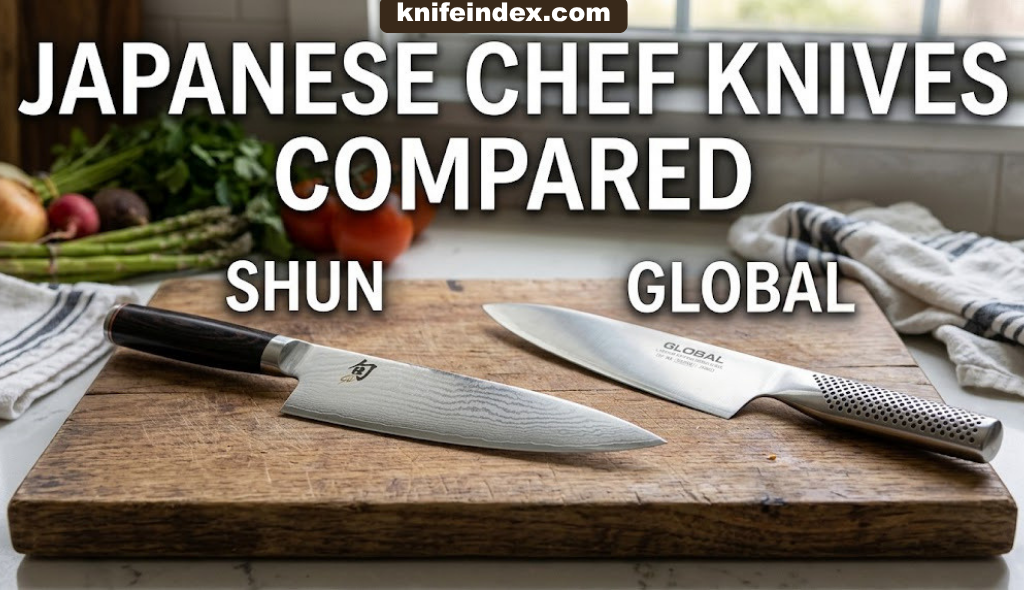
If you have spent any time browsing a kitchen shop or scrolling cutlery reviews, you have almost certainly run into these two names side by side. Shun and Global both built their reputations on Japanese-inspired design, but they arrived at that reputation from opposite directions. Shun leans into traditional Japanese bladesmithing, with laminated Damascus-clad steel, wa-style influenced handles, and a construction process rooted in centuries-old sword-making techniques. Global went the other way, stripping the kitchen knife down to a single piece of molded stainless steel with almost no ornamentation at all, favoring a futuristic, minimalist look that was genuinely radical when it launched.
Neither approach is objectively better. They are built around different priorities, and the “right” answer depends heavily on how you cook, how you store your knives, how much time you want to spend maintaining an edge, and what kind of grip feels natural in your hand. This guide walks through every meaningful difference: the steel, the construction, the handle ergonomics, the balance, the sharpening requirements, and the price-to-performance ratio, so that by the end you will know exactly which brand deserves a spot on your counter.
For readers who want a broader look at how Japanese steel stacks up against European alternatives before diving into brand specifics, our German steel vs Japanese steel comparison is a useful primer.
It also helps to understand why these two brands keep getting compared in the first place. Search any “best Japanese knife” thread online and Shun and Global will almost always be the two names duking it out for the top spot, ahead of German stalwarts and even ahead of some other well-regarded Japanese makers. Part of that is marketing reach; both brands have been widely distributed in North America and Europe for decades, so more home cooks have actually held one in their hands compared to smaller artisan makers who sell mostly direct or through specialty shops. But a bigger part of it is that both brands genuinely deliver on the promise of a thinner, sharper, more precise cutting experience than the thick, heavy German knives that dominated Western kitchens for most of the twentieth century.
That said, “Japanese knife” is a broad umbrella, and Shun and Global sit at two very different points inside it. Shun is closer to what most people picture when they imagine a traditional Japanese blade, complete with the rippled Damascus pattern and a handle shape descended from Japanese sword fittings. Global, on the other hand, barely resembles traditional Japanese cutlery at all in appearance, even though it is manufactured in Japan by a company with deep roots in the country’s cutlery industry. This visual gap is exactly why the comparison generates so much debate: people are not just comparing performance, they are comparing two competing definitions of what “Japanese knife design” even means.
| Category | Shun | Global |
|---|---|---|
| Origin | Seki City, Japan | Yoshikin, Tsubame-Sanjo, Japan |
| Blade Steel | VG-MAX / VG-10 core, Damascus clad | CROMOVA 18 stainless |
| Construction | Laminated, clad, often 32-68 layer Damascus | Monosteel, single-piece molded |
| Handle | PakkaWood, D-shaped, wa-influenced | Hollow stainless steel, filled with sand for balance |
| Typical Weight (8-inch chef) | Heavier, more blade-forward | Lighter, more balanced at the bolster |
| Edge Angle | 16 degrees per side | 15 degrees per side |
| Rockwell Hardness | 60-61 HRC | 56-58 HRC |
| Maintenance | Whetstone recommended, more careful handling | More forgiving, still whetstone recommended |
| Price Range | Premium to super-premium | Mid to premium |
| Best For | Traditionalists, precision cutting, aesthetics | Minimalists, dishwasher-adjacent households, hygiene-focused kitchens |

Shun Classic 8-Inch Chef Knife
The benchmark Shun model most reviewers compare everything else against.
Check Price on AmazonBrand History and Philosophy
Shun is a product line of Kai Corporation, a company that has been making blades in Seki City since the late 1800s, an area of Japan historically tied to samurai sword production. Shun was introduced in the early 2000s specifically to bring that sword-making heritage into a Western kitchen format, combining Japanese steel and lamination techniques with handle shapes that would feel intuitive to cooks who grew up using German-style knives. The result is a knife that looks unmistakably artisanal, with rippling Damascus patterns and a curved, dark PakkaWood handle, while still functioning in a familiar way for someone used to a rocking chef’s knife motion.
Global takes a completely different philosophical stance. Designed by Komin Yamada in the early 1980s and manufactured by Yoshikin, Global was conceived as a rethinking of what a knife could be, not an homage to tradition. The all-steel, one-piece construction eliminates the seams, rivets, and organic handle materials that can harbor bacteria or degrade over time. It was one of the first knife lines to gain widespread traction in professional Western kitchens specifically because it looked, felt, and performed differently than anything else on the market. Global’s dimpled handle and lightweight steel body remain instantly recognizable decades later.
Readers curious about the deeper story of how single-piece Japanese cutlery evolved may enjoy our breakdown of the history of Japanese knife making from samurai to sushi.
It is worth pausing on just how unusual Global’s launch was for its era. In the early 1980s, the overwhelming majority of professional and home kitchens in the West were stocked with heavy, bolstered German knives from brands that had barely changed their core design in generations. A lightweight, all-steel knife with a dimpled handle and no visible bolster at all was a genuine departure, and it took real conviction from Yoshikin to bring it to market. Early adoption came largely through culinary schools and professional kitchens in Europe and Australia before the design caught on more broadly in North America through specialty retailers and, later, big box kitchen stores.
Shun’s arrival two decades later followed a different market logic. By the early 2000s, Western home cooks had already been introduced to the idea of Japanese steel through smaller artisan importers and a handful of enthusiast retailers, but very few of those knives were designed with a Western hand in mind. Kai saw an opportunity to bridge that gap: take genuinely high-performance Japanese steel and lamination techniques and pair them with a handle shape and blade profile that would not require a steep learning curve for someone used to a German chef’s knife. That hybrid approach is a big part of why Shun became one of the most commercially successful Japanese knife brands in Western retail, appearing in mainstream department stores and kitchen chains rather than staying confined to specialty cutlery shops.
Both companies remain headquartered and manufactured in Japan today, and both continue to expand their lineups with new steel formulations, handle materials, and specialty blade shapes, which is one more reason the “Shun vs Global” debate has stayed relevant for so long rather than fading the way many knife trends eventually do.
Steel and Blade Composition
Steel is where these two brands diverge most dramatically, and it is arguably the single most important factor in how each knife performs day to day.
Shun’s VG-10 and VG-MAX Core
Most Shun kitchen knives use a VG-10 or the newer VG-MAX steel core, both of which are high-carbon stainless steels prized for their ability to take an extremely fine, hard edge. That core is then clad in layers of softer stainless steel folded and forged into the recognizable Damascus pattern, sometimes as many as 68 layers depending on the collection. The cladding is not just decorative; it adds flexibility and shock absorption around a hard, brittle core, which reduces the risk of chipping while still letting the edge itself stay razor sharp for a long time.
Global’s CROMOVA 18
Global uses a proprietary alloy called CROMOVA 18, a stainless steel blend containing chromium, molybdenum, and vanadium. It is a tougher, slightly softer steel than VG-10, which trades a bit of maximum sharpness and edge retention for significantly better resistance to chipping and corrosion. This is part of why Global knives have such a reputation for being nearly indestructible in a busy kitchen environment where knives get bumped, dropped in sinks, and handled by multiple people.
If you want a deeper technical dive into how these steels compare against other popular options in the same tier, our guides on VG-10 vs AUS-10 and high-carbon vs regular stainless steel knives break the metallurgy down further.
Why the Cladding Matters as Much as the Core
It is easy to focus entirely on the core steel and overlook what is happening around it, but the cladding layers on a Shun blade are doing real mechanical work, not just adding visual flair. A hard, high-carbon steel like VG-10 or VG-MAX is fantastic at holding an edge, but on its own, that same hardness makes it more prone to chipping or even cracking under lateral stress, the kind of stress you get from twisting a blade or prying with the tip. By sandwiching that hard core between layers of softer, more ductile stainless steel, Shun effectively builds in a shock absorber. The softer outer layers flex slightly under stress, protecting the brittle core from the kind of sudden impact that would chip an unclad blade of the same hardness.
This is also why the Damascus pattern on a Shun blade is not purely cosmetic marketing, even though it certainly looks striking. The pattern is a visible signature of the folding and forging process that created those protective layers in the first place. Cheaper “Damascus-look” knives sometimes use etched or laser-applied patterns on a single piece of steel purely for appearance, without any of the underlying structural lamination, so it is worth knowing that Shun’s pattern reflects genuine construction rather than surface decoration alone.
Why Global Chose a Softer, Tougher Alloy
Global’s engineering priorities were different from the outset. Because the entire knife, blade and handle together, is stamped from a single sheet of CROMOVA 18, the steel needed to be tough enough to survive that stamping and shaping process without cracking, while still being hard enough to take a genuinely sharp, functional edge. A steel as hard as VG-10 would be far more difficult and expensive to stamp and shape into Global’s continuous one-piece design, so CROMOVA 18 represents a deliberate compromise: give up a little maximum hardness in exchange for a steel that is easier to manufacture at scale, more resistant to corrosion, and more forgiving of the kind of rough handling that happens in a busy commercial kitchen.
In practical terms, this means Global’s edge will show signs of dulling slightly sooner than Shun’s under identical use, but it will also be far less likely to chip if the knife is accidentally used on a bone, dropped on a tile floor, or twisted while cutting through something unexpectedly hard. For a kitchen where multiple people share the same knives, or where the knife gets heavier daily abuse, that toughness can matter more in practice than maximum theoretical sharpness.
Shun Steel Advantages
- Higher hardness holds a finer edge longer
- Clad layers add flex and reduce chipping risk
- Distinctive Damascus pattern doubles as a wear indicator
Shun Steel Drawbacks
- Harder steel is more brittle under lateral stress
- Requires more careful sharpening technique
- Higher HRC means slower re-sharpening on coarse stones
Construction and Craftsmanship
Shun knives are forged and laminated, meaning the blade is built from multiple sheets of metal that are stacked, heated, and hammered together before being ground into shape. This is a labor-intensive process closely related to traditional Japanese sword forging, and it is a major reason Shun knives carry a premium price tag. Each blade also typically has a full tang that extends into the handle, secured with three visible rivets, giving the knife excellent structural integrity for chopping and rocking motions.
Global’s construction could not be more different. Each knife starts as a single sheet of CROMOVA 18 steel that is stamped, ground, and shaped into both blade and handle in one continuous piece. There is no separate handle material bonded to a tang; the “handle” is a hollow, dimpled extension of the same steel, filled with precisely measured sand to shift the balance point forward or back depending on the model. This one-piece approach removes any seam where bacteria could collect, and it is part of why Global markets its knives so heavily on hygiene grounds.
For a broader look at how forging philosophy affects blade performance across brands, see our comparison of forged vs stamped knives and the related piece on the difference between forging and stamping in knife making.
The Sand-Filled Handle Explained
One of the most frequently misunderstood details about Global knives is the sand inside the handle. Because the handle is hollow stainless steel rather than a solid material, it would be far too light and blade-heavy on its own to balance properly. Yoshikin’s solution was to fill each hollow handle with a carefully measured quantity of sand before sealing it permanently, using that sand as ballast to shift the balance point to the desired location for each specific knife model. Larger knives, like an 8-inch chef’s knife, get more sand than a small paring knife, and different models within the lineup, such as the more Western-balanced Sai series, use different sand quantities specifically to change how the knife feels in hand.
This detail matters for buyers because it explains why you should never attempt to disassemble, drill into, or modify a Global handle. Doing so breaks the seal, lets moisture in, and permanently throws off the balance the knife was engineered around.
How Shun Achieves Its Full-Tang Strength
Shun’s construction relies on a more conventional full-tang approach, where the blade’s steel extends the entire length of the handle, sandwiched between two panels of PakkaWood and secured with three stainless rivets. This is the same basic construction principle used in high-quality Western knives for generations, and it is well proven for withstanding the twisting, rocking, and occasional light prying that happens during normal kitchen use. The visible rivets are more than decorative; they are structural points holding the tang and handle scales together under pressure, and their symmetrical placement is part of what gives Shun knives their traditional, crafted appearance compared to Global’s futuristic minimalism.
Blade Design and Geometry
Shun blades tend to follow a Western-Japanese hybrid profile, meaning the belly of the blade has enough curve to support a rocking chop for people used to German-style technique, while the tip stays fine and controlled for precision work. The edge is typically ground at a narrower angle than most German knives, which contributes to Shun’s reputation for exceptional slicing performance, particularly on proteins and delicate produce.
Global blades are ground with a slightly straighter profile, closer to a traditional gyuto shape, which rewards a push-cutting or up-and-down chopping technique rather than a heavy rocking motion. This is a meaningful difference for anyone coming from a German knife background, since it can take a short adjustment period to get used to the flatter belly. Once that adjustment happens, most cooks find the Global geometry extremely efficient for fine dicing and julienne work.
If you are trying to decide between a chef’s knife and a santoku-style profile in either brand, our guide on chef knife vs santoku for rocking vs push cutting lays out exactly how blade curvature changes technique, and our piece on blade geometry and thin vs thick behind the edge explains why thinner grinds like these tend to glide through food with less resistance.
Tip Control and Detail Work
Beyond the belly of the blade, tip geometry is another meaningful difference. Shun’s tip tends to taper gradually, giving it excellent control for detail tasks like trimming silver skin off a tenderloin, deveining shrimp, or scoring the skin on a piece of fish. Global’s tip, in keeping with its more angular overall profile, is slightly more aggressive and pointed, which some cooks find better suited to piercing tasks, like starting a cut into a squash or breaking down poultry at the joint.
Neither tip style is objectively superior; the difference mostly shows up in tasks that require precision at the very point of the blade, and cooks who do a lot of butchery or fine trim work often develop a strong preference for one geometry over the other after using both for a while.
Blade height, meaning the distance from the cutting edge up to the spine, is another subtle but meaningful design choice. A taller blade gives more knuckle clearance over the cutting board and makes it easier to scoop chopped ingredients using the flat of the blade, while a shorter blade can feel quicker and lighter but occasionally forces knuckles closer to the board on a thick cutting surface. Shun’s 8-inch chef’s knife tends to run slightly taller than Global’s equivalent model, which some cooks with larger hands specifically seek out for the added clearance, while cooks who prize a lighter, lower-profile blade often gravitate toward Global’s proportions instead.

Global G-2 Chef’s Knife
The flagship Global model and the most common entry point into the brand.
Check Price on AmazonHandle Design and Ergonomics
Shun’s PakkaWood handles are D-shaped and subtly contoured, designed to sit comfortably in a pinch grip with a slight bulge that helps prevent the hand from sliding forward onto the blade during hard chopping. PakkaWood itself is a composite of real wood layered with resin, which gives it the visual warmth of natural wood while being significantly more resistant to moisture, cracking, and bacterial absorption than solid wood alternatives. Many cooks describe the Shun handle as feeling closer to a traditional, natural-material knife, which appeals strongly to people who want their tools to feel warm and organic rather than clinical.
Global’s handle is the more controversial element of the design. The dimpled stainless steel surface is textured specifically to improve grip when wet, since a smooth steel handle would become dangerously slippery around water and oil. Some cooks love the way it feels; others find the all-metal handle cold and less comfortable during long prep sessions. It is genuinely one of the most polarizing handle designs in the cutlery world, and it is worth handling one in person before committing, if at all possible.
For readers comparing handle material more broadly across the knife world, our overview of knife handle materials compared covers wood, G-10, Micarta, and plastic side by side, and our piece on understanding knife balance and why it matters explains how handle weight interacts with blade weight to change how a knife feels in motion.
Weight, Balance, and Feel
An 8-inch Shun Classic chef’s knife typically weighs somewhere around 7 to 8 ounces, with the balance point sitting just slightly forward of the bolster, giving it a confident, blade-forward feel that many cooks associate with control during heavy chopping. The added weight from the Damascus cladding contributes to this, and the knife tends to do a lot of the work for you once momentum is established in a rocking cut.
Global knives are noticeably lighter, with the same size chef’s knife often weighing closer to 5.5 to 6.5 ounces. Because the handle is hollow and filled with a specific amount of sand, Global is able to fine-tune the balance point to sit almost exactly at the bolster, creating a knife that feels nimble, quick, and almost weightless in motion. This makes Global knives especially popular for people who do a lot of fine, repetitive cutting, such as mincing garlic or herbs, where a lighter tool reduces fatigue over a long prep session.
Choose Shun’s Heft If You…
- Prefer momentum-assisted rocking cuts
- Do a lot of heavy chopping on dense vegetables
- Like a knife that feels substantial and grounded
Choose Global’s Lightness If You…
- Do extended prep sessions and want less hand fatigue
- Prefer fast, precise push cuts
- Have a smaller hand or lighter grip strength
Balance point is worth explaining a little further, since it is often confused with total weight but actually matters more for how a knife feels during use. A knife balanced right at the bolster, where the blade meets the handle, tends to feel neutral and controlled, pivoting easily during fine cuts. A knife balanced further back toward the handle feels lighter and quicker in the tip, while a knife balanced further forward into the blade feels more momentum-driven and powerful during heavy chopping. Global engineers its balance point very close to the bolster on most models specifically to create that neutral, nimble feel, while Shun’s added blade mass naturally shifts the balance slightly forward, reinforcing the momentum-assisted chopping style it is known for. Neither balance point is universally correct; professional chefs are divided on which they prefer, and the right answer really does come down to personal cutting style.
Maintenance and Sharpening
Both Shun and Global are hand-wash-only knives, and neither should ever go through a dishwasher. The heat, detergent, and jostling inside a dishwasher can dull the edge prematurely, damage the handle material, and in Global’s case, cause the sand-filled handle to shift internally over time.
Sharpening Shun
Because of the higher hardness and narrower edge angle, Shun knives are best sharpened on a whetstone at or near the factory angle, ideally in the 1000 to 6000 grit range for touch-ups, moving up to finer grits for a polished, hair-splitting edge. A honing rod can be used for very light maintenance between sharpenings, but it will not restore a genuinely dull edge on steel this hard.
Sharpening Global
Global’s softer steel is more forgiving on a whetstone and will re-sharpen faster, but it is still a Japanese-style bevel, so pull-through Western sharpeners designed for 20-degree German edges are not recommended, since they can strip away far more material than necessary and permanently change the blade’s geometry.
Our full breakdowns of whetstone vs electric sharpeners and honing steel vs whetstone go into detail on exactly how to keep either brand performing like new, and our list of the best knife sharpeners can help you pick the right tool for the job.
Cutting board choice plays a bigger role in edge longevity than most people realize, and it applies equally to both brands. Wood and quality plastic boards are gentle on either steel and will help preserve the factory edge angle for far longer, while glass, stone, and ceramic boards will dull even the hardest Japanese steel remarkably fast, sometimes within a single use. If you have invested in a premium Shun or Global knife, pairing it with an appropriate wood or plastic cutting surface is one of the simplest, cheapest ways to protect that investment and stretch out the time between sharpenings.

Dual-Grit Whetstone Sharpening Set
A solid starter stone for maintaining either brand’s factory edge angle at home.
Check Price on AmazonPopular Lineups Compared
Both brands offer multiple collections, and it helps to know what separates them before you shop.
Shun Collections
- Shun Classic — the original, 34-layer Damascus, PakkaWood handle
- Shun Premier — hammered tsuchime finish for food release
- Shun Sora — entry-level, VG10-adjacent steel, more accessible pricing
- Shun Kanso — carbon-fiber handle, matte finish, budget-friendly
Global Collections
- Global G-Series — the flagship line, including the iconic G-2
- Global Sai — heavier bolster, more Western-feeling balance
- Global Ni — walnut handle inserts for a warmer grip
- Global NI Forged — hybrid forged construction, higher price
For readers who want to see how these lineups stack up against a third major Japanese competitor, our comparison of Miyabi vs Shun steel is a natural next read, and our dedicated Shun Classic chef knife review covers the flagship model in far greater depth than we have room for here.
How to Choose Within Each Brand’s Lineup
Deciding between Shun and Global is only half the decision; picking the right model within whichever brand you choose is just as important. Within Shun, budget-conscious buyers should start with the Sora or Kanso lines, both of which use a simplified single-bevel-style steel formulation and a more affordable handle material while still delivering the sharpness Shun is known for. Cooks who want the full traditional experience, including the visible Damascus pattern and PakkaWood handle, should look at the Classic line, and those who specifically want a hammered, dimpled finish that helps release sticky foods like potato or squash from the blade should look at Premier.
Within Global, the G-2 remains the default recommendation for most buyers because it represents the most balanced expression of the brand’s design philosophy at a relatively accessible price point. Cooks who came from a heavier German knife background and are worried about adjusting to Global’s lightness should strongly consider the Sai line, which adds a heavier bolster specifically to ease that transition. Those who dislike the all-metal handle feel but still want Global’s monosteel construction and balance philosophy should look at the Ni line, which adds walnut inlays to the handle for extra grip and warmth without abandoning the core design.
Price and Value
Shun knives generally sit in the premium to super-premium bracket, with an 8-inch Classic chef’s knife often priced in a range that reflects the labor-intensive Damascus lamination process. Limited editions and higher-end collections push the price further still. Global occupies a slightly wider price band, with entry-level G-Series knives often priced more accessibly than comparable Shun models, while the forged NI line climbs into Shun territory.
Value is subjective here. If you weigh cost per year of expected use, both brands tend to be excellent long-term investments, since a well-maintained Japanese knife from either company can realistically last decades with proper care. Where the value conversation actually diverges is in what you are paying for: Shun’s price reflects craftsmanship and materials, while Global’s price reflects design engineering and manufacturing precision.
If your budget is tighter and you are still deciding whether a premium Japanese knife is worth it at all, our guide to finding the best budget chef knife and our list of best chef knives for home cooks offer some lower-cost alternatives worth considering before you commit to either brand.
It is also worth factoring in the hidden costs of ownership beyond the sticker price. A Shun knife’s harder steel means you will likely want a quality whetstone set with at least a 1000 and 6000 grit combination to maintain it properly at home, which represents an additional upfront investment if you do not already own sharpening equipment. Global’s more forgiving steel is somewhat less demanding in this regard, though a decent whetstone is still the recommended long-term solution over pull-through sharpeners for either brand. Neither knife requires professional sharpening services on any regular schedule if you are willing to learn basic whetstone technique, and many owners find the sharpening process itself becomes a genuinely enjoyable kitchen ritual once they get comfortable with it, rather than a chore.
Resale value is another consideration that rarely comes up in typical buying guides but is worth mentioning here. Both Shun and Global knives, when well maintained, tend to hold their value reasonably well on the secondhand market compared to lesser-known brands, partly because both names carry strong recognition and partly because both are known to last for decades with proper care. This is less relevant for most buyers who plan to keep and use their knife indefinitely, but it is a nice bit of reassurance for anyone worried about buying the “wrong” brand and being stuck with a bad investment.
| Model | Brand | Approx. Price Tier | Best Use Case |
|---|---|---|---|
| Shun Sora 8-inch Chef | Shun | Entry Premium | First step into Japanese steel |
| Shun Classic 8-inch Chef | Shun | Premium | All-around daily driver |
| Shun Premier 8-inch Chef | Shun | Premium+ | Sticky food release, rustic finish |
| Global G-2 8-inch Chef | Global | Mid Premium | Lightweight all-around use |
| Global Sai Chef | Global | Premium | Western-leaning balance |
| Global NI Forged Chef | Global | Super Premium | Hybrid forged performance |
Who Should Buy Which Brand
Choose Shun if you want a knife that feels traditional and substantial in the hand, you enjoy the ritual of whetstone maintenance, you are drawn to the visual beauty of Damascus patterning, and you tend to use a rocking chop motion inherited from Western culinary training. Shun rewards cooks who treat their knife as both a tool and a piece of craftsmanship.
Choose Global if you prioritize speed, lightness, and hygiene above all else, you prefer a push-cutting or straight chopping motion, you want a knife that is easy to clean and resistant to bacterial buildup because of its seamless construction, and you are not particularly attached to a wood-handle aesthetic. Global rewards cooks who want maximum efficiency with minimal fuss.
Many serious home cooks and professionals eventually own both, using Shun for slicing proteins and fine precision work, and Global for high-volume vegetable prep where speed and lightness matter most. If you are building out a broader kitchen knife rotation rather than picking a single blade, our guide on the three essential blades that can replace a full knife block and our piece on 10 essential kitchen knives for a professional rotation can help you figure out where each brand fits best.
It is also worth thinking about who else uses your kitchen. In households where multiple people, including guests or less experienced cooks, regularly grab whatever knife is closest, Global’s toughness and forgiving nature toward the occasional accidental misuse can be a genuine practical advantage over Shun’s more delicate, higher-hardness edge. On the other hand, if you are the only person who touches your knives and you already have solid knife skills, Shun’s added sharpness and edge retention will be easier to appreciate fully without the risk of someone else chipping it on a frozen bagel or a stray bone.
Gift-giving is another scenario where the two brands tend to diverge in popularity. Shun’s visual presence, with its rippling Damascus pattern and traditional handle, photographs beautifully and tends to be perceived as a more obviously “special occasion” gift for a serious home cook, wedding registry, or housewarming present. Global’s understated, minimalist look appeals more to recipients who already know and appreciate the brand’s design philosophy, making it a slightly more knowledgeable-buyer gift rather than an immediately impressive unboxing experience for someone unfamiliar with Japanese cutlery.

Global Santoku Knife
A great complementary blade for cooks who want Global’s balance for vegetable-heavy prep.
Check Price on AmazonStorage, Longevity, and Everyday Handling
How you store a knife between uses has a real effect on how long its edge and finish last, and this is another area where Shun and Global ask for slightly different habits. Shun’s clad Damascus finish, while resistant to corrosion, can still show scratches and dulling of its pattern if it is tossed loosely into a drawer alongside other metal utensils, so a dedicated knife block, an in-drawer knife tray, or a magnetic strip is strongly recommended. The PakkaWood handle is also more sensitive to prolonged direct sunlight and extreme humidity swings than Global’s all-steel construction, so storing Shun knives away from a sunny windowsill will help the handle keep its finish over the years.
Global’s steel handle is essentially immune to the kind of humidity or sunlight damage that affects wood or composite handles, which is one more reason it has such a strong reputation for durability in demanding kitchens. That said, the smooth blade finish can still pick up fine scratches from drawer storage, and while those scratches are almost entirely cosmetic rather than functional, a magnetic strip or knife block will keep the blade looking new for much longer.
Our guides on magnetic knife strips and edge damage and how to make a knife block cover safe storage options in more depth, and if you travel with your knives regularly for catering or competitions, our piece on how to travel with kitchen knives safely is worth a read regardless of which brand you end up choosing.
Rust, Spotting, and Corrosion Resistance
Both VG-10/VG-MAX and CROMOVA 18 are genuinely stainless formulations, meaning true rust is rare under normal use, but “stainless” has never meant “stain-proof.” Acidic ingredients like citrus, tomato, or vinegar-based marinades left in contact with either blade for an extended period can occasionally cause light spotting or discoloration, especially on Shun’s higher-carbon core. The fix in both cases is the same: rinse and dry the blade promptly after use rather than leaving it sitting in a sink or on a wet cutting board. Neither brand requires the kind of obsessive oiling and drying that a true high-carbon, non-stainless Japanese knife would demand, which is part of why both remain approachable for home cooks who do not want a second part-time job maintaining their cutlery.
Real-World Cutting Performance
Specs and steel charts only tell part of the story, so it is worth talking through how these differences actually show up during real cooking tasks.
Slicing Proteins
On raw chicken breast, salmon fillets, and beef, Shun’s thinner, harder edge produces noticeably cleaner slices with less tearing at the surface, particularly on delicate fish where a duller or thicker edge would compress the flesh rather than gliding through it. Global performs well here too, but side by side, most testers notice a very slight difference in slice cleanliness in Shun’s favor, especially several weeks into ownership before either knife has been resharpened.
Dicing Onions and Aromatics
This is where Global’s lighter weight and flatter blade profile start to shine. The reduced weight means less wrist fatigue during a long dicing session, and the straighter belly rewards the quick up-and-down chopping motion that works well for onions, garlic, and shallots. Shun can absolutely handle the same task well, but cooks used to a rocking motion may find themselves adjusting technique slightly to get the same efficiency out of Global’s straighter profile.
Breaking Down Root Vegetables and Squash
Heavier, denser vegetables like butternut squash or large sweet potatoes benefit from Shun’s added mass, since the extra weight assists in driving the blade through tough skin and dense flesh with less arm effort. Global can still manage these tasks, but some cooks add a bit more downward force manually to compensate for the lighter blade when working through particularly tough produce.
Herb and Garlic Mincing
For fine mincing work, Global’s balance and lighter swing weight generally win out, letting cooks maintain a fast, controlled rocking or rocking-push hybrid motion for longer without fatigue. Shun performs this task well too, and the sharper factory edge means less bruising of delicate herbs like basil, but the raw speed advantage tends to go to Global here.
For a broader set of technique fundamentals that apply regardless of which brand you choose, our guide on the five essential knife skills every home cook must master is a great companion resource.
Buying Checklist Before You Decide
Before you commit to either brand, it helps to run through a short mental checklist based on everything covered above.
- Do you use a rocking chop or a push-cut/straight chop technique most often? Rocking favors Shun; push-cutting favors Global.
- Do you prefer a warmer, wood-style handle or a cool, seamless metal grip? Shun and Global split cleanly on this point.
- How much time are you willing to spend on whetstone maintenance, and how often? Global is more forgiving of infrequent sharpening.
- Is hygiene and ease of cleaning a top priority, such as in a shared or commercial kitchen? Global’s seamless construction has a real edge here.
- Do you want a knife that also functions as a visual centerpiece on a magnetic strip or in a display block? Shun’s Damascus pattern is hard to beat.
- What is your total budget, including the eventual cost of proper whetstone sharpening tools? Both brands justify their price with proper care, but Global’s entry models are often slightly more accessible.
If you are still torn after running through this list, renting or borrowing a friend’s knife in either brand for a single cooking session, or testing one in a kitchen showroom, remains the single best way to make a final call, since so much of this decision comes down to how the knife physically feels in your specific hand. Pay attention not just to how the handle feels while standing still, but to how the balance shifts once you actually start cutting, since a knife that feels great sitting in your palm at a store display can feel completely different mid-chop after a few minutes of real use.
Frequently Asked Questions
Is Shun or Global better for beginners?
Global tends to be slightly friendlier for beginners because of its lighter weight and softer steel, which makes touch-up sharpening easier and less intimidating for someone new to whetstone maintenance. The reduced weight also means less wrist fatigue while a new cook is still building confidence and muscle memory with a sharper-than-usual blade. Shun is still very much beginner-friendly, and many first-time Japanese knife buyers choose it specifically for the more familiar handle shape and rocking motion, but its harder steel does reward a bit more sharpening confidence once the factory edge eventually needs a full resharpen rather than just a touch-up.
Can Shun or Global knives go in the dishwasher?
No, and this is one of the few rules that applies without exception to both brands. Dishwasher heat, harsh detergent, and the jostling that happens against other utensils during a wash cycle can degrade the edge, discolor or dull the finish, and in Global’s case potentially affect the internal balance of the sand-filled handle over time if water somehow finds its way into a seam. Hand washing immediately after use with mild soap, followed by prompt towel drying, is the standard care routine recommended by both manufacturers and by virtually every professional who has used either brand for an extended period.
Which brand holds an edge longer, Shun or Global?
Shun generally holds its edge longer thanks to its higher Rockwell hardness, typically 60 to 61 HRC compared to Global’s 56 to 58 HRC on the CROMOVA 18 alloy. In everyday kitchen use, this often translates to several additional weeks or months of noticeably sharp performance before a full resharpening is needed, depending on cutting board material and frequency of use. Global compensates for its slightly shorter edge retention window by being faster and easier to re-sharpen on a whetstone when it does eventually dull, so the total time investment across a year of ownership tends to even out more than the raw hardness numbers might suggest.
Are Shun knives worth the higher price compared to Global?
It genuinely depends on what you personally value in a kitchen tool. Shun’s price reflects labor-intensive Damascus lamination, a higher grade of core steel, and a more traditional handle material, all of which contribute to a knife that feels like a crafted object as much as a working tool. Global’s price reflects precision engineering, a lighter and more hygienic seamless design, and decades of manufacturing refinement rather than hand-applied ornamentation. Both hold their value extremely well as long-term kitchen investments, and neither should be considered overpriced relative to what it delivers, but the “worth it” question ultimately comes down to whether you prioritize traditional craftsmanship or engineered minimalism.
Do Global knives rust?
Global’s CROMOVA 18 steel is highly corrosion resistant and rarely develops true rust under normal use, since the chromium content in the alloy forms a passive protective layer on the surface of the steel. That said, like any stainless steel, it can still develop light spotting or discoloration if left wet, dirty, or in contact with acidic ingredients for extended periods, particularly if the knife sits unwashed overnight. Drying the blade promptly after washing, rather than letting it air dry in a wet sink, prevents this issue entirely and keeps the finish looking new for years.
What edge angle should I sharpen Shun and Global at?
Shun knives are typically factory-ground at 16 degrees per side, while Global knives are ground slightly more acute at 15 degrees per side. Matching the original factory angle as closely as possible on a whetstone preserves the intended cutting performance of each brand, and most modern whetstone kits include an angle guide specifically to help home sharpeners hit these narrower Japanese angles consistently, since they are noticeably more acute than the 20-degree angle typical of most German knives.
Is the Global handle uncomfortable for people with larger hands?
Some users with larger hands report the Global handle feels narrow or less substantial compared to Shun’s more contoured, wider PakkaWood grip, particularly during extended prep sessions. Other large-handed cooks report no issue at all once they adjust to the dimpled texture and lighter overall weight. It is genuinely worth handling both in person at a kitchen store if at all possible, since hand comfort is one of the most subjective factors in this entire comparison and tends to vary more by individual preference than by any objective measurement.
Can I use a honing rod on Shun or Global knives?
A smooth ceramic honing rod can be used sparingly for light, in-between maintenance on either brand to realign a slightly rolled edge between full whetstone sharpenings, but a standard grooved steel honing rod designed for softer German steel is not recommended for either brand, since the aggressive ridges can chip or micro-fracture the harder, more acute Japanese edge rather than simply realigning it. If you already own a traditional steel honing rod for a German knife set, it is best kept separate from your Shun or Global cutlery entirely.
Which brand is more popular in professional kitchens?
Global has a longer track record in professional Western kitchens due to its early adoption in the 1980s, its lightweight design that reduces fatigue during long service shifts, and its hygienic, seamless construction that appeals to health-code-conscious kitchen managers. Shun has grown significantly in popularity among both professional chefs and serious home cooks over the past two decades as well, particularly among cooks who specifically want a knife that also performs well as a display piece or gift, and it is common to see both brands represented side by side in the same professional knife roll.
Do Shun and Global knives come with a warranty?
Both brands typically offer limited lifetime warranties covering manufacturing defects in materials and workmanship, though normal wear and tear, accidental damage, and improper care such as dishwasher use are generally excluded from coverage. Registering your knife with the manufacturer shortly after purchase and retaining proof of purchase is the best way to ensure a smooth warranty claim if something does go wrong down the line, and both companies have established, responsive customer service departments for handling these requests.
Is a santoku or a chef’s knife better in either brand?
A santoku from either brand tends to suit cooks who primarily do vegetable-focused prep work using a push-cutting or straight chopping motion, thanks to its flatter belly and typically shorter blade length, while a full-size chef’s knife remains more versatile across proteins, herbs, and larger cutting tasks that benefit from a longer edge and a bit more curve for rocking. Many households eventually own both a chef’s knife and a santoku in the same brand, using each for the tasks it handles best. Our guide on santoku vs nakiri for vegetable prep can help narrow this down further if vegetables make up the bulk of your prep work.
Which brand is lighter overall across their lineups?
Global is consistently lighter across nearly every comparable model in both brands’ core lineups, since the hollow, sand-filled handle construction keeps overall weight down compared to Shun’s denser, multi-layered Damascus blades paired with solid PakkaWood handle scales. This weight difference is most noticeable in larger knives like an 8 or 10-inch chef’s knife, where the cumulative effect of Shun’s additional cladding layers and denser handle material becomes more pronounced than it is on smaller paring or utility knives.
How do I know when it is time to resharpen either brand?
The simplest home test is the paper slice test: hold a sheet of printer paper vertically and try to slice through it with just the weight of the blade. A properly sharp Shun or Global should glide through cleanly with minimal effort, while a knife that snags, tears, or requires noticeable sawing motion is due for a whetstone session. Testing on a ripe tomato is another reliable indicator, since a sharp edge should bite into the skin immediately rather than sliding or squashing the fruit before cutting through.
Final Verdict
There is no universal winner between Shun and Global, only a better fit for your specific hands, habits, and priorities. Shun delivers a harder, longer-lasting edge wrapped in genuinely beautiful Damascus craftsmanship, ideal for cooks who want a traditional, blade-forward tool with real heft. Global delivers a lighter, faster, more hygienic all-steel design engineered for speed and precision, ideal for cooks who prize efficiency and low-maintenance durability above ornamentation.
If you already lean toward one aesthetic or grip style after reading this comparison, trust that instinct. Both brands represent some of the best Japanese-influenced cutlery available anywhere near their price point, and either one will outperform the vast majority of Western knife blocks sold today. For a wider view before you finalize your decision, our roundup of best Japanese gyuto knives for home chefs and our best chef knife brands guide can help you compare against a few additional contenders before you check out.
Whichever direction you go, remember that even the best knife in the world underperforms if it is left dull in a drawer. Budget for a proper whetstone, learn the basic maintenance routine for your chosen brand, and store the knife somewhere it will not get knocked around by other utensils. Do that, and either a Shun or a Global chef’s knife will likely become the single most-used tool in your kitchen for many years to come, easily justifying its place at the top of your countertop lineup over cheaper, shorter-lived alternatives.
Shop Shun and Global Knives on Amazon