Exposing the Kitchen Legend: Comprehensive MAC Chef Knives Review
Walk into any Michelin-starred kitchen, high-end bistro, or intense culinary school environment, and you will notice a trend. Amidst the flash of expensive custom Damascus steel and the rugged reliability of heavy German beaters, there is one knife that appears with astonishing frequency. It usually has a matte black handle, a shockingly thin blade, and a simple, unassuming logo: MAC.
For decades, MAC knives have been the worst-kept secret in the culinary world. Revered by icons like Thomas Keller and Charlie Trotter, these Japanese-crafted blades have achieved a cult-like status among line cooks and executive chefs alike. But in a modern market saturated with boutique knife makers and direct-to-consumer brands, do they still hold the crown?
In this extensive MAC chef knives review, we are going deep into the metallurgy, the unique asymmetrical edge geometry, and the ergonomic design that makes these knives legendary. We will analyze the flagship Professional Series, compare them against industry titans, and help you determine if a MAC knife deserves a spot on your cutting board.
1. Introduction to MAC Knives: The Professional’s Choice
MAC knives are not designed to be display pieces. You won’t find hammered finishes (tsuchime), intricate folded Damascus cladding, or exotic burl wood handles. MAC builds pure, unadulterated cutting instruments. They are the quintessential “function over form” kitchen tool.
What makes a MAC knife exceptional is its specific hybridization. It takes the razor-thin, lightweight profile and high-hardness steel of traditional Japanese cutlery, and marries it to the familiar, curved belly and Western handle shape of a German chef’s knife. This creates a blade that feels instantly familiar in the hand but cuts with a terrifying, laser-like precision that German knives simply cannot match.
Because they strike this perfect balance, they have become the ultimate transitional knife for Western cooks looking to upgrade to high-performance Japanese steel without completely abandoning their traditional cutting techniques. The philosophy behind the MAC knife is deeply rooted in the idea of “kitchen harmony.” It is a tool that disappears in your hand, allowing the cook to focus entirely on the ingredient rather than the instrument. This psychological shift is profound. When you are not fighting the tool, your knife cuts become more consistent, your prep speed increases, and the overall cooking experience transforms from a mechanical task into a fluid, almost meditative art form. This is why the MAC knife is often described not just as a purchase, but as a career investment for cooks.
The knife’s balance point is meticulously calculated. For the Professional series, the balance sits exactly at the bolster pinch point, creating a neutral, effortless feel. Unlike heavy German knives that rely on their weight to fall through food, the MAC relies on sheer sharpness and geometry. This fundamental difference is the first thing a new MAC user notices: the knife does the work for you. It doesn’t chop; it separates. It doesn’t crush; it glides. This makes it particularly exceptional for delicate herbs like chives and basil, where a dull or heavy knife would bruise the leaves, turning them black and bitter. With a MAC, chiffonade becomes an effortless, clean process that preserves the herb’s essential oils and vibrant color.
2. The History and Philosophy of MAC Corporation
The story of MAC begins in 1964 with Tatsuo Kobayashi. While studying in the United States, Kobayashi accidentally dropped a kitchen knife. It landed tip-down, and the sharp, pointed tip snapped off completely. Instead of throwing it away, he reshaped the broken end into a rounded tip. To his surprise, he found the knife safer to use and highly effective.
Returning to Japan, Kobayashi founded the MAC Corporation in Seki City—the historical epicenter of Japanese sword making. He partnered with local blacksmiths to refine his designs, ultimately securing patents for his unique edge geometry and distinctive blade shapes.
The name “MAC” stands for Macro. Kobayashi wanted to create a knife that was macro-versatile, appealing to the macro-majority of cooks around the world. Today, the company remains relatively small and intensely focused, hand-crafting and hand-sharpening their blades in Japan using the same rigorous quality control standards they established over half a century ago. This dedication to a single craft, refusing to diversify into cookware or gadgets, is a rarity in today’s corporate world and a primary reason for their cult following.
Seki City’s legacy cannot be overstated. For over 780 years, the city has produced legendary katana swords. The smiths who craft MAC knives are descendants of these ancient sword-making families. The water in Seki City is mineral-rich, perfect for tempering steel. The pine charcoal used in the forging process burns clean and hot. MAC has taken this ancient infrastructure and applied it to modern kitchen cutlery. The Original Series was the first to gain traction internationally. Chefs who lost their fingertips due to the pointed tips of traditional Western knives flocked to the Original’s safety profile. However, as culinary techniques evolved, Kobayashi realized that the professional world needed a pointed tip for precision work and a bolster for balance. Thus, the Professional Series was born, creating the definitive bridge between Eastern sharpness and Western ergonomics.

3. MAC Steel: The Proprietary Chrome Molybdenum Alloy
If you ask a knife nerd what steel a MAC is made from, you will get a frustrating answer. MAC closely guards their specific metallurgical formula. However, they do disclose that it is a proprietary, high-carbon Chrome Molybdenum Vanadium alloy, further enriched with Tungsten.
Here is why that combination matters in the kitchen:
- High Carbon: Allows the steel to be hardened significantly. MAC tempers their blades to roughly 59-61 on the Rockwell Hardness scale (HRC). This is much harder than standard German steel (usually HRC 56-58), allowing the MAC to hold a sharper edge for much longer.
- Chrome & Molybdenum: These elements provide excellent stain and rust resistance. While not 100% rust-proof, it requires far less maintenance than a pure carbon steel Japanese knife.
- Tungsten: This is the secret weapon. Tungsten adds incredible wear resistance and toughness. It allows MAC to grind their blades astonishingly thin without the edge instantly micro-chipping when it hits the cutting board.
- Sub-Zero Tempering: On their Professional lines, MAC cryogenically treats the steel, freezing it to extremely low temperatures after heat treatment. This refines the grain structure, making the blade even more durable and capable of taking a wicked edge.
The cryogenic treatment is a fascinating process. After the blade is heated to its critical temperature and quenched, it is submerged in liquid nitrogen at temperatures approaching -300°F (-184°C). This process transforms retained austenite (a soft, unstable crystalline structure in the steel) into martensite (a hard, stable structure). The result is a steel matrix that is significantly more uniform. For the user, this means the edge does not just feel sharp; it feels silky. The absence of microscopic soft spots means the edge wears down evenly. This is why a MAC knife, when properly maintained, can feel brand new even after years of heavy daily use. The steel’s ability to resist deformation under lateral stress—such as when slicing a dense butternut squash—is directly attributable to the synergy between the tungsten and the sub-zero tempering cycle.
4. Blade Geometry: The Legendary MAC Edge
The steel is excellent, but the geometry is where MAC truly shines. Pick up a Wüsthof or Zwilling, and look at the spine; it’s thick, tapering down to a wedge. Pick up a MAC, and the spine is shockingly thin—often around 2mm or less. This thinness allows the knife to glide through dense vegetables like carrots and potatoes without wedging or cracking them.
Furthermore, MAC utilizes an asymmetrical edge grind. Most Western knives are sharpened to a 50/50 V-edge. MAC sharpens their knives to an off-center angle, typically 60/40 or 70/30. This creates a shallower angle on the cutting side, mimicking the frictionless slicing capability of a traditional single-bevel Japanese knife, while remaining easy to steer.
The profile of the blade also features a gradual curve (belly) towards the tip. If you are deciding between different cutting styles, reading up on chef knife uses in rocking vs push cutting will help you understand why MAC’s hybrid profile is so brilliant. It is flat enough at the heel for rapid up-and-down push cutting (Japanese style), yet curved enough at the tip to allow for smooth rocking motions over herbs and garlic (Western style).
The 60/40 asymmetrical grind is not a marketing gimmick; it is a physics-based solution to food adhesion and separation. When cutting a carrot with a symmetric 50/50 edge, the two halves are pushed apart equally, often causing the carrot to crack violently or fly off the board. The MAC’s asymmetrical edge, typically ground more steeply on the right side (for a right-handed user), acts like a chisel slicing through the food, directing the cut piece cleanly to the left. This phenomenon, known as “steering control,” takes about two minutes of use to adapt to, but once mastered, it fundamentally increases the precision and speed of your prep work.
The thin blade stock is also critical in reducing drag. The total cutting resistance is a combination of the edge sharpness and the thickness of the blade pushing the food apart. MAC minimizes both. This is most noticeable when cutting semi-frozen proteins for hot pot or carpaccio. A standard German knife would struggle, requiring downward pressure that compresses the meat. The MAC, driven purely by its geometry, allows you to produce paper-thin slices without tearing the muscle fibers.

5. The MAC Professional Series (Focus on MTH-80)
The MAC Professional Series is the flagship line, and the crown jewel of this collection is the MTH-80 (8-inch Chef’s Knife with Dimples). This specific knife has won nearly every major culinary gear award in existence.
What sets the Professional series apart is the inclusion of a forged steel bolster (the metal band where the blade meets the handle). This bolster adds a slight amount of weight to the center of the knife, providing perfect, gravity-assisted balance directly at the pinch grip. The steel is sub-zero tempered, and the handles are made from premium Pakkawood.
The MTH-80 also features Granton edges (scalloped dimples) running along the blade. These dimples create tiny air pockets between the steel and the food, reducing suction and preventing starchy vegetables like potatoes from sticking to the side of the blade as you chop. It is, quite simply, a masterpiece of kitchen engineering.
The MTH-80’s bolster is a point of contention among knife purists. Some argue that a full bolster makes sharpening difficult over time as the blade wears down. MAC solved this issue by engineering the bolster to be slightly shorter than the cutting edge. This means you can sharpen the entire length of the blade for a decade or more without the bolster creating a dead zone near the heel. This “sharpening relief” cutout is a tiny detail that professional chefs worship. The 8-inch length is also deliberately chosen. While many Western cooks prefer a 10-inch blade, MAC found that the 8-inch length maximizes the agility of the Japanese push-cutting style while still being long enough to slice a large brisket. It is the Goldilocks dimension: perfectly balanced between maneuverability and capacity.
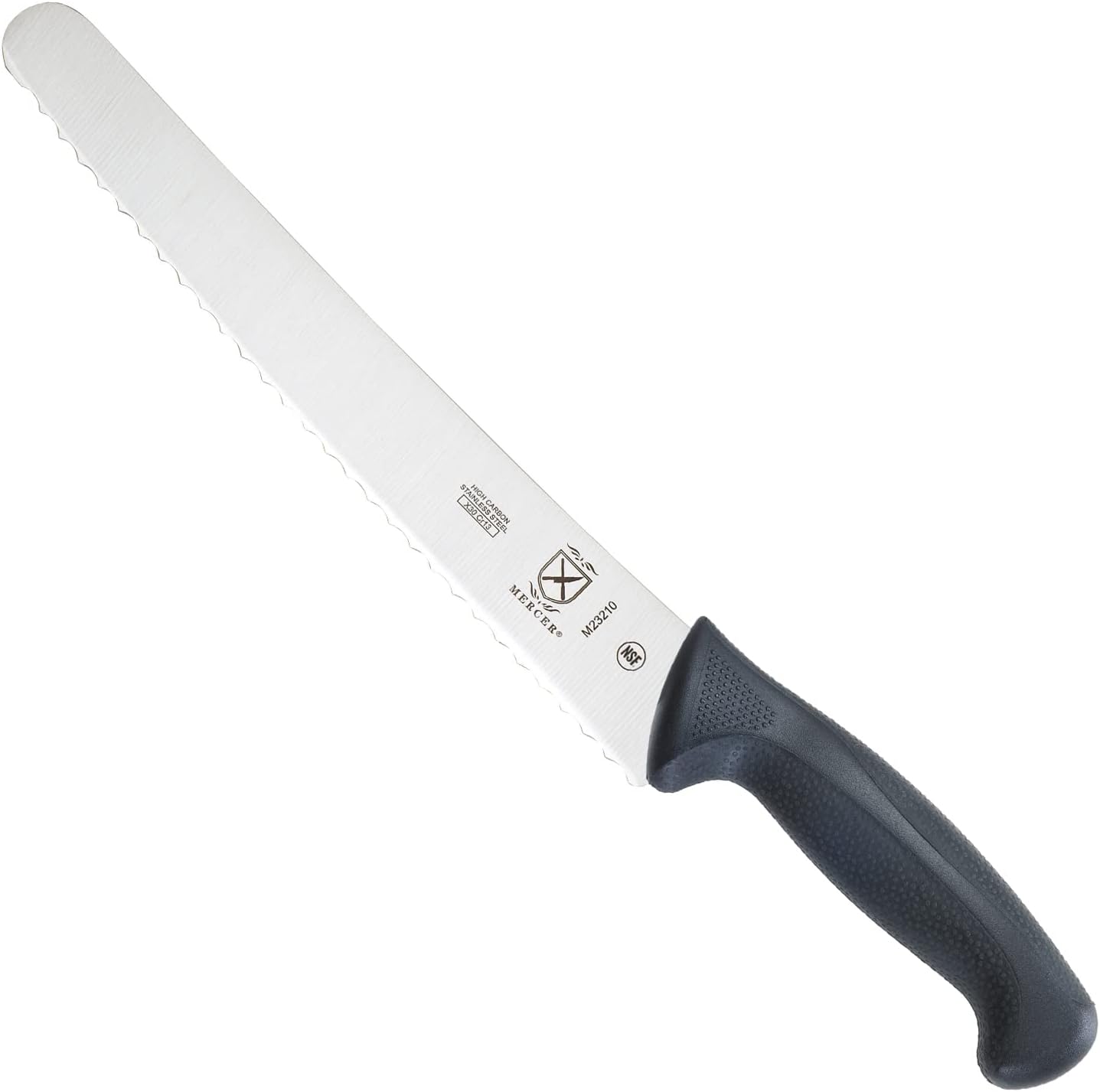
Within the Professional line, you’ll find not just the chef’s knife but specialized tools designed for specific tasks. The boning knife, for instance, is flexible yet rigid enough to separate silverskin from a beef tenderloin with surgical precision. The bread knife uses a wavy serration pattern that cuts crusty sourdough without tearing the soft interior crumb. These are not afterthoughts; they are engineered with the same obsessive attention to detail as the MTH-80.
6. The MAC Superior Series
If you want the legendary MAC edge but are working with a tighter budget, the Superior Series is the answer. These knives use the same high-carbon Chrome Molybdenum steel as the Professional line, but they lack the forged steel bolster and the sub-zero cryogenic tempering.
Because they lack the bolster, Superior series knives are noticeably lighter. The blade is also stamped slightly thinner. For home cooks who prioritize nimbleness and a feather-light feel over the weighted, forward-falling momentum of a professional chef’s knife, the Superior Santoku or Superior Chef’s knife is an incredible value. The handles are slightly elevated, offering excellent knuckle clearance on the cutting board.
The lack of cryogenic treatment is the primary differentiator in performance. While the steel formula is identical, the Superior series will lose its hair-whittling sharpness slightly faster than the Professional series. However, “slightly faster” for a MAC is still far longer than most competitors. Home cooks who use the knife once a day will likely not notice a significant difference in edge retention. The absence of the bolster also makes the Superior series easier to sharpen on a whetstone, as you have complete, unobstructed access to the entire heel. Many knife enthusiasts actually prefer the Superior line for this exact reason: it offers a purer sharpening experience and a lighter, more connected feel to the cutting board.
The Santoku in the Superior line is particularly noteworthy. With its sheepsfoot-style dropped tip, it offers a completely flat profile from heel to belly, making it arguably the best knife MAC makes for strict push-cutting and rapid vegetable chopping. If your cooking style involves a lot of tap-chopping, the Superior Santoku might be a more suitable choice than the MTH-80.

7. The MAC Original Series
The MAC Original Series is where it all started. These knives are easily identified by their unique, fully rounded tips and the signature hole punched through the end of the blade.
While professional chefs rarely use the Original series today, they hold a special place for specific users. The rounded tip makes them incredibly safe for older cooks, children learning culinary skills, or chaotic, cramped environments (like boat galleys) where dropping a pointed knife is a major hazard. The hole at the tip allows the knife to be hung safely on a peg. They feature a very thin, flexible blade that excels at slicing soft vegetables and proteins.
Diving deeper into the design intent, the hole is not just for hanging. In high-volume catering kitchens where sanitation is paramount, the hole allows the knife to be quickly dipped into a sanitation bucket and hung to air dry without the blade touching any surface. The fully rounded tip was also a precursor to modern safety knives used in industrial food processing. While a chef might miss the tip for scoring duck skin or carving pumpkins, a home cook preparing a simple salad will find the Original Series incredibly forgiving. The blades on the Original Series are the thinnest of all MAC lines, making them the true “lasers” of the family. They flex slightly, which can be an asset when filleting a delicate fish like flounder or removing the skin from a salmon fillet, where the blade can follow the contour of the protein without digging into the flesh.
8. Handle Design and Ergonomics: Comfort Meets Function
A knife is only as good as its handle, and MAC takes a decidedly Western approach to their ergonomics. While traditional Japanese knives use round or octagonal wooden “Wa” handles, MAC utilizes a classic Western shape, featuring a full tang and three metal rivets.
The handles are constructed from Pakkawood. This is an engineered material made by impregnating layers of natural hardwood with structural resin under extreme heat and pressure. The result is a handle that looks and feels like warm, natural wood, but is completely waterproof, warp-resistant, and hygienic. It won’t shrink or crack over decades of use.
MAC slightly elevates their handles relative to the blade. This ergonomic tweak provides massive knuckle clearance, ensuring you never rap your knuckles against the cutting board when completing a chop.
The handle’s ergonomic design extends to its subtle contours. The bottom of the handle has a gentle swell that fills the palm, while the top is slightly flattened to provide a secure anchor for the thumb in a pinch grip. The rivets are not just decorative; they are mechanically bonded to the tang, ensuring the handle never separates from the blade. MAC’s Pakkawood is also heat-resistant up to a certain point, meaning it can withstand brief contact with a hot pan handle or a torch better than cheaper plastic handles. However, it should never be left near an open flame. The dark color of the Professional series handles is also a practical choice: it hides patina and staining from kitchen grime, keeping the knife looking professional even after years of abuse in a commercial kitchen.
For those transitioning from heavy German knives, the MAC handle offers a revelation in grip security. Because the knife is so light, you don’t need to squeeze tightly to control it. A relaxed pinch grip on the exposed tang (the area between the handle and the bolster) gives you complete directional control with zero forearm strain. This is often cited as the primary reason chefs with carpal tunnel syndrome or tendonitis switch to MAC: the knife’s overall ergonomics drastically reduce the repetitive stress load on the wrist.

9. MAC vs. Wüsthof vs. Global: The Hybrid Advantage
How does MAC stack up against the other giants of the culinary world?
Vs. Wüsthof: Wüsthof represents the pinnacle of German forging. Their knives are heavy, thick, and practically indestructible. However, they wedge in hard vegetables and require frequent honing. To see how these two fundamentally different philosophies clash, read this deep dive on MAC vs Wüsthof hybrid Japanese vs German forged knives. Ultimately, MAC wins on pure cutting performance and sharpness, while Wüsthof wins on sheer durability for tasks like splitting squash or navigating bones.
Vs. Global: Global is another massively popular Japanese brand, famous for their all-steel, seamless construction. Global knives are incredibly light and feature a convex edge. However, many chefs find Global’s metal handles become slippery when wet. MAC’s Pakkawood handle offers far superior grip, and the proprietary MAC steel holds its edge noticeably longer than Global’s Cromova 18 steel.
Expanding this comparison to practical kitchen scenarios illuminates the core differences. If you are breaking down a whole chicken, Wüsthof’s weight and thick spine allow you to confidently cut through cartilage and small joints. A MAC would require more finesse and is not recommended for bone contact. However, for the subsequent step of dicing the chicken breast into uniform cubes, the Wüsthof crushes the meat fibers, leaving a ragged cut, while the MAC slices cleanly through, preserving texture. The Global, in this scenario, sits awkwardly in the middle. Its all-metal handle, while seamless and hygienic, lacks the tactile feedback of the MAC’s Pakkawood, especially during long prep sessions where the knife needs to feel like an extension of your hand. The MAC therefore excels in the precision tasks that occupy 95% of a cook’s time, conceding only the heavy butchery tasks.
| Brand | Steel Hardness (HRC) | Blade Profile | Best For |
|---|---|---|---|
| MAC (Professional) | 59 – 61 | Ultra-thin, Asymmetrical | Precision slicing, professional prep, laser-like cutting. |
| Wüsthof (Classic) | 58 | Thick, 50/50 V-Edge | Heavy-duty chopping, durability, rock-chopping. |
| Global (G-Series) | 56 – 58 | Thin, Convex Edge | Lightweight agility, modern seamless aesthetics. |
10. Edge Retention and Sharpening MAC Knives
Because MAC tempers their steel to HRC 60, their edge retention is stellar. A home cook can easily go six months between major sharpening sessions. However, because the blade is thin and hard, you must treat it with respect. Never use a pull-through carbide sharpener on a MAC knife; it will tear the delicate, asymmetrical edge to shreds.
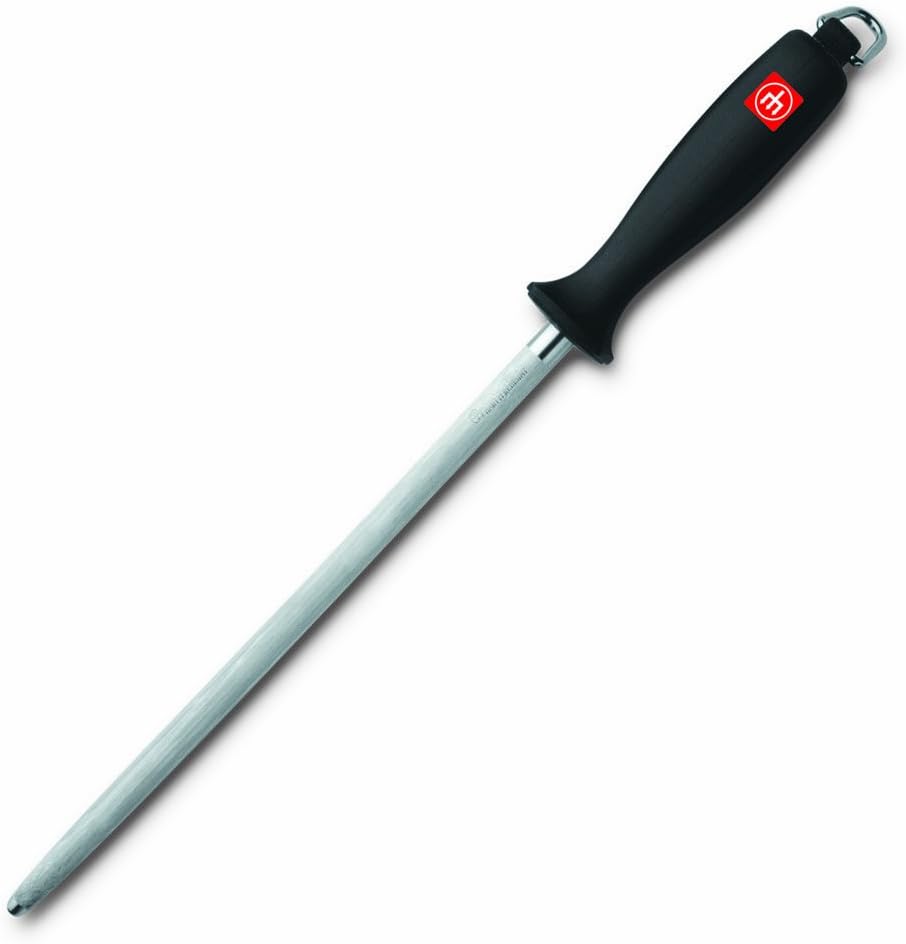
To maintain a MAC, you should hone it regularly with a fine ceramic rod (do not use a heavily ribbed steel honing rod). When it comes time to truly sharpen the blade, you must use whetstones. Because of the asymmetrical grind, you will spend slightly more time sharpening the right side of the blade than the left. If you are new to this process, studying the ultimate knife sharpening guide for professional edges is mandatory to ensure you don’t ruin the factory geometry.
The ceramic honing rod is essential daily maintenance. Unlike a ribbed steel honing rod, which tears out microscopic carbides from the hard steel, the ceramic rod gently realigns the edge and actually removes a minuscule amount of material, refreshing the sharpness. The technique involves light, alternating strokes at the original factory angle (approximately 15 degrees). It is recommended to strop the knife on bare leather or a denim apron after honing to remove the final burr. This three-step ritual—wash, hone, strop—takes thirty seconds and can extend the time between full whetstone sharpenings to a year for home users. When the knife finally stops responding to honing and feels “glassy” on the board, it’s time for a whetstone. Start with a 1000-grit stone to establish the new edge, focusing pressure distribution (60% on the right face, 40% on the left for right-handers). Finish on a 4000 to 6000-grit stone to polish the bevels. The goal is a “toothy” edge that bites into tomato skins and pepper skins, rather than a mirror polish that is too slippery for practical kitchen use.

11. Pros and Cons of MAC Kitchen Knives
No knife is perfect for every single user. Here is the honest breakdown of where MAC excels and where it falls short:
Pros
- Incredible out-of-the-box sharpness.
- Laser-thin geometry prevents wedging in dense root vegetables.
- Hybrid profile allows for both push-cutting and rocking.
- Pakkawood handles are exceptionally comfortable and durable.
- Lighter than German knives, reducing wrist fatigue.
- Sub-zero tempering enhances edge retention durability.
- Asymmetrical edge reduces food sticking and cracking.
- Bolster designed with sharpening relief for full blade use.
Cons
- Fragile edge: Can chip if used on bones, frozen food, or hard pits.
- Utilitarian looks: Lacks the visual “wow” factor of Damascus knives.
- Asymmetrical grind requires a learning curve for sharpening.
- Not completely rust-proof; requires prompt washing and drying.
- Limited availability in local retail stores; often online only.
- Right-hand bias in the grind can feel awkward for lefties initially.
12. Final Verdict: Are MAC Knives Worth the Money in 2026?
If you are serious about cooking, the answer is a definitive yes. MAC knives, particularly the Professional MTH-80, represent the sweet spot of culinary cutlery. They offer the terrifying, laser-like cutting capability of a high-end Japanese blade, combined with the comfortable, familiar ergonomics of a Western knife.
When curating your culinary arsenal, selecting versatile tools is key. As noted in discussions regarding essential kitchen knives for a professional rotation, a MAC chef’s knife effortlessly anchors any collection, handling 90% of your daily prep work with unmatched grace and efficiency.
They aren’t flashy, and they don’t look like art pieces. They are serious tools engineered for serious cooks. If you prioritize performance, balance, and edge retention above all else, MAC is arguably the best kitchen knife brand in the world.
In a market obsessed with the aesthetics of hammered finishes and damascus patterns, MAC remains a bastion of pure, unadulterated performance. It is the knife you buy when you stop caring what the block looks like on the counter and start caring exclusively about what happens on the cutting board. It is not a knife for collecting; it is a knife for cooking. The value proposition of a MAC knife extends beyond its price tag. When you factor in the decades of service, the reduction in food waste from bruised herbs and crushed tomatoes, and the sheer joy of effortless meal prep, the MAC MTH-80 is one of the most affordable luxury investments you can make in your kitchen.
13. The MAC Knife Ecosystem: Beyond the Chef’s Knife
While the chef’s knife is the anchor, MAC has meticulously crafted a full ecosystem of supporting blades. Understanding this ecosystem is key to building a complete, high-performance kitchen block. The MAC paring knife, for example, is a 3.25-inch powerhouse. Unlike bulky Western paring knives, the MAC parer is needle-sharp and incredibly thin, making it ideal for tournée cuts, segmenting citrus suprêmes, and fine precision work like deveining shrimp. Its handle is scaled down but retains the same ergonomic principles as its larger siblings.
The MAC utility knife (5 to 6 inches) fills the gap between the paring knife and the chef’s knife. It is often the most-used knife in a home kitchen for tasks like trimming chicken breasts, slicing sandwiches, or cutting small fruits. The thin blade stock makes it perform more like a scalpel than a conventional kitchen knife. When selecting a utility knife, the scalloped-edge version (granton) is recommended, as it prevents the blade from binding in cheese or deli meats.
The MAC Nakiri is a vegetable-specific knife featuring a straight, rectangular blade and a flat edge. Unlike the chef’s knife with its belly curve, the Nakiri makes complete contact with the cutting board on every stroke, ensuring you never have accordion-cut vegetables. It excels at julienne and brunoise cuts. Paired with a MAC MTH-80, the Nakiri forms a two-knife combination that can handle virtually any vegetable preparation a recipe demands.
MAC’s serrated bread knife uses a scalloped serration pattern rather than a saw-tooth pattern. This creates fewer crumbs and tears less crust. It is also a secret weapon for slicing ripe tomatoes when your straight-edge knives have started to dull. The flexibility of the blade allows it to follow the curvature of a watermelon rind or a pineapple skin, making it a surprisingly versatile tool far beyond its designated “bread” role.
Lastly, the MAC honing rod and ceramic sharpener deserve mention. MAC offers a proprietary roll-sharp system for those intimidated by whetstones. It uses two ceramic wheels set at the precise asymmetrical angle required by the blade, allowing a user to pull the knife through and restore the edge without any technical knowledge. While purists prefer whetstones, this system is a lifesaver for busy line cooks who need to touch up an edge in seconds during a dinner rush.
14. Care, Maintenance, and Storage Solutions
Owning a MAC knife is a commitment to proper care. The single worst enemy of a MAC knife is the dishwasher. The high heat and humidity can warp the Pakkawood handle, causing microscopic cracks where the tang meets the wood. The caustic detergents will also stain and pit the high-carbon steel, even with its molybdenum content. Furthermore, the violent water jets can cause the knife to bang against other utensils, chipping the fragile edge. Hand-washing with warm, soapy water and a soft sponge, followed by immediate drying with a cotton towel, is the only acceptable cleaning method.
Storage is equally important. Throwing a MAC into a crowded kitchen drawer is a recipe for disaster. The delicate edge will clatter against other tools, developing micro-chips that drastically reduce cutting performance. A wooden magnetic knife strip, a padded knife guard (edge protector), or an in-drawer knife block with cork slots are all excellent storage solutions. If using a magnetic strip, place the knife spine-first against the strip to prevent the edge from touching the metal or wood when removing it.
Cutting board material directly impacts edge life. Avoid glass, marble, or ceramic cutting boards entirely. These surfaces are harder than the knife steel and will instantly dull or roll the edge. End-grain wooden cutting boards (maple, walnut, or cherry) are the gold standard, as the wood fibers separate to allow the blade edge to slip between them, minimizing wear. High-density polyethylene (HDPE) rubber boards are the industry standard in commercial kitchens because they are dishwasher-safe and gentle on edges. Bamboo boards are a distant third: they are sustainable, but the adhesive resins used to bind the bamboo fibers are surprisingly hard and can accelerate dulling.
If you notice a slight rust spot or patina forming, do not panic. Use a gentle abrasive like Barkeeper’s Friend mixed with a little water to make a slurry. Apply it to the affected area with a cork or soft cloth and gently rub. This will remove surface rust without scratching the steel deeply. Once clean, dry immediately and apply a microscopic drop of food-safe mineral oil (like Camellia oil, a traditional Japanese blade oil) to the blade. This creates an oxygen barrier that prevents future rust.
15. Advanced Culinary Techniques Enabled by MAC Geometry
The unique geometry of a MAC knife unlocks culinary techniques that are frustrating or impossible with standard Western blades. One such technique is the horizontal onion cut. When dicing an onion, a chef must make horizontal cuts parallel to the board before the vertical dicing cuts. With a thick German knife, the act of pushing the blade sideways through the onion often causes the layers to crack apart. The MAC’s laser-thin blade and convex grind slice through the onion horizontally with virtually zero resistance, leaving the onion structurally intact until the final vertical dice. This yields perfect, uniform cubes.
Another technique is the “fish butchery” glide. When portioning a delicate salmon fillet, standard knives require a sawing motion that tears the fat lines. The MAC, guided solely by its sharpness, allows a single, uninterrupted pull cut from heel to tip, creating a glass-smooth surface on the fish. This is not just cosmetic; a smooth cut surface oxidizes slower than a ragged one, keeping the fish fresher for longer in the refrigerator.
For pastry chefs and bakers, the MAC knife offers surprising utility. Slicing a delicate genoise cake or a crusty loaf of brioche without compressing the crumb is a challenge. The scalloped dimples on the MTH-80 create an air gap that releases the crumb, while the sharp edge cuts through the crust without downward pressure. This preserves the airy, risen structure of the baked good. Similarly, chopping chocolate from a large block is effortless; the thin geometry prevents the chocolate from exploding into shards and dust, instead creating clean, uniform chunks ideal for melting.
The MAC also excels at Katsuramuki, the classic Japanese rotary peeling technique used to create thin sheets of daikon radish. While traditionally performed with a single-bevel usuba knife, the asymmetrical edge of the MAC professional series makes it a surprisingly accessible entry point for Western chefs looking to attempt this advanced garnish skill. The knife registers the thickness of the sheet perfectly, preventing the blade from digging too deep into the vegetable. This versatility—from rustic mirepoix chops to haute cuisine garnishes—is the ultimate testament to the MAC’s hybrid design philosophy.
Frequently Asked Questions
Upgrade Your Kitchen Experience
Dull, poorly balanced knives make cooking a chore and increase your risk of injury. A MAC chef knife transforms meal prep from a tedious task into a culinary joy. By merging the best elements of Eastern precision and Western durability, MAC has crafted a tool that will elevate your skills and last a lifetime.
Stop fighting your ingredients. Experience the effortless glide of a true Japanese hybrid today.
Ready to Wield the Professional’s Secret?
Shop the legendary MAC Professional Series and feel the difference of a razor-thin, perfectly balanced blade.
Shop MAC Knives on Amazon