Nakiri vs Santoku for Vegetable Cutting: Which Blade Actually Wins in Your Kitchen?
Two of the most popular Japanese kitchen knives, one job description — chopping vegetables fast and clean. Here’s how their blade shapes, edge geometry, and everyday handling actually differ once you put them to work.
1. What Nakiri and Santoku Actually Are
If you’ve spent any time browsing Japanese kitchen knives, you’ve probably run into both of these names and wondered whether they’re basically the same tool with a different label. They’re not — even though they overlap enough to cause genuine confusion for home cooks who are trying to build out a knife roll or replace a single all-purpose blade.
The nakiri is a vegetable-dedicated knife with a rectangular, almost slab-like blade and a flat cutting edge from heel to tip. Its entire design brief is chopping produce: onions, carrots, cabbage, daikon, leafy greens. There’s no curve to speak of, which means the blade meets the cutting board in a straight line every time you bring it down.
The santoku, meaning roughly “three virtues,” was built as a general-purpose knife for meat, fish, and vegetables. It has a shorter, wider blade than a Western chef’s knife, a slight curve near the tip, and — on most modern versions — a santoku’s signature sheep’s-foot profile that drops down toward the tip instead of curving upward like a chef’s knife.
Where the nakiri commits fully to vegetable prep, the santoku is a compromise blade — flatter than a Western chef’s knife but with enough curve near the tip to allow a small rocking motion when needed. That single design choice explains almost every practical difference you’ll notice at the cutting board, and it’s worth understanding before you decide which one deserves a spot in your knife block.
Both knives trace back to Japanese kitchen traditions, but they arrived at their current shapes through different paths. The nakiri descends from the professional usuba, a single-bevel blade used almost exclusively by trained chefs for precision vegetable work. As Japanese knives became popular in home kitchens outside professional circles, manufacturers reworked the usuba’s flat profile into a double-bevel version that’s far easier for a home cook to sharpen and maintain — that’s the nakiri you’ll find on store shelves today.
The santoku’s history is more recent and more directly tied to Western influence. It emerged in the mid-twentieth century as Japanese manufacturers responded to home cooks who wanted something shorter and lighter than a traditional gyuto but more versatile than a single-purpose vegetable knife. The name itself, often translated as “three virtues” or “three uses,” is a direct nod to its intended role covering meat, fish, and vegetables in one blade — a marketing-friendly promise that turned out to be largely accurate.
Understanding that lineage helps explain why the two knives feel so different in hand even though they’re often displayed side by side in the same knife blocks and sold at similar price points. One is a specialist that gave up flexibility for precision; the other is a generalist that gave up a bit of specialization for everyday convenience.

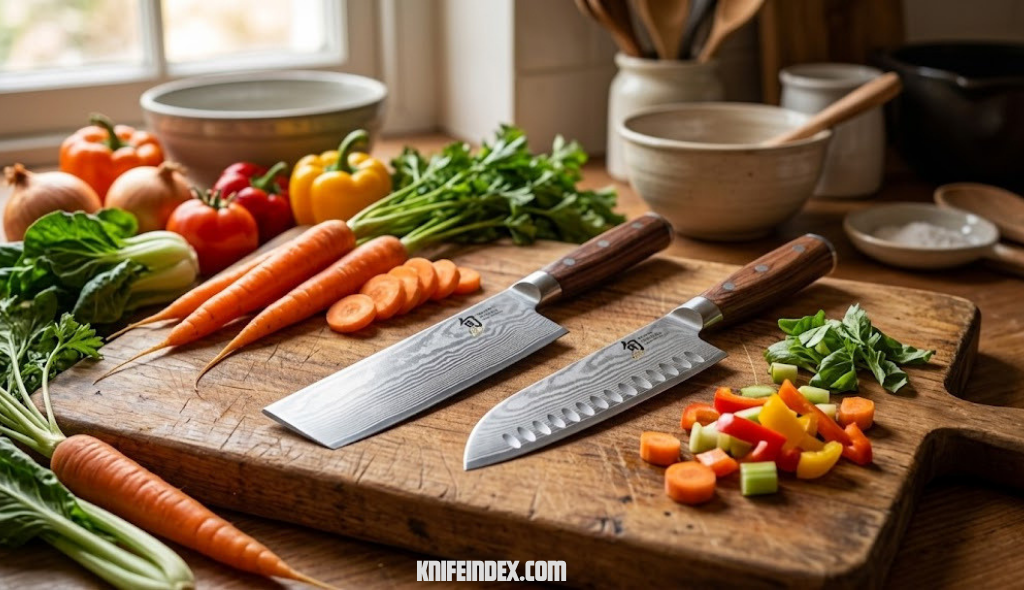
Want to see a dedicated nakiri in action first? This is the profile shape we’ll be referencing throughout the comparison — flat edge, tall blade, straight spine.
Check Nakiri Prices on Amazon2. Blade Shape and Edge Geometry Compared
Blade geometry is the single biggest factor separating these two knives, and it’s worth slowing down here because everything else — cutting motion, board contact, knuckle clearance — flows directly from it.
Nakiri: The Flat-Edge Rectangle
A nakiri blade typically runs 5 to 7 inches long and 1.75 to 2 inches tall, giving you a large, flat cutting surface with very little curvature anywhere along the edge. The spine is usually straight and parallel to the edge, which is why the whole knife reads visually as a rectangle rather than a wedge.
Most nakiris use a double bevel, meaning both sides of the edge are ground symmetrically — this differs from the traditional single-bevel usuba, which is the professional Japanese vegetable knife nakiris were adapted from for home kitchens.
Santoku: The Sheep’s-Foot Compromise
A santoku blade is usually 5 to 7 inches long as well, but the spine curves gently downward toward the tip while the edge stays mostly flat, meeting at a point that sits lower than the spine’s highest point. This is the sheep’s-foot profile, and it gives the santoku a small curved section near the tip that a nakiri simply doesn’t have.
That curved section is small — usually the last inch or two of blade — but it’s enough to allow a limited rocking motion, something a true nakiri can’t do at all because its edge has nowhere to pivot against the board.
For a deeper look at how curve and grind affect cutting performance more broadly, our guide on blade geometry and thin-versus-thick behind the edge breaks down why these small shape differences matter so much once steel meets food.
Tip Design and What It Means for Precision Work
The nakiri’s squared-off tip is a direct consequence of its flat edge — there’s simply no curved section left to taper into a point. This makes the nakiri nearly useless for tasks like scoring meat, piercing a package, or trimming around a bone, but it also means the entire blade length is usable cutting surface, with no wasted curvature near the tip that rarely touches the board anyway.
The santoku’s sheep’s-foot tip, by contrast, keeps a usable point without the aggressive upward curve you’d see on a Western chef’s knife or a gyuto. That makes it a middle ground — not as precise a point as a paring knife, but far more capable of detail work than a nakiri.
Blade Height and Board Clearance
Blade height — the distance from edge to spine — is another quiet but important difference. Nakiris are usually taller relative to their length than santokus, which is part of why they feel so substantial in hand despite often weighing about the same. That extra height isn’t just cosmetic; it directly increases the distance between your knuckles and the cutting board during a full downward chop, which matters more than most buyers expect until they’ve spent twenty minutes prepping vegetables with a shorter blade.
Spine Thickness and Wedging
Spine thickness — how thick the blade is at its top edge — affects how much a knife wedges into dense produce as it cuts deeper. Nakiris are often ground thinner behind the edge specifically because their entire job is slicing through vegetables cleanly, while santokus split the difference to remain sturdy enough for occasional protein work. If you’re comparing knives with noticeably different spine thickness, expect the thinner blade to glide through a daikon radish or a whole cabbage with less resistance and less of that telltale wedging “crack” partway through a cut.
3. Cutting Motion: Push-Cut vs Rock-Chop
Because of the geometry differences above, these two knives actually want to be used with different techniques — and using the wrong technique on either one is the single most common reason people feel underwhelmed after switching.
The Nakiri Push-Cut
A nakiri is built for a straight up-and-down push cut. You lift the knife, bring it straight down through the ingredient, and let the entire flat edge make contact with the board at once. There’s no rocking, no pivoting — it’s closer to a guillotine motion than a rolling one. This is extremely efficient for high-volume prep like julienning carrots, batonning zucchini, or breaking down a whole cabbage.
The Santoku Rock-Chop (Limited)
A santoku allows a shortened rock-chop, similar to what you’d do with a Western chef’s knife versus santoku rocking-versus-push-cut motion, but the curve is much less pronounced, so the rock is subtler and the tip does most of the work. Many santoku owners actually use it with a push-cut style anyway, since the flatter mid-section behaves almost like a shorter nakiri.
If you already lean on rocking cuts from years with a Western chef’s knife, the santoku will feel more familiar out of the box. If you’re happy to adapt your technique, the nakiri’s push-cut is arguably faster once you’re used to it, especially for repetitive prep.
Why Technique Matters More Than Marketing
A surprising number of disappointed knife owners aren’t actually unhappy with the blade itself — they’re unhappy because they kept using their old technique on a new shape. Someone who’s spent years rocking a Western chef’s knife through onions will naturally try the same motion on a nakiri, notice the tip doesn’t want to pivot smoothly, and conclude the knife is “wrong” somehow. In reality, the nakiri simply expects a different input.
The fix is almost always the same: lift the whole blade, bring it straight down through the ingredient, and let the flat edge do the work in one clean motion rather than a rolling one. It takes a surprisingly short adaptation period — most people report feeling comfortable within a few meals — but skipping that adjustment is the single biggest reason nakiris get returned or shelved after a disappointing first week.
The santoku is more forgiving here precisely because it splits the difference. You can lean on a shortened rock-chop near the tip for delicate work, or flatten your motion out for the wider mid-section of the blade when chopping through denser vegetables. That flexibility is part of why it’s often recommended as a first Japanese-style knife purchase.
4. Head-to-Head on Real Vegetables
Specs only tell you so much. Here’s how the two knives actually compare across the vegetables people cut most often at home.
Onions and Cabbage
The nakiri’s tall, flat blade shines here — you can chop through a whole onion or a wedge of cabbage without the tip catching or the blade rocking off-center. The santoku does fine too, but its slightly curved tip means the very last bit of the cut sometimes needs a small forward push to finish cleanly.
Carrots and Root Vegetables
Both knives handle dense root vegetables well, but the nakiri’s flat edge makes rapid julienne and brunoise cuts more consistent because every slice starts and ends the same way. The santoku’s curve gives you a bit more control if you’re cutting on a diagonal, which some cooks prefer for stir-fry prep.
Leafy Greens and Herbs
This is where the santoku’s rocking capability earns its keep — a light rock-chop through basil or parsley produces a fine chiffonade quickly. A nakiri can do this too with a rocking-adjacent motion, but because the edge is fully flat, most people default to a straight chop-and-scrape technique instead.
Squash and Dense Vegetables
Butternut squash, sweet potatoes, and other dense produce benefit from the nakiri’s taller blade, which gives your knuckles more clearance above the cutting board — a genuinely underrated comfort factor once you’re twenty minutes into meal prep. For very hard squash, a heavier gyuto-style chef’s knife may still out-muscle both, but between the two knives in this comparison, the nakiri usually wins on tall vegetables.
Tomatoes and Soft-Skinned Produce
Tomatoes are a genuine test of edge sharpness rather than blade shape, since a dull knife of either style will tear the skin instead of slicing through it cleanly. That said, the nakiri’s flat edge tends to produce more even slices because there’s no curve encouraging the blade to roll slightly as it moves through the fruit. A well-maintained santoku handles tomatoes just as capably, provided the edge is kept sharp and the cut starts with a light sawing motion to break the skin.
Potatoes and Batch Prep
For large-batch tasks like dicing potatoes for a big pot of soup, the nakiri’s straight push-cut genuinely speeds things up once you’ve built a rhythm — each stroke is identical, which makes repetitive cuts feel almost mechanical in a good way. The santoku can keep pace but tends to require slightly more wrist adjustment across dozens of repeated cuts, which some cooks notice as mild fatigue during very large batch-prep sessions.
Quick takeaway: nakiri for high-volume, repetitive vegetable chopping; santoku for mixed prep that jumps between vegetables, herbs, and the occasional piece of boneless protein.
5. Versatility Beyond Vegetables
This is the category where the santoku pulls ahead decisively, and it’s the main reason so many home cooks choose it as their single go-to knife instead of building out a full set.
A santoku can break down boneless chicken breast, slice cooked pork loin, portion fish fillets, and mince garlic — essentially covering the same territory as a Western chef’s knife, just in a shorter, lighter package. If you’re comparing it against dedicated slicing tools, our yanagiba versus sujihiki guide for slicing raw fish is a good next read once you’re ready to specialize further.
A nakiri, by contrast, struggles the moment you ask it to do anything outside vegetable prep. Its flat edge and squared-off tip make it a poor choice for piercing, trimming silverskin, or any task that needs a fine point. Some cooks keep a small paring knife on hand specifically to cover what the nakiri can’t.
| Task | Nakiri | Santoku |
|---|---|---|
| Chopping onions, cabbage, root vegetables | Excellent | Very good |
| Julienne / brunoise cuts | Excellent | Good |
| Chiffonade on herbs and greens | Good | Excellent |
| Slicing boneless meat or fish | Poor | Good |
| Mincing garlic and ginger | Good | Excellent |
| Piercing or fine detail work | Poor | Fair |
6. Full Comparison Table
| Attribute | Nakiri | Santoku |
|---|---|---|
| Primary purpose | Dedicated vegetable knife | General-purpose all-rounder |
| Blade shape | Rectangular, fully flat edge | Sheep’s-foot, slight curved tip |
| Typical length | 5″–7″ | 5″–7″ |
| Typical blade height | 1.75″–2″ | 1.5″–1.75″ |
| Bevel type | Usually double bevel | Usually double bevel |
| Best cutting motion | Straight push-cut | Push-cut with limited rock-chop |
| Knuckle clearance | High (taller blade) | Moderate |
| Handles meat/fish | Not recommended | Yes, reasonably well |
| Beginner-friendly | Very, for veg-focused cooks | Very, as a do-it-all option |
| Storage footprint | Single-purpose, an add-on knife | Can replace a chef’s knife entirely |

Leaning toward the all-rounder? A quality santoku is one of the easiest single-knife upgrades for a home kitchen that handles vegetables, meat, and fish.
Check Santoku Prices on Amazon7. Handle, Weight, and Ergonomics
Weight distribution affects fatigue more than most home cooks expect, especially during long prep sessions. Nakiris tend to feel blade-forward because of their tall, broad profile, which some cooks describe as giving extra “drop” to each chop with minimal wrist effort. Santokus are usually a touch lighter overall and better balanced between blade and handle, which can feel more nimble for quick, varied tasks.
Handle shape varies more by brand and price point than by knife type. Traditional Japanese-style handles (octagonal or D-shaped wa-handles) show up on both nakiris and santokus, while Western-style pistol-grip handles are common on budget and mid-range versions of either knife aimed at the U.S. market. If ergonomics and grip comfort across a whole knife lineup matter to you, it’s worth reading how handle materials like wood, G-10, and Micarta compare, since the same handle logic applies here.
Blade height is where the ergonomic difference is most noticeable in daily use. A taller nakiri blade lifts your knuckles further from the cutting board, which matters if you cut with a claw grip and tend to graze your fingers on shorter blades.
8. Steel, Edge Retention, and Sharpening
Steel choice is independent of whether a knife is shaped like a nakiri or a santoku — you’ll find both styles made in everything from soft stainless steels to high-hardness powder steels. That said, a few patterns show up often enough to be worth knowing.
Budget and mid-range nakiris and santokus commonly use steels like VG-10 or AUS-10, both of which hold an edge well and sharpen without excessive effort. Premium versions move toward harder Japanese steels like SG2 or higher-carbon blends, similar to comparisons you’ll see in our MagnaCut versus M390 breakdown for Western-style blades, though that piece focuses on folding knives rather than kitchen knives specifically.
Because nakiri edges are fully flat, they’re actually a little easier to sharpen consistently on a whetstone — there’s no curve to track, so maintaining a single bevel angle along the entire edge is more forgiving for beginners. A santoku’s slight curve near the tip requires a small angle adjustment as you work that section of the blade.
Sharpening a Nakiri
- Flat edge = consistent stone contact
- Easier for sharpening beginners
- Fewer angle changes needed
Sharpening a Santoku
- Curved tip needs angle adjustment
- Slightly steeper learning curve
- Still manageable with practice
9. Which One Suits Your Skill Level
Beginners often assume the santoku is the “safer” first purchase because it’s marketed as general-purpose, and that’s a reasonable instinct if you only want to own one knife. But if the majority of your cooking revolves around vegetables — stir-fries, soups, salads, batch meal prep — a nakiri can genuinely outperform a santoku on the tasks you’ll actually repeat most often.
Intermediate and advanced home cooks tend to end up owning both, using the nakiri for high-volume vegetable work and reaching for a santoku, or a full-size chef’s knife, when meat or fish enters the picture. If you’re building a knife collection gradually, our overview of five essential knife skills every home cook should master is a useful checkpoint for figuring out which techniques you’ll actually use day to day.
10. Pros and Cons Side by Side
Nakiri
Pros
- Unmatched consistency on vegetable-heavy prep
- Tall blade gives excellent knuckle clearance
- Flat edge is easier to sharpen evenly
- Fast, repetitive chopping motion once learned
Cons
- Poor for meat, fish, or piercing tasks
- No rocking motion available
- Adds to your knife roll rather than replacing anything
Santoku
Pros
- True all-rounder for vegetables, meat, and fish
- Can replace a full-size chef’s knife for many cooks
- Lighter, nimble feel for varied prep
- Familiar rocking motion for chef’s-knife users
Cons
- Slightly less efficient on pure vegetable volume
- Curved tip needs more careful sharpening
- Shorter blade height than a nakiri
11. Buying Guide: What to Look For
Whichever style you land on, a few shopping fundamentals apply to both:
- Full tang construction for balance and durability — see our comparison of full tang versus partial tang knives if you’re unfamiliar with why this matters.
- Forged versus stamped blades — forged blades typically offer better edge retention and balance; our forged versus stamped pros and cons guide covers the tradeoffs in detail.
- Rockwell hardness in the mid-to-high 50s to low 60s HRC range balances edge retention with ease of sharpening — our primer on understanding Rockwell hardness in kitchen knives explains what those numbers actually mean for daily use.
- Handle material that suits how often you hand-wash versus put knives in a dish rack.
- Brand reputation and warranty — established Japanese and German knife makers tend to offer more consistent heat treatment than unbranded imports.
If you want a broader shortlist before narrowing down to nakiri or santoku specifically, our roundups of the best nakiri knives for vegetable prep and best santoku knives for everyday cooking are good starting points with specific model picks at different price tiers.
12. Our Recommendations
If your cutting board sees more onions, carrots, and cabbage than anything else, get the nakiri — it’s a genuinely joyful upgrade for anyone who cooks vegetable-forward meals often. If you want one knife that does 80% of everything reasonably well, the santoku remains one of the smartest first purchases in Japanese-style cutlery.
And if budget allows, owning both isn’t overkill — it’s how a lot of home cooks naturally end up building their collection once they notice which tasks each blade handles best. For a broader perspective on how these two fit into a full lineup, our guide to santoku versus nakiri for the best vegetable prep setup and the 10 knife types and how edge geometry fits each task are worth bookmarking.

Ready to decide? Compare current listings for both styles side by side before you commit.
Browse Nakiri & Santoku Knives on Amazon13. Care, Storage, and Longevity
Neither knife demands unusual care compared to any other quality kitchen blade, but a few habits noticeably extend the life of both a nakiri and a santoku, especially if you’ve invested in a mid-range or premium version rather than a budget stamped blade.
Washing and Drying
Hand-wash both knives immediately after use and dry them right away rather than leaving them in a sink or dish rack. This matters more for carbon-leaning steels, which can develop surface rust within hours of sitting wet, but even stainless-leaning blades benefit from prompt drying to protect the edge from moisture-related dulling over time. If you’re dealing with an already-rusted blade, our guide on how to get rust off a knife walks through safe removal methods without damaging the edge.
Cutting Surface
Wood and quality plastic cutting boards are kind to both blade types; glass, stone, and ceramic surfaces will dull an edge far faster regardless of whether you’re using a nakiri or a santoku. Because the nakiri’s flat edge makes full contact with the board on every single cut, board choice arguably matters even more for nakiri owners than for santoku owners, who distribute contact across a slightly curved edge.
Storage
Both knives store well on a magnetic strip, in a knife block, or in individual blade guards — just avoid tossing either one loose into a drawer with other utensils, which is one of the fastest ways to chip a fine edge. If you’re setting up a small-kitchen storage solution, our roundup on small kitchen knife storage and magnetic strip layouts covers space-efficient options that work well for a nakiri’s taller profile.
Sharpening Routine
A quick honing before each use keeps either blade tracking straight, while a proper whetstone sharpening every few weeks — more often with heavy use — maintains the actual edge. As noted earlier, the nakiri’s flat profile is genuinely easier to keep consistent on a stone since there’s no curvature to track, making it a good candidate for cooks who are still building their freehand sharpening skills.
14. Common Myths, Debunked
Myth: A Nakiri Is Just a Cheaper Santoku
Not accurate. The two knives serve genuinely different purposes rather than sitting at different price tiers of the same tool. You’ll find budget and premium versions of both, and price has far more to do with steel quality and construction than with which shape you’re buying.
Myth: You Need Both to Cook Properly
Plenty of skilled home cooks get by with just one Japanese-style knife their entire cooking life. Owning both is a nice-to-have for people who prep vegetables heavily and also handle meat and fish regularly, but it’s far from mandatory for casual weeknight cooking.
Myth: Flat-Edge Knives Can’t Handle Curved Cuts
A nakiri can still produce diagonal and angled cuts — you simply adjust the angle of the ingredient or your wrist rather than relying on the blade’s curve to do it for you. It just requires a small mental shift for cooks used to rocking every cut through a curved blade.
Myth: Santoku Knives Are Only for Beginners
While it’s often recommended as a first Japanese knife, plenty of experienced cooks and even professional chefs keep a santoku in regular rotation specifically because of its versatility, not despite it.
Frequently Asked Questions
For pure vegetable volume, yes — the nakiri’s flat edge and tall blade make repetitive chopping faster and more consistent. The santoku is still very capable with vegetables, just slightly less specialized.
For many home cooks, yes. Its shorter, lighter profile handles most everyday tasks a Western chef’s knife would, though very large ingredients or heavy bones still favor a full-size chef’s knife or cleaver.
It’s designed exclusively for a straight push-cut motion on a cutting board, so a curve would actually reduce its efficiency at the one job it’s built for.
No. The usuba is a traditional single-bevel professional knife that the double-bevel nakiri was adapted from for home kitchens.
The nakiri is generally easier because its edge is completely flat, meaning you maintain one consistent angle across the whole blade without adjusting for curvature.
It’s not recommended. The flat, squared-off edge and lack of a point make it poorly suited to trimming, piercing, or slicing proteins.
Most home cooks do well with a 6.5 to 7 inch blade in either style — long enough for efficient prep without feeling unwieldy on a standard cutting board.
Yes, particularly in kitchens with heavy vegetable prep, though many professionals still prefer a gyuto or chef’s knife as their primary all-purpose tool.
Very much so. Its lighter weight, shorter blade, and general-purpose design make it approachable for cooks who aren’t ready to commit to a specialized vegetable-only knife.
VG-10 and AUS-10 are reliable mid-range choices, while higher-end versions use harder powder steels for improved edge retention.
Regular honing plus periodic whetstone sharpening keeps the flat edge consistent; because there’s no curve, this is one of the more forgiving knives to maintain at home.
If you cook a wide variety of meals, owning both is a natural progression — the nakiri for dedicated vegetable prep and the santoku as your everyday all-purpose blade.
Conclusion: Pick Based on What’s Actually on Your Cutting Board
The nakiri versus santoku decision isn’t really about which knife is objectively “better” — it’s about matching a blade’s design to how you actually cook. If vegetables dominate your weekly prep, the nakiri’s flat, tall blade will feel like an upgrade you didn’t know you needed. If your kitchen jumps between vegetables, meat, and fish on any given night, the santoku’s flexibility is hard to beat as a single go-to knife.
Either way, both are excellent additions to a home knife collection, and neither is a wrong choice — just a different tool for a slightly different job.

Found your match? See current prices and availability for top-rated nakiri and santoku knives.
Shop Japanese Kitchen Knives on Amazon