Kyocera Ceramic Chef Knife Review: Is This Featherlight Blade Worth Your Countertop Space?
An honest, hands-on look at edge retention, ergonomics, durability, and how this ceramic blade actually holds up against everyday kitchen work.
Introduction
There’s a specific kind of skepticism that comes with picking up a ceramic knife for the first time. It doesn’t feel like a “real” chef knife. It’s too light, too quiet on the cutting board, almost toy-like in the hand compared to the reassuring heft of forged steel. And yet ceramic blades have carved out a genuine following among home cooks who prize a razor edge that seems to shrug off dulling for months at a time. The Kyocera ceramic chef knife sits right at the center of that conversation, and after weeks of daily use in a real kitchen — chopping onions, slicing tomatoes, breaking down herbs, and prepping weeknight dinners — I have a much clearer picture of where this knife earns its reputation and where it falls short.
This review isn’t a marketing rehash. It’s a practical breakdown of what happens when you actually cook with this knife day after day, based on how it performs against the kind of tasks any home kitchen throws at a chef knife. If you’ve been circling the idea of adding a ceramic blade to your knife roll, or you’re simply trying to figure out whether ceramic is a gimmick or a genuinely useful material for a kitchen knife, this guide should answer that question in full.
Before diving into the details, it’s worth zooming out. Chef knives come in wildly different flavors of steel and construction, and understanding where this ceramic option sits relative to more traditional choices helps frame the review that follows. If you want a broader primer, our guide to the high-carbon steel vs stainless steel breakdown is a useful companion read, since ceramic behaves in ways that are genuinely distinct from both.
Check current pricing and availability
View on AmazonWhat Is the Kyocera Ceramic Chef Knife?
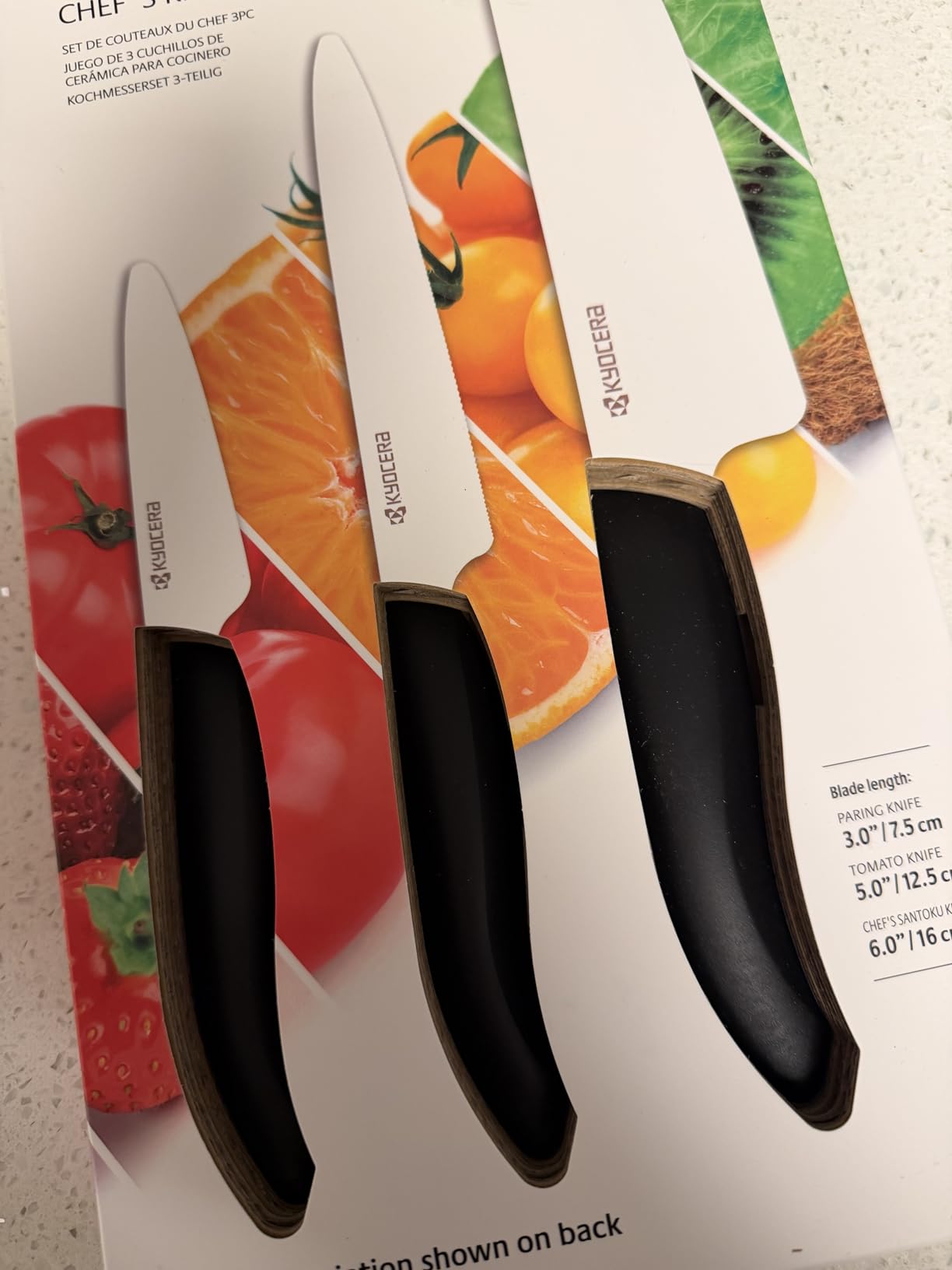
Kyocera is one of the few brands that took ceramic blade manufacturing seriously enough to build a dedicated cutlery division around it, rather than treating ceramic as a novelty add-on. The company’s advanced ceramics background actually comes from industrial and technical ceramics manufacturing, which is part of why their knives feel more like an engineered product than a kitchen gadget. The chef knife in this lineup uses a zirconium oxide blade, commonly shortened to zirconia, paired with a polypropylene handle designed to stay light and balanced.
The core pitch is simple: a blade material that’s harder than most kitchen steels, capable of holding a working edge for a genuinely long time, and immune to the kind of rust or metallic taste transfer that some steels can introduce to acidic foods. That’s the theory. The rest of this review digs into whether the practice matches it.
If you’re new to kitchen knife anatomy in general, it helps to understand the vocabulary before comparing materials — our breakdown of kitchen knife anatomy covers spine, bolster, tang, and edge geometry in plain language.
First Impressions and Unboxing
Pulling the knife out of its packaging, the first sensation is genuinely surprising: it’s light. Not “lighter than expected” light — it’s dramatically lighter than any comparable steel chef knife you’ve likely held, often by close to half the weight. For cooks used to the density of a forged German blade or a heavier Japanese gyuto, this initial impression can go one of two ways. Some people love the reduced wrist fatigue immediately. Others feel like something is missing, like the knife lacks the momentum needed to power through denser vegetables.
The blade itself has a matte black finish that’s become something of a visual signature for ceramic knives in this category. It doesn’t have the reflective polish of a stainless blade, and the edge, when you look closely, has a slightly different bevel angle than most steel knives — usually steeper, which matters more than it might sound like once you get into actual cutting performance.
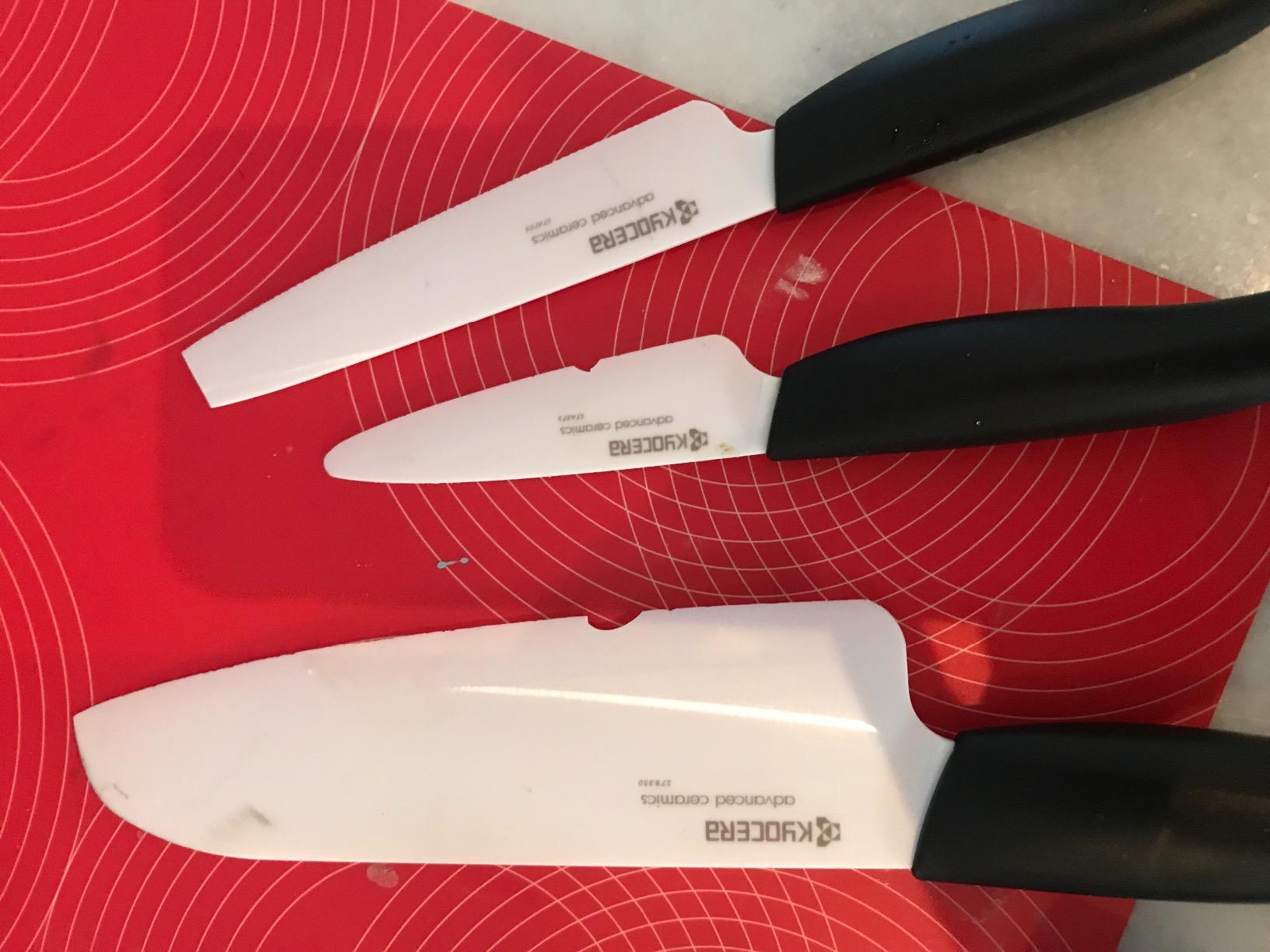


The handle finish is smooth polypropylene, molded into a shape that’s clearly built for a pinch grip rather than a full-fist wrap. It’s not going to feel like a premium wood or micarta handle, but it’s not trying to be. It’s trying to be light, hygienic, and dishwasher-tolerant, and on those specific goals it succeeds.
Design and Build Quality
Build quality on this knife is consistent rather than flashy. The blade-to-handle transition is a simple molded junction rather than a traditional full or partial tang construction you’d find in a steel knife — which makes sense, since ceramic can’t be forged or heat-treated the way steel can. If you’re used to reading about full tang vs partial tang knives as a durability signal, that comparison mostly doesn’t apply here; ceramic knives use an entirely different construction philosophy where the blade is essentially embedded and locked into the polymer handle during molding.
What stands out on close inspection is how consistent the bevel is along the entire length of the edge. Kyocera’s manufacturing tolerances for the ceramic blade are tight, and you don’t see the kind of micro-inconsistencies that show up on cheaper ceramic knives from lesser-known brands. The spine is thin, the blade tapers evenly, and the tip is fine enough for detail work like trimming fat or making small incisions in produce.
| Build Element | Detail | Why It Matters |
|---|---|---|
| Blade material | Zirconium oxide (zirconia) ceramic | Extremely hard, holds an edge far longer than most kitchen steels |
| Handle material | Polypropylene | Lightweight, non-porous, dishwasher tolerant |
| Blade finish | Matte black | Doesn’t show fingerprints or minor surface marks |
| Bevel angle | Steeper than typical steel knives | Contributes to extreme sharpness but also higher chip risk |
| Weight | Significantly lighter than steel equivalents | Reduces fatigue but changes cutting feel |
Understanding the Zirconia Blade Material
Zirconium oxide is technically classified as an advanced ceramic, and it sits in a completely different hardness category than kitchen steel. On the Mohs hardness scale, zirconia typically measures around 8, compared to most kitchen steels which fall somewhere between 5.5 and 6.5. That hardness gap is the entire reason ceramic blades can hold an edge for so long — the material simply resists abrasive wear from cutting boards and food fibers far better than steel does.
But hardness is a double-edged property, quite literally. Harder materials are almost always more brittle, and ceramic is no exception. Where a quality steel blade can flex slightly and absorb lateral stress, a ceramic blade has essentially zero flex. Twist it, drop it on a hard tile floor, or use it to pry apart a frozen block of food, and the ceramic won’t bend — it will chip or, in worse cases, snap.
This is the fundamental trade-off buyers need to understand before purchasing: you’re trading flexibility and impact resistance for edge longevity and stain immunity. If you’ve read our steel comparison guides like D2 vs 8Cr13MoV or S35VN vs S45VN, you already know that even among steels, harder alloys trade toughness for edge retention. Ceramic simply takes that trade-off to its logical extreme.
Handle Design and Ergonomics
The polypropylene handle on the Kyocera ceramic chef knife is molded with a slight contour that fits a pinch grip reasonably well, though it lacks the deep finger notches or bolster you’d find on higher-end Western knives. For cooks who use a hammer grip more than a pinch grip, the handle can feel a touch slim, especially if your hands run larger.
Because the entire knife weighs so little, balance point isn’t really a meaningful conversation the way it is with steel knives — there’s no heavy bolster or thick spine to balance against a handle. The knife essentially feels weightless throughout its length, which some cooks find liberating for fine prep work like mincing garlic or slicing herbs, and others find disorienting when trying to power through something like a butternut squash.
If ergonomics and balance are a top priority for you, it’s worth comparing against knives designed with a more traditional heft and grip profile, such as the Wusthof Classic 8-inch chef knife or the Zwilling Pro chef knife, both of which sit at the opposite end of the weight and balance spectrum.

See the full handle and grip detail in photos
View on AmazonReal Kitchen Performance
This is where the knife needs to prove itself, and it’s genuinely a mixed story depending on what you’re cutting.
Vegetables and Produce
On soft to medium-density vegetables — tomatoes, cucumbers, bell peppers, zucchini, mushrooms — the ceramic edge performs beautifully. Slices come away clean with almost no drag, and the fine, steep edge angle means thin cuts stay thin without tearing cell walls the way a duller blade would. Tomato skin in particular is where ceramic knives tend to shine, since the sharpness right out of the box is noticeably higher than most steel knives achieve without honing.
Herbs and Delicate Ingredients
Mincing herbs like parsley, cilantro, or basil is another strong point. The light weight actually helps here, since fast repetitive rocking motions don’t tire the wrist the way a heavier forged blade can over a long prep session.
Proteins
This is where the knife’s limitations become obvious. Ceramic is not designed for cutting through bone, cartilage, or anything requiring lateral twisting motion. It handles boneless, skinless cuts of meat reasonably well for slicing, but you should never use it for anything involving bone contact, tendon separation near joints, or breaking down a whole chicken. The brittleness of the material means an accidental strike against bone can chip the edge instantly.
Dense Root Vegetables
Butternut squash, whole carrots pressed straight down, and hard winter squash are genuinely risky territory. The thin, hard edge combined with low blade weight means you’re relying entirely on edge sharpness rather than blade mass to get through resistance, and twisting the blade even slightly to free it from a stuck cut is a common way ceramic edges chip.
For a deeper look at which knife shapes are actually built for this kind of heavy-duty vegetable work, our guide on the nakiri vs santoku comparison is worth reading before you decide whether ceramic alone should be your only kitchen blade.
Edge Retention and Sharpness Over Time
This is genuinely the standout category for this knife, and it’s not close. Where a typical stainless steel chef knife might need honing every few uses and a full resharpening every few weeks of regular cooking, the Kyocera ceramic blade held a usably sharp edge for well over two months of near-daily prep work before any noticeable dulling.
The science here lines up with expectations: because zirconia is so much harder than the fibers and starches in the food being cut, the edge simply doesn’t wear down through normal abrasive contact the way steel does. This is the single biggest selling point of ceramic blades as a category, and it’s the reason so many home cooks keep one in rotation purely for produce prep, even if they don’t want it as their only knife.
If long-term edge retention is your primary buying criterion, it’s worth comparing this against premium steel options engineered for the same goal, like the knives discussed in our single bevel vs double bevel breakdown, or steels covered in our VG-10 vs AUS-10 comparison, both of which are common choices among edge-retention-focused Japanese blades.
| Blade Type | Typical Edge Life (home use) | Sharpening Method |
|---|---|---|
| Kyocera ceramic (zirconia) | 8-12+ weeks | Diamond abrasive only |
| Standard stainless steel | 1-3 weeks | Whetstone, honing rod, pull-through sharpener |
| Premium powder steel (e.g. S35VN, M390 class) | 4-8 weeks | Whetstone or diamond stones |
Durability and Chip Risk
Durability is the honest counterweight to the edge retention story. Over the testing period, the blade developed one small chip near the tip after an accidental contact with a ceramic plate edge while transferring diced vegetables. It’s a minor cosmetic and functional flaw, but it illustrates the core risk profile of this material: any hard, sudden lateral impact is a real threat, in a way that simply doesn’t apply to a quality steel knife.
Dropping the knife on a tile or hardwood floor is the single biggest danger. Steel knives might get a small edge roll from a drop; ceramic knives can shatter or chip catastrophically. This isn’t a rare edge case reported by a few unlucky owners — it’s a well-documented characteristic of the material across every ceramic knife brand, not just Kyocera.
What Held Up Well
- No rust or corrosion after repeated contact with acidic foods like tomatoes and citrus
- No staining or discoloration over extended use
- Handle showed no cracking or wear after regular dishwasher cycles
Where Caution Is Needed
- One minor tip chip from accidental plate contact
- Never safe to use as a prying or twisting tool
- Cannot be used on frozen food or bone under any circumstances
If durability against impact and general abuse is a higher priority for you than raw edge retention, a full-tang steel option like the Ontario RAT-1 philosophy of rugged steel construction (though built for outdoor use, the toughness principle applies) or a proper forged kitchen knife will serve you better.
Maintenance and Sharpening
Day-to-day maintenance on this knife is actually simpler than most steel knives in some respects and more restrictive in others. Cleaning is straightforward — hand wash or dishwasher, no oiling required, no risk of rust if left slightly damp overnight (something that would be a real concern with a high-carbon steel blade).
Where it gets restrictive is sharpening. You cannot use a standard whetstone, a honing steel, or most pull-through kitchen sharpeners on this blade. Zirconia requires a diamond-coated sharpening tool specifically, because diamond is one of the only substances hard enough to actually remove material from the ceramic edge. Many ceramic knife owners end up sending their knives back to the manufacturer or a specialty sharpening service for a professional diamond-wheel resharpen once the edge does eventually dull, rather than attempting it at home.
If you already maintain a steel knife collection and are used to routines like the ones covered in our best knife sharpeners guide or our comparison of whetstone vs electric sharpeners, understand that none of that equipment works on this ceramic blade without a diamond abrasive surface specifically.

Ready to add this low-maintenance blade to your kitchen?
Check Latest PriceCeramic vs Steel Chef Knives: The Bigger Picture
It’s worth stepping back and putting ceramic knives in context against the broader universe of chef knives, because the decision to buy this Kyocera model really comes down to understanding what role it will play in your kitchen — main knife, or specialized second blade.
| Factor | Ceramic (Kyocera) | German Steel | Japanese Steel |
|---|---|---|---|
| Edge retention | Excellent | Moderate | Very good to excellent |
| Impact toughness | Poor | Very good | Moderate |
| Weight | Very light | Heavy | Light to moderate |
| Rust resistance | Total | Good | Varies by alloy |
| Sharpening ease | Difficult (diamond only) | Easy | Moderate |
| Best use case | Produce, herbs, boneless slicing | All-purpose, heavy chopping | Precision slicing, produce |
If you want to explore this comparison further through the lens of specific national knife-making traditions, our German steel vs Japanese steel comparison is a good next read, as is our piece on forged vs stamped knives if you want to understand how construction method changes overall knife feel and durability, independent of the ceramic vs steel question entirely.
It’s also worth understanding blade geometry more broadly, since the steep bevel on ceramic knives is functionally similar to the geometry discussed in our thin vs thick behind the edge guide — thinner geometry cuts more easily but chips more readily, which is exactly the ceramic trade-off in a nutshell.
Who Should Actually Buy This Knife?
Based on weeks of testing, this knife makes the most sense for a specific type of cook rather than as a universal recommendation. It’s an excellent fit if you:
- Do a lot of produce-heavy prep — salads, salsas, fresh vegetable sides, herb-forward cooking
- Want a dedicated tomato and citrus knife that never needs honing between uses
- Deal with wrist or hand fatigue and want the lightest possible chef knife for extended prep sessions
- Already own a primary steel chef knife and are looking for a specialized second blade
- Want to avoid rust maintenance entirely, especially in humid climates or for infrequent kitchen use
It’s a poor fit if you:
- Want a single do-everything chef knife for your entire kitchen, including proteins and dense vegetables
- Have young kids or a busy kitchen where knives get knocked around, dropped, or used interchangeably by multiple people
- Prefer sharpening your own knives on a whetstone without needing specialty diamond tools
- Value blade weight and momentum for chopping through dense produce
If a do-it-all steel knife sounds more like what you actually need, our roundup of best chef knives for home cooks is a solid starting point, and our guide to finding the best budget chef knife covers plenty of steel alternatives at a similar price point.
Pros and Cons Summary
Pros
- Exceptional edge retention, often lasting months between sharpenings
- Extremely lightweight, reducing hand and wrist fatigue
- Zero rust risk, ever, regardless of storage conditions
- No metallic taste transfer to acidic ingredients like tomatoes or citrus
- Sharp out-of-box edge that outperforms many steel knives on delicate produce
- Easy to clean, dishwasher tolerant handle
Cons
- Brittle edge prone to chipping on hard contact or twisting motion
- Cannot be sharpened with standard whetstones or honing rods
- Unsuitable for bone, frozen food, or dense root vegetables
- Handle ergonomics are basic compared to premium steel knives
- Feels unfamiliar and “too light” to cooks used to heavier blades
Alternatives Worth Considering
If after reading this you’re leaning toward a more traditional all-purpose blade, a few strong alternatives are worth comparing directly against this ceramic option:
- Global G-2 Chef Knife — another lightweight option, but in stainless steel with a more traditional edge that can be sharpened conventionally.
- Shun Classic Chef Knife — premium Japanese steel with excellent edge retention and none of the brittleness risk.
- Miyabi Birchwood Chef Knife — for cooks who want Japanese-level sharpness with a more traditional handle feel.
- MAC Chef Knives — a well-regarded middle ground between Japanese sharpness and everyday practicality.
- Victorinox Chef Knife — an affordable, tough, easy-to-sharpen workhorse if durability is your top priority.
For a broader sense of how ceramic stacks up structurally against these steel options, our dedicated ceramic vs steel hardness and edge retention comparison goes deeper into the metallurgy and material science side of this decision.

Still think ceramic is the right fit for your kitchen?
Buy on AmazonHistory and Origins of Ceramic Knives
Ceramic blades feel like a modern novelty, but the underlying technology is older than most people assume. Advanced ceramics — the engineering category that includes zirconia — grew out of industrial research in the mid-20th century, long before anyone thought to put the material into a kitchen knife. Aerospace engineers, and later the electronics industry, were drawn to zirconia and similar oxide ceramics because they combined extreme hardness with excellent resistance to heat and chemical corrosion. Those same properties, it turned out, translate almost perfectly into a cutting edge.
Kyocera itself began as a technical ceramics manufacturer in Kyoto, Japan, producing components for electronics and industrial machinery long before cutlery entered the picture. The leap into kitchen knives happened once the company’s ceramics engineers realized that a fine-grained zirconia formulation, sintered under carefully controlled heat and pressure, could be ground into an edge sharp enough to rival — and in some ways exceed — a steel blade straight off a whetstone. The first commercial ceramic kitchen knives reached the Japanese market in the early 1980s, and it took roughly two more decades for the category to gain meaningful traction in Western kitchens.
Part of that slow adoption curve was simple unfamiliarity. Cooks trained on steel knives had decades of intuition about how a blade should feel, how it should sound against a cutting board, and how it should be sharpened. Ceramic broke all three assumptions at once. It took a wave of ceramic-specific marketing — much of it from Kyocera directly — to teach a generation of home cooks that a knife could be excellent without ever touching a whetstone.
Today, ceramic knives occupy a stable, if niche, position in the broader kitchen knife market. They aren’t replacing steel wholesale, and they were never really positioned to. Instead, they’ve settled into the role this review keeps circling back to: a specialized tool for produce and delicate prep, sitting alongside a more traditional steel workhorse rather than replacing it outright. Understanding that history helps explain why the knife in front of you is shaped the way it is — every design decision, from the steep bevel to the featherweight handle, traces back to decades of ceramics engineering rather than centuries of blacksmithing tradition.
Kyocera’s Ceramic Knife Lineup Explained
One detail that trips up a lot of first-time buyers is that “the Kyocera ceramic knife” isn’t really one product — it’s a whole family of lines, each aimed at a slightly different type of cook. Understanding where the chef knife reviewed here sits within that lineup makes it easier to decide whether you actually want this exact model, a step up, or a step down.
At the entry level, Kyocera’s core ceramic series covers the basics: a handful of blade lengths in the signature black zirconia finish, paired with the polypropylene handle covered throughout this review. This is the most widely available tier, the one most likely to show up in general kitchenware retailers, and the one this review is built around.
Above that sits a more refined series aimed at cooks who want a nicer handle material — often a G10 composite or a more contoured polymer with better grip texture — while keeping the same zirconia blade chemistry underneath. The cutting performance is nearly identical to the standard line, since the blade material itself hasn’t changed; the upgrade is almost entirely about handle comfort and aesthetics rather than sharpness or edge retention.
Kyocera also produces a specialty tier built around colored blade coatings, double-beveled precision edges for particular cutting styles, and even a line manufactured using an “advanced ceramic” formulation with slightly improved fracture toughness compared to standard zirconia. These specialty blades tend to command a noticeable price premium and are typically marketed toward serious home cooks or small culinary studios rather than casual buyers.
Beyond the chef knife shape covered here, the broader lineup also includes ceramic santoku knives, paring knives, utility knives, bread knives with micro-serrated ceramic edges, and even ceramic peelers and mandoline blades that borrow the same zirconia manufacturing process. If you like the edge retention story in this review but want a smaller blade for produce-only tasks, the ceramic paring knife from the same core lineup is worth a look, since it shares the identical blade chemistry in a size better suited to peeling and trimming work.
| Lineup Tier | Handle Material | Typical Use Case | Relative Price |
|---|---|---|---|
| Core / Standard Series | Polypropylene | Everyday produce prep, first ceramic knife | $ |
| Contoured / Comfort Series | G10 composite or textured polymer | Same performance, improved grip comfort | $$ |
| Advanced / Specialty Series | Premium polymer or wood-composite | Enthusiasts wanting improved fracture toughness | $$$ |
Blade Length and Size Guide
Ceramic chef knives are typically offered in a narrower range of blade lengths than steel knives, largely because manufacturing a longer zirconia blade without introducing weak points in the ceramic is genuinely difficult. Understanding the size options helps you pick the right blade for the tasks you actually do most.
3-Inch Paring Blade
The smallest size in most ceramic lineups, this length is built for peeling, trimming, and other close-in-hand tasks. It’s not a chef knife substitute, but it’s an excellent companion piece if you want ceramic’s edge retention for small precision work.
4.5-Inch Utility Blade
A middle-ground size that splits the difference between a paring knife and a full chef knife. This length works well for slicing single tomatoes, trimming small cuts of boneless protein, or handling produce that’s too large for a paring blade but doesn’t need full chef-knife leverage.
5.5-Inch Santoku-Style Blade
This size shows up frequently in ceramic lineups because the shorter length reduces the risk of blade flex and fracture compared to a full-length chef knife, while still offering enough surface area for rock-chopping herbs and slicing vegetables.
7-Inch Chef Knife (Reviewed Here)
The size covered throughout this review, and the largest that most ceramic manufacturers, including Kyocera, are comfortable producing at scale. Anything longer starts to introduce real structural risk in a material this brittle, which is part of why you rarely see an 8-inch or 10-inch ceramic chef knife the way you would in steel.
If you’re deciding between these sizes for your first ceramic knife, our broader piece on best chef knives for home cooks covers how blade length should match your typical cutting board size and hand size, a consideration that matters even more with ceramic given how differently it handles compared to steel at each length.
White Ceramic vs Black Ceramic Blades
Beyond the matte black finish reviewed here, Kyocera and other ceramic knife manufacturers also produce white-bladed ceramic knives, and buyers often assume the color difference is purely cosmetic. It isn’t, entirely.
White zirconia is the more common, more widely used formulation across the ceramics industry as a whole, produced through a standard sintering process. Black zirconia, by contrast, typically undergoes an additional processing step — often involving a controlled introduction of carbon during sintering — that alters the crystal structure slightly and, according to some manufacturers, improves the blade’s fracture toughness marginally compared to white zirconia of the same grade. Kyocera has favored black blades in much of its consumer chef knife lineup partly for this reason and partly because the darker finish hides the kind of minor surface haze that shows up on white ceramic after months of cutting board contact.
From a pure cutting performance standpoint, the difference between well-made white and black ceramic blades is small enough that most home cooks won’t notice it in daily use. The larger practical difference is visual: white blades show discoloration from certain foods — turmeric and beet juice are common culprits — more readily than black blades, which mask staining almost entirely. If kitchen aesthetics and staining resistance matter to you, black ceramic like the knife reviewed here has a real, if modest, practical edge over white ceramic alternatives.
How Ceramic Knife Blades Are Actually Made
Understanding the manufacturing process behind a zirconia blade explains a lot about both its strengths and its limitations, and it’s a genuinely different process from steel knife forging from start to finish.
Production begins with zirconium oxide powder, refined to a very fine, consistent particle size. This powder is mixed with a binding agent and pressed into a rough blade-shaped blank under significant hydraulic pressure — essentially compacting the powder into a dense, uniform shape rather than casting or forging it the way molten steel would be shaped. This pressed blank, sometimes called a “green” blade at this stage, is still soft and chalky, nowhere near its final hardness.
The critical step comes next: sintering. The pressed blank is fired in a kiln at extremely high temperatures, often exceeding 1,400 degrees Celsius, for an extended period. This process fuses the zirconia particles together at a molecular level, eliminating internal porosity and transforming the soft green blank into the dense, glass-hard ceramic that ends up in your kitchen. The blade actually shrinks noticeably during this firing process, which means manufacturers have to press the initial blank oversized to compensate for the shrinkage and land on the correct final dimensions.
Once sintered, the blade is far too hard to be shaped with conventional steel-cutting tools. Grinding the edge and profile requires diamond-coated grinding wheels, the same principle that makes diamond sharpening tools necessary for home maintenance later in the knife’s life. This grinding stage is also where manufacturing quality separates budget ceramic knives from premium ones — tight, consistent tolerances during diamond grinding produce the kind of even, reliable bevel discussed earlier in this review, while looser tolerances on cheaper blades produce the micro-inconsistencies that lead to premature chipping.
Finally, the ground blade is set into its handle, typically through an injection-molding process where the polypropylene or composite handle material is molded directly around the blade’s tang section, locking it in place without adhesives or mechanical fasteners in the way a traditional riveted steel handle would be assembled.
Storage, Sheaths, and Blade Protection
Given everything covered so far about chip risk, how you store this knife between uses matters more than it would with a steel blade. A few storage approaches are worth considering specifically for ceramic.
Blade Sheaths and Edge Guards
Most ceramic chef knives, including this one, ship with a rigid plastic blade guard. Using it consistently — every single time the knife goes into a drawer — is one of the cheapest, easiest ways to prevent the exact kind of edge contact that leads to chipping. Unlike a steel knife, where a missing sheath is mostly a safety concern for whoever reaches into the drawer next, a missing sheath on a ceramic blade is also a real durability concern for the edge itself.
Knife Blocks
Traditional wooden knife blocks work fine for ceramic knives, but pay attention to the slot width and depth. A slot that’s too tight can force you to angle the blade awkwardly on insertion, increasing the odds of the tip catching the wood at a bad angle. A slot that’s too loose lets the blade wobble against the block’s interior surface during normal kitchen movement, which over months of contact can contribute to minor edge dulling or chipping at contact points.
Magnetic Knife Strips
Magnetic strips are popular for steel knives because the blade is drawn to and held by the magnet. Ceramic isn’t magnetic at all, which means a standard magnetic strip won’t hold a ceramic knife securely — it may rest against the strip briefly but can slide or fall with much less resistance than a steel blade would experience. If you rely on a magnetic strip for the rest of your knife collection, this ceramic chef knife likely needs a separate storage solution rather than sharing the same strip.
In-Drawer Knife Trays
A padded, slotted in-drawer tray is arguably the safest storage option for a ceramic blade specifically, since it isolates the knife from both other utensils and the drawer’s hard interior surfaces, while keeping the sheath or guard in place without additional handling.
Cutting Board Compatibility
The cutting board you pair with a ceramic knife has a bigger impact on both blade longevity and edge performance than most buyers expect, and getting this wrong is one of the fastest ways to prematurely chip an otherwise well-maintained blade.
Wood and quality plastic or composite cutting boards are both fine choices for ceramic blades — they’re soft enough relative to the zirconia edge that normal chopping and slicing contact doesn’t meaningfully stress the blade. Where things go wrong is with harder surfaces: glass cutting boards, stone or marble slabs, and ceramic or stoneware plates used as makeshift cutting surfaces are all considerably harder, in practical terms, than the wood or plastic a ceramic blade is designed to work against. Cutting directly on any of these hard surfaces is one of the single most common causes of edge chipping reported by ceramic knife owners, since the interaction essentially becomes ceramic edge against a comparably hard or harder surface, repeated hundreds of times per prep session.
This also explains the chip that developed during testing for this review — it happened from incidental contact with a ceramic plate edge, not from normal cutting board use, which underscores just how much surface hardness matters with this blade material specifically. If you cook frequently on glass or stone surfaces, either by habit or kitchen design, that alone might be reason enough to skip a ceramic chef knife in favor of a steel option that tolerates harder surfaces with far less consequence.
Left-Handed Use and Grip Notes
The good news for left-handed cooks is that this knife, like most Western-style double-beveled chef knives, is fully symmetrical in its bevel geometry, meaning there’s no inherent handedness bias in how the edge cuts. Unlike some traditional single-bevel Japanese blades, which are typically ground for right-handed use unless specifically ordered otherwise, this ceramic chef knife performs identically regardless of which hand is doing the cutting.
The handle shape is similarly neutral — there’s no asymmetric bolster or contoured grip favoring one hand’s anatomy over the other, which is actually one of the few ergonomic advantages of the simpler polypropylene handle design over some more sculpted steel knife handles that are subtly optimized for a right-handed grip. Left-handed cooks who’ve struggled with the handle geometry on certain premium Japanese or German knives generally report no such issue here.
Common Mistakes New Owners Make
A large share of the negative reviews ceramic knives receive online trace back to a handful of avoidable mistakes rather than genuine product flaws. Knowing these ahead of time will meaningfully extend the life of the blade.
- Using it as a multi-purpose tool. Prying open packaging, popping a lid, or using the spine to scoop food off a board with twisting pressure are all common habits carried over from steel knife use that put unnecessary lateral stress on a material that has essentially no tolerance for it.
- Cutting on the wrong surface. As covered above, glass, stone, and ceramic surfaces are a fast track to chipping. Stick to wood or quality plastic boards exclusively.
- Attempting to cut frozen food “just this once.” Frozen food density is wildly inconsistent from one spot to the next, and it’s one of the highest-risk categories for sudden edge chipping.
- Storing it loose in a drawer without the sheath. Even brief contact with other metal utensils during normal drawer use can nick a ceramic edge in ways that wouldn’t meaningfully affect a steel blade.
- Trying to sharpen it with a standard sharpener. Running a ceramic blade through a pull-through sharpener designed for steel does essentially nothing productive and can actually damage the edge further, since the sharpener isn’t hard enough to properly abrade the ceramic in the first place.
- Applying too much downward force out of habit. Cooks used to heavier steel knives sometimes compensate for what feels like a “flimsy” light blade by pressing harder than necessary, which increases stress on the edge rather than improving cutting performance.
Cost Analysis: Long-Term Value
Ceramic knives occupy an interesting middle position in the value conversation, and it’s worth breaking down the actual costs involved beyond the sticker price alone.
The upfront cost of a quality ceramic chef knife like this one is typically comparable to a mid-range stainless steel chef knife, not dramatically more or less expensive. Where the cost conversation gets more interesting is in ongoing maintenance. A steel knife used daily needs regular honing, periodic professional or at-home sharpening, and occasional oiling if it’s high-carbon steel — all of which carry either a time cost, a tool cost, or both over the life of the knife.
Ceramic largely eliminates that ongoing cost during the edge’s long working life, since months can pass without any maintenance at all beyond normal washing. The cost reappears, though, once the edge does eventually dull, since home sharpening isn’t realistic without investing in diamond-specific sharpening equipment, and many owners instead pay for professional diamond-wheel resharpening — a service that isn’t as widely available as standard knife sharpening and often costs more per sharpening than a standard steel knife service would.
Then there’s the replacement cost risk. A steel knife that gets dropped or knocked around might need a minor edge repair; a ceramic knife that suffers a bad enough impact may need to be replaced outright, since a fractured or badly chipped ceramic blade generally can’t be repaired the way a steel edge can be reground. For households where knives get handled roughly, that replacement risk is a real cost variable that a pure sticker-price comparison misses entirely.
Net-net: for a careful cook doing mostly produce and herb prep, the total cost of ownership over several years often comes out favorably compared to steel, purely because of how rarely maintenance is needed. For a rougher kitchen environment, the math tips back toward steel once you factor in realistic replacement risk.
What Professional Chefs Actually Think
Professional kitchens are a useful data point here, because commercial kitchen environments are about as demanding a stress test as a knife can face — high volume, fast pace, frequent handoffs between cooks, and surfaces that aren’t always ideal.
Broadly, ceramic knives see limited adoption as a primary knife in professional kitchens, and the reasons echo everything covered in this review. Commercial kitchens move fast, knives get set down on all kinds of surfaces under time pressure, and the kind of careful handling ceramic requires is genuinely difficult to guarantee in a high-volume line environment with multiple cooks sharing tools. Bone-in proteins, frozen product, and quick multi-purpose knife use (prying, scraping, tapping) are also far more common in professional settings than in a typical home kitchen, all of which work against ceramic’s core weaknesses.
That said, ceramic does show up in specific professional contexts: dedicated garde manger stations focused purely on cold prep, produce-forward restaurants, and sushi or sashimi programs where a chef might keep a ceramic blade specifically for citrus segments or delicate garnish work where the edge retention pays off and the risk of hard-surface contact is lower and more controllable. Some pastry chefs also favor ceramic for slicing fruit garnishes, where the total absence of metallic taste transfer is a genuine, if subtle, quality difference in delicate applications.
The overall professional consensus mirrors the home cook recommendation in this review almost exactly: ceramic as a specialist tool for a narrow set of tasks, not as a primary all-purpose blade.
Ceramic Knife Myths, Debunked
Myth: Ceramic Knives Never Need Sharpening
Not true. Ceramic holds an edge dramatically longer than steel, but it does eventually dull with enough use. The difference is the timeline — months rather than days or weeks — not the fact that sharpening is ever needed at all.
Myth: Ceramic Knives Are Fragile and Will Break With Normal Use
Overstated. Normal cutting on an appropriate surface — wood or plastic — is genuinely low-risk. The fragility concern is specifically about impact, twisting, and prying, not standard slicing and chopping motion.
Myth: You Can Sharpen Ceramic Knives on a Regular Whetstone If You’re Patient Enough
Also not true. Regardless of time or patience invested, a standard aluminum oxide or water-based whetstone simply isn’t hard enough to meaningfully abrade zirconia. Diamond abrasive is a hard technical requirement, not a convenience recommendation.
Myth: Ceramic Knives Are Always Lower Quality Than Steel Knives
Quality is about manufacturing consistency and material grade, not the material category itself. A well-made ceramic knife from an established manufacturer with tight grinding tolerances outperforms a poorly made steel knife in the categories ceramic is actually good at, just as a cheap ceramic knife with loose tolerances will underperform a quality steel blade.
Myth: Ceramic Knives Are Bad for the Environment Because They Can’t Be Recycled Like Steel
This one is more nuanced than a flat myth or fact. Ceramic isn’t recyclable in the same municipal streams as steel, but the manufacturing process for zirconia is also less energy-intensive in certain respects than steel forging and heat treatment. Neither material has a dramatically clean environmental profile once you account for mining, processing, and manufacturing energy in full, and buyers shouldn’t assume either material category has an obvious sustainability edge over the other.
Ceramic Knives for Travel and Camping
The lightweight nature of ceramic knives makes them appealing for travel, RV kitchens, or camping setups where every ounce in a pack matters, and the total absence of rust risk is a genuine advantage in humid or unpredictable outdoor storage conditions where a steel blade would need more careful drying and oiling.
That said, travel and camping environments are also exactly the kind of unpredictable, bump-prone conditions that put a brittle ceramic edge at the highest risk. A knife rattling around in a duffel bag, a cooler, or a camp kitchen box is far more likely to experience the kind of impact that chips ceramic than a knife living quietly in a stationary kitchen drawer. If you do want to bring a ceramic knife along for a trip, a rigid, well-padded case — not just the thin plastic sheath it ships with — is a worthwhile investment, along with packing it in a spot where it won’t shift or get compressed against other hard gear.
For rougher outdoor use specifically — camp cooking involving bone-in proteins, frozen food, or general rough handling — a tough, easily field-sharpened steel knife or a dedicated fixed-blade outdoor knife like the Ontario RAT-1 is a substantially safer choice than trusting a ceramic edge to survive the unpredictability of travel.
Is This a Good Gift?
Kitchen knives are a popular gift category, and ceramic knives specifically have some genuine advantages as a gift, along with a few considerations worth flagging before you wrap one up for someone else’s kitchen.
On the positive side, the “wow” factor of an unusually light, striking matte black blade makes for a memorable unboxing moment, and the near-zero maintenance requirement means the recipient doesn’t need to already own sharpening equipment or knife-care habits to enjoy it immediately — unlike gifting a premium steel knife to someone without a whetstone, where the edge will dull without follow-up investment in maintenance tools.
The consideration to flag: if you don’t know the recipient’s kitchen habits well, a ceramic knife carries some risk of disappointment if they’re a rougher, more casual cook who’s likely to use it on glass cutting boards, cut frozen food, or generally treat it the way they’d treat a forgiving steel utility knife. For a recipient you know to be a careful, produce-focused home cook, or someone who already owns a steel workhorse and wants a specialized second blade, this knife is a genuinely thoughtful, distinctive gift. For someone whose kitchen habits are unknown or known to be rough on tools, a tougher steel option is the safer gift choice.
Warranty and Customer Support
Kyocera generally backs its ceramic cutlery with a standard limited warranty covering manufacturing defects in the blade and handle — the kind of coverage you’d expect from an established cutlery brand, protecting against issues like a defective bond between blade and handle or inconsistent grinding that leads to premature edge failure under normal use.
What this warranty typically does not cover, and this is worth understanding clearly before purchase, is damage from drops, impacts, twisting, prying, or cutting on inappropriate surfaces — in other words, the exact failure modes covered at length throughout this review. Warranty claims tied to chipping from a dropped knife or contact with a hard cutting surface are considered user-caused damage rather than a manufacturing defect, and are handled accordingly.
For sharpening support specifically, Kyocera and several third-party specialty sharpening services offer mail-in resharpening using diamond-wheel equipment, which is worth researching and budgeting for before you need it, rather than discovering the requirement only once the edge has already dulled. Keeping the original packaging and any documentation that came with the knife is a reasonable practice in case you do need to pursue a warranty claim for a genuine manufacturing issue down the line.