Santoku vs. Nakiri Knife: Which Japanese Blade Belongs in Your Kitchen?
If you are exploring the world of best Japanese kitchen knives, you have likely encountered two fascinating shapes: the versatile Santoku and the specialized Nakiri. Unlike the Western Chef’s knife, these blades are designed for precision, agility, and the joy of slicing.
But when you have to choose just one, the decision gets tricky. Do you want the multi-purpose utility of the Santoku (“Three Virtues”)? Or do you crave the vegetable-decimating power of the rectangular Nakiri?
In this comprehensive guide, we will break down the geometry, the best uses, and the pros and cons of each. Whether you are a fan of German engineering (like Wusthof vs Zwilling vs Shun) or a Japanese purist, understanding these two profiles is essential for building your perfect kit.
1. The Contenders: Definitions and Origins
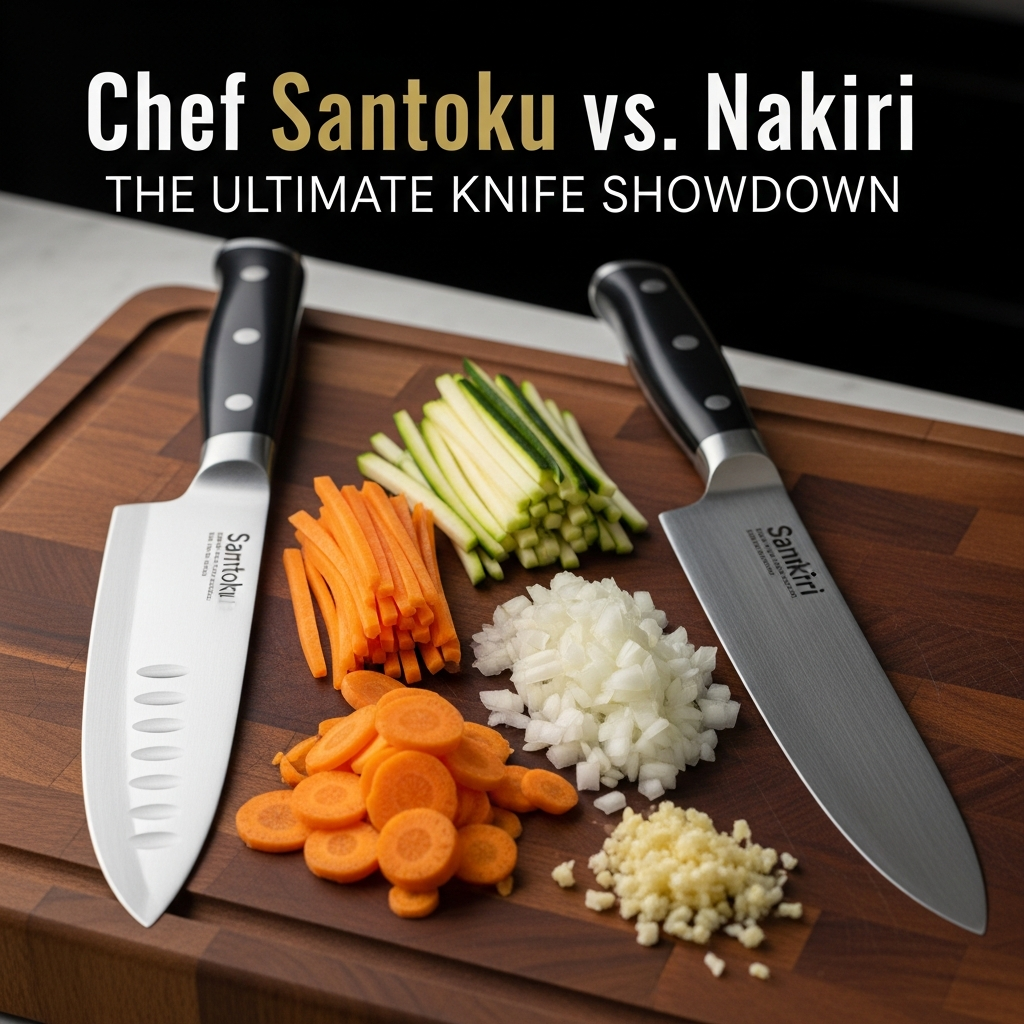
The Santoku (The Hybrid)
The Santoku is Japan’s answer to the Chef’s Knife. Its name translates to “Three Virtues,” referring to its ability to slice, dice, and mince meat, fish, and vegetables. It features a pointed tip (though less aggressive than a Chef’s knife) and a flatter edge. For a deep dive, read our guide: What is a Santoku Knife Used For?
The Nakiri (The Specialist)
The Nakiri is a double-beveled vegetable cleaver. It is rectangular, with a flat edge and a blunt, square tip. It is not designed for meat or bones. It is designed to process mountains of vegetables without the “accordion” effect (where slices stick together). Learn more here: What is a Nakiri Knife Used For?
Where Did These Shapes Come From? A Short History
To really understand the Santoku vs. Nakiri debate, it helps to look backward. Japanese blacksmithing has produced dozens of specialized blade shapes over the centuries, each tied to a specific ingredient or technique. The Nakiri is the older of the two silhouettes by a wide margin. It descends from traditional vegetable cleavers used in home kitchens across Japan for generations, long before stainless steel or mass manufacturing existed. Its rectangular profile was a practical solution: a flat edge meant a cook could chop straight down through a daikon radish or a stack of cabbage leaves without the blade skating forward or backward, and the tall, uniform blade gave the fingers holding the food plenty of clearance from the cutting board.
The Santoku, by contrast, is a relatively modern invention. It emerged in Japan in the years following World War II, roughly in the late 1940s and early 1950s, as home kitchens began shifting away from the heavier, more specialized blades used by professional sushi chefs and fishmongers. Manufacturers wanted something a household cook could use for nearly everything: trimming a piece of chicken, slicing cucumbers, mincing garlic, portioning fish. The result borrowed the flatter edge of the Nakiri and grafted on a rounded, sheep’s-foot tip reminiscent of a scaled-down Gyuto (the Japanese equivalent of a Western chef’s knife). That hybrid design is why the Santoku still feels closer to a chef’s knife in the hand, even though its cutting motion has more in common with the Nakiri than most people realize.
Interestingly, some knife historians note that the Santoku was originally marketed, in part, as a simplified alternative to the Nakiri for younger cooks who found the fully flat vegetable cleaver awkward to control. Over the following decades that positioning flipped: today the Santoku is the default “starter” Japanese knife sold in most Western retail stores, while the Nakiri has become the knife serious home cooks graduate to once they realize how much vegetable prep dominates everyday cooking.
Video Demonstration
Seeing is believing. Watch this video to see the difference in cutting motion between these two iconic blades.
2. Head-to-Head: The Specs Breakdown
| Feature | Santoku | Nakiri |
|---|---|---|
| Shape | Sheep’s Foot Tip, Slight Belly | Rectangular, Flat Edge |
| Tip | Pointed (Useful for detail) | Square/Blunt (Safety) |
| Motion | Push-Cut & Slight Rock | Straight Up-and-Down Chop |
| Best For | Meat, Fish, Veggies | Vegetables Only |
| Length | 5″ to 7″ | 5″ to 7″ |
3. The Technique: How They Cut
The biggest difference is the cutting motion.
Using a Santoku
Because the Santoku has a slight curve (belly) near the tip, you can perform a modified rocking motion, though it excels at the “push-cut” (pushing forward and down). It bridges the gap between a Chef Knife vs Santoku. This makes it comfortable for users transitioning from Western knives.
Using a Nakiri
The Nakiri is flat. Dead flat. If you try to rock it, the tip will dig into the board. You use a straight up-and-down chopping motion. This allows for incredibly fast, paper-thin slices of cucumber or cabbage. The rectangular shape also acts as a spatula to scoop up food.
3b. Blade Geometry: Bevels, Edge Angles, and Steel
Once you get past the silhouette, the real personality of a knife is hiding in its bevel and its steel. This is where a lot of shoppers get confused, because two knives that look almost identical on a product photo can behave completely differently on the cutting board.
Single-Bevel vs. Double-Bevel
Most Santoku and Nakiri knives sold outside Japan are double-beveled, meaning the edge is ground symmetrically on both sides, just like a Western chef’s knife. This makes them approachable for both right- and left-handed cooks and easy to sharpen on a standard whetstone or pull-through sharpener.
However, traditional Japanese artisans also produce single-bevel versions of both shapes, most commonly the Nakiri’s cousin, the Usuba. A single-bevel edge is ground almost entirely on one face, leaving the other nearly flat. This geometry produces an extraordinarily clean, almost polished cut, which is why single-bevel blades are prized for decorative vegetable work like katsuramuki (paper-thin daikon peeling). The tradeoff is that single-bevel knives are handed — a right-handed single-bevel Usuba will fight you constantly if you are left-handed — and they demand far more sharpening skill to maintain correctly.
Typical Edge Angles
Edge angle is measured per side, and it has a huge effect on how a knife feels:
- Western-style Santoku (Wusthof, Zwilling, Mercer): Usually sharpened around 15 to 20 degrees per side. This produces a slightly more durable, forgiving edge that tolerates a bit of contact with bone or a cutting board’s edge.
- Japanese-style Santoku (Shun, Miyabi, Tojiro): Typically sharpened closer to 12 to 15 degrees per side. Thinner angles mean a noticeably sharper edge out of the box, but also a blade that chips more easily if twisted or used on hard surfaces.
- Nakiri (most brands): Because the Nakiri never needs to survive a rocking motion or contact with bone, manufacturers can push the edge angle even thinner, often 10 to 15 degrees per side, for maximum slicing performance on produce.
Steel Types You’ll Encounter
Steel choice drives edge retention, sharpenability, and price more than almost any other spec:
- VG-10: A workhorse Japanese stainless steel found in mid-range Santoku and Nakiri knives (Tojiro, many Shun lines). Good balance of edge retention and ease of sharpening.
- VG-MAX / VG-XEOS: Shun’s proprietary upgrade to VG-10, with added chromium, cobalt, and tungsten for longer edge retention.
- SG2 / R2 Powdered Steel: A premium powdered stainless steel used in high-end Miyabi and boutique Japanese knives. Extremely hard, holds an edge a long time, but more brittle and pricier.
- German Stainless (X50CrMoV15): Used by Wusthof and Zwilling in their Santoku lines. Softer than Japanese steels, which means it dulls faster but is far more chip-resistant and forgiving for beginners.
- High-Carbon Blue or White Steel (Aogami/Shirogami): Found in traditional, often single-bevel, artisan Nakiris and Usubas. Takes an exceptionally keen edge but requires diligent drying to prevent rust.
3c. Weight, Balance, and Handle Styles
Beyond blade shape, the way a knife feels in your hand comes down to weight distribution and handle design, and this is another area where Santoku and Nakiri knives diverge from brand to brand.
Wa-Handle vs. Western Handle
Japanese-made Santoku and Nakiri knives are typically sold with one of two handle styles:
- Wa-handle: A traditional, lightweight, often octagonal or D-shaped wooden handle attached with a simple tang that slides into the handle rather than running through it. Wa-handled knives are noticeably lighter and more blade-forward, which many cooks find gives finer control during precision vegetable work.
- Western (Yo) handle: A heavier, riveted handle similar to what you’d find on a German chef’s knife, often with a full or partial tang running through the handle for added balance and durability. Shun’s Classic line and most Wusthof Santokus use this style.
Neither style is objectively better — it’s a matter of preference. Cooks who grew up using Western knives often find the Yo-handle more intuitive, while those chasing an authentic, ultra-light feel for rapid vegetable prep tend to gravitate toward Wa-handled Nakiris.
Blade Height and Knuckle Clearance
One underrated spec is blade height (the distance from the edge to the spine). Nakiri blades tend to be taller than Santoku blades of the same length, which matters more than people expect: taller blades give your knuckles more clearance above the cutting board, reducing hand fatigue during long vegetable prep sessions like slicing a full head of cabbage or a bag of onions.
3d. Knife Skills: Techniques That Work Best With Each Shape
Beyond the basic push-cut versus chop distinction, certain classic knife techniques genuinely favor one shape over the other. Knowing which is which can speed up your prep time considerably.
Julienne and Batonnet Cuts
Both knives handle these long, uniform strips well, but the Nakiri has a slight edge (pun intended) when working through a large volume, like prepping a full sheet pan of stir-fry vegetables. Its tall, flat blade lets you use a “guide hand” knuckle technique to slide quickly along a carrot or zucchini without the blade’s curve interrupting your rhythm.
Brunoise and Fine Dice
This is where the Santoku’s pointed tip earns its keep. Fine dicing requires a bit of rocking and pivoting at the tip to break down julienned strips into small cubes, and the Santoku’s rounded point makes that pivot far more natural than the Nakiri’s squared-off corner, which can catch or require you to lift the whole blade off the board.
Chiffonade (Ribboning Herbs and Leafy Greens)
Stack, roll, and slice — this classic technique for basil, mint, or leafy greens works beautifully with either knife, though the Nakiri’s straight edge produces slightly cleaner ribbons with less bruising on delicate herbs, since there’s no curved belly dragging through the leaves.
Mincing Garlic and Ginger
The Santoku’s rocking capability makes rapid mincing of small aromatics faster and more intuitive for most cooks. A Nakiri can mince too, but because it can’t rock, you’ll be lifting and repositioning the blade more often, which slows the process down for very small ingredients.
Breaking Down Whole Fish or Poultry
Neither knife is ideal here, but if you had to pick one in a pinch, the Santoku’s pointed tip gives you more control for detail work like removing pin bones or trimming silver skin. Save the Nakiri entirely for produce.
3e. Ergonomics and Hand Size Considerations
Handle circumference and blade height both affect comfort, and this varies more by brand than by shape. Cooks with smaller hands often report that Wa-handled knives (thinner, often octagonal) feel more comfortable for extended use than the thicker, bolstered Western handles found on brands like Wusthof. Blade height matters too: taller blades (common on Nakiris) require a slightly higher grip position, which some cooks with smaller hands find less natural at first but adjust to quickly. If possible, handling a knife in person before buying — even a different model from the same brand — is the best way to judge whether the handle diameter and blade height suit your grip.
3f. Common Myths About Santoku and Nakiri Knives
- Myth: “Nakiri knives can’t cut anything but vegetables.” They can slice boneless proteins and soft cheeses in a pinch; they’re simply not optimized for it and lack the tip control for trimming or detail work.
- Myth: “A Santoku is just a shorter chef’s knife.” The blade geometry, edge angle, and cutting motion are meaningfully different, even though the overall silhouette looks similar at a glance.
- Myth: “Japanese steel is always better than German steel.” They’re optimized for different priorities — Japanese steels generally favor hardness and edge retention, German steels favor toughness and chip resistance. “Better” depends entirely on how you use and maintain the knife.
- Myth: “You need a professional sharpening service to keep these knives sharp.” A basic whetstone and some practice is entirely sufficient for home use, and honing between sharpenings dramatically reduces how often a full sharpening is even needed.
- Myth: “Dishwashers are fine for stainless Japanese knives.” The heat, moisture, and detergent chemicals in a dishwasher cycle degrade edges and can damage wooden handles regardless of the steel’s stain resistance. Hand washing and immediate drying is standard advice across nearly every Japanese knife manufacturer.
4. Top Product Recommendations
We have analyzed the best chef knife brands to bring you the best examples of each style.
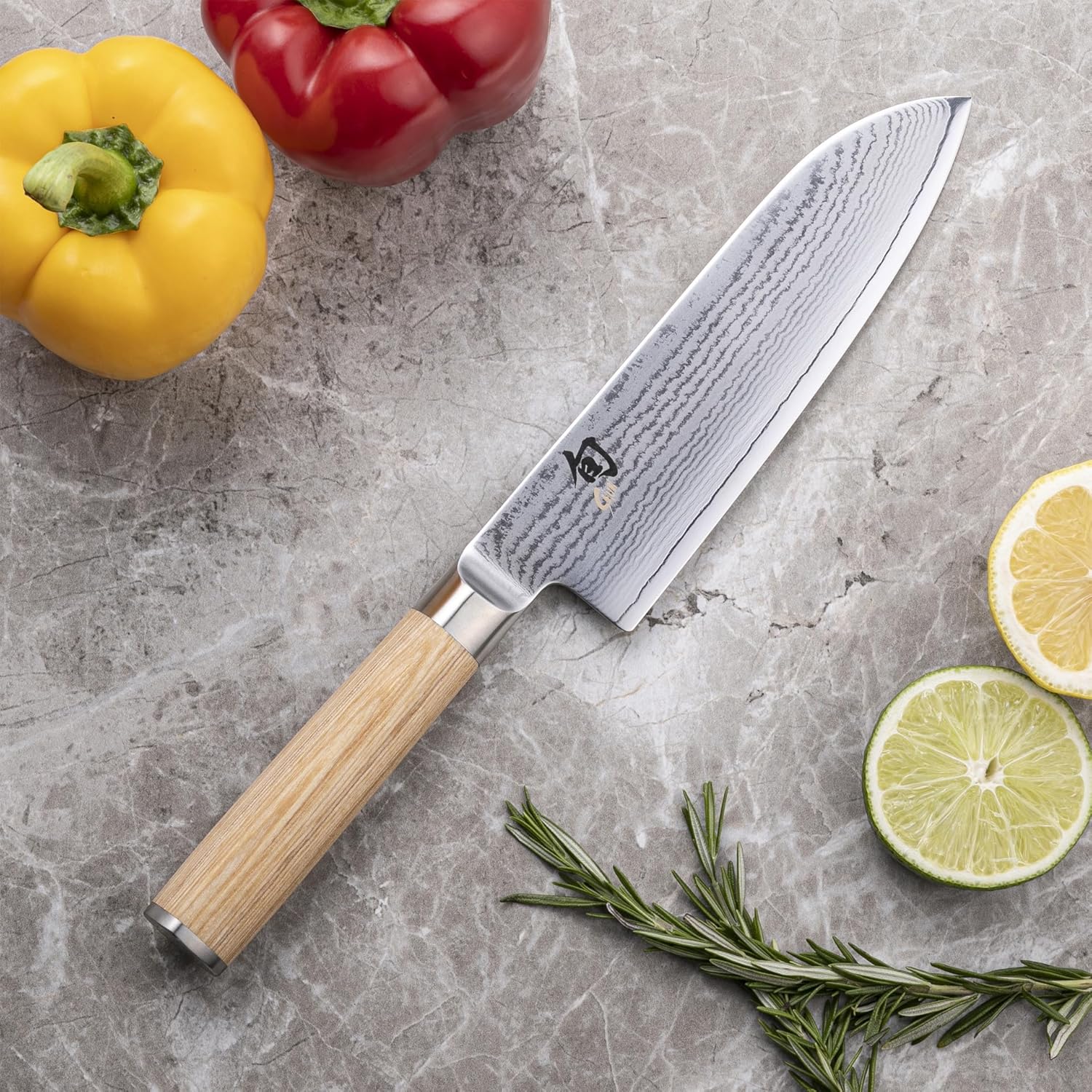 Shun Classic 7″ Santoku
The gold standard. VG-MAX steel, Damascus cladding, and D-shaped handle. Perfect for general prep. See our Shun vs Wusthof review for more.
Check Price on Amazon Tojiro DP Nakiri 6.5″
The value king. VG-10 steel core with stainless cladding. Laser sharp and purely functional. A favorite in our Tojiro vs Shun comparison.
Check Price on Amazon5. Choosing Based on Brand
Different manufacturers approach these shapes differently.
For the Japanese Purist (Shun, Miyabi, Tojiro)
If you want authentic geometry and hard steel (VG10 or SG2), look at these brands.
- Miyabi: Makes exquisite Nakiris with deeper blades. (See Miyabi vs Shun).
- Tojiro: Offers the best performance per dollar. (See Tojiro vs Wusthof).
- Kamikoto: Offers heavy, single-bevel versions, though they are controversial. (See Kamikoto vs Shun).
For the Western Cook (Wusthof, Zwilling, Mercer)
Western brands often modify the Santoku to have more curve (for rocking).
- Wusthof: Their Santoku features a hollow edge (Granton) and heavy bolster. (See Wusthof vs Victorinox).
- Mercer/Victorinox: Excellent stamped options for students. (See Mercer vs Victorinox and Mercer vs Wusthof).
For the Modernist (Dalstrong, Global)
Dalstrong makes aggressive “Shadow Black” Nakiris that look like stealth fighters. (See Dalstrong vs Shun and Dalstrong vs Victorinox).
Global makes a famous vegetable knife (G-5) that is lightweight and hygienic. (See Global vs Wusthof).
5b. Brand Spotlight: The Stories Behind the Steel
Knowing a bit about where these brands come from can help explain why they’re priced and positioned the way they are.
Shun
Shun is the cutlery division of Kai Corporation, a company with roots going back to 1908 in Seki City, Japan — a region historically famous for samurai sword production. Shun transitioned that centuries-old bladesmithing knowledge into kitchen cutlery, and its Classic line remains one of the most recognizable Damascus-clad knife lines in the world, largely thanks to its distinctive layered steel pattern and D-shaped Pakkawood handle.
Miyabi
Miyabi is part of the Zwilling J.A. Henckels group but manufactures its knives in Seki City using traditional Japanese methods, blending German corporate backing with authentic Japanese craftsmanship. This is part of why Miyabi knives often feel like a bridge between the two knife-making philosophies — precise, hard steel with a more refined, presentation-focused finish.
Tojiro
Tojiro has built its reputation on offering genuine VG-10 core steel at a fraction of the price of boutique competitors, largely by keeping construction simple: no elaborate Damascus cladding, no ornate handles, just solid performance. This is why Tojiro consistently comes up as the “best value” pick across nearly every Japanese knife comparison guide, including several referenced throughout this article.
Wusthof
Wusthof has been forging knives in Solingen, Germany since 1814, and its approach to the Santoku reflects that heritage: heavier bolsters, a more substantial full-tang construction, and a softer, tougher steel formulated to withstand the kind of daily abuse a professional Western kitchen dishes out.
Dalstrong
Dalstrong is a newer entrant, founded in the 2010s, that built its brand around aggressive, blacked-out aesthetics (its “Shadow Black” series) paired with genuinely competitive AUS-10V or high-carbon steel specs at accessible price points, appealing especially to cooks who want a striking visual statement alongside solid performance.
6. What Else Do You Need?
Neither the Santoku nor the Nakiri can do it all.
- Bones: You need a Cleaver or a heavy Chef’s Knife. Don’t chip your Japanese steel!
- Bread: You need a serrated blade. Read what is a serrated knife used for and our top picks for best bread knife.
- Peeling: You need a small blade. Check what is a paring knife used for.
- Steak: Don’t use kitchen knives at the table. Get steak knives.
6b. How They Compare to Other Japanese Knife Shapes
Santoku and Nakiri are just two entries in a much larger family of Japanese blade shapes. Understanding where they sit relative to their cousins makes it much easier to decide whether you actually need one, both, or something else entirely.
| Knife | Primary Use | How It Differs from Santoku/Nakiri |
|---|---|---|
| Gyuto | All-purpose, meat and produce | Longer, more curved belly than a Santoku; built for full rocking cuts like a Western chef’s knife. |
| Bunka | All-purpose, detail work | Similar length to a Santoku but with an angular, reverse-tanto tip for more precise piercing cuts. |
| Usuba | Professional vegetable prep | The traditional, usually single-bevel ancestor of the Nakiri; thinner and more difficult to master. |
| Deba | Fish butchery | Thick, heavy spine for breaking through fish bones; not interchangeable with either Santoku or Nakiri. |
| Petty | Small detail tasks | A miniature Gyuto used for peeling and trimming, complementing a Santoku or Nakiri rather than replacing it. |
If your prep work is mostly vegetables with the occasional protein, the Santoku-vs-Nakiri question is really the only one that matters. But if you’re building a full professional-style roll, it’s worth knowing that a Gyuto and a Petty typically round out a three-knife starter set alongside either shape.
6c. Price Ranges: What You Actually Get at Each Tier
Santoku and Nakiri knives span an enormous price range, and the differences between tiers are real, not just marketing.
- Budget ($20–$45): Stamped blades from brands like Mercer or Victorinox. Soft steel that needs frequent honing, but very forgiving and dishwasher-tolerant (even if hand washing is still recommended). A sensible entry point if you’re not sure which shape you’ll prefer long-term.
- Mid-Range ($60–$120): This is where most Tojiro, entry-level Shun, and Wusthof Santoku/Nakiri knives live. Forged or laser-cut VG-10 blades, noticeably sharper out of the box, and durable enough to last a decade with basic care.
- Premium ($150–$300): Shun Premier, Miyabi Birchwood, and similar lines. Damascus cladding, harder proprietary steels, and hand-finished handles. The performance gains over mid-range are real but incremental — you’re paying largely for edge retention and craftsmanship.
- Artisan/Boutique ($300+): Hand-forged, often single-bevel knives from small Japanese workshops. These are enthusiast purchases, not everyday-cook necessities, and usually require whetstone maintenance skills to keep performing well.
6d. Left-Handed Cooks: What to Know
Because nearly every mass-market Santoku and Nakiri sold today is double-beveled, left-handed cooks can use either shape without issue — the symmetrical edge cuts the same regardless of which hand is dominant. The one place left-handed cooks need to pay attention is the Granton (dimpled) edge sometimes found on Santoku blades, which is purely cosmetic/functional for food release and has no handedness. The real caution is around single-bevel Nakiris and Usubas, which are ground for a specific hand and will actively steer off-course if used by the opposite hand. If you’re left-handed and shopping for an authentic single-bevel vegetable knife, confirm with the retailer that a left-handed grind is available before buying.
6e. Common Mistakes New Owners Make
- Rocking a Nakiri like a chef’s knife: The flat edge isn’t built for it, and doing so repeatedly can chip the tip corners.
- Twisting a Santoku or Nakiri to pry apart food: Thin Japanese blades are optimized for straight cuts, not leverage. Twisting is one of the most common causes of chipped edges.
- Cutting on glass, granite, or stone boards: These surfaces are harder than the steel and will dull an edge in a single session. Stick to wood or soft plastic.
- Storing loose in a drawer: Blade-on-blade contact rounds over a fine edge quickly. Use a sheath, block, or organizer.
- Assuming “stainless” means “stain-proof”: Even stainless Japanese steels can spot if left wet with acidic food residue (tomato, citrus) for extended periods.
- Skipping regular honing: A honing rod won’t sharpen a blade, but it realigns the microscopic edge between sharpenings and meaningfully extends how long a knife feels sharp.
6f. Pairing With the Right Cutting Board
The board you cut on matters almost as much as the knife itself. Hardwood end-grain boards (like those made from maple or walnut) are the gentlest on a thin Japanese edge because the wood fibers close back up after each cut rather than dulling the blade. Softer plastic boards are a reasonable, dishwasher-friendly alternative, especially for raw meat prep. Whatever you choose, avoid bamboo boards for your good Nakiri or Santoku — bamboo is technically a grass, and its silica content is harder on a fine edge than most hardwoods.
6g. Building a Starter Japanese Knife Set
If you’re just getting into Japanese knives and trying to decide where the Santoku-vs-Nakiri decision fits into a bigger picture, a sensible three-knife starter roll looks like this:
- A Gyuto or Santoku as your primary all-purpose knife for meat, fish, and general prep.
- A Nakiri as your dedicated vegetable specialist, especially if you cook a lot of plant-forward meals.
- A Petty knife for peeling, trimming, and small detail work that’s awkward with a larger blade.
Many cooks eventually own both a Santoku and a Nakiri rather than choosing between them, using the Santoku as the daily workhorse and reaching for the Nakiri specifically when vegetable volume goes up, like during a big batch of soup or stir-fry prep.
6h. What Home Cooks and Chefs Say
Ask around any kitchen forum or culinary school class, and a pattern shows up quickly. Professional chefs who trained on Western knives tend to reach for a Santoku or Gyuto as their default, treating the Nakiri as a specialty tool they pull out for prep-heavy vegetable stations. Home cooks who cook primarily plant-based or vegetable-forward meals, on the other hand, often report that the Nakiri becomes their most-used knife within weeks of buying one, precisely because so much of everyday cooking is built around onions, carrots, cabbage, and similar produce. Neither preference is “correct” — it simply reflects what’s actually on the cutting board most often in a given kitchen.
7. Care and Maintenance
Japanese shapes usually mean harder, thinner steel.
- Construction: Understand the difference between stamped and forged knives. Forged Nakiris (like Shun) are heavier; stamped (like Victorinox) are lighter.
- Sharpening: Use a whetstone or an electric sharpener designed for 15-degree edges. (See best electric sharpeners and best manual sharpeners).
- Rust: High-carbon blades need to be dry. Learn how to remove rust.
- Storage: Protect the flat edges! Use a drawer organizer, a block, or a knife bag.
Choosing Between Storage Options
Not all storage methods suit every kitchen, and the flat, tall profile of a Nakiri in particular makes some traditional storage awkward. A wooden knife block designed for chef’s knives sometimes forces a Nakiri’s blade to sit at an angle it wasn’t designed for, putting uneven pressure on the edge over time. In-drawer organizers with individual slots tend to be the safest universal option because they keep blades from touching each other and don’t require the blade to hang or wedge at an angle. Magnetic strips mounted on a wall are popular for their visual appeal and easy access, but they do require some care: setting the spine down first and rolling the blade onto the magnet, rather than laying the edge directly against the strip, prevents unnecessary edge contact with the hard surface. For anyone who transports their knives — say, to a cooking class or a friend’s house for a dinner party — a padded knife roll or rigid blade guard (saya) is the safest way to prevent both damage to the edge and accidental injury while reaching into a bag.
7f. How We Evaluated These Knives
The comparisons and recommendations in this guide are built from a combination of published manufacturer specifications (steel type, hardness ratings, blade dimensions), hands-on cutting tests across common prep tasks (dicing onions, julienning carrots, mincing herbs, slicing proteins), and edge retention observations over repeated use. Where specs or user experience varied between sources, we prioritized manufacturer-published Rockwell hardness (HRC) ratings and steel composition, since those numbers are objective and consistent regardless of who is holding the knife. Price tiers referenced throughout this guide reflect typical retail pricing at the time of writing and can shift with sales, steel market prices, and currency fluctuations, so always confirm current pricing before purchasing.
7b. Sharpening Deep Dive: Whetstone Grits Explained
Owning a Santoku or Nakiri without learning basic whetstone maintenance is a bit like owning a sports car and never checking the tire pressure. You’ll still get some enjoyment out of it, but you’re leaving performance on the table. Here’s a practical breakdown of what the grit numbers actually mean and when to reach for each one.
Coarse Stones (#220–#600)
Coarse stones are for repair work, not routine maintenance. If your Nakiri has developed a small chip from an accidental twist, or your Santoku’s edge has rolled after months of neglect, a coarse stone reshapes the bevel and removes damage quickly. You should rarely need to touch a coarse stone if you’re maintaining your knife properly between sharpenings — think of it as the equivalent of a dentist doing a filling rather than a routine cleaning.
Medium Stones (#800–#2000)
This is your everyday sharpening range. A #1000 stone is the classic all-purpose choice recommended by most Japanese knife retailers, capable of taking a dull edge back to genuinely sharp in ten to fifteen minutes of careful work. If you only ever buy one stone, buy one in this range.
Fine and Finishing Stones (#3000–#8000+)
Fine stones don’t remove much metal; they polish and refine the edge that the medium stone already established. For a Nakiri used mainly on vegetables, a pass on a #3000–#5000 stone every few sharpenings noticeably improves how cleanly it glides through onions and cabbage, reducing the tearing that dulls flavor and presentation. Stones above #6000 are largely for enthusiasts chasing a mirror polish and diminishing practical returns for a home kitchen.
How Often Should You Actually Sharpen?
For a home cook using their Santoku or Nakiri a few times a week, a full whetstone sharpening every two to three months is typically enough, assuming you’re honing regularly in between. Professional or high-volume kitchens sharpen far more often, sometimes weekly, because edge degradation compounds quickly under heavy daily use.
Honing vs. Sharpening: Don’t Confuse the Two
This trips up a lot of new owners. A honing rod (sometimes called a “steel,” though ceramic honing rods are common with Japanese knives) does not remove metal or create a new edge. It simply straightens the microscopic edge that rolls slightly out of alignment during normal use. A quick five-to-ten-pass hone before each use keeps a knife feeling sharp far longer between actual whetstone sharpenings. Sharpening, by contrast, physically grinds away steel to form a new edge and should happen far less frequently.
Pro Tip
Always hone in the direction that matches your knife’s edge angle, using light pressure and letting the rod do the work. Excessive pressure on a thin Japanese edge during honing can actually chip it rather than realign it — this is one of the most common ways new owners accidentally damage a brand-new Nakiri or Santoku within the first few weeks.
7c. Rust, Patina, and Long-Term Steel Care
Not all “stainless” is created equal. Japanese stainless steels like VG-10 and SG2 resist rust far better than traditional high-carbon steels, but they are not entirely immune, especially around the edge where the metal is thinnest. High-carbon blades (common in traditional single-bevel Nakiris and Usubas) will develop a gray-blue patina over time with proper care — this is normal, even desirable, since a stable patina actually helps protect against deeper rust. What you want to avoid is active orange rust, which typically shows up when a blade is left wet, especially after contact with acidic ingredients like tomatoes, citrus, or onions.
- Wash immediately after use rather than letting food residue sit on the blade.
- Dry thoroughly by hand before storing — never air dry a Japanese knife in a rack.
- Apply a light coat of mineral oil or camellia oil to high-carbon blades if they won’t be used for several days.
- Never soak in a sink full of soapy water with other dishes; this is one of the most common causes of both rust and accidental cuts.
7d. Seasonal and Gift-Buying Considerations
Santoku and Nakiri knives are popular gifts around the winter holidays and for housewarming occasions, and a few extra considerations apply if you’re buying for someone else rather than yourself. First, err toward the Santoku unless you know for certain the recipient cooks a heavily vegetable-forward diet — its broader versatility makes it a safer default gift. Second, consider a boxed set that pairs the knife with a basic honing rod or a simple bamboo saya (blade guard), since many first-time recipients don’t own proper storage yet. Finally, in many cultures gifting a knife is traditionally paired with a small coin or token from the recipient, symbolizing that the “gift” was technically purchased rather than given outright — a superstition some people still like to observe, tied to the idea that a gifted blade might otherwise “cut” the relationship.
7e. Sustainability and Where These Knives Are Made
Country and region of manufacture varies quite a bit across the brands covered in this guide, and it’s worth knowing what you’re actually buying. Brands like Tojiro, Miyabi’s higher-end lines, and traditional artisan Nakiri makers produce their blades in established Japanese cutlery regions such as Seki City and Sakai, both of which have centuries of blacksmithing history tied to samurai sword production. Shun’s factory is also based in Seki. German brands like Wusthof and Zwilling manufacture domestically in Solingen, Germany, another region with a centuries-old cutlery tradition. Budget-friendly brands such as Mercer and Victorinox often manufacture in a mix of facilities across Asia and Europe depending on the specific product line, so it’s worth checking individual product listings if country of origin matters to your purchasing decision.
Frequently Asked Questions (FAQ)
Technically yes, if it is boneless (like slicing chicken breast). However, the lack of a sharp tip makes it hard to trim fat or silver skin. The Santoku is much better for meat.
The Santoku is generally safer because it is versatile and intuitive. The Nakiri’s flat edge can be jarring if you are used to rocking your knife.
Not necessarily. If you are a vegetarian or prep huge amounts of veggies, get a Nakiri. If you want one knife to do dinner prep (meat and veg), get a Santoku.
That is a “Granton edge.” It creates air pockets to stop starchy vegetables (like potatoes) from sticking to the blade.
They’re closely related. “Nakiri” is the traditional Japanese name for this rectangular vegetable knife shape, and many Western retailers market the same profile as a “vegetable cleaver” or “vegetable knife.” The design intent is identical: a flat edge for straight-down chopping.
Most Japanese-style Santoku and Nakiri knives are sharpened between 12 and 16 degrees per side. Western-style Santokus with German steel are often a bit more forgiving at 17 to 20 degrees per side. Check your specific manufacturer’s recommendation before using a fixed-angle sharpener.
Yes, as long as it’s double-beveled, which covers the vast majority of Nakiris sold today. Only traditional single-bevel Nakiris and Usubas require a handedness-specific grind.
A mid-range knife in the $60–$120 range (like a Tojiro DP or entry-level Shun) offers the best balance of sharpness, durability, and value for a first purchase. Budget knives under $45 are fine for testing whether you like the shape before investing more.
For cooks who prep a lot of vegetables regularly, yes. Many kitchens use the Santoku as the everyday all-purpose knife and bring out the Nakiri specifically for high-volume vegetable tasks, similar to how a Petty knife complements a larger Gyuto.
End-grain hardwood boards (maple, walnut) are gentlest on the thin edges typical of both shapes. Soft plastic boards are an acceptable, dishwasher-safe alternative. Avoid glass, stone, and bamboo boards, which dull fine Japanese edges faster.
Buying Checklist: Santoku or Nakiri?
If you’re still on the fence, run through this quick checklist before you buy:
- I cook meat, fish, and vegetables regularly: Lean Santoku.
- Vegetables make up most of what I cook: Lean Nakiri.
- I’m switching from a Western chef’s knife and want a familiar rocking motion: Lean Santoku.
- I already own a Gyuto or chef’s knife for proteins: A Nakiri fills the gap nicely as a second knife.
- I want one do-it-all knife and don’t plan to buy a second: Santoku.
- I want the fastest, cleanest vegetable prep possible and don’t mind owning multiple knives: Nakiri, paired with a Petty or Gyuto for everything else.
7g. Regional Japanese Knife-Making Traditions
Part of what makes Santoku and Nakiri knives so compelling to collectors and enthusiasts is the regional craftsmanship tied to where they’re forged. Two regions dominate the Japanese cutlery world, and each has a distinct character.
Seki City
Located in Gifu Prefecture, Seki City has been a center of bladesmithing for roughly 700 years, originally producing katana for samurai thanks to access to high-quality river sand used in traditional steelmaking, clean water, and abundant charcoal from surrounding forests. When sword demand declined, Seki’s blacksmiths pivoted to kitchen cutlery, and today the city produces a significant share of the world’s Japanese kitchen knives, including lines from Shun, Miyabi, and numerous smaller workshops.
Sakai
Sakai, near Osaka, has its own centuries-long cutlery tradition, historically tied to tobacco-cutting blades before shifting toward kitchen knives. Sakai is particularly known for traditional single-bevel knives, including high-end Usuba and Deba blades used by professional sushi chefs across Japan. Knives from Sakai workshops are often produced using a more traditional division-of-labor process, where separate artisans handle forging, sharpening, and handle-fitting rather than a single maker completing the entire knife.
Knowing a knife’s regional origin won’t change how it performs on a cutting board, but it does add context to why certain artisan Nakiris and Usubas command premium prices — you’re paying for a supply chain and skill set that, in some cases, has been refined continuously for hundreds of years.
Conclusion: The Verdict
The battle of Santoku vs. Nakiri is a battle of versatility vs. specialization.
Choose the Santoku If: You want a “do-it-all” knife that is lighter and more agile than a traditional Chef’s knife. It is the perfect primary knife for the home cook.
Choose the Nakiri If: You love vegetables. If you make a lot of salads, stir-frys, or soups, the Nakiri will change your life. It is the ultimate secondary knife to complement your Chef’s Knife.
Whichever you choose, ensure you keep it sharp and store it safely. A dull Japanese knife is a tragedy. Browse our best knife sharpener guide to keep your new blade performing at its peak.
If you’re still torn, remember that this isn’t really an either/or decision for most serious home cooks — it’s a question of sequencing. Many people start with a Santoku because of its familiarity and flexibility, then add a Nakiri once they notice how much of their weekly cooking revolves around vegetables. Others go the opposite direction, picking up a Nakiri first because they’re drawn to its speed and precision on produce, then adding a Santoku or Gyuto later to round out meat and fish prep. There’s no wrong order, and both knives are affordable enough at the mid-range tier that owning both isn’t an unreasonable long-term goal, even if you only start with one.
What matters most is matching the knife to how you actually cook, not how you imagine you might cook someday. If your weekly grocery haul is dominated by produce, don’t talk yourself out of the Nakiri just because the Santoku is the more familiar shape. And if you split your time evenly between proteins and vegetables, the Santoku’s versatility will likely serve you better as a single go-to blade. Either way, pairing your new knife with proper care — regular honing, occasional whetstone sharpening, a suitable wooden or soft plastic cutting board, and dry, dedicated storage — will keep it performing like new for years, regardless of which shape ends up living in your knife block.