Takamura Chef Knife Review: The Ultra-Thin Japanese Workhorse Home Cooks Are Talking About
A deep, honest breakdown of geometry, steel, edge retention, comfort, and whether this cult-favorite gyuto deserves a spot in your knife roll.
Quick Overview
Every so often a knife shows up in enthusiast forums with a reputation that seems almost too good to be true: absurdly thin behind the edge, shockingly light in the hand, and priced well below knives that don’t cut nearly as well. That’s the reputation the Takamura chef knife has built for itself, and after putting one through weeks of daily prep, breakdown work, and side-by-side cutting tests, I understand exactly why.
This is not a knife built to look impressive in a display case. It’s a working tool designed by a small Japanese workshop that has spent decades refining a single idea: thinner steel behind the edge means less resistance, less resistance means less effort, and less effort means a knife that disappears in your hand while you work. If you’ve ever felt your wrist ache after twenty minutes of onion prep with a heavy Western chef’s knife, this review is for you.
See current pricing and availability on Amazon.
Check Price on AmazonBefore going further, it’s worth being upfront about who this knife is for. It rewards a lighter touch and a bit of care. If you’re the type of cook who uses your chef’s knife to pry open cans or chop through frozen chicken, this is not the knife for that job — and honestly, no thin Japanese blade is. But if you want a knife that makes vegetable prep feel closer to slicing through butter, keep reading.
Who Makes Takamura Knives, and Why It Matters
Takamura is a small Japanese knife-making operation based in Niigata Prefecture, a region with a centuries-long tradition of blacksmithing that stretches back to sword and tool production for the samurai era. Niigata’s Sanjo and Tsubame area in particular is known across Japan for producing some of the country’s finest cutlery, hand tools, and tableware, and Takamura sits comfortably within that lineage.
What sets workshops like this apart from mass-market cutlery brands is scale. Takamura isn’t stamping out thousands of identical blades a day on an automated line. Production runs are smaller, quality control is tighter, and the blacksmiths involved have typically spent years, sometimes decades, learning the specific heat treatment and grinding techniques that give these knives their signature thin geometry.
That craftsmanship-driven approach explains both the strengths and the quirks of the knife. It also explains why, unlike mainstream production brands, you’ll notice small variations from knife to knife — a slightly different grind line here, a subtle difference in spine finishing there. These aren’t defects; they’re evidence of hand involvement in a process that a lot of competitors have fully automated. For more context on how hand-forging compares to machine stamping, this breakdown of forging versus stamping is a useful companion read.
The Sanjo-Tsubame region has functioned for generations as a kind of metalworking cluster, where specialized skills pass between neighboring workshops the way wine-growing knowledge circulates through a tightly packed valley. Nail making, tool forging, and tableware production all grew up alongside each other there, and a good portion of the knife industry’s raw talent has historically moved fluidly between these adjacent crafts. That density of shared expertise is part of why a comparatively small operation like Takamura can produce blades that go toe-to-toe with far larger, better-marketed competitors.
Unlike brands that lean heavily on retail storefronts and glossy packaging, workshops of this size typically build their reputation almost entirely through word of mouth among serious home cooks and professional chefs who talk to each other in forums, at trade events, and increasingly on social platforms dedicated to kitchen cutlery. That kind of organic reputation is difficult to fake. A knife either performs the way people say it does, or the conversation moves on to the next contender within a season or two. Takamura has stayed part of that conversation for years, which says something about consistency across production runs.
It’s also worth understanding how this workshop model differs from the larger heritage brands most Western shoppers already know. Companies with retail presence in department stores typically operate multiple production lines, employ dedicated marketing teams, and offer warranty and service infrastructure that a small workshop simply can’t match. If brand-name support infrastructure matters more to you than raw cutting performance, it’s worth reading how Zwilling compares to Henckels as an example of how established German houses structure their offerings, or how the major chef knife brands stack up on that front more broadly.
A Short History of Japanese Knife Making, and Where This Knife Fits
To really appreciate why a knife like this feels the way it does, it helps to understand the broader tradition it comes from. Japanese blade making traces back to sword smithing, where blacksmiths spent lifetimes perfecting techniques for folding and differentially hardening steel to produce blades that were simultaneously hard enough to hold an edge and flexible enough to survive impact. When sword production declined, many of those same smithing families and workshops redirected their expertise toward kitchen cutlery, agricultural tools, and other practical blades. This history of Japanese knife making traces that transition in more detail for readers curious about the full arc.
That heritage explains a lot of what feels different about knives from workshops like this one compared to mainstream Western cutlery. Where European blacksmithing traditions historically prioritized durability and general-purpose toughness — useful for a culture that also relied heavily on knives for tasks like leatherwork and light woodworking — Japanese kitchen knife traditions specialized almost entirely around food preparation, and specifically around the kind of precise, high-repetition cutting found in professional kitchens preparing rice, fish, and vegetables.
Single-bevel knives, still used by professional sushi chefs today, represent the purest expression of that specialization: an edge ground on only one side, capable of producing cuts so clean they barely disturb the cell structure of delicate raw fish. Most Western home cooks won’t use a single-bevel knife day to day, but the double-bevel gyuto shape used by Takamura borrows heavily from that same philosophy of extreme thinness and precision, just adapted into a more universally usable double-bevel format. Readers curious about the single-bevel side of that spectrum can explore this single-bevel versus double-bevel breakdown for more context.
It’s worth noting that “Japanese knife” is not a single monolithic category. Regional workshops across the country vary enormously in steel choice, grind style, and handle tradition. Sakai, near Osaka, is historically associated with professional-grade single-bevel knives for restaurants. Seki, in Gifu Prefecture, built a reputation around cutlery and, historically, sword production as well. Niigata’s Sanjo-Tsubame area, where this workshop is based, carved out its own niche around blacksmithing broadly, including hand tools and tableware alongside kitchen knives. Each region’s specialty shows up in subtle differences in how their knives are ground, finished, and handled.
First Impressions and Unboxing
Pulling the knife out of its packaging, the first thing that hits you is weight — or rather, the lack of it. Compared to a typical German chef’s knife of the same blade length, this one feels almost feathery. That’s by design. The blade stock is ground remarkably thin, and the handle is proportioned to match rather than to add counterbalancing heft.
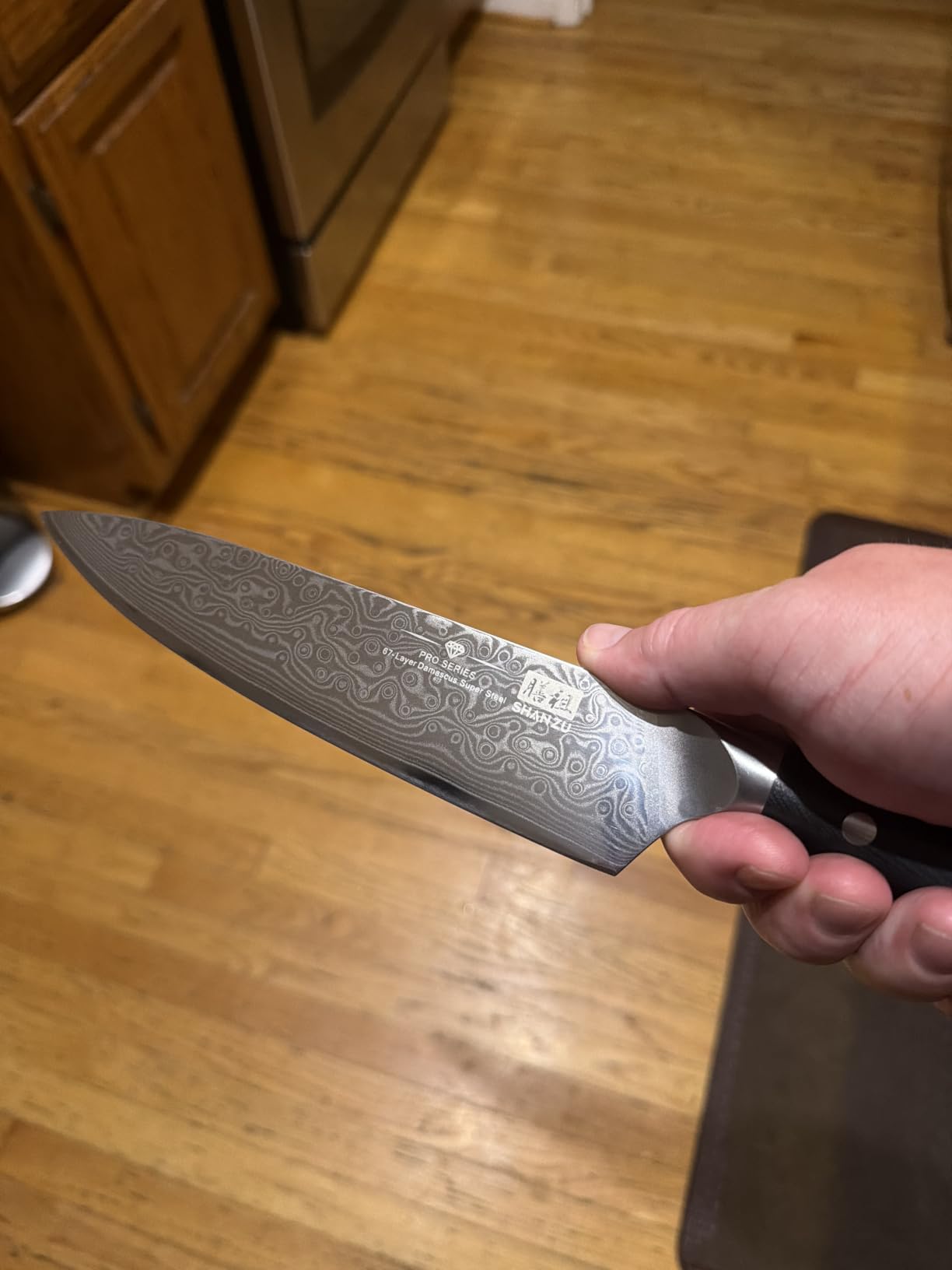
The finish on the blade face is a factory or “kasumi-style” grind depending on the specific line, giving it a matte, workmanlike look rather than a mirror polish. It’s not trying to be a showpiece. The spine and choil are lightly rounded, which matters more than it sounds like it should once you’re twenty minutes into prep and your fingers are riding along the spine.

Grab this exact model while stock lasts.
View on AmazonFit and finish between the handle and bolster area is clean, without the gaps or rough transitions you sometimes see on budget import knives. It’s not going to compete with a $400 custom on fit and finish theatrics, but for the price bracket it occupies, it punches well above its weight class — or rather, well above its featherweight.
Steel and Metallurgy: What’s Actually Inside the Blade
Takamura is best known for producing knives in a few different steel options depending on the line, with high-carbon and semi-stainless “R2/SG2” powdered steel variants being especially popular among enthusiasts. Powdered steels like this are made by atomizing molten steel into fine powder and then compacting it under heat and pressure, which produces a much more uniform carbide structure than traditional ingot steel.
In practical terms, that uniformity translates to two things cooks actually care about: the edge takes a very fine, very sharp apex, and it holds that edge longer than most stainless steels in the same price range. If you’re unfamiliar with how carbide structure affects real-world sharpness retention, this edge retention science guide goes into the mechanics in plain language.
| Property | Typical Result |
|---|---|
| Hardness (Rockwell) | Approximately 62–64 HRC |
| Edge retention | Very good to excellent |
| Corrosion resistance | Good on stainless-clad versions, lower on carbon-core versions |
| Sharpening difficulty | Moderate; benefits from whetstones over pull-through sharpeners |
| Chip resistance | Fair; thin edge is more prone to micro-chipping on hard contact |
That hardness figure is meaningfully higher than what you’ll find on most Western chef’s knives, which typically sit in the 56–58 HRC range. Higher hardness generally means better edge retention but also means the steel is a little less forgiving of lateral stress, which is part of why proper cutting board choice and cutting technique matter more with this knife than with a soft German blade.
If you’re trying to decide between similar high-performance steels, it’s worth comparing options like S35VN and S45VN or MagnaCut and M390 to understand where powdered Japanese steels sit relative to modern American super steels used mostly in pocket knives.
Why Powdered Steel Matters
Traditional ingot steel is cast in large molds and then hammered or rolled into shape, a process that naturally produces larger, less evenly distributed carbide clusters within the metal. Powdered metallurgy sidesteps that problem entirely by atomizing the molten alloy into extremely fine droplets before it solidifies, then compressing that powder under intense heat and pressure into a solid billet. The result is a far more homogeneous grain structure with small, evenly dispersed carbides throughout the steel.
In a kitchen knife, that translates into an edge that can be taken to a genuinely fine apex without those carbides tearing out prematurely, which is exactly what produces the long-lasting sharpness this knife is known for. It also means the steel behaves more predictably during sharpening, since you’re not fighting against unevenly distributed hard spots the way you sometimes do with older ingot steel formulations.
Clad Construction and Why It’s Used
Many Japanese knives, including several Takamura lines, use a clad or san-mai construction, where a very hard, high-performance steel core is sandwiched between two softer, tougher outer layers, typically a more corrosion-resistant stainless alloy. This construction gives you the best of both worlds: a core hard enough to take and hold an extremely fine edge, protected by an outer layer that’s more forgiving of impact and less prone to rust. It also makes the knife easier to sharpen than if the entire blade were made from the harder core steel alone, since only a thin strip of the hardest material is actually exposed at the edge.
Hardness Numbers in Context
A Rockwell hardness in the low-to-mid 60s puts this knife solidly in premium territory. For comparison, most mass-market Western knives sit in the high 50s specifically because softer steel is more forgiving of the kind of rough handling — twisting, prying, occasional bone contact — that happens in a lot of home kitchens. The trade-off Takamura and similar Japanese workshops make is deliberate: sacrifice some of that forgiveness in exchange for an edge that stays sharp through significantly more use before it needs attention. Whether that trade-off makes sense for your kitchen really comes down to how disciplined you are about avoiding hard-contact cutting tasks.
Blade Geometry: Why This Knife Feels So Different
Geometry is really the whole story with this knife. Most production chef’s knives measure somewhere between 1.5mm and 2.5mm thick just behind the edge before the final bevel. Takamura’s grinds routinely come in well under a millimeter in that same measurement zone, sometimes as thin as 0.3–0.5mm depending on the specific model and how it was sharpened at the factory.
That thinness is the entire reason the knife glides through dense vegetables like carrots, sweet potatoes, and butternut squash with so little resistance. A thick blade has to wedge its way through the food as it cuts, pushing material apart on both sides. A thin blade slices cleanly with minimal wedging, which is why people describe cutting with this knife as feeling closer to using a straight razor than a typical kitchen tool.
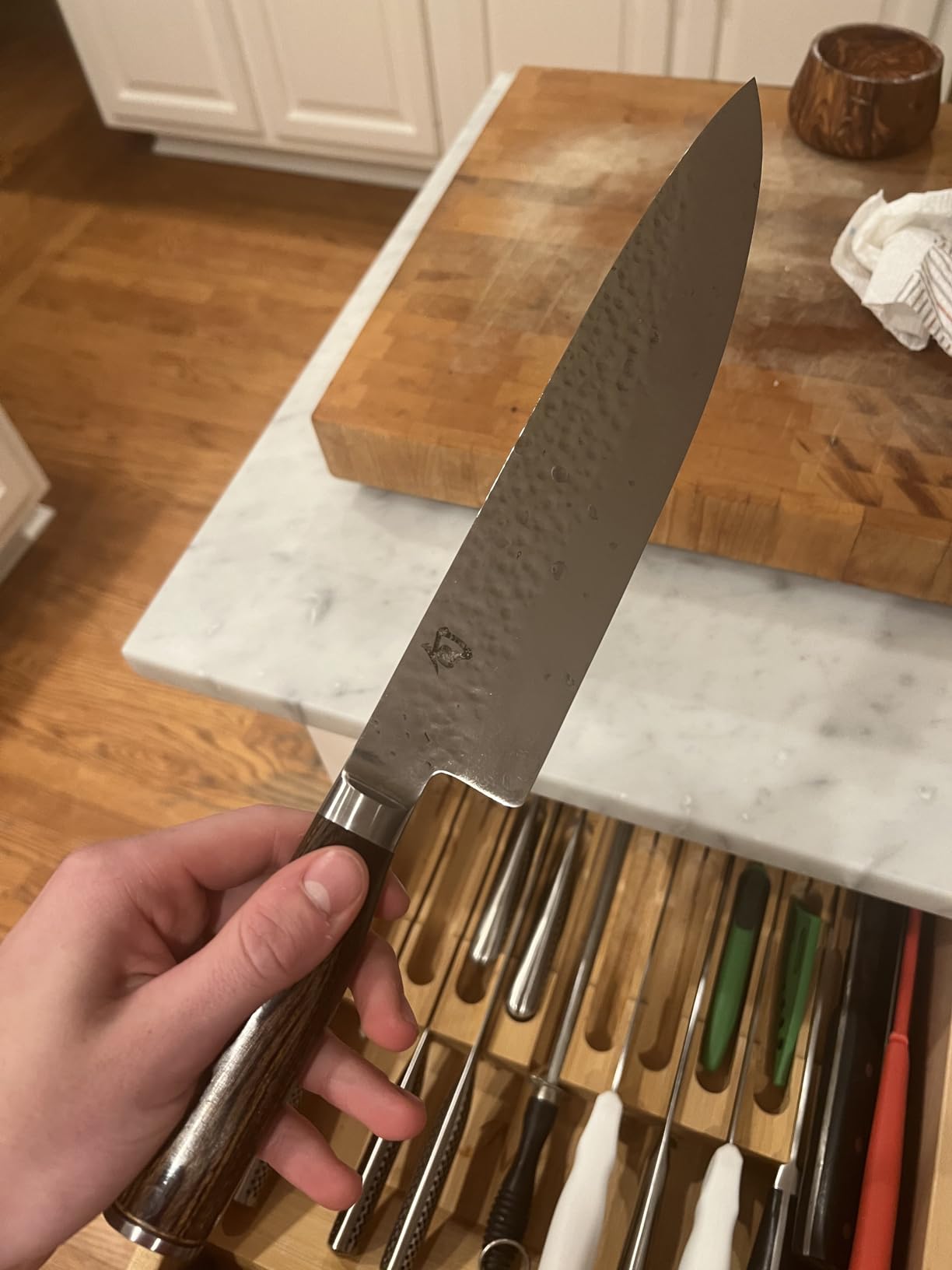
The trade-off, and there always is one, is that thinner geometry is inherently a bit more delicate. Twisting the blade in a cut, prying with the tip, or cutting directly against a hard surface like a ceramic plate or granite counter is much more likely to chip a thin edge than a thick one. This isn’t unique to Takamura — it’s true of virtually every thin-ground Japanese gyuto, and it’s covered well in this thin versus thick behind the edge explainer.
For readers weighing Japanese thin-ground blades against thicker German-style construction more broadly, this German steel versus Japanese steel comparison is a helpful primer on the philosophical difference between the two traditions.
Blade Height and Knuckle Clearance
Beyond thinness at the edge, overall blade height — the distance from the edge to the spine — also plays a meaningful role in how comfortable a knife feels during long prep sessions. A taller blade gives your knuckles more clearance above the cutting board, which reduces the awkward hunching or hand-angling some cooks develop with shorter blades to avoid scraping their fingers. This knife’s proportions strike a reasonable middle ground, tall enough for comfortable knuckle clearance without becoming unwieldy for smaller hands.
Tip Shape and Detail Work
The tip on this gyuto tapers to a fine, controlled point rather than the blunter, more rounded tip found on santoku-style blades. That fine tip becomes genuinely useful for tasks like hulling strawberries, deveining shrimp, trimming silverskin, or scoring the skin on a duck breast before searing. It’s a small detail that often goes unmentioned in spec sheets but shows up constantly in day-to-day kitchen use.
How Geometry Affects Food Release
A secondary benefit of thin, flat-ground geometry that doesn’t get discussed often enough is food release — how cleanly slices separate from the blade face rather than sticking to it through surface tension and suction. Thicker, more convex grinds tend to trap food against the blade face more, which is why some cooks resort to a rocking, side-to-side motion just to shake slices loose. This knife’s thin flat grind releases food far more cleanly, which becomes especially noticeable when slicing starchy vegetables like potatoes that tend to cling to duller or thicker blades.
Handle and Ergonomics
Takamura typically ships their knives with a traditional Japanese-style octagonal or oval wa-handle made from magnolia or a similar lightweight wood, sometimes with a buffalo horn ferrule. This is a departure from the full-tang, bolstered handles common on German knives, and it’s part of what keeps the overall weight so low.
The handle shape encourages a pinch grip — thumb and forefinger pinching the blade just above the heel, with the remaining fingers wrapped around the handle. This grip style is standard for most Japanese knives and gives you significantly more control over the tip than a hammer-style grip on a bulky Western handle. If pinch grip is new to you, it takes a few sessions of prep work to feel natural, but most home cooks pick it up within a week of regular use.
What Works Well
- Very light, reduces fatigue on long prep sessions
- Pinch grip friendly, aids fine tip control
- Rounded spine is comfortable over time
Things to Know
- Wood handle needs occasional oiling to prevent drying
- Not ideal for cooks who prefer a heavy, bolstered handle
- No finger guard, so grip discipline matters
If you’re comparing handle materials across different knife categories, this handle materials comparison covers how wood stacks up against G-10, Micarta, and molded plastic in terms of durability and grip in wet conditions.
Wet-Hand Grip Considerations
One legitimate concern with a bare wood handle is grip security when hands are wet or greasy, a common state during real cooking sessions involving raw proteins or oily marinades. In practice, the octagonal or oval cross-section used on most of these handles provides enough texture and shape reference for the fingers to maintain a secure pinch grip even with damp hands, though it’s still wise to pause and dry your hands periodically during long sessions rather than pushing through with a compromised grip. Cooks coming from synthetic handles with aggressive traction patterns may notice this difference initially, but most adapt within a few uses.
Balance Point and How It Affects Control
Because the handle is so much lighter than a bolstered Western handle, the balance point on this knife sits closer to the blade itself rather than at the bolster, which is where many Western knives are weighted. This forward-leaning balance is typical of Japanese-style knives and tends to favor precision and control over momentum-driven cutting. It’s part of why the knife feels so natural for push-cutting and detail work, but also part of why cooks used to a heavier, handle-weighted knife sometimes describe an adjustment period before the balance starts to feel intuitive rather than unfamiliar. For a deeper explanation of how balance point interacts with cutting feel more broadly, this knife balance guide is a helpful companion resource.
Real-World Cutting Performance
Numbers on a spec sheet only tell part of the story, so here’s what actually happened across several weeks of daily use in a home kitchen setting, prepping everything from delicate herbs to root vegetables to raw proteins.
Vegetable Prep
This is where the knife shines brightest. Julienning carrots, slicing onions, and breaking down cabbage all felt noticeably easier than with a standard German chef’s knife of similar length. The thin geometry means less food sticks to the blade face during slicing, and the light weight means less arm fatigue during long prep sessions like batch-cooking soup bases or slaws.
Protein Breakdown
For boneless proteins like chicken breast, pork loin, or fish fillets, the knife performs beautifully, gliding through clean cuts with minimal tearing of the flesh. It is not, however, a knife you want anywhere near bone. Cutting through poultry joints or a rack of ribs risks chipping the thin edge, and Takamura themselves would likely tell you to reach for a heavier cleaver or boning knife for that kind of work. For a deeper dive into task-specific blade selection, see this boning knife buying guide.
Herbs and Fine Mincing
Mincing garlic, chiffonading basil, and fine-chopping parsley are effortless tasks with this knife. The thin blade doesn’t bruise delicate herbs the way a thicker, duller edge tends to, which matters more than people expect for anything going into a raw preparation like a chimichurri or gremolata.
Fruit and High-Moisture Produce
Slicing tomatoes cleanly is one of the classic litmus tests for any kitchen knife, and it’s an area where a lot of otherwise decent blades fall short, tearing the skin instead of gliding through it. This knife passes that test with almost no resistance at all, producing clean slices on ripe tomatoes without needing a sawing motion. The same holds true for slippery, high-moisture produce like ripe peaches, mangoes, and melons, where a dull or thick edge tends to squash the fruit rather than cleanly parting it.
Batch Prep and Repetitive Tasks
Where the light weight really earns its keep is in repetitive, high-volume tasks: dicing several pounds of onions for a batch of caramelized onion soup, breaking down a case of bell peppers for meal prep, or slicing through a large pile of mushrooms for a stir fry. Heavier knives tend to accumulate fatigue in the forearm and wrist over these longer sessions, and testers doing back-to-back prep found noticeably less soreness after switching to this knife compared to a standard 8-inch German chef’s knife of similar length.
Rock-Chopping vs. Push-Cutting
One adjustment Western-trained cooks sometimes need to make is technique. This knife, like most Japanese gyutos, is optimized more for push-cutting — a forward slicing motion — than for the rock-chopping technique common with curved German blades. The blade profile is flatter through the belly, so a full rocking motion doesn’t engage the edge as efficiently as a controlled push or pull stroke. Cooks who spend a session or two adjusting their technique tend to report the biggest jump in how effortless the knife feels. For a broader look at how blade curvature affects cutting style, this nakiri versus santoku comparison illustrates the same principle in a related knife shape.
Comparing the Feel to a Santoku or Nakiri
Home cooks who already own a santoku or nakiri will find the transition to this gyuto shape relatively intuitive, since all three share the same philosophy of thin geometry and light weight. The main difference is blade length and tip profile — the gyuto shape retains a more pronounced point useful for detail work like trimming silverskin off a tenderloin or scoring duck skin, tasks where a santoku’s blunter tip is less convenient. Readers deciding between shapes may find this chef’s knife versus santoku comparison and this santoku versus nakiri breakdown useful for narrowing down which profile fits their prep style best.
Ready to upgrade your prep game?
Check AvailabilityEdge Retention and Sharpening
Given the hardness and steel quality, edge retention across a normal week of home cooking is excellent. Most testers report going ten to fourteen days of regular vegetable and protein prep before the edge starts to feel noticeably less crisp, which is longer than most stainless German knives in the same price range.
When it’s time to sharpen, whetstones are strongly recommended over pull-through electric sharpeners. Pull-through sharpeners are calibrated for thicker Western edge angles and will aggressively remove material from a thin Japanese edge, shortening the knife’s lifespan and altering its performance characteristics. A 1000-grit stone for maintenance and a 3000–6000 grit stone for polishing will keep this knife performing at its best. This whetstone versus electric sharpener guide explains why metal removal rates matter so much on thin blades.
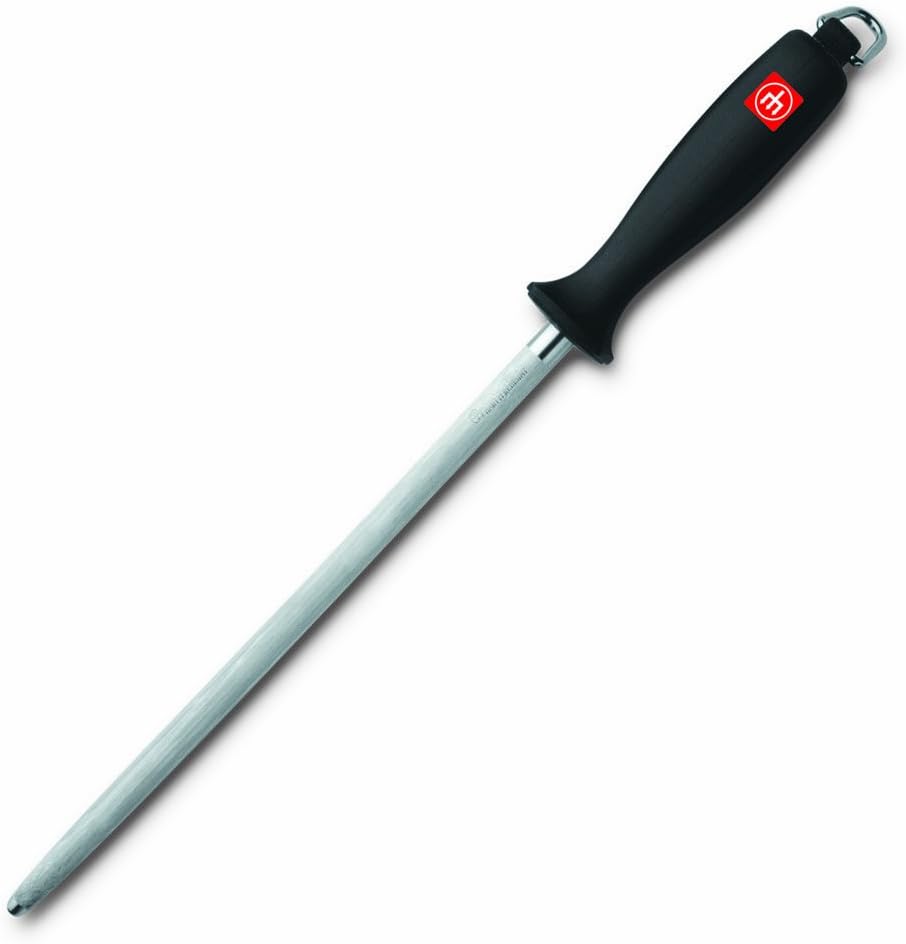
Between full sharpening sessions, a honing rod or leather strop can help realign the edge without removing material. This honing versus whetstone comparison is a good reference if you’re new to the distinction between realignment and regrinding.
A Basic Whetstone Routine
For anyone new to freehand sharpening, a simple, repeatable routine goes a long way toward preserving the thin geometry this knife is known for. Start by soaking a splash-and-go stone for a few minutes, or a traditional water stone for the manufacturer-recommended soak time. Hold the blade at a shallow angle, generally somewhere between 10 and 15 degrees per side given how thin this edge already is, and use light, consistent pressure rather than aggressive force.
Work through the blade in sections — heel, middle, and tip — rather than trying to sharpen the entire edge in one continuous stroke, which tends to produce uneven results for beginners. A light burr forming along the opposite side of the edge is the signal that you’ve fully apexed that section and can move on. Once the whole edge has a consistent burr, flip to the fine stone and repeat with lighter pressure to refine and polish the edge, finishing with a few strokes on each side to remove the burr entirely.
Signs the Knife Needs Sharpening
Rather than sharpening on a rigid schedule, it helps to watch for practical cues. If the knife starts requiring noticeably more downward pressure to get through a tomato skin, if it drags rather than glides through fresh herbs, or if it no longer catches cleanly on a fingernail when tested gently at an angle, it’s time for a touch-up. Catching these signs early means less material needs to be removed to restore the edge, which extends the knife’s usable life considerably over the years.
Stropping for Longevity
A leather strop loaded with a light polishing compound is an underrated tool for extending the interval between full sharpenings. A few passes per side after a normal cooking session, done gently and without excessive pressure, can realign microscopic deformation in the edge before it turns into a noticeable dullness. This is a five-minute habit that pays for itself many times over in reduced whetstone sessions.
Care and Maintenance
Because the blade is ground so thin and, on some models, uses a semi-stainless steel, a bit more care is required than with a fully stainless Western knife. Hand washing and immediate drying after use is non-negotiable — never leave this knife sitting wet in a sink, and never run it through a dishwasher.
The wooden handle also benefits from an occasional light coat of food-safe mineral oil, especially in dry climates, to prevent cracking over time. Store it in a way that protects the edge from contact with other utensils; a saya (wooden sheath), a magnetic strip, or a slotted block are all good options. This knife storage guide and this magnetic strip and edge damage breakdown are worth reading if you’re setting up a storage system for the first time.
If surface staining or light discoloration does appear on carbon-leaning versions, this rust removal walkthrough and this rust prevention guide cover the basics of keeping the blade in top condition long-term.
How It Compares to Other Popular Chef’s Knives
| Knife | Typical Weight | Hardness | Best For |
|---|---|---|---|
| Takamura Chef Knife | Very light | 62–64 HRC | Vegetable prep, precision slicing |
| Wusthof Classic 8-inch | Heavy | 56–58 HRC | All-purpose, bone-adjacent work |
| Shun Classic | Medium | 60–61 HRC | Balanced daily driver |
| Global G-2 | Light | 56–58 HRC | All-metal durability, easy cleaning |
| Miyabi Birchwood | Medium-light | 60–62 HRC | Premium finish and aesthetics |
For deeper individual comparisons, see the Wusthof Classic in-depth review, the Shun Classic review, the Global G-2 review, and the Miyabi Birchwood review. If you’re deciding between German heritage brands directly, this Zwilling versus Wusthof face-off is a useful sidebar read, and for a broader budget-conscious shortlist, this budget chef knife buyer’s guide rounds out the picture.
Cutting Boards and Kitchen Setup That Complement This Knife
A thin, hard Japanese edge is only as good as the surface it’s cutting against. Glass, granite, ceramic plates, and stone boards are the fastest way to chip a blade like this, and they should be avoided entirely regardless of how convenient they seem for cleanup. Instead, a softer end-grain or edge-grain wood board, or a quality synthetic composite board, will preserve the edge far longer while also being gentler on the knife’s finish.
Board size matters too. A cramped board forces awkward cutting angles that increase the odds of the blade contacting the counter or sliding off the edge mid-stroke. Investing in a board with enough surface area for your typical prep volume is a small upgrade that meaningfully protects a knife of this caliber.
Building Out a Complementary Knife Set
Because this knife isn’t meant to handle bone-in proteins or frozen food, most owners eventually pair it with one or two complementary tools. A basic three-knife setup — a gyuto like this one for general prep, a petty or utility knife for small precision tasks, and a heavier knife or cleaver for bone and tough produce — covers the vast majority of home cooking needs without requiring a full block of rarely used specialty blades. This three-blade essentials guide and this rundown of the ten knives professionals actually rotate through both make the case for a smaller, more intentional collection over an oversized block set.
If you eventually want a dedicated tool for tougher tasks this knife isn’t suited for, it’s worth reviewing options like the best cleaver knives for heavy-duty chopping or a solid kiritsuke for a blend of slicing and chopping versatility that sits between the two extremes.
Long-Term Durability and Value Over Time
It’s easy to focus entirely on day-one performance and overlook how a knife ages, but that’s arguably more important for a purchase you’ll be using for years. With proper care, the high-hardness steel in this knife should hold its geometry and edge quality for a very long time, with sharpening sessions gradually removing tiny amounts of material over the years rather than any sudden degradation.
The wood handle is the component most likely to show wear first, particularly if oiling maintenance is neglected in a dry climate. A handle that dries out can develop small surface cracks over several years, though this is easily prevented with the occasional light oiling mentioned earlier. Replacement handles are available from specialty retailers for this style of knife if one ever does need to be swapped, which is a notable advantage of the traditional wa-handle design over a fully bonded Western handle that can’t be separated from the tang.
When you factor in the extended edge retention, the relatively accessible price point for this level of steel performance, and the repairability of the handle system, the long-term value proposition holds up well against knives that cost significantly more up front but don’t necessarily outperform it in daily use.
Pros and Cons Summary
Pros
- Exceptionally thin, effortless-cutting geometry
- Excellent edge retention thanks to high-hardness powdered steel
- Very lightweight, reduces hand and wrist fatigue
- Takes a razor-sharp edge on whetstones
- Strong value relative to comparable Japanese gyutos
Cons
- Thin edge is more prone to chipping if misused
- Not dishwasher safe, hand care required
- Wood handle needs occasional oiling
- Requires whetstone sharpening for best results
- Not designed for bone or frozen food contact
A Week in the Kitchen: What Daily Use Actually Looks Like
Specs and steel charts only tell part of the story, so it’s worth walking through what a typical week of ownership actually feels like for someone who cooks regularly at home.
Monday: Weekly Meal Prep
Most home cooks front-load their heaviest knife work into a single weekend or early-week prep session — dicing several pounds of onions, breaking down a bag of carrots and celery for stock, and portioning proteins for the week ahead. This is exactly the kind of high-volume, repetitive task where the knife’s light weight and thin geometry pay off most obviously, since fatigue that would normally build up over forty-five minutes of continuous prep with a heavier knife simply doesn’t accumulate the same way here.
Wednesday: A Quick Weeknight Dinner
On a rushed weeknight, the knife’s speed matters more than its finesse. Quickly slicing bell peppers and onions for a stir fry, mincing a couple of garlic cloves, and breaking down a chicken breast into strips all happen faster with less resistance than with a duller or thicker blade, which adds up to real time saved when you’re trying to get dinner on the table quickly after a long day.
Friday: Entertaining and Presentation
When cooking for guests, the fine, clean cuts this knife produces genuinely improve plating. Thin, even slices of steak against the grain, precise fans of avocado, and clean cross-sections of citrus for garnish all look noticeably better when cut with a razor-sharp, thin edge rather than a slightly dull, thicker one that tends to compress and tear delicate ingredients.
Weekend: Maintenance Ritual
Many owners settle into a simple end-of-week maintenance habit: a quick strop or light touch-up on a fine stone after Sunday’s cooking session, paired with an occasional check of the handle for dryness. This small weekly ritual, taking maybe ten minutes total, is really all it takes to keep the knife performing at its best indefinitely.
Taken together, these everyday scenarios illustrate something that’s easy to miss when just reading a spec sheet: the value of this knife shows up cumulatively, across dozens of small moments of reduced effort and improved results, rather than in any single dramatic “wow” moment. That’s a very different value proposition than a knife that just looks impressive, and it’s exactly the kind of quiet, consistent performance that builds long-term loyalty among home cooks who’ve used it for years.
Who Should Buy This Knife
This knife makes the most sense for home cooks who already do a fair amount of vegetable and protein prep and want a noticeable upgrade in cutting feel without spending on a fully custom blade. It’s also a strong pick for anyone transitioning from Western knives who wants to experience what a proper thin Japanese grind actually feels like, rather than a compromise “Japanese-style” knife from a mainstream Western brand.
It’s less suited to cooks who want a single knife to handle everything from butchery to bagel slicing to prying open packaging. If that’s your use case, a more robust all-purpose knife, or a small collection covering a core three-knife rotation, will serve you better. Readers who slice a lot of raw fish may also want to compare this to dedicated slicing geometry covered in this yanagiba versus sujihiki guide.

See the full listing and current stock.
Buy on AmazonCommon Issues and How to Fix Them
The Edge Feels Rough or Toothy Right Out of the Box
Some factory edges are left slightly toothy rather than fully polished, which can feel less refined on delicate cuts. A few light passes on a fine finishing stone, in the 3000–6000 grit range, will smooth this out and noticeably improve the feel on soft produce like tomatoes and herbs.
Small Chips Appearing Along the Edge
This almost always traces back to contact with a hard surface — a ceramic plate, a glass cutting board, or an accidental knock against the sink faucet during washing. The fix is straightforward: a quick pass on a coarser stone, in the 400–1000 grit range, to remove the damaged section and reset the edge. Going forward, being more deliberate about board choice and storage location prevents most repeat occurrences.
Handle Feels Loose or Slightly Wobbly
Traditional wa-handles are often friction-fit onto the tang rather than permanently bonded, which means very minor seasonal movement can occur as the wood expands and contracts with humidity changes. A small amount of movement is normal and usually self-corrects; if it becomes a persistent issue, a specialty knife retailer familiar with Japanese handle construction can reseat it properly.
Discoloration or Dark Spots on the Blade
Especially on knives with a higher-carbon core, faint discoloration can appear after contact with acidic ingredients like citrus, tomatoes, or onions if the blade sits wet for too long. This is typically cosmetic rather than structural. A gentle scrub with a soft sponge and a mild abrasive like a barkeeper’s-style cleanser, followed by immediate drying, usually restores the finish. Many enthusiasts actually welcome a light, even patina as a sign of a well-used, well-loved blade rather than treating it as a defect.
Difficulty Getting a Consistent Angle While Sharpening
This is the most common frustration for cooks new to whetstone sharpening. A simple angle guide clipped onto the spine, used only during the learning phase, can help build muscle memory for the correct angle until it becomes second nature. Most people find they no longer need the guide after several sharpening sessions.
What to Check Before You Buy
Because small workshops sometimes offer several near-identical product listings across different steel types, handle woods, and blade lengths, it pays to double-check exactly which variant a specific listing represents before purchasing. Look closely at the product title and images for confirmation of blade length, steel type, and handle material, since these details meaningfully affect both price and performance.
It’s also worth checking seller information and recent buyer feedback when shopping through a third-party marketplace, simply to confirm the listing is being fulfilled by a reputable source rather than a reseller of uncertain authenticity. Products at this quality tier are popular enough that counterfeits and mislabeled alternatives occasionally appear on general marketplaces, so a quick review of seller ratings is a worthwhile few minutes before checkout.
Finally, consider what else you might need alongside the knife itself. A basic whetstone set, a bottle of food-safe mineral oil for the handle, and either a saya or magnetic strip for storage will round out everything needed to keep this knife performing at its best from day one.
Frequently Asked Questions
Is the Takamura chef knife good for beginners?
It can work well for beginners who are willing to learn proper knife care, but its thin edge means it’s less forgiving of rough handling than a typical starter knife. Cooks new to Japanese knives should be prepared to hand wash, avoid bone contact, and eventually learn whetstone sharpening.
What steel does Takamura use?
Depending on the specific line, Takamura knives are typically made with high-performance powdered steels, often in the R2/SG2 family, known for high hardness and strong edge retention compared to standard stainless steel.
Can I put this knife in the dishwasher?
No. Dishwashers expose the blade and handle to prolonged moisture, heat, and detergent, which can damage the wood handle and dull or corrode the edge. Hand wash and dry immediately after each use.
How often does it need sharpening?
Most home cooks find they need a full sharpening session every one to two weeks with regular use, plus occasional honing or stropping in between to maintain the edge.
Is a pull-through sharpener safe to use on it?
It’s not recommended. Pull-through sharpeners are built for thicker Western edge angles and can remove excessive material from a thin Japanese edge, shortening the knife’s usable life.
Will this knife rust?
Fully stainless-clad versions resist rust well with normal care, but carbon-leaning cores can develop surface staining or spotting if left wet. Drying immediately after washing prevents most issues.
Is it good for cutting through bone or frozen food?
No. The thin edge geometry that makes this knife excel at vegetable and protein slicing also makes it vulnerable to chipping against bone, frozen food, or hard surfaces. A separate cleaver or boning knife is better suited for that work.
How does it compare to German knives like Wusthof or Zwilling?
It’s lighter, thinner, and generally holds an edge longer, but it’s less forgiving of rough use and requires more careful maintenance than a typical German stainless knife.
What grip style works best with this knife?
A pinch grip, with thumb and forefinger pinching the blade just above the heel, gives the most control and is the traditional grip style associated with Japanese-style handles like the one found on this knife.
Is the handle comfortable for long prep sessions?
Most users find the lightweight wood handle comfortable for extended use, though it feels different from a bulky bolstered Western handle and may take some adjustment time.
Does it come sharp out of the box?
Yes, most units arrive with a very keen factory edge, though many enthusiasts choose to refine it further on a whetstone to match their personal sharpening preferences.
What’s the best way to store it safely?
A wooden saya, magnetic strip, or slotted knife block all work well. Avoid tossing it loose in a drawer where the edge can contact other utensils.
Is it worth the price compared to a well-known German brand?
For cooks who prioritize cutting performance, edge retention, and light weight over brand recognition and warranty support, it generally represents strong value. Cooks who prefer the reassurance of a widely available brand name with easy retail servicing may still lean toward established German options.
Can left-handed cooks use this knife comfortably?
Yes, though some Japanese knife lines offer handle shapes optimized specifically for left-handed users. It’s worth checking the specific listing to confirm whether the handle is symmetrical or handedness-specific before purchasing.
What blade length should I choose?
Most home cooks find an 8 to 9 inch blade the most versatile for everyday prep, offering enough length for larger produce while remaining maneuverable in a typical home kitchen.
Final Verdict
The Takamura chef knife earns its reputation honestly. It isn’t the flashiest knife on the market, and it isn’t trying to be. What it delivers instead is a genuinely different cutting experience: thin, light, and precise in a way that most production knives simply can’t match at a similar price point. For cooks who value how a knife feels in the hand over how it looks in a display case, this is one of the more rewarding upgrades available right now.
It won’t replace every knife in your kitchen, and it isn’t meant to. But as the primary workhorse for the vegetable prep, protein slicing, and fine mincing that makes up the bulk of everyday home cooking, it’s hard to find a knife in this price range that performs quite as effortlessly. The learning curve around care and sharpening is real, but it’s also modest, and most cooks find it well worth the payoff once the routine becomes second nature.
If you’re ready to feel the difference for yourself, now is a good time to check current availability before stock runs low.
Check Latest Price on Amazon