MAC vs Global Japanese Knives: Which Brand Actually Belongs in Your Kitchen
Two of the most respected names in Japanese-style cutlery, compared blade by blade, steel by steel, and dollar by dollar — so you can stop guessing and start cutting.
Quick Overview: MAC vs Global at a Glance
Ask ten serious home cooks which Japanese knife brand they’d recommend to a friend, and you’ll likely hear these two names more than any other pair: MAC and Global. Both are Japanese-made, both are aimed at people who want something noticeably better than a department-store block set, and both have earned cult followings among professional cooks. But they arrive at “excellent” from almost opposite directions, and that difference matters far more than most buying guides let on.
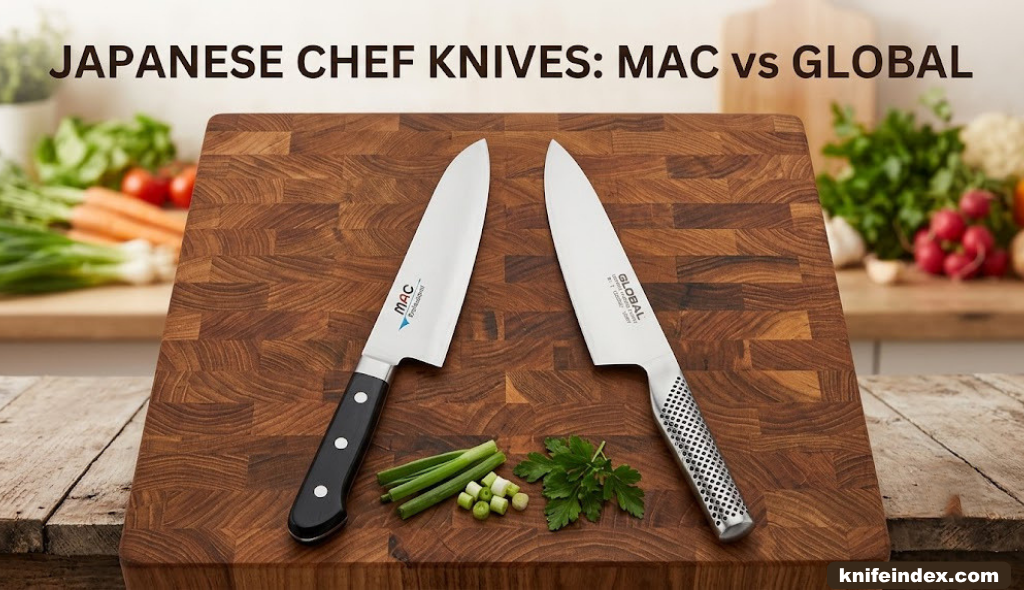
MAC builds its reputation on traditional construction: a full tang, a wood-composite or Pakkawood handle, and a blade philosophy that borrows from old-school Japanese blacksmithing while staying practical for a Western kitchen. Global, by contrast, is the brand that made an entire generation of cooks rethink what a chef’s knife could even look like — a single piece of molded stainless steel, hollow handle filled with sand for balance, and a design language so distinctive it sits in the permanent collection of the Museum of Modern Art in New York.
If you’re comparing these two because you’ve narrowed your search down to just these brands, you’re already ahead of most shoppers. The decision from here isn’t about which brand is “better” in the abstract. It’s about which philosophy of knife design fits how your hands work, how you sharpen, and how you cook.
It’s also worth being honest about why so many buyers land on exactly this matchup in the first place. Both brands sit at a price point that’s genuinely accessible to a serious home cook without requiring the kind of budget reserved for boutique hand-forged blades, and both have decades of consistent reviews behind them rather than a trendy social-media moment that fades in a year or two. That track record is worth something on its own — a lot of knife brands come and go, but MAC and Global have both been refining the same core designs since long before most current kitchen gadgets existed, and that kind of institutional knowledge tends to show up in small details: how the tip holds up over years of use, how the edge behaves after a hundred sharpenings, how the handle ages under repeated hand-washing.
This guide walks through every angle of the comparison in detail — steel, construction, ergonomics, sharpening, and price — so that by the end you’ll have a clear, specific answer for your own kitchen rather than a generic “it depends” that leaves you no closer to a decision than when you started reading.
| Category | MAC | Global |
|---|---|---|
| Construction | Full tang, riveted or bonded handle | One-piece molded stainless steel |
| Typical steel | High-carbon stainless (proprietary MAC blend, often molybdenum-vanadium) | CROMOVA 18 stainless |
| Blade hardness | Roughly 58-60 HRC | Roughly 56-58 HRC |
| Handle material | Pakkawood / resin composite | Hollow stainless, sand-weighted |
| Weight feel | Blade-heavy, traditional balance | Handle-light, nimble balance |
| Edge angle | ~15 degrees per side | ~15 degrees per side |
| Best known model | MAC Professional Series Hollow Edge Chef’s Knife | Global G-2 Chef’s Knife |
| Price range | Mid to upper-mid | Mid to upper-mid |
| Dishwasher safe | No | No |

Meet MAC Knives: Origins and Philosophy
MAC Knife was founded in Seki, Japan — a city with a knife-making tradition that stretches back roughly 800 years to when swordsmiths settled there because of the region’s abundant charcoal, clay, and river water for quenching. When the sword trade declined, those same forging skills shifted naturally into kitchen and pocket cutlery, and Seki remains one of the most concentrated centers of blade production in the world today.
MAC’s approach has always leaned pragmatic rather than showy. The company built its early reputation not through flashy design but by getting into the hands of working chefs and culinary schools, where knives get used eight or ten hours a day and any weakness in the steel or the handle shows up within weeks. That’s a brutal proving ground, and it’s part of why MAC blades tend to feel unfussy — thin, sharp, well-balanced, and built to be sharpened and used rather than admired on a magnetic strip.
If you’ve spent any time researching the best Japanese gyuto knives for home chefs, MAC’s Professional and Superior lines come up constantly, and for good reason — they hit a sweet spot between traditional single-bevel Japanese geometry and the double-bevel practicality Western cooks expect.
What Makes a MAC Knife Distinctive
Three things define the MAC identity: a thin blade profile that bites into food with minimal resistance, a hollow-ground edge on many models (a series of small dimples along the blade face that reduce drag and prevent food from sticking), and a handle that, while not as radical as Global’s, is genuinely comfortable across a wide range of hand sizes because MAC uses a slightly oval Pakkawood grip rather than the perfectly round Western handle shape.
There’s also a quieter piece of the MAC story worth noting: unlike some Japanese cutlery brands that sell almost exclusively through specialty kitchen shops, MAC built a genuinely international distribution network early on, which is part of why so many culinary schools across North America standardized on MAC knives for their student kits. That institutional adoption created a feedback loop — thousands of students trained on MAC blades, graduated into professional kitchens, and kept buying the brand because it was the knife their hands already knew. It’s a less glamorous origin story than Global’s museum-piece design narrative, but it’s arguably a more meaningful real-world endorsement, since it’s built entirely on repeated daily use rather than aesthetics.
MAC also differentiates itself through relatively conservative model turnover. Where some competitors refresh their lineups frequently with new steel blends or handle materials, MAC has kept its core Professional and Superior lines largely consistent for years, tweaking details rather than reinventing the product. For buyers, that translates into a knife that’s easy to research thoroughly before purchase, since reviews and feedback tend to describe a product that hasn’t meaningfully changed underneath them.
Meet Global: Origins and Philosophy
Global knives were designed in 1983 by Komin Yamada, working with cutlery maker Yoshikin in Niigata Prefecture, a region historically known for hardware and metalwork rather than sword-forging specifically. The brief Yamada set for himself was ambitious: build a knife that was completely dishwasher-adjacent in appearance (though not actually dishwasher-safe), corrosion-proof, seamless, and visually radical enough to sit on a counter as an object of design in its own right.
The resulting one-piece construction — blade, bolster, and handle forged from a single continuous piece of CROMOVA 18 stainless steel — solved a problem that had annoyed cooks for decades: the seam between a Western knife’s handle and tang, where food debris, moisture, and bacteria like to collect. Global’s hollow, sand-filled handle also let Yamada tune the balance point without adding a heavy separate bolster, giving the knife a nimble, almost weightless feel in the hand.
Global’s dimpled handle texture (small indentations meant to improve grip when wet) and the brand’s now-famous black dot logo made it instantly recognizable, and its knives have been part of the Museum of Modern Art’s permanent design collection since the 1990s — a rare distinction for a piece of kitchen equipment.

What Makes a Global Knife Distinctive
Global’s identity is inseparable from its silhouette. The seamless steel body means zero crevices for bacteria, the hollow handle keeps overall weight low (which some cooks love and others find under-substantial), and the thin, hard CROMOVA 18 edge takes a very keen angle that excels at precise, controlled cuts — vegetables, herbs, and boneless proteins in particular.
What’s easy to overlook is how genuinely risky Global’s original design was from a business standpoint. In the early 1980s, the kitchen knife market was overwhelmingly conservative — cooks trusted wood-handled, forged knives that looked like their grandparents’ knives, and a stainless-steel knife with a hollow sand-filled handle looked, to a lot of buyers at the time, more like a novelty than a serious tool. Yamada’s bet paid off because the knife performed as well as it looked, and once professional chefs started publicly endorsing it, the design stopped being seen as gimmicky and started being seen as genuinely innovative engineering.
Global has also stayed remarkably disciplined about not diluting its core design language. Even as the lineup has expanded to include bread knives, cleavers, and specialty shapes, every Global knife still shares the same seamless steel construction and dimpled grip, which means picking up any knife in the catalog gives you an immediately familiar feel. That consistency is a big part of why Global built such strong brand loyalty — once a cook adapts to the balance and grip of one Global knife, every other knife in the range feels like an extension of it rather than a new tool to relearn.
Steel and Metallurgy Compared
Steel choice is where the practical differences between these two brands really start to show up at the cutting board, so it’s worth slowing down here.
MAC’s Steel
MAC uses a proprietary high-carbon stainless blend, typically a molybdenum-vanadium alloy, hardened to roughly 58-60 on the Rockwell C scale. That hardness range sits in a comfortable middle ground — hard enough to hold a genuinely sharp edge through extended prep sessions, but not so hard that the blade becomes brittle or difficult to resharpen with standard whetstones. If you’ve read through comparisons like VG-10 vs AUS-10, the same logic applies here: MAC’s steel prioritizes a balance of edge retention and ease of maintenance over extreme hardness numbers.
Global’s Steel
Global uses its own CROMOVA 18 stainless steel, an 18% chromium alloy with added molybdenum and vanadium for edge stability, typically hardened to around 56-58 HRC. That’s a touch softer than MAC’s blades, which means Global knives dull slightly faster under heavy use but are also a bit more forgiving and quicker to bring back to a working edge on a whetstone or honing rod.
Neither steel rusts easily thanks to high chromium content, but neither is truly stain-proof — both benefit from a hand-dry-immediately habit, the same rule that applies to virtually every quality kitchen blade, as covered in our guide on how to prevent rust on knives.
Why Hardness Numbers Don’t Tell the Whole Story
It’s tempting to treat Rockwell hardness as the single deciding factor in a steel comparison, but hardness is only one variable in how a blade actually performs. Toughness — the steel’s resistance to chipping or cracking under lateral stress — matters just as much, and it often trades off against hardness. A harder steel like MAC’s can hold a keener edge longer, but it also has a slightly narrower margin for error if the blade contacts something unexpectedly hard, like a stray bone fragment or a frozen patch of food. Global’s marginally softer CROMOVA 18 sacrifices a bit of that peak edge retention in exchange for a slightly wider safety margin against chipping.
Grain structure also plays a role that’s easy to overlook. Both MAC and Global use modern production processes that keep the steel’s internal grain fine and consistent, which is part of why both brands sharpen to a genuinely keen edge despite neither using the ultra-premium powder steels found in boutique Japanese blades. If you want to go deeper on how grain structure and alloy composition interact, our explainer on understanding Rockwell hardness in kitchen knives unpacks the metallurgy in more detail than most buying guides bother to cover.
One more factor worth flagging: neither MAC’s nor Global’s steel is marketed as a “super steel” in the way some enthusiast brands now describe exotic powder-metallurgy blends. That’s not a knock against either brand — both steels were engineered specifically for kitchen use, where extreme wear resistance matters less than a forgiving balance of sharpness, ease of resharpening, and corrosion resistance. Buyers coming from the pocket-knife world, where steels like the ones compared in our MagnaCut vs M390 breakdown dominate the conversation, should recalibrate their expectations accordingly — kitchen steel selection criteria are genuinely different from folding knife steel criteria.
Construction, Weight, and Balance
This is arguably the single biggest differentiator between the two brands, and it’s the one that most shoppers underweight when they’re comparing spec sheets instead of actually holding the knives.
MAC knives use conventional full-tang construction: a steel tang that runs the length of the handle, sandwiched between two scales of Pakkawood (a resin-impregnated wood composite) and secured with rivets. This gives MAC knives a forward-weighted, blade-heavy balance that traditionalists tend to prefer — it feels substantial, the kind of heft that does some of the chopping work for you on a rock-chop motion.
Global knives are the opposite. The one-piece steel construction means there’s no separate handle material at all — it’s all steel, hollowed out and filled with a precise amount of sand to shift the balance point back toward the palm. The result is a knife that feels lighter overall and balances closer to the bolster, which many cooks describe as more “nimble” or “flicky.” It rewards a lighter grip and quicker wrist motion rather than a heavy chopping stroke.
If you’ve ever compared forged vs stamped knives, you already have some intuition for this tradeoff: MAC’s construction sits closer to the traditional forged-knife feel (weight forward, substantial), while Global essentially invented its own third category that doesn’t map neatly onto forged or stamped conventions at all.
It’s worth actually holding numbers in your head here, because “blade-heavy” and “handle-light” are relative terms that mean little without a frame of reference. A typical 8-inch MAC Professional chef’s knife weighs a bit more than an equivalent Global G-2, and nearly all of that extra mass sits forward of the bolster. That difference of only an ounce or two doesn’t sound like much on paper, but it’s very noticeable the moment you switch between the two knives mid-task, which is exactly why so many buying guides recommend testing both in person if you have any access to a well-stocked kitchen store rather than buying blind from a spec sheet.
The balance point itself is arguably more important than total weight. MAC’s balance point typically falls just forward of the bolster, inside the first inch or two of the blade, which is the classic “pinch grip” balance most culinary instructors teach toward. Global’s balance point sits essentially right at the bolster or fractionally behind it, inside the handle itself, which is what gives the knife its distinctive “flicky,” wrist-driven feel. Neither balance point is objectively correct — professional kitchens run on both — but they do reward genuinely different grip habits, and cooks who’ve spent years training one grip style sometimes need a short adjustment period switching to the other brand.
MAC Balance — Pros
- Substantial, confident feel for heavy prep
- Familiar grip shape for Western-trained cooks
- Less wrist fatigue during long rock-chop sessions
MAC Balance — Cons
- Slightly less agile for fine, precise cuts
- Heavier overall knife to carry in a roll
Global Balance — Pros
- Extremely nimble for detail work
- Lower fatigue on long, light-touch prep
- Seamless body is easier to keep spotless
Global Balance — Cons
- Can feel underweight for heavy chopping
- Smooth steel handle takes adjustment when wet
Handle Design and Ergonomics
MAC’s handle is oval in cross-section, tapering slightly toward the butt, made from Pakkawood that resists moisture far better than solid wood while still giving a warm, non-slip surface even without the dimpled texture Global uses. Most cooks find it grips intuitively no matter how they hold a knife — pinch grip, hammer grip, or somewhere in between.
Global’s handle is the more polarizing of the two. It’s smooth stainless steel with a dimpled texture (small indented dots) designed to improve traction, and it works well for cooks with dry or average hand moisture. Cooks with consistently damp or sweaty hands sometimes report the handle feeling slick despite the dimples, and it can also feel cold to the touch straight out of a drying rack — a minor but real complaint from some long-term owners.
For readers who’ve researched how different knife handle materials compare, this is essentially the wood-composite-vs-metal tradeoff playing out in miniature: MAC’s Pakkawood offers warmth and grip security, Global’s steel offers hygiene and durability with a small ergonomic tradeoff for some users.
Grip style matters more here than most buyers expect going in. Cooks who use a traditional handle grip — fingers wrapped fully around the handle, thumb resting along the spine — tend to feel very little difference between the two brands, since both handles are shaped to support that grip comfortably. Cooks who use a pinch grip, gripping the blade itself just above the bolster with thumb and forefinger while the remaining fingers curl around the handle, sometimes notice Global’s smooth steel bolster is a touch less textured to pinch against than MAC’s more clearly defined Pakkawood bolster transition. It’s a small detail, but it’s exactly the kind of thing that only shows up after a few weeks of regular use rather than in a five-minute showroom test.
Handle length and grip circumference differ slightly across each brand’s size range too. MAC scales its handle proportionally with blade length, so an 8-inch chef’s knife has a noticeably longer handle than a 6-inch one. Global does the same, but because the entire handle is a single continuous piece of hollow steel, the wall thickness and grip diameter stay a bit more consistent across sizes than MAC’s, where the visible taper of the Pakkawood scales varies a bit more model to model.
Edge Geometry and Cutting Performance
Both brands sharpen their knives to roughly a 15-degree angle per side out of the box — noticeably thinner than the 20-22 degree angles common on German-style knives, which is part of why both MAC and Global feel so much more precise straight out of the box than a typical Western block-set knife.
MAC’s Hollow Edge models add a series of shallow dimples ground into the lower blade face. These act like tiny air pockets that reduce suction and surface contact when slicing through starchy or sticky foods — potatoes, sweet potatoes, cheese — so food releases from the blade instead of clinging to it. It’s a genuinely useful feature for high-volume vegetable prep, and it’s one of the more copied design elements in the mid-range knife market.
Global’s edge is thinner still in cross-section on many models, which gives it an exceptionally clean bite through soft and medium-firm ingredients — herbs, tomatoes, boneless chicken breast, fish. Where it can struggle slightly is on dense, fibrous, or frozen ingredients, where the thin edge is more prone to micro-chipping compared to MAC’s marginally more robust geometry. If precise slicing of raw fish is a priority for you, it’s worth reading our breakdown of yanagiba vs sujihiki for slicing raw fish, since a dedicated slicer may outperform either general-purpose chef’s knife for that specific task.
Blade profile — the curve of the cutting edge from heel to tip — also shapes how each brand feels in motion, separately from the sharpness of the edge itself. MAC’s blade profile includes a gentle, continuous curve that supports a rock-chop motion comfortably, similar in spirit to a German-style chef’s knife but with a noticeably thinner cross-section behind the edge. Global’s profile is flatter through the middle of the blade with a tighter curve concentrated near the tip, which favors a push-cut or a shorter rocking motion rather than a long continuous rock. Neither approach is wrong, but they do reward different cutting techniques, and cooks who’ve built years of muscle memory around one style sometimes find the other brand’s profile feels slightly unfamiliar for the first few uses.
Edge retention testing — informal as it usually is in home kitchens — tends to bear out the steel comparison discussed earlier. In practical terms, expect a MAC blade to go noticeably longer between whetstone sessions under identical daily use, while a Global blade will ask for a quicker touch-up but reward you with an edge that’s marginally easier and faster to restore. Neither difference is dramatic enough to be a dealbreaker on its own, but it’s a real, measurable distinction that shows up over months of ownership rather than in a single test cut.

Comparing the Core Lineups
Neither brand sells just one knife, and the lineup you land in matters almost as much as the brand name itself.
MAC’s Main Lines
The Professional Series is MAC’s workhorse line, favored by culinary schools and restaurant kitchens for its combination of durability and edge performance — the Hollow Edge chef’s knife within this line is the brand’s flagship product. The Superior Series sits slightly above it with a Damascus-style pattern welded outer layer over a harder core steel, aimed at cooks who want a bit more visual flair alongside the performance. MAC also produces dedicated santoku, nakiri, bread, and paring knives that share the same construction philosophy.
Global’s Main Lines
The G-Series is Global’s core lineup, with the G-2 chef’s knife as the brand’s signature model. The Global Ni series uses a slightly different, tougher steel aimed at cooks who found the standard CROMOVA 18 edge a touch too delicate for heavy use. Global also makes a wide range of specialty shapes — santoku, nakiri, bread knives, and a compact “Global Classic” line with smaller handles for cooks with petite hands.
It’s worth noting that Global knives get compared constantly to other major players in this segment. If you’re still widening your search, our head-to-head breakdowns of Shun vs Global and MAC vs Wusthof are useful next reads, since they map MAC and Global against the two other brands most commonly cross-shopped against them.
Sharpening, Care, and Longevity
Both brands demand the same basic care regimen that applies to essentially every quality kitchen knife: hand wash only, dry immediately, store on a magnetic strip or in a blade guard rather than loose in a drawer, and never run through a dishwasher, whose heat, moisture, and detergent chemistry will dull the edge and can pit the steel over time.
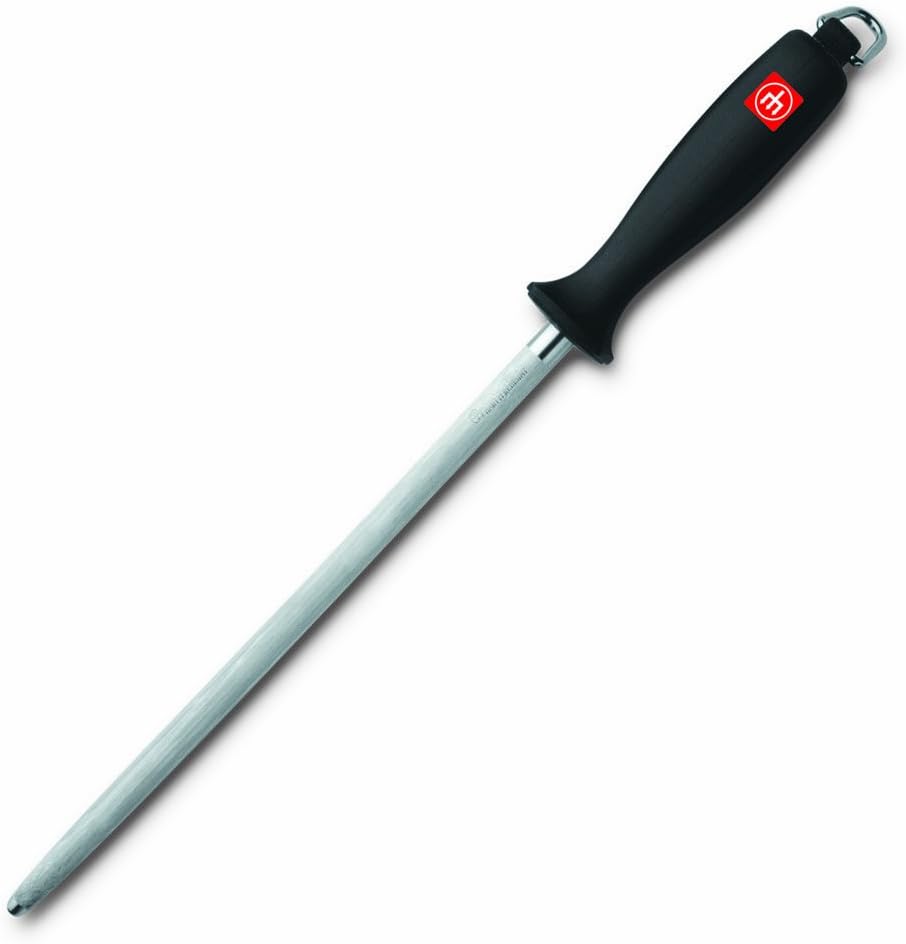
Because both use thinner edge geometry than typical Western knives, a honing steel should be used gently and sparingly — aggressive honing on a thin Japanese-style edge can actually roll or damage it rather than realign it. For genuine edge maintenance, a whetstone is the right tool for both brands; our comparison of whetstone vs electric sharpeners explains why hand sharpening tends to preserve thin Japanese edges better than motorized systems, which remove more metal per pass and generate more heat.
MAC’s harder steel holds its edge longer between sharpenings but takes slightly more skill and time to bring back once it does dull. Global’s marginally softer steel dulls a touch sooner but responds faster to a few strokes on a fine-grit stone, making it a more forgiving option for cooks who are still building their freehand sharpening technique. If you’d rather understand the difference between full realignment and actual sharpening, our guide to honing steel vs whetstone breaks that distinction down clearly.
Storage habits matter more with thin Japanese-style edges than with thicker Western blades, since a delicate edge is more vulnerable to chipping from careless contact with other utensils in a drawer. A dedicated block, an in-drawer knife tray, or a wall-mounted magnetic strip all work well for either brand, and the choice mostly comes down to kitchen layout and personal preference rather than any brand-specific requirement. If you’re setting up storage from scratch, our comparison of magnetic knife strips and edge damage risk is worth a read, since not all magnetic strips treat a thin Japanese edge equally gently.
Cutting board choice also has a bigger impact on edge longevity than most home cooks realize. Both MAC and Global edges will dull noticeably faster on glass, stone, or ceramic cutting surfaces than on wood or quality plastic boards, simply because harder surfaces micro-abrade the edge with every cut. Pairing either brand with a proper end-grain wood or soft composite board is one of the single easiest ways to extend the interval between sharpenings, regardless of which brand you choose.
Pricing and Value Breakdown
Both brands occupy a similar overall price bracket — meaningfully more expensive than budget stamped knives, but well below the premium hand-forged tier occupied by brands discussed in our piece on hand-forged knives. Within that shared bracket, small differences show up model by model rather than brand by brand.
| Knife type | MAC (approx. tier) | Global (approx. tier) |
|---|---|---|
| Standard chef’s knife | Mid-range | Mid-range |
| Santoku | Mid-range | Mid-range |
| Paring knife | Budget-to-mid | Budget-to-mid |
| Premium/Damascus-style line | Upper-mid | Upper-mid |
| Bread knife | Mid-range | Mid-range |
Where the value proposition really diverges is in resale and long-term ownership cost. Because Global’s construction has no separate handle, there’s simply less to go wrong mechanically over a 20-year ownership period — no rivets to loosen, no handle material to crack. MAC’s traditional construction is extremely durable too, but it does have more individual components that could theoretically need attention decades down the line, even though field failures are rare with proper care.
It’s also worth thinking about value in terms of cost-per-year-of-daily-use rather than sticker price alone. A chef’s knife that gets picked up every single day for meal prep and lasts fifteen to twenty years amortizes down to a genuinely small annual cost regardless of whether you choose MAC or Global — often less than the cost of a single restaurant meal per year. That framing tends to make the price gap between either of these brands and a cheap department-store knife look a lot less significant than it does at the checkout screen, especially once you factor in how much more efficient and enjoyable prep becomes with a genuinely sharp, well-balanced blade.
Buyers on a tighter budget shouldn’t feel locked out of either brand. Both companies offer smaller blade lengths and simpler models — a 6-inch chef’s knife or a basic santoku — at meaningfully lower price points than their flagship 8-inch models, and these smaller knives share the same steel and construction quality as their larger siblings. Starting with a smaller blade and adding pieces to your set over time is a perfectly sound strategy with either brand, and it’s often how professional cooks build out their own personal knife rolls in the first place.
Who Should Buy MAC, Who Should Buy Global
Neither brand is objectively superior — they’re built around different assumptions about how a cook holds and moves a knife, and the right choice comes down to matching that philosophy to your own habits.
Choose MAC if:
- You prefer a blade-forward, substantial feel in hand
- You do a lot of heavy rock-chopping (onions, herbs in volume, dense vegetables)
- You want an edge that holds up longer between sharpenings
- You’re coming from a Western knife and want an easier transition
Choose Global if:
- You prefer a lighter, more maneuverable knife
- Your prep style favors push cuts and precise slicing over rocking motion
- You want the lowest-maintenance, most hygienic construction possible
- You have smaller hands or prefer a slimmer handle profile
Cooks who do a lot of general-purpose vegetable and protein prep — the kind of tasks covered in our rundown of the 5 essential knife skills every home cook must master — will likely be happy with either brand. The deciding factor usually comes down to a genuine in-hand test if you can manage one, since balance preference is deeply personal.
It’s also worth thinking about your existing knife collection before deciding. If you already own and like a German-forged workhorse for heavy tasks — the kind of knife discussed in our Zwilling vs Wusthof face-off — you might actually get more marginal value from adding a Global to your collection specifically because its lightweight, precise character complements a heavier primary knife rather than duplicating it. Conversely, if your current knife roll leans light and delicate already, MAC’s added heft might round out your set better than a second lightweight blade would.
Cooking frequency matters too, in a way that’s easy to underestimate. A cook who prepares meals from scratch every single day will feel the cumulative benefit of MAC’s longer edge retention far more than someone who cooks a few nights a week, simply because the edge sees more total cutting cycles between sharpenings. Lighter, less frequent cooks may never notice much practical difference in edge retention between the two brands and can safely let ergonomics and balance preference be the deciding factor instead.

Other Japanese Brands Worth Considering
If MAC and Global aren’t quite landing for you, a handful of other Japanese-style brands are worth a look before you commit. Shun offers a more decorative Damascus-clad aesthetic with a harder VG-MAX core steel, covered in depth in our Shun Classic chef’s knife review. Miyabi sits at a more premium price point with SG2 powder steel construction, detailed in our comparison of Miyabi vs Shun steel differences. For a more budget-conscious entry into Japanese-style geometry, our Tuo chef’s knife review and Mosfiata review cover strong value alternatives that borrow design cues from brands like Global without the full price tag.
And if you’d rather step back and compare the entire Japanese-vs-German philosophy before committing to any single brand, our guide on German steel vs Japanese steel knives is a useful primer on the tradeoffs that MAC and Global both represent in different ways.
It’s also worth understanding a bit of the broader history behind why Japan produces so many of the world’s most respected kitchen knife brands in the first place. Our overview of the history of Japanese knife making from samurai swords to sushi knives traces the lineage that both MAC and Global ultimately descend from, even though their specific design philosophies took very different paths once that centuries-old forging tradition met modern manufacturing techniques. Understanding that shared root helps explain why so many Japanese brands — despite wildly different aesthetics — share an underlying commitment to thin, precise, hard-wearing edges that Western cutlery traditions historically prioritized less heavily.
Buyers who are drawn specifically to Global’s one-piece steel construction but want to compare it against other monobloc-style designs should also look at our breakdown of Global vs Wusthof monobloc vs riveted tang construction, which digs further into how seamless steel handles compare against traditional riveted tang designs across a wider set of brands than just these two.
Santoku, Nakiri, and Specialty Blades Compared
A chef’s knife is where most buyers start, but both MAC and Global build out full specialty lineups, and the differences between brands often show up even more clearly in these shorter, more task-specific blades.
Santoku
Both brands offer a santoku — a shorter, flatter-profiled blade suited to push-cutting rather than the rocking motion of a Western chef’s knife. MAC’s santoku carries its signature hollow-edge dimples on most models, making it particularly good at slicing vegetables without them sticking to the blade face. Global’s santoku keeps the same lightweight, nimble balance as its chef’s knives, and its flatter profile pairs naturally with the push-cut technique many santoku owners default to. If you’re trying to decide between the two blade shapes generally rather than the two brands, our comparison of nakiri vs santoku for vegetable cutting is a useful companion read.
Nakiri
The nakiri is a rectangular, double-beveled vegetable knife, and both MAC and Global produce excellent versions. MAC’s nakiri leans on the same thin, hard steel as its chef’s knives, giving it exceptional bite through dense root vegetables. Global’s nakiri keeps the brand’s lightweight balance, which some cooks find ideal for long vegetable-prep sessions where wrist fatigue becomes a real factor over time. For a broader look at how this shape stacks up against other vegetable-focused blades, see our guide to the best nakiri knives for vegetable prep.
Paring and Utility Knives
Both brands’ paring knives scale down the same design philosophy — MAC keeps its familiar Pakkawood handle and thin, hollow-ground blade in miniature, while Global’s paring knife is essentially a shrunken version of its seamless steel silhouette. Either is a sensible add-on once you’ve settled on a brand for your primary chef’s knife, since matching balance and grip across your full set reduces the mental adjustment every time you switch blades mid-prep.
Bread Knives
Bread knives are one category where the two brands diverge less dramatically, since serration geometry does most of the performance work regardless of brand. Both MAC’s and Global’s bread knives use a scalloped serration pattern that shears through crust without crushing soft interior crumb. If serrated blades interest you more broadly, our explainer on what a bread knife is used for covers the mechanics of why serration outperforms a straight edge on crusty loaves.
Real-World Kitchen Test: Six Common Tasks
Spec sheets only tell part of the story, so it helps to walk through how each brand actually performs across the kinds of tasks that make up a typical week of home cooking.
1. Dicing a large onion
MAC’s added weight and blade-forward balance make quick work of a large onion, letting the knife’s own momentum do more of the cutting on each rock-chop stroke. Global handles it just as cleanly but requires slightly more deliberate wrist action since there’s less mass carrying the blade through the cut.
2. Julienning carrots
This is where Global’s nimbleness shows its advantage — the lighter blade is easier to control through long, thin, repetitive cuts without fatiguing the wrist. MAC performs well here too, particularly with its hollow-edge models, but most testers report Global edges out slightly on pure precision tasks like this one.
3. Breaking down a whole chicken
Neither brand is a dedicated boning knife, but between the two, MAC’s marginally sturdier edge geometry holds up a bit better against occasional light contact with joints and cartilage. Global can do the job too, but its thinner edge calls for slightly more careful technique to avoid edge damage.
4. Mincing garlic and herbs
Both brands excel here, and it’s largely a wash. MAC’s hollow-ground dimples help minced garlic release from the blade face rather than clumping, while Global’s thin edge shears through herb leaves cleanly without bruising them.
5. Slicing a ripe tomato
Both blades are sharp enough out of the box to glide through tomato skin without pressing down, which is really the core test of any well-sharpened Japanese-style edge. Neither brand has a meaningful edge here.
6. Extended prep sessions (45+ minutes)
This is where personal ergonomics matter more than brand. Cooks who prefer a lighter tool over long sessions gravitate toward Global; cooks who prefer a knife with presence and momentum tend to reach for MAC. Reviewers who do extensive knife-type and edge-geometry task fitting tend to land on this same conclusion: neither knife tires the hand meaningfully faster than the other over a full session, but the type of fatigue differs — Global users report more forearm engagement, MAC users report more wrist engagement.
Long-Term Ownership Cost
Upfront price is only part of the total cost of owning a quality kitchen knife. Sharpening supplies, occasional handle care, and eventual replacement all factor into what a MAC or Global knife actually costs over a decade or more of use.
| Cost factor | MAC | Global |
|---|---|---|
| Whetstone sharpening frequency | Lower (harder steel holds edge longer) | Slightly higher (softer steel needs more frequent touch-ups) |
| Handle maintenance | Occasional oiling of Pakkawood recommended | None — sealed steel body needs no handle care |
| Risk of handle failure | Low, but nonzero over decades | Essentially zero — no separate handle to fail |
| Resale/trade value | Moderate — steady demand among cooking-school grads | Moderate-to-high — strong brand recognition helps resale |
| Replacement need over 15 years | Rare with proper care | Rare with proper care |
In practice, both brands are inexpensive to own relative to their performance once you factor in how rarely either needs professional service. A basic whetstone, a soft cloth, and a habit of hand-washing and drying immediately is essentially the entire maintenance budget for either brand, which is a big part of why both remain popular recommendations in our broader best chef knife brands roundup.
Common Mistakes When Choosing Between Them
A few recurring mistakes show up again and again in buyer regret stories for both brands, and most are avoidable with a little forethought.
Buying based on looks alone
Global’s striking silhouette sells a lot of knives to buyers who never actually hold one before purchase. It’s a genuinely excellent knife, but buying it purely for the look without confirming the balance feels right in your hand is the single most common source of buyer’s remorse in this category.
Ignoring blade length
Both brands offer their chef’s knives in multiple lengths, typically 6-inch, 7-inch, and 8-inch options. Buyers with smaller kitchens or smaller hands sometimes default to the 8-inch flagship model simply because it’s the most commonly reviewed size, when a 6- or 7-inch version would actually suit their prep style better.
Skipping the sharpening commitment
Both MAC and Global reward owners who are willing to learn basic whetstone maintenance. Buyers who assume any knife stays sharp indefinitely, or who plan to rely solely on a honing rod, will be disappointed by either brand’s edge retention over time — that’s a maintenance-habit problem, not a brand-quality problem.
Overlooking the full lineup
Many buyers compare only the flagship chef’s knife from each brand and stop there, missing that both brands’ santoku, nakiri, and specialty shapes might actually fit their cooking style better than the standard chef’s knife. Reading through a broader shape comparison, such as our guide to nakiri vs santoku, before settling on a specific model can prevent this.
Frequently Asked Questions
Is MAC or Global better for a beginner home cook?
MAC tends to be the easier transition for cooks coming from a Western-style block set, since its balance and handle shape feel more familiar. Global’s lighter, more nimble feel usually clicks faster for cooks who are willing to adjust their grip and technique slightly.
Do MAC and Global knives rust?
Both use high-chromium stainless steel that strongly resists rust and staining, but neither is fully rust-proof. Leaving either knife wet or in a damp environment for extended periods can still lead to spotting or corrosion over time.
Can I put a MAC or Global knife in the dishwasher?
No. Dishwasher heat, moisture, and detergent will dull the edge, can discolor the steel, and may damage MAC’s Pakkawood handle over repeated cycles. Both brands should be hand washed and dried immediately.
Which brand holds its edge longer?
MAC’s harder steel (roughly 58-60 HRC) generally holds an edge longer under daily use than Global’s CROMOVA 18 steel (roughly 56-58 HRC), though the difference is modest in typical home kitchen use.
Are Global knives too light for serious cooking?
Not for most tasks. The lighter weight is a deliberate design choice that reduces wrist fatigue, and professional chefs use Global knives daily. Cooks who specifically favor a heavy rock-chop motion on dense vegetables may prefer MAC’s added heft.
Why does the Global handle feel cold or slippery to some people?
Because the entire handle is molded stainless steel rather than wood or resin, it naturally feels cooler to the touch and can feel slicker for cooks with consistently damp hands, despite the dimpled grip texture designed to offset this.
What’s the difference between MAC’s regular and hollow-edge blades?
The hollow-edge version has small dimples ground along the lower blade face that reduce food sticking to the blade, particularly useful for starchy vegetables like potatoes. The standard edge is a plain bevel without these dimples.
Is Global considered a luxury or a mid-range brand?
Global sits solidly in the mid-range to upper-mid-range category. It’s a step above entry-level stamped knives but below the ultra-premium hand-forged or powder-steel tier occupied by brands with far higher price points.
Can either brand be sharpened at home, or do they need a professional?
Both can be sharpened at home with a whetstone, and doing so is recommended over sending them out regularly. A basic dual-grit whetstone and a bit of practice is enough to maintain either brand’s edge indefinitely.
Which brand is more popular in professional kitchens?
Both see heavy use in professional settings, but MAC has a particularly strong reputation in culinary schools and restaurant kitchens specifically because of its edge retention and familiar balance, while Global is popular across both home and professional settings for its hygienic one-piece build.
Do these knives come with a warranty?
Both MAC and Global typically back their knives with a manufacturer’s warranty against defects in materials and workmanship, though normal wear, misuse, and dishwasher damage are generally excluded. Check the current warranty terms on the product listing before purchase.
Which knife is better for people with small hands?
Global’s slimmer, lighter handle tends to suit smaller hands better right out of the box, and the brand’s Classic line offers an even more compact grip. MAC’s oval Pakkawood handle is comfortable for most hand sizes but is proportionally a bit larger.
Do MAC or Global make left-handed friendly knives?
Both brands’ standard chef’s knives use a symmetrical double bevel, which works equally well for left- and right-handed cooks. Neither brand requires a dedicated left-handed version for their general-purpose knives.
How long should a MAC or Global knife realistically last?
With proper hand-washing, drying, and periodic whetstone sharpening, both brands are commonly used for well over a decade, and many owners report daily use for twenty years or more without needing replacement.
Is a Global or MAC knife a good gift for a home cook?
Both make strong gifts for a cook who already owns a basic starter set and is ready to upgrade. Global’s distinctive design tends to feel more like a statement gift, while MAC’s understated performance-first design appeals to cooks who value function over flash.
Final Verdict
There isn’t a universally “correct” answer between MAC and Global, and that’s precisely why both brands have survived decades of intense competition from cheaper imitators. MAC rewards cooks who want a substantial, blade-forward knife with steel that holds its edge through long, heavy prep sessions. Global rewards cooks who want the lightest, most hygienic, most maneuverable knife they can put in a drawer, and who don’t mind a slightly softer edge that needs a bit more frequent touch-up.
If you cook daily, do a lot of volume vegetable prep, and want something that feels like a natural evolution of a Western chef’s knife, start with MAC’s Professional Hollow Edge. If you want the knife that changed how an entire industry thinks about kitchen design, and you’re willing to adapt your grip slightly for a lighter, faster blade, Global’s G-2 remains the standard-bearer. Either way, you’re buying into two of the most trusted names in Japanese cutlery — the real risk isn’t picking the “wrong” one, it’s not picking either and settling for a knife that won’t hold an edge past its first year.
Whichever direction you lean, resist the urge to buy a full matching set on day one. Start with the single chef’s knife from whichever brand’s philosophy resonates with you, use it for a few months of real cooking, and let that hands-on experience tell you whether you want to build out the rest of your knife roll in the same brand or mix in complementary pieces from elsewhere. Both MAC and Global reward that kind of patient, deliberate approach far more than an impulse purchase of an entire block set — and a decade from now, the knife you actually reach for every single day will matter far more than the one that simply matched a set.