The Difference Between Forging and Stamping in Knife Making
A deep, practical breakdown of how forged and stamped blades are actually made — and what that means for the knife in your hand.
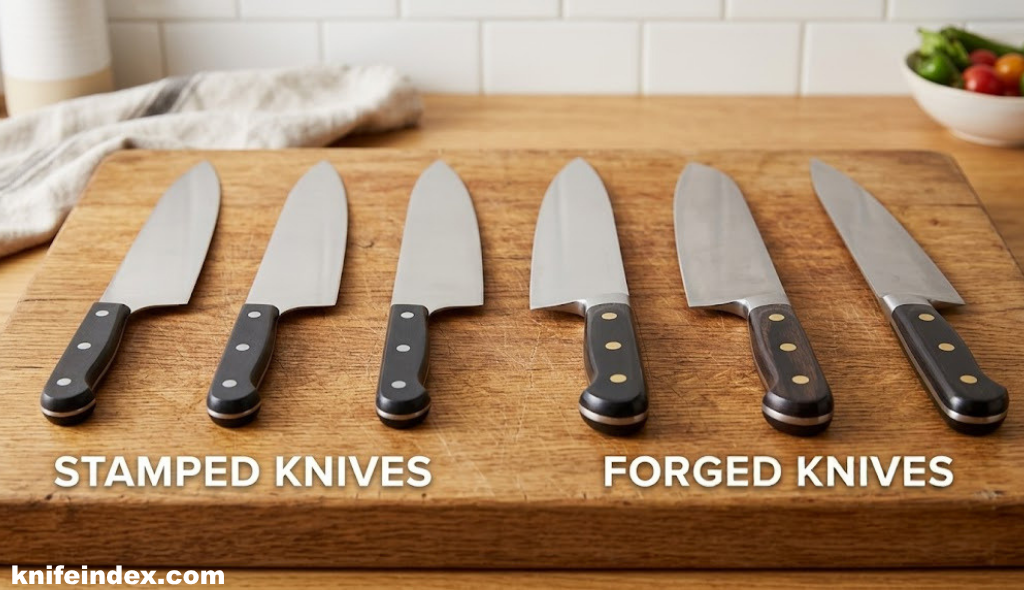
Introduction: Two Roads to the Same Blade
Walk into any kitchen store or scroll through a knife retailer’s listings and you’ll eventually run into two words that get thrown around constantly: forged and stamped. Sellers treat “forged” like a badge of honor and “stamped” like something to apologize for, but the truth is more layered than that marketing shorthand suggests. Both are legitimate, industrially proven ways of turning a flat piece of steel into a functioning blade, and both have produced knives that have lasted generations in professional kitchens and home drawers alike.
Understanding what actually happens to the steel during each process — not just the folklore around it — is the only way to make an informed buying decision. This guide walks through the mechanics of forging and stamping from the factory floor to your cutting board, explains where the real performance differences come from, and dismantles a few myths that have outlived their usefulness. If you’re comparing options like the Wusthof Classic 8-Inch Chef Knife against a lighter stamped alternative, this is the background you need before you spend a dollar.
We’ll also touch on how this manufacturing choice ripples outward into things you might not expect — blade balance, edge geometry, bolster construction, and even how a knife ages over ten years of daily use. By the end, you should be able to look at a knife’s spec sheet, or even just pick it up, and have a real opinion about how it was made and whether that matters for what you’re using it for.
It’s also worth saying up front that this isn’t purely a kitchen knife conversation. The same forging-versus-stamping question shows up in outdoor and utility blades too, from bushcraft knives to axes and hatchets. If you’ve ever compared a Fiskars against an Estwing for splitting kindling, you’ve already run into a version of this same manufacturing debate, just applied to a different tool category. The underlying physics doesn’t change much whether you’re talking about a paring knife or a splitting maul — heat, deformation, and grain structure behave the same way regardless of the final shape.
Throughout this guide we’ll lean on concrete, testable claims rather than vague appeals to tradition. Where a claim about strength, edge retention, or durability can be measured — Rockwell hardness, steel composition, tang thickness — we’ll point you to the measurement rather than the marketing language. That’s the only way to actually compare two knives that use different manufacturing processes on equal footing.
What Is a Forged Knife?
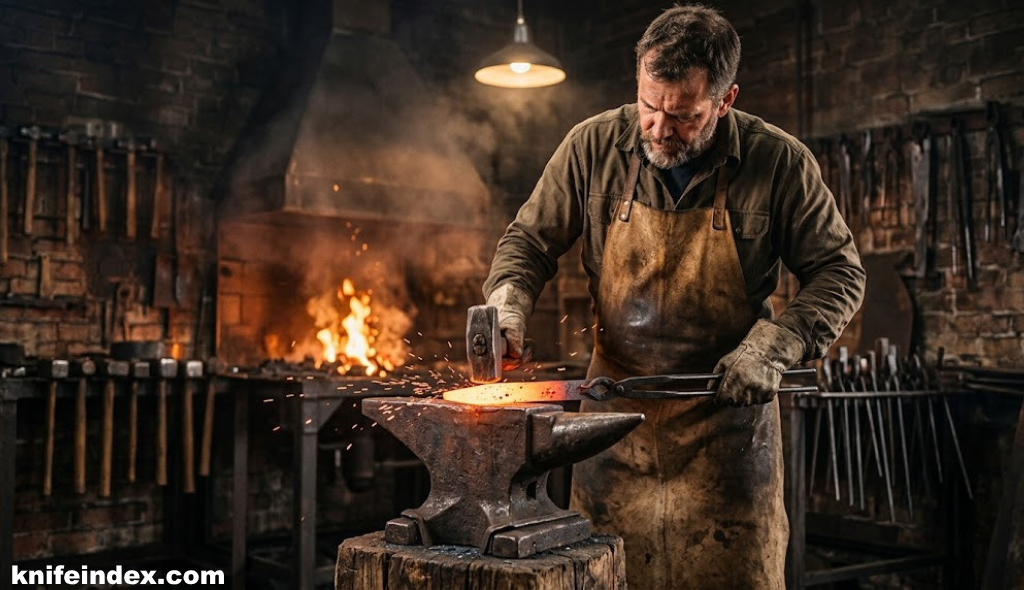
Forging is the older of the two methods, tracing its roots directly back to traditional blacksmithing. A bar or billet of steel is heated to a high temperature — typically somewhere between 1,700°F and 2,100°F depending on the alloy — until it becomes malleable enough to be shaped under repeated impact. A blacksmith, or more commonly today a drop hammer or hydraulic press, then pounds and compresses the glowing steel into the rough silhouette of a blade.
What makes forging distinct isn’t just the heat; it’s the mechanical work done on the steel while it’s hot. Each hammer strike compresses the internal grain structure of the metal, squeezing out microscopic voids and aligning the crystalline grain flow along the contour of the blade. This is the same principle used in forging automotive crankshafts, wrenches, and other parts that need to withstand repeated stress without cracking.
After the rough shape is hammered out, the blank is normalized (a controlled heating and cooling cycle to relieve internal stress), then hardened through quenching, and finally tempered to bring the hardness down to a usable, less brittle range. Only after all of that does grinding, sharpening, handle fitting, and polishing begin. A single forged blank can take a full day or more to move from raw bar stock to a hardened blade shape, which is one reason fully forged knives tend to carry a higher price.
Traditional hand-forged knives, of the kind covered in our guide to hand-forged knives, take this even further, with a smith individually shaping each blade rather than relying on a drop hammer and die. That level of individual attention is part of why hand-forged blades often carry premium pricing and collector interest.
It’s worth distinguishing between the different scales at which forging happens, because “forged” covers a wide range of production realities. At the smallest end, an individual bladesmith working with a coal or gas forge, an anvil, and a hand hammer might spend anywhere from several hours to several days on a single blade, adjusting the shape stroke by stroke and eyeballing temperature by the color of the glowing steel. This approach produces highly individual blades, sometimes with visible hammer texture left intentionally in the finish, and it’s the tradition that most people picture when they hear the word “forged.”
At the industrial end, large manufacturers use drop hammers or hydraulic presses paired with steel dies to forge thousands of nearly identical blanks per day. The steel is still heated and mechanically worked the same way, and the grain-refining benefits still apply, but the process is standardized and repeatable rather than dependent on one smith’s hand. Wusthof, Zwilling, and most other large forged-knife manufacturers operate at this industrial scale, which is why their forged knives are far more affordable than a comparable hand-forged custom blade while still retaining the structural benefits of the forging process.
There’s also a middle category worth knowing about: partially forged or “semi-stock-removal” blades, where a manufacturer forges only the tang and bolster area — the section that benefits most from added mass and integral strength — while the rest of the blade is shaped through grinding from a pre-hardened bar. This hybrid approach shows up in some premium product lines as a way to get the structural benefits of forging at the handle junction without the full cost of forging the entire blade profile.
One detail that often gets glossed over is what happens to the steel immediately after the shaping is finished. A freshly forged blank is under significant internal stress from the uneven cooling and deformation it just went through. Skilled manufacturers normalize the blank — reheating it to a specific temperature and letting it cool slowly and evenly — specifically to relieve that stress before hardening. Skipping or rushing this step is one of the most common ways a forged knife ends up warped, cracked, or prone to failure later, and it’s a step that has nothing to do with the initial hammering and everything to do with quality control after the fact.
What Is a Stamped Knife?
Stamping (sometimes called “stock removal” when done more broadly, though stamping specifically refers to the blank-cutting step) starts differently. Instead of a solid bar of steel being heated and hammered into shape, manufacturers begin with a large, flat sheet of pre-rolled steel that has already been through the mill’s own heat treatment during production. A blade-shaped die — essentially an industrial cookie cutter — presses down on the sheet and punches out the blade’s silhouette in a single motion.
From there, the blank goes through grinding to establish the bevel and edge geometry, then heat treatment (hardening and tempering) to bring it to a working hardness, followed by finishing, handle attachment, and sharpening. Because the sheet steel used is thinner and more uniform than a forged billet, and because cutting a shape from flat stock is far faster than hammering one out, stamped blades can be produced at a much higher volume and lower cost per unit.
This is not some inferior shortcut invented to cut corners — stamping is how the overwhelming majority of the world’s knives, including many extremely well-regarded ones, are made. Global’s entire lineup, for instance, is stamped from a single sheet of high-carbon stainless steel, and it remains one of the most respected Japanese knife brands on the market. If you want a sense of how a well-executed stamped blade performs against a heavier forged competitor, our Global G-2 review is a good real-world reference point.
The word “stamped” itself is a bit of a historical holdover that causes more confusion than it resolves. In the earliest days of factory knife production, the blank really was punched out with something close to a literal stamping press, in one loud mechanical motion, and the resulting edges were rough and required extensive secondary grinding. Modern stamping still uses a die, but the dies themselves are far more precise, often laser-cut or wire-EDM machined to extremely tight tolerances, which means the punched blank arrives at the grinding stage much closer to its final shape than older equipment allowed.
It’s also worth understanding what “stock removal,” a related but distinct term, actually refers to, since the two get conflated constantly. Stock removal describes any process where the final blade shape is achieved by grinding material away from a piece of steel rather than by moving material around through heat and force, as forging does. Stamping is technically one entry point into a stock-removal workflow — the die-cut step replaces what would otherwise be a slower hand-cutting or bandsaw step, but the grinding that shapes the bevel and edge afterward is stock removal regardless of whether the blank came from a stamp or was hand-cut with a jigsaw from a sheet. Custom knifemakers who don’t have access to industrial forging equipment often build entirely stock-removal knives by hand, starting from pre-hardened bar stock and grinding the whole profile themselves — a method distinct from both mass-production stamping and traditional forging, but frequently lumped in with “stamped” in casual conversation.
Sheet steel used for stamped blades typically arrives from the steel mill already rolled to a consistent thickness and, in many cases, already through an initial annealing cycle to make it soft and workable for cutting and grinding. The manufacturer’s own heat treatment — hardening and tempering — still happens after the blade is shaped, exactly as it does for a forged blank. This is an important point because it means both blade types go through essentially the same critical hardening process; the sheet steel’s mill-applied treatment is a preparation step, not a substitute for the manufacturer’s own quench and temper cycle.
Step-by-Step Process Comparison
It helps to see the two processes laid out side by side, step by step, because the divergence happens earlier than most people assume.
| Stage | Forged Blade | Stamped Blade |
|---|---|---|
| Starting material | Solid steel bar or billet | Pre-rolled flat steel sheet |
| Shaping method | Heated and hammered/pressed into shape | Cut/punched from sheet with a die |
| Grain structure | Compressed and aligned by hammering | Retains the sheet’s original rolled grain |
| Bolster | Often integral, forged as one piece with the blade | Usually a separate piece, glued or riveted on |
| Typical thickness | Thicker at the spine, tapering toward the edge | Uniform thickness across the blade |
| Production speed | Slower, more labor-intensive | Faster, highly automatable |
| Typical weight | Heavier, more substantial in hand | Lighter, more nimble |
| Cost to produce | Higher | Lower |
Step 1: Sourcing the Steel
Step 2: Shaping the Blade
Step 3: Heat Treatment
Step 4: Grinding and Finishing
Notice that heat treatment and finishing converge — both blade types are hardened and ground with similar equipment. The real divergence lives in steps one and two, which is exactly why comparisons that focus only on the “forged vs. stamped” label without looking at heat treatment quality can be misleading. A poorly heat-treated forged knife will underperform a well heat-treated stamped one every time.
The Metallurgy: What Actually Changes
This is the part that most marketing copy skips over, and it’s the part that actually matters. Steel is made of crystalline grains, and the size, shape, and orientation of those grains influences toughness, how the blade resists chipping, and how it behaves under lateral stress like prying or twisting.
When steel is forged, repeated compressive force at high temperature refines the grain structure and aligns it along the contour of the part being made. This is called grain flow, and in theory it produces a slightly tougher piece of metal that resists crack propagation better than the same alloy left in its as-rolled state. This effect is well documented in industrial metallurgy for things like forged wrenches and connecting rods, which is part of where the reputation for forged knives being “stronger” originally came from.
However — and this is the detail that gets lost — modern rolled sheet steel used for stamped blades is already extremely fine-grained and consistent, because industrial rolling mills also apply significant mechanical work to the steel during production. The gap in raw grain quality between a well-made stamped blank and a forged one is much smaller today than it was decades ago when rolled steel was cruder. Heat treatment protocol, not the shaping method alone, has become the dominant factor in how a modern blade performs. This is a big part of the discussion in our piece on complete knife steel types, where alloy choice often outweighs shaping method in determining edge retention.
Rockwell hardness, a measure of how resistant the steel is to indentation and by extension how well it holds an edge, is determined by the quench and temper cycle, not by whether the blade was forged or stamped. You can find our full explanation of that scale in understanding Rockwell hardness in kitchen knives, but the short version is: a stamped VG-10 blade tempered to 60 HRC will out-hold-an-edge a poorly forged, poorly tempered 420 stainless blade every single time, regardless of shaping method.
To put some concrete numbers behind this, metallurgical studies on grain refinement through hot working generally show that repeated deformation can reduce average grain size from something in the range of 50 to 100 microns down to under 20 microns in favorable conditions, and finer grain size is broadly associated with improved toughness and a modest bump in yield strength. That’s a real, measurable effect — nobody disputes the underlying materials science. The disagreement is over how much that specific improvement matters once you compare it against everything else that happens to the steel afterward: the austenitizing temperature during hardening, the quench medium and speed, the tempering temperature and hold time, and even how evenly the blade was ground, since uneven grinding can introduce its own stress risers regardless of grain structure.
Independent knife testers and metallurgists who’ve cut open and examined both forged and stamped blades of comparable steel have generally found that, once you control for heat treatment quality, the difference in actual cutting performance and edge retention between the two groups shrinks to the point of being difficult to detect in blind testing. Where forging’s grain-refinement advantage shows up most clearly is not in edge-holding but in resistance to catastrophic failure under high lateral stress — the kind of abuse a knife should never really be subjected to in the first place, like prying open a paint can or twisting the blade sideways in a stuck joint.
This is also why steel type discussions, like our comparisons of S35VN vs. S45VN or MagnaCut vs. M390, tend to be far more predictive of real-world performance than whether a given knife was forged or stamped. Alloy composition determines what’s even possible in terms of hardness, wear resistance, and corrosion resistance; the shaping method determines the blade’s macro-geometry and, to a smaller degree, its fine-grained toughness.
Blade Geometry and Bolster Differences
Where forging genuinely does earn its reputation is in geometry flexibility, particularly around the spine and bolster. Because a forged blank starts as a thick billet, a smith or press can taper the thickness — thick at the heel and spine, thinning gradually toward the tip and edge — in ways that are difficult to replicate from uniform sheet stock without extensive, costly grinding.
This tapering, called distal taper, changes how the knife balances in the hand and how it feels moving through dense food. A full distal taper shifts weight toward the handle, which many cooks find gives better control during long prep sessions.
Forged knives also frequently feature an integral bolster — the thick collar between blade and handle — forged as one continuous piece with the blade itself. Stamped knives, by contrast, usually need a bolster added afterward, either riveted, glued, or welded on, since there’s no extra material at that point in the blank to form one from. We break this specific distinction down in detail in stamped vs. forged bolster geometry and sharpening, which also covers how bolster placement affects how easily you can sharpen all the way to the heel of the blade — a genuine, practical downside of full bolsters on either blade type.
| Feature | Typical Forged Knife | Typical Stamped Knife |
|---|---|---|
| Spine thickness | Tapers from thick to thin | Generally uniform |
| Bolster | Integral, forged as one piece | Attached separately, or absent |
| Balance point | Often near the bolster/handle | Often more blade-forward |
| Sharpening to the heel | Can be obstructed by full bolster | Usually unobstructed |
None of this is inherently better or worse — it’s a tradeoff. A heavier, bolster-balanced knife suits some cutting styles; a lighter, blade-forward knife suits others. If you’re weighing full-tang construction as part of this decision too, our comparison of full tang vs. partial tang knives is a useful companion read, since tang construction and shaping method are often — but not always — correlated.

See a Forged Blade in Action
The Wusthof Classic is one of the most popular integrally forged chef knives on the market, with a full bolster and distal taper.
Check Price on AmazonReal-World Performance: What You’ll Actually Notice
Strip away the marketing language and here’s what actually shows up when you’re standing at a cutting board. Forged knives tend to feel heavier and more substantial, with weight distributed toward the handle thanks to the bolster and tapered spine. That heft can make them feel more stable during heavy tasks like breaking down a chicken or chopping through a butternut squash, a comparison explored in our German steel vs. Japanese steel comparison, since German-style knives lean forged and heavier while many Japanese-style knives lean stamped and lighter.
Stamped knives, being lighter and often thinner behind the edge, tend to excel at fine, precise work — thin slicing of vegetables, delicate fish work, or repetitive prep tasks where wrist fatigue becomes a factor over hours of use. This is a major reason lighter Japanese-style knives, many of them stamped, are favored for tasks like the ones described in our yanagiba vs. sujihiki slicing guide.
Edge retention comes down almost entirely to steel alloy and heat treatment quality, not shaping method, as covered above. Where you will notice a difference is in how the knife feels rocking through a chopping motion versus push-cutting — a heavier, curved forged blade often rocks more naturally, while a lighter, flatter stamped blade favors push and pull cuts. If you want to understand how blade thickness behind the edge changes cutting feel independent of forging or stamping, our guide on blade geometry: thin vs. thick behind the edge goes deeper into that mechanic.
Balance point is another aspect of real-world feel that gets attributed to forging more often than it should be. Balance is simply a function of where mass is distributed along the length of the knife, and while forged knives with integral bolsters do tend to shift the balance point toward the handle, this isn’t an automatic consequence of forging itself — it’s a consequence of the specific design choice to add a heavy bolster. A manufacturer could, in principle, forge a blade with no bolster at all and end up with a blade-forward balance similar to many stamped knives. Similarly, some higher-end stamped knives use a heavier handle scale material or an internal weight specifically to shift balance back toward the grip, without any forging involved. Balance is a design decision layered on top of the manufacturing method, not an inherent property of the method itself.
Vibration dampening during heavy cuts is one area where the two categories can feel genuinely different in hand. A thicker, forged blade with more mass tends to absorb and dampen the shock of contact with a cutting board or a stubborn squash rind, transmitting less jarring feedback into your wrist. A thinner stamped blade, especially on a hard maple or glass cutting board, can transmit more of that impact directly back through the handle, which some cooks find fatiguing over a long prep session and others simply don’t notice or don’t mind. If you do a lot of heavy-duty prep — winter squash, large cuts of meat, or dense root vegetables — this is a legitimate factor to weigh, independent of pure sharpness or edge retention.
Rocking-motion chopping, the classic technique where the tip of the knife stays anchored to the board while the heel lifts and falls in a continuous rolling motion, tends to favor blades with a pronounced curve along the edge, which is more common on Western-style forged chef’s knives. Push-cutting and pull-slicing, where the blade moves straight down or is drawn through the food in a single controlled stroke, tends to favor flatter-profile blades, which are common among both stamped Japanese-style knives and some flatter forged designs. Neither technique is objectively better, and most experienced cooks blend both depending on the ingredient, but your preferred technique is a legitimate factor in deciding which blade profile — and by extension, which manufacturing tradition — will feel more natural in your hand.
Durability and Long-Term Wear
Over years of daily use, both types of knives can last decades if the steel quality and heat treatment were done properly. Where you do sometimes see a real durability gap is at stress points — specifically where the blade meets the handle. An integrally forged tang with a bolster distributes stress more gradually across a larger cross-section, which can make it more resistant to snapping under heavy lateral force, like twisting a blade to pop apart a joint (something you should generally avoid doing with any knife regardless).
Cheap stamped knives with thin, poorly supported tangs are more prone to failure at the handle junction under abuse. But this isn’t a universal rule — plenty of premium stamped knives, including many from Japan, use full-tang or partial-tang constructions that are extremely durable in normal kitchen use. The failure mode is almost always tied to how much material and support exists at the stress point, not the shaping method used upstream.
Corrosion resistance and edge chipping are governed by alloy choice again — a high-carbon steel prone to reactivity will develop a patina or rust regardless of whether it was forged or stamped, which is why we cover that separately in our guide to knife patina, what it is, and how to develop it. If you’re weighing high-carbon against stainless more broadly, our high-carbon vs. stainless steel breakdown is the more relevant read than the forging question itself.
Fatigue behavior over thousands of cutting cycles is another area worth separating from the forging-versus-stamping debate. Metal fatigue, the gradual weakening of a material from repeated stress cycles well below its ultimate strength, is influenced by grain structure, but in a kitchen knife’s actual service life the stress levels involved in normal cutting are far below the threshold where fatigue failure becomes a realistic concern for either blade type. The knives that fail from fatigue-related cracking are almost always ones used well outside their intended purpose, as pry bars, screwdrivers, or bottle openers. Within normal kitchen use, both forged and stamped blades of reasonable quality will comfortably outlast the cook using them.
Edge chipping, as opposed to edge rolling or dulling, is more closely tied to hardness and toughness balance than to shaping method. Very hard steels, often found in premium Japanese blades regardless of whether forged or stamped, hold an exceptionally sharp edge for a long time but can be more prone to micro-chipping if used on hard surfaces like glass boards, bone, or frozen food. Softer, tougher steels, common in many mid-range forged German knives, resist chipping better but dull faster and need more frequent honing. This tradeoff between hardness and toughness is a heat-treatment and alloy decision made by the manufacturer, and it exists independently within both categories, meaning you can find a chip-prone knife or a chip-resistant knife in either camp depending on how it was tempered.
Long-term corrosion at the handle-to-blade junction deserves one more mention because it’s one of the few spots where forged construction can introduce a genuinely unique failure mode. On a full-tang forged knife with a riveted handle and an integral bolster, moisture can work its way into the tiny seam where bolster meets handle scale if the knife isn’t dried thoroughly after washing. Over years, this can lead to discoloration, pitting, or in rare cases loosening of the handle rivets. Hollow-handled stamped knives, like the Global line, sidestep this specific issue because the handle is a single sealed piece of steel with no seam for moisture to collect in, though they introduce their own tradeoff of a lighter, less traditional grip feel that not every cook prefers.
Where Forging Tends to Win
- Integral bolster strength at the handle junction
- Distal taper for balanced weight distribution
- Feel of heft and stability for heavy chopping
- Traditional craftsmanship and resale/collector appeal
Where Stamping Tends to Win
- Lighter weight, less wrist fatigue over long sessions
- Faster, more even sharpening to the heel
- Lower cost for equivalent steel quality
- Consistent thickness across the whole blade
Cost, Labor, and Why Price Varies So Much
Forging is labor and energy intensive. Heating a billet to over 1,700°F, hammering it into rough shape, normalizing, and then still grinding and finishing it afterward takes far longer per unit than punching a blank from sheet steel and grinding it directly. That labor and energy cost gets passed straight into retail price, which is part of why fully forged knives from name brands often sit well above their stamped counterparts using comparable steel.
That said, price is not a reliable proxy for quality on its own. Some stamped knives using premium steel and excellent heat treatment, like several models discussed in our best chef knives for home cooks guide, outperform mid-tier forged knives using cheaper steel at a similar price point. If your budget is tight, our budget chef knife guide leans heavily on well-made stamped options because dollar-for-dollar they typically deliver better steel quality than a budget forged blade, which often has to cut corners elsewhere to hit a low price point.
It’s also worth understanding where the labor cost actually concentrates within a forging operation, because it isn’t evenly spread across the process. The heating and hammering stage itself, especially on automated drop-hammer lines, can move relatively quickly once the equipment is set up and running. The more time-consuming and skill-dependent stages are usually the normalizing and stress-relief cycles, the careful hardening and tempering, and the hand-finishing work around the bolster, which often can’t be fully automated because of its irregular, sculpted shape. A stamped knife’s bolster, by contrast, if it has one at all, is typically a separately manufactured piece attached in a standardized step that’s much easier to automate, which compounds the cost gap between the two approaches.
Retail markup and brand positioning also play a bigger role in final price than raw manufacturing cost alone. Some brands intentionally market their forged lines as premium flagship products and price them well above their actual production cost difference compared to a stamped counterpart in the same catalog, simply because “forged” carries perceived prestige with many buyers. This is worth keeping in mind if you’re shopping by price point rather than by spec sheet — two knives with nearly identical steel and heat treatment can carry very different price tags purely because one wears the forged label and the other doesn’t.
| Price Tier | What You’ll Typically Find |
|---|---|
| Budget (under $40) | Mostly stamped, often 420-series steel, thinner construction |
| Mid ($40–$120) | Mix of quality stamped and entry forged, VG-10/AUS-8/German stainless common |
| Premium ($120+) | Fully forged integral construction, or high-end laminated stamped Japanese blades |
Common Myths, Debunked
Myth: “Stamped knives are always cheap junk.”
False. Some of the most respected knife brands in the world, including several favorites reviewed on this site, use stamping as their primary production method and are prized precisely for their light, nimble handling.
Myth: “Forged knives are always sharper.”
Sharpness is a function of edge angle and final sharpening, not shaping method. Any properly sharpened knife, forged or stamped, can reach the same working sharpness.
Myth: “Forged knives never need replacing.”
Even a forged blade will wear, chip, and eventually need replacement or reprofiling if abused or improperly cared for. Longevity depends far more on how the knife is used and maintained than on how it was shaped at the factory.
Myth: “You can always tell forged from stamped just by looking.”
Not reliably. Some manufacturers add a fake “bolster” appearance to stamped knives to mimic the forged look, which has muddied consumer expectations for years. The only certain way to know is to check the manufacturer’s specifications directly.
Myth: “Forged knives are always one solid piece of steel.”
Not necessarily. Some knives marketed as forged use a forged blade paired with a separately attached bolster or handle assembly, rather than a single continuous piece from tip to tang. True integral construction, where the blade, bolster, and tang are all one uninterrupted piece of forged steel, is a specific and often higher-end feature, not a universal trait of every forged knife on the market.
Myth: “A stamped knife can never have a full bolster.”
False, though it is less common. Some manufacturers attach a separately forged or cast bolster piece to a stamped blade blank, giving the appearance and some of the balance benefits of a forged knife while keeping the main blade production cost lower. This hybrid approach can blur the line between the two categories in ways that make the forged-versus-stamped label less useful than checking the actual construction details.
Which Should You Actually Buy?
The honest answer is that neither method is universally superior, and the right choice depends on how you cook and what you value. If you want a heavier, balanced knife with a substantial feel for chopping and don’t mind paying more, a forged option like the Zwilling Pro chef knife is worth your attention. If you prioritize light, nimble handling for precision cuts and want strong value for money, a stamped option like those discussed in our MAC vs. Global comparison is likely the better fit.
Also consider your hand size and grip style. Cooks with smaller hands often find lighter stamped knives easier to control for extended periods, while cooks who prefer a rocking chop motion frequently gravitate toward the heft of forged German-style blades. If in doubt, testing both in person — many kitchen stores carry demo knives — is the single best way to settle the question for your own hand.
Think about the tasks that actually dominate your week in the kitchen, rather than the tasks you do occasionally. If ninety percent of your cutting is vegetables, herbs, and boneless proteins, a lighter stamped knife will likely serve you better day to day, even if a heavier forged knife feels impressive when you pick it up in a store. If your cooking regularly involves breaking down whole chickens, splitting squash, or other tasks that benefit from added chopping momentum, the extra mass of a forged blade starts to pay off in a way that’s hard to appreciate until you’ve used both back to back.
Storage and knife block compatibility is a smaller but genuinely practical consideration. Heavier forged knives with thick spines sometimes fit less precisely into slim slots designed around thinner stamped blade profiles, and vice versa. If you’re building out a full set rather than buying a single knife, checking that your intended storage solution, whether that’s a custom knife block or a magnetic strip, comfortably accommodates the blade thickness you’re choosing can save some frustration later.
Finally, don’t discount how a knife feels emotionally, not just mechanically, in your hand. Some cooks genuinely enjoy the substantial, traditional feel of a forged knife and find it motivating to cook with; others love the nimble, almost weightless feel of a good stamped blade. Both preferences are completely valid, and neither one makes you a more or less serious cook. The manufacturing method is a means to an end, and the end is simply a knife that makes you want to cook with it.
Notable Examples in Each Category
To ground all of this in real products, here’s how some well-known brands split across the two manufacturing methods, drawing on reviews already published on this site.
| Primarily Forged | Primarily Stamped |
|---|---|
| Wusthof Classic | Global |
| Zwilling Pro / Henckels Statement | MAC Professional |
| Miyabi Birchwood | Tojiro |
| Shun Classic (partially forged/laminated) | Victorinox Fibrox |
Our Zwilling vs. Wusthof face-off and Tojiro vs. Shun value comparison go into much more brand-specific detail if you want to compare specific models head-to-head rather than the manufacturing category alone.
Some brands intentionally blend the two approaches across their product lines rather than committing fully to one method. Dalstrong, for example, offers both forged and stamped lines within its catalog, targeting different price points and use cases, which is covered in more depth across our Dalstrong vs. Wusthof comparison and Dalstrong vs. Zwilling breakdown. This kind of dual-line strategy is increasingly common as manufacturers try to serve both the traditionalist buyer who wants a forged flagship and the value-focused buyer who wants strong performance at a lower price point.
Victorinox deserves special mention as a brand almost entirely built on the strength of stamped construction. The Fibrox line, widely recommended in professional culinary school programs and reviewed in depth in our Victorinox chef knife review, has become something of a proof point that a well-executed stamped knife with quality steel and a properly designed handle can outperform far more expensive forged competitors for the vast majority of home and even professional use cases.

See a Stamped Blade in Action
The Global G-2 is one of the most iconic single-piece stamped and hollow-handled chef knives on the market.
Check Price on AmazonCare Differences Between the Two
Day-to-day care is nearly identical for both types: hand wash, dry immediately, store safely, and hone regularly. Where care can diverge slightly is around the bolster on forged knives — a full bolster can trap moisture at the handle junction if not dried thoroughly, which over years can contribute to corrosion at that seam. Stamped knives without a full bolster generally don’t have this specific vulnerability, though they can still corrode elsewhere depending on the steel.
Sharpening technique also differs slightly. A full forged bolster can physically block your sharpening stone or rod from reaching the heel of the blade, leaving a small unsharpened section over time unless you use a technique or tool designed to work around it — something addressed directly in the bolster geometry guide linked earlier. Stamped knives, lacking that obstruction, are generally easier to sharpen evenly across the entire edge, including with the setups covered in our best knife sharpeners guide.
Rust prevention practices are the same regardless of shaping method and come down to steel composition and drying habits — our guide on how to prevent rust on knives applies equally to forged and stamped blades.
Honing frequency is another area where the two categories don’t really diverge, despite occasional claims otherwise. A honing rod realigns a rolled edge rather than removing material, and this need arises from how the edge is used, not from whether the underlying blade was forged or stamped. Whether you’re maintaining a heavier German-style forged blade or a lighter stamped Japanese-style one, a quick pass on a honing rod before or after use, followed by a proper sharpening session on a whetstone every few weeks to months depending on use, is the right maintenance rhythm for either type. Our comparison of honing steel vs. whetstone explains that distinction in more detail if you’re still building out your sharpening routine.
One area where blade thickness, which correlates loosely with shaping method, does affect maintenance is how much metal you remove per sharpening pass. Thinner stamped blades generally need fewer passes to raise a fresh burr and refresh the edge, since there’s less material to work through at a given angle. Thicker forged blades, especially those with a more obtuse edge angle, can require slightly more time and more passes to fully refresh the edge, though the actual frequency of sharpening needed is driven far more by usage and steel hardness than by this thickness difference alone.
A Brief History of the Two Methods
Forging is, in a real sense, as old as bladed tools themselves. Early ironworkers discovered that heating iron and hammering it into shape not only made the metal workable but also improved its structural qualities, and that basic principle carried forward through the Bronze and Iron Ages into the sophisticated bladesmithing traditions of medieval Europe and feudal Japan. The famous folded and forge-welded construction behind traditional Japanese swords, and by extension many traditional single-bevel kitchen knives, grew directly out of forging techniques refined over centuries to compensate for inconsistent raw steel quality by folding and welding layers together.
Stamping, by contrast, is fundamentally a product of the industrial revolution and the rise of consistent, mass-produced rolled steel. Once steel mills could reliably produce large, uniform sheets of high-quality steel, it became possible to cut blade shapes directly from that material rather than starting from a bar and forging it into shape. This shift dramatically lowered the cost and increased the speed of knife production, making decent-quality knives accessible to a much broader consumer base than the earlier tradition of expensive, hand-forged blades had allowed.
Interestingly, the rise of stamping didn’t kill off forging so much as split the market. Forging retreated somewhat into a premium and traditional-craft niche, while stamping expanded rapidly to serve the mass market, restaurant supply chains, and eventually the modern direct-to-consumer knife brands that dominate online retail today. Both traditions continued to refine their techniques in parallel over the twentieth century, which is part of why the quality gap between a well-made example of either type has narrowed so significantly compared to a century ago.
Material Efficiency and Manufacturing Waste
A less-discussed but practical difference between the two methods involves how much raw material ends up as waste. Stamping a blade blank from a flat sheet inherently leaves behind an outline of scrap steel around the punched shape, similar to the negative space left after cutting cookies from rolled dough. Manufacturers typically nest multiple blade patterns tightly together on a single sheet to minimize this waste and recycle the leftover scrap steel back into the supply chain, but some material loss is unavoidable with this approach.
Forging, by contrast, generally uses a more precisely portioned bar or billet cut close to the volume of steel actually needed for the final blade, since the material is being compressed and redistributed into shape rather than cut away from a larger flat sheet. This can mean less raw scrap generated per blade, though forging often uses more energy overall because of the sustained high heat required throughout the shaping process, which partially offsets the material efficiency gain from an overall environmental footprint perspective.
Neither method has a dramatically better or worse environmental profile once you account for the full picture, including energy use, scrap recycling rates, and transportation, and most manufacturers today recycle steel scrap regardless of which method they use. This is a minor consideration compared to the bigger sustainability factors in knife ownership, like buying a durable knife that lasts decades rather than replacing cheap knives repeatedly, and maintaining whatever knife you own properly so it doesn’t need premature replacement.
Regional Manufacturing Traditions: Where Forging and Stamping Dominate
Knife manufacturing has clustered around a handful of regions for well over a century, and each region’s dominant method says a lot about its industrial history. Solingen, Germany, often called the “City of Blades,” built its reputation primarily on forged cutlery, with generations of metalworking infrastructure oriented around drop-hammer forging lines. Brands headquartered there, including several covered throughout this site, still lean heavily on forged construction as part of their regional identity and marketing, even as some of their product lines have shifted toward stamped manufacturing for value-tier offerings.
Seki, Japan, tells a more mixed story. The city has a centuries-old bladesmithing tradition rooted in sword forging, and that heritage carries through to high-end forged and laminated kitchen knives produced there today. At the same time, Seki is also home to large-scale manufacturers producing excellent stamped stainless blades at high volume, meaning the city doesn’t fall neatly into either camp — it’s better understood as a center of manufacturing skill that happens to excel at both methods depending on the product tier.
Yangjiang, China, has become one of the largest cutlery manufacturing hubs in the world by volume, and the majority of that output is stamped construction, reflecting the method’s suitability for high-throughput, cost-efficient production. This doesn’t mean Yangjiang-made knives are inherently lower quality; many contract manufacturers there produce private-label stamped knives for well-known Western brands using solid steel and reasonable heat treatment, though quality does vary significantly across different factories and price tiers in the region.
Thiers, France, represents a smaller but historically significant forging tradition, particularly known for pocket and folding knife production alongside kitchen cutlery. Like Solingen, Thiers built its reputation on forged construction, and many artisanal French knifemakers still emphasize traditional hammer-forged techniques as a point of regional pride and craftsmanship, even as industrial competition from stamped imports has reshaped the broader market.
Understanding these regional patterns can help you read between the lines of a product listing. A knife marketed heavily around its German or French heritage is more likely, though not guaranteed, to be forged, while a knife emphasizing value and consistency at a lower price point is more likely produced through a stamped process, frequently out of large-scale East Asian manufacturing hubs.
Quality Control and Testing Methods in Factory Production
Regardless of whether a blade started as a forged billet or a stamped sheet, reputable manufacturers subject finished blades to a battery of quality control tests before they ever reach a store shelf, and understanding these tests helps explain why two knives using the same nominal shaping method can still perform very differently.
Hardness testing, typically performed with a Rockwell hardness tester, is the most fundamental check. A small, calibrated indenter is pressed into a sample blade under controlled load, and the resulting indentation depth is converted into an HRC number. Manufacturers producing forged and stamped blades alike run this test on sample batches to confirm the heat treatment landed within the intended range, since even a well-executed hammering or stamping process can be undone by an inconsistent quench.
Bend testing evaluates how much flex a blade can tolerate before taking a permanent set or snapping outright. This is especially relevant for tang strength, since the tang is the area most likely to experience lateral stress in real use. Manufacturers clamp the handle end and apply measured force to the blade tip, checking both the amount of elastic flex before permanent deformation and the ultimate break point. This test is one of the more direct ways to compare forged and stamped tang designs on genuinely equal footing, since it measures the actual structural outcome rather than assuming one method is automatically stronger.
Edge retention testing, while harder to standardize across the industry, generally involves cutting a fixed material, often a specific type of rope, cardboard, or abrasive test medium, a set number of times and measuring how much sharpness is lost using a device that gauges cutting force required afterward. Some manufacturers and independent reviewers publish these numbers, and they consistently show that steel alloy and hardness explain far more of the variation between knives than shaping method does, reinforcing a theme that runs throughout this entire guide.
Visual and dimensional inspection rounds out most quality control processes, checking for consistent blade thickness, straightness, proper bevel symmetry, and surface finish defects. This step matters more for stamped blades in one specific way: since stamped blanks start from uniform sheet stock, any inconsistency introduced during grinding is more visually obvious than on a forged blade, where the tapered profile already varies by design.
Specialized Construction: San Mai, Damascus, and Laminated Blades
Both forging and stamping intersect with a separate but related manufacturing concept worth understanding: layered or laminated blade construction, sometimes marketed under names like San Mai or Damascus. These terms describe how many layers of steel make up the blade’s cross-section, which is a different question entirely from how the blade was shaped into its final silhouette.
San Mai construction sandwiches a hard, high-performance steel core between two softer, tougher outer layers, aiming to combine excellent edge retention from the core with added impact resistance from the cladding. This layered billet can be either forged into shape using traditional hammer techniques, or the pre-laminated sheet can be stamped and ground using stock-removal methods, meaning San Mai construction is compatible with either shaping process discussed throughout this guide.
Damascus, or more accurately pattern-welded steel in most modern kitchen knife contexts, refers to visually distinctive layered steel created by repeatedly folding and forge-welding different steel alloys together, then etching the finished blade to reveal a wavy or mottled pattern on the surface. True pattern-welded Damascus is inherently a forging technique, since the folding and welding process requires the steel to be heated and hammered repeatedly. However, many modern “Damascus” kitchen knives use a pre-made laminated billet purchased from a steel supplier, which the manufacturer then either forges into shape or, increasingly commonly, stamps and grinds from a pre-patterned sheet, meaning a knife can carry a genuine Damascus pattern while technically being a stamped rather than forged product.
This distinction matters for buyers because Damascus patterning is often marketed alongside forging heritage, even when the actual shaping method used for a specific product is stamping. If authenticity of traditional forging technique matters to you as a buyer, it’s worth looking past the visual pattern and confirming the actual shaping method in the product description, since the two are sold together far more often in marketing language than they are in actual manufacturing practice.
Tang Types and How They Interact With Shaping Method
The tang, the portion of the blade steel that extends into the handle, comes in several distinct configurations, and while tang type correlates loosely with shaping method, the two are ultimately independent design decisions that manufacturers mix and match.
A full tang extends the complete width and length of the handle, typically sandwiched between two handle scales riveted through the steel. This is the most common configuration on both forged and stamped Western-style kitchen knives, prized for its balance and strength, and it’s the configuration most people picture when they think of a sturdy, professional-grade knife.
A partial or half tang extends only part of the way into the handle, offering a lighter feel and lower material cost, at some expense to the strength of the handle-to-blade junction. Partial tangs show up more often on budget stamped knives, though they’re not exclusive to that category, and some traditional forged designs, particularly certain single-bevel Japanese knife styles, intentionally use a partial or hidden tang as part of their construction philosophy rather than as a cost-cutting measure.
A hidden or rat-tail tang narrows dramatically from the blade’s shoulder into a thin rod that’s inserted into a drilled handle and secured with epoxy or a pinned collar, a construction method common in many traditional Japanese knives regardless of whether the blade itself was forged or stock-removed from a laminated billet. This style keeps weight concentrated toward the blade for a nimble, forward-balanced feel, which is part of why it remains popular among knives designed for precision push-cutting techniques.
Understanding tang construction independently from shaping method gives you a more accurate picture of a knife’s actual strength characteristics than the forged-or-stamped label alone. A full-tang stamped knife will generally outperform a partial-tang forged knife in handle durability, despite the forged knife carrying the more prestigious manufacturing label, which is exactly the kind of nuance that gets lost in oversimplified marketing comparisons.
Certifications, Standards, and What They Actually Mean
Buyers occasionally encounter references to industry certifications or standards bodies when researching knives, and it’s worth understanding what these actually verify, since none of them directly certify whether a blade was forged or stamped.
NSF certification, common on commercial kitchen equipment including knives sold into professional foodservice channels, verifies that a product meets specific public health and sanitation standards, primarily around material safety and cleanability. This certification says nothing about shaping method and applies equally to well-made forged and stamped commercial knives.
The American Bladesmith Society’s Master Bladesmith certification is a genuinely relevant credential for the forging side of the industry specifically, since it requires demonstrated hand-forging skill, including passing a rigorous performance test where a forged blade must cut through rope, chop through nails, and then still be able to bend significantly without breaking. This certification is a meaningful signal of forging craftsmanship, but it applies to individual smiths and custom makers rather than to mass-market factory knives, forged or otherwise.
ISO manufacturing standards, when referenced by larger knife manufacturers, typically relate to quality management systems and consistency of production processes rather than certifying a specific manufacturing method as superior. A factory can hold relevant ISO certification whether its primary output is forged or stamped, since the certification evaluates process consistency and documentation rather than which specific shaping technique is used.
The takeaway across all of these certifications is the same one that runs through this entire guide: none of the meaningful, verifiable quality signals in the knife industry map directly onto the forged-versus-stamped distinction. They map onto steel quality, heat treatment consistency, and manufacturing process control, all of which exist as separate variables layered on top of the basic shaping method choice.
Resale Value and Collectibility
For buyers who care about long-term value retention, whether for eventual resale or simply peace of mind about a significant purchase, forged and stamped knives tend to follow somewhat different value trajectories over time. Hand-forged custom knives from recognized makers, particularly those holding credentials like Master Bladesmith status, can appreciate in value over time, similar to other handmade craft goods, especially if the maker becomes more well known or stops producing a particular model.
Mass-produced forged knives from established brands generally hold their value reasonably well on the secondary market, particularly well-maintained examples from well-regarded product lines, since buyers recognize the brand and construction quality even years after original purchase. This is part of why some cooks view a forged knife purchase as a long-term investment rather than a simple tool purchase.
Stamped knives, even excellent ones, generally don’t carry the same collector appeal or resale premium, largely because the category is associated with mass production rather than craftsmanship narrative, regardless of actual performance. This doesn’t mean stamped knives are a poor value; it simply means their value proposition is centered on cutting performance and affordability during the ownership period rather than appreciation or resale potential.
If resale value genuinely matters to your purchasing decision, buying from well-established, recognizable brands within either category tends to matter more than the forged-versus-stamped distinction on its own, since brand recognition drives secondary market demand more directly than manufacturing method alone.
Can You Try Either Method at Home?
A growing number of hobbyists get interested in knifemaking after learning about the difference between forging and stamping, and it’s worth knowing that both paths are genuinely accessible to beginners, just with very different equipment requirements.
Home forging typically starts with a basic setup: a propane or coal forge, an anvil or heavy steel plate, a hammer, and tongs. Entry-level equipment can be assembled for a few hundred dollars, and community maker spaces or local blacksmithing clubs often provide access to shared equipment for newcomers who aren’t ready to invest in a home setup. The learning curve is real, though, since controlling temperature by eye and developing consistent hammer technique takes considerable practice before results start looking clean and professional.
Home stock removal, the hobbyist equivalent of industrial stamping, is often considered more approachable for absolute beginners. Starting from pre-hardened or annealed bar stock, a maker cuts a rough blade profile with a hacksaw or angle grinder, then shapes the bevel using files or a belt sander, before sending the blade out for professional heat treatment or using a home kiln if the maker has invested in that equipment. This path avoids the need for forge equipment entirely and lets beginners focus on developing grinding and shaping skills first.
Many experienced amateur and professional knifemakers eventually work in both traditions, using stock removal for precise, repeatable designs and forging for pieces where they want more expressive control over the blade’s shape and grain flow. If you’re knife-curious beyond just buying one, either path offers a legitimate, rewarding way to understand these processes far more intimately than any article, including this one, can fully convey.
Frequently Asked Questions
What is the difference between forging and stock removal?
Forging shapes steel by heating and hammering it into form, while stock removal, which includes stamped blades, shapes steel by cutting and grinding material away from a flat piece of stock until the final blade shape emerges.
Are San Mai and Damascus knives always forged?
Not necessarily. While traditional pattern-welded Damascus is created through forging and folding, many modern Damascus-patterned knives use a pre-laminated billet that manufacturers either forge or stamp and grind into shape.
Does tang type depend on whether a knife is forged or stamped?
No. Full, partial, and hidden tang designs appear across both forged and stamped knives, since tang construction is a separate design decision made independently of the blade shaping method.
Do certifications like NSF or ISO indicate whether a knife is forged or stamped?
No. These certifications verify sanitation standards or manufacturing process consistency, not the specific shaping method used to produce the blade.
Which holds resale value better, forged or stamped knives?
Forged knives, especially from recognized brands or individual makers, tend to hold resale value and collector interest better than stamped knives, though brand recognition matters more than shaping method alone.
Can I forge or stamp a knife myself at home?
Yes. Home forging requires basic blacksmithing equipment like a forge, anvil, and hammer, while home stock removal, the hobbyist equivalent of stamping, can be done with simpler tools like a hacksaw, files, and a belt sander.
Do Solingen or Seki knives always use one specific method?
No. Both regions produce a mix of forged and stamped knives across different product tiers, though Solingen has historically leaned toward forged construction and Seki produces significant volumes of both.
Is a forged knife always better than a stamped knife?
No. Forged knives tend to offer more heft, balance, and integral bolster strength, while well-made stamped knives can match or exceed forged performance in edge retention and precision, depending on steel quality and heat treatment.
How can I tell if my knife is forged or stamped?
Check the manufacturer’s product description first, since it’s not always visually obvious. Forged knives often, but not always, have a visible full bolster and a tapered spine that’s noticeably thicker near the handle than near the tip.
Do stamped knives break more easily?
Cheap, thin stamped knives with unsupported tangs can be more prone to snapping under heavy lateral stress, but well-made stamped knives with proper tang support are just as durable in normal kitchen use as forged ones.
Why are forged knives more expensive?
Forging requires more labor, energy, and time per unit — heating, hammering, normalizing, and additional finishing steps — which raises production cost compared to punching a blade shape from flat sheet steel.
Does forging make steel sharper?
No. Sharpness comes from the final edge angle and sharpening process, not the shaping method. Both forged and stamped blades can be sharpened to the same level of sharpness.
Are Japanese knives forged or stamped?
Both exist in the Japanese knife world. Some traditional single-bevel knives are hand-forged, while many popular Western-style Japanese brands, like Global, use stamped stainless steel construction.
Which is better for beginners, forged or stamped?
Stamped knives are often recommended for beginners because they’re lighter, easier to control, and generally more affordable, making them a lower-risk entry point while developing knife skills.
Can a stamped knife have a full tang?
Yes. Tang construction and shaping method are independent choices. Many stamped knives are built with full tangs for added strength and balance.
Does the shaping method affect rust resistance?
No. Rust resistance is determined by the steel alloy’s chromium content and how well the knife is cared for, not whether it was forged or stamped.
What steel types are common in forged versus stamped knives?
Forged German-style knives commonly use X50CrMoV15 or similar steels, while stamped knives span a wider range, from budget 420 stainless to premium VG-10, AUS-10, and other high-performance alloys.
Do professional chefs prefer forged knives?
Preferences vary widely. Many professional kitchens use a mix of both, often choosing forged knives for heavy chopping tasks and lighter stamped knives for precision or high-volume prep work.
Is it worth paying extra for a forged knife?
It depends on your priorities. If you value heft, balance, and integral bolster construction, the extra cost can be worthwhile. If you prioritize value and light handling, a quality stamped knife may serve you just as well.
Conclusion: It’s About the Steel, Not Just the Method
Forging and stamping are simply two different starting points on the road to a finished blade. Forging gives manufacturers more freedom to sculpt weight, taper, and integral bolsters into a knife, at the cost of higher labor and price. Stamping delivers speed, consistency, and lighter handling, at a typically lower cost, without inherently sacrificing edge quality when the steel and heat treatment are done right. The real predictor of how a knife performs and lasts is the alloy chosen and how carefully it was heat treated — not which of these two paths it took to get its shape.
Next time you’re comparing two knives, skip the marketing buzzword and check the steel type, the Rockwell hardness, and the tang construction instead. That’s where the real answers live.
Browse Top-Rated Chef Knives on Amazon