Leather Strop vs. Honing Steel: The Final Step to Razor Sharpness
You have invested in the best chef knife brands on the market. You own a high-quality whetstone or perhaps one of the best knife electric sharpeners. Yet, despite your best, most diligent efforts on the stones, your knife still absolutely refuses to deliver that terrifying, hair-popping, tomato-slicing edge you constantly see in professional culinary videos. Why?
The secret lies entirely in the finish. In the nuanced world of knife maintenance, the physical act of sharpening (grinding away steel) is only half the battle. The other, equally vital half is honing and stropping.
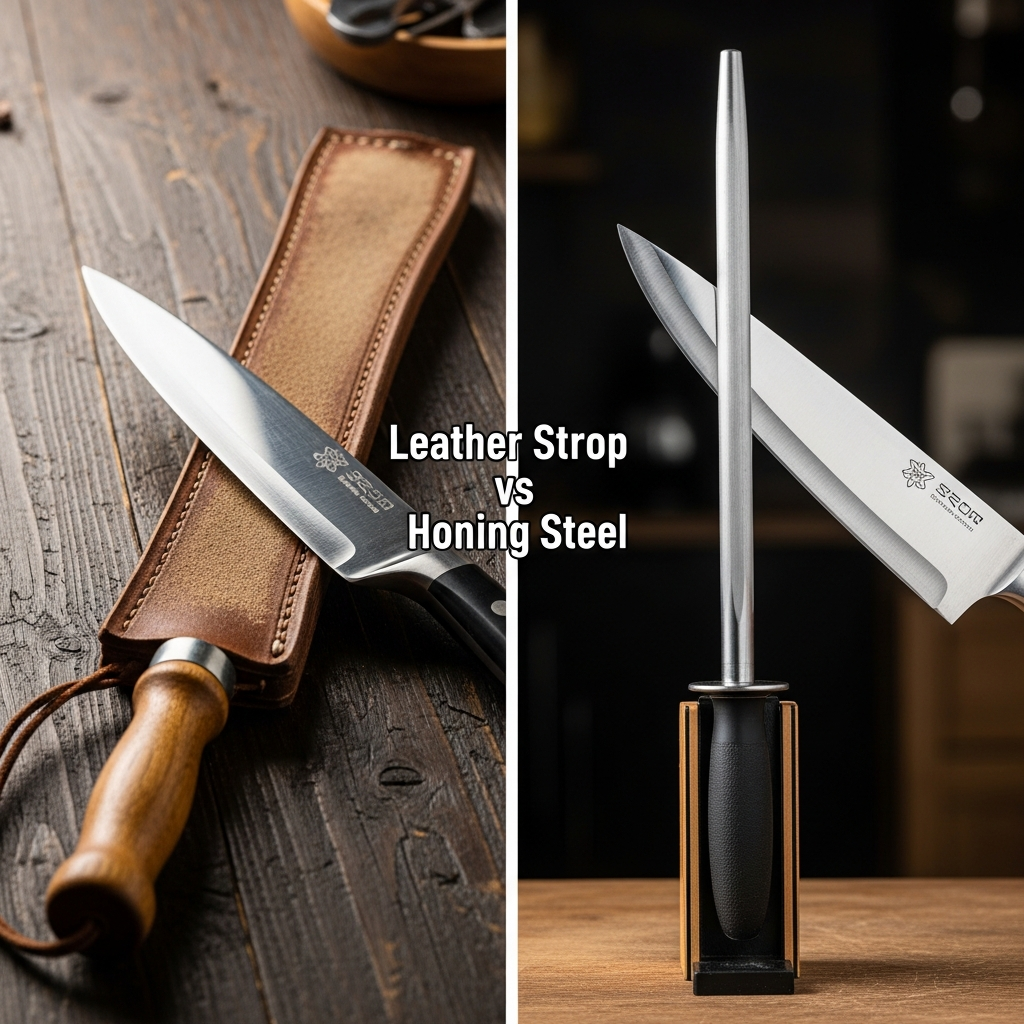
The Leather Strop vs. Honing Steel debate is one of the most frequently misunderstood topics in culinary knife care. Many home cooks falsely assume they perform the exact same function. They emphatically do not. One tool is designed to forcefully align a bent edge for daily, rough use; the other delicately polishes the edge for surgical, microscopic precision. In this comprehensive, deep-dive guide, we will aggressively break down the metallurgy and mechanics of both, explain exactly when to use them, and help you definitively decide which one (or both) rightfully belongs in your knife drawer.
1. The Honing Steel: The Daily Realignment Tool
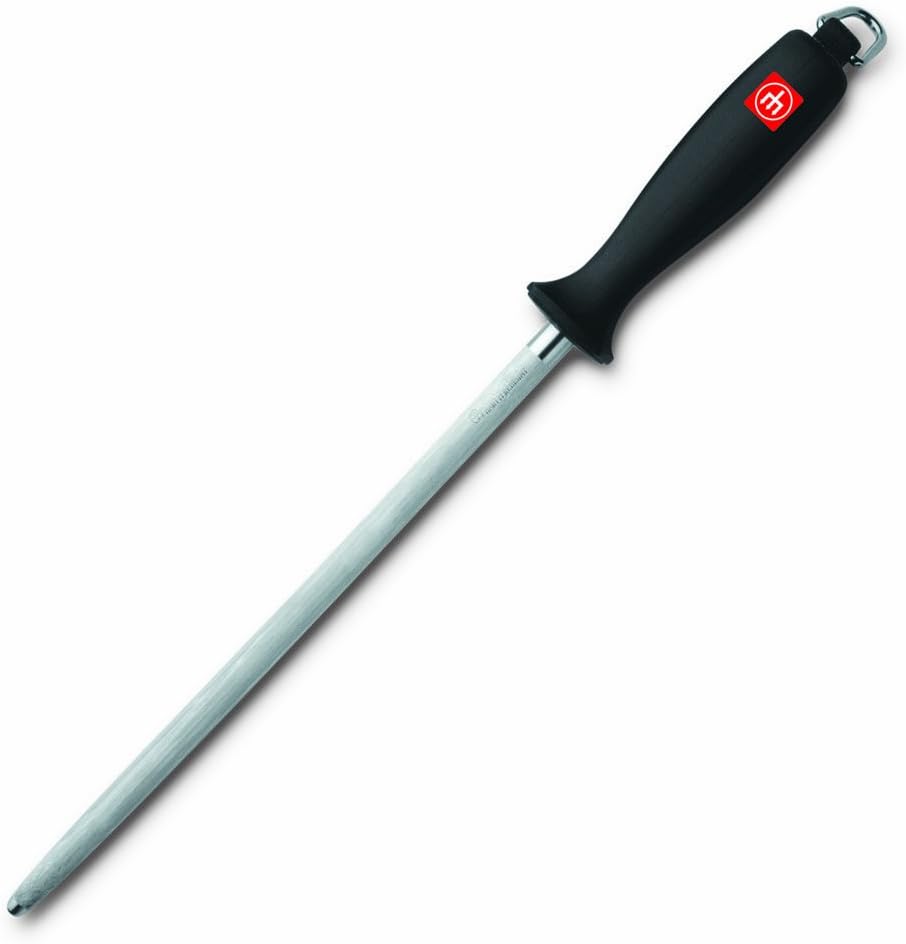
A honing steel (also commonly referred to as a honing rod) is the long, textured metal or ceramic stick that likely came included with your standard knife set with block. It is the absolute most common maintenance tool found in busy Western kitchens and butcher shops. Understanding the physical interaction between the rod and your blade is critical to mastering freehand sharpening. The microscopic teeth on a grooved steel act like a comb for your blade’s edge, gently teasing the deformed metal back into a straight line without the aggressive material removal associated with diamond stones or electric grinders. For professionals working long shifts, the speed of a honing rod is unmatched; you can restore a working edge in under ten seconds without interrupting the flow of service. This immediacy is why you will find a magnetized steel dangling from the apron of almost every butcher and line cook in high-volume steakhouses and busy brunch spots. The repetitive motion of honing also builds crucial muscle memory for maintaining consistent angles, a skill that directly transfers to more advanced techniques like whetstone sharpening. However, the term “honing steel” is a bit of a misnomer in the modern era, as many high-end rods are now made from ceramic or diamond-coated substrates that offer entirely different performance characteristics. While the classic steel rod relies purely on physical displacement of the metal, ceramic and diamond rods introduce a mild abrasive action that bridges the gap between simple alignment and actual sharpening. This makes the choice of rod a nuanced decision based on your specific blade’s hardness and intended use. The history of the butcher’s steel dates back centuries, originally serving as a way to maintain carbon steel blades that dulled quickly during the breakdown of whole carcasses, where the edge would constantly be exposed to bone and dense connective tissue. Modern metallurgy has evolved, but the fundamental need for a quick, reliable edge restorer remains constant in any kitchen that values efficiency and precision.
What It Actually Does (The Science of the Roll)
To understand a honing rod, you must imagine your knife’s microscopic cutting edge is as thin and flexible as a piece of aluminum foil. When you repeatedly chop down through dense food and make aggressive contact with a hard cutting board, that microscopic edge doesn’t necessarily chip or break off; instead, it physically bends or “curls” over to the left or the right. This is known as edge rolling. Under a scanning electron microscope, this phenomenon looks like the peak of a wave crashing over, and it is the primary reason a knife that technically still has a sharp apex fails to cut effectively. The angle of the roll can be influenced by the cutting board material; soft, end-grain wooden boards are far more forgiving and generate less roll than rigid glass, bamboo, or composite plastic boards. The force required to realign this roll is surprisingly minimal, relying on the friction generated as the steel’s ridges catch the curled apex and gently tug it back to center. This is a mechanical straightening process, not an abrasive one, which is why a traditional steel rod does not produce the black metallic swarf you see on a whetstone. However, it is essential to understand that repeated rolling and realignment eventually fatigues the steel matrix at the microscopic level, leading to micro-fractures. This metal fatigue means that over a prolonged period of daily realignment, the edge will eventually begin to crumble away rather than roll, at which point a true abrasive sharpening session becomes necessary to expose fresh, stable steel beneath the fatigued layer. The quality of the steel rod’s surface also dictates its effectiveness; smooth, polished steels offer a very gentle, almost burnishing action suitable for extremely fine edges, while deeply grooved steels provide aggressive bite for quickly tackling heavy rolls on thick, soft German blades. The speed of the draw across the steel also matters; too slow, and the rod will skip and vibrate, potentially causing micro-chipping, while a smooth, confident stroke with consistent light pressure yields the best alignment results.
When to Use It
You should absolutely use a honing steel every single time you cook. A few quick, alternating swipes (roughly 4-5 per side) before you start your heavy prep work will keep your Santoku or Chef’s knife cutting smoothly and safely for weeks or even months between actual, abrasive whetstone sharpenings. This daily ritual transforms the cooking experience, as a properly aligned edge requires significantly less physical force to push through ingredients, reducing hand fatigue and the dangerous likelihood of the blade slipping sideways on a tough onion skin or dense root vegetable. The psychological satisfaction of starting your mise en place with a perfectly responsive blade is a profound joy that converts many casual cooks into obsessive knife maintainers. It’s important to integrate honing into your setup and cleanup routine; placing the rod next to your cutting board as a visual trigger ensures you never forget this critical step. For home cooks preparing a single meal, this takes mere seconds; for a professional chef breaking down fifty pounds of mirepoix, periodic honing throughout the prep session is essential to maintain a safe, predictable cutting performance. The number of passes depends on the state of the edge, but over-honing with poor technique can actually be detrimental, as excessive pressure or wildly inconsistent angles can prematurely dull the apex. Listening to the sound of the steel can provide feedback; a smooth, ringing “shing” indicates a clean, consistent pass, while a scratchy, grinding sound suggests your angle is too steep or you are applying too much pressure. Additionally, the environment you work in matters; a dry steel works best, and you should never oil a grooved steel rod, as the oil will trap metal dust and food debris in the grooves, turning it into a sticky, abrasive paste that will scratch your blade’s finish over time.
Know Your Rods: Steel vs. Ceramic vs. Diamond
Grooved Steel Rods: Best exclusively for softer, tougher German knives (like Wüsthof or Zwilling) sitting at 56-58 HRC. They provide the necessary “bite” to push softer steel back into place. The Rockwell Hardness scale (HRC) rating here is critical, as trying to realign a 62 HRC Japanese blade on a traditional grooved steel often results in the hardened rod simply skating off the blade or, worse, chipping it because the brittle steel refuses to roll elastically and fractures instead. The length of the rod should also match your knife; a 12-inch rod is ideal for a 10-inch chef’s knife, giving you ample runway for a full-length draw stroke without running off the tip of the rod.
Ceramic Rods: Best for harder, more brittle Japanese knives (like Shun or Miyabi). Ceramic is harder than the blade steel and removes a microscopic amount of metal, effectively performing a “micro-sharpening” while it aligns, without the severe risk of chipping a hard VG-10 edge. The grit of a ceramic rod is typically very fine, often equivalent to a 2000-grit or finer whetstone, meaning it refines the scratch pattern on the edge while it works, leading to a smoother, more polished cutting feel that glides through delicate proteins and soft vegetables without tearing. However, ceramic rods are extremely fragile and will shatter if dropped on a tile floor, so they require careful handling and storage, ideally in a sheath or a dedicated slot in your knife block. Over time, the white ceramic surface will load up with grey metal residue, which is a sign it is actively working, but this loading eventually clogs the abrasive surface and diminishes its effectiveness, necessitating thorough cleaning.
Diamond Rods: These are technically sharpeners, not hones. They are coated in industrial diamond dust and aggressively remove steel. Use them sparingly, only when an edge is completely lost. The abrasive nature of diamond rods makes them dangerously effective at quickly eating away metal, so they are best reserved for repairing damaged edges or quickly restoring a completely neglected blade, rather than routine maintenance. Most diamond rods feature a continuous layer of monocrystalline diamonds electroplated onto a steel substrate, offering rapid stock removal but leaving a very aggressive, toothy edge that may be ideal for slicing fibrous meats but feels rough on fine produce. For chefs who travel or work in remote kitchens without access to a full sharpening station, a compact diamond rod can serve as an emergency sharpening solution in a pinch.
2. The Leather Strop: The Final Surgical Polish
A leather strop is a simple strip of thick, raw leather, most often glued securely to a flat block of wood (a paddle strop) or hung from a hook (a barber’s hanging strop). It is the quintessential, historical tool of classic barbers (for straight razors), high-end woodworkers, and serious knife enthusiasts. The art of stropping is deeply rooted in the history of fine craftsmanship, predating modern sharpening stones in many cultures as the primary method of maintaining a razor’s edge. The natural collagen fibers in leather possess a unique ability to embed abrasive particles and present them to the steel at a very shallow, forgiving angle, which is why leather has remained the substrate of choice for final finishing for centuries. Different types of leather produce dramatically different results; vegetable-tanned cowhide is firm and provides fast action, while softer, more pliable horse butt or kangaroo leather molds to the edge more intimately for a supreme polish. The backing of the strop is equally crucial: a paddle strop mounted on rigid wood eliminates the risk of rounding the apex that comes with the slight give in a hanging strop, making it far more forgiving for beginners learning to maintain a precise angle. Some advanced users prefer a hanging strop because the subtle convexing it produces can actually increase edge stability on very thin, flexible blades, a controversial but long-debated topic in straight razor forums. The psychological aspect of stropping cannot be understated; the rhythmic, meditative sound of steel whispering over leather creates a sensory feedback loop that connects you to your tool in a way that no electric sharpener can replicate. For those interested in the ultimate edge, stropping with diamond-sprayed nano-cloth instead of leather is an advanced technique that produces astonishingly sharp edges, but the traditional leather strop loaded with a good compound remains the accessible gold standard for culinary knife enthusiasts.
What It Actually Does (Polishing and Deburring)
Stropping executes two incredibly vital, microscopic functions that a honing rod simply cannot perform:
- Extreme Micro-Alignment: Leather has natural give and elasticity. It wraps around the microscopic apex of the edge, straightening it on a level far finer and gentler than a rigid steel or ceramic rod ever could. This subtle conformability is what burnishes the steel at the molecular level, creating a smooth, cohesive apex without the longitudinal scratches that even the finest honing rod leaves behind. The warmth generated by the friction of the draw also slightly softens the very top layer of waxes and oils in the compound, helping them flow and coat the abrasive particles for a more uniform cut. This process essentially cold-works the steel surface, compacting it and increasing its apparent sharpness and durability.
- Polishing and Deburring (The Magic): When a strop is “loaded” (rubbed) with an abrasive polishing compound (usually a green or white waxy paste), it transforms into an ultra-fine sandpaper. After you sharpen a knife on a whetstone, a tiny, jagged flap of metal called a “burr” or “wire edge” is left hanging onto the apex. The abrasive strop gently grabs this burr and snaps it off cleanly, leaving behind a perfectly polished, mirrored, razor-sharp finish that glides through tomatoes effortlessly. The formation of a burr is a natural consequence of abrasive sharpening, and its complete removal is the hallmark of a truly sharp edge, as a lingering burr folded over during cutting will cause the knife to feel sharp initially but dull almost instantly. The stropping motion draws this burr out perpendicular to the edge and then fractures it at its base, a process often referred to as “cutting the burr off,” which leaves behind a crisp, geometrically perfect intersection of the two bevel planes. The color of the compound matters: green chromium oxide is aggressive and excellent for stainless steel, while white aluminum oxide is finer and better for high-carbon steel or final polishing stages. Red jeweler’s rouge is an even finer option reserved for achieving a true mirror polish on the bevel, though it is often overkill for a working kitchen edge that benefits from some microscopic toothiness.
When to Use It
You should definitively use a strop immediately after sharpening on a whetstone as the final finishing step to remove the burr. You can also use it weekly to quickly “touch up” an edge that is just starting to lose its aggressive bite. It is far less destructive than a honing rod but produces an exponentially finer, sharper result. The technique of “touch-up stropping” extends the interval between full sharpening sessions dramatically, as you are maintaining the apex at its peak geometry rather than allowing it to dull to the point of requiring significant metal removal. This minimal material loss over time translates to a significantly longer lifespan for your expensive blades, as each full sharpening removes a small but measurable amount of steel from the blade’s width. Professional chefs who own extensive Japanese knife collections often strop their carbon steel blades at the end of every shift, not just to refine the edge, but to apply a micro-coating of waxy compound that acts as a temporary moisture barrier against the acidic ingredients they’ve been cutting, providing a small measure of rust prevention. For home enthusiasts, making stropping a relaxing Sunday ritual while listening to music or a podcast transforms knife maintenance from a dreaded chore into a satisfying, tangible demonstration of self-reliance and skill. It’s also an excellent diagnostic tool; if you cannot restore a screaming edge with a loaded strop, it’s a clear signal that the blade has reached the end of its current edge life and needs to visit the stones again.
3. Head-to-Head: The Technical Breakdown
| Feature / Metric | The Honing Steel / Rod | The Leather Strop |
|---|---|---|
| Primary Mechanical Function | Realignment (Straightening a rolled edge) | Polishing & Deburring (Removing the wire edge) |
| Recommended Frequency | Daily / Immediately before heavy prep work | After whetstone sharpening / Weekly touch-ups |
| Metal Removal | None to Minimal (unless using a diamond rod) | Microscopic (when loaded with abrasive compound) |
| Best For (Metallurgy) | Softer German/Western Steels (56-58 HRC) | Hard Japanese/High-Carbon Steels (60+ HRC) |
| Required Skill Level | Easy (Tolerant of slight angle variations) | Moderate (Requires strict angle control) |
Delving deeper into the technical disparities, the surface finish left by these two tools is where the practical difference is most keenly felt during food preparation. A honing rod, particularly a grooved one, leaves a relatively coarse, toothy edge that excels at initiating a bite into tough, smooth-skinned produce like bell peppers and tomatoes. This micro-serrations act like tiny teeth that grab and tear the cell walls, providing a sensation of aggressive sharpness. A leather strop, conversely, burnishes these micro-serrations down into a smooth, polished apex that push-cuts with effortless finesse but can sometimes skid on very smooth, waxy skins without the initial bite. This is why many experts advocate for a hybrid approach: daily honing on a steel to maintain toothy geometry, and weekly stropping to refine and deburr, achieving a balance between aggressive slicing and silky push-cutting. The tactile feedback is another differentiator; a steel provides a harsh, ringing vibration that communicates the blade’s contact, while a strop provides a muted, velvety draw that requires a more developed sense of feel to judge correct angle and pressure. From a metallurgical perspective, the steel rod’s action can actually work-harden the very surface of a softer steel blade, making it slightly more wear-resistant over many cycles, while the strop’s gentle abrasive action, being less impactful, preserves the original heat treatment’s integrity more faithfully. For single-bevel knives, such as traditional Yanagiba sashimi slicers, neither a typical steel nor a flat leather strop is straightforward; these require specialized flat ceramic stones or flat-backed strops to avoid ruining the delicate urasuki (concave back), a topic that fills entire chapters in advanced Japanese knife sharpening manuals. Understanding these granular differences elevates your knife maintenance from simple sharpness into the realm of edge engineering, where you can tailor the exact edge finish to the specific type of cuisine you are preparing that day.
4. Which Tool Do You Actually Need? (By Knife Type)
The specific metallurgical type of steel you own entirely dictates the maintenance tool you absolutely need. (If you are unsure what steel you have, reference our Stainless vs Carbon Steel guide). This foundational decision impacts not just your maintenance routine, but your entire cutting experience, as using the wrong maintenance tool can rapidly degrade an expensive blade. The interplay between blade hardness, carbide structure, and ductility is what drives this choice, and it extends far beyond just the country of origin of the knife.
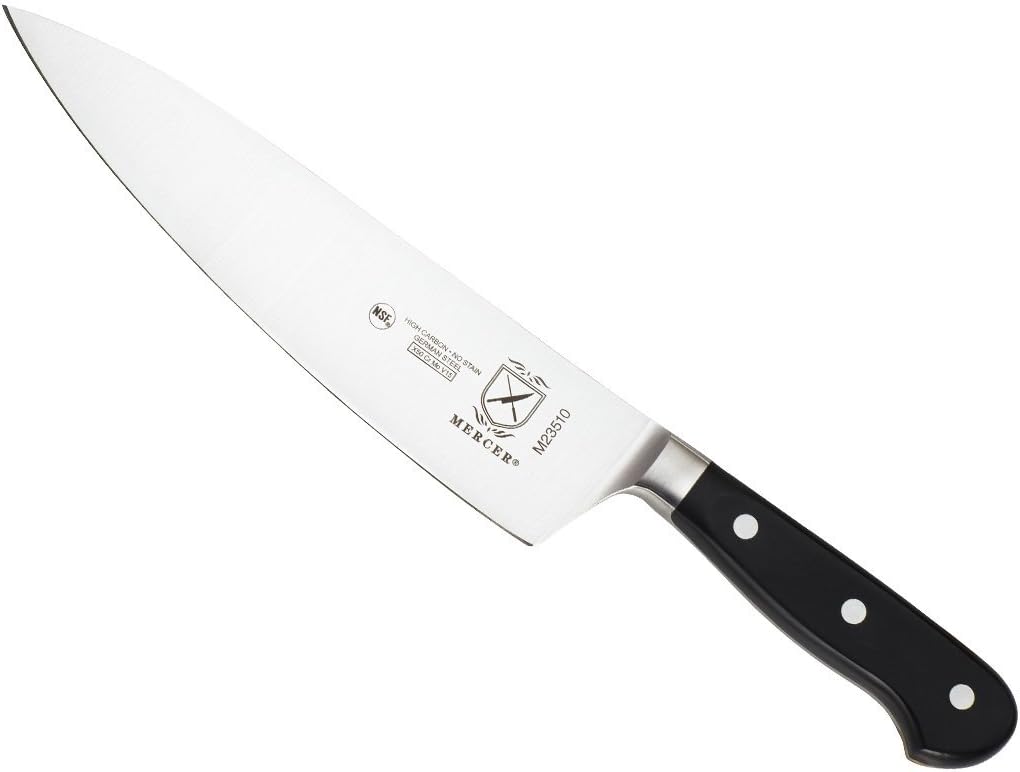
For Heavy German Knives (Wüsthof, Victorinox, Mercer)
Heavy-duty, workhorse knives like the Wüsthof Classic or Victorinox Fibrox utilize softer, tougher steel alloys (usually around 56-58 HRC). Their edges are highly prone to rolling over when hitting cutting boards. The steel formulation, often X50CrMoV15, prioritizes stain resistance and toughness over absolute hardness, creating an edge that deforms plastically rather than fracturing. This is a deliberate design choice, as a rolled edge can be easily fixed in seconds on a steel rod, whereas a chipped edge requires grinding off significant material.
The Verdict: You definitively NEED a Honing Steel. It is an absolute, non-negotiable essential for daily kitchen maintenance to push that soft steel back into place. A leather strop is a fantastic bonus for a finer edge, but it is not strictly required. When selecting a steel for these knives, a 12-inch fine-cut or regular-cut steel with a magnetic tip is ideal, as the length allows for long draw strokes and the magnet helps collect metal dust. The oval or round profile of the steel also matters; oval steels provide a larger contact area for faster realignment, while round steels offer a more concentrated pressure point for tackling stubborn rolls on specific sections of the blade. Over time, a grooved steel rod will itself wear down; the sharp ridges that provide bite will become flattened and burnished, at which point they become a smooth steel, losing their aggressive realignment capability and requiring replacement. Many professional chefs replace their grooved steel rod every year or two, depending on volume, treating it as a consumable wear item rather than a permanent fixture.
For Delicate Japanese Knives (Shun, Miyabi, Tojiro)
Precision knives like the Shun Classic or Tojiro DP are forged from incredibly hard, brittle super-steels (like VG-10 or SG2, sitting at 60-63 HRC). If you aggressively strike these hard edges against a rigid, grooved steel honing rod, you risk physically chipping or shattering the microscopic edge. The high volume of chromium carbides in these powder metallurgy steels provides exceptional edge retention but makes the matrix inflexible, so instead of bending, the edge fractures like glass when struck laterally.
The Verdict: You definitively NEED a Leather Strop (or a very fine, smooth ceramic rod). The forgiving nature of the leather strop gently realigns and polishes the brittle, hard steel without the severe risk of impact chipping. The use of a smooth, non-grooved ceramic rod at a precisely controlled angle is an acceptable alternative, but it must be a very fine grit to avoid creating deep scratches that form stress risers and lead to chipping down the line. The fragility of these edges also demands a heightened awareness of cutting board material; a soft hinoki wood or high-quality rubberized board (like Sani-Tuff) is strongly recommended to prevent edge rolling and micro-chipping in the first place, reducing the need for aggressive maintenance. When stropping these hard steels, using a diamond paste compound (1 micron or finer) on a leather or balsa wood strop can actually be more effective than traditional green compound, as the diamond abrasive is hard enough to cut the vanadium and tungsten carbides that standard aluminum oxide cannot, resulting in a sharper, more durable edge that retains its bite longer on fibrous vegetables and raw fish.
For Specialty Blades
Meat Cleavers: Heavy, bone-crushing meat cleavers possess thick, obtuse edge angles that benefit massively from the aggressive realignment of a sturdy, grooved steel rod. The sheer mass and forceful impact of cleaver work through bone and cartilage create edge rolls that a delicate strop simply cannot correct efficiently. A dedicated butcher’s steel, which is typically thicker, heavier, and more coarsely grooved than a chef’s steel, is the correct tool here, providing the aggressive bite needed to push the thick edge back into true. The technique for a cleaver is also different, involving a firm, slow, deliberate pass rather than the quick, light strokes used on a chef’s knife.
Serrated Knives: Neither a flat strop nor a standard rod works effectively on the recessed teeth of a bread knife. You require a tapered ceramic rod that specifically fits into the individual gullets. (See Serrated Knife Maintenance). The sharpening of serrated knives is a completely separate discipline; each scallop must be treated individually from the back side of the blade, and a flat strop can only address the very tips of the serrations, which often leads to a wavy, inconsistent edge. Specialized conical diamond files or ceramic slip stones are the correct tools for this job, and patience is paramount, as each serration requires multiple passes at a consistent angle to restore its full cutting power. Outdoor and Pocket Knives: For modern super-steels found in high-end pocket knives (like CPM-S30V, M390, or MagnaCut), a loaded leather strop is often the only maintenance needed between extended use cycles, as these steels are so wear-resistant that they rarely roll; they simply slowly wear smooth through abrasive mechanisms, which a fine diamond-loaded strop can refresh without the need for a full stone progression.
5. Top Expert Product Recommendations
We have rigorously tested the market to find the absolute best, most reliable maintenance tools for both your budget beaters and your premium, heirloom knives. These recommendations are based on hands-on use, value for money, and long-term durability in a busy home kitchen environment. The right maintenance tool, much like the right knife, should feel like a natural extension of your hand, inspiring confidence and delivering consistent, measurable results every time you use it. We considered factors like ergonomics, handle material, substrate longevity, and the quality of included compounds when making these selections.
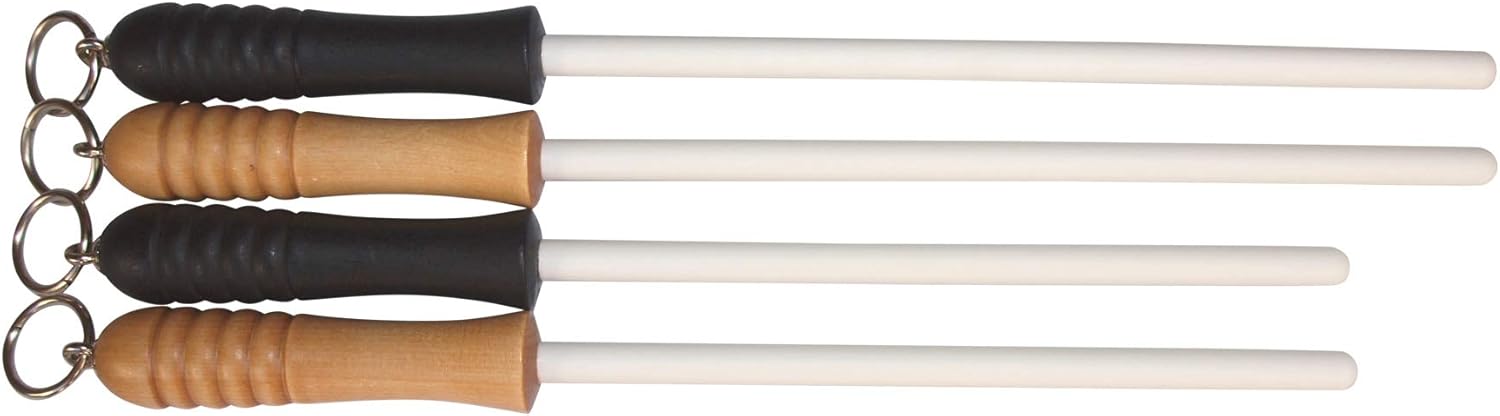 Idahone Fine Ceramic Rod (12-Inch)
The ultimate, universal kitchen solution. It is physically hard enough to align premium Japanese knives without chipping, yet gentle enough to maintain soft German ones. It perfectly aligns and lightly polishes simultaneously. Highly recommended for Global and Wüsthof owners alike. The high alumina ceramic body of the Idahone is incredibly dense and resistant to loading, meaning it stays cleaner longer between required scrubbings, and its 12-inch length provides ample working surface for 10-inch blades. The fine grit hits the sweet spot between realignment and micro-sharpening, making it the one rod that can genuinely bridge the gap between a daily steel and a monthly stropping session. Its solid construction and lack of a separate core prevent the separation issues sometimes seen in cheaper ceramic rods where the ceramic sleeve detaches from the inner steel core.
Check Availability on Amazon BeaverCraft Leather Paddle Strop
An exceptionally high-quality, double-sided leather paddle strop that conveniently includes a block of green polishing compound. It is the absolute perfect tool for surgically finishing your Dalstrong or Shun after a rigorous session on the water stones. The dual-sided nature of this paddle, with one side rough and one side smooth, allows you to progress from an aggressive deburring stage on the rough side to a final, mirror-polishing stage on the smooth side, all with a single tool. The solid wood base is heavy and stable, resisting skidding on the countertop, and the generous width provides a stable platform for even large chef’s knives, reducing the risk of tipping and rounding the edge. The included green compound is a standard chromium oxide formulation that cuts quickly and evenly, and the kit represents exceptional value for a beginner just getting into serious edge maintenance without the intimidation factor of expensive modular systems.
Check Availability on Amazon6. Proper Mechanics: How to Strop Correctly
Stropping is the exact mechanical opposite of sharpening on a stone. If you perform the wrong motion, you will instantly ruin your strop. The most common mistake beginners make is treating the strop like a sharpening stone, pushing the edge forward into the leather. This results in a deep, irreversible gouge in the leather surface that will catch the knife tip on subsequent passes and render that section of the strop unusable. Mastering the trailing edge draw is the gatekeeper skill that separates those who maintain their own knives from those who eventually give up in frustration.
- Direction of Travel (The Golden Rule): You must always move the blade spine first (the trailing edge). If you push the sharp cutting edge forward into the soft leather, you will immediately slice a deep gouge into the strop, destroying it. Think of it as painting a thin layer of compound onto the very apex of the edge, rather than scraping it off. The sound of a correct stropping stroke is a soft, consistent hiss, while an edge-leading stroke is often completely silent just before it catastrophically digs into the leather.
- Angle Control: Meticulously attempt to match the exact angle you just sharpened the knife at on the stones (usually 15 degrees for Japanese, 20 degrees for Western). The tendency for beginners is to unconsciously lift the spine as they draw, increasing the angle and effectively dulling the edge they are trying to refine. Placing the strop at the edge of a table and watching the knife’s shadow can help you maintain a locked wrist position. Some high-end paddle strops come with an angle guide, but for freehand stropping, developing the proprioceptive sense of the correct angle is a skill that takes weeks of consistent practice.
- Pressure Application: Use incredibly light, feather-weight pressure. The leather has give; if you push down too hard, the leather will wrap around and dub (round off) the microscopic apex you just spent hours creating. Let the abrasive compound do the physical work. A good mental cue is to imagine you are trying to gently wipe a thin layer of dust off a fragile antique mirror; the weight of the blade itself should provide most of the downward force, with your fingers merely guiding the trajectory.
- Repetitions: 10 to 15 alternating passes per side is usually more than enough to fully remove the burr and restore that terrifying, “sticky” sharp feeling to the edge. A useful test is to make a few passes, then gently feel for a burr on the opposite side of the blade with your thumb; once you can no longer detect a raised lip, your stropping is complete. Going beyond the necessary number of passes on a loaded strop can actually create a new, finer burr on the opposite side, so knowing when to stop is just as critical as the stropping itself.
This trailing-edge technique is absolutely vital for safely maintaining the incredibly delicate, brittle edges of flat Nakiri knives or specialized, single-bevel Usuba knives. These vegetable-centric blades have extremely acute edge angles that are prone to chipping if handled aggressively, but when correctly stropped, they achieve a level of silent, effortless cutting through produce that defines the pleasure of Japanese blade craftsmanship. For single-bevel knives, the stropping sequence is asymmetric: the vast majority of stropping is done on the wide bevel side to maintain its flat geometry, while the concave back side receives only a single, very light pass to remove any tiny burr that has folded over, preserving the delicate hollow grind that gives these knives their unique food-release properties. The Nakiri, in particular, responds beautifully to a highly polished strop edge, as its primary use is push-cutting through vegetables, where a refined, low-friction finish allows the blade to fall through dense root vegetables like sweet potatoes under its own weight.
7. Long-Term Maintenance and Care for Your Tools
Your premium maintenance tools inevitably require their own maintenance to function correctly. A clogged ceramic rod or a glazed leather strop is as useless as a dull knife, and neglecting these simple care steps will lead to subpar edge results and the erroneous belief that your tools are faulty. Establishing a quarterly maintenance routine for your maintenance tools elevates your entire sharpening workflow and protects your investment in high-quality knives.
- Cleaning the Ceramic Rod: After several uses, white ceramic rods will turn dark grey with microscopic metal filings (swarf). This clogs the abrasive surface. Clean them efficiently using a standard “Rust Eraser,” or simply use a rough scouring pad with warm water and Bar Keepers Friend. (See how to remove rust safely). The Bar Keepers Friend method is particularly effective because the oxalic acid in the powder chemically dissolves metal particles while the mild abrasive scrubs them away, restoring the pristine white ceramic surface. Rinse extremely thoroughly and dry completely before storing, as any residual moisture trapped against a metal ferrule can cause hidden rust that will later stain your blades. Some professionals use a dedicated crepe rubber block designed for cleaning sanding belts, which effectively pulls the swarf out of the ceramic pores without any liquid, allowing the rod to be used again immediately.
- Cleaning the Leather Strop: Leather naturally dries out and cracks over time. Apply a few drops of mineral oil or neatsfoot oil occasionally to keep it supple. If the green or white polishing compound builds up too thick and becomes glazed over with black metal swarf, carefully scrape it off flat with the spine of a knife or a credit card, and reapply a fresh layer of compound. The glazed compound is essentially a layer of compressed metal dust and oxidized compound that no longer exposes fresh abrasive to the blade, so removing it restores the strop’s cutting action. Avoid using vegetable oils for conditioning, as they can turn rancid and sticky over time, attracting dust and potentially staining your blades. A clean, soft toothbrush can also be used to gently brush out loose compound dust from the pores of the leather after scraping, ensuring the new compound adheres directly to the leather fibers for maximum effectiveness.
- Safe Storage: Always hang your strop by its lanyard hole or keep it securely in a knife bag to prevent abrasive household dust or dirt from settling onto the leather, which can severely scratch your polished blades. Honing rods fit perfectly in the round slot of most knife blocks. Storing a loaded leather strop face-down on a dusty workbench is a cardinal sin, as the waxy compound will act like a magnet for airborne grit, effectively turning your finishing strop into a coarse grinding surface that will trash your carefully polished edge on the first pass. A dedicated drawer with a silica gel packet to control humidity is an ideal environment for both rods and strops, preventing rust on steel components and mold on organic leather.
Expert Frequently Asked Questions (FAQ)
Absolutely not. A leather strop strictly polishes and realigns an already existing edge; it cannot physically grind away enough steel to create a brand-new edge bevel. If your knife is truly, deeply dull (meaning it actively reflects light on the cutting edge or has visible flat spots), you must use a whetstone or electric sharpener first to establish an apex, and then finish it on the strop. The distinction is akin to trying to sand a rough plank smooth using only a sheet of newspaper; the newspaper can burnish the surface to a shine but cannot remove the deep saw marks. The abrasive in a strop compound is simply too fine and the substrate is too conformable to remove the amount of material necessary to reshape a bevel or remove chips. Over-stropping a dull knife in the vain hope of bringing it back will only result in a highly polished, shiny, but still completely blunt edge that frustrates you in the kitchen.
For kitchen and pocket knives, yes, it is highly recommended. While plain, bare leather will effectively align a rolled edge, loading the leather with Green Compound (Chromium Oxide) acts as an ultra-fine, microscopic abrasive (approximately 0.5 micron). This abrasive action is what aggressively removes the stubborn burr and provides that stunning, mirror-polished, razor finish. The mechanical action of bare leather is purely one of alignment and burnishing; it tends to push the burr back and forth rather than cleanly abrading it away, which can lead to a weak, unstable edge that fails quickly. The compound gives the strop “teeth,” enabling it to cut the steel at a microscopic level, which is especially critical for modern wear-resistant stainless steels that shrug off simple burnishing. For straight razor users, the distinction between a clean leather strop for final polishing and a pasted strop for edge refinement is standard practice, and this two-strop system is increasingly being adopted by high-end knife sharpeners for the ultimate edge longevity.
Knives from brands like Mercer or Victorinox utilize softer, highly durable European steel. Because this steel is more prone to rolling than chipping, a standard, grooved steel honing rod is absolutely perfect, highly effective, and very cost-efficient for maintaining their daily working edges. The Victorinox Fibrox, in particular, is a culinary school workhorse specifically engineered to be maintained quickly with a steel, embodying a philosophy of functional, accessible sharpness over esoteric edge perfection. A ceramic rod works well on these too, but the cost-benefit ratio favors a simple, high-quality grooved steel rod that can be aggressively used without fear of damage. The frequency of honing with these softer steels should be very high, almost constantly during a long prep session, as they are specifically formulated to be “friendly” to the steel rod user, sacrificing absolute edge retention for ease of realignment.
In a pinch, yes! An old, thick leather belt pulled completely taut can work surprisingly well as an emergency field strop. Just ensure it is entirely clean of dirt or sand. Use the rough, suede-like inside if you want to apply a polishing compound, or use the smooth, finished outside for a final, clean edge alignment. However, the inconsistency of belt leather thickness and its tendency to stretch under tension makes it a poor long-term substitute for a rigid paddle strop. The metal buckle, rivets, and any stitching present significant hazards that can catch a sharp blade tip, potentially chipping the point or causing a dangerous slip. If you must use a belt, remove the buckle if possible and anchor one end securely to a fixed object, keeping the leather as flat and stable as possible. This makeshift method is a useful survival skill for outdoorsmen and camp cooks, but for your expensive chef’s knives at home, a dedicated $30 paddle strop is a far safer and more effective investment that eliminates the variables and risks of improvised stropping.
A highly refined, stropped edge will interact differently with various board materials. A polished edge from a strop will glide effortlessly across a soft, end-grain wooden board, preserving the edge for an exceptionally long time. However, the same polished, smooth edge may slip or skate on a dense plastic composite board, failing to initiate the cut securely, which can be dangerous. A toothier edge from a ceramic rod or a coarser stone is often preferred for polypropylene or rubber boards, as the micro-serrations catch the board’s surface and provide a more secure, controlled cutting feel. This is a subtle but important detail for professional chefs who work on standardized kitchen cutting boards, where board material is dictated by health code rather than personal preference. The ideal scenario is to tailor your edge finish not just to your knife, but to the primary cutting board you use daily, creating a harmonious system where blade, board, and maintenance tool all complement each other for maximum safety and efficiency.
Conclusion: The Final Verdict on Finishing
The great battle of Leather Strop vs. Honing Steel is ultimately not a question of which tool is definitively “better.” It is entirely a question of the specific metallurgy of your knives and the level of absolute perfection you personally demand from your cutting edges. The tools are not adversaries but complementary instruments in a symphony of edge maintenance, each playing a distinct role that contributes to the overall harmony of the cutting experience. The home cook who understands this distinction has graduated from simple knife ownership into the realm of true culinary craftsmanship, where the tool becomes an extension of intent rather than a blunt instrument of force.
You desperately need a Honing Steel If: You simply want a highly functional, dependably sharp knife for daily, high-volume cooking and you own softer German or Swiss steel. It is the culinary equivalent of the toothbrush—something you must use every single day to maintain basic health and prevent major issues. The convenience and speed of a steel cannot be overstated; in the time it takes to boil water, you can restore a working edge and continue your prep without skipping a beat, a workflow efficiency that a strop cannot match for sheer rapidity. For the pragmatist who values function over form, the honing steel is the bedrock of knife maintenance.
You desperately need a Leather Strop If: You want a terrifyingly sharp, surgically precise edge. If your ultimate goal is to effortlessly push-cut receipt paper, silently shave hair off your arm, or maintain the brittle edge of a high-end Japanese knife, the loaded leather strop is the mandatory final step that takes a blade from merely “sharp” to “scary.” The pursuit of this level of sharpness is a hobby in itself, a meditative practice that rewards patience and precision with a sensory experience that transforms the most mundane vegetable chopping into a profound, tactile pleasure. For the enthusiast who sees sharpening not as a chore but as a craft, the leather strop is an indispensable gateway into the deeper world of edge geometry and metallurgy.
Ideally, a serious, well-equipped home cook or professional chef owns both tools. A fine ceramic rod for quick daily use on the line, and a loaded paddle strop for that meticulous weekend sharpening session. Be sure to check out our comprehensive master sharpening guide to clearly see exactly how both of these essential tools fit into a complete, professional edge maintenance workflow. Investing in both a quality steel and a quality strop will cost less than a single premium chef’s knife, yet it will dramatically extend the life and cutting performance of every blade in your collection, making it the highest-leverage purchase any cook can make for their kitchen.