Bread Knife vs. Serrated Knife: What is the Difference?
In the culinary world, terminology can be confusing. You are browsing knifeindex.com/ to complete your kitchen kit, and you see terms like “Bread Knife,” “Tomato Knife,” “Sausage Knife,” and “Utility Knife.”
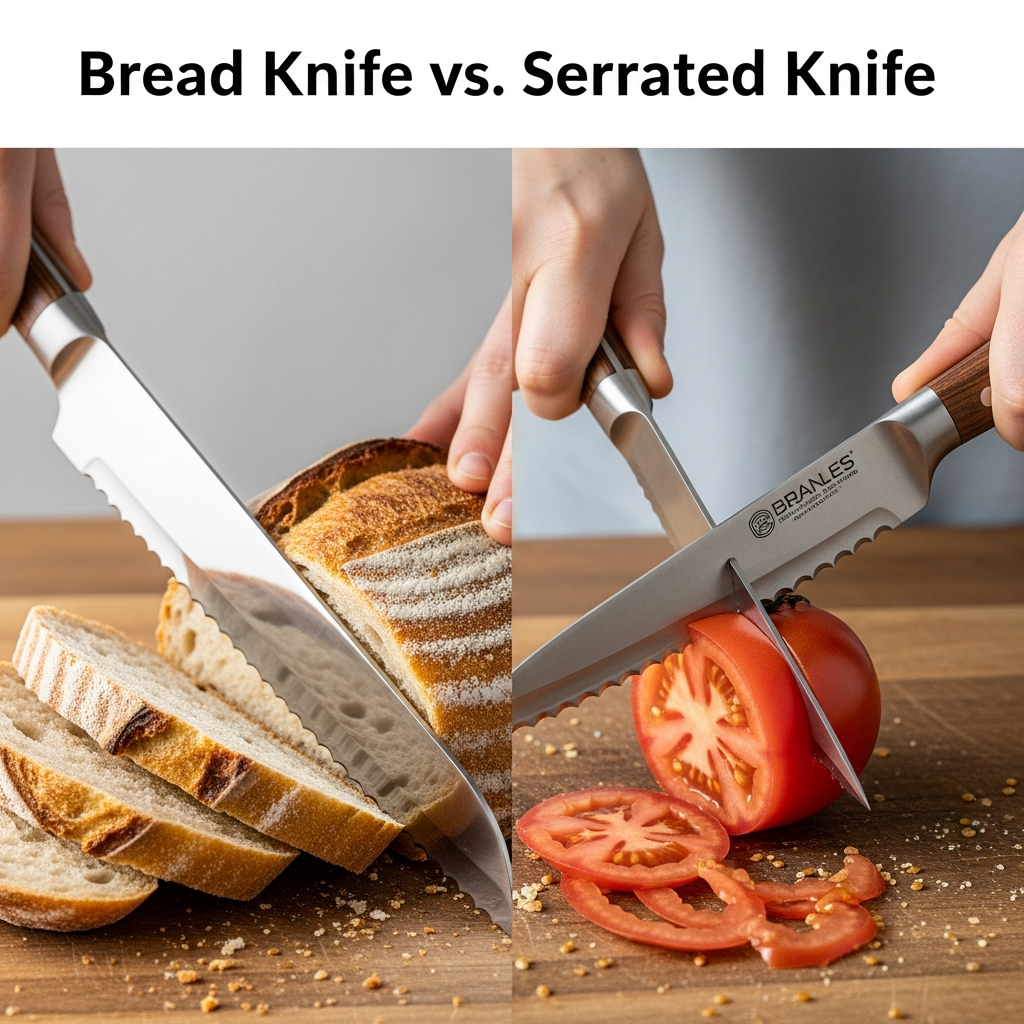
Here is the secret: All bread knives are serrated knives, but not all serrated knives are bread knives.
While the terms are often used interchangeably, understanding the distinction is key to choosing the right tool. Using a small serrated utility knife on a massive sourdough boule will result in crushed bread and frustration. Conversely, using a 10-inch bread knife to slice a single lemon is overkill.
In this comprehensive guide, we will break down the anatomy of serrated blades, explore the different types (like Wusthof vs Shun serrations), and help you decide which ones belong in your knife block.
1. The Core Definition: What is a Serrated Knife?
A serrated knife is any blade that has a saw-like edge. Instead of a smooth line (like a Chef’s Knife or Santoku), it features “teeth” and “gullets.”
How it Works: The points of the teeth pierce the hard exterior of food (crusty bread, tomato skin, sausage casing), protecting the sharp curves inside the gullets. This allows the knife to slice through soft interiors without crushing them. For a deep dive, read our article: What is a Serrated Knife Used For?
2. The Bread Knife: The Specialist
A Bread Knife is a specific type of serrated knife designed for one main purpose: slicing loaves.
Key Characteristics:
- Length: Typically 8 to 10 inches long. You need this length to saw back and forth across a wide loaf without the tip getting stuck inside.
- Stiffness: Generally stiff to maintain a straight cut through dense crusts.
- Blade Shape: Usually straight or slightly curved (offset) to keep your knuckles off the cutting board.
If you bake sourdough or buy artisan loaves, this tool is non-negotiable. Check out our guide to the best bread knife for our top picks.
Video Demonstration
Watch this quick breakdown to see how different serrations affect cutting performance.
3. The “Other” Serrated Knives: Utility and Steak
When people say “serrated knife” but don’t mean a bread knife, they are usually talking about these smaller cousins.
The Serrated Utility Knife (Tomato Knife)
Usually 5 to 6 inches long. It is perfect for foods that have a tough skin but soft middle, like tomatoes, citrus, or bagels. It bridges the gap between a Paring Knife and a Bread Knife. Read more in our Paring vs. Utility Knife comparison.
The Steak Knife
Designed for the table, not the prep board. However, they use the same mechanics. If you are looking for durability at the dinner table, check out our guide to dishwasher safe steak knives.
4. Head-to-Head: The Specs Breakdown
| Feature | Bread Knife | Serrated Utility Knife |
|---|---|---|
| Blade Length | 8″ – 12″ | 5″ – 6.5″ |
| Primary Use | Bread, Large Melons, Cakes | Tomatoes, Bagels, Citrus, Sausage |
| Flexibility | Stiff / Rigid | Semi-Flexible |
| Knuckle Clearance | High (often offset) | Low (handle near board) |
| Alternatives | Slicing Knife | Paring Knife |
5. Types of Serrations: Pointy vs. Scalloped
Not all teeth are the same. The shape of the serration drastically changes how the knife cuts.
Pointy Serrations (Mercer, Victorinox)
These teeth look like little triangles. They are aggressive and bite into hard crusts instantly. They are typical of the best budget knife brands because they stay sharp a long time but tear softer foods more easily. (See Mercer vs Victorinox).
Scalloped/Wavy Serrations (Wusthof, Shun, Mac)
These look like inverted clouds. They are gentler. They slice through cake or soft brioche with less crumbs.
- Wusthof: Uses a “Double Serrated” edge. (See Wusthof vs Victorinox).
- Shun: Uses a gentle wave. (See Shun vs Wusthof).
- Mac: Uses a unique rounded tip serration. (See Mac vs Wusthof).
6. Top Product Recommendations
We have tested the best chef knife brands to find the leaders in serrated technology.
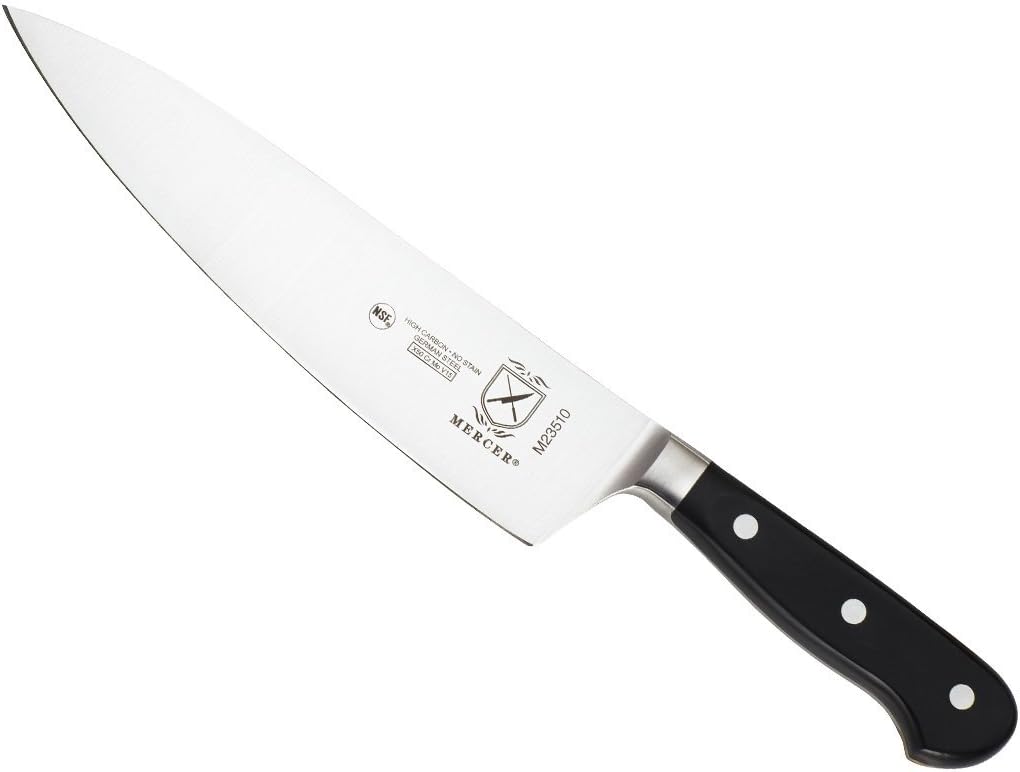
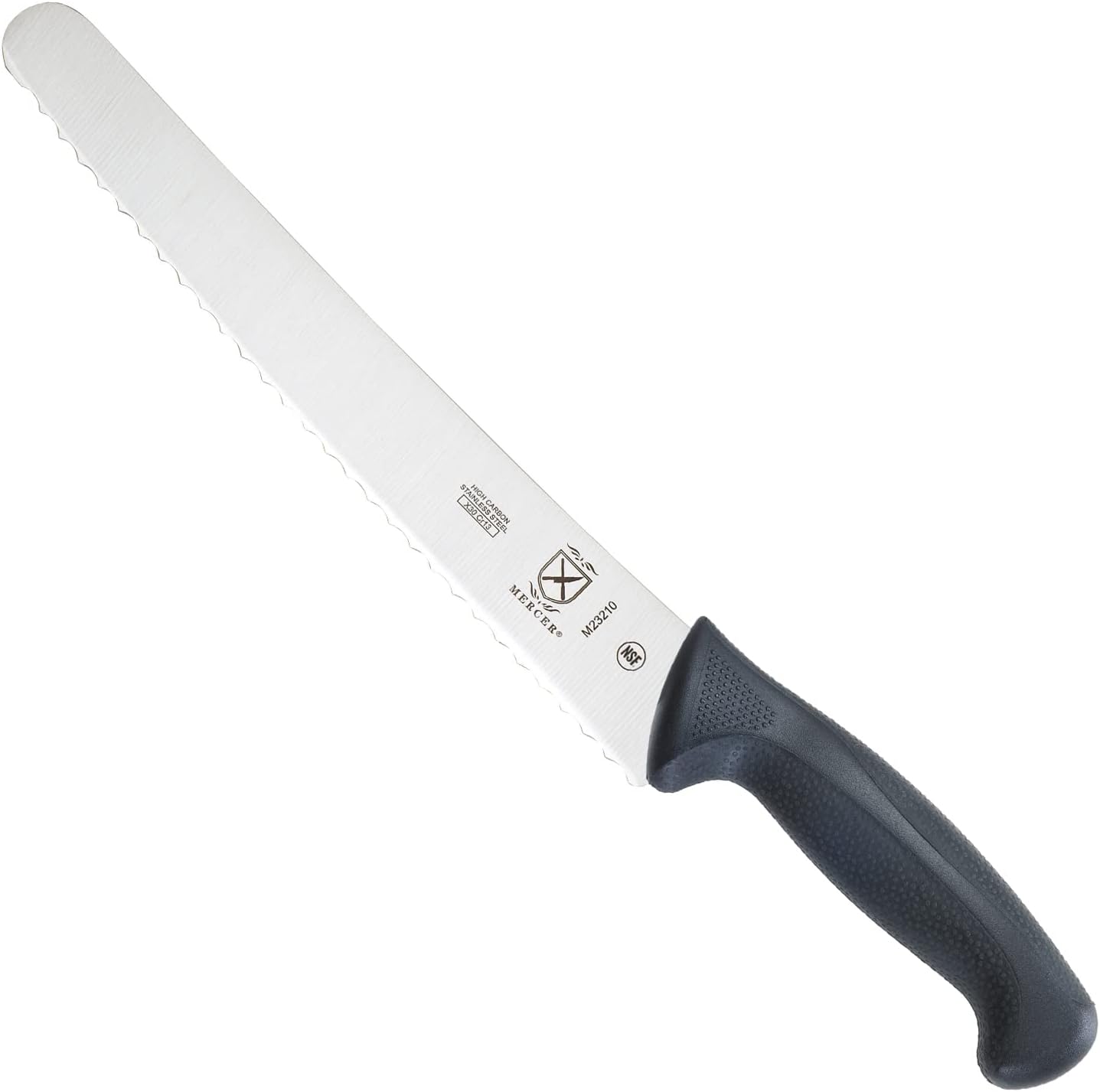
 Mercer Renaissance 8″ Bread Knife
The Value King. Forged German steel with aggressive serrations that conquer the hardest sourdough. Unbeatable for the price. See Mercer vs Wusthof.
Check Price on Amazon Wüsthof Classic Ikon 5″ Sausage Knife
The Multitasker. Perfect for tomatoes, salami, and bagels. The double-serrated edge stays sharp for years. A top pick in German Knives.
Check Price on Amazon7. Maintenance: The Tricky Part
Serrated knives are notoriously difficult to sharpen. Unlike a straight edge that you can run over a stone, each serration must be sharpened individually.
- Sharpening: You need a tapered ceramic rod. Go slowly, tooth by tooth. For easier maintenance, check our guide on the best knife electric sharpeners (some have serrated slots).
- Rust: Moisture gets trapped in the gullets. Ensure they are bone dry, especially high-carbon brands like Dalstrong or Shun. Learn how to remove rust.
- Storage: Do not throw them in a drawer! The teeth will snag on everything. Use a drawer organizer or a magnetic strip.
8. Building Your Kit: Do You Need Both?
If you are building a set from scratch (or buying one of the best knife sets), look for:
- A Chef’s Knife or Santoku for 90% of prep.
- A Bread Knife (10-inch) for loaves and large melons.
- A Serrated Utility Knife (5-inch) for tomatoes and citrus.
If you can only afford one? Get the large Bread Knife. It can cut a tomato (awkwardly), but a small utility knife cannot cut a large loaf of bread.
9. Brand Comparisons
Looking for a specific brand?
- Tojiro: Makes a legendary budget bread knife. (See Tojiro vs Shun).
- Zwilling: Offers robust, heavy serrated knives. (See Zwilling vs Henkel).
- Victorinox: The Fibrox bread knife is a pastry chef favorite. (See Victorinox reviews).
- Global: Their G-9 bread knife is stiff and laser sharp. (See Global vs Wusthof).
10. Bread Knife vs. Chef’s Knife: Why You Can’t Substitute One for the Other
One of the most common questions we get from readers building their first kitchen kit is whether a good chef’s knife can simply replace a bread knife. The honest answer is no, and the reason comes down to edge geometry rather than sharpness. A chef’s knife relies on a continuous, razor-thin bevel that works by applying downward pressure and a rocking motion. That works beautifully on vegetables, proteins, and herbs because the cellular structure of those foods is relatively uniform from the skin to the center.
Bread is a different problem entirely. A crusty sourdough boule has a hard, brittle, almost glass-like exterior surrounding a soft, airy, sponge-like crumb. If you press a straight edge like a chef’s knife straight down into that structure, the blade tends to crack the crust unevenly before it ever reaches the interior, and once it does reach the crumb, the flat edge compresses the air pockets instead of severing them cleanly. The result is a lopsided, squashed slice with crust shards scattered across the cutting board.
A serrated bread knife solves this because the teeth act like a series of tiny individual points, each one puncturing the crust at a single spot rather than trying to shear through the whole surface at once. As you saw motion the knife back and forth, those points walk their way through the crust with minimal downward force, which means the crumb underneath is never compressed. This is why professional bakers, even ones who own extremely expensive chef’s knives, always keep a dedicated serrated blade in the kit specifically for bread and other crusty items.
There is a secondary reason a chef’s knife struggles with bread: edge retention. A fine, polished edge is engineered for push-cuts and slicing through soft materials. Repeatedly using it to hack through a hard crust will roll the edge, chip the fine bevel, and dull the knife far faster than normal use would. Serrated edges are, by design, more resistant to this kind of damage because each tooth only needs to be sharp at its point, and the recessed gullets are naturally protected from most of the abrasive contact with the crust.
When a Chef’s Knife Still Wins
To be fair to the chef’s knife, there are situations where it remains the better tool even around bread. If you are slicing very soft dinner rolls, brioche buns, or pre-sliced sandwich bread that has no meaningful crust, a sharp chef’s knife or even a utility knife will do the job fine, and some cooks prefer the cleaner look of a straight cut for photography-ready sandwiches. But once you introduce any real crust, thickness, or diameter, the serrated bread knife becomes the only tool that will not mangle the loaf.
11. Granton Edge vs. Serrated Edge: Don’t Confuse These Two
Search engines are full of confused comparisons between “granton edge” and “serrated edge,” and it’s worth clearing this up because the two terms describe completely different technologies that are sometimes combined on the same blade.
A Granton edge (sometimes spelled “grantón” or referred to as a “hollow edge” or “kullenschliff” in German cutlery circles) refers to the small oval indentations ground into the sides of a blade, just above the cutting edge. These divots create tiny air pockets between the food and the blade face as you cut, which reduces suction and helps thin slices of fish, meat, or vegetables release cleanly from the steel instead of sticking to it. Granton edges are most commonly seen on slicing knives, salmon knives, and some santoku-style vegetable knives.
A serrated edge, in contrast, is not about the sides of the blade at all — it is about the cutting edge itself, which is scalloped or toothed rather than perfectly straight. The purpose is entirely different: instead of reducing suction on the blade face, serrations are designed to concentrate cutting force at a series of points so the knife can penetrate hard, uneven, or slippery exteriors.
Some manufacturers do combine both technologies on a single blade, most often on longer slicing and carving knives, where a scalloped edge helps the initial bite into a roast or ham while Granton-style hollows along the flat reduce drag and sticking as the slice is completed. If you see a knife advertised as having both features, understand that you’re getting two distinct benefits stacked on one blade rather than a single hybrid technology.
12. Ceramic Serrated Knives: Are They Worth Buying?
Most of what we’ve discussed so far assumes a steel blade, but ceramic serrated knives have carved out a real niche, especially among people who bake gluten-free or low-acid diets and want a blade that will never impart a metallic taste or oxidize. Ceramic blades are typically made from zirconium dioxide, a material that is significantly harder than most kitchen steel, which means the edge stays sharp for a very long time without honing.
The trade-off is brittleness. Ceramic is hard but not flexible, so where a steel bread knife can flex slightly and absorb shock when it hits something unexpected, like a stray nut or a frozen spot in the loaf, a ceramic blade is far more likely to chip or snap outright. Ceramic serrated knives are also nearly impossible to resharpen at home; once the teeth dull or chip, most owners simply replace the knife or send it to a specialty ceramic sharpening service, which can cost more than a mid-range steel replacement.
For most home cooks, we recommend sticking with a quality forged or stamped steel serrated blade for daily bread duty and reserving ceramic knives for lighter tasks, if you want them at all. The one legitimate advantage worth considering is for anyone with a nickel allergy or extreme sensitivity to metallic taste transfer, since ceramic is chemically inert against acidic foods like tomatoes and citrus, which is where the smaller ceramic serrated utility knives genuinely shine.
13. Electric Bread Knives and Electric Serrated Knives
Before dismissing this as a gimmick, it’s worth understanding why electric serrated knives exist at all, because they solve a real problem for a specific group of people. An electric knife uses two thin, closely spaced serrated blades that oscillate rapidly back and forth, essentially automating the sawing motion that a manual bread knife requires from your wrist and shoulder.
This matters most for two groups: people with arthritis, carpal tunnel, or limited grip strength who find repetitive sawing painful, and anyone regularly carving very large or very dense items, like a whole holiday ham, a thick prime rib, or an oversized country loaf that would otherwise take dozens of strokes to get through. The motor does the repetitive work, so the user only needs to guide the blade and apply light forward pressure.
The downsides are real, though. Electric knives are bulkier to store, they require either a cord or a charged battery, and the thin twin blades are considerably harder to clean thoroughly since food debris tends to work its way into the mechanism at the base. They also tend to produce a slightly rougher cut surface than a well-honed manual serrated blade in the hands of an experienced user, since the oscillation can shred delicate crumb structures if the operator pushes too hard. For most people who bake bread regularly and have reasonable hand strength, a good manual bread knife remains the better daily tool, with the electric version kept as a specialty item for holidays or accessibility needs.
14. Choosing Bread Knife Length by Loaf Shape
Not every loaf is the same shape, and matching your bread knife’s length to what you actually bake or buy will save you a surprising amount of frustration.
- Baguettes and Batards: These long, narrow loaves don’t need a huge blade. A 9-inch bread knife handles the length easily, and the narrower crumb structure means you don’t need extreme reach.
- Round Boules and Country Loaves: This is where a full 10-inch blade earns its keep. Wide, round loaves need the extra length so you can complete a full stroke without the tip disappearing into the crust and getting stuck mid-cut.
- Sandwich Loaves and Pullman Bread: A shorter 8-inch blade is often more comfortable here since these loaves are narrower and more uniform, and a shorter blade is easier to maneuver in the smaller motion needed for consistent sandwich-thickness slices.
- Focaccia and Sheet-Pan Breads: These wide, flat breads benefit from a long, flexible blade that can glide across a large horizontal surface without requiring you to saw vertically through significant height.
- Bagels and Rolls: Ironically, a full-size bread knife is often the wrong tool here. A dedicated bagel guillotine or a shorter serrated utility knife gives you more control over a much smaller, denser item and reduces the well-known risk of bagel-related hand injuries.
15. Blade Steel and Construction: What “German Steel” and “X50CrMoV15” Actually Mean
Product listings often throw around steel designations without explaining them, so here is a plain-language breakdown of what you’re actually paying for.
Most mid-range and budget German-style bread knives use a steel alloy commonly labeled X50CrMoV15. Breaking down that code: the “50” indicates roughly 0.5% carbon content, “Cr” stands for chromium (roughly 15%, hence the “15” at the end) which provides stain resistance, “Mo” is molybdenum for added toughness, and “V” is vanadium, which helps refine the grain structure for a more consistent edge. This is a soft-ish but very tough stainless steel that resists chipping and rust extremely well, which is exactly why it’s the standard choice for a tool that regularly encounters moisture from dough and gets tossed in a drawer.
Higher-end Japanese-influenced serrated knives sometimes use higher-carbon stainless steels like AUS-8 or VG-10, which can take and hold a sharper point on each individual tooth, but these blades are also more particular about drying immediately after washing to avoid spotting or light surface rust. For a bread knife specifically, most cutlery experts agree that the tougher, slightly softer German-style steels are the better practical choice, since the primary demand on a bread knife is durability and rust resistance rather than the ultimate fineness of edge that matters more on a chef’s knife or paring knife.
Construction also matters beyond the steel itself. Forged blades, made by hammering or pressing a single heated billet of steel into shape, tend to have a heavier bolster and better balance, while stamped blades, cut from a flat sheet of pre-hardened steel, are lighter and more affordable but can feel less substantial in hand. Neither is objectively wrong for a bread knife; a lighter stamped blade actually reduces wrist fatigue during long sawing strokes, which is part of why so many professional bakeries favor lightweight stamped serrated blades over heavier forged versions.
16. Proper Sawing Technique: How to Actually Use a Serrated Knife
Even with the right knife, technique determines whether you get clean slices or crumbled wreckage. The core principle is to let the serrations do the work rather than pushing down with force.
- Rest, don’t press: Place the blade on top of the crust with minimal downward pressure. The teeth are sharp enough to begin engaging the surface almost immediately.
- Use long, full strokes: Short, choppy sawing motions concentrate wear on a small section of teeth and produce ragged slices. Use the entire length of the blade in each stroke.
- Let the knife travel forward, not just back and forth: The most efficient motion combines the horizontal sawing action with a slight forward glide, similar to how a handsaw cuts wood more effectively when angled rather than pumped straight up and down.
- Stabilize the loaf, not the slice: Use your guide hand to hold the loaf steady further back from the cut line, with fingers curled safely away from the blade path.
- Let gravity finish the cut: As you near the bottom crust, ease off pressure entirely and let the sawing motion alone complete the separation, which prevents the classic “crushed bottom” that happens when people push down hard through the final few millimeters.
17. Left-Handed Use and Ergonomics
Serrated knives are one of the few blade types that are genuinely symmetrical in most designs, since the teeth point in both directions along the saw pattern rather than being ground with a single-bevel edge favoring one hand. This makes the vast majority of bread knives naturally ambidextrous, unlike some single-bevel Japanese knife styles that require a mirrored left-handed version.
Where handedness does matter is with offset bread knives, since the drop-handle design that lifts your knuckles off the board is often shaped asymmetrically. Left-handed users should check whether a specific offset model is marketed as reversible or symmetric, since a poorly matched offset handle can actually make knuckle clearance worse rather than better for a left-handed grip.
18. Dishwasher Safety: A Closer Look
Many bread knife listings advertise themselves as “dishwasher safe,” and while this is often technically true, cutlery experts almost universally recommend hand washing anyway, for reasons that go beyond marketing disclaimers.
Dishwasher detergents are highly alkaline and can accelerate the dulling of any fine edge, serrated or not, through a combination of chemical exposure and the physical jostling that happens during the wash cycle when knives knock against other utensils and rack tines. For serrated blades specifically, that jostling is particularly damaging because the fine points of each tooth are the most fragile part of the edge, and a knock against a metal fork tine or the dishwasher’s rack wire can chip a point in a way that’s difficult to fully repair even with professional sharpening.
There’s also a food safety and hygiene angle: the gullets between serration teeth can trap tiny food particles that a dishwasher’s water jets don’t always fully dislodge, whereas hand washing with a sponge or dedicated knife brush lets you physically work soap into each gullet. For a knife you use as often as a bread knife, the extra thirty seconds of hand washing is a small price for both a longer-lasting edge and better hygiene.
19. Buying Guide Checklist: What to Look for Before You Purchase
If you’re comparing multiple listings and feeling overwhelmed by specs, run through this checklist:
- Blade length matched to your typical loaf: Don’t buy the longest knife available if you mostly slice sandwich bread; match length to the section above on loaf shapes.
- Serration pitch: Wider, pointier serrations bite into hard crusts faster; narrower, wavy serrations give a cleaner cut on cakes and soft breads. Consider what you cut most often.
- Handle material and grip: Look for textured, ergonomic handles, especially if you have larger hands or plan to cut for extended periods, such as slicing bread for a large gathering.
- Bolster and balance: A full bolster (the thick junction between blade and handle) adds weight and protects your fingers, but can make the knife front-heavy; decide based on your grip preference.
- Steel type and stain resistance: For a knife that regularly touches moist dough, prioritize stain-resistant stainless steel over ultra-high-carbon blades that need more maintenance.
- Straight vs. offset design: Offset handles add knuckle clearance but change the balance point; try both styles if possible before committing.
- Warranty and sharpening support: Some premium brands include lifetime warranties or complimentary sharpening services, which can offset a higher upfront price over years of use.
20. A Brief History of the Serrated Bread Knife
The serrated knife as we know it today is a relatively modern invention compared to the straight-edged blades that have existed for millennia. Toothed cutting tools go back to ancient sickles and saws, but the specific concept of a serrated table or kitchen knife designed for bread didn’t become common until manufacturing techniques in the late 19th and early 20th centuries made it economical to stamp consistent tooth patterns into thin sheet steel.
Early European bread knives were often simple flat blades with coarse, deep teeth cut by hand, closer in spirit to a small handsaw than to the refined scalloped edges we see today. As bread culture diversified across different regions, particularly with the rise of dense, crusty artisan loaves in France and Germany, cutlery makers refined the tooth pattern to strike a better balance between crust-piercing aggression and crumb preservation. The scalloped, wave-style serration that dominates premium bread knives today emerged largely from mid-20th-century German cutlery workshops experimenting with rounded rather than pointed tooth shapes specifically to reduce crumb tearing on soft interiors.
Meanwhile, the smaller serrated utility or tomato knife has a somewhat different lineage, emerging more directly from steak knife and paring knife traditions as manufacturers realized that a miniaturized serrated edge solved the specific problem of slippery, thin-skinned produce like tomatoes, which were notoriously difficult to start a clean cut on with a smooth blade. Today, both tools have become kitchen staples precisely because they solve two distinct but related problems: large, crusty exteriors and small, slippery ones.
21. Using a Bread Knife for Cake Leveling and Torting
Bakers frequently discover that their bread knife does double duty as one of the best tools for leveling cake layers and creating even torted layers for layer cakes. This is a genuine keyword search many home bakers run into without realizing the bread knife is the answer.
The long, straight blade of a standard bread knife is ideal for this task because it lets you rest one hand flat on top of the cake as a guide while sawing horizontally in a single continuous stroke, using the length of the blade to maintain an even plane across the entire diameter of the cake. A short blade forces you to reposition multiple times across a wide cake, which is exactly where inconsistent, wavy cuts come from. The gentle, wavy serration pattern common on premium bread knives (as opposed to the aggressive pointed teeth found on budget models) is particularly well suited to cake work, since it glides through soft sponge without tearing or leaving visible saw marks on the exposed crumb.
If cake leveling and torting is a frequent task in your kitchen, look specifically for a bread knife advertised with a scalloped or wave-style edge rather than a sharply pointed serration, and prioritize a straight (non-offset) handle design, since the offset drop-handle useful for bread crust clearance can actually work against you when you need the blade to stay perfectly level across a wide cake.
22. Slicing Melons and Large Produce
Large, thick-skinned produce like watermelon, honeydew, cantaloupe, and winter squash present a similar challenge to bread: a tough, sometimes waxy exterior surrounding a much softer interior. This is why bread knives are so frequently recommended as a secondary tool for melon prep, and why some manufacturers market dedicated “melon knives” that are really just longer, stiffer bread knives with a slightly different handle.
For a whole watermelon, the length of a 10-inch or 12-inch bread knife matters even more than it does for bread, since you need enough blade to get through the full diameter in as few strokes as possible. The rind’s waxy surface can also cause a smooth blade to skate before it bites, whereas the serrated teeth immediately grip and begin cutting. Once you’re through the rind and into the flesh, the same forward-sawing technique described earlier in this guide keeps your cuts clean and prevents the knife from crushing the juicy interior.
Pineapple is a related use case, though the tough, fibrous skin combined with the sharp spines around the crown makes many cooks reach for a dedicated pineapple corer instead. If you don’t own one, a stiff bread knife will get through the skin, though you’ll want to follow up with a paring knife to clean out the fibrous “eyes.”
23. Safety Considerations and Kid-Friendly Serrated Options
Serrated blades have an interesting safety profile compared to straight edges. Because the teeth concentrate force at multiple small points rather than along a single continuous edge, a serrated knife can often feel less immediately dangerous to handle, which sometimes leads to complacency. In reality, a chip or a slip with a serrated edge can cause a jagged laceration that is arguably harder to treat cleanly than a straight cut, so normal kitchen safety practices still apply in full: keep fingers curled away from the blade path, never try to catch a falling knife, and store the blade with the edge protected.
For introducing children or less experienced cooks to bread cutting, several brands now make kid-safe serrated knives with rounded, nylon, or silicone teeth designed to cut soft foods like bananas, bread, and soft fruit without the risk profile of a full steel edge. These are worth considering for a family kitchen, though they are not a substitute for adult supervision, and they will not handle a genuinely hard-crusted sourdough loaf; they’re intended purely as an educational stepping stone toward eventual use of a real serrated blade under supervision.
24. Compact and Travel-Friendly Bread Knives
Campers, RV owners, and anyone with a small galley kitchen often search for a compact bread knife that doesn’t sacrifice too much cutting ability for the sake of size. A handful of manufacturers make folding serrated knives specifically for this purpose, where the blade pivots into the handle for safe, compact storage in a drawer, glove box, or camp kitchen kit.
If a folding option isn’t available in the length you need, the next best approach is a shorter fixed-blade serrated knife in the 6 to 7 inch range paired with a rigid sheath, which offers most of the crust-cutting capability of a full-size bread knife in a smaller travel-friendly footprint. Keep in mind that anything shorter than about 6 inches will start to struggle with wide, round loaves, so if car camping with fresh bakery bread is a regular activity, it may be worth simply packing your full-size bread knife wrapped in a knife roll or blade guard rather than compromising on length.
25. Handle Materials: Wood, POM, and G10
The handle material on a serrated knife affects grip, water resistance, and longevity just as much as the blade steel does, yet it’s often overlooked in buying guides.
- POM (Polyoxymethylene): A dense, water-resistant synthetic polymer used on the vast majority of mid-range German-style knives. It resists moisture absorption, won’t crack from dishwasher heat the way some woods can, and provides a stable, textured grip even when wet from dough.
- Pakkawood: A resin-infused laminated wood that gives the warm look of natural wood while resisting water absorption far better than solid wood. Common on knives trying to blend a traditional aesthetic with modern durability.
- Solid Wood: Offers the most traditional feel and often the most attractive grain patterns, but requires more care, should never go in a dishwasher, and can develop cracks over years of exposure to moisture if not periodically oiled.
- G10: A fiberglass-based composite popular on higher-end outdoor and kitchen knives. Extremely durable and completely impervious to water, though it can feel less warm in hand compared to wood or POM in cold conditions.
- Stainless Steel (Full Tang, Monoblock): Some premium bread knives use a single piece of steel from tip to tail with no separate handle scales at all. This offers maximum hygiene and dishwasher durability but can be slippery when wet unless the manufacturer adds texturing.
26. Shopping by Budget: Entry-Level, Mid-Range, and Premium Tiers
Buyers researching serrated knives usually fall into one of three budget tiers, and understanding what changes at each price point helps set realistic expectations.
Entry-Level
At the lowest price tier, expect stamped stainless steel blades, simple molded plastic handles, and coarser, more aggressive serrations that cut effectively but may tear slightly on very soft crumb. These knives are perfectly serviceable for occasional bread slicing and are a reasonable starting point for anyone unsure how much use a dedicated bread knife will actually get in their kitchen.
Mid-Range
This tier typically introduces forged construction, a full bolster for better balance and finger protection, ergonomic POM or Pakkawood handles, and a more refined wave-style serration that handles both crusty bread and soft cake with equal grace. For most home cooks who bake or buy bread regularly, this is the sweet spot that balances performance, durability, and price.
Premium
At the top tier, you’ll find higher-grade steels, hand-finished serration patterns, lifetime warranties, and sometimes complimentary sharpening services from the manufacturer. The performance gains over a good mid-range knife are often marginal for a home cook, but the extended warranty and resharpening support can make the higher upfront cost worthwhile for anyone who plans to use the knife daily for decades.
Frequently Asked Questions (FAQ)
Yes, but it is tedious. You need a ceramic honing rod that fits the size of the serrations. You sharpen the scalloped side, then remove the burr from the flat side. Many people prefer to send them to a professional once every few years.
An offset knife has a handle that is raised higher than the blade (like a Z shape). This allows you to slice all the way through a loaf without your knuckles hitting the cutting board. It is highly ergonomic.
You can use it for carving a roast if you don’t have a carving knife, but it will leave a rougher surface on the meat. For clean slices, use a straight-edge Slicing Knife.
This is almost always a technique issue rather than a knife defect. It happens when the user presses straight down instead of using long, full sawing strokes that let the serration teeth do the work. Switching to a forward-gliding sawing motion, as described earlier in this guide, and easing off pressure near the bottom crust usually resolves the problem immediately. It can also indicate that the serration pitch is too fine or too worn for a particularly hard, thick crust, in which case a more aggressive pointed-tooth bread knife may perform better than a gentle wave-style edge.
Yes, almost universally. Tomato skin is thin, tough, and slick, which causes a smooth blade to slide across the surface before it can bite in, especially once any pressure squashes the fruit slightly. The small teeth on a serrated utility or tomato knife pierce the skin instantly at multiple points, allowing a clean first cut without the fruit rolling or squishing under the blade.
With proper hand washing, dry storage, and occasional honing on a ceramic rod, a quality forged or stamped stainless serrated knife from a reputable brand should easily last a decade or more of regular home use. Many premium brands back this up with lifetime warranties against manufacturing defects, though normal wear from years of cutting is generally not covered.
Generally no. Because serration teeth only contact food at their points rather than along a continuous edge, they tend to stay functionally sharp longer than a straight edge under the same amount of use. That said, once the points do dull or chip, sharpening is more involved than a straight blade, since each tooth technically needs individual attention with a tapered rod.
27. Bread Knife vs. Bread Slicing Guillotine
Home bakers who bake frequently often ask whether it’s worth buying a bread slicing guide or guillotine instead of relying purely on a knife. These devices, usually made of wood or bamboo with vertical slots, hold a loaf in place and guide a knife blade at consistent intervals so every slice comes out the same thickness, which is especially useful for anyone trying to make uniform sandwich bread at home or portion a loaf for the freezer.
A guillotine or slicing guide is not a replacement for the knife itself; you still need a proper serrated bread knife to actually make the cut. What the guide adds is consistency, which matters most for people who bake their own sandwich loaves and want factory-style uniform slices, or for anyone freezing bread in individual portions where thickness consistency affects thawing and toasting times. For an occasional bread eater slicing a single artisan loaf for dinner, a guide is unnecessary; for a dedicated home baker producing loaves weekly, it’s a worthwhile low-cost accessory that pairs with, rather than replaces, a quality serrated blade.
28. How Serrations Are Actually Manufactured
Understanding how a serrated edge is made helps explain some of the price differences between budget and premium knives. Most serrations begin life as a flat, straight blade blank, either stamped from a sheet of pre-hardened steel or forged from a heated billet and ground to shape. The serration pattern is then cut into the edge using a specialized grinding wheel with a profile matching the desired tooth shape, whether that’s the aggressive pointed pattern common on budget knives or the rounded, wave-style scallop found on premium models.
Budget manufacturers typically use a single pass with a coarser wheel, which is faster and cheaper but produces less consistent tooth spacing and a rougher finish inside each gullet. Premium manufacturers often use multiple grinding passes at progressively finer grits, sometimes finishing with a hand-polishing step on each individual tooth, which is part of why higher-end serrated blades feel noticeably smoother when you run a finger carefully along the spine side of the edge and why they tend to produce cleaner cuts with less crumb tearing straight out of the box.
Some ultra-premium bread knives go a step further with a “double serration,” where a second, finer set of micro-teeth is ground onto the primary serration pattern. This creates more total cutting points along the same blade length, which translates to less force needed per stroke and an even cleaner release from soft crumb, at the cost of a more complex and expensive manufacturing process.
29. Environmental and Ethical Considerations
A smaller but growing group of buyers factor sustainability into their kitchen tool purchases, and serrated knives have a few relevant considerations worth flagging. Steel itself is highly recyclable and a well-made knife that lasts decades has a much lower lifetime environmental footprint than a series of cheap replacements, which is one more practical argument for buying a mid-range or premium blade rather than repeatedly replacing a bargain knife every year or two.
Handle materials also carry different footprints. Sustainably sourced Pakkawood and FSC-certified solid wood handles are increasingly available from brands that publish sourcing information, while synthetic POM and G10 handles, though extremely durable, are petroleum-derived plastics that don’t biodegrade at end of life. Neither choice is clearly “correct” from a sustainability standpoint; the more meaningful factor is simply choosing a knife durable enough that it doesn’t need replacing, regardless of which handle material you prefer.
Packaging is another small but visible factor: many premium brands have shifted from blister-pack plastic clamshells, which are notoriously difficult to recycle, to simple cardboard boxes or fabric knife rolls, both of which are easier to reuse or recycle and often double as long-term storage rather than being discarded immediately after unboxing.
30. Common Mistakes to Avoid With Serrated Knives
After years of testing and reader feedback, we’ve noticed the same handful of mistakes come up again and again, regardless of which brand or price tier someone buys into.
- Buying too short a blade for round loaves: A 6-inch serrated utility knife simply cannot span the diameter of a large boule, no matter how sharp it is. Match blade length to your typical loaf shape, as covered earlier in this guide.
- Storing loose in a drawer: Beyond the safety hazard, loose storage is the single fastest way to chip serration points through repeated contact with other utensils. A knife block, magnetic strip, or blade guard pays for itself in extended edge life alone.
- Running it through the dishwasher out of habit: Even when a knife is labeled dishwasher safe, the combination of harsh detergent and rattling against other items in the rack shortens the effective sharp life of the serration considerably.
- Trying to sharpen on a standard flat stone: A flat sharpening stone will only touch the tips of the highest points and completely miss the recessed gullets, leading to an uneven edge. A tapered ceramic sharpening rod, sized to fit inside the gullets, is required for a proper serrated edge.
- Using a bread knife for delicate boning or trimming work: The thickness and tooth pattern that make a bread knife excellent for crust are the same features that make it clumsy and imprecise for fine meat trimming or vegetable work best left to a chef’s or paring knife.
- Ignoring handle ergonomics in favor of steel specs alone: A knife with impressive steel but a handle that doesn’t fit your hand well will fatigue your wrist quickly during long sawing strokes, especially when cutting for a crowd. Handle comfort matters as much as blade performance for a tool used with repetitive motion.
Conclusion: The Verdict
The Bread Knife vs. Serrated Knife debate is simply a matter of size and application.
You need a Bread Knife if: You buy whole loaves of bread, bake cakes (for leveling), or cut large fruits like watermelon and pineapple.
You need a Serrated Utility Knife if: You prep a lot of tomatoes, citrus, avocados, or sandwiches. It is the perfect companion to your Paring Knife.
To ensure your kitchen is fully equipped, browse our extensive reviews on knife sets to find a collection that includes both of these essential serrated tools.