Understanding Rockwell Hardness in Kitchen Knives
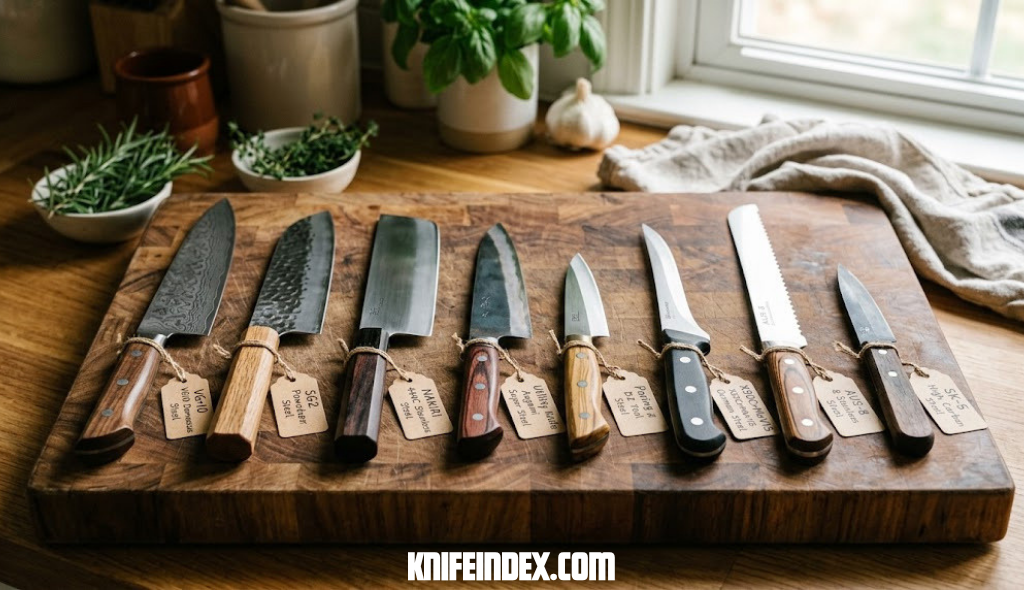
Every kitchen knife you have ever picked up carries an invisible number stamped somewhere in its metallurgy — a figure that quietly decides how it sharpens, how long it stays sharp, whether it chips on a chicken bone, and how much elbow grease you will spend on a whetstone every few months. That number is its Rockwell hardness, and once you understand it, you will never shop for a knife the same way again.
This guide walks through exactly what that number means, how it’s actually measured on a factory floor, why two knives made from the same steel can behave completely differently, and — most importantly — how to translate all of it into a practical buying decision for your own kitchen. Whether you’re comparing a twenty-dollar stamped utility knife to a two-hundred-dollar hand-forged gyuto, or simply trying to understand why your favorite chef’s knife needs sharpening so much less often than the one it replaced, the answer almost always traces back to this single, often-overlooked spec.
1. What Rockwell Hardness Actually Is
Rockwell hardness is a standardized measurement of how much a material resists permanent indentation. In the knife world, you will see it written as HRC, which stands for Hardness Rockwell C — the “C” scale being the one used for hardened steels like the kind found in blades. The number itself, usually somewhere between 52 and 67 for kitchen knives, tells you how the steel behaves at a microscopic level: how tightly its internal crystal structure is packed after heat treatment, and how much force it takes to deform that structure.
Think of it less as a grade and more as a personality trait. A higher HRC steel is stiffer and more resistant to wear, similar to a diamond scratching glass. A lower HRC steel is more forgiving, bending slightly under stress rather than chipping, similar to a coat hanger you can flex without snapping. Neither is universally better — they are simply suited to different jobs, different users, and different sharpening habits.
Kitchen knife shoppers often encounter this number for the first time on a spec sheet for a Japanese gyuto or a premium Western chef’s knife, sitting quietly next to the steel type, blade length, and handle material. Understanding what it actually communicates turns that spec sheet from marketing noise into a genuinely useful buying signal — the same way understanding blade geometry changes how you evaluate a knife’s cutting performance.
It’s worth pausing on why this particular scale, and not some other measurement system, became the industry standard for cutlery. The Rockwell system was developed in the early twentieth century specifically because earlier hardness tests, like the Brinell method, were slow and impractical for production-line quality control. Rockwell testing takes seconds, requires no complicated calculations by the operator, and can be repeated consistently across thousands of blades coming off the same production line. That practicality is exactly why it became the default language knife makers use when describing their steel, and why you’ll see “HRC” printed on everything from a twelve-dollar paring knife to a thousand-dollar handmade gyuto.
There’s also a subtlety worth knowing before you go further: Rockwell hardness is a bulk material property, not a description of the edge itself. When a manufacturer states a blade is 60 HRC, they are describing the hardness of the steel throughout the blade’s cross-section (or, in differentially hardened knives, throughout the hardened portion), not a coating or surface treatment applied afterward. This distinction matters because it means the number is baked in at the molecular level during heat treatment, not something that can be polished on or worn off through normal use. A knife’s HRC on the day you buy it is, for practical purposes, the same HRC it will have a decade later, barring damage from improper sharpening or extreme heat exposure.
Because the number is so foundational, it also explains a phenomenon many home cooks notice but can’t quite articulate: why two knives that look nearly identical, cost about the same, and are marketed almost interchangeably can feel completely different at the cutting board. One might glide effortlessly through a ripe tomato and hold that edge for weeks, while the other feels like it needs honing after every meal. Nine times out of ten, the invisible difference driving that gap in real-world performance is hardness, working quietly behind the scenes of every single cut.

Want a knife with a proven, well-balanced hardness rating? The Wüsthof Classic line is heat-treated to a dependable mid-hardness range that suits nearly every home kitchen.
Check Price on Amazon2. How the HRC Test Works
The actual test is refreshingly mechanical. A lab technician presses a diamond-tipped cone, called an indenter, into a sample of the steel under a fixed, controlled load. First a small “preload” force seats the indenter, then a much larger major load is applied, then removed. The machine measures how deep the indenter sank into the metal after the load is released, and that depth is converted into a Rockwell C number using a standardized scale.
The deeper the indenter sinks, the softer the steel, and the lower the resulting HRC number. A shallow indentation means the steel resisted deformation well, producing a higher HRC number. This is why the scale runs in the direction it does — higher numbers always mean harder, more wear-resistant steel.
Reputable knife makers test hardness on finished blades, not just raw billets, because the heat treatment process — hardening, quenching, and tempering — is what ultimately sets the final HRC. Two knives made from identical steel can leave the factory with noticeably different hardness numbers depending on how that heat treatment was executed, a topic covered in more detail in the heat treatment section below and explored further in this breakdown of Buck’s 420HC heat treatment process.
Precision matters enormously here, which is why testing labs calibrate their machines regularly against reference blocks of known, certified hardness. A single stray reading isn’t trusted at face value; most quality-focused manufacturers take several readings across a batch, or even multiple readings on the same blade at different points along the spine and edge, and average them to smooth out any local inconsistency in the steel or heat treatment. This is also why you’ll sometimes see hardness specs expressed as a range, such as “60–61 HRC,” rather than a single fixed digit — it reflects the natural variance inherent in any real-world manufacturing process, not sloppy testing.
It’s also worth understanding what the test does not measure, because the misconceptions here run deep. The Rockwell C test says nothing about a steel’s chemical composition, its corrosion resistance, or its wear resistance against abrasive materials like sand or bone dust — those are related but separate properties, sometimes tested with entirely different methods like abrasive wear index testing. Rockwell hardness is purely mechanical: it isolates one specific question, how resistant is this steel to localized surface deformation, and answers it with a single, repeatable number. Everything else you might want to know about a blade’s real-world behavior — toughness, edge stability, corrosion resistance — requires looking at additional specs and, ideally, real-world reviews alongside the HRC figure.
| Test Method | Best Suited For | Speed | Common Use in Cutlery |
|---|---|---|---|
| Rockwell C (HRC) | Hardened steels, finished blades | Seconds per reading | Industry standard for knife specs |
| Brinell | Softer metals, castings | Minutes per reading | Rarely used for finished knives |
| Vickers | Thin materials, coatings, micro-hardness | Slower, more precise | Occasionally used in metallurgical research on blade steel |
3. Why HRC Matters for Kitchen Knives
For a home cook or a working chef, Rockwell hardness translates into three very practical, everyday realities: how often you sharpen, how the edge fails when it fails, and how much force you need behind each cut.
Beyond those three practical realities, hardness quietly shapes a fourth factor that experienced cooks eventually notice even if they can’t name it right away: consistency of feel across a long prep session. A knife that starts a session razor sharp but rolls slightly after twenty minutes of onion and carrot work will feel progressively less confident to use as the session goes on, subtly changing how much pressure you instinctively apply and, in turn, how safely and precisely you’re cutting. A harder blade that maintains a more consistent edge throughout a long prep session tends to keep that feel stable from the first cut to the last, which is part of why professional kitchens with high-volume prep work often gravitate toward harder, thinner Japanese-style blades despite the added maintenance care they require.
- Sharpening frequency. Higher-hardness blades hold a sharp edge through more cutting sessions before needing a touch-up, which matters if you cook daily and hate stopping to hone or hit the stones.
- Failure mode. A softer blade tends to roll or fold at the edge under stress — annoying, but usually fixable with a few strokes on a honing rod. A harder blade tends to chip instead, which requires actual sharpening to repair, not just realignment.
- Cutting feel. Harder steels can be ground thinner behind the edge without losing structural integrity, which often makes them feel more effortless through dense vegetables and proteins — a benefit explained further in the discussion of thin versus thick blade geometry.
This is why the same HRC number can be a selling point on one knife and a red flag on another, depending on context. An HRC of 66 sounds impressive printed on a box, but on a knife meant for daily use by someone who occasionally cuts against a glass cutting board or hits a chicken thigh bone, that same number can mean recurring chip repairs. Context — how the knife will actually be used — always outranks the number by itself.
There’s a cost-of-ownership angle here too, one that rarely gets discussed alongside the more romantic talk of “holding an edge like a razor.” Sharpening takes time, and time has value. A cook who sharpens a soft 56 HRC utility knife every week but only spends ninety seconds doing it with a pull-through sharpener may actually spend less cumulative time on maintenance than someone who sharpens a 63 HRC gyuto only once every two months but needs a full twenty-minute whetstone session each time because the steel resists abrasion so effectively. Neither approach is wrong, but recognizing which one matches your actual patience and available time prevents the frustration of buying a “better” knife on paper that ends up neglected in a drawer.
Hardness also interacts with something less obvious: perceived value and resale. Enthusiast buyers researching premium folding and fixed-blade knives, such as those covered in reviews of the Spyderco Paramilitary 2 or the Ontario RAT-1, often treat published HRC specs as a shorthand for overall build quality and manufacturing seriousness, even outside the kitchen. A brand willing to publish precise, consistent hardness numbers is usually a brand that has invested in quality control elsewhere too — a signal worth watching for when comparing kitchen cutlery brands as well.
4. HRC Ranges Explained (Soft to Super-Hard)
Kitchen knives generally fall into one of four broad hardness bands. None of these bands is “correct” in an absolute sense; each represents a different set of trade-offs that different steels and different manufacturers lean into on purpose.
| HRC Range | Character | Typical Examples | Best Suited For |
|---|---|---|---|
| 52–56 HRC | Soft, very tough, easy to sharpen | Budget stamped knives, some vintage carbon steel | Heavy daily abuse, minimal sharpening skill required |
| 56–58 HRC | Classic German/Western balance | Wüsthof, Zwilling, Victorinox | All-purpose home and pro kitchens, forgiving of technique |
| 58–61 HRC | Sharper, holds edge longer, moderate care | Many Japanese gyutos, premium Western hybrids | Cooks who want a keener edge and don’t mind occasional care |
| 61–67 HRC | Very hard, exceptional edge retention, more brittle | High-end single-bevel Japanese knives, powder steels | Precision cutting, enthusiasts comfortable with careful use |
These bands aren’t arbitrary marketing tiers either — they roughly map to distinct manufacturing philosophies and target users. Entry-level and mass-market Western knives often sit at the low end because it maximizes forgiveness for inexperienced sharpeners and reduces liability around chipping complaints. Mid-range German and hybrid brands cluster in the middle because it has proven, over decades, to satisfy the widest possible range of home cooking styles. And the premium Japanese and specialty segment pushes toward the top because its buyers are specifically shopping for maximum edge performance and are willing to trade some day-to-day forgiveness to get it.
It helps to compare this to something you already know: think of a rubber pencil eraser versus a ceramic tile. The eraser (low HRC) bends and bounces back under pressure and almost never cracks, but wears down quickly with use. The ceramic tile (high HRC) holds its shape and edge under normal use but shatters instead of bending if you hit it wrong. Kitchen steel sits somewhere on that spectrum, and manufacturers choose where deliberately.
Lower HRC (52–57) Pros
- Very forgiving of technique and cutting boards
- Rarely chips
- Easy to resharpen quickly, even with basic tools
- Great for beginners
Lower HRC (52–57) Cons
- Edge dulls faster
- Needs more frequent honing/sharpening
- Can roll under heavy chopping
Higher HRC (60+) Pros
- Holds a sharp edge much longer
- Can be ground thinner for effortless slicing
- Feels precise on push-cuts
Higher HRC (60+) Cons
- More prone to chipping on bone or hard boards
- Requires more careful sharpening technique
- Less forgiving of mistakes
It’s useful to walk through what actually happens at the edge, at a microscopic level, as you move across these bands. At 52–56 HRC, the steel’s crystal lattice has enough give that when the very edge encounters resistance — say, the fibrous skin of a butternut squash — individual grains at the apex can shift and fold over rather than breaking away cleanly. That folded-over edge feels dull even though no material was actually lost, which is exactly why a few strokes on a honing rod can “resharpen” a soft knife almost instantly: honing simply straightens the folded metal back into alignment.
Move up into the 58–61 HRC band and that same folding behavior becomes much less common; the lattice is stiffer and resists deforming that way. Instead, when this steel does eventually fail at the edge, it’s more likely to lose microscopic flecks of material through abrasive wear — a slower, more gradual process that shows up as the edge simply feeling less keen over time rather than suddenly rolling.
At 61 HRC and beyond, the story shifts again. The steel is now stiff enough that instead of folding or gradually abrading, localized stress concentrations — a knot in a butternut squash’s stem, an unnoticed peppercorn, an edge dragged across a stray fork tine in the sink — can cause a small piece of the edge to fracture away entirely, creating a visible micro-chip rather than a smooth roll or gradual wear pattern. This is the mechanical reality behind the well-worn advice to treat very hard knives with more deliberate care: it’s not superstition, it’s a direct consequence of how hardened steel fails under stress.
Understanding these three failure modes — rolling, abrasive wear, and chipping — is arguably more useful to a home cook than memorizing exact HRC numbers, because it tells you what to actually watch for with your own knives, and what kind of maintenance response is appropriate when you notice it.

Curious about the higher end of the hardness spectrum? Shun’s VG-MAX steel runs harder than most Western blades and holds an edge remarkably long.
See Current Price5. Hardness vs. Edge Retention
It is tempting to treat HRC as a direct proxy for edge retention, but the relationship is more nuanced than “higher number, sharper for longer.” Edge retention is really a function of three things working together: hardness, the steel’s carbide content and type, and the final edge geometry the manufacturer chose. A high-HRC blade with a poorly designed edge angle can still dull faster than a moderately hard blade ground and finished with more care.
That said, hardness is the foundation the other two factors build on. Harder steel resists the microscopic edge rolling that causes most everyday dulling — the kind that happens from cutting boards, not from major impacts. This is why enthusiast-grade steels used in high-performance folding knives and premium kitchen blades alike, such as those compared in this S35VN vs. S45VN breakdown, are often engineered specifically to push HRC higher while managing the toughness trade-off through alloy design.
Carbide content deserves a closer look, since it’s the piece most often left out of casual hardness discussions. Many steels contain hard particles called carbides — compounds formed from carbon bonding with elements like chromium, vanadium, or molybdenum — embedded within the softer surrounding steel matrix. These carbides act almost like tiny embedded diamonds, adding wear resistance on top of whatever the base hardness provides. A steel with abundant, well-distributed, fine carbides can deliver excellent edge retention even at a moderate HRC, while a steel with large, poorly distributed carbides can actually undermine edge stability despite a high hardness number, because those larger particles create weak points where chipping starts.
This is part of why modern powder-metallurgy steels, produced by atomizing molten steel into fine powder and then compressing it under heat and pressure, have become so popular in premium cutlery. The powder process produces exceptionally fine, evenly distributed carbides compared to traditional ingot-cast steel, which is part of why steels discussed in comparisons like 14C28N versus Nitro-V can achieve strong edge retention and toughness simultaneously in ways that would have seemed contradictory using older manufacturing methods.
Edge angle is the third leg of this stool, and it’s entirely under the control of whoever last sharpened the knife, regardless of the steel’s HRC. A blade sharpened to a wide, obtuse angle will always feel less keen and dull more slowly than the same blade sharpened to a narrow, acute angle, independent of hardness. This is why two people can own the identical model of knife, at the identical factory-set hardness, and have completely different experiences with how long the edge lasts — because their sharpening habits, not the steel itself, are doing most of the differentiating.
6. Hardness vs. Toughness (The Trade-Off)
This is the single most important concept in the entire hardness conversation, and it is the one most often misunderstood by first-time knife buyers: hardness and toughness are not the same property, and they typically move in opposite directions.
Toughness is a material’s ability to absorb energy and deform without fracturing. Hardness is a material’s resistance to being deformed in the first place. A steel can be extremely hard and still be relatively brittle, meaning it resists small everyday stresses beautifully but shatters or chips under a sudden, sharp impact — like twisting the blade in a jar lid or hitting a frozen chicken bone at the wrong angle.
| Property | What It Measures | What Increases It | Kitchen Consequence |
|---|---|---|---|
| Hardness (HRC) | Resistance to surface deformation | More carbon, harder heat treat, higher tempering precision | Longer edge retention, thinner possible grinds |
| Toughness | Resistance to fracturing under impact | Lower hardness, certain alloy additions, softer temper | Fewer chips, more forgiving of misuse |
Manufacturers spend enormous effort trying to push both properties upward at once through alloy science and heat treatment refinement — the entire premise behind modern “super steels” like those discussed in this MagnaCut vs. M390 comparison. But even the best modern steels still obey this trade-off to some degree; they have simply moved the whole curve upward rather than eliminating it.
A useful mental model borrowed from materials science is the idea of a toughness-hardness curve, unique to each steel alloy. Picture a line graph with hardness on one axis and toughness on the other; for any given steel chemistry, as you push the heat treatment toward higher hardness, the curve bends downward toward lower toughness, and vice versa. What separates an average steel from an exceptional one is not where it sits on that curve at any single point, but how far up and to the right the entire curve is positioned compared to older alloys. This is precisely the marketing pitch, and the genuine engineering achievement, behind steels compared in guides like this S35VN versus S45VN breakdown — both alloys represent meaningful upward shifts of that whole curve relative to their predecessors, not a trick that avoids the trade-off entirely.
Manufacturers also make deliberate choices about where along a given steel’s curve they want to sit, and this decision is often just as important as the steel choice itself. A maker might choose to heat-treat a steel capable of reaching 64 HRC down to 61 HRC instead, deliberately sacrificing some maximum edge retention in exchange for meaningfully improved toughness and chip resistance — a trade-off that often makes more sense for a knife meant to be used hard in a professional kitchen than chasing the highest number the steel is theoretically capable of.
This same trade-off shows up clearly outside the kitchen too. Outdoor and bushcraft knives, like the Morakniv Companion or heavier choppers such as the axes compared in this Fiskars X7 vs. X11 comparison, are almost always heat-treated toward the tougher end of their steel’s range, because impact resistance matters more for those tools than raw edge retention. Kitchen knives sit on a spectrum of their own, and recognizing where a given blade’s maker chose to land on that curve tells you far more about how it will perform than the steel name alone.
7. Common Steels and Their Typical HRC
Every steel type has a “natural” hardness window it performs best in, determined by its carbon content, alloying elements, and grain structure. Here is how some of the most common kitchen knife steels typically shake out.
| Steel | Typical HRC | Notes |
|---|---|---|
| German X50CrMoV15 | 56–58 | Classic tough, easy-care Western steel; found in Wüsthof, Zwilling |
| 420HC | 56–58 | Budget-friendly stainless, very rust-resistant, moderate edge retention |
| AUS-8 / AUS-10 | 58–60 | Japanese-influenced stainless, good balance of edge and toughness |
| VG-10 | 60–61 | Popular premium Japanese stainless; sharp and durable |
| SG2/R2 Powder Steel | 62–63 | Fine grain structure, excellent edge retention |
| Blue Steel (Aogami) | 62–64 | Traditional carbon steel, prized for sharpness, needs rust care |
| White Steel (Shirogami) | 62–65 | Very pure carbon steel, exceptional sharpness, more reactive |
Comparisons like the one in this VG-10 vs. AUS-10 guide are useful precisely because they translate these HRC numbers into how the steel actually behaves at the cutting board, which is ultimately what matters more than the number itself. Similarly, the difference between D2 and 8Cr13MoV illustrates how a large HRC gap between two steels shows up in everyday chip resistance and sharpening effort.
It’s worth noting that the numbers in the table above represent typical, well-executed hardness ranges for each steel, not hard ceilings imposed by the periodic table. A given steel’s chemistry sets an upper limit on how hard it can reasonably be pushed before toughness drops to impractical levels, but manufacturers routinely choose to heat-treat the same steel differently depending on their target market. This is why you’ll occasionally see a brand advertise “our own proprietary heat treatment” for a well-known steel like VG-10 or AUS-10 — they aren’t changing the steel’s chemistry, they’re adjusting where on that steel’s own hardness-toughness curve they’ve chosen to land.
Beyond the mainstream stainless options, there’s a growing category of specialty powder steels worth knowing about if you’re shopping at the premium end of the market. Steels like those compared in this CRUWEAR versus 3V comparison, while more commonly found in outdoor and pocket knives than kitchen cutlery, illustrate the broader industry trend toward finer grain structures and more sophisticated alloy chemistry that has gradually trickled down into premium kitchen knife lines as well. Watching how these steels perform in the demanding, high-wear world of folding and fixed-blade knives often previews what will eventually become available in kitchen-specific blade lines a few years later.
Traditional Japanese carbon steels deserve a special note here, because they behave somewhat differently than their stainless counterparts even at similar HRC numbers. Blue steel (Aogami) and White steel (Shirogami), used in high-end single-bevel knives, contain very little chromium compared to stainless alloys, which means less of the hardness-robbing carbide formation that chromium can sometimes cause. The result is steel that can reach very high hardness while still taking an exceptionally fine, keen edge — part of why these traditional steels remain prized by professional sushi chefs and serious enthusiasts alike, despite requiring noticeably more diligent rust prevention than stainless alternatives.

Want a lightweight, harder-steel option with excellent edge retention? The Global G-2 is a long-time favorite among cooks who want Japanese-level hardness in an everyday knife.
View on Amazon8. Heat Treatment: Why Two Knives With the Same Steel Differ
Steel type only tells half the story. The other half is heat treatment — the precise process of heating the blade to a critical temperature, quenching it rapidly, and then tempering it back down to relieve internal stress. This process is what actually locks in the final hardness, and two manufacturers using the exact same raw steel can produce blades with meaningfully different HRC numbers and performance depending on how carefully that heat treatment is executed.
This is why brand reputation and manufacturing transparency matter so much in the premium knife space. Some companies, like Benchmade with its “BladeHQ Exclusive” heat treatments or Buck with its long-standing partnership with Paul Bos Heat Treating discussed in this 420HC heat treat breakdown, have built entire reputations around consistent, well-controlled heat treatment rather than exotic steel alone.
Heat treatment quality also explains why some “budget” knives punch well above their price point. Brands like CIVIVI and CJRB, covered in reviews such as this CIVIVI Elementum review and this CJRB Pyrite review, have earned strong reputations partly because their factories have refined consistent heat treatment processes even on relatively affordable steels.
The actual mechanics of heat treatment are worth understanding in a bit more depth, because it demystifies why this step carries so much weight. The process typically begins with austenitizing, heating the steel to a specific critical temperature — often somewhere between 1,900°F and 2,100°F depending on the alloy — at which point its internal crystal structure reorganizes into a phase called austenite that can dissolve carbon and alloying elements more readily. From there, the blade is quenched, rapidly cooled in oil, air, or a specialized quenching medium, which locks that reorganized structure in place as a much harder phase called martensite. This is the step that actually creates the hardness; everything before it is preparation.
But martensite straight out of a quench is typically too hard and too brittle to be usable — chipping and even spontaneous cracking are real risks at this stage. That’s why the final step, tempering, involves reheating the blade to a much lower, more controlled temperature and holding it there, which relieves internal stress and trades away a small amount of peak hardness in exchange for a meaningful gain in toughness. The precise tempering temperature chosen is, in effect, the manufacturer’s final decision about where on that steel’s hardness-toughness curve the finished blade will land, and it’s frequently a closely guarded detail for premium brands.
Cryogenic treatment has also become common among premium knife makers, an additional step where the blade is chilled to extremely low temperatures, sometimes using liquid nitrogen, after quenching but before tempering. This process converts any remaining “retained austenite” — soft, untransformed material left over from the quench — into additional martensite, squeezing out a small but meaningful improvement in both hardness and consistency. It’s a good example of how modern heat treatment has become almost as much a science of eliminating small inefficiencies as it is a science of hitting a target hardness number.
10. Choosing the Right Hardness for Your Kitchen
The “best” hardness is entirely dependent on who is holding the knife and how it will actually be used, not on chasing the highest number on a spec sheet. A few honest questions can point you toward the right range.
- Do you sharpen often, or avoid it? If sharpening is a chore you’d rather skip, lean toward 56–59 HRC steels that stay serviceable longer between honing sessions without demanding perfect technique.
- Do you cut on glass, stone, or bamboo boards? Harder boards are punishing on high-HRC edges. If you can’t commit to a wood or soft plastic board, stay in the mid-hardness range.
- Do you cook meat with bones regularly? Bone contact is one of the fastest ways to chip a hard blade. Consider a dedicated boning or butcher knife at a slightly lower HRC for that task, as discussed in this boning knife buying guide, and reserve your harder blade for produce and protein slicing.
- Are you comfortable investing in proper sharpening tools? If yes, higher-hardness Japanese steels reward that investment with dramatically longer edge life between sharpenings.
Many experienced cooks land on a two-knife solution: a tougher, mid-hardness Western knife for rough, everyday tasks, and a harder, thinner Japanese-style knife such as those covered in this best Japanese gyuto roundup reserved for precision slicing work. This mirrors how enthusiasts often carry both a tough, high-toughness folding knife like the Morakniv Garberg for rough outdoor tasks and a harder, more precise blade for detail work.
Skill level and confidence with a knife also belongs in this decision more than most buying guides admit. A harder blade rewards good technique — a controlled, deliberate cutting motion that avoids twisting or prying — but punishes bad habits more severely than a softer blade would. If you’re newer to cooking and still developing muscle memory around knife handling, a mid-hardness Western knife gives you far more room to make mistakes without consequence while those habits form. There’s no shame in “graduating” to a harder, more demanding blade later once your technique has caught up; plenty of serious home cooks and even professional chefs follow exactly that progression.
Budget is the other practical factor that inevitably enters this decision, and it’s worth being clear-eyed about it. Achieving both high hardness and high toughness simultaneously requires more expensive alloying elements and more sophisticated, carefully controlled heat treatment processes, both of which cost real money to execute well. This is part of why knives in the 62-plus HRC range with genuinely good toughness tend to sit at higher price points, while budget-friendly options, like those reviewed in this Victorinox chef knife review, typically land in the more forgiving mid-hardness range where quality, affordable steel and heat treatment can reliably deliver solid, dependable performance.
| Cook Profile | Recommended HRC Range | Reasoning |
|---|---|---|
| Busy weeknight cook, low sharpening interest | 56–58 | Forgiving, quick touch-ups, minimal technique required |
| Enthusiastic home cook, owns a whetstone | 58–61 | Balanced edge life with manageable maintenance |
| Precision-focused enthusiast or serious hobbyist | 61–64 | Maximum edge retention, rewards careful handling |
| Professional kitchen, high volume, rough use | 56–59 | Toughness and quick resharpening matter more than max retention |

Ready for a knife built with a higher, precision-focused hardness? Miyabi’s SG2 core steel is engineered for exceptional edge retention with careful heat treatment.
Check Availability11. Care and Maintenance by Hardness Level
How you store, wash, and handle a knife should shift depending on where it sits on the hardness scale, because the failure risks are genuinely different.
Storage
Harder blades are more susceptible to edge damage from careless storage. Tossing a 61 HRC knife loose into a drawer where it clatters against other tools is a fast route to micro-chips. A proper knife block or a padded magnetic strip designed to minimize edge damage protects the edge far better than loose drawer storage, regardless of hardness, but the consequences of skipping this step are more severe on harder steels.
Washing
Dishwashers are hard on every knife, but especially rough on higher-carbon, higher-hardness blades, which are often more reactive and prone to both corrosion and edge chipping from banging against other dishware. Hand washing and immediate drying remains the universal best practice across every hardness level.
Rust Prevention
Higher-hardness carbon steels, like traditional Japanese Blue and White steel, are often less stainless than their HRC-matched stainless counterparts, making rust prevention a bigger priority. This guide on how to prevent rust on knives and this one on removing existing rust are worth bookmarking if you own any high-carbon blade.
Cutting Board Choice
This is the single highest-leverage maintenance decision you can make. Wood and quality plastic boards are gentle on any edge; glass, stone, and bamboo (which is harder than it looks) accelerate dulling and increase chip risk dramatically on hard steels.
Handling and Cutting Technique
Twisting motions — using a knife blade to pry apart a stuck bagel or lever open a stubborn lid — are disproportionately dangerous for hard blades. That kind of lateral, off-axis stress is exactly what a hardened, less flexible edge handles poorly, since it has little give to absorb the sideways force. Straight, controlled push or draw cuts along the blade’s intended cutting plane keep stress aligned with the direction the steel was designed to handle, regardless of hardness, but the margin for error shrinks considerably as HRC climbs.
Long-Term Storage
If a knife will sit unused for an extended period, a light coat of food-safe mineral oil on carbon steel blades prevents the kind of surface corrosion that can otherwise pit the edge and effectively lower its functional hardness by introducing microscopic weak points. Stainless blades are far more forgiving here, but even they benefit from being stored fully dry rather than damp, since prolonged moisture exposure can eventually affect even corrosion-resistant alloys at the edge, where the steel is thinnest and most exposed.
Travel and transport introduce their own risks worth planning for, particularly for anyone who brings a personal knife between a home kitchen and a professional one. A dedicated, padded knife roll or case, discussed in this guide on how to travel with kitchen knives safely, prevents the kind of jostling against other hard objects in a bag that can chip even a well-maintained edge before it ever reaches the cutting board.
12. Common Myths About Rockwell Hardness
Myth: “Higher HRC always means a better knife.”
Not true. A higher HRC knife that chips constantly because it doesn’t match your cutting habits is a worse knife for you than a lower HRC blade that simply works. Hardness is a tool for matching a knife to a use case, not a leaderboard.
Myth: “HRC tells you how sharp a knife is out of the box.”
Sharpness at purchase depends on the factory edge and final grinding angle, not hardness. A soft knife can arrive razor sharp; a hard knife can arrive dull.
Myth: “Stainless steel can’t be hard, and carbon steel can’t be tough.”
Modern metallurgy has largely broken this old assumption. Powder-metallurgy stainless steels regularly reach 62-plus HRC while maintaining respectable toughness, and the comparisons in guides like CRUWEAR vs. 3V show just how much alloy science has closed the old stainless-versus-carbon toughness gap.
Myth: “You can eyeball hardness by how the blade feels.”
You genuinely cannot reliably judge HRC by feel, weight, or flex alone. It requires proper testing equipment. Trust published manufacturer specs and reputable third-party reviews over intuition.
Myth: “A knife that chips is automatically defective.”
A single chip on a hard, thin-edged knife after an accidental bone strike or a drop onto a tile floor isn’t necessarily a manufacturing flaw — it can simply be that particular steel’s expected failure mode under that kind of stress. A pattern of chipping under normal, careful use, however, is a legitimate reason to suspect either an overly aggressive heat treatment or an edge angle ground too thin for the steel’s toughness, and worth raising with the manufacturer.
Myth: “All premium knives use the highest HRC steel available.”
Plenty of respected, expensive knives deliberately use moderate hardness steels because the maker prioritized toughness, ease of maintenance, or a specific cutting feel over maximum edge retention. Price and prestige track craftsmanship, fit, and finish at least as much as they track a single hardness number, and conflating the two leads to disappointing purchases.
Working through these myths tends to reveal a common thread: most misunderstandings about Rockwell hardness come from treating it as a single, standalone quality score rather than one variable among several that a manufacturer balances deliberately. Once that mental shift happens, spec sheets stop feeling like marketing puzzles and start feeling like genuinely useful information you can act on.
Frequently Asked Questions
What is a good Rockwell hardness for a kitchen knife?
For most home cooks, 56–60 HRC hits the sweet spot between edge retention and ease of maintenance. Enthusiasts comfortable with more careful sharpening often prefer 60–63 HRC for the extended edge life.
Is a higher HRC knife always sharper?
No. HRC measures resistance to deformation, not sharpness itself. Sharpness comes from the edge angle and finish applied during sharpening, which can be equally fine on a soft or hard blade.
Why do Japanese knives usually have higher HRC than German knives?
Japanese knife-making traditions historically prioritized extreme sharpness and edge retention for precise, delicate cutting tasks, while German knife-making prioritized durability and toughness for heavier, more forceful kitchen work. These different priorities shaped the steel and heat treatment choices each tradition still favors today.
Can a knife’s Rockwell hardness change over time?
The hardness set during heat treatment is essentially permanent under normal kitchen use. It does not soften with age or use. It can, however, be altered — usually reduced — if the blade is overheated during aggressive machine sharpening or grinding.
Does a higher HRC knife need a different sharpening angle?
Not strictly a different angle, but harder steels can support thinner, more acute edge angles without immediately rolling, which is part of why they often feel sharper in use. Softer steels are usually sharpened at slightly wider angles for durability.
Is it safe to put a high-HRC knife in the dishwasher?
It’s not recommended for any knife, but especially not for high-hardness blades. The tumbling and knocking against other dishware in a dishwasher significantly increases the risk of edge chipping on harder, more brittle steels.
What HRC is too hard for a kitchen knife?
Most kitchen cutlery tops out around 65–67 HRC, generally reserved for specialty single-bevel Japanese knives used by skilled hands. Beyond that range, steel becomes too brittle for practical kitchen use and chip risk rises sharply.
Do budget knives ever have high Rockwell hardness?
Yes, though it’s less common. Some budget brands use harder steels but pair them with less refined heat treatment, so the real-world performance doesn’t always match the number on paper. Reviews of value-oriented brands, like this Paudin knife review, are useful for checking whether the marketed hardness translates into real performance.
How do I find out the HRC of a knife I already own?
Check the manufacturer’s product page or manual first, since reputable brands publish this spec. If it’s not listed, a knife shop with Rockwell testing equipment can measure it directly, though this is rarely necessary for everyday cooks.
Does hardness affect how a knife feels in daily cutting?
Indirectly, yes. Harder steels allow thinner blade grinds, which often makes a knife feel lighter and more effortless through food, while softer steels are typically ground slightly thicker behind the edge for added durability.
Is carbon steel always harder than stainless steel?
Not necessarily. While traditional high-carbon steels can reach very high hardness, many modern stainless steels — particularly powder-metallurgy stainless steels — match or exceed traditional carbon steel hardness while offering better corrosion resistance.
Why do some manufacturers refuse to publish HRC specs?
Some budget or mass-market brands skip publishing hardness specs because their heat treatment can vary between production batches, or because the number simply isn’t a strong selling point for their target buyer. As a general rule, brands confident in their heat treatment consistency tend to publish HRC openly, which is itself a useful signal when comparing options.
Can heat from a dishwasher or hot pan affect a blade’s hardness?
Normal dishwasher heat and typical stovetop proximity aren’t hot enough to alter a blade’s hardness. However, prolonged direct exposure to very high heat, such as leaving a knife resting against a hot burner or in an open flame, can soften the steel near the affected area by effectively undoing part of the tempering process.
The Bottom Line on Rockwell Hardness
Rockwell hardness isn’t a score to maximize — it’s a dial that trades edge retention against toughness, and the right setting depends entirely on how you cook, how you store your knives, and how much sharpening you’re willing to do. Once you know your own habits, matching a blade’s HRC to your kitchen becomes simple rather than intimidating.
The next time you’re comparing two knives side by side, resist the urge to treat the higher HRC number as an automatic win. Ask instead how that knife was heat-treated, what steel it’s made from, how it’s likely to fail under stress, and — most importantly — whether that failure mode fits the way you actually cook. A knife chosen with that kind of understanding will serve you better, for longer, than one chosen on spec-sheet bragging rights alone.
Browse Top-Rated Chef Knives