Complete Guide to Knife Steel Types: VG-10, AUS-8, and 440C Explained
Everything you need to know about three of the most common knife steels — how they’re made, how they perform, and which one belongs in your pocket or kitchen drawer.
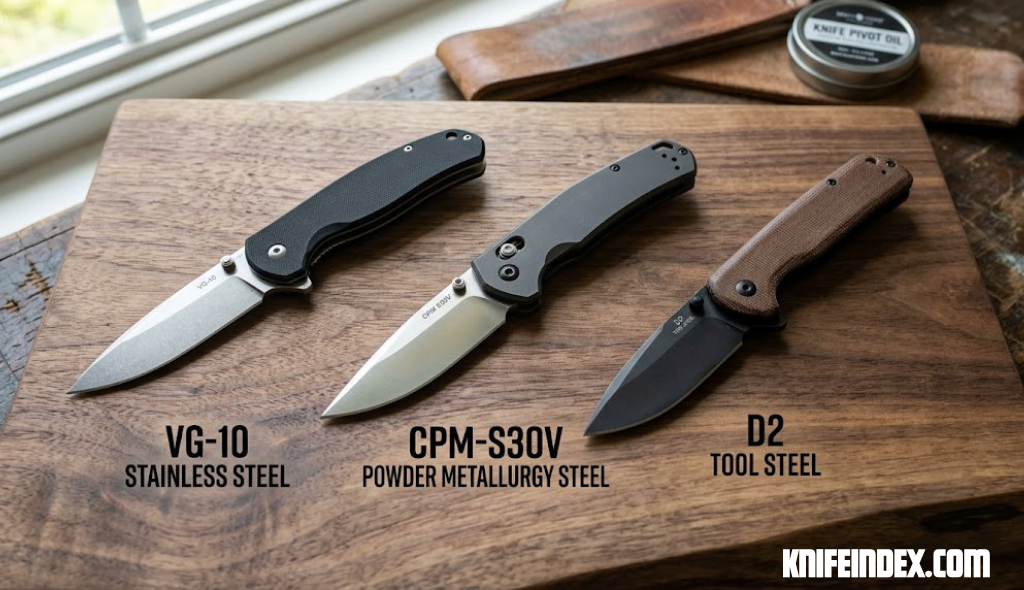
1. Why Knife Steel Matters More Than You Think
Walk into any knife shop, browse any online marketplace, or scroll through a single product listing, and you’ll run into a wall of unfamiliar alloy names. VG-10. AUS-8. 440C. S30V. D2. To a newcomer, these look like model numbers or marketing filler. In reality, the steel a blade is made from is the single most important factor determining how that knife will behave for the rest of its life. It decides how long the edge stays sharp between touch-ups, how easily you can restore that edge with a stone, how much abuse the blade can take before it chips or snaps, and how quickly it will rust if you forget to wipe it down after cutting citrus or leaving it in a damp sheath.
Every other feature of a knife — the handle scales, the lock mechanism, the pivot, the pocket clip — is secondary to the steel when it comes to actual cutting performance over time. A gorgeous handle on a soft, poorly heat-treated blade will still leave you sharpening constantly. Meanwhile, a plain-looking knife built around a well-executed mid-tier steel can outperform flashier knives that skimped on heat treatment or used a cheaper alloy dressed up with fancy branding.
This guide focuses on three steels that show up constantly across budget-friendly and mid-range knives: VG-10, a Japanese stainless steel famous for kitchen cutlery and premium folders alike; AUS-8, a workhorse stainless steel prized for toughness and easy sharpening; and 440C, an American-made stainless that has been a staple of the cutlery industry for decades. By the end, you’ll understand exactly what sets these three apart, how they stack up against each other in real-world use, and which one actually fits the way you use a knife day to day.
If you’re shopping for a folding knife built around one of these steels, it also helps to see how they perform in specific models. Reviews like the Ka-Bar Dozier review, which covers AUS-8A in a hollow-ground blade, are a good next stop once you understand the fundamentals below.
There’s also a practical financial argument for understanding steel before you buy. Knives built around premium powder-metallurgy steels can cost two or three times as much as a comparable knife in VG-10, AUS-8, or 440C, but the improvement in real-world performance for most people’s daily tasks is often smaller than the price gap suggests. Knowing exactly what you’re getting — and what you’re giving up — with a mid-tier steel lets you make a much smarter purchase instead of simply chasing the newest name on a spec sheet. For someone who cuts open a few boxes, trims some rope, and preps dinner a few nights a week, a well-treated AUS-8 or 440C blade may genuinely outperform a poorly-treated “premium” steel knife from a less careful manufacturer.
It’s also worth noting that steel choice interacts heavily with blade geometry and grind. A thin, acutely ground edge in a tougher steel like AUS-8 can out-cut a thicker, more obtuse edge in a harder steel like VG-10, at least for push cuts and slicing tasks. This is one reason experienced users are cautious about ranking steels in a strict hierarchy — the steel is only one variable in a chain that includes grind angle, edge geometry, heat treatment, and even how the knife is used. Our guide to blade geometry and thin versus thick behind the edge goes deeper into how grind shapes real-world cutting performance independent of steel type.
Throughout this guide, we’ll refer back to specific knife models that use each steel so you can see the theory play out in real products rather than staying purely abstract. Understanding VG-10, AUS-8, and 440C at a conceptual level will also make it much easier to evaluate newer steels you encounter later, since almost every modern alloy is essentially a variation on the same handful of trade-offs: hardness versus toughness, edge retention versus ease of sharpening, and corrosion resistance versus cost.

Looking for a well-built folder to start with?
Check Current Price on Amazon2. Steel Composition Basics: What’s Actually in the Blade
Before comparing VG-10, AUS-8, and 440C directly, it helps to understand what the numbers and letters in a steel’s name actually mean. Knife steel is, at its core, iron mixed with carbon plus a handful of other elements added in small, carefully controlled percentages. Each of those additional elements changes the steel’s personality in a predictable way.
Carbon
Carbon is what allows steel to be hardened at all. More carbon generally means the steel can reach a higher hardness on the Rockwell C scale, which in turn usually means better edge retention — but also more brittleness if pushed too far without the right heat treatment.
Chromium
Chromium is the element responsible for corrosion resistance. Any steel with roughly 13% chromium or more is generally classified as “stainless.” VG-10, AUS-8, and 440C are all stainless steels, though the exact chromium content differs and affects how rust-resistant each one truly is.
Vanadium, Molybdenum, and Cobalt
Smaller additions of vanadium and molybdenum refine the steel’s grain structure, improve wear resistance, and help the alloy hold together at a microscopic level. VG-10 famously includes a small percentage of cobalt, which is partly why it developed a reputation as a “premium” stainless steel back when it first became popular in Japanese kitchen cutlery.
Heat Treatment: The Hidden Variable
It’s worth repeating a point that gets lost in most online debates: the steel type only tells half the story. Two knives made from identical AUS-8 can perform completely differently depending on how well the manufacturer executed the heat treatment. A rushed, poorly controlled heat treat can leave AUS-8 soft and prone to rolling, while a well-executed one can make that same steel punch well above its reputation. This is why brand reputation and quality control matter just as much as the steel spec sheet — a lesson well illustrated by the Buck 420HC heat treatment breakdown, which shows how much a dialed-in heat treat can elevate an otherwise humble steel.
How Heat Treatment Actually Works
Heat treatment is a multi-stage process that transforms raw steel into a functional blade. It typically begins with austenitizing, where the steel is heated to a temperature high enough to change its internal crystal structure, usually somewhere between 1,850°F and 2,100°F depending on the alloy. From there, the blade is rapidly cooled, or quenched, which locks the steel into a hard but brittle state called martensite. Because martensite on its own is too brittle for practical use, the blade then goes through tempering — a controlled reheating cycle at a much lower temperature that relieves internal stress and trades away a small amount of hardness in exchange for a meaningful gain in toughness.
The specific temperatures and timing used at each stage are proprietary information for most manufacturers, and this is exactly why identical steel specifications can produce such different results. A company with an in-house metallurgy lab, like the well-known Bos Heat Treat facility used by several major American knife brands, can dial in the process far more precisely than a factory running high-volume production with looser tolerances.
Rockwell Hardness (HRC) Explained
Throughout this guide you’ll see hardness expressed in HRC, or Rockwell C scale — a standardized measurement used across the cutlery and metalworking industries. The test works by pressing a diamond cone into the steel under a fixed load and measuring how deep the indentation goes; harder steel resists the indenter more and produces a higher HRC number. Most knife steels fall somewhere between 55 and 65 HRC. As a rough rule of thumb, every full point of HRC above 60 represents a meaningfully harder, more wear-resistant — but also more brittle — steel than the point below it, which is why manufacturers treat the target hardness for a given steel and application as a careful balancing act rather than a “the higher the better” exercise.
Ingot Metallurgy vs. Powder Metallurgy
VG-10, AUS-8, and 440C are all produced using traditional ingot metallurgy, where molten steel is poured into a mold and allowed to cool and solidify as a large ingot before being rolled and processed into bar stock. This is a well-established, cost-effective manufacturing process, but it has a natural limitation: as the molten steel cools, the various alloying elements don’t distribute themselves perfectly evenly, which can create larger carbide clusters at a microscopic level compared to more advanced production methods.
Powder metallurgy, used to make premium modern steels, instead atomizes molten steel into a fine powder that’s then compacted and sintered under intense heat and pressure. This process allows for a far more uniform distribution of alloying elements and carbides, which is why powder-metallurgy steels can often achieve a combination of high hardness, strong toughness, and good corrosion resistance that traditional ingot steels like our three subjects here simply can’t replicate. Understanding this manufacturing distinction helps explain why VG-10, AUS-8, and 440C — despite being excellent, well-proven steels — occupy a different performance tier than something like M390 or MagnaCut, and why the price difference between these categories is so significant.
Carbide Structure and Grain Size
Beyond hardness alone, the size and distribution of carbides — the hard particles formed by carbon bonding with elements like chromium and vanadium — plays a huge role in real-world cutting performance. Steels with finer, more evenly distributed carbides tend to take a cleaner, more refined edge and resist chipping better than steels with large, unevenly distributed carbide clusters, even at the same nominal hardness. This is part of why VG-10’s cobalt addition matters: cobalt is believed to help refine grain structure during heat treatment, which contributes to VG-10’s reputation for taking an unusually crisp edge relative to its hardness.
3. VG-10 Steel Explained
VG-10 (sometimes written V-Gold 10) is a Japanese stainless steel produced by Takefu Special Steel. It’s built around roughly 1% carbon, 15% chromium, 1% molybdenum, 0.2% vanadium, and about 1.5% cobalt. That cobalt addition is a big part of why VG-10 earned its premium reputation — cobalt doesn’t dramatically raise hardness on its own, but it’s believed to improve grain refinement and edge stability, giving VG-10 a reputation for taking an exceptionally fine, crisp edge.
VG-10 typically hardens in the 60-61 HRC range, occasionally pushed slightly higher or lower depending on the manufacturer. That hardness sits comfortably above AUS-8 and gives VG-10 noticeably better edge retention in day-to-day cutting tasks — slicing rope, breaking down cardboard, food prep, and general EDC chores.
Where You’ll Find VG-10
VG-10 shows up constantly in Japanese kitchen knives, often as the core of a laminated or “san-mai” construction where a hard VG-10 edge is sandwiched between softer, tougher cladding steel for extra durability. This lamination approach is clever: it lets manufacturers push the core steel to a higher hardness for edge retention while relying on the softer outer layers to absorb shock and resist chipping, getting something close to the best of both worlds. It’s also used as a standalone blade steel in a wide range of folding knives from brands like Spyderco. If you want to see VG-10 in action in a well-regarded folder, the Spyderco Delica 4 review is a great real-world example, and the Spyderco Tenacious review offers a useful contrast since it uses a different, more budget-oriented steel.
The History Behind VG-10’s Reputation
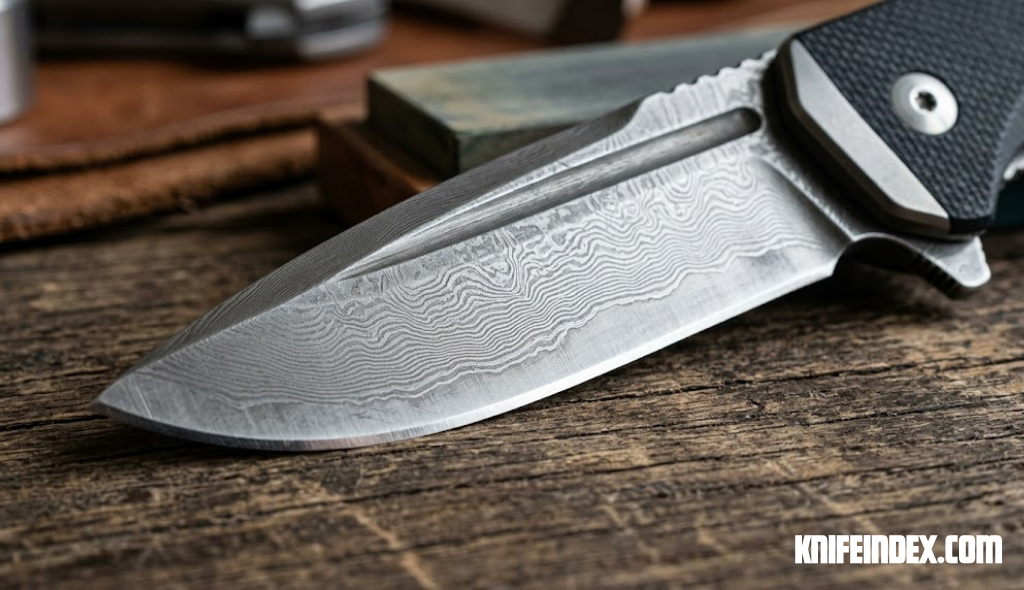
VG-10 first gained widespread recognition in the kitchen cutlery world during the 1990s and early 2000s, as Japanese knife manufacturers began exporting laminated Damascus-pattern chef’s knives to Western markets. The visual appeal of the hammered or etched Damascus cladding combined with a genuinely excellent core steel created something of a perfect storm for popularity — buyers got a knife that looked like a piece of functional art while also cutting exceptionally well. This crossover appeal is part of why VG-10 still carries a “premium” connotation today, even though newer powder-metallurgy steels have technically surpassed it in raw edge retention. If you’re curious how VG-10 fits into the broader history of Japanese blade-making, our piece on the history of Japanese knife making traces that lineage from traditional forging techniques through to modern stainless alloys like VG-10.
How VG-10 Behaves in the Kitchen vs. in a Folder
It’s worth noting that VG-10 performs somewhat differently depending on the application. In a kitchen knife with a thin, acute edge geometry designed purely for push cuts and slicing, VG-10’s slight brittleness rarely becomes an issue, since kitchen tasks don’t typically involve lateral stress or prying. In a folding EDC knife, however, where the blade might be used for prying open packaging, scraping, or occasional harder tasks, that same hardness can occasionally lead to small edge chips if the user isn’t careful about how they apply force. This is one reason many manufacturers slightly adjust the heat treatment of VG-10 when it’s destined for a folder rather than a kitchen knife, aiming for a hardness closer to 59-60 HRC instead of pushing toward 61 HRC.
VG-10 Pros
- Takes an exceptionally sharp, fine edge
- Good edge retention for a stainless steel
- Solid corrosion resistance
- Well understood by manufacturers, so heat treatment is usually consistent
VG-10 Cons
- Slightly more brittle at the edge than tougher steels
- Can be prone to micro-chipping on very thin edge geometries
- Costs more than budget stainless steels like AUS-8
| Property | VG-10 Rating |
|---|---|
| Typical Hardness | 60-61 HRC |
| Edge Retention | Good to Very Good |
| Corrosion Resistance | Good |
| Toughness | Moderate |
| Ease of Sharpening | Moderate |

Want to try a VG-10 blade yourself?
See VG-10 Knives on Amazon4. AUS-8 Steel Explained
AUS-8 is a Japanese stainless steel produced by Aichi Steel, sitting in the same general family as AUS-6 and AUS-10, with the number roughly indicating carbon content. AUS-8 carries about 0.7-0.75% carbon, 13-14.5% chromium, small amounts of molybdenum and vanadium, and typically hardens in the 57-59 HRC range — noticeably softer than VG-10.
That lower hardness is exactly why AUS-8 has such a devoted following among budget and mid-range knife buyers. Softer steel is inherently tougher and more forgiving. It resists chipping better, handles harder use like batoning through wood or prying more gracefully, and — critically for beginners — sharpens up quickly on almost any stone or pull-through sharpener without a lot of technique required.
Where You’ll Find AUS-8
AUS-8 is extremely common in mid-range outdoor and everyday-carry knives, especially from brands that prioritize value and durability over cutting-edge performance. The Ka-Bar Dozier is a textbook example, using AUS-8A (a slightly refined variant) in a simple, tough hollow-ground blade that’s easy to maintain in the field. AUS-8 also shows up frequently in budget button-lock and spring-assisted folders, where manufacturers need a steel that tolerates the occasional rough treatment these knives see from casual users. Our roundup of button lock knives under 100 dollars covers several models built around this exact steel.
AUS-8 vs. AUS-6 vs. AUS-10
AUS-8 sits in the middle of the AUS steel family produced by Aichi Steel. AUS-6 carries less carbon and is softer still, typically used in inexpensive kitchen knives and utility blades where cost matters more than edge retention. AUS-10, on the other hand, pushes carbon content higher, closing much of the edge retention gap with VG-10 while retaining slightly better toughness. For shoppers deciding between the two higher-performing options in this family, our detailed comparison of AUS-10 vs VG-10 for ease of sharpening is directly relevant, since AUS-10 often gets positioned as a budget-friendly alternative to VG-10 in mid-range folders.
Why Toughness Matters More Than Spec Sheets Suggest
It’s easy to assume that a steel with lower edge retention numbers is simply “worse,” but that framing misses an important practical reality: a knife that chips or snaps in the field is far more useless than one that simply needs a few extra strokes on a sharpening stone. This is exactly why AUS-8 remains a go-to choice for hunting knives, bushcraft blades, and tools that see genuine outdoor abuse. The Morakniv Companion review and the Morakniv Garberg review both illustrate how a tougher, easier-to-sharpen steel can be the smarter engineering choice for knives meant to survive genuinely hard field conditions rather than looking impressive on a spec sheet.
AUS-8 Pros
- Very easy to sharpen, even for beginners
- Tougher and more chip-resistant than harder steels
- Good corrosion resistance
- Inexpensive to produce, keeping knife prices low
AUS-8 Cons
- Edge retention is noticeably lower than VG-10 or 440C at higher hardness
- Requires more frequent touch-ups during heavy use
- Considered a “budget” steel, so it’s less common in premium knives
| Property | AUS-8 Rating |
|---|---|
| Typical Hardness | 57-59 HRC |
| Edge Retention | Fair |
| Corrosion Resistance | Good |
| Toughness | Very Good |
| Ease of Sharpening | Excellent |
Curious how AUS-8 stacks up against other budget-friendly stainless options? Take a look at our breakdowns of D2 vs 8Cr13MoV and AUS-10 vs VG-10 for ease of sharpening for more context on where AUS-8 sits in the broader steel landscape.
5. 440C Steel Explained
440C is the highest-carbon member of the 440 stainless steel family (440A, 440B, 440C), and historically one of the most important stainless steels in American cutlery. It contains roughly 1.0-1.2% carbon and 16-18% chromium, giving it both high achievable hardness and strong corrosion resistance — often described as a good middle ground between AUS-8’s toughness and VG-10’s edge retention.
440C typically hardens in the 58-60 HRC range depending on the manufacturer’s heat treatment, and it has a long history in both kitchen cutlery and outdoor knives. Before newer powder-metallurgy super-steels became mainstream, 440C was often considered a top-tier choice, and it still holds up admirably today, especially in knives designed for wet or humid environments where corrosion resistance is a top priority.
Where You’ll Find 440C
440C remains popular in dive knives, fishing knives, and any tool that regularly gets wet, thanks to its excellent stain resistance. It’s worth checking out our detailed breakdown of whether 440 stainless steel is good for a knife if you want a deeper dive into how the 440 family compares to modern alternatives.
A Brief History of 440C in American Cutlery
440C rose to prominence in the mid-20th century as American cutlery manufacturers searched for a stainless steel that could compete with the edge-holding ability of carbon steels while eliminating the rust problems that plagued non-stainless blades. For decades, 440C was considered close to the ceiling of what a mainstream stainless steel could achieve, and it became a standard reference point against which newer steels were measured. Even after powder-metallurgy steels like S30V and later CPM alloys pushed performance further, 440C never disappeared — it simply settled into a reliable, well-understood niche, prized specifically for situations where corrosion resistance outweighs the need for maximum edge retention.
440C in Fixed Blades vs. Folders
440C tends to show up more often in fixed-blade knives than in folders, partly because of its long association with hunting, diving, and marine applications where a fixed blade’s added strength and rigidity matter more than a folder’s compactness. That said, it does appear in some folding designs as well, particularly older or classically styled knives. If you’re comparing a 440C fixed blade against tougher alternatives for field dressing game, our guide to choosing a field dressing knife based on blade shape and steel covers how 440C stacks up against other common hunting knife steels.
Why Chromium Content Is the Real Star of 440C
The defining characteristic of 440C isn’t really its carbon content — plenty of steels match or exceed it there — but its unusually high chromium percentage relative to other knife steels in its performance class. That extra chromium is what gives 440C its reputation as one of the more rust-resistant “working” steels available, and it’s the main reason it remains a top recommendation for anyone who needs a knife that can handle repeated exposure to saltwater, blood, or prolonged humidity without developing surface corrosion.
440C Pros
- Excellent corrosion resistance, ideal for wet environments
- Good balance of edge retention and toughness
- Long track record of reliable performance
- Widely available and reasonably priced
440C Cons
- Edge retention falls short of premium modern powder steels
- Can feel dated compared to newer alloys like S30V or MagnaCut
- Quality varies significantly between manufacturers
| Property | 440C Rating |
|---|---|
| Typical Hardness | 58-60 HRC |
| Edge Retention | Good |
| Corrosion Resistance | Excellent |
| Toughness | Good |
| Ease of Sharpening | Moderate |

Need a knife that resists rust in wet conditions?
Browse 440C Knives on Amazon6. Side-by-Side Comparison: VG-10 vs AUS-8 vs 440C
Seeing all three steels laid out together makes the trade-offs much easier to visualize. None of these steels is objectively “the best” — each represents a different balance of hardness, toughness, and corrosion resistance suited to different tasks and budgets.
| Steel | Hardness (HRC) | Edge Retention | Toughness | Corrosion Resistance | Sharpening Ease |
|---|---|---|---|---|---|
| VG-10 | 60-61 | Good-Very Good | Moderate | Good | Moderate |
| AUS-8 | 57-59 | Fair | Very Good | Good | Excellent |
| 440C | 58-60 | Good | Good | Excellent | Moderate |
If you’re deciding between related steels beyond this trio, our comparisons of 14C28N vs Nitro-V and VG-10 vs AUS-10 extend this same framework to a wider set of stainless options you might encounter while shopping.
Which Steel Wins for Each Priority?
Rather than trying to pick one “winner” across the board, it’s more useful to ask which steel wins for a specific priority. If long edge retention between sharpenings is your top concern, VG-10 comes out ahead. If you want a knife that can survive drops, impacts, and rough treatment without chipping, AUS-8 is the safer bet. If your knife will spend serious time around water — fishing, boating, diving, or coastal environments — 440C’s superior chromium content makes it the most sensible choice. Very few buyers actually need to maximize all three properties simultaneously, which is exactly why these three steels have all remained popular for so long despite newer alloys entering the market.
A Note on Price-to-Performance Ratio
One of the most overlooked aspects of choosing between VG-10, AUS-8, and 440C is simply how much performance you get per dollar spent. Because all three are ingot-metallurgy steels produced at scale, they tend to keep knife prices reasonable compared to knives built around premium powder steels, without sacrificing much in the way of practical, everyday performance. A well-treated AUS-8 knife costing a fraction of a premium alternative can comfortably handle years of typical EDC or outdoor use with basic maintenance, making it an excellent value proposition for buyers who don’t need to push a knife to its absolute limits. This is part of why all three steels remain in constant production today, decades after their introduction, despite the steady arrival of newer, flashier alloys on the market.
How These Steels Compare to Premium Modern Alloys
It’s worth setting expectations correctly: none of these three steels will out-perform modern powder-metallurgy super-steels like S30V, S35VN, M390, or MagnaCut in a pure lab-test sense. Those steels use more advanced manufacturing processes that produce finer, more evenly distributed carbides, allowing them to achieve high hardness, strong toughness, and good corrosion resistance simultaneously in ways older ingot-metallurgy steels like VG-10, AUS-8, and 440C simply cannot match. For a sense of how far the top end of the market has moved, our comparison of S35VN vs S45VN and our breakdown of MagnaCut vs M390 show what’s possible once cost becomes less of a constraint. That said, the price premium for these modern steels is often substantial, and for the vast majority of everyday cutting tasks, the practical difference between a well-treated VG-10 or 440C blade and a premium super-steel blade is smaller than the price tags would suggest.
7. Edge Retention Explained
Edge retention refers to how long a blade stays functionally sharp under normal use before it needs to be touched up or fully resharpened. It’s driven primarily by hardness and the presence of hard carbide-forming elements like vanadium, but it’s not simply a matter of “harder equals better.” A blade that’s too hard for its intended use can develop micro-chips that actually reduce practical sharpness faster than a slightly softer, tougher blade would.
Among our three steels, VG-10 generally holds an edge the longest thanks to its higher hardness and cobalt addition, followed by 440C, with AUS-8 trailing due to its lower carbon content and softer heat treatment range. In practical terms, this means a VG-10 kitchen knife might go two or three weeks of daily food prep before needing a strop or light touch-up, while an AUS-8 blade doing similar work might need attention every week or so.
For a deeper technical look at what actually drives edge retention across steel families, our article on the science of edge retention breaks down the metallurgy in more detail.
How Edge Retention Is Actually Tested
In more rigorous product testing, edge retention is often measured using a standardized cutting medium — commonly manila rope or cardboard — cut repeatedly under controlled pressure until the blade can no longer slice cleanly through a set number of strands or a defined thickness of material. The number of cuts achieved before the edge fails to perform is recorded and compared across steels. While home users rarely have access to this kind of controlled testing, understanding that it exists helps explain why online edge-retention rankings can vary between reviewers — differences in test medium, blade geometry, and starting sharpness all affect the results, even when the underlying steel is identical.
Real-World Signs Your Edge Needs Attention
Rather than relying purely on steel type to predict when a blade needs sharpening, it helps to know the practical signs of a dulling edge: increased effort required to start a cut, a tendency to slip or roll off the material’s surface instead of biting in, visible light reflecting off a rounded edge line when held up at an angle, and rope or paper snagging rather than parting cleanly. A blade in VG-10 will typically show these signs later than a comparable blade in AUS-8, but all three steels will eventually need maintenance, and stropping at the first sign of dulling — rather than waiting for the edge to become genuinely blunt — will keep any of these steels performing closer to their potential for longer.
8. Corrosion Resistance Compared
All three of these steels are technically “stainless,” but stainless doesn’t mean stain-proof. Chromium content is the main driver of corrosion resistance, and 440C’s higher chromium percentage (16-18%) gives it a real edge over both VG-10 and AUS-8 when it comes to resisting rust spots, especially after exposure to saltwater, acidic foods, or prolonged moisture.
VG-10 and AUS-8 both sit in a similar middle ground — resistant enough for typical kitchen and everyday-carry use, but still capable of developing surface spotting if left wet for extended periods, particularly around the edge where the steel is thinnest. If corrosion resistance is your top priority, especially for a knife that will see regular water exposure, it’s worth reading our guide on how to prevent rust on knives for maintenance habits that extend the life of any stainless blade.
What “Stainless” Actually Means
A common misconception is that stainless steel simply doesn’t rust. In reality, “stainless” only means that the steel forms a passive, self-healing chromium oxide layer on its surface that significantly slows corrosion compared to plain carbon steel — it doesn’t make the steel immune to rust altogether. This passive layer can be disrupted by scratches, prolonged salt exposure, or acidic residue, all of which can allow localized corrosion to take hold even on a nominally stainless blade. Higher chromium content, like what you find in 440C, gives the passive layer more raw material to rebuild itself with, which is part of why 440C tends to resist pitting and staining better than VG-10 or AUS-8 over the long run.
What to Do If Your Blade Already Has Rust Spots
If you’ve already noticed light surface rust or discoloration on a stainless blade, the good news is that it’s usually cosmetic and fully correctable rather than a sign the steel has failed. Light rust can typically be removed with a mild abrasive, a rust eraser, or a paste made from baking soda and water, followed by a thorough drying and a light coat of oil to protect the surface going forward. For a step-by-step walkthrough, our guide on how to get rust off a knife covers several methods ranging from gentle to more aggressive depending on how established the corrosion is.
9. Ease of Sharpening
This is where AUS-8 clearly shines. Its lower hardness means the steel removes material quickly on a stone, requires less pressure, and is far more forgiving of imperfect sharpening angles — a big advantage for anyone still building their sharpening technique. VG-10 takes noticeably more time and patience on a stone due to its higher hardness, though it rewards the extra effort with a longer-lasting edge once you get it right. 440C lands in between, sharpening more easily than VG-10 but requiring more passes than AUS-8.
If you’re building out a sharpening routine for any of these steels, our roundup of the best knife sharpeners and our comparison of whetstone vs electric sharpeners are useful starting points for choosing the right tool for the job.
Choosing the Right Angle for Each Steel
Edge angle matters as much as the sharpening tool itself. A common recommendation is around 15-17 degrees per side for VG-10 kitchen knives, since the steel’s hardness supports a thin, acute edge without excessive chipping in typical food-prep use. AUS-8, being softer and more prone to rolling at very thin angles, often does better with a slightly more obtuse edge around 20 degrees per side, especially in outdoor knives that see harder use. 440C typically splits the difference, comfortably handling angles in the 17-20 degree range depending on the specific application.
Maintaining an Edge Without a Full Resharpen
Not every touch-up requires a full trip through a set of stones. A leather strop loaded with a fine abrasive compound can realign a slightly rolled edge and remove light dullness in just a minute or two, extending the interval between full sharpening sessions considerably. This is useful for all three steels, but especially valuable for VG-10, where full resharpening takes longer due to the steel’s higher hardness. Comparing the two maintenance approaches, our guide on honing steel vs whetstone explains when each technique is appropriate, while our piece on stropping vs honing rods digs into the specific differences between polishing and realigning an edge.
10. Toughness and Chip Resistance
Toughness measures a steel’s ability to absorb impact and flex slightly without chipping or snapping — and it’s often the inverse of hardness. This is where AUS-8 pulls ahead of the other two, making it a favorite for outdoor knives that see batoning, prying, or general rough use. VG-10, being the hardest of the three, is the most prone to micro-chipping if used to pry or strike against hard materials, while 440C sits in a comfortable middle ground.
For knives that need to survive genuinely hard use in the field, it’s worth comparing how tougher, more impact-resistant steels perform against these three — our breakdown of Cruwear vs 3V covers steels built specifically to prioritize toughness over outright edge retention.
Understanding the Hardness-Toughness Trade-Off
The relationship between hardness and toughness is one of the most fundamental trade-offs in all of metallurgy, not just knife steel. As hardness increases, the steel’s crystal structure becomes more rigid and resistant to deformation, which is great for holding a sharp edge but also means the steel has less ability to flex or absorb sudden shock before cracking. Toughness, by contrast, describes a material’s ability to absorb energy and deform somewhat before fracturing. A steel optimized purely for hardness will hold an edge beautifully in controlled cutting but may chip or even crack if used to pry, baton through knots, or strike against something unexpectedly hard. This is exactly the trade-off you’re navigating when choosing between VG-10 and AUS-8.
Real-World Chip Resistance Testing
Enthusiast reviewers sometimes test chip resistance by chopping into hardwood dowels or batoning through knotty wood and inspecting the edge under magnification afterward for chips or rolls. In these informal tests, AUS-8 blades typically show fewer and smaller chips than VG-10 blades pushed to similar tasks, even when both are sharpened to the same angle, simply because AUS-8’s lower hardness gives it more flex before failure. This is a big part of why experienced outdoorsmen and bushcrafters often specifically seek out tougher, lower-hardness steels for knives meant to see genuinely hard field use, reserving harder steels like VG-10 for knives that will primarily see controlled cutting tasks.
Impact Resistance in Cold Weather
Toughness differences become especially pronounced in cold temperatures, since steel generally becomes more brittle as it gets colder. A VG-10 blade that performs perfectly well in normal room-temperature conditions may become noticeably more prone to chipping in freezing winter conditions, particularly if used for tasks like batoning frozen wood or prying at ice. AUS-8, with its inherent toughness advantage, tends to handle cold-weather impact tasks more gracefully, which is one reason it remains a popular choice for knives marketed toward winter camping, ice fishing, and cold-climate outdoor use. If cold-weather performance is a priority for your specific use case, this is worth factoring in alongside the other trade-offs discussed throughout this guide.
11. Best Use Cases for Each Steel
Kitchen Considerations Specifically
For kitchen use, steel choice interacts closely with how the knife is stored and cleaned. VG-10 knives, especially laminated Damascus-style chef’s knives, generally should be hand-washed and dried immediately rather than left in a sink or run through a dishwasher, since prolonged wet exposure combined with harsh detergents can accelerate surface staining even on well-made stainless cladding. 440C kitchen knives tolerate this kind of treatment somewhat better thanks to their higher chromium content, though hand-washing is still recommended for any quality knife regardless of steel. AUS-8 rarely appears in high-end kitchen cutlery, but when it does, typically in beginner-friendly Japanese-style knife sets, it offers an easy, low-maintenance introduction to the format before someone invests in a more premium VG-10 blade.
VG-10 Is Best For:
Kitchen knives used daily for food prep, premium folding EDC knives where a fine, sharp edge matters more than raw toughness, and situations where you’re willing to sharpen with a bit more care in exchange for longer edge life.
AUS-8 Is Best For:
Outdoor and survival knives, budget-friendly EDC folders, beginners who are still learning to sharpen, and any application where toughness and ease of maintenance matter more than maximum edge retention.
440C Is Best For:
Dive knives, fishing knives, marine environments, and any tool that will regularly be exposed to water or humidity where corrosion resistance is the top priority.
If you’re weighing a specific model built around one of these steels, our reviews of the Morakniv Companion and the Ontario RAT-1 both cover budget-friendly stainless options that fit squarely into the AUS-8 and 440-family use cases described above.
Matching Steel to Your Actual Cutting Habits
Rather than choosing a steel based on abstract specifications, it helps to honestly assess how you actually use a knife day to day. If your typical week involves opening packages, trimming a few cords, and prepping food, edge retention differences between these three steels will rarely be noticeable in practice, and any of them will serve you well. If you’re someone who processes game in the field, works construction, or otherwise puts a knife through daily hard use, toughness and ease of field sharpening — AUS-8’s core strengths — become far more valuable than a slightly longer edge life. And if your knife regularly gets wet, whether from cooking, fishing, or humid storage conditions, 440C’s corrosion resistance advantage becomes the deciding factor.
Steel Choice for Specific Knife Categories
For pocket EDC folders used mainly for opening mail and light cutting tasks, VG-10 offers a nice blend of a refined edge and manageable maintenance, and it’s worth comparing options like the Benchmade 940 Osborne or the Knafs Lander to see how different manufacturers approach similar steel choices. For outdoor and bushcraft knives, AUS-8 options like the Ontario RAT-2 demonstrate the toughness-first philosophy in action. For kitchen knives specifically, comparing German steel vs Japanese steel approaches will help clarify why VG-10 dominates certain price tiers of Japanese-style cutlery while German brands often lean on different, tougher alloys for their thicker-ground blades.

Ready to pick your next everyday-carry knife?
Shop EDC Knives on Amazon12. Buying and Maintenance Tips
When shopping for a knife based on steel type alone, remember that heat treatment execution matters just as much as the alloy itself. A well-known, established brand with a track record of consistent quality control will usually get more out of AUS-8 or 440C than a lesser-known brand does with a “better” steel on paper.
Regardless of which steel you choose, a few simple habits will dramatically extend the life of your blade: dry it immediately after use, avoid prolonged contact with acidic foods or saltwater, store it in a way that avoids trapping moisture against the blade, and strop or hone the edge regularly rather than waiting until it’s noticeably dull. For long-term storage solutions that also protect the blade, see our guide on how to make a knife block or our comparison of magnetic knife strips and edge damage.
Finally, if you’re comparing specific knives before making a purchase, our reviews of the Benchmade Bugout, the Spyderco Paramilitary 2, and the CIVIVI Elementum all discuss how premium and mid-tier steels perform in real-world folding knife designs.
Reading Between the Lines of a Spec Sheet
When comparing knives online, resist the urge to judge a knife purely by its steel name without context. Look for whether the listing specifies a hardness rating, since a VG-10 blade heat-treated to 58 HRC will behave quite differently from one treated to 61 HRC. Reviews and community feedback from actual owners are often more reliable indicators of real-world heat treatment quality than the marketing copy on a product listing, since manufacturers rarely publish their internal quality control processes in detail.
A Simple Maintenance Routine That Works for All Three Steels
Regardless of which of these three steels you end up with, a simple weekly routine will keep the blade performing well: wipe the blade dry immediately after any use involving moisture or food acids, apply a drop of mineral oil or knife-specific oil to the blade and pivot every few weeks, strop the edge lightly before it becomes noticeably dull rather than waiting until cutting performance has degraded significantly, and store the knife somewhere with stable humidity rather than a damp garage or basement. This routine takes only a few minutes but dramatically extends both the corrosion resistance and edge life of any stainless knife steel, regardless of its specific alloy composition.
When It Makes Sense to Upgrade Beyond These Steels
If you find yourself sharpening a VG-10, AUS-8, or 440C blade more often than you’d like despite good maintenance habits, or if you’re regularly pushing a knife into tasks that cause chipping despite reasonable care, it may be worth considering a step up to a modern powder-metallurgy steel. Knowing exactly which limitation you’re running into — edge retention, toughness, or corrosion resistance — will help you choose the right upgrade rather than simply chasing the most expensive option on the shelf.
13. Common Myths About Knife Steel
Myth: A Higher HRC Number Always Means a Better Knife
This is perhaps the most persistent myth in online knife discussions. Hardness alone doesn’t determine overall quality — it’s one variable among several, and pushing hardness too far without a corresponding increase in toughness can make a blade more prone to chipping in everyday use. A well-treated AUS-8 blade at 58 HRC can genuinely outperform a poorly-treated VG-10 blade nominally rated higher but executed with inconsistent quality control.
Myth: Stainless Steel Never Needs Oiling or Maintenance
Stainless steels like VG-10, AUS-8, and 440C still benefit significantly from periodic light oiling, especially at the pivot and blade tang where moisture can collect unnoticed. Treating a stainless knife as maintenance-free is one of the fastest ways to end up with surprise rust spots or a stiff, gritty pivot down the line.
Myth: Expensive Steel Automatically Means a Sharper Knife Out of the Box
Factory edge quality depends far more on the manufacturer’s sharpening process and quality control than on the steel itself. A budget AUS-8 knife from a brand with tight quality control can arrive sharper out of the box than an expensive VG-10 knife from a brand that rushes its factory edge finishing.
Myth: You Need Expensive Diamond Stones for Any of These Steels
None of VG-10, AUS-8, or 440C require exotic sharpening equipment. Standard aluminum oxide or ceramic stones handle all three steels just fine; diamond stones are more of a convenience for speed than a strict necessity, and they matter far more for genuinely hard powder-metallurgy steels than for this trio.
Myth: All 440 Stainless Steel Is the Same
As covered earlier, 440A, 440B, and 440C differ meaningfully in carbon content and therefore performance. A knife simply labeled “440 stainless” without specifying the letter grade is often using the cheaper 440A variant, which underperforms genuine 440C in edge retention. Always check for the specific grade when it matters to your buying decision.
Frequently Asked Questions
Is VG-10 better than AUS-8?
VG-10 generally offers better edge retention thanks to its higher hardness and cobalt content, while AUS-8 offers better toughness and easier sharpening. Neither is universally “better” — it depends on whether you prioritize edge life or ease of maintenance.
Is 440C a good knife steel?
Yes. 440C offers a strong balance of corrosion resistance, edge retention, and toughness, and it remains a reliable choice, especially for knives used in wet or humid conditions.
Which steel is easiest to sharpen: VG-10, AUS-8, or 440C?
AUS-8 is the easiest to sharpen of the three due to its lower hardness. 440C is moderately easy, while VG-10 requires more time and a sharper technique due to its higher hardness.
Does VG-10 rust?
VG-10 is stainless and highly resistant to rust under normal conditions, but like any stainless steel it can develop surface spotting if left wet or exposed to salt and acids for extended periods without cleaning.
What hardness is AUS-8 steel?
AUS-8 typically hardens in the 57-59 HRC range, though this can vary slightly depending on the manufacturer’s heat treatment process.
Is 440C stainless steel food safe?
Yes, 440C is commonly used in kitchen cutlery and is considered food safe, provided the knife is properly cleaned and maintained like any other kitchen tool.
Why is VG-10 used in Japanese kitchen knives?
VG-10 is popular in Japanese kitchen cutlery because it takes an extremely fine edge and holds it well, which is ideal for the precise slicing tasks common in Japanese culinary techniques.
Which steel is toughest: VG-10, AUS-8, or 440C?
AUS-8 is generally the toughest of the three due to its lower hardness, making it more resistant to chipping and better suited to harder use like batoning or prying.
Can 440C hold an edge as well as VG-10?
440C’s edge retention is good but typically falls slightly short of VG-10’s, mainly due to VG-10’s higher achievable hardness and cobalt addition, which refines the steel’s grain structure.
Is AUS-8 a good beginner knife steel?
Yes. AUS-8 is widely recommended for beginners because it’s forgiving to sharpen, holds up well to everyday abuse, and doesn’t require advanced sharpening technique to maintain.
What’s the difference between 440A, 440B, and 440C?
The main difference is carbon content, which increases from 440A to 440C. Higher carbon content in 440C allows it to reach higher hardness and better edge retention compared to 440A and 440B.
Does steel type matter more than knife brand?
Both matter. The steel type sets the theoretical performance ceiling, but the manufacturer’s heat treatment and quality control determine how close the actual knife gets to that ceiling.
Is VG-10 good for outdoor and survival knives?
VG-10 can work for light outdoor use, but its higher hardness makes it more prone to chipping under heavy prying or batoning compared to tougher steels like AUS-8, which is generally the better choice for hard field use.
How often should I sharpen a knife made from these steels?
It depends heavily on use, but as a rough guide, AUS-8 blades in regular use may need touch-ups weekly, while VG-10 and 440C blades under similar use can often go two to three weeks between sharpenings.
Conclusion: Choosing the Right Steel for You
VG-10, AUS-8, and 440C each represent a different philosophy of what a good knife steel should prioritize. VG-10 leans toward sharpness and edge retention for detailed cutting work. AUS-8 leans toward toughness and ease of maintenance for everyday and outdoor use. 440C strikes a balance with standout corrosion resistance, making it a smart pick for wet environments. None of these steels is a wrong choice — the right one simply depends on how and where you plan to use the knife.
Whichever steel you land on, pairing it with a well-executed heat treatment and a bit of regular maintenance will get you a blade that performs reliably for years. If you’re ready to compare specific knives built around these steels, browse a few current options below.
Shop Knives on Amazon