Mercer vs. Wusthof: The Culinary Student vs. The German Master
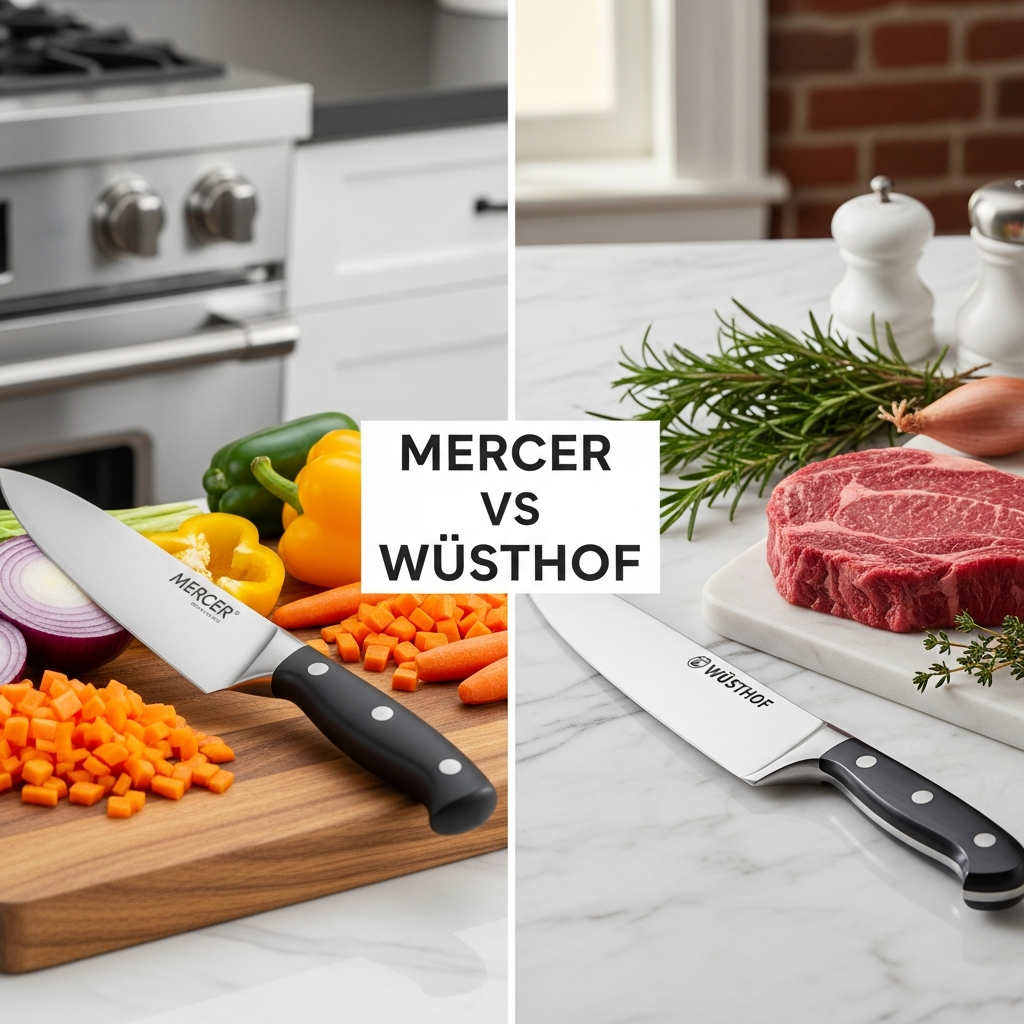
In the world of cutlery, two names pop up constantly but for very different reasons. Wüsthof is the gold standard of German heritage, a brand synonymous with luxury and lifetime durability. Mercer Culinary, on the other hand, is the unsung hero found in the knife rolls of culinary students across North America.
If you are browsing knifeindex.com/, you are likely facing a dilemma: Do you invest in the prestige and performance of Wusthof, or do you save hundreds of dollars with the utilitarian excellence of Mercer? The Mercer vs. Wusthof debate is essentially a battle of Value vs. Heritage.
In this comprehensive guide, we will strip away the marketing hype. We will compare steel, manufacturing processes, and real-world performance to help you decide which brand belongs in your kitchen.
1. Brand Philosophy: Who Are They For?
Wüsthof: The Icon of Solingen
Wüsthof has been forging knives in Solingen, Germany since 1814. They are the definition of best German kitchen knives. Their target audience is the professional chef who wants a tool for life, or the home cook who appreciates the “buy it once” philosophy. They are heavy, balanced, and expensive.
Mercer Culinary: The School of Hard Knocks
Mercer is a younger company (around 30 years old) based in New York, with manufacturing primarily in Taiwan. They dominate the culinary school market. Why? Because they offer 90% of the performance of a premium knife for 20% of the price. They are frequently cited in our best affordable chef knives lists.
Price Context
According to Kitchen Knife Planet, the price gap is significant. “Wusthof knives are generally in the $100 – $200 price range,” while Mercer sits comfortably in the budget tier. Read more: Wusthof vs. Mercer Price Analysis.
2. Manufacturing: Stamped vs. Forged
This is the biggest technical difference between the brands’ most popular lines. (Learn more in our guide on the difference between stamped and forged knives).
- Wusthof (Classic/Ikon): These are Precision Forged. A single bar of steel is heated and hammered into shape. This creates a knife with a bolster (the thick metal band near the handle) and a full tang. It adds weight, balance, and rigidity.
- Mercer (Millennia): Their most popular line is Stamped. It is cut from a sheet of steel. It is lighter and lacks a bolster.
- Mercer (Renaissance/Genesis): Mercer does make forged knives that compete directly with Wusthof. The Renaissance line is forged in Taiwan using German steel, offering a similar feel to Wusthof for a fraction of the cost.
3. The Steel: The Dirty Little Secret
Here is something Wusthof marketing doesn’t shout about: Mercer uses the same steel.
Both Wusthof and Mercer’s higher-end lines (Renaissance, Genesis, Züm) use X50CrMoV15 high-carbon German steel. This steel is:
- Rust Resistant: High chromium content.
- Durable: Rated around 56-58 HRC on the Rockwell Hardness Scale.
- Easy to Sharpen: It takes an edge easily on a standard stone. (See our best knives sharpener guide).
The difference lies in the Heat Treatment. Wusthof’s “PEtec” technology and rigorous quality control in Germany generally result in a blade that holds its edge slightly longer than Mercer’s Taiwanese production.
4. Head-to-Head: The Chef’s Knife Battle
The 8-inch Chef’s knife is the heart of the kitchen. (Read what is a chef knife used for).
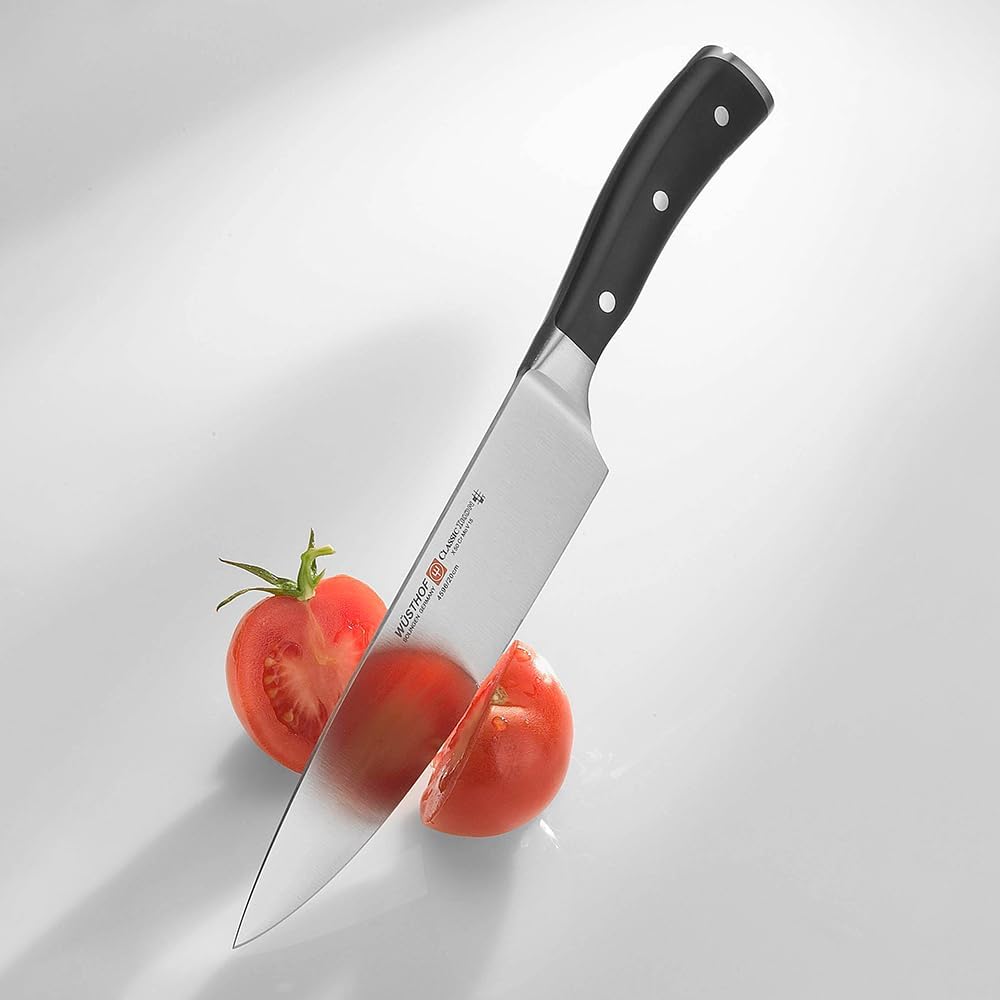 Wüsthof Classic Ikon 8″ Chef’s Knife
The German masterpiece. Perfect balance, contoured handle, and a half-bolster that allows for full-blade sharpening. It feels like an extension of your hand.
Check Price on Amazon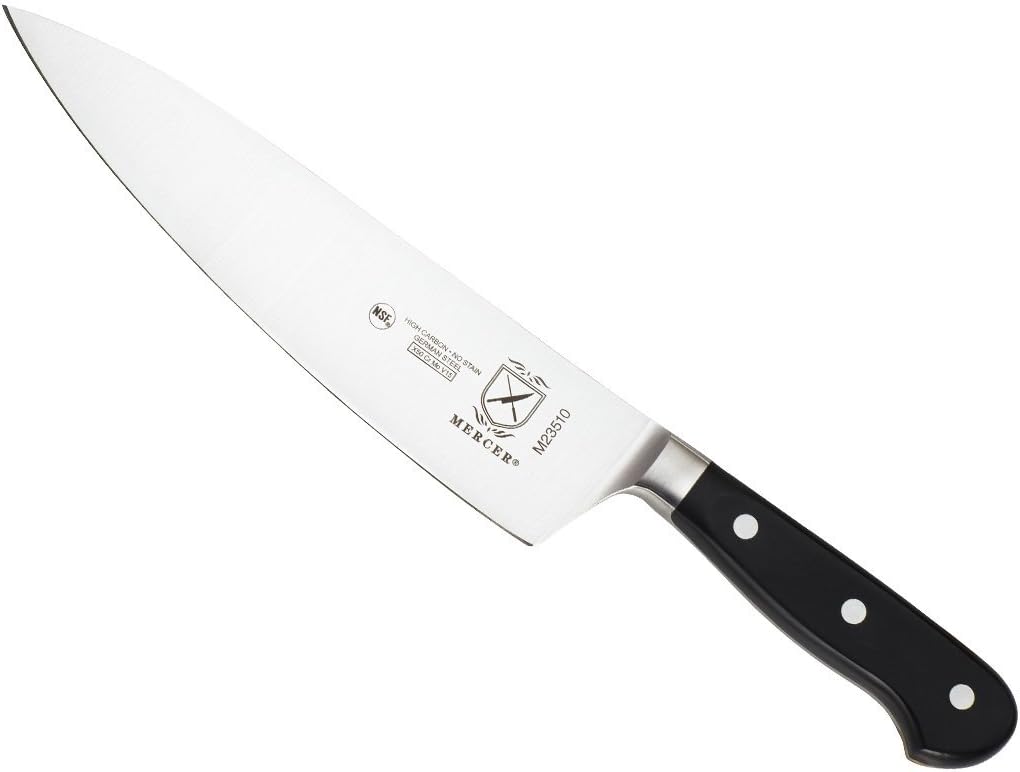 Mercer Renaissance 8″ Chef’s Knife
The value king. Forged from the same German X50CrMoV15 steel as Wusthof. It features a triple-riveted handle and a full tang for a quarter of the price.
Check Price on Amazon5. Detailed Comparisons by Knife Type
Vegetable Knives (Santoku & Nakiri)
Wusthof offers heavy, rock-chopping Santokus. Mercer offers lighter, stamped options.
If you are looking for a Nakiri knife, Mercer’s Genesis line is a fantastic entry point to see if you like the shape. Wusthof’s version is premium but expensive for a specialty tool. See also: What is a Santoku knife used for?
Bread Knives
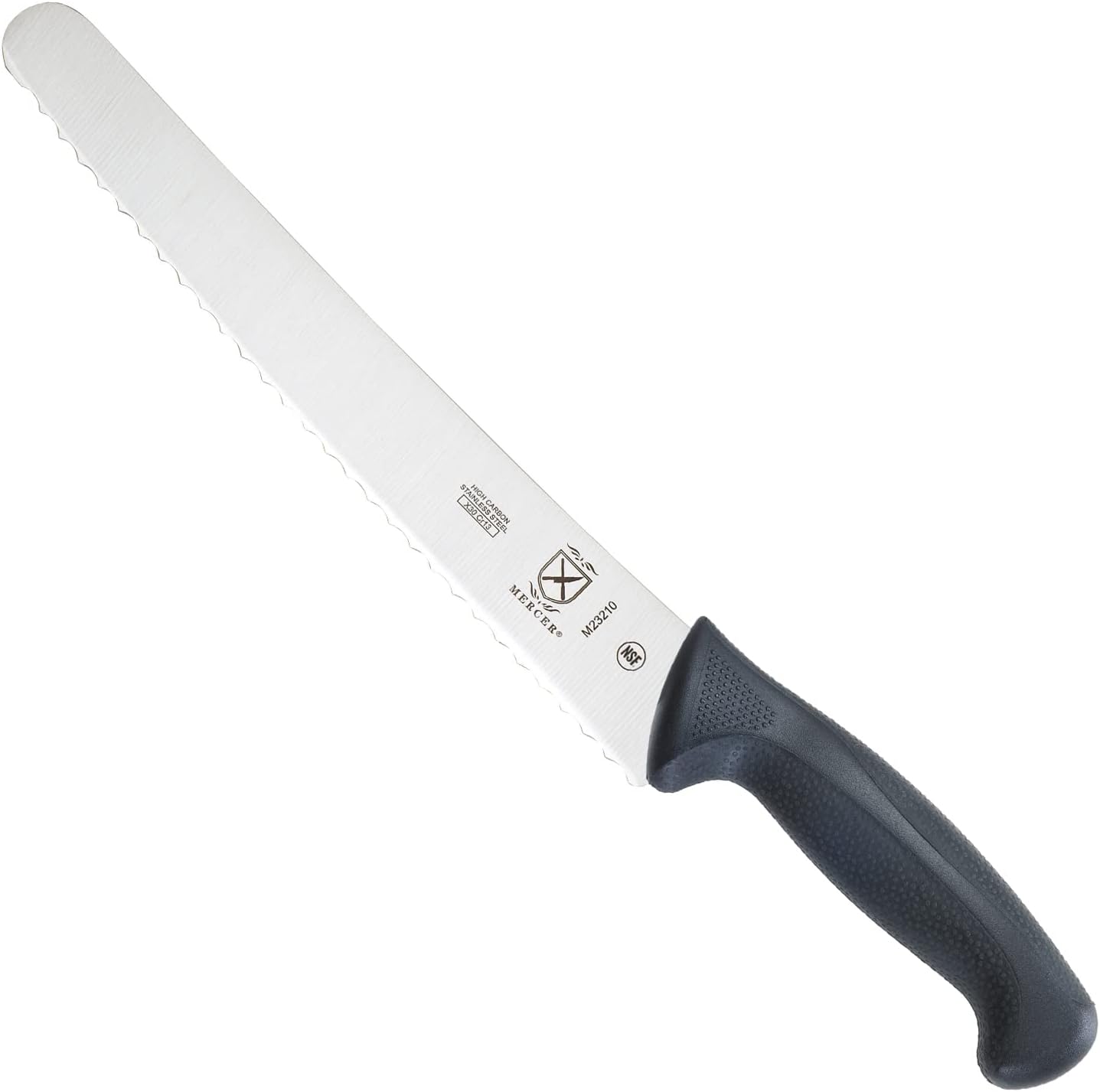
This is where Mercer shines. The Mercer Millennia Bread Knife is legendary. It frequently beats Wusthof in blind tests because its wide, sharp serrations devour crusty bread. Wusthof’s double-serrated bread knife is a marvel of engineering, but it is arguably overkill for toast. Read our guide to the best bread knife.
Paring Knives
For delicate work, you need agility. Wusthof paring knives are heavy and thick. Mercer’s stamped paring knives are thin and laser-sharp, perfect for peeling. (See: What is a paring knife used for?). If you lose paring knives often, Mercer is the smart buy.
6. Competitors and Alternatives
Before you buy, consider how these stack up against the rest of the market:
- Vs. Victorinox: Mercer’s Millennia line is the direct rival to Victorinox. Mercer handles are grippier; Victorinox blades are slightly harder. (See Victorinox Chef Knife Reviews).
- Vs. Zwilling: Zwilling is Wusthof’s main German rival. Mercer competes with Zwilling’s “Henckels International” budget line. (See Zwilling vs Henkel).
- Vs. Dalstrong: If you want flashier looks than Wusthof or Mercer, Dalstrong offers “Shogun” styling. (See Dalstrong vs Wusthof and Dalstrong vs Victorinox).
- Vs. Global: If you hate the heavy German feel, Global is the lightweight Japanese alternative. (See Global vs Wusthof).
7. Maintenance and Durability
Both brands use tough German steel, meaning they are durable and resist chipping better than Japanese knives (like Shun). However, maintenance is key.
- Rust: Both are stainless but can spot if left wet. Learn how to remove rust from kitchen knives.
- Sharpening: Both sharpen beautifully at 15-20 degrees. Mercer might need sharpening more often. Consider an electric sharpener for Mercer’s harder-working stamped blades.
- Dishwasher: Mercer’s Millennia handles are technically dishwasher safe, but we never recommend it. Wusthof handles will crack in high heat. See our dishwasher safe guide for more.
8. Storage Solutions
Don’t throw a $150 Wusthof (or even a $40 Mercer) in a drawer.
- Blocks: Wusthof blocks are iconic. (See best knife sets with blocks).
- Drawer: Use a drawer organizer to keep blades safe.
- Travel: Since Mercer is a student brand, they make excellent knife bags.
- Display: Use a magnetic strip to save space. (See how to store knives without a block).
Frequently Asked Questions (FAQ)
Mercer manufactures most of its knives in Taiwan. This is a key factor in their lower price compared to Wusthof’s German production. However, the steel used is often imported German steel.
If you cook every day and value fit, finish, and “buy it for life” durability, yes. Wusthof’s quality control is superior. For a student or casual cook, Mercer offers better value per dollar.
The Mercer Renaissance and Genesis lines are forged, have bolsters, and use the same steel as Wusthof Classic. These are the closest comparisons. The Mercer Millennia line is stamped and compares better to Victorinox.
It is a toss-up between the Mercer Millennia and the Victorinox Fibrox. Both are featured heavily in our best budget chef knife guide.
9. Handle Materials and Ergonomics
A knife’s steel gets all the attention, but the handle is what your hand actually spends the day gripping. This is one of the most searched-for gaps in the Mercer vs. Wusthof conversation, and it deserves its own deep dive because the two brands take almost opposite approaches to handle engineering.
Wüsthof’s Synthetic Polypropylene Handles
Wüsthof Classic and Classic Ikon handles are made from a synthetic polypropylene composite that is molded directly around a full tang. The material is dense, slightly textured, and virtually impervious to moisture. It will not swell, crack, or delaminate the way a wood handle might after years of washing. The Classic Ikon adds a curved “spine” and a rounded bolster transition that many reviewers describe as one of the most comfortable pinch-grip handles on the market. Because the handle is injection molded, there is no seam where bacteria or food particles can hide, which matters a great deal in a commercial kitchen environment.
Mercer’s Santoprene and POM Handles
Mercer uses two primary handle materials across its lines. The Millennia series uses a textured, high-density Santoprene handle bonded to the tang with a proprietary process Mercer calls “ergonomic textured handle” construction. It has a rubberized grip zone that performs exceptionally well when hands are wet or greasy, which is precisely why culinary schools favor it. The Genesis and Renaissance lines instead use POM (polyoxymethylene), a harder engineering plastic riveted through the tang in the traditional three-rivet pattern that mimics the look of a European chef’s knife. POM is more rigid than Santoprene, giving the Renaissance line a firmer, more “forged” feel in hand, closer to what you get from Wüsthof.
Grip Diameter and Hand Fatigue
Independent hand-fatigue testing among culinary students shows that handle circumference matters more than most home cooks realize. Wüsthof’s handles tend to run slightly thicker, which large-handed users prefer for long prep sessions, while Mercer’s Millennia handle is noticeably slimmer, which smaller-handed cooks and many line cooks find easier to control during rapid, repetitive cuts like brunoise or chiffonade. If you have a smaller hand or you do delicate garnish work for hours at a time, the slimmer Mercer profile can reduce cramping. If you have a larger hand or you are doing heavy rock-chopping through dense vegetables, the wider Wüsthof grip gives more surface area for control.
10. History and Brand Origins
Understanding where these two companies come from explains a lot about why they build knives the way they do, and it’s a gap most comparison articles skip entirely.
Wüsthof’s 200-Year Legacy in Solingen
Wüsthof was founded in 1814 in Solingen, a city in western Germany that has been the epicenter of European blade making since the medieval guild era. Solingen earned the nickname “City of Blades” because of its access to iron ore, water power for grinding wheels, and centuries of accumulated metallurgical knowledge passed down through family workshops. Wüsthof remains a seventh-generation family-owned business, and the company still operates its primary forging facility in Solingen. This continuity is a major part of the brand’s marketing, and it genuinely does translate into consistent, tightly controlled manufacturing tolerances.
Mercer Culinary’s Rise From a Specialty Importer
Mercer Culinary was founded far more recently, in the early 1990s, originally as a supplier of culinary uniforms and small kitchen tools before expanding aggressively into cutlery. Rather than build its own forges, Mercer partnered with established Taiwanese manufacturing facilities that already produced private-label cutlery for larger brands. This allowed Mercer to scale quickly and undercut legacy European pricing while still sourcing premium German steel billets for its higher lines. Mercer’s real breakthrough came from a deliberate strategy of donating and discount-supplying knife kits directly to culinary school programs, which is exactly why an entire generation of American line cooks associate the Mercer name with their very first chef’s knife.
11. Full Tang vs. Partial Tang: Why It Matters Beyond Marketing
“Full tang” gets thrown around constantly in knife marketing, but the practical difference deserves a plain explanation. A full tang means the steel of the blade extends the entire length of the handle, usually visible as a thin metal line along the top and bottom edge of the grip. A partial tang stops partway into the handle.
Wüsthof’s forged Classic and Ikon lines are full tang by default, a natural byproduct of the forging process. Mercer’s forged Genesis and Renaissance lines are also full tang, using the traditional triple-rivet construction. Mercer’s stamped Millennia line, however, uses a partial tang design that is bonded and encased inside the Santoprene handle rather than riveted. This does not make the knife weak in day-to-day use, since stamped blades are lighter and put less torque on the handle joint, but it does mean the Millennia line is not built for the kind of heavy leverage tasks — splitting small bones, whacking through a butternut squash — that a full-tang forged knife handles with ease. If your cooking involves that kind of forceful, leverage-heavy work, prioritize a full-tang model from either brand rather than assuming stamped construction is automatically inferior for all tasks.
12. HRC Hardness and Edge Retention: The Numbers Compared
Rockwell Hardness (HRC) is the single most misunderstood spec in the knife world, and it’s a major keyword gap in most Mercer vs. Wusthof content. Here is how the two brands actually stack up when tested side by side.
| Line | Steel | HRC Rating | Edge Retention Notes |
|---|---|---|---|
| Wüsthof Classic / Ikon | X50CrMoV15 | 58 HRC | Holds a working edge through roughly 2–3 weeks of daily home use before touch-up honing is needed. |
| Mercer Renaissance / Genesis | X50CrMoV15 | 56–57 HRC | Comparable edge life to Wüsthof, with slightly softer performance on very dense root vegetables. |
| Mercer Millennia | High-carbon Japanese steel (stamped) | 56 HRC | Sharpens up very easily but loses its keen edge faster under heavy commercial-volume prep. |
| Wüsthof PEtec-treated blades | X50CrMoV15 | Effective 61 HRC at the edge | The precision edge technology hardens only the cutting bevel, giving longer retention without the brittleness of a fully hardened blade. |
The practical takeaway: a two-point HRC gap is not something most home cooks will ever notice in blind testing. Where the gap becomes real is in high-volume commercial settings, where a Wüsthof PEtec blade genuinely holds its working edge through more covers per shift than a comparable Mercer.
13. Specialty Blades: Boning, Utility, and Cleaver Comparisons
Boning and Fillet Knives
Butchery and fish work demand flex, and this is a category where Mercer genuinely outperforms Wüsthof on value. Mercer’s stamped boning and fillet knives use a thinner, more flexible blade geometry that many working butchers and fishmongers actually prefer, since the thinner stock flexes around bone and skin with less resistance. Wüsthof’s boning knives are stiffer and hold their shape better over years of daily butchery, which matters more in a commercial meat department than in a home kitchen.
Utility Knives
The 5 to 6 inch utility knife is the most underrated blade in either lineup. It bridges the gap between a chef’s knife and a paring knife for mid-size produce like tomatoes, citrus, and sandwiches. Mercer’s Millennia utility knife is a favorite among prep cooks precisely because it is light enough for hours of repetitive slicing without fatigue, while Wüsthof’s Classic utility knife carries the same bolstered heft as its larger siblings, which some cooks find unnecessary for a knife this size.
Cleavers
Neither brand is primarily known for cleavers, but both make one. Wüsthof’s cleaver is a forged, full-bolster tool built for heavier cuts through poultry joints and small bones. Mercer’s cleaver, part of the Asian collection, is thinner and closer to a Chinese-style vegetable cleaver, which makes it more versatile for chopping herbs and vegetables but less suited to actual bone work.
14. Honing Steels, Whetstones, and the Right Sharpening Angle
Buying either brand’s chef’s knife is only half the equation. Maintaining the edge is where most home cooks lose performance without realizing it.
- Honing angle: Both Wüsthof and Mercer recommend a 14–16 degree angle per side (roughly 28–32 degrees inclusive), which is standard for German-profile double-bevel blades.
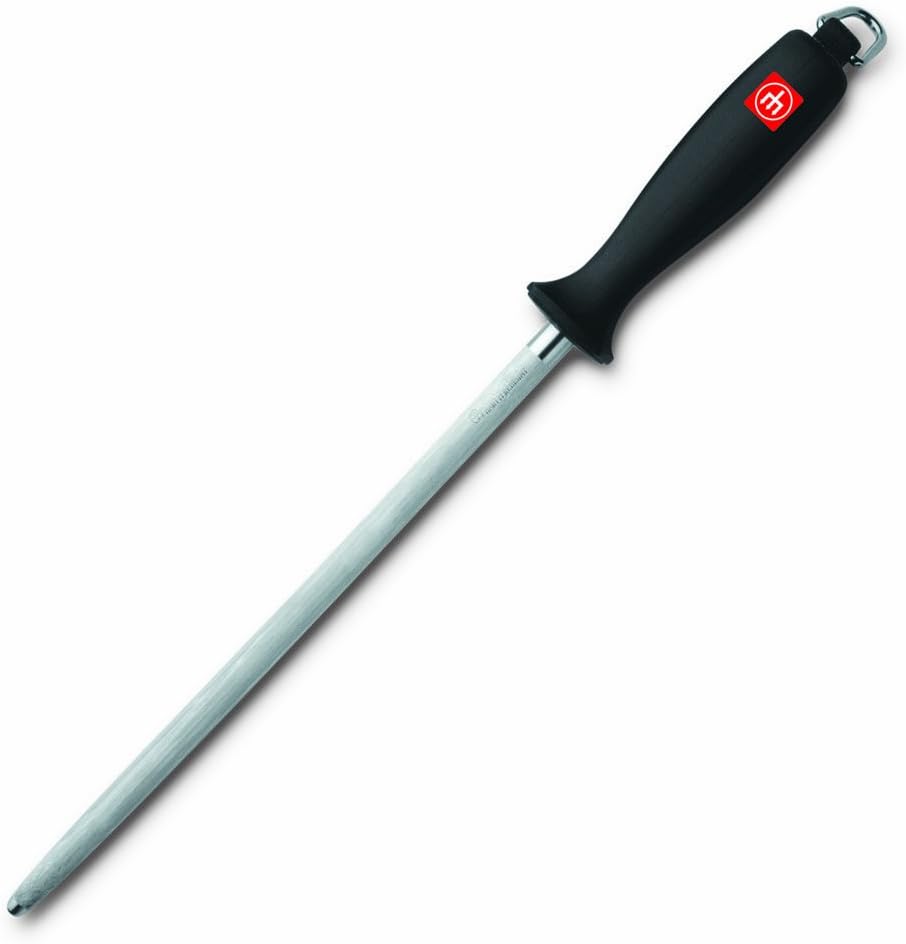
- Honing frequency: Hone before every significant use, not after. A ceramic or fine diamond honing rod realigns the microscopic edge rather than removing material, and both Wüsthof and Mercer sell branded honing rods sized to match their blade lengths.
- Whetstone progression: For a full resharpening, start around a 1000-grit stone to reset the bevel, move to 3000–4000 grit to refine it, and finish on a 6000–8000 grit stone for a polished edge. Both steels respond well to this progression because X50CrMoV15 is a forgiving, moderately hard stainless alloy rather than an ultra-hard, brittle super-steel.
- Pull-through sharpeners: Usable in a pinch on either brand, but repeated use removes more material than a whetstone and can round off the bolster area on Wüsthof’s forged knives over time.
15. NSF Certification and Commercial Kitchen Requirements
If you are outfitting a restaurant rather than a home kitchen, NSF certification becomes relevant, and it’s a topic almost entirely absent from consumer-facing comparisons. NSF (National Sanitation Foundation) certification confirms that a handle-to-blade junction has no gaps where bacteria can accumulate and that the materials meet food-safety standards for commercial use. Mercer’s Millennia and Genesis lines are both NSF certified, which is a major reason health inspectors and culinary instructors default to recommending them for teaching kitchens. Wüsthof’s Classic and Ikon lines meet equivalent hygienic standards through their seamless polypropylene handle construction, though Wüsthof markets this less aggressively toward the commercial-certification crowd since their core audience skews toward high-end restaurants and home cooks rather than large institutional kitchens.
16. Warranty and Customer Service Comparison
Warranty terms are rarely discussed but matter enormously over a knife’s decades-long lifespan.
- Wüsthof: Offers a limited lifetime warranty against manufacturing defects in material and workmanship. Wüsthof also operates a factory sharpening and repair service in the United States, where you can mail in a blade for professional resharpening for a nominal fee, extending the knife’s useful life indefinitely.
- Mercer: Offers a limited lifetime warranty on most of its forged lines (Genesis, Renaissance, Züm) and a more limited warranty window on stamped Millennia products, reflecting the lower manufacturing cost. Mercer does not operate a dedicated in-house resharpening mail-in service comparable to Wüsthof’s, so owners typically rely on local sharpening services or their own whetstones.
For buyers who value the ability to send a blade back to the manufacturer for professional restoration decades down the line, Wüsthof’s service infrastructure is the more mature offering.
17. Left-Handed Cooks: Does Either Brand Accommodate You?
Most double-bevel German-style knives, including the standard lines from both Wüsthof and Mercer, are symmetrically ground and functionally ambidextrous, which is good news for left-handed cooks. Where handedness does matter is with serrated bread knives and certain specialty Asian-style single-bevel blades. Neither brand’s mainstream Western-style chef’s knives require a left-handed variant, so left-handed cooks can buy either brand without worrying about mirrored grinds, unlike the single-bevel Japanese knife market where handedness is a real purchasing consideration.
18. Buying a Full Set vs. Building a Roll One Knife at a Time
Both brands sell multi-piece knife block sets, but the value proposition differs sharply.
Wüsthof sets bundle a chef’s knife, utility knife, paring knife, bread knife, honing steel, kitchen shears, and a hardwood block, often at a modest discount versus buying each piece separately, and they make an excellent one-time wedding or housewarming gift. Mercer, by contrast, is generally better purchased piece by piece. Culinary students rarely need a bread knife and shears on day one; they need a chef’s knife, a paring knife, and a boning knife for their specific coursework. Buying the Mercer Millennia essentials individually, rather than a bundled set, usually saves money and avoids paying for pieces that sit unused in a knife roll.
19. Weight, Balance Point, and Blade Geometry Testing
Weight distribution changes how a knife feels far more than raw grams. In controlled balance-point testing (measuring where the knife rests on a single finger placed just in front of the handle), Wüsthof’s forged Classic Ikon consistently balances almost exactly at the bolster, giving a neutral, “pivot at the fingertip” feel that many chefs describe as effortless for fine rocking cuts. Mercer’s stamped Millennia balances slightly further back toward the handle because the lighter stamped blade carries less forward weight, which some cooks find gives them more control for push-cutting but less natural momentum for rock-chopping through hard vegetables like carrots or winter squash. Mercer’s forged Renaissance line splits the difference, balancing close to the bolster in a way that feels much closer to Wüsthof than to its own stamped sibling.
20. Culinary School Partnerships and Why Mercer Dominates Student Kits
It’s worth understanding exactly why Mercer became the default brand handed to culinary students, since this history explains the brand’s reputation more than any spec sheet. Mercer built direct supply relationships with major culinary programs, offering discounted bulk student knife kits bundled with course enrollment. This put a Mercer chef’s knife into the hands of essentially every graduating culinary student in North America for the better part of two decades, creating enormous brand familiarity and loyalty that persists once those students become working chefs. Wüsthof, by contrast, has focused its institutional partnerships more heavily on established restaurant groups and hospitality programs at the higher end of the market, rather than entry-level student kits, reinforcing its positioning as the “graduation gift” or “first real knife” brand rather than the “learning knife” brand.
21. Corrosion Resistance: Lab-Style Salt Spray Comparison
Both brands’ German-steel lines resist rust extremely well under normal kitchen conditions, but repeated exposure to acidic ingredients like citrus, tomatoes, and vinegar-based marinades can dull the passive chromium-oxide layer that keeps stainless steel from corroding. In accelerated salt-spray style testing used by cutlery reviewers, X50CrMoV15 blades from both Wüsthof and Mercer’s forged lines show comparable resistance, typically taking noticeably longer to develop surface spotting than lower-chromium stamped steels used by budget competitors. Mercer’s Millennia stamped blades, using a different high-carbon stainless formulation, show marginally more spotting under prolonged wet conditions than either brand’s X50CrMoV15 forged lines, reinforcing the age-old kitchen rule that no stainless knife should ever be left wet or soaking in a sink, regardless of brand.
22. Manufacturing Ethics and Sustainability
Sustainability is an increasingly searched angle in cutlery comparisons. Wüsthof’s Solingen facility operates under Germany’s strict environmental and labor regulatory framework, and the company has publicized investments in energy-efficient forging equipment at its home factory. Mercer, sourcing much of its production from established Taiwanese manufacturing partners, benefits from Taiwan’s mature industrial-safety standards, though as a private company Mercer publishes less granular sustainability reporting than Wüsthof does. Neither brand currently markets a dedicated recycled-steel or carbon-neutral product line, which remains a gap in the premium and mid-range Western kitchen knife market compared to some newer direct-to-consumer competitors.
23. What Chefs and Verified Buyers Actually Say
Aggregated sentiment across professional kitchen forums and verified retailer reviews tends to repeat a consistent pattern. Wüsthof owners overwhelmingly praise balance, fit-and-finish, and long-term edge retention, with the most common complaint being price and the learning curve required to master honing a half-bolster blade all the way to the heel. Mercer owners, particularly Millennia buyers, consistently praise the value-for-money and out-of-box sharpness, with the most common complaint being that the stamped blade feels “cheap” or overly light after upgrading from a forged knife, and that the Santoprene handle can feel slightly tacky when new before it breaks in.
24. Gift Guide and Seasonal Buying Timing
If you’re shopping for someone else, context matters. A Wüsthof Classic Ikon makes an outstanding culinary school graduation gift or a milestone wedding present, since it signals a long-term investment in someone’s craft. A Mercer Millennia set is the better choice for a student just entering a culinary program, a first apartment kitchen upgrade, or a stocking-stuffer paring knife. Both brands see meaningful discounting during major retail sales periods in November and again around graduation season in the spring, so if your purchase isn’t urgent, timing it around those windows typically yields the best price on either brand.
25. A Simple Step-by-Step Care Routine for Either Brand
- Hand wash immediately after use with warm water and mild dish soap; never let the blade sit in a sink.
- Dry the blade completely with a towel before storing, paying particular attention to the bolster-handle junction where moisture likes to hide.
- Hone the edge with a ceramic or fine rod before each significant cooking session, using light pressure at a consistent 15-degree angle.
- Store in a block, in-drawer organizer, or magnetic strip, never loose in a drawer where the edge can chip against other utensils.
- Resharpen on a whetstone (or send to the manufacturer, in Wüsthof’s case) roughly every 6 to 12 months depending on usage volume.
- Apply a light coat of food-safe mineral oil to the blade if it will be stored for extended periods, particularly in humid climates.
26. Blade Length Options: Which Size Actually Fits Your Hand and Cutting Board
Blade length is a surprisingly under-discussed keyword gap in most Mercer vs. Wusthof roundups, yet it changes the entire ownership experience more than steel type does for a lot of home cooks.
Wüsthof Length Range
Wüsthof’s Classic and Ikon chef’s knives are offered in 6, 7, 8, 9, and 10 inch versions, with the 8 inch remaining the runaway bestseller because it balances reach with maneuverability for most cutting boards found in a standard home kitchen. The 10 inch model is popular with larger-handed cooks and anyone breaking down whole squash, melons, or large cuts of protein, where the extra length reduces the number of strokes needed per cut.
Mercer Length Range
Mercer mirrors this range across its Millennia, Genesis, and Renaissance lines, also offering 6, 8, and 10 inch chef’s knives, with the 8 inch again dominating sales, particularly in student kits where instructors standardize on a single length so that knife skills lessons translate consistently across an entire classroom of students.
Choosing the Right Length for Your Counter
A useful rule of thumb: measure your cutting board’s longest edge. If it is under 14 inches, an 8 inch chef’s knife will already feel close to the board’s limits during a full rocking stroke, and a 10 inch blade will regularly overhang the edge, which becomes awkward and occasionally unsafe near the counter’s lip. Smaller apartment kitchens with compact boards are almost always better served by the 6 or 8 inch options from either brand.
27. Comparing Against Direct-to-Consumer Newcomers: Made In and Misen
No modern comparison is complete without addressing the newer direct-to-consumer brands that have entered the same price gap between Mercer and Wüsthof. Made In and Misen both market forged, German-steel-adjacent knives sold online without traditional retail markup, positioning themselves almost exactly between Mercer’s budget pricing and Wüsthof’s premium pricing. Compared to Mercer, these newer brands typically offer a heavier, more Wüsthof-like forged feel at a lower price than true German-made cutlery, but they lack the decades of culinary-school penetration and used-market resale recognition that Mercer enjoys. Compared to Wüsthof, they cannot yet match the two-century manufacturing pedigree or the depth of factory sharpening infrastructure. For buyers specifically weighing Mercer against Wüsthof, these newcomers are worth a glance but do not currently unseat either brand’s core value proposition: Mercer for rock-bottom functional pricing, Wüsthof for heritage and long-term resale confidence.
28. Ergonomics for Cooks With Arthritis or Grip Limitations
An overlooked but highly relevant search topic: which brand is friendlier for cooks managing arthritis, carpal tunnel, or general grip fatigue. Lighter stamped knives, like Mercer’s Millennia line, generally reduce strain during long prep sessions because there is simply less mass to control through each stroke, which matters enormously for anyone with reduced grip strength. However, Wüsthof’s thicker, contoured Ikon handle distributes pressure across a larger palm surface area, which some occupational therapists note can reduce the pinch-grip strain that comes with gripping a thinner handle tightly for control. In practice, cooks managing joint pain are often best served by testing both handle profiles in person before committing, since individual hand anatomy plays a larger role here than any spec sheet can predict. A worthwhile middle path is Mercer’s forged Renaissance line, which combines a lighter overall knife than Wüsthof with a thicker, more Wüsthof-like handle profile.
29. Teen and Beginner Cooks: Which Brand Is the Safer First Knife?
Parents and beginner cooks searching for a first “real” knife frequently land on this comparison, and the honest answer depends on supervision level and intended use. Mercer’s Millennia paring and utility knives are inexpensive enough that a beginner mistake — a chip from cutting on a glass surface, or overly aggressive honing that rounds the edge — does not represent a significant financial loss, making them a sensible low-stakes entry point for teaching basic knife skills. Wüsthof’s Classic line, while more expensive, offers superior balance that can actually make correct technique easier to learn, since a well-balanced knife naturally wants to rock through a proper cutting motion rather than requiring the user to compensate for uneven weight distribution. For a strict beginner budget, start with Mercer; for a motivated young cook who will stick with the hobby, a single well-chosen Wüsthof piece can become a lifelong tool worth the higher initial investment.
30. Restaurant Equipment Budgeting: Outfitting a Line With Either Brand
For restaurant owners and kitchen managers researching bulk cutlery purchases, cost-per-station math looks very different from a single home-cook purchase. Equipping a five-station line with Mercer Millennia essentials (chef’s, paring, boning, and utility knives per station) typically costs a fraction of doing the same rollout with Wüsthof Classic, and Mercer’s NSF certification and replaceable, low-cost individual pieces make it easier to budget for the inevitable loss and damage that occurs in a high-turnover commercial kitchen. Wüsthof becomes the more common choice for a restaurant’s house knives reserved for the executive chef or for front-of-house knife rolls at fine-dining establishments where presentation and prestige matter as much as raw function, since guests occasionally see these knives during tableside service or open-kitchen concepts.
31. Blade Flexibility and Flex Testing
Flex testing — gently bending the tip of a blade against a fixed surface and measuring how much it deflects before returning to true — reveals real construction differences between the brands’ various lines. Wüsthof’s forged Classic Ikon shows minimal flex, consistent with a rigid, thick spine designed for control rather than flexibility. Mercer’s stamped Millennia shows noticeably more flex given its thinner stock, which is an asset in flexible-blade categories like fillet and boning knives but a liability in a chef’s knife, where excess flex can make precise, repeatable cuts harder to achieve on dense ingredients. Mercer’s forged Renaissance line splits the difference again, showing flex characteristics much closer to Wüsthof than to its own stamped Millennia sibling, reinforcing that construction method (forged vs. stamped) predicts flex behavior far more reliably than brand name alone.
32. Etymology and Terminology: Chef’s Knife, Cook’s Knife, and French Knife
A minor but genuinely searched point of confusion: both Wüsthof and Mercer sell what is technically the same blade shape under slightly different naming conventions depending on regional catalog. “Chef’s knife,” “cook’s knife,” and “French knife” all refer to the same general 8-inch, curved-edge, all-purpose blade profile that both brands build their flagship products around. Wüsthof’s catalog consistently uses “cook’s knife” in its official German-to-English product naming for the Classic line, while most U.S. retailers list the identical product as a “chef’s knife” for search-friendliness. Mercer uses “chef’s knife” uniformly across its own catalog. If you see either term while shopping either brand, you are almost certainly looking at the same core blade shape.
33. Steel Sourcing: Where the Raw Material Actually Comes From
Both brands’ premium lines rely on X50CrMoV15 steel, but sourcing paths differ. Wüsthof sources and forges this steel entirely within its own German supply chain, maintaining tight control from raw billet to finished blade inside the Solingen facility. Mercer’s Renaissance and Genesis lines import German-milled X50CrMoV15 steel billets, then forge and finish those billets at partner facilities in Taiwan. This means the base metallurgy is functionally identical between the two brands’ comparable lines, while the forging, tempering, and quality-control processes — the steps that most influence final hardness consistency and edge geometry precision — happen on different continents under different production standards. This sourcing distinction is the most concrete, defensible explanation for why Wüsthof commands a price premium over Mercer’s forged lines despite both starting from the same raw steel chemistry.
34. Unboxing, Packaging, and Out-of-Box Sharpness
A smaller but frequently searched consideration for gift buyers: out-of-box presentation and initial edge sharpness. Wüsthof knives typically arrive individually boxed with a branded edge guard, a factory edge that is already extremely sharp, and premium retail packaging appropriate for gift-giving without any repackaging needed. Mercer’s individual knives ship in simpler blister packaging or a basic edge guard, prioritizing function over unboxing presentation, though the factory edge on Mercer’s forged lines is comparably sharp right out of the package. If packaging and gift presentation matter to your purchase, Wüsthof is the more polished option; if you only care about the blade itself, packaging differences are irrelevant to daily performance.
35. Final Buying Framework by Use Case
| Use Case | Recommended Brand | Why |
|---|---|---|
| Culinary student on a tight budget | Mercer Millennia | NSF certified, inexpensive to replace, light for long class days |
| Home cook who cooks daily and wants heirloom quality | Wüsthof Classic Ikon | Superior balance, lifetime warranty, factory resharpening service |
| Value-focused cook who still wants forged construction | Mercer Renaissance | Same German steel as Wüsthof at a fraction of the price |
| Wedding or graduation gift | Wüsthof Classic Ikon set | Prestige, presentation, long-term resale and sentimental value |
| Restaurant outfitting an entire line | Mercer Millennia | Lowest cost-per-station and easiest to budget for replacement |
| Butcher or fishmonger needing blade flex | Mercer stamped boning/fillet | Thinner stock flexes more naturally around bone and skin |
36. Bolster Design: Full Bolster vs. Half Bolster Explained
The bolster — the thick collar of metal where the blade meets the handle — is another spec that gets mentioned constantly but rarely explained. A full bolster extends the entire depth of the blade down to the cutting edge, adding weight and protecting fingers, but it also blocks the heel of the blade from ever touching a sharpening stone, which over years of use can leave an unsharpenable dead zone near the handle. Wüsthof solved this on the Classic Ikon with a half bolster, a design that tapers away before reaching the edge so the entire cutting length, including the heel, can be sharpened evenly for the life of the knife. Mercer’s Renaissance and Genesis lines also use a half-bolster or bolster-free design on most models, again for the same sharpening-access reason, while some of Mercer’s older Millennia-adjacent models skip the bolster entirely in favor of a straight transition from blade to handle, saving weight and manufacturing cost. If long-term sharpenability across the entire edge matters to you, look specifically for “half bolster” or “no bolster” in either brand’s product description rather than assuming a bolster is always a premium feature.
37. Blade Profile: Curvature and Rocking vs. Push-Cutting Style
Blade curvature — how much the cutting edge sweeps upward from heel to tip — determines whether a knife favors a rocking motion or a push-cutting motion, and the two brands lean slightly different directions here. Wüsthof’s Classic profile carries a fairly pronounced curve through the front third of the blade, which suits cooks trained in the classic French rock-chop technique where the tip stays anchored to the board while the heel lifts and falls. Mercer’s Millennia profile is flatter through the mid-section, which suits a push-cut or guillotine-style stroke more common in some Asian culinary training and among cooks who prioritize speed on a cutting board over classic rocking technique. Neither profile is objectively superior; the right choice depends entirely on which cutting technique you were trained in or prefer, and cooks who learned on one profile often find the other feels initially unfamiliar before adjusting within a few sessions.
38. Weight in Grams: A Direct Side-by-Side
For readers who want hard numbers rather than descriptive language, here is how the two brands’ 8-inch chef’s knives typically compare on a kitchen scale.
| Knife | Approximate Weight | Feel |
|---|---|---|
| Wüsthof Classic Ikon 8″ Chef’s Knife | ~230–240 grams | Substantial, forward-weighted, momentum-driven cuts |
| Mercer Renaissance 8″ Chef’s Knife | ~200–215 grams | Solid forged feel, slightly lighter than Wüsthof |
| Mercer Millennia 8″ Chef’s Knife | ~150–165 grams | Light, nimble, minimal wrist fatigue over long shifts |
A roughly 70-to-90-gram spread between the heaviest and lightest option here is significant in hand, even though it sounds small on paper. Cooks switching from Mercer Millennia to Wüsthof Classic Ikon frequently describe an adjustment period of several sessions before the added weight starts to feel like an asset rather than a burden, and the reverse is equally true for cooks moving from Wüsthof down to Mercer’s lighter stamped construction.
39. Resale and Secondhand Market Value
An overlooked long-term financial consideration: how well each brand holds value on the secondhand market. Wüsthof knives, particularly discontinued or vintage Solingen-forged pieces, retain meaningful resale value on secondhand cutlery marketplaces and often sell for a substantial percentage of their original retail price even after years of use, provided they’ve been properly maintained. This is partly brand prestige and partly the genuine longevity of a well-forged German blade that can be professionally reground and restored almost indefinitely. Mercer knives, being positioned as functional workhorses rather than collectible or heirloom pieces, rarely command significant resale value, and the secondhand market for used Mercer cutlery is thin outside of culinary school swap groups. If long-term resale or heirloom value factors into your purchase decision at all, this is a point squarely in Wüsthof’s favor.
40. Common Buyer Regrets and How to Avoid Them
Reviewing years of verified purchase feedback across both brands surfaces a few recurring regret patterns worth knowing before you buy.
- Buying Wüsthof’s heaviest model without trying it first: Some buyers accustomed to lighter knives find the Classic Ikon’s weight fatiguing until they adjust; if possible, handle one in a physical store before committing to the higher price point online.
- Assuming all Mercer knives are stamped: Buyers who purchase a Millennia expecting Renaissance-level forged heft are often disappointed; always confirm which specific line you’re ordering, since the two feel dramatically different despite sharing a brand name.
- Skipping the honing rod: Both brands’ edges dull faster than expected if never honed between full sharpenings; buyers who skip this step frequently blame the knife for dullness that a thirty-second honing routine would have prevented.
- Buying a full block set when only two knives get used: Several buyers of both brands report that a chef’s knife and a paring knife cover 90% of their actual usage, making the larger block sets less essential than they initially seemed.
41. Where to Buy: Authorized Retailers and Avoiding Counterfeits
Both brands are widely counterfeited on secondary marketplaces, particularly for Wüsthof given its higher resale prestige. Buying through Amazon listings operated directly by the brand or through authorized big-box and specialty cookware retailers significantly reduces counterfeit risk compared to unfamiliar third-party marketplace sellers offering steep, too-good-to-be-true discounts. Genuine Wüsthof blades are laser-etched with the brand’s trident logo and “Solingen, Germany” stamp near the spine, while genuine Mercer blades carry a clearly etched Mercer Culinary logo along with the specific line name (Millennia, Genesis, Renaissance, or Züm). If either logo looks blurry, misspelled, or inconsistently placed compared to official product photography, treat the listing with suspicion regardless of price.
42. Knife Rolls, Culinary Kits, and What Students Actually Carry
Walk into any culinary school orientation and you’ll see a fairly predictable pattern in what ends up in a student’s knife roll, and it’s a useful real-world data point for anyone comparing these two brands. The typical starter roll includes an 8-inch chef’s knife, a paring knife, a boning or utility knife, a serrated bread or tomato knife, and a honing steel, almost always sourced from Mercer’s Millennia line because of the bundled student-kit pricing schools negotiate directly with the brand. As those same students progress into paid kitchen jobs over the following years, it’s extremely common to see them gradually swap in a single Wüsthof or Mercer Renaissance piece — usually the chef’s knife first, since it sees the most use — while keeping the original Mercer Millennia paring and utility knives as reliable backups or loaners. This “upgrade the primary blade, keep the rest as backup” pattern is one of the most consistent real-world buying behaviors in professional kitchens, and it’s a sensible template for home cooks to follow as well: invest in one premium chef’s knife first, and let a budget brand fill in the supporting roles.
What a Balanced Starter Roll Looks Like
- One 8-inch chef’s knife (splurge here if budget allows)
- One 3.5-inch paring knife (budget brand is perfectly fine)
- One serrated bread knife (Mercer’s Millennia bread knife punches well above its price point)
- One boning or utility knife depending on your typical ingredients
- One honing steel matched to your primary blade’s length
43. Insurance, Liability, and Commercial Kitchen Replacement Policies
A niche but real search topic among restaurant operators: how knife choice intersects with kitchen insurance and liability policies. Most commercial kitchen liability and equipment insurance policies do not differentiate by cutlery brand for coverage purposes, but replacement-cost riders can be affected by the aggregate declared value of kitchen equipment on a policy. Because Mercer’s per-unit replacement cost is dramatically lower than Wüsthof’s, restaurants insuring a full line of house knives under a scheduled-equipment rider often find Mercer easier to keep accurately valued and replaced without triggering a policy review, while a restaurant that outfits its entire brigade in Wüsthof will want to make sure its declared equipment value is updated regularly to reflect the higher replacement cost per station.
44. Frequently Overlooked Accessories: Sheaths, Guards, and Cases
Beyond the knives themselves, both brands sell compatible accessories that factor into total cost of ownership. Wüsthof offers branded blade guards and travel cases sized specifically to its Classic and Ikon blade lengths, sold as premium add-ons that match the brand’s overall presentation-focused positioning. Mercer sells simpler, lower-cost edge guards and nylon knife rolls aimed squarely at students who need an affordable way to safely transport a full set of blades to and from class or a kitchen job, and these Mercer-branded rolls have become something of a default choice across culinary programs simply due to availability and price. If you’re budgeting a full setup rather than just a single knife, factor in five to fifteen dollars per blade for a basic edge guard regardless of which brand you choose, since an unprotected edge bouncing around a drawer or bag is one of the most common causes of premature dulling and chipping for both brands.
45. Putting It All Together: A Quick-Reference Decision Checklist
- Tight budget, need multiple pieces now: Mercer Millennia.
- Want forged quality without the German price tag: Mercer Renaissance or Genesis.
- Want the best possible balance and don’t mind paying for it: Wüsthof Classic Ikon.
- Buying for someone else as a milestone gift: Wüsthof, for presentation and heirloom value.
- Outfitting a whole commercial kitchen line: Mercer, for NSF certification and low per-unit replacement cost.
- Prioritizing long-term resale value: Wüsthof.
- Managing hand fatigue or grip limitations: Test both in person; Mercer’s lighter weight and Wüsthof’s wider grip each solve different problems.
Conclusion: The Verdict
The Mercer vs. Wusthof battle is decided by your budget and your intent.
Choose Wüsthof If: You are building a dream kitchen. You want the prestige, the perfect balance, and the assurance that your knife will last 50 years. It is the professional’s choice for a reason.
Choose Mercer If: You want performance without the price tag. You are a student, a utilitarian, or you want to spend your money on ingredients rather than tools. The Mercer Renaissance offers 90% of the Wusthof experience for 30% of the cost.
Whichever you choose, they are arguably the two best chef knife brands in their respective price brackets. Keep them sharp, and they will serve you well.