Are Magnetic Knife Strips Bad for Knife Edges? A Deep Dive into Kitchen Storage Safety
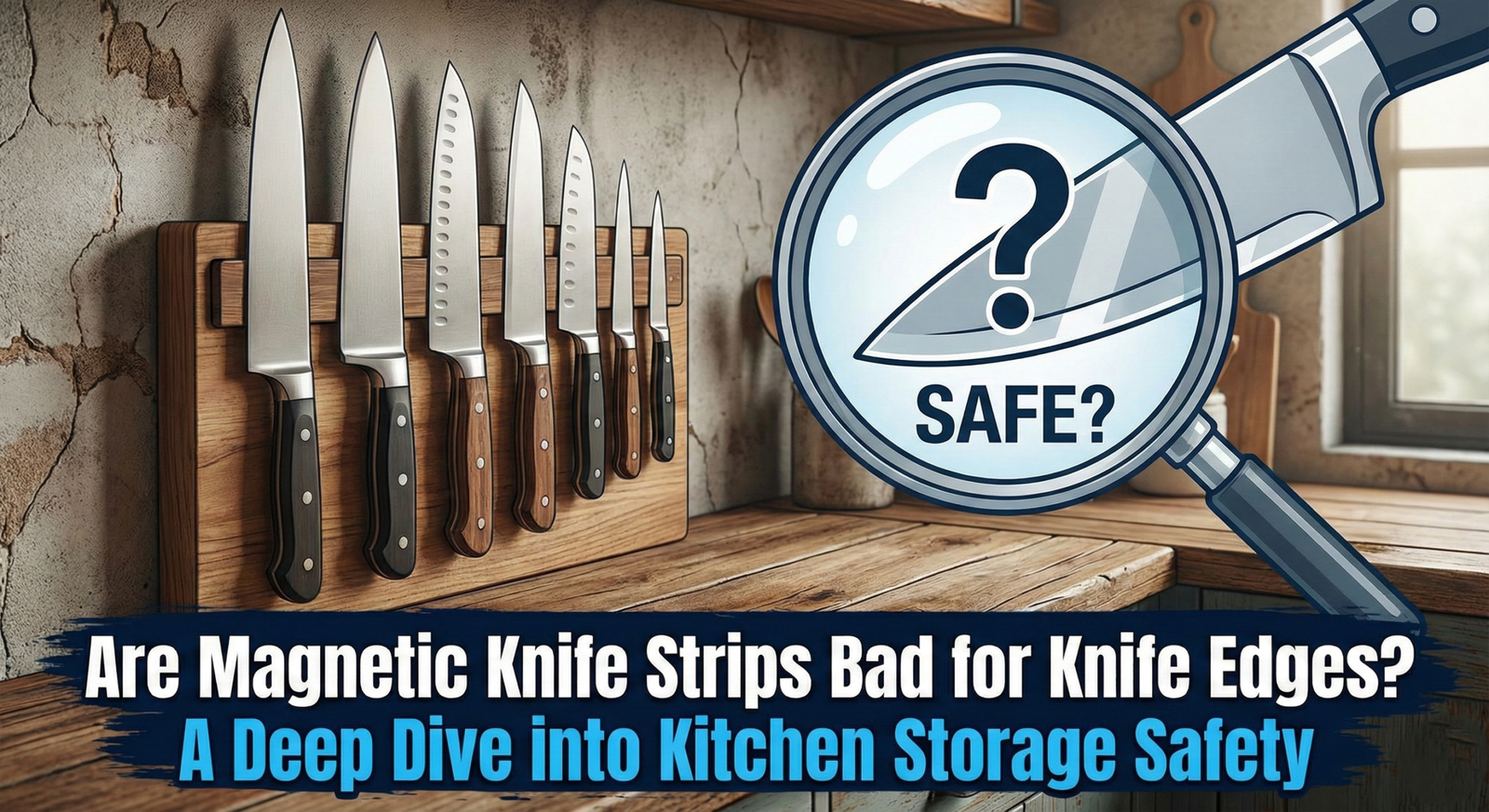
In the world of culinary arts, the debate over knife storage is almost as heated as the debate over stainless steel vs. carbon steel. For years, professional chefs and home cooks alike have gravitated toward magnetic knife strips. They look sleek, they save precious drawer space, and they make you feel like a master chef grabbing a tool mid-service. But a lingering question remains: Are magnetic knife strips bad for knife edges?
The short answer is no, not if you choose the right strip and use the correct technique. However, the long answer is filled with nuance regarding materials, magnetic force, and the microscopic fragility of a knife’s apex. If you are investing in high-end cutlery, such as premium Japanese kitchen knives, understanding how your storage solution interacts with your blade is crucial.
This comprehensive guide will break down the mechanics of magnetic storage, debunk common myths, and teach you exactly how to store your knives to ensure they stay razor-sharp for years to come. We’ll also cover installation, sizing, maintenance, safety, and how magnetic strips stack up against every other storage method on the market — so by the end, you’ll know not just whether magnetic strips are safe, but exactly which one to buy and how to mount it correctly the first time.
How Magnetic Knife Strips Interaction with Steel
To understand if magnetic strips are harmful, we first need to understand the physics at play. A magnetic knife holder consists of a series of strong magnets—usually neodymium or ferrite—embedded within a housing bar. When a ferromagnetic object, like a chef’s knife, comes into close proximity, the magnetic flux pulls the steel tight against the surface.
The “Clack” Factor
The primary concern most critics have is the “clack” sound heard when a knife snaps onto a metal strip. This sound is the audible evidence of an impact. If the cutting edge (the very sharpest part of the blade) hits the metal strip first, it can roll, chip, or dull the edge instantly. This is particularly dangerous for harder, more brittle steels found in brands like Shun or Miyabi.
However, this is rarely a fault of the magnet itself, but rather the user’s placement technique or the surface material of the strip.
Neodymium vs. Ferrite: Does Magnet Type Matter?
Most budget strips use ferrite magnets, which are cheaper but weaker and require thicker housings to achieve a usable hold. Premium strips use neodymium (rare-earth) magnets, which are dramatically stronger for their size. This matters for edge safety in a counterintuitive way: a stronger magnet actually increases the “snap” force pulling the blade toward the bar in the final inch of approach, which means technique becomes even more important on high-powered neodymium strips. A weak ferrite strip is more forgiving of sloppy placement but may not hold a heavy santoku or cleaver securely, creating a different kind of risk — the knife slipping off entirely.
The practical takeaway is that magnet strength should be matched to the weight of your heaviest knife, not simply maximized. A strip rated to hold several pounds per linear inch is overkill for a paring knife collection but appropriate for a mixed set that includes cleavers or a large chef’s knife.
Metal Strips vs. Wood-Encased Magnets: A Crucial Distinction
Not all magnetic strips are created equal. The material that contacts your blade is the single most important factor in preventing damage.
1. Exposed Metal Strips (Aluminum or Stainless Steel)
These are the industrial-style rails often seen in commercial kitchens. While they are durable and easy to sanitize, they pose the highest risk to your edges. Metal-on-metal contact creates friction. If you slide the knife while removing it, you risk scratching the beautiful Damascus finish on a Dalstrong or Shun knife. More critically, if the edge snaps against the hard metal, micro-chipping is almost guaranteed over time.
2. Wood or Silicone-Encased Strips
These are the “gold standard” for home kitchens. The magnets are hidden behind a layer of wood, bamboo, or soft-touch silicone. This layer acts as a shock absorber. Even if you are slightly careless when racking your knife, the wood is softer than the steel edge, meaning the wood will dent before your knife dulls. For anyone looking for the best knife holders that preserve sharpness, wood-encased magnetic strips are the superior choice.
3. Acrylic and Plastic-Coated Strips
A third, less-discussed category uses clear acrylic or ABS plastic housing. These sit in a middle ground: harder than wood but softer than raw steel or aluminum. They’re popular in modern minimalist kitchens because they blend into backsplashes rather than standing out. Edge safety is generally good, though cheap acrylic can develop hairline scratches from repeated contact, which — while cosmetic rather than functional — can make the strip look worn faster than a wood equivalent. If aesthetics matter as much as function, look for acrylic strips with a rubberized inner lining rather than bare plastic against the magnet housing.
Wood Species and Why It Matters
Not all wood-encased strips perform identically. The three most common species are:
- Bamboo: Technically a grass, bamboo is dense, moisture-resistant, and inexpensive, making it the most common material on budget-to-midrange strips. It’s hard enough to stand up to years of use while remaining gentle on edges.
- Acacia: A hardwood with a tight grain and attractive color variation. Acacia is slightly harder than bamboo and holds up well to humidity, making it a popular premium choice.
- Walnut: The most premium option, prized for its dark, rich color and fine grain. Walnut strips tend to be the most expensive but are also extremely durable and visually striking as a kitchen focal point.
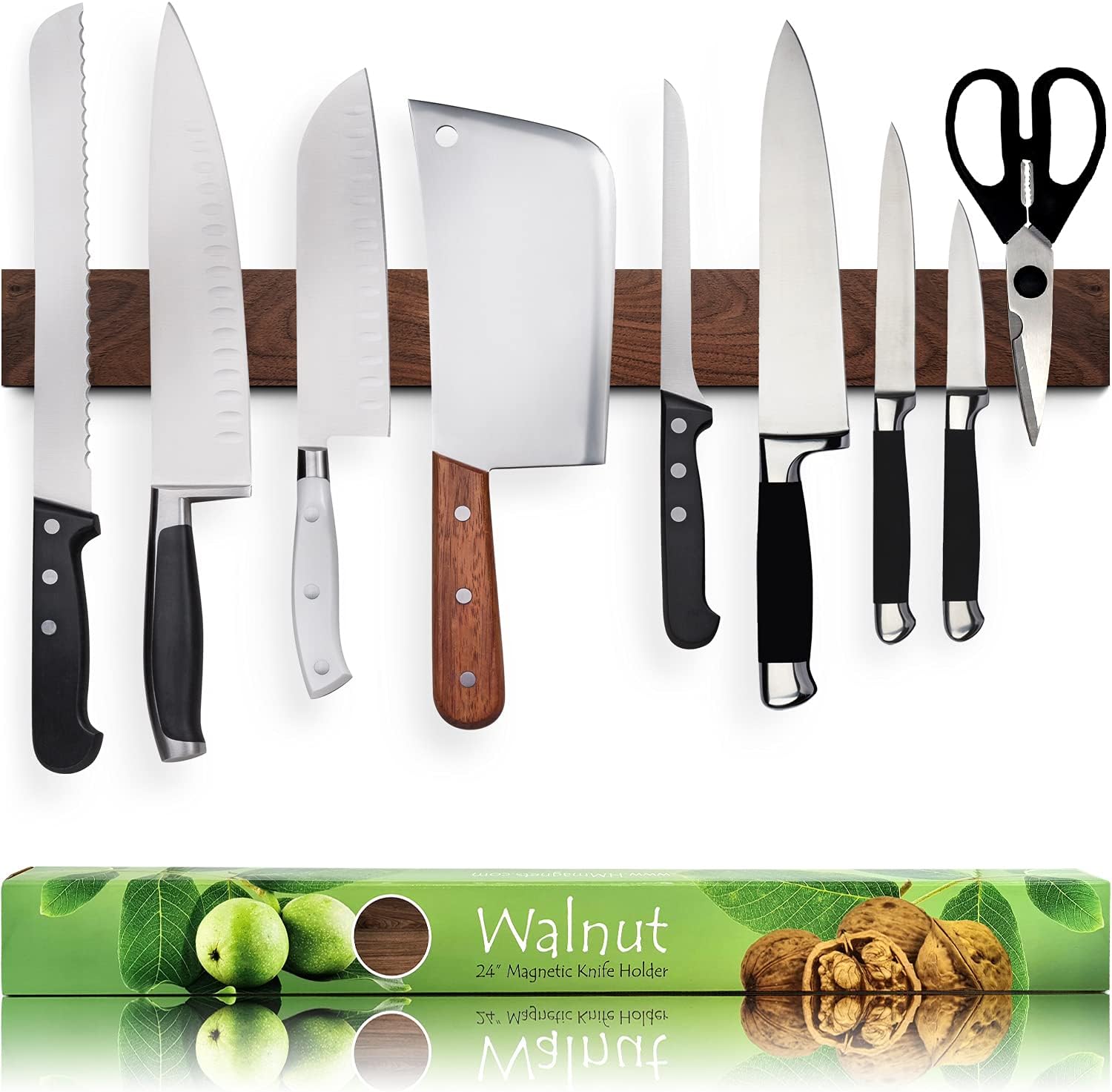
Recommended: Premium Walnut Magnetic Knife Bar
Gentle on edges, strong hold, and elegant design.
Check Price on AmazonMyth Busting: Does Magnetism “Mess Up” the Steel?
A persistent myth in the cutlery world is that storing knives on a magnet will align the iron molecules in the blade, causing the knife to become magnetic itself, which then attracts metal filings during sharpening.
While it is true that storing a knife on a strong magnet can impart a slight magnetic charge to the blade, this effect is negligible for daily cooking. Unless you are sharpening your knives on a grinding wheel where metal dust is flying everywhere, a slightly magnetized knife poses no performance issues. It certainly does not affect the heat treat or the structural integrity of the steel.
If you are concerned about metal filings sticking during stone sharpening, a simple wipe down solves the problem. It is a minor inconvenience compared to the hygiene issues of a dirty knife block.
Other Common Myths, Debunked
Myth: Magnetic strips will eventually pull knives out of alignment or warp thin blades. This isn’t physically supported. The magnetic force involved is nowhere near strong enough to bend or warp hardened steel, which is far stiffer than the force a knife strip exerts. Warping is caused by heat (such as a knife left near a stove or dishwasher heating element), not magnetism.
Myth: Magnetized knives are dangerous around electronics or pacemakers. A lightly magnetized blade carries a trivial residual field, far below the threshold that affects nearby electronics. This concern is more theoretical than practical for a home kitchen.
Myth: You can’t ever demagnetize a knife once it’s picked up a charge. In practice, any slight magnetism a blade picks up from a strip fades naturally over weeks of normal handling and use, and can be sped up by running the blade tip-to-heel across a demagnetizing tool if it ever becomes a nuisance during sharpening.
Are Certain Knives More Vulnerable?
The risk of using a magnetic strip varies depending on what is in your arsenal. Let’s look at how different knives react.
- German Knives (Wusthof, Zwilling): These generally use softer steel (around 56-58 HRC). They are more forgiving. If they hit a metal strip, the edge might roll, which can be fixed with a honing steel. See our comparison of Wusthof vs Zwilling vs Shun for more on steel hardness.
- Japanese Knives (Shun, Global, Miyabi): These utilize harder steel (60+ HRC) which is more brittle. A hard impact against a metal strip can cause chipping, which requires removing metal to fix. Wood-faced strips are mandatory for these.
- Ceramic Knives: Since ceramic is non-ferrous, it is not magnetic. Magnetic strips are useless for ceramic knives. Attempting to force them to stick or storing them loosely near the strip can lead to catastrophic breakage.
Understanding Rockwell Hardness (HRC) and Why It Changes the Risk Calculation
The Rockwell Hardness scale, abbreviated HRC, measures a blade’s resistance to deformation. It’s the single best predictor of how a knife will behave on a magnetic strip:
| HRC Range | Typical Knives | Edge Behavior on Impact | Magnetic Strip Risk |
|---|---|---|---|
| 52–56 HRC | Budget stamped knives, many Western utility knives | Rolls or bends rather than chips | Low risk of chipping, but edge retention is already short-lived |
| 56–59 HRC | Wusthof, Zwilling, most German forged knives | Rolls, occasionally dents | Low-Medium; fixable with honing |
| 59–62 HRC | Shun, Miyabi, mid-range Japanese Gyutos | Micro-chips on hard impact | Medium-High; wood strips strongly recommended |
| 62–65+ HRC | High-end hand-forged Japanese blades, some powdered-steel knives | Chips readily on hard contact | High; treat with extreme care regardless of strip material |
As a general rule, the harder and more expensive the knife, the softer and more forgiving your storage surface needs to be. This is why professional sushi chefs, who often use extremely hard single-bevel blades, rarely use bare metal magnetic strips at all — they favor wood-lined strips or traditional saya (wooden sheaths).
Serrated and Bread Knives
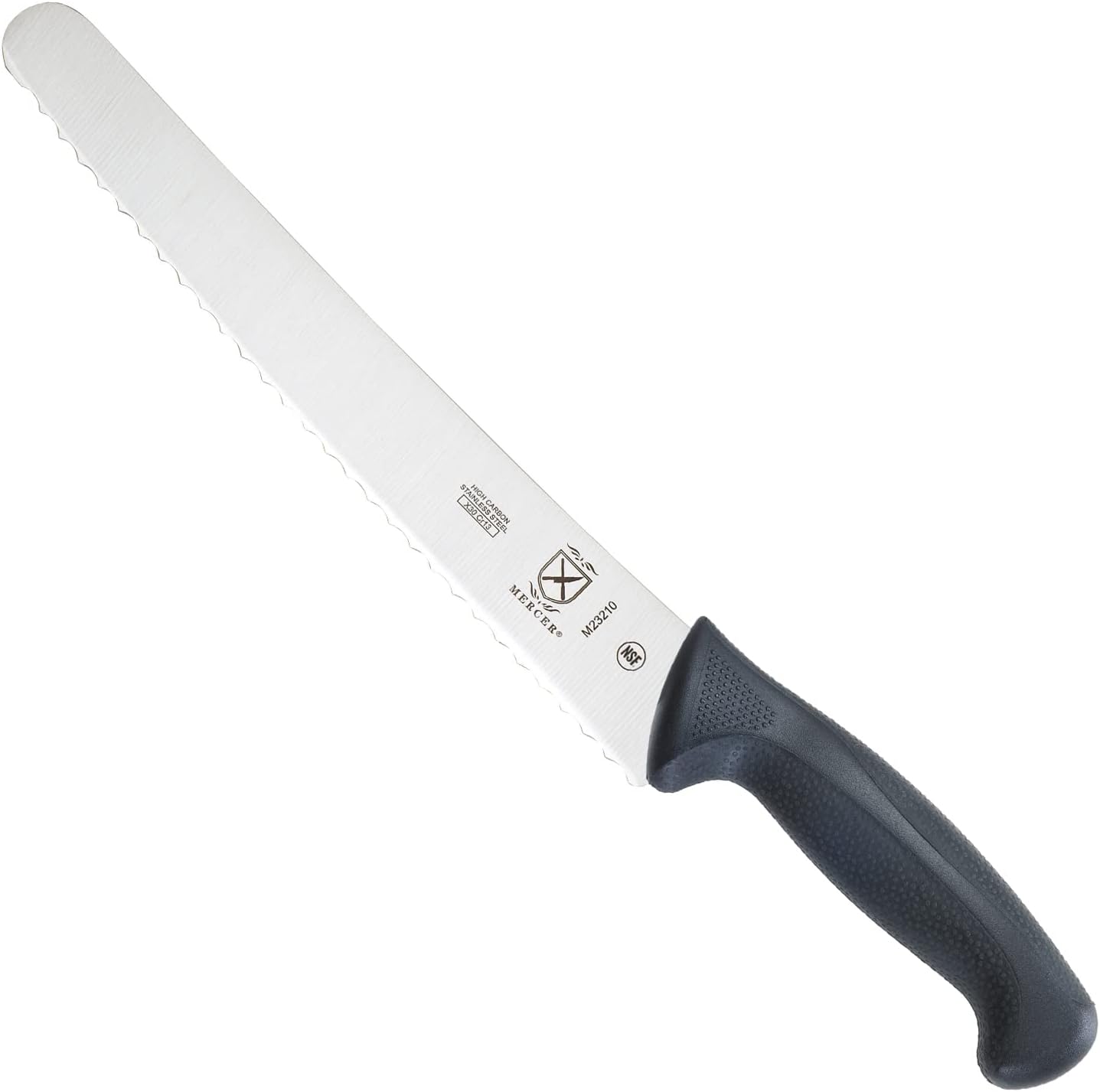
Serrated blades present a unique case. Because the “teeth” of a serrated edge contact the strip at multiple discrete points rather than along a continuous line, the force at each contact point can actually be higher than with a straight edge, even though the knife itself is usually softer steel. Serrated knives can also be more difficult to twist off cleanly using the spine-first technique, since the spine is often the same width as the serrated edge on a bread knife. It’s generally safer to store serrated knives in a slot or sheath rather than on a magnetic strip.
The “Twist and Roll” Technique: How to Use a Strip Correctly
Even the best wood-covered magnet can damage a knife if the user pulls the knife straight off by the handle, dragging the edge across the surface. Here is the expert-approved method to rack and un-rack your tools.
To Attach the Knife:
- Hold the knife firmly by the handle.
- Approach the strip with the spine (the dull back of the blade) slightly angled toward the strip.
- Let the spine make contact first.
- Gently roll the flat of the blade onto the magnet until it secures.
- Ensure the edge is not touching any other knives.
To Remove the Knife:
- Grasp the handle securely.
- Twist the spine outward, rotating the knife away from the strip using the edge as the pivot point (without dragging the edge).
- Once the magnetism breaks, pull the knife away from the wall.
- Never slide the knife horizontally along the strip, as this can cause scratches.
Common Mistakes Even Experienced Cooks Make
- Approaching straight-on: Bringing the blade toward the strip perpendicular to the surface, rather than at a shallow angle, dramatically increases the chance the edge contacts first.
- Racking with wet hands or a wet blade: A slippery grip makes the controlled roll motion harder to execute, increasing the odds of an uncontrolled “clack.”
- Overloading a short strip: Cramming too many knives onto too little strip length forces edges into close proximity with each other, risking edge-on-edge contact when knives are added or removed.
- Letting kids or guests remove knives: Anyone unfamiliar with the twist-and-roll technique is statistically more likely to yank a blade straight off, chipping the edge or scratching the strip.
- Ignoring knife weight distribution: Very tip-heavy or handle-heavy knives can rotate unexpectedly on the magnet if not centered properly, causing them to swing into neighboring blades.
Knife Storage Showdown: Which is Best?
If you are still on the fence, let’s compare magnetic strips against the other two most common storage methods: the traditional countertop block and the drawer organizer. For a deeper dive, check out our guide on how to store knives without a block.
| Feature | Magnetic Strip | Knife Block | Drawer Organizer |
|---|---|---|---|
| Edge Safety | High (if wood-faced & used correctly) | Medium (Risk of dulling on insertion) | High (Knives are separated) |
| Hygiene | Excellent (Easy to clean, airy) | Poor (Slots can harbor mold/bacteria) | Good (If cleaned regularly) |
| Counter Space | Maximized (Wall-mounted) | Occupies significant space | Hidden (Occupies drawer space) |
| Accessibility | Instant | Good | Requires opening drawer |
| Aesthetics | Modern, Display-focused | Traditional | Invisible |
| Upfront Cost | Low-Medium ($15–$60) | Medium-High ($40–$200+) | Low-Medium ($15–$80) |
| Installation Effort | Requires mounting (drilling or adhesive) | None; freestanding | Minimal; fits inside existing drawer |
| Child/Pet Safety | Lower (blades visible and reachable) | Medium (handles visible, blades hidden) | High (fully enclosed when drawer is shut) |
| Best For | Enthusiasts, open kitchens, small collections | Traditional cooks, matched knife sets | Households with children, minimalist counters |
While blocks are traditional, they are often difficult to clean inside. See our review of the best knife sets with blocks if you prefer that aesthetic. However, for sheer hygiene and edge preservation, a magnetic strip or a high-quality drawer organizer usually wins.
What About Knife Rolls and In-Transit Storage?
Magnetic strips are a fixed, at-home solution, but many home cooks and traveling chefs also need portable storage. A rolled canvas or leather knife roll with individual pockets is the standard for transporting blades to a friend’s house, a cooking class, or a professional gig, since it protects edges without relying on any wall mount. If you split time between a home kitchen and a commercial or shared space, it’s worth pairing a magnetic strip for daily home storage with a knife roll for anything that leaves the house — trying to use a magnetic strip as your only solution simply doesn’t cover the transport use case.

Alternative: Bamboo In-Drawer Knife Organizer
Perfect if you don’t want to drill holes in your backsplash.
Check Price on AmazonPros and Cons of Magnetic Knife Strips
✅ Advantages
- Hygiene: No hidden slots for moisture or bacteria to accumulate.
- Visibility: You can see exactly which knife you are grabbing—no more guessing if you’re pulling a Chef knife or a Santoku.
- Versatility: Fits any size knife, unlike blocks with pre-sized slots.
- Space Saving: Frees up counter space and drawer real estate.
- Universal: Works for cheap beaters or affordable chef knives just as well as expensive ones.
- Airflow and Drying: Knives dry faster when hung in open air, reducing the chance of water spots or, on carbon steel, flash rust.
- Encourages Better Habits: Because knives are visible, many home cooks report drying and hanging blades immediately after washing rather than leaving them in a sink or drying rack, which is itself a safety improvement.
❌ Disadvantages
- Installation: Requires drilling into the wall or backsplash (though heavy-duty adhesive versions exist).
- Safety: Blades are exposed; potential hazard for children or pets who can reach the counter.
- Fall Risk: Weak magnets can cause heavy cleavers or butcher knives to slip.
- Edge Damage: Only if used improperly or with metal-on-metal strips.
- Wall Damage on Removal: Drilled strips leave holes if you move or rent, which renters need to consider before installing.
- Limited Capacity: A single strip can only hold so many knives before it becomes cluttered or knives start touching edge-to-edge.
How to Install a Magnetic Knife Strip the Right Way
A magnetic strip is only as safe and secure as its mounting. A strip that’s improperly anchored can pull loose from drywall under the combined weight of a full knife set, which is far more dangerous than any edge-dulling concern. Here’s how to do it properly.
Step 1: Choose Drilled Mounting or Adhesive Mounting
Most magnetic strips come with two mounting options:
- Screw-mounted (drilled): The most secure option, especially for strips holding more than three or four knives. This requires locating wall studs or using drywall anchors rated for the strip’s loaded weight.
- Adhesive-mounted (mounting tape or included adhesive strips): Convenient for renters or tile backsplashes where drilling isn’t desirable. However, adhesive mounts have a maximum weight rating that’s easy to exceed once several heavy knives are racked at once, and they can fail over time in humid kitchen environments near a stove or sink.
Step 2: Find Studs or Use the Right Anchors
If you’re drilling into drywall without hitting a stud, use anchors rated for at least double the fully-loaded weight of your knife collection (a full set of six to eight knives can easily weigh three to five pounds). A stud finder is inexpensive and removes the guesswork. If you’re mounting into tile or a stone backsplash, use a masonry bit sized for your anchor, and always drill slowly to avoid cracking the tile.
Step 3: Choose the Right Height
Mount the strip so that the bottom edge of the longest knife blade sits well above counter height and, ideally, above the reach of small children standing at the counter. A common recommendation is mounting the strip so the lowest point of the shortest hanging knife is no less than roughly 48 inches (about 122 cm) from the floor in households with young children. In kitchens without children, comfortable reach height — typically eye level or just below — is more important than safety clearance.
Step 4: Mind the Surroundings
Avoid installing directly above a sink, stove, or high-traffic walkway. Steam and splashing water near a sink or stove accelerates corrosion on carbon steel blades and can degrade adhesive mounts faster. A high-traffic walkway increases the odds of someone bumping into a hanging blade while carrying dishes or reaching past it.
Step 5: Test the Hold Before Trusting It
Once mounted, rack your heaviest knife first and give it a firm, gentle tug (not a yank) to confirm the strip holds securely to the wall and the magnet holds the blade. Repeat with a fully loaded strip to simulate real-world daily use before relying on it unsupervised, especially in a household with children.
How to Choose the Right Magnetic Knife Strip: A Buying Guide
With dozens of options on the market, picking the right strip comes down to five variables: length, magnet strength, surface material, mounting type, and price. Here’s how to evaluate each.
1. Length: How Much Strip Do You Actually Need?
| Strip Length | Approximate Knife Capacity | Best For |
|---|---|---|
| 10–12 inches | 3–4 knives | Small kitchens, apartments, minimalist collections |
| 16–18 inches | 5–7 knives | Most home kitchens with a standard chef’s knife set |
| 20–24 inches | 7–10 knives | Larger collections, households that also hang kitchen shears or steels |
| 30+ inches | 10+ knives/tools | Commercial kitchens, serious enthusiasts, shared households |
A common mistake is buying a strip that’s too short and then cramming knives too close together, which increases the odds of edge-to-edge contact. When in doubt, size up — leaving a couple of inches of empty strip is far better than overcrowding it.
2. Magnet Strength
Look for product listings that specify pull force (often listed in pounds or kilograms of holding strength per magnet). As a rule of thumb, a strip needs enough combined pull force to comfortably support your heaviest single knife with a safety margin of at least double its weight, since knives are rarely mounted with the center of mass perfectly aligned with the magnet’s strongest point.
3. Surface Material Priority
Reiterating the earlier material breakdown: prioritize wood, bamboo, or silicone-lined strips over bare exposed metal, especially if your collection includes any hardened Japanese-style knives above roughly 60 HRC.
4. Mounting Compatibility
Check whether the strip includes both screw and adhesive mounting hardware, and confirm the adhesive option’s rated weight capacity if you plan to avoid drilling. Tile, glass, and stone backsplashes may require specific anchor types not included in a generic hardware kit.
5. Price Tiers
- Budget ($10–$20): Typically shorter, ferrite-magnet strips with basic wood veneer or plastic housing. Fine for light-duty use with a small, softer-steel knife set.
- Midrange ($20–$40): Solid bamboo or acacia construction, neodymium magnets, often the sweet spot for most home kitchens.
- Premium ($40–$80+): Hardwood (walnut, teak), extended lengths, higher pull-force ratings, and refined aesthetics suited to open-concept or display kitchens.
Single-Bar vs. Multi-Bar and Rail Systems
Beyond a single fixed strip, some manufacturers sell modular rail systems that combine a magnetic bar with hanging hooks for utensils, or double-decker designs that stack two strips vertically to maximize capacity without adding wall width. These are worth considering for small kitchens where horizontal wall space is limited but vertical space above a backsplash is available.
Cleaning, Maintenance, and Rust Prevention
A magnetic strip is low-maintenance compared to a knife block, but it isn’t zero-maintenance. Treat it right and it will outlast several knife sets.
Cleaning the Strip Itself
Wipe wood or bamboo strips with a barely damp cloth and dry immediately; never submerge a wood-encased strip or run it through a dishwasher, since prolonged water exposure can warp the wood or weaken the adhesive holding the housing together. For metal or acrylic strips, a mild dish soap solution and a soft cloth are sufficient. Avoid abrasive scrubbers on any strip material, since they can scratch the surface and create rougher spots that are more likely to catch and scuff a blade during the twist-and-roll motion.
Preventing Rust on Carbon Steel Knives
If your collection includes carbon steel blades (common in traditional Japanese knives), rust prevention becomes more important on a magnetic strip than in a drawer, since the blade is exposed to ambient kitchen humidity around the clock rather than sealed away. Best practices include:
- Always dry the blade completely before racking it — never hang a knife wet.
- Apply a thin layer of food-safe mineral oil or camellia oil to carbon steel blades periodically, especially in humid climates.
- Avoid mounting the strip in a spot that receives direct steam from a stovetop or dishwasher vent.
- Wipe down blades with a dry cloth every few days even if they haven’t been used, since ambient humidity alone can start surface oxidation on unprotected carbon steel.
Checking Magnet Strength Over Time
Magnets can lose a small amount of strength over many years, particularly cheaper ferrite magnets exposed to heat near a stove. If you notice knives sitting looser on the strip than they used to, or slipping more easily, it’s worth testing the hold with your heaviest knife and considering a replacement strip if the pull force has noticeably weakened.
Re-Tightening Loose Mounts
Over months of daily use, screws can work slightly loose, especially if the wall material has any give. Periodically check that the strip is still firmly anchored by giving it a gentle push test, and re-tighten screws or replace anchors if you notice any wobble.
Safety Considerations for Households With Kids and Pets
One of the most searched concerns about magnetic knife strips isn’t edge damage at all — it’s household safety. Exposed blades are, by definition, more accessible than a knife tucked into a block slot or a closed drawer.
Height and Placement
As covered in the installation section, mounting height is the first line of defense. In households with young children, position the strip high enough that it’s out of reach even when a child is standing on a step stool at the counter, and avoid installing it directly above a spot where a child might climb (such as next to an open shelf or low cabinet that could serve as a foothold).
Pets and Magnetic Strips
Cats in particular are drawn to counter surfaces, and a curious cat brushing against a low-mounted strip is a realistic scenario in many households. If pets have regular counter access, consider a drawer organizer instead, or mount the strip on a wall section pets can’t reach, such as above a stretch of counter that’s otherwise inaccessible to jumping.
Guests and Multi-Person Households
Anyone unfamiliar with the twist-and-roll removal technique is more likely to grab a knife carelessly. In shared kitchens, roommate situations, or homes that frequently host guests who cook, it’s worth a quick verbal heads-up on how to remove knives safely from the strip, since an unfamiliar guest yanking a blade straight off is one of the more common causes of both edge damage and minor cuts.
Earthquake and High-Traffic Considerations
In regions prone to seismic activity, or in kitchens with a lot of foot traffic near the strip, it’s worth considering the small but real risk of a knife being jarred loose. While modern neodymium magnets hold firmly under normal conditions, homes in earthquake-prone areas may prefer a drawer-based system for peace of mind, or should ensure the strip is mounted well away from walkways where a dislodged blade could fall into a high-traffic zone.
Can You Make a DIY Magnetic Knife Strip?
For budget-conscious or hands-on cooks, building a DIY magnetic strip is a popular weekend project. Here’s a general approach and the safety pitfalls to avoid.
Materials Typically Needed
- A length of hardwood board (oak, walnut, or bamboo plank work well)
- Rare-earth (neodymium) bar or disc magnets, sized appropriately for the board thickness
- Wood glue or epoxy rated for the magnet type
- Wall mounting hardware (French cleat, screws, or heavy-duty adhesive strips)
- Sandpaper and wood finish (mineral oil or food-safe wood conditioner)
The Key Engineering Consideration
The single biggest factor in a safe DIY strip is magnet-to-surface distance. Every additional millimeter of wood between the magnet and the blade reduces holding strength substantially, since magnetic field strength drops off sharply with distance. A DIY board that’s too thick will result in a weak hold no matter how strong the magnets are, which reintroduces the fall-risk problem discussed earlier. Most successful DIY builds use a groove routed into the back of the board so the magnets sit recessed just beneath a thin face veneer, rather than being buried in the full thickness of the board.
Why Many Cooks Choose Not to DIY
While a DIY strip can be a satisfying project, it requires woodworking tools (a router, in particular) that not everyone has access to, and getting the magnet strength and spacing right takes some trial and error. For most home cooks, a quality commercial strip in the $20–$40 range offers a more predictable, tested result for less total effort than sourcing magnets, routing a board, and testing hold strength from scratch.
Magnetic Strips in Commercial and Professional Kitchens
Professional kitchens face additional considerations beyond what a home cook needs to think about, including health code compliance, high-volume use, and multi-user handling.
Health Code and Sanitation Considerations
In many jurisdictions, commercial kitchen health inspectors favor magnetic strips over traditional wooden knife blocks precisely because open-air storage eliminates the enclosed, hard-to-clean slots where food debris and moisture can accumulate. That said, inspectors typically expect the strip itself — and the wall behind it — to be easy to wipe down and free of porous surfaces that can’t be sanitized, which is one reason many commercial kitchens opt for stainless steel strips despite the edge-safety tradeoffs discussed earlier in this guide.
High-Turnover, Multi-Cook Environments
In a busy line kitchen where multiple cooks share a knife station, the twist-and-roll technique becomes even more important, since knives are being racked and un-racked dozens of times per shift, often under time pressure. Many commercial kitchens mitigate edge damage risk by assigning personal knife rolls to each cook for their primary tools, reserving the shared magnetic strip for house knives and utility blades that see harder, less careful use anyway.
Durability Under Heavy Use
Commercial-grade strips are typically longer, rated for higher combined pull force, and built with more robust mounting hardware than home versions, since they may hold a dozen or more knives simultaneously and endure use dozens of times a day rather than a handful. If you’re outfitting a small restaurant, food truck, or catering operation, look specifically for strips marketed as commercial or NSF-listed rather than repurposing a home product.
Frequently Asked Questions
Do magnetic knife holders dull knives?
Not inherently. Magnetic holders only dull knives if the blade edge strikes the strip during placement, or if the strip is made of hard metal. Using a wooden magnetic strip and placing the knife spine-first prevents dulling.
Can I put ceramic knives on a magnetic strip?
No. Ceramic knives are made of zirconium dioxide, which is not magnetic. They will not stick to a magnetic strip and could fall and break if you try.
Is it safe to hang heavy knives like cleavers on a magnet?
It depends on the strength of the magnet. High-quality strips with strong neodymium magnets can hold heavy cleavers, but you should always test the hold before letting go. Ensure the strip is securely mounted to the wall studs.
Do magnetic strips scratch Damascus steel?
Metal magnetic strips can scratch the delicate acid-etched finish of Damascus steel. To protect the finish of high-end knives like those discussed in our Miyabi vs Shun comparison, always use a wood-covered or silicone-coated magnetic strip.
How high should I mount a magnetic knife strip?
Mount the strip at comfortable reach height for adults, and in households with young children, position it so the lowest hanging blade is well above a child’s reach even while standing on a step stool, generally at least four feet from the floor.
Can I install a magnetic knife strip without drilling into the wall?
Yes, many strips include heavy-duty adhesive mounting as an alternative to screws, which works well for renters. However, adhesive mounts have a lower weight capacity, so check the rated limit against your knife collection’s total weight before relying on adhesive alone.
Will a magnetic strip cause my knives to rust?
The magnet itself does not cause rust. However, carbon steel knives left wet on any open storage system, including a magnetic strip, are more exposed to humidity than knives sealed in a drawer, so always dry blades fully before racking them.
How many knives can a magnetic strip hold?
Capacity depends on strip length and knife size, but as a general guide, a 12-inch strip holds roughly three to four knives, an 18-inch strip holds five to seven, and strips over 24 inches can comfortably hold ten or more.
Troubleshooting Common Magnetic Strip Problems
“My knife keeps falling off the strip.”
This usually means one of three things: the magnet strength doesn’t match the knife’s weight, the blade isn’t making full contact with the magnetic surface (often because it’s resting at an angle rather than flat), or the strip itself has come loose from the wall. Test each in order — first re-rack the knife flat against the strip, then check the mount for wobble, and if both check out, the strip may simply be underpowered for that knife.
“There’s a gap or dead zone on my strip where nothing sticks well.”
Most strips use a series of discrete magnets rather than one continuous magnetic bar, so pull strength can vary along the length of the strip. If you notice a consistent weak spot, try repositioning your knives to the strongest sections (usually the center, where multiple magnets overlap in field strength) and reserve the weaker ends for your lightest knives.
“My wood strip has started to crack or split.”
This is typically caused by humidity swings — a strip mounted too close to a stove, dishwasher vent, or sink can dry out and re-absorb moisture repeatedly, stressing the wood grain over time. Relocating the strip away from steam sources and periodically conditioning the wood with a food-safe oil can slow this process, though a badly split strip should be replaced since a compromised housing can affect both magnet performance and structural mounting strength.
“The adhesive backing failed and the strip fell off the wall.”
Adhesive mounts have a maximum-rated weight and a maximum-rated temperature range, and kitchens routinely exceed both without the user realizing it. If this happens, switch to screw mounting for anything holding more than two or three lightweight knives, and reserve adhesive mounting for genuinely low-load, low-heat locations.
Final Verdict: Are Magnetic Strips Safe?
Magnetic knife strips are not bad for knife edges—bad habits are bad for knife edges.
When used correctly, a magnetic strip is arguably the most hygienic and convenient way to store your culinary tools. It keeps them dry, prevents the cross-contamination common in knife blocks, and turns your collection into a visual centerpiece. The key is to invest in a wooden or silicone-coated strip to provide a soft landing for your steel, and to practice the spine-first twisting motion when retrieving your knives.
Beyond edge safety, remember that a great magnetic strip experience comes down to getting the fundamentals right from the start: choosing the correct length and magnet strength for your collection, mounting it securely into studs or rated anchors, positioning it thoughtfully around household safety needs, and giving it basic ongoing care to prevent rust and wear. Get those five things right, and a magnetic strip will likely outperform every other storage method you’ve tried.
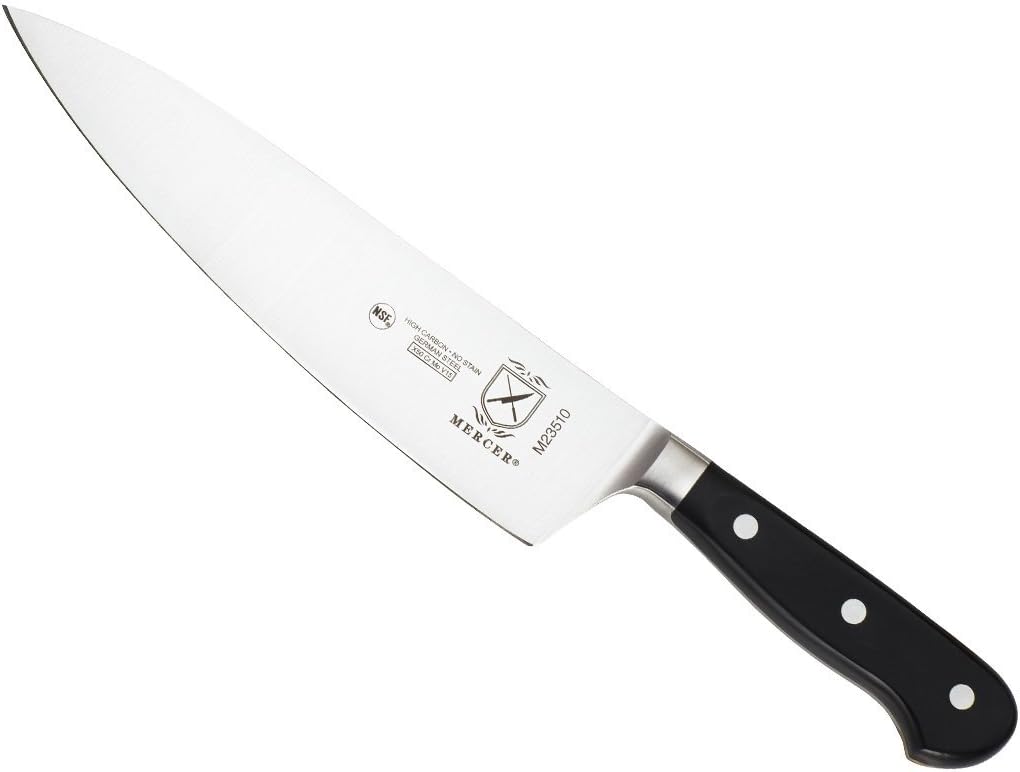
Whether you are rocking a robust Mercer or Victorinox for daily prep, or a delicate hand-forged Gyuto, a magnetic strip is a safe, professional choice. Just ensure you install it securely away from high-traffic areas where it might be bumped.
Ready to upgrade your kitchen storage? Check out our top recommendations below.
Top Pick: Ouddy 16 Inch Magnetic Knife Bar
Stainless steel with powerful magnetic grip. Best value for the money.
See It On Amazon