
Tojiro vs. Shun: The Battle of Performance vs. Polish
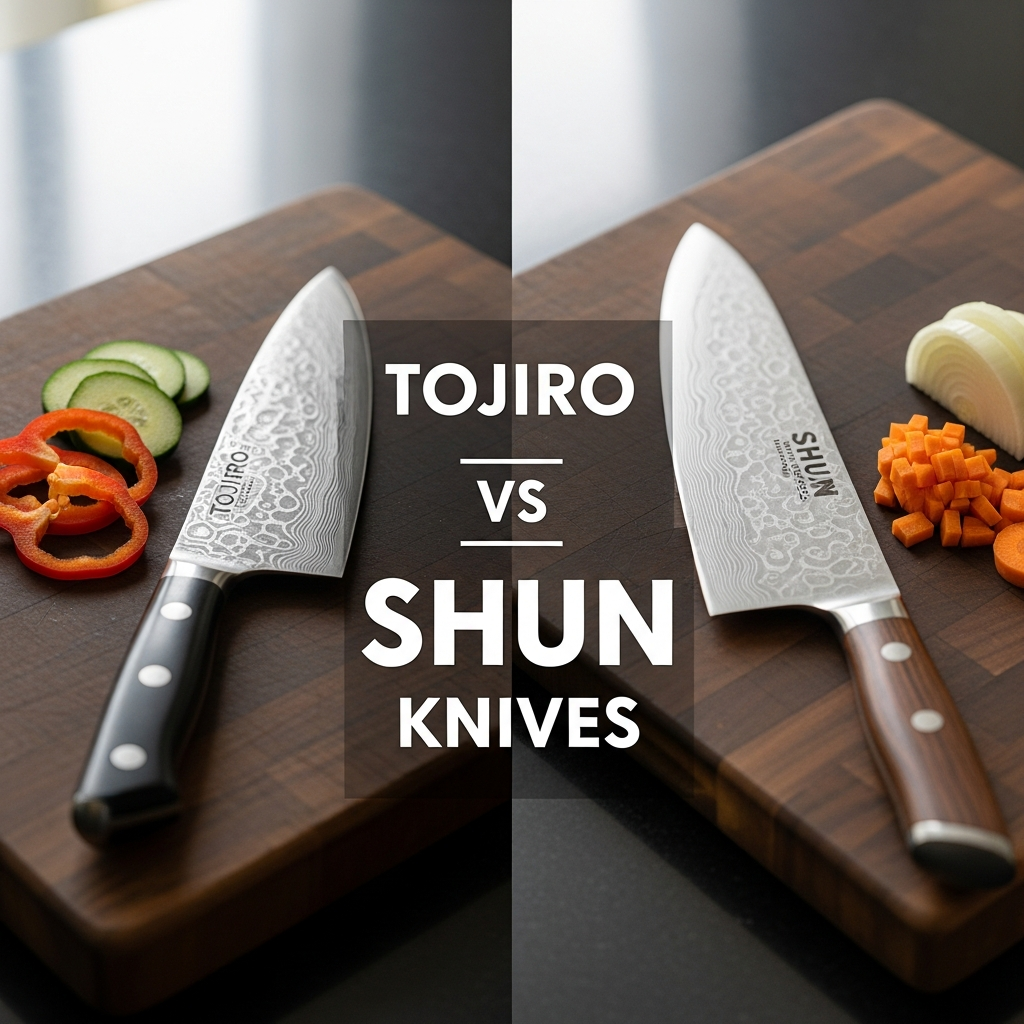
In the realm of high-performance cutlery, there are two distinct paths to Japanese knife nirvana. One path is paved with intricate Damascus patterns, polished Pakkawood handles, and marketing that emphasizes “art.” This is the path of Shun. The other path is quieter, industrial, and ruthlessly efficient. This is the path of Tojiro.
If you are browsing knifeindex.com/ trying to decide where to invest your money, the Tojiro vs. Shun debate is one of the most critical comparisons to understand. It is not just about price; it is about what you value more: the stunning aesthetic finish or pure, unadulterated cutting performance per dollar.
In this comprehensive guide, we will strip away the marketing hype. We will analyze the steel, the ergonomics, and the real-world durability of these two Japanese titans to help you find the right tool for your kitchen.
1. Brand Philosophy: The Artist vs. The Worker
Shun: The Ambassador of Seki City
Shun is the most recognizable name in Japanese cutlery in the West. Owned by the Kai Group, they brought the concept of the high-end, layered Damascus knife to the mainstream. Their knives are beautiful, widely available, and come with lifetime sharpening support. They are the benchmarks for best Japanese kitchen knives in terms of fit and finish.
Tojiro: The Pride of Tsubame-Sanjo
Tojiro operates out of Niigata prefecture, a region famous for metalworking. Unlike Shun’s focus on elegance, Tojiro focuses on professional utility. Their knives are often described as “wolves in sheep’s clothing.” They use high-end steel (often identical to Shun) but skip the expensive finishing touches to keep costs down. They are arguably the best affordable chef knives in the high-performance category.
External Insight
For a deeper dive into the specific model comparisons and handling characteristics, Knife Vibe offers an excellent breakdown: Tojiro vs. Shun: Which Knife Is Better?
1a. A Deeper History: Two Cutlery Towns, Two Philosophies
To really understand why Tojiro and Shun feel so different in the hand, it helps to understand the towns that made them. Seki City, in Gifu Prefecture, has been a blade-forging center since the 1300s, when swordsmiths settled there because of the abundant clay, charcoal, and access to clean river water needed for tempering steel. When the samurai era ended and sword demand collapsed, Seki’s smiths pivoted to pocket knives, straight razors, and eventually kitchen cutlery. Kai Corporation, the parent company behind Shun, grew out of that swordsmithing lineage, and it shows in how the brand talks about its knives: as heirloom objects meant to be displayed, admired, and passed down.
Tsubame-Sanjo, in neighboring Niigata Prefecture, has a completely different origin story. The region became a metalworking hub not because of swords, but because of nails. Farmers in the area needed a side income during the harsh winters when rice fields were unworkable, and nail-forging became a cottage industry as early as the 1600s. Over centuries, that grew into a broader metalworking tradition focused on tools, flatware, and factory-scale production efficiency. Tojiro emerged from that industrial, tool-making culture, and its entire product philosophy reflects it: make something that performs at a professional level, manufacture it efficiently, and pass the savings to the customer rather than the marketing department.
This history matters because it explains a pattern you will see throughout this guide. Shun invests heavily in hand-finishing steps, mirror polishing, and presentation because that is what its heritage rewards. Tojiro invests in edge geometry, steel selection, and manufacturing consistency because that is what its heritage rewards. Neither approach is wrong; they are simply optimizing for different outcomes.
2. Head-to-Head: The Specs Breakdown
We are comparing the two most popular lines: The ubiquitous Shun Classic vs. the cult-favorite Tojiro DP.
| Feature | Shun Classic | Tojiro DP |
|---|---|---|
| Core Steel | VG-MAX (Proprietary) | VG-10 (Cobalt Alloy) |
| Hardness (HRC) | 61 | 60-61 |
| Cladding | Damascus (68 Layers) | Stainless Steel (3 Layers) |
| Handle | D-Shaped Pakkawood | Western Style Eco-Wood |
| Edge Angle | 16° per side | 9-12° per side (Very Sharp) |
| Price Tier | Premium ($$$) | Value / Mid-Range ($$) |
3. The Steel: VG-MAX vs. VG-10
Is there a difference?
Shun uses VG-MAX, which they claim is an improvement on VG-10 with more chromium and vanadium for edge retention and corrosion resistance. Tojiro uses standard VG-10 (or sometimes VG-10 equivalent Cobalt Alloy).
In practice? The difference is negligible for most home cooks. Both are high-carbon stainless steels that take a screaming sharp edge. However, Tojiro tends to grind their edges thinner (more acute angle), which can make them feel sharper out of the box, though slightly more brittle. (See Shun vs Wusthof to understand how this compares to German steel).
3a. Rockwell Hardness, Explained for Home Cooks
Every kitchen knife spec sheet lists an HRC number, but very few articles actually explain what that number means in practical terms. HRC stands for Rockwell Hardness Scale, C-scale, and it measures how much a standardized diamond indenter deforms the metal under a fixed load. The higher the number, the harder the steel, and the harder the steel, the longer an edge stays sharp before it needs touching up. German knives from brands like Wusthof or Zwilling typically sit in the 56-58 HRC range. Japanese knives from Shun and Tojiro sit noticeably higher, at 60-61 HRC, which is one of the biggest reasons Japanese blades feel “sharper” for longer.
But hardness is a trade-off, not a pure win. As HRC climbs, the steel becomes less flexible and more prone to chipping on lateral stress. That is why nobody recommends twisting a Japanese chef’s knife inside a dense root vegetable, or using it to pry apart a frozen chicken breast. Both Shun and Tojiro sit in a similar hardness band, so neither brand has a meaningful durability advantage purely from HRC. Where they diverge is in edge geometry, which we cover in more detail below.
3b. Carbide Structure and Why VG-10 Became an Industry Standard
VG-10 is a Japanese stainless steel developed by Takefu Special Steel Co., and it became popular in premium kitchen cutlery because it strikes a rare balance: high hardness, good corrosion resistance thanks to its chromium content, and a fine, even carbide structure that allows for a very refined, toothy edge. Carbides are microscopic hard particles embedded in the steel’s matrix; when they are large and unevenly distributed, the edge tends to chip in an irregular, jagged way. When they are small and evenly distributed, as in well-made VG-10, the edge wears down more predictably and can be brought back to full sharpness with less material removal.
Shun’s VG-MAX is essentially an evolution of that same base recipe, with tweaks to the chromium, cobalt, and vanadium content intended to nudge edge retention and stain resistance slightly further. In blind cutting tests conducted by enthusiast forums and review channels, the practical difference between VG-10 and VG-MAX is measured in single-digit percentage improvements in edge retention, not the dramatic leaps the marketing copy sometimes implies. If you already own a VG-10 Tojiro and are wondering whether to “upgrade” to Shun purely for the steel, the honest answer is that the improvement will be nearly impossible to notice in day-to-day cooking.
3c. Corrosion Resistance in Real Kitchens
Chromium content is what gives stainless steel its “stainless” property, and both VG-10 and VG-MAX carry enough chromium to resist rust under normal kitchen conditions. That said, “stainless” does not mean “rust-proof.” High-carbon Japanese stainless steels like these will still develop spotting or discoloration if left wet, especially in contact with acidic foods like tomatoes, citrus, or vinegar-based marinades. Anecdotally, owners report that Tojiro blades, likely due to a slightly different heat-treatment recipe optimized for cost efficiency, can show faint water spotting a bit more readily than Shun’s VG-MAX, though this is inconsistent across individual units and heavily dependent on drying habits. Neither knife should ever be left to air dry in a sink.
4. The Chef’s Knife Battle
The 8-inch Gyuto (Chef’s Knife) is the heart of the kitchen. (Read what is a chef knife used for).
 Shun Classic 8-Inch Chef’s Knife
The beauty queen. D-shaped ebony Pakkawood handle, stunning Damascus cladding, and a polished finish. It feels refined and balanced.
Check Price on Amazon Tojiro DP Gyuto 8.2-Inch
The workhorse. Plain looks, blocky Western handle, but a blade performance that rivals knives twice the price. The choice of line cooks everywhere.
Check Price on Amazon4a. Blade Geometry: Why “Thin Behind the Edge” Matters More Than Steel Type
One of the most overlooked variables in any Tojiro vs Shun conversation is blade geometry, specifically the concept of “thin behind the edge,” or how much steel mass sits just above the actual cutting bevel. A knife can be advertised with premium steel and a high HRC rating, and still feel sluggish through food if the geometry directly behind the edge is thick. This is where Tojiro quietly wins a lot of blind taste tests among line cooks: the DP series is ground noticeably thinner behind the edge than the Shun Classic, which is part of why it can feel “sharper” even when the raw steel hardness numbers are nearly identical.
Shun’s slightly thicker geometry is a deliberate trade-off in favor of edge stability. A marginally thicker edge shoulders lateral stress better, which matters if you occasionally twist the blade while cutting through something like a butternut squash or a dense sweet potato. Tojiro’s thinner grind rewards a precise, straight push-cut and punishes any twisting motion with a higher chance of a micro-chip. Understanding this distinction is more useful for predicting real-world performance than comparing steel names alone.
4b. Blade Profile: Flat vs. Curved, and Why It Changes Your Cutting Style
Blade profile refers to the curve, or lack of curve, along the cutting edge from heel to tip. A knife with a pronounced curve, sometimes called “belly,” is designed for a rocking motion where the tip stays anchored to the board and the heel lifts and falls in an arc. A flatter profile is designed for push-cutting, where the entire edge moves forward and down through the food in a single controlled stroke, lifting the whole blade off the board between cuts.
Shun’s Classic Gyuto has a moderate amount of belly, which suits cooks trained in Western culinary technique who grew up rock-chopping herbs and garlic. Tojiro’s DP line, reflecting its more traditional Japanese lineage, is ground flatter, encouraging push-cutting and pull-cutting technique. Neither style is objectively better, but if you already have muscle memory built around rock-chopping, the Shun profile will feel instantly familiar, while the Tojiro profile may require a short adjustment period.
4c. Full Tang vs. Partial Tang: Does It Matter Here?
“Tang” refers to how far the steel of the blade extends into the handle. A full tang runs the entire length of the handle and is often visible as a metal strip along the top and bottom, common in Western-style knives. Many traditional single-bevel Japanese knives use a partial, hidden tang set into a wooden handle secured with a bamboo pin, which allows for quick, tool-free handle replacement.
Both the Shun Classic and the Tojiro DP, being Western-handled double-bevel knives, use full-tang or near-full-tang construction bonded into their respective handle materials, so tang length is not a meaningful differentiator between these two specific product lines. Where tang construction becomes relevant is if you branch out into Tojiro’s more traditional single-bevel offerings, which do use the classic Japanese wa-handle system with a replaceable partial tang, a detail worth knowing if you ever expand into a Yanagiba or a traditional Deba.
5. Ergonomics and Handle Design
Shun: Hand-Friendly Luxury
Shun Classic handles are “D-shaped,” designed to tuck into the curve of your fingers (specifically for right-handers, though lefties use them too). They are made of Pakkawood, a composite that is waterproof and smooth. The fit and finish are flawless—no rough edges.
Tojiro: Blocky Utility
Tojiro DP handles are the weak point for some. They are blocky, Western-style handles made of reinforced laminated material. They are durable, but the “fit and finish” isn’t as high. You might feel a slight ridge where the metal tang meets the wood. However, many chefs prefer this no-nonsense grip, finding it similar to German knives.
5a. A Note for Left-Handed Cooks
Handle shape matters enormously for left-handed users, and this is an area where the two brands genuinely diverge. Shun’s D-shaped Pakkawood handle on the Classic line is molded with a slight asymmetry intended to nestle into a right hand’s finger curve, which can feel awkward, though not unusable, for left-handed cooks. Shun does offer left-handed specific versions of some models, but the mainstream Classic Chef’s Knife most commonly stocked in stores is right-hand oriented. Tojiro’s DP handle, by contrast, is a straight, symmetrical Western oval shape with no handedness bias built in, making it a genuinely ambidextrous option out of the box. If you are shopping specifically as a left-handed cook, this is one of the more concrete, non-marketing reasons to lean Tojiro.
5b. Weight and Balance Point
Beyond handle shape, weight distribution changes how a knife feels through a long prep session. The Shun Classic 8-inch Gyuto tends to carry its balance point closer to the bolster, giving it a slightly heavier, more substantial, “planted” feel in the hand, which some cooks associate with confidence and control. The Tojiro DP is lighter overall and carries its balance point a touch further forward, toward the middle of the blade, giving it a nimbler, faster feel that some professional line cooks prefer for high-volume prep work like dicing onions or breaking down cases of vegetables. Neither balance profile is universally correct; it comes down to whether you prefer a knife that feels like an extension of a deliberate, controlled motion (Shun) or one that feels quick and reactive (Tojiro).
5c. Sound and Tactile Feedback While Cutting
This is a subtle detail rarely discussed outside of enthusiast forums, but the two knives produce noticeably different tactile and audio feedback when cutting through dense vegetables like carrots or potatoes. The Tojiro’s thinner grind produces a crisper, quieter “snap” through the food with less resistance, while the Shun’s slightly thicker geometry produces a bit more resistance and a duller thud on the board. Cooks who prep large quantities of vegetables daily often notice this difference within the first few uses, and it factors meaningfully into which knife starts to feel like a natural extension of the hand.
6. Specialty Knives Comparison
Vegetable Prep (Nakiri & Santoku)
Tojiro’s Nakiri is legendary value. It is laser-thin and falls through onions. Shun’s Nakiri is heavier and prettier.
For Santoku knives, Shun offers a bit more belly (curve), allowing for slight rocking. Tojiro profiles are flatter, dedicated to push-cutting.
Bread Knives
While Shun makes a great bread knife, the Tojiro Bread Slicer is an internet icon. It is flexible, incredibly sharp, and costs very little. It often beats out premium brands in head-to-head tests. Read more in our best bread knife guide.
Paring Knives
For detail work (see what is a paring knife used for), Tojiro offers simple, effective tools. Shun offers various lengths and shapes, including bird’s beak styles, with matching aesthetics for your block.
6a. Boning and Filleting Knives
Beyond the everyday Gyuto and Santoku, both brands offer task-specific blades that rarely get compared side by side. Tojiro’s boning knives, drawn from their professional-kitchen-supply roots, are thin, flexible, and inexpensive enough that many working chefs treat them as semi-disposable tools to be replaced every couple of years rather than babied for a lifetime. Shun’s boning and fillet knives, by contrast, are marketed more toward the serious home cook who processes their own fish or poultry occasionally rather than daily, with a stiffer flex profile and the same polished Pakkawood handle found across the Classic line. If you break down whole chickens or fish weekly, Tojiro’s utilitarian approach and lower replacement cost make more practical sense; if you do this a few times a year and want one nice tool that lasts, Shun’s offering is the more comfortable long-term companion.
6b. Utility Knives and the “In-Between” Blade
A utility knife, typically 5 to 6 inches long, fills the gap between a paring knife and a full chef’s knife, and it is an underrated category in this comparison. Tojiro’s utility offerings share the same thin, aggressive grind as their Gyuto line, making them excellent for slicing sandwiches, small fruits, and delicate produce. Shun’s utility knives carry the same Damascus cladding and bolster weight as their larger siblings, which some users find makes the knife feel slightly less nimble for quick, small tasks compared to the featherlight Tojiro equivalent.
6c. Honesuki and Specialty Japanese Shapes
For cooks who want to go beyond Western-style shapes entirely, Tojiro’s catalog dips further into traditional Japanese blade shapes such as the Honesuki (a triangular poultry-boning knife) and various single-bevel options, reflecting its deeper roots in traditional Japanese blacksmithing supply chains. Shun’s specialty shape offerings tend to stay closer to Western-familiar silhouettes even when they borrow Japanese names, which makes Shun the easier on-ramp for a Western home cook curious about Japanese cutlery, and Tojiro the deeper rabbit hole for someone ready to commit to traditional technique.
7. Comparison to Other Brands
If you are still on the fence, consider the alternatives:
- Vs. Miyabi: Miyabi is Shun’s direct rival in the “pretty knife” category. They are often sharper and harder (SG2 steel) than Shun. (See Miyabi vs Shun and Miyabi vs Wusthof).
- Vs. Global: Global knives are lighter and handle completely differently (metal vs. wood). Tojiro feels more traditional. (See Global vs Zwilling).
- Vs. Mac: Mac is the closest rival to Tojiro in terms of “performance first,” but Mac knives are often stamped and thinner. (See Mac vs Wusthof).
- Vs. Victorinox: If Tojiro is still too pricey, Victorinox is the ultimate budget step-down. (See Victorinox reviews).
7a. Where Each Brand Sits in the Broader Market
It helps to zoom out and think about where Tojiro and Shun sit on the full spectrum of kitchen cutlery, from mass-market stamped knives all the way up to handmade custom blades costing thousands of dollars. At the entry level, brands like Victorinox and basic Western stamped knives dominate on pure affordability, using softer steel around 54-56 HRC that is easy to sharpen but dulls quickly. One tier up, German forged brands like Wusthof and Zwilling occupy the “buy once, sharpen forever” mid-premium space, prioritizing durability and edge stability over ultimate sharpness.
Tojiro slots in just above that German tier in terms of raw cutting performance, while often undercutting German forged knives on price, which is precisely why it built such a devoted following among working chefs who need performance without ceremony. Shun occupies a parallel but distinct lane: comparable performance to Tojiro, priced closer to or above premium German cutlery, but justified by presentation, brand recognition, and finishing quality. Above both sits a tier of Japanese specialty brands like Miyabi and various artisan smiths using powdered steels like SG2 or R2, which push edge retention further still at a steep price premium. Understanding this ladder helps explain why so many kitchens end up owning both a Shun for showing off and a Tojiro for actual daily abuse.
8. Maintenance: The Price of Sharpness
Both brands use hard Japanese steel. This means they hold an edge longer than Western knives, but they are brittle.
- Chipping: Do not cut bones, frozen food, or hard squash with these. Tojiro’s edge is often thinner and more prone to micro-chipping if abused.
- Sharpening: You cannot use a standard pull-through sharpener designed for German knives. You need whetstones or specific electric sharpeners for 15-degree edges.
- Rust: While stainless, VG10 can spot if left wet. Dry immediately. See how to remove rust if you mess up.
- Dishwasher: Absolutely Not. The heat will ruin the handles and dull the blades. See our dishwasher safe guide for why.
8a. A Practical Whetstone Grit Guide for Both Brands
Because neither Tojiro nor Shun should ever touch a pull-through carbide sharpener, it is worth walking through what an actual whetstone routine looks like, since this is the single biggest source of confusion for new owners. Whetstones are graded by grit number, with lower numbers being coarser and higher numbers being finer. A typical progression starts around 220-400 grit, used only when a knife is genuinely damaged, chipped, or badly rolled and needs the edge fully reset. Most owners will never need to go this coarse.
The workhorse range for routine maintenance sits between 1000 and 1200 grit, sometimes called a “combination stone” when paired with a finer grit on the flip side. This is where you will do the bulk of actual edge sharpening, roughly every few weeks to few months depending on use. From there, a 3000-6000 grit stone refines the edge, removing the small burr left by the coarser stone and polishing the bevel to a cleaner, more precise cutting surface. Enthusiasts chasing an almost mirror-polished edge sometimes push to an 8000 grit finishing stone, though this level of polish is arguably overkill for daily kitchen tasks and matters more for slicing raw fish than for dicing onions.
Because Tojiro’s factory edge angle runs thinner (9-12 degrees per side) than Shun’s (16 degrees per side), maintaining that geometry on a whetstone requires slightly more attention to angle consistency. Many owners use an angle guide clip for their first dozen sharpening sessions until muscle memory takes over. Shun’s wider factory angle is more forgiving of small inconsistencies in your stone technique, which is a meaningful, if rarely mentioned, advantage for beginners who are nervous about ruining an expensive knife on their first sharpening attempt.
8b. Honing Rods: What They Do (and Don’t Do)
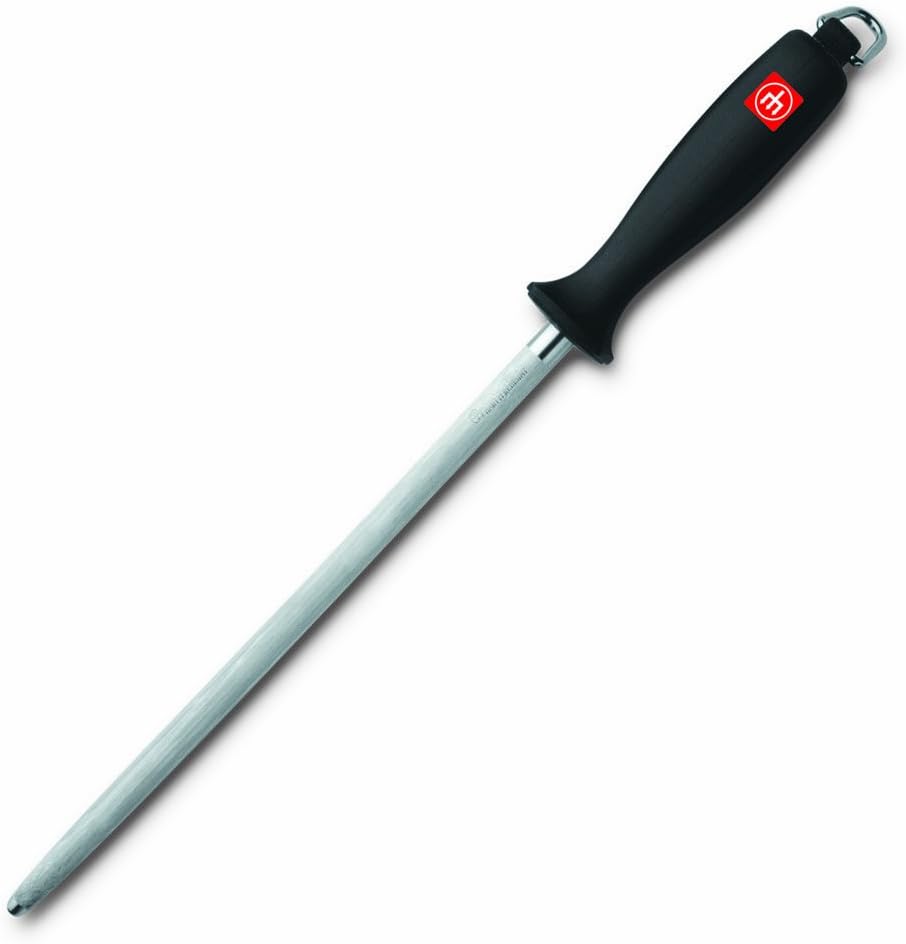
A honing rod does not sharpen a knife; it realigns the microscopic edge that folds over slightly with normal use, restoring the “bite” of an already-sharp blade between full sharpening sessions. Standard steel honing rods, common with German knife sets, are actually too aggressive for Japanese hard steel and can cause chipping on a blade this hard. If you want to hone either a Tojiro or a Shun between sharpenings, look specifically for a ceramic honing rod, which is gentler and matched to the hardness of Japanese stainless steel. A quick pass of ten to fifteen light strokes per side, every few uses, will meaningfully extend the time between full whetstone sessions on either brand.
8c. Cutting Board Compatibility
The cutting surface you pair with either knife matters more than most buyers realize. Glass, granite, marble, and ceramic cutting boards are aggressively hard on any edge, and they will dull a Tojiro or Shun far faster than the steel quality would suggest, sometimes within a single prep session. Both brands perform best, and last longest between sharpenings, on end-grain wood boards or a softer synthetic composite board designed specifically for knife longevity. If you already own a glass or stone cutting surface, budget for more frequent honing and sharpening regardless of which brand you choose, since the board, not the knife, becomes the limiting factor.
9. Storage and Presentation
Shun knives are showpieces. They deserve a magnetic strip. Tojiro knives are tools; they are happy in a drawer (protected) or a block.
- Magnetic Strip: Best for Shun to show off the Damascus. (See how to store knives without a block).
- Drawer: Use a knife drawer organizer for Tojiro to keep them safe but out of sight.
- Travel: Tojiro is a favorite for line cooks, so a knife bag is a common accessory.
10. Product Line Breakdown: It’s Not Just One Knife Per Brand
A common gap in most Tojiro vs Shun comparisons is treating each brand as if it only makes one product. In reality, both companies sell several distinct tiers, and picking the wrong tier within a brand can matter more than the brand choice itself.
10a. The Shun Family Tree
Shun Classic is the flagship line most people picture, with its black Pakkawood handle and 68-layer Damascus cladding. Above it sits Shun Premier, which uses a hand-hammered “tsuchime” finish for a rustic, textured look and a slightly different walnut-toned handle, popular with cooks who want the Damascus performance with a less glossy aesthetic. Shun Sora is the brand’s budget entry point, dropping the Damascus cladding and VG-MAX steel in favor of a simpler VG-10 core and a composite handle, priced to compete more directly with mid-range German knives. Shun Hiro pushes in the opposite direction, using SG2 powdered steel at a higher hardness for edge-retention enthusiasts willing to pay a significant premium. Shun Kanso strips the design back to a minimalist tsuchime finish with a lighter-colored Tagayasan wood handle, aimed at cooks who want the performance without the “flashy” Damascus look. Knowing this range matters because a shopper comparing “Shun” to “Tojiro” without specifying the line might be comparing a $70 Sora to a $90 Tojiro DP, a very different conversation than comparing a $150 Shun Classic to that same Tojiro.
10b. The Tojiro Family Tree
Tojiro DP (Damascus Powder, sometimes read as their mid-tier Damascus-clad line) is the version most frequently compared to Shun Classic, and the one featured in the product grid above. Below it, the Tojiro Fujitora and basic stainless lines drop the Damascus cladding entirely for a plain, mono-steel finish at an even lower price point, popular in culinary schools as a first “real” knife. Above the DP sits the Tojiro Shirogami and various white-steel (Shirogami) or blue-steel (Aogami) carbon steel lines, which trade stainless convenience for a traditional carbon steel edge that can be sharpened to an even finer degree but requires diligent drying and occasional oiling to prevent rust. Tojiro also produces the Zen line, aimed at a slightly more refined aesthetic market, attempting to compete more directly with Shun’s presentation-focused segment while retaining Tojiro’s performance-first grind.
11. Buying Guide by Cook Type
Rather than a single verdict, it is more useful to think about which knife fits your specific cooking life.
11a. The Home Cook Who Cooks a Few Times a Week
For someone cooking dinner three or four nights a week, either brand will comfortably outperform what most people already own. The deciding factor here usually comes down to whether the knife will live on display or in a drawer, and whether the buyer gets genuine enjoyment from a beautiful object on the counter. If so, Shun’s presentation quality pays for itself in daily satisfaction even if the performance gap is marginal.
11b. The Serious Home Cook or Aspiring Chef
Someone who preps large batches of vegetables, cooks daily, or is building skills toward professional work will likely appreciate Tojiro’s thinner, faster-cutting geometry and lower cost of entry, which leaves budget room for a second specialty knife like a Nakiri or a Bread Slicer.
11c. The Working Line Cook
For a professional kitchen environment where knives get dropped, banged against steel tables, and used by multiple hands, Tojiro’s lower replacement cost and no-nonsense durability make it the overwhelming favorite, which is reflected in how often it shows up in professional kitchen supply catalogs rather than boutique gift shops.
11d. The Gift Buyer
If you are buying a knife as a gift for a food-loving friend or family member who does not sharpen their own knives on whetstones, Shun’s beautiful presentation, gift-ready box, and reputation as a recognizable “nice” brand make it a far safer and more appreciated gift than Tojiro’s plain, utilitarian packaging, even though the Tojiro might objectively outperform it in a blind cutting test.
12. Warranty, Customer Service, and Long-Term Ownership
Shun is well known in the West for its lifetime sharpening service, where owners can mail knives back to Kai USA for a professional edge restoration, a benefit many customers value even if they rarely use it. This service, combined with Shun’s wide distribution through major kitchen retailers in the United States, makes warranty claims and replacement parts straightforward to navigate for a first-time Japanese knife buyer.
Tojiro, being a more import-focused, professional-supply-oriented brand, has a thinner direct-to-consumer support network in Western markets. Warranty claims typically route through the retailer or importer rather than a dedicated consumer service line, and there is no equivalent free lifetime sharpening program. For a buyer who wants convenient customer support and does not want to learn whetstone sharpening themselves, this is a real and often overlooked advantage in Shun’s favor.
13. Common Complaints and Long-Term Ownership Notes
No comparison is complete without acknowledging the recurring complaints owners report after months or years of use. The most common Shun complaint involves the D-shaped handle feeling less comfortable during extended prep sessions than expected, along with occasional reports of the Damascus cladding losing some of its luster if not dried and cared for meticulously. Some owners also note that the polished bolster, while beautiful, can occasionally rub against the knuckle in a pinch grip, a detail that rarely shows up in short in-store test holds.
The most common Tojiro complaint is the plain, “boxy” handle feeling less premium in the hand compared to the price-adjacent competition, along with occasional reports of inconsistent factory edge quality out of the box, likely a byproduct of higher-volume manufacturing. Neither issue is a dealbreaker for most owners, but both are worth knowing before you buy so expectations are calibrated correctly.
14. Sustainability and Manufacturing Footprint
Both brands manufacture domestically in Japan rather than outsourcing to lower-cost regions, which keeps quality control tighter than many competing “Japanese-style” knives actually produced elsewhere. Shun, as part of the larger Kai Corporation, publishes more visible sustainability and craftsmanship messaging as part of its brand positioning, including references to traditional forging techniques passed down through generations of Seki artisans. Tojiro is a smaller, more industrially focused manufacturer and does not market sustainability messaging as prominently, though its efficient, lower-waste production process arguably produces a smaller footprint per unit simply by virtue of skipping the extensive hand-finishing steps Shun invests in.
15. Resale Value and Long-Term Cost of Ownership
Because both brands hold up well with proper care, resale value is rarely a major factor in this decision, but it is worth a brief mention. Shun knives, thanks to stronger brand recognition, tend to hold a bit more resale value on the secondhand market relative to their original price, since buyers recognize the name even outside enthusiast circles. Tojiro, despite arguably better performance-per-dollar, is less recognized by casual secondhand buyers, meaning resale prices are typically a smaller percentage of the original cost. For most buyers, this is a minor consideration compared to the years of actual use both knives will provide before resale ever becomes relevant.
Frequently Asked Questions (FAQ)
You are paying for the extensive hand-finishing (over 100 steps), the branding, the lifetime sharpening service, and the aesthetic details like Damascus cladding and Pakkawood handles.
No. Tojiro knives are manufactured in the Tsubame-Sanjo district of Niigata, Japan. This is a region famous for high-quality metalwork. Some budget lines might be outsourced, but the DP line is Japanese.
Tojiro is often sharper. They grind their edges to a very aggressive angle (sometimes 9-12 degrees). Shun is sharp (16 degrees), but Tojiro often wins the “paper cut test” initially.
It is blocky. If you are used to the contoured comfort of a Wusthof or Shun, the Tojiro handle might feel a bit “boxy.” However, it is perfectly functional for a pinch grip.
Shun is generally the gentler on-ramp for a total beginner, thanks to its wider 16-degree edge angle, which is more forgiving of imperfect sharpening technique, and its lifetime sharpening service, which removes the pressure of learning whetstones immediately. Tojiro rewards a bit more sharpening confidence but is significantly more forgiving on the wallet if you decide Japanese knives aren’t for you.
Tojiro’s symmetrical Western handle is naturally ambidextrous. Shun’s D-shaped Classic handle is subtly molded for right-handed use, though left-handed specific versions exist in some of Shun’s product lines.
Yes. Neither VG-10 nor VG-MAX steel should be sharpened on a standard pull-through carbide sharpener designed for softer German steel. A whetstone in the 1000-1200 grit range for routine sharpening, with an optional 3000-6000 grit stone for refinement, is the recommended approach for both brands.
Shun, in most cases. Its recognizable branding, attractive packaging, and lifetime sharpening service make it a safer, more appreciated gift for someone who won’t be maintaining the knife themselves on a whetstone.
Anecdotally, Tojiro shows up far more often in working kitchens, largely because of its lower replacement cost when knives get borrowed, dropped, or damaged in a high-turnover professional environment. Shun is more commonly seen in home kitchens and as a personal “nice knife” even among some professionals.
Conclusion: The Verdict
The Tojiro vs. Shun battle is a choice between heart and head.
Choose Shun If: You want the full package. You want a knife that performs beautifully, looks stunning on your counter, feels luxurious in the hand, and comes with excellent customer support. It is the best choice for the home enthusiast who takes pride in their gear.
Choose Tojiro If: You want pure performance per dollar. You don’t care about “pretty.” You want a blade that cuts like a $200 knife but costs less than $100. It is the best choice for the pragmatist, the line cook, or the budget-conscious foodie.
Whichever you choose, you are getting genuine Japanese steel. Just remember to keep them sharp! Check our guide on the best knives sharpener to maintain that razor edge.
















Pingback: Kamikoto vs Shun: Which Knife Brand Is Better?