Global vs. Zwilling: A Clash of Titans (Japan vs. Germany)
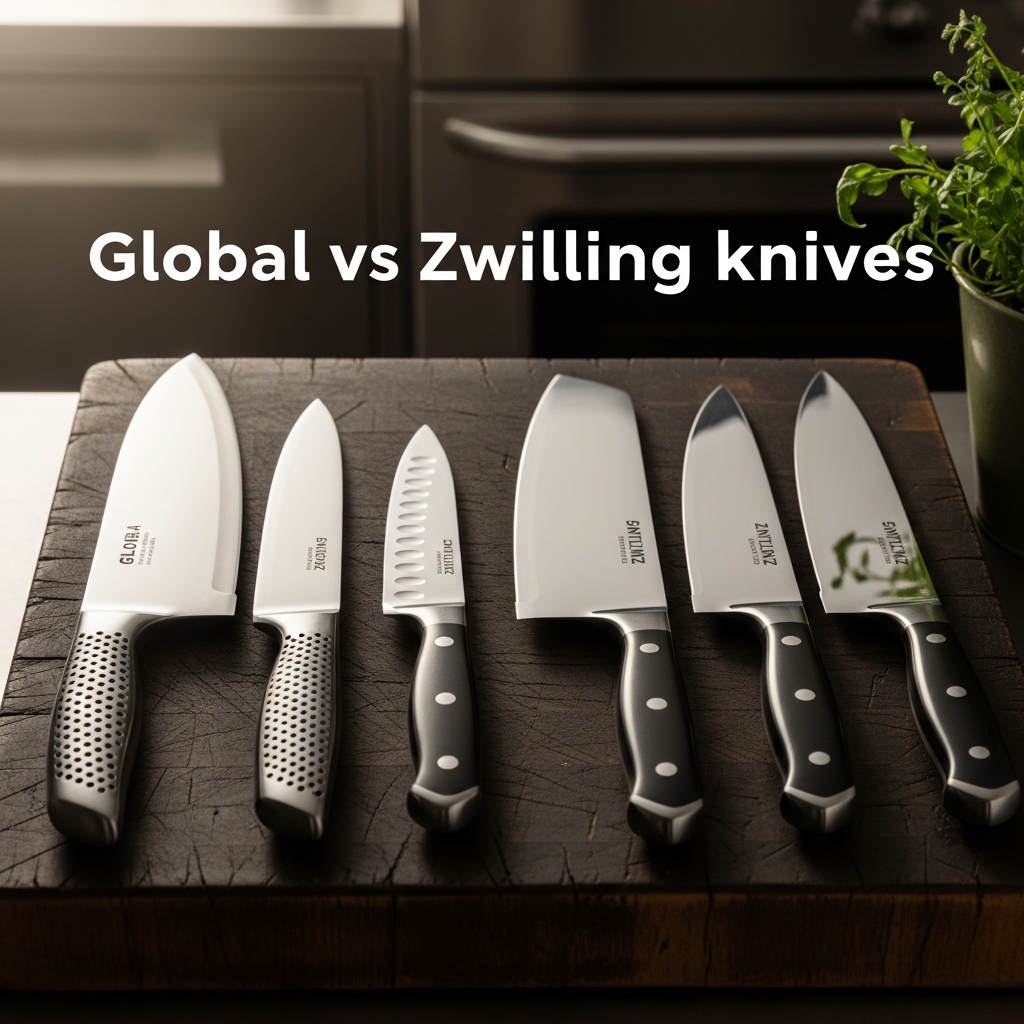
If you are standing in a premium kitchenware store or browsing knifeindex.com/ looking for your “forever knife,” you have likely narrowed your search down to two iconic names: Global and Zwilling J.A. Henckels.
These brands represent the two dominant philosophies in the cutlery world. Zwilling is the embodiment of German engineering: heavy, bolstered, and virtually indestructible. Global is the samurai of the modern kitchen: lightweight, seamless, and razor-sharp.
The Global vs. Zwilling debate isn’t just about which knife is sharper; it is about how you cook, how you hold your knife, and what feels right in your hand. In this comprehensive guide, we will break down the metallurgy, the design quirks, and the performance of both brands to help you decide.
1. The Contenders: Tradition vs. The Future
Zwilling J.A. Henckels: The German Giant
Founded in 1731 in Solingen, Germany, Zwilling is one of the oldest brands in the world. They set the standard for best German kitchen knives. Their knives are typically forged, featuring a full tang and a bolster (the thick metal band between the blade and handle). They are designed to be workhorses, capable of handling heavy-duty chopping without chipping.
Note: Be careful not to confuse Zwilling with their budget line. Read our Zwilling vs. Henkel knives guide to understand the difference between the premium “Twins” and the budget “Single Man” logo.
Global: The Modern Samurai
Global knives, manufactured by Yoshikin in Japan, burst onto the scene in 1985. Designed by Komin Yamada, they rejected the traditional wood-handle aesthetic entirely. Global knives are made from stainless steel from tip to tail, featuring a hollow handle filled with sand for perfect balance. They are a staple in best Japanese kitchen knives lists due to their unique look and incredible sharpness.
Deep Dive
For a granular look at how Global stacks up against other European giants, check out the external analysis at Prudent Reviews: Global vs. Zwilling: What’s the Difference?
2. Head-to-Head: The Specs Breakdown
To keep this fair, we are comparing the flagship lines: Zwilling Pro vs. Global Classic (G-Series).
| Feature | Zwilling Pro | Global Classic (G-2) |
|---|---|---|
| Steel | Friodur Ice-Hardened (German) | CROMOVA 18 (Japanese) |
| Hardness (HRC) | 57 | 56-58 |
| Construction | Forged (Full Tang) | Stamped / Welded |
| Edge Angle | 15° per side | 10-15° per side (Steep Convex) |
| Weight | Heavy / Substantial | Very Lightweight |
| Handle | Polymer (3-Rivet) | Stainless Steel (Dimpled) |
3. Design & Ergonomics: Heavy Metal vs. Featherweight
The Handle Battle
This is the most polarizing feature.
Zwilling Pro features an ergonomic curved bolster that encourages a professional “pinch grip.” The handle is smooth polymer and feels substantial. It is comfortable for all hand sizes.
Global handles are slim, metal, and textured with their signature black dimples. They are fantastic for smaller hands, but some chefs find them slippery if their hands are wet or oily. They lack a bolster entirely.
Weight and Balance
Zwilling relies on mass. The weight of the knife helps drive the blade through dense foods like sweet potatoes. It feels authoritative.
Global relies on agility. Because they are hollow and filled with sand, they are incredibly light. You can chop for hours without wrist fatigue, but you have to apply the downward pressure yourself. This makes them comparable to affordable chef knives in weight, but with premium performance.
4. Performance in the Kitchen
The Chef’s Knife
The 8-inch Chef’s knife is the most important tool in your kit. (Read what is a chef knife used for to learn why).
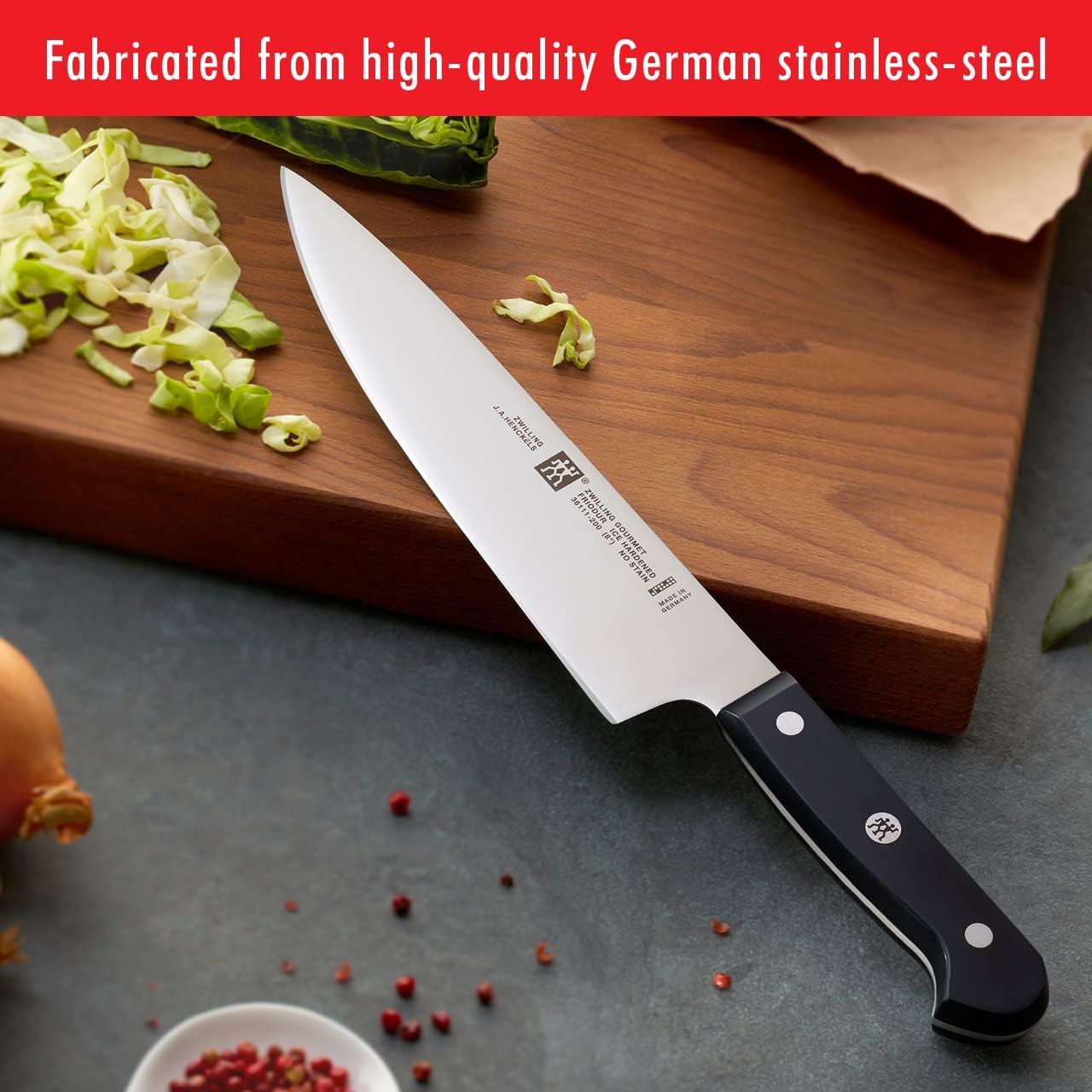 Zwilling Pro 8-Inch Chef’s Knife
The ergonomic masterpiece. Designed by architect Matteo Thun, the curved bolster supports the pinch grip perfectly. Ideal for rock-chopping herbs and heavy prep.
Check Price on Amazon Global G-2 8″ Chef’s Knife
The modern icon. Thin, agile, and razor-sharp. The lack of a bolster allows for full-blade sharpening. Perfect for slicing meats and vegetables with precision.
Check Price on AmazonSpecialty Tasks
- Vegetables: Global shines here. Their Nakiri knives are laser-thin and glide through onions without wedging. Zwilling’s thicker spine can split hard carrots.
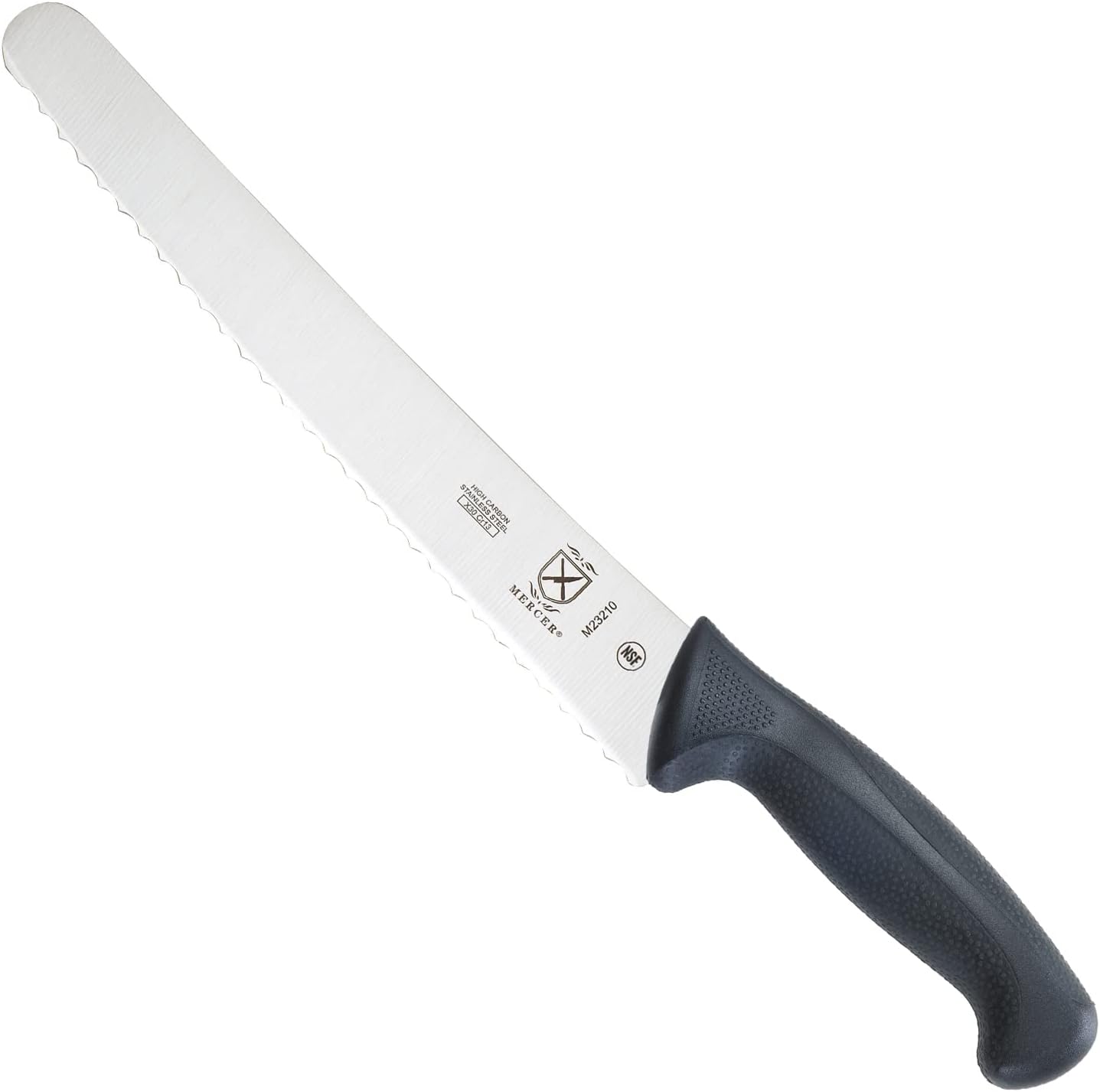
- Bread: Zwilling wins. Their heavier, stiffer bread knives handle crusty sourdough better than the flexible Global blades.
- Detail Work: Global’s lightweight paring knives feel like an extension of your finger, offering superior control for peeling.
5. Durability: Stamped vs. Forged
This touches on the classic stamped vs forged debate.
- Zwilling (Forged): The Pro series is forged from a single piece of steel. It is robust and handles abuse well. If you are tough on your tools, Zwilling is the safer bet.
- Global (Stamped/Welded): Global knives are stamped blades welded to hollow handles. While the steel (CROMOVA 18) is tough, the edge is ground very thin. They are more prone to micro-chipping if you hit a bone.
6. Maintenance: Keeping them Sharp
Both brands are high-quality, but they have different needs.
- Rust: Both are stainless, but Global’s high chromium content makes them exceptionally rust-resistant. However, the dimples on the handle can trap food residue. Use a brush to clean them. (See how to remove rust if you spot any).
- Sharpening: Zwilling is easier to sharpen. The steel is slightly softer and takes a new edge quickly on a standard steel. Global requires a specific angle (10-15 degrees). You cannot use a standard German pull-through sharpener on a Global knife; it will ruin the edge. Check our best knives sharpener guide for water stones suitable for Global.
- Dishwasher: NEVER put either in the dishwasher. It ruins the temper and the handle. Even if you use dishwasher safe steak knives, keep your chef knives out.
7. Storage Solutions
Because Global knives are metal, they look stunning on a magnetic strip. Zwilling knives are heavy, so you need a strong magnet or a sturdy block.
- Magnetic Strip: The best way to show off Global’s design. See how to store knives without a block.
- Drawer Dock: Great for Zwilling to protect the heavier blades. Check our drawer organizer guide.
- Travel: Global’s lightweight nature makes them a favorite for traveling chefs using a knife bag.
8. Alternative Comparisons
Still undecided? See how they stack up against others:
- Vs. Wusthof: Zwilling’s direct German rival. Wusthof is often slightly sharper out of the box, while Zwilling is more ergonomic. (See Global vs Wusthof).
- Vs. Shun: If you like the Japanese style of Global but want something prettier (Damascus), Shun is the answer. (See Dalstrong vs Shun for context on Japanese steel).
- Vs. Dalstrong: If you want flashier designs than either, Dalstrong offers a middle ground in price. (See Dalstrong vs Zwilling).
Frequently Asked Questions (FAQ)
Yes, Global knives are often cited as the best professional knives for chefs with smaller hands. The handles are slimmer and the lack of a bulky bolster allows for a tight, comfortable grip.
It is a myth that they snap easily. However, because they are hardened and thin, dropping a Global knife tip-first onto a tile floor will likely snap the tip. Zwilling knives are more likely to bend than break.
Global’s CROMOVA 18 steel holds its edge slightly longer than Zwilling’s Friodur steel due to the heat treatment and thinner geometry. However, Zwilling is much easier to re-sharpen when it does go dull.
It depends on your style. Global makes an excellent Santoku (See what is a Santoku used for). If you chop vegetables with an up-down motion, get a Santoku. If you rock-chop herbs, get the Zwilling Chef’s Knife.
9. Company History: Two Very Different Origin Stories
Understanding where a knife comes from tells you a lot about why it behaves the way it does on your cutting board. Zwilling and Global did not arrive at their current designs by accident — each brand’s history is baked directly into the geometry, the steel, and the philosophy of the knives you buy today.
Zwilling: Three Centuries in Solingen
Zwilling J.A. Henckels traces its roots back to 1731, when master cutler Peter Henckels registered the now-famous “Twin” (Zwilling) symbol as a trademark in Solingen, Germany — a city that has been the epicenter of European blade-making since the medieval era. Solingen earned the nickname “City of Blades” because its location near the Wupper River provided the water power needed to run grinding wheels, and its proximity to iron-ore deposits gave local smiths a steady supply of raw material. For nearly 300 years, Zwilling has operated almost continuously from this region, and the brand still manufactures its flagship lines in Solingen today, even as it has expanded production of budget lines to other countries.
Zwilling’s long history means the company has weathered enormous shifts in cutlery technology — from hand-forged carbon steel blades to industrialized stainless production — while maintaining a design language rooted in weight, durability, and craftsmanship. This is why, even in 2026, a Zwilling Pro knife feels like a tool built to be handed down through generations rather than replaced every few years.
Global: A Design Revolution from Tsubame-Sanjo
Global’s story starts much later and much more deliberately. In the early 1980s, Japanese knife manufacturer Yoshikin, based in the Tsubame-Sanjo region — an area historically known for metalwork and cutlery — wanted to create a knife line that broke completely from both Western tradition and old-school Japanese wood-handled designs. They commissioned industrial designer Komin Yamada, who studied under legendary designer Kazuo Kawasaki, to create something entirely new.
The result, launched in 1985, was a knife with no wooden handle, no bolster, and no visual separation between blade and grip. Every Global knife is machined from a single continuous piece of CROMOVA 18 stainless steel, then fitted with a hollow handle filled with precisely measured sand to balance the knife at the bolster line. This was radical at the time — most premium knives in 1985 still used wood or riveted composite handles — and it is part of why Global knives ended up in the permanent design collection of the Museum of Modern Art in New York. The brand’s entire identity, even 40 years later, still revolves around that original design decision: a knife should be as light, hygienic, and seamless as possible.
10. Steel Metallurgy: What’s Actually in the Blade
Both brands use proprietary stainless steel alloys, but the compositions and heat-treatment methods differ enough to explain most of the performance gap you feel at the cutting board.
Zwilling’s Friodur Process
Zwilling’s signature steel treatment is called Friodur, an ice-hardening process. After the blade is forged and shaped, it is heated to a precise temperature and then rapidly cooled to sub-zero temperatures before being tempered again. This process refines the grain structure of the steel, producing a blade that is tough, resistant to chipping, and easy to re-sharpen, typically landing around 57 on the Rockwell hardness scale (HRC). The tradeoff is that softer steel dulls a little faster during heavy use than harder Japanese alloys — but it is far more forgiving if you accidentally hit a bone or a frozen block of ginger.
Global’s CROMOVA 18
Global’s CROMOVA 18 is a proprietary stainless alloy containing roughly 18% chromium for corrosion resistance, along with molybdenum and vanadium added in smaller percentages to increase edge retention and hardness. This composition allows Global to push hardness slightly higher, typically in the 56-58 HRC range, while keeping the steel stain-resistant enough to skip the oiling and drying rituals that carbon-steel Japanese knives require. The higher vanadium content is largely responsible for Global’s reputation for holding a hair-splitting edge longer between sharpenings, at the cost of slightly more brittleness at the very tip.
| Steel Property | Zwilling Friodur | Global CROMOVA 18 |
|---|---|---|
| Primary Alloying Elements | Chromium, Molybdenum, Vanadium (lower %) | Chromium (~18%), Molybdenum, Vanadium (higher %) |
| Corrosion Resistance | Excellent | Outstanding |
| Edge Retention | Good | Very Good |
| Ease of Re-Sharpening | Easy | Moderate (angle-specific) |
| Chip Resistance | High | Moderate |
11. Model Lineups: Beyond the Flagship
Most buyers only compare the two flagship lines, but both brands sell several tiers with meaningfully different steel, geometry, and price points. Picking the wrong sub-line is one of the most common mistakes shoppers make.
Zwilling’s Full Range
- Zwilling Pro: The line featured above — full-tang, forged, ergonomic bolster, Friodur steel. The best all-rounder for most home cooks.
- Zwilling Four Star: An older, slightly heavier design with a rounder bolster. Loved by traditionalists who want maximum heft.
- Zwilling Twin Signature: A more budget-friendly forged line with a triple-riveted handle, aimed at cooks who want German quality without the flagship price.
- Zwilling Professional S: A hybrid design with a full bolster and a slightly thinner profile than Four Star, popular in professional kitchens.
- Zwilling Bob Kramer Collection: A collaboration with American bladesmith Bob Kramer, offering Damascus-clad, high-carbon options that push Zwilling into premium Japanese-style territory.
Global’s Full Range
- Global G Series: The Classic line covered above — the original 1985 design, still the best seller worldwide.
- Global GS Series: Smaller utility and paring knives that share the same steel and construction as the G Series but in more compact sizes.
- Global GSF Series: A forged sub-line that adds a small bolster for extra weight and stability, aimed at cooks who like Global’s steel but want more heft.
- Global Ni Series: A premium tier with a slightly different bolster shape and heavier balance, sitting between the G Series and forged Western knives.
- Global Sai Series: Global’s take on a more traditional Japanese profile, including single-bevel options for sushi and sashimi work.
12. Price and Value: What You’re Actually Paying For
Both brands sit in the premium tier, but their pricing philosophy diverges. Zwilling’s pricing scales heavily with line — the budget Twin Signature series can be dramatically cheaper than the flagship Pro or Bob Kramer collections, giving shoppers a wide range of German quality at different price points. Global’s pricing is more uniform across the G Series, since nearly the entire line uses the same steel and construction method; you are mostly paying more for larger blade sizes or specialty shapes rather than a “better” steel tier.
In terms of long-term value, Zwilling knives tend to have a lower total cost of ownership because they are cheaper and easier to professionally re-sharpen over a 10+ year lifespan. Global knives often cost slightly more to maintain properly, since they require whetstone sharpening or a specialist rather than a basic pull-through sharpener, but many owners feel the trade-off is worth it for the edge quality and iconic look.
13. Manufacturing Process: How Each Knife Is Actually Made
How a Zwilling Pro Knife Is Forged
Production starts with a single steel blank that is heated and hammer-forged into the rough shape of the blade, bolster, and tang in one continuous piece. This is what gives forged knives their reputation for strength — there is no seam or weld point between the blade and the bolster. After forging, the blade goes through the Friodur ice-hardening treatment, is precision-ground to its final edge geometry, and then fitted with a polymer handle that is riveted through the tang for a permanent, waterproof bond.
How a Global G-Series Knife Is Made
Global’s process starts differently: a sheet of CROMOVA 18 steel is stamped into the rough blade shape rather than hammer-forged. The blade is then hardened, precision-ground on both sides to create its distinctive thin, slightly convex edge, and hand-finished. The handle is a separate hollow stainless steel shell that is filled with a carefully weighed amount of sand and then laser-welded to the blade so there is no visible seam. This is a far more labor-intensive assembly process than a typical stamped knife, which is part of why Global commands a premium price despite not being traditionally forged.
14. Grip Styles, Hand Size, and Left-Handed Use
Ergonomics matter as much as steel quality, especially if you’re prepping food for hours at a time.
- Pinch Grip Users: Zwilling’s curved bolster is specifically shaped to cradle the thumb and index finger in a pinch grip, the technique most professional chefs are taught. It naturally “locks” your hand into the correct position.
- Hammer Grip Users: If you grip further back on the handle, Global’s slim, evenly weighted handle feels more neutral and less bolster-dependent.
- Small or Petite Hands: Global is generally the better fit — the handle circumference is noticeably smaller than Zwilling’s bolstered grip.
- Large Hands: Zwilling’s fuller handle and bolster give more surface area to grip, which many larger-handed cooks find more secure.
- Left-Handed Cooks: Both brands’ Western-style double-bevel knives (Zwilling Pro, Global G Series) are fully ambidextrous. It’s only Global’s single-bevel Sai series and traditional Japanese-style knives elsewhere on the market where left-handed cooks need to specifically request a left-handed grind.
15. Knife Weight Chart by Type
Because weight is one of the biggest differentiators between these brands, here is an approximate breakdown across common knife types (actual weights vary slightly by blade length and edition):
| Knife Type | Zwilling Pro (approx.) | Global G Series (approx.) |
|---|---|---|
| 8″ Chef’s Knife | ~230-250g | ~170-190g |
| 7″ Santoku | ~200-220g | ~150-165g |
| Nakiri | ~190-210g | ~140-155g |
| Paring Knife | ~60-80g | ~40-55g |
| Bread Knife | ~210-230g | ~150-170g |
16. Fish, Sushi, and Sashimi Work
For cooks who regularly break down whole fish or slice sashimi, neither flagship line is the ideal specialist tool, but the two brands diverge sharply once you look at their specialty offerings. Zwilling doesn’t have a dedicated single-bevel sushi lineup — their closest option is a flexible Western-style fillet knife, which is fine for boning but not built for the paper-thin sashimi cuts sushi chefs rely on. Global, by contrast, offers the Sai series and other single-bevel options designed specifically for traditional Japanese fish preparation, including yanagiba-style slicers. If sashimi and sushi prep is a priority, Global’s ecosystem is simply more complete, though most home cooks are better served by a dedicated specialty brand for that narrow use case.
17. Sharpening in Detail: Angles, Stones, and Tools
Sharpening is where the philosophical differences between these brands become very practical.
- Whetstone Grit for Zwilling: A 1000-grit stone for repair and a 3000-6000 grit stone for polishing is sufficient, sharpened at roughly 15 degrees per side.
- Whetstone Grit for Global: Global recommends starting no coarser than 1000 grit and finishing around 3000-8000 grit, maintained at the factory’s steeper 10-15 degree angle to preserve the thin convex edge.
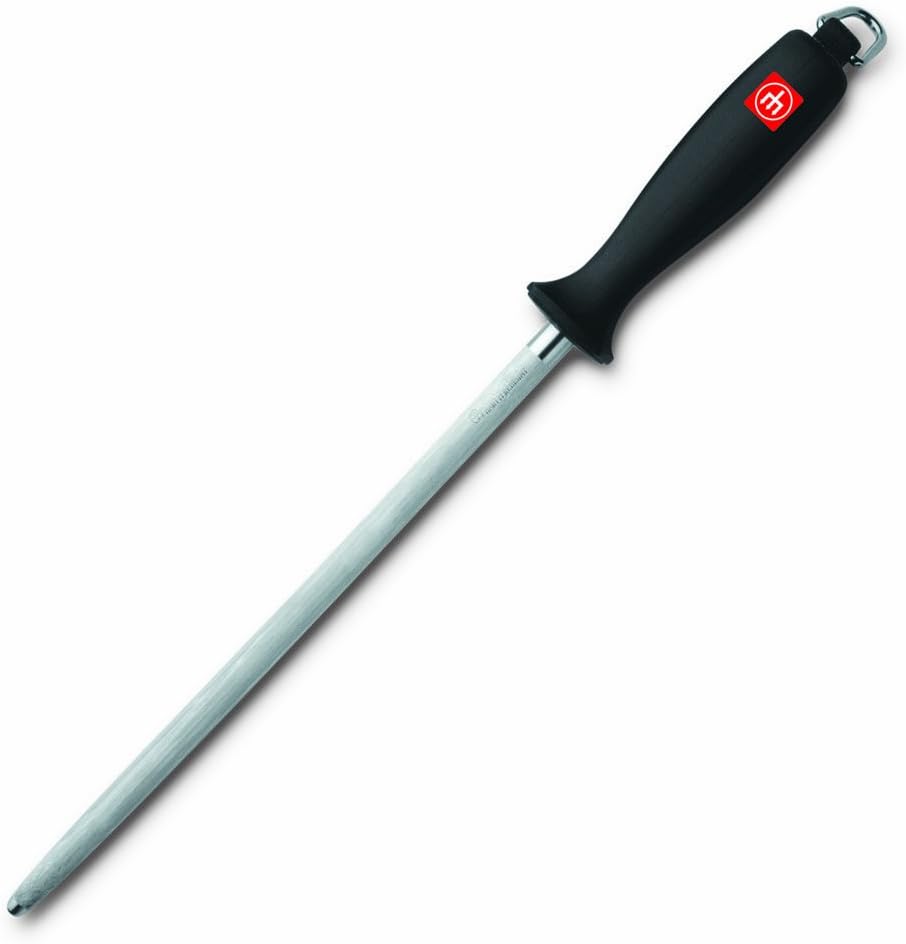
- Honing Steel Compatibility: A standard honing steel works well on Zwilling’s softer, more ductile edge to realign it between sharpenings. Global does not recommend traditional honing steels at all — the harder, thinner edge is more likely to micro-chip than realign, so Global sells its own ceramic honing rod matched to their edge angle.
- Pull-Through Sharpeners: Safe (in moderation) on Zwilling. Actively discouraged on Global, since most pull-through sharpeners are set to a wider Western angle that will grind away Global’s thinner geometry unevenly.
- Professional Sharpening Services: Both brands offer factory sharpening programs; Zwilling’s is widely available through partner retailers, while Global recommends specialists familiar with steeper Japanese-style angles.
18. Warranty and Lifetime Guarantees
Both brands stand firmly behind their manufacturing quality. Zwilling offers a limited lifetime warranty against defects in material and workmanship on most of its forged lines, reflecting the brand’s “built to last generations” positioning. Global similarly backs its knives with a manufacturer’s warranty covering defects, though — as with any premium cutlery brand — normal wear, chipping from misuse (like cutting frozen food or bone), and damage from dishwashers are excluded from both warranties. Neither warranty covers loss of sharpness over time, since that is considered normal wear rather than a defect.
19. Country of Manufacture: Where the Steel Actually Comes From
“Made in Germany” and “Made in Japan” carry real weight in the cutlery world, and both brands lean into their heritage. Zwilling’s flagship Pro, Four Star, and Professional S lines are still manufactured in Solingen, Germany, though the company also produces budget and mid-tier lines (including some Henckels-branded products) in other facilities to hit lower price points — which is exactly why the Zwilling vs. Henckels distinction matters so much to informed buyers. Global’s entire G Series and most of its specialty lines are manufactured by Yoshikin in Japan, and the brand has kept production centralized there since 1985, which is part of why the “Made in Japan” stamp on every Global blade carries genuine manufacturing pedigree rather than just a marketing label.
20. Building a Full Knife Set: Mixing and Matching
Many serious home cooks don’t pick one brand exclusively — they build a mixed set that plays to each brand’s strengths. A common combination is a Zwilling chef’s knife and bread knife for heavy daily prep and crusty loaves, paired with a Global paring knife and Nakiri for detail work and vegetables. If you’d rather commit to one ecosystem for a cohesive block or magnetic strip display, our best knife sets with blocks guide breaks down which pre-built sets from each brand offer the best value, and how block sets compare to buying open-stock pieces individually.
21. Sustainability and Materials
Neither brand publishes a fully detailed sustainability report aimed at consumers, but their manufacturing philosophies do differ in material efficiency. Global’s single-piece stamped-and-welded construction generates less scrap steel per knife than traditional forging, and the brand’s all-metal, handle-free-of-composite design means the knives are easier to recycle at end of life since there’s no wood or synthetic resin to separate from the steel. Zwilling’s forged construction is more energy-intensive per unit but produces an exceptionally long-lived product; because Zwilling knives are easy to re-sharpen and repair over decades, many stay in active use far longer before ever being discarded, which is its own form of sustainability through longevity.
22. Which Knife Fits Your Cooking Style?
Instead of thinking purely in terms of specs, it helps to think about your actual cooking habits.
- The Weekend Batch-Cooker: If you do large batches of soups, stews, and root vegetables on weekends, Zwilling’s weight and chip resistance will serve you better through dense, repetitive chopping.
- The Daily Line Cook (Home Edition): If you cook every night and value speed and low wrist fatigue over raw chopping power, Global’s lightweight agility will feel more comfortable over a long stretch of prep.
- The Precision Plater: If your cooking leans toward fine julienne, delicate herb chiffonade, or plated presentation work, Global’s thin geometry gives you finer control.
- The Meat-and-Bone Household: If you regularly break down bone-in cuts or poultry, Zwilling’s forged toughness is the safer choice to avoid chipping.
- The Minimalist: If you want one knife that looks as good on display as it performs, Global’s sculptural, all-metal design doubles as a piece of kitchen decor.
23. Common Mistakes Owners Make With Each Brand
- Using a German-angle pull-through sharpener on a Global knife — this is the single most common way owners ruin their Global edge within the first year.
- Letting food dry in Global’s handle dimples — the textured grip looks great but needs a quick brush-clean, not just a wipe, or residue builds up over time.
- Storing either knife loose in a drawer — both brands’ edges are premium enough to justify a blade guard, dock, or magnetic strip rather than tossing them in with other utensils.
- Assuming “stainless” means indestructible — both brands resist rust well, but neither is rust-proof; leaving either knife wet for extended periods, especially in humid climates, can still cause spotting.
- Skipping honing on Zwilling — because Zwilling’s edge is more ductile, it needs more frequent realignment with a honing steel than owners often realize, or it will feel dull well before it actually needs a full sharpening.
24. Extended FAQ
Both brands have a strong professional following, but they tend to split by kitchen role. Chefs doing heavy butchery, banquet-scale prep, or line cooking in high-volume Western kitchens often gravitate toward Zwilling for its durability. Chefs in Japanese, fine-dining, or precision-plating roles frequently prefer Global for its lighter feel and finer edge control.
Yes, both brands’ standard blade widths fit most universal knife blocks, though Global’s handle-free-of-bolster design means it may sit slightly differently in a block designed around a bolstered Western profile.
Neither brand recommends cutting fully frozen food with these knives, as both risk chipping. If you regularly work with frozen ingredients, Zwilling’s tougher, more ductile steel is the more forgiving of the two, but a dedicated frozen-food knife is safer for both brands’ edges.
Yes, but proportionally less than Zwilling. Because Global’s balance point comes from the sand-filled hollow handle rather than blade mass, even a 10-inch Global chef’s knife stays noticeably lighter than the equivalent Zwilling size.
Zwilling’s long heritage and limited collaborations, like the Bob Kramer line, tend to hold collector interest well over time. Global’s design-icon status — including its place in museum design collections — also gives well-kept vintage pieces from the 1980s and 1990s a following among collectors, particularly early Yamada-era models.
25. Glossary: Cutlery Terms Used in This Guide
If some of the terminology above is unfamiliar, here’s a quick reference so you can shop with confidence, whether you’re comparing Global vs. Zwilling or any other premium knife brand.
- Bolster: The thick collar of metal between the blade and handle on a forged knife. It adds weight, protects fingers, and on Zwilling’s Pro line, shapes the grip.
- Full Tang: When the steel of the blade extends the full length of the handle, usually visible as a metal strip sandwiched between handle scales. Zwilling’s forged lines are full tang; Global’s construction achieves a similar strength through a continuous welded steel body instead.
- HRC (Rockwell Hardness): A scale measuring how resistant steel is to indentation, used as shorthand for how hard (and by extension, how edge-retentive but also how brittle) a blade is.
- Convex Edge: An edge ground with a gentle outward curve rather than a flat bevel, common on Global knives, which improves food release and slicing performance.
- Single Bevel vs. Double Bevel: A single-bevel edge is ground on only one side (traditional for Japanese sushi knives), while a double bevel is ground symmetrically on both sides, like nearly all Western knives and the standard Global and Zwilling lines.
- Damascus Steel: A layered steel pattern created by folding and forge-welding multiple steel types together, used in premium collaborations like the Zwilling Bob Kramer line, prized as much for its wavy visual pattern as its performance.
- Patina: A discoloration that forms on high-carbon steel exposed to acidic foods. Not a concern for either Zwilling or Global, since both use stainless alloys that resist patina formation.
26. Cutting Board Pairing: Getting the Most From Either Blade
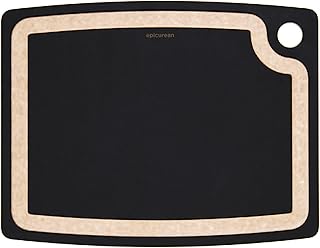
The cutting surface you use has a bigger impact on edge life than most people realize, and it interacts differently with each brand’s steel hardness. Because Global’s CROMOVA 18 sits at the higher end of the hardness range, it is less forgiving on hard surfaces like glass, stone, or bamboo end-grain boards; the edge will dull noticeably faster and is more prone to tiny chips on unforgiving surfaces. Zwilling’s slightly softer Friodur steel tolerates a wider range of boards without dulling as quickly, though it too will suffer on glass or stone. For either brand, a soft end-grain wood board or a high-quality synthetic composite board is the safest choice, and will meaningfully extend the interval between sharpenings regardless of which brand you own.
27. Packaging, Presentation, and Gifting
Both brands understand that a premium knife is often purchased as a gift or a milestone kitchen upgrade, and their packaging reflects that. Zwilling knives typically ship in sturdy branded boxes with a molded interior tray, reinforcing the “heirloom tool” positioning of the brand. Global leans into its design-icon reputation with sleek, minimalist packaging that mirrors the knife’s own aesthetic — often cited by gift-givers as part of the unboxing appeal. If you’re buying either as a gift, both brands also offer single-knife gift sets paired with a saya (blade cover) or presentation box, which is worth checking for during holiday and wedding-registry season.
28. Seasonal Maintenance Schedule
A simple maintenance rhythm keeps either brand performing like new for decades. For a household that cooks most nights, a reasonable schedule looks like this:
- After every use: Hand wash immediately, dry completely before storing — critical for both brands but especially for Global, where trapped moisture in handle dimples can eventually cause spotting.
- Weekly: Hone a Zwilling blade with a honing steel to realign the edge. For Global, use their ceramic honing rod instead of a traditional steel.
- Every 2-3 months (moderate home use): A quick touch-up on a fine 3000-6000 grit stone for either brand, or a specialist pull-through pass on Zwilling only.
- Once or twice a year: A full re-sharpening from the coarse stone up, or send the knife to a professional sharpening service — especially recommended for Global owners without whetstone experience.
- Annually: Inspect the handle (rivets on Zwilling, weld seam on Global) for any looseness or hairline gaps, and address it before it worsens.
29. Buying Checklist Before You Order
Before you add either knife to your cart, run through this quick checklist to make sure you’re getting the right knife for your kitchen:
- Confirm the blade length matches your cutting board size and storage solution (block slot, magnetic strip length, or drawer dock width).
- Decide whether you want a bolster (Zwilling) for a pinch-grip feel, or a bolster-free handle (Global) for a lighter, more neutral grip.
- Check whether you already own a compatible sharpening tool, or budget for a whetstone/professional sharpening if you’re going with Global.
- If buying for someone with smaller hands, lean toward Global’s slimmer handle circumference.
- If the recipient regularly cuts through bone-in poultry or dense root vegetables, lean toward Zwilling’s tougher, more chip-resistant edge.
- Verify the specific line (Pro vs. Four Star vs. Twin Signature for Zwilling; G Series vs. GSF vs. Ni for Global) matches the price and feature set you actually want, since names between sub-lines are easy to confuse when scanning listings quickly.
30. Myths About Global and Zwilling, Debunked
- Myth: “Japanese knives are always sharper than German knives.” Not necessarily — sharpness is a function of edge angle and maintenance, not country of origin. A well-maintained Zwilling can be just as sharp as a Global; Global simply ships with a steeper factory angle.
- Myth: “Heavier knives are always better for beginners.” In practice, many beginners find a lighter knife like Global easier to control and less fatiguing while they’re still building technique.
- Myth: “Global knives will rust if you look at them wrong.” Global’s high-chromium steel is actually more corrosion-resistant than Zwilling’s, not less — the myth likely persists because owners overlook the handle dimples where moisture can hide.
- Myth: “You need a completely different knife skill set for each brand.” Both are double-bevel, symmetrical Western-style profiles for the G Series and Pro lines — the cutting technique transfers directly between them, only weight and balance feel different.
- Myth: “Forged always means better quality than stamped.” This was truer decades ago when stamped knives were budget, thin blanks. Global proves that a precision-stamped-and-welded knife can rival or exceed forged construction in fit, finish, and performance when engineered at a premium level.
31. Regional Availability and Where to Buy
Both brands are widely available through major retailers, department stores, and authorized online sellers, but availability of specific sub-lines can vary by region. Zwilling’s full range, including the Bob Kramer collaboration, tends to be easiest to find in North America and Europe, with occasional regional exclusives. Global’s core G Series is sold globally with strong availability in North America, Europe, and Australia, though some of its more traditional Japanese specialty pieces, like single-bevel sushi knives, are easier to source from retailers specializing in Japanese cutlery or directly from Japan. When shopping online, always confirm you’re buying from an authorized retailer, since both brands have been targeted by counterfeiters, particularly for individually sold flagship chef’s knives.
32. Task-by-Task Performance Scorecard
To summarize everything above in one place, here’s how each brand scores across common kitchen tasks on a simple 1-10 scale, based on the comparisons detailed throughout this guide.
| Task | Zwilling Pro | Global G Series |
|---|---|---|
| Rock-Chopping Herbs | 9 | 6 |
| Slicing Boneless Protein | 7 | 9 |
| Dense Root Vegetables | 9 | 7 |
| Fine Julienne / Detail Work | 6 | 9 |
| Long Prep Sessions (Fatigue) | 6 | 9 |
| Ease of Sharpening at Home | 9 | 6 |
| Edge Retention | 7 | 8 |
| Durability vs. Bone Contact | 8 | 5 |
Conclusion: The Verdict
The battle between Global vs. Zwilling is a choice between two distinct culinary identities.
Choose Zwilling If: You want a knife that feels like a tank. You appreciate the “pinch grip,” you do heavy-duty prep, and you want a classic German tool that will last a lifetime with minimal fuss. It is the safe, reliable choice.
Choose Global If: You want speed. You slice a lot of boneless proteins and vegetables. You have smaller hands or find heavy knives tiring. You want a modern, hygienic, all-metal aesthetic. It is the sports car of the kitchen.
To build your perfect set, don’t forget to look at our reviews for the best knife sets with blocks or mix and match to get the best of both worlds.