AUS-10 Steel vs. VG-10 Knife: The Ultimate Japanese Steel Showdown
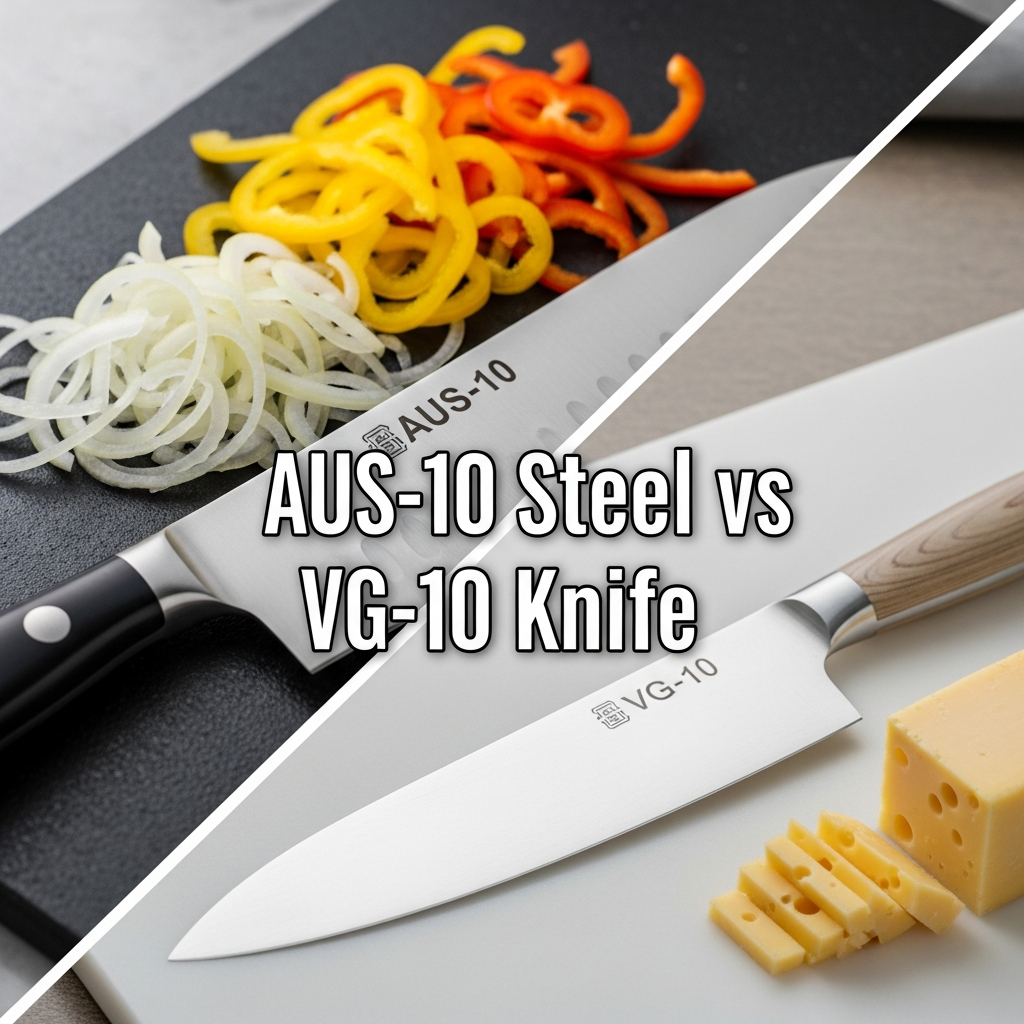
If you are diving deep into the world of high-performance cutlery, you have inevitably hit a wall of acronyms. You want the best Japanese kitchen knives, but the spec sheets read like a chemistry exam: Rockwell Hardness, Chromium percentage, Vanadium carbides.
Two names rise above the rest in the premium market: VG-10 and AUS-10.
VG-10 has been the reigning king of Japanese stainless steel for decades, championed by giants like Shun and Tojiro. But AUS-10, a newer formulation from Aichi Steel, is challenging the throne, appearing in knives from modern disruptors like Dalstrong.
In this comprehensive guide, we will strip away the marketing hype and look at the metallurgy. We will compare sharpness, durability, and ease of sharpening to help you decide which steel belongs in your knife block.
Quick Navigation
- The Contenders
- Origins & History
- Chemical Breakdown
- Rockwell Hardness Explained
- Hardness & Sharpness
- Durability & Brittleness
- Toughness Testing
- Ease of Sharpening
- VG-10 vs VG-Max vs VG-2
- AUS-10 vs AUS-8 vs AUS-6
- Vs. 440C and Powder Steels
- San Mai, Cladding & Tang Types
- Handle Materials
- Top Product Recommendations
- Which Steel for Which Knife
- Single vs Double Bevel
- Weight & Balance
- Cryogenic Treatment
- Maintenance: Rust & Care
- Patina Formation
- Corrosion Lab Testing
- Price Tier Buying Guide
- Brand Comparisons
- Professional Chef Opinions
- Common Myths
- Sustainability & Sourcing
- Warranty & Customer Service
- Left-Handed Considerations
- Accessories You’ll Need
- FAQ
1. The Contenders: What Are These Steels?
VG-10 (V Gold 10)
Produced by Takefu Special Steel, VG-10 is often called “The Gold Standard.” It is a high-carbon stainless steel designed specifically for cutlery. It is famous for its ability to take a screaming sharp edge and hold it.
Key Element: Cobalt. This adds structural strength to the steel matrix.
AUS-10 (Aichi Steel 10)
Produced by Aichi Steel (a Toyota group company), AUS-10 is the highest grade in the AUS series. It was designed to bridge the gap between stainless durability and carbon steel sharpness.
Key Element: Vanadium. This refines the grain structure for incredible sharpness and toughness.
External Insight
According to Seido Knives, while both are high-performance steels, AUS-10 is often praised for being slightly more durable and easier to sharpen. Read their deep dive here: AUS10 vs VG10 Steel: What is Better?
2. Origins & History: How These Steels Came to Dominate Kitchens
To really understand why VG-10 and AUS-10 sit where they do in the market, it helps to know where they came from. Neither steel was invented for knives in a vacuum — both are products of Japan’s broader post-war steel industry, which spent decades refining alloys originally intended for industrial cutting tools, razors, and surgical instruments before cutlery makers adopted them wholesale.
VG-10 traces its lineage to Takefu Special Steel Co., a company based in Takefu, Fukui Prefecture — a region with a centuries-old reputation for bladesmithing thanks to its access to iron sand and clean river water used in traditional forging. Takefu developed the “V Gold” (VG) series specifically to compete with older tool steels that were excellent for edge retention but far too prone to rust for a home kitchen. VG-10 became the breakout success of that series in the 1990s, when Japanese knife exporters realized Western consumers wanted the sharpness of a carbon steel blade without the maintenance headache. Brands like Tojiro and Shun built their reputations largely on the back of this single alloy, and it quickly became the default recommendation anytime someone asked what a “real” Japanese chef’s knife should be made of.
AUS-10 has a very different corporate history. Aichi Steel was founded in 1934 and later became part of the Toyota Group, primarily supplying automotive-grade steel for forged components, axles, and specialty alloys. Their AUS series (AUS-6, AUS-8, AUS-10) was originally developed for general-purpose cutlery and industrial blades, drawing on Aichi’s automotive metallurgy expertise rather than a dedicated bladesmithing tradition. For years AUS-8 was the more commonly seen grade, especially in outdoor and tactical knives from brands like Cold Steel. AUS-10 sat quietly as the “flagship” of the family until knife brands like Dalstrong began marketing vacuum-treated AUS-10V variants aggressively in the direct-to-consumer boom of the 2010s, introducing the steel to a much wider home-cook audience that had never previously looked past VG-10.
This history matters for buyers because it explains a lot of the marketing language you will see. VG-10 carries decades of established trust and appears constantly in best Japanese kitchen knife roundups almost by default, while AUS-10 has had to earn its reputation more recently through aggressive vacuum heat-treating and clever branding (AUS-10V, “Super Steel,” etc.) to convince buyers it belongs in the same conversation.
3. Head-to-Head: The Chemical Breakdown
To understand performance, we must look at the recipe.
| Element | VG-10 | AUS-10 | Impact on Performance |
|---|---|---|---|
| Carbon | 0.95% – 1.05% | 0.95% – 1.10% | Hardness & Sharpness (Both are excellent) |
| Chromium | 14.5% – 15.5% | 13.0% – 14.5% | Rust Resistance (VG-10 is slightly more stainless) |
| Molybdenum | 0.9% – 1.2% | 0.1% – 0.3% | Corrosion resistance & Strength |
| Vanadium | 0.1% – 0.3% | 0.1% – 0.27% | Grain refinement (Sharpness & Durability) |
| Cobalt | 1.3% – 1.5% | None | Increases hardness ceiling (VG-10 wins) |
A few elements on this table deserve more explanation than a single column can offer, because they are the actual reason the two steels feel different in your hand.
Molybdenum is arguably the most underrated number on this chart. VG-10’s molybdenum content, roughly four times higher than AUS-10’s, does double duty: it boosts corrosion resistance by helping stabilize the passive chromium-oxide layer that keeps stainless steel stainless, and it also increases the steel’s resistance to softening at elevated temperatures. That second property matters more than people think, because it gives knife makers a wider margin of error during the heat-treating process — a small overshoot in temperature is less likely to ruin a VG-10 blade than the same overshoot would be on a leaner alloy.
Vanadium is the element that AUS-10 leans on more heavily relative to its overall recipe, and it is responsible for one of the steel’s most-praised traits: fine, evenly distributed carbide structure. Vanadium carbides are smaller and harder than the carbides formed by chromium alone, and a fine, well-distributed carbide structure is what lets a steel take an aggressively acute edge without those carbides tearing out during use. This is the metallurgical reason AUS-10 is so frequently described by sharpening enthusiasts as feeling “toothy” and grabby straight off the stones.
Cobalt, found only in VG-10, does not directly affect hardness the way carbon does. Instead, it strengthens the surrounding martensitic matrix that holds all the carbides together, effectively letting manufacturers push VG-10 to a higher achievable hardness ceiling before the steel becomes unacceptably brittle. This is why some premium VG-10 knives — particularly Shun’s proprietary VG-MAX blend, discussed later — can be heat-treated slightly harder than a typical AUS-10 blade while remaining just as usable.
4. Rockwell Hardness Explained (What “60 HRC” Actually Means)
Every knife spec sheet throws around an HRC number, but few explain what it measures or why it matters. The Rockwell C scale (HRC) measures a material’s resistance to indentation by pressing a diamond cone into the steel under a fixed load and measuring how deep the cone penetrates. A higher number means the surface resists deformation more, which in a knife translates to an edge that stays sharp longer under repeated cutting, since a harder edge deforms and rolls less easily against a cutting board.
But hardness is not a one-directional good. As HRC climbs, steel typically becomes less able to flex without cracking — it trades toughness for wear resistance. This is why kitchen knives generally sit in the 58-62 HRC window rather than the 64-67 HRC range you might see in a straight razor or a woodworking chisel; a kitchen knife needs enough resilience to survive twisting motions, occasional bone contact, and the general abuse of daily cooking, while a razor only ever needs to glide through hair.
Both VG-10 and AUS-10 occupy almost the same practical hardness window (roughly 59-61 HRC as manufactured, though some AUS-10V variants and Shun’s VG-MAX push slightly higher), which is exactly why the two steels feel so similar in raw sharpness. The differences buyers actually notice in daily use come from toughness and grain structure rather than raw HRC.
5. Hardness and Sharpness (HRC)
Both steels fall into the “High Carbon Stainless” category (see our Stainless vs Carbon guide for more context).
- VG-10: Typically heat-treated to 60-61 HRC. It is very hard. This allows for extremely thin edges (15 degrees or less), like those found on Shun knives.
- AUS-10: Typically heat-treated to 59-61 HRC. It gets just as sharp as VG-10 but relies on Vanadium to create a fine grain structure that gets “scary sharp.”
Verdict: Draw. Both can slice a grape by just looking at it.
6. Durability and Brittleness
This is where they diverge. High hardness usually comes with brittleness (the tendency to chip).
VG-10 is notorious for being somewhat brittle. If you twist a VG-10 blade or hit a bone, it can micro-chip. (Read Miyabi vs Shun for more on brittle edges).
AUS-10 is generally considered tougher. The chemistry allows it to absorb slightly more impact without chipping. If you are a heavy-handed cook who might accidentally hit a seed or bone, AUS-10 is safer.
7. Toughness Testing: What a Charpy Test Actually Tells You
Metallurgists don’t rely on gut feeling to measure toughness — they use standardized impact tests, most commonly a Charpy or Izod impact test. In these tests, a small notched steel sample is struck by a swinging pendulum, and the energy absorbed before the sample fractures is recorded, usually in joules or foot-pounds. A steel that absorbs more energy before snapping is “tougher,” even if its raw hardness number is identical to a competitor’s.
Independent lab comparisons and knife-maker testing (rather than any single manufacturer’s marketing copy) have generally shown that vanadium-rich, moderate-chromium alloys like AUS-10 tend to outperform cobalt-alloyed, higher-chromium steels like VG-10 in these impact tests at comparable hardness levels. The practical translation for a home cook: if your knife occasionally strikes a cutting board with force, twists while chopping through something fibrous, or gets used by someone less experienced in the kitchen, the steel with the higher toughness margin will tolerate that abuse with fewer visible chips along the edge.
It’s worth noting that toughness tests measure bulk material behavior, not edge geometry. A thin, acutely ground VG-10 edge can still out-chip a thicker, more obtuse AUS-10 edge purely because of geometry, independent of the underlying alloy’s toughness. This is why the way a manufacturer grinds and thins the blade often matters as much as the steel choice itself — something worth asking about before buying.
8. Ease of Sharpening
No knife stays sharp forever. When it’s time to hit the stones:
- VG-10: Can be tricky. The Cobalt makes it hard and abrasion-resistant. It can sometimes feel “glassy” on the stone and takes longer to raise a burr.
- AUS-10: Is widely loved by sharpeners. It behaves more like a traditional carbon steel. It grinds easily and deburrs cleanly.
If you are learning to use a whetstone, AUS-10 is the friendlier teacher.
For beginners specifically, the difference is more than just feel. VG-10’s abrasion resistance means a coarse stone (around 400-600 grit) will take noticeably longer to reprofile a damaged edge, which can frustrate someone still learning to hold a consistent angle. AUS-10’s faster-cutting feedback on the stone lets a beginner correct their angle more quickly because they can see and feel progress sooner, reinforcing good habits rather than encouraging over-sharpening out of impatience.
9. VG-10 vs VG-Max vs VG-2: Understanding the “V Gold” Family
VG-10 is not a single monolithic product — it’s the middle child of a family. Takefu’s V Gold lineup also includes VG-1 and VG-2 (simpler, lower-alloy predecessors used mostly in entry-level or single-bevel Japanese knives) and VG-Max, a more heavily alloyed, proprietary blend used almost exclusively by Shun.
VG-2 is a leaner, less corrosion-resistant steel typically found as the core of clad Japanese knives where cost matters more than ultimate performance. It sharpens easily and holds a fine edge reasonably well, but it doesn’t match VG-10’s wear resistance or hardness ceiling.
VG-Max, Shun’s flagship formulation, adds extra carbon, chromium, tungsten, and cobalt on top of the VG-10 base recipe, pushing hardness slightly higher (typically 60-61 HRC, sometimes marketed as reaching higher) while aiming to retain similar toughness. If a listing says “VG-Max” rather than plain “VG-10,” you are looking at Shun’s proprietary upgrade, not a generic competitor’s steel — worth knowing before you assume two knives with similar-sounding steel names perform identically.
10. AUS-10 vs AUS-8 vs AUS-6: Understanding the AUS Family
The AUS series follows a simple naming logic: the number roughly correlates with carbon content and, by extension, achievable hardness and edge retention. AUS-6 sits at the entry level, commonly used in budget outdoor knives where toughness and low cost matter more than outright sharpness longevity. AUS-8 is the long-time workhorse of the tactical and outdoor knife world — brands like Cold Steel and SOG have used it for decades because it strikes a comfortable, forgiving balance between edge retention, toughness, and ease of resharpening in the field.
AUS-10 sits at the top of the family, with more carbon than AUS-8 to push both achievable hardness and wear resistance higher, while still relying on the same core toughness advantages that make the whole AUS lineup popular with people who value a resilient edge over an ultra-long-lasting one. When you see “AUS-10V” specifically, that “V” typically denotes a vacuum-hardening heat treatment process (rather than added vanadium content beyond the base alloy), which produces a more consistent, refined grain structure than traditional furnace hardening — this is the version Dalstrong markets heavily in its Shogun and Gladiator series.
11. How Do They Compare to 440C and Powder Steels Like S30V?
Buyers researching VG-10 and AUS-10 often end up cross-shopping against two other steel families: 440C, an older American stainless workhorse, and modern powder-metallurgy “super steels” like S30V or SG2.
440C is a budget-to-midrange stainless steel with high chromium content but no vanadium or cobalt refinement. It can be hardened to a similar HRC range as VG-10 and AUS-10, but its larger, less refined carbide structure means it generally can’t take as fine or as durable an edge as either Japanese steel. It remains popular because it’s inexpensive and extremely rust-resistant, making it common in dive knives and budget kitchen cutlery, but serious cooks typically view it as a step down from VG-10 or AUS-10.
Powder metallurgy steels like S30V, S35VN, or Takefu’s own SG2 (also called R2) are produced by atomizing molten steel into fine powder and compacting it under heat and pressure, rather than casting it as a solid ingot. This process produces an extremely uniform, fine carbide distribution — finer than either VG-10 or AUS-10 can achieve through conventional casting — which generally translates to noticeably better edge retention and the ability to take a more acute edge angle without chipping. The tradeoff is cost: powder steels are significantly more expensive to produce, which is why they show up mainly in premium lines like Miyabi’s SG2 knives rather than mainstream kitchen cutlery. If budget allows and edge retention is your top priority, a powder steel outperforms both VG-10 and AUS-10 — but you’ll pay a real premium for that gain.
12. San Mai, Cladding & Tang Types: How the Blade Is Built Matters Too
Steel chemistry only tells half the story — how the blade is constructed changes how that steel performs in your hand.
San Mai / Clad Construction
Most VG-10 and AUS-10 kitchen knives are not solid, uniform blocks of steel. Instead, they use “San Mai” (three-layer) construction: a thin core of the hard, high-performance steel sandwiched between two softer, tougher outer layers of stainless cladding — sometimes decorated with a Damascus-style pattern purely for aesthetics. This construction lets manufacturers use a harder, more brittle core steel than they could safely use in a solid blade, because the softer cladding absorbs lateral stress and protects the core from cracking. It’s the reason many VG-10 knives, despite the steel’s reputation for brittleness, hold up fine in daily use — the cladding is doing quiet protective work you never see on the spec sheet.
Full Tang vs Partial Tang
The tang is the portion of the blade steel that extends into the handle. A full tang runs the entire length of the handle and is typically visible along the top and bottom (or sandwiched between handle scales), providing maximum strength and better balance for heavier cutting tasks. A partial tang, common on lighter Japanese-style handles (wa-handles), extends only partway into the handle and is secured with a smaller tapered pin. Partial tang designs are lighter and shift balance toward the blade, which many Japanese-knife purists actually prefer for control, but they’re generally considered less durable for very heavy-duty use. Neither VG-10 nor AUS-10 dictates tang style — it’s a manufacturer choice, so check the specific knife rather than assuming based on steel type.
Distal Taper
A distal taper is a gradual thinning of the blade’s thickness from heel to tip (as opposed to only thinning the edge bevel). A well-executed distal taper reduces weight toward the tip, improving agility for delicate tasks, and is often a better indicator of a knife’s real-world cutting feel than the steel type alone. High-end VG-10 and AUS-10V knives from reputable makers usually feature a more pronounced, evenly executed distal taper than budget knives using the same nominal steel.
13. Handle Materials: The Other Half of the Knife
Since VG-10 and AUS-10 blades are often paired with strikingly similar handle options, it’s worth understanding what you’re actually choosing between.
- G10: A fiberglass-resin composite, extremely durable, fully waterproof, and impervious to swelling or cracking. Common on modern Western-style handles like those found on Dalstrong’s AUS-10V lineup.
- Pakkawood: A resin-impregnated wood composite that looks like traditional wood but resists moisture far better than solid wood. Popular on traditional-styled Japanese-inspired handles, including many VG-10 Gyutos.
- Micarta: A linen or canvas composite soaked in resin, prized for its grippy texture even when wet, often seen on premium tier knives from both camps.
- Traditional Wa-Handles (Magnolia, Ho wood): Lightweight, unfinished or lightly lacquered wood used on traditional Japanese-style handles, offering excellent blade-forward balance but requiring more care to avoid moisture damage over time.
Neither steel is inherently tied to a handle material, so don’t let a beautiful handle distract you from checking the actual core steel and construction.
14. Top Product Recommendations
We have analyzed the best chef knife brands to see who uses these steels best.
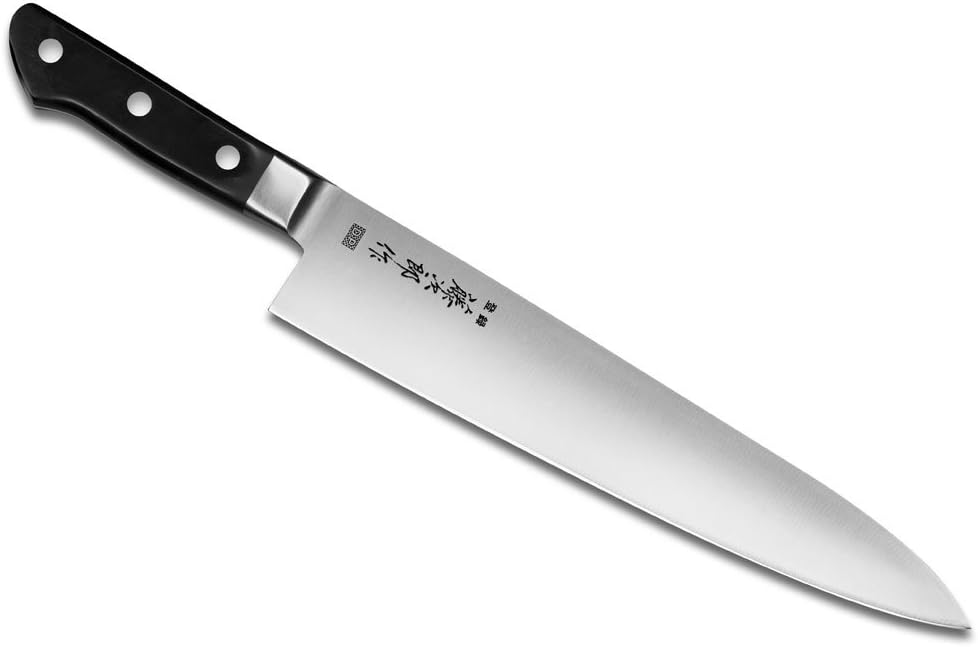 Tojiro DP Gyuto (VG-10)
The legendary value king. A VG-10 core clad in stainless steel. It offers professional performance at an entry-level price. See Tojiro vs Shun.
Check Price on Amazon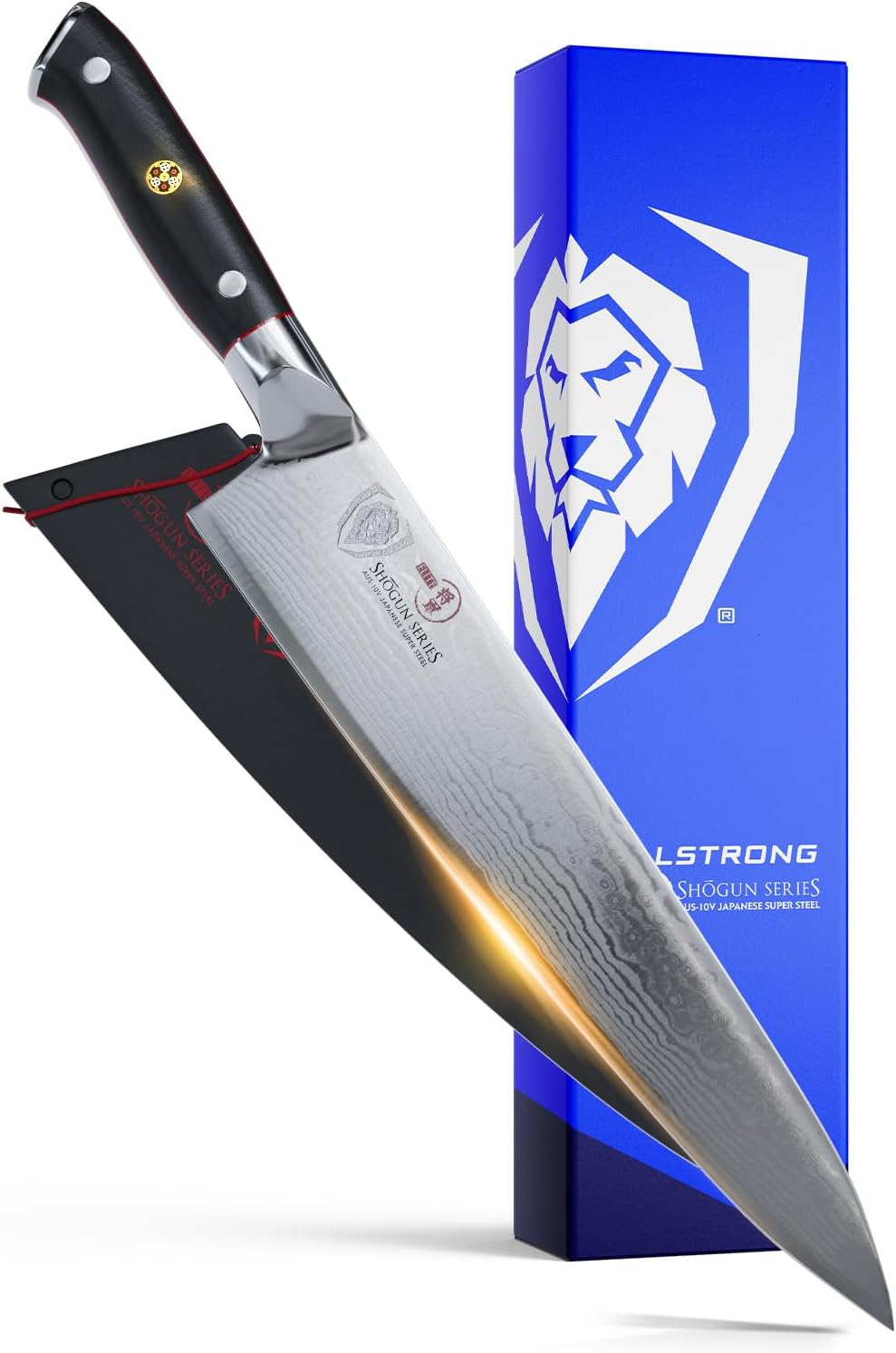 Dalstrong Shogun Series X (AUS-10V)
The modern powerhouse. Uses AUS-10V with a vacuum heat treatment. Stunning Damascus finish and G10 handle. See Dalstrong vs Wusthof.
Check Price on Amazon15. Which Steel for Which Knife?
Does the steel matter for the shape?
Vegetable Knives (Nakiri/Santoku)
For a Nakiri or Santoku, where you are chopping straight down on cutting boards, the extra toughness of AUS-10 is a benefit. It resists micro-chipping from board contact better than VG-10.
Detail Knives (Paring/Utility)
For a Paring Knife, VG-10 is excellent. It allows for a laser-thin geometry that glides through fruit skins.
Heavy Duty (Cleaver/Boning)
Honestly? Neither. For heavy tasks like breaking down chickens or hacking pumpkins, you should use softer German steel or a meat cleaver. Both VG-10 and AUS-10 are too brittle for bones.
Gyuto and Chef’s Knives
For an all-purpose Gyuto or Western chef’s knife — the workhorse of most kitchens — either steel performs admirably, and the decision often comes down more to handle comfort and blade profile than the steel itself. If you rock-chop on a wooden board with real force, lean AUS-10; if you use a push-cut style on a softer board and prize razor-thin geometry, VG-10 has a slight edge.
16. Single Bevel vs Double Bevel: Does It Change the Steel Comparison?
Most Western-style Gyutos and Santokus made from VG-10 or AUS-10 use a double bevel edge — both sides of the blade are ground symmetrically, making the knife suitable for both left- and right-handed use and generally easier to maintain. Traditional single-bevel knives (like a Yanagiba or Usuba), by contrast, are ground almost entirely on one side, producing an extremely acute cutting edge ideal for precise slicing tasks like sashimi preparation, but requiring specialized sharpening technique and handedness-specific grinding.
Single-bevel knives in VG-10 exist but are less common than double-bevel; AUS-10 single-bevel knives are rarer still, since AUS-10’s marketing has focused mostly on Western-style double-bevel products. If you’re specifically hunting for a traditional single-bevel Japanese knife, you’ll find a noticeably wider selection in VG-10 (and traditional carbon steels like White #2 or Blue #2) than in AUS-10.
17. Weight and Balance Considerations
Steel choice has only a small direct effect on a finished knife’s weight, since blade thickness, handle material, and tang style matter far more. That said, AUS-10’s toughness advantage does let some manufacturers grind it slightly thinner behind the edge without worrying as much about chipping, which can produce a marginally lighter, more nimble-feeling blade at the same nominal thickness spec compared to an equivalent VG-10 knife ground more conservatively.
Balance point (where the knife feels like it pivots in your hand) is influenced far more by handle material and tang design than by steel type. A full-tang G10-handled AUS-10V knife will typically balance closer to the bolster or slightly handle-heavy, while a lightweight wa-handled VG-10 Gyuto with a partial tang will balance more toward the blade — a difference in construction, not in the steel itself.
18. Cryogenic Treatment in Modern Blade Making
Some premium manufacturers subject VG-10 and AUS-10 blades to a cryogenic treatment step after the initial hardening quench — chilling the steel to sub-zero temperatures (sometimes using liquid nitrogen) before tempering. The goal is to convert any leftover retained austenite (a softer, less stable crystal structure that can remain after quenching) into martensite, the harder structure responsible for edge-holding performance. Properly executed cryogenic treatment can modestly improve both hardness consistency and wear resistance in either steel.
Not every manufacturer using VG-10 or AUS-10 performs this step, and it’s rarely advertised prominently outside of enthusiast-focused brands, so if edge retention is your top priority, it’s worth asking or researching whether a specific model includes cryogenic processing rather than assuming based on steel name alone.
19. Maintenance: Rust and Care
Both are stainless, but they are high-carbon. They are not stain-proof.
- Rust: VG-10 has slightly higher Chromium, making it marginally more rust-resistant than AUS-10. However, both will spot if left wet. (Learn how to remove rust).
- Storage: Never throw them in a drawer. Use a drawer organizer or magnetic strip.
- Dishwasher: NEVER. Heat destroys the temper and harsh detergents corrode the edge. See our dishwasher safe guide for why.
Beyond the basics, a light coating of food-safe mineral oil on the blade before extended storage (especially in humid climates) adds meaningful protection for either steel, and drying the blade immediately after washing — rather than letting it air dry — prevents the vast majority of spotting complaints owners report online.
20. Patina Formation: Should You Worry About Discoloration?
Because both VG-10 and AUS-10 are true stainless steels (not carbon steels like White #2 or Blue #2), they generally do not develop the deep blue-gray patina associated with traditional Japanese carbon steel knives. What owners occasionally see instead is localized spotting or light staining, usually from prolonged contact with acidic foods like citrus, tomato, or onion, left uncleaned for extended periods. This is cosmetic surface oxidation rather than the intentional protective patina carbon-steel users cultivate, and it can typically be removed with a paste of baking soda and water or a dedicated rust eraser, without affecting the blade’s performance.
If you specifically want a knife that develops a traditional patina as a badge of honor over years of use, neither VG-10 nor AUS-10 is the right choice — you’d want a genuine high-carbon (non-stainless) Japanese steel instead, and that’s a meaningfully different maintenance commitment than either steel discussed here requires.
21. Corrosion Resistance: What Lab Testing Shows
Beyond marketing claims, corrosion resistance can be tested more rigorously using a salt spray (fog) test, where samples are exposed to a controlled saline mist for a set number of hours and then evaluated for surface rust and pitting. Steels with higher chromium and molybdenum content generally perform better in these tests, since both elements help stabilize the passive oxide layer that gives stainless steel its rust resistance.
Given VG-10’s higher chromium (14.5-15.5% vs AUS-10’s 13.0-14.5%) and substantially higher molybdenum content, it’s reasonable to expect VG-10 to outperform AUS-10 in a controlled salt-spray comparison, and this generally lines up with informal owner reports and enthusiast forum testing over the years. The real-world difference is modest, however — both steels are firmly in the “high-performance stainless” category, and neither will develop meaningful rust with reasonably attentive care (drying after washing, avoiding prolonged wet storage).
22. Price Tier Buying Guide: What to Expect at Each Budget
Knife pricing depends on far more than steel alone — construction quality, handle materials, brand reputation, and country of manufacture all factor in — but here’s a general sense of what buyers typically encounter at different price points for knives using these two steels.
- Entry-level ($40-$90): Expect stamped (rather than forged) blades, simpler handle materials, and less refined heat treatment consistency. VG-10 knives at this tier, like the Tojiro DP line, are often praised as exceptional value because Tojiro applies a genuinely solid heat treatment even at accessible pricing.
- Mid-range ($90-$180): This is where most AUS-10V knives from brands like Dalstrong live, typically featuring forged full-tang construction, Damascus cladding for aesthetics, and G10 or Pakkawood handles.
- Premium ($180-$350+): Shun’s VG-MAX line and Miyabi’s higher-tier offerings sit here, along with hand-finished traditional wa-handled Gyutos, often featuring more meticulous distal tapers and hand-polished finishes.
- Ultra-premium ($350+): Custom or semi-custom makers working with either steel family, or knives incorporating powder-metallurgy steel cores alongside VG-10 or AUS-10 cladding for aesthetic Damascus patterns.
A useful rule of thumb: within the same price tier, construction quality and heat-treat consistency usually matter more to real-world performance than which of these two steels is used.
23. Brand Comparisons
How do brands utilize these steels?
- Shun (VG-MAX): Shun uses a proprietary version of VG-10. It is excellent but pricey. (See Shun vs Wusthof).
- Miyabi (FC61/SG2): Miyabi often skips standard VG-10 for FC61 (tougher) or SG2 (harder). (See Miyabi vs Shun).
- Global (Cromova 18): Global uses a softer, tougher steel than either VG-10 or AUS-10. (See Global vs Wusthof).
- Dalstrong (AUS-10V): They champion AUS-10V in their top tier. (See Dalstrong vs Zwilling).
24. What Do Professional Chefs Actually Say?
Ask a room full of working line cooks and chefs about VG-10 vs AUS-10 and you’ll get a surprisingly practical, non-tribal answer compared to enthusiast forums. Most professionals care less about the specific alloy and more about three things: does the knife hold a working edge through a full service, can it be touched up quickly on a steel or stone between tasks, and does it survive being occasionally set down harder than it should be during a rush.
On those practical terms, chefs who prioritize speed of touch-up between prep sessions often gravitate toward AUS-10’s easier sharpening feel, especially in high-volume kitchens where there’s no time for a slow, glassy VG-10 edge to be brought back with a coarse steel. Chefs working more delicate, precision-focused stations (garde manger, sushi prep) more often reach for VG-10’s ability to hold an extremely fine, thin edge for detailed cuts. Neither preference is universal, and plenty of professional kitchens run both steels side by side without issue.
25. Common Myths About Japanese Steel
- Myth: “Higher HRC always means a better knife.” In reality, hardness is only useful in proportion to toughness. A knife hardened past what its intended use can tolerate simply chips more, regardless of steel name.
- Myth: “VG-10 and AUS-10 are basically carbon steel.” Both are true stainless steels with substantial chromium content; they behave nothing like a genuine carbon steel such as White #2 in terms of rust behavior or patina formation.
- Myth: “A stamped blade in AUS-10 or VG-10 is automatically inferior to a forged one.” Stamped blades cut from pre-hardened steel sheet can perform very well; construction quality and heat treatment consistency matter more than stamped-vs-forged status alone.
- Myth: “More expensive always means better steel performance.” Price often reflects handle materials, brand marketing, and finishing labor as much as it reflects the underlying alloy’s actual cutting performance.
26. Sustainability and Ethical Sourcing
Steel production is an energy-intensive process, and buyers increasingly ask about the environmental footprint of their kitchen tools. Both Takefu Special Steel and Aichi Steel operate within Japan’s broader industrial regulatory framework, which includes emissions standards for steel manufacturing, though neither company publishes cutlery-specific sustainability data as prominently as some outdoor gear or apparel brands do for their supply chains.
From a longevity standpoint, a well-maintained VG-10 or AUS-10 knife easily lasts decades with proper care and periodic sharpening, which is arguably the single biggest sustainability factor for any kitchen tool — a knife you keep and maintain for twenty years has a dramatically smaller lifetime footprint than several cheap knives replaced every few years. Choosing a reputable brand with available sharpening services, spare parts, and a track record of long-term support (rather than the cheapest available option) is a meaningful sustainability decision in its own right.
27. Warranty and Customer Service Comparison
Warranty terms vary far more by brand than by steel type, but it’s worth knowing what’s typical. Shun, for instance, has historically backed its VG-10 and VG-MAX knives with a lifetime warranty against manufacturing defects, alongside a free sharpening service for the life of the knife when mailed to their facility — a genuinely valuable perk for anyone not confident sharpening at home. Tojiro, being a more budget-focused brand, typically offers more limited manufacturer support, relying instead on its reputation for low prices and strong out-of-box heat treatment.
On the AUS-10 side, Dalstrong has built its brand partly around generous consumer-facing guarantees, commonly including extended trial periods and lifetime warranties against manufacturing defects, reflecting the newer, direct-to-consumer sales model the brand grew up in compared to more traditional Japanese exporters.
Before buying, it’s worth checking current warranty terms directly with the manufacturer, since policies change over time and vary by specific product line even within the same brand.
28. Left-Handed Considerations
For double-bevel Western-style Gyutos and Santokus made from VG-10 or AUS-10, handedness is largely a non-issue — symmetrical grinds work equally well in either hand. The consideration becomes more relevant for single-bevel traditional Japanese knives, where a right-handed grind will actively fight a left-handed user’s cutting technique, causing the blade to wander off a straight line. Left-handed cooks specifically shopping for single-bevel VG-10 knives should look for models explicitly labeled “left-handed” or “sabaki,” since standard stock is almost always ground for right-handed use, and true left-handed single-bevel AUS-10 knives are rare enough that VG-10 (or traditional carbon steel) will likely be the more realistic option if a single-bevel blade is the goal.
29. Accessories You’ll Need to Keep Either Steel Performing
Whichever steel you choose, a few accessories make a meaningful difference in long-term performance:
- Whetstones: A combination stone (roughly 1000/6000 grit) covers both repair sharpening and fine polishing for either steel. See our whetstone guide.
- Honing rod: A ceramic (rather than traditional steel) honing rod is gentler on the harder, more brittle edges typical of both VG-10 and AUS-10.
- Cutting boards: Wood or soft plastic boards reduce edge stress dramatically compared to glass, stone, or bamboo end-grain-free boards, extending the practical life of either steel’s edge.
- Blade guards or a proper knife block: Protects the edge from unnecessary drawer contact, which is one of the most common (and avoidable) sources of chipping reported by owners of both steels.
- Mineral oil: A light food-safe oil coating protects against spotting during storage in humid environments.
Frequently Asked Questions (FAQ)
It isn’t “better,” it is different. AUS-10 is generally tougher and easier to sharpen. VG-10 has slightly better corrosion resistance and a higher hardness ceiling due to Cobalt. For most home cooks, AUS-10 is more forgiving.
They are “stain-resistant,” not rust-proof. If you leave lemon juice on them or let them air dry, they can develop rust spots. Always wash and dry immediately.
VG-10 technically has higher wear resistance due to the Cobalt, but AUS-10V (the vacuum heat-treated version) is extremely close. In a home kitchen, you likely won’t notice a difference in edge retention.
Yes. While often associated with forged knives, high-end stamped knives can use these steels. The manufacturing method matters less than the heat treatment. (See Stamped vs Forged).
The “V” generally refers to a vacuum-hardening heat treatment process rather than a different chemical recipe. Vacuum treatment produces a more consistent, refined grain structure, which is why AUS-10V is often marketed as a step up from standard furnace-hardened AUS-10.
Powder-metallurgy steels like SG2 and S30V generally outperform both VG-10 and AUS-10 in edge retention thanks to their finer, more uniform carbide structure, but they cost significantly more to produce. VG-10 and AUS-10 remain the better value choice for most home cooks.
No. Dishwasher heat and detergents can damage the temper and dull or corrode the edge over time. Both steels should be hand washed and dried immediately.
Generally no. Both are true stainless steels, so they don’t develop the deep patina associated with traditional Japanese carbon steel. Any discoloration you see is typically light surface staining that can be cleaned off.
AUS-10 is generally considered the friendlier option for beginners, since it removes material more quickly on the stones and gives faster feedback, making it easier to learn consistent angle control.
Conclusion: The Verdict
The battle of AUS-10 vs. VG-10 is a battle of nuance.
Choose VG-10 (e.g., Shun, Tojiro) If: You want the “Gold Standard.” You prioritize corrosion resistance and want a steel with a massive track record of success in professional kitchens.
Choose AUS-10 (e.g., Dalstrong, Misen) If: You want a “Modern Workhorse.” You want ease of sharpening and a blade that is slightly less prone to chipping when you get enthusiastic with your chopping.
Both are miles ahead of standard German steel in terms of pure cutting performance. Whichever you choose, ensure you have the right sharpening tools to keep that edge singing.