Global vs. Wusthof: Which Knife Heavyweight Belongs in Your Kitchen?
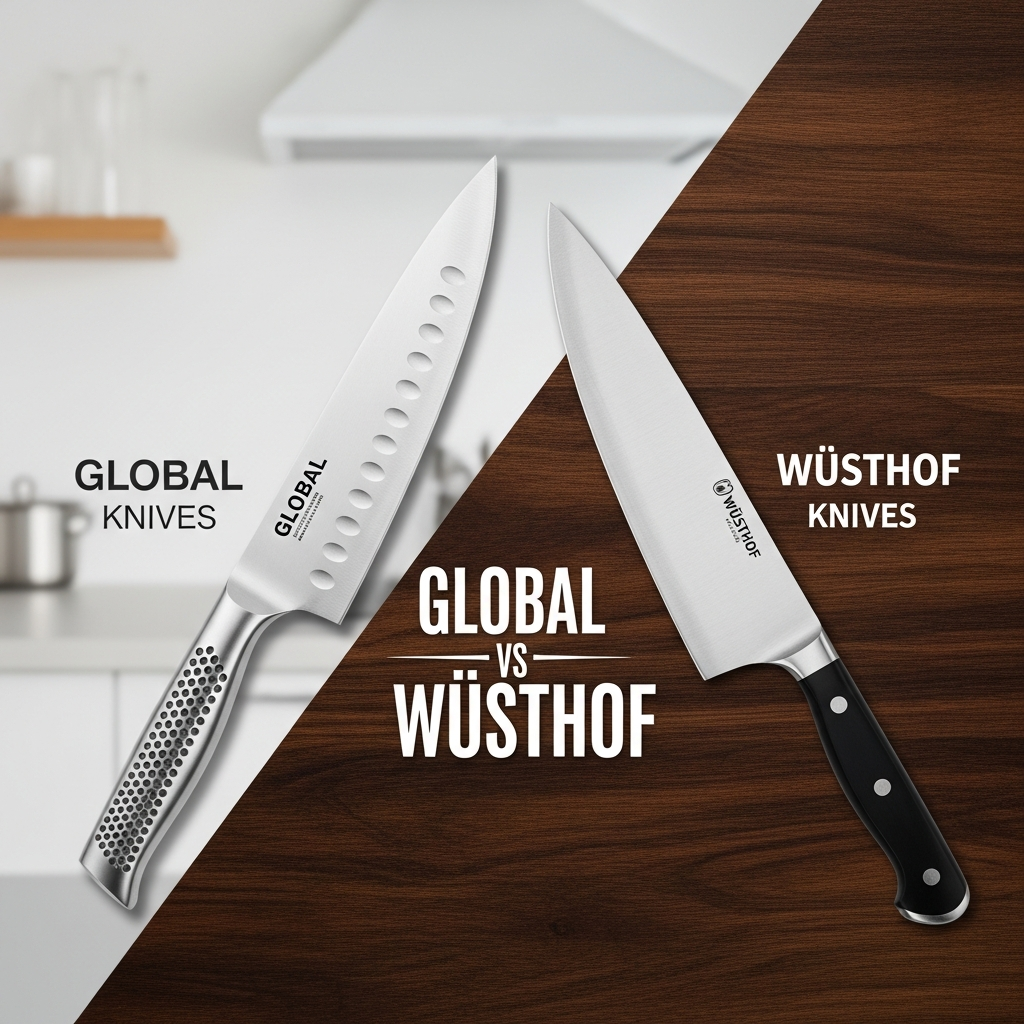
In the world of professional cutlery, the battle between Global and Wusthof is a clash of philosophies. It is East vs. West. It is lightweight agility vs. heavyweight durability. It is the modern stainless steel monobloc vs. the classic riveted handle.
If you are browsing knifeindex.com/ trying to decide between these two titans, you are not alone. They are arguably the two most recognizable knife brands in professional kitchens worldwide. But they feel completely different in the hand.
In this comprehensive guide, we will dissect the steel, the ergonomics, and the performance of both. Whether you are comparing them to Shun or looking for the best chef knife brands for your specific grip style, this guide has the answers.
1. The Contenders: Japanese Modern vs. German Classic
Wüsthof: The Solingen Powerhouse
Wüsthof is the definitive German knife. Made in Solingen (“The City of Blades”) since 1814, they represent the Western ideal: heavy, thick-spined, and virtually indestructible. They feature a full tang, a bolster for balance, and a belly curved for “rock chopping.” They are the rugged workhorses found in best German kitchen knives lists everywhere.
Global: The Samurai of the Future
Global burst onto the scene in 1985 from Japan, designed by Komin Yamada. They rejected tradition entirely. Global knives are lightweight, bolster-free, and feature a seamless all-steel construction with a hollow handle filled with sand for perfect balance. They are razor-sharp and designed for precision slicing, earning them a top spot among the best Japanese kitchen knives.
External Insight
For a deeper dive into the history and specific steel compositions, Prudent Reviews offers a fantastic breakdown of the rivalry: Wusthof vs. Global: The Definitive Comparison.
1a. Where They’re Made: Solingen vs. Niigata
Geography shapes philosophy just as much as steel chemistry does, and understanding the two manufacturing towns behind these brands explains a lot about why the knives feel the way they do. Solingen, tucked into the hills of North Rhine-Westphalia in Germany, has been a center of blade-making since the medieval period. Guilds of smiths settled along the fast-flowing Wupper river because the current could power grinding wheels, and the tradition of heavy, durable, forged steel took root there centuries before “chef’s knife” was even a phrase in English. Wüsthof’s factory sits within that lineage, and the company still markets itself heavily on the “Made in Solingen” stamp, treating it the way a Swiss watchmaker treats “Made in Switzerland.”
Niigata, on Japan’s western coast, tells a completely different story. The prefecture became known for metalwork not because of knives specifically but because of a broader tradition in tableware and hardware manufacturing, including cutlery, scissors, and gardening tools. Global’s founder wanted to break from the katana-inspired aesthetic that dominated Japanese blade making at the time and instead build something that looked and felt like industrial design from the future. The factory that produces Global knives, Yoshikin, still handles the entire process in-house, from steel stamping to the final hand-finishing of the dimpled handle.
This difference matters for buyers who care about provenance. A Wüsthof purchase supports a 200-year-old family-run business with deep roots in a single town’s identity. A Global purchase supports a newer, design-forward Japanese manufacturer that intentionally distanced itself from tradition to create something modern. Neither approach is “better,” but the marketing language around each brand leans hard into its origin story, and it is worth knowing what you are actually paying for beyond the steel itself.
1b. Stamped vs. Forged: Clearing Up a Common Myth
One of the most persistent points of confusion in the Global vs. Wüsthof conversation is the stamped-versus-forged debate, and most articles online oversimplify it. The common assumption is that Wüsthof knives are always forged and Global knives are always stamped, with forged treated as automatically superior. The reality is more nuanced.
Wüsthof’s mainline Classic and Classic Ikon series are indeed drop-forged from a single billet of steel, which is part of why they carry a full bolster and feel so substantial in hand. However, Wüsthof also sells stamped lines aimed at lower price points, and those knives trade some of that heft for affordability.
Global, on the other hand, is often assumed to be entirely stamped, and while that is true for the bulk of the standard G-Series lineup, the brand also produces a smaller “Classic Forged” sub-collection, sometimes labeled with a “GF” prefix on the model number. These forged Global knives include specific vegetable knives, boning knives, butcher’s knives, and a handful of chef’s knife lengths. If you see “Global GF” instead of just “Global G,” you are looking at one of these forged variants, which typically carries a bit more heft than the standard stamped range while keeping Global’s signature handle design.
The practical takeaway: forged construction generally means a thicker spine, more perceived durability, and a higher price tag, while stamped construction means a lighter blade that some cooks find easier to maneuver for long prep sessions. Neither method determines sharpness on its own — that comes down to steel hardness, edge angle, and how the factory grinds the bevel. Don’t let “forged” alone convince you a knife is automatically the better performer; it is one variable among several.
2. Head-to-Head: The Specs Breakdown
Let’s compare the flagship lines: The Wüsthof Classic vs. the Global Classic (G-Series).
| Feature | Wüsthof Classic | Global Classic (G-2) |
|---|---|---|
| Steel | X50CrMoV15 (German) | CROMOVA 18 (Japanese) |
| Hardness (HRC) | 58 | 56-58 |
| Edge Angle | 14° per side (PEtec) | 10-15° per side (Straight) |
| Weight | Heavy / Substantial | Very Lightweight |
| Handle | Synthetic (POM), Riveted | Stainless Steel (Sand Filled) |
| Bolster | Full or Half Bolster | No Bolster |
2a. Weight and Balance, In Exact Numbers
“Heavy” and “lightweight” only tell you so much. Once you actually put both 8-inch chef’s knives on a kitchen scale, the difference becomes concrete rather than anecdotal. The Wüsthof Classic 8-inch chef’s knife typically weighs somewhere in the neighborhood of 8 ounces (roughly 225 grams), depending on the exact production run and handle material. The Global G-2 8-inch chef’s knife, by contrast, usually comes in closer to 5.6 to 6 ounces (around 160-170 grams). That’s a difference of over 2 ounces concentrated entirely in a tool you are gripping for potentially hours during a busy prep shift.
Balance point matters just as much as total weight. Wüsthof’s bolster shifts the center of mass forward and slightly down, near the heel of the blade, which is part of why the knife feels so planted during a rocking chop. Global’s sand-filled handle was engineered specifically to counterbalance the thin blade, placing the center of mass almost exactly at the point where your index finger and thumb pinch the bolster-less collar. The result is a knife that feels almost weightless in a pinch grip but can feel slightly tip-light if you try to use a hammer grip more suited to Western-style knives.
For cooks who suffer from wrist or hand fatigue, particularly those managing early-stage arthritis or repetitive strain concerns, this gram-level difference compounds over a full prep list. Multiply a 2-ounce difference by hundreds of chopping motions and the cumulative strain on tendons becomes measurable. This is one of the most frequently cited reasons professional line cooks switch from German to Japanese-style knives partway through their careers, even when they started out trained on Wüsthof or Zwilling.
3. Design & Ergonomics: The “Feel” Factor
The Handle
This is the most polarizing difference.
Wusthof handles are contoured and bulky. They fill the hand and are comfortable for a variety of grips. If you have large hands, Wusthof usually feels better.
Global handles are slim, smaller, and covered in signature black dimples for grip. They are excellent for smaller hands, but some chefs find them slippery when hands are greasy or wet.
Weight and Balance
Wusthof relies on heft. The weight of the knife helps drive it through dense foods like squash. It feels authoritative.
Global relies on agility. They are feather-light. You can chop for hours without wrist fatigue, but you have to provide the downward force yourself. If you are looking for knives that feel fast, Global wins.
4. Performance in the Kitchen
The Chef’s Knife Battle
The Wusthof Classic 8-inch vs. the Global G-2 is the main event. (Unsure why this knife matters? Read what is a chef knife used for).
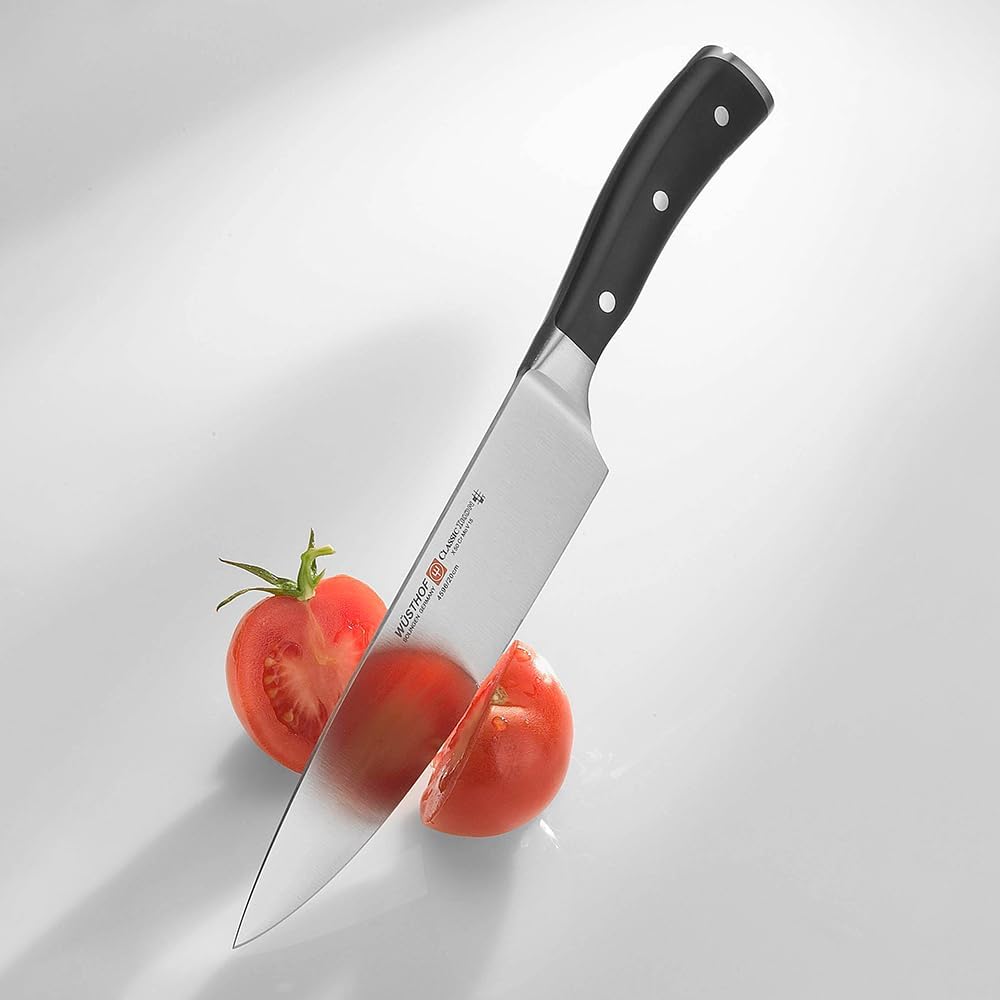 Wüsthof Classic Ikon 8″ Chef’s Knife
The rugged icon. Perfect for rock-chopping herbs and disjointing chicken. The heavy bolster protects your fingers and balances the blade.
Check Price on Amazon Global G-2 8″ Chef’s Knife
The nimble slicer. Thin, sharp, and precise. It lacks a bolster, allowing you to use the full length of the blade. Ideal for slicing vegetables.
Check Price on AmazonSpecialty Knives
- Vegetables: Global excels here. Their Nakiri knives are laser-thin and glide through onions without wedging. Wusthof’s thicker spine can sometimes crack a carrot before cutting it.
- Bread: Wusthof wins. Their heavy, stiff serrated knives tackle crusty sourdough better than the flexible Global blades.
- Detail Work: Global’s small paring knives feel like a scalpel, offering incredible control for peeling.
4a. Full Task-by-Task Breakdown: Santoku, Cleaver, Boning, and More
The chef’s knife gets all the attention, but most kitchens rely on a rotation of five or six blade shapes across a normal week of cooking, and each brand handles those specialty shapes differently. Here’s a deeper look beyond the chef’s knife.
Santoku
Global’s santoku (the G-48 in their standard lineup) is arguably the knife the brand is most famous for among home cooks, thanks to its flat profile and the dimpled “Granton” style hollows ground into the blade face that are supposed to reduce food sticking. Wüsthof also makes a santoku, typically with a slightly more curved belly than a traditional Japanese santoku, which makes it feel like a hybrid between a santoku and a compact chef’s knife. If you want an authentically flat-profile santoku for a push-cut technique, Global’s version is closer to the traditional Japanese shape.
Nakiri
This double-beveled vegetable cleaver is where Global genuinely dominates. The thin, rectangular blade is designed purely for straight down-and-up chopping of vegetables, and Global’s version is light enough to use for a solid twenty minutes of prep without fatigue. Wüsthof does not currently offer a dedicated nakiri in most of its core lines, which is a real gap for vegetable-forward home cooks comparing the two brands directly.
Cleaver
Neither brand is known primarily for cleavers, but Wüsthof’s heavier construction philosophy translates better to the occasional need to break down poultry joints or crack through small bones. Global does sell a vegetable cleaver, but it is explicitly not designed for bone work, and using it that way risks chipping the thin edge.
Boning and Utility Knives
Both brands offer flexible boning knives, and this is a category where personal preference outweighs brand loyalty. Wüsthof’s boning knife has a bit more flex and a comfortable, grippy handle that some find easier to control around joints. Global’s boning knife is stiffer but offers more precise tip control for detailed trimming work, such as removing silver skin from a tenderloin.
Bread Knives
As mentioned above, Wüsthof’s serrated bread knife is the stronger performer here thanks to its stiffness and length options, which make it easier to saw through a tough crust without compressing the crumb. Global’s bread knife exists but is less commonly recommended, since the thin, sand-filled handle doesn’t provide quite the same leverage over a large domed loaf.
5. Durability and Maintenance
This is where the stamped vs forged debate usually happens, though Global is technically stamped/welded and Wusthof is forged.
- Chipping: Global’s steel (CROMOVA 18) is tough, but the edge is ground very thin. It is more prone to micro-chipping on bones than Wusthof’s robust edge.
- Rust: Global is extremely rust-resistant (high chromium), but not immune. Wusthof is also very stain-resistant. Both need to be kept dry. See how to remove rust if you spot any.
- Sharpening: Wusthof is easier to hone. Global requires a specific angle (10-15 degrees). You cannot use a standard German pull-through sharpener on a Global knife; it will ruin the edge. Check our best knife sharpener guide for water stones suitable for Global.
5a. Price, Value, and Cost Per Year of Ownership
Sticker price is rarely the full story with premium cutlery, and the Global vs. Wüsthof comparison is a good example of why cost-per-year matters more than upfront cost. At full retail, an 8-inch Wüsthof Classic chef’s knife and an 8-inch Global G-2 chef’s knife tend to land in a similar bracket, usually somewhere in the $100-$160 range depending on sales and retailer, though Wüsthof’s Ikon and Classic Ikon lines can run noticeably higher due to the added bolster work and the more labor-intensive forging process.
| Cost Factor | Wüsthof Classic | Global G-Series |
|---|---|---|
| Typical 8″ Chef’s Knife Price | Mid-to-upper premium tier | Mid-to-upper premium tier |
| Resharpening Frequency | Lower (thicker edge holds a working edge longer) | Higher (thin edge dulls sooner but takes an edge faster) |
| Professional Sharpening Cost | Standard rate, any sharpener | Slightly higher if a specialist angle is required |
| Expected Lifespan | Decades with care | Decades with care |
| Warranty | Limited lifetime against manufacturing defects | Limited lifetime against manufacturing defects |
Where the real cost divergence shows up is in the sharpening habit each brand demands. Because Global’s edge is ground thinner, it takes an edge beautifully on a whetstone but also loses that edge slightly faster in daily use, especially if it is used on a hard cutting board or occasionally makes contact with bone. Wüsthof’s slightly thicker edge geometry holds a “good enough” working edge for longer stretches between sharpenings, which some home cooks value simply because they don’t own a whetstone and rely on a honing rod between professional sharpenings.
If you buy a full block set rather than individual knives, the price gap widens. Wüsthof’s block sets tend to bundle in specialty pieces like kitchen shears and a honing steel, while Global’s block sets are typically leaner, focused purely on blades. Neither is a bad value, but if you want an all-in-one purchase with accessories included, Wüsthof sets often edge out Global sets on included extras for a comparable price point.
5b. Warranty and Customer Support Comparison
Both companies back their knives with a limited lifetime warranty against manufacturing defects, but “manufacturing defect” is doing a lot of work in that sentence, and it is worth understanding what is and is not covered before you buy.
Wüsthof’s warranty, administered in most regions through its official distributor network, covers issues like a blade that separates from the handle, a rivet that fails, or steel that develops a defect unrelated to normal wear. It does not cover chips from bone contact, rust from improper drying, or damage from dishwasher use, all of which are considered misuse rather than defects. Wüsthof is also known for a responsive customer service team that can often be reached directly for questions about specific model numbers or production years, which matters if you inherited an older knife and want to confirm its lineage.
Global’s warranty operates similarly, again covering manufacturing defects in the weld between blade and handle or in the steel itself, but not covering edge chips or corrosion from neglect. Because Global knives are distributed more heavily through third-party retailers in some regions, warranty claims sometimes need to be routed through the retailer rather than the manufacturer directly, which can add an extra step compared to Wüsthof’s more centralized support model.
Neither company will replace a knife because you don’t like how it performs, and neither warranty covers cosmetic wear like handle scratches or blade patina that develops naturally over years of use. If a warranty claim is central to your buying decision, keep your original receipt and register the knife where the manufacturer allows it.
5c. Knife Sets and Block Comparisons
Buying a full block set instead of individual pieces changes the calculus in a few important ways. Wüsthof’s block sets, such as their popular 7-piece and 10-piece Classic sets, are built around a philosophy of “one knife for every job,” typically bundling a chef’s knife, a paring knife, a bread knife, a utility knife, kitchen shears, a honing steel, and the wooden block itself. This makes them a strong choice for someone furnishing a kitchen from scratch who doesn’t want to research individual blade shapes.
Global’s block sets, like the G-6316 or similar bundles, tend to be more minimalist, usually including a chef’s knife, a utility knife, a paring knife, and sometimes a santoku, packaged in a slim block designed to match the brand’s understated aesthetic. Global rarely bundles shears or a honing steel into its sets, reflecting the brand’s overall design ethos of doing fewer things but doing them precisely.
For a household that cooks a wide variety of foods and wants full coverage in one purchase, a Wüsthof set often delivers more functional value out of the box. For a cook who already owns a few specialty tools and just wants an elegant, lightweight core trio for daily prep, a Global set fits that use case more naturally.
5d. Resale Value and Long-Term Ownership
Both brands hold their value reasonably well on the secondhand market, particularly compared to budget cutlery brands that lose most of their value the moment they leave the box. Wüsthof knives, especially older Solingen-stamped pieces from past decades, sometimes attract a small collector’s premium because the steel formulations and stamping methods used decades ago are seen as slightly different in character from current production, and long-time users often seek out specific vintage runs.
Global knives, being a younger brand overall, don’t yet have quite the same collector’s market, but well-maintained pieces still sell reliably on the secondhand market because the design has remained largely consistent since the 1980s, meaning even an older Global knife looks and performs almost identically to a current one. If long-term resale value matters to your purchasing decision, both brands are safer bets than most competitors, but Wüsthof’s longer manufacturing history gives it a slight edge in the collector and heritage-buyer segment.
6. Brand Comparisons
If neither feels right, consider these alternatives:
- Vs. Shun: Shun is “true” Japanese (Damascus, VG-MAX). Global is a hybrid. Shun is harder and prettier but more fragile. (See Dalstrong vs Shun for similar comparisons).
- Vs. Zwilling: Zwilling is Wusthof’s twin. If you like Wusthof but want a different handle shape, Zwilling is the answer. (See Zwilling vs Henkel).
- Vs. Victorinox: If you love the lightness of Global but hate the price, Victorinox is the budget alternative. (See Victorinox Chef Knife Reviews).
6a. Who Should Buy Which: Four Buyer Profiles
The Home Cook Furnishing a First “Real” Kitchen
If you are moving away from a mismatched drawer of hand-me-down knives and want one purchase that covers almost everything, a Wüsthof block set is the more forgiving choice. It bundles the shapes most home cooks actually reach for, the heft is forgiving of imperfect technique, and the bolster protects your fingers if your knife skills are still developing.
The Precision-Focused Home Cook or Aspiring Chef
If you already have decent knife skills and care more about slicing thinly and evenly than about brute-force chopping, Global rewards that skill level. The lightweight blade responds to subtle wrist movement, and the thin edge produces cleaner slices on delicate ingredients like fish, herbs, and soft produce.
The Professional Line Cook
Professional kitchens often end up with a mix of both brands on the line, precisely because different stations benefit from different tools. A butchery or heavy-prep station leans Wüsthof for durability under high-volume, repetitive use, while a garde manger or sushi-adjacent station leans Global for precision slicing. Many working chefs simply own both and reach for whichever suits the task in front of them.
The Gift Buyer
Buying a knife as a gift is trickier than it looks, since hand size and grip preference vary so much. If you know the recipient has larger hands or does a lot of heavy vegetable prep, Wüsthof is the safer, more universally comfortable gift. If the recipient has smaller hands, already owns basic knives, or has expressed interest in precision Japanese-style cutting, a Global piece reads as a more considered, design-forward gift.
7. Comments From the Community: What Real Buyers Say
Beyond the spec sheets, one of the more useful signals when choosing between these two brands is what long-term owners actually report after years of daily use, rather than an initial unboxing impression. Across cooking forums and review comment sections, a few consistent themes repeat often enough to be worth summarizing here.
Wüsthof owners frequently mention that the knife “grew on them” after an adjustment period, particularly cooks who started with lighter Japanese-style blades and found the German heft awkward at first. Within a few weeks, most report that the weight starts to feel like an asset rather than a burden, especially for repetitive tasks like breaking down a case of onions or a bag of potatoes. The most common complaint centers not on performance but on care: a Wüsthof left wet in a sink for even a single afternoon can develop faint water spotting on the bolster, which some owners find frustrating given the knife’s premium price.
Global owners tend to describe a shorter adjustment period simply because the knife feels intuitive from the first use, but the most repeated long-term concern is edge retention under heavy use. Owners who use their Global knife daily in a professional or semi-professional setting often report needing a touch-up on a fine stone every week or two to maintain peak sharpness, whereas an occasional home cook using the knife a few times a week might go a month or more between sharpenings. The dimpled handle also draws mixed reactions: some owners love the tactile grip, while others, particularly those with larger hands, find the handle circumference a bit small for a full four-finger grip.
A smaller but recurring theme across both communities is the “one of each” strategy: rather than treating this as a strict either/or decision, a meaningful share of serious home cooks eventually end up owning at least one knife from each brand, using the Wüsthof for heavier, more forgiving prep and the Global for fine, precision work. If your budget allows it, this hybrid approach sidesteps the debate entirely by letting each brand do what it does best.
8. Care and Maintenance Routine: A Practical Weekly Guide
Because both of these knives represent a meaningful investment, a consistent care routine pays off over years of ownership. Below is a practical maintenance rhythm that applies to both brands, with notes on where the routine diverges.
After Every Use
Hand wash immediately in warm, soapy water using a soft sponge, never an abrasive scrubber. Dry the blade completely with a towel before storing it. This single habit prevents the vast majority of rust and water-spotting issues reported by owners of both brands.
Weekly
Hone the edge using a ceramic or fine steel rod. For Wüsthof, most standard honing steels sold alongside the brand work fine. For Global, look specifically for a honing rod without aggressive ridges, since Global’s straight-edge geometry does not respond well to the coarse, ridged steels bundled with many German knife sets.
Monthly to Quarterly
Assess the edge with a simple paper-slice test. If the blade tears rather than slices cleanly through a sheet of printer paper, it is time for a proper sharpening session on a whetstone. Wüsthof should be sharpened at roughly 14 degrees per side, while Global should be sharpened at 10 to 15 degrees per side, and mixing up these angles across knives is one of the most common at-home sharpening mistakes.
Storage
Avoid tossing either knife loose into a drawer, where the edge can chip against other utensils and where the exposed blade poses a real cutting hazard when reaching into the drawer. A dedicated drawer organizer or a magnetic strip keeps the edge protected and the blade visible, which is safer for households with children or roommates unfamiliar with the knives.
Frequently Asked Questions (FAQ)
NO. Both brands explicitly advise against it. The heat destroys the temper of the steel, and detergents are abrasive. For Global, the sand inside the handle can heat up and affect the weld. For Wusthof, handles can crack. Even dishwasher safe steak knives degrade over time. Hand wash only.
Yes, they are widely considered the best professional knife for small hands. The handles are slim and the lack of a bolster allows for a tight pinch grip. Wusthof handles can feel bulky if you have a smaller grip.
Do not use a honing steel designed for German knives (which usually have ridges). Use a ceramic rod or a whetstone. Global suggests a 10-15 degree angle. See our best knife electric sharpeners for models that have “Asian” slots suitable for Global.
Because they are welded (blade to handle), there is a myth that they snap. This is extremely rare in normal use. However, dropping a Global knife on a tile floor can snap the tip because the steel is hard and thin.
Most culinary programs teach classic French knife technique, including rock-chopping and a hammer grip, which lines up naturally with Wüsthof’s balance and bolster. Many students start with a Wüsthof or similar German-style knife for this reason, then add a lighter Japanese-style knife like Global later once their technique matures and they want a second knife for precision work.
Wüsthof currently offers a broader lineup, spanning roughly seven distinct collections that vary in handle material, bolster style, and price point, from the entry-level Gourmet line up through the premium Classic Ikon and Epicure ranges. Global’s core lineup is narrower, built mainly around the G-Series, with smaller Classic Forged and other specialty sub-lines rounding it out. If variety of handle colors, materials, or price tiers matters to you, Wüsthof currently gives you more to choose from.
No, and this applies equally to both brands. Glass, stone, and ceramic cutting boards are far harder than the steel edge of either knife and will dull or chip the blade rapidly, regardless of how expensive the knife is. Stick to wood or quality plastic cutting boards for either brand, and treat any “knife-friendly” claim on a glass board with skepticism.
Standard chef’s knives from both Wüsthof and Global are symmetrically ground and work equally well for right- and left-handed cooks. Where handedness matters more is in specialty single-bevel Japanese knives, which neither brand’s core mainstream lineup typically includes, so left-handed cooks generally do not need to seek out a special version of either brand’s standard chef’s, santoku, or utility knives.
Both brands use rust-resistant stainless steel, but “resistant” is not the same as “immune.” In consistently humid climates, or in coastal kitchens with salty air, both knives benefit from being dried immediately after washing and occasionally wiped with a light coat of food-safe mineral oil if they will sit unused for more than a few days. Global’s steel handle is slightly more prone to visible water spotting in humid conditions than Wüsthof’s synthetic handle, though the blade steel itself performs similarly on both.
Conclusion: The Verdict
The choice between Global vs. Wusthof is a choice between two different eras of cooking.
Choose Wüsthof If: You want a knife that feels invincible. You do heavy prep, cut tough vegetables (pumpkins, rutabaga), or prefer the rocking motion. It is the reliable choice that will last a lifetime.
Choose Global If: You want speed and precision. You slice a lot of soft vegetables and boneless meats. You have smaller hands or find heavy knives fatiguing. It is the surgical choice for the modern cook.
And if you genuinely can’t decide, remember that plenty of experienced cooks eventually own both, letting each knife handle the job it was actually designed for rather than forcing one blade to do everything.
Whichever you choose, protect the edge. Don’t toss them in a drawer; use a drawer organizer or a magnetic strip to show off that steel.