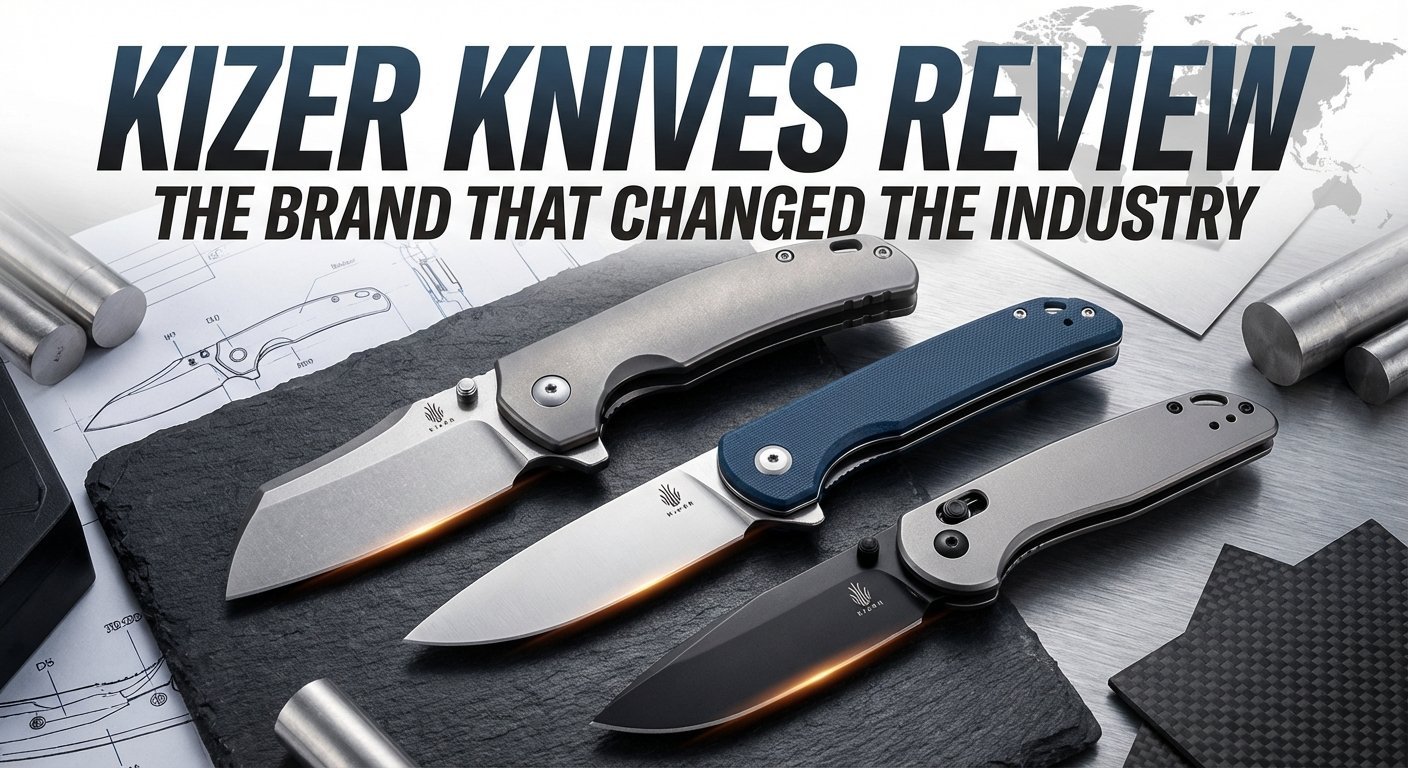
Kizer Knives Review: The Brand That Changed the Industry
In the last decade, the knife world has undergone a seismic shift, and one brand sits at the epicenter: Kizer Knives. Once upon a time, “Made in China” was synonymous with the cheap, disposable blades you’d find in M-Tech knife reviews. Kizer changed that narrative entirely. By utilizing premium USA-made steels, titanium handles, and collaborations with world-renowned designers, Kizer pioneered the “Premium Chinese Production” market. But with prices rising and competition fierce, are Kizer Knives still the best bang for your buck in 2024? This comprehensive review breaks down the metallurgy, the mechanics, and the must-have models.
Brand Overview: Who is Kizer Cutlery?
Kizer Cutlery entered the market around 2013 with a bold mission: to produce high-end knives using precision machining (EDM wire cutting) and top-tier materials, but at a price point that undercut American manufacturers like Benchmade and Spyderco.
Unlike many overseas manufacturers that focused on cloning or low-budget production, Kizer took a different route. They were one of the first Chinese companies to import CPM-S35VN steel from the USA to use in their production folders. This signaled to the enthusiast community that they were serious about performance.
Today, Kizer splits its catalog essentially into two main tiers:
- Bladesmith/Prime Series: These are the flagship models. Expect titanium handles, framelocks, S35VN or 20CV steel, and intricate machining. These compete directly with ZT knife reviews for premium build quality.
- Vanguard Series: This is their budget-friendly line. By swapping titanium for G10 or Micarta and using N690 or 154CM steel, they offer incredible designs at the $50–$80 mark.
In-Depth Analysis: Build Quality & Performance
Fit, Finish, and Action
If there is one thing Kizer is famous for, it is the “action.” Most Kizer knives run on ceramic ball bearings. Whether you are flipping a high-end titanium framelock or a budget Vanguard model, the deployment is usually snappy, and the closing action is often drop-shut smooth.
The machining tolerances are exceptionally tight. Unlike the rough edges you might find in budget Smith & Wesson knife reviews, Kizer chamfers the edges of their spines and handles. They understand that a knife is a tactile object; it shouldn’t just cut well, it should feel good in the hand.
Steel and Heat Treatment
Kizer’s choice of steel is a major selling point. They don’t use “mystery meat” stainless.
- CPM-S35VN: Their standard for premium knives. It offers a fantastic balance of toughness, edge retention, and corrosion resistance.
- 154CM / N690: Common in the Vanguard series. These are reliable mid-range steels that take a razor edge and hold it reasonably well—far superior to the 8Cr13MoV found in many competitors.
- CPM-3V / 4V: Occasionally used in their exclusives or fixed blades, showing they can handle tool steels that require precise heat treatments.
While some users argue that American heat treats (like those from Buck) are superior, Kizer’s consistency has improved dramatically. They are no longer running their steels too soft; they are hitting the industry standard hardness (HRC) numbers.
Ergonomics and Design
Kizer outsources much of its design work to custom knifemakers. Names like Ray Laconico, Justin Lundquist, and Matt Cucchiara are plastered all over their catalog. This gives Kizer a massive variety of shapes. From the gentlemanly aesthetic of the Feist to the tactical cleaver shape of the Sheepdog, there is something for everyone.
Top 5 Best Kizer Knives Reviewed
With hundreds of models in their catalog, choosing one can be overwhelming. Based on sales, community feedback, and our testing, here are the top models defining the brand right now.

1. Kizer Sheepdog (C01C)
Designed by Chris Conaway of Sheepdog Knives, this cleaver-style folder is the face of the brand. It is available in everything from a tiny “Mini” version to an XL behemoth.
Why it wins: The sheepsfoot blade excels at utility tasks like opening boxes and food prep. The lack of a sharp point makes it safer for working in close quarters, similar to the safety benefits mentioned in our Ka-Bar Dozier review, but with much higher-end materials. The opening action is authoritative—the heavy blade flies out with a satisfying “thwack.”
- Best For: Heavy duty EDC, collectors.
- Key Feature: Iconic Cleaver Blade.
2. Kizer Begleiter

The Begleiter (German for “Companion”) is the definitive “do-it-all” knife. Designed by Azo, Kizer’s in-house wizard, it is slim, slender, and tactical without being aggressive.
Why it wins: It fits the pocket perfectly. The blade is a useful drop point that pierces well. While a Kershaw Blur relies on an assist spring, the Begleiter relies on smooth washers or bearings (depending on the version) for a clean, manual deployment. The Vanguard version in Micarta is widely considered the best value knife under $60.
Check Price on Amazon3. Kizer Drop Bear

This is Kizer’s shot across the bow at Benchmade. The Drop Bear features the “Clutch Lock,” an axis-style crossbar lock that is adjustable.
Why it wins: It is fully ambidextrous. You can adjust the tension of the lock springs, a feature not found on most competitors. It is fidgety, robust, and comes in aggressive 154CM or premium LC200N/20CV variations. If you like the locking mechanism in our SOG-TAC XR review, the Drop Bear feels even more refined.
Check Price on Amazon4. Kizer Cormorant

If you can’t decide how you want to open your knife, get the Cormorant. It has a front flipper, a back flipper, a thumb hole, and a button lock.
Why it wins: Pure fidget factor. It is also a very practical tool with a hollow-ground S35VN blade that slices like a laser. The aesthetics are polarizing (it looks like a gaming mouse), but the performance is undeniable.
Check Price on AmazonComparison: Kizer vs. The Competition
Kizer vs. Civivi / WE Knife Co.
This is the main battle. WE Knife Co (and their budget brand Civivi) is Kizer’s biggest rival. Generally, Civivi releases more models faster and focuses heavily on budget aesthetics. Kizer tends to feel slightly more substantial in hand. If you want a thin, slicey knife, Civivi often wins. If you want a more robust tool that feels like a Zero Tolerance, Kizer is often the better pick.
Kizer vs. QSP
QSP is the new kid on the block. The QSP Hawk and Penguin are cheaper than most Kizers. However, Kizer generally offers better finishing on the handles and more complex milling work on their Titanium models. QSP is great for pure budget; Kizer bridges the gap to premium.
Kizer vs. American Heritage (Buck/Case)
Comparing Kizer to Buck Knives is a clash of philosophies. Buck focuses on bos heat-treated 420HC, traditional lockbacks, and lifetime heritage. Kizer focuses on modern deployment (bearings), super-steels, and CNC precision. If you are a hunter, stick with Buck. If you are an urban EDC enthusiast, Kizer offers more modern conveniences.
See Kizer In Action
The mechanics of a Kizer knife, especially the new Drop Bear with its adjustable Clutch Lock, are best understood visually. Watch this detailed breakdown to see how these knives perform in real-world scenarios.
Buying Guide: How to Choose
When shopping for a Kizer, consider these three factors:
- The Series: Do you want a working tool or a showpiece? If you want a user, get the Vanguard series (Micarta/G10 handles). If you want something to admire, get the Bladesmith series (Titanium).
- The Lock: Kizer offers Liner Locks, Frame Locks, and Button/Clutch Locks. For hard use, a Frame Lock or the Clutch Lock (Drop Bear) is superior. For light EDC, a liner lock is sufficient.
- The Use Case:
- Food Prep/Utility: Get the Sheepdog.
- Office Carry: Get the Feist or the Yorkie.
- Tactical/Self Defense: While we generally recommend fixed blades like the Cold Steel Wild West Bowie for defense, the Kizer Critical or Megatherium are large, imposing folders.
- Outdoor/Survival: Kizer is primarily a folder company. For serious survival, look at our Fallkniven S1 review or ESEE JG3 review instead.
Pros and Cons
| Pros | Cons |
|---|---|
|
|
Frequently Asked Questions
1. Are Kizer Knives made in China?
Yes, Kizer Cutlery is based in Guangdong, China. They were one of the first Chinese manufacturers to prove that high-end production quality could come from the region, challenging the stigma previously associated with imports like those in Blue Ridge Knives reviews.
2. What is Kizer’s warranty like?
Kizer offers a Limited Lifetime Warranty against defects in materials and workmanship. They have a US-based service center (Mojave Outdoor), which makes warranty claims much faster than shipping a knife back to China.
3. Is Kizer better than Benchmade?
In terms of “Materials per Dollar,” yes. You get better materials for less money with Kizer. However, Benchmade offers a superior warranty (LifeSharp) and holds its resale value better. The Kizer Drop Bear is currently the closest rival to the Benchmade Bugout.
4. Do Kizer knives rust?
Most Kizers use stainless steels (S35VN, 154CM, VG10) which are highly rust-resistant. However, if you are working in saltwater environments, they are not completely rust-proof like the LC200N found in the Spyderco Caribbean. Regular oiling is recommended.
5. What is the difference between Vanguard and Bladesmith series?
Vanguard is the budget line (G10/Micarta handles, N690/154CM steel). Bladesmith is the premium line (Titanium handles, S35VN/20CV steel). The internal mechanics are often similar, but the materials differ.
6. Can I buy replacement parts for my Kizer?
Kizer is known for including extra screws in many of their boxes, which is a nice touch. For specific parts like clips or pivot assemblies, you can contact their support, though availability depends on if the model is discontinued.
7. Are Kizer knives good for self-defense?
While models like the In-Yan or Critical are large, folding knives are generally poor choices for self-defense compared to fixed blades. For defensive carry, reliability is key, and a fixed blade or a specialized tactical lock (like the XR lock) is often preferred.
8. Where can I buy Kizer Knives?
They are widely available on Amazon, BladeHQ, KnifeCenter, and direct from their website.
The History of Kizer: From Contract Manufacturer to Industry Leader
To understand why Kizer occupies such a unique position in the cutlery world, it helps to look at where the company came from. Long before the Kizer name meant anything to Western collectors, the factory behind it was already producing knives — just not under its own banner. Like many of the manufacturing hubs in Guangdong, the operation began as an OEM (Original Equipment Manufacturer) and ODM (Original Design Manufacturer) shop, quietly building components and finished products for brands that put their own logos on the pivot screws.
What separated the eventual Kizer Cutlery from the countless anonymous factories around it was a decision to stop hiding behind other people’s labels. Around 2013, the company rebranded and began selling knives under its own name, betting that Western enthusiasts would respond to transparency about where — and how — their knives were actually made. It was a gamble. At the time, “China” as a country of origin on a knife box was, fairly or not, a red flag for corner-cutting. Kizer’s answer was to lean into premium materials rather than away from the stigma.
The turning point most collectors point to is Kizer’s early adoption of imported American powder-metallurgy steel. Sourcing CPM-S35VN — the same steel used by Benchmade, Spyderco, and other blue-chip American brands — was a statement of intent. It told the enthusiast community that Kizer wasn’t trying to compete on price alone; it wanted to compete on merit. That decision, more than any marketing campaign, is what convinced early adopters on forums like BladeForums and USN to give the brand a second look.
From there, Kizer’s growth followed a familiar but effective playbook: recruit respected custom knifemakers, put their designs into production at accessible prices, and let the knives speak for themselves. Designers like Ray Laconico, Justin Lundquist, Matt Cucchiara, Chris Conaway, and the brand’s in-house designer Azo became just as associated with Kizer as the company name itself. This collaborative model — production houses partnering with custom makers for royalty-based releases — has since become standard practice across the industry, and Kizer was one of the earliest Chinese manufacturers to fully embrace it at scale.
Today, Kizer operates its own dedicated factory rather than functioning purely as a contract shop, giving it tighter control over quality assurance, tolerances, and finishing than many of its peers. That vertical integration is part of why fit and finish across the catalog — from a $50 Vanguard piece to a $250 titanium flagship — tends to feel consistent rather than like a lottery.
Blade Shape Glossary: Decoding Kizer’s Catalog
One of the more confusing aspects of shopping for a Kizer knife is the sheer variety of blade geometries on offer. Unlike brands that stick to two or three silhouettes, Kizer’s catalog reads like a survey course in knife design. Understanding the vocabulary will help you pick the right shape for your actual use case rather than buying on looks alone.
- Drop Point: The workhorse shape found on the Begleiter and Vanguard Bison. The spine curves gently down to meet the edge, creating a strong tip and a generous belly for slicing. This is the safest default recommendation for a first Kizer purchase.
- Sheepsfoot: Found on the Sheepdog. A straight edge meets a spine that curves sharply downward, eliminating the sharp point entirely. Excellent for controlled cuts and safer for tasks like opening boxes or cutting rope near your body.
- Clip Point: A concave curve cut into the spine near the tip, creating a fine, controllable point. Less common in Kizer’s modern lineup but present in some of their more traditional or bowie-inspired fixed blades.
- Wharncliffe: A straight edge that runs the full length of the blade with a spine that drops steeply to meet it. Popular in office and EDC-focused Kizer models for its precision in detail work.
- Reverse Tanto: A hybrid shape with a raised, reinforced tip angle that borrows from traditional tanto geometry while retaining a usable belly. Seen on some of Kizer’s more tactically-oriented releases.
- Hawkbill / Recurve: Rare in Kizer’s catalog but occasionally appears in specialty or utility-focused collaborations, designed for pulling cuts like cutting cord or carpet.
Knowing these shapes matters because Kizer often releases the same handle platform in multiple blade profiles. The Begleiter, for instance, has variants with different grinds and tip geometries depending on the release year and collaboration. If you already own one Kizer and are considering a second, picking a genuinely different blade shape — rather than a near-duplicate — will get you more practical value out of your collection.
Bearing Systems Explained: Ceramic Bearings, Washers, and IKBS
A recurring theme in every discussion of Kizer knives is “the action” — but few reviews actually explain what’s happening mechanically inside the pivot to create that smooth, fast deployment. Understanding the hardware helps explain both why Kizer knives feel the way they do and why maintenance matters so much.
Most premium folding knives use one of three pivot systems: phosphor bronze washers, caged ball bearings, or a bearing race system like IKBS (Ikoma Korth Bearing System). Washers are the simplest and most tunable — they offer good blade lockup and are easy to maintain, but typically feel slightly slower and less “glassy” than bearings. Caged ball bearings, which Kizer uses extensively across both the Vanguard and Bladesmith lines, hold small ceramic or steel balls in a retainer ring around the pivot. This drastically reduces friction, which is why even budget Vanguard models can flick open with surprisingly little effort.
Ceramic bearings specifically are prized because ceramic is harder and smoother than steel, resists corrosion completely (no rust inside your pivot), and requires less lubrication to perform well. The tradeoff is that ceramic bearings can be slightly more brittle under lateral stress than steel, which is why manufacturers cage them carefully rather than leaving them as loose bearings.
Some Kizer collaborations use a hybrid or race-style bearing system similar in concept to IKBS, where the bearings ride in a track cut directly into the handle scales and blade tang rather than in a separate cage. This can allow for even tighter tolerances and a lower-profile pivot, though it usually requires more precise machining — another area where Kizer’s investment in CNC and EDM equipment pays off.
For everyday users, the practical takeaway is simple: bearing-equipped Kizers need periodic cleaning to stay fast, because dust and pocket lint work their way into the cage over time and slow the action long before any actual wear occurs. A few drops of a light, non-gumming oil on the bearings — not the washers — restores most knives to like-new smoothness in under a minute.
How to Clean, Maintain, and Sharpen a Kizer Knife
A knife is only as good as its maintenance routine, and Kizer’s premium steels reward owners who take a few minutes of care every month or two.
Cleaning the Action
Over time, pocket lint, dust, and skin oils accumulate around the pivot and inside the bearing cage, causing the blade to feel gritty or slow even though nothing is mechanically wrong. The fix is straightforward: hold the knife blade-down over a trash can, flick it open and closed a dozen times to knock loose debris free, then apply a single drop of a thin lubricant — a PTFE-based oil or even a light gun oil works well — directly onto the bearings at the pivot. Wipe away excess with a microfiber cloth. Avoid thick oils or greases, which attract more dust than they repel.
Caring for Titanium and G10 Handles
Titanium handles on the Bladesmith series develop a light patina over time from skin contact, which most collectors consider a feature rather than a flaw — it gives each knife a slightly unique, lived-in look. If you prefer to keep the anodized color pristine, avoid harsh abrasives and stick to a damp microfiber cloth. G10 and Micarta handles on the Vanguard line are essentially maintenance-free; they’re resistant to solvents, UV fading is minimal, and they can be scrubbed with soap and water without concern.
Sharpening S35VN, 154CM, and N690
Kizer’s steels all sharpen reasonably well on standard equipment, though there are differences worth knowing. CPM-S35VN contains niobium carbides, which are slightly easier to sharpen than the vanadium-heavy carbides in steels like S30V, while still holding a working edge for a long time. A 20-degree per side angle is a safe, versatile choice for EDC use. 154CM and N690, found on Vanguard models, are simpler stainless steels that respond well to basic sharpening systems and take a very keen edge quickly, though they won’t hold that edge quite as long under hard use as S35VN.
A guided sharpening system is the most foolproof option for maintaining a consistent angle, but a simple ceramic honing rod used every week or two will keep any Kizer shaving-sharp far longer than most owners expect. For a full edge restoration, a two-stage system — coarse stone to reset the edge, fine stone or strop to polish it — is all these steels really need.
Disassembly and Reassembly
Most Kizer models use standard Torx hardware (commonly T6 or T8 for pivots and body screws), and the brand is generous about including spare screws in the box — a detail long-time collectors appreciate. When disassembling for a deep clean, lay parts out in the order they’re removed, note the orientation of the bearing cage if present, and avoid overtightening the pivot on reassembly; snug enough to eliminate blade play without introducing drag is the goal, not maximum torque. Because the screws can be on the softer side compared to some Japanese-made hardware, a high-quality bit — not a worn or cheap one — is essential to avoid stripping.
Sizing and Carry Guide: Choosing the Right Kizer for Your Pocket
Kizer’s catalog spans a huge range of dimensions, and picking the wrong size is one of the most common regrets among first-time buyers. Here’s how the major categories break down.
- Compact EDC (2.75″–3.25″ blade): Models like the smaller Feist or Mini Sheepdog variants. These disappear in the pocket and are ideal for office environments or minimalist carry, though they sacrifice some cutting power for large tasks.
- Standard EDC (3.25″–3.75″ blade): The sweet spot occupied by the Begleiter and standard Sheepdog. This size handles the vast majority of daily tasks — opening mail, breaking down boxes, food prep — without printing heavily through clothing.
- Large/Heavy Duty (3.75″–4.25″ blade): The Drop Bear and XL Sheepdog variants live here. These knives are noticeably more capable for outdoor or heavy utility work but require a more committed carry style, often in looser pants or with a dedicated pocket.
- Oversized/Collector Pieces (4.25″+ blade): Models like the Critical or Megatherium. These are less about daily practicality and more about presence — imposing folders that some owners carry for confidence or simply collect for their engineering.
Pocket clip orientation is another consideration many buyers overlook. Most modern Kizer releases ship with four-position clips (tip-up or tip-down, left or right side), making the brand genuinely friendly to left-handed carry — a point worth calling out explicitly, since not every manufacturer bothers to support left-handed users equally. Older or budget models sometimes ship with a fixed tip-up right-side clip only, so if ambidextrous carry matters to you, check the specific listing before buying.
Left-Handed Use: How Kizer Supports Southpaw Carry
Left-handed knife users are frequently an afterthought in the cutlery industry, but Kizer has generally done better than most competitors on this front. Because the majority of their lineup uses ambidextrous flippers or dual thumb studs rather than a single right-side-only opener, left-handed users can access the blade just as quickly as right-handed users.
The lock type matters here too. Frame locks and liner locks, which make up most of Kizer’s catalog, are technically easier to disengage with the thumb of a hand holding the knife in a reversed grip, meaning left-handed users don’t lose much functionality even on models designed with a right-handed default in mind. The Drop Bear’s Clutch Lock deserves special mention: because it’s a crossbar-style lock actuated from either side of the handle, it is arguably one of the most left-hand-friendly locking mechanisms in Kizer’s entire lineup, front flipper included.
The four-position pocket clip mentioned above is the other half of the equation. A left-handed user who wants tip-up carry on their dominant side can simply relocate the clip using the same screws and mounting holes provided in the box — no proprietary parts or special-order components required. This is a small but meaningful detail that distinguishes Kizer from brands that treat left-handed carry as a niche afterthought rather than a standard use case.
Titanium Anodizing and Customization Options
One of the more visually striking aspects of the Bladesmith series is the range of anodized titanium finishes Kizer offers. Anodizing works by passing an electrical current through the titanium in a chemical bath, which builds up an oxide layer on the surface. The thickness of that oxide layer determines which wavelengths of light are reflected, producing color — this is a physical, not a dyed, effect, which is why anodized titanium colors don’t fade or wear off the way a coating would (though they can be scratched down to the base metal with heavy abuse).
Kizer has released handles in deep blues, purples, bronzes, and multi-tone “flame” patterns that shift color depending on the angle of light. Limited and exclusive runs — often produced in partnership with retailers like BladeHQ or specific dealers — frequently feature more elaborate anodizing or hand-rubbed satin finishes that aren’t available on the standard catalog versions.
Beyond factory finishes, the aftermarket community around Kizer is fairly active. Because many models use standard-sized pivots and accessible hardware, some owners experiment with aftermarket pocket clips, custom pivot collars, or even re-anodizing their own titanium scales at home with basic equipment — though this does void any warranty coverage. For collectors who want a truly one-of-a-kind piece without going the DIY route, watching for limited exclusive drops is the more reliable path.
Is Kizer Legal to Carry? A Note on Knife Laws
Knife legality varies significantly by location, and it’s worth addressing since Kizer’s catalog spans several mechanism types that carry different legal implications depending on where you live.
In most of the United States, standard folding knives with a blade under roughly 3 to 4 inches are legal to carry openly or concealed, though state and municipal laws vary considerably — some cities have stricter blade-length limits than their surrounding state, and a small number of jurisdictions still restrict assisted-opening or automatic mechanisms specifically. Because virtually all Kizer knives are manual — opened by hand via a flipper, thumb stud, or thumb hole rather than a spring-assisted or automatic mechanism — they generally fall into the least-restricted legal category compared to assisted or switchblade-style knives, which remain banned or restricted in several states.
That said, this is general information, not legal advice, and Kizer’s larger models (the Critical, Megatherium, or XL Sheepdog variants) can exceed blade-length limits in stricter jurisdictions even though the opening mechanism itself is unrestricted. If you plan to carry a Kizer for work or daily use, it’s worth a quick check of your specific state and city ordinances, as well as any workplace or school policies, before assuming a knife is automatically permitted simply because it’s manually opened.
International buyers should be even more cautious. Countries like the UK, Canada, and much of the EU have their own blade-length and locking-mechanism restrictions that differ substantially from US law, and a knife that’s perfectly legal to carry in most American states may not be legal to carry — or in some cases even to import — elsewhere.
Spotting Fakes: Kizer Authenticity and Counterfeit Awareness
As Kizer’s popularity has grown, so has the market for counterfeit and clone versions of their most popular models, particularly the Sheepdog and Begleiter. Because Kizer already manufactures in China, counterfeiters have an easier time than usual replicating the general look of these knives, making authenticity checks more important than with brands manufactured exclusively in the US or Japan.
A few practical checks can help buyers avoid counterfeits. First, purchase only from authorized retailers — the official Kizer website, established dealers like BladeHQ and KnifeCenter, or Amazon listings sold and shipped by reputable sellers rather than unknown third-party marketplace accounts with no track record. Second, examine the pivot and lockup: genuine Kizer knives have exceptionally tight tolerances, centered blades with no side-to-side wobble, and smooth, consistent bearing action. Counterfeits frequently have visible blade play, uneven grinds, or gritty, inconsistent deployment because they use lower-quality bearings and looser machining tolerances.
Steel marking is another giveaway. Genuine Kizer blades are laser-etched with accurate steel type markings (S35VN, 154CM, N690, etc.), and the etching itself tends to be crisp and precisely placed. Blurry, off-center, or misspelled markings are a red flag. Finally, packaging matters — genuine Kizer knives ship in branded boxes with a pouch, and often include a small card or included spare screws, details that low-effort counterfeits typically skip to cut costs.
If a listing’s price seems dramatically lower than the going rate for a given model — say, half the typical price for a titanium framelock model — that alone should raise suspicion. Counterfeiters compete almost entirely on price, since they can’t compete on quality.
Kizer for Professionals: Trade and Occupational Use Cases
While much of Kizer’s marketing leans into the EDC and collector community, the brand’s practical build quality makes several models genuinely useful as working tools for specific trades.
- Warehouse and Delivery Work: The Sheepdog’s sheepsfoot blade is close to ideal for box-cutting duty — the lack of a sharp point reduces the risk of accidentally puncturing packaging contents, and the blunt tip is safer in fast-paced environments where the knife changes hands frequently or is used one-handed while carrying items.
- Restaurant and Food Service: Stainless steels like N690 and S35VN resist the corrosive effects of acidic foods and frequent washing far better than a carbon steel kitchen knife would in a pocket, and a compact Begleiter or Feist is discreet enough for front-of-house staff.
- Electricians and Contractors: The Drop Bear’s adjustable Clutch Lock and ambidextrous operation suit users who may need to open the knife one-handed while the other hand is occupied, and its robust lockup holds up to repeated use cutting cable jacket, drywall, or packaging on a job site.
- Office and Administrative Roles: A slim Vanguard-series knife with a Wharncliffe or drop point blade covers mail opening, cutting zip ties, and general desk utility without looking overtly tactical in a professional setting.
It’s worth repeating that Kizer is fundamentally a folding-knife company; for trades that demand a genuinely heavy-duty fixed blade — construction demolition, hunting and field dressing, or wilderness survival — a purpose-built fixed blade like those covered in our Fallkniven S1 review or ESEE JG3 review will outperform any folder, Kizer included.
Price Tiers Breakdown: What You Actually Get at Each Price Point
Kizer’s catalog spans roughly $40 to $300+, and understanding what changes at each price band helps set realistic expectations before you buy.
- $40–$70 (Entry Vanguard): G10 handles, 154CM or N690 steel, liner locks, and washer or basic bearing pivots. Fit and finish is still notably tighter than most budget competitors in this range, but you’ll see simpler blade grinds and fewer premium touches like flow-through construction.
- $70–$130 (Premium Vanguard / Entry Bladesmith): Micarta or carbon fiber handle options appear, along with more refined milling, ceramic bearings become standard, and some models introduce partial titanium construction or framelock designs.
- $130–$220 (Core Bladesmith): Full titanium handles, CPM-S35VN or 20CV steel, flipper tabs with detent adjustability, and anodized finishes. This is where most of the brand’s flagship designer collaborations, including the Begleiter Ti and Drop Bear, live.
- $220–$300+ (Exclusives and Limited Runs): Dealer-exclusive anodizing, upgraded steels like LC200N or 20CV, hand-finished details, and lower production numbers. These models are aimed squarely at collectors rather than pure users, though they remain fully functional EDC tools.
The practical advice for most buyers: the $130–$220 range represents the strongest value-to-performance ratio in the catalog, since it includes titanium construction and premium steel without paying a significant collector’s premium for exclusivity alone.
Storage, Rotation, and Long-Term Collection Care
For owners who accumulate more than one or two Kizer knives — a common outcome once the “addictive action” mentioned throughout this review takes hold — proper storage extends the life and appearance of the collection considerably.
Titanium and G10 handled knives can generally be stored together without special precautions, but stainless steel blades should be kept lightly oiled if they won’t be used or handled for extended periods, particularly in humid climates. A drop of oil wiped along the blade and pivot before long-term storage prevents the kind of light surface oxidation that can otherwise appear even on corrosion-resistant steels like S35VN.
Dedicated knife rolls or foam-lined cases are the preferred storage method among serious collectors, as they prevent handles and clips from scratching against each other — a real risk when several knives are tossed loosely into a drawer. For owners rotating between multiple daily carries, keeping a simple log of which knife was carried and cleaned when can help ensure no single knife in the collection goes months without a maintenance check, which is the most common cause of a “problem” pivot that turns out to just need cleaning.
The Collector and Enthusiast Perspective
Beyond pure functionality, Kizer occupies an interesting cultural position within the collector community. Forums and communities dedicated to production and mid-tech knives frequently cite Kizer as a “gateway brand” — the manufacturer that first proves to budget-conscious enthusiasts that premium materials and design don’t require a $300+ price tag, which in turn often leads collectors toward higher-end mid-techs and eventually full custom knives.
This gateway status has a downside collectors point to often: with hundreds of SKUs and frequent limited releases, tracking Kizer’s full catalog is genuinely difficult even for dedicated fans, and older or discontinued models can become surprisingly hard to source replacement parts for. Community-run spreadsheets and dedicated subforums have emerged specifically to help enthusiasts track which models are current production versus discontinued, and which dealer exclusives correspond to which base models.
Secondary market activity for Kizer remains active but modest compared to brands like Spyderco or Chris Reeve Knives — most models trade close to or slightly below original retail on the used market, reflecting steady demand but not the speculative premiums seen on some limited custom collaborations from other manufacturers. For buyers purchasing primarily as users rather than investors, this is arguably good news: it means used Kizer knives in good condition represent solid value on the secondary market.
Gift Buying Guide: Choosing a Kizer for Someone Else
Kizer knives make popular gifts for the EDC-curious recipient, but choosing well requires a bit of thought about the person receiving it rather than simply picking the flashiest model.
- For a first-time knife owner: A Vanguard-series Begleiter or Feist in G10 offers approachable size, an easy-to-use liner lock, and a price point that doesn’t feel like an over-the-top gift for someone who hasn’t expressed strong knife enthusiasm yet.
- For the established EDC enthusiast: A titanium Bladesmith-series piece in an anodized finish they don’t already own signals thoughtfulness — checking their existing collection or wish list first avoids duplicate blade shapes.
- For the outdoorsy or trade-worker recipient: The Drop Bear’s rugged Clutch Lock and available 154CM or premium steel options make it a practical, hard-use gift that doesn’t sacrifice refinement.
- For the collector who “has everything”: Watch for dealer-exclusive limited runs with unique anodizing — these are the releases least likely to already be sitting in an established collector’s rotation.
A final consideration for gift-givers: always check local laws regarding gifting knives, particularly for recipients under 18, as several US states and most international jurisdictions impose minimum age requirements on knife purchases and transfers, separate from the carry laws discussed earlier in this guide.
Final Verdict
Kizer Knives is no longer an “up-and-coming” brand; they are a dominant force. They have successfully bridged the gap between budget folders and high-end production mid-techs.
If you are looking for a knife that offers premium tactile feedback, modern materials, and custom-level designs without the $400 price tag, Kizer is arguably the best option on the market today. Whether you choose the fidget-friendly Drop Bear, the workhorse Begleiter, or the iconic Sheepdog, you are getting a tool that punches well above its weight class.
Just be warned: the smooth action is addictive. You probably won’t stop at just one.
Check Price on Amazon