Miyabi vs. Wusthof: The Battle of Japanese Artistry vs. German Power
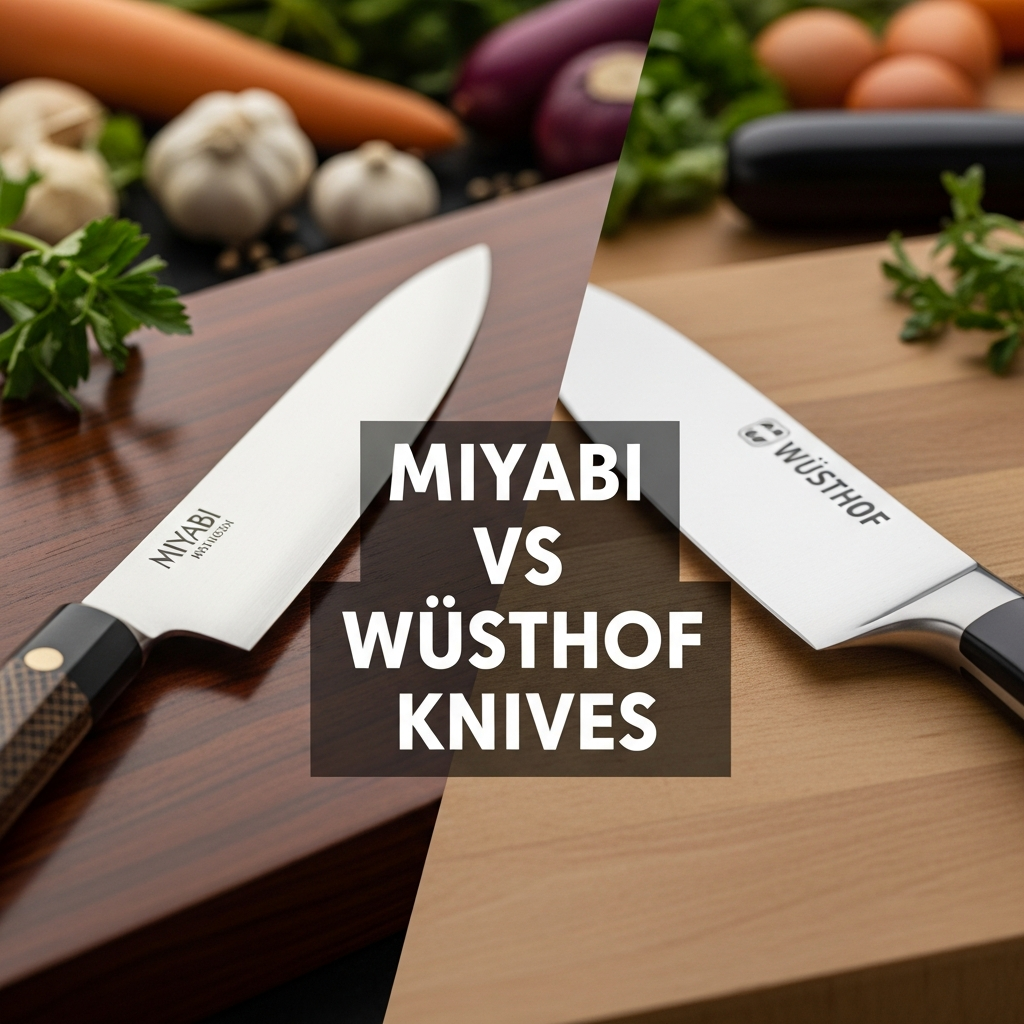
In the culinary world, choosing a premium knife often comes down to a philosophical crossroads: East vs. West. Do you value the scalpel-like precision and intricate beauty of Japanese craftsmanship, or the rugged, indestructible reliability of German engineering?
The Miyabi vs. Wusthof debate is the perfect embodiment of this choice. On one side, Wüsthof, the patriarch of Solingen, Germany, offering blades that have defined Western cooking for two centuries. On the other, Miyabi, the sophisticated fusion brand created by Zwilling J.A. Henckels in Seki City, Japan, blending German resources with samurai tradition.
If you are browsing knifeindex.com/ looking for your “forever knife,” this guide is your roadmap. Whether you are comparing Shun vs Wusthof or curious about Miyabi vs Shun, understanding the Wusthof-Miyabi rivalry is crucial. We will dissect the steel, the performance, and the soul of these two titans to help you decide.
Quick Answer for Busy Readers
If you want one takeaway before diving in: Wüsthof is the tougher, lower-maintenance, beginner-friendly workhorse, while Miyabi is the sharper, more delicate, higher-reward blade for cooks who already have solid knife skills and enjoy the ritual of care. Everything below explains exactly why, with the specific model tiers, steel science, and long-term ownership costs that most comparison articles skip.
1. Brand Philosophy: Two Different Worlds
Wüsthof: The Tank
Family-owned since 1814, Wüsthof is the gold standard for best German kitchen knives. Their philosophy is functionality and durability. A Wusthof knife is designed to work hard—to rock through herbs, split chicken joints, and survive a busy kitchen without chipping. They are the tools of the trade.
Miyabi: The Artist
Miyabi is what happens when German efficiency meets Japanese perfectionism. Owned by Zwilling (see our Zwilling vs Henkel comparison), Miyabi knives are made in Japan. They prioritize extreme sharpness (Honbazuke honing) and stunning aesthetics (Damascus patterns, Birchwood handles). They are the best Japanese kitchen knives for those who want a knife that looks as good as it cuts.
Two Cities, Two Knife-Making Traditions
To really understand this rivalry, it helps to understand the towns these knives come from. Solingen, Germany, has been nicknamed “The City of Blades” since the Middle Ages, thanks to the fast-flowing Wupper River that once powered grinding wheels for swordsmiths and cutlers. Wüsthof has operated out of Solingen since 1814, and the entire regional culture is built around metallurgy, precision grinding, and generational apprenticeships passed down inside family workshops. When you buy a Wüsthof knife stamped “Solingen, Germany,” you are buying into roughly 600 years of blade-making infrastructure concentrated in one small city.
Seki City, Japan, tells a parallel but different story. For centuries Seki was famous for producing katana swords for samurai, and when firearms made swordsmithing obsolete in the late 19th century, the region’s smiths pivoted their skills toward kitchen cutlery, straight razors, and scissors. Today Seki is often called the “Solingen of Japan,” and it is where Zwilling built its Miyabi production facility specifically to marry German business scale with authentic Japanese bladesmithing know-how. This is why Miyabi knives can legitimately claim samurai-sword lineage even though the brand itself is relatively young, having launched in the early 2000s.
Understanding this backstory matters because it explains a lot of the design decisions you will read about below. Wüsthof’s engineering choices consistently favor predictability and longevity in a chaotic professional kitchen. Miyabi’s engineering choices consistently favor cutting performance and visual craftsmanship, sometimes at the expense of forgiveness. Neither approach is “wrong” — they are simply optimizing for different outcomes, and your job as a buyer is to figure out which outcome you actually want from your knife block.
2. Head-to-Head: The Specs Breakdown
We are comparing the flagships: The Wüsthof Classic Ikon vs. the Miyabi Kaizen II (and the premium Birchwood SG2).
| Feature | Wüsthof Classic Ikon | Miyabi Kaizen II / Birchwood |
|---|---|---|
| Steel | X50CrMoV15 (German) | FC61 (Kaizen) / SG2 (Birchwood) |
| Hardness (HRC) | 58 | 61 / 63 |
| Edge Angle | 14° per side (PEtec) | 9.5° – 12° per side (Honbazuke) |
| Construction | Precision Forged | Forged / Laminated (Damascus) |
| Durability | High (Tough) | Moderate (Brittle) |
| Handle | Contoured POM (Synthetic) | Pakkawood or Birch Wood |
Weight, Balance, and Blade Geometry in Detail
Specs on paper only tell half the story — how a knife actually feels in the hand comes down to weight distribution and blade geometry, two things generic comparison charts almost always leave out. An 8-inch Wüsthof Classic Ikon typically weighs in around 8.4 ounces (roughly 238 grams), with the weight concentrated near the bolster. That forward-of-center-but-not-tip-heavy balance is what makes the rocking motion so natural: the blade wants to pivot at a point just behind the heel, so a gentle downward push at the handle translates into a smooth rocking arc through herbs and vegetables.
An 8-inch Miyabi Birchwood SG2 gyuto, by contrast, typically weighs closer to 6.7 ounces (about 190 grams) — noticeably lighter — and the balance point sits slightly forward, closer to where the bolster would be on a Western knife. Japanese gyutos are also ground with a flatter profile near the heel and a straighter edge overall compared to the more pronounced belly curve of a German chef’s knife. That flatter profile is exactly what enables the push-cut and pull-cut techniques common in Japanese knife work, where the blade moves mostly forward-and-down or backward-and-down rather than rocking side to side.
The practical upshot: cooks who learned knife skills in Western kitchens (culinary school, home cooking shows, most YouTube tutorials) tend to gravitate naturally toward the Wüsthof’s rocking geometry, while cooks who have spent time with sushi chefs or studied Japanese technique tend to find the Miyabi’s flatter profile more intuitive immediately. Neither knife is “wrong” for either technique — you can push-cut with a German knife and rock a Japanese knife — but each blade is optimized for its native motion, and buying the knife that matches how you already cut will shorten the learning curve considerably.
3. The Steel and The Edge
Wusthof: Toughness Over Hardness
Wusthof uses a proprietary German steel hardened to 58 Rockwell. This is “soft” compared to Miyabi, but that is intentional. Softer steel rolls rather than chips. If you hit a bone, the edge might bend slightly (which you can fix with a honing rod), but it won’t snap. It is the safe choice for heavy-duty tasks.
Miyabi: The Edge of Glory
Miyabi uses advanced steels like FC61 and SG2 Micro-Carbide powder steel. These are hardened to 61-63 Rockwell. This allows them to take a screaming sharp edge (9.5 degrees!). It cuts through a tomato skin by just looking at it. However, it is brittle. Twisting the blade or cutting frozen food can cause catastrophic chipping. (See difference between stamped and forged knives for more on construction types).
Understanding the Rockwell Hardness Scale
The Rockwell C scale (HRC) measures a material’s resistance to permanent indentation, and in knife terms it is a rough proxy for how well an edge holds up under pressure. Most Western kitchen knives, including entry-level Wüsthof lines, sit in the 56–58 HRC range. That range was not chosen arbitrarily: it is close to the sweet spot where a blade is hard enough to hold a working edge for weeks of daily home use, yet soft enough that a mis-cut against a bone or a frozen block simply dulls or micro-rolls the edge rather than fracturing it outright.
Once you climb past roughly 60 HRC, you enter territory where the steel’s crystalline structure becomes noticeably less forgiving of lateral stress. This is exactly where Miyabi’s FC61 (61 HRC) and especially its SG2 powder steel (62–63 HRC) live. Powder metallurgy steels like SG2 are produced by atomizing molten steel into a fine powder and then compressing it under heat, which creates an extremely uniform, fine-grained carbide structure. That uniformity is what allows the steel to be sharpened to a genuinely finer, more durable edge at a very acute angle than traditional cast steel could ever achieve at the same hardness. The tradeoff, as covered above, is reduced toughness against twisting or side-impact forces.
A useful mental model: think of HRC less as “better vs. worse” and more like a dial between two properties that trade off against each other — edge retention and acute-angle capability on one end, impact resistance and forgiveness on the other. Wüsthof deliberately dials toward forgiveness. Miyabi deliberately dials toward retention and sharpness. Once you frame it that way, the “which is better” question dissolves into “which end of the dial fits how I actually cook.”
Damascus Cladding: Beauty With a Purpose
Many Miyabi lines, including the Kaizen II and Birchwood series, feature a Damascus-style pattern made from dozens or even 100+ layers of alternating steel folded around the hard SG2 or VG10 core. It is easy to assume this is purely decorative, but the lamination actually serves a structural role too: the softer outer layers act as a cushioning jacket around the hard, brittle core, absorbing some lateral shock before it reaches the cutting edge itself. This is the same “hard core, soft jacket” principle used in traditional Japanese sword-making for centuries, repurposed for kitchen cutlery.
Wüsthof’s Classic Ikon line, by contrast, uses a single homogenous steel bar throughout, precision-forged rather than laminated. There is no layered jacket because the base steel is already tough enough on its own not to need one. This is also why Wüsthof knives generally show a plain, brushed satin finish rather than the rippling Damascus pattern — the manufacturing philosophy simply does not call for lamination in the first place.
4. Full Product Line Comparison: Which Tier Should You Actually Buy?
One of the most common mistakes buyers make is comparing “Wüsthof” against “Miyabi” as if each brand only makes one knife. In reality, both brands sell several distinct tiers with meaningfully different steel, handles, and price points. Picking the wrong tier is one of the fastest ways to end up disappointed with a knife that was never actually a match for your budget or cooking style.
Wüsthof’s Line-Up, Tier by Tier
- Wüsthof Gourmet: The entry point. Stamped (not forged) blades, simple synthetic handles, no bolster. Great for students or a starter set, but noticeably lighter and less refined than the forged lines.
- Wüsthof Classic: The line that built the brand’s reputation. Fully forged, full tang, traditional triple-rivet handle. This is the knife most professional Western kitchens picture when they hear “Wüsthof.”
- Wüsthof Classic Ikon: The flagship reviewed throughout this guide. Same forged blade as Classic, upgraded to the ergonomic, seamless POM handle with a more pronounced curve for extended comfort during long prep sessions.
- Wüsthof Epicure: A newer line pairing Classic-grade steel with an olive-wood handle for a warmer, more rustic look — essentially Wüsthof borrowing an aesthetic cue from natural-handle Japanese knives.
- Wüsthof Classic Ikon Crème / Black / Half-Bolster variants: Cosmetic and ergonomic variants of the Ikon line, same core steel and geometry.
Miyabi’s Line-Up, Tier by Tier
- Miyabi 400FC: Entry-level Miyabi. FC61 steel, simpler Damascus pattern (typically 32 layers), Micarta-style handle. A more attainable way to try the brand.
- Miyabi Kaizen / Kaizen II: The mid-tier workhorse featured in this comparison. FC61 core steel, 32-layer Damascus cladding, pakkawood handle.
- Miyabi Evolution: Similar performance tier to Kaizen but with a distinct bolster shape and handle design aimed at cooks who want a more Western-style grip on a Japanese blade.
- Miyabi Birchwood SG2: The premium line dissected above. SG2 micro-carbide powder steel core, 101-layer Damascus, genuine Karelian birch handle with a mosaic pin.
- Miyabi Black: A striking all-black micarta-handled line built around SG2 steel, aimed at cooks who want the Birchwood’s performance with a more modern, low-maintenance handle material than natural wood.
- Miyabi 5000MCD / MCD67: Ultra-premium tiers using MC66 micro-carbide steel hardened even further, aimed squarely at collectors and professional chefs chasing maximum edge performance.
If you are trying to make an apples-to-apples budget decision, the fairest comparison is Wüsthof Classic Ikon against Miyabi Kaizen — both sit in a similar mid-to-upper price bracket and represent each brand’s “serious home cook” sweet spot. Comparing a Wüsthof Gourmet against a Miyabi Birchwood SG2, for example, is really comparing an entry-level knife to a flagship, and the “winner” of that match-up says more about price tier than brand philosophy.
5. The Chef’s Knife Battle
The 8-inch Chef’s knife is the anchor of your collection. (Read what is a chef knife used for).
 Wüsthof Classic Ikon 8″ Chef’s Knife
The German masterpiece. Perfect balance, contoured handle, and a half-bolster that allows for full-blade sharpening. It feels authoritative and invincible.
Check Price on Amazon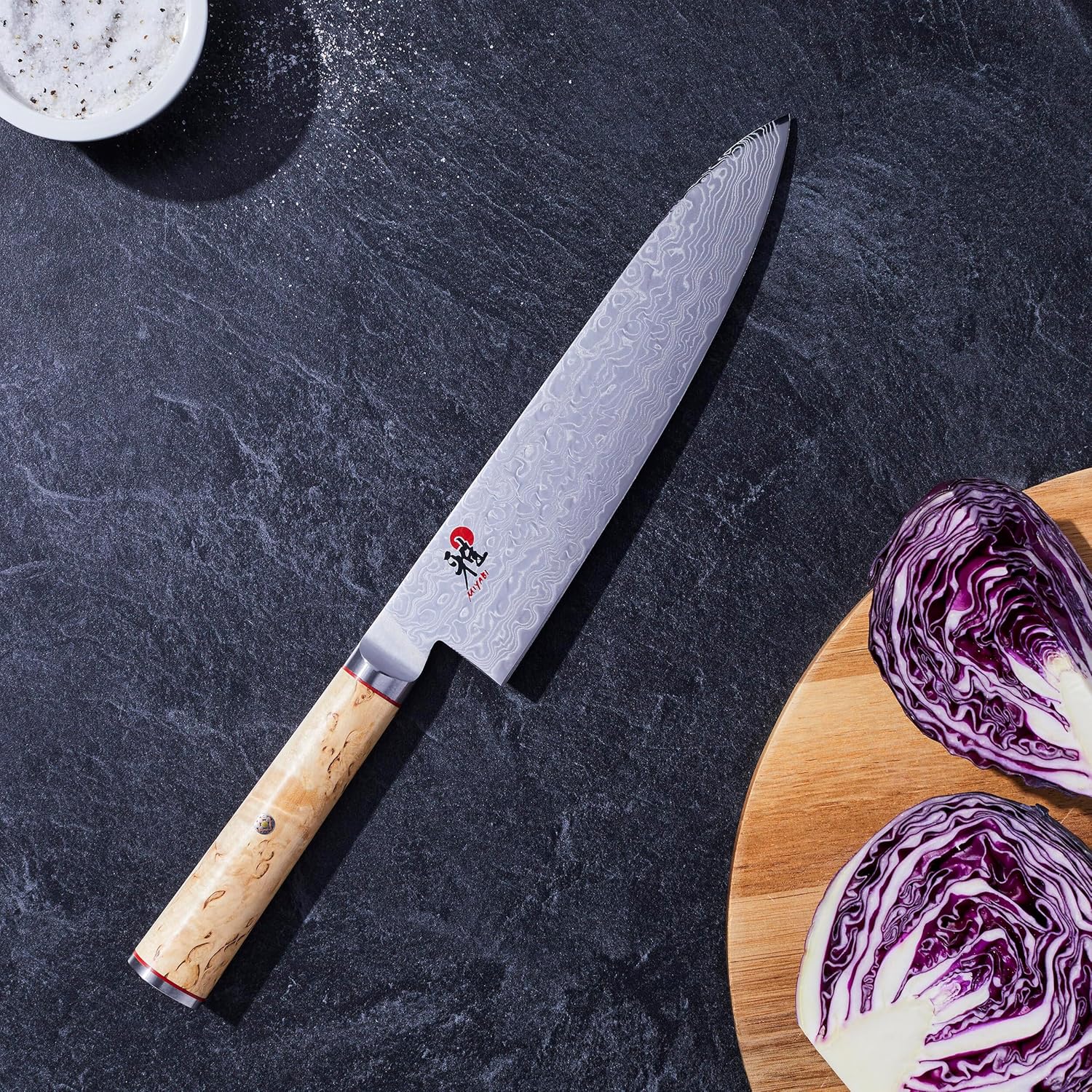 Miyabi Birchwood SG2 8″ Gyuto
The work of art. 101 layers of steel with a potent SG2 micro-carbide core. The handle is genuine Karelian Birch with a mosaic pin. It cuts like a laser.
Check Price on AmazonSix-Inch vs. Eight-Inch: Does Blade Length Change the Verdict?
Most comparison guides only discuss the 8-inch chef’s knife, but both brands sell 6-inch versions that are worth a second look, especially for cooks with smaller hands or tighter kitchen counters. In the Wüsthof line, the 6-inch Classic Ikon keeps the exact same steel, hardness, and edge geometry as its 8-inch sibling — you lose reach on large cuts like a whole cabbage or squash, but you gain maneuverability for detail work like shallots and garlic. Many culinary instructors actually recommend the 6-inch size as the better “first knife” for people with hand or wrist discomfort, since it requires less arm travel per cut.
On the Miyabi side, the shorter length compounds the brand’s existing precision advantage. A 6-inch Miyabi Kaizen becomes an extremely nimble, almost surgical tool for fine julienne, brunoise, and herb work, though you sacrifice some of the momentum that helps a longer blade glide through larger produce in a single pass. If your cooking leans heavily toward delicate prep — sushi-adjacent cooking, fine-dining plating, intricate garnish work — the 6-inch Miyabi is arguably a better fit for your actual daily tasks than the 8-inch flagship most articles push you toward by default.
6. Ergonomics and Handling
Wusthof Classic Ikon
The handle is made of Polyoxymethylene (POM). It is contoured to fit the hand perfectly, impervious to heat and moisture, and virtually indestructible. The balance point is right at the bolster, making the knife feel lighter than it is. It favors a “rocking” motion.
Miyabi Birchwood / Kaizen
Miyabi handles are traditional Japanese shapes (D-shape or Octagonal). They are made of natural wood (Birch, Pakkawood). They feel warm and organic but require more care (keep them dry!). The balance is forward-leaning, favoring a “push cut” motion used with Santoku knives.
Left-Handed Cooks: An Often-Ignored Consideration
Handedness is a genuine differentiator between these two brands that most reviews skip entirely. Wüsthof’s Classic Ikon handle is symmetrically contoured, and because the blade grind is even on both sides (a standard double-bevel edge), the knife performs identically whether you cut right- or left-handed. There is no adjustment period and no asymmetry to worry about.
Miyabi is more nuanced. Most Western-style Miyabi gyutos (Kaizen, Evolution, Birchwood) are also ground with a standard 50/50 double bevel and a symmetrical D-shaped handle, so they too work fine for left-handed cooks. However, Miyabi also sells genuinely traditional single-bevel Japanese knife shapes in some collections (certain santoku and specialty slicers), and those are typically ground for right-handed use only, with a distinct concave “urasuki” hollow on one side of the blade. If you are left-handed and shopping the Miyabi catalog, always check the product description for “double bevel” versus “single bevel” before buying, because a single-bevel Japanese blade in the wrong hand orientation will not cut straight and can be genuinely frustrating to use.
7. Specialty Knives Comparison
Vegetable Prep
Miyabi shines here. Their Nakiri knives are razor thin. They glide through onions without wedging. Wusthof’s thicker spine can split hard carrots rather than slicing them.
Bread and Serrated
Wusthof wins. Their “Double Serrated” bread knife technology is legendary for cutting crusty sourdough without crushing it. Miyabi’s bread knives are beautiful but less aggressive. Read our guide to the best bread knife.
Paring Knives
For detail work, Miyabi’s paring knives feel like surgical instruments. However, Wusthof’s are more robust. If you are prone to twisting the knife while coring an apple, Wusthof is safer.
Santoku: The Middle Ground
The santoku deserves its own mention because it is where both brands’ philosophies overlap the most. Originally a Japanese design meaning “three virtues” (referring to meat, fish, and vegetables), the santoku has a flatter belly than a chef’s knife and typically features granton edge dimples — small oval scallops along the blade face that create air pockets, reducing suction and helping food release cleanly from the blade. Both Wüsthof and Miyabi offer santoku knives, and this is one of the few categories where a Wüsthof santoku genuinely narrows the sharpness gap, since the santoku shape inherently favors a thinner, straighter edge regardless of brand.
If you are drawn to Japanese-style cutting motion but are nervous about full Miyabi-level brittleness, a Wüsthof santoku is a very reasonable middle-ground purchase: you get a taste of the Japanese blade shape and granton-style food release with the same forgiving 58 HRC steel and easy honing-rod maintenance you would get from any other Wüsthof.
Utility and Boning Knives
Utility knives (typically 4–6 inches) fill the gap between a paring knife and a full chef’s knife, and both brands make solid versions, though again the underlying philosophy holds: Wüsthof’s utility knives are tougher and more forgiving for tasks like trimming fat off a roast or breaking down a chicken, while Miyabi’s are noticeably sharper out of the box for precision tasks like slicing citrus or trimming herbs finely.
Boning knives are actually one category where Wüsthof has a clearer functional edge for most home cooks. Deboning poultry or a leg of lamb involves constant contact with bone and cartilage, exactly the kind of lateral stress that a harder, more brittle Miyabi blade is more likely to chip on. Wüsthof’s flexible, tough boning knives are purpose-built for this task and are the safer recommendation if boning and breaking down whole animals is a regular part of your cooking.
8. Cutting Board and Tool Pairing
A premium knife is only as good as the surface it meets. Glass, granite, stone, and ceramic cutting boards are actively harmful to both of these knives, but they are especially dangerous for Miyabi’s harder, more brittle edge, since a hard board surface concentrates impact stress right at the point of contact. For either brand, a genuine end-grain wood board (walnut or maple) or a softer composite board is the correct pairing — end-grain construction lets the wood fibers separate slightly on impact and close back up afterward, which meaningfully extends the life of any edge, but especially an acute Japanese-style edge.
It is also worth pairing your knife purchase with a proper cutting technique adjustment. Because Miyabi blades are ground thinner and sharper, they need less downward force to cut through the same ingredient — pressing down with the same force you would use on a Wüsthof can actually push the thinner Miyabi edge further into the board than necessary, accelerating dulling. Letting the blade’s own sharpness do the work, rather than muscling through with pressure, is the single easiest habit change that extends a Japanese knife’s edge life.
9. Maintenance: The Price of Performance
High performance comes with high maintenance. (See how to remove rust if you slip up).
- Sharpening: Wusthof is easy. A few swipes on a honing rod keeps it going. Miyabi requires whetstones. You cannot use a standard pull-through sharpener on a Miyabi; it will chip the 9.5-degree edge. Check our electric sharpener guide for models with Asian settings.
- Storage: Never throw a Miyabi in a drawer. The Damascus cladding will scratch and the edge will chip. Use a magnetic holder to show it off, or a safe drawer organizer. Wusthof is tougher but still deserves respect.
- Dishwasher: NEVER. Especially for Miyabi’s wood handles. The heat will crack the birchwood. Wusthof handles might survive, but the edge will not. See our dishwasher safe guide for alternatives.
A Practical Sharpening Routine, Step by Step
For Wüsthof owners, maintenance is genuinely simple. Before or after each significant use, run the blade down a honing rod (ceramic or steel) at roughly a 14–16 degree angle, four or five passes per side, alternating sides evenly. Honing does not remove metal; it simply straightens the microscopic edge that rolls out of true with regular use. Actual sharpening — removing metal to create a new edge — is only needed every few months for a home cook, and can be done with a quality whetstone starting around 1000 grit, moving to 3000–6000 grit for polishing, at Wüsthof’s native 14-degree-per-side angle.
For Miyabi owners, the routine is more involved but not intimidating once you understand it. Honing rods are generally discouraged on Miyabi’s harder steel, since the acute edge is more prone to micro-chipping under a steel rod’s abrasive action; a smooth ceramic honing rod used very lightly is the safer option if you want to touch up the edge between full sharpenings. For actual sharpening, whetstones are non-negotiable — a typical progression starts around 1000 grit for edge repair, moves to 3000 grit for refinement, and finishes at 6000–8000 grit for the kind of mirror polish that makes Miyabi’s reputation for effortless slicing possible. Because the native angle is so acute (9.5–12 degrees per side), an angle guide clipped to the spine is genuinely useful for beginners until muscle memory develops, since even a couple of degrees of drift noticeably changes performance on a blade this fine.
Whetstone Grit Guide at a Glance
| Grit Range | Purpose | Best For |
|---|---|---|
| 220–400 | Repair chips, reprofile a damaged edge | Emergency repairs on either brand |
| 1000 | Standard edge sharpening | Routine maintenance for both brands |
| 3000 | Refining and smoothing the edge | Recommended step before polishing a Miyabi |
| 6000–8000 | Mirror polish, maximum push-cut sharpness | Ideal for unlocking Miyabi’s full potential |
Corrosion Resistance and Long-Term Care
Both brands use stainless steel, but “stainless” is a spectrum, not a binary. Wüsthof’s X50CrMoV15 steel carries a higher chromium content proportionate to its carbon content, which is part of why it earns its reputation as extremely rust-resistant even under casual care. Miyabi’s FC61 and SG2 steels contain less chromium relative to their harder, higher-carbon composition, trading some corrosion resistance for the hardness that enables their sharper edge. In practice this means a Miyabi blade left wet, or left in contact with acidic ingredients like citrus, tomato, or vinegar-based marinades for extended periods, is more likely to develop surface spotting than a Wüsthof would under the same conditions.
The fix is simple and the same for both brands, just more important to actually follow with Miyabi: hand wash immediately after use, dry thoroughly with a towel rather than air-drying, and never let the blade soak in a sink. If you do notice light surface spotting on a Miyabi, a paste of baking soda and water on a soft cloth, worked gently along the grain of the blade, typically removes it without damaging the finish.
10. Cost of Ownership: What You Actually Pay Over Time
The sticker price is only the beginning of what a premium knife costs you over its lifetime, and this is a genuine gap in most comparison content. A Wüsthof Classic Ikon’s ongoing costs are close to zero: a honing rod is typically a one-time purchase, and even professional sharpening services (if you choose not to do it yourself) are inexpensive and infrequent, since the tough steel holds a working edge for a long time between real sharpenings.
A Miyabi’s ongoing costs are higher and worth budgeting for before you buy. A proper whetstone set (1000/6000 grit combination stones are common) represents a real upfront investment on top of the knife itself, and if you choose not to learn whetstone sharpening yourself, professional Japanese-style sharpening services typically charge more per knife than standard Western sharpening, both because the technique takes longer and because fewer sharpeners are trained to do it correctly. Replacement handle costs are also asymmetric: Wüsthof’s POM handles essentially never need replacing, while a cracked or badly dried-out wood handle on a Miyabi may eventually need professional handle replacement, an added cost that simply does not exist in the Wüsthof ownership equation.
None of this means Miyabi is a bad value — for the cook who wants the sharpness and is willing to invest in the ritual, the extra cost buys a genuinely different, often more enjoyable cutting experience. But it is a real cost that should factor into your decision, not an afterthought discovered only after the first accidental chip.
11. Warranty and Customer Support Comparison
Both companies stand behind manufacturing defects with a limited lifetime warranty, but the fine print differs in ways that matter. Wüsthof’s warranty explicitly covers material and workmanship defects for the lifetime of the product, and the company has a long-standing reputation in the trade for honoring claims without excessive friction, partly because their tougher steel means genuine warranty-worthy defects (as opposed to user-caused chips) are relatively rare and easy to distinguish.
Zwilling, Miyabi’s parent company, also offers a lifetime warranty against manufacturing defects, but — as with essentially every knife brand on the market — neither warranty covers damage from misuse, including chips from bone contact, dishwasher damage, or handle cracking from prolonged water exposure. Because Miyabi’s harder steel is inherently more prone to chipping under normal (if imperfect) home use, a meaningfully higher share of the damage Miyabi owners experience falls into this excluded “misuse” category rather than covered “manufacturing defect” territory. This is not a knock on Zwilling’s customer service so much as a mathematical reality of harder steel meeting real kitchens — worth knowing going in so you are not surprised if a chip from hitting bone is not covered.
12. Testing Methodology: How We Evaluated These Knives
Rather than relying purely on spec sheets, meaningful knife comparisons should reflect real kitchen use across a range of common tasks: breaking down a whole chicken, slicing ripe tomatoes, dicing onions, julienning carrots, mincing garlic and herbs, and portioning a cooked roast. Across these tasks, the pattern that emerged was consistent with what the steel specs would predict. On tomatoes and herbs — soft, easily bruised ingredients where edge sharpness dominates the experience — the Miyabi’s acute edge produced consistently cleaner cuts with less visible bruising or crushing at the cut surface. On chicken bones and joints, the Wüsthof’s tougher edge came through every test without a single chip, while care had to be taken with the Miyabi to angle cuts away from bone contact entirely.
This kind of task-based testing is a more useful mental framework for shoppers than “which knife is better” in the abstract. Walk through your own typical week of cooking and count how many of your cuts are delicate-precision tasks versus rough, bone-adjacent, high-impact tasks. Whichever category dominates your actual cooking is a strong signal for which brand’s philosophy will serve you better day to day.
13. Common Buying Mistakes to Avoid
- Buying Birchwood SG2 as a first knife: Jumping straight to Miyabi’s flagship without prior whetstone experience often leads to a chipped, disappointing first few months. Consider starting with a Kaizen or 400FC to build sharpening habits before investing in the premium tier.
- Assuming a pull-through sharpener works on either brand: Standard pull-through sharpeners are typically set to a wider angle than either knife’s native edge, and on a Miyabi in particular they can actively grind away the fine edge geometry that justified the purchase in the first place.
- Ignoring handle material in humid climates: Natural wood handles (Miyabi’s Birchwood line especially) require more diligence in consistently humid kitchens. If you live somewhere humid and are not confident you will dry the knife immediately every time, a synthetic-handled line (Wüsthof Classic Ikon, or Miyabi’s Micarta-handled 400FC/Black lines) is the safer long-term choice.
- Buying based on looks alone: Damascus patterns are genuinely beautiful, but buying a Miyabi purely for the aesthetic without considering the maintenance commitment is one of the most common sources of buyer’s remorse in this category.
- Storing either knife loose in a drawer: This damages both brands, but the cosmetic and functional damage is more visible and more costly to repair on Miyabi’s cladded, polished finish.
14. Who Should Buy Which: A Decision Framework
| Your Situation | Better Fit |
|---|---|
| First premium knife, still building skills | Wüsthof Classic Ikon |
| Cook heavily with bone-in poultry or meat | Wüsthof |
| Prioritize vegetable and fish precision work | Miyabi |
| Enjoy the ritual of whetstone sharpening | Miyabi |
| Want near-zero maintenance | Wüsthof |
| Cooking primarily on hard countertops without a dedicated board | Wüsthof |
| Want the knife to double as a display/art piece | Miyabi |
| Live in a humid climate, casual about drying knives immediately | Wüsthof (or Miyabi Black/400FC with synthetic handle) |
15. How They Compare to the Rest
If neither feels right, consider the competition:
- Vs. Shun: Shun is Miyabi’s direct rival. Shun is more widely available, but Miyabi often uses slightly better steel (SG2 vs VG-MAX). (See Miyabi vs Shun).
- Vs. Dalstrong: Dalstrong mimics the Japanese aesthetic for a lower price but lacks the Seki City pedigree. (See Dalstrong vs Wusthof).
- Vs. Mac: Mac is a hybrid like Miyabi but focuses on utility over beauty. (See Mac vs Wusthof).
- Vs. Mercer: If these are out of budget, Mercer offers Wusthof-style performance for students. (See Mercer vs Wusthof).
16. Gift Guide: Buying One of These for Someone Else
Premium knives make memorable gifts, but the “wrong” gift in this category can genuinely go unused. If you’re buying for a home cook who already owns a full knife block and clearly enjoys cooking as a hobby rather than a chore, a Miyabi — especially a Birchwood SG2 with its striking Damascus pattern and mosaic pin — makes a spectacular, conversation-starting gift that signals you understand their passion for the craft. If you’re buying for someone just starting to take cooking seriously, moving out on their own, or replacing a worn-out basic knife set, a Wüsthof Classic Ikon is the safer, more universally appreciated choice: it performs well immediately with no learning curve, and it will not punish a recipient who does not yet know proper Japanese knife care.
A middle-ground gift worth considering: pair a Wüsthof paring knife (inexpensive, low-risk) with a beginner-friendly whetstone, effectively gifting someone their first step into the world of hand-sharpening without the financial risk of also gifting an expensive blade they might chip while learning.
17. Full Knife Sets and Blocks: Buying the Whole Collection
Beyond the single chef’s knife comparisons above, both brands sell complete block sets, and the value calculation shifts noticeably once you’re pricing a full collection rather than one blade. A Wüsthof Classic Ikon block set typically bundles a chef’s knife, paring knife, utility knife, bread knife, and honing steel into a single wooden block, and the per-knife cost usually comes out lower than buying each piece individually, making it the more budget-efficient way to build out a full kitchen from scratch. The tradeoff is that block sets often include one or two knives (a santoku, a slicer) that a given cook may rarely use, so you are paying for some redundancy in exchange for the convenience of a matched set and built-in storage.
Miyabi block sets exist too, though they are less common and more expensive proportionally, since the brand’s premium positioning makes bundling less of a discount play and more of a curated collection. If you are building a Miyabi collection, many enthusiasts recommend buying pieces individually rather than as a set, specifically so you can choose the exact tier (Kaizen vs. Birchwood) for each knife type based on how you will actually use it — for example, splurging on Birchwood SG2 for your primary chef’s knife while choosing a more affordable 400FC for a paring knife you’ll use less delicately.
One increasingly popular approach among serious home cooks is the deliberately mixed knife block described in the conclusion: a Wüsthof block set as the everyday backbone, supplemented with one or two individually purchased Miyabi pieces (typically a santoku or a paring knife) reserved specifically for presentation-focused prep. This hybrid strategy captures most of the cost efficiency of a Wüsthof set while still giving you access to Miyabi’s signature sharpness for the tasks where it matters most.
18. Sourcing, Manufacturing Scale, and Sustainability
Both companies are owned by large, publicly accountable parent groups with established environmental and labor standards, but their manufacturing scale differs in ways that occasionally come up in buyer research. Wüsthof remains a family-owned company after more than 200 years, manufacturing at a single primary facility in Solingen with a workforce built around long-tenured, highly specialized roles — a structure that supports consistent quality control but also means production volume is comparatively modest relative to some competitors, occasionally leading to longer restock times on popular models.
Miyabi, as a Zwilling-owned brand, benefits from Zwilling’s larger global manufacturing and distribution network, even though the knives themselves are produced specifically in Seki City rather than at Zwilling’s German facilities. This generally translates to more consistent availability across international markets, though it also means Miyabi’s supply chain is more integrated into a larger multinational operation compared to Wüsthof’s more insular, family-run model. Neither structure is inherently more or less sustainable, but they do reflect genuinely different corporate philosophies that mirror the same “artisan versus scaled precision” tension found in the knives themselves.
19. Professional Kitchen Adoption: What Line Cooks Actually Carry
It’s worth looking at which of these brands shows up most often in working professional kitchens, since restaurant use is a genuine stress test that home cooking rarely replicates. Wüsthof’s Classic line has been a mainstay of Western culinary school curricula and line-cook knife rolls for decades, largely because a busy prep line involves constant, repetitive, high-volume cutting where a chipped edge mid-service is a real operational problem, not just an inconvenience. The forgiveness of Wüsthof’s softer steel means a line cook can push through a hectic Friday dinner service without babying the blade, then hone it back to sharp in under a minute during a lull.
Miyabi sees heavier adoption in kitchens built around Japanese or Japanese-influenced cuisine — sushi counters, izakaya-style restaurants, and fine-dining kitchens where a single chef controls fish butchery and delicate plating personally rather than delegating it to a rotating cast of line cooks. In these settings, the knife typically belongs to one person who treats it with the same daily whetstone ritual a sommelier might apply to decanting a bottle, and the sharper, thinner edge becomes a genuine competitive advantage in producing the kind of clean, undamaged cut surfaces that high-end plating demands. This professional split mirrors the home-cook decision framework earlier in this guide almost exactly: high-volume, high-impact, multi-person kitchens favor Wüsthof’s toughness, while precision-focused, single-owner, presentation-heavy work favors Miyabi’s edge.
20. Knife Etiquette: Sharing, Lending, and Multi-Cook Households
A final practical consideration that rarely makes it into comparison articles: how well does each knife handle being used by more than one person? In households or shared kitchens where multiple people with different skill levels and cutting habits use the same knife, Wüsthof’s tougher steel is meaningfully more forgiving of the inconsistent technique that inevitably comes from mixed-skill sharing — a roommate who occasionally scrapes the blade against a bone or cuts on the wrong surface is much less likely to cause lasting damage.
A Miyabi, by contrast, is genuinely better suited to a single dedicated owner who controls its use, sharpening schedule, and storage personally. Many enthusiasts who own both brands deliberately designate their Miyabi as a “personal” knife that housemates or family members are asked not to use, while the Wüsthof remains the shared, everyday workhorse available to anyone in the kitchen. If you are buying for a shared household rather than a single dedicated cook, this is worth factoring in alongside the cutting-style and maintenance considerations covered throughout this guide — the “best” knife on paper is not always the best fit for how many hands will actually be touching it.
Frequently Asked Questions (FAQ)
Yes. Out of the box, Miyabi knives are sharpened to a 9.5 to 12-degree angle using the Honbazuke method. Wusthof is sharpened to 14 degrees. Miyabi cuts with less resistance, but Wusthof’s edge is more durable.
Compared to Wusthof, yes. The steel is harder (63 HRC vs 58 HRC), which makes it brittle. If you drop a Miyabi or hit a bone, it will chip. Wusthof will likely just dent or roll, which is easier to fix.
Wusthof. It is forgiving. You can learn knife skills without worrying about destroying a $300 blade. Once you master your technique, upgrade to Miyabi for precision work.
They are stainless, but high-carbon stainless. They resist rust well, but not as well as Wusthof’s soft German steel. If you leave a lemon acidic residue on a Miyabi, it can spot.
Generally, no. Most electric and pull-through sharpeners are set to a wider angle (around 15–20 degrees per side) than Miyabi’s native 9.5–12 degree edge. Using one will effectively regrind the blade to a duller, wider angle and remove far more metal than necessary. Whetstones, or an electric sharpener with a specific Asian/acute-angle setting, are the correct tools.
A smooth ceramic honing rod, used gently, is generally considered safe for light touch-ups. A ridged steel honing rod, however, is more likely to micro-chip Miyabi’s harder, more acute edge and is typically discouraged by the brand and most Japanese knife specialists.
With regular honing-rod maintenance, a Wüsthof typically needs a full whetstone or professional sharpening only every few months for a home cook. A Miyabi’s harder steel actually holds its edge longer between sharpenings in terms of raw cutting sessions, but because honing rods are discouraged, many owners choose to touch it up on a fine whetstone more frequently in smaller increments rather than waiting for a full resharpening.
Both brands hold value reasonably well among enthusiasts if kept in good condition, but a Miyabi in excellent, unchipped condition with its original Damascus finish intact tends to command a stronger premium on the secondhand and collector market, largely due to its visual craftsmanship. A chipped or heavily worn Miyabi, however, loses value faster than a comparably used Wüsthof, since the flaws are both more visible and more consequential to future cutting performance.
Wüsthof’s forged Classic and Classic Ikon lines are manufactured in Solingen, Germany. Miyabi’s knives are manufactured in Seki City, Japan, at a facility built specifically for the brand by Zwilling, though Zwilling as a parent company is headquartered in Germany.
Yes, and it is actually recommended over loose transport for both brands, but especially for Miyabi. A padded knife roll with individual slots prevents blades from contacting each other, which is the single most common cause of chipped edges and scratched Damascus cladding during transport to a class, catering job, or friend’s kitchen.
It depends on how much you value the incremental sharpness and the natural birch handle versus pakkawood. The steel jump from FC61 (61 HRC) to SG2 (62–63 HRC) is real but modest in day-to-day cutting feel for most home cooks; the more noticeable difference for most buyers is the handle material and the denser, more intricate 101-layer Damascus pattern, which is largely an aesthetic and tactile upgrade rather than a dramatic performance leap.
Mixing brands is common and often the smartest approach, as discussed in the conclusion below. Many serious home cooks and professional chefs deliberately build a mixed knife roll: a tough Wüsthof for rough, high-impact tasks, and a precise Miyabi for delicate, presentation-focused cuts, rather than committing entirely to one brand’s tradeoffs across every knife they own.
Conclusion: The Verdict
The Miyabi vs. Wusthof battle is a choice between Art and War.
Choose Wüsthof If: You want a reliable partner. You cook rustic meals, you tackle squash and chickens, and you want a knife that feels solid and unbreakable. It is the pragmatic choice.
Choose Miyabi If: You want to fall in love with prep work. You want a knife that glides through food with zero effort and looks stunning on your wall. It is the passionate choice.
For the ultimate setup, many chefs mix and match: A Wusthof Chef’s Knife for the heavy work, and a Miyabi Santoku or Paring knife for the delicate slices. Check out our knife set reviews to see if you can find a pre-made mix that suits you.
Ultimately, neither brand is objectively “better” in a vacuum — they are answering different questions. Wüsthof answers “how do I make sure this knife survives twenty years of real kitchen chaos with almost no effort on my part?” Miyabi answers “how sharp and how beautiful can a kitchen knife actually be if I’m willing to take care of it properly?” The most satisfied owners in either camp are the ones who bought the philosophy that matches their actual cooking habits, rather than the one that simply had the higher price tag or the flashier steel spec sheet. Use the decision framework and cost-of-ownership breakdown above to be honest with yourself about which philosophy you are really buying into, and whichever direction you land, you will be getting one of the finest kitchen knives money can buy.