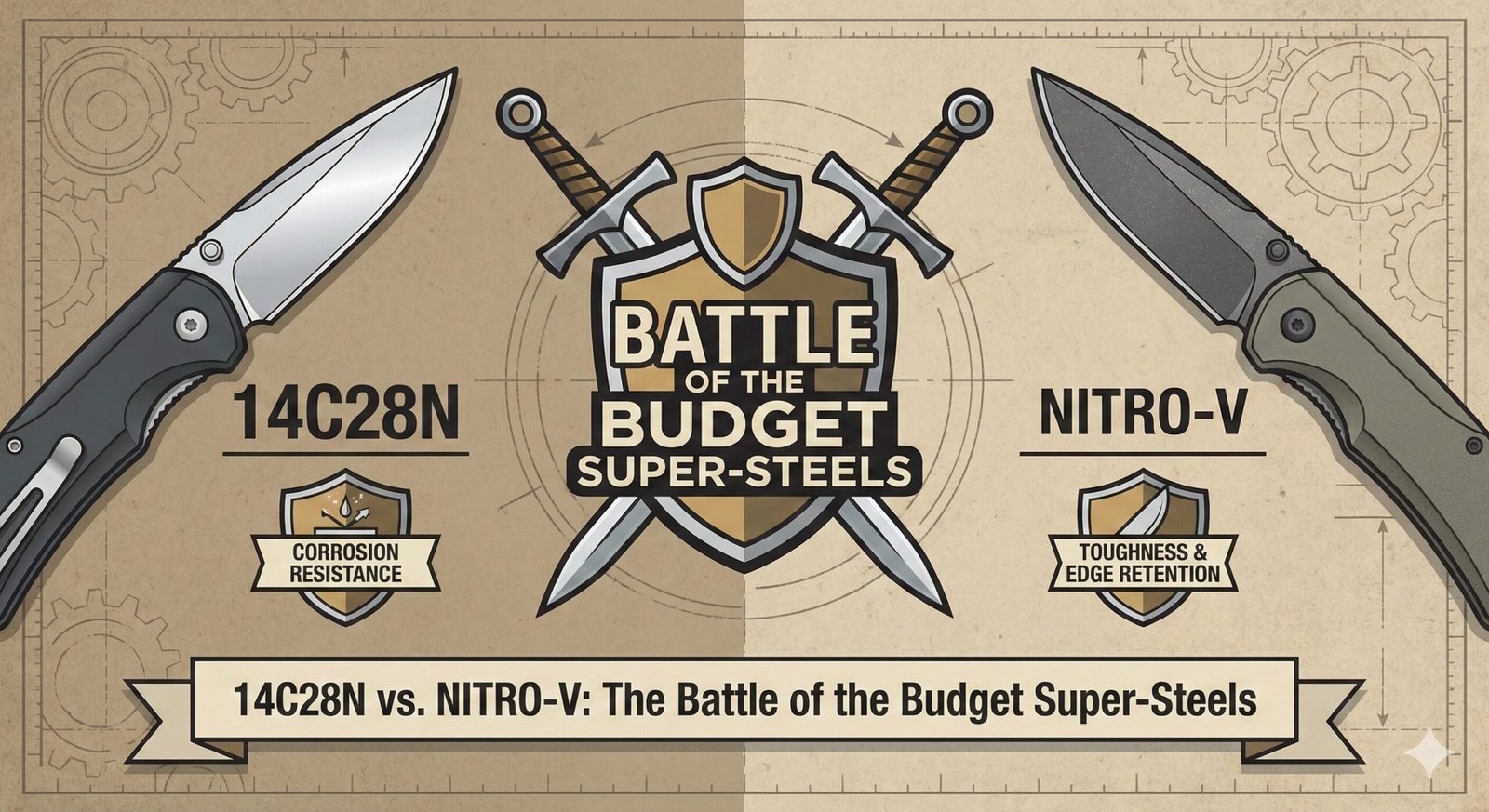
14C28N vs. Nitro-V: The Battle of the Budget Super-Steels
Introduction
In the world of knife steel, we often get distracted by premium “Super Steels” like MagnaCut, M390, or S90V that can easily push the cost of a folding knife past the $200 mark. But for 99% of users, the absolute best value lies in the “Budget Premium” category.
Two steels have completely taken over this segment over the last few years: Sandvik 14C28N and Nitro-V. By uniquely utilizing Nitrogen in their chemical matrix, these alloys manage to achieve incredible performance—high toughness, razor-sharp edge capabilities, and immense corrosion resistance—all at a price point that won’t make you afraid to actually use your knife.
If you are looking at modern knives from brands like Kershaw, Civivi, Kizer, or WE, you are almost certainly going to end up deciding between these two. While they share a nitrogen-enriched DNA, they are tailored for slightly different philosophies of use. This ultimate guide will break down exactly which one is superior for your specific needs.
The Evolution of the Budget Steel Market
To appreciate how good we have it with 14C28N and Nitro-V, we have to look back at what “budget steel” meant just a decade ago. For a long time, the affordable knife market was dominated by steels like 8Cr13MoV, AUS-8, and 440A/440C.
While these older steels were highly rust-resistant and easy to sharpen, they lacked fundamental edge retention and structure. If you cut down a few heavy cardboard boxes, your AUS-8 blade would quickly roll and dull. Knife enthusiasts demanded better performance without the “super steel” tax.
This gap in the market triggered a metallurgical arms race. Knife makers realized that by tweaking the chemical recipes of high-performing razor blade steels, they could create alloys perfect for everyday carry (EDC) without jacking up the price. Enter the Nitrogen Revolution.
The Contenders Explained
Sandvik 14C28N: The Swedish Tank
Developed by the massive materials science company Sandvik in Sweden, 14C28N actually came into existence because of a direct request from Kershaw Knives. Kershaw had been using Sandvik’s 13C26 steel but found it slightly lacking in corrosion resistance for everyday pocket carry.
Sandvik’s metallurgists went to work. By slightly decreasing the carbon and adding a precise dose of nitrogen, they created 14C28N. It maintained the legendary ultra-fine grain structure of Swedish steel but brought corrosion resistance to a level that rivals high-end marine knives. It quickly became the gold standard for budget EDC.
Nitro-V: The American Custom Favorite
Nitro-V has a different, more recent pedigree. It was developed by New Jersey Steel Baron (NJSB) in collaboration with Buderus Steel. They started with a base of AEB-L, a famous steel used in literal razor blades because of its ability to take a microscopic, laser-like edge.
NJSB tweaked the AEB-L formula by adding Nitrogen and Vanadium. The goal was to take that razor-blade sharpness and give it the backbone needed for tactical knives, hunting knives, and EDC folders. Today, it is heavily favored by custom makers and high-volume production companies like Civivi and WE Knife.
Metallurgy & Chemical Composition
The secret sauce in both of these alloys is Nitrogen (N). In traditional steel making, carbon dictates hardness, and chromium dictates rust resistance. But there is a flaw: high amounts of carbon and chromium bind together to form massive “chromium carbides.” While hard, these large carbides make the steel brittle and drain the chromium from the surrounding steel matrix, making it prone to rust.
Nitrogen acts as a “stand-in” for carbon. It allows the steel to achieve high hardness levels without forming those massive, brittle carbides. The result is a fine-grained, tough, and highly stainless steel.
| Element | 14C28N | Nitro-V | Effect on Performance |
|---|---|---|---|
| Carbon (C) | 0.62% | 0.68% | Increases hardness and wear resistance, but decreases toughness. |
| Chromium (Cr) | 14.0% | 13.0% | Provides corrosion resistance (“stainless” quality). |
| Nitrogen (N) | 0.11% | 0.11% | Refines grain structure, boosts hardness, increases rust resistance. |
| Vanadium (V) | – | 0.08% | Forms extremely hard vanadium carbides, increasing edge retention. |
| Manganese (Mn) | 0.60% | 0.65% | Improves grain structure and hardenability during heat treat. |
The Takeaway: The key difference is Nitro-V’s inclusion of Vanadium and slightly higher Carbon. This small amount of vanadium creates hard micro-carbides that give Nitro-V slightly more “bite” and wear resistance. 14C28N relies strictly on its ultra-pure, fine-grain structure.
The Critical Role of Heat Treatment (HRC)
You can have the best chemical composition in the world, but if the heat treatment is poor, the knife will perform terribly. Heat treatment dictates the final Rockwell Hardness (HRC) of the blade.
- 14C28N Sweet Spot (58-60 HRC): Sandvik designed this steel to be tough. Most manufacturers run it between 58 and 60 HRC. At this hardness, the steel is virtually unbreakable under normal EDC conditions, prioritizing toughness over long-term edge holding.
- Nitro-V Sweet Spot (59-62 HRC): Because of the added vanadium and carbon, Nitro-V can be pushed harder. Custom makers often run it at 61-62 HRC, often using cryogenic treatments. At this hardness, it holds a thin edge remarkably well, though it sacrifices a tiny bit of impact toughness.
Toughness: The Unbreakable Edge
Toughness is arguably the most important metric for a hard-use knife. It determines whether your blade will chip or snap when it hits a staple, drops on concrete, or is used to pry apart pieces of wood.
Winner: 14C28N. It is widely considered one of the toughest stainless steels on the market, period. In Charpy C-Notch impact tests, 14C28N behaves almost like a carbon spring steel. If you abuse it, the edge is more likely to safely “roll” rather than form jagged micro-chips. If you baton wood or process game, 14C28N is the safer bet.

The knife that put this steel on the map. Ken Onion design, assisted opening, and made in the USA. A tank of a knife that utilizes 14C28N’s extreme toughness perfectly for hard daily labor.
Check Price on AmazonEdge Retention & Wear Resistance
Edge retention measures how long a knife will continue to cut cleanly through abrasive materials like cardboard, rope, and dirty carpet. Neither of these steels are “edge holding monsters” like CPM-S90V or Maxamet. They are fine-grained steels meant for ultimate razor sharpness, not marathon endurance cutting.
Winner: Nitro-V (Slightly). Thanks to the vanadium carbides and the ability to run at a higher HRC, Nitro-V will outlast 14C28N in abrasive cutting tasks by roughly 10% to 15%. However, to the average user opening amazon packages and cutting apples, this difference is highly negligible.
Corrosion Resistance: Surviving the Elements
If you live in a humid climate, work near the ocean, or sweat profusely while carrying your knife inside your waistband, rust resistance is a top priority.
Winner: 14C28N. With a full 14% Chromium and nitrogen locking the matrix, 14C28N is incredibly stainless. It is routinely used in fishing knives and marine environments for a reason. You have to actively neglect this steel in salt water to make it rust.
Nitro-V is also very good—vastly superior to tool steels like D2 or M4—but with only 13% chromium, it can occasionally develop light surface patina or “pepper spots” if left wet with acidic juices (like lemon or tomato) or trapped against sweaty skin for days. A quick wipe-down prevents this completely.

The updated version of the world’s most popular budget knife now features Nitro-V steel. The fine grain allows for a super-thin blade geometry, resulting in unmatched slicing performance in a sleek, gentlemanly profile.
Check Price on AmazonHead-to-Head: How Do They Compare to the Competition?
To truly understand their value, we must see how 14C28N and Nitro-V stack up against other steels commonly found in the $50 to $100 price bracket.
vs. D2 Tool Steel
D2 has been the king of the budget knife world for years. Verdict: Nitrogen Steels Win. While D2 will hold an edge significantly longer than both 14C28N and Nitro-V, it is semi-stainless (it rusts easily), it is brittle (prone to chipping), and it is famously annoying to sharpen. For EDC, 14C28N and Nitro-V offer a much better balance of traits.
vs. VG-10
VG-10 is the standard high-end Japanese kitchen knife steel, also used heavily by Spyderco. Verdict: Tie. VG-10 has slightly better edge retention than 14C28N, but it is notoriously prone to micro-chipping. Nitro-V and 14C28N are substantially tougher and easier to maintain, making them better for hard-use pocket knives, while VG-10 excels in the kitchen.
vs. CPM-S30V
S30V was the original powder metallurgy “super steel.” Verdict: Different Classes. S30V costs more, holds an edge much longer, but is more brittle and harder to sharpen. If you hate sharpening and want to cut for months, save up for S30V. If you want a tough blade you can beat on and touch up easily, stick with Nitro-V or 14C28N.
AEB-L: The Common Ancestor Nobody Talks About
Most head-to-head articles compare 14C28N and Nitro-V as if they sprang from entirely separate family trees. They didn’t. Both alloys are, at their core, descendants of the same razor-blade lineage: AEB-L, a Swedish stainless steel originally engineered by Uddeholm for disposable razor blades and surgical scalpels. Understanding this shared ancestry explains almost everything about why these two “budget super-steels” feel so similar in the hand, and why they diverge in exactly the places their recipes diverge.
AEB-L is prized in the razor and scalpel industry for one reason above all: it forms an extraordinarily fine, homogeneous carbide structure when hardened. Fewer large carbides means the grain boundaries stay tight, which means the apex of the edge can be taken down to a genuinely microscopic thickness without crumbling. A razor blade doesn’t need to survive prying open a paint can. It needs to shave through hair with zero resistance, and AEB-L was engineered for exactly that single job.
Sandvik took AEB-L’s close cousin, 13C26, and refined the chromium and nitrogen balance to create 14C28N specifically for knives that needed to survive daily carry rather than a single pass through a razor cartridge factory. New Jersey Steel Baron took a more direct route, starting from AEB-L itself and grafting on nitrogen plus a small vanadium addition to create Nitro-V. Both companies were chasing the same goal from different starting points: take the razor-sharp DNA of AEB-L and give it enough backbone to survive a pocket knife’s working life.
Why This Matters for Buyers
If you already own a knife in plain AEB-L—increasingly common in custom kitchen cutlery and some budget slicers—you already have a rough preview of how 14C28N and Nitro-V will behave. AEB-L sharpens almost embarrassingly easily, takes a scary-sharp edge, and is reasonably stainless, but it is the softest and least wear-resistant of the three at a given hardness. 14C28N adds meaningfully more corrosion resistance on top of that base recipe. Nitro-V adds a small wear-resistance boost via vanadium and pushes hardness a couple of points higher. Neither steel abandons the AEB-L formula; both refine one specific weakness in it.
This lineage also explains a detail that trips up a lot of shoppers: none of these three steels are “powder metallurgy” steels. They are conventionally cast and hot-rolled, which is precisely why they are so cheap to produce relative to CPM or MPS powder steels like S35VN or M390. The fine grain structure people associate with expensive powder steels is achieved here through pure alloy chemistry and rolling technique rather than an atomized powder process—a genuinely clever piece of budget engineering that keeps costs down without sacrificing the qualities that matter most for everyday cutting.
Debunking the Vanadium Edge-Retention Myth
Scroll through enough knife forums, YouTube comment sections, and even a few AI-generated buying guides, and you’ll find a confident claim repeated over and over: “Nitro-V holds an edge noticeably longer than 14C28N because of its vanadium content.” It sounds authoritative. It is also, according to the metallurgists who actually test these steels, substantially overstated.
Here is the problem with the popular narrative. Vanadium improves wear resistance by forming vanadium carbides—but only in meaningful quantities. Premium powder steels that lean on vanadium for their edge-holding reputation, like S30V or S110V, carry vanadium contents in the 3% to 9% range. Nitro-V contains roughly 0.08% vanadium—a fraction of a percent, more of a chemical trace than a true carbide-forming alloy addition. At that concentration, independent lab analysis has found that Nitro-V forms essentially no significant volume of dedicated vanadium carbides at all.
So where does Nitro-V’s small real-world edge-retention advantage actually come from? Two places, and neither is vanadium. First, its slightly higher carbon content (0.68% versus 14C28N’s 0.62%) gives it a marginally higher achievable hardness ceiling. Second, because custom makers commonly heat-treat Nitro-V a couple of HRC points harder—often 60 to 62 HRC versus 14C28N’s more common 58 to 60 HRC—the resulting edge simply resists rolling and abrasion a little better purely as a function of hardness, not alloy content.
This matters practically because it flips a lot of buying advice on its head. If you find a 14C28N knife heat-treated to 61 HRC and a Nitro-V knife heat-treated to 59 HRC, expect the 14C28N blade to actually out-hold its edge in that particular comparison, vanadium or not. Chemistry sets the ceiling; heat treatment decides how close a manufacturer actually gets to it. Always check a brand’s published HRC spec rather than assuming Nitro-V automatically wins on edge retention just because the label lists vanadium in the recipe.
CATRA Testing & Real-World Cut Data
Marketing copy loves adjectives—”incredible,” “razor-sharp,” “unmatched.” What it rarely provides is numbers. The knife industry’s closest thing to an objective edge-retention benchmark is the CATRA (Cutlery and Allied Trades Research Association) card-cutting test, which measures how many standardized silica-impregnated cardstock cuts a blade can make before it drops below a defined sharpness threshold. It isn’t a perfect proxy for every cutting task, but it is repeatable, and it lets us compare steels on a level playing field.
Across the independent testing that has been published on fine-grained nitrogen steels, 14C28N and Nitro-V land in a strikingly similar band—generally in the same performance tier as other AEB-L derivatives, and meaningfully below powder steels like S35VN, M4, or MagnaCut. Neither steel is going to out-cut a CPM powder steel on raw cardboard volume, and neither claims to. What the data does show is a real but modest gap: Nitro-V heat-treated to its higher hardness range typically edges out 14C28N run at its more toughness-focused hardness by somewhere in the ballpark of 10% to 20% additional cutting distance before the edge needs a touch-up.
Rope-Cutting and Toughness Testing
On the flip side of the ledger, toughness testing—typically measured via Charpy C-Notch impact tests or informal “baton and pry” abuse testing done by knife reviewers—consistently favors 14C28N. Reviewers who deliberately try to chip these steels by driving the edge into hardened staples, dropping blades edge-first onto concrete, or batonning through knotty wood report that 14C28N rolls rather than chips more reliably than Nitro-V, especially when the Nitro-V sample has been pushed to the top of its hardness range with a cryo treatment.
The practical translation for shoppers: if a retailer or forum post cites a specific CATRA card count or rope-cut number, always check what hardness the tested blade was run at before assuming the number generalizes to every knife made from that steel. A soft-tempered Nitro-V blade at 58 HRC could easily lose an edge-retention test to a harder 14C28N blade at 61 HRC, even though “on paper” Nitro-V is supposed to be the wear-resistance winner.
Where Do These Steels Fit Against the Next Generation?
No comparison of budget nitrogen steels is complete without addressing the elephant in the room: CPM MagnaCut. Developed by metallurgist Dr. Larrin Thomas specifically to solve the toughness-versus-corrosion-resistance-versus-edge-retention trilemma that has plagued knife steel design for decades, MagnaCut has become the new benchmark against which every mid-tier steel gets measured.
MagnaCut achieves something 14C28N and Nitro-V simply cannot: high hardness (62-64 HRC), genuinely excellent edge retention rivaling steels with far higher carbide volume, toughness that competes with far softer alloys, and corrosion resistance that rivals surgical-grade stainless—all in a single powder-metallurgy recipe. It does this by using a small, precisely balanced amount of niobium carbide (extremely hard and extremely fine-grained) instead of relying purely on chromium carbides or bulk vanadium content.
So does this make 14C28N and Nitro-V obsolete? Not remotely, and price is the entire reason why. A quality folding knife in MagnaCut routinely costs $150 to $300 or more, because MagnaCut is a powder steel that requires specialized production and precise heat treatment to unlock its properties. A comparably built knife in 14C28N or Nitro-V frequently costs $30 to $70. For the overwhelming majority of EDC buyers, that’s a five-times price difference for a steel upgrade that, in daily cardboard-and-fruit cutting tasks, most users will genuinely struggle to notice.
It’s also worth noting that Sandvik and other steel producers have taken note of MagnaCut’s success. Newer conventionally-produced alloys are beginning to appear that borrow some of its design philosophy, narrowing the gap further over time. The budget steel segment that 14C28N and Nitro-V pioneered is not standing still—it is actively evolving in response to the pressure MagnaCut has put on the entire market.
Kitchen & Culinary Applications
One of the most overlooked use cases for both of these steels is the kitchen, and it’s a genuinely important angle for anyone shopping for a chef’s knife, paring knife, or fillet knife rather than a folding EDC blade.
14C28N in the Kitchen
Sandvik didn’t just stumble into knife steel by accident—14C28N was explicitly engineered with food-contact applications in mind, and Sandvik has long supplied steel to major kitchen cutlery manufacturers across Europe. Its 14% chromium content gives it outstanding resistance to the acidic, moisture-heavy environment of a working kitchen: citrus juice, tomato acid, and repeated dishwasher cycles (even though hand-washing is always recommended for any knife) are far less likely to cause staining or pitting compared to lower-chromium alternatives. This is precisely why you’ll find 14C28N in fillet knives, boning knives, and a growing number of budget-to-midrange chef’s knife lines.
Nitro-V in the Kitchen
Nitro-V has also found a home among custom kitchen knife makers, largely because of its AEB-L heritage. Remember that AEB-L itself is already a favorite among custom chef’s knife makers for its ability to take an obscenely thin, polished edge—the kind of edge that glides through a tomato skin without crushing the flesh beneath. Nitro-V inherits that trait while adding a bit more durability than plain AEB-L, making it a popular choice for gyuto and santoku-style kitchen knives from smaller custom shops.
For a dedicated kitchen knife that will spend its life around lemon juice, vinegar, and the inside of a sink, most cutlery specialists lean slightly toward 14C28N for its extra chromium margin. For a knife that will be dried immediately after each use and stored properly, Nitro-V’s marginally thinner, harder edge geometry can deliver a noticeably crisper slicing experience on soft produce and proteins.
Field Testing: How Owners Actually Use These Steels
Lab numbers and Rockwell specs only tell part of the story. To really understand how 14C28N and Nitro-V behave, it helps to look at how they hold up across the specific tasks that dominate real ownership: opening mail, breaking down cardboard, food prep, light bushcraft, and the inevitable accidental abuse every pocket knife eventually suffers.
Cardboard & Package Opening
This is the single most common task any EDC knife performs, and both steels handle it exceptionally well for the first several dozen cuts. Cardboard is mildly abrasive—the recycled fibers and adhesive residue slowly round over a fine edge—and this is where Nitro-V’s slightly harder temper shows its value. Owners who track cut counts informally (a common practice among knife reviewers using standardized cardboard stock) typically report Nitro-V pushing 15-25% further before the edge starts to feel “toothy” rather than smooth. Neither steel, however, requires more than a few passes on a strop to restore full performance, so the practical downtime difference is minutes, not hours.
Food Prep & Fruit
For slicing fruit, cheese, or bread on a camping trip or at a picnic, both steels excel, but this is arguably where Nitro-V’s AEB-L heritage shines brightest. Its ability to hold a genuinely fine, polished edge means it glides through the skin of a tomato or apple without the slight “grabbing” sensation a coarser edge can produce. 14C28N performs admirably here too, though most reviewers note it needs slightly more frequent touch-ups to maintain that same push-cut smoothness on soft produce.
Light Bushcraft & Fire-Making
Striking a ferro rod, notching tinder, or carving a feather stick puts lateral and torsional stress on a blade that cardboard cutting simply doesn’t. This is 14C28N’s home turf. Its higher toughness rating means it shrugs off the accidental twist or side-load that can chip a harder, thinner edge. Owners of Mora fixed blades in 14C28N routinely report years of hard bushcraft use without a single chip, even when the knife is used well outside its “intended” EDC role.
Accidental Abuse
Every pocket knife eventually gets dropped, used to pry something it shouldn’t, or accidentally driven into a hidden staple inside a cardboard box. This is the scenario that most clearly separates the two steels in owner anecdotes. 14C28N tends to roll or deform slightly at the very edge in these situations—an easy fix with a few minutes on a stone. Nitro-V, particularly when heat-treated toward 61-62 HRC, is statistically a bit more likely to show a small chip in the same scenario, though it remains far tougher than true high-vanadium powder steels in identical testing.
Reading the Spec Sheet: Why HRC Matters More Than the Steel Name
One of the most common mistakes shoppers make is treating “14C28N” or “Nitro-V” as a single fixed performance profile. In reality, the same steel can behave meaningfully differently depending on how a specific manufacturer heat-treats it, and reputable brands will publish their target Rockwell hardness somewhere in the product spec sheet or on request.
- Below 57 HRC (either steel): Unusually soft for these alloys—this typically signals a manufacturer prioritizing extreme toughness and ease of resharpening over edge retention, common in some budget import lines. Fine for very light-duty use, but expect frequent touch-ups.
- 58-60 HRC (typically 14C28N): The sweet spot most major brands target for this steel—an excellent balance that leans toward toughness while still holding a serviceable edge for weeks of normal EDC use.
- 60-62 HRC (typically Nitro-V): The range most custom makers and premium production brands target for this steel, maximizing edge retention and hardness while still keeping toughness in a safe zone for EDC use.
- Above 62 HRC (either steel): Uncommon and generally only seen from custom makers using cryogenic treatment. Excellent edge retention, but toughness margins shrink and the risk of micro-chipping under hard use rises noticeably.
If a listing doesn’t specify HRC at all, that’s often a minor red flag worth factoring into your decision—reputable steel-forward brands are usually proud to publish this number because it demonstrates quality control.
A Quick Note on Steel Naming Conventions
The alphanumeric names attached to these steels aren’t marketing flourishes—they follow real industry naming logic, and understanding it helps decode other steels you’ll encounter while shopping. Sandvik’s “14C28N” designation reflects the company’s internal naming system: roughly indicating carbon content, chromium family, and the nitrogen addition denoted by the trailing “N.” Its predecessor, 13C26, used the same logic without the nitrogen suffix, and other Sandvik steels like 12C27 and 19C27 follow the identical pattern with different carbon and chromium ratios.
“Nitro-V,” by contrast, is a trade name rather than a systematic alloy designation—New Jersey Steel Baron chose a name that plainly communicates its two defining modifications: nitrogen and vanadium, layered on top of the AEB-L base. This is common practice among smaller specialty steel suppliers, who often prioritize a memorable, descriptive name over the more clinical designations used by large industrial producers like Sandvik, Bohler-Uddeholm, or Crucible.
Knowing this naming logic is genuinely useful the next time you’re comparing steels you haven’t researched yet: a Sandvik-style alphanumeric name usually signals a steel engineered for a specific industrial application (razor blades, saw blades, kitchen cutlery) with tightly controlled properties, while a trade name often signals a boutique steel developed with knife enthusiasts specifically in mind.
Brands, Availability & What You’ll Actually Pay
Knowing which steel is “better” on paper only matters if you can actually buy a knife made from it. Fortunately, both 14C28N and Nitro-V have become mainstream enough that they show up across a wide range of price points and knife styles.
Where You’ll Find 14C28N
14C28N shows up heavily in Kershaw’s assisted-opening and everyday-carry lineup (it’s the steel that built Kershaw’s reputation for tough, affordable blades), throughout Mora of Sweden’s legendary fixed-blade bushcraft knives, in a large portion of Ruike’s budget folder catalog, and increasingly in fishing and marine-focused knife lines from smaller outdoor brands. Expect to pay anywhere from $20 for a basic Mora fixed blade up to $60-$90 for a more feature-rich assisted-opening Kershaw folder.
Where You’ll Find Nitro-V
Nitro-V has become something of a house steel for the modern Chinese-designed budget-premium segment: Civivi, WE Knife’s budget sub-brand, Kizer’s entry-level lines, and a growing number of custom and semi-custom makers who buy raw stock directly from New Jersey Steel Baron all use it extensively. Pricing here tends to run a touch higher than comparable 14C28N knives, typically $40 to $110, reflecting the more design-forward, slicer-oriented nature of the knives it usually appears in.
A useful shopping heuristic: if you’re comparing two otherwise similar knives and one is $15-$20 cheaper while using 14C28N instead of Nitro-V, that price gap is rarely about the steel itself (raw stock costs for both are comparable per pound) and more about brand positioning, country of manufacture, and included features like flipper bearings or premium handle scales. Don’t assume the pricier steel automatically means a better knife—check the whole package.
Cold Weather & Environmental Extremes
A question that rarely gets addressed in most steel comparisons is how these alloys perform outside of a temperate, room-temperature environment. For hunters, ice fishermen, and cold-climate EDC carriers, this is a genuinely practical concern.
Fine-grained stainless steels like 14C28N and Nitro-V generally handle cold weather better than coarser-grained tool steels. Extreme cold can make some steels more brittle and prone to cracking on impact—a phenomenon metallurgists call the ductile-to-brittle transition. Because both of these alloys already have a very fine, homogeneous grain structure and were designed from the outset with toughness in mind, neither shows the dramatic cold-weather brittleness that some coarser powder steels or high-carbide tool steels can exhibit in sub-freezing conditions.
That said, 14C28N’s inherent toughness margin gives it a small additional buffer for anyone regularly using a knife in genuinely harsh winter conditions—ice fishing, cold-weather hunting, or high-altitude backpacking where the blade might be subjected to impact while already cold-soaked. Nitro-V remains a perfectly safe choice for cold-weather carry as well; the difference here is a matter of margin, not a hard functional limitation.
Humidity & Marine Environments
We touched on general corrosion resistance earlier, but it’s worth being specific about marine and high-humidity use cases, since this is a frequent search topic for anyone shopping for a boating, fishing, or coastal EDC knife. Neither steel is a true marine-grade alloy in the sense that H1 steel (a nitrogen-stabilized, genuinely rust-immune steel used in some dedicated dive and fishing knives) is. However, 14C28N’s higher chromium content puts it noticeably closer to that tier than Nitro-V, which is precisely why it shows up so often in dedicated fishing and boating knife lines. If your knife will regularly contact saltwater directly—not just humid sea air, but actual immersion or heavy splash exposure—14C28N is the more forgiving choice, though a rinse-and-dry routine after saltwater exposure is still strongly recommended for both steels.
A Practical Buying Checklist
With all the metallurgy out of the way, here’s a condensed, practical checklist for narrowing down your actual purchase once you’ve decided which steel fits your needs.
- Check the published HRC. As covered above, the specific hardness a brand targets often matters more than the steel name alone. Look for 58-60 HRC on 14C28N knives and 59-62 HRC on Nitro-V knives as healthy, well-executed ranges.
- Match the blade shape to the steel’s strength. A thick, robust drop-point in 14C28N leans into its toughness advantage. A thin, flat-ground wharncliffe or sheepsfoot in Nitro-V leans into its edge-geometry advantage. Buying a Nitro-V blade ground unusually thick, or a 14C28N blade ground unusually thin, partially cancels out each steel’s natural strength.
- Consider the lock and handle quality separately from the steel. It’s easy to fixate on steel choice and forget that a knife’s overall reliability depends just as much on its lock mechanism, pivot quality, and handle materials. A mediocre lock on a great steel is still a mediocre knife.
- Factor in your climate honestly. Coastal, humid, or marine users should weight 14C28N’s corrosion margin more heavily. Dry-climate users optimizing purely for slicing performance can lean toward Nitro-V without much practical downside.
- Don’t overpay for the “better” steel. Since the real-world performance gap between these two alloys is genuinely small for most tasks, prioritize the knife’s overall build quality, ergonomics, and lock type over chasing whichever steel currently has better forum reputation.
Patina, Staining & Long-Term Care
Both steels are marketed as “stainless,” and functionally, both absolutely are for everyday purposes. But “stainless” is a spectrum, not a binary, and understanding where light staining might show up helps set realistic expectations.
With 14C28N, staining is genuinely rare. Most owners report years of daily carry with zero visible spotting, even in humid coastal climates. When staining does occur, it typically shows as very faint, hard-to-notice discoloration after extended contact with something acidic and salty simultaneously—think a knife left unwashed after cutting citrus and then carried against sweaty skin for several days straight.
Nitro-V is slightly more prone to developing a light gray patina or small “pepper spots,” particularly on knives heat-treated toward the top of the hardness range. This isn’t structural corrosion or pitting in any meaningful sense—it’s a cosmetic surface change, similar to the patina that forms on high-carbon kitchen knives, just far slower and far less pronounced. A quick wipe with a damp cloth after cutting acidic fruit, and drying the blade before closing it into a pocket, eliminates the issue entirely for the vast majority of users.
Best Use Cases for Each Steel
The Bushcrafter & Hard Worker
If you are heading into the woods, building campfires, cutting heavy zip-ties, or using your knife in dirty, gritty environments, 14C28N is the champion. Its ability to absorb shock without chipping and its near-immunity to environmental rust makes it an elite outdoor steel, popularized by brands like Mora and Ruike.
The Culinary Slicer & Urban EDC
If your daily routine involves slicing fruit, opening letters, breaking down cardboard boxes, or you simply appreciate a knife that can take a hair-splitting mirror edge, Nitro-V is the way to go. Its ability to support razor-thin edge geometry at a higher hardness makes it cut like a much more expensive knife. It is no surprise that many high-end custom chef knives are being forged in Nitro-V today.
Which Steel Matches Your Buyer Persona?
Sometimes it’s easier to see yourself in a use case than to weigh abstract metallurgy charts. Here’s how these two steels map onto the kinds of buyers who actually search for this comparison.
The First-Time Knife Buyer
If this is your very first “real” knife purchase and you just want something reliable that won’t rust in a junk drawer or a glovebox, 14C28N is the safer default. It is more forgiving of neglect, easier to bring back to sharp with basic tools, and the Kershaw and Ruike catalogs offer excellent entry points under $50.
The Knife Enthusiast Building a Rotation
If you already own a couple of knives and are adding a slicer-focused folder to the rotation for fruit, packages, and fine detail work, Nitro-V’s thinner achievable edge geometry and slightly harder temper make it the more satisfying “precision tool” in a multi-knife collection.
The Outdoorsman & Bushcrafter
Anyone doing wood processing, game cleaning, or general outdoor abuse should lean toward 14C28N. Its toughness margin is the single most relevant property when a blade might see lateral stress, batonning, or accidental drops onto rock.
The Budget-Conscious Kitchen Upgrader
Moving up from a basic stamped kitchen knife set? Either steel is a genuine upgrade, but 14C28N’s extra chromium margin makes it the lower-maintenance pick for a knife that will live near a sink and cutting board full-time.
The Custom Knife Collector
If part of the appeal is supporting small-batch and custom makers, you’ll simply find far more Nitro-V options, since it has become the de facto standard raw stock steel for the modern American custom maker community sourcing from New Jersey Steel Baron.
Final Verdict: Which is Better?
Ultimately, there is no loser here. The knife community widely agrees that both 14C28N and Nitro-V represent the absolute pinnacle of “budget” knife materials today. The choice comes down to your personal philosophy of use.
Choose Sandvik 14C28N If:
- You prioritize Extreme Toughness above all else.
- You work in wet environments, on boats, or around food prep.
- You prefer easier sharpening and love a steel that takes a fast strop.
- You need a hard-use “beater” knife that won’t fail you. (See the Kershaw Blur).
Choose Nitro-V If:
- You want slightly better Edge Retention for repetitive daily cutting.
- You prefer modern, slicey folder designs common with Civivi and WE Knives.
- You want a steel that feels like a “custom” AEB-L upgrade with a crisp, hard edge.
- You don’t mind occasionally wiping the blade down to prevent moisture buildup.
Expert FAQs
No. Nitro-V is considered a high-performance “mid-range” steel. It excels in toughness, grain structure, and sharpenability, but it lacks the high volume of hard vanadium/tungsten carbides required for the extreme edge retention seen in true super steels like M390, MagnaCut, or S90V.
For most EDC users, yes. D2 holds an edge longer, but it is not truly stainless and is quite brittle. 14C28N is incredibly tough, highly stainless, and much easier to sharpen. For an outdoor, survival, or hard-use pocket knife, 14C28N is vastly superior to D2.
It is very difficult to rust 14C28N under normal circumstances. Thanks to its high 14% chromium and 0.11% nitrogen content, it forms a highly passive oxide layer. While no steel is 100% rust-proof (unless it is a non-magnetic alloy like LC200N), you would have to severely neglect 14C28N—such as leaving it covered in saltwater or blood for days—to see pitting.
Yes, you can use diamond stones, and they will cut these steels extremely fast. However, because neither steel possesses ultra-hard carbides in large quantities, standard aluminum oxide or ceramic whetstones will also sharpen them with ease. Diamond is not strictly required like it is for S110V or Maxamet.
Custom knife makers love Nitro-V because it was designed with them in mind. It is relatively easy to stamp, grind, and finish before heat treatment. More importantly, its precise chemical makeup means makers who have good heat-treating ovens can easily tune it to exact specifications (e.g., locking it in at a perfect 62 HRC with cryo treatment) yielding incredibly consistent and impressive results.
Yes, directly. Nitro-V is a modification of AEB-L, a Swedish steel originally developed for razor blades and surgical scalpels. New Jersey Steel Baron added nitrogen and a small amount of vanadium to the base AEB-L recipe to improve hardness potential and wear resistance while keeping AEB-L’s famously fine grain structure and easy sharpenability intact.
Only marginally. At roughly 0.08% vanadium content, Nitro-V does not contain enough of the element to form a significant volume of wear-resistant vanadium carbides—true carbide-forming steels typically use 3% or more. Most of Nitro-V’s real-world edge-retention advantage over 14C28N comes from its slightly higher carbon content and the tendency of makers to heat-treat it a few points harder, not from the vanadium itself.
Both work well in the kitchen, and both were shaped by kitchen-adjacent design goals. 14C28N was engineered with food-contact corrosion resistance in mind and is widely used in fillet and chef’s knives across Europe. Nitro-V inherits AEB-L’s reputation for taking an extremely thin, polished edge favored by custom chef’s knife makers. For a knife that lives near acidic foods and moisture constantly, 14C28N’s extra chromium gives it a slight edge in low-maintenance corrosion resistance.
MagnaCut outperforms both steels in edge retention, achievable hardness, and toughness simultaneously, thanks to its powder-metallurgy production and niobium-carbide chemistry. However, it typically costs three to five times more per knife. For most everyday cutting tasks, 14C28N and Nitro-V deliver a large percentage of MagnaCut’s real-world performance at a fraction of the price, making them the smarter choice unless budget isn’t a factor.
Both are highly stainless and rarely develop true corrosion, but Nitro-V is slightly more prone to a faint gray patina or light “pepper spotting” than 14C28N, particularly on blades heat-treated toward the higher end of their hardness range. This is a cosmetic surface effect, not structural pitting, and it’s easily prevented by wiping the blade dry after cutting acidic foods.