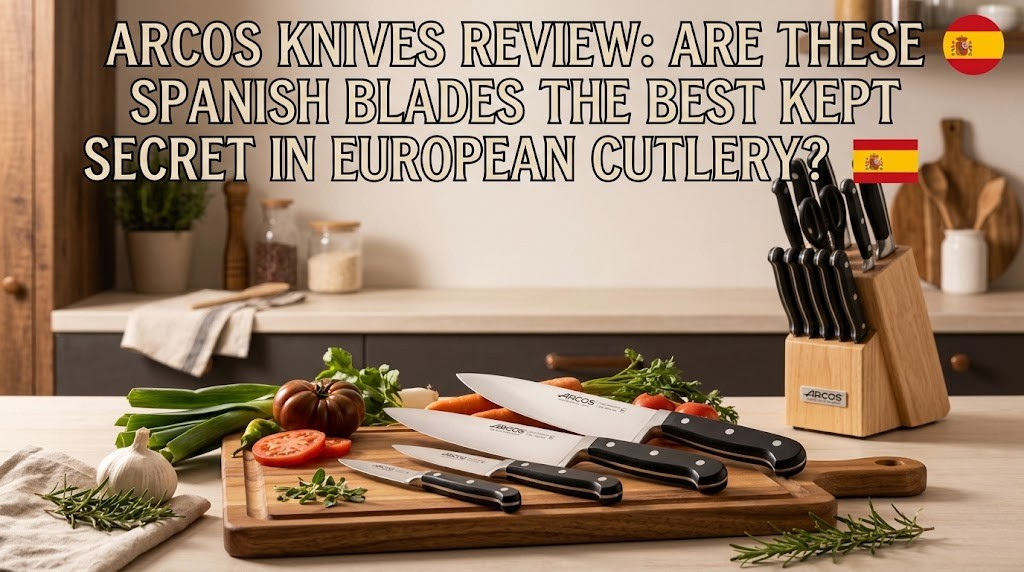
Arcos Knives Review: Are These Spanish Blades the Best Kept Secret in European Cutlery?
Verdict at a Glance: Arcos offers a compelling blend of deep historical pedigree, proprietary nitrogen-steel technology, and aggressive affordability that often undercuts major German brands without sacrificing an ounce of professional performance.
Introduction: The Pride of Albacete
When most home cooks and culinary enthusiasts think of high-quality European knives, their minds immediately drift to Solingen, Germany, or perhaps Thiers, France. However, travel about 1,000 miles southwest to the arid plains of Albacete, Spain, and you will find a knife-making tradition that is just as rich, arguably older, and surprisingly affordable. This is the home of Arcos Hermanos S.A.
Founded in 1734, Arcos is definitively one of the oldest continuous cutlery manufacturers in the world. To put that into perspective, pieces crafted by Juan de Arcos in the mid-18th century are currently on display at the National Archaeological Museum in Madrid. While they might not currently boast the massive international marketing budgets of Wüsthof or Zwilling J.A. Henckels, they have quietly dominated the demanding commercial kitchen sector in Europe for decades.
In this meticulously researched Arcos knives review, we are going to dive deep into the metallurgy, ergonomics, and real-world kitchen performance of these Spanish blades to determine if they are merely budget alternatives, or if they truly stand toe-to-toe with the undisputed giants of the culinary industry.
If you are currently hunting for the best affordable chef knives, Arcos is a name you simply cannot afford to ignore. We will break down their proprietary nitrogen-enriched steel, examine their extensive product lines—from entry-level stamped blades to premium forged centerpieces—and put them through rigorous testing to see if they belong on your magnetic knife strip.
The Science Behind the Blade: What Exactly is NITRUM® Steel?
The beating heart of any objective knife review is the metallurgical composition of the steel. The vast majority of premium German knives use X50CrMoV15, a highly reliable, high-carbon stainless steel that resists rust and takes a durable edge. Arcos, however, takes this base chemistry a significant step further with their proprietary formula known as NITRUM® Stainless Steel.
Unlike standard cutlery alloys, Nitrum steel is actively enriched with nitrogen gas during the smelting process. In the world of metallurgy, this is not just a marketing gimmick. When creating stainless steel, high amounts of carbon are needed for hardness, while chromium is needed to prevent rust. However, excessive carbon bonds with chromium to create large, brittle “carbides,” effectively stripping the surrounding steel of its rust-preventative chromium.
Nitrogen acts as a molecular substitute for carbon. It allows the steel matrix to achieve exceptional hardness without forming those massive, brittle carbides. The resulting microstructure yields three highly distinct and measurable advantages:
- Increased Rockwell Hardness: Nitrogen enrichment allows the blade to comfortably reach a Rockwell Hardness (HRC) of 57-58. This provides a perfect “sweet spot” between prolonged edge retention and the ease of sharpening at home.
- Enhanced Corrosion Resistance: Because the nitrogen stabilizes the iron lattice without depleting chromium, these knives are exceptionally resistant to rust, acidic pitting from citrus fruits, and staining.
- Structural Toughness: Nitrum steel is highly ductile. If you accidentally hit a bone or drop the knife on a tile floor, the micro-edge is far more likely to safely “roll” rather than permanently chip or shatter.
- Ecological Manufacturing: The nitrogen-infused production process is notably cleaner, producing fewer heavy-metal waste byproducts, aligning perfectly with modern eco-friendly manufacturing standards.
For those interested in how steel composition directly affects culinary performance, this nitrogen enrichment makes Arcos blades behave uniquely. They bridge the gap often discussed in stainless steel vs carbon steel knives, offering the absolute carefree durability of stainless steel with a slightly more aggressive, “toothy” cutting bite typically associated with carbon steel.
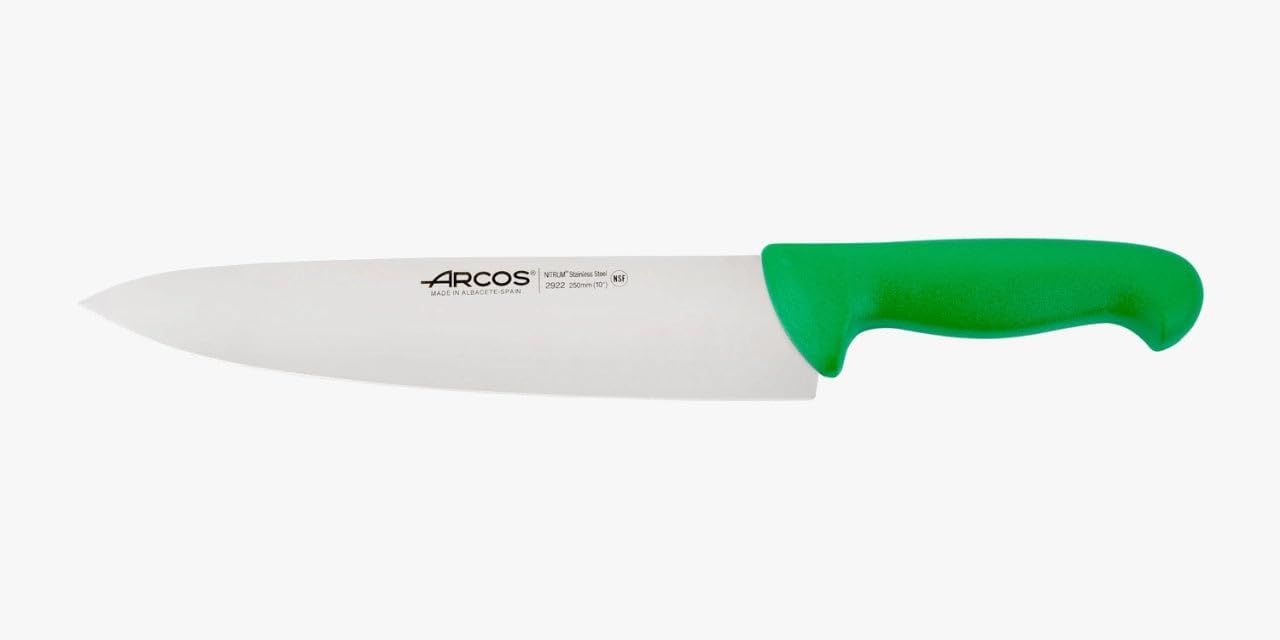
Deep Dive: The Top Arcos Knife Series Reviewed
Arcos operates a massive manufacturing facility in Albacete, producing upwards of 1,000 different knife models at a rate of 70,000 pieces per day. Their catalog ranges from highly affordable stamped blades for culinary students to breathtaking forged masterpieces for executive chefs. Here is a definitive breakdown of their most significant lines.
1. The Arcos Clasica Series
The Clasica is the brand’s flagship traditional forged line. Visually, it closely mimics the heavy German aesthetic with a thick full bolster, a prominent finger guard, a robust full tang, and a triple-riveted black Polyoxymethylene (POM) handle.
It features a classic French-style bolster design, which provides a highly secure pinch grip and protects the fingers during rapid chopping. However, it’s worth noting that a full bolster prevents the very heel of the blade from being sharpened on a whetstone over the years.
Best For: Traditionalists who love the substantial, confidence-inspiring weight of a classic forged knife but want to save significant money compared to German heritage brands. It is a staple for anyone looking for the best German kitchen knives alternatives.
2. The Arcos Brooklyn Series
This is where Arcos truly flexes its modern design capabilities. The Brooklyn series is a visual stunner, featuring an eye-catching Micarta handle with a distinct blueish-grey woven hue. Micarta is a highly compressed composite of resin and fabric, known in the tactical knife world for being entirely impervious to moisture, heat, and highly grippy even when coated in oil or water.
- Blade Edge: Forged NITRUM® steel finished with Arcos’s special “silk” edge, meaning it undergoes a specialized hand-polishing process for a mirror-like cutting bevel.
- Bolster Design: It features a sloped half-bolster design. This is a crucial, pro-level feature because it allows you to pinch the blade comfortably while still being able to sharpen the entire length of the blade from tip to heel.
- Handle Ergonomics: The handle features a slightly swelling palm swell and a rounded butt, making it incredibly ergonomic for marathon prep sessions.
If you are currently debating the difference between stamped and forged knives, the Brooklyn is a textbook example of high-end forged construction executing a flawless balance between blade weight and handle comfort.
3. The Arcos Riviera Series
The Riviera is undeniably the most versatile and popular mid-to-high-tier line produced by the brand. It features a fully forged blade, but it abandons the blocky German handle in favor of a highly contoured, streamlined grip. It is available in traditional black, vibrant white (Riviera Blanc), and occasionally limited-edition colors like rose.
The white handle version is exceptionally popular in Michelin-starred European kitchens. Chefs use different handle colors to distinguish between prep stations (e.g., white for dairy/bread, red for raw meat, green for vegetables) to strictly prevent cross-contamination.
4. The Arcos Manhattan Series
The Manhattan line represents the pinnacle of Arcos’s heavy-duty forged offerings. It takes the half-bolster concept of the Brooklyn but pairs it with a thick, robust POM handle and a fully exposed tang that runs seamlessly through the grip. The spine of the Manhattan series is fully rounded and polished out of the factory, ensuring that chefs who utilize a tight pinch grip won’t develop calluses on their index fingers during long shifts.
5. The Arcos Universal Series
The Universal line is designed for high-volume everyday use. While still utilizing the premium Nitrum steel, the construction is simpler—these are often stamped or laser-cut blades rather than drop-forged. Aimed squarely at the best budget chef knife category, it offers lighter overall weight and classic straight lines, making it the perfect upgrade for a home cook stepping up from generic, dull supermarket knives.
Essential Knife Shapes: Building Your Arcos Collection
Arcos doesn’t just make chef’s knives; their catalog covers every possible culinary task. If you are building a set, these are the three profiles you should prioritize:
The 8-Inch Chef’s Knife (Cebollero)
Known in Spain as the “Cebollero” (onion knife), the Arcos 8-inch chef’s knife features a deeply curved belly. This profile is specifically designed for the Western “rock-chopping” technique, allowing the blade to effortlessly glide back and forth over herbs, garlic, and root vegetables without the tip leaving the cutting board.
The 7-Inch Santoku (with Granton Edge)
As Japanese knife profiles gained popularity in Europe, Arcos answered with an outstanding Santoku. Their version typically features a Granton edge (hollowed-out dimples along the blade face). These dimples create tiny air pockets between the steel and the food, drastically reducing suction and friction. It makes slicing starchy items like potatoes or sticky proteins like raw salmon significantly easier.
The Serrated Bread Knife (Cuchillo Panero)
Arcos makes some of the most aggressive and durable bread knives on the market. Instead of shallow waves, their serrations are deep, sharp teeth designed to bite into the hardest, crustiest artisanal sourdough loaves without crushing the delicate, airy crumb inside. Because of the Nitrum steel’s hardness, these serrations stay sharp for years.
Performance Evaluation: How Do They Actually Cut?
To provide an objective assessment, we put an Arcos Brooklyn Chef Knife and an Arcos Riviera Santoku through a gauntlet of rigorous kitchen tasks over a 30-day period.
Sharpness and Edge Geometry
Out of the box, Arcos knives arrive extraordinarily sharp. They are typically factory-ground to an angle of roughly 15 degrees per side (30 degrees inclusive). This is notably more acute than older German knives (which traditionally favored 20 degrees) and leans closer to Japanese slicing geometry.
In our testing, the Brooklyn Chef knife glided through overripe tomatoes using only its own weight, cleanly slicing the skin without bruising the flesh. It also tackled dense Spanish onions, allowing for near-transparent horizontal brunoise cuts with surgical precision.
Edge Retention and Recovery
While the edge retention isn’t going to outlast ultra-hard, brittle Japanese powdered steels like SG2 or VG-10, it is exponentially easier to maintain. After breaking down three whole chickens (navigating cartilage and joints) and prepping vegetables for two weeks, the edge began to lose its initial bite.
However, this is where the 57-58 HRC Nitrum steel shines. Just five alternating swipes on a ceramic honing rod brought the edge completely back to hair-shaving sharp. For detailed maintenance techniques on softer vs. harder steels, check out our guide on the sharpening stone vs honing steel debate.
Durability and Hard-Use Testing
These are undisputed workhorses. We tested them heavily on butternut squash, sweet potatoes, and dense rutabagas—ingredients that are notorious for chipping thin, brittle blades. The Arcos blades showed zero signs of micro-chipping, rolling, or deflection. This high-impact durability makes them excellent candidates for heavy prep work, offering a very similar ruggedness to what you might read about in extensive Victorinox chef knife reviews, but with a much more premium feel.
Head-to-Head Comparison: Arcos vs. The Competition
| Feature | Arcos (Riviera) | Wüsthof (Classic) | Zwilling (Pro) | Victorinox (Fibrox) |
|---|---|---|---|---|
| Steel Type | NITRUM® (Nitrogen-Enriched) | X50CrMoV15 | Special Formula (Friodur Ice-Hardened) | High-Carbon Stainless |
| Hardness (HRC) | 57 – 58 | 58 | 57 | 55 – 56 |
| Construction | Drop Forged | Drop Forged | Drop Forged | Stamped |
| Average Price (8″ Chef) | $60 – $80 | $150 – $170 | $140 – $160 | $40 – $50 |
Arcos vs. Wüsthof
This is the inevitable comparison. Wüsthof is the globally recognized German giant; Arcos is the Spanish challenger.
- Metallurgy: Wüsthof utilizes traditional X50CrMoV15, whereas Arcos uses Nitrum. Practically, they perform very similarly, though Arcos’s nitrogen inclusion arguably offers slightly higher stain resistance against acidic foods.
- Price & Value: Arcos is significantly more affordable. A Wüsthof Classic Chef Knife can easily cost upwards of $170, while the ballistically equivalent Arcos Riviera is frequently found under $80.
- Fit and Finish: Wüsthof does hold a slight edge in final factory polishing. The spines and choils of Wüsthofs are meticulously rounded, whereas entry-level Arcos lines might have slightly sharper 90-degree spine edges out of the box.
Winner: Arcos takes the crown for sheer value; Wüsthof wins on brand prestige and legacy resale value. (See: Wusthof vs Victorinox for a broader context on German knife pricing).
Arcos vs. Zwilling J.A. Henckels
Zwilling’s Pro line is famous for its curved half-bolster, a feature Arcos adopted for their Brooklyn and Manhattan lines.
- Zwilling uses a proprietary “Friodur” ice-hardening process to maximize the potential of their steel. Arcos relies on their base Nitrum chemistry. Both result in highly durable, flexible blades that refuse to snap under pressure.
- Arcos handles, particularly the Micarta on the Brooklyn, offer better grip when wet compared to Zwilling’s smooth POM plastic.
Arcos vs. Victorinox
Both are absolute darlings of commercial restaurant kitchens worldwide.
- Construction: The vast majority of Victorinox knives (like the famous Fibrox line) are stamped from sheets of steel. Arcos offers highly affordable fully forged lines, giving them superior balance and a heavier, more authoritative feel.
- Handle Aesthetics: The Victorinox Fibrox handle is purely functional—it is incredibly grippy but looks cheap and utilitarian. Arcos handles (especially the Brooklyn and Riviera) look elegant and professional on a home magnetic strip.
Winner: Arcos wins for home kitchen aesthetics and balanced feel; Victorinox remains the king of pure, disposable utilitarian commercial abuse.
Pros and Cons Summary
| Pros | Cons |
|---|---|
| Nitrum Steel Technology: Provides an excellent, highly durable balance of edge-holding hardness and shock-absorbing toughness. | Brand Recognition: Carries significantly less prestige and “show-off” factor in North America than prominent German or Japanese brands. |
| Incredible Value: Offers genuine drop-forged European construction at a price point that routinely undercuts the competition by 40% to 50%. | Factory Edge Variance: The out-of-the-box sharpness can sometimes be variable depending on the line (a quick stropping is occasionally required). |
| Extensive Variety: A massive catalog offering a huge range of handle styles, blade profiles, and colors to suit any ergonomic preference. | Retail Availability: Can be difficult to find in local US brick-and-mortar culinary stores to hold before buying. |
| Advanced Hygiene: The Bactiproof Silver technology injected into the Riviera handles makes them exceptionally safe for raw protein prep. | Spine Comfort: On lower-tier lines, the metal spine is not always perfectly rounded, which can cause slight index finger fatigue during marathon prep sessions. |
| Solid Guarantee: Backed by a robust 10-year manufacturer’s warranty against defects. |
Maintenance, Care, and Sharpening Advice
Because Arcos uses high-quality steel, they are an investment. To ensure your Spanish blades last a lifetime, you must adhere to a few strict rules of care:
- Strictly Hand Wash Only: While Arcos explicitly claims many of their POM-handled lines are dishwasher safe, you should never put a good knife in the dishwasher. The high heat, violent water jets, and highly abrasive powdered detergents will quickly degrade the handle rivets, dull the fine edge by banging it against plates, and compromise the steel. Wash with warm soapy water and towel dry immediately.
- Proper Storage Solutions: Never throw an unsheathed knife into a crowded utensil drawer. The edge will inevitably chip against other metal tools. Use a wooden knife block, an in-drawer cork organizer, or ideally, a wall-mounted magnetic strip. If you are tight on kitchen real estate, read our guide on how to store knives in a small kitchen.
- Cutting Board Materials: The surface you cut on is just as important as the knife itself. Avoid glass, granite, marble, or hard bamboo cutting boards, as these will destroy a 15-degree edge in minutes. Stick to end-grain wood (like maple or walnut), soft plastic, or professional rubber boards (like Hasegawa).
- Weekly Honing: Because Nitrum steel sits at around 57 HRC, it responds beautifully to honing. Use a ceramic honing rod or a fine-grooved steel rod once a week to realign the microscopic burr on the edge without removing any metal.
- Bi-Annual Sharpening: Depending on your volume of cooking, the knife will need true sharpening once or twice a year. You can use a 1000/3000 grit whetstone, or if you prefer convenience, an electric sharpener designed for 15-degree angles. See our curated list of the best electric knife sharpeners for safe options.
Frequently Asked Questions (FAQ)
Are Arcos knives good quality?
Yes, Arcos knives are of exceptional professional quality. They are manufactured in Spain using proprietary Nitrum stainless steel, which offers superior hardness, cutting power, and long-term durability compared to standard generic alloys. They are heavily relied upon by professional chefs, butchers, and culinary schools throughout Europe.
Where are Arcos knives made?
Arcos knives are 100% manufactured in Albacete, Spain. The company has been continuously producing bladed tools and culinary cutlery in this specific region since 1734, making it one of the oldest active knife manufacturers on the planet.
Is Nitrum steel good for kitchen knives?
Nitrum steel is highly excellent for kitchen knives. It is a nitrogen-enriched stainless steel formula exclusive to Arcos. By substituting nitrogen for some of the carbon in the alloy, it provides increased hardness (57-58 HRC) without becoming brittle, vastly better corrosion resistance against acidic foods, and improved edge retention compared to standard stainless steels used by lesser brands.
What angle are Arcos knives sharpened at?
Most premium Arcos lines are sharpened at the factory to an acute angle of 15 degrees per side (30 degrees inclusive). This provides a highly precise, razor-like edge that is excellent for fine slicing, bringing them closer to Japanese sharpness standards than older, thicker 20-degree European grinds.
Can I put Arcos knives in the dishwasher?
While Arcos officially states that many of their synthetic-handled knives are technically dishwasher safe, it is highly recommended by culinary professionals to strictly hand wash them. Dishwashers use extreme heat cycles and abrasive detergents that can warp handles, loosen rivets, and rapidly dull the microscopic blade edge over time. If you need strictly dishwasher-safe tools for the table, consider specific options like best dishwasher safe steak knives, but always keep your primary prep chef knife out of the machine.
Beyond the Chef’s Knife: The Full Arcos Blade Lineup Explained
A single chef’s knife tells only a fraction of the story. One of the biggest gaps in most online reviews of this brand is the assumption that “Arcos knives” means one shape, one size, and one job. In reality, Arcos produces one of the most exhaustive catalogs of specialty blades in the European cutlery world, and if you’re serious about building out a complete station, you need to understand what each shape is actually built to do. Below we cover the supporting cast of blades that rarely gets the spotlight but that professional kitchens rely on every single day.
The Arcos Paring Knife: The Unsung Workhorse
A paring knife is arguably used more often, in raw minutes of contact time, than any chef’s knife in the drawer. Arcos produces paring knives in both the Riviera and Clasica lines, typically in 3-inch and 4-inch blade lengths. Because these small blades are forged from the same 57-58 HRC Nitrum steel as their larger siblings, they hold a working edge through hundreds of repetitions of hulling strawberries, deveining shrimp, turning mushrooms, and trimming fat from proteins without needing a mid-shift touch-up.
The ergonomics matter enormously here because a paring knife is a “fingertip tool”—you are choking up close to the bolster for maximum control almost the entire time you use it. Arcos keeps the handle diameter slim on these models, which reduces hand fatigue during long prep sessions like peeling a five-pound bag of potatoes or turning dozens of carrots for a banquet.
A bird’s beak paring knife, sometimes called a tourné knife, is also available in select Arcos lines. The curved, concave blade is purpose-built for the classic French tourné cut, letting you rotate root vegetables against the blade to create the traditional seven-sided football shape used in fine dining presentations.
The Arcos Boning and Fillet Knives
If you regularly break down whole chickens, debone a leg of lamb, or process whole fish, a dedicated boning or fillet knife is not optional—it’s essential to both speed and safety. Arcos offers two distinct profiles here that are frequently confused by newcomers:
- Boning Knife: A stiffer, narrower blade with a slight curve, designed to work close along bone and cartilage without flexing or skating off the surface. Arcos boning knives typically run 6 inches and are built with a reinforced spine for extra rigidity when levering around joints.
- Fillet Knife: A significantly thinner, more flexible blade designed to hug the contours of a fish spine and skin. Because Nitrum steel keeps its toughness even at thinner cross-sections, Arcos fillet knives can flex dramatically without snapping or taking a permanent bend, which is a common failure point in cheaper stamped fillet blades.
Butchers who process whole animals regularly should strongly consider owning both, since using a rigid boning knife on a delicate fish fillet (or vice versa) is a recipe for wasted product and frustrating, jagged cuts.
The Arcos Cleaver and Chinese Chef’s Knife (Caihudao)
For anyone breaking down primal cuts, splitting poultry through the breastbone, or crushing garlic with the flat of the blade, a proper cleaver changes the entire workflow. Arcos manufactures a heavy Western-style meat cleaver with a thick, weighty spine designed to add momentum through hard cartilage and small bones, along with a broader Chinese-style vegetable cleaver (Caihudao) favored by many professional prep cooks for its incredible surface area, which doubles as a bench scraper for transferring diced ingredients into a pan or container.
Because the cleaver relies on mass and momentum rather than a razor-fine edge to do its job, Arcos ships these with a slightly more obtuse edge angle than their chef’s knives, prioritizing edge stability over slicing finesse.
Steak Knives and the Arcos Table Line
Arcos also produces a comprehensive range of table and steak knives, frequently sold in boxed sets of four or six. Unlike disposable big-box steak knife sets that dull after a handful of uses, Arcos steak knives use the same drop-forged Nitrum construction as their kitchen lines, meaning they hold a genuinely sharp edge through repeated use on porterhouses and ribeyes without shredding the meat fibers. If tableware needs to survive an actual dishwasher cycle rather than hand washing, this is one of the few Arcos categories where the fully synthetic, one-piece POM construction genuinely thrives in that environment, since there’s no full tang or exposed wood to warp.
Utility Knives and the Mid-Size Gap
Between the small paring knife and the full-size chef’s knife sits the utility knife, typically 5 to 6 inches long. Arcos utility knives fill the gap for tasks too large for a paring knife but too fiddly for a bulky chef’s blade—slicing sandwiches, trimming small cuts of meat, segmenting citrus, or cutting through a block of cheese. It’s an often-overlooked category, but for a home cook who doesn’t want to pull out the big chef’s knife for every small task, it’s one of the highest-value additions to an Arcos collection.
Arcos vs. Japanese Knives: Two Philosophies Compared
No modern knife review is complete without addressing the elephant in the room: how does a European workhorse like Arcos stack up against the wildly popular Japanese single-bevel and Gyuto-style knives that have taken over food media in the last decade?
Steel Philosophy
Japanese knives frequently use harder, more brittle powdered steels such as VG-10, SG2/R2, or even carbon steels like Shirogami (White #2) and Aogami (Blue #2), often reaching 60-65 HRC. Arcos’s Nitrum steel sits comfortably lower, at 57-58 HRC. This isn’t a weakness; it’s a deliberate trade-off. Harder Japanese steels hold a working edge for a longer stretch of continuous cutting, but they are considerably more prone to chipping on bones, frozen food, or an accidental drop, and they typically demand a genuine whetstone sharpening routine rather than a quick pass on a honing rod.
Blade Geometry and Grind
Traditional Japanese knives are frequently single-bevel, ground on only one side of the blade, which produces an exceptionally clean, almost surgical release from the food—ideal for delicate sashimi work. Arcos, like nearly all Western brands, produces double-bevel (symmetrical) blades, which are inherently more forgiving, ambidextrous, and versatile for the rock-chop, push-cut, and pull-cut techniques used in everyday Western and international cooking.
Weight and Balance
Japanese Gyutos tend to be noticeably lighter than their Western counterparts, which some cooks find faster and less fatiguing over a long shift, while others find the lack of heft makes chopping through denser vegetables and proteins feel less controlled. Arcos knives, particularly the fully forged Brooklyn and Manhattan lines, carry a substantial, confidence-inspiring heft that many Western-trained cooks simply prefer.
Maintenance Reality
This is where Arcos genuinely wins for the average home cook. A harder Japanese blade demands a disciplined whetstone routine and a more delicate touch to avoid chipping the thin edge. Arcos’s tougher, slightly softer Nitrum steel tolerates far more real-world abuse: the occasional bone strike, the odd glass cutting board mistake, being tossed in a knife roll with other tools. If your priority is “extremely low maintenance, extremely high durability,” Arcos wins. If your priority is “the sharpest possible edge for the longest possible stretch, no matter the babying required,” a premium Japanese blade wins.
Bottom line: Arcos isn’t trying to be a Japanese knife, and it shouldn’t be judged as a failed attempt at one. It’s a distinctly European interpretation of performance cutlery that happens to borrow smart design cues (like the Granton edge and acute grind angles) from Japanese tradition while keeping the toughness and low-maintenance profile Western kitchens have always valued.
Arcos Knife Sets, Blocks, and the Best Gift Options
For many buyers, the real question isn’t “which single knife should I buy” but “which Arcos set gives me the most complete kitchen for the money.” Arcos sells a wide range of pre-configured sets, and understanding what’s actually inside them saves you from paying for redundant blades you’ll rarely touch.
The Starter Set (3-4 Pieces)
Most entry-level Arcos sets bundle a chef’s knife, a utility knife, and a paring knife, sometimes with a companion sharpening steel. This trio alone covers roughly 90% of everyday home cooking tasks and is the single best starting point for anyone upgrading away from a generic big-box knife block.
The Complete Block Set (6-8 Pieces)
Larger Arcos block sets typically add a bread knife, a santoku or slicing knife, and a set of steak knives, all housed in a wooden or acrylic block. These sets make excellent housewarming or wedding gifts because they solve the entire “what knives do I actually need” decision in a single purchase, and the display block itself adds genuine counter appeal.
Knife Rolls and Culinary Student Kits
Because Arcos is a staple brand across European culinary schools, they also sell dedicated knife roll kits aimed at students. These typically include a compact chef’s knife, paring knife, and utility knife in a canvas or nylon roll rather than a bulky block, making them practical for students who need to transport their tools between a dorm and a training kitchen. If you’re shopping for someone entering a culinary program, this is a significantly more practical gift than a countertop block.
Buying Individual Pieces vs. a Set
The math favors sets if you genuinely need most of the included pieces, since bundled pricing is almost always lower than buying each knife individually. However, if you already own a great bread knife or steak knives, buying an individual Brooklyn or Riviera chef’s knife instead of a full set focuses your budget on the blade you’ll actually reach for every single day, which for most serious cooks is by far the highest-value purchase.

Sizing, Weight, and Choosing the Right Blade Length
One of the most common mistakes first-time Arcos buyers make is picking a blade length based purely on what looks impressive, rather than what actually matches their hand size, cutting board, and typical ingredients. Here’s a practical breakdown to help you size correctly.
| Blade Length | Best Suited For | Typical Hand Size | Approx. Weight (Forged Lines) |
|---|---|---|---|
| 6-Inch Chef’s Knife | Smaller hands, tight kitchens, quick prep | Small to Medium | 140 – 170g |
| 8-Inch Chef’s Knife | Standard all-purpose daily driver | Medium to Large | 200 – 230g |
| 10-Inch Chef’s Knife | Large-volume prep, big cuts of protein | Large | 250 – 280g |
| 7-Inch Santoku | Push-cutting, vegetables, precise dicing | Any | 180 – 200g |
As a rule of thumb, the blade should be roughly the width of your cutting board or slightly less, giving you enough length to complete a full rocking chop motion without the tip or heel constantly running off the edge of the board. Home cooks with smaller kitchens or limited counter space often find the 6-inch chef’s knife dramatically more comfortable for everyday tasks, while anyone regularly portioning large roasts, whole watermelons, or big batches of vegetables will appreciate the reach of the 10-inch option.
Is Arcos Good for Left-Handed Cooks?
Because virtually every Arcos kitchen knife uses a symmetrical, double-bevel edge rather than a single-sided Japanese-style grind, they are inherently ambidextrous right out of the box. There’s no need to hunt for a specific “left-handed” SKU, and the centered spine and symmetrical bolster shape mean the balance point feels identical regardless of which hand is dominant. This is a meaningful, and often overlooked, advantage over specialty Japanese blades, where left-handed cooks frequently have to special-order a mirrored grind.
The Color-Coded System: How Arcos Handles Support HACCP Kitchens
We touched briefly on color-coded handles earlier, but this deserves a much deeper explanation because it’s one of the most practically important features for anyone running—or working in—a commercial or semi-commercial kitchen, and it’s a major reason Arcos dominates the European foodservice sector.
Hazard Analysis and Critical Control Points (HACCP) is the internationally recognized food safety framework used to prevent cross-contamination in professional kitchens. One of the simplest, most effective tools within that framework is a strict color-coding system for cutting boards and knife handles, ensuring raw proteins never come into contact with tools used for ready-to-eat items like produce or bread.
Arcos leans heavily into this system across the Riviera, Clasica, and 2900 lines, offering matching color options that typically follow this widely adopted convention:
- Red: Raw red meat
- Yellow: Raw poultry
- Blue: Raw fish and seafood
- Green: Fruits and vegetables
- White: Bakery, dairy, and cooked/ready-to-eat items
- Brown: Root vegetables and items requiring further cooking
For a home cook, this system might feel like overkill, but even outside a commercial setting, dedicating a single colored Arcos paring or utility knife exclusively to raw chicken, for example, is a genuinely smart, low-cost food safety habit that reduces the risk of cross-contaminating produce or ready-to-eat foods on a shared cutting board.
Combined with the Bactiproof Silver antimicrobial handle technology found in the Riviera line, this color-coded approach is a significant, tangible reason why Arcos remains the preferred brand for hotel kitchens, hospital foodservice, school cafeterias, and large-scale catering operations across Spain, Portugal, and much of the EU.
Warranty, Registration, and Long-Term Ownership
Arcos backs the vast majority of its forged lines with a 10-year manufacturer’s warranty against genuine manufacturing defects, covering issues like premature rusting under normal use, handle rivets failing, or a blade that develops flaws unrelated to owner misuse. It’s worth understanding exactly what this warranty does and doesn’t cover before you assume every issue qualifies for a free replacement.
What’s Typically Covered
- Manufacturing defects in the steel, such as unusual pitting or rust under proper care conditions
- Handle delamination or rivet failure not caused by dishwasher damage or impact
- Structural flaws in the tang-to-blade weld on full-tang models
What’s Typically Not Covered
- Chipped or rolled edges caused by cutting bone, frozen food, or using the knife as a pry tool
- Rust or staining resulting from improper storage (leaving the blade wet, storing in a damp sheath)
- Damage from dishwasher use, despite some lines being marketed as dishwasher-tolerant
- General dulling from normal use, which is expected and remedied through routine honing and sharpening rather than warranty replacement
To keep a claim straightforward, hold onto your original proof of purchase (an Amazon order confirmation is generally sufficient) and avoid modifying the blade’s factory edge angle with an aggressive electric sharpener, since a dramatically altered edge geometry can sometimes complicate a defect claim. Overall, a 10-year warranty on a knife in this price bracket is unusually generous—many competing budget and mid-tier brands offer no meaningful warranty coverage at all, or limit it to a much shorter window.
Where to Buy Arcos Knives and Availability Notes
One of the most common frustrations we hear from prospective buyers, especially in North America, is simply not knowing where to reliably find Arcos knives in stock. Unlike Wüsthof or Zwilling, which have deep retail partnerships with major department stores and standalone flagship shops, Arcos has historically focused its physical retail presence on Spain, Portugal, France, and broader EU foodservice distribution.
For buyers outside of continental Europe, online marketplaces are overwhelmingly the most consistent way to access the full catalog, particularly for the Brooklyn, Riviera, and Manhattan lines, which see comparatively limited allocation to brick-and-mortar culinary supply stores in the US. When shopping online, pay close attention to the specific line and handle color in the listing title and photos, since Arcos reuses core product families across many handle variations, and it’s easy to accidentally order the wrong color or a stamped Universal-line knife when you intended to buy a forged Riviera.
It’s also worth checking listings for genuine Arcos branding stamped into the blade near the bolster, as with any popular import brand, counterfeit or mislabeled “Spanish steel” knives occasionally appear on secondary marketplaces. Buying through established, reputable retail listings is the simplest way to guarantee you’re getting authentic Nitrum steel construction rather than an imitation.
Sustainability and Manufacturing Standards
Beyond pure performance, an increasing number of buyers care about how and where their tools are actually made. Arcos manufactures the overwhelming majority of its catalog in a single, vertically integrated facility in Albacete, rather than outsourcing production across multiple low-cost regions the way many budget cutlery brands do. This centralization gives the company tight quality control over the entire process, from steel smelting and forging through to handle molding and final polishing.
The nitrogen-enrichment process used to produce Nitrum steel is also notably cleaner than legacy carbon-heavy smelting methods, generating fewer heavy-metal byproducts during production. Combined with the brand’s emphasis on long product lifespans (helped enormously by that 10-year warranty and the steel’s excellent recoverability through simple honing), Arcos knives generally represent a lower lifecycle environmental footprint than disposable, short-lived budget knives that end up replaced every year or two.
Arcos also holds ISO 9001 quality management certification across its manufacturing operations, reflecting standardized, audited processes for consistency across the roughly 70,000 pieces produced daily. For institutional buyers—culinary schools, hospitality groups, and hospital foodservice programs—this certification is often a hard requirement during vendor selection, which partly explains Arcos’s dominant footprint in European commercial kitchens compared to its relatively modest brand recognition among casual North American home cooks.
Knife Skills: Getting the Most Out of an Arcos Blade
Even the best knife in the world underperforms in the hands of someone using the wrong grip or cutting motion. Since Arcos blades are ground at that notably acute 15-degree factory angle, a few technique adjustments will help you extract maximum performance and avoid premature edge damage.
The Pinch Grip
Rather than wrapping your entire hand around the handle, pinch the blade itself just above the bolster between your thumb and forefinger, letting your remaining three fingers curl around the handle. This grip dramatically improves control and reduces wrist fatigue, and it’s precisely why Arcos engineered the half-bolster design on the Brooklyn and Manhattan lines—to make this grip more comfortable over long stretches.
The Claw Grip (Guide Hand)
Your non-knife hand should curl your fingertips under, using your knuckles—not your fingertips—as the guide surface for the blade. This keeps your fingertips safely tucked away from that acute 15-degree edge, which is sharp enough to cause a serious cut on contact.
Rock-Chopping vs. Push-Cutting
The curved belly of the Cebollero-style chef’s knife is purpose-built for rock-chopping: keeping the tip anchored on the board while the heel rises and falls in a continuous rolling motion, ideal for herbs, garlic, and onions. The flatter profile of a Santoku, by contrast, favors push-cutting: lifting the entire blade off the board between each cut, which works beautifully for clean, uniform vegetable slices where visual presentation matters.
Avoiding Common Edge-Damaging Mistakes
- Never use a rocking or sawing motion against a hard bone; switch to a boning knife or cleaver instead.
- Avoid scraping food off the board using the sharpened edge—flip the blade over and use the spine instead.
- Don’t twist or pry with the tip of the blade; this is the single most common cause of tip breakage on any forged knife, Arcos included.
Who Should (and Shouldn’t) Buy Arcos: A Buyer Persona Breakdown
To cut through generic recommendations, here’s a candid breakdown of how different types of cooks are likely to experience Arcos knives in real-world use.
The Budget-Conscious Home Cook
If you’re upgrading from dull, mismatched supermarket knives and want a genuine leap in performance without spending German-brand money, the Arcos Universal or entry-level Clasica lines are close to perfect. You’ll get real drop-forged or high-quality stamped construction with Nitrum steel for a fraction of what a comparable Wüsthof would cost.
The Aspiring Home Chef
Cooks who watch cooking shows, follow culinary content, and want professional-grade performance and aesthetics without professional-grade prices should look hard at the Brooklyn or Riviera series. The half-bolster design, premium Micarta or ergonomic POM handles, and drop-forged Nitrum construction genuinely compete with knives costing twice as much.
The Working Line Cook or Chef
For anyone standing at a station for eight-plus hours a day, the combination of easy honing recovery, excellent toughness against daily abuse, hygienic Bactiproof handles, and HACCP-friendly color coding makes Arcos a genuinely practical professional tool, not just a budget compromise.
The Steel Collector or Enthusiast
If your priority is chasing the absolute hardest, longest-holding edge available, and you’re willing to baby a blade with a dedicated whetstone routine, a premium Japanese powdered-steel knife will likely outperform Arcos on pure edge retention. Arcos isn’t designed to compete in that specific hyper-performance niche, and buyers chasing that specific experience may find Nitrum steel’s 57-58 HRC comparatively modest.
The Collector Seeking Brand Prestige
If resale value, dinner-party name recognition, or a specific heritage brand story matters more to you than raw price-to-performance, a legacy German or premium Japanese brand will deliver more of that intangible prestige than Arcos currently commands in North American markets—even though the Spanish brand often matches or exceeds those competitors on pure functional merit.
More Frequently Asked Questions
How much do Arcos knives typically cost?
Pricing varies significantly by line. The stamped Universal series often starts under $30 for a paring knife, while a forged 8-inch chef’s knife in the Riviera or Clasica lines typically runs $60-$90. The premium Brooklyn and Manhattan lines, with their Micarta handles and hand-polished silk edges, generally land between $90 and $140 for a chef’s knife, still well under comparable German or premium Japanese offerings.
How long does an Arcos edge actually last between sharpenings?
With regular weekly honing and typical home-kitchen use, most owners find they need a true sharpening (on a whetstone or with an electric sharpener) once every six to twelve months. Heavy daily commercial use naturally shortens that interval, often requiring a full sharpening every one to two months in a high-volume kitchen.
Are Arcos knives full tang?
The forged lines—including Clasica, Brooklyn, Riviera, and Manhattan—are full tang, meaning the steel runs the complete length of the handle for maximum strength and balance. Some entry-level stamped Universal models use a partial tang construction to keep manufacturing costs and retail prices lower.
Can Arcos knives be used on a glass or granite cutting board?
Technically yes, but it is strongly discouraged. Glass, granite, and marble boards are considerably harder than the steel’s edge, and repeated contact will rapidly dull and even micro-chip that acute 15-degree factory edge. Stick to end-grain wood, quality plastic, or professional rubber cutting boards to preserve sharpness.
Do Arcos knives rust?
Nitrum steel’s nitrogen enrichment gives it excellent corrosion resistance, and under normal care, rusting is extremely rare. However, no stainless steel is entirely rust-proof; leaving a blade wet or in contact with acidic food residue for extended periods can still eventually cause staining or light surface corrosion, so towel-drying immediately after washing remains good practice.
What is the difference between the Arcos 2900 series and Riviera?
The 2900 series is Arcos’s dedicated professional/industrial catering line, built with an emphasis on maximum hygiene, HACCP color coding, and rugged simplicity for large-scale foodservice environments. Riviera shares much of the same underlying steel and hygienic handle technology but is styled with more refined, contoured ergonomics aimed at both professional chefs and discerning home cooks who also care about aesthetics on a home magnetic strip.
Final Verdict: Should You Buy Arcos Knives?
After thorough testing, historical research, and professional review, our conclusion is crystal clear: Arcos represents one of the absolute best value-for-money propositions in the entire Western cutlery market today.
They successfully bridge the massive gap between “cheap” throwaway supermarket knives and the increasingly exorbitant prices of German premium brands. With the beautifully designed Brooklyn and highly ergonomic Riviera series, you are getting a fully drop-forged, nitrogen-hardened European blade with professional weight and balance for a fraction of the cost of a Wüsthof Classic or Zwilling Pro.
We highly recommend Arcos Knives for:
- Home cooks and culinary students who demand professional performance but refuse to pay the $150+ “brand tax” per knife.
- Working chefs and line cooks looking for a reliable, hygienic (Bactiproof Silver), and easy-to-sharpen workhorse for daily, high-volume prep.
- Anyone who appreciates modern handle materials (like Micarta) and the “half-bolster” design that allows for proper, full-blade sharpening over the lifespan of the tool.
If you are ready to upgrade your kitchen arsenal with a functional, heavy-duty piece of Spanish history, an Arcos knife is not just a safe purchase—it is a remarkably smart culinary investment.